
Season 2: Episode 30 - Stories of Blood and Fire
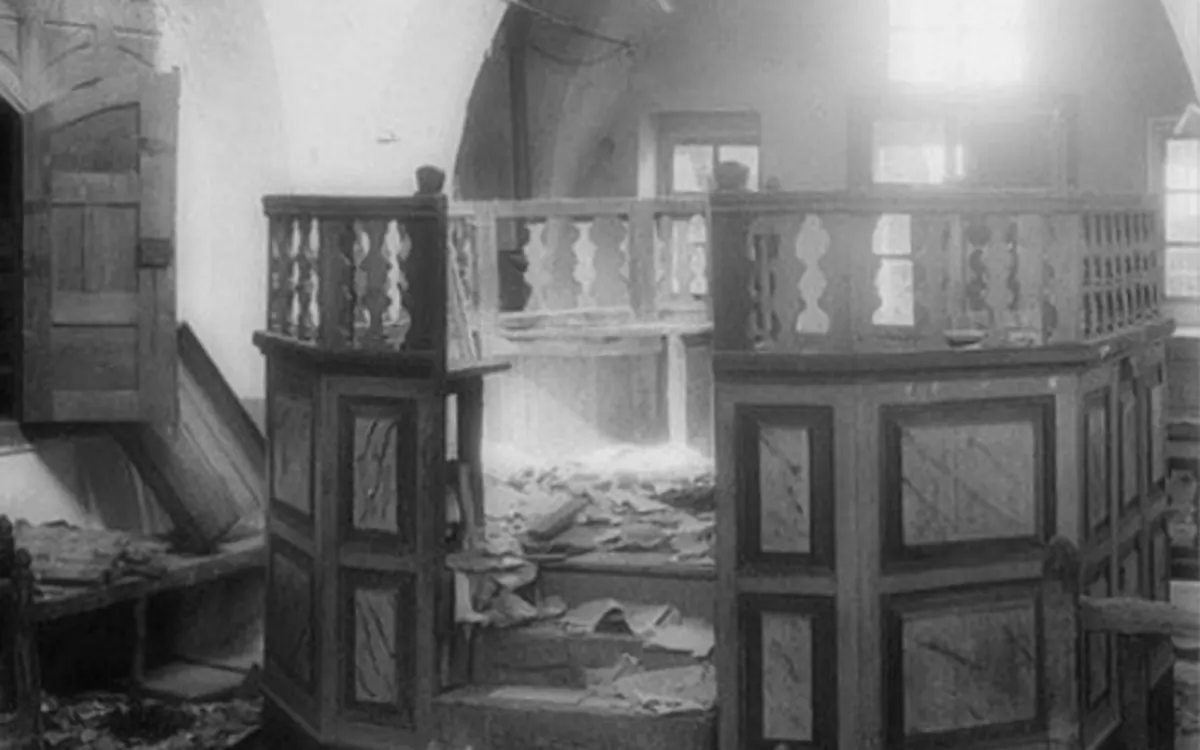
Patterns are hard things to break, and we can learn much about ourselves by how they come about. Here is a look at the cycle of riots which rocked the Yishuv in the 1920's, and set the mold for Arab/Jewish relations for decades to come.
About this episode
We tell stories to forget, said Kurosawa. His Rashomon, required viewing in Rav Mike's project evaluation course, shows a crime through four eyes and teaches that no honest person can separate inner experience from what we call reality; the evaluator's job is to map every stakeholder's story into a picture all can recognize. We are at a turning point, and the narratives are diverging: Ben-Gurion and Jabotinsky over the plough and the gun, over equality against freedom, socialism's road to from each according to his ability against every man a king, internationalism against happy particularism. And now the Arab narrative must enter, because unlike the Greeks and Romans the Arabs are still here, and the issue around which the narratives diverge is violence, with its cycle of strike and counter-strike, international condemnation, the official hunger for equivalency, and the Jewish quarrel over force and restraint, plus the third party, the British then and the arms-selling international community now. The challenge is a story honest in holding many perspectives and true in the Torah's sense of moving the world toward wholeness.
Every spring the Ottomans had sent Muslims to the Nebi Musa shrine on the Jericho road during Orthodox Easter, deploying overwhelming force because the tribes came armed. In 1920 the British assigned a hundred police. The Muslim-Christian Association had been founded by Jaffa's mayor to rally against Balfour and was gathering arms; February demonstrations, allowed in the name of free expression, were read as approval, the government is with us; Tel Hai fell on March 1; Weizmann warned Storrs of a pogrom in the making. On April 4 tens of thousands gathered in the Old City and heard the mayor Musa Kazim and his nephew Amin al-Husseini, son of the mufti, of a clan claiming descent from the Prophet through Ali and Fatima, delegate to the pan-Syrian Congress of 1919 that became the Syria-Palestine Congress of 1921 after France and Britain drew their line, the birth of formal Palestinian aspirations. Independence, Palestine is our land, the Jews are our dogs, and Khaybar, Khaybar, ya Yahud, nationalism mixed with religion. Jabotinsky's Legion veterans had been training, but the Old City Jews were unprepared; four days, five Jews and four Arabs dead, 216 Jews wounded; the British barred the gates with his men outside, Storrs confiscated his pistol, searched out three rifles and two pistols, jailed nineteen and gave Jabotinsky fifteen years when he claimed command. Musa Kazim lost the mayoralty, Amin got ten years and fled. The Palin Commission heard the Jews call it a pogrom, lower lawless elements with police connivance, and named three causes: Arab disappointment over wartime promises, fear that Balfour denied self-determination and that immigration meant subjugation, and pan-Arab and pan-Muslim propaganda. All the pieces in place.
Pan-Arab nationalism came from the revolt against the Turks, built on Hashemite religious status to transcend tribes, and marched into Damascus, where Faisal reigned until France deposed him and Britain gave him Iraq and Abdullah Transjordan. Palestinian consciousness has an earlier trace in the Jaffa newspaper Filastin, 1911 to 1914, which first watched the Second Aliyah with interest and from mid-1912 turned hostile, and only then began writing of the Palestinian land, the Palestinian community, and Palestinians. The culture clash mattered: socialist egalitarian pioneers who had rebelled against their own patriarchs threatened Arab patriarchy. A national consciousness born in conflict with France, Britain and the Zionist project all but depends on the struggle, which makes its maintenance a life or death matter, and Jews who dream of peace must ask how much of their own identity was born of it too. Early Zionists imagined Arabs welcoming progress, or a land without a people, and territorialists fled the problem; most simply did not think about it, and the dunam-by-dunam approach did not preclude Arab neighbours. By 1920 labour held two romantic views: the Arabs as lost brothers, Jews who had stayed and converted, which Ben-Gurion wrote in 1918 and took seriously enough to consider converting the Negev Bedouin, and the Arab worker as an organic part of the country like the mountains and valleys whose destiny rises or falls with the Jewish worker's. The Histadrut's efforts to organize Arab labour bore little fruit; religion and nationalism united the fellahin, not class.
Yaakov Lederberg wrote his brother in 1921 of the pogrom in Jaffa, the heart of Zionist settlement. On May Day a brawl between Achdut HaAvodah marchers and Bolshevik anti-Zionists drew in the Arab populace on rumours of Zionist attack, and a mob with clubs, swords and pistols descended on the Jewish quarter for days; Brenner died on an outlying farm; at the immigrant hostel eleven were killed and Mrs. Cherkowski raped and murdered after a neighbour had warned her to leave. Forty-seven Jews and forty-eight Arabs dead, most Arabs by British fire. Herbert Samuel declared emergency, censored the press, brought destroyers, then met Musa Kazim and suspended immigration, turning back boats with three hundred Jews to Istanbul, and appointed Haj Amin Grand Mufti. The Haycraft Commission convicted Jaffa's Arabs of murder and mayhem and blamed hostility to immigration and Zionist policy; the Churchill White Paper of 1922, the first official reading of Balfour, said tension came from exaggerated interpretations, that Britain had no aim of making Palestine as Jewish as England is English, that immigration would be limited to economic absorptive capacity, and in the Transjordan Memorandum removed everything east of the Jordan, two thirds of the mandate, for Abdullah's kingdom. Every parent knows that a tantrum rewarded guarantees another. The Haganah formed after Jabotinsky's defence, was formalized in 1920 and placed under the Histadrut, a union with its own army, absorbing Legion veterans, the Mule Corps and Hashomer, with tensions between professionals and militia; Hashomer's faction sent an assassin after Jaffa's police chief Tawfiq Bey. Its doctrine: the armed force of the nation under the authority of the WZO, defence of the Yishuv, the enterprise and the land, dissidents to be dismissed; its posture restraint, havlagah, soon to split its ranks, and still debated, as a minister said last week that restraint causes escalation.
The riots of 1929 made the Haganah countrywide, recruiting kibbutz youth and beginning arms smuggling and production; Hillel Cohen calls 1929 year zero, when the Old Yishuv and the Zionists came under one political roof and an Israeli identity was born in blood and fire, and when religion, nationalism and violence were welded into a Palestinian one. The trigger was Yom Kippur 1928 at the Kotel, then a dirty alley with no divider: a movable screen between men and women triggered the Waqf and the Supreme Muslim Council under Haj Amin, who had gilded the Dome with funds from the Muslim world and told the British the Jews meant to take al-Aqsa starting from its western wall, the cry heard before violence to this day. A year of rumour; the British upheld the status quo, no mechitza; Beitar marched round the walls on the Ninth of Av and to the wall with flags and sticks shouting the wall is ours, institutions that persist as the Ninth of Av walk and the flag march; the Waqf's counter-demonstration burned prayer books. From August 23 to 29, 1929, after Friday sermons, villagers poured out of Jerusalem in a wave: 133 Jews killed, nearly half in Hebron on August 24, whole families in their homes, unarmed, in ways that do not bear description; 116 Arabs killed, mostly by British troops firing indiscriminately after incidents had ended. For Jews a monstrous slaughter of innocents; for Arabs another round in defence of a home built on Arab land under British bayonets. The Shaw Commission and the Passfield White Paper followed, and Rav Mike ends with Jabotinsky's Iron Wall of 1923, which opens by swearing never to eject anyone or breach equal rights and then asks whether a peaceful aim can always be reached by peaceful means. Our peacemongers think the Arabs fools to be deceived or corrupt to be bribed; they know what we want, immigration, and it is what they do not want; colonization proceeds only behind an iron wall the native population cannot breach, and the only difference between our militarists and our vegetarians is whether the wall is Jewish or British soldiers. Zionism is moral and just, so justice must be done whether Ivan or Ahmed agrees, and the Arabs are not a rabble but a living people who will yield only when there is no hope of getting rid of us; the way to an agreement in the future is to abandon seeking one now.
Key ideas
- Rashomon: no story is told without a vested interest, and the Jewish, Arab and British narratives of violence began diverging in 1920.
- Nebi Musa 1920: Haj Amin's incitement, four days of riot, Jabotinsky jailed for fifteen years, and the Palin Commission's three causes that still frame the conflict.
- Palestinian identity has a trace in the Jaffa paper Filastin from 1912 and was born in conflict with France, Britain and Zionism; labour's romance of lost brothers and organic workers missed it.
- Jaffa 1921: 47 and 48 dead, immigration suspended, Haj Amin made mufti, and the Churchill White Paper with the Transjordan Memorandum cut two thirds of the mandate from the national home.
- The Haganah, a union army under the WZO, chose restraint, and the question whether havlagah is strength or weakness still runs.
- 1929, year zero: a screen at the Kotel, a gilded Dome, Beitar's flags, Hebron, 133 and 116 dead; Jabotinsky's Iron Wall says the Arabs are a living people who will yield only when hope of removing us is gone.
Chapters
- 0:00 Stories to forget; Rashomon
- 2:10 Project evaluation: every interest is a story
- 3:16 Narrative divergence: equality, freedom, particular
- 7:33 Adding the Arab narrative; the cycle of violence
- 9:39 Honest and true: the challenge
- 11:46 Nebi Musa and a hundred police
- 13:55 The government is with us; Weizmann warns Storrs
- 15:05 Amin al-Husseini and the Syria-Palestine Congress
- 18:23 Independence, dogs, and Khaybar
- 19:25 Four days; Jabotinsky jailed
- 21:35 Pogrom; the Palin Commission's three causes
- 23:45 Pan-Arab nationalism from the revolt
- 25:59 Filastin: when Palestinians appeared
- 28:08 Identity born in conflict
- 29:10 Zionist views of the Arabs: lost brothers, organic workers
- 33:35 Lederberg's letter; May Day in Jaffa
- 35:43 The immigrant hostel
- 36:47 Samuel's concessions; Haycraft
- 38:59 The Churchill White Paper and Transjordan
- 42:24 The Haganah: a union with an army
- 44:33 Doctrine, dissidents, restraint
- 46:44 1929 as year zero
- 48:50 A screen at the Kotel; the gilded Dome
- 50:58 Beitar's flags; burned prayer books
- 52:03 August 1929: Hebron
- 53:07 British fire; the triangle cemented
- 55:16 The Iron Wall
Who, where and when
People
Haj Amin al-Husseini, Musa Kazim al-Husseini, Zev Jabotinsky, David Ben-Gurion, Chaim Weizmann, Ronald Storrs, Edmund Allenby, Herbert Samuel, Winston Churchill, Faisal and Abdullah, Yosef Chaim Brenner, Yaakov Lederberg, Tawfiq Bey, Hillel Cohen, Akira Kurosawa
Places
Nebi Musa and the Jericho road, Jerusalem's Old City, Jaffa, Damascus, Transjordan, The Kotel, Hebron, Safed, Gaza
Texts
Rashomon, The Palin Commission report, Filastin, The Land of Israel, Past and Present, The Haycraft Commission report, The Churchill White Paper of 1922, The Transjordan Memorandum, The Haganah's founding doctrine, The Shaw Commission and Passfield White Paper, The Iron Wall
When
1911 to 1914 CE: Filastin published, April 4, 1920 CE: Nebi Musa riots, May 1, 1921 CE: Jaffa riots, 1921 CE: Haj Amin appointed mufti, 1922 CE: the Churchill White Paper, 1923 CE: The Iron Wall, Yom Kippur 1928 CE: the screen at the Kotel, August 23 to 29, 1929 CE: the riots; Hebron on the 24th
Read the transcript
We all want to forget something, says Akira Kurosawa, so we tell stories. It's easier that way. Now, I'm not looking to forget, I actually want to remember, but as everybody knows, there's a very strange dynamic between the two. I'm Rav Mike Foyer, and this is The Jewish Story. Episode 30, Stories of Blood and Fire When I was in graduate school, one of the best courses I took was project evaluation. And there was no time or even need to go into exactly why I loved the class, though I would encourage anyone listening to spend some time delving into the power of systems thinking if you ever get a chance. But for now, the most memorable event of the course was right at the beginning, when a professor sat us down in one of the university's lecture halls and showed us Akira Kurosawa's classic film, Rashomon.
If you haven't seen it, it is a must. a classic of 1950s cinema, and by the way, the film that brought Kurosawa onto the international scene. It's the story of a brutal crime, hardly unique in the history of cinema, but the way in which he tells the story changed the way in which moviegoers see the world to this very day. The event is presented through the eyes of four different people, the perpetrator, the two victims, and a witness. And it's more than a thriller. It's actually an exploration of the clash between narrative and truth. Actually, clash is the wrong word. The film asserts that the search for objective truth as a measure of human morality is a fool's quest, because even the most honest and well-intentioned person can't separate their inner experience from what we like to call reality.
Unless I give you the impression that Rashomon is just another one of these depressing post-modern films where good and evil are presented as equivalent and the very notion morality called into question, you should go watch it yourself. But the reason I'm bringing it up now is that my professor considered the film required viewing before he could teach a class on project evaluation. No one goes into a project without a vested interest, even if it's simply financial. And you wouldn't want it otherwise because people who aren't interested in a project don't tend to make it happen. and that very interest essentially amounts to a story. Who am I and why am I doing what I'm doing? When it comes to evaluating a project, I have to make it clear.
What's the narrow reality of interest that brings me to the table or you or whomever else I'm speaking to? Who am I and why am I evaluating this? And then I have to map the stories of the whole constellation of interests that go into making the project happen. And whether my standards of evaluation are financial, environmental, political, or moral, I'll run up against the problem that each party can only tell you their story. My job as the evaluator is to weave them into a picture in which all interests can agree that it's depicting what's happening. So we're at a turning point in the Zionist Project, and I've been striving in this era to tell a story which lays the foundations that can hold multiple perspectives.
not out of some need to placate opposing opinions but rather from a desire to come to some sense of a wholeness in the Jewish story and things are getting messy fast. In the last couple of episodes, we witnessed the symptoms of what I like to call narrative divergence within the Zionist movement. Ben Grin and Jabotinsky, labor Zionism, revisionist Zionism, they differ on so many things. We first saw their struggle really around the legacy of Yosef Trompadour and the Battle of Telchai. Is the plow the primary tool of Jewish national aspiration? Or the gun? The battle over the Battle of Telchai was a struggle for the ownership of a national myth, a powerful tool to be sure, and not one to be conceded lightly.
But in the last episode, we witnessed the beginnings of the struggle for national leadership. If the struggle between Ben-Gurion and Jabotinsky was just a question of Miberosh, who gets to be in charge, then it wouldn't even be worth remembering. Such things are hardly unique. After all, for all his passion, Jabotinsky is going to die in 1940, and Ben-Gurion will be the undisputed leader of the new state for many years to come. There's no question he won that contest. But their struggle was actually quite a bit more. It was one of divergent visions of what it means to be Amd-Arzo, a people in its land. And those visions, in turn, rested in a large way on the fault lines that split Western culture of their day.
The topography on which the personal and national conflict between the laborites and the revisionists played out was one of competing narratives, stories about how to best balance the values which can help guide human development to a better personal, national, and human expression. The socialist perspective that underlay Ben-Gurion's politics envisioned a world whose development was guided with the quest for equality. It's true that the path to equality would demand not only tremendous sacrifice, but also perhaps a phase of unequal, centralized distribution. But in the long run, the workers' paradise would be so productive that Marx's famous dictum would finally become possible. From each according to his ability, to each according to his needs.
And of course, the workers of Zion may have been Zionists, but they were also members of the international socialist movement. National liberation was a stepping stone to world economic revolution. On the other hand, Jabotinsky's political vision emphasized freedom, every man a king, as his trademark saying goes. Therefore, the revisionists leaned far more toward a free market than their socialist brothers. And we see today how clearly unfettered capitalism comes at the cost of inequality. The challenge to the idea of liberty when my freedom comes at the cost of somebody else's has not yet been adequately addressed. Not only that, it's noteworthy that Jabotinsky and the revisionists demanded absolute loyalty, willingness for self-sacrifice in pursuit of their goals, things that might appear to contradict his vision of freedom.
And that's where his charismatic appeal managed to create thousands of loyalists who would willingly give up a measure of their personal freedom for the goal of national liberation. And last but certainly not least, Jabotinsky was a happy particularist. He believed wholly in the importance of national existence, which well for every individual citizen within the state he envisioned, provided that individual accepted the Jewish national project. So, the intra-Jewish narrative has already begun to diverge around the tensions between the particular and the universal, militancy and restraint, equality and freedom. And just when you thought that was bad enough, we have to add the Arab narrative into the mix.
Now this is the Jewish story, and my belief is that by following the conflicting narratives and subsequent breakdowns within Am Yisrael, I can best serve the goals of healing, justice, and peace. Nevertheless, we can no longer tell that story without at least considering how our external antagonists, soon to be the Arab peoples, see the situation. And you know, you might ask why I never spoke about how the Romans felt during the Great Revolt, or how the Greeks saw the Hanukkah story. And I would tell you that's a very good question. The short answer is, is the Greeks and the Romans are gone. We're still living cheek and jowl with the Arabs. The particular issue in this episode, around which the Jewish and Arab narratives begin to diverge, is violence.
And we're talking about way more than the question of who started it. You know, as a parent, I can tell you that asking who started the fight is always a risky business. Even if you are an eyewitness to the events in question, too many studies have shown that you can't erase your personal perspective from your experience of what you're seeing. And of course, the questions of justice, which are triggered by who threw the first punch this morning, can't be divorced from the fight last night or from underlying relationship issues in the household. So we're going to visit some of the first national clashes between Zionist Jews and Palestinian Arabs in this episode. And we'll also get a bit of a taste of what our media today loves to call the cycle of violence.
All the elements will be there. The rinse and repeat sequence of strike and counter-strike, international condemnation, the desire on the part of the official organs of justice for equivalency, and of course the dispute amongst Jews whether force or restraint is the real measure of power. If you read the news, this should all sound familiar. Something else this episode is going to induce is the third party element in this so-called cycle of violence. A piece that's often downplayed or even downright missed. This is more than a chapter about violence between Jews and Arabs. The British own an increasingly bigger part of the plot structure in this narrative as does the international community in today's story of violence.
I mean, it's all well and good for the United States to be an advocate for peace, but they are selling arms to every side of this story. So we're going to wade into some of the origins of Arab Jewish violence today, despite my trepidations. And I'm warning you now, this story is going to get harder as we go along. It'll get harder for me to tell as the narratives not only begin to diverge but compete. and it will get harder for you to listen as elements within the story begin to challenge your narrative, sometimes maybe even your core identity. If it were just a question of the Jewish perspective versus the Arab perspective, we would struggle, but I'd do my best. But then we have to add in the British or international angle, and that makes it even worse.
But the real lens, which I hope that this stage of the Jewish story can offer, is the divergence in the internal Jewish narrative. And as we'll see in the long run, this might be the biggest challenge to telling a unified story. Because whether it's the universal versus the particular, the gun versus the plow, equality versus freedom, we have a growing split within the Zionist movement, which is going to color how we engage the Arabs of the Palestine province from day one. And how we relate to Britain and other foreign powers that have played their role in the emergence of a language of violence that is sadly one of the primary ways we speak to each other in our day. And just to make matters worse, if you've been listening to the Jewish story since season one, you have a sense of the momentum behind the quest of Am Yisrael to return home.
Zionism isn't some simple 19th century European nationalism, despite everything that it takes from that source. There's a much bigger story coming to fruition here. So this is our challenge for today. Something small. How do I begin to tell a story which is honest, in the sense of presenting multiple perspectives, as well as true in the sense that the Torah uses the word of moving the world toward a more whole expression of God's will in creation. All I ask is that you prepare yourselves to be both challenged and affirmed. And by the way, that you send me your challenges and affirmations. rovmikefoyer at gmail.com. You can always reach me there. Your thoughts, your feedback, your challenges, your affirmations are always welcome.
and God willing, you can help me keep telling a story that the whole world can hear. When the Ottoman Empire ruled the land of Israel, every spring on the Friday before Good Friday, thousands of Muslims would gather in Jerusalem for their annual pilgrimage to the Nebi Musa Shrine on the way down to Jericho, not far from where I live today. According to tradition, and some archaeologists, this shrine was first built in the time of Saladin, the great Kurd defeater of the Crusaders to mark the spot from which it's possible to see Mount Niveau where the Torah tells us that Moshe himself was buried. Over the centuries the spot had become confused with Moshe's burial place itself and marked by successive waves of building and neglect.
In the early 19th century, the Ottomans renovated the dilapidated shrine and they instituted a three-day festival hoping to give their Muslim subjects a reason to celebrate while the Christians of Jerusalem were marking the Orthodox date of Easter, and perhaps not incidentally to get them out of town, as the chroniclers of that time record that the tribes had a tendency to arrive in Jerusalem with banners and heavily armed for the occasion, and the Turks were always careful to deploy overwhelming force to keep order. Well, apparently, the British rulers who took over the Palestine mandate didn't get the memo about potential religious violence, because only 100 or so police were assigned to keep the peace in the spring of 1920.
And it may not have been obvious to the British, but it was clear to the Zionist leadership that spring that violence was in the air. The Muslim-Christian Association had been founded already by Jaffa's mayor a year before with the express aim of rallying the Arabs against the Balfour Declaration, and they immediately began to publish anti-Jewish incitement and secretly to gather arms. In February 1920, in a first show of force, anti-Zionist demonstrations were conducted throughout the Palestine mandate. Now, the British military administration was committed to the idea of free expression and democracy. They were, after all, Westerners. And therefore, they allowed the demonstrations to proceed. Unfortunately, in a classic case of cultural miscommunication, their permissiveness was perceived as approval.
and for the first time the cry of the government is with us was heard in the streets. And of course, the Battle of Tel-Chai was on the 1st of March only a few days later. All these elements were enough to induce Chaim Weizman and the rest of the official Zionist leadership to warn the military governor, Ronald Storrs, that there was a pogrom in the making and to plead with the British to come out in force. Maybe Storrs and General Allenby, the conqueror of Jerusalem, thought that the memory of the British victory was fresh enough that a simple warning from the ruling powers would be enough to keep order. But unfortunately, they were wrong. Maybe they underestimated British prestige, or perhaps they didn't appreciate that a new nationalist element had arisen amongst the local Arab tribes really since the Franco-Syrian War of the preceding months.
On April 4th, 1920, tens of thousands of Muslims gathered within the walls of the old city of Jerusalem, ready for the festival. And as they waited two voices rang out to them One was the mayor of Jerusalem Musa al and he addressed them from the balcony of the municipal building a government functionary The other was his nephew, Amin al-Husseini. His choice of platform was the gallery of the Jerusalem Arab Club, a nationalist location for a person who would become a religious figure. Amin al-Husseini, soon to be Haj Amin, when he completes his first pilgrimage to Mecca, is going to play an important role in the development of Palestinian nationalism. He'll be with us for some time to come. He'll also play a significant role in setting the pattern of Arab-Jewish violence for decades to come.
So he needs a bit of introduction. Amin was born in Jerusalem at the end of the 19th century, son of the Mufti of Jerusalem, Tahir al-Husseini, a religious leader who, from the first appearance of the Zionists, became their fervent opponent. Now, the Husseini clan wasn't just another group. they claimed descent from Hussein, son of the Caliph Ali, and Fatima, the daughter of Muhammad, the prophet himself, which gave them a prestige that crossed tribal boundaries, and thus made them natural leaders in the emerging nationalist movement. Only a year before our events, Amin had attended the pan-Syrian Congress of 1919, as a representative of the Palestine region. This was the conference that precipitated that failed Franco-Syrian war in which Tel-Khai was destroyed.
And by 1921, looking forward a bit, it was no longer the pan-Syrian Congress, but rather the Syria-Palestine Congress, a change in name that marks a critical, perhaps even a watershed moment for Palestinian nationalism. Palestine was now something other than the southern end of the Syrian province, a development which was in part a result of the French-British boundary agreement in 1920 that ended the Franco-Syrian war peace was kept between competing colonial powers as it had always been by drawing a line on a map without considering the people who actually lived there and suddenly at the stroke of a pen Palestine was no longer part of the Syrian province as it had been since Roman times basically the French got the big chunk of the pie and the British took the Holy Land but we could discuss that some other time.
Now, the terms Palestine and Palestinian do appear a few years before these events, as we'll see in a moment, but the public statement issued in 1921 by the Syria-Palestine Congress to the League of Nations demanding recognition of the independence and national rule of Syria, Lebanon, and Palestine could be labeled as the birth of formal national aspirations for the Palestinian segment of the Arab people. But these are international questions, and everybody knows real politics are local. And Amin Husseini's true entry into power politics came when he helped to whip the Jerusalem crowd into an anti-Zionist frenzy on that April day in 1920. And as his rhetoric grew more in passion, cries of independence, independence, and Palestine is our land, the Jews are our dogs, filled the air.
You know, mixed into these new nationalist slogans was also the traditional religious call to violence against the Jews. Kiber, Kiber, Yah Yahud, right? Jews, remember Kiber, the army of Muhammad is returning. And this mix of religious and nationalist themes is important. But for now, not all the Jews of Jerusalem were the ones that the Arabs used to know. The blood of Yosef Trompeldorf was barely a month dry, and Zeb Jabotinsky had not been idle. Chaim Weizman and the official Zionist leadership saw British protection as the solution to threaten violence. Jabotinsky saw the solution as the Jews being ready, willing, and able to fight. Led by veterans of the Jewish Legion, young men had begun training in hand-to-hand combat months before, and arms were slowly being gathered.
Now, unfortunately, the Jews inside the old city were completely unprepared for the violence to come. And the riots which erupted after Al-Husseini's incitement lasted for four full days. Five Jews and four Arabs died, 23 Arabs and 216 Jews were injured. On the second day of violence, the British actually barred the gates of the old city in an attempt to contain the riots. But that meant that Jabotinsky's trained men were trapped outside. Only two were able to slip in disguised as medical personnel, and they managed to organize some sort of rudimentary defense. When Jabotinsky approached the military governor to suggest that his volunteers be deployed to keep order, not only did Storrs refuse, but he confiscated Jabotinsky's pistol and threatened to arrest him if he didn't reveal the location of the rest of his arms.
The British went on a search, and in the offices and apartments of the Zionist leadership and a building used by Jabotinsky's nascent defense force, they found three rifles, two pistols, and 250 rounds of ammunition, and they arrested 19 men. When Jabotinsky came back to protest to the police that he was their commander and therefore solely responsible, he just joined them in jail. The 19 were sentenced to three years, and Jabotinsky himself received a 15-year prison term for possession of weapons. In the end, order was restored, or the riots ran their course depending on who you ask. The Al-Husseini clan paid for the disturbances, and Jabotinsky's defense force. Muzikassim was replaced as mayor by his hated rival.
and Amin was sentenced to 10 years for incitement, but he had already fled to Syria after skipping Baal. There was only one element left in the three-part drama of violence, punishment, and politics, which is going to dominate this region for decades, a commission of inquiry. The Palin Commission, named for its head Major General Sir Philip Palin, heard over 150 witnesses, and the Zionist leadership made sure to present a strong case. The Arabs, by the way, more or less refused to address them. The argument of the Jews is that these weren't riots, but rather a pogrom. Now, the significance of the term lies in more than the projection of historic trauma. Though, for the Eastern European Jews returning to their homeland, the Arabs are going to quickly replace the Cossacks of their exile nightmares.
And don't forget the role which the Kishiniv pogrom played in the awakening of the Zionist movement through the call for Jewish self-defense. What could be more righteous than defending yourself against murderers and conniving policemen? As one of the members of the commission said, the word pogrom was problematic because it means an attack on the Jews of the city carried out by the lower lawless elements who were given free play by the non-interference of the police, not necessarily with the connivance of the government, but almost invariably of the lower police official. violence between the Arabs, the British, and the Jews is going to be a complex dance from here on out but one whose steps are going to be increasingly familiar if the word pogrom opens up the sort of psychodynamic dimensions of the violence which will become increasingly common in the Mandate the conclusions of their commission set the political pattern the Palin Commission identified three causes for violence number one, Arab disappointment at the non-fulfillment of the promises of independence which they claimed had been given to them during the war.
Number two, Arab belief that the Balfour Declaration implied a denial of their right to self-determination and their fear that a great increase in Jewish immigration would lead to their economic and political subjugation. Number three, the aggravation of those sentiments by propaganda from outside Palestine associated with the growth of pan-Arab and pan-Muslim ideas. All the pieces are in place and the ball is rolling. The only question is, where will it head? Violence is always a shock, but it was actually the nationalist tone which emerged in the Nebi Musa riots that really took the leaders of the Zionist organization and the labor movement by surprise. The riots of 1920 in Jerusalem, and the more serious round, which will follow in Jaffa less than a year later, cemented the national consciousness that had been developing among the Arabs of Palestine for almost a decade.
Arab nationalism, in the European sense of a political movement which aims to gain sovereignty over a particular territory on behalf of a clearly defined people, is often seen to have its origins in the revolts against the Turks during World War I. Go back to episode 27 for the details of how the British encouraged that through the McMahon-Hussein correspondence. but for now, the early nationalism of the Arab revolt in many ways relied upon the religious affiliation of Muslims as a means of transcending the tribal boundaries that divided their culture and prevented any sense of national solidarity the tribal association of the Sharif of Mecca and his sons was Hashemite but their religious status as guardians of Mecca was as universal as it was unassailable and with British support and an obvious enemy and the Turks, they were able to cobble together some sense of Arab nationalism in World War I.
The Arab Revolt made its final triumphal march into Damascus at the end of the war, one of the oldest and most important cities in the Arab world, and so it's no surprise that its leader, Faisal, should seek to become the first king of Syria, despite the massive kingdom envisioned in his father's correspondence with McMahon. And as we mentioned, he didn't last long. The French had other ideas about who would rule in Syria. and in the wake of the Franco-Syrian War, Faisal was deposed. Not to worry though, because the British quickly carved out a new kingdom of Iraq for him in the Mesopotamian province. And as we'll soon see, his brother Abdullah received a similar gift from his colonial backers in the form of the Kingdom of Transjordan, but more on that later.
Our question right now is, if Pan-Arab nationalism in the modern sense began in the Arab revolt, when did a specifically Palestinian national consciousness arise? Now I already mentioned the Syria-Palestine Congress of 1921 as evidence that the Arabs of Palestine no longer saw themselves as simply southern Syrians. And remember, this was largely a result of their being caught between the struggle of colonial powers of France and Britain. But interestingly enough, the earliest written signs amongst the Arabs of southern Syrian province that they were actually Palestinians can be found in a newspaper published in the city of Jaffa from 1911 until 1914, when it was finally suppressed by the Ottomans.
Its name, not surprisingly, by the way, is Philistine. From its inception, the paper includes articles that deal with Jews and Zionism. The pioneers of the Second Aliyah were big news economically and culturally in 1911. The element of culture clash can't be undervalued, by the way. Keep that in mind. It's a significant part of the early stages of conflict between the Arabs and Jews. The halutzin, the pioneers of that second aliyah, were themselves rebelling against the restraints of their own traditional society. And the socialist egalitarian attitudes that they espoused were a direct threat to the patriarchal way of life that ruled Arab society. Even today, there's a conservative progressive struggle here in our country that crosses sometimes national boundaries.
The initial attitude of the editorials in Philistine toward Zionist immigration range from enthusiastic to somewhat suspicious. And what's more noteworthy, in the context of these early articles about Jewish development, the term Palestinian and Palestine are almost entirely absent. But this changes around about mid-1912, when the editors of the paper turned toward a critical and even hostile view of the Zionist project. Maybe it was the culture the Jews brought, or the success at land purchase, or just the sheer increase in numbers. Together with this hostility toward the Israelites, as the Jews are termed in the paper, comes a growth in the uses of the phrases colonization of the Palestinian land, the country of Palestine, the Palestinian community, the danger for Palestine and its inhabitants.
And by the summer of 1914, not only was the area increasingly identified as Palestine, but as an Arab hadents have begun to think of themselves as Palestinians. Now, aside from the historical interest in the point of origin of Palestinian national identity, and I admit that the information here is far from decisive, it's one newspaper, but what we need to see is a clear sense of nationalist consciousness born in conflict. In conflict with the colonial powers of France and Britain, in conflict with the Zionist project of immigration and settlement. And that has vast implications for the conflict still burning in our day. Insofar as the Arabs in the land of Israel are Muslims, their identity reaches way back to the 7th century.
Insofar as they're Arabs, it crosses all the boundaries of the Middle East and even into large parts of Africa. But insofar as they're Palestinians, their national consciousness was born in conflict and all but depends on the struggle. You do the math. I've asserted many times that identity is a life or death issue. And in our era, nationalism is a particularly powerful organizing principle for collective identity. Therefore, the maintenance of this conflict might just be a life or death issue for the Palestinian people. What would happen if peace broke out? But this is the Jewish story. And at some point, anyone who dreams of being a people at peace in its own land has to consider to what degree our own national identity was born out of, and therefore depends on this conflict as well.
You know, the attitude of early Zionists toward the Arab inhabitants in the land of Israel is a complex question. In his book, The Jewish State, it seems that Herzl assumed the Arab peasants he saw in his visits to Palestine would welcome the economic and social benefits which the Jews brought with open arms. And back in episode 25, we discussed the famous phrase, a land without a people for a people without a land, that made Zionism seem like such a neat solution to the Jewish question. And there were definitely Zionists who believed that the land of Israel had remained empty of inhabitants, waiting for the return of her children. And there were even ardent Zionists who, upon their first realization that this wasn't true, and there were actually people already living in the Palestine providence however many it was turned away from the idea of Zionism toward the notion of territorialism It seemed they wanted to avoid the moral challenges of national re by building a home in some empty, unclaimed territory, though I'm not quite sure where that would have been.
But the majority of early Zionists simply didn't think too hard about the issue. Life was too pressing, and if they did think about it, they certainly recognized that while there were Arabs in the land, there was not an Arab people which claimed it as their national home. And the pragmatic approach of the labor Zionists made sidestepping the Arab issue particularly easy. They themselves had abandoned Herzl's grand vision of a state granted by the international community, into which world Jewry would flow en masse. One more dunam, one more goat, doesn't preclude having Arab neighbors, at least in the beginning. As we've seen, by 1920, the labor Zionists had reached the point of institution building, and the Anglo-Zionist alliance had once again brought the question of the national home back into focus.
The attitude of the socialists toward the Arab inhabitants and the mandates was no longer one of benign neglect, but was marked by basically two fundamental attitudes, each more romantic than the next. The first was the idea that the Arabs of the Palestine province were actually their long-lost brothers. They were descendants of Jews who hadn't fled with the destruction of the Second Temple, but rather had converted first to Christianity and then to Islam over the course of centuries. David Ben-Gurion actually discusses this theory in the land of Israel past and present. It's a book he published while in America during World War I. And, by the way, it wasn't just a theory in his eyes. In the early days of the state, when Israel was still a country in search of a people, as he called it, Ben-Gurion seriously considered the mass conversion of the thousands of Bedouins living in the Negev Desert because he saw them as lost Jews.
And truth of the matter is, there are many people, ranging from serious scholars to serious kooks, who continue to argue for this idea to this day. Now, I'm not interested in the truth of the notion. For our story, we need to see it as expressive of the general view with which the labor Zionists saw the Arabs in the land of Israel. That they certainly had no national existence, and they might actually support the Jewish national narrative. The other lens which the socialist Zionists applied to the Arab question, as it became to be known in the 20s, and it's something we'll have to consider at some point, how is it that the solution of the Jewish question produced the Arab question? The other lens is best expressed in the words of Ben-Gurion himself.
Quote, The Arab worker is an organic, integral part of the country, just like one of the mountains and valleys. The destiny of the Jewish worker is linked to the destiny of the Arab worker. Together we will rise or fall. Now, despite the heavy dose of European tendency to romanticize the natives, and the somewhat paternalistic attitude, I can't help wondering how it feels to be seen as part of the scenery, the socialist side of Ben-Gurion's worldview saw real potential in the workers of the world uniting under Zionist leadership. But unfortunately, early efforts by the Hista Drut to organize Arab labor bore little fruit. the Arabs did not see themselves as long lost Jews nor did the class consciousness of the European socialist vision exist amongst the Arab fellahim it was religion if anything that united them along with the rising voice of nationalism and with each wave of writing that voice will grow stronger with the help of God may he be praised I give you the good news that I was saved from death.
The danger that hung over my head has passed completely, and I have almost healed from the injuries and blows I suffered last Sunday. I'm sure you've read about the pogrom that happened in Jaffa, and you saw my name amongst the wounded. Now I shall tell you exactly what happened, from beginning to end. These are the opening lines of a letter from the Jaffa merchant, Yaakov Lederberg to his brother Abraham written in the wake of the riots of 1921. This second explosion of violence rocked the Yeshuv in a way in which the Nebi Musa riots had not done. I mean, Jaffa was the heart of Zionist settlement with nearly 10,000 Jews already by the beginning of the 20th century. But it wasn't just the location which was so unsettling.
The Jaffa riots were marked by brutality that would come to characterize the anti-Jewish violence in the years ahead. And the disturbances actually began as a scuffle between rival Jewish groups. It was May Day, the great day of the workers of the world. There was a parade of mainstream socialist party, Ahdut Avodah, which clashed with their rivals in the socialist workers party. But what began as a brawl between socialist Zionists and Bolshevik anti-Zionists soon became a general disorder, when the Arab populace of Jaffa was drawn into the fray. According to most accounts, rumors spread that the Zionists were attacking, and the Arabs of Jaffa went on the offensive as a mob bearing clubs, swords, and even pistols, and descended on the Jewish quarter of the city.
The violence lasted for several days and even spread to surrounding communities. It was in one of these outlying farms that the author Yosef Chaim Brenner met his fate, as we spoke about a couple episodes before. But the most brutal events took place during an attack on an immigrant hostel run by the Zionist Commission in the very heart of the city. Nissel Rosenberg, a survivor, described the scene in its aftermath. On the first floor, the belongings of the immigrants were scattered and outside stood male and female Arabs and their children dividing the spoils. The courtyard looked like a place that had been destroyed and many wounded were on the ground. Next to the door was the body of Mrs. Cherkiewski and it was clear that the murderers had raped her.
We found 11 killed and a large number of wounded. Afterwards, the victims would claim that an Arab neighbor had warned Mrs. Cherkowsky to leave the hostel while she still could, casting doubt on the spontaneous nature of the violence. After all, the casual account in the Jaffa riots was far higher than that in Jerusalem the year before. 47 Jews and 48 Arabs were killed, more than 200 wounded on both sides. The Jews were killed by the rioters, while most of the Arab deaths resulted from clashes with the British forces attempting to restore order. Restoring order, by the way, was not a quick process, and it came at a price in more than blood. The British High Commissioner, Herbert Samuel, declared a state of emergency at the outset of the riots.
He imposed press censorship, he called for reinforcements from Egypt, and in fact, Allenby sent two destroyers to the port of Jaffa. But then, Samuel went and he met with Arab representatives in an attempt to calm the situation. when he did, Musa Kazim al-Husseini the deposed mayor of Jerusalem who'd been dismissed due to his involvement in the previous year's riots demanded a suspension of Jewish immigration as the price for the end of violence and Samuel assented in fact, two or three small boats were refused to dock and were actually sent back to Istanbul with over 300 Jews and finally, in an effort to further placate the Arab nationalist camp Samuel appointed Haj Amin al-Husseini Grand Mufti of Jerusalem.
The Zionists were obviously dismayed at these actions which they perceived as appeasement and as a threat to the lifeline of their whole project immigration. But the worst was yet to come because no round of rioting is complete without a commission of inquiry. The commission which Herbert Samuel appointed consisted of its head the President of the Supreme Court of the Palestine Mandate Thomas Haycraft and the representatives of the Muslim, Christian, and Jewish communities. At the end of 291 interviews and two months of deliberations, the commission finally published its report. They named the Arab community of Jaffa as guilty, guilty of murder and mayhem as they called it, but they judged the cause of their violence to be, quote, a feeling among the Arabs of discontent with and hostility to the Jews due to political and economic causes, and connected with Jewish immigration and with their conception of Zionist policy as derived from Jewish exponents.
Now, the Haycraft Report was a judicial statement about the situation on the ground, not a policy paper that recommended what action should be taken in light of Arab hostility to Jewish immigration. But it was followed quickly by such a document, the Churchill White Paper of 1922, which was the first official statement from the British government that served as an interpretation of the Balfour Declaration. I mean, everybody had been saying whatever they wanted about the fact that Her Majesty's government viewed with favor the idea of an establishment of a Jewish home in Palestine. And the White Paper had three main points, none of which found favor in the eyes of the Jews. The first regarded the causes of the recent violence.
Quote, The tension which has prevailed from time to time in Palestine is mainly due to apprehensions based upon exaggerated interpretations of the meaning of the Balfour Declaration, favoring and establish of a Jewish national home in Palestine. He goes on to say that unauthorized statements have been made, saying that the purpose in view is to create a wholly Jewish Palestine. Phrases have been used such as, that Palestine is to become as Jewish as England is English. It concludes that part by saying His Majesty's government regard any such expectation as impractical and have no such aim in view. The second point addressed immigration as another source of strife in the mandate. And it said that immigration had to be limited to what was called economic absorptive capacity.
And furthermore, it should not derive any section of the present population of their employment. Now, the idea of living immigration to the potential to absorption sounds logical. But sitting here in a country of 8.5 million people, it's hard not to question the motives behind such a statement. Finally, the third point, which was the real bombshell, actually came not in the white paper itself, but in what's known as the Transjordan Memorandum. It was companion to the white paper, delivered to the Secretary General of the League of Nations, and which dealt with the boundaries within which the Palestine Mandate would be applied. Quote, the provisions of the mandate for Palestine are not applicable to the territory known as Transjordan.
And then it goes on to detail what those boundaries are. And as the white paper stated, the terms of the Balfour Declaration do not contemplate that Palestine as a whole should be converted into a national home, but that such a home should be found in Palestine. And here, with the Transjordan Memorandum, at the stroke of a pen, two-thirds of the Palestine mandate, Everything east of the Jordan River was excluded from the area in which the British were responsible for creating that national home. Instead, the Kingdom of Transjordan was born. And as I mentioned earlier, the British placed Abdullah ibn Hussein on the throne, son of the Sharifah Mecca who had led the Arab revolt in World War I, and brother of Faisal, who they placed first on the throne of Syria, and then Iraq when the French drove him out.
Now, I realize you may be on information overload. I understand, there's a lot of details to keep straight. 1920, 1921, riots, pogroms, white papers, commissions, memorandums. So just remember this. Every parent knows that when a child resorts to tantrums and violence and gets their way, it's almost a guarantee that there's another round soon to follow. Jewish self-defense has been at the core of the Zionist project from the early 20th century. One could in fact argue that the pattern that plays itself out in 20's Palestine Mandate was really set in the Kishinev pogrom and the waves of violence that followed. Subseut Arabs for Russians, but the basic premise is that the new Jew, the muscular Jew, is ready to defend himself.
The key word at this point is still defense. And we'll see in our story going forward that there's a question over whether the defensive posture is one of weakness or strength. the Irgun HaHaganah HaIvri the Hebrew defense organization better known simply as the Haganah began to form in the aftermath of Jabotinsky's attempts at organized self-defense during the Nebuchadnezzar riots its existence was formalized in 1920 when the Achdu Ta'avoda you'll recall joined with Po'le Tzion to form the Mapai Mifleget Po'le Eretz Yisrael the party of the workers of Israel that political party which will rule the country for decades to come. In December that year, the Haganah was placed under the control of the Histerdrut Labor Union, making it a universal union with its own army.
And now you know why the Histerdrut actually became the foundation for many of the structures of state power. Now at first, the Haganah absorbed all the militant Jews in the mandate. Veterans of the Jewish Legion, the Zion Mew Corps, Jabotinsky's volunteers from Jerusalem, and even the Hashomeric Guards, who I hope you remember were formed back in 1909 to guard Jewish settlements. But from the outset, there were tensions between the army veterans who wanted a tight-knit, professional, organized group and the Hashomer people who wanted more of a popular militia and freedom of operations. I mean, after all, even though the Haganah was completely ineffective in protecting the Jews of Jaffa in 1929, the Hashomer faction within Haganah dispatched an assassin to take revenge on Tufik Bey al-Sayed.
He was the Jaffa chief of police whose forces collaborated with the rioters. That's a very different approach to how you keep order. The political leadership of the labor Zionist organization wanted the Haganah to become a legal body and therefore needed them to be subordinated to the British. Many of the actual soldiers of the Haganah objected because they feared they'd lose not only their independence, but their arms as well. And eventually, that tension is going to lead to a split within the Haganah between the more militant and independent faction, which will follow Jabotinsky's revisionist leadership, and the more mainstream defensive posture. But that story lies ahead. It is worth, right now, touching on the founding values of the Haganah, however.
And this is all from their foundational doctrine. The Haganah organization is the armed force of the Jewish nation that is building its political independence in the land of Israel And the organization is under the authority of the World Zionist Organization in cooperation with the Zionist Assembly in the land of Israel Now, that may just sound like political gobbledygook, but I want you to hear the emphasis on official authority, organization, organization. Because the Haganah will dismiss anyone who breaks away from it as dissidents. and that's going to become very important in the struggles ahead. So the doctrine goes on to say the duties of the organization are defense of the Hebrew Yeshuv in the land of Israel, defense of the Zionist endeavor, and the political rights of the Jewish people in the land of Israel, defense of the land of Israel against any enemy activity from abroad.
And as you can clearly hear, the Haganah was, as its name indicates, a defensive organization. And what began as a posture of defense is going to evolve into a well-articulated military doctrine during the coming Arab revolt of 1936 and 1939. It's known as Havlagah, or restraint in English. Now, it's important to understand what that restraint implies, because the Haganah is going to go on to become the core of the modern Israeli army, which of course in Hebrew is called Tzavah Haganah, the Israel Defense Force. But before it does, this doctrine of restraint is going to lead to a split within its ranks, as I mentioned, over whether it's actually the proper posture toward a violent enemy who holds the overwhelming advantage of numbers and is unrestrained in their use of violence.
Unless you think this question is just one of the past. Just last week, after yet another flare-up on the Gaza border, I heard a minister from a right-wing party complain in the media about the limited nature of the army's response. Restraint, he said, causes escalation. Wow, there's a whole episode in that statement, don't you think? So as I said, the Haganah did not exist in the Nebim Musa riots, and it was more or less ineffective in Jaffa in 1921. But it was the riots of 1929 which transformed the Haganah into a countrywide organization. With the backing of the political leadership, the Haganah began to recruit the youth and young adults of the Kibbutzim in settlements, which became the backbone of the organization.
and they also recruited many in the cities. And they started the beginnings of an underground smuggling and arms production industry, which would become critical in the struggles ahead. Truth is, the riots of 1929 transformed our situation as a whole. The Jewish settlement, and in many ways, the entire relationship between Arab, Jew, and British in the land of Israel. The Israeli academic, Hillel Cohen, actually calls the riots of 1929 year zero of the Arab-Israeli conflict. He says on one hand, no other factor was more influential in bringing the established Jewish communities in Palestine, meaning the old Yeshu, the religious world, and the new Zionist community together under a single political roof.
And thus, by the way, bringing about the true beginnings of an Israeli identity born in blood and fire. And he also notes, on the other hand, that the heat of the riots gave the final weld to the scaffolding of religion, nationalism, and violence, which underlay a particularly Palestinian national identity. Now, at this point in our story, all the distal causes of conflicts have been identified. Jewish immigration and land purchase, the Anglo-Zionist alliance, which created a colonial native dynamic within the mandate, the culture clash, and rising Arab nationalism. The proximal cause, or as we call it, the trigger, took place on Yom Kippur 1928. You know, today if you go to the Kotel, you can find a fantastically beautiful open plaza.
And there's a story of how this great space came to be. And I'll tell it when we get to 1967. Please God we get there. But for now, erase it from your mind. I want you to picture the Kotel, a front of which is a narrow, dirty alley, often strewn with garbage and even worse. And don't tell anyone I said this, no mechitza, no divider between men and women. You know, some things never change. In my darker hours, sometimes I wonder if the mechitza wars being fought at the Kotel today aren't some spiritual echo coming down to us from the high holidays of 1928. Because that year, the Jewish community decided to actually put up a movable screen by the wall in order to separate between men and women in prayer.
It was a change, not a big one, but enough to trigger the reaction of the wa'af. The wa'af was the Muslim religious trust under whose authority the wall and all of the Temple Mount resided, and which was guided by the Supreme Muslim Council, at whose head sat, you guessed it, Haj Amin al-Husseini. Since his appointment as Grand Mufti of Jerusalem by Herbert Samuel back in 1921, Al-Husseini had taken it upon himself to restore the Dome of Iraq in a way to build up his own personal prestige, and of course the prestige of Jerusalem. And so he gathered funds from around the Muslim world, and he painted its dome with gold. That's when it became the Golden Dome. And it was Haj Amin who approached the British a day or two after the screen went up, and he made the claim that the Jews' aim is to take possession of the Mosque of Al-Aqsa, gradually by starting with the western wall of this place.
This is perhaps the origin of the cry which is unfortunately heard before violence down to our very day that the Jews are trying to take over the mosque. Now that year in 1928, rumors swirled, an ill feeling began to grow amongst the Muslims and basically stewed for an entire year. And then in the months leading up to the holidays of 1929, the British authorities announced that they would uphold the status quo and allow no innovations at the Western Wall, meaning there would be no more Mechitza. And now it was the turn of the Zionists to feel their rage. Members of Beitar, the youth organization associated with Zev Jabotinsky's revisionist Zionist movement, decided to respond by organizing marches, first around the walls of the Old City on the 9th of the 9th of Av, and then the next morning carrying flags down to the Western Wall itself.
And by the way, if you're familiar with modern Israeli society, you should know that those two institutions still exist. The 9th of Av march around the old city walls, and the flag march on Jerusalem Day. So in addition to praying when they reached the wall, and showing force by carrying sticks, they raised their flags and shouted, the wall is ours. But fortunately, the British police had been warned, and they came out in force. No violence occurred. However, the waft was not about to let such an assertion go uncontested, and they organized a counter-demonstration at the site the very next day, and whipped the crowd into such a frenzy that they began to burn Jewish prayer books and destroy any religious article they could find.
A week of extreme tension followed, marked by incitement in the Muslim and Jewish press and sporadic interpersonal violence. But then the storm burst. Between the 23rd and the 29th of August, 1929, The Jews of Jerusalem, Hevron, and Safed, and a number of rural areas, were brutalized by attacks. Attacks which began after on Friday, Muslims from the outlying villages poured into Jerusalem for Friday morning prayers, and then, following the sermon, outward in a wave of violence. Of the 133 Jews killed in that week, almost half died in the Hevron Massacre of August 24th. Hundreds more were wounded. Individuals and whole families were murdered, mainly in their homes, unarmed, in brutal fashions, particularly in Hevron, that just don't deserve description right now.
116 Arabs were killed as well, and 100 or more wounded. Now I want you to hear the numbers. We've gone from 4 and 5, 45, 47, to hundreds. Now most of the Arabs were actually killed by British troops and police. The British were brutal in their use of force to restore order, and often apparently indiscriminate. In one case, Cohen records, I quote, they arrived after the end of an incident when no one was in danger any longer and fired indiscriminately, killing women and old people. The arbitrary British response was the principal cause of the large numbers of Arab casualties in Jerusalem and its surrounding villages. 50 Arabs died as a result. The triangle of violence and hatred was cemented by the horrific events of 1929.
for the Jews it was a monstrous slaughter of innocents and a seminal event which drew all the Jews of the country together in a realization that blood and fire was going to be part of their identity for the Arabs it was another round in the defense of their national home as Cohen says in their eyes the homes the Jews built stood on Arab land and the fields they plowed were Arab soil and they did so under the protection of British bayonets with the goal of transforming the land into a Jewish one. There's so much more to say. Aside from all the detail I skipped, we need to consider how the cycle of riots that culminated in 1929 helped to create both Israeli and Palestinian identity locked in a life-or-death struggle.
We have to think about how this seemingly intercommunal battle was actually a three-way dynamic, which included the British, and how that foreign party element plays a critical role in the dynamics of the conflict down to our very day. And of course, there was the inevitable commission of inquiry and official political response, the Shaw Commission and the Passfield White Paper. But we can't do anything, and I'm done with the information dump. And furthermore, if we want to understand how Jewish consciousness has developed in its historical context, which is, after all, the goal of the Jewish story, then we could do worse than ending with the words of Zeb Jabotinsky. Because unlike the Romantic conceptions of the Arab populace which gripped the labor Zionists in the early 20s, in all fairness, they moved on from the Romantic conception into the Pragmatic conception.
And in 1924, Ben-Gurion's attitude was already moving toward partition, a national home for the Jews and a national community at least for the Arabs. But Jabotinsky had no such illusions. And when he published his vision of a healthy relationship between Arab and Jew, in his famous 1923 essay, The Iron Wall, it's clear from his first words that he knew he was already being painted by his fellow Jews as an evil fascist. Quote, I'm reputed to be an enemy of the Arabs, who wants to have them ejected from Palestine, and so forth. It is not true. I am prepared to take an oath binding ourselves and our descendants that we shall never do anything contrary to the principle of equal rights, and that we shall never try to eject anyone.
This seems to me to be a fairly peaceful credo. But after that opening, he makes a powerful and challenging statement. But it is quite another question whether it is always possible to realize a peaceful aim by peaceful means. Remember our question? Does restraint lead to peace or escalation? Jabotinsky goes on to say, Our peacemongers are trying to persuade us that the Arabs are either fools, whom we can deceive by masking our real aims, or that they are corrupt and can be bribed to abandon to us their claim to priority in Palestine. I repudiate this conception of the Palestinian Arabs. We may tell them whatever we like about the innocence of our aims, but they know what we want, as well as we know what they do not want.
The Zionists want only one thing, says Jabotinsky. Jewish immigration, and this Jewish immigration is what the Arabs do not want. And so he says Zionist colonization must either stop or else proceed regardless of the native population, which means that it can proceed and develop only under the protection of a power that is independent of the native population, behind an iron wall, which the native population cannot breach. That is our Arab policy, says Jabotinsky, whether we admit it or not. And he goes on to say, in this matter, there is no difference between our militarists and our vegetarians. And pay attention to this, except that the first prefer that the Iron Wall should consist of Jewish soldiers, and the others are content that they should be British.
And then, Jabotinsky makes an important assertion that every Jew must consider. And not just for themselves, they have to consider it from the perspective of 1923, from the perspective of 1945 and from the perspective of 2018 we hold that Zionism is moral and just and since it is moral and just justice must be done no matter whether Joseph or Simon or Ivan or Ahmed agree with it or not and finally Jabhatinsky concludes with words that ring true from the violence we've just described right down to the war you can read about in the papers today As long as the Arabs feel that there is at least hope of getting rid of us, they will refuse to give up this hope in return for either kind words or for bread and butter, because they are not a rabble, but a living people.
And when a living people yields in matters of such a vital character, is only when there is no longer any hope of getting rid of us, because they can make no breach in the iron wall. In other words, the only way to reach an agreement in the future is to abandon all idea of seeking an agreement at present. Those are words which are food for thought. I just want to thank a few people. I want to thank the people who give their hard-earned money to help make this show possible, to keep it out there and free and accessible, and I want to invite you to join them. I'm in the middle of raising funds right now for Season 3. Please, put your money where your ears are. Go right now to robmike.com. In the upper right-hand corner, you'll see a Be a Patron button.
click on through to give a little bit of per podcast support. I want to thank The Land of Israel, that's thelandofisrael.com for creating a network that allows me to reach so many wonderful people. I want to thank the Pardes Institute where I'm sitting even as we speak. That's www.pardes.org.il for building an institution that allows me to teach so many wonderful Jews. And I want to thank you for listening. I'm Rav Mike Hoyer and this is The Jewish Story. Thank you.
More from Season 2
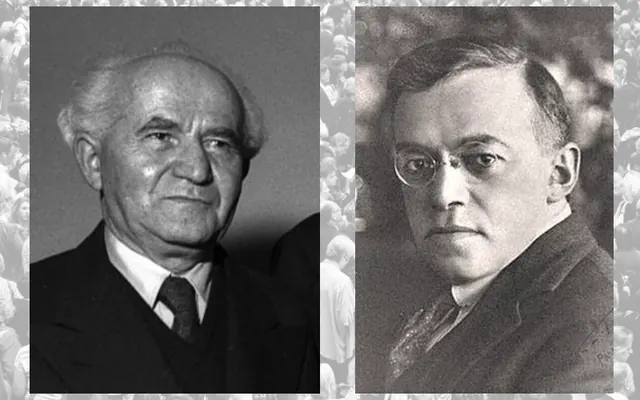
Season 2: Episode 29 - The Conflict Within
Each successive wave of immigrants that came up to the land brought with them their blessings, and their challenges. As the population grew, so did the nature of...
Play Episode
Season 2: Episode x - Sukkot
The Sukkot holiday is a time of messianic expectation and prophetic inspiration. Here is an interlude with some musings on the meaning of war and prophecy. And as...
Play Episode
Season 2: Episode 31- Interwar Jewry
Though the land of Israel is the hinge around which the Jewish Story turns, there are many Jews whose future does not lie in Zion. This episode widens...
Play Episode