
TJS S3E3 Mass Immigration and Ingathering the Exiles - part I
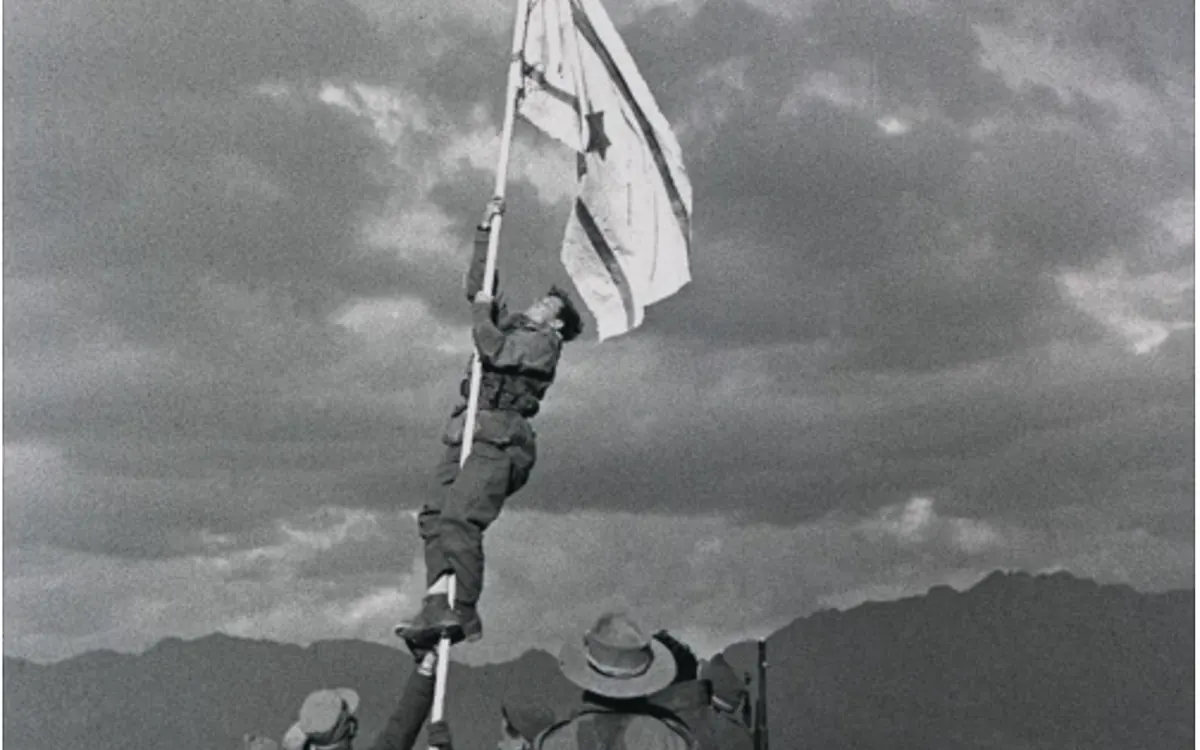
illustration attribution: By Government Press Office (Israel), CC BY-SA 3.0, commons.wikimedia.org/w/index.php?curid=22807003Rav MikeJewish HistoryKibutz GaluyotBen Gurion
About this episode
In Israel, to be a realist you must believe in miracles, said Ben-Gurion. Before the detail of state-building comes a more fundamental question that has not had enough attention and is making a frightening comeback in the mouths of Israel's enemies and in the eyes of bewildered Jews: what is the point of a Jewish state. Rav Mike asks it now, up front, in the context of the year after. On March 10, 1949 the IDF reached Umm Rashrash at the tip of the Red Sea, biblical Eilat, taken without a fight, and raised the improvised ink flag. The war had cost 6,373 casualties, nearly one percent of the population, almost two thousand of them survivors of the death camps, with fifteen percent of the populace in uniform, total war ending in euphoria and near-total exhaustion. Israel held all the land of partition and almost sixty percent of the proposed Arab state, and with the flight of the Palestinian Arabs a geographic and demographic vacuum that international politics abhors even more than nature.
World Jewry was in a sketchy state: the survivors huddled in the DP camps, repatriation impossible, and between 850,000 and a million Jews in the Arab world. Heykal Pasha warned the UN that partition might endanger them and make the UN responsible for a massacre, an interesting statement given that the violence had already begun, the Farhud of 1941 in Iraq, the Aden riots, bombs in Cairo, martial law in Iraq, and the 1950 choice for Iraqi Jews to abdicate citizenship and abandon property; of the hundreds of thousands then, only a few thousand remain today. So in 1949 the people held the greatest gift since Sinai, a sovereign state won by the mightiest Jewish army since the Maccabees, and also stood broken, thousands dead, the camps overflowing, the Muslim world boiling. The visionary and the pragmatic do not make easy bedfellows, and combining them takes a particular leader. In two years 688,000 immigrants almost doubled the population, and by the end of the first wave in 1951 three quarters were foreign-born and half had been in the country under five years.
In March 1949 Ben-Gurion convened a two-day symposium of forty intellectuals, ministers, writers and academics on the spiritual and cultural absorption of the masses, how to make an Israeli melting pot and a new Jew to take up the next phase of Zionism, nation-building, along the lines of the second aliyah pioneers. Most in the room held the classic assumption of shlilat hagalut, seeing mass immigration as the chance to heal the sickness of exile. Ben-Gurion saw the challenge: the coming immigration would be mainly from physically and spiritually impoverished Jews remote from the centers of culture, a Eurocentric and even racist attitude toward the Jews of the Arab world, and he had his own fears about absorbing the survivors. His goal, stated at the close, was to gather the Jewish human dust scattered through the world and forge it in the crucible of independence, crystallizing Hebrew attributes that never existed before, a phrase worth dissecting, from the scary human dust of a man of the age of social engineering to the excitement of what might come to be. An argument emerged with Martin Buber, who insisted that Zionism had always been about choice human material and a spiritual melting pot, asking from the plenum what the purpose of a Jewish land was. Ben-Gurion answered, to bring forth bread from the land, and that alone is enough, since ninety-nine percent of the people had not attained a decent living to even ask Buber's question.
Both were messianists, Ben-Gurion the realist, Buber the idealist, and in this forum Ben-Gurion made his famous statement that the Messiah has not come and he prays he never will, since the moment he arrives he ceases to be the Messiah, the messianic age more vital than the Messiah himself. His genius was to distinguish the present requirement from its ultimate purpose, focusing on the how of building the vessel, the precious vessel of the state, believing it would fill with the why. Two laws gave effect to his melting pot. The National Service Law obligated military and agricultural training to inculcate pioneering ideals, so the army was from the outset a tool of social engineering as much as self-defense. The second was the citizenship law: Ben-Gurion's coalition aimed at a law that would not distinguish between Jews and non-Jews, both because of the demographic balance and because of the UN, and after seventeen drafts the July 3, 1950 law declared that Israeli citizenship is not contingent on membership in the Jewish people, nor is such membership sufficient to confer it, giving expression to the declaration's complete equality of rights.
But the declaration also promised aliyah and kibbutz galuyot, the ingathering of the exiles, which Deuteronomy 30 describes as God gathering the dispersed to the land of their forefathers, at the heart of the complex mix of pragmatic survival, romantic nationalism and classic messianism in Zionism's roots. The government's first response was to leave it to policy rather than law, but Rav Zerach Warhaftig argued that leaving it to policy was not enough and that camouflage discrimination is worse than open and clearly defined distinction, since there are two faces to the state, the civil democratic guarantee of equal rights and the national historic and messianic ingathering, and both must be enshrined in law. His solution was to separate: a general citizenship law and a Law of Return stating that every Jew making aliyah is an individual returning to their homeland, automatically naturalized. The Law of Return passed on July 5, two days after the citizenship law, a strikingly short text, every Jew has the right to come to this country as an oleh, but it did not define who is a Jew, a bomb that exploded later, from the 1962 Brother Daniel case, where the court ruled the law does not include Jews who practice another religion, to the 1970 amendment defining a Jew as one born of a Jewish mother or converted and not of another religion, and extending the law's rights, as Hitler did, to anyone with one Jewish grandparent.
Key ideas
- The fundamental question of the era, what is the point of a Jewish state, is posed up front against the broken and triumphant reality of 1949.
- The violence against the Jews of the Arab world had begun before partition, and of hundreds of thousands then only a few thousand remain.
- Ben-Gurion's symposium aimed at a melting pot and a new Jew, and his debate with Buber set the realist messianist against the idealist messianist.
- His pragmatism focused on building the vessel, the precious vessel of the state, believing it would fill with the why.
- The citizenship law did not distinguish Jew from non-Jew, giving the state its civil democratic face and a place in the polity of nations.
- Warhaftig won a separate Law of Return so the national and messianic ingathering would be enshrined in law, though it left who is a Jew undefined.
Chapters
- 0:00 To be a realist, believe in miracles
- 1:09 What is the point of a Jewish state?
- 3:25 The 1949 reality; the ink flag
- 5:36 The Jews of the Arab world
- 8:53 The greatest gift and the broken people
- 11:03 The challenge of mass immigration
- 12:11 Ben-Gurion's symposium
- 14:23 The new Jew and shlilat hagalut
- 15:26 Jewish human dust; tribal fragments
- 19:45 Ben-Gurion and Buber
- 22:01 Bread from the land; the purpose
- 24:11 The Messiah who will never come
- 25:13 Two laws; the National Service Law
- 26:27 The citizenship law
- 28:38 A state for a nation that lives elsewhere
- 29:46 Kibbutz galuyot; Deuteronomy 30
- 32:04 Warhaftig: camouflage discrimination is worse
- 34:19 The Law of Return
- 36:31 Who is a Jew left undefined; Brother Daniel
- 38:37 The 1970 amendment
Who, where and when
People
David Ben-Gurion, Martin Buber, Zerach Warhaftig, Heykal Pasha, Tawfiq al-Suwaidi, Nuri al-Said, Nachum Sarig, Brother Daniel, Oswald Rufeisen
Places
Umm Rashrash, Eilat, The DP camps, Iraq and the Farhud, Aden, Cairo and Alexandria
Texts
The Declaration of Independence, The citizenship law, The Law of Return, Deuteronomy 30
When
March 10, 1949 CE: the ink flag over Eilat, March 1949 CE: Ben-Gurion's symposium, July 3, 1950 CE: the citizenship law, July 5, 1950 CE: the Law of Return, 1962 CE: the Brother Daniel case, 1970 CE: the Law of Return amendment
Read the transcript
In Israel, says David Ben-Gurion, in order to be a realist, you must believe in miracles. Well, I get to see miracles almost every day, and that's about as real as it gets. I'm Rav Mike Foyer, and this is The Jewish Story. Episode 3, Mass Immigration and the Ingathering of the Exiles, Part 1. So last season we ended off with the three decisions that birthed the modern state. And at the beginning of this season, we've taken a little bit of a catwalk, a segue, to fill in some of the backstory of American Zionism. Because the coming season, looking forward, is in many ways going to be a dialogue between these two remaining bastions of Am Yisrael, America and Israel, that is. But the drama of our story will stay squarely centered around the land of Israel and the newborn state.
And I want to come back there today. because through this season, really more than any of the ones before it, we're going to have to have an eye on the contemporary development of the Jewish story. And in order to do that, we first need to lay the foundations for understanding today's chapter by fleshing out in detail the process of state building that took place in the first decade or so of Israel's history. We're talking about military and foreign policy. We've got to talk about education and domestic policy. We've got to look at the roots of the primary fractures, at least as I see them, within the current social fabric of our fair state, secular religious, Ashkenazi Mizrahi, left and right. Before we can get to any of this, though, I actually want to start with a more fundamental question, because it's going to take us a while.
We could be in the late 40s and early 50s for quite some time. And that question, that fundamental question I want to start with, is one that hasn't gotten enough tension, in my humble opinion, ever since the state's founding. But it happens to be making a frightening comeback in the mouths of Israel's enemies. And by the way, also in the eyes of those bewildered Jews who just don't know how to relate to a project anymore when they begin to see its imperfect nature. And that question is, what's the point? What is the purpose of having a Jewish land, a Jewish state? Now, when we look back at this time period that we're going to engage today, I could tell you a simple story. There's no time to ask. I mean, after all, if you've been following the Jewish story for a little while, then you know that since the turn of the 20th century, it was build, build, build.
Then by the late 20s, we added that fight, fight, fight. And then once the War of Independence comes to end, we add on top of that grow, grow, grow. If our mission were nothing more than survival, I might accept such an answer. After all, when your actual existence is in question, there's very little room for abstract, existential questions. That's why, as we'll see, I'm projecting now, season four, the questions of why and wherefore really erupt in Israeli society in the 70s, when for various reasons that we can't discuss right now, the sense of imminent disaster begins to recede to some degree within large parts of Israeli society. But I want to ask the question now, up front, right at the very start.
And I want to ask that question of what's the point of a Jewish land in the context of two things, really. First is the reality of the year after. On the 10th of March, 1949, nearly 10 months after the Declaration of Independence, the IDF finally reached Umrashash at the tip of the Gulf of the Red Sea. It's the site of Biblical Eilat, as well as the site of the present-day city of the same name. And the 8th Battalion of the Negev Brigade rolled in and took that sleepy village without even a fight. And when it was discovered that they didn't even have a flag to raise over their newly conquered land, the Negev Brigade Commander, Nachum Sarig, gave the orders to just make one. And thus, Degel Hadio was born, the ink flag.
The raising of it, I'm sure you've seen. It's an iconic image of the war. And for our question of what's the point, I want you to take a few points of context from the end of the war here. One is that the newborn state sustained 6,373 casualties. That's nearly 1% of the population. And almost 2,000 of them had actually escaped the death camps of Europe to die on the battlefield there in the Middle East. Add to this the fact that by the end of the war, the IDF was fielding 88,000 soldiers. That's almost 15% of the populace in uniform. And you'll understand then that this was total war, which means at its end, in addition to the euphoria of victory, there was near total exhaustion. That's critical to understand the way in which the country is going to face the challenges that come.
So another key point of context that the end of the war offers is territorial. because in addition to holding all of the territory which UN Resolution 181 proposed for a Jewish state, Israel had conquered almost 60% of the land proposed to the Arab state. Now, together with that conquest came the flight of the hundreds of thousands of Palestinian Arabs that had been living there. However you think it happened, we've touched on that, and trust me, we'll come back to it again. And now suddenly, this new state is holding, we'll call it a geographic and demographic vacuum. And international politics abhorfs the vacuum even more than nature. So this is the 1949 reality, which gives context to my question.
What's the point of having a Jewish state? We're touching it now, but I want to keep it in the back of your mind for a number of coming episodes. And I'll just add a few words about another piece of context, and that's the state of world Jewry. Now, leaving aside American Jewry, who we've discussed, the bulk of the Jews are in a pretty sketchy situation at this point. There's no need to detail the state of the remnant of European Jewry. The survivors are huddled now in the DP camps, the displaced person camps in Europe, desperate to get out. It's clear to everyone they have to have a home. But, you know, the idea of repatriation, of putting them back to their place of origin, even if they could endure the horror of picking up where they'd left off, meant for many of them it's just simply not possible, as with my great-aunts and uncles, that there are people living in their homes.
We add to this somewhere between 850,000 to 1 million Jews living in the Arab world in 1948. Heichel Pasha, who was an Egyptian delegate to the UN, addressed the political committee of the General Assembly on November 14, 1947. That's just a few days before the UN vote on the partition plan. And he'd come for a very particular purpose, to deliver a warning. He says, the United Nations should not lose sight of the fact that the proposed solution might endanger a million Jews living in the Muslim countries. Partition of Palestine might create in those countries an anti-Semitism even more difficult to root out than the anti-Semitism which the Allies were trying to eradicate in Germany. if the United Nations decides to partition Palestine it might be responsible for the massacre of a large number of Jews it's an interesting statement on one hand there's truth to what he said and it bears reflection in the fact that anti-Semitism has indeed found a new home in the Muslim and Arab world on the other hand who's making the decisions here the United Nations is going to be responsible for this massacre the United Nations will cause that anti-Semitism or maybe it's just the enemies around us.
And frankly, the violence had already begun before Heichel Pasha's threat. In Iraq, 150 Jews were murdered in 1941 in a three-day pogrom that's known as the Farhud. It was the largest wave of anti-Jewish violence that the country had ever seen. That was in 1941. In Egypt, anti-Jewish riots broke out in 1945 on the anniversary of the Balfour Declaration. 82 Yemenite Jews actually died in riots that swept Aden in the wake of the UN's vote for partition. And of course, with the declaration of the state, things only got worse. In many countries, hundreds of Jews were accused of involvement in Zionist plots, communist plots, any kind of plot you can come up with. There were continuous attacks, basically, from June.
Bombs were planted in the Jewish court of Cairo. The Jewish area of Alexandria was actually burned down. Iraq declared martial law. It sent its Jews to death, put them in jail, slapped them with huge fines. And in fact, all of the Jews of Iraq were given the choice in March of 1950 to stay and suffer or to leave on the condition of abdicating their citizenship and abandoning their property. Now, there's much more to that story. And we're going to hear a lot of it in the coming episode. But for now, suffice it to say that of the hundreds of thousands of Jews who lived in the Arab world in 1948, Today, there remain only a few thousand. And that's part of the context for our question. So here we are in 1949.
On one hand, the people in our land, and we're holding the greatest gift the Jewish people has arguably received since Sinai, a sovereign state on a large swath of our ancestral homeland, won by the mightiest Jewish army since the Maccabees and easily framed as the fulfillment of the words of our prophets. We were like dreamers. The whole thing is like a dream, I can tell you, for me personally. But the question is, what do we do with it? For what purpose have we attained this land? So that's one side of the equation. On the other side, broken. So broken. Thousands of dead and wounded. The DP camps overflowing. The anger of the Muslim world boiling around us, uprooting a culture that had lived largely in peace for over a thousand years.
And from that perspective, it seems pretty obvious why we've attained this land. You've got to have somewhere to go when there's nowhere else to be. So the visionary and the pragmatic don't necessarily make easy bedfellows when you want to put them together into a nation. To combine them takes a particular type of leader. In the two years following the end of the war 688 immigrants reached the shores of the newborn state of Israel That doubled its population almost. And in the coming two decades, by the way, the population would more than triple. We'll tell the details of some of that in the coming episode. But now I just want to think about the basic challenges posed by such a mass immigration. It's staggering when I try to think about it.
Now, some of the problems were purely economic and logistical. How do you house, feed, and employ that many people, especially when you live in a society that's right now recovering from a terrible war and is already under a universal boycott by all the countries of their region? And by the way, there were many in those countries who didn't believe that Israel would survive. Tafiq al-Sawadi, whose name I'm sure I just butchered, the Iraqi Prime Minister, who played a central role in passing the law that actually permitted Jewish emigration, reported to the Arab League in 1949 on the damage that the mass aliyah was already wreaking on Israel. And his successor, Nouri al-Sayed, actually said that every additional immigrant is an additional nail in Israel's coffin.
Now, like I said, those were our enemies. But as we're going to see in this episode and the next, even within the country, there was no consensus that unrestrained immigration was a good thing within Israel. And we're going to discuss the strategies that the government chose to overcome the logistical challenge of mass aliyah and the consequences of these choices as we move forward. But for now, I want to focus on a slightly different aspect of the problem. In March of 1949, a little more than two weeks after that ink flag was raised over a lot, Prime Minister David Ben-Gurion convened a two-day symposium. I'm talking about 40 intellectuals, cabinet ministers, writers, academics, and other public figures who all came together in order to discuss what he saw to be the next great challenge facing the nation.
The spiritual, cultural absorption, as he called it, of the masses of immigrants who had already begun to flood into the new country. In other words, he wanted to talk about how we make an Israeli melting pot. Now, keep in mind, by the end of the first wave of mass aliyah, which is around 1951, three quarters of the population were foreign-born, and half of all Israelis had lived in the country for less than five years. Now, it's, again, like I said, staggering to try to think of how do you make a people out of that many immigrants. If you recall, the first two episodes of this season touched on the challenge that the American melting pot posed to Jewish identity. It's a model of cultural cohesion, which seemed to require assimilation that ran against the desire of the Jews to be the Jews.
And then we spoke about Horace Callen and how his Zionist vision of Jewish identity led him to actually propose a different model for American society, one in which ethnicity could maintain its voice in a harmonious symphony of culture, as he called it. Cultural pluralism is what we name it today. Now, America's need to form one society as a nation was very real. And we can see, by the by, from the growing fractures in its social fabric today, that it was only somewhat successful. But it pales in comparison to the young state of Israel's need to afford a nation. Furthermore, the Americanization that lay behind the American melting pot, as we discussed, had two faces. One was an attempt to sort of remake everyone in the Anglo-Saxon mold.
The idea that the WAS, the white Anglo-Saxon Protestant, was an American, and everyone had to join that team. It had a competing model, though, in that something new would emerge that there was actually an American, there was a human being called the American that had never existed before. And the two have their own uneasy relationship. Here in the state of Israel, the problem runs even deeper. On one hand, you have the Jews who have been, let's just say, a bit fractious for most of our history. And to agree on what a Jew is, well, I refer you back to my last episode. On the other hand, you do have a core social model, which is the second Aliyah pioneer, this Zionist ideal that really, even though it numerically was a fragment of the population, still sort of culturally and idealistically was its leader.
And then, of course, you have that desire for the new Jew. And Ben Grimm's symposium was held with the explicit aim that a new Jew must emerge from this ingathering of the dispersed Jews of the world. And he was a Jew that would take up the next phase of Zionism, nation building, with as much dedication and really along the lines of the pioneers of the second Aliyah. Now add to this the fact that most of the people in the room also held that classic Zionist assumption of Shlilat HaGalut, the negation of exile. They saw the Zionist project, and in particular this mass immigration, not just as a return to place, or even a repatriation to homeland. This was it. This was the opportunity to heal the brokenness and the sickness of exile, and to finally fulfill our divine historic mission by becoming a free people in our land.
But how, oh how on earth, do you do such a thing without imploding as a society? Now, always farsighted, Ben-Gurion saw the cultural challenge that lay on the immediate horizon. This is how he stated it. In the wake of European Jewry's annihilation, the mass immigration soon arriving in the country will be coming mainly from sparsely populated, physically and spiritually impoverished Jews remote from the major centers of Jewish life and human culture for centuries. Yeah, you heard it. He saw the Jews of the Arab world as distant from culture, and in particular from the secular European ideologies that had lent such drive to the Zionist project. Now, we'll explore the consequences of this Eurocentric and maybe even racist attitude in the next episode, but just keep it in mind.
Ben-Green also had his own fears about absorbing large numbers of the survivors of the Holocaust into the country. Now, they were Europeans, but he'd made many trips through the DP camps in the last couple of years, and he spoke now at the beginning of the symposium of, quote, the horrors of war and slaughter that they'd experienced and the residue of concentration camp life that can be seen in them. Now, there's a theme that we can find in between the spaces of a lot of the speeches of the Zionists of this period, a concern about the moral fiber of the survivors. Implicit in that is that anyone who survived must be something to be afraid of. Now, I've promised that we have to discuss the integration, or lack thereof, I guess better stated, of the survivors back into Jewish life, both here and in America.
And I'll likely do that in the context of the capture of Adolf Eichmann. But again, I want to stay focused on our story right now. So ultimately, toward the end of his opening speech, Ben-Gurion expressed the goal like this. In the coming days when immigration increases immensely, a great effort will have to be made to preserve national unity. Our nation is in the process of being recreated from tribal fragments, and this requires gathering up the Jewish human dust scattered throughout the world, returning to the land of Israel, and being forged in the crucible of independence and the framework of sovereign statehood. Hebrew attitudes and styles that never existed before, and that could not have existed in the diaspora, when we were a nation lacking a homeland, independence and national freedom, will now have to be crystallized.
That's a statement that deserves to be dissected. First of all, the Jewish human dust, that's a scary phrase in my eyes. Remember, Ben-Gurion was a product of the great age of social engineering. This is a time when Stalin and Mao felt like moving millions of people around for the sake of their nation was perfectly justifiable. Remember, many human beings die in the service of humanity, And there's something inhuman about every ideologue. But nevertheless, taking on the scale of challenges he was facing, you couldn't do otherwise. I mean, keep in mind, when we discuss the Ma'abarot in the coming episode, Ma'abarot are the transit camps in which many of these immigrants were settled. And of course, his decision to settle the immigrants on the borders, sometimes on abandoned Arab lands, sometimes making them build cities where they sat, that his vision of social engineering, at the base of it, this notion of the Jewish human dust.
So he also used this phrase, recreation from tribal fragments. Now, this goes to the heart of the question of the melting pot. Now, there's always a tension in the idea of melting pot between how the diversity of ways of being a Jew could contribute to our society or how it could actually undermine the project of building a nation. How do we fix that fractious nature that has plagued us since the destruction of the Second Temple without homogenizing the beautiful diversity out of the Jewish people? And finally, these Hebrew attributes and styles that never existed before and that could not have existed in the diaspora. Do you feel the excitement of what might actually come to be when we're a people in our land?
But of course, that element comes at the end of his speech. So at a certain point in the symposium, an argument emerged between Ben-Gurion and Professor Martin Buber. I would love to have seen this, right? Buber, intellectual, mystic, and though today many find it hard to reconcile the idea of a support for a binational state with Zionism, he was a passionate advocate, not only of Zionism in general, but the need for a pioneering spirit to revive Am Yisrael. So their argument began around the nature of the melting pot that could possibly handle the situation they face. Ben-Gurion wanted to gather together, as we said, this Jewish human dust and forge them into a people in the crucible here of independence and the framework of sovereign statehood.
This is this concept of a mamlachtut, of a way of being a sovereign people that will get its own treatment in good time. But in contrast, Buber insisted that from the beginning, the Zionist movement had never been about mass numbers. It had been focused on choice human material, as he called it, not mass immigration. This is a question that goes all the way back if you recall to the arguments between well first Herzl and Ahada Am and then you know Max Nordau and Jabotinsky on one side and the practical Zionists on the other Go back and do some review in season two. But in Buber's words, the pioneers of the last generation, whose energy and drive Ben-Gurion wanted to recreate and harness toward the present state building, quote, did not come to an immigrant country, but to a land waiting for the realization of Aliyah.
Remember, Aliyah means going up. It's more than immigration. It's an elevation. And it's an elevation not just physically, but spiritually. It's a stepping into a different dimension of action. And I don't just say that. I can tell you that you're joining the national drama when you step into this land. And in Buber's eyes, what we needed to do was to evoke that sense into every immigrant who crossed the shores of Israel. He envisioned, basically, a spiritual melting pot. And he said its goal was, quote, to absorb the masses that were daily entering the country by molding their character and image into the form of a nation. Do you hear it? Buber wants to clarify the idea of the state. and then let its vision shape every immigrant.
Ben-Gurion wants to strengthen the form of the state, believing that the task of building will actually allow a new vision to eventually emerge. And that's why Buber insisted that the first question that they needed to address in the face of mass immigration was, what is the purpose of a Jewish land? And he posed it from the plenum. The answer he got from Ben-Gurion was, Hamotzi Lechem Min Haaretz. The purpose is to bring forth bread from the land. Buber says, back for what purpose? Ben-Gurion says, that alone is enough. 99% of our people have still not attained a decent living condition to be able to even ask Professor Buber's question. Buber replies, this is not a question of now or later. To which Ben-Gurion says, it most certainly is a question of now or later.
Burning questions are now facing us. Even the previous question, what are we living for, is suited for a people who you already called the refined elite. Buber says, yes, that's true. Ben-Gurion replies, we have to remain within the framework of earthly Jerusalem, if only because there exists a heavenly Jerusalem. Buber says, I was referring to the earthly Jerusalem all along. Do you hear the depth of their conflict? They were both messiness. The difference is that Ben-Gurion was a realist messiness, and Buber was an idealist messiest. Both felt the pain of an earthly Jerusalem that was still split and bleeding from 1948. both believed in the need of molding the masses into a new nation and they shared the belief that the critical role would be played by the pioneering spirit.
It's just that Buber actually held out the hope that the ideal would be realized now, or at least in the near future. And therefore, it needed to be our immediate question of what for. Well, Ben-Gurion believed that only a historical social process would be able to melt the Jews into a people who are adequate to the task of even asking the question, much less realizing the ideal. Now this is the forum, and it's no coincidence, in which Ben-Gurion made his famous statement, I say that the Messiah has not yet come, and I pray that he will never come. The moment that he arrives, he'll cease to be the Messiah. It's because the Messiah is needed so badly that he will not be coming. The Messianic age is more vital than the Messiah himself, and the Jewish people lives in the Messianic age, awaiting its arrival, believing it.
This is the main factor in preserving the life of the Jewish people. I mean, it's astounding. Ben-Gurion's genius was in being able to distinguish between the present requirement and its ultimate purpose, and his pragmatism drove him to focus on the how of state building rather than the why. While his messianism allowed him to believe that this itself will become the vessel that would bring about the redemption of the people. Focus on the how. Build the vessel, and it will fill with the why. In fact, that's what he called the state. A precious vessel. It was not the purpose. It was the means. Now, symposiums are, of course, useful forums for thought. Anybody who wants to invite me to one, I'm happy to come.
And it says a lot about Ben-Gurion's character as a leader, that he saw the intellectuals of his day as critical voices in helping to answer questions of state. However, that such things were still occurring. But the reins of statecraft lie in the hands of government. And there will be two laws that give effect to Ben-Gurion's vision of the melting pot. Because, of course, in all the fights of these few years, he wins. First was the National Service Law. The original version of which actually obligated every young man and woman not only to undergo military training, but agricultural training as well. The hope was that through the military and their agricultural arm, they could inculcate those second Aliyah ideals of pioneering into every new young Israeli.
And you have to take from this that from the outset, the Israeli army has been as much a tool for social engineering as for self-defense. The second law, the one destined to shape a new nation out of the tribal fragments and human dust, deserves a bit of a discussion on its own. If you look at the third part of the Israeli Declaration of Independence, you will see that it reads, The State of Israel will be open to Jewish aliyah and kibbutz galiot, the ingathering of the exiles. It will strive to develop the country for the benefit of all of its inhabitants and will be founded on the principles of liberty, justice, and peace in light of the vision of the prophets of Israel. We'll maintain a complete equality of social and political rights for all of its citizens, regardless of religion, race, or gender.
Now, we'll tell the story of how the Israeli government actually took shape in a later episode, and I want to explore together this question of a constitution. But for now, if you want to understand the worldview of the people who made up the provisional government that formed once the British mandate came to an end, then all you need to know is that their first act of legislation was to remove any limitation imposed by the mandatory government on Jewish immigration. That was their major concern. Get the Jews home. And not long after the war, when an actual government, the Knesset, took form, discussion of the legal parameters for citizenship and immigration began. Now, first of all, Ben-Gurion's coalition set the aim of passing a citizenship law that would not distinguish between Jews and non-Jews.
Even though they believed in a Jewish state, they recognized that they were on thin ice, both demographically, meaning the balance of Jews to Arabs within the country, and democratically and their ability to be part of the new polity of nations represented by the United Nations. It took 17 drafts to get there. just think of what governance looks like with these types of Jews but on July 3rd, 1950 the combined citizenship law was brought before the first Knesset and the preface of the final draft reads as such Israeli citizenship is not contingent on membership in the Jewish people or the Jewish religion or the Jewish national movement and on the other hand such membership is not sufficient to confer status of Israeli citizenship This goes to the heart of a deep question that we've already posed a few times.
How do you have a state which embodies a nation that doesn't actually live in your state? The Knesset is not the sovereign body of the Jewish people because a Jew living in Brooklyn isn't under their jurisdiction. At the same time, to think that it's simply the sovereign body of the Israeli people is insufficient when you understand the relationship between the Jews of the world and the Jewish state, and vice versa. the Knesset can't simply be the embodiment of the Jewish people or even the Jewish state, since there are non-Jewish members of the Knesset itself, not to mention plenty of citizens. So it's complicated. And the citizenship law gives expression to that statement in the Declaration of Independence of complete equality of social and political rights for all citizens.
But what about the declaration that the State of Israel will be open to Jewish aliyah and kibbutz galiot, the ingathering of the exiles. Where does that come into law? And can it be transformed into an actionable law without actually undermining the principle of equality? Unless you think that that's purely an academic historical question, take a quick cruise on the holy internet. You see what people are saying about the Israeli law of return. The right of every Jew to become a citizen of the state of Israel. It is seen not only in the world of Israel haters, but even amongst the left-wing academic elite of Israel as intrinsically opposed to the democratic character of the state. After all, how could you favor one group over another?
By the way, I'm not going to go into it. If you're interested, you should look at the notes for this show. If you're a patron, by the way, for $1 patronage, you can get access to the bibliography that comes with each show. I know I need to catch up. Don't worry, it's coming. But just for now, you should know that there are good reasons, good arguments to be made that it is a principle of international law that countries have the right to restrict their immigration and make it partial toward repatriation of those they deem to be the descendants of their citizens. But that being said, the government's first response to this problem was a void. Let the question of encouraging the mass immigration of Jews become one of policy and not law, and they seem to think that that would solve the problem of the contradiction.
but the Declaration of Independence says that the state will be open not only to Jewish immigration but to Gipputz Galyot as well to this vision of the ingathering of the exiles and that deserves a word on its own in fact a few words from God if you will Davarim 30 1-5 describes what will happen it will be when all these things come upon you and you will return to the Lord your God with all your heart with all your soul Then the Lord your God will bring back your exiles and he will have mercy upon you He will once again gather you from all the nations where the Lord your God had dispersed you. It goes on, and you should read it all, but it says in the end, he will bring you to the land which your forefathers possessed.
He will take possession of it, and he will do good to you, and he will make you more numerous than your forefathers. Now there's so much in these lines. The link between our behavior and the return, which was rejected by the secular Zionists, the relationship between the exiles scattered throughout the world and the land of their forefathers, all this goes to the heart of that complex mix of cross-currents between pragmatic survival, romantic nationalism, and classic Jewish messianism that make up the roots of the Zionist movement, and by the way, are still feeding our society today, both in its unity and its fractious nature. How do you relate to this project when it's not simply a matter of one, of getting the Jews in the door?
And it's not even a question of how do you then create a culture that can meld these Jews back into one nation, but it's rather bound up with an underlying assumption by the Jewish people that our mission is one of God in history. now Rav Zerach Varhaftig who happens to be actually the father of the Rabbi of Mayashul coincidence, but it's a fun one was the director of the Institute for the Study of Jewish Law within the Ministry of Justice in the new government and he believed that leaving the question of Kibbutz Galiot of the ingathering of the exiles to policy was not enough that in order to really fulfill not only the promise of the Declaration of Independence but really the purpose of having a Jewish state at all, he believed the law must state unequivocally that there was a principle, that a Jew arriving in Israel is returning to their homeland, and therefore is not just an immigrant like any other.
And so, in response to the 15th draft of the citizenship law, Rav Varhovnik wrote, It is inevitable that the citizenship law in the state of Israel will struggle with the apparent contradiction between two fundamental principles of the state, the ingathering of Israel's exiles, meaning classic religious messianism, and the guarantee of equal rights for every citizen and resident, meaning liberal democracy. And the realization of the goal of Zionism, kibbutz galiot, as he says it, requires a special stance toward Aliyah from the Jewish diaspora. And there's a need and a necessity to give expression to this stance in law. Every disregard for or attempted neglect of the quest for an appropriate way to underscore the principle of kibbutz galiot in law, out of fear of creating a disparity of treatment between Jews and non-Jews, will only pass the core of the problem on to the administration.
Apparent discrimination will perhaps disappear from the law, but not from life. Camouflage discrimination is far worse than open and clearly defined discrimination. He's putting his finger on a couple of very important points here. Number one, that there are two faces to the state of Israel. There is the civil democratic, which is a guarantee of equal rights. And then there is the national historic and perhaps even divine messianic, the ingathering of the exiles. And those two need to be enshrined in law together. And even though, as he points out, it seems to be that there's a contradiction, and he doesn't necessarily deny that. What he's saying is that to try to avoid that contradiction through enshrining only the democratic principle and law, and leaving the national historical, or perhaps messianic, to a question of government policy will only camouflage the actual goals of that government.
As he says, camouflage discrimination is worse than open and clearly defined distinction. So the solution, he suggested, is to separate. There's a general citizenship law on one hand, and the law of the ingathering of the Agazals, which would state that every Jew making Aliyah in Israel, in order to settle, should be viewed as an individual returning to their homeland, and therefore automatically naturalized as a citizen. And, can you imagine the merit? The result of Rav Rav Hafecht's intervention, the law of return was passed by the Knesset on July 5th, only two days after the citizenship law. For all its significance, it's a strikingly short piece of legislation, whose purpose is clear from the first line.
It says every Jew has the right to come to this country as an ole. Notice, an immigrant in Hebrew is one who goes up. Now the catch is, as we mentioned in a previous episode, the law doesn't define who is a Jew. Now partially, that's because of the potentially explosive nature of such a debate, and the fear that its impact would have on what was still a very information social fabric. And another reason which needs to be appreciated is in 1950, who in their right mind would imagine that anyone who wasn't actually a Jew, either motivated by ideology or fleeing persecution, and therefore a Jew in the traditional sense, would want to move to the state of Israel. But the fact is, once you state every Jew has a right to come to this country, you can't avoid defining the Jew.
The first major challenge will come in 1962 in what's known as the Brother Daniel case. In short, Brother Daniel was born Oswald Rufzin, a Polish Jew, one in fact who helped to save hundreds of his fellow Jews during the Holocaust. And then he himself eventually took shelter in a convent. And while he was there, he was baptized. And apparently not by force, because after the war became a Carmelite monk. And though he went on to serve as a Catholic priest in Poland, during a wave of government anti-Semitism in the 50s, Brother Daniel actually applied to immigrate to Israel under the new law of return. And he maintained in his application that though he practiced the Catholic religion, I mean, he was a monk, he was still a Jew.
Quote, my ethnic origin is and always will be Jewish. I have no other nationality. If I'm not a Jew, what am I? I did not accept Christianity to leave my people. I added it to my Judaism. I feel as a Jew. Well, anyone who knows the history of Judaism and Christianity, and certainly those who've been listening to the Jewish story for quite some time, know that that's a very uneasy statement. And eventually, in 1962, the Supreme Court, the Israeli Supreme Court, actually ruled that the law of return does not include Jews who practice another religion. That's a complicated question, right, on the national, religious, and ethnic front. In 1969, there was another case that came before the court, and it ruled that a child born in Israel to a Jewish Israeli father and a non-Jewish mother could be registered as Jewish in Israel's population registry.
Now, if you don't know, that's a ruling that runs counter to the traditional Jewish legal definition of a Jew, which is someone born to a Jewish mother. Controversy erupted, and it led in 1970 to an amendment to the law of return, which is quite significant. Number one was, for the purposes of this law, Jew means a person who was born of a Jewish mother or has become converted to Judaism and who is not a member of another religion. There's both the Brother Daniel case and what's called the Baby Shalit case. Of course, it doesn't define what type of conversion, and if you're familiar with the battles in Israel today, that's a big one. But then, this amendment includes the rights of members of the family, which is the rights of a Jew under this law and the rights of an ole, as well as the rights of an ole under any other actment, are also vested in a child and a grandchild of a Jew, the spouse of a Jew, the spouse of the child of a Jew, and the spouse of the grandchild of a Jew, except for a person who's been a Jew and has voluntarily changed his religion.
Meaning, just like Hitler, who saw you as a Jew if you had one Jewish grandparent, so too now the rights of the law of return apply to those Jews as well. Now, there are many more facets of the story of Mass Aliyah, and we're going to tackle them, like I said in the coming episode, it might even take us three. But for now, here's another element of that pragmatic messianism driving David Ben-Gurion. On one hand, the citizenship law allowed Israel to join the polity of democratic nations. And I, for one, am grateful that this is so, both as a pragmatist who knows that we need the world to get by, and as a believer in our redemptive mission that we should never be entirely other than the world. on the practical level the law of return gave a legal framework for integrating the Jewish masses of the world into the state and on the visionary level it opened the doors not just for immigration or even simple repatriation to the state of Israel it opened the land of Israel to the ingathering of the exiles and that's a practical opening on the way to redemption so I just want to thank a few people I want to thank all the folks who give their hard-earned money and help make this show possible I want to invite you to join them you can go right now to my website jewishstory.co and up in the upper right hand corner you'll see a little box that says be a patron you can click on through for a little bit of per podcast support and as long as I'm making invitations I want to invite you to be in touch robmikefoyer at gmail you can also find me at the jewishstorypodcast on facebook or Rav Mike Foyer on Facebook.
And one last invitation. The first webinar was a great success and I'm already taking registration for the second. So send me an email if you want the details and get involved. I also want to thank the Land of Israel Network. That's thelandofisrael.com for creating a platform that allows me to reach so many amazing people. I want to thank the Pardes Institute, pardes.org.il for building an educational institution that allows me to touch the hearts and minds There are so many amazing Jews. I want to invite you to join them, by the way. This coming summer, some great teaching going on. And I want to thank you for listening. I'm Rav Mike Foyer, and this is The Jewish Story.
More from Season 3


TJS S3 Purim 5779: The Oldest Hatred, a practical analysis
Illustration attribution www.maxpixel.net/Aggression-Viole…ss-Attack-656795
Play Episode
TJS S3E4 Sink or Swim - mass immigration and the in-gathering part II
There are times in the history of peoples and nations when the decisions made shape the future. The three years after Israel's foundation saw its population double through...
Play Episode