
TJS S3E4 Sink or Swim - mass immigration and the in-gathering part II
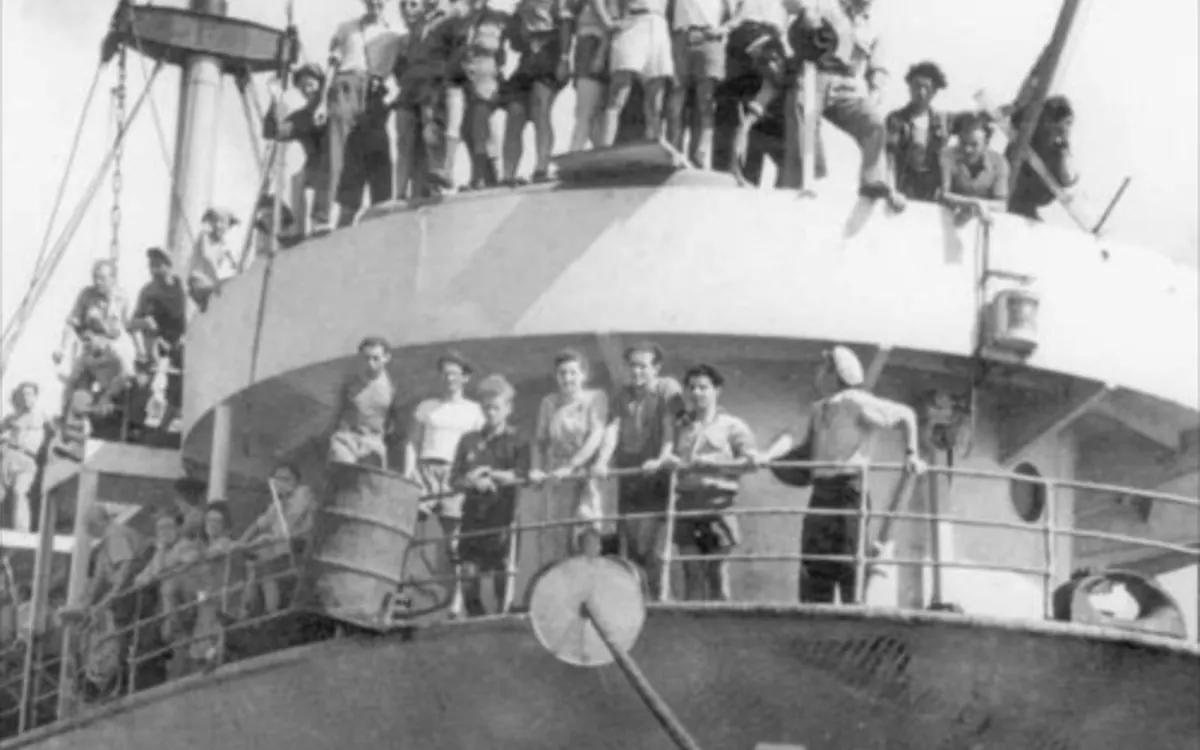
There are times in the history of peoples and nations when the decisions made shape the future. The three years after Israel's foundation saw its population double through immigration, the way in which the immigrants were received set the mode for many years to come.
About this episode
Israel must be redeemed by its own efforts and by natural agency, said Ben-Gurion. The question of what a Jewish state is for will not go away, and this episode fills in what it actually looked like to bring so many people into the country. In 1920 the aging Max Nordau called for the immediate aliyah of a million Jews in the wake of Balfour, haunted by the coming catastrophe, at a time when Weizmann was advising many not to immigrate out of concern for the absorptive capacity and the vision of producing a new type of Jew. That argument repeated in 1948: should Israel take all, irrespective of their ability to be absorbed, or first receive the young, strong and moldable. The first layer is pragmatic, a safe haven requiring open floodgates versus a viable state requiring ideological aliyah. The deeper layer is what salvation looks like, rescue or evolution, saving every Jew or the salvation of the Jews, since evolution is an elite project and mercy is foreign to natural selection, questions disturbing to ears shaped by the individual, especially asked in the wake of the Nazi attempt to engineer humanity.
Until the 1930s selective and gradual aliyah was the watchword, and the British limits on immigration suited the practical Zionists, giving the Jewish Agency the power to distribute certificates, which Jabotinsky denounced as he called for mass immigration by any means. By 1944 Ben-Gurion called to bring a million even if soup kitchens were needed, and in 1949 he rejected calls to slow immigration until housing was ready, saying that anyone who asserted such a thing did not understand what was taking place in Jewish lives. Yet in less public forums his goal was building the state: he characterized aliyah as an aspect of national defense, so that if war came there would be a people to stand up, warm healthy bodies in overwhelming numbers the only thing that could hold up the state, since saving the Jewish people could not come at the expense of saving the Jews but was the only way to save them in the long run. The nearly 700,000 who arrived in three years pushed the ideological questions underground, and in 1949 the choice was not refuge or exceptional society but sink or swim.
A 1950 joke captured it: Dov Yosef, the least known and most disliked of the founders, born in Montreal, a McGill-trained lawyer who fought in the Jewish Legion, settled in Jerusalem and governed the besieged city with a meticulous, ruthless rationing that helped save it. As the immigrants flooded in and the economy threatened collapse, Ben-Gurion, a believer in centrally planned economics, appointed him minister of rationing and supplies, and his Tzena, austerity, began in May 1949 around the magic number of 1,600 calories a day, far below modern consumption. Rationing, in place since 1939, widened in 1950 to clothes, shoes, pots and furniture, enforced by hundreds of inspectors and roadblocks, because Ben-Gurion identified the Jews' subversive attitude toward law and order as a fundamental barrier to sovereignty. The pioneering and underground culture that had overcome the empire now went toward an extra measure of food, and the reviled Yosef, the humorless Anglo, kept the doubled population fed for about four years before being shunned by his own party, valued for what he achieved and hated for it.
As Eliyahu Dobkin's 1943 statement shows, the Jews of the Muslim countries had become more valuable, easier to reach and the first to join, a statement that strikes the modern ear as cold like Ben-Gurion's human dust. Some 688,000 came in three years, averaging almost twenty thousand a month: first the survivors from the DP and Cyprus camps, whole communities like Bulgarian and Yugoslav Jewry, then the Jews of the Muslim world through Operation Magic Carpet from Yemen and Operation Ezra and Nehemiah from Iraq. All could be fed, but where would they live and how be integrated. The first settled the emptied Arab urban areas, and once those filled the Ma'abarot, the transit camps, were Levi Eshkol's brainchild, a desolate country and a desolate people meant to make each other blossom; the first opened in May 1950, and by the end of 1951 some 220,000 lived in them, two thirds from Muslim countries, in shacks of cloth, tin or wood without water or electricity. The timing of the waves became crucial: the first arrivals seized the urban centers near employment while the later ones ended on the peripheries or in the camps, and combined with lower formal education, less modern Hebrew and a more traditional culture, this produced a low-status Mizrahi layer rather than equality, a classic case of asymmetric contact.
There is also racism, which Rav Mike declines to cherry-pick into a one-sided picture or to replace with a hagiography of the pioneering elite, locating the truth in between. A process of othering took place, with origins in the inception of Zionism, which emerged from a European crisis Muslim Jewry did not share, drew on Western theory, and rode colonialism into the land, so that pronouncements from Herzl's rampart of Europe against Asia to Sharett's salt of the land reflect a Eurocentric and even racist attitude. But the counterforce to colonial stratification was the national ethos of solidarity, and the bottom line is that the doors stayed open, 20,000 a month fed, clothed, sheltered and clumsily educated. Rav Mike closes on Ben-Gurion's philosophy of Mamlachtiyut, which has no good translation, a combination of legal sovereignty and the cultivation of civic sensibility, since a state does not exist until internalized in the hearts of its people. It names his battles to subordinate the volunteerist army, education and healthcare to the center, his refusal to split the Jewish people from the Jewish state, and five attributes: belief in a supreme being embodied in secular national existence, a moral doctrine that health replaces the distortion of exile, total devotion and sacrifice, public ritual and ceremony, and social institutions led by the army, a school for youth, and the education system. Mamlachtiyut was how he hoped to forge the tribal fragments into a nation that could express the moral will and historic vision of Israel, merging the messianic dream of the refined elite with the one latent in the immigrant from Morocco.
Key ideas
- The sink-or-swim question had two layers: refuge versus viable state, and the deeper one of rescue versus evolution, the salvation of every Jew or of the Jews.
- Ben-Gurion came to open the floodgates, casting aliyah as national defense, since saving the people could not come at the expense of saving the Jews.
- Dov Yosef's reviled austerity, Tzena, kept the doubled population fed around 1,600 calories a day, valued for what he achieved and hated for it.
- The Ma'abarot transit camps and the timing of the waves set later Mizrahi arrivals on the peripheries, producing a low-status layer rather than equality.
- The othering of Mizrahi Jews had roots in Zionism's European and colonial origins, countered by the national ethos of solidarity that kept the doors open.
- Mamlachtiyut was Ben-Gurion's vessel for forging tribal fragments into a sovereign people, from subordinating the militias to public ritual and the army.
Chapters
- 0:00 Redeemed by its own efforts
- 1:09 Nordau's call for a million
- 3:26 Rescue or evolution
- 6:37 Evolution as an elite project
- 7:44 Selective aliyah; Jabotinsky's dissent
- 9:55 Aliyah as national defense
- 10:58 Sink or swim; the yogurt joke
- 11:48 Dov Yosef and the siege of Jerusalem
- 13:18 Tzena and the magic number 1,600
- 15:28 Law and order; the reviled Anglo
- 18:43 Dobkin: the Jews of the Muslim countries
- 19:58 The waves and the operations
- 22:09 The Ma'abarot
- 24:19 Timing and asymmetric contact
- 26:29 Racism and the whole story
- 29:50 Solidarity against stratification
- 31:03 Mamlachtiyut
- 33:09 Subordinating the volunteerist structures
- 34:11 Five attributes of the philosophy
- 36:24 The army and the school; the messianic dream
Who, where and when
People
David Ben-Gurion, Max Nordau, Chaim Weizmann, Zev Jabotinsky, Dov Yosef, Levi Eshkol, Eliyahu Dobkin, Moshe Sharett, Theodor Herzl
Places
Jerusalem under siege, The Ma'abarot, Keselon, Yemen and Aden, Iraq, Morocco and North Africa
Texts
Tzena, the austerity program, The National Service Law, Mamlachtiyut
When
1920 CE: Nordau's call for a million, 1944 CE: Ben-Gurion's call for a million, May 1949 CE: Tzena begins, May 1950 CE: the first Ma'abara, 1950 CE: Operation Magic Carpet, 1951 to 1952 CE: Operation Ezra and Nehemiah
Read the transcript
Zionism, political and secular, says Ben-Gurion, held that Israel must be redeemed by its own efforts and by natural agency, that the Jewish people on its own must create the foundations of a new life. Well, I'm definitely looking to found a new life for my people in the land, although I'm not so sure we can do it on our own, because I'm Rav Mike Foyer, and this is The Jewish Story. Episode 4, Sink or Swim, Mass Immigration and the In-Gathering, Part 2 So in the first episode, I raised a critical question that in my eyes comes up because of the mass immigration that followed the birth of the state of Israel, and that is, what is the purpose of a Jewish state? And as I warned you, that question is not going to go away, because you can't simply bring together the fragments of a people, masses of human beings, and try to weld them into one nation without having some idea of what it's for.
We're going to touch another aspect of that question today as we try to fill in the gaps of the picture of what it actually looked like to bring that many people into the country. Because primarily our focus today is going to be to think about the methods of the ingathering and their results and take that from both a pragmatic and ideological standpoint. I want to paint a picture in this episode of how it could possibly be that so many hundreds of thousands of people flood into the state in such a short period of time. Because in my experience, we often in our own personal lives live in the consequences of the decisions that we make when we're young. And part of growing up is both forgiving ourselves for the decisions that we don't like and taking agency to set our lives on a different path.
And a state can function the same way. We're still living in many of the decisions made in that era, some of them good, some of them less so. There's need for a bit of forgiveness, and there's also a need for some renegotiation. So before we get into the kishkas of the ideological question, I want to touch on that opening idea. What's this for? So in 1920, when he was 71 and already an outsider in the Zionist movement, Max Nordau tried to make a comeback as a leader. Now, you may recall from season two that Norzow was revered for his fame in non-Jewish circles. He was a critic of culture in Europe, well-known throughout the world, really, and his close association with Herzl. But the brand of political Zionism that he'd shared with Herzl, with its focus on large-scale solutions, was already considered passe by 1920.
The Balfour Declaration had been achieved only a couple of years before. And now the task of building the Jewish home, which it promised, was firmly in the hands of the practical Zionists. If you want to understand the difference, go back to Season 2, Episode 25, One Dunum, One Goat, and you'll get the picture. For now, just know that Nordau was haunted, despite the words of the practical Zionists and the achievement of the Balfour Declaration, haunted by the catastrophe that he saw looming for the Jews of Europe. It was that same sense of urgency that had led Herzl back to Uganda plan, and which had driven Jabotinsky to an early grave shouting, get out now while you still can. And so, in 1920, Nordau called for the immediate aliyah, the immediate immigration by a million Jews in the wake of the Balfour Declaration.
And just to appreciate the conflict which this aroused, the call came at a time when Chaim Weizman, who was the current leader of the Zionist movement, was actually advising many Jews not to immigrate to the mandate. And that's because Weizman's concern was about the absorptive capacity of the issue of the community there, and because he shared the vision of the labor Zionist leadership, that the survival of the Jewish people lay not in simply getting Jews into the land, but in getting the land to produce a new type of Jew. And that was all before the state. Nevertheless, their argument repeats itself among the leadership of Israel in 1948, as they began to consider what to do about the floodgates they needed to open or keep shut to the masses of European, Asian, and African Jews waiting to make Aliyah after the birth of the state.
They wanted to know, should they take them all, irrespective of their ability to survive and be absorbed, or should they first receive those who are young, strong, and easily molded to the pioneer model that had merged in the last 30 years? Now, the first layer of the question is purely pragmatic. Was the goal to make a safe haven for the Jews? And if so, you've got to open the floodgates to mass immigration. Or is the goal building a viable Jewish state? In which case, then aliyah, ideological going up to the land, and not simply immigration is what we need. Bring in the young, the strong, the idealistic, and then the masses can follow and inhabit the state which they build. But there is another layer past the pragmatic that we can't ignore.
And that's the question of, what does salvation look like? Is it simply a question of rescue or of evolution? Is our history about saving every Jew or the salvation of the Jews? Now, don't forget that the Zionist vision is based in large part on the notion of Shlilat HaGalut, the negation of exile, and also the desire to create what we call Chva Lemofit, an exceptional society which would be the secular fulfillment of Isaiah's call to be an O L'Goyim, a light unto the nations. To the labor Zionist leadership of 1948, the self-sacrificing, independent, Hebrew-speaking pioneer was the new Jew, freed finally from the disgrace of exile. And the victory of 1948 had finally opened the door to creating their ideal society that would no longer be a foreign rule which constrained their ability to shape the world to the image of their ideals.
Now, to some degree, evolution is always an elite project. And the notion of mercy is foreign to natural selection. Not only foreign, but one might even call it counterproductive because if my sense of tender care for this one creature prevents a new superior breed which is able to survive and thrive from emerging, have I helped the species? And so in that light, the Zionists were faced with a question. If we swamp the ship of state with millions and it goes under, then we've done nothing. And even if I can give those millions of world Jewry shelter, but in so doing, they extinguish the emerging new Jew, the one who's going to be capable of taking Jewish history and humanity to the next stage. Then have I succeeded?
Now, these may sound like disturbing questions in our ears. our ears, which are so much the product of a society which values the individual above all else, certainly above the collective and any notion of a narrative to history. And in particular, we have to remember that the Zionist leadership was asking these questions in the wake of the Nazi attempt to engineer humanity, right? An engineering which cost one third of our people, not to mention the tens of millions throughout the world. Nevertheless, these are the very questions that were in the air. Until the 1930s, selective and gradual Aliyah was the watchword of Zionist movement. The practical Zionists wanted only those who were both physically and ideologically ready to be halutzim, to be pioneers, and to build that exceptional society of which they dreamed.
And ironically, the limits which the British mandate placed on Aliyah, which we discussed back in last season, actually worked quite well with that perspective. The Jewish agency was able to distribute the limited number of immigration certificates to those who were prepared to build the society which they envisioned. It gave them quite a bit of power, and it was mostly that aspect of power that caused Zev Jabotinsky to vehemently denounce their approach from the beginning. He always called for mass immigration by any means necessary, legal or illegal. But it wasn't until the gates of Europe began to close in the 30s that the rest of the Zionist movement began to wake up to his cries that if you won't eliminate the diaspora, the diaspora will eliminate you.
And in 1944, Ben-Gurion was already calling to bring a million Jews to Palestine, even if public soup kitchens had to be set up to feed them. Now, partially, this was a rescue effort, one for which he frankly continued to advocate after independence. And in 1949, during a Knesset debate about the severe overcrowding in the immigrant absorption facilities, Ben-Gurion rejected the calls by other members of Knesset to slow down the pace of immigration until housing could be provided for the newcomers. He said that anyone who asserted that Israel should not promote immigration until houses and jobs were available, quote, does not see and does not understand what is taking place in the lives of the Jews.
He'd come around, it seems, to Jabotinsky's perspective. But in reality, in less public forums, Ben-Gurion made it clear that his goal wasn't entirely rescue, but rather building the state. During a debate in the Mapai Central Committee that very same summer, Van Goghien characterized Aliyah as an aspect of national defense. Everything towards increasing Aliyah, he said, because this is a question of military administration. It is so that if they do make war against us, there will be a people to stand up in our defense. And this characterizes a lot of Van Goghien's thinking. He had a sense that warm healthy male bodies overwhelming numbers of them were the only thing that could hold up the state Because Rebengarion creating a Jewish state was the central aim of Zionism And that was what would save the Jewish people for their destiny.
And saving the Jewish people couldn't come at the expense of saving the Jews. Indeed, it was the only way to save the Jews in the long run. So there are some very hard choices ahead and some other motivations that we're going to have to flesh out. But in the meantime, the nearly 700,000 new immigrants who arrived in the course of these three years, 1948 to 1951, pushed the idea out of questions deep underground. Because in 1949, what it really looked like is that the choice wasn't between refuge or Hevron and Moffet, the exceptional society, but rather between sink and swim. so right about 1950 there was a popular joke that circulated in Israel you ready for this one? Yosef comes home for lunch one day only to find absolutely nothing on the table except a bowl of something cold and white with a frown he hesitantly lifts his spoon to his lips but suddenly hmm please he continues to gobble up the bowl's contents until it's all gone and then he turns to his wife and he says what was that?
She replies, it's yogurt, the only thing I could find in the grocery store all day long. Yogurt, exclaims Yosef. Ooh, it's delicious. I'll make sure to ban that first thing tomorrow. Get it? Okay, maybe not. You might not find it at all, but maybe if I fill in some of the details, you at least have a chance of understanding it. So the Yosef there is Dov Yosef. He's the least known of Israel's founding fathers, but perhaps one of the most important. and without a doubt in his day, he was the most disliked. Born Bernard Joseph in Montreal in 1899, Joseph doesn't fit the mold of the Zionist success story. When Ben-Gurion and his peers were pursuing the Second Aliyah dream of Jewish labor, breaking rocks for roads and building kibbutzim, Joseph was at McGill University in Montreal.
And while the ideologues of the Second Aliyah were writing treatises about socialism and casting off the shackles of the bourgeois life, he was getting a doctorate in law. But Yosef's story actually joins theirs when he took a break from school during World War I to join the British Army's Jewish regiment. And not only did he fight to free the land of Israel from Ottoman rule, he ended up staying and settling in Jerusalem and quickly gained a reputation as one of the sharpest lawyers in town, which is saying something in a town full of Jews. And when the War of Independence broke out, only a couple of decades later, and Jerusalem was besieged, Yosef was appointed governor general of the city. Now, this was a terrible time, one that we've spoken a little bit about, although, frankly, I didn't go so deeply into the siege of Jerusalem.
His major challenge was food rationing, because as the siege tightened and supplies dwindled, the threat of riots and mass starvation became quite real. But ever the quintessential attorney, Yosef created a rationing system which was meticulous, meticulous, focused, and ruthlessly in force. And despite all the complaints, one could honestly say that he had a large part in saving the city. Now, after the war, as the thousands and tens of thousands of new immigrants began to flood into the new state each month, it was now Israel's economy as a whole, and not just the food base of Jerusalem that threatened to collapse. Remember, Ben-Gurion was a true believer in centrally planned economics, And he wanted a system that would cut out reliance on imports.
His concern was to preserve as much of Israel's precious foreign currency reserve as possible, and yet still provide every citizen with sufficient food that the country still wasn't able to produce. And so he turned once again to Dov Yosef and appointed him the minister of rationing and supplies in the first government of the state of Israel. And Yosef introduced his program, Tzena, or austerity as it's known in English, in May of 1949, only two months after the end of the war. At the core of the program was one magic number, 1,600. That's the number of calories that Yosef, having consulted a range of experts, believed that each Israeli needed to consume every single day. Now, just to give you a sense of scale, the USDA recommends 2,000 to 2,600 calories per day if you're a sedentary adult male, and 1,600 to 2,000 if you're a sedentary adult female.
Now, they go up another to 3,000 for men and 2,400 for women if you're active. And let's remember, this was about as active a time period as Israel's ever known. That's on the American side. But according to the UN Food and Agricultural Organization, today we here in Israel currently consume 3,500 calories a day. More than twice that's not allowed. No wonder that obesity is, God forbid, an increasing problem. So anyway, in reality, despite the fact that Joseph is painted as the architect of Tena, the residents of Israel had been living under one uninterrupted legal regime of rationing, basically since 1939, when the British mandatory authorities put it into place at the beginning of World War II. It went until 1959, although it really broke down at the end.
It's worth it if you haven't before, asking people of that generation what it was actually like to live in a place, in a world, in which food and basic staple items, beyond food even, were quite limited. Because by spring of 1950, Ben-Gurion had widened Yosef's authority to ration, not just food, but clothes, shoes, pots and pans, furniture, basically any consumer good. And of course, along with such a mandate, came the staff to fight the black market. Now, you have to know something. From the very beginning of his quest to establish a new civic culture, his quest for the Mamlach Teut that we'll discuss at the end of the episode, Ben-Gurion had identified the attitude of the Jews toward law and order as a fundamental challenge in state building.
For most of the exile, in his opinion, while living under oppressive regimes, Jews had come to see law and order as an obstacle to be overcome. Let's face it, in medieval times, it was basically illegal to be a Jew. So Ben-Gurion went so far as to say that this subversive attitude toward law and order was the cultural barrier that had prevented the Jews from establishing their own sovereign polity up until now. But it goes beyond law and order. As he said, in our country, even good manners are lacking. Much of the population, including the youth, has not learned how to treat their neighbor with respect, politeness, tolerance, or sympathy. the basic sense of fairness between people that makes public life pleasant and provides an environment of general amity and understanding is defective.
And I can tell you, I've been living here for 17 years it's not as bad as all that but there's plenty of work to be done. So, in the time of Tzena, of the austerity program the pioneering initiative that had given the Chalutim the courage to go where no Jew had gone before and the underground culture that had allowed the Haganah, Yergun and Leche to overcome the British Empire was suddenly put into action toward gaining an extra measure of food or some consumer item. Hundreds of inspectors were sent out to check marketplaces, grocery stores, anywhere, to ensure that no one was consuming more than their share. Even roadblocks were used. And so now you can understand the joke. Already unpopular, you've got to see a picture of the guy.
He just looks like someone you hate. Yosef now became positively reviled. To the average Israeli, he was always the Anglo. he was the first Anglo-born minister to sit in the government, and perhaps even the only one, there might have been another. He was the Anglo, the foreigner, the humorless square, they called him, whose harsh rules sucked the life out of what they considered to be a culture of improvisation. Nonetheless, the intense enforcement of Tsenna lasted about four years, which was the peak at which Israel doubled its population, and Yosef's program was crucial to keeping them all fed. But never forget, you can be valued for what you achieve while still being hated for it. Because by the time Ben-Gurion quit politics for good, Yosef was also shunned by his party, and he left government forever as well.
Forgotten, but not unvalued. Already in 1943, Eliyahu Dabkin, the head of the Jewish agency Aliyah Department, made the following statement. These exiles, referring to the Jews in the Muslim countries, have become more valuable in the present era. A. We do not know how many Jews will be left in Europe after the campaign to exterminate them, and how many of them we'll be able to be in touch with, because it is possible that millions will remain under Soviet rule and will be torn for us for a long time. B. We all know the simple truth that the entire secret of our policy today is to augment our strength by increasing the Jewish population in Palestine. And it's clear that these Jews will be the first to join us.
See, it's easier to reach them. We're not separated by seas and war fronts, and it's easier for them to reach us as well. Now, that type of statement tends to strike the modern ear as cold, if not downright heartless. Kind of like in the last episode when Ben Grange spoke of the Jews scattered throughout the world as human dust. But before we judge the leaders of that young state for their attitude toward mass immigration, and in particular for how they received the Jews of Asia and North Africa who appeared so foreign in their eyes we need to put a little bit of context around these statements So first let just remember the numbers Some 688,000 immigrants came to Israel during the country's first three years.
That's an average of almost 20,000 a month. Now, there will be a second wave in the mid-50s, smaller but quite intense, and we're going to speak about it when we get to that point in our story. And that is, frankly, where I really want to delve into the problem of the ethnic stratification in Israeli society. For now, I'm just trying to lay the base of that story. So the first immigrants to reach the new state were survivors of the Holocaust, from the displaced persons camps in Europe and others from the British detention camps in Cyprus. In fact, a few entire communities were transferred, like the Bulgarian and Yugoslavian Jewry. After that initial influx of European Jews, the immigration of Jews from Muslim countries in Asia and Africa came online.
There were a few special operations that were launched to bring over whole communities in that case as well, communities that were perceived to be in serious danger. There was Operation Magic Carpet that brought the Jews of Yemen and Aden. There was Operation Ezra and Nehemiah that brought over the Jewish community of Iraq. At this time was when the majority of Libyan Jewry came to the country, along with many from Morocco, Tunisia, and Algeria. although they'll be the communities that really come in the mid-50s, not to mention Turkey and Iran. All of these Jews were able to be fed. You know, Dov Yost's iron hand succeeded in guaranteeing a minimum caloric intake. But two major problems remain. Number one, where would they live?
And number two, how could they be integrated into the social and economic fabric of the young society? This is an unprecedented situation. If you're aware of any other situation comparable, a young state which having fought a battle where 1% of its population died, then immediately turns around and absorbs immigrants from all over the world, double its population, let me know. But meanwhile, let's start with the question of where to put them. Now, the first new immigrants settled pretty quickly into the urban areas that had been emptied of Arabs during the war. Yaffa, Ramla, Lod, certain major neighborhoods in the major cities of Jerusalem, Haifa, places that you might be familiar with. And we're going to speak about the relationship between immigration, border settlement, and the ongoing conflict with the Arabs, maybe next episode, sometime soon.
But for now, once those immediate sources of housing were full, the Ma'abarot transit Kent camps began to be established. The Ma'abarot were the brainchild of Levi Eshkol. We're going to know him as a very important prime minister during the 1967 war, but now he's the treasurer and head of the settlement department of the Jewish agency. Remember, the Jewish agency began as part of the quasi-governmental structure which preceded the birth of the state. But even though many of those quasi-governmental structures were folded into the government, they maintained their independence because they're a critical link to this very day with the resources and manpower and personalities of world Jewry. And so he wrote later in his memoirs, together with the government, that the Jewish agency was completely overwhelmed by the human tidal wave that they face.
Quote, We didn't know exactly what to do with these Jews. Then we brought in from the counsels of our heart and from the experience we had amassed thus far and said, a desolate country, a desolate people. These two things must cause one another to blossom. From this the idea was born to launch an extensive agricultural settlement operation and absorb a large part of the immigrants. I want you to hear the ideal. He's looking back on his own experience as an immigrant and those of his compatriots and saying, we came with almost nothing. And armed with our ideology and our will to work, we transformed the land and allowed it to transform us. Of course, the same thing will work. Well, we'll see if that's true.
But for now, the first Ma'abara, the first transit camp, was set up in May of 1950 in Keselon, in the Judean hills. And by the end of 1950, 93,000 new immigrants were living in over 60 transit camps. The number peaked by the end of 1951 with 220,000 in transit camps, with another 25,000 or so in other provisional housing. Roughly two-thirds of these camp residents were from Muslim countries. We'll talk about why that is in a moment. The population of the camps declined over the years. By 1963, only 15,000 or so remained, but they still remained, in temporary housing. Some of the camps became Moshavim and development towns, places that you might be familiar with. Others became urban neighborhoods or suburbs.
Some were simply taken apart. And the immigrants did begin to integrate into Israeli society, but not before the stage for social stratification had been set. There are many causes, But one of the most surprising is actually the timing of the waves of immigration. It actually turned out to be a crucial issue. The first immigrants, who as I mentioned were primarily from the DP camps of Europe, immediately seized the abandoned urban areas and thus ended up closer to the centers of employment and resource. The later arrivals ended up on the urban peripheries, which quickly became slums, or in the tent camps constructed by the government. And in those camps, families were living in small shacks, made of cloth or tin or wood, sometimes no bigger than 10 square meters.
All of them lacked water and electricity in their homes. There was running water available from central faucets, but it had to be boiled before drinking. Public showers and laboratories did generally exist, but they were totally inadequate and often in complete disrepair. When you add to this somewhat grim picture that the Jews that came from the Muslim world, the Mizrachim, as they're commonly called, by and large had lower levels of formal education and lacked the command of modern Hebrew, and that they were culturally far more traditional than the modern society that received them. Nationalism, the Protestant work ethic, bureaucratic procedure, industrial economy were all foreign concepts. You can see that this adds up to a very difficult attempt.
In the eyes of sociologists, this encounter between Mizrahi immigrants and the Ashkenazi establishment is a classic case of what's called asymmetric contact and competition, meaning the cards were completely stacked against these immigrants, even if there had been goodwill. And that led to the emergence of a low-status Mizrahi ethnic layer in society, rather than an assimilation and a creation of equality within society. But that's even if there had been goodwill, because there's one more piece I have to add before I pull back, and that's racism. Now, I could easily shower you with horrendous quotes from the media of this time period, cherry-picked, in order to demonstrate just how Israel is a racist society from its inception.
It's something that many academics delight in doing today. And you can imagine how people coming from the urban elite to see these ma'abarut and encountering people that to them didn't look like Jews and living in very squalid conditions could easily draw all kinds of conclusions about the moral education or even racial nature of the people they were looking at. So I could paint that picture if I wanted to or I could lay out for you an image of the righteous pioneering elite of the Ashkenazi society who after building something out of nothing and then fighting a war to keep it in which they lost 1% of the population nevertheless, without catching their breath, opened the doors to absorb the refugees of the Jewish world as best they could.
And that's even though, ideologically, they were terrified that the little spark of an exceptional society for which they labored and died might be completely extinguished by a population who are refugees and not ideologically motivated or lean immigrants. But, as usual, I think that the truth of the matter lies somewhere in between these two images. There's no question that a process of othering, as we call it today, took place during the mass immigration of Mizrahi Jews. And frankly, it may have taken place then, but it had its origins in the very inception of the Zionist project. I mean, after all, secular Zionism emerged out of a crisis of European Jewry, one which Muslim Jewry didn't really share.
And it drew its inspiration for solving what they call the Jewish problem, largely from Western political theory and philosophy. The first East the Zionist movement even attempted to organize was Turkey, and Africa was a completely unknown quantity in their eyes. And of course, culturally, Zionism had a strong alignment with Western culture from the outset. And we have to add to that, as long as we're stacking up the evils, that colonialism was the vehicle that opened the gates of the land to the Jews. Go back and listen to season two. Therefore, it should come as no surprise that the pronouncements of many early Zionists reflect a Eurocentric, if not downright racist attitude that they'd adopted from their European powers.
All the way from Herzl's statement in the Jewish state that, quote, Palestine is our ever memorable historic home. We should there form a portion of a rampart of Europe against Asia, an outpost of civilization as opposed to barbarism. from there to Moshe Sharet Israel's foreign minister declaring in December of 1948 we cannot count on the Jews in Morocco to build the country because they have not been educated for this For the purpose of building up our country I would say that the Jews of Eastern Europe are the salt of the land And it's easy to trace the ethnic hierarchy of colonial thought, that thought that it was always interested in declassifying groups according to their proximity to the superior European culture.
And like I said, in coming episodes we're going to have to unpack the impact of this ethnic stratification and the racism which accompanies it on Israeli society because unfortunately, it's still with us today. But also, like I said, my goal in doing so is just like in the personal therapy I often get the privilege of doing with people. Sometimes you have to look back at the young self, the one that lacked a full scope of understanding that would have given real agency and forgive the decisions that were made, even while accepting that the reality in which we live right now are a product of those decisions. And that allows us in the present to exercise the true agency we have to put the present on a better path to the future.
Because the reality is, even from the outset, this colonial racist picture isn't the whole story. The counterforce to colonialism that attempted to stratify society was the national ethos that Zionism was trying to create. Because if colonialism is all about stratification, nationalism is about solidarity. And the bottom line fact is that the state kept the doors open. They struggled, people sacrificed and gave and bled and succeeded in intaking and absorbing 20,000 immigrants a month. They gave them food, clothing and shelter, and they even tried to educate them. And that education may have been clumsy, Eurocentric, and maybe militantly secular at times. but his intention was to provide the skills and knowledge needed for success in modern society.
So while there's much to say about the othering of Mizrahi Jews and the price we still pay for it, and we will say it, that discussion lies ahead in the mid-50s for reasons that you'll determine when we get there. For now, I want to close this episode off with a word on Ben-Gurion's personal philosophy of nation-building, that vessel that he used to forge the tribal fragments of Israel into one people. and that's called Mamlachtiyut. Mamlachtiyut has no good translation. It was a word popularized, if not actually coined, by Ben-Gurion. Essentially, it's a combination of legal sovereignty, the structures of the state, and a cultivation of civic sensibility, right? Because society finds expression through both power and norm, through sovereignty and sociology.
and a state, as much as it may have a legal and political existence, doesn't really exist until it's been internalized in the hearts, souls, and consciousness of the people who make it up. And when the formal legal structure of a state becomes a state of awareness, I am an Israeli, I am an American, a state of responsibility, I'm part of my society and want to give toward its success, and a sense of affinity that connects all its citizens, we are Israel, then it can actually act in a truly sovereign manner. Because remember, Ben-Gurion's great concern, and one that's going to follow this season of our story straight on through, is how do the Jews learn to wield power together? So there's so much in the term Mamlachtiyut.
It encapsules Ben-Gurion's battles of Mamlachtiyut that make up the early years of the state, when he fought again and again to subordinate to his central government all of the independent volunteerist elements that had built the state, that had built the yeshuv to begin with. You know, that was the army and the educational systems and the healthcare. All that volunteerist pioneering effort needed to be sublimated to the center. And in that sense, Mamlachtu means, as he said, quote, turn health, education, welfare, and defense over to the new establishment and consider yourself amongst its members. Notice, law and power, turning those things over, but also the norm of considering yourself part of it.
Now, Mamlach Teut also speaks to the tension between the Jewish people and the newborn Jewish state. Ben-Gurion, as a baseline philosophy, was unwilling to split those two, something which, if you recall, people like Hillel Cook advocated. He didn't want to declare a Hebrew nation in the land of Israel and recognize the existence of a Jewish religion outside of it. No, to Ben-Gurion, the Zionist movement began with the quest for political self-determination, but its goal was ultimately to answer the eternal question of Jewish life. Statehood is the end of politics, but it's the means toward a Jewish social-spiritual revolution in his eyes. The state may not have sovereignty over world Jewry, and the Knesset will never be the Jewish national parliament, but through Mamlachtiot, the new Jew can arise within the land on the personal and societal scale in order to realize the purpose of existence for all Jews.
Yeah, I know, it's just a small go, but he was always the pragmatic messiness. I could go on forever about Mamlach Teut, and it's really worth reading some of the essays that get referenced with the bibliography of the show, but just for now, let's reflect on what are considered to be the five attributes of his philosophy. Number one, belief in a supreme being. but one whose will is embodied in the secular national existence of Israel. This is a discussion we'll have later of what's called civil religion. Number two, a moral doctrine, which asserts that health in the life of the land is meant to replace the distortion of exile, and furthermore, that the unity of the Jews will be maintained because the diaspora is bound to wake up and make Aliyah, going up to a higher moral plane of home.
Number three, total devotion and personal sacrifice. Ben-Gurion spoke time and again of the ultimate sacrifice that awaited everyone in Israel who, quote, are called to the most painful task in history, are summoned to pledge outright allegiance to the Jewish revolution, allegiance in sentiment and will, in thought and deed, in your lives and, if it must be, with your lives. Number four, public ritual and ceremonies. Now this one strikes the American as somewhat strange, But if you've ever been here to see the flag dances that my kids participate in, the public marches, or the sort of like quasi-military nature of youth groups here, or probably most expressive, the tremendously powerful twin ceremonies of Yom HaZikaron Memorial Day and Yom HaAzimut Independence Day, then you understand the importance of creating public ritual and ceremony in order that there be a state.
And last, but certainly not least, there needed to be social institutions that can propagate these new rituals and define all the social boundaries. In Ben-Gurion's eyes, these were primarily the army, which he called a school for growing youth, a nursery of the nation's singleness, its culture and courage. Just think about it. I thought an army was to fight wars. And number two, the education system, which I have a whole episode brewing about. We will definitely get to it. So Ben-Gurion's strong hand actually managed to guide the state through, from my perspective, look like completely impossible waters. First, there was the international political struggle leading up to the Declaration of Independence.
Second, there was actually pulling off victory against the combined might of the Arab world. And third now, the ingathering of the exiles. And he did it all along, guided by the belief, as he said in 1950, quote, the Jewish people is not merely a political and national unit. And from the time it first stepped upon the stage of history, and his personified moral will and historic vision. Mamlachdiyot was the way in which Ben-Gurion hoped to forge those tribal fragments of Israel in exile into a nation that could express that will and fulfill that historic vision. And as he said in his argument with Martin Buber that we discussed last episode over whether to open the floodgates to mass immigration or to follow the classic Zionist path of cultivating a refined elite, even the immigrant from Morocco who appears uncivilized and who never read a book in his life stands behind the messianic dream of thousands of years of Jewish history that flows through his blood and nourished his soul and the question is how to merge the messianic dream at the basis of this refined elite with the messianic dream latent within the myriads of immigrants and unveil it in the public light So I just want to thank a few people before we close out.
I want to thank all the folks that give their hard-earned money and help make this show free, possible, and just keep it widely available. I want to invite you to join them. Go to my website, jewishstory.co. In the upper right-hand corner, you'll see a button that says Be a Patron, and you can click on through to give a little bit of per-podcast support. While I'm at it, you can also like the Facebook page, Jewish Story Podcast. and if you're interested in joining the ongoing Jewish Story webinars send me an email at ravmikefoyer at gmail.com and I'll shoot you back the information I want to thank also the Land of Israel network, that's thelandofisrael.com for creating a platform that allows me to reach so many amazing people I want to thank the Pardes Institute P-A-R-D-E-S dot org dot I-L for building an educational institution that gives me the privilege of teaching so many wonderful Jews and I want to thank you for listening.
I'm Rav Mike Foyer, and this is The Jewish Story.
More from Season 3

TJS S3 Purim 5779: The Oldest Hatred, a practical analysis
Illustration attribution www.maxpixel.net/Aggression-Viole…ss-Attack-656795
Play Episode
TJS S3E3 Mass Immigration and Ingathering the Exiles - part I
illustration attribution: By Government Press Office (Israel), CC BY-SA 3.0, commons.wikimedia.org/w/index.php?curid=22807003 Rav Mike Jewish History Kibutz Galuyot Ben Gurion
Play Episode
TJS S3 Passover Interlude: The Exodus, a story beyond belief
The commandment around which seder night revolves is the telling of the story of the Exodus. Many people today struggle with questions of historicity, meaning - did this...
Play Episode