
TJS S4E12 The 1972 Munich Massacre
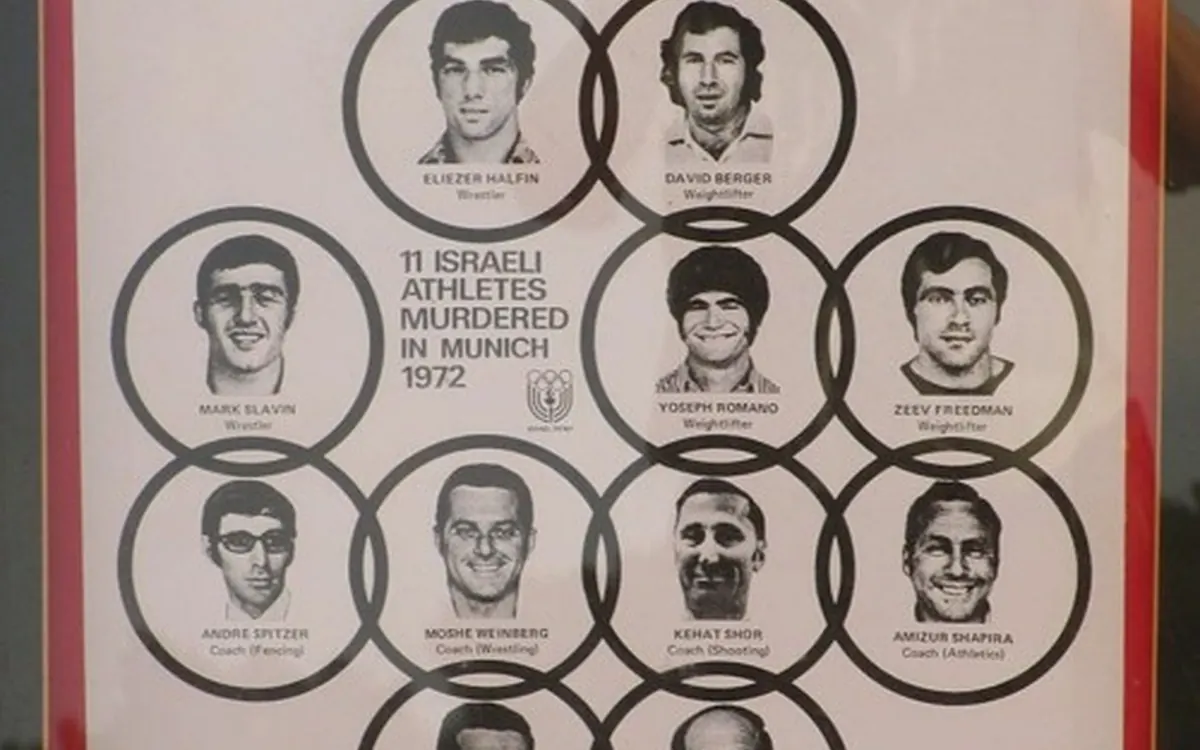
The whole world watched in horror as the murder of eleven Israeli athletes at the 1972 Munich Olympic Games by the Black September terrorist group raised the bar on international terror to previously inconceivable heights. The events cannot be forgotten, and their consequences are with us down to this day.
About this episode
Machiavelli said an injury done to a man should be such that vengeance cannot be feared, and Rav Mike opens by wondering to whom vengeance is really due. The story begins personally, in the Shaker Heights weight room he used every day, named for David Berger, one of the eleven Israeli athletes murdered at Munich in 1972. Berger grew up in an academically ambitious family where sports were no emphasis, and his mother winced when his dropped weights dented the basement floor. He won an NCAA weightlifting title at Tulane, took third at the 1965 Maccabiah in Tel Aviv, and tasted a place where a Jew excelling at the physical was simply normal. After an MBA and law degree at Columbia, he made aliyah in 1969, aiming to reach Munich and then open a law office.
In late 1971 Yasser Arafat and the Fatah leadership, their guerrilla war degraded after the massacres of Black September 1970, resolved to imitate the PFLP with headline-grabbing international terror. Salah Khalaf, Abu Ayyad, secretly headed a new organization named Black September, whose stated purpose was to make the world feel the Palestinian people exist, and whose one demand of recruits was a willingness to die. Rav Mike pauses on the internal dynamic, the old truism that revolutions eat their founders, with extremists pushing moderates to lead or get out of the way, so the group doubled as a survival bid by Fatah moderates seeking plausible deniability. Their first act avenged their namesake, the gunning down of Jordanian Prime Minister Wasfi Tal in a Cairo hotel lobby, where an assassin knelt and lapped the blood from the marble floor.
When Berger reached Munich he entered an athletic fairyland, the largest Olympic Village yet built, the first German games since Hitler's Berlin of 1936, and the organizers wanted happy games with inconspicuous, unarmed security. A warning from Beirut three weeks before was passed along and then denied, buried in a cover-up exposed by Der Spiegel only in 2012. At half past four on the morning of September 5, eight Black September men entered the village, and in the chaos Moshe Weinberg and Yosef Romano were killed and Berger wounded as they fought back, leaving two dead and nine captive. The terrorists demanded release of over two hundred prisoners in Israel and of the Red Army Faction founders, plus safe passage to Cairo. Golda Meir's stance was absolute, no negotiation, yet she sent Mossad chief Zvi Zamir to seek permission for a rescue.
What followed at the airbase Rav Mike calls a folly of errors too tragic to be comedy. The Germans placed five sharpshooters, none with sniper training, against what turned out to be eight terrorists, and the sixteen policemen posted inside the waiting Boeing voted among themselves to abandon the mission and were never reprimanded. The helicopters landed so as to deny clean shots, the scouts found the plane empty and sprinted back, and a pitched battle ran past midnight until the terrorists opened fire on their bound hostages and hurled grenades into the helicopters. All nine captives died. Around the world an estimated nine hundred million people had followed it on live television, and after an early false report of rescue, ABC's Jim McKay faced the camera and said simply, they are all gone, thinking of Berger's parents in Shaker Heights.
The decision was made that the games must go on, and Rav Mike sets Avery Brundage and Mark Spitz's seven golds against Jim Murray's line that it was almost like holding a dance at Dachau. Jean-Paul Sartre called terrorism a terrible weapon the oppressed poor have no other of, and Abu Ayyad judged that although no prisoners were freed, world opinion was forced to take note, so that two years later Arafat addressed the UN carrying a gun. Golda Meir and a secret panel with Dayan, Aaron Yariv and Zamir concluded that an extraordinary attack demanded an extraordinary response, and authorized the operation later dubbed the Wrath of God, to hunt and kill those involved. Yariv explained it as sheer necessity weighed by cost and benefit, an eye for an eye, a question Rav Mike carries into an interlude on vengeance.
Key ideas
- David Berger's path from a Shaker Heights weight room to the Israeli Olympic team gives the Munich story a personal face.
- Black September grew out of Fatah's degraded guerrilla war and the drive of moderates to get in front of the extremists.
- The murder of Wasfi Tal in Cairo was the group's first act, a blood debt paid with chilling theater.
- The massacre and the botched rescue unfolded on live television before some nine hundred million viewers.
- The world mostly chose to let the games go on, while Sartre and others framed the killing as the weapon of the oppressed.
- Golda Meir's panel answered with the Wrath of God, which Aaron Yariv defended as sheer necessity rather than morality.
Chapters
- 0:00 Vengeance that cannot be feared
- 1:05 The weight room and David Berger
- 4:20 Aliyah and the Olympic dream
- 5:25 Black September is born
- 6:31 Revolutions eat their founders
- 9:53 The blood of Wasfi Tal in Cairo
- 12:17 Munich and the happy games
- 13:23 Warnings that went unheeded
- 14:28 The pre-dawn assault
- 16:43 The demands and Golda's refusal
- 18:57 The folly at the airbase
- 21:07 They are all gone
- 22:12 The games go on
- 28:45 Sartre and the Palestinian gain
- 31:05 The Wrath of God
- 34:20 Vengeance and sheer necessity
Who, where and when
People
David Berger, Yasser Arafat, Abu Ayyad, Wasfi Tal, Moshe Weinberg, Yosef Romano, Golda Meir, Zvi Zamir, Aaron Yariv, Jean-Paul Sartre, Jim McKay, Mark Spitz
Places
Munich and the Olympic Village, Shaker Heights, Ohio, Tel Aviv, Cairo, Beirut
Texts
Machiavelli's The Prince, The Wretched of the Earth, The Der Spiegel report of 2012
When
1971 CE: Black September is founded, 1971 CE: the killing of Wasfi Tal, 1972 CE: the Munich massacre, 1974 CE: Arafat addresses the UN
Read the transcript
Men ought either to be indulged or utterly destroyed, said Niccolo Machiavelli, for if you merely offend them, they take vengeance. But if you injure them greatly, they are unable to retaliate, so that the injury done to a man ought to be such that vengeance cannot be feared. Well, there are many things to fear in this world, and I'm kind of wondering to whom vengeance is due, because I'm Rav Mike Foyer, and this is The Jewish Story. Season 4, Episode 12, The Munich Massacre. You know, I have to tell you something that you may not know about me, and that is that in high school, I was crazy for lifting weights. Every single day, at least by the end of my senior year, I was in the weight room pumping iron.
The legs, the chest, the arms, it was fantastic. And yet, despite that daily devotion, it wasn't until near the end of my senior year that I bothered to read the dedication plaque in the weight room, something I'd walk by every single day. Or to ask who was this David Berger and why had someone honored him by naming our workout space after him. Now the funny thing was, coming to know who David Berger was also brought a small bit of my own life into focus. Like why my father, who graduated from the very same high school in which I was lifting weights only two years after David Berger, had given me commemoratory medals from the 1972 Olympics when I was still quite young. Because David Berger was one of the 11 Israeli athletes murdered by Palestinian terrorists during the summer games held that year, 1972, in Munich, Germany.
And the story I want to explore today is a little bit about the nature of international terrorism, power, and even vengeance. But for me at least, it needs to start on a personal note. Because though I never had any aspirations beyond getting in shape, for four years, I lifted weights almost daily in the very same room as Burger had. And it just makes me wonder. It makes me wonder many things. One of which is, what made him different from his other, more active peers? The ones who were protesting the Vietnam War. Maybe wearing their hair long, tuning in, turning on, and dropping out. And I can't help asking if David Berger had been part of the other story of the Jewish American 60s. If he'd been out on the street fighting a man, would that have saved his life?
Or would it have reduced its impact? You know, on some level, any muscular Jew in early 60s America was a rare beast at best. I mean, still in the 1990s, when I was on the Shaker Heights football team, my mom was insisting to me, Jews don't play football. and was always a bit skeptical about how much time I spent working out. And I can only imagine the reaction of David's parents when he decided as a teenager to commit himself to physical fitness and to bulking up what he called his scrawny stature. A family friend said that his newfound passion conflicted more than a little bit with his family traditions. He started lifting and got his own weight set, she said. He grew up in an academically ambitious family.
family. Sports was not their emphasis. And when he would drop the weight on the basement floor, his mother would get upset because it dented the floorboards. Now, despite this determination to succeed in a distinctly un-Jewish realm, David didn't neglect the world of academic achievement. And so after graduating from Shaker Heights High School, go Red Raiders, where he'd been an honor student, David headed to Tulane to continue his path of combined athletic and academic achievement. In his junior year, he won the NCAA weightlifting title in the 148-pound class, and more importantly for our story, he got his first taste of international competition when he ventured to Tel Aviv for the Maccabia Games of 1965.
David took third place in Tel Aviv, and his experience not only increased his dedication to becoming an Olympic-level weightlifter, it opened his eyes to the idea that Israel might actually be the best place to pursue that dream. After all, in the Jewish state, it was normal for a Jew to excel at the physical. For many, that's what the whole state was about. So after graduating from Tulane, Berger enrolled in the joint MBA law degree program at Columbia, while continuing to rack up medals in the weightlifting world. And upon graduation in 1969, David won his weight division at the Maccabiah Games and made Aliyah to Israel immediately after. The plan was to qualify for the 1972 Munich Summer Games and then opened a law office in Tel Aviv.
And when he made the cut for the Israeli Olympic team, it seemed to David Berger that his dreams were finally coming true. Little could he imagine the nightmare which lay ahead. For the end of the summer of 1971, Yasser Arafat and the Fatah leadership decided that a change of strategy in their war to liberate Palestine was in order. That crushing defeat of Black September 1970 and the follow operations of the summer of 1971 had seriously degraded Fatah's ability to wage a guerrilla war. Now it's true that their retreat to southern Lebanon, now known as Fatah Land, created a new and far more secure base of operations, and they would return to the cross-border war model before too long. But for now, the Fatah leadership felt that the time had come to imitate the PFLP, and pull off some headline-grabbing actions of their own.
Salad Khalaf, also known as Abu Ayyad, was chosen as a man who would secretly head a new organization, one which would focus on international terror, and it was dubbed Black September in commemoration of the brutal massacres of less than a year before. Khalaf described the organization's purpose as to make the world feel that the Palestinian people exist, And as he told a Palestinian student conference in January 1973, at the height of his reign of terror, we shall find the enemy in every place. Hunt the enemy down in every place we can reach him. Remember those words when we get to the end of this story. Now, beyond its operational objectives, Black September also had some political goals. One was to drive a wedge between the Western government and their allies in the Arab world, particularly Jordan and the oil-rich Saudi Arabia.
Another was to position themselves as a power in the realm of international revolutionary movements. Over the last decade, the success of the Viet Cong against the American Goliath, along with the internal ruptures within America over the struggle for civil rights, had raised the hope amongst revolutionaries around the world that the existing global system was finally showing its cracks. Radical groups were popping up like mushrooms, the Weather Underground, West German Red Army Faction, the Italian Red Brigade, the Japanese Red Army, the French Action Direct. And by the early 70s, the PLO succeeded in supplanting the Viet Cong as the heroic model for revolutionary activism. Maybe it was because the conflict in Vietnam was fading.
Or maybe it was just a little bit too geographically specific to really carry the flag of a global movement. Whatever the cause, the Palestinian struggle was soon to be emblematic of the fight for freedom by peoples throughout the developing world. And frankly, it remains so today. That's how you can connect Patterson and Palestine. And the operations of the Black September organization did much to capture the global imagination. There was also an internal political dynamic at play with the founding of Black September. that can't be ignored. You know, since the sans-culottes captured the momentum of the French Revolution, pushing out the Girondins and ushering in Robespierre and the Jacobins, it's been a truism that revolutions often eat their founders.
Extremists gain power by clamoring for greater militancy and pushing the moderates to lead, follow, or get out of the way. And let's not forget that the result of this dynamic for the French Revolution was the reign of terror. This is a dynamic which deserves close attention in our day on the American political street. Have you noticed how those strident radical voices are pushing the process forward? Now, the Fatah leadership well knew that those perceived as moderates within a revolutionary movement are often the first to find themselves with their backs against the wall when the extremists come to power. And therefore, the creation of Black September was in many ways a bid for survival by more moderate forces within Fatah itself, an attempt to get out front and lead the herd through extreme action, if you will.
In late August of 1971, Fatah was gathered in Damascus for a general congress, and it was here that Arafat and the other leaders resolved to form Black September. And though the organization would function as a unit within Fatah existing intelligence and security apparatus it was to be kept secret and separate allowing for the ever plausible deniability meaning that Arafat continued to be a moderate who claimed that his only objective was the liberation of his home territory, while at the same time pulling the strings of a coordinated campaign of international terror. The only requirement which was asked of the recruits to the Black September, beyond their technical skills was a willingness to lay down their lives wherever and whenever a mission required.
And their first mission was to avenge the blood spilled in their namesake massacres, which had taken place the year before. In November of 1971, Jordanian Prime Minister Was Vidal was in Cairo, heading up Jordan's delegation to the Arab States Defense Council. He was there surrounded by foreign ministers, defense ministers, and chiefs of staffs of most of the Arab states. And of course, the Prime Minister was surrounded by security as well, with 15 Jordanian bodyguards accompanying him wherever he went, in addition to the general measures taken by the Egyptians to secure the meeting. Now that might sound extreme, but apparently it wasn't enough. Not in light of what occurred, or in light of who he was, because Tal had been appointed Prime Minister in the midst of that 1970 Black September uprising, and he was considered by the Palestinians to be the architect behind the Jordanian Legion's initial assault on the PLO, as well as the driving force behind the second wave of operations, which had ended only a few months before this defense council meeting.
On November 28th, as Tal entered the lobby of the Sheraton Hotel in downtown Cairo, where he was staying, he was gunned down by a team of black September terrorists. And as he lay dying, one of the assassins knelt and lapped with his tongue the blood spattered across the marble floor of the lobby before being seized by the Egyptian security. It was a grisly scene, and one that was reported in detail by the Times of London and papers around the world. The next day, the Fatah issued a statement praising the murder. We think Tal's death was the natural end of a man whose hands are stained with the blood of the Palestinian people. For our first operation, it was an unbelievable success. Black September had not only killed their man, they created an image of uncompromising violence and determination, which was broadcast instantly around the world.
It was a model which they would pursue to much success. Now, right at this moment, political incinerations made this their last attack against the Jordanians. But if Black September was ready to drink the blood of Wahsi Tal in vengeance, just imagine what they were prepared to do to the Israelis. When David Berger arrived in Munich, he felt like he entered an athletic fairyland. The Olympic Village, which had been constructed for the competitors, was the largest yet built, which reflected not only the fact that these were the largest games held to date, but also that they were the first Olympic competition held in Germany since 1936. Those games had been held in Berlin, and Hitler had used them as a platform for his Nazi ideology.
Subsequently, the Olympic Committee had been criticized for the blatant racism and anti-Semitism that characterized the competition. And now, 36 years later, the West German government was determined to offer the world a sharp contrast to that horrifying spectacle of Berlin. The games opened on August 26th with their customary fanfare. And many people noticed that security was light. The Munich organizers wanted these to be what they called the happy games. And they'd spent less than $2 million on the arrangements for security. their primary concern was that the personnel in charge of security be inconspicuous and non-confrontational. They weren't even armed. Now, needless to say, these measures were not adequate in the eyes of the Israeli security professionals, but they had no authority to operate on German soil.
And there was no way that the Israelis could know that three weeks before the coming massacre, the German embassy in Beirut reported to Bonn that an informant had talked about Palestinian plans for an incident during the Olympics. Now you can imagine security forces get these types of tips all the time, but this one was considered substantive enough that the foreign ministry passed it on to the Secret Service Munich branch with the advisory to, quote, take all possible security measures. But the warning went unheeded. Indeed, its existence was denied altogether, as was much of what lay ahead, until the details of a German cover-up were revealed in the German paper Der Spiegel in 2012, 40 years later.
Fred and Barbara Berger, David Berger's siblings, had come to Munich to cheer their brother on, and Barbara recalled being able to visit David in the Olympic Village using only a borrowed Israeli team jacket as identification to get in. David's moment in the sun, I have to say, was brief. He failed to place in his first event on September 2nd, And the siblings spent a couple more days together before Fred and Barbara went off camping in Austria early on the morning of September 5th. They would only later learn that as they were heading into the mountains, David was fighting for his life. It was 4.30 in the morning on September 5th, 1972, when five Black September terrorists climbed the two-meter-high fence surrounding the Olympic Village.
They were seen by several people, but as they were wearing track suits, no one thought anything of it. Athletes were routinely hopping the fence, and no one could know that their athletic bags were actually packed with guns and grenades. These five were met by the rest of the team, three more men who had somehow obtained credentials to enter the village through the main gate. In the pre-dawn silence, Israeli wrestling referee Yosef Guthrund heard a faint scratching noise at the door of his apartment. He got up to investigate, and as the door burst open, he shouted, In the pre-dawn silence, Israeli wrestling referee Yosef Gutfund heard a faint scratching noise at the door of his apartment. He got up to investigate, and as the door burst open, he shouted, Hey, boys, get out of here!
And he threw his 300-pound frame against the door in hopes of barring the attacker's entry. From here, chaos erupted in the Israeli rooms. Some managed to escape, others to hide. Weightlifters Roseph Romano and David Berger, together with wrestling coach Moshe Weinberg, attacked the terrorists as they were moving their first round of hostages between the apartments. Weinberg and Romano were killed and Berger wounded. In all, two Israelis were killed in the initial assault, and nine were now captive. Police and press converged on the scene of the attack, and by 9.30 in the morning, the terrorists had identified themselves as Palestinians, members of the Black September Organization. Their demand was that Israel release 234 Palestinians and others jailed in Israel along with the two founders of the West German Red Army Faction held at that time in Germany.
They themselves were to be given safe passage out of Germany ultimately to Cairo where they looked to unite with their freed brothers. It was later revealed that Romano was castrated and Weinberger's body thrown out into the street as a demonstration of their resolve. The West German police negotiators managed to extend several deadlines imposed by the terrorists, buying time for the political dance which followed. The government of Egypt flatly refused to become involved, even to provide assistance in support of any hope police action. Prime Minister Golda Meir's stance was absolute as well. Israel was and remains opposed to any negotiation with terrorists. To give in meant to guarantee that the next tack was only a matter of time.
Now, Prime Minister Meir wasn't giving in, but she also wasn't giving up. Instead, she sent Mossad chief Zvi Zemir to Munich with instructions to negotiate permission for the Sayeret, Israel's most highly trained commandos, to conduct a hostage rescue. It might have been that West German Chancellor Willy Brandt would agree to Israeli soldiers operating on his soil, considering the weight of history which he felt closing in on the events, as Jews were once more held hostage to terror on German soil. But according to the German Federal Constitution, the decision actually lay in the hands of the state officials who insisted that they had the situation in hand. The negotiations were handled by Munich Police Chief Manfred Schreiber, and tries he might, he could not get the terrorists to agree to any concessions.
As a grim background, you should know that as the hostage situation was unfolding, the games continued. In fact it was a full 12 hours after the first murder that enough pressure was brought to bear that it caused the International Olympic Committee to pause the competition at all Meanwhile, Police Chief Schreiber had concluded that a rescue attempt was his only option. At first, his forces gathered in the Olympic Village. But due to the live media broadcast, the terrorists were actually able to watch them prepare to assault on TV. And so, his next move was to feign agreement with the terrorist demands and transport them by helicopter to a nearby NATO airbase where an ambush had been arranged. Now, what followed would be called a folly of errors if it wasn't actually so tragic.
The West German police originally estimated that there were five terrorists, and that led them to put five sharpshooters in place around the plane that they had promised. But as the group emerged from the Olympic Village with their hostages, it turned out that there were actually eight. Furthermore, I said sharpshooters, not snipers. The men were actually West German policemen, none of whom had sniper training nor were given any special weapons for the assault. Now, I'm not going to detail all the failures right now, but just know that once the helicopters carrying the terrorists, their hostages, and the negotiating team arrived at the airbase, things went from bad to worse. On the tarmac, a Boeing 727 jet was awaiting.
The plan was that its flight crew had been replaced by 16 West German policemen, and they were to overpower any terrorists sent to inspect the plane while the snipers would take care of the rest. Now, I say the plan was because the team inside the plane had decided that this was a suicide mission, and they'd unilaterally voted to abandon it, An act for which they were never reprimanded. And that's really where everything began to unravel. The copters landed in such a way as to deny the rooftop snipers any clean shots. Meanwhile, when the terrorist scouts went to inspect the airplane and found it Empey, they immediately realized it was a trap and sprinted back toward their comrades. This is when the snipers finally opened fire and chaos erupted.
Two of the terrorists were killed in the initial volley, and the helicopter pilots managed to escape. But six heavenly armed terrorists took shelter in and beneath the helicopters, while the hostages remained bound inside. A pitched battle ensued. And when the West Germans finally managed to bring in armored personnel carriers to initiate an infantry-style assault, the terrorists realized that their mission had failed. Or, rather, that its goal had changed. And it was four minutes past midnight on September the 6th when they opened fire on their hostages at point-blank range with their Kolasnikov rifles, throwing grenades into the helicopters, which burst into flame. The police closed in, but it was too late.
When the smoke had cleared, five terrorists were dead and three in custody. None of the hostages survived. As I said, the Munich Massacre was broadcast on live television, and people around the world had been glued to their sets. Nearly 20 hours after terrorists had entered the Olympic Village, ABC Television's 11 p.m. broadcast relayed the good news to U.S. viewers. Though details were still emerging, a German official had announced that the nine hostages had been rescued unharmed. But Ben and Dorothy Berger, David's parents, watching from their home in Shaker Heights, Ohio, knew that the report must be wrong. If the hostage had been released, David would have called to say that he was okay. Indeed, an hour later, ABC's Jim McKay returned to the studio.
Later, he said that all he could think of was the Berger family. I knew I'd be the one, he said, to tell them if their son was alive or dead. But that night, once the definitive reports of the disastrous rescue attempt had arrived, all he said as he faced the camera was, they're all gone. And what did the world have to say in the face of such a horrific massacre? Well, I guess that depends on who you ask. First of all, I have to note that the decision was made, the games must go on. After a memorial service for the murdered Israeli athletes at the main Olympic Stadium, International Olympic Committee President Avery Brundage announced the competition would continue in order to show that the terrorists hadn't won.
I leave you to decide what you think about the morality of such a decision, and I'll throw into it the fact that Mark Spitz, famous American Jewish swimmer, won his seven gold medals at the 1972 Munich Olympics, a record that would wait almost 40 years to be broken. Nonetheless, I have to say for me, my sentiments lie more with Jim Murray of the LA Times, who wrote in response to the decision, Incredible! They're going on with it. It's almost like having a dance at Dachau. On the morning after the attack, the New York Times reported that, quote, People spoke of it to strangers on the street, expressing horror. A taxi driver, forgetting to complain about traffic for once, turned to his fare and said, but they're crazy.
The world is going crazy. The only Arab leader to issue more than a mealy-mouthed comment, a true public condemnation, was King Hussein of Jordan, who, of course, had as much to lose in face of Black September as anyone else. He called the attack a horrible crime in his message to Chancellor Willy Bunt, stating it was the work of sick minds, quote, who are opposed to humanity, the Palestinian people and Jordan, and opposed to Arabism its traditions, its values, and its cause. The reaction of the United States government was predictably complex. On one hand, the administration was concerned with containing Israel's reaction. President Nixon and National Security Advisor Henry Kissinger knew that while Israel might be justified in a harsh response, their reaction could easily send the entire region into war.
Not long before, the President had actually commented in an interview that the Middle East was akin, quote, to the Balkans before World War I, where two superpowers could be drawn into a confrontation that neither of them wants. And therefore, he and Kissinger were walking on eggshells. Initially, Ambassador Rabin pushed to get the U.S. to withdraw from participation in the remainder of the Games as a show of support for Israel, but even this move was rejected by Nixon, Kissinger, and Secretary of State William Rogers. They couldn't afford to be seen as in Israel's pocket, or at least that's how they told it themselves. Nonetheless, on the other hand, September of 1972 was a re-election season, and Nixon's campaign was well underway.
And though he didn't love them, American Jewry was a force to be reckoned with no matter what. the president's letter to Prime Minister Guldemir was addressed as much to the domestic audience as to his fellow head of state it read Dear Madam Prime Minister the heart of America goes out to you to the bereaved families and to the Israeli people in the tragedy that has struck your Olympic athletes this tragic and senseless act is a perversion of all the hopes and aspirations of mankind which the Olympic Games symbolize in a larger sense it is a tragedy for all the peoples and nations of the world We mourn with you the deaths of your innocent and brave athletes. We share with you the determination that the spirit of brotherhood and peace they represented shall in the end persevere.
Beautiful words, but they weren't really matched by so much action. On the international front, the Americans were well aware that this massacre had ushered in a new global reality, what we today call international terrorism. Due to the relatively new nature of the news media, as well as the high profile of the Olympics, an estimated 900 million people in almost 100 different countries who were watching the Olympics actually saw the Munich crisis unfold before them on the television screen. And it wasn't just the reach of this terrible act or the fear it inspired around the world. By attacking what had been up until now a sacrosanct venue, as you heard Nixon's language, and killing in such a ruthless fashion, the Black September terrorists had raised the bar for terror altogether.
Now, no one could feel safe. In an address delivered to the UN General Assembly, less than three weeks after the massacre, Secretary of State Rogers put it this way, The issue is not war, he said. The issue is not the strivings of people to achieve self-determination and independence. Notice, he rejects that justification. Rather, it is whether millions of travelers can continue to fly in safety each year. It is whether a person who receives a letter can open it without the fear of being blown up. It is whether diplomats can carry out their duties It is whether international meetings like the Olympic Games like this assembly can proceed without the ever threat of violence In short the issue is whether the vulnerable lines of international communication can continue without disruption to bring nations and peoples together.
All who have a stake in this have a stake in decisive action to suppress these demented acts of terrorism. Strong words, but like I said, they were not really matched by strong action. And they echoed down in an address that was given in New York City nearly 40 years before September 11th. This could have been the real beginning of the war on terror. And what about the Palestinians? Well, the day after the Massacre, voice of Palestine radio station, read out a letter which claimed to be the last word of the terrorists. We are neither killers nor bandits. We are persecuted people who have no land and no homeland. We will the youth of the Arab nation to search for death so that life is given to them, their countries and their people.
Each drop of blood spilled from you and from us will be oil to kindle this nation with flames of victory and liberation. And despite the horrific nature of the attack, these were words which resonated in many quarters. World-renowned existentialist philosopher, Frenchman Jean-Paul Sartre, wrote the introduction to the 1961 edition of Frantz Fanon's The Wretched of the Earth. And there he declared, in the first days of the revolt, you must kill. To shoot down a European is to kill two birds with one stone, to destroy an oppressor and the man he oppresses at the same time. There remain a dead man and a free man. And while Sartre's exact stance on the Arab-Israeli conflict is a storage of huge academic conflict, his statement in response to the Munich massacre was really quite straightforward.
Quote, Terrorism is a terrible weapon, but the oppressed poor have no others. According to Abu Ayyad, founder of the Black September, the Munich mission, quote, didn't bring about the liberation of any of their comrades imprisoned in Israel as they hoped, but they did attain the operation's other two objectives. World opinion was forced to take note of the Palestinian drama, and the Palestinian people imposed their presence on an international gathering that had sought to exclude them. And the fact is that just over two years after the attack, PLO head Yasser Arafat was invited to address the UN General Assembly, a meeting he went to toting a gun. We'll have that discussion. and shortly afterward, the PLO gained special observance status in the international body.
And this leaves us with only one more party's reaction to consider. An editorial in Israel's most popular newspaper, Mariv, set the tone of the day. The time has come, declaimed the editor, for a major stock-taking, settling the one and only account we have with the guerrillas and the dispatchers. We shall hit them at home. We shall settle our account with them and their dispatchers. Prime Minister Meir echoed the sentiment from the Knesset podium, declaring we will smite them wherever they may be. And indeed, within three days on September 8th, the Israeli planes were bombing PLO bases in Syria and Lebanon, killing scores of guerrillas and civilians. But this was a standard reaction. expected, if despised, in certain quarters.
And the Prime Minister felt that such an extraordinary attack called for extraordinary response. And that is how a top-secret counter-terrorist committee is born. Prime Minister Meir and Defense Minister Moshe Dayan chaired this special panel. General Aaron Yariv, the Prime Minister's advisor on counter-terrorism, as well as Mossad Chief Tzvi Zamir, were also involved. and the question at hand was how Israel was going to deter terrorists. How can you stop a group which shows increasing sophistication of operational capability and an unbounded willingness to die for their cause? The deliberations of the committee took on an added measure of importance. Only eight weeks later, with the release of three terrorists that the West German police had managed to capture after the Munich massacre, It happened on October 29th.
A Lufthansa Boeing 727, on its way from Damascus to Frankfurt, was hijacked by two terrorists as it left Beirut Airport. Oddly enough, there were only 11 passengers on board, all male, and when the pilot was told to fly to Munich and the terrorist demands were relayed to Bonn, within hours, German Chancellor Willy Brandt had given in and the three prisoners were handed over. Israel was not consulted. Many claimed, then, as now, that this was all a facade, that a deal had been struck between the Germans and the Palestinians, and that the release of these black September prisoners was a payment of protection which would keep the terrorists from operating any more on German soil, a behavior which would become increasingly common in European capitals.
Be that as it may, this failure of justice made it very clear to Prime Minister Golda Meir and her secret panel what must be done. The panel concluded that the most effective means to make a clear statement that Israel would not tolerate terrorist activity of any kind was to authorize the assassination of any Black September terrorist involved in the Munich attack. A list was drawn up, one which included any individual identified as either directly or indirectly involved in the planning or the execution of the assault on the Israeli athletes and the Mossad was put to task. It was made very clear that the objective was to kill, not to capture, and to sow terror within the Black September and all the other terror organizations.
This was no mission to prosecute suspects. The days of the Eichmann trial were done. Over the coming 20 years, the Mossad hunted down and killed many of the men involved in the Munich massacre, as well as bystanders who were entirely innocent. There were dramatic victories and fantastic blunders. And there are a number of books and movies which have been made on the subject, many of which I'm sure you've seen and read. The problem is that considering the nature of the mission, it's doubtful that any official evidence of the assassination program even exists. All that remains is an abundance of newspaper articles, investigative reports, police documents, declassified U.S. government files, all of which verify the assassinations of these terrorists, but none of which explained exactly how it happened.
The mysterious operation has been dubbed the Wrath of God, though it's likely that that was a creation of the media. I myself wouldn't put it past being a product of Israeli psychological warfare, hoping to just notch up the fear and paranoia with the PLO all that much more. Now there's a moral question which emerges from the Wrath of God operation. How do we relate to the quality of vengeance? and what does it have to do with justice? I think that I need to do an interlude on that next week. But for now, I want to end this episode with a quote from General Aaron Yariv, who, as the Prime Minister's advisor on counterterrorism, oversaw the operation. We had no choice, he said. We had to make them stop, and there was no other way.
But it was a question of sheer necessity. We went back to the old biblical rule of an eye for an eye. I approach these problems not from a moral point of view, but, hard as it may sound, from a cost-benefit point of view. If I'm very hard-headed, I can say, what's the political benefit in killing this person? Will it bring us nearer to peace? Will it bring us nearer to an understanding with the Palestinians? In most cases, I don't think it will. But in the case of Black September, we had no other choice, and it worked. Is it morally acceptable? One can debate that question. Is it politically vital? it was. And I'm happy to share with you the details of how you can dedicate a show in honor of your loved ones today or those who have passed on.
I want to thank the Land of Israel Network, that's thelandofisrael.com, for creating a platform that allows me to reach so many wonderful people. I want to thank the Pardes Institute, pardes.org.il, for building an educational institute that gives me the privilege of teaching so many amazing Jews. And I want to thank you for listening. I'm Rav Mike Foyer, and this is The Jewish Story. Thank you.
More from Season 4
TJS S4 Interlude: Interview with Rena Rossner
The power of fairy stories goes well beyond entertainment. In this interlude Rena Rossner, author of The Sisters of the Winter Wood joins me to explore myth, story...
Play Episode
TJS S4E11 Black September
There is a narrative battle which has been raging for decades between Arab and Jew in the land of Israel, and sometimes it breaks out into open warfare....
Play Episode
TJS S4 Interlude Adar: doing more with joy
It is Adar once again, believe it or not! Here at the end of a Covid-crazy year the call to increase joy can also be heard as a...
Play Episode