
TJS S4E13 Yom Kippur War part I - the context for surprise
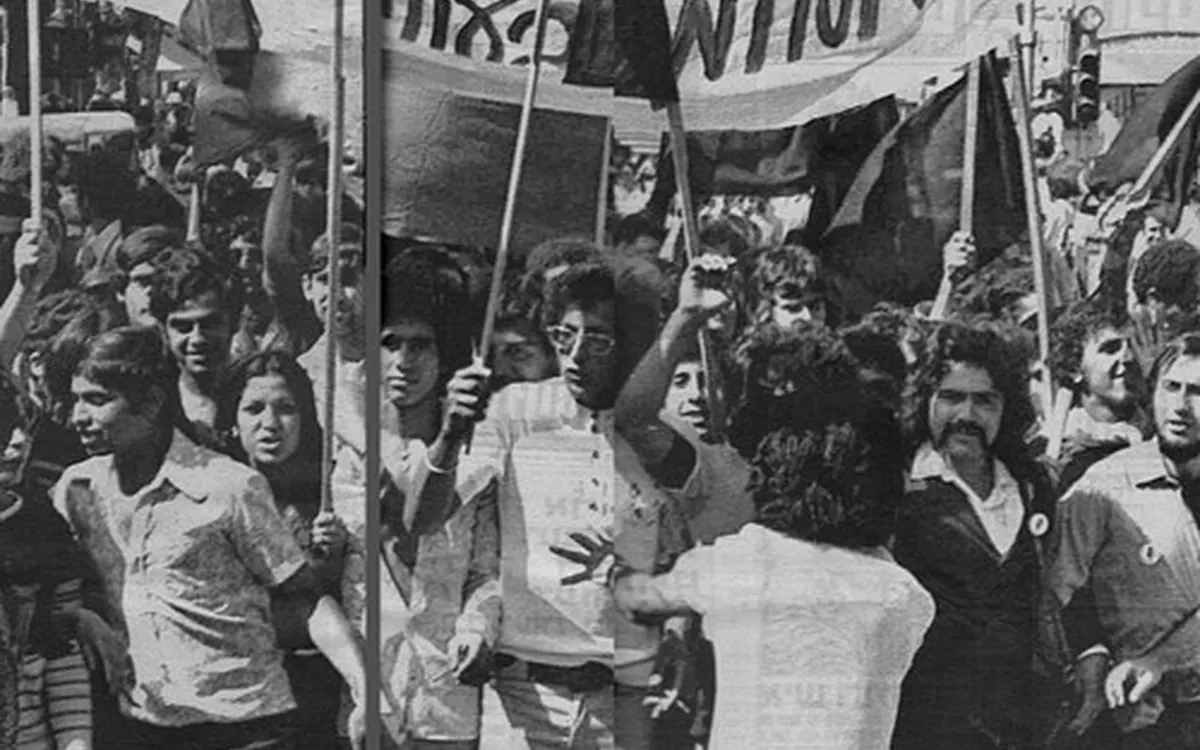
If we call what happened in the 1967 a war of the spirit, then what occurred seven years later was a struggle of psychology. Here is the first episode leading up to the 1973 Yom Kippur War. It explores the booming economy, the Israeli Black Panthers and the emergence of a new leader of Egypt, all in an attempt to understand the context for surprise. Learn about Moroccan Jewish immigrants to Israel such as Charlie Bitton and Saadia Marciano, the Musrara neighborhood of Jerusalem, Prime Minister Golda Meir, Egyptian leader Anwar Sadat, and the Suez Canal.
About this episode
Wayne Dyer said that changing the way you look at things changes the things you look at, and Rav Mike needs that lens to understand how 1973 followed 1967. He frames the Six-Day War as a war of spirit, fought while the Holocaust's shadow was still real and mass graves were dug in Tel Aviv parks, crowned by the miracle of Jerusalem and Naomi Shemer's song. The Yom Kippur War he calls a war of psychology, where surprise was the ultimate advantage and the reasons for it were purely national character, a disaster that the post-game analysis shows did not have to happen. It is the first war where many casualties were treated for shock, branding the psyche of a generation. His aim across these episodes is to check the national head and build the context in which the surprise became possible.
After 1967 Israel was booming, with the GNP growing at ten percent a year, television arriving, roads filling with private cars, and new Sinai oil wells feeding a sense of economic powerhouse. The boom soon showed its ugly side, as the gap between rich and poor widened and a quarter century of Labor rule bore its fruit of corruption, with protexia, insider deals and speculation driving housing prices up. The collapse of the Israel Corporation into embezzlement was only the most famous case, tax evasion was becoming a way of life, and the rot reached even the army, where generals became vote magnets and a cult of personality formed around Moshe Dayan. The country would pay for this in October 1973, when whole tank battalions found themselves missing essential gear that contractors had been paid for and never supplied.
The deeper bad lay in social inequality, which Rav Mike revisits through the Ashkenazi-Mizrahi divide and the life of Charlie Bitton, born in Casablanca and settled young in the Jerusalem neighborhood of Musrara, a former battlefield left for emergency housing. Bitton stayed in school through an ORT vocational track, grateful for work yet resentful that boys like him were steered toward trades while others were groomed for degrees. A growing perception held that a government born of European Zionism still served European Zionists, and real discrimination, as in the Wadi Salib riots of 1959, fed the grievance. When the postwar boom lifted all boats unequally, and rumors spread that Musrara would be rebuilt for incoming Soviet immigrants who would arrive to apartments rather than tents, Bitton and his friends had eyes to see that not everyone's struggle was the same.
In 1971 these young men formed the Israeli Black Panthers, borrowing a name meant to frighten Golda Meir and to voice a racism and exclusion that felt close to home. Taught by anti-Zionist students to name the causes of injustice they already felt, and handed the tools of protest by municipal workers, they marched without a permit, pulled off Operation Milk by moving bottles from wealthy Rehavia to the slums, and filled Zion Square on the Night of the Panthers. Golda met them, gave an empathetic ear and no commitments, and then stumbled, calling those who threw Molotov cocktails at Jewish police not nice boys, words that spread as a verdict on a whole community. The lesson Rav Mike draws is a government grown self-referential, unable to see how those outside its world experienced it.
If Golda's circle could not see the divides inside its own society, Rav Mike argues, it is no surprise they misread the map of the Middle East. Nasser had died, and his successor Anwar Sadat was dismissed as a bland placeholder even as he presented a reworking of Dayan's canal plan and, for the first time from an Arab leader, spoke of peace in exchange for withdrawal. Dayan preferred Sharm el-Sheikh without peace to peace without Sharm el-Sheikh, and Golda wanted defensible borders that would deter by their mere existence. The leadership convinced itself through what became known as the concept, that Egypt could not fight without long-range bombers and missiles and that no Arab state would move without Egypt, so war was impossible. Kissinger's later words sum it up, that their definition of rationality never imagined starting an unwinnable war to restore self-respect.
Key ideas
- Rav Mike reads 1967 as a war of spirit and 1973 as a war of psychology, where surprise decided everything.
- The postwar boom carried corruption, protexia and a cult around Dayan that eroded the army's discipline.
- Charlie Bitton's Musrara shows how the Mizrahi community was steered toward trades and left feeling unseen.
- The Israeli Black Panthers turned felt grievance into protest, from Operation Milk to the Night of the Panthers.
- Golda's not nice boys remark revealed a government grown self-referential and blind to lives unlike its own.
- The concept assumed Egypt could not fight and no Arab would move without it, which blinded Israel to Sadat.
Chapters
- 0:00 Change and the way we look at things
- 1:10 A war of spirit and a war of psychology
- 3:26 Surprise as the ultimate advantage
- 6:48 The boom after sixty-seven
- 8:01 The ugly side of abundance
- 9:08 Protexia and the spoils system
- 11:19 Corruption reaches the army
- 13:35 Charlie Bitton and Musrara
- 16:51 The resentment of a vocational life
- 18:58 Soviet immigrants and a neglected neighborhood
- 21:19 The Israeli Black Panthers
- 24:41 Operation Milk and the Night of the Panthers
- 27:56 Golda and the not nice boys
- 31:34 Misreading the map
- 33:46 Sadat says peace
- 35:58 The concept and its blindness
Who, where and when
People
Golda Meir, Moshe Dayan, Charlie Bitton, Reuven Abergel, Anwar Sadat, Gamal Abdel Nasser, Henry Kissinger, Naomi Shemer
Places
Musrara and Jerusalem, The Sinai, Wadi Salib in Haifa, The Suez Canal
Texts
Jerusalem of Gold, The slogans of the Black Panthers, Kissinger's postwar remark
When
1967 CE: the Six-Day War, 1971 CE: the Israeli Black Panthers, 1971 CE: Sadat speaks of peace, 1973 CE: the Yom Kippur War
Read the transcript
If you change the way you look at things, says psychologist Wayne Dyer, the things you look at change. And the way I look at it, there's a whole lot of change that's got to happen in the world. Because I'm Rav Mike Foyer, and this is The Jewish Story. Season 4, Episode 13, Yom Kippur War, Part 1, Building the Context for Surprise. You know, perhaps it's an inevitability that when we want to understand the 1973 Yom Kippur War, we're going to compare and contrast it to the Six-Day War that occurred only seven years before. And in reality, there's a good argument to be made that you can't actually understand one without the other. Now, my good friend, Yishai Fleischer, makes an important distinction. He likes to say that the 1967 Six-Day War was actually the war of the religious Zionist world, a bit of a vision of a redemptive national story, while the 73 Yom Kippur War really belongs to the secular left and their vision of a garrison state doomed to a perhaps hopeless struggle.
I don't want to dive into that right now, although it's going to have to be a critical part of our post-war analysis. So there's also, of course, the way in which 67 led to 73. I'm not talking about the sort of Paris Peace Conference sense that the Allies in World War I set up a situation in which it was inevitable that Germany was going to go back to war because she was so down and out. Now, I might say there's a bit of a sense of a divine pairing. Certain elements of the religious Zionist camp would also like to make this argument that the failure to appreciate the fruits of the first war and its miraculous nature led to the divine punishment of the second. And I'll touch that thread when we get back to the movement for the settlement of the greater Israel in the aftermath of the war.
There's also, of course, the problem of pride, a little bit less divine, but more psychological, and that leads to our discussion today. because I have a tendency to view the distinction between the 1967 Six-Day War and the 1973 Yom Kippur War as a story of spirit versus one of psychology. I like to call the 1967 war a war of spirit because Am Yisrael as a whole, and in particular the state of Israel, was still in that raw, emotive, will-driven condition. The national psychology hadn't yet gilled. We were living on spirit. I mean, don't forget, it was a time in which the shadow of the Holocaust was so real that it wasn't hard to believe that the mass graves that were being dug in the parks of Tel Aviv would soon, God forbid, have been filled.
There was also a sense of momentum from 1948. There were visions of finishing the conquest. Jerusalem was still divided, so our spirit wasn't just broken from the shadow of the Holocaust, but it had begun to awaken. And then, of course, there's the miraculous six-day victory, which allows a framing of the War of Spirit to be so compelling. Just picture Rav Gorin sweeping into Hevron on the wings of spirit, or how moving the whole world found Naomi Shemmer's immortal classic, Jerusalem of Gold. This is what I mean by a War of Spirit. Now compare that to the 1973 War of Psychology. Surprise, of course, is the ultimate psychological advantage. And as we'll come to see in later episodes when we actually look at the war itself, it's not just a reality in the moment.
Once you seize the initiative, you hold the psychological edge in every subsequent encounter. And the reasons that Israel was surprised were purely a product of national psychology, which the post-game analysis shows pretty conclusively did not have to happen. And this is going to take us into a realm of reflection within the Jewish story we haven't actually seen since the wars that ended the Second Commonwealth. How aspects of the national character and collective historical experience can combine to create a disastrous behavior and frame for decision-making, which appears obvious after the fact. It's not that we haven't touched on the same idea. For instance, our discussion of why the Jews of Spain converted in such large numbers when compared to the Jews of the Rhineland during the Crusades.
But there's something fundamentally different. When we have the nation embodied as a state within a large majority of the biblical borders, in a sense, when we put 67, 73, and of course 48 together, it almost feels like we're writing new chapters of the book of Judges. And, of course, our understanding of the impact, the aftermath of the war, will have to be eminently psychological. Kip Shuto, in the most simple sense, the 1973 Yom Kippur War will be the first where a significant percentage of the casualties were also treated for shock. And it's the war that will therefore brand the psyche of a generation, the generation that runs our country right now, by the way. Practically speaking, because the 1973 war was such a surprise, there is no waiting period type of buildup that characterized the Six-Day War, which means for me that whatever pre-war episodes I can offer are less a tracing of the direct narrative threads that lead to the conflict and more a laying out of the context in which that surprise attack occurred.
But of course, since much of that context is itself what allowed the attack to be a surprise in the first place, the distinction between causality and context is not so easy to make. So basically, with this episode, I want to start a process that I think of as checking the national head. And I'm going to do my best along the way to return us to the fact that we're building a context for the lead up of the war, but it may seem a little bit thin at times. So I'm going to ask you to keep this in mind. Our goal is to understand how it could be that in the space of seven years, Israel went from a victory of biblical proportions to a struggle where, despite its ultimate victory, its very existence hung in the balance.
If you recall the lead-up to the Six-Day War, you may remember that Israel was in bad economic straits. straits. There were so many people who were basically economic refugees leaving the country that the running joke was, last one out through Lod Airport, please shut off the lights. Nonetheless, the society as a whole could bear it because it had really never known anything else. The two decades before the 67 war had been ones of relentless struggle, economic, military, immigration. Go back to season three and listen in. But all that seemed to change. in June of 1967. The economic growth was rapid after the war, and frankly, it had all the hallmarks of a boom, the good, the bad, and the ugly. And for the sake of our story today, I'm actually going to present it as the good, the ugly, and the bad.
So the good news is that in the late 60s, early 70s, Israel was booming. The rising economic tide began to lift after the war and showed no signs of stopping. In fact, the gross national product, the GNP, grew at an annual rate of 10% right through 1973. Furthermore, it's a seller's market out there in the labor pool. The need for workers in the economy is so widespread that even 130,000 Arabs commuting daily from the newly acquired, administered territories, as Moshe Dayan likes to call them, aren't enough to take up the slack. Now remember, television is only introduced into Israel in 1966. It had been held off as a pernicious influence by Ben-Gurion and the old labor guard. But only a half decade later, there will be antenna sprouting like a forest over the new buildings in the cities, and the roads are becoming choked with 370,000 private vehicles.
That's in a population of only 3 million. Combined with the newly acquired oil wells of the Sinai, this means that Israel feels like it's on its way to becoming an economic powerhouse. Never had the Arab attempt to crush the new state through embargo seemed to be more futile. But before too long, this boom, for all its good, began to show its ugly side. Remember, going good, ugly, bad here. The gap between rich and poor grew just as fast as the economy did and showed itself as the structural problem which still plagues us today, and one which seemed to put a lie to the socialist foundations of the ruling Labour Party. And to make it worse, that Labour Party's exclusive control of government for almost 25 years at this point, and that's just counting post-48, was bearing its inevitable fruit of corruption, driven by an increasingly materialistic nouveau riche, many of whom had gained their wealth directly through public subsidies and insider deals.
In 1971, Yitach Ben Aron, Histadrut Secretary General, the Histadrut is the General Labor Unit of Israel, and at the time, a tremendously powerful force in the economy, he observed that though 95% of the country's land was publicly owned, the remaining 5%, which was almost entirely urban big city, was the object of blatant speculation, something which continued to drive up housing prices in an insupportable manner, something which we still suffer from by the way today And he accused the government of being the silent partner in what he called a spoils system harshly criticizing the phenomenon of protexia which, if not outright bribery, was basically a systematic approach to peddling influence.
And suddenly, when you looked around, officials of the party, whose roots were with A.D. Gordon, Burl Katniss, and Bear Borokoff, were living in fancy villas, driving the most expensive cars in fighting for choice, travel, and expense accounts on the government bill. Perhaps the most notorious case of this type of corruption was the collapse of the Israel Corporation. They'd been established by Levi Eshkol back in 1968 and funded by Jewish investors from around the world. By 1974, it would be in ruins, brought down by a series of bad investments and outright embezzlement of tens of millions of pounds. And that's just the most famous example. And this is more than just the political elite, a group of people in power who had abandoned their ideological roots to fight for the makoma hei karob le kara, like they say, the closest place to the trough.
For the average citizen, tax evasion was in danger of becoming a way of life. And as much as there was resentment toward the high-level corruption, there was more than a little bit of envy toward it as well. Even the army, once the bastion of rigid discipline and moral purity, was not spared the corrupt influence of these sudden riches. After the Six-Day War, generals were Israel's new heroes. And as the focus of national pride, not to say adulation, they were also vote magnets for the political parties, which now began to court them shamelessly. Flattered, wined and dined, it was only a matter of time before the men responsible for the safety of the nation began to let that rot work its way not just into their ranks, but down into the rank and file.
Now, Defense Minister Moshe Dayan was in the position to fight that corrupting influence, but instead he seemed to be leading the charge as the center of a virtual cult of personality. The country is going to pay a real price for this loss of discipline. When war breaks out in October of 1973, whole tank battalions will discover that they're missing critical essential gear. Contractors will have been paid for work they never did, and overall discipline will have been deeply eroded. Basically, the sense of spaciousness provided by the tripling in size of the country, together with a rush of material abundance, was downright intoxicating. We could just say that the economic and political leadership, as well as a good slice of the citizenry, was more than a bit full of itself.
And let's not forget, the pride comes before the fall. So we've got the good, fantastic growth, which cannot be discounted, and the ugly, cheap materialism, rampant individualism, socioeconomic arrogance and corruption. What about the bad? Well, frankly, there are a number of directions in which I could point that finger. The question of the economic and social relationships between Arab and Jew in the newly conquered territories, I'm going to leave for its own discussion later. Right now, I feel like the extent of the bad can be better appreciated, and in particular, how it represents a certain type of psychological blindness that allows for the context of a greater international blindness to emerge if we explore the issue of social inequality by revisiting for a few minutes the Ashkenazi-Mizrahi divide.
Charlie Bitton was born in Casablanca, Morocco and in 1949 at age 2 came to the land of Israel along with half of Moroccan Jewry he was part of that first great ingathering that doubled the population of the new state within 3 years of its foundation the second half of Moroccan Jewry would follow in 1956 if you want to review the immediate consequences good, bad, or otherwise, of such a biblical-scale populationship, you can go back to Season 3, Episode 4. For now, I'm moving forward. Due to their relatively early arrival, the Biton family did not land in the Ma'abarot, those transit camps which often became semi-permanent slums. Nor did they end up building the cities in which they would live, as happened to many in development towns like Dimona, Rucham, Kiryat, Shona.
They, instead, were settled in the newly conquered Jerusalem neighborhood of Musrara, along with many of their fellow Moroccans. Tucked between Me'asharim to the north and the old city to the south, Musrara was a battlefield during the 48th War of Independence. In the course of one year, went from a wealthy neighborhood to a no-man's land as the Arab residents fled or were driven out during the fighting. And the fact that most of its buildings were left intact made it a perfect option for emergency housing in the center of the Holy City. By all accounts, the neighborhood received not so much attention or development from the municipal authorities in the years between 48 and 67, but in all fairness, it was dangerous border territory in every sense of the word.
Bombed out buildings left from the war, shared the streets with crowding living spaces, and the threat of random sniper fire from the Jordanians on the other side of a divided Jerusalem was quite real, as was the poverty of most of its residents, uprooted from their lives abroad, dropped into a country which itself was struggling to survive. Unlike many of his peers, Charlie managed to stay in school, first the municipal elementary and then an art vocational school. It's worth it to actually say a quick word about the Organization for Rehabilitation Through Training. It was founded back in 1880 in St. Petersburg to provide professional and vocational training for young Jews. And it began its operations in Israel in 49, just about the time that Charlie B.
Tone arrived. At this point, there are 210 art educational institutions, ranging from an engineering college to an elementary school, mostly around Israel's periphery, and 100,000 students in attendance. Just a word of praise for those who do that kind of work. So Charlie's experience embodies that of many immigrants from North Africa and the Middle East. The primary schooling option open to him, beyond the elementary, was a vocational school, something for which on one hand he was grateful, but on the other, which he came to resent. Now the source of the gratitude is obvious. Working is better than abject poverty, and Charlie and his peers had eyes to see the national struggle to survive and grow unfolding around them, but they also had eyes to see that not everyone's struggle was the same.
and thus the resentment. As the first decade of the state passed, there was a growing perception amongst non-European immigrants that the government, which you remember had emerged out of the World Zionist Movement and the Jewish Agency, weren't just a product of European Zionism. They remained primarily in service of European Zionists. The government, private organizations like ORT, etc., made trade schools specifically available to kids like Charlie B. Tone, not college degree tracks, because they were meant to be mechanics, plumbers, hairdressers, and the like, not doctors, lawyers, and such. And the resentment which Charlie and his peers felt was more than simply the envy of neighbors getting the better piece of the pie.
Persistent poverty was part of their life, and a feeling of ethnic grievance, along with, by the way, experience of real discrimination at the hands of the police, something which, in 1959, actually led to a series of violent demonstrations in a place called Wadi Salib, a neighborhood of downtown Haifa. It was touched off by the police shooting of a young Moroccan man. Now, we can attribute this ethnic stratification of Israeli society to many things. And like I said, if you want to explore the complex elements of the backstory, you can revisit Season 3, Episodes 3 and 4. For now, the why isn't so critical, but rather the what in which Charlie B. Tone grew up, a world in which he lived in a poor, neglected neighborhood and was being prepared for a life of economic service, if not downright servitude.
Now, as I said, the whole country was struggling between 48 and 67, but with the Six-Day War boom, Charlie and his peers rightly expected that a rising economic tide would lift all boats, and indeed it did, just not in an equal fashion. Between June and July of 1967, Musrara went from being a dangerous border neighborhood to being the center of united Jerusalem. And before too long, there was talk of government plans to rebuild the neighborhood with high-rise apartment complexes. And by 1971, the rumor was that they were destined for a hoped-for influx of Soviet immigrants. There's a lot of threads going in our story at this point. And I know I keep saying this, but we'll visit the struggle or revisit the struggle for Soviet journey in its proper time and place.
For now, it intersects our story in a very specific way, one which is a sad demonstration of the law of unintended consequences or the rule that no good deed goes unpunished. I hope you recall the failed hijacking attempt that served to elevate the plight of Soviet Jewry onto the international stage back in 1970. We discuss it in episode four of this season. Well, by 1971, Soviet Premier Vyoneh Brezhnev had relaxed the quotas on immigration in an attempt to improve relations with the West part of that era of detente which is a critical piece of our context The result was that 27 Jews suddenly applied for exit visas at the beginning of 1971 almost three times the number which had applied the year before, and more than 25,000 were granted.
It seemed that another tidal wave of Aliyah might be in the offing, and Israel of 1971 was not the Israel of 1951. These immigrants would land in the comfort of apartments, not tent camps, and their professional skills would help fuel a rapidly growing economy instead of building the very cities in which they'd live. Well, that's good news for the Jews, right? I guess it depends on which Jews you ask. Because 1971 was also a turning point for Charlie B. Tone and his friends. As the 60s came to a close, the municipality did actually bring something to their neighborhood. It wasn't better garbage service, though. It was political consciousness. You know, they say that unlike American Jews, who remember Prime Minister Golda Meir quite fondly, everybody's grandma after all, many, if not most, Israelis recall her with mild, if not intense, dislike.
One reason should be obvious, the failure of her government to foresee and prepare for the Yom Kippur War. That tale lies ahead. But remember, I want to keep a finger on our overall context. I'm trying to get a feeling for what's happening in a country that will allow it to go from such a fantastic victory to the brink of destruction within seven years. Another reason that Israelis don't remember Golda so fondly is what she once said about a group of young Moroccan men from Musrara. So like I said, by the end of the 60s, political consciousness is bubbling in Musrara, as it was elsewhere in the country and all over the world, along with a good deal of anger at the socioeconomic inequality which was their lived reality.
It was anti-Zionist and communist university students who first taught Charlie Bitton, Reuven Avergel, Kochav Shemesh, and other young men of Musra'a to understand the causes of the injustice which they already felt in their flesh. Now add to this the power of protest and the tools of mass media, which were introduced to them by members of the municipality's community work division. And they began to understand as tools which could give voice to their pain. And the result would be a group of 10 young men who came together in 1971 to protest their hard social conditions and hoping to educate the establishment which they felt was willfully ignorant of their suffering. These young men from Musra also looked to vent some serious anger at the favoritism, if not outright racism, behind the treatment of the Soviet immigrants who looked to be receiving a better life than the one they and their parents had labored for decades and not achieved.
And they get that on arrival. In a sense, Charlie Bitton and his peers were passing deep judgment on the state and its heroic narrative of the ingathering of the exiles, which was so important to the Zionist story. As they said, you brought us here. It's your responsibility to take care of us. And they felt that that responsibility had been a failure. Furthermore, these young men were looking to create a model of leadership for themselves in what was basically a total vacuum. At this point, Jews of North African and Middle Eastern descent were almost completely absent from Israeli politics, senior public services, and higher education, which is in part why they chose the name of the Israeli Black Panthers.
Bobby Seale and Huey Newton might be far away on the globe, but sociologically, their experience of racism and exclusion from the American establishment felt quite close to home for these young men of Musra. So Adi Marciano, a Moroccan-born Jew and founding member, later said that the group also chose the name of the Black Panthers because they thought it would scare Prime Minister Golda Meir. Furthermore, the revolutionary ideology of the American Black Panther Party, as well as its willingness to use any means necessary in pursuit of their aims, were an inspiration to action. In February 1971, the Black Panthers filed a request with the police to hold a protest in Jerusalem against the cost of living.
They were denied the permit, but went ahead with the demonstration nonetheless on March 3rd. And from that day on, periodic demonstration continued for months, and at times becoming violent and leading to serious clashes with the police. But the goal of the Panthers was not protest for protest's sake. They wanted a voice in the decision-making structures that shaped their lives. In early April 1971, they threatened a hunger strike at the Western Wall if Prime Minister Meir would not meet with them to hear their complaints. And Golda agreed. It ended up to be Reuven Abregel who presented their case. Abregel was a few years older than Charlie Bitton, like him Moroccan-born. His political awakening actually came in the wake of the Wadi Salib riots.
And when the Panthers were formed in Musrara, his house became their headquarters. He told Prime Minister Meir, there are many obstacles for people like me. They don't have the opportunity to rise. We're not seeking welfare funds or charity. We're healthy and we can work. All we want is the opportunity to advance ourselves. If this was just my problem, he said, it would have been wonderful. But there's the problem of the Sephardim or Mizrachim, who formed 65% of the country's population, many under the poverty line, earning less than 400 lira a month. We're talking about families, he said, with 10 or more children. What they earn isn't enough to live. I wandered in the neighborhoods. I saw it with my own eyes.
now the Prime Minister gave them an empathetic ear but didn't make any commitments and so the protests continued even after the meeting along with some more creative forms of direct action meant to shock the establishment into taking them seriously one of the Black Panther's most famous acts was nicknamed Operation Milk they stole milk bottles from the relatively wealthy neighborhood Ashkenazi neighborhood of Rahabia and distributed them to the poor living in the slums of Jerusalem writing on the bottles for the children of the slums who don't have the milk that they need in the morning while elsewhere cats and dogs live in luxury. The protests reached their peak on May 18, 1971. It was a night dubbed the Night of the Panthers when more than 5,000 demonstrators gathered in Jerusalem Zion Square without police permission.
When the security forces moved in to disperse the crowd, the protesters threw stones and Molotov cocktails, leading to injuries on both sides. Twenty people were hospitalized, and the police arrested over a hundred. An event of this scale was bound to produce results in national politics. The next day, the Rakkak, that's the communist faction in the Knesset, proposed a no-confidence motion against the government, claiming that the police conduct during the demonstration was brutal and excessive. Now, the motion was voted down by a wide margin, but the Panther cause had become a prominent feature on the public agenda. Two ministers actually demanded the government present a plan of action to solve the issues which they were raising, and a public committee was established.
The very next night, Prime Minister Meir met with what she deemed to be the legitimate representatives of the Mizrahi community, and this is where she put her foot in her mouth. The host of the evening was Shaul Ben Simhon, himself an important political figure. He was a Moroccan Jew, founding member of the World Organization of North African Jews. He happens to be the person who made the Mimuna a public event for the first time in 1968. And Ben Simchon was a member of the Histadrut Central Committee, Labor Party activist. So basically, he was an establishment man, and Prime Minister Mayer felt she was on safe ground. Nonetheless, when the topic of the protests of the night before came up, Ben Simchon commented that he had met with some of the young men who had been arrested, and found them to be, Bahurim Nechmadim, good guys, nice guys, to which Golda responded, people who throw Molotov cocktails at Jewish police aren't nice guys.
It was an innocuous enough remark, and one which really can be easily understood in light of Golda's own life experience. Nonetheless, it shows a stunning lack of understanding for the depth of the problem which these not-nice boys and their community face, A problem which, if not deliberately created by the Ashkenazi labor elite that Prime Minister Amir represented, it was certainly their responsibility to fix it. And it was the subject of deep neglect. Now, aside from the importance of the Israeli Black Panthers unto themselves as their own story, this is what I want you to take from the story as part of our context leading up to the Yom Kippur War. The mentality of Israel's government had become self-referential, if not downright self-justifying, meaning the way that they lived was the way in which the world ought to be, and anyone who deviated from that must have their own problem.
therefore its ability to engage those problems without and within was deeply impaired. If you can't get outside of the way in which you see the world and understand how those who are complaining see it then you'll never be able to bridge between the two worlds in which you live. Golda's comment meanwhile spread like wildfire. In doing so it was transmuted from a comment about the behavior of the panther people who throw Molotov cocktails at Jewish police aren nice boys to a comment on their ethnic community These Mizrachim are not bachurim nechmanim, they're not good people. And her words came to embody the attitude of a government, as it was perceived by many in the Mizrachi community, elderly, complacent, out-of-touch Ashkenazi power elite.
The protests continued as well, and for months going, you could see signs reading, Golda, Golda, get already. Everybody's had enough of you in downtown Jerusalem. And you could hear speeches addressing, quote, the War of the Black Panthers against the Ashkenazi government. The Knesset Committee, which was formed in the wake of the Night of the Panthers, concluded, in fact, that discrimination did exist at many levels in society, and they pushed for significant increases in the budgets of the offices dealing with social issues. But in a repeated trope in Israeli society, the Yom Kippur War changed the government's list of priorities only two years later. And most of those resources were turned right back towards security needs.
By the way, Biton and Abigail and their fellow activists didn't stop. In the summer of 1973, only months before the war, Kochav Shemesh met with Angela Davis, as well as the leaders of the Palestine Liberation Organization, that's the PLO, along with several Eastern Bloc country representatives, all of whom encouraged him and the Panthers to move into electoral politics. In the 1973 elections, their slate fell just short of the threshold for entry into Knesset. And eventually, the Panthers joined with an offshoot of the Israeli Communist Party to form the Hadash List, which is still part of the electoral landscape today. Charlie Bittone himself would serve in Knesset four times, and he as fellow activists remained social and political leaders to this very day.
but the real profound electoral impact of the rise of Israeli ethnic consciousness and its opposition to the Ashkenazi elite as embodied in the Labour Party is going to come in 1977 when Menachem Begin managed to become Prime Minister but that's a story for another day If Golda Meir and the labor establishment failed to fully appreciate, and sometimes to even see, the deep divides within their own society, then it should come as no surprise that they grossly misread the map of the Middle East. Though the Israeli cabinet had voted by a thin margin back in June 1967 to offer the Sinai back to Egypt and the Golan to Syria in return for full peace, there's good reason to believe that they didn't really mean it even then.
And certainly, once the Arab world took its rejectionist stance at the Khartoum Conference, and the sense of expansiveness set in the one which the Sinai and the Golan themselves provided, there was little incentive to offer once again. Now it is true that in December of 1970, Defense Minister Moshe Dayan proposed that the IDF draw back about 20 miles from the Suez Canal in order to allow its reopening. Dayan's logic was actually quite simple. The Gideon Mitla Passes, which exists in the mountains of the Sinai, are a perfectly defensible border. They're basically the only way to get significant amounts of armor across the peninsula. And he furthermore felt that if Egypt opened the canal and rebuilt the cities along its banks, they would essentially be hostages to peace, or the first victims of war.
But his proposal was rejected by Prime Minister Golda Meir. Xi wasn't interested in the canal. Xi was after defensible borders, which she was only willing to draw in exchange for a real peace, not withdrawals in return for the non-belligerency that Dayan proposed. The United States, meanwhile, grasped at Dayan's plan in hope that it might at least move the situation forward, and it even caught the attention of the new Egyptian president, Anwar Sadat. Our old nemesis, Gamal Abdel Nasser, president of Egypt, had died of a heart attack less than two months after the ceasefire which ended the war of attrition. And Israel saw his successor as a bland personality, essentially a nobody who would serve as a placeholder while the power structure of Egypt worked itself out.
Yet another failure to read the cards right. Sadat has a big future ahead of him in the coming decade. before his assassination. In February of 1971, Sadat actually presented a reworking of Dayan's idea for the reopening of the Suez Canal, but his vision diverged from the defense ministers in a critical way. He saw it as an initial move in a total Israeli withdrawal from the Sinai. Sadat also shocked all those listening by declaring his readiness for peace. The first time any Arab leader had made any such comment. Granted, it was a peace that would be contingent on Israeli withdrawal from all territory captured in 67, including East Jerusalem, and a full resolution of the Palestinian refugee problem.
But he did say peace, not non-belligerency. Now, I'm a bit wary of what you can see in the academic world today. It's a revisionist wave, one that's looking to overturn the old narrative of the Arabs never miss an opportunity to miss an opportunity and replace it with the Jews were never really interested in any of the opportunities offered. Nonetheless, two and a half years after Sadat made this shocking statement, nearly 3,000 Israeli soldiers will be dead. And one has to wonder how Golda felt about her insistence at that point that, quote, we want defensible borders, not only so that if we are attacked, we will be able to defend them, but so that the borders by their very existence will dissuade our neighbors from touching us.
Or, as Dayan put it more succinctly, Better Sharm el-Sheikh without peace than peace without Sharm el-Sheikh. Meanwhile, neither Dayan, the Prime Minister, nor the military leadership were particularly concerned about war. We'll talk about the arrogance of dismissing the Arab capacities to even wage war at another time. But for now, in another astonishing display of self-referential thinking, they'd convince themselves that going to war for the Arabs was all but an impossibility. It's something known as the concept, and it will play a big role in a later episode. But for now, I want to outline it just to appreciate how deep blindness can be produced by this self-referential psychology. In essence, the concept says that Egypt is the leader of the Arab world, and it's there we need to examine the chances of war.
And that without long-range bombers and surface-to-surface missiles with which to deter Israel's air force, Egypt will never launch a war to regain the Sinai. And without Egypt, no Arab country, not even Syria, which is next in the ranks of power, would ever go to war. And since the Soviets have not yet supplied those weapons to its client state, ergo, there's no threat of war. Only a fool would launch a war he couldn't hope to win, right? Meanwhile, Sadat wasn't cooperating with this Israeli analysis of his motivations. For Sadat, 1971 was a year of decision. And by mid-year, his hopes to regain the Sinai through negotiation had begun to fade rapidly. Even his efforts to move away from the Soviets and closer to the American camp in hopes that they would pressure the Israelis seemed to prove in vain.
As Henry Kissinger told Egyptian National Security Advisor Hafez Ismail, My advice to Sadat is to be realistic. The fact is that you've been defeated, so don't ask for a victor's spoils. Either you can change the facts, or you can't change the facts. I'm certainly not asking Sadat to change the military situation. If he tries that, Israel will win once again, and more so than in 1967. So, as far as Israel and America were concerned, war is simply not an option. Nonetheless, in the summer of 1971, Sadat ordered Chief of Staff Lieutenant General Sa'id El Shazli to prepare a plan for a limited operation against the Israelis in the Sinai. And we will detail later how for two years, essentially Israel blinded itself to the coming storm.
For now, the effect of this self-referential psychology, of assuming that the world actually conforms to how we have pre-a priori judged it to be, and the impact of completely misunderstanding the issue as the Egyptian president saw it is best summed up by Kissinger's comment made after the war. Our definition of rationality, he says, did not take seriously the notion of starting an unwinnable war to restore one's self-respect. I just want to thank a few folks before I sign off. I want to thank all the folks who give their hard-earned money to make this show possible, keep it free and widely available, and I want to invite you to join them. You can go right now to my website, jewishstory.co and you'll see a button in the upper right-hand corner.
You can make a little bit of per-podcast support. On that note, this show is actually dedicated for my birthday by my mother-in-law, Judy Eichengar. Thank you so much for making it happen. You want to dedicate a show, you can be in touch with me at robmikefoyer at gmail.com or you can send me a message on Facebook. I also want to thank the Land of Israel Network. That's thelandofisrael.com for building a platform that allows me to reach so many amazing people. I want to thank the Pardes Institute, P-A-R-D-E-S dot org dot I-L, for building an educational institution that gives me the privilege of teaching so many wonderful Jews. And I want to thank you for listening. I'm Rav Mike Foyer, and this is The Jewish Story.
More from Season 4

TJS S4 Interlude Adar: doing more with joy
It is Adar once again, believe it or not! Here at the end of a Covid-crazy year the call to increase joy can also be heard as a...
Play Episode
TJS S4 Interlude: Vengeance, an conversation with Thane Rosenbaum
The desire to get even is as old as Cain and Abel, so what new could possibly be said about it? Here is an interview with author Thane...
Play Episode
TJS S4 Interlude: Haggadah - interview with Mark Gerson
Telling the story of the Exodus is something so simple that we do it every year, and so complicated that we never get it quite right. With all...
Play Episode