
TJS Live - Survival Zionism part III
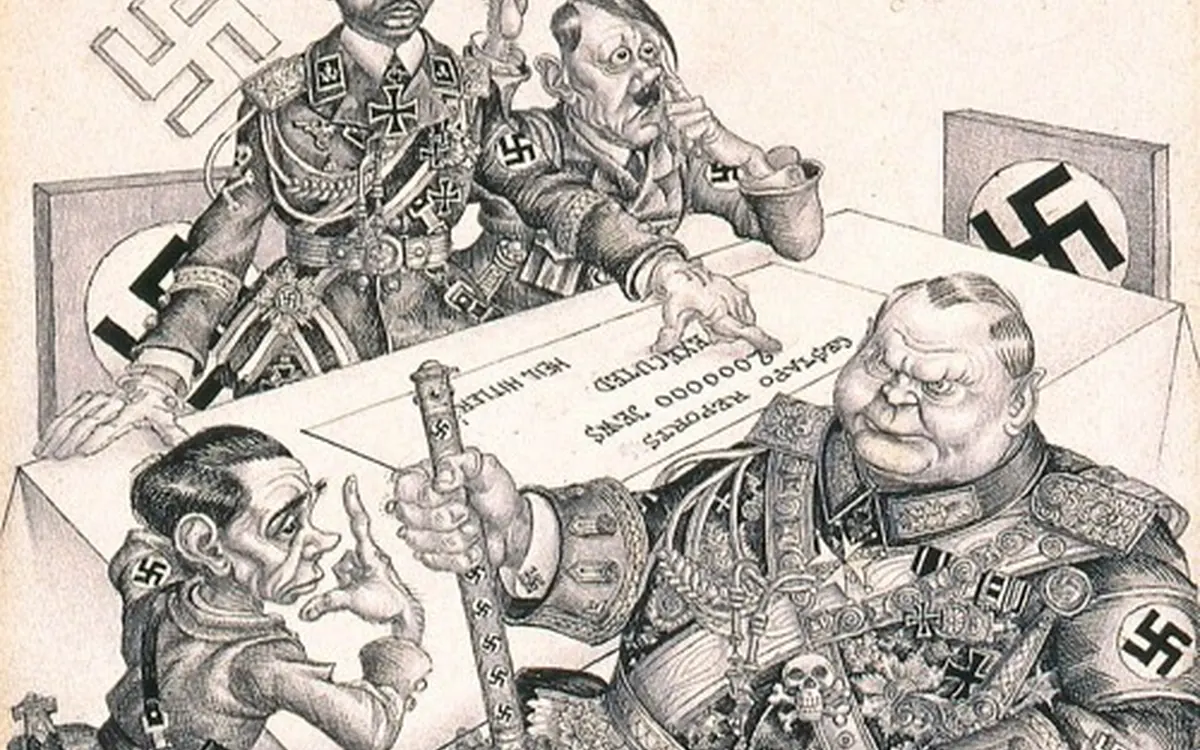
Here is part three of my live series on Survival Zionism. This episode takes us to Europe in the war years and explores the evolution of the Final Solution, which served as the great selection of European Jewry. If you like the live style, sign up for this year's TJS Live weekly class at:
image attribution: Caricature of Hermann Göring detail with text of "Gestapo reports 2,000,000 Jews executed- Heil Hitler" by Arthur Szyk (1894-1951). We're Running Short of Jews (1943), New York (cropped).jpg.podcastJewish HistoryRav MikeHolocaust
About this episode
Sometimes even to live is an act of courage, said Seneca. Rav Mike turns the gaze toward Europe and the principle of shlilat hagalut, the negation of the exile, which takes on an ugly cast as the exile is quite literally negated. He sets two 1933 responses side by side. In America, as Hitler became chancellor and violence swept Germany, the American Jewish Congress under Stephen Wise broke a cautious silence and filled Madison Square Garden, launching the anti-Nazi boycott, speaking of being called to manhood and to Jewish nationhood. In the Yishuv, the Jewish agency signed the transfer agreement with the Nazi government, letting German Jews move their wealth by buying German goods shipped to Palestine. It bolstered the Yishuv and broke the back of the boycott, and it later fed decades of propaganda that the Zionists were allies of the Nazis.
Beneath the practical choices lay a divide. American Jewry largely wanted to save Jewish people, every soul rescued. The ideological core of labor Zionism asked instead how to save the Jewish people, which could be carried by a small, strong, active remnant able to build anew. Rav Mike presses the discomfort of it. Do we want hundreds of thousands of old, feeble Jews who might swamp the Yishuv and sink the whole project, or do we want the young who can defend and cultivate the land? He names the social Darwinist thread running through labor Zionism, and holds it against the reality that the Yishuv could not, in the end, stop the destruction of the six million. Jabotinsky, the political Zionist, kept one eye on the world and opposed the transfer agreement as a betrayal.
Three doors were closing at once. The Evian Conference of July 1938 convened thirty-two nations to help refugees and broke up in confusion once Poland and Romania claimed the same right to expel their Jews. Golda Meir sat there as a silent observer and said she hoped to see the day her people would no longer need the sympathy of the world. Kristallnacht and the Munich pact were test balloons that showed the world would not sacrifice for the Jews. The ship St. Louis carried over nine hundred refugees to Cuba and back, turned away everywhere, and a third of its passengers later died in the Holocaust. Then the British locked the one territory pledged as a national home, the McDonald White Paper limiting immigration to seventy-five thousand over five years and then Arab consent.
Within the Yishuv the fractures deepened. At an Irgun command meeting on the eve of the invasion of Poland, with David Raziel in a British cell, two men argued over who the real enemy was. Raziel's camp said the Nazis, and Avraham Yair Stern said the British, since the empire would never willingly abandon an asset like Eretz Yisrael. From this came the split, the Lehi breaking from the Irgun as the Irgun had broken from the Haganah, three groups the class will track. The next day the Nazis rolled into Poland, where more than three million Jews lived. Ben-Gurion watched Dunkirk and the Blitz from Britain, and the resilience of a free people under Churchill convinced him that a democracy led wisely could cope with great crisis, displacing Stalin as his political ideal.
Operation Barbarossa in June 1941 turned the war into an escalation of the war against the Jews, since in Hitler's mind world domination and the elimination of the Jews moved together, and the pale of Russia held the bulk of world Jewry. Immigration from Europe was forbidden in view of the forthcoming final solution, and the Wannsee Conference of January 1942 brought the bureaucracy of murder, an hour and a half that sealed the fate of European Jewry in neutral administrative speech. The last refugee ship, the Struma, sat in Istanbul for seventy days and was towed back to sea and sunk with all but one aboard, a slap to the Jews fighting for the British Empire. Jan Karski, a Catholic Pole, was smuggled into the Warsaw Ghetto and a camp, carried the truth to London and Washington, and met a world that could not believe him.
Key ideas
- The negation of the exile took on an ugly cast as the exile was literally negated, and Zionism would emerge from the Shoah as the leading Jewish movement.
- America answered Hitler's rise with the boycott, while the Yishuv signed the transfer agreement that bolstered it and broke the boycott.
- Labor Zionism asked how to save the Jewish people through a strong remnant, a divide with the drive to save every Jewish person.
- Evian, the St. Louis and the McDonald White Paper closed the world's doors just as escape became a matter of life and death.
- An Irgun meeting split over the enemy, the Nazis or the British, giving rise to the Lehi alongside the Haganah and Irgun.
- Barbarossa, Wannsee and the Struma marked the machinery of murder, while Jan Karski met a world that could not believe the truth.
Chapters
- 0:01 Even to live is an act of courage
- 4:30 Negation of the exile turns dark
- 6:47 Hitler's rise; the American boycott
- 11:20 The transfer agreement with the Nazis
- 16:02 Save the Jewish people or save Jews
- 20:25 The Evian Conference; Golda Meir
- 24:57 Kristallnacht; the test balloons
- 26:08 The St. Louis turned away
- 29:26 The McDonald White Paper
- 32:59 The Irgun split; who is the enemy
- 41:24 Fortress Europe; Dunkirk
- 44:57 Operation Barbarossa
- 49:50 Authorization for the final solution
- 55:35 The Wannsee Conference
- 58:58 The Struma
- 64:31 Jan Karski; the world cannot believe
Who, where and when
People
Stephen Wise, David Ben-Gurion, Zev Jabotinsky, Golda Meir, David Raziel, Avraham Yair Stern, Winston Churchill, Jan Karski, Adolf Hitler
Places
Madison Square Garden, Evian, Cuba and Istanbul, Warsaw, Dunkirk
Texts
The transfer agreement, The McDonald White Paper, The Wannsee protocols, The mass extermination report
When
1933 CE: Hitler chancellor; the transfer agreement, 1938 CE: the Evian Conference, 1939 CE: the St. Louis and the White Paper, 1941 CE: Operation Barbarossa, 1942 CE: the Wannsee Conference and the Struma
Read the transcript
Sometimes, said Seneca, even to live is an act of courage. While I'm feeling pretty full of life right now, and that makes me awful brave, I'm Rav Mike Foyer, and this is The Jewish Story. We interrupt your regularly scheduled programming to bring you Part 3 of the Live Survival Zionism Series. If you like The Jewish Story Live, reserve your seat now at the upcoming weekly live class beginning on August 8th. You can find the registration information by emailing me at robmikefoyer at gmail.com, or you can find it at Facebook at Jewish Story Facebook or Rav Mike Foyer on Facebook, or you can go to my website, jewishstory.co, and you'll see all the registration information. Hope to see you there. As usual, I want to thank the parties in suit, pardf.org.il, for making this class happen.
And good morning to everybody. I saw a request here from Shelley that we backtrack a little bit and distinguish between Jabotinsky's and Ben Grin's stance vis-a-vis Britain, and that indeed is going to be part of what we're doing. I try to take a bit of an iterative approach to this class, as you guys have noticed, push forward and then cycle back and push forward and cycle back. That's going to be particularly relevant because though the class is called Destruction and Rebirth, the sort of classic frame for this decade, really what I'm after is the evolution of survival Zionism. And we're going to see sort of another aspect of that story today. First two classes were devoted to, I would say, the sort of local context of emergence, meaning here in the land of Israel, pre-state during mandatory Palestine, the internal and external conflicts, right, the struggle amongst the various branches of the Zionist movement, and then between Jew and Arab, and really Jew, Arab, and British is going to see that sort of hate triangle emerge.
Those are the first two classes. And yes, I will touch back on some of the divisions there today in order to get us into a running start. Where I want to go today and next week is to turn our gaze toward Europe, because, of course, to speak about the evolution of survival Zionism, as I told you, as uncomfortable as the idea may be, we can look at the Holocaust as the great selection, meaning in terms of the Darwinian sense of natural selection, this was, of course, not a natural process, but in the sense that only some will survive, and that will contribute quite deeply to the emergence of Zionism in general as a central principle for the Jewish people, which it was, of course, not before World War II, at least numerically.
And it will also contribute quite deeply to the type of Zionism. Remember, as I told you, one of the questions we want to keep on the board is what qualities allow for survival in a situation like this? And furthermore, are those the qualities which will allow for the creation of society in which you want to live? Right. So today and next week, we're going to turn our gaze toward Europe. as I told a couple of people I'm not going to go too heavily into the details of the Shoah and the destruction of European Jewry because I feel that many of us have delved into that I also feel that it is not what I have to contribute to the discourse I have to trace a line I mean there's so much history happening today in this period so we're going to try to hold three threads and we're going to see all of them today but like I said the first two were in the land of Israel these next two are going to be in Europe The fifth class is going to be in America, and I intend to really keep that fifth class as the only American story.
And then the last two will be about the lead-up to the War of Independence post-war. So today what we have to do is we have to keep track of the one thread, which is in the land of Israel. We need to focus on Europe. We're going to see the emergence of a little bit of the American stories as we go along. So that's, I think, a sufficient task for the time allotted. You guys ready to get started? Another aspect in this story of the evolution of survival Zionism is going to be the shifting relationship between the Zionist movement, remembering that you have the Yishuv, the Jews who are actually physically in the land of Israel, and you have the international movement who believe that's where the Jews belong.
And the era of armchair Zionism, of the guy who raises money from one guy to pay another guy to go live in Israel, is also out there, but nonetheless, primarily when I say Zionist, I'm speaking about those who are physically in the land of Israel, or at least ideologically believe that's where the Jews belong. So we're going to see a shifting nature of the relationship between the Zionist movement and the Jews of the diaspora, as one of the central principles of Zionism takes on a somewhat ugly caste. You may recall, those of us who were together in the last couple of semesters, is this idea of shlilatagalut, right, the negation of the exile, right, that it's a fundamental principle of Zionist thought that, you know, the exile must be shed both physically, you've got to pick up and move to the land of Israel, and also ideologically, we'll see religiously, Rav Kook, etc., you know, there's a sense that in order to become the new Jew, be it in the secular Zionist sense or even in the spiritual religious sense of Rav Kook, there's something which must be left behind.
Well, negation of the exile, like I said, is going to take on a pretty ugly cast from the year 1938 to 1945, right? As much of the exile is quite literally negated. And so therefore, we have to think both ideologically and religiously in the long run, how does Zionists and Jews begin to integrate the reality of Shoah into their thinking about the relationship between Jews here and there? There'll be elements of survivor syndrome, There'll be elements of you got what was coming to you. There'll be elements of sort of a biblical judgment, et cetera. That lies ahead. But because at this stage, I'm mostly interested in the practical response of the political and then ultimately military activists. What do the Zionists do about the progressive destruction of European Jewry?
And if we want to understand how that relationship evolves, then we have to have some reference point. Right. I can't claim that it evolved if there's if there's not somewhere I can say it was here and now it is there. Follow? That's just kind of like basic logical honesty. So in order to do that, I actually want to start back in 1933, even though I keep pushing us sort of a little bit back beyond where the purview of the class is long, with two separate events or movements or agreements that in many ways embody the very different attitudes toward Jewish existence between the Zionist and the non-Zionist world. In 1933, January 30th, Hitler, Adolf Hitler, is appointed chancellor of Germany, right? And immediately afterwards, a wave of violence and very ugly public incidents targeting Jews sweeps Germany.
Very public because, of course, the eyes of the world were on Germany as well, to the extent that international media already existed. And the response within American Jewry was swift and uncharacteristically bold, right? Because when the word of not only Hitler's appointment, but the subsequent violence reached America, you had the American Jewish Committee, which if you recall, this is the more elite German Jewish old guard that had established itself in an attempt to sort of be the out front leadership before the masses of mostly Eastern European Russian Jewry. sort of marshal their political force, if you remember from our discussions last semester, right? So the American Jewish community had been a brief organization, which is the oldest fraternal organization, and really largest organization at that time amongst American Jewry, and the American Jewish Congress, which had emerged with Stephen Wise and out of the Paris Peace Conference in an attempt to be a more democratic, small d, right, broad-based representation of Jewish people.
They all came together, met in New York, and at first their only thing they could agree upon was a joint committee to monitor the situation, but they agreed no public protest, which is very important to understand. We're not going to go into this American story in full today, but I want you to keep them in the background, that in 1933, the attitude of American Jewry, at least of the leadership, was largely don't rock the boat. Now, they claim this was because they didn't want to make the situation for German Jewry, which was quite precarious at this point, any worse. But as we'll see when we get into the American story, they also weren't necessarily as secure as they would have liked to be in their own sense of American-ness.
And that's going to play in. Nonetheless, less than a month after this meeting, the American Jewish Congress, which was the more small d democratic and a little bit more militant of these organizations, changed its mind. They began to call for an American protest campaign. They convened an emergency meeting of Jewish organizations that 1,500 Jews attended. and they announced their intent to hold a Madison Square Garden rally on March 27, 1933. And indeed, they did it. And in that rally, I mean, which you have to picture that you're talking about simultaneous rallies in Madison Square Garden, New York, Chicago, Boston, Philly, Baltimore, Cleveland, and 70 other smaller cities across America. Madison's MSG alone had 55,000 people in an overflow crowd.
And we're all Jews. and there at that um at the which was and the and the meeting at msg was broadcast worldwide which is significant because amongst the speakers was always uh jay george fredman he was the commander in chief of the jewish war veterans of america which is you know an interesting position that's as american as you get war veteran but the jewish war veteran and and when we get to the american story we'll speak about that tension more but the reason i mentioned him now is he got up and he called for an American boycott of German products. And this was the unofficial but quite powerful beginning of what was known as the international anti-Nazi boycott of 1933. That the Jews of America triggered a response even amongst non-Jews and it swept its popularity through European Jewry.
That the idea that the Jews could marshal their economic power to, as is done today, you know, for good, bad, or otherwise, in an attempt to alter the policies of the German government. Now, why do I tell you this story? Because that's how American Jewry sort of responds. And we'll see, you know, I'll give you Stephen Wise, Rabbi Stephen Wise, sorry, who, you know, were great leaders of American reform Jewry, who we will see again when we come back to the full scale of American response to the Holocaust, made the following statement at this conference. He said, The time for prudence and caution is past. We must speak up like men. How can we ask our Christian friends to lift their voices against the wrong suffered by Jews if we keep silent?
It is not the German Jews who are being attacked. It is the Jews. We're going to unpack that to a greater extent in, you know, coming class. But I want you to appreciate that there's an element here, for lack of a better term, of being called to manhood. Right. That that that wise represents an element within American Jewry, which will be a widespread discussion, as we'll see today, which is is passivity a loss. I know, you know, in the 21st century here in the in the year 2021, I don't know if you're allowed to say sort of manhood anymore, but isn't a loss, a sense of agency and abandonment of responsibility. Right. And and and essentially a throwing up one hand and saying, I can't fix this situation.
Furthermore, there's a call of Jewish nationhood. It's not the German Jews being attacked, it's the Jews. Now, remember those words when we get to the full story of how he negotiates the emerging reality of the Shoah. Nonetheless, that's what's happening in America. What's happening in the Eshuv? What's happening within the land of Israel? Well, on the 25th of August, 1933, the Jewish agency, together with the Anglo-Palestine Bank, which is the major financial instrument here in the mandatory Palestine, and the Zionist Federation of Germany, signed a deal with the Nazi government. that deal is known as or the transfer agreement I guess I would translate what's going on? Why are the Zionists signing deals with the Nazis?
well it's quite simple actually the deal goes like this Germany has Jews and they want to get rid of them the Zionists in the Yishuv want Jews see but the Germans aren't willing to let the Jews leave with their possessions because the Jews have quite a bit of money. So what happens is they cut a deal that the Jews wanting to flee Germany will be allowed to transfer their goods by purchasing German manufactured goods, which will then be exported to Israel, purchased, and some portion of that money will be returned to the Jewish German immigrants that are coming, right? And when we talk about scale, approximately 60,000 German Jews will leave legally between the years 1933 and 1939 until it's cut off by the McDonald white paper that we'll come back to shortly.
And $35 million in goods will be shipped from Germany to British mandatory Palestine. Now, this is a major factor in bolstering the population of the Yishuv, right? The Yishuv basically doubles in its Jewish population between 1931 and 1939. And this is a big chunk of it. It's also a huge asset in labor and goods. But you know what else it does? It breaks the back of this international boycott. Because the Nazis weren't afraid yet that the economic power of international Jewry would be able to bring them to the mat. But they had a suspicion that it might. And now the Jews themselves were opening the door for economic participation. Furthermore, as a classic example of the law of unintended consequences in history, you may recall what else happened during the years 1936 to 1939 in the mandatory Palestine, in the land of Israel.
What did we discuss last week? The Arab Revolt. And you'll recall that the Arab Revolt was basically the bursting into flame of the sort of embers of Arab resentment against Jewish immigration. Well, I said at the time, although I didn't put in context, that it was the German-Jewish immigration, what's called the Fifth Aliyah, that finally sparked the revolt, meaning this effort to bring German Jewry over not only broke the will to have an international boycott of Nazi Germany, but was the fuel and the fire that caused the Great Revolt to burst into flame. and spawned generations, decades of anti-Zionist and anti-Semitic propaganda claiming that the Zionists were allies of the Nazis. Now that story really lies with what's known as the Kastner Affair.
We're going to get a little bit more into it probably next week. We'll speak a little bit more about the various attempts to get German Jewry, sorry not German Jewry, European Jewry out of Europe and into the land of Israel. But for now, I offer you these two things as vastly different attitudes on what the task of Jewish leadership is in this moment. And in the sense that my focus is on Zionism, I want to really zero in on the fact that the Zionist movement and in particular the Zionist, I call it the Zionist entity because I sound like I'm an Iranian diplomat, you know, the Yishuv. We can just call it the Yishuv. Everybody understands what I mean by the Yishuv? Yes? meaning the Jews actually living and incorporating themselves as a national entity within the mandate.
The Eshuv has a very different perspective on survival than American Jewry. And if I was going to sum it up, you have to remember, first of all, that no one knows what's coming. In general, what we call historical anachronism is a very big challenge when you're learning history. It's hard not to view the actions of people in 1933, 1934, et cetera, through the lens of what we already know. So we have to try not to. And furthermore, it's hard to appreciate how incomprehensible it was that the Nazis was actually seek to eliminate the Jews of Europe. I know you've all heard that statement before. I'm sure many of you have contemplated before, but I'm going to say it again and again and again, because it is simply, even to the evidence of people's own eyes, an incomprehensible notion.
And to our great sorrow, we live in a world in which such a thing is now comprehensible. So that's important to remember. Nonetheless, if you know the history of political Zionism, which hopefully some of you do, you know that since Herzl and Max Nordau, the idea that there is a mass tragedy on the horizon for European Jewry, sort of the culmination of this bubbling pot of European anti-Semitism, has not only been sort of a recognized reality, but it's been one that's been used as a motivating factor for political Zionism. Right? Got to get the Jews out. Herzl was all about rescue. If you recall, the Uganda proposal. This idea that, okay, we're not going to establish the Jewish state for real in Uganda, but let's save the Jews, came up after the pogroms in Kishnev, if you recall.
But that is the sort of Zionist, sorry, the political Zionist vision. And in our day, Zev Jabotinsky is the one who has this sense of political Zionism, which is why, by the way, Jabotinsky was a vehement opponent of the transfer agreement. He felt that dealing with the Nazis was a tremendous betrayal, right? And I don't want to overload you with details about the past, but I'm just cutting myself off. On the other hand, the pragmatic Zionists, the ideological core of the labor Zionist movement, have always viewed this question of antisemitism more pragmatically, for lack of a better term. I mean, there's always been a little bit of the social Darwinist thought within the labor Zionist movement. If you recall, it popped up in A.B.
Gordon's thought and certain Max and Baraborkov's thought. And for our purposes, why am I mentioning it? Because the real question that the Zionist movement faces and where they diverge from much of diaspora Jewry is our goal to serve to save the Jewish, the Jewish people or to save Jewish people. You understand the difference? Is our goal to save the Jewish people or is our goal to save Jewish people? If our goal is to save Jewish people, then we want to get as many Jews out of Europe as possible, and we don't want to mess around, we've got to defeat the Nazis. If our goal is to save the Jewish people well the idea of an elite intellectual group the change makers the young the strong who are able to build anew who might have to witness the tragic leaving behind like the four that were left behind in Egypt according to the Midrash But you're not looking to just save Jews, you're looking to save the Jewish people, which is an idea that can be embodied in a very small and active element.
You understand the difference that this going to lead to, right? And we're going to see ahead some potentially very ugly outcomes of this difference in thinking. So, this is kind of the back story. Yes. I don't get it because they're both the same thing. No, they're not. You want those 60,000 Jews who I don't understand. You want the 60,000 Jews to strengthen the Yashuv. Listen, even though the Yashuv is only 300, almost 400,000 Jews right now, if they're strong and they survive, then even if the millions of European Jews don't make it, the Jewish people will survive. You understand? And not only that, let's face it, in the background are all these ideologies saying, and really, we're the new Jews. Because those diaspora Jews, Shlilatagalut, the negation of the exile, is going to take on a dark caste here.
I have a question for you. Do we really want, and we'll see this question come up very strongly next week. Do we really want hundreds of thousands of old, feeble, religious Jews who are going to overburden our economy, be unable to contribute to agriculture, incapable of self-defense? Do we really want them? And if we bring them in and it swamps the Eshuv and we go down here, the Jewish people might not survive. Am I more clear now? Oh, yes. But But don't ignore the reality in a time in which they themselves could not stop the destruction of the six million. But I'm putting the pieces on the board right now. Is that more clear now, though? Thank you for the clarification. Yeah. Okay. That's a little bit of uncomfortable background.
Now what I want to talk about is the evolution of the final solution. A couple of pieces that we need to understand. understand because again the threads we're holding is what's happening within the land of israel what's happening in european jury and what's happening in america as representative of um the world powers so july of 1938 there is um a conference which convenes in avion france strangely enough called the avion conference um right and it opens up to us uh a uh a sort of layer in this story that we're going to see in repeated places that I want to give some attention to, but not too much, which is this question of immigration with an E, not immigration into Europe, but emigration, like moving out.
Remembering that since we began to speak about the Jewish problem or the Jewish question, we've spoken about the fact that either assimilation or emigration, meaning either absorb the Jews and make them like us or just spin them out, have been the two options. elimination has not really been put forward by anyone as a realistic option and won't really be until 1942 so so um basically the evident conference is convened in order to facilitate the escape of from germany and austria of political refugees in quotes since really it's mostly talking about jews um 32 countries send representatives there's 24 voluntary organizations um and today it's seen as a case study in the incompetency of international politics but at the time, it seemed to open up in a very positive way.
Hitler made it very clear that if the nations would take the Jews, he'd be more than happy to send them. He said, I can only hope and expect that the other world, which has such deep sympathy for these criminals, meaning the Jews, will at least be generous enough to convert this sympathy into practical aid. We, on our part, are ready to put all these criminals at the disposal of these countries for all I care, even on luxury ships. Meaning, he didn't want to necessarily kill the Jews of Germany and Australia. He just went, sorry, Austria. He wanted to get rid of them at this point. And at first it appears that the world would receive them. The Dominican Republic pledged to take 100,000 Jews off the bat, which is very impressive.
But what happened is that as soon as this discussion began, the Polish and Romanian governments announced that they had the same right as Germans to expel their Jews. Now there were about 47, 475,000 Jews in Germany and Austria at this point. Call it half a million, just so you can work in round numbers. Which was a challenge, but could potentially be absorbed by the 30 or so nations represented at this conference. But there are 3.3 million Jews in Poland. And I don't really know how many in Romania, but more. There was no way that the world was capable or even interested in absorbing them. And so the conference broke up basically in complete confusion. and it came to not. Golda Meir was actually there, although she was known as Golda Meyerson at the time.
She was sent as the representative of the Yishuv but not permitted to speak or participate in any of the proceedings. She was just an observer. And before she departed, she gave a classic quote to the press. You know, Golda, if you follow her career, just like some of the best lines. I'm in the middle in my podcast of the Yom Kippur War and she just, she nails it every time. But so anyway, she told the press, there's only one thing I hope to see before I die. And that is that my people should not need expressions of sympathy anymore. And I want you to hear in that one of the key elements of survival Zionism locking in, which is do not look to the world anymore. Political Zionism, Jabotinsky, even to his dying day, had one eye on the world, at least.
that the world would be empathetic or would see it in its interest, etc., that through political negotiation we could receive what it was we needed. Now, the labor Zionists have not yet abandoned the Anglo-Zionist alliance, as Shelley asked me, and I'm about to shortly come back to the split over the Anglo-Zionist alliance. Nonetheless, there's a growing awareness amongst even the most beholden to the British that the world will never give you anything you're not willing to take. And that, you know, as Melk-Mek said, by any means necessary is the watch phrase of survival. So Miss Meyerson was forced to leave without any results, as were the rest of the world. And within months, the Nazis are going to swallow Sudetenland.
And a year later, they'll be in Warsaw, and organized immigration will no longer be the issue. Escape or death is what we see. So scrolling forward, people are probably familiar that in November of that same year, November 1938, November 9th and 10th, was the mass pogrom known as Kristallnacht, the Night of Broken Glass, where throughout Germany the Nazis torched synagogues, vandalized Jewish homes, schools, businesses killed almost 100 Jews, which at the time I'm sure seemed like a lot. But really, in many ways, this was yet another test balloon. And that's how I want you to see it. The Avion conference showed that the world was interested but didn't really care enough to sacrifice. And before we're too quick to condemn the world on that, let's look at what's happened to the Syrian refugees, people drowning in the Mediterranean trying to escape North Africa, meaning it is not simple or what's happening on the southern border of America right now.
These questions of population movement are never simple. And I'm going to leave the deeper discussion of it to the rise of the state in three classes. But I just want to say that before I sound too simplistic in my condemnation. So there is that, Avion Conference. Then there's this second test balloon, which is what will the war do if we start to brutalize the Jews? And the answer is not much. Right. And finally, you know, in only a month before Kristallnacht, the Munich pact had been signed, had been signed between Hitler and Mussolini, Edouard de la, I can't say his name, de la Dier, who's the premier of France. And of course, Neville Chamberlain. Right. that's the accords that allowed the Nazis to march unimpeded into the Sudetenland is held up today as the sort of gold standard of appeasement of evil.
Again, easy to say now, but Chamberlain was looking for peace in our time. And one more incident I want to sort of put into this before we come back to the internal Jewish discourse, which is on May 13th. May 13th, 1939, the ship St. Louis set sail from Hamburg to Cuba. Now, many people may know the story that Gustav Schroeder was the captain of the ship. He ultimately is actually counted by Yav Vashem amongst the righteous of the nations. The ship held over 900 Jewish refugees from Germany who were desperately seeking a home. She was headed for Cuba, where many of the passengers actually had legal visas. they were nonetheless denied entry. Right? So the captain took the ship back to Miami without any permission, but the State Department warned him off, and the Coast Guard and Geed prevented them from landing, because he was considering actually grounding the ship.
He even tried Canada to no avail, and eventually the ship was forced to return to Germany. He tried his almighty best. The U.S. officials, together with some British and others, managed to find refuge for some of the Jews in the UK and France and Belgium, the Netherlands. But of course, except for Britain, most of those countries were under Nazi rule within another year. Right. And as far as the records can be told, a third of the passengers of the St. Louis died in the Holocaust. Right. It's a sort of an emblematic, emblematic journey. And I give it to you here just so we can understand the pressure that there's one option of legal immigration, which has been shut down, at least to America and other countries.
There's escape, which is becoming increasingly difficult. Then, of course, the one stunningly obvious solution in the minds of everyone except the British, which is there is a piece of territory which was granted to the imperial government in order to create a national home for the Jewish people. Remembering that the international community in the form of the League of Nations gave the British power over this portion of the Middle East toward the goal of creating a national home for the Jewish people in Palestine. And whatever the borders of that were going to be, and however they were going to dice it and slice it, they had a legal and I would argue moral responsibility to do so. But as we saw, only 10 days after the St.
Louis embarked on May 23rd, I found, by the way, three or four different dates for when the McDonald white paper was published. So if I said to you the 17th before, they're just some conflicting sources, but they're all within a week. So on May 23rd, the McDonald White Paper is published. If you recall, this was a rejection of the idea of partition, right? We had the Great Revolt that we spoke about last week, where the Arabs attempted to throw off the British yoke because they felt the British were trying to follow through on creating a state for the Jews who are a minority in the land. The Peel Commission, which researched the causes of this revolt, decided the cause was indeed Jewish immigration and that the solution should be a partition of the land between Arab and Jews.
Well, the McDonnell White Paper rejected that idea of partition and moved all the way into the idea of simply appeasing the Arab populace. The most important piece for our discussion is that Jewish immigration was going to be limited to 75,000 people for the next five years, subject to what's called economic absorptive capacity. And after that would be contingent on Arab consent, meaning there wouldn't be any. because, of course, the Arabs were making it quite clear through their violent actions that the last thing they wanted was more Jews. So just as the world at the Avian Conference had shown that they were unable to come up with an organized solution and had demonstrated that they were willing to even hold back from their shores escapees like those in the St.
Louis, the British locked the gates of the one piece of territory in the world which, by right, should have been receiving the masses of Europe. Now, I told you that Ben-Gurion's initial reaction was explosive. Right. That he declared that we're going to fight, you know, we're going to fight the white paper as if there were no Nazis and we'll fight the Nazis as if there is no white paper. Easier said than done, because as the war gets closer and closer, there's going to be a deep split within the Zionist movement around who the primary enemy actually is. And here, Shelley, now I'm going to touch on a little bit of a review of this stance of each group toward that. But before I do, I want to pause because I'm throwing out a lot of information here.
I realize I want to make sure I haven't lost anybody who want clarifications, et cetera. Remembering that I can't necessarily see everybody's hand. So if I'm not calling you, it's not because I don't care. It's because I don't see it. the question at hand is how do the various zionist groups all whom are arming themselves react to this british declaration that the gates to palestine are shut now remember on one hand we have the hagana which is the labor zionist movements militia quasi-official because during the um during the great revolt so-called the 1936 1939 arab revolt The British, as we've spoken about, had armed many Jewish police. I also spoke to you last week about Ord Wingate, this sort of messianic, I guess you want to call him a messianic Christian, this dispensational, millenarial, that's actually the technical term, Christian, who believed that the Jewish people's return to their land was going to usher in a messianic era, therefore devoted himself to training the Jews sort of illicitly to some degree in guerrilla tactics.
That's the quasi-official labor Zionist world. We saw also that there was a split at a certain point around the issue of restraint, that within the Haganah, that the Irgun, the Irgun Tzvay Lumi, the organization, the national military organization, had split off from the Haganah. They hadn't quite allied themselves with Jabotinsky and the revisionist movement from the beginning, but they eventually seek the leadership of Jabotinsky. They split from the Haganah, not over the issue of World War II, but over the issue of restraint. They believed in attacking the Arabs in retaliation for the terror which was happening within the land. Another split is coming, which is going to set up, even though our focus is going to go back to Europe quite quickly.
I want you to understand as the pressure rises and the fractures within the Zionist movement appear, they're going to lay the groundwork for the battle of liberation, which lies ahead. So in August 31st, 1939, which is a very significant date because it's the day before Germany invades Poland. August 31st, 1939, there's a meeting of the Irgun General Command in Tel Aviv. The Irgun, remember, is the breakaway, more militant faction from the Haganah, who is now associated with Jabotinsky's revisionist party. It's a mess. Tense and stormy meetings because there's still a split over the question no longer about restraint. The restraint has been broken as far as they're concerned. They're more than happy to retaliate.
The question now is about who is really the enemy. Now, David Raziel, who you may recall from last week was the commander who ultimately sort of led this ship from what he called passive to active defense, who was able to lead the Irgun in its attacks on the Arabs, is not at this meeting because he's sitting in a British jail cell. As soon as the British declared in the McDonald white paper that immigration was closed, they snatched Raziel off a plane as he landed in the land of Israel because they knew that the Irgun was not going to respond well. And they figured that putting him in jail two days after the publication of the white paper was just a good insurance policy. And therefore, the people in charge were Hanukkah-Kalai and Avraham Yair Stern.
Right. Avram Yair Stern and Kalai were in the midst of a deep argument about the very simple question of who is the real enemy. Raziel's man, who was Kalai, said the real enemy is the Nazis. Right. Because the Nazis are going to are threatening to destroy world Jewry and furthermore, locally, the real enemies of the Arabs. We need to fight the Arabs. And if we could, we could fight the Nazis, say Raziel's men. Yair Stern said the real enemy is the British because no matter what they're telling you the Arabs might strike a deal he said and indeed if you're familiar with the Lehi as we'll describe their ideology in later classes the Lehi despite the reputation they gained were never opposed to the Arabs their opposition was to the British Empire because he said Yair said the Arabs might strike a deal But the empire will never willingly abandon an asset like Eretz Yisrael to anybody else's rule.
Right. And furthermore, Yair Stern said that we have to break even with Jabotinsky's revisionist party. Why? Because politicians will not lead the revolution. He was a revolutionary, whereas these other men saw themselves as a military commanded by political leaders. Now, I've got a lot here, but I'm actually going to skip much of it because of the time and we'll get more of it. What happens is what's known as the split, is that the Irgun had already split away from the Haganah, and now within the Irgun, what's known as the Lechemi, the freedom fighters of Israel, will split away from the Irgun. We will track these three groups going forward. It's a split which will devastate the Irgun and deeply hamstring their capacity to fight in the crucial next two years.
Many of them actually, by the way, end up in jail, having been followed to this very meeting that I'm describing to you by the criminal investigative department of the British mandate. right and they will sit out the first year or two of war in jail but for our purposes I just want you to know that as the pressure rises in Europe fractures within the yeshuv prevent any coordinated effort And what ultimately happens is that the Haganah decides to enlist with the British against the Nazis. The Irgun basically doesn't take an official stance. They say, we're not going to fight the British as long as they're fighting the Nazis, and we're not going to enlist en masse, and many of their men will actually enlist through the Haganah, but the Lechi will stay squarely focused on the British Empire as the enemy to the extent that they'll even entertain making an alliance with the Nazis against the British, right?
And that's a story that lies ahead. But it's also a story for right now that gets cut off because if that meeting was on August 31st, the next day, September 1st, the invasion of Poland, right? The invasion of Poland, Nazis roll into Warsaw. The gates are already shut at this point. We saw the Avion Conference. We saw the St. Louis, the White Paper. To the east is Russia, which basically promises the gulag for many Jews. When we get to the story of Menachem Begin, who flees to the east, we'll hear a bit more about that. And the most important thing to know is that on the eve of the German invasion of Poland, 3.3 million Jews are living in Poland. And at the end of the war, approximately 3,800, sorry, 380,000 will remain alive.
I mean, three million Polish Jews have now entered into the Nazi death machine. Mike, can you, you went a little quickly, can you, Haganah, Irgud, and Lefi, can you do a second? The Haganah is the semi-official militia of the labor Zionists, who I say semi-official because they are the Jewish agency. They control the leadership of the Yishuv. And they have built somewhat of an alliance, even militarily, with the British through the process of the Great Revolt, in becoming police and getting training through Ord Wingate. The Yishuv broke away from the Haganah over the issue of restraint. Remember, they wanted to retaliate against the Arabs, whereas, as we spoke about last week, the mainstream labor world was talking about purity of arms and their enemy is the Arabs not the British and that's exactly the point and then the Lehi breaks away from the Irgun because they say you're all wrong the real enemy is the British because we need to drive the British out of our land and then everything will be solved the Jews come out of Europe when the Arabs attack the Irgun doesn't care the Lehi doesn't care They will return fire to anyone.
But as we'll speak about in a coming class, right now I just wanted to understand because I didn't want to miss this point in history. I want you to understand there's an evolution happening within the land of Israel as the pressure rises within Europe. Okay. We will speak more in detail about the Haganah, the Irgun, and the left. Okay. Don't worry. Absolutely. Okay. So now war has broken out in Central Europe. What's interesting, of course, is that we're about to encounter what's known as Fortress Europe. If you're familiar with a little bit of the history of World War II, in late spring, early summer of 1940, May, June, is the Nazi victory at Dunkirk. Right. Which was until the invasion of Normandy in 1944 is essentially the end of the Allied forces within continental Europe.
Dunkirk is a if you've never seen by the way the movie is very moving the but for our story in order to get the narrative thread David Ben-Gurion is actually in Great Britain watching as the debacle of Dunkirk unfolds he sees the Allied defeat he weathers the battle for Britain the air raids apparently he was legendary for refusing to take cover in the air shelters during the Blitz don't ask me why stubborn guy Ben-Gurion But for our purposes, what I want you to know is that beyond the suffering of war, what moved Van Gurion was the resiliency of the British people and the leadership of Winston Churchill. Now, why does this matter? Because up until this time, Stalin had been Van Gurion's political ideal.
He'd been to the Soviet Union. He had seen what he considered to be the incredible progress and victories of the communist state. But what he came to realize in the midst of war is that democracy could actually cope with great crisis. And that a resolute and wise leader who stood at the head of a people who were empowered by democracy really couldn't be defeated. And, you know, this made a profound impression on Ben-Gurion as he then will become one of the great leaders in the struggle for national liberation for the Jewish people within the land of Israel. But right now I'm putting dates on our board before we get a little bit deeper. So Dunkirk happens, right? The invasion of Poland is September 1st, 1939.
The fall of the continental forces of the Allies at Dunkirk is in May, June 1940. And on April, sorry, from April 1st to November 14th, 1940, will begin the construction and then ultimate completion of the Warsaw Ghetto Wall. right meaning the nazis invade and again it we have to avoid historical anachronism it wasn't clear to anyone including apparently the nazis themselves what exactly they were trying to do remember hitler was more than willing to just expel the jews of germany but now once he invades poland there are 3.3 million more jews under his command and the world doesn't want them so he starts to herd them into ghettos certainly willing to make them suffer and there were already concentration camps in Germany at this point, but they were concentration camps in the true sense.
They were, for political prisoners and Jews, they were not yet extermination camps. That is taking some time. Just as a point of fact, on August 4th, 1940, Zev Jabotinsky dies. And in many ways, like his mentor and hero Herzl, of a broken heart. He's actually in a Beit Haar camp in upstate New York, having been long ago banished from the Yishuv, having escaped Europe. If you recall, the last word we had from him in Europe was in Warsaw in 1938, telling people to eliminate the Galut before the Galut eliminates you. And from many accounts, basically witnessing the unfolding of the Nazi war machine just simply broke his heart. He could not take the unfolding of what he had predicted. And in the story going forward, it's going to be important because the revisionist party will be split by much confusion and the Irgun, the military associated with them, is going to be somewhat rudderless now in what one could argue is the hour of greatest need for the Jewish people.
Still scrolling forward in history to get these pieces forward, 1941, June 22nd. I would ask if anybody knows, but Abraham, I'm guessing, knows exactly what happened then. June 22nd, 1941 was Operation Barbarossa. Operation Barbarossa was the first phase of the Nazi invasion of Russia. If you recall, in 1939, just before the invasion of Poland, the Nazis had signed the Molotov-Ribbentrop Pact, which was a non-aggression pact. Basically, the Nazis said, we'll take the western part of Poland, you take the eastern part, and we'll fight with each other. Well, you know, that's all good until Hitler felt that he was powerful enough to take on the Russians. The Operation Barbrosa, by the way, is one of the classic examples of surprise in military history and was the largest invasion force ever assembled at this point in history.
Just scale of what's happening in the world. And it represents not just a turning point in the war, but really in our story. Why? Well, I'll tell you that in the order of the day to the millions of soldiers poised for what was going to be what Hitler called the powerful blow that's going to shatter this enemy before the onset of winter. Hitler wanted to make it quite clear who the real, what he called horrendous beast-like enemy, intent on annihilating not only German but the whole of Europe was. Juden und nur die Juden. The Jews and only the Jews. that despite these sort of strategic considerations and his desire for global military domination, Hitler saw the invasion of Russia as an extension and an escalation of the war against the Jews.
And what we will see is that the means that he employed in that war also took a radical shift after Operation Barbarossa. Two weeks after the invasion, we have evidence that the first transport trains filled with Jews from Western Europe will leave for the ghettos of Lodz, Kovno, Riga, and Minsk. And in Kovno and Riga, thousands are shot upon arrival. Meaning, this is the first beginning of a concentration of the Jews. And on October 18th, which, let me look at that date again, on October 18th, which is only July, August, September, only four months after the invasion, the first declaration comes from the high echelons of the Nazi party that all Jewish immigration from Europe is now forbidden, quote, in view of the forthcoming final solution of the Jewish question.
Notice, up until now, the idea of getting the Jews out had been appealing to Hitler. There was just nowhere to send them. But now he has shut the gates from within because a different type of solution has come to hand. Just, you know, in the general war, just to keep track, you can recall that on December 7th, 1941, the Japanese destroyed the Pacific Fleet in their sneak attack on Pearl Harbor, and Hitler declares war on America only four days later. So we're in full scale global war at this point. There's no longer a European conflict. And the quote that I would give you is that the day after clearing war on America, Hitler addressed a troop of Nazi party leadership in a secret speech, which nonetheless we have the minutes of because Joseph Goebbels, the minister of propaganda, wrote down some of it in his diary.
And what he said tells us where the Nazi party was at and what's about to come. He says, in regard to the Jewish question, the Fuhrer is determined to wipe the slate clean. He prophesied to the Jews that if they once more brought about a world war, they would be annihilated. It was not a mere declaration. The world war is here. The extermination of the Jews must be its necessary consequence. that, you know, on some level, and we'll have more of this discussion next week because right now I'm trying to lay the sort of factual base for our discussion. The Jews represent the infinite in the world. It's one of the ways you can always, you know, we represent God, we represent that which doesn't fit the system.
And therefore anybody who wants total control has to get rid of the Jews because we represent something outside the standard equations of power, culture, history, even religion. And Hitler knew this well. And so then there's not, it's not a mistake, this reference we see in Goebbels' journal, that as soon as Hitler had achieved global war, that then he hit fast forward on his mission of destroying the Jews, because the two had to come out. Read that line again. The world war is here. The extermination of the Jews must be its necessary consequence. We already have, by July 1941, evidence that Hermann Göring, Hitler's deputy, was passing on written authorization to Reinhard Heydrich, chief of the SS, the special police of the Nazi party, to prepare and submit a plan for the total solution of the Jewish question under German control.
And with the invasion in Operation Barbarossa, there was a prospect of a total of 11 million Jews. Remember, he invaded Poland, but he had not reached the pale of Russia, where still numerically the bulk of the world's Jews resided. If Hitler had managed to conquer Russia, 11 million of the world's Jews would have been under his control. And we also know that by November 1st of that very year of 1941, construction of the first extermination camp, Belzick, outside of Lublin, began, meaning the wheels of liquidation are now moving as opposed to attempt to to expel the Jews or to concentrate them right but really as I'm sure many of you know it's the WANSI conference in January of 1942 that puts this seal on the fate of European Jewry.
I'm going to pause questions comments things people need to clarify. I'm having difficulty with the concept of where the elimination of the Jews versus Germany's need to restore itself after World War I in Europe? So that's a deep question, and I'll give it a brief answer if I can, because it's a big one. So one answer is an external enemy is always a useful tool for uniting a people. That's true. Right. And the Jews have played that role within German culture at this point for quite some time as the sort of alien element. So that's like, I would say, a first order answer. The second order answer is the one that I offered you, which is the Jews also represent something which exists outside of totalitarian power structure.
It's not for naught that the Nazis, the communists, in its own way, even, you know, sort of like universalist humanism, have had the needs to eliminate the Jews. We see it again today, by the way, in certain all-embracing ideologies. The Jews don't fit. And if you want to have an all-embracing, be it you're all-embracing power or you're all-embracing economic ideology or you're all-embracing sort of social philosophy, you have to either co-opt the Jews or eliminate them because we operate by our own program and by that very fact assert that yours is not universal. So that, I would say, is a second order, meaning in order for the Nazis to have global domination, the Jews couldn't exist. The third order would go deep into Hitler's own mind.
If you've ever looked into any of his writings in Mein Kampf, et cetera, there's some pretty wacky notions that on some level, in his mad genius, he recognized that the Jews represented God in the world, and therefore he wanted to be God and had to kill them. There's an idolatrous element, as I would call it, is the sort of third order. That's the brief answer. That helped a little bit? And all that, of course, was facilitating the rebuilding of the power of the German first state and then ultimately empire. Yes. Yes. Yes. I find it so strange. the Operation Barbarossa evidently was just following right after the attack by the Japanese and the declaration of war by Hitler against the U.S. So only a couple of weeks between the two.
No, no, no, no. You might have misheard or I might have mis-meaned it. Barbarossa was in June of 1941. Right. So the attack on Pearl Harbor was in December of 1941. Barbarossa came first. Oh, right, right, right. Barbarossa taking June. December 7th, 1941 is the attack on Pearl Harbor. Hitler declares war on America four days after. And the historians say that Hitler was the one who said to the Japanese, you don't declare war. Strike mercilessly. And that in many ways Barbarossa was an inspiration for the strike on Pearl Harbor. Thank you. You're welcome. Barbara? I guess I just don't understand why the invasion of Russia is an escalation of war against Jews. I thought he just wanted to dominate the world. Where's the Jewish part?
I don't understand that statement. Part of it is kind of connected to what I was saying to Shelley. That in Hitler's mind, world domination and the elimination of the Jews go together. And for the various reasons I just said. The other one is pragmatic. Is there a lot more Jews in the Pale of Russia? Right. And as Abraham pointed out here, thank you for that point, is that Hitler associated communists and Jews. I have this quote here is that the mortal enemies of the new Germany are all what he calls the plutocratic forces allied with world Bolshevism. You know, that's that's, you know, Nazi speak for Jews, that he associated communists and the Jews and every element that he saw as undermining the power that he was building.
Therefore, he had to invade Russia because they were a military enemy, but he was absorbing many Jews on a pragmatic level by invading the pale, so he had to get rid of them. It was no longer possible to spit them out or corral them into ghettos. I think that's the sort of simple response. Thanks. Other things before we move forward? Sorry that this is getting grimmer as we go. So the WANSI conference, in many ways will go down in history as the epitome of bureaucratic evil. People may be familiar with Hannah Arendt's book, The Banality of Evil, as she calls it around the Eichmann trial. We can talk about that if we ever get there in our linear presentation here. And there are challenges there. Challenges in the banality of evil because in many ways it divests people of the responsibility for the actions which they took.
But what I want you to understand about the WAN-C conference is that it was the bureaucracy of murder, that this was an administrative conference. It was the senior government officials of Nazi Germany and the SS leadership, and what they wanted to ensure was a smooth cooperation of the administrative leaders of all government departments in service of the final solution. It wasn't actually about the mechanics of death. It was about its administration, which in many ways to me is even more chilling. um reinhard heidrich presided eidof eichmann was his secretary there were people from the foreign office justice interior state ministries and again you have to appreciate the uh the the mind and the nazi machinery this is a legal effort legal administrative bureaucratic they want it all to run both smoothly and legally right um and they they all sat there as heidrich outlined how european jews were to be rounded up and sent to extermination camps based in what they called the general government which was the Nazi term for the occupied elements of Poland Now at this point it also important to know that mass killings of Jews in the conquered territories in the East were ongoing and essentially served to sort of identify and perfect the most efficient methods of mass murder.
They were being refined in the field, shooting, gassing, you know, etc. Now, there's only one set of records, sort of minutes that survived the war. And like I said, it proves that Wansi was about about the administration, not the mechanics of murder. They wanted to support all government ministries to the SS in this matter, which put real wrinkles in the war effort, right? And they wanted to arrive at a definition of who was Jewish and thus determine its scope. And if you look at those protocols, you will see how chilling the language is because they all knew what they were doing. And they spoke in neutral bureaucratic speak, right? I mean, I'll give you a taste of it. Under proper guidance in the course of the final solution, the Jews are to be allocated for appropriate labor in the East.
Able-bodied Jews will be taking large work columns into the areas for work on roads. In the course of this action, doubtless a large portion will be eliminated by natural causes. The possible final remnant will, since it undoubtedly consists of the most resistant portion have to be treated accordingly because it is the product of natural selection and would, if released, act as a seed of a new Jewish revival. Notice, nowhere in there is the word kill or death used, but it's extremely clear what is being done. The conference lasted an hour and a half. If you do the math, that's 66,000 Jews per minute. So once Juan C. had created the administrative infrastructure for the mass murder of European Jewry, and Europe itself was a fortress closed in most places to the Jews, right and the um bulk of the last standing free jewish people with any hope of arms had devoted themselves to the british cause that's the hagana and even the dissenting voices like yet your stern who identified the british as the primary enemy because they would never let the jews have liberation in their own land which in a year's eyes would be the perfect solution to the Nazi problem.
It was only a matter of time before things were going to explode. I'm going to add a couple of more historic pieces here, and then we'll round things out. On February 24th, 1942, only a month after Wanzi, actually, truth is, December 12th, 1941, before Wanzi, about a few weeks before Wanzi, the last ship to leave Europe in wartime, less refugee ship, to leave Europe in wartime, left from the Balkan Peninsula. It was called the Struma. Actually, it sailed from Romania in my notes here. It was called the Struma, and it was loaded with 769 Jewish immigrants. It'd be commissioned by the New Zionist Organization. That's Jabotinsky's revisionist movement. And it was staffed by soldiers of the Yergun. Now, this boat was an old cargo boat meant to ply the rivers of Europe, maximum capacity 150, which means it's carrying, what's that, five times, more than five times its normal capacity.
Its objective was to anchor in Turkey and await immigration certificates to the mandate. It broke down several times along the journey, and a trip that should have taken 14 hours took three days. When the trip finally reached Istanbul, the Turks refused to let anyone disembark. They were afraid, rightly, that the British would refuse entry permits and that they would be left held in the bag for almost 800 impoverished immigrants. There were acute shortages of food and water on board the ship, even though the Jewish community of Istanbul did its almighty best to help the people. they stayed offshore in Istanbul, in the port, not offshore really, in Istanbul for 70 days. As the Jewish agency in Israel and the Joint Distribution Committee based out of America begged, pleaded, threatened, tried to bribe the British into allowing the ship into the mandate.
But in the end, the McDonald white paper and British war policy continued. Right. And they pressured the Turks, the British pressured the Turks to return the ship back to Romania in order to discourage any attempts at further immigration. Remember, at this point, the Wansi conference has already happened. Think of the message. So what happened? Even though the captain of the boat assured the Turkish authorities that the ship would never make the return journey, that he barely managed to get to Istanbul as it was afloat. The Turks towed the unseaworthy boat back out into the Black Sea on February 23, 1942. The following day, a massive explosion was heard, and the ship went down all hands aboard. There was actually only one survivor.
Later reports will claim that it was hit by a Russian torpedo, but to this day, no one is entirely sure. but 768 Jews attempting to escape Europe were blocked by the British and then murdered by someone. The struma will stand as an insult in the face of the Jews. At this point, over 100,000 Jews had enlisted from the Yishuv in the British army. By the way, I didn't mention it, but the British tried to insist that there be parallel enlistment from the Arabs in order to try to keep a balanced hand. But the Arabs were almost entirely in favor of Nazi Germany and refused to enlist. And the British were so desperate for manpower that they had to accept the Jews without them. But they kept them dispersed amongst the British army.
Next week we'll speak about the emergence of what's known as the Jewish Brigade. But for now, the struma isn't just a slap in the face of all those Jews that are fighting to defend the British Empire. But it will be another blow on the restraint that the Irgun in particular is exerting against attacking the British. Because what lies ahead in our story, two or three episodes ahead, is going to be what's called the revolt. When the Jews finally, full scale, open up their guns on the British and fight a war of liberation. One more piece, if you guys have the stomach for it. I told you this is a grim day. because I've said a few times and I'm sure you guys all know because is there really a Jew today that hasn't learned something about the Holocaust but it's just hard to appreciate the confusion first of all it's not a world of mass media in the same way that we have obviously computer technology communication etc but it's beyond the fact that what was leaking out of Europe were rumors and people were afraid and they had a disincentive by the way of course to believe what was happening because if you really believe what was happening that you would have to do something about it.
It was just simply incomprehensible that a country as Germany, which militarily might be as mean and nasty as you want, but was still seen to be one of the leading lights of European and therefore world culture. So I want to tell you a quick story about a man, a non-Jewish man, one of the great righteous of the world named Jan Karsky. Jan Karsky was born in Lodz, Poland, in a devout Roman Catholic family. He grew up a proud Pole. And in 1935, he had already graduated from university, and he embarked on a career of civil service in the Polish Ministry of Foreign Affairs. But four years later, when the Germans occupied Poland, Karski took his patriotism underground, and he began to fight with the Home Army, which was the name of the Polish underground at the time.
Now, Karski was well known for having a photographic memory. And therefore, he was an ideal courier, right, that the underground army used him to make regular trips between Poland and the Polish government in exile, which was based first in France and then after the Nazi invasion of France, moved to London. In October 1942, when the destruction of Polish Jewry really had kind of reached its inflection point in terms of just numbers per day, the government in exile actually ordered Karski to deliver a comprehensive report on the situation of occupied Poland. And naturally, the situation of Poland's more than three million Jews was going to be part of that report. So he traveled the countryside of his former home, speaking with underground leaders, socialists, peasants, politicians, clergymen, right before he ended his journey.
Two Jewish leaders approached Karski and begged him to deliver a message, a personal message from the Jews to the world, saying that our entire people will be destroyed. Now, this appeal so touched Karski that he realized he actually needed to see things with his own eyes before he could deliver a proper report. And so at great risk to his life, he was smuggled first into the Warsaw Ghetto and then into a concentration camp outside of Lublin. Can you imagine? He's not a Jew. He doesn't have to get involved in this. They smuggled him first into the ghetto and then into a concentration camp outside of Lublin. And what he saw by his own report completely transformed him. Because when he left, he was no longer a courier for the Polish underground.
He saw himself as the voice of European jury. In November 1942, he reached London. He delivered his report to the Polish government in exile and then set out to meet Winston Churchill and any other politician, journalist or public figure who would even give him 30 seconds of his time. That month, actually a few weeks later, December 10, 1942, the Polish government in exile under Karski's direction published a pamphlet entitled The Mass Extermination of Jews in German Occupy Poland. This is the first official document that attempted to inform the Western world about the Holocaust. December 10, 1942. Two, there's a lot of time left for the destruction of European Jewry. Who published that report? The Polish government in exile.
Driven by Karski's passion, but they didn't have to do it. Credit where credit is due. Now, they sent this booklet to the foreign ministers of all 26 governments that had signed what's called the Declaration by United Nations. This was the allies who ultimately became the United Nations after the defeat of the Nazis. and it contained detailed information on the persecution and murder of the Jews in Poland and in particular on the planned liquidation of the Warsaw Ghetto. Now, unfortunately, the effects of the pamphlet were extremely limited. Why? Well, we could talk about wartime pragmatism. We could talk about just the troubles in the land of Israel and how the British Empire had no interest in letting Jews out and, frankly, perhaps had an interest in there being less Jews left after the war to have to deal with.
We can also talk about the very real issues of bound up with immigration. Like I said before, it's not so simple to just say the world should just take three, four, five million Jews and just be happy about it. But more than anything else, what Karski found is that the world was incapable of comprehending what he had seen. that even he who had seen it I mean think about it, today there are people who deny the Holocaust ever happened even though we have documentary evidence and survivors at that time to try to research such a thing was true, Gnodkarski actually left London for the United States consumed by his mission, he left the Polish underground he only had one mission in life at this point he went to the US, he tried to get to Roosevelt via the US Supreme Court Justice Felix Frankfurter, Jewish Supreme Court Justice who'd been appointed, who did meet with Karski.
And Frankfurter reported later saying that after hearing Karski's account, he didn't think the man was lying, but he simply couldn't be telling the truth. You understand? That's where the world is at at this point. I'll say it again. He didn't believe Karski was lying, but he just simply couldn't believe he was telling the truth because such a thing could not be. Now, we'll speak more about the reaction of American Jewry next, no, not next week, in two weeks. But I do want to at least give Karski his credit that, you know, just to finish his story, after the war he actually stayed in the U.S. He became a professor at Georgetown University. A professor who was committed to perpetuating the memory of the six million.
And he was basically in his own writings perpetually unable to come to terms with what he had seen, and in particular with the world's silence in his attempts to inform them. And in 1981, I have a very powerful quote here from an address he gave to a meeting of American military officers who would help liberate the camps, where he says he failed to fulfill his wartime mission. He says the following, and thus I myself became a Jew. And just as my wife's entire family was wiped out in the ghettos of Poland, in its concentration camps and crematoria, so have all the Jews who were slaughtered and become my family. But I'm a Christian Jew. I'm a practicing Catholic. My faith tells me the second original sin has been committed by humanity.
This sin will haunt humanity to the end of time, and I want it to be so. So I think that that's probably a good place, I don't know, good, a right place to end this presentation for now. Right now, our situation is what's happening in America is a question. Europe is shut and European Jewry is being consumed. And next week, I want to speak about the Warsaw Ghetto Uprising and the role it plays both in the elimination and sort of selection of European Jewry, as well as its influence on the emergence of survival of Zionism. And what we're seeing in the Yishuv is confusion, a fracturing of politics, which before may have been frustrating, but in the face of this great hour of need, in my heart, in my eyes, is downright heartbreaking for now.
So I'll stop there. There's a couple minutes left for questions or comments. Yeah, Marsha. The records of the Wansi Conference, those are the records you said have survived? There's one record that survived, yes. One record. So if there was any dissidence, we wouldn't know about it anyway, but there probably wasn't in 66 minutes, right? If there was anybody that said, what in the hell is going on here? Yeah, I don't know if we would. Also, I can imagine by that point that they would have been pushed out of the infrastructure. Yes, I find that over the years, people have been insisting on the fact that the world couldn't comprehend. And I think this is becoming a new policy, like Poland is denying more and more that their people help in the concentration camp and killing the Jew.
It is a kind of smoothing the image. I think the world didn't want to know. I mean, listen, that's exactly what Karski experienced. I only offer it as part, meaning there was the wartime pragmatism. We can't involve in this. First of all, there's the fact that the world didn't care about the Jews. A, there's a wartime pragmatism. That's the most important. This is the most important. Yeah, although why am I pushing against that a little bit? Because I don't think the world cares in general. It wasn't specifically not caring about the Jews. Does the world care about the Syrian refugees? Does the world care about, you know what I mean? I'm not so sure that people care about masses of other people. there is also the finger I personally, you're going to ask me who I hold responsible, aside from the Nazis who actually did it, the British because the simple solution to this entire equation was for them to fulfill their mandate and open the gates rather than shut them and that's why Avram Yair Stern and the Lohamei Cherut Yisrael, the Lechi, as we'll speak about in a few episodes, were the ones who realized that only a war of liberation as opposed to attempting to help the empire fight the nazis but rather to fight the empire only that would save the jews unfortunately they were a very small element amongst the uh voices of the issue at the time but yeah i hear i appreciate the correction you are correct a lot of that is a very soft denial of responsibility mike yes henry just just to confirm one of the things you've said in the british national archives which are held in a in a building in richmond in uh in kue gardens actually just outside london I have seen the cabinet, the British government's cabinet meeting of February 1942, where there is a report of this.
And also, I think something like five or six photographs which were put in there showing the problem with the camps, etc. And you're quite right. People, even the Jewish community who got drift of what was going on, said the man has to be mad. No such thing could happen. we're going to come back to this all but right now it's a little bit over time so I need to stop I want to thank everybody for their focus and attention and I will see you all next week before I sign off I want to thank a few people I want to thank all the folks that give their hard earned money to make this show possible keep it free, make it widely available I want to invite you to join them go to my website jewishstory.co and you'll see a button in the upper right hand corner that says be a patron and you can click on that to make a little bit of per-podcast support.
I'd also like to invite you while you're there to sign up for Jewish Story Live. The upcoming weekly live class is beginning on August 8th. It's going to be a whole lot of fun. I want to thank the Land of Israel Network, that's thelandofisrael.com, for creating a platform that allows me to reach so many wonderful people. I want to thank the Pardes Institute, pardes.org.il, for building an educational institution that gives me the privilege of teaching so many fantastic Jews. And I want to thank you for listening. I'm Rav Mike Foyer, and this is The Jewish Story.
More from Survival Zionism (Live)
TJS Live - Survival Zionism I
You know about labor Zionism, revisionist Zionism, practical Zionism and religious Zionism - but have you heard of survival Zionism? Here is the first episode in a six...
Play Episode
TJS Live - Survival Zionism part II
Here is the second installment in my LIVE series exploring survival Zionism. This episode explores many of the roots of the Arab Israeli conflict and how they contributed...
Play Episode
TJS Live - Survival Zionism part IV
Here is part four of the live series on Survival Zionism. This episode tells the story of the Warsaw Ghetto. If you like the live style, sign up...
Play Episode