
TJS S4 Interlude: Haggadah - interview with Mark Gerson
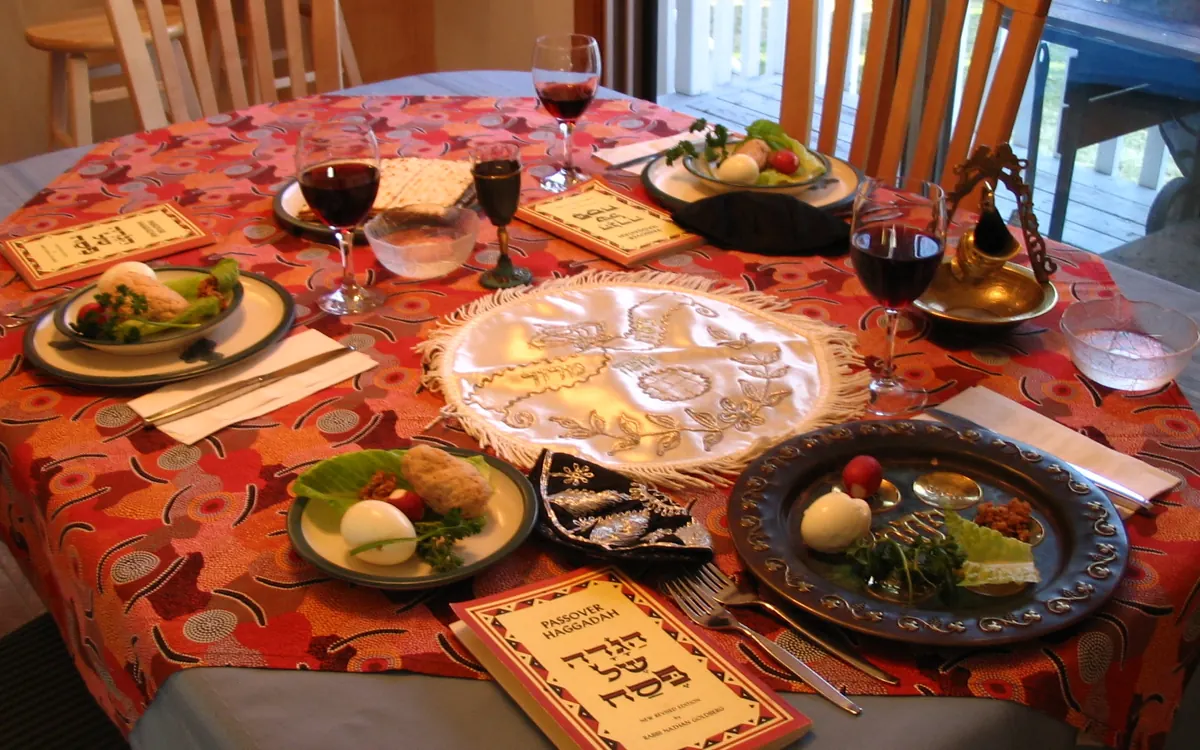
Telling the story of the Exodus is something so simple that we do it every year, and so complicated that we never get it quite right. With all the effort we put into preparation for a kosher Pesach, it is worth dusting off the Passover Haggadah a couple of weeks early in or to prepare for an awesome Seder. Mark Gerson, author of The Telling: How Judaism's Essential Book Reveals the Meaning of Life and host of The Rabbi's Husband joins me to discuss his new book about the Haggadah and how we can best access its energy and wisdom.
About this episode
Viktor Frankl said a man conscious of his responsibility to another person or to unfinished work can bear almost any how, and Rav Mike feels himself in the thick of such work as Pesach nears. He notes how much elbow grease goes into clearing chametz and how little into the positive command of Exodus, to tell your children on that day what God did for you. Telling a story children will absorb rather than merely sit through is a powerful task, worth as much preparation as the kitchen. To help, he turns to Mark Gerson, co-founder of United Hatzalah and author of The Telling. Gerson explains the name of his podcast, the rabbi's husband, through the Hebrew panim, that we each hold many faces, and this is the singular face he chooses as he discusses Torah.
The first question with any media is the genre, and reading the Haggadah as a dinner program or cookbook gets it wrong. Gerson calls it the greatest hits of Jewish thought, a guidebook assembled for the biblical New Year of Pesach, so families can take inventory and ask what kind of people they want to become in the year ahead. Rav Mike notes the Mishnaic argument between Nisan and Tishrei, and how Pesach is the more intimate, the Jewish story rather than the universal human one. Gerson points out that the Haggadah is the tool for telling the story and not the story itself, which lives in the book of Exodus, and that it begins with Abraham because the Exodus is an ongoing story. Since seventy went down to Egypt but only sixty-nine are named, he reads each of us as number seventy.
A central chapter Gerson calls the unfinished, built on how the farmer's declaration is cut off before he reaches the land, and how the four cups fall short of the five expressions of redemption, so the destination keeps being removed. He contrasts Moshe, who commands holiness in the future tense as a process, with Korach, who asserts the people are already holy, and names Korach's claim of completeness the great unforgivable sin. Shimon Peres, asked for the greatest Jewish gift to humanity, answered dissatisfaction, since the hungry keep asking what to change in themselves and the world. Rav Mike presses the pastoral worry of living a life that never ends without misery, and Gerson answers with setting a goal you cannot reach in a lifetime, taking joy in accomplishment while knowing the ultimate task stays unfinished.
This speaks to Rav Mike's own work telling the Jewish story, where you do not know what a story is about until it is over, and since the real Jewish story never ends we are always alive to its meaning. Gerson reads Rabbi Elazar ben Azariah, a prodigy who called himself like a seventy-year-old, not as immortalized bragging but as the humble acknowledgment of a God-given gift, with C.S. Lewis that humility is thinking of yourself less. He draws on the Rebbe's teaching that every Jew is a guarantor for every other, which only makes sense if each is richer than the other in some way, so everyone at the table can ask where they are rich enough to guarantee another's growth. False humility, both agree, is itself a sin.
There is no Hebrew word for history, only for memory, and Gerson says Pesach turns ancient experience into contemporary memory. Rav Mike offers three readings, Jewish continuity, inherited wisdom in the spirit of Santayana, and the Baal Shem Tov's teaching that exile flows from forgetting and redemption from remembering, and Gerson suspects all three. Moshe chose to perpetuate the people through educating children in an age before universal literacy, tying it to the verse when your children ask you, since every child is curious. The four questions are deliberately mediocre, Gerson argues, because no generic question arouses a real child, so the Seder leader must find each child's own access point, which is why his chapter is called why whoopee cushions are kosher for Pesach. Rav Mike closes on his own lesson, that the Seder is finally about the children and the experience more than the content.
Key ideas
- The Haggadah reads best as a guidebook for life, the greatest hits of Jewish thought gathered for the biblical New Year.
- Seventy went down to Egypt but sixty-nine are named, so each of us can stand as number seventy in the story.
- The farmer's declaration and the four cups are left unfinished, teaching that the Jewish story has no ending.
- Peres named dissatisfaction the great Jewish gift, so Gerson counsels a goal you cannot reach in a lifetime.
- True humility, with C.S. Lewis and the Rebbe, is acknowledging your gift and owning the responsibility it creates.
- Pesach turns ancient experience into contemporary memory, and the Seder is finally about the children's curiosity.
Chapters
- 0:00 Scrubbing cabinets and the other side of Pesach
- 2:16 Telling a story children will hear
- 3:20 Meeting Mark Gerson
- 6:43 What is the genre of the Haggadah
- 8:00 Pesach as the biblical New Year
- 11:17 Each of us is number seventy
- 13:27 The unfinished and the missing fifth cup
- 14:31 Moshe, Korach and the finished people
- 15:33 Peres and the gift of dissatisfaction
- 17:53 A goal you cannot reach
- 21:12 You do not know the story until it is over
- 25:46 Rabbi Elazar and the gift to acknowledge
- 29:09 The Rebbe and the guarantor
- 35:54 Memory, not history
- 38:09 When your children ask you
- 42:35 Whoopee cushions and the curious child
Who, where and when
People
Mark Gerson, Viktor Frankl, Moshe, Korach, Shimon Peres, Rabbi Elazar ben Azariah, C.S. Lewis, The Lubavitcher Rebbe, The Baal Shem Tov
Places
Egypt, The land of Israel, Ir David in Jerusalem
Texts
The Telling, The Haggadah, The Book of Exodus, The farmer's declaration in Deuteronomy
When
The Exodus, the night of the Seder, the biblical New Year of Nisan
Read the transcript
A man who becomes conscious of the responsibility he bears toward a human being, who affectionately waits for him, said Viktor Frankl, or to an unfinished work, will never be able to throw away his life. He knows the why for his existence and will be able to bear almost anyhow. Well, I'm certainly engaged in some serious unfinished work. I'm not entirely sure why, but I do know how I'm moving forward, because I'm Rav Mike Foyer, and this is The Jewish Story. Interlude on the Haggadah, an interview with Mark Gerson. So it's that time again. I hope you're feeling the Pesach power season. How many of you out there right now are scrubbing the inside of your cabinets? As you listen to me, admit it, you can raise your hands.
Nobody can see you. Now, I'm a big believer in the importance of Buur Hametz, of cleaning out all the leaven from our lives, both on the physical and spiritual level. And there might actually be an episode lurking inside me about that somewhere. But I really feel every year, as the frenzy builds and the air is redolent of cleaning agents, the call to remind us all that Pesach, like every other package of Mitzvot, and certainly like every holiday, has two sides. The power provoked by the low tasseh, by that command to clean ourselves out, lest we, God forbid, eat or even possess any chametz, is tremendous, as is the angst that accompanies it. And it's also quite familiar. Many of us started feeling the stress back around tubishvat.
But how many of us put that much thought, much less elbow grease, into preparing for the mitzvot aseh, the positive obligations that are bound up with the day, and in particular with the powerful one found in Shemot, in Exodus 13, 8, where it says, You'll tell it to your children on that day, saying, It's because of this that God did for me when I came out of Egypt. A simple line, but awesome in its implications. We're not going to dive into it now, but if you have children, or have ever been a teacher, or remember what it is to be a child, You can appreciate the very powerful and problematic task of what it is to tell a story your kids won't just listen to, but will actually hear. And to do it every year.
With the friends and family gathered around, making it joyful and much more complex. Family dynamic is what this night is all about. Love it or no. Please God, it should only be a success. and surely a task of such magnitude and importance to say nothing of its own angst evoking nature, which also happens to be a primary purpose of the Chag, of the holiday itself, deserves as much time and preparation as the construct of your kitchen. Now last year I went live and talked a bit about the Pesach story as narrative therapy as it relates to my counseling work and if you want to hear that again, you can either find it on SoundCloud or you can send me an email, robmikefoyer at gmail.com or a message on Facebook.
I'll put it up there. Keep an eye out. It's always worth hearing again. But this year, I decided to take a somewhat different task, a bit more fit to this season. So here's an interview, which I hope will serve you in good stead as a preparation for the positive commandments of this fantastically exciting day, which is now Ode Ma'at, just a little bit upon us. Basically, I can't clean your fridge for you, But God willing, I can make a little contribution to your Seder and the story that you want to tell. So, okay, here I am with Mark Gerson. He's an American businessman, investor, co-founder, and chairman of United Hatzalah. He's actually a fellow podcaster, which amongst all the illustrious accomplishments made him warmest to my heart.
And last but certainly not least, author of the new book, The Telling, How Judaism's Essential Book Reveals the Meaning of Life. And that's really what I'm here to speak with Mark about today is a little bit of the Haggadah. So shalom, Mark. Welcome to The Jewish Story. Michael, it's so great to be here. Thank you. I really appreciate you making time and for such an exciting topic. I think that, as you say in the book itself, preparation is half the battle. So we could do a lot worse at this stage of the season to have a little conversation about the Haggadah. But before we do, I just have to ask a quick personal question, if I may. of course i am a lover of of um titles i think that they convey a tremendous amount about what people want to say and also the precision of their message and i think you've done extremely well tell me about the rabbi's husband now aside from the obvious i understand that your wife is a rabbi but like how did you come that's a bold move where does that come from the name of your podcast oh uh well thank you i mean i i love the name because you know as i'm sure we'll talk about in in our discussion of the haggadah there's there's no hebrew word in the singular for face Right.
There's panim, which is plural. We all have many faces. We all have many identities. We all have many ways to present ourselves. So when I think, what's the singular way that I wanted to present myself in this capacity, the podcast, and also just generally, it's without a doubt, is the rabbi's husband. That's my proudest appellation, is the rabbi's husband. So when I thought about how do I want to define myself to the world particularly, but not exclusively by any means, as I discussed Torah, is the rabbi's husband. Excellent. Wow. That's a beautiful answer. So, before we get started in the detail, I'm just curious a little bit about the process. How does someone who, as far as I can tell, has devoted a good chunk of his life to business, to investment, to understanding, as we were speaking about before we started the show, how to get the best return of investment on tzedakah, how do you come to write a book on the Haggadah?
It seems, I think, to most people to be a very sort of technical pursuit. So, how did that come about for you? Oh, that's interesting. Yeah, well, I think you kind of just explained why I wrote the book. Because the Haggadah is, yes, people might perceive it as a technical document or as a dinner program or as a manual to get through a Jewish holiday, a holiday manual or dinner program. Sure. Or a technical pursuit. But what it actually is, it's the greatest hits of Jewish thought compiled into a guidebook that we use at the Seder, but also for life. Every passage in the Haggadah yields the most profound life lessons that enable us to live a happier, better, and more meaningful life in the most actionable ways today.
So I wrote the book when I began to discover what the Haggadah really was, which is this great guidebook for us. And it just became a labor of love, not even a labor, just an activity of love. And as I studied the Haggadah more and more and just realized how much fascinating wisdom was packed into this book that we read every year. And that some people may look at it as a technical thing. It just reinforces why I wrote the book, because the Haggadah is word for word the best book ever written. You know, you tell a beautiful story in your introduction about falling in love. this story you call the discovery of the Haggadah and how you fell in love with it and how it led you to actually a deeper engagement with Torah learning in general.
I can tell you that as an educator, amongst all the insights that you offer, and we're going to touch on some of them soon, I have to say that that was personally the most moving piece that I read. This idea that your discovery of the Haggadah led you deeper into Torah. And I'm curious, how would you guide people in falling in love themselves with what you call the book of the greatest hits in Torah? Right. Well, I think the most important thing, the most important approach to any kind of media is first asking, what is the genre? And so and that's especially important with the Haggadah. So if we look at it as a dinner program or an instruction manual or a cookbook, we're going to read it wrong and we're not going to get out of it what we should.
It is really the great Jewish guidebook. And it's the Torah. It's as though the authors of the Haggadah thousands of years ago said Pesach is the authentic Jewish New Year, which it is. It's the biblical Jewish New Year. Rosh Hashanah is not even in the Bible or it's not even in the Torah. Pesach is the authentic Jewish New Year. Well, I mean, Yom Chirah is there, but it's not called, correct, it's not called the beginning of the year. No, no, it's the day of Shouting, right? Yes, and the seventh month, Davka, yeah, true. Yeah, and it's probably shouting that Sukkot is coming, you know, to alert people, perhaps, that alert people to the great festival of Sukkot is coming, but it's not the Jewish New Year in the Torah.
Certainly not how it's presented, yeah. Yeah, so, but we do have a New Year, which is Pesach. So I think that the authors of the Haggadah said, OK, we have this great Jewish New Year of Pesach. What guidebook can we give the generations so that they can live happier and better Jewish lives in the year to come? So let's let's put the greatest hits of Jewish thought. Let's take the most important ideas from the Torah and subsequent commentary and put it in one short book to be used at the great New Year celebration. Because what do we do with the New Year in a secular context or religious context? What do we do? We consider how we did in the previous year. We take inventory of ourselves today and we think, what kind of person and or people do I want to be in the coming year and how do I do that?
And the Haggadah exists to serve that function. So if I understand you correctly, essentially, the authors of the Haggadah packed together almost the lead strings of all the great things you could find elsewhere in Torah. and they put it right at the hinge point of the year. When everybody comes together, there's a lot of drama. Like you say, from the Torah onward, it's introduced as a dramatic day. And all the threads are there. So if the family comes together and the friends come together, at least they can touch that hinge point of the year together with the hinge point of the Torah. That's a powerful perspective. And in what you're saying about the Jewish New Year is important. I'm guessing you're familiar with the fact that the Sages of Mishnahh actually had an argument about when the year starts, between Rabbi Yeshua and Rabbi Eliezer, between Tishrei and Nisan, between basically Rosh Hashanah and Pesach.
And in many ways, Pesach is the more intimate of the two. Tishrei is the universal creation of Adam and Eve and the sort of encompassing Jewish, sorry, human story. Whereas Pesach is, you know, kind of the Jewish story, something which is a passion of mine, hence the name of the show. So, and you note, again, in your introduction that the Haggadah is actually not the story of the Exodus. It's an important insight, which many people miss, is that you come together, the mitzvah, the commandment, is to tell the story. But the Haggadah is not the story itself. It's the tool that we use to tell the story. So in your understanding, how does it work? People are going to be sitting down in a few weeks. It's a fascinating question because it depends on how we define the Exodus.
So if one were to give a student an assignment, tell the story of the Exodus, it wouldn't be that hard conceptually from the student's perspective, because the entire story of the Exodus is in the biblical book of Exodus. Yeah, it's right there. It's a narrative. It's right there. But the Haggadah begins with Abraham, and then we go through the Seder of B'nai Barak and Dayenu. The story of people telling the story. And the story of people telling the story, exactly. But we are telling the story of the Exodus because the instruction is to relive and retell the story. So I think it teaches us how to conceptualize the Exodus. The Exodus is not only one moment that occurred in history. It is that, but it is not only that.
The Exodus is the great Jewish story upon which the Exodus text, which tells the liberation story, is the focal point. But the Exodus story, the story of liberation, began with Abraham, and I would argue it's ongoing. And that why in the Haggadah it says 70 people went down to Egypt but if you count the names in the Bible they only 69 Right So who number 70 I believe each of us is number 70 because there for instance there no Hebrew word for history but there a very important Hebrew word for memory So we have no concept of something that happened to other people at a distant time in the past. But we do have a very rich concept of an ongoing story in which we are participants. So I think we can read the authors of the Haggadah want us correctly to read the Exodus story as an ongoing story that actually started with Abraham and that we are continuing to participate in, of course, which had its focal point in the book of Exodus.
So this is actually a beautiful segue to the next question I wanted to ask you, which is you have a powerful chapter, which you call the unfinished. and it's beautiful what you're saying this idea of there are 70 people that went down to Egypt but if you count there's only 69 which I've always just taken as the quintessentially if we're going to have 19 blessings in our 18 blessings there's never anything straightforward for Ami Israel but in the unfinished you note how the central text of the Haggadah which is the Aram Yol Vedav the declaration that the farmer makes when they bring their first fruits up to the temple and the sort of ideal structure of Jewish social religious life. But that text is a Thanksgiving text.
It's a text of confession. It's many things. But you point out that what one would think to be the culminating statement of gratitude that God has brought us to the land of milk and honey is cut off in the Haggadah. It's not in clear. And then you go on to demonstrate how actually one could say this is a theme throughout the text of the Haggadah, how the sort of legendary four languages of redemption to which we build the four cups is missing the fifth, which you're also aware that there is even a tradition out there, not just in modern religious Zionists like my crowd, but also going way back of a fifth cup. But it's not in the structure of the God. Somehow the destination has been removed. And you give a beautiful illustration that I want to sort of just let our listeners know about.
in contrasting Moshe and Korach as two models of how to understand, in essence, the Jewish story. Moshe brings the great command from God of ketoshim to you. You should be holy. But as you point out, it's in the future tense. It's a process orientation. Whereas Korach makes the assertion, that the people are all holy in the present sense. And then you make what I think is a very bold statement, is that you see, since Korach is, of course, universally condemned in the rabbinic mind, also in the text. I mean, there's no bigger condemnation to getting swallowed by the earth, right? Yeah, he's the worst Jew in the Torah. Right, yeah, no question. He definitely, and is remembered as such, beyond in the rabbinic literature.
And they make this amazing statement that the great, unforgivable, eternal sin is saying that the Jewish people are complete. Right. Tell me more about the pitfalls of stories that have endings. I'm a great lover of story. Tell me a little bit more about that, how that drives your understanding of the Haggadah, and where you see it even, you know, as you were pointing out, today. The pitfalls of stories of things. Well, I'm so gratified by what you say, and that you found meaning in that passage, because I think it's, of my book, which I think is so important, is that the great Jewish story is unfinished. Of course, the quintessential example is Moses doesn't get to the Promised Land. Right. Right. I mean, if you were to tell the story of Moses, I mean, of course, it would be a happy, if I were to tell the story, I would wrap up with him getting in the Promised Land, right?
But that's not what God does in the Torah. is that Moses does not get to the promised land, teaching us that great Jewish stories are unfinished. And this has a profound life lesson for each of us, as does everything in the Agadah. But Shimon Peres was asked, what is the greatest Jewish contribution to humanity? And he, of course, had a lot to choose from. Being such a great champion of Jewish entrepreneurship and Israeli innovation, he could have picked something medical or technological or military or humanitarian or intellectual. Instead, he said it's dissatisfaction. Really? Yeah. He said the greatest Jewish contribution to humanity is dissatisfaction. And so why? Because when we're dissatisfied, we're hungry.
And this is actually fits with my chapter as to all who are hungry, come need all who need to come and celebrate Passover. When we're dissatisfied, we're hungry. But then we have to ask hungry for what? So what do we want to change about ourselves spiritually? What do we want to change about others materially? But when we're finished, we're satisfied. Right. But a Jew should always be dissatisfied because that is what Shimon Peres said is the greatest Jewish contribution to humanity. Therefore, we should never be finished. There should always be something that we're working on, something within ourselves spiritually and something in the world materially. And the moment that we say that people are holy, not might be holy or will be holy, but are holy, we're finished.
I mean, that was Coraxin. It's a beautiful insight, but I'm thinking that there's got to be someone out there listening right now who's saying, boy who's saying gosh you know i i it's been a long haul whether you look at it from the historical perspective of 2 000 years of exile and and the desire rightly or wrongly to live a normal life so to speak in our land or or the sort of personal desire i do i'm one of the things i do is spiritual counseling and i know that um i see the power of what you're pointing out in terms of of never really just settling and feeling that sense of drive and it doesn't surprise me that someone like yourself who's been successful in so many fields sees this to be a powerful call.
At the same time, I'm wondering, especially, and I'm drawn to this in light of this sort of daily disruption that we're all experiencing in the madness of the COVID world, how do you actually, without living a miserable life, pursue a Jewish life that doesn't end? You call the full Jewish life as one that never ends. What advice would you give to people to do that in a way which is nonetheless sustainable and life-giving as opposed to just the sense of endless struggle. Right. Well, I would say everyone should set a goal that they cannot achieve successfully in their lifetime. Everyone should set a goal that they cannot achieve successfully in their lifetime. So that when we die, we'll have advanced, God willing, towards the achievement of that goal, but we will not have fulfilled it.
That's the theory of big, hairy, audacious goals, meaning that you just got to set something out there that you're willing to struggle for but you know you'll never reach you know you never reach exactly and uh yeah exactly and i think that is the quintessential definition of a jewish goal is is i'm going to pick something that's very meaningful and i'm going to work and struggle to achieve it knowing that i'm going to die with it having been unfulfilled but i think your spiritual counseling is so interesting in this context but But as a spiritual counselor, if somebody came to you and said, and you said, okay, how are you doing? And they said, you know, today I feel great. I'm totally satisfied.
I'm done. I'm done. I'm so satisfied. I'm done, Rabbi. I'm great. I'm done. What would you say? I'd probably say first, well, then why are you calling me? But after we got past that stage, I would say, okay, so first of all, it is important to enjoy a sense of accomplishment. And I think that allowing oneself to feel good about things is actually challenging for many people. At the same time, I would push against this idea of being done, because only something which is dead is done in our world. Exactly. Exactly. What it brought up for me, you know, I'm sure you're familiar with the statement of the Mishnahh that, you know, no, sorry, it's not upon you to finish the work. And it's sort of ultimate messianic vision.
And maybe you've heard Ben-Gurion's, I don't know if it's a famous statement, to me it's one of my favorites, is that he was a strange mix of a messianic pragmatist. He wasn't a religious man, but he had a certain messianic vision. But he once said that if the Messiah has a phone number, then he ceases to be the Messiah. Meaning that aspiration for the more, for the larger, for the redemptive, which of course is so central to the Exodus story. by definition can't be fulfilled. There might be stages of accomplishment, and I think that there are different generations. But yeah, I think that's very powerful what you're saying. Well, and of course, one can and should take joy. Joy, as I also discussed in the book, is a commandment in the Torah.
We are commanded to be joyous. Yeah, on past stuff in particular. Absolutely. And so one should take joy, of course, in one's accomplishments. But taking joy in one's accomplishments can still happen with the realization that the ultimate task, I will die being unfinished. I mean, we're just talking about our great mutual friend, Daron Spielman, who is proving day after day with his sacred work at Ir David, the Jewish provenance in Jerusalem. Yet, I'm sure if we ask Daron, when you're 120, is there still going to be stuff to be found? Are there still going to be stories to be told? He's going to say, of course there will. But just think about in the time that you and I have known Daron, the extraordinary work that he's done at Ir David.
So this is a great example of something which really speaks to me in the work that I do in telling the Jewish story. I've been telling now, I'm in my fourth season, I started the book of Daniel for reasons that just will lay it aside for now. And right now I'm in 1972, I'm going to lead up to the Yom Kippur War. So I have this sense whenever I tell the story, and I think Ir David bespeaks it well, and if you had asked someone, after the destruction of the Second Temple, let's go second century of the Common Era, for the next 1,500 years, you ask people, is Jerusalem the capital of the Jewish people? So every non-Jew who answered the question would have said, well, it was. But that story's over. And because they felt the story was over, they felt they knew what it was about.
But the reality is, the type of work that your David is doing and the type of work, frankly, that you're doing with connecting the Haggadah to people's sort of ability to live a meaningful life shows, truth is, you don't know what the story is about until it's over. And since what you're pointing out is that the real Jewish story never ends, so we're always in a process of a live engagement, not just moving the story forward, but even what it meant looking back. And that gains, it gives us a lot of power, I think, in our ability to live a meaningful life, because the interpretive process is where meaning lies. Absolutely. And I think that the authors of the Haggadah not only knew this, but really wanted us to understand it, which is why there are five expressions of redemption in the Torah, but four cups of wine.
You know, there could be, there should be five sons from the Torah. There are four sons. The part in the great farmer's declaration, that's interesting in and of itself. When we finally come around to telling the story of the Exodus in the Haggadah, we do throw through an imaginary man in Deuteronomy. Right. But, which is fascinating, and I have a chapter on that. But we skip the part of the farmer's declaration where the farmer arrives in the land because we have our stories unfinished. And the authors of the Haggadah, I believe, want us to really understand it and to contemplate what does it mean to live an unfinished life and to aspire to live an unfinished life. So really, the goal is beyond the telling.
It's a deep identification with the story. As the Mishnahh says, that a person is obligated to see themselves as if they themselves went out of Egypt. And that, I think, really shows why each of us is number 70. Yeah. I like it because 70, of course, is also a number of wholeness. That's right. The complete, as you pointed out from the beginning, that there's no singular usage for the human faith. It's panim, not pan. I mean, pan is a facet of something, but it's not a face. Right. And we say, that there are 70 faces to the Torah. And so then I myself is not just a reader passively of the Haggadah teller of the story in my life really become that 70th faith It a beautiful it a beautiful image So I have another story as a fellow author of fiction you know, and also as a learner, you know, every year for a long time, I used to love to buy a new Haggadah.
It's like, you know, going down to Meisharim or another bookstore and, you know, look through it. It's exciting. And I always, I recommend my students to do it all the time. At a certain point, I kind of got overwhelmed, to be honest with you. It's like, there's no end. to how many haggadot there are. And I'm curious, just first of all, on the personal level, for you, did you find it intimidating to think that you were going to pick up a task that almost every great mind of Jewish history has done, and also where there's a bookshelf full of predecessors, right? What was it that you felt that you had to add to people's ability to engage the haggadot that had not yet been said? What a great question. I think what I felt was showing people that the Haggadah is the greatest self-help book ever written, that it exists as Deuteronomy says of the Torah.
It exists for Deuteronomy of the Torah. It exists for your benefit. Right. That that expression, I think it's 10 seven. But, you know, that expression for your benefit, we would call that. Oh, so it's a self-help book. Right. Exactly. And so I wanted people to be able to read the Haggadah as a great self-help book, as all the wisdom of the Jewish tradition packed into this short book to help us live happier, better, more fulfilling lives in the year to come in the most practical and actionable ways. So there's nothing technical about this. There's nothing abstract about it. There's nothing ethereal about it. It's all intensely practical. It's the compilation of Jewish wisdom on our Seder table for us to open, enjoy, experience and live by starting Tanakh or tomorrow in ways that are accessible and actionable for everybody.
so on that note would you share with us um either what you feel to be the most important or something which just uh strikes you like the thought an exercise or or a framing insight that you that really will help people connect to what you mean by the Haggadah as a as a guide to self-help yeah exactly okay so we can we can almost we can open almost any page and do this because every page has this actionable and totally interesting Jewish wisdom so here's one Rabbi Eleazar Ben Azaria, who we know was about 16 or 17 at the time. Right. You know, he said, I am like a seven year old man. Now we don't have to go through what he said, although it's important and interesting. But he said, I'm like a seven year old man.
Now, he was not saying I'm like a seven year old man in my capacity as an athlete. Right. He was shopping days are over. Right. Right. He was saying I'm like a seven year old man in my capacity of wisdom. Right. Leading us to ask, are we immortalizing the bragging of an adolescent in our sacred Pesach New Year? That's a good question. That's what we seem to be doing, right? We'd be immortalizing the bragging of an adolescent, where most of the time we think that if an adolescent brags, we should encourage him and help them to get through that phase as quickly as possible on something more mature. Yet, we are immortalizing the bragging of an adolescent in the Haggadah. So it must be teaching us something.
And I think it's teaching us a profound and very actionable lesson, which is, and I think it was the Christian author, C.S. Lewis, who put it so magnificently. I'm a huge fan. But he said, well, yeah, he said, humility is not thinking less of yourself, it's thinking about yourself less. Or the Havats Haim, who said that false humility is a sin, right? So when he was seen to be bragging, what he was doing was he was just acknowledging a gift that God gave him, which was the gift of wisdom. He was a prodigal in that sense. He was as wise as a 72 man at age 16. He was saying, God gave me this gift, and he wasn't congratulating himself about it. What follows is he was acting towards creating a dwelling place for God on earth with this gift.
So I think all of us in the spirit of this 16 year old young man who is saying he's like a 70 year old we should all think what great gift did god give me specifically and how can i use that gift as a tool as the staff in my hand to make the kind of contribution to the world that god wants from me it's beautiful because i'm picturing at my uh seder table you know it's often struck me that there's a deep misunderstanding of the idea of humility. Right. You know, because Moshe is famously called the most humble of all men. And yet he stands up to Pharaoh. He stands up to God. You know, he splits the red. He stands up to Pharaoh. He stands up to God. He takes it to an Egyptian, like when the Egyptians pray.
Oh, yeah. And then he sees the multiple men who were harassing the women at the well of Midian. Takes it to all of them. That's right. whether it's physical, emotional, psychological spiritual, he has confidence in himself completely, yet in that passage you quote, it's like the author of the Torah steps out of his role as telling the story and becomes a pundit, and says by the way Moses, he's supposed to come on in the never to live right, which means that, you know, it's always been taught to me that he was never one ounce more than he was, classic humility, but he was also never one ounce less that real humility like you're pointing out is recognizing what I am, what I've been giving, and the responsibility that creates.
So I'm picturing, you've given a sort of a theoretical insight on what is humility, but there's also an opportunity, like you pointed out, for everyone around the Seder table to now say, what gift are you holding that it's important for you to acknowledge and own? Exactly. And the Seder leader should not let anybody say, well, I don't have any, because that's false humility. Because God created us all in his image. God created a mission and a purpose for each of us. And he put something in our hands, a staff in our hands, which is some great gift that we have to do it. Now, the Rebbe, Menachem Shearson, I think he put it so magnificently. He took the phrase, every Jew is a guarantor for every other Jew.
Right. Call you the Rebbe and say, listen. Yeah, exactly. And he said, I don't know if he used this term, but he said effectively, in economic terms, what does that mean? The Rebbe took language very seriously. You know, he would never say house of the sick. It was always house of healing. He would never say deadline. It was always due date. So he took language very seriously because God creates a world with nine or so God says, right? So words are very important. So he took these words seriously. What does it mean that we say we're a guarantor for every other Jew? And, of course, the same thing could be said about any community. Any community member could say I'm a guarantor. What it means to be a member of a community is to be a guarantor.
Sure. So he said it makes no sense to be a guarantor for somebody unless you're richer than that person in some way. True. Otherwise, you're not cosigning the loan. Exactly. Exactly. Could you imagine going to the bank and saying, I'm going to guarantee the loan. and the bank officer says, okay, can I see your assets? It turns out that you're poorer than the guy for whom you're guaranteeing. The bank officer will say, what's going on here? Right, that's funny. So the Rebbe's point is so profound. So if we believe, as we should, that every Jew is a guarantor for every other Jew, then that must mean that every Jew is richer than every other Jew in some capacity, as the Rebbe explained. Wow, that's beautiful.
And I think this is what this 16-year-old young rabbi, coming from the Seder B'nai Barak, either knew or intuited, is that, yes, he had this gift, and humility is acknowledging this gift and then asking, how can I contribute it to God? and beautifully you tie it back to the fact that everyone around the Seder table now can be challenged to ask themselves, where in my life am I richer than everyone around me that puts me in a position to be able to really be a guarantor for their growth, for their well-being? Beautiful. You know, a lot of people, I don't know, you probably have had this experience since you've been learning and teaching the Haggadah and studying for so long. A lot of people are very intimidated by Seder night.
It's one of the only things that I love. I live here in Israel and I've been on the sort of israeli religious calendar for a long time and i have to be honest with i don't miss two two holidays in a row two hakim in a row but sometimes i have found that the idea of making a second seder for some people takes the pressure off it's like it's like you know what you're gonna do it once we'll do it again and but but i know a lot of my peers here feel a tremendous pressure either as parents they want to make it right for their kids or as learners they want to make it sort of deep or themselves they want to connect so um as someone who spent so much energy in it has actually produced a book to help people with this.
What do you find to be the most challenging part of the Haggadah, either as a leader of the Seder or as a participant or personally challenging? What do you see in there that's a challenge for you? Well, I think there are spiritual challenges all throughout the Haggadah, which is this is the great New Year. And I talk about in New Year's celebration, I talk about in the book that if you want to understand a person or a people, perhaps the best singular way to do so is to observe how they celebrate. Tell me more. Well, just pick like a 40-year-old guy and think about, well, how does he celebrate his birthday? And just think of like two very different ways. And you could probably start his biography and get a lot of the way through only knowing how he celebrated his birthday.
That's an interesting lens. I like it. And so if you want to understand the Jewish people, probably the best singular way is observe how they celebrate Pesach. They tell the story to their children and in so doing, try to extract the life lessons and apply it in the year to come. So that's fundamentally what we do at our New Year's celebration. So if we do this in the way that the authors of the Haggadah wanted us to, we have to ask, for instance, all who are hungry, come and eat. We have to ask, and this is one of the many questions we have to ask, what am I hungry for? So that's a challenge. And as Yisrael Salantir said, we should always be concerned about improving ourselves spiritually and the lives of others materially, not the other way around.
Yeah, one of my favorite quotes by him. Yeah. So that's a challenge. But it's a good challenge. There are no bad challenges in the Haggadah. I mean, if someone is like really worried about, do I have all the right stuff for the Seder? Now, of course, the whole community of Israel has to be provided for. Everybody needs to contribute to a Pesach relief fund. I think that's effectively required. But that's not what I'm talking about here. I mean, if someone is, oh, did I get the right kind of brush or the egg or is this on the right plate or did we wash hands at the right moment? A lot of stress there. It's a misinterpretation. It's like all that exists to serve these existential investigations. And if that becomes the focal point, then we got to reinterpret and get back to the existential questions.
This is an important point that I've tried to drive home in a number of ways, is that, you know, as a person who's devoted his life essentially to the power of story, I am deeply committed to the tool of tension. Without tension, you don't have a story. You lose interest quickly. And so if I understand you correctly, the details, which could be looked at either as a technical issue or they could even look at as the structural sort of flow, should also be engaged as points of tension. If I'm feeling stressed or I'm wondering, did I do it right or why, that that tension itself should be productive as opposed to distracting me and falling prey to sort of an almost pedantic focus on the bits. I need to be able to feel that tension and understand that this is actually what makes the story real, because anything that you feel tension around is far more real to you than just some tale you're telling to pass the time.
Right. And I think it's just it's just important to distinguish between the things we do to allow us to focus on the story and realizing that those things are actually not the story. Yes. They're just what we do. So if we make a mistake here and there in that process, it's OK. Let's just get to the let's get to the heart of it. Let's discover who we are and who we can be in this great Torah context. And let's investigate that. And if anything gets in the way of that, forget it. So, I mean, I think that's a good guiding principle for taking some of the pressure off. There's another statement as I was reading through the book that really struck me because you mentioned at the beginning of the show that there's no word in Hebrew for history.
Now that for me had been a watchword and a guiding principle since I began my journey into teaching Jewish history the Jewish story almost 15 I think 15 years ago at this point And that the power of memory is really the driver of how we relate to our past. And you have this line that passive is about turning ancient experience into contemporary memory. I think in many ways encapsulates what we're trying to do, but I want to offer you three different sort of models on how that might be understood and just see what you think about any or all of them. One, of course, is classic Jewish continuity, right? One of the ways in which I know people who are balay tshuva, people who didn't grow up religious and have become more religious, and even though Pesach is perhaps second only to lighting Hanukkah candles, one of the most observed aspects of Jewish life, nonetheless, a lot of people lack that sort of childhood memory of what the Seder was.
And so we are literally creating memories, and that is itself Jewish continuity. That's one idea, maybe, of what you mean there. Another one is inherited wisdom that guides us, right? That's Santayana's famous quote, those who cannot remember the past are condemned to repeat it. Like you point out, the Exodus story is an ongoing story. It's there in our lives, which also means the story of slavery and oppression is there. And so therefore, it's perhaps an important thing to let the wisdom of the past guide us in the present. And last but not least is a quote that's very dear to my heart, is that the Baal Shem Tov gives a very different version than Zantayana. Not surprisingly, as a founder of Hasidut, he says that exile flows from forgetting, while redemption comes from remembering.
So I'm wondering when you say that Pesach is about turning ancient experience into contemporary memory, is that continuity? Is it accessing inherited wisdom? Or is it itself the way in which we bring about redemption? I think it might be all of them. I mean, in the sense as to what are we doing? I mean, it's such a profound construct that you you offer. I mean, it's and it really brings to mind, like, what is the quintessential ancient experience? The ancient experience is Moses on that the last meal in Egypt, the night we had the last meal in Egypt. And Moses says, I want to make this an eternal decree. Right. So eternal decree or forever. That's a long time. Right. So but but and, you know, you talk about remembering, you know, the term remembering appears often in the Torah.
But it's not like God ever forgot. Right. It's like God remembered. No, he didn't say, oh, yeah, that guy on the on the ark. Oh, yeah. Destroyed the world. No, it's that remembering is always a cue to something important. Some important action is about to take place. Absolutely. So Moses decides he wants to perpetuate the Jewish people forever, and he decides to do so in a kind of insane way through education of children. Insane because the alphabet had barely been invented. It's because nobody in the world even knew about the idea of universal literacy or mass education. And it wasn't until the 20th century when everyone kind of accepted it, literally until the 20th century. And yet he decides that he wants to build the future of the Jewish people to have us last forever on that basis.
and he ties it, I believe it's Exodus 13, 14, when it says, when your children ask you. What about, what do you mean when your children ask you? What if they don't ask me? It's like, how about if your children ask you? He said, no, no, no. What does every child have in common? Every child is curious. So your child will ask you. So he was saying effectively, I meant, I meant what I said, when your children ask you. And so this is ancient experience. And so much of the Haggadah, so much of what we're doing at Seder And so much of what we do as parent educators or as professional educators is living that ancient experience in our day. And in fact, if we had to to encapsulate the Seder experience in one way, we would say it's about education the children.
Now, of course, we educate our children. We also educate ourselves. Oh, yeah, because we don't educate in a pediatric way. You know, we educate by asking and answering and discussing these profound questions. And everyone can understand. That's one of the geniuses of the Torah is that, you know, in our home, you know, we're blessed with four kids in our home. We don't have any children's books about the Torah. Like we study the real thing. You know, it's because it because kids at a very young age can understand, can love it, can assimilate it into their lives. And that's what we're doing on Passover night. Pesach night is we are taking that ancient experience and we're playing it into contemporary memory.
And we're all participating in the same story in the same conversation. There's a very powerful message. I think that it's worth repeating in what you said. There's many, but the one that really struck me is that the keystone to education and in this model, therefore, redemption, is the curiosity of our children. Absolutely. Therefore, if we have to ask ourselves, am I succeeding as a parent or even before I'm going into analysis, I'm trying to make a decision as a parent about what to do, how to do it, et cetera. One of the questions I should ask is, is this going to promote curiosity or is it going to push satisfaction as you were speaking before? Am I trying to get my kids to plateau or am I leaving them just a little bit?
Because curiosity and dissatisfaction have a very sort of intimate relationship. You know, you're curious when you're dissatisfied with your understanding of the world as it is. That's a great way to look at it. And I think that there's a powerful combination there, which also can bring a lot of comfort to those who end up feeling a little bit dissatisfied that the Seder wasn't what they thought it could be or would be, which is just an invitation to pick up books like yours. and to remember that the beauty is that this is a long haul. The Exodus is going to come around. I think you just described that was a beautiful description of what might be a great Seder. Like, oh, all these things I didn't cover.
I didn't finish. Exactly. You did a great job because nothing Jewish is ever finished. So if you conclude your Seder and you're like, oh, I'm dissatisfied. There are all these subjects I wanted to address. There are all these questions I wanted to ask. And I didn't get to do it. You did a great job. I want to share one personal image with you. And then I have a last question, which is that I, you know, I'm about Shuvah and came to learning Torah in a serious manner later in life. And as true with many people like myself, I got super excited about it. Super excited. I'd never, I mean, I've always been a learner and thank God did well in school, but I'd never really encountered anything like the Torah that just challenged me on the same level.
That simply, as you point out in the book, it's almost fractal. It's just infinite. You keep digging in the doors. And this just says, hafah, hafah, kulabah. You keep turning it over and over and there's just more. In my excitement, there was a stage at which I was also a teacher. Bringing my students together at the table was like a dream, right? I'm going to get there and I'm going to be in this position of teaching. And at a certain point, the family dynamic, my kids were still young. We thank God I have five kids now, but at the time I think there was only three. It started to break down. And I couldn't figure out what was going on because in my eyes this was the ideal Seder. Students and asking and answering.
And what I realized is that I had missed the point. the Seder was actually about the kids the mitzvah is you got to tell it to your children and something which I think you can probably relate to as writing a book that is an engagement with the Haggadah as a revelation of the meaning of life as opposed to the details and the technical discourse and the depth of Torah even in that sense is to me a recognition that it's not as much about the content as it is about the experience, which is one of the great blessings that our children can always give us. Because, you know, I could throw all the great content I want at my kids, but if I'm unable to connect them to the experience, if I'm unable to connect myself to it and through that connect them, it's going to go right over their heads.
It will just be more information to put in the hopper to maybe be processed later, but certainly not to be moving. So I feel like I'm glad to share that. Oh, absolutely. I think your insight there is actually in the Haggadah, because let's talk for a moment about the four questions. Sure. Dipping, reclining, matzah and vegetables. OK, how many of us have been to a Seder when and the point of the four questions, of course, is to arouse the interest of the children. Right. That being said, how many of us have been to a Seder where somebody has leapt from her chair and said, oh, my God, we're dipping twice. Tell me about the Exodus. Like probably not anybody listening. No, nobody. And it's not like kids these days are so jaded.
Back when in olden times, people were really excited by. Dipping was far more exciting, right? Yeah, dip vegetables. No, and we know that because the great rabbis of yore, they would use toasted grains or popcorn. I learned last night, actually, a good friend of mine who's a rabbi told me that Rav Joseph Solovitchik's grandfather would come into the Seder wearing like a pot on his head. Mm hmm. And because it's it's teaching us about how to educate. So why are these these four questions are mediocre? They actually don't serve the function of arousing interest of the children. So why in 2000 years or 3000 years has somebody not said, well, let's think of four better questions and put them in because these four aren't working.
The answer is because no generic questions will work, because when it comes to educating our children, we have to think, what is the unique access point for that specific child? And how can I educate that child in a way that's responsive to her sacred uniqueness? And so when we look at the four questions, we should think these aren't arousing the interest of my kids. And then we should think again, well, how can I do so? And then we think about each kid before us and say, well, that's why the chapter in my book on this is called Why Whoopi Cushions Are Kosher for Passover. I got to say, like I mentioned before in my love of titles, looking through the table of contents not only brought a smile to my face multiple times, but it really engaged my curiosity.
And the truth is, you just answered, in a sense, the last question I wanted to ask you, although I'll throw it out for you anyway in these last few minutes, is there a last thought or question you want to raise, something you want to share for people going into the holiday of how to best engage the Haggadah? Well, what a terrific way to conclude. I mean, I think the best way to engage the Haggadah is with the realization that every passage has a profound and really interesting lesson for you. And if we don't see it, then we got to try to reinterpret because it's there. And in the book, I go through about 50 of the passages or so and discuss them. But it's an intensely practical and actionable self-help book.
The Haggadah is an intentionally actionable and practical self-help book. And I think it's so important, particularly as we conceive of Pesach as the Bible does, as the Jewish New Year, it's so important that we realize these intensely practical lessons that are there for us, and then we can go live by them. I mean, it's beautiful. What you're saying is that we have to engage the Haggadah with faith, but not in the type of faith that people might have thought of in the sort of religious discourse, but in almost a deeper and more simple faith that there is wisdom there for us and that we are capable of finding it and benefiting from it. So beautiful. So Marcus, and thank you so much for joining me here on The Jewish Story, author of Vitalik Judaism's essential book that reveals the meaning of life.
If people want to get their hands on the book, how are they going to go about doing that? Oh, well, thank you. It's available at any online bookseller and many bookstores as well. Excellent. So it is out there. And, folks, if you need more details, you can be in touch with me. And as long as we're wrapping up, I want to thank not only Mark for joining me. I want to thank all the folks that give their hard-earned money to make the show happen, keep it free and widely available. I want to invite you to join them. You can go to my website, jewishstory.co, and you'll see a button in the upper right-hand corner that says Be a Patron. You can click on that to make a little bit of her podcast support. Or if you want to dedicate a show, oh, you know what?
I'm so glad I said that. My mother-in-law, God bless her, insisted I dedicate this show to myself, oddly enough, because it was my birthday not long ago, and she wants that to be recognized. And if you want to do that as well, you can contact me, RobMikeFoyer at gmail.com, or you can find me on Facebook. I'm happy to get your messages there. I want to thank the Land of Israel Network, that's thelandofisrael.com, for building a platform that lets me reach so many amazing people, and the Pardes Institute, p-a-r-d-s.org.il, for building an educational institution that gives me the privilege to teach so many fine Jews. And I want to thank you for listening. I'm Rav Mike Foyer, and this is The Jewish Story.
More from Season 4
TJS S4 Interlude: Vengeance, an conversation with Thane Rosenbaum
The desire to get even is as old as Cain and Abel, so what new could possibly be said about it? Here is an interview with author Thane...
Play Episode
TJS S4E13 Yom Kippur War part I - the context for surprise
If we call what happened in the 1967 a war of the spirit, then what occurred seven years later was a struggle of psychology. Here is the first...
Play Episode
TJS S4E14 Yom Kippur War part II The Cherbourg Boats
Long before there was a start-up nation the Jews were the can do people, but a constant crisis-solving posture poses problems of its own. Here is part two...
Play Episode