
TJS S5E9 The Upheaval Election of Menachem Begin in 1977
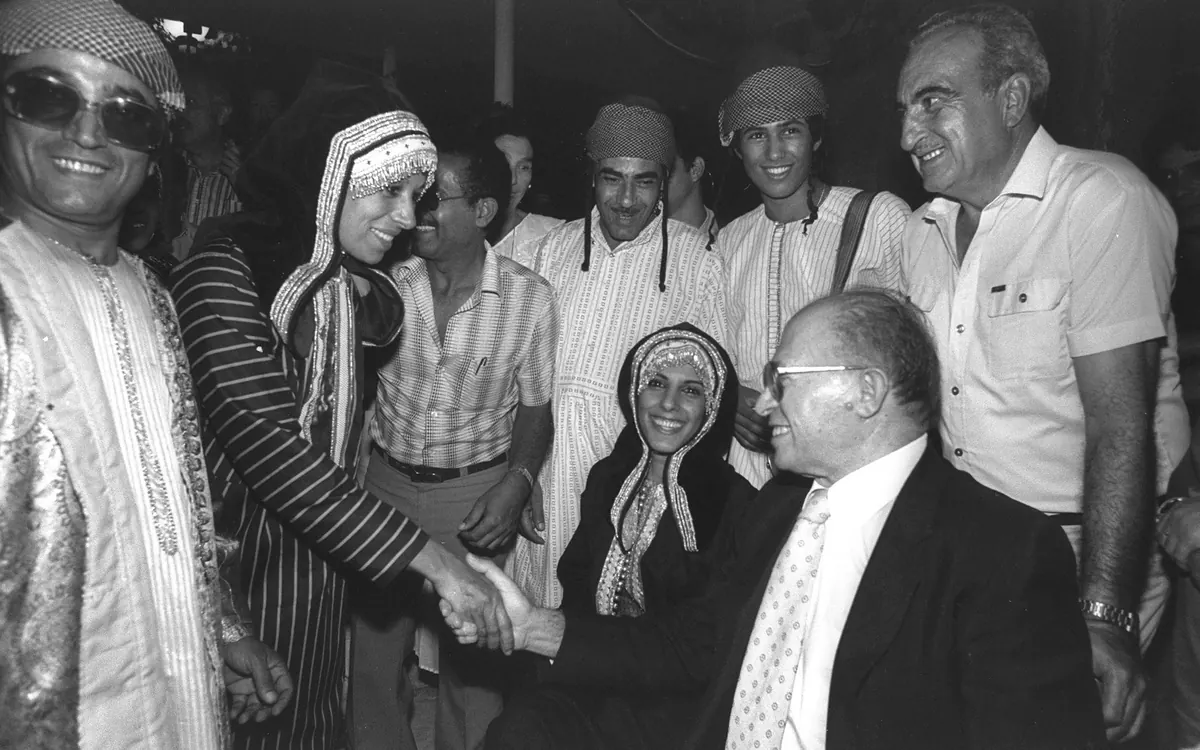
There are few events in the history of Israel's democracy which have had a greater impact than the elections of 1977. When all the votes were counted three decades of Labor Zionist rule had come to an end and Menachem Begin and his Likud party was victorious. It is known in Israeli history as 'the earthquake' or 'upheaval' and this episode explores what forces underlay such a tectonic shift in Israel's political system.
Learn about the Leah Rabin's Dollar Account affair, the Sephardic Jewish experience, the Buzaglo test and the socio-political intersectionality that led to Begin's defeat of Shimon Peres for Prime Minister of the State of Israel.
About this episode
On the evening of May 17, 1977, news anchor Chaim Yavin looked into the camera and called it a mahapach, an earthquake. Menachem Begin and his Likud had won, and Israel would form its first right-wing government in twenty-nine years of statehood. The word earthquake carried both meanings, an overturning of what had seemed unshakable in labor Zionist rule, and the shock of a disaster no one saw coming. The strange part is that Begin's victory should not have surprised anyone. Rabin's first term had been a litany of woes, a stretched social fabric, a sunken economy, rising terror, and corruption as deep as a ruling party can manage. Many expected labor to lose, yet few imagined it falling to Begin, the man exiled to the margins for decades.
Begin had run and lost eight times since 1948 and sat in opposition for all but three of those years. The British had branded him a terrorist for the revolt that drove them out, and his fellow Jews were quick to echo it, with Ben-Gurion adding the most effective label, a threat to democracy. Faced with the impossible or the unacceptable, most people choose the impossible, and accepting Begin meant revising what one believed to be right. It was the reparations fight that brought him roaring back as the voice of national honor. He was both Jew and Zionist, the only prime minister who never Hebraized his name, once giving it before the Knesset as Menachem son of Dov and Chasia Begin, a man who lived the wholeness of Jewish history.
The end of labor rule began in December 1976, when three F-15 jets arrived on a Friday and the welcome ran close to Shabbat, triggering a no-confidence vote by the Haredi party. The National Religious Party abstained rather than back Rabin, now driven by the young guard and the messianic settlement vision of Gush Emunim. Rabin ejected the NRP, invoking coalition discipline for the first time, and his coalition fell below a majority, so he dissolved his own government. The pundits scanned the horizon and saw only Yigael Yadin's new Democratic Movement for Change, warrior and scholar, clean against a decrepit labor alignment. No one was looking to the right, and no one considered Begin a realistic alternative in the prime minister's chair.
Then came the dollar account affair. In March 1977, while Rabin met President Carter in Washington, his wife Leah drew dollars from a Washington bank account that should have been closed years before, since Israelis were barred from holding foreign accounts. A journalist deposited a fifty-dollar check to capture the account number, and Haaretz broke the story. To ordinary Israelis who could only dream of a dollar account, it was the last straw of leaders who said do as I say, not as I do. Attorney General Aharon Barak, fresh from the Yadlin affair, pressed the Buzaglo test, that a prime minister must face the same judgment as an ordinary Mizrahi citizen. Leah Rabin was found guilty, Rabin took responsibility, and Shimon Peres replaced him atop the list.
The deeper story was inter-ethnic. There is no one more Ashkenazi in caricature than Begin, and yet the marginalized Mizrahi voters, the Buzaglos of Israel, crowned him. In 1973 Yitzhak Shamir had quietly rebuilt Cherut from the top down into a bottom-up, meritocratic party, opening its doors to local Mizrahi leadership. Labor had absorbed the Jews of the Middle East and North Africa into a patron-client role, voters without real power, treated with open contempt. Begin offered them belonging, participation, and respect for the tradition they cherished, declaring his would be a Jewish style of government. At the victory rally a Moroccan Jew named Marcel said Begin had given him back his stolen honor, and the crowd roared Begin, Melech Yisrael.
Key ideas
- Chaim Yavin called the 1977 vote a mahapach, and Begin formed Israel's first right-wing government after twenty-nine years.
- Facing the impossible or the unacceptable, voters long chose the impossible over accepting the exiled Begin.
- The reparations fight made Begin the voice of national honor, a man who was both Jew and Zionist to the core.
- Rabin ejected the NRP and dissolved his government, while pundits watched only Yadin's DMC and never the right.
- The dollar account affair and the Buzaglo test made Leah Rabin face an ordinary citizen's judgment.
- Shamir's rebuilt Cherut and Begin's respect won the Mizrahi voters who crowned him Melech Yisrael.
Chapters
- 0:01 An earthquake on Channel 2
- 2:16 An earthquake more than a change
- 4:26 The impossible versus the unacceptable
- 6:41 If this is the will of the people
- 7:44 Begin the terrorist and criminal
- 10:09 Reparations bring Begin roaring back
- 11:12 Both Jew and Zionist; the unchanged name
- 14:39 The F-15s and the Shabbat vote
- 16:54 The National Religious Party flexes
- 19:16 Yigael Yadin and the DMC
- 24:55 The dollar account affair
- 28:18 The Buzaglo test
- 31:53 Shamir's quiet revolution in Cherut
- 33:12 Labor's patron-client Mizrahi ties
- 36:34 Pride, tradition, and a Jewish style
- 39:45 Marcel; Begin gave me back my honor
Who, where and when
People
Menachem Begin, Chaim Yavin, Yitzhak Rabin, David Ben-Gurion, Yigael Yadin, Yitzhak Shamir, Aharon Barak, Leah Rabin, Shimon Peres
Places
Israel, Washington, Beit Shemesh, North Africa and the Middle East
Texts
The Revolt, The Land of Israel by Amos Oz, The New York Times report
When
December 1976 CE: the F-15 no-confidence vote, March 1977 CE: the dollar account affair, May 1977 CE: the upheaval election
Read the transcript
The upheaval of our world and the upheaval of our consciousness, said Carl Jung, are one and the same. I don't know. I like to keep a little bit of space between the turmoil inside and the turmoil outside. I'm Rav Mike Foyer, and this is The Jewish Story. Season 5, Episode 9 The Upheaval Election 1977 In the last 20 years of being a voter, I've found that elections in Israel can have a bit of a life-or-death feeling. There's a sense that rather than facing a transition in political leadership, we're approaching an existential crisis. Now, I've seen that Americans have gotten a taste of this in the last few cycles, unfortunately, but even in Israel, there are a few electoral moments that can compare to the vote for the ninth Knesset.
On the evening of May 17, 1977, millions of Israelis waited on pins and needles to hear the results of the votes that they cast that very day. When news anchor Chaim Yavin, Israel's own Mr. Television, came on to Channel 2, he looked out his viewers and announced, ladies and gentlemen, an earthquake, Mahapach, and you could almost hear the collective gasp ring across the country. Menachem Begin and his Likud party were victorious, and in the coming weeks, Israel would witness the formation of the first right-wing government in the state's entire 29-year history. The once unthinkable had become a reality, and Yavin's label of Mahapach, of earthquake, had stuck. It was driven home by the popular Israeli daily newspaper Mariv that published an article the next morning titled Mahapach.
The editor's assessment was, on May 17, 1977, Israel experienced its first political earthquake. You may cheer for it, you may bemoan it, you cannot disregard it. Now we've got plenty of episodes ahead to discuss who cheered and who bemoaned and why. And trust me when I tell you that no one disregarded Begin's victory, not in Israel, not amongst world Jewry, and certainly not in the halls of international power. No one that is except for perhaps Damascus Radio, whose response was Paris or Begin, they're all the same. Now at first glance, the term earthquake is being used here in terms of upheaval, which is how mapach is also often translated, an overturning of things up until now assumed unshakable, like labor Zionist rule in Israel.
But Earthquake can also express the shock we experience in the face of a huge disaster we didn't or perhaps even couldn't see coming. And that's a bit odd. Seeing as Begin's victory wasn't exactly a surprise. After all, we spent two whole episodes focused on the litany of woes that Yitzhak Rabin faced in his first term between 74 and 76. I mean, after all, the social fabric was stretched thin to the point of tearing. The economy was in the dumps. Terror was on the rise, and after three decades of being hachi karov le ka'ara, as close as you get to the trough, as we say here in Israel, the labor alignment government was as corrupt as a ruling party could be in a democracy. If you can still call it a democracy, by the way, when one constellation of parties has run the country since at least a decade before independence.
Now, many educated minds and other shrewd observers had assumed a change was coming in these elections. But an earthquake is more than a change. It's a revolution. And as such, it demands that we look at everything in a new light. I mean, after all, once you've seen the ground make waves like the ocean, then maybe you'd be able to see your way to understanding how an old warrior like Begin could make peace. Now I think the surprise element was actually rooted largely in the figure of Begin himself and the role that he'd come to play in the story of the Israeli state. I mean, plenty of pundits were ready to see labor lose, saw it coming in fact, but not many of them saw it coming at the hands of Menachem Begin.
And in all fairness, having run and lost for Prime Minister eight consecutive times since 1948 and sat in the opposition for all but three of the last 29 years, Begin himself was more than a little surprised at his victory. You know, after taking office, he used to love to tell the same joke over and over. They say we hired an old Jew for a few shekels to stand in front of the Knesset every morning and call out, Begin to power! Begin to power! And when people asked him why he'd taken on such boring and low-paying work, he said, well, at least it's the job for life. But jokes aside, Begin had been the bete noire of the Jewish political world for so long, far longer than the Knesset had actually existed, that he could be forgiven some shock.
As could large parts of a society which had been raised on the image of Begin as the bugbear threatening the internal stability of the state. Now never forget that fundamental truth that when faced with a choice between the impossible and the unacceptable, most people will go with the impossible. Because all that believing the impossible requires is some profound wishful thinking and willful blindness. But to accept the unacceptable requires far more. That requires an internal revision of what I deem to be right and wrong and how exactly I reached the current impasse. And we'll see that Bacon's victory brought together many elements of society which were profoundly disenfranchised, which in fact, the cultural and political elite had placed beyond the political pale.
As literary scholar Dan Miron put it, actually, in the very early 80s, these were people that were the wild and tattered margins of Israeli urban society, that stood completely outside the pale of the political and cultural agreements and arrangements of the organized Yeshu, that's Israeli society. It was to them that Menachem Begin directed his rhetoric, along with the roar of the motorcycles that accompanied him in his public appearances and other populist mannerisms imbued with fascist elements. That's great. But, you know, to put it more simply in the words of labor Zionist icon Yitzhak Ben-Aaron, who spoke for the political establishment on television right after Begin's victory, if this is the will of the people, we have to replace the people.
Now that sounds like a joke, but he was serious. and it's an attitude from which the left in our country have never really recovered. The arrogance of it. To Ben Arohn, Begin was more of a demon than a political adversary and certainly not a legitimate one. And friends don't let friends vote for the devil. And frankly, if people do vote for the devil, they don't really deserve to vote. Who's the threat to democracy now, right? Now we're going to look at Begin's coalition of the underrepresented represented, and consider how he gained the seats necessary to form a government. But first, I want to give Menachem Begin his due by catching him up to 1977. It's been quite a while since we heard from him, and the profundity of this victory can't really be appreciated without recalling a bit of the backstory.
Everybody knows the earliest labels are the hardest to shed in life, and already by 1948, Begin was well known as a terrorist and a criminal. These were titles granted by the British in recognition of Begin's leadership in the anti-colonial struggle that kicked them out of our land. That's the War of Liberation, which preceded the War of Independence. And the British may have been the first to label Begin a terrorist, but his fellow Jews and political opponents were quite quick to join in the course. It's very convenient to label everyone that you don't want to compete with you as an unacceptable character. In 1948, there was even an open letter published in the New York Times, signed by prominent Jews like Albert Einstein and Hannah Arendt that branded Begin a fascist.
But let's face it, very few of the hands leading Israel in its opening decades were clean from blood. And Ben-Gurion himself could be fairly labeled as a statist if I didn't want to pin the F word on him. But the most bitter and effective name given to Begin was actually a special gift from Ben Gurion and the ruling Labour Zionists. They called him a threat to democracy. It's a stick with which politicians, particularly on the left, love to beat the right even today. And in its time was the title calibrated to keep Begin beyond the margin of legitimate political discourse. And it worked. Even though Begin pleaded with his men to head off civil war after the Alta Elena incident, while Ben-Gurion himself praised the canon that had opened fire on his fellow Jews, it was Begin who went from life as an underground leader straight into the political wilderness.
In fact, he almost walked away from politics altogether when his Heirut party made a poor showing in Israel's second election. I mean, technically second, but it was actually the first free election, if you recall the push of the Constitutional Convention, which declared itself the first Knesset. It was only, if you recall, the controversy of the reparations from Germany that could bring him roaring back. His fear that the reborn Jewish people might sacrifice their honor for gold established Begin as the voice of national consciousness in the Knesset. And in this generation, he said, which we call the last of servitude and the first of redemption, In the generation when we gained a position of honor in which we came out of slavery to liberty, you come.
And because of a few million defiled dollars, throw away the little bit of dignity which we have earned for ourselves, you cut the ground from under our feet. You endanger our honor and independence. How we shall be scorned. They're fine words. And in fact, Begin's understanding of the role that pride played in national consciousness would serve him well in the coming upheaval. But at the time, he lost the battle over reparation. In fact, he lost more or less every parliamentary struggle after. Nevertheless, sitting in opposition, Begin managed to hone his already impressive rhetorical skills. And it wasn't until Prime Minister Levi Eshkol invited his Gachal party to join a unity government in the lead up to the Six-Day War that he came into the actual halls of political power.
Bacon spent three years in that government, reveling, I can imagine, in the opportunity to live his dream that longing of 2 years for Jewish sovereignty And in his final address before resigning he eulogized not only Eshkol but the government from which he was departing He said he took upon himself vital decisions initiated measures, and lent support to faithful judgments of historic consequence. Without his leadership, whatever was accomplished could never have come about. Indeed, I believe his government was a unique phenomenon in Israel's history. And as we will see in coming episodes, and as you may recall from previous ones, Menachem Begin was a man who lived the wholeness of Jewish history.
His was no classic Zionist outlook, that min hatanach el hapamach, jumping from the Bible all the way to the pre-state underground, negating the wisdom, value, and experience of exile. Begin was both Jew and Zionist. And in fact, a large part of the power he was able to muster came from how he put the two seamlessly together. Did you know that Menachem Begin was the only prime minister of Israel who didn't Hebrazize his name? Sharon was originally Schneerman. Golda Meir, Golda Meirson, even Ben-Gurion was born as David Grun. But Menachem Begin remained the old world Jew even as he rose to lead the Zionist state. Once, toward the end of his life, he was called to testify before Knesset. And when they asked him to state his name, he answered, Menachem ben Dov the Chassia Begin.
He was both Jew and Israeli. And his victory in 1977, in many ways, rested on reminding the nation that Israel only matters if the Jews matter. Begin left that government in 1970 on a principled stand, in opposition to Golda Meir's acceptance of an American plan that brought the end of the war of attrition. And when her government bowed to American pressure to ignore Egypt's gross violations of the agreement, he raged at this betrayal of the nation, warning that Israel's sons would pay for it in blood. And sadly, in the opening days of the Yom Kippur, you may recall his words were proven fatally true. But loyal son of his people, Begin stood in support of the government during the entire Yom Kippur war as leader of the opposition.
At the same time, that same loyalty drove him to the front ranks in calling for Prime Minister Meir's resignation afterwards. I am compelled to say to you, not as a politician, not as a party member, but as a father and a grandfather, that I can no longer depend on your government to ensure the future of my children and grandchildren. Go to the President and hand him your resignation. Your duty bowed to do so in the name of truth. Please go. And in the end, she went. But still, Begin did not replace. The hegemony of the labor alignment was still strong enough to weather the storm, and so Yitzhak Rabin became Israel's fifth prime minister, as we've discussed. But even though Begin didn't win the post-war elections, the tide had somewhat turned already in his favor.
You may remember war hero Ariel Sharon had cobbled together the Likud, meaning a consolidated bloc, in the rapid lead-up to the election, At the heart, and setting the agenda, sat Begin's Cherut party. Around it were the rest of what was called the Democratic Right Nationalist, Free Center, Greater Land of Israel movement. And Likud captured 39 seats in that 8th Knesset, a huge leap from the 26th that the Gachal had held in the 7th. And that's yet another reason that no one should have been surprised by what happened in the elections for the 9th. But hey, we all see what we want to see. The beginning of the end for four decades of labor rule came in mid-December 1976, when Prime Minister Rubin's government barely survived a vote of no confidence.
The vote itself was really not so significant. It was the result of a tempest in a teacup stirred by the arrival on December 10th of three F-15 fighter jets from the U.S. The Jets were important in their own right, and also representative of Israel's most essential security relationship, and so the Prime Minister and other members of his cabinet were on hand for the welcoming ceremony. But unfortunately, the 10th was a Friday in 1976, by the way, as it is tomorrow, and you may know that in December, Shabbat comes in mighty early. Later, Rabin would insist that the ceremony had ended exactly 17 minutes before Shabbat. But true or not, the religious members of the delegation were forced to walk home.
And in less than a week, his government faced a vote of no confidence initiated by the Haredi party, United Torah Front, or Gudat Yisrael, who were outraged at such an officially sanctioned desecration. In the end, the Prime Minister was able to muster the majority he needed for his government to survive. but it was by a bare margin, and most significantly, his coalition partners in the National Religious Party abstained, rather than casting their votes in support. This was more than political theater, or even religious solidarity with the Haredi sensibilities about Shabbat. We spoke in previous episodes about the transformations which the NRP underwent in the decade after the Six-Day War, And by December of 1976, they were no longer the party of the Kibbutz Adati movement, the religious kibbutz movement, you know, vaguely socialist and an unquestioning junior partner in the labor Zionist constellation.
The young guard within the National Religious Party was now ascendant, and their issues were far more national religious than social religious. They were inspired by the settlement efforts of Gush Emunin, not by the early pioneers, and they were lit by a messianic vision. And, as we saw back in Episodes 5 and 6, the radicals of Gush and Munim saw Rubin as an obstacle to Jewish history, not as a partner in pushing it forward. Recall that the showdown at Sebastia we spoke about in Episode 6 was only a year ago. And by abstaining from supporting the government in this vote, the NRP was both signaling its displeasure at Rubin's settlement policies and flexing its political muscle by implying that it had elsewhere to go.
Now, parliamentary politics being what they are, the Prime Minister's revenge was swift in coming. Less than a week after that no-confidence vote, Ministers Yosef Burgs, Wulin Hammer, and Yitzhak Raphael were removed from their posts and the National Religious Party officially ejected from the government. Rubin had done it by invoking for the first time ever a 1962 law that permitted the Prime Minister to dismiss anyone from the coalition in his cabinet if they voted against the government or even abstained on a vote of confidence. Today we call it coalition discipline, but then it was brand new. With the ouster of the NRP, Rubin's coalition went from 67 to 57. That's less than he needed to rule. So he was faced with the need to either bargain for new partners or dissolve his government altogether.
His punishment of the NRP thus appeared to many as a pyrrhic victory. But more astute observers saw Rabin's political savvy. Or so they imagined. Because when pundits scanned the horizon for the threats out there to the labor alignment rule, no one was looking to the right. And certainly no one considered Menachem Begin as a realistic alternative to Rabin in the prime minister's chair. They were focused instead on Yigal Yedin, Hero General of the War of Independence, former Chief of Staff of the IDF, and present-themed archaeologist. Also, a member of the Agronot Commission, which had investigated the failures of the Yom Kippur War. Yedin had recently accepted leadership of the Democratic Movement for Change, the DMC, a new party whose origins lay in the protest demonstrations, which themselves grew out of the failures of the Yom Kippur War.
We spoke back in Season 4, Episode 20, about Captain Moti Ashkenazi, how when he was released from active duty down in the Sinai, Ashkenazi began a vigil which became the Israel Sholanu movement. His major accusation was that the men who died under his watch in the war did so because of six years of neglect by the government. And his goal was simple, if somewhat vague. The government and the people are on different planets, said Ashkenazi. They've adopted a psychology of we versus they. That is what has to change. The democratic movement for change had taken this sweeping condemnation and focused it down on what it perceived to be the basic flaw in Israel's political system, the party list method of voting.
Now, if you're not aware, in Israel there was, and frankly still is, no real direct representation. You don't actually vote for a person. Each party chooses an electoral slate, either through a highly oligarchical central committee, or sometimes simply by fiat of the leader, and then presents that slate to the voters as a take it or leave it option. This is a holdover from the pre-state Zionist organization, the World Zionist Organization in particular, and in my eyes is one of the greatest barriers to real democratic change in our society. Now, the DMC wanted to change that in 1976. And in order to highlight the flaws of the party rule, their campaign focused on the rampant governmental corruption, which they saw as its inevitable result.
And even amongst stalwarts, people that had been casting their votes for labor for more than three decades, 1976 was a hard year to swallow. In September, Bank of Israel governor Asher Yadlin had been arrested on charges of bribery and fraud and funneling money into the labor campaign chest. It was a move which precipitated the suicide of housing minister Avram Ofer, also implicated in what became known as the Yadlin Affair. And that was just the latest and greatest scandal. By many, Yigal Yadin was seen as the exact opposite of Asher Yadlin. He was the unstained. The newness of the DMC stood in sharp contrast to the decrepit look of the labor alignment. Yadin, after all, was the prototype of the Zionist ideal, warrior and scholar.
He'd stayed out of government until now, but was throwing his hat into the ring in hopes of saving the nation. and the polls showed that his message had begun to resonate specifically with Labour's voters. Thus Rabin decision to dissolve his own government It was a preemptive strike He was hoping that by forcing early elections he could hobble Yudin efforts to organize an effective campaign and just head him off on the way to the voting booth, so to speak. But apparently, Rabin and the labor alignment were so used to winning that they couldn't read the writing on the wall. The DMC was far from the only threat which they faced. When he dismissed the National Religious Party from his government, Rabin felt that he was putting them in their place, and that they knew it.
They would come back to the fold. After all, the National Religious Party had been a loyal client of labor patronage since 1948. And to say nothing of the political irrelevance Rabin attributed to the United Torah Front, after all, the Haredi Party may have initiated that vote of no confidence, but they had been sitting in the opposition since 1952. when they left Ben-Gurion's government over his decision to draft women in the army. It is really the fatal flaw in secular Zionist parties that they fundamentally misunderstand the essential role which Judaism, in its broadest sense, plays in upholding our society. Now, shortly after his victory, Begin proved that the opposite was true for him. When asked what style of leadership he intended to pursue as prime minister, his immediate response was, a Jewish style.
What is the sign of the government? The Jewish sign of the government is good. And aside from the personal traditionalism, which played such an important role in his appeal to certain voting sectors, this was a political stance as well. Bagan set the mold for a government to this day when he welcomed the United Torah Front into the government and in the first time gave a Haredi party control of the powerful Knesset Finance Committee. He also made a new alliance with the National Religious Party, one that we'll explore. We'll see that his stance on settlement was not as straightforward as the activists of Grish Emunim would have liked, but he supported it. And furthermore, Begin gave the National Religious Party control over the education ministry.
For the first time, a religiously observant person held that position. And from 1977 all the way through 2000 and later, after all, current Prime Minister Naftali Bennett was education minister before, right? Whenever the Likud held the government, the NRP would hold the education portfolio. That's almost three decades of social impact. But despite it all, despite the rise of the DMC, the resurgence of religions in politics, the corruption, etc., etc., etc., the labor alignment might have pulled it off if it weren't for parashat cheshbon adolari, the dollar account affair. Now, I know I'm strange, because for most people, the study of chaos theory has remained completely obtuse, if not simply irrelevant.
But I love it. Nonetheless, as strange as I may be, most people are familiar with what's called the butterfly effect, the notion that a vanishingly small act can have a profound effect on an entire system, as it said, like a butterfly flapping its wings over the Atlantic, causing a hurricane to form. And I think the appeal of this idea is because we can all relate to the ineffable power of the seemingly insignificant. But I think we often miss the real message of the butterfly effect, which has less to do with its wings, and more to do with the fact that small factors are causing a shift in the powerful initial conditions of a system. Meaning, if you want to understand why the straw broke the camel's back, you have to understand the big forces it was already bearing.
And in March 1977, Prime Minister Rabin was in Washington to meet with recently elected President Jimmy Carter. Now, Rubin may have been sitting as the head of a caretaker government and in the midst of a heated electoral season, but he didn't neglect his responsibility to build bridges with a new American leader. And of course, a picture with the president doesn't hurt in the polls, except this time his trip backfired in a big way. Because while they were in Washington, the prime minister's wife, Leah, stopped by a D.C. bank to draw out some dollars. Now, for point of information, in those days of struggle for the shekel, which was barely maintaining its nose above the waterline, barring exceptional circumstances, it was illegal for an Israeli citizen to hold a bank account overseas.
The account in question was certainly an exception because it had been open during Rabin's days as ambassador to the U.S., but according to procedure, it should have been closed when he returned home to Israel more than three years prior. Dan Margoliet, Washington correspondent for the Israeli newspaper Haaretz, got an anonymous tip about the transaction and immediately rushed to the bank. Playing innocent, he told the teller that he happened to owe the Rabin's money and asked to deposit a $50 check in their account. The teller was happy to comply, and he wrote down the account number on the back of the check prior to depositing it, thus giving Margoliet all the information he needed. Haaretz broke the story on March 15, 1977, the day after Rabin returned to Israel, and only two months before labor lost the election.
Now I know that as far as political scandals go, this doesn't sound like much. And in truth, such minor offenses by government officials were usually resolved by a slap on the wrist, and perhaps rightly so. But in 1976, the average Israeli could only dream of a dollar account. And the voters had had enough of politicians getting away with whatever they wanted, of telling them, do as I say, not as I do. So I can imagine many cheered when Eternally General Aaron Barak announced his intention to prosecute Leah Rabin. Barak is mostly remembered as Chief Justice of Israel's Supreme Court. You can go back to Season 3, Episode 8 to explore his role as the judicial buccaneer that created Israel's non-Constitution.
But in 1976, he was known as a crusader against government corruption. Only months before, he was one that prosecuted the Yadlin affair. And then, Barak had made a statement which lifted the hearts of the average Israeli, discussed it not just by the gross self-interest of those in government, but by the shamelessness in how they pursued it. Barak had declared, Deen Yadlin, Ke Deen Buzaglo. Meaning that the judgment of Yadlin should be the same as the judgment of Buzaglo. A leader has to be held to the same judicial standards as an ordinary citizen. And prosecuting the Prime Minister for a wrongly held bank account was a perfect opportunity to prove what was known as the Buzaglo test. Now, why Buzaglo, you ask?
Well, Yadlin, and now Rabin, represented the Ashkenazi political elite of Israel, a group notoriously used to having its way and not shy of flaunting it in 1976. Buzaglo, on the other hand, was a name meant to represent the Mizrahi population, Jews from North Africa and the Middle East, whose relative poverty and political marginalization gave them far less opportunity to be corrupt and absolutely no protection before the law should they be caught. And though Barak originally coined the phrase in the context of government corruption and the need for a rule of law which was impartial, the Buzaglu test became known as a litmus test for a whole range of inter-ethnic issues in Israel. Ashkenazim and Mizrahim really get the same treatment?
In the dollar affair, by the way, the Rabinians passed the test. Leigh Rabin was indeed found guilty, and in a rare display of public responsibility, her prime minister husband joined her in taking moral and legal responsibility. Which is why on April 8th, only a month before the elections, Yitzhak Rabin was replaced by Shimon Peres as the top candidate on Labor Alignment's electoral list. He'd withstood the Buzaglo test, and in so doing contributed to the end of decades of party rule. But the reality is that the inter-ethnic issues for which the test was named were actually a much bigger part of the story. They were the powerful initial conditions that allowed this minor event to initiate an earthquake.
You know, on some level, there is no one more Ashkenazi than Menachem Begin. There's an old Israeli joke that a man who knows nothing about Ashkenazi Jews decides to consult the encyclopedia to learn more. and he starts flipping through the pages, finally reaches the spot where there should be a whole entry for Ashkenazi, but he finds no text, no history, no facts, no figures, just a full-page picture of Menachem Begin. Picture it, the slight-framed bird chest, heavy Yiddish accent, lifelong chronic illnesses. I mean, Begin was the obsessively formal bourgeois Polish lawyer, and practically an Ashkenazi stereotype come to life. And yet, it was the underrepresented Mizrahi Jews, the Buzaglos of Israel, who would crown him prime minister.
In 1973, Cherut politician and future prime minister Yitzhak Shamir took control of the Cherut Central Committee and started what some scholars call a quiet revolution in Israeli politics. We're going to have to give Shamir his own due at some point. You may recall him from his days in the Lehi. But for now, in order to understand how the 1977 earthquake took place, we need to know that he was responsible for a massive reorganization of the party's structure. In many ways, he was doing to Cherut what the Democratic Movement for Change wanted to do to the country as a whole. And it was a large part of the reason that Yigal Yadin eventually agreed to join Begin's government. Shamir replaced the traditional top-down process of appointing party candidates with a more bottom-up and therefore more meritocratic model, one that gave far more power to local leadership in shaping Chayruth's national representation.
Now that may sound like a technical, structural issue, but what it did was open the door for Mizrahi voters who really were the ones who brought the Likud to power now the labor alignment government had overseen the Aliyah and absorption of the Jews of the Middle East and North Africa in the 50s and 60s It was an intense and complicated process, whose consequences we began to consider all the way back in Season 3. Politically, the labor alignment had cultivated a patron-client relationship with Mizrahi. Meaning what? they basically co-opted them into the role of voters without giving them real political powers. Even those Mizrahi who rose through the ranks of the party were seen primarily as means to access the electorate, not as real partners in shaping a political vision.
That was the role of the Ashkenazi pioneering elite. What's worse, labor Zionist leaders weren't shy about their contempt for these useful voters. As one Beit Shemesh man told author Amos Az in his book The Land of Israel, The Mapinics, referring to the labor, just wiped everything that was imprinted on a person, as if it were all nonsense, and then they just put what they wanted into him, from that ideology of theirs, like we were some kind of dirt. The tide of unquestioning support by the Mizrahi for labor had already begun to turn in the early 70s. You can go back to Season 4, Episode 13, to see the rise of the Israeli Black Panthers as a social protest movement, and the dismissive response they received from Prime Minister Golda Meir's government.
Which is not to say that Menachem Begin and the leadership in the Cherut were so empathetic to the radical leadership of men like Reuven Abigail and Charlie B. Tone. They rejected the Panthers' critique of Zionism because the Panthers called it fundamentally European, Orientalist, and discriminatory. Furthermore, Begin and the Cherut saw the separatist appeal to Mizrahi ethnicity as standing in contradiction to the call that Bacon had made over and over for people of different ethnic backgrounds to unite. Finally, they were very wary of the name Black Panthers. Bacon went so far as to once suggest that they should call themselves the Jewish Black Lions. He despised the American version of the Black Panthers, or the original version, I should say, because of their association with the PLO.
Big and somewhat simplistic approach to the problems that the Israeli Black Panthers were motivated by was, of course we will condemn any incitement to class or ethnically based hatred. That problem should be resolved through love for Israel, and it should be resolved very quickly. More than a little bit patronizing. Nonetheless, the opening up of the Cherut political structure to grassroots organizers had an undeniable appeal to many Mizrahi Israelis. often more so than the radical stance of the Panthers, whose leadership drifted toward the anti-Zionist and communist parties. The Mizrahi voters weren't interested in shifting from being patronized by labor to being marginalized from the political discourse altogether.
They were seeking a way to belong. Not just to belong, but to integrate and participate in shaping the society which, frankly, their labor upheld. And, with Shamir's rebuilding of Cherut, they now stood an actual chant. They could run for and win elections in towns and neighborhoods where they actually lived, something that up until now had been less than possible. As one Mizrahi Cherutnik recalled, In Cherut, everything is open. You can stand for any office. There's no appointments committee. If you want to compete, you can. The opportunities are wide open. Everyone has the same chance. A professor at Tel Aviv University and a garbage collector are equal. Now that's a tremendous appeal. And together with a tangible sense of actual representation in a major government party, and thus the possibility for real, call it upward political mobility, came a sense of cultural respect.
That they were respected, and with that came pride. Now you have to understand, since the pre-state underground days, the labor Zionist leadership had attempted to tarnish both the reputation of Begin and the Irgun by pointing out what they called the higher percentage of Mizrahi, or at the time Sephardi members, in the Irgun than there were in the Haganah. In his memoir, The Revolt, Menachem Begin recalled it like this, wishing to belittle us, these gentlemen whispered, or said aloud, that the whole of the Irgun consisted only of Yemenites. The Nazis used to say, maybe not all Jews are communists, but all communists are Jews. Similarly, some Zionists said of us, not all Yemenites are Irgunists, but all the Yagun people are Yemenite.
For Begin, that smear which our enemies and opponents tried to belittle us was to us a source of pride. People who had been humiliated and degraded became proud fighters in our ranks, free and equal, men and women, bearers of liberty and honor. And that was in the pre-state days. Now they became proud voters. So add to this historic association of pride, as we'll call it, Begin's reverence for Jewish tradition. He himself did not consider himself orthodox. Begin was Jewish to the core of his being, and not just culturally so. He valued the learning and practice of Torah, which was a value upheld within Israeli society, primarily by Jews of the Middle Eastern and North African bent, aside from, of course, the religious segments.
Talking about the broad swaths of society. Put it this way, that same Beit Shemesh man interviewed by Amos Oz said now that Begin's here, believe me my parents can stand up straight with pride and dignity I'm not religious either, but my parents are, they're traditional and Begin has respect for their belief so Shamir threw the doors of the party wide open, and Begin's personality made many Mizrachim actually feel welcome the numbers had begun to shift already in the early 70s one poll indicates that while 62% of Mizrahi voters supported the Labor-Left coalition pre-Yom Kippur war, that percentage dropped down to 43 in the post-war election, and it would plummet in 1977, because that campaign was really a nail in the coffin of the alliance between the Labor and the Mizrahi.
Now, Labor pulled no punches in depicting both the Mizrahi Israelis and the revisionist Zionists as a twin menace to democracy and Israeli society as a whole. One election poster put out by the citizens' rights movement, a faction of the Labour Party, warned, quote, the right wing frightens you, and rightly so. And Labour alignment voters took to calling these Raki voters primitivim in the streets. That's primitives, for those who don't understand Hebrish. There is no better way to produce solidarity at the voting booth than to generate a sense of shared oppression. Again, from Amos Az's interviews in Beit Shemesh. For 30 years you treated Begin like a dog. Not one of his people ever got a government post.
No Memorial Day for Irgun fighters. Nothing. You put him down and shut his mouth. Here in Beit Shemesh, when Begin came to speak, the Labor Council would cut off the electricity in the auditorium, let him speak in the dark like a dog. So what did he do? Did he run off to America and badmouth you? Did he incite the soldiers against the country? Exactly the opposite. He suffered in silence. Just like we suffered you in silence. and now that perseverance was going to come due because the upheaval in 1977 proved that the Mizrahi Jews of Israel would be silent no more there is way more to discuss in that equation and the new alliance between the political right and the economically and socially underprivileged deserves a deep analysis it's actually part of the Israeli political topography which doesn't map well onto American understanding.
I mean, today, people don't get it when they call us a white colonialist settler state or wherever it is, that it's just simply not true. But already, in the New York Times writing, in 1977, immediately after Begin's victory, the following, they say, terminology such as right-wing or leftist is quite inappropriate in the Israeli environment, since the poor and underprivileged apparently now regard the right-wing party as their representative, while the bourgeois supports the leftist party of labor. And then the Times goes on to open up an element which we haven't discussed yet, because I think I'm going to pick it up in the next episode. It says, perhaps a more appropriate label for the rival camps might be optimists, meaning the labor alignment, and skeptics, meaning the food, with regard to Arab intentions concerning Israel.
Now, that may sound correct, but in many ways, as you'll see in the coming episode, it's yet another indication that the New York Times is excellent at getting things half right. For now, I want to draw things to close with the words of a Moroccan Jew at the 1977 Likud Victory Rally, who identified himself as Marcel to the television interviewer who he was speaking to. He said, In Casablanca, my father was an honored member of the community. He was the patriarch of our family. He had kavod, respect. Now what does he do? He breaks his back on a building site. who's going to give him his kavod now? His kavod has been stolen. In Morocco, I was a bookkeeper. That's an occupation of kavod. My kavod has been trampled upon.
Menachem Begin has given me back my honor. And then the crowd of young men who had gathered around him during his interview, also Mizrachim, exploded in celebration, kicking off the chant, Begin, Begin, Melech Yisrael. Menachem Begin, King. of Israel. it happen. Or, if you want to give a one-time support, you can send it to PayPal, robmikefoyer at gmail.com is the associated email. Or, you can send me a message on Facebook, robmikefoyer, and I'm happy to share with you the details of how you can dedicate a show. I also want to thank the Land of Israel Network, that's thelandofisrael.com. They're building a center for global transcendence in the heart of Judea. I want to thank the Pardes Institute, pardes.org.il for throwing the doors of the Beit Midrash open as wide as possible.
and I want to thank you for listening. I'm Rav Mike Foyer, and this is The Jewish Story.
More from Season 5
The Jewish Story: Interlude - Hanukkah: Who Knows Eight?
Have you ever wondered why exactly Hanukkah lasts eight days? You may be familiar with the 'jar of oil' answer, but this interlude will give you a lot...
Play Episode
TJS S5 Interlude: Empires come, empires go
Many people look at the world today and feel the foundations of American power shaking - and most are afraid. Here is an episode about empires, made in...
Play Episode
TJS S5E10 Menachem Begin 1977 election aftershocks
Menachem Begin's upheaval victory in the 1977 Israeli elections was the beginning of revolutionary change for the Jewish State, not the end. Some who rejoiced will be bemused,...
Play Episode