
TJS S5E12 The Jewish Underground part I
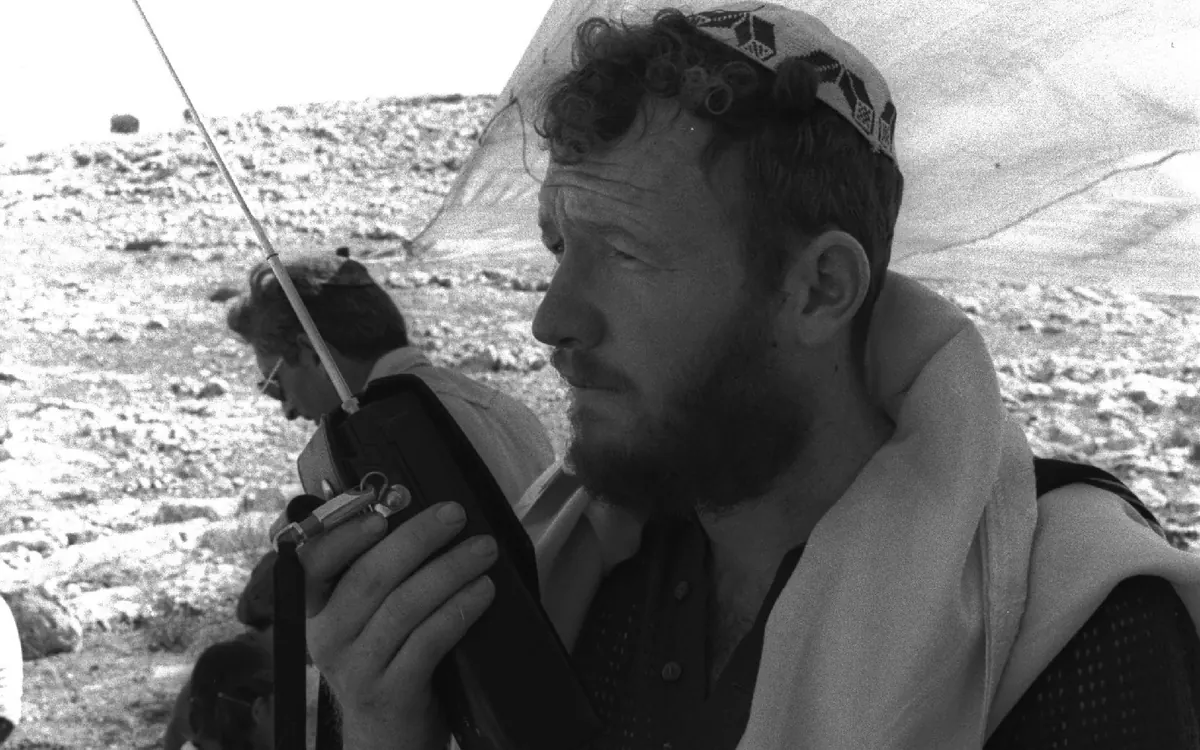
In politics as in physics - for every action there is an equal and opposite reaction. Prime Minister Menachem Begin's signing of the Camp David Accords with Egypt's Anwar Sadat did not produce a singular response, but it did send shock waves through every aspect of Israeli society. Among the idealists of the settlement movement, it birthed an underground element which felt called to continue the revolution which Begin himself had helped to forward. Fueled by redemptive visions, powerful personalities and practical pressures the action they take in response to Camp David will be explosive.
Learn about Shabtai Ben-Dov, Rabbi Yoel Bin-Nun, Yehuda Etzion, the Temple Mount, Gush Emunim, Beit Hadassah in Hebron and more.
Photo: Yehuda Etzion in Elkana, 1979. Credit: Moshe Milner, Government Press Office
About this episode
Hannah Arendt's On Revolution frames the episode. The revolutionary spirit joins two elements, the founding of a new and stable body politic, and the intoxicating experience of a new beginning, the freedom to act unrestrained by life as it has been. In Arendt's reading that spirit died in America, France, and Russia, because the republics they created left no space for the very freedom that made them. Rav Mike adds a fourth world-shaping event, the return of the Jewish people to its homeland after two thousand years, and distinguishes liberation from freedom. Freedom from throws off a yoke we can name, while freedom of is the trickier freedom found in the act itself, the freedom to become what we actually are once the constraints are gone.
For thirty years, from 1948 to 1978, the answer to freedom was mostly survival, fighting, growing, and absorbing. Rav Mike recalls Buber asking Ben-Gurion what a Jewish land is for, and Ben-Gurion pushing him off with the answer, to bring bread out from the land. But by 1978 the state was stable and even powerful, with peace newly possible, so Buber's question returns all the sharper. What do we do with our hard-won freedom? History teaches that the revolutionary spirit lasts longest on the frontier, as it did on the American West, and the pioneering ethos still founds the modern state. The young men and women of Gush Emunim took up that mantle, making Jewish life in Judah, Shomron, and Gaza the new frontier of the Zionist avant-garde.
A pioneer is free insofar as he liberates himself from the constraints of the state, which works while he paves the way for the republic, but turns to conflict when he collides with the very vision that society means to establish. In Hebrew this is stira al menat livnot, tearing down in order to build, since chaos always precedes creation, as even the Torah begins with tohu. The Camp David Accords sent shockwaves through Israel. There was euphoria that war with Egypt might be over, and the reserve officers who formed Peace Now called on Begin not to squander a historic chance. There was also political upheaval, as core members of Begin's Cherut, shocked at the retreat from Sinai, broke away under Geula Cohen to form the Techiya party of revival.
Among the settlers the spiritual reaction was confusion and despair, one rabbi writing in Nekudah that their whole world was collapsing. Rav Yoel Bin Nun called for a cheshbon nefesh, a self-accounting from within the camp, asking what we must do today to bring Israel's redemption and avoid its terrible afflictions. His words held an invitation as well, which could be heard as a call to move redemption forward by any means. Yehuda Etzion, a student of Bin Nun who had changed his name in celebration of the return to Gush Etzion, took that call deepest. He found his answer in Shabtai Ben Dov's book, which taught that Israel's destiny lay in its unique nature, and that true revolution would require a liberation even from the Zionist state itself.
Ben Dov stressed the power of first actions, and it grew clear to Etzion that the path to redemption began on the Temple Mount. The idea had seeds in his havruta with Yeshua Ben Shoshan, who longed to remove the abomination on the mount, and who brought in Menachem Livni, a combat engineer embittered by his evictions around Hebron. The three met on Thursday nights to discuss redemption and their role in it, gathering explosives and surveilling the mount, though Livni was troubled by the absence of rabbinic support. Meanwhile Jewish life returned to Beit Hadassah in Hebron in 1979, and after an Arab ambush murdered six young men in 1980, some felt that explosives meant to trigger redemption could serve just as well for revenge.
Key ideas
- Arendt's revolutionary spirit joins founding a stable order with the intoxicating freedom of a new beginning.
- Liberation is freedom from a named yoke, while true freedom is found in the act of becoming what we are.
- By 1978 survival had given way to stability, so Buber's question of what a Jewish land is for returns sharper.
- The revolutionary spirit lives longest on the frontier, and Gush Emunim made the heartland its new frontier.
- Camp David birthed Peace Now and, among the shocked right, Geula Cohen's Techiya party of revival.
- Shabtai Ben Dov's book led Yehuda Etzion toward the Temple Mount, and a circle gathered explosives around it.
Chapters
- 0:00 Arendt on revolution and freedom
- 1:15 The two elements of the revolutionary spirit
- 4:41 Freedom from and freedom of
- 5:49 Thirty years of survival
- 7:02 Buber's question returns
- 8:16 The revolutionary spirit on the frontier
- 11:36 Camp David sends shockwaves
- 13:54 Peace Now is born
- 15:00 Geula Cohen and the Techiya party
- 19:25 Yoel Bin Nun's call to self-accounting
- 21:41 Yehuda Etzion and the Temple poster
- 24:58 Shabtai Ben Dov's book
- 29:21 The path begins on the Temple Mount
- 32:37 Ben Dov's deathbed answer
- 36:02 The return to Beit Hadassah
- 43:49 Explosives for revenge
Who, where and when
People
Hannah Arendt, Martin Buber, David Ben-Gurion, Geula Cohen, Rav Yoel Bin Nun, Yehuda Etzion, Shabtai Ben Dov, Yeshua Ben Shoshan, Menachem Livni
Places
Judah and Shomron, The Temple Mount, Hebron and Beit Hadassah, Ofra, Gush Etzion
Texts
On Revolution, Israel's Redemption in the Crisis of the State, Nekudah journal, The writings of Rav Kook
When
1948 CE: independence, 1978 CE: the Camp David Accords, 1979 CE: Jewish life returns to Beit Hadassah, 1980 CE: the Beit Hadassah ambush
Read the transcript
The end of rebellion, said Hannah Arendt, is liberation, while the end of revolution is the foundation of freedom. I'm definitely looking to be free, though I got a bit of the rebel in me. I'm Rav Mike Feuer, and this is The Jewish Story. Season 5, Episode 12, The Jewish Underground, Part 1. Hannah Ratt's book, On Revolution, is a worthy read. I tell you that now. And truth be told, she's a woman who has her own thread in the Jewish story. But for right now, I'm going to restrain myself and focus. On Revolution is a comparative exploration of the three great political revolutions of modern times. The American, French, and Russian, if you were unaware. And her primary interest is in trying to understand how liberty and freedom interact.
How a society that liberates itself can actually maintain the freedom which it achieves, not a simple question and one that I am hoping you feel the pressing relevance of in our day. Now Arendt notes that the revolutionary spirit of freedom, as she called it, is actually made up of two apparently contradictory elements. The first is the act of founding a new body politic. I mean, after all, what's the revolutionary spirit about if not making a new and better world? Now, we often miss the fact that, by definition, that's a drive towards stability. Revolution is meant to result in a higher state for society, one which will last, if not forever, at least for long enough. And that drive stands in sharp contrast to the second element of the revolutionary spirit, as Arendt defines it.
the revolutionary's experience of the revolution, which he calls the exhilarating awareness of the human capacity of beginning. Now, Rant notes how intoxicating this experience of a new beginning can be. And I think that anyone who's ever stepped out of the old into the new, even in the most humble personal sense, recognizes its power. The idea of revolution is eternally seductive because it holds out the hope that what is does not have to find what might be. Or, as Arendt says, the sense that the course of history suddenly begins anew, an entirely new story, a story never known or told before, is about to unfold. And what could be possibly more exciting than that? Now, revolution, she says, brings together freedom, in the sense of the freedom to take action, and the experience of a new beginning, that my freedom to act is now unrestrained by life as it has been up until now.
Like I said, what could be more intoxicating? In her analysis, Arendt notes that the spirit of revolution quickly died in all three cases in America, France, and Russia, each through their own local processes. But in her eyes, there's really one overriding clause for the loss of what she calls the revolutionary treasure of freedom. The problem is that the republics which these revolutions brought into being left no space for the very freedom which made them come about in the first place. Once the revolutionaries had liberated their societies from the old and through freedom of action created the new, there was no place any longer within those societies for radical free action. On the contrary, even a government founded on freedom thrives primarily on stability, and therefore to some degree on obedience.
Now much of Arendt's work, if you're familiar with it, here in On Revolution and elsewhere, revolves around the question of how a society can actually preserve this revolutionary treasure. How does an established republic create a space for true freedom of action without imploding into constant revolutionary chaos? it's a question I feel deserves some serious consideration but for now, for present purposes at least I want to add to those three revolutions on which Arendt's book focuses, a fourth world-shaping event the revolutionary return of the Jewish people to our homeland after 2,000 years of exile and I'm very interested in the tension which is arising at this point in the story that I'm telling between the revolutionary spirit and the social desire to preserve and protect what has been gained.
And in that light, I feel it's important to clarify the distinction between liberty and freedom, or between what I like to think of as freedom from and freedom of. We gain liberation when we throw off a yoke, whether governmental, a foreign oppressor, or even false consciousness that's been forced on us by society. So long as we can understand what or whom is holding us down, we can fight for freedom from it. Freedom of, or true freedom as opposed to simply liberation, is quite a bit trickier. That freedom, Arendt says, is, quote, experienced in the process of acting and nothing else. It's the freedom found in pursuit of what I actually am and what I can do in the world once liberated from that which constrains me.
So, we spoke not so long ago, About the Jews liberating themselves from the British yoke, fighting the Arabs of the mandate and the surrounding states, and liberating a portion of our ancestral lands. And once we have that, we have the freedom to do what? Now, for 30 years, from 48 to 78, the answer was really mostly survive. Fight, fight, fight, grow, grow, grow, absorb, absorb, absorb. I mean, we've had three major wars, countless battles, economic crises without number, you name it. we've survived it. Back in Season 3, Episode 3, I spoke about a debate between the philosopher-mystic Martin Buber and Ben Gurion. It was part of a symposium Ben Gurion had convened only weeks after the War of Independence was over.
And the focus was on what he called the spiritual-cultural absorption of the masses of refugees pouring into the new country. We've referenced it a few times. You may recall that Buber insisted that the first question to be addressed by the new state was, what is the purpose of a Jewish land? Well, Ben-Gurion pushed him away basically with both hands, saying there was only one possible answer to that question, to bring bread out from the land. He well understood that if the newly liberated state was unable to feed and protect its citizenry, the question of what the Jewish people should do with its new national freedom was irrelevant. But 30 years later, Ben-Gurion's labors have succeeded in creating a stable, even powerful state in 1978.
And its power is only now being enhanced in our story by the possibility that we'll no longer be at war. And thus, Buber's question not only hasn't gone away, it's all the more pressing. What do we do with our hard-won freedom? What is the right action to take when you can choose to be free? Now there's a crucial question here of how deep liberation needs to go before I can truly act in a free manner. Of how much I have to throw off foreign influence, both internal and external, before there's an actual self able to know what it is that I want. Hence the decolonization discourse in all postcolonial studies and in our own humble Jewish way as well. But I'm not going there right now. What interests me now in our story is where does the revolutionary spirit reside in Israel in the late 1970s?
And frankly, I'm wondering about it today as well. Where is that element of society seeking freedom through genuine action and self-actualization? Now, it's important to remember that history teaches us one place the revolutionary spirit lasts longest within societies is on the frontier. I mean, certainly, in the history of American Revolution, that holds true. And the colonists, the original ones from England I'm speaking of, would have never contemplated breaking with the crown if they hadn't been beyond the reach of what they considered civilization. And after the Revolution, that Western frontier continued to be the realm for freedom of action. I mean, the brutality of the conquest from east to west of the North American continent rested on the very lawlessness which made it appealing to those who sought their freedom to act outside the boundaries set by society.
If you know Frederick Jackson Turner's frontier thesis, and if you don't, you should look it up, he saw the process of moving west as the crucible of American democracy, with all the heat and destruction, by the way, the word implies, which of course begged the question of what happened to American democracy when that ever-expanding horizon closed. Now, the revolutionary return of the Jews to our land has been bound up with a frontier spirit as well. From the outset, Zionism sought to go where no Jew had gone before, or at least for millennia. And the pioneering labor Zionist ethos still serves as the foundation of the modern state in both myth and fact. More recently, we've been speaking about how the young men and women of Gush Emunim, of the settlement movement, took up that pioneering mantle.
aiming to awaken the state to its true self by making the establishment of Jewish life in Udash, Shalom, and Gaza the new frontier. And to this very day, the national religious world really carries the torch of the Zionist avant-garde, insisting on its freedom of action even when the established state tries to deny its legality. Meaning, a pioneer is free insofar as they liberate themselves from the constraints of the state. that may work if they're really in avant-garde, paving the way for the advance of that stable new republic. But what happens when the pioneer comes in conflict with society? With the very nature of the vision which that society is attempting to establish, revolution always involves further liberation in order to create greater space for authentic action.
In Hebrew, we call this stira laman binyan. Sometimes you have to knock away the old in order to create the new. And in a sense, that destruction is the ultimate creative act. I mean, for goodness sake, even the story of creation begins with Tohu. It begins with chaos. Chaos always precedes creation. And the young men and women of the settlement movement were seeking deeper liberation, aiming to awaken Am Yisrael not just to their political power, but to God's call and the call of Jewish destiny unrestrained by any government, foreign or domestic. And so I might be tempted to call them spiritual revolutionaries Menachem Begin had declared a revolt against the British and his fight against them certainly had its revolutionary moment But when he signed the Camp David Accord he put a process of another sort into motion Some saw it as the establishment of the very republic for which the revolution had been fought.
Others saw it as a check on its progress. What's certain is that there was a revolutionary spirit still seeking its freedom there in the hills, beyond the bounds of the established Republic of the State of Israel. The chaos that precedes creation, that liberation, which opens space for freedom of action, is always a violent force. And knowing the line between freedom and destruction can be difficult in the best of circumstances, and all the more so in the midst of a revolution. Newton said it best, For every action, there is an equal and opposite reaction. Now, he was talking about the three laws of motion, but social psychology and politics have their own physics, and sometimes they're strangely parallel.
The ratification of the Camp David Accords sent shockwaves through Israeli society. The possibility of a life beyond siege hit up against much of what the country was built on, and therefore, the reactions were quite powerful. First, there was widespread euphoria and joy. a hopeful upwelling that peace with Egypt was actually the end of an era of war. No more would the life of the average citizen be defined by the stance that Moshe Dayan had laid out in his famed eulogy of Roy Rottenberg, Kibbutznik from the Gaza region, murdered by Therien more than 20 years ago, as he said, to be ready and armed, tough and hard, or else the sword shall fall from our hands and our lives will be cut short. And now, the peace with Egypt had posed a different type of question.
What does a national posture look like when we put down the sword? What is it beyond the stance of eternal war that we might do? The word peace began to seep from fantasy to reality all across society, and daydreamers about a different life suddenly became activists overnight. Even during the negotiations at Camp David, 348 reserve officers and soldiers from combat units had published an open letter to Prime Minister Bacon calling on him not to, quote, squander the historic opportunity for peace between the two nations. Tens of thousands of ordinary citizens joined a petition in support of the letter, and what emerged was a movement known as Shalom Achshav, Peace Now, a movement that to this very day was defined by its urgency and originating essentially from a historic reaction.
We'll see more of Peace Now's story when we come to the war in Lebanon, but for the moment, the name really says it all. Not just peace, peace now. The political upheaval was immediate in coming. It originated in the Knesset vote over the Accords. Begin won, if you recall, with plenty of room to spare. But over the opposition of his core party members, 84 members of Knesset voted in favor of the Camp David Accords. 17 abstained and 19 voted against, mostly from Begin's own Cherut faction. It was his comrades from the War of Liberation who were most shocked at his retreat from the Sinai and at the prospect of uprooting Jews who had settled the land of Israel. Core members Geul Akon and Moshe Shemir actually broke away to form a new party that they named first Banai and then Tchia'a Banai.
Now, B'nai is a Hebrew acronym. It means Brit Nemanei Eretz Yisrael, the covenant of the land of Israel faithful. And T'chiyah means revival. It spoke their aim of reviving the policies of expansion and the spirit of what they deemed a sovereign Jewish people. Ge'ul HaKon was the driving force behind T'chiyah and remained its head actually until the party disappeared in 1992 when she joined the Likud. Kohn, you may know, came to Cherut from the Lehi. She was the famed voice of their underground radio broadcasts during the War of Liberation against the British. She was also a committed revolutionary and passionate advocate of Jewish sovereignty over all of the land of Israel. And hence, when the party was announced, it drew to it core members of Gushu Munim leadership, people like Hanan Porat, who felt that planting facts on the ground through settlement was no longer a sufficient approach to realize their vision of giving a new direction to the nation.
As Perrant declared in an interview from the Knesset Plaza on the night the Camp David Accords were ratified, the resolution adopted this evening proved we can no longer settle for extra-parliamentary activity. I therefore announce the establishment of a new nationalist political movement, the Tichyia Movement. Now, if the state is a sacred vessel, as Rav Tzvi Yehuda had taught his students, then politics is a divine cause. And his hope was that parliamentary activity, together with education, could lead to a national revival, which would then, of course, play itself out in policy within the Knesset. Ratzu Yehuda had just called the Gush activists back, back from the brink of violent confrontation at that protest settlement at Rujub, by declaring ha'am lo'itanu.
The nation is not with us. Not now, but that doesn't mean the nation can't be. And there would be no better proof or source of political legitimacy than a Knesset majority standing for sovereignty over all the land. Now, Parat's declaration was not to say that extra-parliamentary activity would cease. I mean, creating facts on the ground is part of the political educational process. And we'll touch at least on the cutting edge of settlement activity as it pushes forward in Hevron before the end of the episode. And even someone as committed to the sanctity of the state as Hanan Perat recognized that there were limitations, and that meant there was a confrontation coming. As he said that very same night, any decision to uproot settlements in Israel is morally invalid.
We shall resist it with full force. Bold words. But the withdrawal from Sinai was still a theoretical event, and it faced many political hurdles ahead, domestic and international. His hope was to stop it from within the system, by democratic and not revolutionary means. Meanwhile, we've had a couple of forms of reaction, call it the national emotive and the political. The spiritual reaction amongst the rank and file and the leadership of the settlement movement was one of confusion and even despair. This wasn't just a retreat from Sinai. and the inconceivable notion that the Jewish state meant to be vehicle for redemption was going to uproot Jews from the land. The Camp David Accords contained a plan for autonomy of the Arabs of Yudah and Shomron in Gaza.
And that had practical consequences for the safety of the Jews who had chosen to live among them and seemed to threaten the project of Jewish settlement altogether. Our whole world is collapsing, wrote one rabbi in the settler journal Nekudah. Not only has there been a retreat and forsaking of the land and settlements, not only has security deteriorated, not only is there fear for the future, in a phrase, our whole world is collapsing. All of Zionism is about to be wiped out. Dire words and the subsequent discussion amongst the rabbinic and political leadership took up several issues. There were those who called to redouble the teaching of Rav Kook's writings to the public, to understand that redemption is never a linear process, to somehow redefine national objectives toward the genuine Jewish state.
And in the off-page discussions, community leaders even spoke of stockpiling arms. Their fear was classes with their Arab neighbors, which they saw as all but inevitable once the army moved to the lowered profile called for in the autonomy plan. Now one response that really resonated with me came from Rabbi Yol Ben Nun, Rabbi and resident of Ofra in the Shomron Ben Nun had been amongst the liberators of the Temple Mount in 67 He was the founder of Olon Shfut in the Gush Etzion The Etzion block And had been carried off by the army During the first attempts to settle the Shomron In summer of 74, which we spoke of The unfolding process of redemption Wasn't an idea to Yol Ben Nun It was a lived reality And so the present political catastrophe he felt as a spiritual failing within Am Yisrael.
Now fortunately, he was a true disciple of Rav Avam Yitzchakon Cook's writings, and therefore believed that all real processes, including redemption, are evolutionary. And what's more, that Am Yisrael's success, historical and in the future, depends on conscious evolution. And so, Bin Nun called for a cheshbon nefesh, a self-accounting. Not just a national accounting in the abstract or accusations placed against failed political policies, but a profound self-examination, b'toch ha-machaneh, in the midst of our own camp, as he called it, from within the ranks of the settlement activist movement, which was carrying the flag of redemption. Let us ask ourselves, he wrote, what we have to do today to bring about Israel's redemption in our generation, and to avoid the terrible afflictions of redemption imposed by God.
Now, as a call to introspection, this is all to the good. But if you listen closely, Yopin Nune's words hold an invitation as well. As such, they could easily be heard as a call to step out of the settled bounds, the bounds of politics, the bounds even of settlement, perhaps even of conventional morality, and to move redemption forward by any means necessary. When I was here in Israel during college, I actually studied at Ben-Gurion University down in Beersheba. Being in the Negev was great. I love it. But nonetheless, Jerusalem is always a magnet. So one day I found myself sitting on the Tayelet and Talbiot with a group of close friends. Now, if you've never been on that promenade, then you have to go.
And if you have, then you know that it gives perhaps the most stunning panoramic view of the old city, which you can really get. So there we were, contemplating the view. When someone commented that whether you believe in God or not, the Dome of the Rock we were looking at was basically a giant gold button which said, push here for Armageddon. At the time, I remember we all laughed. But trust me, the thought has stuck with me since. and we were certainly not the first to think it back in the good old days of 1994 Yehudah Etzion was a student of Rav Yol Ben Nun and he shared his teacher deeply felt sense that the Torah vision for universal redemption revolved around this geography of the land of Israel, and not just around the land, but most especially around the temple meant to be built at its heart.
Born on Kibbutz Ein Surim in 1951, to Yaffa and Avram Mintz, they themselves, members of the Lechi from the pre-state days, You'd have been too young to be amongst the liberators of Jerusalem in 67. But no matter if history had passed him by in that cosmic moment, he was determined to get out ahead of the wave of redemption once he got out of his house. When the Jews returned to the Etzion block south of Jerusalem in 1968, you can review the story back in Season 4, Episode 6, you would have changed his name from Mintz to Etzion in celebration, and then enrolled in the Har Etzion Yeshiva in Alon Shavud, basically just as it was coming into being, That's where he met and learned with Rav Yol bin Nun, deepening his knowledge of Gemara, absorbing the teachings of Rav Kook, and soaking up the sense of an unfolding redemption which saturated students and teachers alike.
It was while the Yeshiva that Yehuda and some of his friends stood on one another's shoulders in the courtyard of the Holy Land Hotel, risking broken bones and maybe a broken neck, to snap a simulated aerial photo of the scale model of the second temple that had recently been built there. They took that shot and superimposed it on a present-day aerial photo of the Temple Mount. And voila, you have an image of how the future could be superimposed on the present. The poster was an instant. The photo became a poster. And that became an instant underground hit in the religious Zionist world. I've seen remakes of it in my day. But for a young man as passionate and pure in his dedication to Am Yisrael and to the divine vision of redemption as Yehuda, this was more than just redemption fan art.
He continued to study and grow, never ceasing to seek outlets for action, served in 73, joined Gush Emunin in the aftermath, and was on the executive council and amongst the hardy few who established the work camp that became the Ofra settlement, the first permanent Jewish settlement in the Shomron in 1975. You might also recall that Yehudah was the one who labeled Defense Minister Ezer Weizman as a traitor when he came to uproot the Rugeb protest settlement established before Begin had even come back from Camp David. And that leaves little doubt as to how he felt about that attempt to thwart the process of redemption. Once the accords ratified and gained increasing sense of an imminent reality, as I said, the confusion and despair swept the settlers and it sent Yehudah into a period of personal withdrawal.
He went back to Ufra after Rugeb and poured his energy into his cherry orchards, literally driving his roots deeper into the land. But all the while, Yol Ben-Nun's call to self-examination echoed in his thoughts. What do we, what do I have to do today to bring about Israel's redemption in this generation? And lo and behold, Yehudah found his answer in a book entitled Israel's Redemption in the Crisis of the State. Truth is, he'd actually received the book back in high school and read it directly from the author, in fact, Shabtai Bendov. But his rereading in light of the present events became a transformative process. Bendov had been a friend of his parents, a fellow Lehi fighter, turned over to the British by the Haganah at age 18.
Now, Bendov was a polymath, an autodidact of astounding scale. It's a story that repeats itself in Jewish history, if you've been paying attention. And six years in prison is a lot of time to think and learn. With no activist outlet for his revolutionary fervor, Ben Dove poured it into ideas. Fluent in eight languages, functional in 13, he devoured the corpus of European literature, and from there on to philosophy, history, psychology, and of course, the Hebrew language. By 1948, Ben Dove became a free man together with his fighting compatriots, and his studies expanded to the law. And it was here, in the first days of an independent Jewish state, that he realized the fundamental limitation which his generation faced.
As he says, the laws that the university set out to teach me were fit only for the needs of non-Jews. They were wholly irrelevant to the problems of our national revival. And so Ben Dove turned to his native intellectual and spiritual soil, which, having devoted his youth just to fighting and surviving, was unknown to him. But now he immersed himself in the Talmud, in the breath of Torah, and of course in the writings of Rav Avram Yitzchak HaKohen Cook. Israel's redemption in the crisis of state, like all of Ben Dov's writing, was a synthesis and critique of everything he learned. And it was suffused by the sense of the revolutionary potential of the time in which he lived. Ben Dov pushed sharply up against the limitations of secular Zionism, whose role in history he deemed was limited by its aspiration to create a nation like any other.
The new Jew that had inspired so many of the secular Zionists was, in Bendo's eyes, just another nation. In his opinion, Israel's destiny lay in its unique nature, and only a new movement dedicated to redemption would be capable of carrying that national mission forward. to empower such a movement required a much deeper liberation throwing off foreign influences and ways of thought and even a liberation from the Zionist state itself as he wrote in our circumstances the revolutionary effort will not be able to avoid a measure of tension it will not be the laws of the state themselves that determine for us what we may and may not do in our revolutionary struggle against the state but rather the Torah of Israel and the consciousness of national responsibility and he warned the road ahead might be long, because Shabtai Bentov saw no shortcuts to redemption.
His was a plan for liberating fellow Jews from false consciousness through education and political development, not for bringing down the state. The crisis, he said, is too profound to be solved by an inadvertent shock, even a revolutionary and mighty one. It can be resolved only through protracted spiritual revolutionary development. now it therefore appears he writes that if Jerusalem were to come to the people it would be nothing more than a vehicle leading to a lengthy process of crises rooted in the existing crisis and the whole entablment of what he called still unresolved Zionist complexes I think I might have a Zionist complex and his words about Jerusalem were actually proven prophetic with 1967 and its aftermath I mean what could be a better demonstration of these unresolved Zionist complexes than Israel's hasty retreat from the Temple Mount immediately after the war.
Shabtai Ben-Telv actually submitted a petition to the Supreme Court in the wake of that retreat, asking that control of the sacred site be handed over to those who would guard it in proper faith, as he said. His writings passed harsh judgment. The state of Israel, he wrote, has nothing to do with the destinies and temples, and believes it only convenient that it be left alone in the stagnation it finds ideal. In his raw state in 1979, these writings appeared to Judah Etzion as an echo of the prophetic voice, which Ben Dove named as the supreme guide for true Jewish action. Was it not our desire to act like other nations, which was driving the national treat of the Camp David Accords, threatening the redemptive process itself?
The deeper Etzion went into the writings, the more a map laying out the path to redemption seemed to open out before him. pointing him toward what he himself needed to bring about in this generation, as his mentor, Yol Ben-Nun, had asked. Ben-Dov placed a heavy emphasis on the power of first actions, on their ability to catalyze a national waking. And it became slowly clear to Yetzion that the path to redemption began on the Temple Mount. Now, it was an idea whose seeds originated elsewhere. In a friendship in Havruta, he struck up with Yeshua Ben Shoshan. It had developed while Etzion was in his process of withdrawing to Ofra and away from Gushem Unim activities. Ben Shoshan is a personality unto himself, eighth generation Yerushalmi, whose childhood had been spent immersed in an atmosphere of tzaddikim and Kabbalah and mysticism.
His greatest joy, when he was young, was to climb Mount Zion, trying to catch a glimpse of the Temple Mount from afar. Now, he was a decorated combat veteran and an accomplished Torah scholar who had nourished since those early days a determination to remove what he called the shame of the abomination on the mount. Now that was a drive strengthened greatly by the Camp David Accords. His feeling was one radical action could at the same time erase Israel's shame and prevent national retreat. Ben Shoshan was a faithful Jew and he sought spiritual guidance on the question even seeking rabbinic support for the action. Ratzvi Yehuda, when approached, had seemed shocked by the idea, but he hadn't rejected it outright.
Ben Shoshan approached the two most important Kabbalists of Jerusalem, and it seemed at least one was in favor. Meanwhile, all the while, Yehuda Etzion and Yeshua Ben Shoshan continued to learn together and discuss how they themselves might forward the process of redemption on a practical front. In the end, despairing of any hope for official rabbinic stamp, and increasingly convinced that destruction of the Dome of the Rock was the catalyst, Yehuda brought the question to Shabtai Ben Dov himself. Now Ben Dov died prematurely in 1979, at only age 55. But in the last year of his life, Yehuda Etzion had developed a personal relationship with him. So it was that he approached Ben Dov's deathbed, and, his voice almost trembling, asked if Ben Shoshan was right.
If removing the Dome of the Rock from the site of the Temple might be the first step which would waken the process of redemption. If you want to do something that will solve all the Jews' problems, said Ben Dove, do that. That's a very hard thing, protested Etzion. Difficult, but not impossible. Yeshua ben Shoshan and Yehudah Etzion were visionaries, picturing a new world which would arise on the rubble of the Dome of the Rock, and thus we might call them revolutionaries in thought. But neither actually knew so well how to blow things up. For that, ben Shoshan approached Menachem Livni, deputy commander of a reserve combat engineering battalion and one-time coordinator of the Kiryat Arba administration.
Livni had actually been a Tel Avivie until he and his fellow Jews were evicted from the cave of the Patriarchs and Matriarchs on Rosh Hashanah of 1973 for the terrible crime of praying Shocked that a Jewish government would do such a thing Livni moved to Kiryat Arabah and threw himself, body and soul, into the battle on behalf of the Jewish presence in and around Hevron. As administration coordinator, Livni had spent more than a year of his life in daily battles on behalf of the Jewish community, far more fought with the government than with the surrounding Arab population. When Ben Shoshan approached him, Livni had since resigned with a bitter taste in his mouth and was working in the metal shop he'd built in Kiryat Arba.
The feeling he'd taken from that struggle was that only a fundamental shift in national mindset was going to change anything, and it was a sense deepened by Menachem Begin's announcement of the retreat from Sinai. And so, when Ben Shoshan showed Livni a postcard with a picture of the Dome of the Rock, and argued that the existence of what he called the abomination on the Temple Mount was the root cause of all the spiritual errors of our generation, and the basis of Yishmael, meaning the Arab, hold on Eretz Yisrael, the idea fell on fertile ground. For the next several months, Yudah Etzion, Yeshua Ben Shoshan, and Menachem Livni met on Thursday nights to discuss Israel's national redemption and contemplate the role that they might personally play in pushing it forward.
They were filled with doubts and misgivings, technical issues and philosophical ones. Nonetheless, it became increasingly clear to all three that the way ahead lay through the Dome of the Rock. To Etzion, the act was the beginning of the redemptive movement that Shabtai Ben-Dov had imagined. This act, he said, will be an incomparable appropriate opening move. We must view ourselves as messengers who bear the kingdom's good tidings with no thought of personal gain, who act only the nation's benefit and future in mind. Menachem Livni was less interested in Bendo's grand vision of a redemptive movement. In fact, he shied away from using the language of redemption altogether, warning, most Jews are ignorant in this regard.
No one ever taught them to yearn for redemption. They all considered a threat to their eat, drink, and be merry way of life. The very first thing is to talk to the people, to explain them in their own language what redemption is and why it's necessary. Now, in order to speak to people, Livni was well aware you have to have their attention, and blowing up the Dome of the Rock would certainly get that. Despite ideological disagreements, and the sense that, from a technical perspective, the time was not right for action, the plan crept slowly forward. Livni in particular was troubled by their failure to gain any significant rabbinic support for the act. Nonetheless, in the years between the signing of the Camp David Accords and the evacuation of the Sinai, information was gathered, extensive surveillance of the Temple Mount undertaken, and explosives were even acquired.
All that demanded a widening circle of conspirators, which of course required caution, but was far from impossible. As I said, the activists of Gush Emunim had been shocked by Camp David and the postponement of redemption that they perceived it to be. But nonetheless, most managed to hold fast to Rav Avram Yitzchak HaKohan's injunction, reinforced by his son Rav Tzvi Yehuda, that the state and its legal system were sacred and therefore deserved their allegiance, almost no matter what they did. Most managed to hold on to that perspective. but not all. And so a growing circle of what I'll call would-be revolutionaries began to gather around Etzion, Livni, and Ben Shoshan. Now, I've got to give a spoiler alert.
If you don't know, there's still a big golden dome on the Temple Mount. But that's not to say that all this energy and discredent produced no explosion. You may recall the story of the effort to return Jewish settlement to Hevron in Pesach of 1968. If you don't, hit pause, go back to Season 4, Episode 7, and do a little bit of review. At the time, I mentioned the government struck a compromise with Rav Moshe Leviger and his followers when they moved in to the Park Hotel in the center of Hevron on Pesach, convincing them to move out to an army base which was adjacent to Hevron. That base became the city of Kiryat Arba, which, by the way, today has, I don't know, between 6,000-8,000 residents. and its first housing units were opened in 1972, not long before Menachem Livni became the administrator.
But by 1979, the longing to return to the heart of Hevron, to live next to the graves of the forefathers and mothers, was too great to resist, as was the desire to defy Menachem Begin's government. And so, once again, immediately after Passover, a group of 10 women and 40 children moved from Kiryat Arba to Hevron in the middle of the night, entering the abandoned Beit Hadassahh building in the heart of the city. They actually climbed in through a small window in the rear of the structure. Beit Hadassahh has its own history. It was originally constructed by the Jewish community in 1893 as a tzedakah institute that they called Chesed l'Avraham. In 1911, the Hadassah Women's Organization built a second story, hence Beit Hadassahh, and they opened a clinic there which provided free medical care for all residents of the city, Jew and Arab alike.
That clinic was destroyed, along with muster the rest of the community, during the 1929 Hevron massacre. The Arab rioters, adding insult to injury, seized the property and opened in it a school. But since the Israeli conquest of 1967, the building had been abandoned. That is, until one spring morning in 1979 that soldiers patrolling the area heard singing coming from Beit Hadassahh. You can imagine their confusion, but it didn't hold a candle to the fury felt by Prime Minister Menachem Begin. He saw this unauthorized move as a direct challenge to not only his authority, but that of the government altogether. Begin convened his cabinet to discuss the move, vowing that no one, no one would dictate to the government when or where settlements would be established.
Now the Gush Emunim leaders had taken to calling him a traitor in public. He now declared to his cabinet that they themselves were liars afflicted by a Messiah complex. Strong words, but if you know the history of settlement in Yudan Shemron, it's been made by action, not rhetoric. Begin toned it down quite quickly, urging the settlers to leave peacefully and warning that the government would not tolerate what he called the seizure of property, whether in Hevron or Tel Aviv, threatening to remove them by force. And of course, ignoring the fact that they weren't seizing this property, really, from anyone. So, in the end, he had the army surround Beit Hadassahh, not uproot the people. No one was allowed in, and anyone leaving actually was not allowed to return.
Even food, water, and medical supplies weren't allowed through the blockade at first. This is a 24-hour watch? Yes, this is a 24-hour watch. And what do you hope for in the end? We hope that the government decides to inhabit the Jewish houses, this one being among them, and to allow Jewish families to return to the houses where Jews lived before 1929. But eventually, members of the own government prevailed upon Begin, pointing out to him that even when the IDF had surrounded the Egyptian Third Army in the Sinai during the Yom Kippur War, they'd allowed through food and water. And so the Prime Minister relented. The struggle wasn't over, and there are many other elements to it, But for our purposes, in the end, the government was forced to give its blessing to the facts on the ground in the settlement of the Beit Hadassahh.
And thus, in 1979, Jewish life returned to Hevron. While the siege was ongoing, men, including husbands of some of the women inside, were still barred from living in the building. Thus, students from a nearby yeshiva in Kirat Arba had taken to coming down on Friday nights to pray at the cave of the Machpelah, where the tombs of the forefathers and foremothers are, if you're unaware. They would sing and dance their way from there to Beit Hadassahh, where they would say Kiddush, the Friday night blessing for the women, and then return home to Kirat Arba. But their enthusiasm and their consistent pattern of behavior had not gone unnoticed. And thus it was, on one Friday night in late spring of 1980, Arab terrorists set an ambush.
As the boys sang, the terrorists opened fire, throwing hand grenades also from the roof of a building facing Beit Hadassahh. In the end, six young men were murdered and many others wounded. The immediate result was horror and death. While Shabbat prayers, including women and kids, were on their way as usually from Marat HaMekpelah to the Beit Hadassahh, they opened with a fire, another one with 600 grenades from this direction. They all stood on the roofs. Have you any indication where the terrorists actually came from? What country? According to what we have found, we can assume that they are local. And we do demand revenge, but our revenge is not to go out and murder the Arabs in Hevron if they want to stay living in certain places as residents here.
Let them remain there as long as they accept us as being here too. And then came the inevitable government regret and sorrow, followed quickly by the decision to allow the women to reunite with their husbands and children in Beit Hadassahh. The building was even repaired and expanded under the government auspices. In a strange but familiar twist of events, just as Jewish blood had led to the evacuation of Hevron 50 years earlier, now it was responsible for the return of the Jews. But there were those who felt that the price of Jewish blood could not be so cheaply effaced. Destroying the Temple Mount may have been a far-off grand vision to Etzion, Livni, Ben Shoshan, and the group gathered around them.
But remember, explosives destined to trigger redemption can serve just as well for revenge. And that's the story which lies ahead. I want to thank some folks before I sign off. I want to thank all the folks who give their hard-earned money to make the show happen, keep it free, widely available. I want to invite you to join them. You can go to my website, Jewestory.co, and up in the right-hand corner there, you'll see a button that says Be a Patron. You can click on that to give me a little bit of per-podcast support. If you're interested in reaching me, you can reach me at robmuffoyer at gmail.com, or you can direct message me on Facebook, the same name. I'm also happy to share with you details how you can dedicate a show in honor of someone with you today or in memory of those who've passed on.
I want to thank the Land of Israel Network. That's thelandofisrael.com. They're building a center for global transcendence in the heart of Judea. I want to thank the Pardes Institute, P-A-R-D-S dot org dot I-L, for throwing the doors of the Beit Midrash open as wide as possible. And I want to thank you for listening. I'm Rav Mike Foyer, and this is The Jewish Story.
More from Season 5

TJS S5 Interlude - Don't lose the thread
Is anyone else feeling a little frayed around the edges? Here is an interlude where I give some insight on how to avoid snapping under the pressure of...
Play Episode
TJS S5 Interlude - Interview with Settler Leader Daniella Weiss
It is rare that someone who begins a movement is still leading strong fifty years later. Daniella Weiss was part of the original settlement of Judea and Samaria...
Play Episode
TJS S5E13 - Settler Violence? The Jewish Underground of the 1980s part II
Today the media loves to discuss "settler violence," but it is rarely interested in its historical origins. This episode picks up the story of Yehuda Etzion and Menachem...
Play Episode