
TJS S5E16 - Lebanon War part I
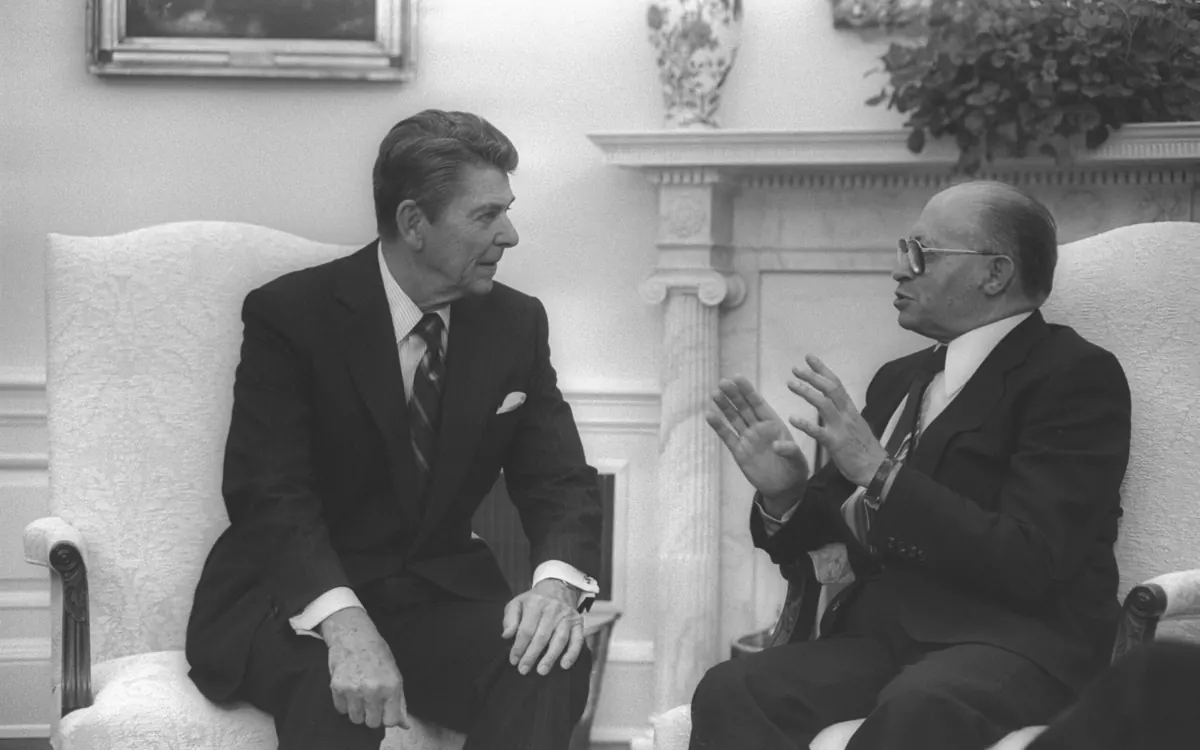
Before we can discuss the outbreak of war between Israel and the PLO in Lebanon, we must lay out the political context. As Yasser Arafat and his Palestinian liberation army were massing troops along the border, and the city of Kiryat Shmona was facing bombardment, Prime Minister Menachem Begin visited US President Ronald Reagan in Washington to solidify a US-Israel relationship - a goal made more complicated by Reagan's cabinet. American envoy to the Middle East Philip Habib will fight to keep the border from boiling over, but his efforts will come to an end with the assassination attempt against Israeli ambassador Shlomo Argov in 1982.
About this episode
Know thyself, know thy enemy, said Sun Tzu, and before the war in Lebanon Rav Mike weighs Menachem Begin as a leader, hated on hard left and hard right alike. His friend Yishai Fleischer names Begin's flaw as pathos, an over-immersion in his people's story. The elections of June 1981 tested whether the 1977 upheaval was a true turning, and most expected Labor to win as it always had. Two processes came to a head, the hardening of a Labor versus Likud contest and a sharpening ethnic divide, with Likud painted as the Mizrahi party though both were led by Ashkenazim. The economy under the Liberal Party's new policy had brought soaring prices and strikes, softened only by housing and Project Renewal that twinned struggling towns with communities abroad.
The peace with Egypt stood as a real achievement, yet the Sinai withdrawal was increasingly felt as a retreat, and its promised benefits remained theoretical while Yamit still stood. All of this made for the most bitter campaign Israel had seen, with street violence, slashed tires and more than two hundred arrests, most of them young Mizrahi men. The Ashkenazi elite spoke of them with open contempt, Gershom Schocken blaming the immigration from Muslim lands and Peres warning of Khomeiniism, while the papers cast Begin as Melech Yisrael who spoke the minds of the disenfranchised. His strike on Osirak a month before the vote lifted his standing, since it reflected the man he truly was. Likud took one seat more than Labor, and Begin was again asked to form a government.
Rav Mike pauses on how a historian assigns the start of a war, the difference between triggers and drivers, and refuses the parent's trap of who started it. On July 10, 1981, cross-border violence escalated into what became the Two-Week War. The PLO had built a real arsenal along the Arafat Route from Damascus into Fatahland, standing brigades and artillery battalions aimed south. The barrage on the north reached a new intensity, and for the first time Kiryat Shmona emptied under heavy shelling, guerrillas driving Jews off the land if only for a while. The strategy of targeting civilians with indiscriminate rockets became a method of choice for forty years, seen again and again in Gaza and from the north in our own day.
President Reagan sent Philip Habib, a Brooklyn son of Lebanese Maronites, to calm the fighting, and by July 24 he announced a ceasefire so carefully worded it named no parties at all. Begin's government read it as silence in the north, the PLO as a political victory, and the quiet mostly held for a year. Yet the Syrian missiles sat in the Beqa Valley, and when the BBC carried Assad's absolute rejection of peace, Begin moved to apply Israeli law to the Golan Heights in December 1981. Washington suspended the fresh strategic memorandum in response, and Begin told the American ambassador that a Jew bends his knee to no one but God, that Israel had lived thirty-seven hundred years without such an agreement and would live another.
Ariel Sharon had finally bulldozed his way into the defense ministry, and in February 1982 Shamir carried a list of two hundred forty PLO ceasefire violations to Washington, where Haig conceded a response would be understandable if proportionate. Even Arafat read the writing on the wall, sending Begin a message as one veteran to another not to try to break him in Lebanon. The Prime Minister sent no reply. In the end the trigger came from Abu Nidal, a splinter leader and bitter enemy of Arafat backed by Iraqi intelligence, whose gunman shot Israel's ambassador Shlomo Argov outside a London hotel on June 3, 1982. Argov survived, paralyzed, and though the Mossad warned the aim was to provoke an invasion, the cabinet was already set on war.
Key ideas
- Rav Mike reads Begin through his pathos, an over-immersion in Jewish memory that would cloud his judgment over Lebanon.
- The bitter 1981 election fused revisionist grievance with Mizrahi marginalization, and Likud took one seat more than Labor.
- The strike on Osirak a month before the vote lifted Begin by reflecting the man he truly was.
- The Two-Week War of July 1981 emptied Kiryat Shmona and made indiscriminate rocket fire a method of choice for forty years.
- Habib's carefully worded ceasefire held for a year, but the Golan Heights Law cost Israel its new strategic memorandum with Washington.
- The shooting of Ambassador Argov by Abu Nidal's gunman gave the cabinet the trigger it wanted for war.
Chapters
- 0:00 Know thyself; Begin's pathos
- 1:06 The 1981 election; upheaval or not
- 3:17 Labor versus Likud; the ethnic divide
- 4:29 The new economic policy; Project Renewal
- 6:39 Peace as retreat; a bitter campaign
- 8:52 Contempt for the Mizrahim; Melech Yisrael
- 11:11 Osirak lifts Begin; Likud wins
- 12:20 Triggers and drivers; who started it
- 14:32 The Two-Week War; the Arafat Route
- 16:43 Kiryat Shmona under fire
- 18:54 Habib and the worded ceasefire
- 23:21 The Syrian missiles remain
- 33:01 The Golan Heights Law
- 35:20 A Jew bends his knee to none
- 39:50 Sharon, Shamir and the violations
- 40:54 Abu Nidal shoots Argov
Who, where and when
People
Menachem Begin, Shimon Peres, Ariel Sharon, Philip Habib, Yitzhak Shamir, Hafez al-Assad, Yasser Arafat, Abu Nidal, Shlomo Argov, Gershom Schocken
Places
Kiryat Shmona, The Beqa Valley, Fatahland, The Golan Heights, Washington
Texts
The Khartoum resolutions, The strategic memorandum of understanding, The Jerusalem Post editorial
When
June 1981 CE: the tenth Knesset election, July 1981 CE: the Two-Week War, December 1981 CE: the Golan Heights Law, June 1982 CE: Argov shot in London
Read the transcript
Know thyself, know thy enemy, said Sun Tzu. A thousand battles, a thousand victories. Here I am, trying to just get a little bit of a grip on who I am, and knocking out those enemies one by one. I'm Rav Mike Foyer, and this is The Jewish Story. Season 5, Episode 16, Lebanon War Part 1, The Political Context. This show is dedicated by my mother-in-law, a little awkward, but in honor of me on the occasion of my birthday. She says, I'd like to dedicate this contribution to a special son-in-law, a wonderful educator, a personal advisor, loving husband and father, and much more. Wishing you, me, continuing success with all of your endeavors. So, I've made no secret of my admiration for Menachem Begin as a leader of Am Yisrael.
We've been with him for quite some time. Nonetheless, I've been hearing from listeners, and I know in general, it's a perspective that not everyone shares. I mean, you might say that someone who is despised, both on the hard left and on the hard right, had something going on. But nonetheless, if we're going to try and measure up Begin as a leader, then how are we going to do that? We have to take the struggle against the British. the Alt-Helena, 30 years in loyal opposition, Sinai, Osirak, and of course, before we could possibly hope to pass judgment of a character of this magnitude, there's the war in Lebanon to be considered. And we're just starting that process today. My guess is it could take us three or four episodes.
Now, I was talking to my good friend Yishai Fleischer just the other day, who is, I'll admit it, not a great lover of Menachem Begin. Aside from the fact that he had very specific critiques, in his genius with words, Yishai pointed out that Begin's problem was one of pathos, that that's really the place from which his failure flowed. Now, I'm going to leave the idea of pathos just hanging in the air there, because really I think next week is going to be the place in which we can really engage how much that clouded Begin's judgment. But for now, before we can really talk about pathos, we have to understand a little bit of politics. Elections for the 10th Knesset took place on June 30th, 1981. You know, Menachem Begin's upheaval 1977 victory gave him a four-year government.
It sounds like a strange beast. It's a sense of stability, frankly, that right now appears unprecedented in my eyes. But the real test of whether you can lead a democracy over the long term is, of course, getting re-elected. and Begin had an awful lot of obstacles to overcome on his path toward a repeat victory. First of all, one upheaval does not a revolution make. The expectation amongst the electorate, party activists, and general observers was that the labor alignment would win, simply because it always had in the past one-time upheavals notwithstanding. And in fact, pre-election polls called a tide race uncertainty about who even won would last late into election night. Now add to that assumption of Labour Party political hegemony two parallel and interactive processes which the 1981 election brought to a head.
The clarification of a Labour versus Likud struggle as the center line of Israel's political landscape and the polarization along ethnic lines within the Jewish electorate. Both parties, in reality, were led by Ashkenazi politicians. Shimon Peres on the labor and Menachem Begin for Likud, nonetheless, there was much talk of Likud as the ethnic party. Now, ironically, the labor alignment was just as much an ethnic party in the sense that about two-thirds of their voters were Ashkenazim, a similar percentage of Mizrahim who voted for Likud. But the fact that only one of the parties was labeled as ethnic says quite a lot. Now, mind you, things hadn't been always this divided. And in many ways, it was the economic landscape which supercharged the ethnic split.
Despite its socialist roots, by 1981, the Labor Party was perceived as standing for upper class demands, as it is even today, while Likud spoke for the lower class, most of whom belonged to that so-called Second Israel, whose parents were even gathered from North Africa and the Middle East in the early 50s. And by the by, the economic horizon in general wasn't Likud's best look going into the election. In 77, Begin had handed the keys to the economy over to the Liberal Party. He was a member of his Likud bloc. He gave them the finance ministry and the directorships of many of the state corporations. All of them were experienced businessmen with that classic revisionist commitment toward opening the economy to capitalist development that had put them in opposition to the labor socialists from the outset.
And they were quick to propose what they called a new economic policy. Here are the capitals in that. It was a package of laws, policies, meant to encourage investment, fight inflation, reduce national tax burden, auction off government corporations to private investors, and generally fee up the market. You might even call it an Israeli Reaganism. It also, by the way, held major reductions of government subsidies on food, transportation, and housing, never a popular move with the voters. And the results overall, from 1977 on, were disastrous. Soaring prices, rising economic equality, widespread strikes even. Not good fodder for the campaign trail, to say the least. There was one bright spot on the economic horizon.
Begin had promised a revolution in housing to the young, working-class, mostly Mizrahi voters who had swung the elections toward him in 77, and he did his best to follow through. His policies encouraged large-scale construction of rental housing, and Begin's Project Renewal went even further by twinning 32 Jewish communities abroad with 82 underprivileged communities in Israel. With the Jewish agency guiding the process, infrastructure and housing was rebuilt, parks, daycare, community centers expanded, loan and mortgage funds was established, and by 1983, Project Renewal actually spent more than $130 million. Its impact is still evident today, if you know where to look. And I wonder if anybody out there listening grew up with a twin town for their community.
I was in Cleveland. We were twinned with Beit Sheyan. Now add to this Likud's success in an additional three years of tuition-free schooling for the whole country, which allowed every Israeli to complete high school without having to pay. And you can see that the economic front was grim, but not catastrophic. So there's economy, and then there was, of course, the peace process. The treaty with Egypt was signed, and the IDF withdrawal from Sinai well underway in the summer of 1981. It was seen as a real political achievement for the man many labeled as a warmonger before his first election. But the army's withdrawal was increasingly perceived as a retreat amongst the electorate, even beyond the hard right who had opposed it from the outset.
At this point in our story, Yamit won't be destroyed for another 10 months, and many believe it never will. Meanwhile, the promised economic and political benefits of peace are purely theoretical at this stage. Not to mention that, though no one could know it at the time, Sadat will be dead from an assassin's bullet in three months. My point is, many a slip twixt the cup and the lip, especially when it comes to actualizing big political decisions at the ballot box. All in all, these came together to make one of the most bitter electoral seasons that Israel had ever witnessed, marked by street violence that had never really occurred before, at least not since the pre-state days. That eruption of anger was in many ways the final stage in something that we spoke about back in the original episodes on the upheaval, the fusing of old-school revisionist sense of exclusion from the political and cultural elite with the modern Mizrahi experience of social and economic marginalization.
Likud supporters threw rotten tomatoes, they slashed tires, vandalized election offices, and regularly disrupted labor rallies with heckling. By the end of the campaign, police had arrested more than 200 people. And the fact that a majority of them were young Mizrahi men became grist for the mill for Shimon Peres and the Ashkenazi elite who saw Mizrahi Jews and Revisionist Zionists as a two-pronged existential threat to politics and even society, or at least society as it ought to be. And trust me when I tell you, they weren't shy to say so. Gershom Shakin, then publisher of Aretz and now father of the current publisher of Aretz, declared, the mass immigration from the underdeveloped Muslim countries is to blame for the unholy combination of religious extremism and nationalist fanaticism, which does not figure in Zionist doctrine.
Or, as Shimon Peres put it, after Likud supporters rolled a trash can filled with flaming garbage into a crowd in Petah Tifa, do you want this Khomeiniism to take over Israel with idol worship? Even chairman of the Election Commission took it upon himself to warn that parts of the Israeli electorate were, quote, hot-tempered and still unfamiliar with democracy. A little more delicate. but raw nonetheless. A June 19, 1981 editorial in the Jerusalem Post actually framed the entire election this way. A not inconsiderable segment of the population takes a dim view of the country's system of democracy and would be happy to see it scrapped and replaced by an authoritarian strongman regime. To most of them, Begin is as hero.
Begin, Melech Yisrael, king of Israel. He speaks their minds and articulates their thoughts. No wonder, then, that the more he moves around on the hustling, rattling his saber over missiles and nuclear reactors, they lap up his message. Now, I've got to say that rhetoric aside, perhaps I should consider why it was that all these people who had been disenfranchised from the elite felt that Begin spoke their mind. But that's just a side point. That reference there to nuclear reactors wasn't just rhetoric, of course. Remember, Begin had ordered the strike in Osirak less than a month before these elections. And it's true that his bold defense of Israel elevated his standing in the polls. It might have even been what turned the tide in his favor but only because it was reflective of the type of man Begin truly was In a move which not only backfired but actually said more about him than his opponent Labor Party head Shimon Peres criticized the attack on Il Sirac as a political ploy.
Just remember, we all judge the world through the prism of ourselves. Begin's response to Peres' accusation was classic. Jews, he said, you've known me for 40 years, since I lived in the Hasidorf neighborhood of Petach Tikva to fight for the Jewish people, was a reference to his underground days. Would I send Jewish boys to risk death or captivity worse than death? Because those barbarians would have tortured our boys horribly for elections? Well, apparently the people's answer was no. Because on June 30th, 1981, Likud received one more seat than labor, and Menachem Begin was once again invited by the president to form the government. Now, neither Begin nor his voters could possibly know that this government would soon send thousands of Jewish boys to risk torture and death, though certainly not for the sake of getting elected.
If, as I'm always warning you, you know a storyteller by where he starts his tale, then you can tell a historian or political analyst by where he says a war began. We've actually talked about this problem in the past. How exactly is one meant to assign causality for something as large and complex as a war without simply shaping the facts to fit our pre-existing opinions? One aspect of the problem is this issue of proximal and distal causes, or what we might call triggers and drivers. For example, the existence of a large refugee population in southern Lebanon, increasingly politicized and militant, is certainly a driver of the coming war. And of course, the Black September uprising back in 1970 and the birth of Israel in 1948 were drivers for that.
While it's going to be a single act of terror that triggers the Israeli invasion in the summer of 1982. So is terror a trigger or a driver? A closely related problem is the one that every parent loves. Who started it? Now, we're all watching this unfold in our day, in blood-curdling and downright absurd fashions, on social media, as people try to prove who is more guilty of causing the chaos in Eastern Europe right now, Russia or Ukraine. And of course, there's always the issue of moral rectitude. There is a problem that will become acute by the time the Lebanon War reaches its height with the siege of Beirut and stands in many ways at the center of this story. So what is a storyteller or a historian to do?
I mean, aside and causality, is a legendary mess for historians. Just take a poll on what really caused the American Civil War. And I'm going to chuck the question of who started it as well. Every parent will tell you that's a rabbit hole. no one needs to descend into. And I'm not about to feed into the whole if the Jews hadn't become Zionists, none of this would ever happen in the first place narrative. And while the question of right and wrong is certainly central in my eyes, at the moment, I'm a storyteller and not a political analyst or even a moral philosopher. And as such, warnings aside, I have to start somewhere. Now, we already got a bit of the backstory in previous episodes. And I'm giving you a commitment right now that before we talk about the actual invasion, I'll give you a working understanding of the mess into which the IDF will wade in Lebanon.
But for right now, I want to talk about July 10th, 1981, less than two weeks after Reagan's election victory and before he could even present his new government to the Knesset. That's the day which began a period of intense cross-border violence, which became known as the Two-Week War. Who started it? I refer you to my earlier comments, and add only the sad reality that the more successful Israel became in the 70s at stopping cross-border raids, the more heavily the PLO and other enemies invested in long-range weapons. Either way, on July 10th, a marked escalation from previous attacks began, because up until now. They generally consisted of a few Soviet-made rockets or mortars lobbed across the border, and not a sustained barrage.
But the PLO had been building up its arsenal in southern Lebanon for some time, using the so-called Arafat Route, a supply line of arms originating in Damascus and ending just north of the Khermon Ridge, in the region that the IDF called Fatah Land. Arafat had also become a major organization, or I should say reorganization of his forces in southern Lebanon. When they fled from the Jordanian army in 1970, the Palestinian Liberation Army was really only so in name. In actuality, it was a somewhat ragtag collection of terrorist and guerrilla bends, deadly but disorganized. But by 1981, the Castel, Karami, and Yarmouk Brigades were established, boasted seven new artillery battalions. A standing army was coming into existence in southern Lebanon, and its guns were pointed directly south.
Therefore, the barrage which struck the north of Israel on the 10th of July was the most intense yet seen. It was a combination of Ketusha rockets and 130mm artillery shells that rained down and for the first time subjected Israel's border town of Kiryat Shmona to heavy shelling. Not that death from the skies was anything new for Israel's northern residents. Six people had been wounded by a Ketusha in Kiryat Shmona just this past January, but this was a round that reached new intensity. I won't be chased out of Kiryat Shmona because it's my home. In addition, my wife was disabled in the use of both legs by a Katyusha rocket attack in 69. Despite all that, I stay and will stay forever. By the 15th, when three Israelis were killed in Nariya and 17 more wounded in Kiryat Shmona, life in the north had all but come to a halt.
The people of Kiryat Shemona are not afraid. The people living in the Yopan aren't used to things like this. Yesterday I spoke to my daughter. She didn't actually cry, but she doesn't understand. She's sitting in class and suddenly there's an ultrasonic boom. We hope things will settle down. Another week, another month, it'll be all right. Two days later, on the 17th, The Israeli Air Force launched a large-scale raid, for the first time targeting PLO buildings in the heavily populated center of Beirut. But, you know, such violence always has its own logic. And certainly, no one in this situation was going to be the first to back down. The PLO simply intensified its bombardment, forcing thousands of Israelis to move southward or to live in bomb shelters for several days.
The city of Kiryat Shmona was all but abandoned. And for the first time, guerrilla forces had succeeded in driving Jews off the land, if only temporarily. The strategy of targeting Israel's civilian population with indiscriminate rocket violence, from this moment on became a method of choice for 40 years. We've seen it in our day many times in Gaza and even from the north. Meanwhile, American President Ronald Reagan had dispatched his new special envoy for the Middle East, Philip Khabib to try and calm the situation. Khabib is actually a fascinating character of American diplomacy. I encourage you to look into him sometime. For now, just to have an image to go with, he was a Brooklyn-born son of Lebanese Maronite Christians, raised in all places Bensonhurst, a largely Jewish neighborhood.
Khabib was also a longtime member of the Foreign Service, but his career had been cut short in 78 by a massive heart attack. Nonetheless, Reagan saw him as the man of the hour and had called him out of retirement in hopes that his background and skills would allow Khabib to bring at least a little peace in the Middle East. The Prime Minister was not entirely thrilled to greet the American envoy. Khabib had already undertaken a round of shuttling back and forth between Damascus and Jerusalem a few months ago in April. On the 28th of that month, Israel had downed two Syrian helicopters, mistakenly thought to be en route to attack the so-called French Chamber. It was an important Christian position on Mount Sanin.
Begin had basically promised Christian Lebanese leaders Kamil Shamun and Bashar Gamayel that Israel would not let the Syrian air force attack the Christian militias. He feared, in fact, that the Christians of Lebanon faced an impending genocide, something which will weigh quite heavily in the coming episode. And thus, they were willing to strike the Syrian helicopters. In response, the Syrians moved 19 anti-aircraft missile batteries, including advanced SA-6s from Russia, into Lebanon's central Bekaa Valley. The missiles severely threatened the Israeli Air Force's freedom of flight over Lebanon, and their deployment not only shifted the balance of power, it broke an unwritten understanding with Syria that it held since 1976.
Khabib failed to secure the removal of the missiles, And Begin actually decided to risk war with Syria and strike those new positions. But the operation was called off due to weather conditions, and then shelved all together in favor of the strike on the nuclear reactor in Osirak, which actually took place only a couple of months later. But don't worry. Keep your eye on that Syrian anti-aircraft batteries in the Beka Valley, because its story is not going away. Meanwhile, now Khabib was back in July, struggling to bring the latest round of violence under control. He and Begin met on the 19th, and the Prime Minister authorized the American envoy to negotiate a ceasefire with Lebanese President Elias Sarkis.
Notice, with the President of Lebanon, not the PLO. By the 24th, Khabib had succeeded, in a sense, and leaving a meeting with Prime Minister Begin, he faced the press with the following announcement. I have today reported to President Reagan that as of 1330 hours local time, July 24th, 1981, all hostile military actions between Lebanese and Israeli territory in either direction will cease. Now, such a terse declaration begs interpretation, and I promise you, it began almost immediately. Notice first that Habib omitted any mention of the actual parties to the agreement And he didn even use the phrase ceasefire All we got was hostile actions between Lebanese and Israeli territory will cease. Now, the PLO claimed this as a political victory.
For the first time in Israel's 33-year history, they forced the government to agree not to conduct operations against Palestinian forces. largely because of the pain of 6 dead and 65 wounded and massive destruction. It was a big boost not only to the morale, but to their claim to political and military legitimacy in the Arab world. At the same time, the ambiguity of Khabib's statement allowed Israel to deny it had negotiated with PLO at all, or whether there was even a ceasefire against their mortal enemies. When asked whether he regarded the agreement as a ceasefire, Begin's press advisor Uri Perat replied, you can call it what you like. For me, it means silence in the north. As Housing Minister David Levy met with officials in Kiryat Shmona to discuss a return to normal for the 15,000 residents of the Shell Shockdown, he promised there would be a massive retaliation for any further rockets.
We've all heard that one before. And indeed, though it was unpopular in many circles, the ceasefire brought a mostly quiet year to Israel's northern border. Nonetheless, no one fooled themselves into thinking that the underlying conflict had been resolved. I mean, Syria still had 30,000 troops in Lebanon. It was unclear actually whether they were a party to that agreement at all. Israel's commitment, however, to cease all hostile military actions across the Lebanese border meant that those surface-to-air missiles in the Bekaa were now off-limit to the Air Force. Furthermore, though Israel interpreted the agreement as a commitment to the cessation of Palestinian violence of all types, the PLO read it in a strict sense.
No more attacks against Israel from Lebanese territory. But planning terror attacks against Jews and Israelis around the world from their now safe haven in southern Lebanon? Well, that was clearly fair game. So, in a sense, if the war didn't begin here, the countdown toward it certainly had. I mean, what's a small country like Israel to do in such an alarmingly explosive and international situation? You could say many things, but surely one of them was to make sure that its superpower patron was firmly in its quarter. We heard a little bit at the last episode how New American President Ronald Reagan had reacted to the initial report of the bombing of Osirak. Boys will be boys. and as supportive as this sounds and as supportive as Reagan generally was of Israel his administration took a somewhat harsher view on the use of American weapons for preemptive strikes the US in fact had temporarily suspended weapon deliveries only days after the strike to which Israel's foreign minister had responded we consider this as unjust Israel acted in self-defense against threats to its very existence Israel had tried to utilize every diplomatic avenue which was open, and only after the efforts failed was forced to take the action it took.
Well, the coming explosion in Lebanon is going to make Osirak look like a schoolyard spat, and Begin knew that now was the time to once again make every diplomatic effort in Washington. Prime Minister Begin's trip to Washington in early September 1981 was far from his first, but it was his introduction to the Reagan White House. he was accompanied by a new team the results of the cabinet formed after that summer's elections, and they came prepared to play hardball. Foreign Minister Yitzhak Shamir was in attendance, legendary operations leader of the Lehi, who had sentenced the British High Commissioner of the Middle East, Lord Moyn, to death by assassination in the 40s, and who, in his own turn as Prime Minister in the 80s, would make famous what I like to call the Shamir negotiating tactic.
No. No. No. Begin was also accompanied by the newly appointed Defense Minister Ariel Sharon, also known as the Bulldozer. Now, we're going to speak in the coming episode about exactly why Sharon had been denied that post for so long. For now, his role as a key asset in the recent electoral campaign had finally made it impossible to deny him any longer. Facing them were President Reagan, a well-known lover of Israel, and high-level members of his cabinet who were a little more restrained in their admiration. After a warm welcome and, of course, some jelly beans, the two leaders sat together before joining the larger forum waiting in the cabinet room. Here, as President Reagan introduced his guests smoothly like only an old movie actor can do, he made the mistake of describing Israel as a strategic asset right before inviting Prime Minister Begin to speak.
Begin thanked his host and then proceeded to give a comprehensive view of the Middle East as he saw it, being careful to refer to Israel as America's most reliable and stable ally of freedom against Soviet expansionism in the Middle East. He knew his crowd. And in case the gipper had missed the point, the prime minister added at the end, you, Mr. President, kindly referred to my country just now as a strategic asset. While that certainly has a positive ring to it, I find it nonetheless a little patronizing. Given the bipolar world in which we live, democracy versus communism, the cherished values we share, and our confluent interests on so many fundamental issues, might I suggest the time has come to publicly acknowledge that Israel is not just a strategic asset, but a full-fledged strategic ally.
It was a bold move, and one that Begin never would have dared to risk in the chilly days of the Carter administration. Things were far warmer in the room at the moment. Nonetheless, he saw that his comments stirred more than a little unease around the cabinet table. The frown on the face of Secretary of Defense Caspar Weinberger said it all. And his look was shared by others when the Prime Minister went on to liken Israel to a mistress whom America was in love with but ashamed to recognize in public. Nonetheless, President Reagan was listening closely, and when Reagan finished, he replied, I'd be proud to acknowledge you in public anywhere, anytime. In courage, the Prime Minister took another step, reminding all assembled that, quote, over the decades, Israel has done a thing or two which might have contributed to the American strategic interests in our region.
He wanted to make it clear that the American-Israeli relationship wasn't based on charity, nor was it simply one of patron-client, It was a mutually beneficial alliance and should be called as such. And that's when he made the ask. Might I suggest, said Prime Minister Begin, Mr. President, that consideration be given to an agreed document on this matter. Begin was asking for a formalization of what he called the strategic relationship between Israel and America. and knowing he was out on a limb he was quite surprised by President Reagan's quick response what the Prime Minister proposed sounds like a good idea to me let's look into it and if Begin was shocked Secretary of Defense Weinberger was downright livid Defense Minister Sharon jumped up and began to lay out his vision of U.S.-Israel strategic cooperation in characteristic style oblivious to the reactions his grandiose schemes were generating around the table Begin, however, was far more adept at reading the room, and he could tell that a strategic retreat was now in order.
So he suggested that the president authorize the two defense ministers to confer on a mutually agreeable formula, to which Reagan happily agreed. Why don't you two fellas get together, he said, and see if you can work something out in this area. The next day, Prime Minister Begin was ecstatic in his interview with Israeli radio, hailing the beginning of a new era in strategic relations between Israel and the United States. They asked him, what makes this visit with Ronald Reagan a successful one, as you describe it? And the Prime Minister responded, time will tell. I can say that I heard this morning my friend and colleague Moshe Dayan claim that, actually, the whole strategic security cooperation between Israel and the U.S.
boils down to the building of a few hospitals. He said this because he simply doesn't know the facts. We're talking about real cooperation. We haven't signed an agreement yet. We've come to an agreement in principle on the matter. We're not talking only about a few hospitals, but about real cooperation. on land, on the sea, and in the air. But, as I said earlier, many a slip twixt the cup and the lip. If that was true when it came to actualizing big political citizens at the ballot box, it's doubly so when it comes to translating conversations in a cabinet meeting into treaty documents. Secretary of Defense Caspar Weinberger loathed Ariel Sharon personally, and he was in no way sure that a tighter strategic alliance with Israel was actually in the American interest.
And so, while Begin was declaring victory to the press, Weinberger was telling his senior aides, they'll want a binding document with lots of detail and publicity. We're not going to subscribe to anything like that. Whatever we'll sign will be so general and so empty of content that we'll be able to defend it in the Arab world. And so it was. Ariel Sharon's defense ministry presented the Pentagon with a comprehensive 29-page booklet, a sweeping array of proposals for strategic cooperation on every possible military front. But by the time Caspar Weinberger was done, it had become a 700-word memorandum of understanding. Not only was there no dramatic presentation of a new strategic reality to the world press, the two defense secretaries actually signed the almost meaningless document at a National Geographic Society dinner.
The president's tendency to shoot from the hip and the heart had been checked by his secretary's colder calculus, if not entirely stifled. But, as it turned out, there were rough waters immediately ahead for this new U.S.-Israel strategic relationship. Love Menachem Begum or hate him or be neutral on the fact no one can deny that he gave everything he had in service of the Jewish people including his health So much so that not long after his return from Washington Begin landed in a wheelchair with a broken femur His recovery involved excruciating pain And in the evenings, the Prime Minister sought the comfort of his beloved BBC news broadcast, something to which he was so devoted that he stuck with it even in his days of fighting the British occupation.
But even the BBC was challenged to hold the Prime Minister's attention with the pain he endured. Nonetheless, Begin sat up when one evening he heard the following report on Syrian President Hafez al-Assad, quoted from a Kuwaiti paper. He will not recognize Israel, even if the Palestinians deigned to do so. There can be no question of making peace between Israel and the Arabs, so long as the strategic balance plays into Israel's hands. He called upon the Arab states to persist in their rejectionist stance until they attained the power necessary to impose peace conditions on Israel in the spirit of Arab demands. It had been two months since returning from Washington and five since the ceasefire negotiated by U.S.
envoy Khabib. Meanwhile, the trickle of cross-border attacks by the PLO had begun once again. Furthermore, it was eight months since the Syrians had moved their anti-aircraft missiles into the Beka Valley, and it was clear they weren't going anywhere. Remember, Begin hated the PLL with an unparalleled passion. They were simply, in his eyes, the modern embodiment of the Nazis that had caused he personally and the Jewish people in general so much pain and death, a fact which he never failed to point out. And the Prime Minister knew that their hatred for Israel was implacable as well. Put together, this meant that sooner or later, that the PLO would feel strong enough to strike, and only a fool or a coward allows such an enemy to choose when war begins.
But Prime Minister Reagan also knew that navigating the ship of state took quite a bit of care. That recent strategic memorandum with the U.S. might not have been everything that he'd wanted, but it was something, and thus not to be thrown away lightly. One point on which President Reagan and his cabinet had agreed and made abundantly clear was that no matter the scale of the PLO threat, there would be no preemptive invasion of Lebanon. Nonetheless, Begin knew that war was an inevitable. Given the PLO's militant approach, a provocation would certainly present itself soon enough. Meanwhile, the BBC had just provided him with an inspiration of how he could move some pieces on the international chessboard that would allow him at least to check one player in the game.
It was time to halt the creeping Syrian takeover of Lebanon. So the next morning, the Prime Minister called his cabinet together. Time had come to apply Israeli law to the Golan Heights. To their shocked replies, Begin declared it was the only viable response to Syria's absolute rejectionist stand to their recent deployment of missiles in the Beka Valley. and frankly, the least violent response he could think of to make Syria back off in Lebanon and cease aiding the buildup of the PLO. How many times did we call for the rulers of Syria to open negotiations for peace with us, Begin asked. I repeatedly said that I invite President Assad to Jerusalem or am willing to go to Damascus to open peace negotiations.
The Syrians rejected our outstretched hand with a total rejection of our right to exist as a Jewish state. He then went on to recall how, before 67, Syrian shelling from the heights had made the lives of tens of thousands of civilians hell. Could anyone think Israel would ever agree to renew this situation, he asked? Ever conscious of history, Begin then noted that, for many generations, the Golan Heights were an inseparable part of the land of Israel, and it was only the arbitrary nature of colonial rule that had separated them. This arbitrariness, he said, does not obligate us. In the end, despite fears of American reaction, he carried not only his cabot, but the Knesset as well. And on December 14, 1981, the Golan Heights Law was adopted by a majority of 63 against 21.
Amongst those in favor, by the way, were eight members of the opposition Labor Party. Syrian President Hafez al-Assad got the message right away. In fact, he saw the application of Israeli law to the Golan as a declaration of war, but nonetheless felt that Syria was in no condition to fight it. Now, the Americans didn't see the move quite as so definitive. Nonetheless, the reaction was far more belligerent. World attention was at that very moment focused on the emerging solidarity movement and Moscow's efforts to suppress the mass protests and strikes rocking Warsaw. Begin had actually hoped the Golan vote would go quickly and quietly while the world was busy with Poland and especially would stay under the major radar of America.
And so he was shocked by the White House's announcement of a suspension of that recently signed strategic agreement. And when American Ambassador Sam Lewis was ushered into the Prime Minister's office the morning after the White House learned of the Golan Law, he started nicely, or at least politely, by inquiring after Begin's health. The Prime Minister replied that he was doing much better. The trouble is, he said, I can't bend my leg, But, you know me by now, Sam, a Jew bends his knee to no one but God. It was a witty reply, but it was a declaration of defiance as well, and it set the tone for the meeting to come. Ambassador Lewis had come to explain that the Memorandum of Understanding had been suspended, contingent on what he said to be progress in the autonomy talks concerning the Arabs of the West Bank and the situation in Lebanon, but instead he received a lecture from an angry master of rhetoric.
Are we a vassal state, said Begin? Are we a banana republic? Are we 14-year-old boys that have to have their knuckles slapped if they misbehave? You cannot and will not frighten us with punishments, Mr. Ambassador. Threats will fall on deaf ears. We shall not allow a sword of democles to hang over our heads. The people of Israel have lived for 3,700 years without a strategic agreement with America and will continue to live without it for another 3,700. What followed was a few months of UN condemnations, and honestly a rocky patch in the relationship with America. But I gotta tell you, I was in the Golan not so long ago, and the view hasn't changed in 3,700 years. So, now we have, more or less, the political pieces that are going to lead to war on the board.
Though there's obviously far more to explore in the coming episode. Ariel Sharon is defense minister, and we'll see that he has grand plans for Lebanon. The Americans are not exactly on board with the plan, but Prime Minister Begin dispatched Foreign Minister Yusak Shamir to Washington in February of 1982, carrying a detailed list of 240 violations by the PLO of the ceasefire that they had negotiated. Faced with such evidence, Secretary of State Alexander Haig was forced to concede that an Israeli reaction would be understandable, though he was quick to add it must be proportionate. Ha, ha, ha. Even PLO Chairman Yasser Arafat could read the writing on the wall, and he sent a message to Menachem Begin via a UN emissary in May of 1982, writing, as he said, as one resistance veteran to another.
You of all people, he said, must understand that it is not necessary to face me on the battlefield. Do not try to break me in Lebanon. You will not succeed. The Prime Minister sent no reply. And in the end, the Palestinians did indeed supply the trigger that war required, but actually not the PLO. The Palestinian National Liberation Movement was a splinter group that had broken away from the PLO. Its leader, known as Abu Nidal, was actually a bitter opponent of Yasser Arafat, and with funding and guidance from the Iraqi Intelligence Agency, had even made several attempts on his life. Failing that, Abu Nidal and the Iraqis had come up with a much better idea, that the Israelis do the job for him. And so it was that as Israeli ambassador to the United Kingdom, Shlomo Argov left a banquet from the Dorchester Hotel on the night of June 3, 1982, Hassan Said, a young disciple of Abu Nidal, was waiting outside on the cold London streets.
Said fired a single shot before fleeing, but it was enough. Shlomo Argov would live, but he was paralyzed for life. With their ambassador critically ill in hospital after being shot in London last night, the Israelis have taken swift action in retaliation. Mr. Shlomo Argov was shot outside the Dorchester Hotel in Mayfair, and four men are now helping the police. The Israeli government showed their anger with deeds rather than words. Their jets bombarded targets around the Lebanese capital, Beirut. Later, Palestinian guerrillas struck back against Jewish settlements in the north of Israel. Demonstrators from the Union of Jewish Students and Board of Deputies protested this afternoon outside the London office of the Palestine Liberation Organization.
But PLO spokesmen in London and Beirut have denied any involvement in the shooting. Despite the evidence presented by the Mossad to Prime Minister Begum the next day that Abu Nidal's intent was actually to provoke an invasion of Lebanon, the cabinet was intent on war. And before the day was out, the Israeli Air Force was bombarding PLO targets across Lebanon and the cities of northern Israel were absorbing a massive PLO response. The march to war had become a headlong run. And at this point, no one could imagine where it was actually headed. I want to thank a few folks before I sign off. I want to thank all the folks that give their hard-earned money to make this show happen, keep it free, widely available.
I want to ask you to join them right now. You can go to my website, jewishstory.co, and up right in the hand corner, you'll see a button that says Be a Patron. You can click on that to give a little bit of per-podcast support. Or if you'd like, you can dedicate this show by reaching out to me at robmikefoyer.gmail.com or on Facebook. I'm happy to share with you the details. I also want to thank the Land of Israel Network, that's thelandofisrael.com, for building a center for global transcendence in the heart of Judea. I want to thank Pardes Institute, pardes.org.il, for throwing the doors of the Beit Midrash open as wide as possible. And I want to thank you for listening. I'm Rav Mike Foyer, and this is The Jewish Story.
More from Season 5
TJS S5E15 - Bombing of the Iraqi Nuclear Reactor
Israel's leadership came to be part by never forgetting the principal of "when one comes to kill you, rise early and kill first." Israel Prime Minister Menachem Begin's...
Play Episode
TJS S5 Interlude Purim 5782 In search of joy
Adar is the month when we increase our joy. The question is, in an increasingly bewildering world, where is it to be found? Learn about the Jewish holiday...
Play Episode
TJS S5E17 - Lebanon War part II
Operation Peace for the Galilee begins with Israeli jets pounding Yasser Arafat's PLO bases in southern Lebanon, but there is always a backstory. In this episode learn about...
Play Episode