
TJS S5E23 The Jonathan Pollard affair
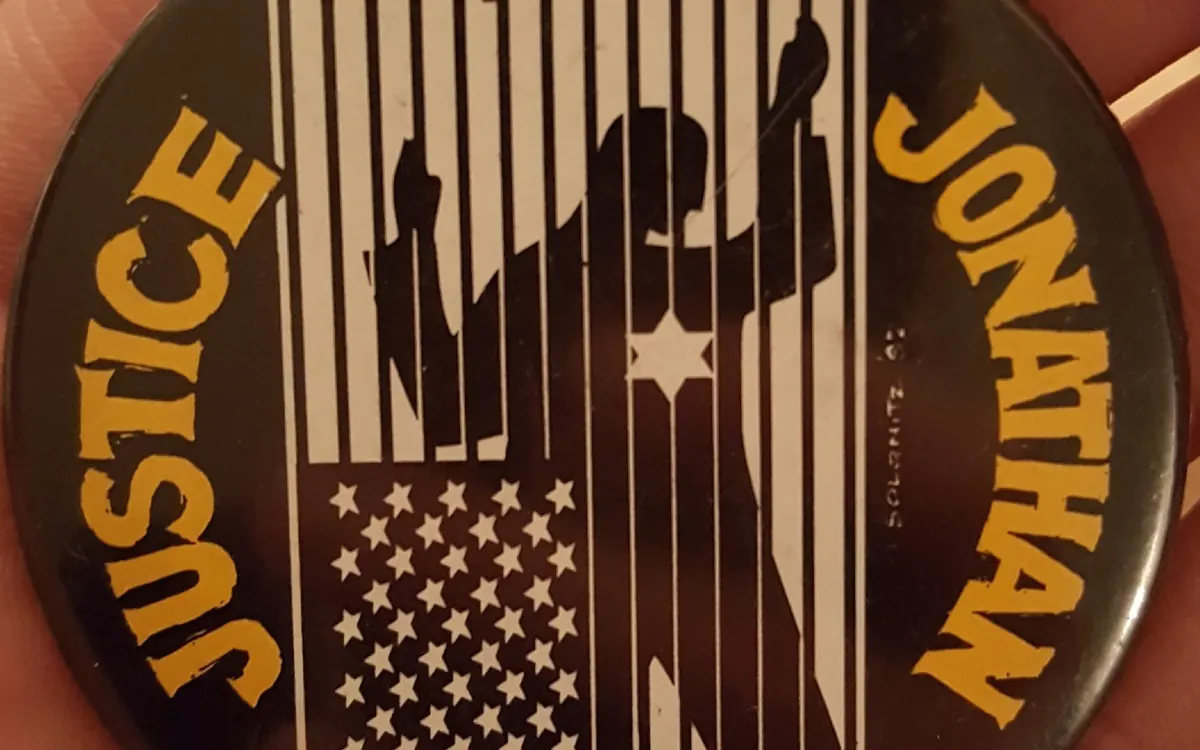
The 1980s saw many seismic shifts in the fabric of American Jewish society, and among them was the earthquake of the Jonathan Pollard affair. The 1985 arrest of the Navy analyst rocked the US/Israel relationship and accelerated the fragmenting of attitudes toward Israeli among Jews in the US. Whether you see Jonathan Pollard as a traitor or a prisoner of Zion, his story must be heard.
About this episode
Blake on forgiving a friend. The task is mapping American Jewry's topography through the eighties and its seismic shifts, the demographic drop, the changing face after the 1983 intermarriage resolution, and the splintering of the old consensus on Israel, accelerated by Jews in the press like Thomas Friedman working out identity issues in public, and by a rising anti-Israel posture in the media after 1967. Into this comes an earthquake. On November 21, 1985, Jonathan Pollard, a Jewish naval intelligence analyst, sped to the Israeli embassy in Washington seeking asylum, was turned away, and was arrested, the beginning of a story that rattled the foundations on which American Jewry had been built.
Pollard's path ran through a Washington shul, where he told fellow congregant Steve Stern that he saw the most classified information on Israel and wanted to share it. Born in Galveston in 1954 and raised a passionate Zionist in South Bend, he had been forged by the fear and salvation of the Six-Day War and a family visit to Dachau, which taught him that without the power to protect what we love, life ends in tragedy. He boasted of false Mossad ties, was turned down by the CIA amid red flags, yet landed in naval intelligence. Stern passed him to Aviem Sela, the Israeli colonel who had led the Osirak strike and the operation against the Syrian missiles, a near-demigod in Pollard's eyes.
The Mossad would not touch him, both from its rule against recruiting diaspora Jews after the disaster of Operation Susanna and from its agreement to stay out of American soil. So the offer reached Rafi Eitan of Lekem, the veteran who had kidnapped Eichmann, who decided an American Jewish agent was worth the risk. Eitan made Pollard a paid asset, buying the engagement ring, flying the couple to Maxim's in Paris, inventing a rich Uncle Joe, and opening a Swiss account to lock him in. For this he got what his handlers called a one-man intelligence agency: layouts of chemical factories, Soviet arms shipments, Pakistan's bomb program, and the photos that made the long-range strike on the PLO in Tunis possible.
Pollard's appetite became insatiable, and when he delivered codes far beyond Israeli security interests his handlers told him to stop, too late. A co-worker reported his Friday removals of classified files, and in November 1985 the FBI stopped him. He telephoned his wife Anne to water the cactus, a signal to clear their home of documents. After a partial confession he was turned away from the embassy and arrested. He pleaded guilty, expecting the agreed twenty years, yet Judge Robinson received a forty-six-page memo from Caspar Weinberger and sentenced him to life, with Anne crying no on the courtroom floor. The memo's claim that Pollard had exposed agents executed in Moscow proved a total falsehood, the work of Aldrich Ames.
Back in Israel the affair was first cast as a rogue operation, and when the American demand for cooperation forced a reckoning, Rafi Eitan took the stand and the whole blame, covering Peres, Shamir, Rabin and Barak, to whom he had actually shared Pollard's output. The deeper wound was to American Jewry, where the charge of dual loyalty, thought long gone, found new life, and counterintelligence began to suspect high-ranking Jewish officials. American Jews felt betrayed, their decades of advocacy repaid by the recruitment of one of their own, and Theodore Mann called it a profound insult, while Norman Podhoretz declared Pollard guilty of a sin against the Jewish people, and the Israeli authorities guilty of the same sin as well.
Key ideas
- Pollard told a fellow congregant he saw the most classified information on Israel and wanted to share it, forged by the Six-Day War and Dachau.
- The Mossad declined him after the disaster of Operation Susanna, so the offer reached Rafi Eitan of Lekem.
- Eitan made Pollard a paid asset, and his intelligence made the long-range strike on the PLO in Tunis possible.
- Pollard signaled his wife to water the cactus, and after a partial confession he was turned away from the embassy and arrested.
- Judge Robinson received Weinberger's forty-six-page memo and sentenced Pollard to life, a claim within it later proved false.
- The affair revived the charge of dual loyalty, and American Jews felt betrayed by the recruitment of one of their own.
Chapters
- 0:01 The changing topography
- 3:24 The splintering consensus
- 7:57 Pollard at the embassy gate
- 9:05 A passionate Zionist
- 11:25 Dachau; the power to protect
- 13:35 The Mossad declines
- 14:45 Rafi Eitan and Lekem
- 15:51 Pollard made a paid asset
- 18:08 A one-man intelligence agency
- 20:24 The raid on Tunis
- 23:40 Appetite beyond security
- 25:57 Water the cactus
- 31:27 The plea and Weinberger's memo
- 33:46 Sentenced to life
- 38:04 Eitan takes the blame
- 40:22 The wound of dual loyalty
Who, where and when
People
Jonathan Pollard, Anne Pollard, Steve Stern, Aviem Sela, Rafi Eitan, Caspar Weinberger, Aldrich Ames, Norman Podhoretz, Theodore Mann, William Safire
Places
Galveston, South Bend, Washington, Tunis, Paris
Texts
The Weinberger memorandum, Capturing Jonathan Pollard, Commentary
When
1954 CE: Pollard born, 1985 CE: the Tunis raid, 1985 CE: Pollard arrested, 1986 CE: Pollard pleads guilty, 1987 CE: the life sentence
Read the transcript
It is easier, said William Blake, to forgive an enemy than to forgive a friend. Words that deserve some contemplation. I'm Rav Mike Foyer, and this is The Jewish Story. Season 5, Episode 23, The Pollard Spy Affair. I don't want to lose track of the fact that our overall task right now is mapping the topography of American Jewry through the 80s. And in order to do that, we have to remember that it's undergoing seismic shifts. Some of them we've already seen. There's the demographic issue. Slowing down the reproduction rate and the rising intermarriage numbers mean a dropping in absolute numbers of Jews in America. That will have obvious communal consequences in the decades that lie ahead in terms of everything from fundraising to educational institutions to political clout.
And those demographic changes also mean a rapidly changing face to American Jewry. Recall the wording of the CCAR, that's the Central Conference of American Rabbis, 1983 resolution, the status of children of mixed marriages. These leaders of the reform movement declared we face today an unprecedented situation due to the changed conditions in which decisions concerning the status of the child of a mixed marriage are to be made. An awkward sentence to say the least, but notice the emphasis. This is all due to the changed conditions in which decisions need to be made. And those changes are about the numbers of intermarriage, as well as, by the way, the unprecedentedly tolerant society which America offered around them, which of course was a primary driver for those very rising numbers.
We call that a positive feedback loop. The more accepted the Jews are, the more they interact with non-Jews in a positive and equal way. The more, of course, they fall in love and get married and become intermarried couples who in turn preach and encourage tolerance. It can be positive, but it's also going to erode the number of Jews in America. And in the space of the 50 years before that declaration, American Jewry went from a culture where it wasn't unheard of to cut someone out of the family for marrying a non-Jew to one in which it has become unacceptable to exclude the intermarried from our communities. Love it or hate it, that's a big shift. And I'll leave it to next year to discuss how the face of American Jewry looks today, almost 40 years since that declaration.
But I will say to you what we used to say on geology trips in college when trying to understand complicated strata in order to map them. Accept it, man. Shift happens. But the Jews are always about more than numbers. And so if we're going to look for changes to the topography of the American Jewish story, we have to look at more than demography. And remember, during the story of the Lebanon War, we touched on how the consensus of either support or silence toward Israeli policy amongst American Jews and their leadership began to splinter with the siege of Beirut. I might be so bold as to call that splintering an irreversible process. Now, part of that is that Jews are simply not well known for our uniform consensus in general.
And American Jewry's unified posture of support for Israel was a latecomer to its development, if you've been following this story for a season or two. The role the media played in widening those splits, or at least in accelerating the process of breakdown, does deserve its own full consideration at some point or another. I guess that'll be next year as well. part of it was driven by Jews in the press. People like Thomas Friedman, for instance, columnist at the New York Times, who were challenged in their moral posture and assumptions by Israel's actions on the world stage and used their public platform to work out what basically amounted to internal identity issues. Now, there's nothing intrinsically illegitimate in that, but it was perceived by some as moral leadership, as a guide or at least a call to new policy by Israel, and by others as a public angsting best done in private as it undermined not only morale, but Israel's reputation in the eyes of the world.
But despite the number of Jews in the American press, we are a global minority. And a new wave of anti-Israel posture was rising in the 80s that will have a heavy impact on this breakup of American Jewish attitudes toward Israel. In a seminar with foreign press correspondents held in Israel in late October 1982, not long after the siege, there was a general denial that bias had played any role in the media coverage of the Lebanese war. The journalist's presence generally held the war was covered objectively, if in a somewhat sensational manner, considering that even the print media was now bowing to the competitive 24-hour news cycle coverage that grew out of television news. But when pressed further, at least one veteran European correspondent admitted that there was another factor.
He said there is no such thing as judgment-free reporting. Since the 1967 war, there's been a growth of pro-Palestinian, a decline of pro-Israel thinking, amongst the circles in which the European correspondents travel. Therefore, it's natural for correspondents to gain points with their colleagues, and sometimes with their bosses by reporting in ways that reflect that viewpoint. He went on to claim that reporters didn't make up or exaggerate facts, but they reflected an anti-Israel viewpoint by selecting the stories which they chose to report or emphasize. Another correspondent from the Washington Post added that in his eyes, at the American media side, they become more muckrake-minded on all fronts, And that meant the attacks on revered institutions, which Israel fell into that category quite clearly.
And when an Israeli editor piped up and proposed that there was a special edge to that muckraking when applied to Israel, because it enabled the non-Jewish world to squeeze out from under their guilt of the Holocaust, no one disagreed. So Jews in the media is not only a piece of our changing topography, media portrayal of Israel is a driver for all kinds of other changes. Now, not everything is grim on the horizon, of course. Last episode, we saw the struggle for Soviet Jewry and how it generated an unprecedented level of unity, both in perspective and action amongst American Jewry. That high-water mark of American Jewish activism will provide momentum which lasts for decades on the broad communal scale and will be completely transformative on the level of countless individuals.
Add to this the model of peoplehood being taught in the institutions, especially of conservative Judaism, and flowing out from there in many directions amongst American Jews, a perspective that dovetailed quite well with the mass movement phase at the end of the struggle for Soviet Jewry. And of course there is the thriving Orthodox world, as we mentioned last episode, a growing and increasingly active element in American Jewry. So all these, demography, intermarriage, political consensus, media perception of betrayal, communal activism, just to name a few, these are seismic shifts, gradual processes that affect the wholeness of the topography, and therefore whose impact requires a broad consideration.
But here in the heart of our story, in the 80s, there's another type of seismic event which will occur, an earthquake that is going to rattle the very foundations on which American Jewry was built. On the morning of November 21st, 1985, a car sped up to the Israeli embassy in Washington, D.C., several other vehicles in tow. They stopped on the street while the lead car pulled straight up to the gate. I'm an agent of the State of Israel, shouted the driver to the guard. I've been exposed. I'm asking for asylum. If you don't let me in, they'll arrest me immediately. The guard was unimpressed, to say the least. It was far more likely that this was a weirdo or some lame attempt at infiltration. He called for instructions and was told to evict the driver, who had already exited his car and headed toward the main building.
Unfortunately for all involved, the story proved to be true. The man in question was Jonathan Pollard, Jew, intelligence analyst for the U.S. Navy, Israeli spy and soon-to-be prisoner of Zion. Pollard's path to this unfortunate ending began in a shul in the D.C. suburbs less than two years before, in conversation with fellow congregant Steve Stern. Stern was known to have close ties at the Israeli embassy, and the young analyst wanted to speak to him about things he had begun to see in his work. Now, Stern knew that Pollard worked at the Navy Ocean Surveillance Information Center and was wise enough to know that this meant he was an intelligence analyst. Nonetheless, he was unprepared for what the younger man had come to say to him.
On a daily basis, I see the most classified information on Israel you can imagine, Pollard told Stern, and I want to share it with Israel. Stern's astonishment must have been playing on his face because Pollard was quick to explain. Despite the commitment that's part of the agreement between Israel and the U.S. to cooperate in intelligence matters, how authorities refrained from giving Israel the information that could save Israeli lives. I want to give Israel that information. Now with everything that would be said and written about Pollard, his motivations, his decisions, his impact, that sense of indignation and passion for Israel lie at the base of his story. In a prison interview given to Wolf Blitzer, then the Jerusalem Post's Washington correspondent, years later, in prison awaiting his sentencing, Pollard echoed those original sentiments, insisting that the U.S.
had withheld intelligence that was vital to the security of the Jewish state, information he described as horrifying. The interview actually violated Pollard's plea agreement and likely influenced his sentencing. Nonetheless, Pollard not only revealed details of his exploit to Blitzer, but spoke about how his frustrations became relentless, relentless, so much so that that was what led him to spy. Now Stern may have been shocked by Pollard's approach that day, but to those who know a certain subplot of the Jewish story, it should come as no surprise. I mean, Jonathan Pollard is a Jewish American story. He was born in Galveston, Texas in 1954 and raised as a proud Jew and passionate Zionist in South Bend, Indiana.
In 1967, Pollard was 13 years old, and the experience of fear, followed by national salvation during the Six War served as a crucible which fused his love of and commitment to Israel into the center of his being Not long after a family trip to Europe included a stop at Dachau concentration camp which drove home yet another point to young Jonathan. Without the power to protect that which we love, life ends in tragedy. In the summer of 1970, Palerik attended a program at the Weizmann Institute in Rehovo and was only stopped from staying, making aliyah, as we say, and spending the rest of his life in Israel by his mother's pleas. That's another unspoken fact of a certain subset of Jewish education, communal activity, and even family life.
Be a Zionist, but don't leave your mother. In addition to his passion for Israel, Pollard also became enthralled by what he saw as the intrigue of the espionage world at this stage. When he went to Stanford as an undergraduate, He boasted to skeptical friends and acquaintances of a non-existent connection to the Mossad and to the CIA. And after graduation, he set out to make those dreams a reality. Pollard applied unsuccessfully for a graduate fellowship at the CIA. And there were enough red flags waving after that process that by most standards, he should have been shut out from that world altogether. Nonetheless, not long after, he landed a job in naval intelligence where he was employed until his rest in 1985.
Now Stern may have been shocked initially by Pollard's request, but he followed up on it nonetheless. And a few days later, he gave Pollard the number of Aviem Sela, an Israeli Air Force colonel who had come to study at Columbia University in New York City. Sela was a veteran pilot of all Israel's wars since 1967, which was enough to make him a hero. But the fact that he had commanded the Israeli strike on Osirak and Operation Mole Cricket 19, which eliminated the Syrian SAM batteries back in Lebanon a year before, elevated him to near-demigod status in Pollard's eyes. He repeated his offer to Sela, who then passed it on to his own commanders in Israel, who pushed it up the chain to the chief of staff, Moshe Levy, in their turn.
Like everyone else, General Levy was unsure what to make of this offer from an enthusiastic young American Jew, and so he passed it on to the intelligence branches just to get it off his desk. Now the Mossad, Israel's equivalent of the CIA, was not about to touch such an offer with a 10-foot pole, and for two good reasons. The first was an institutional opposition to recruiting diaspora Jews into any active espionage role. You may recall the spectacular failure of Operation Susanna in the lead-up to the 1956 Sinai campaign, which eventually metamorphosed into the political Lavon affair. You can review the story back in Season 3, Episode 13 if you want, but for now, just know it was the ultimate cautionary tale.
The Mossad had internalized the wisdom that Diaspora Jews are excellent in roles of quiet support and not be placed on the front lines. The other reason that the Mossad passed on Pollard was that they had a working agreement with the CIA to stay out of one another's countries. And in their eyes, the naval analysts couldn't possibly produce anything worth risking that. So it was that Pollard's offer came to rest on the desk of Rafi Eitan, who at the time headed Lechem, known as the Bureau of Scientific Relations. Lechem was founded in 1957 within the Defense Ministry, and their original mandate was to gather intelligence in the field of science and technology in order to advance Israel's nuclear program.
But when Rafi Eitan took over the organization in 1981, he was one of the most veteran members of Israeli intelligence, most famous perhaps for his kidnapping of Adolf Eichmann from Argentina in 1960, but that's only because it was one of his only known public exploits. Eitan was the personification of the daring Sabra, the tough guy type who shrank at nothing in defense of Israel's security, by any means necessary and at whatever risk. And therefore, he wasn't interested in limiting Leket's field of operations to science and technology. Despite the reservations expressed by his contact on the ground, after Pollard's initial launch, Priscilla, Eitan instructed him to move forward in recruiting the naval intelligence officer as an asset.
By the way, Klael Gadol, as a general principle you should know, intelligence agencies don't like ideological motivations. They tend to be unpredictable and even potentially dangerous. And even if approached for such altruistic reasons, they push for a more straightforward relationship that involves a clear give and take. As one of Mossad's most legendary recruiters once said, the moment of victory in recruitment comes only after the agent agrees to receive monetary compensation. And in this respect, Pollard reproved the same as any other asset, no better and no worse. Of course, Rafi Eitan was nothing if not professional, and so he took quickly the necessary steps to make Pollard a paid asset, ordering his operators, Ilan Ravid, deputy science attache at the embassy in D.C., Yossi Agour, science advisor at the consulate in New York, and Colonel Sella, of course, to flood Pollard with cash.
When Pollard asked his girlfriend, Anne Henderson, for her hand in marriage, Lechem bought the diamond-studded engagement ring and flew the couple to the famous Maxim's Restaurant in Paris, where they shared a table together with Ravid and Sella to celebrate. Eitan appeared on that trip as well, where he insisted Pollard accept a monthly salary of $1,500, quite a bump in his income and concocting a weak cover story about a rich Uncle Joe who was suddenly underwriting his ability to live above his means in the coming months Uncle Joe would shell out an all-expenses-paid trip to Israel a wedding in Venice complete with European honeymoon Eitan even pushed Pollard's salary upwards eventually seeking to lock him in as an asset by opening a Swiss bank account into which he would deposit $30,000 annually for a decade Only after 10 years of service would Pollard be able to access that money and come home to Israel.
Eitan had decided that running an American Jewish agent in the United States was worth the risk, both to the U.S.-Israeli relationship and to the standing of the American Jewish community. And if that sounds like a big risk and a lot of money, just listen to what he got for it. Jonathan Pollard not only held top secret security clearance, he had clearance for what the U.S. government calls sensitive compartmented information. Throughout the Washington area, there are secure libraries that contain intelligence information accessible only through computer terminals which require code words, code words that Pollard had and therefore could readily access. Not only that, Pollard had a so-called courier card, which permitted him to leave those libraries without having his belongings checked by any security personnel.
Like other intelligence analysts, he was supposed to operate on the honored system, meaning that he would limit his access to information for which he had official need to know. But since he had all the codes, Pollard could easily obtain information unrelated to his specific duties. In short, he was the perfect spy. Leckham set up a special unit to receive Pollard's document, renting a second Washington apartment for Embassy Secretary Irith Arab, where she could operate sophisticated photocopying equipment in secret. The analyst began to deliver a large suitcase full of papers on a Friday evening on his way home from work and retrieve them on Sunday in order to have them back in place before the work week began.
In later reports, one Israeli intelligence official said that the information Pollard began to deliver was, quote, so breathtaking that it justified the risk Israel was taking in running an agent in Washington. And over time, Sela, Yegor, and Eitan began to tell Pollard that he was basically a one-man intelligence agency for the state of Israel. America's refusal to provide Israel with information on Iraqi and Syrian chemical warfare capabilities had particularly angered Pollard, and therefore the first documents he delivered, which greatly impressed his handlers, included the layout of eight chemical factories. What followed was a deluge of information. Soviet arms shipment to Arab states, specifics on the SS-21 ground-to-ground SA-5 anti-aircraft missiles, U.S.
intelligent assessments of new Soviet-made fighters, Pakistan's program to build an atomic bomb. And through Pollard, Israel suddenly practically had the pick of U.S. intelligence on Arab and Islamic conventional and non-conventional military activities from Morocco to Pakistan and everywhere in between. Most crucial were the photos Pollard provided. Israel didn't have spy satellites of its own in the 80s. And since the bombing of the Osirak reactor in 81, the U.S. had greatly restricted access to their own. Pollard now delivered pictures of chemical and biological weapon plants in Iraq and Syria, nuclear sites in Pakistan, military installments in Egypt, PLO camps in Tunisia. That last proved not only crucial to a specific Israeli operation, but risked an international incident which might have blown Pollard's cover.
The summer of 1985, as the IDF withdrew to the security zone in southern Lebanon, and the PLO's leadership settled into their new home in Tunis, were they gone after being booted from Beirut? A string of terror attacks struck Israeli targets at home and abroad. The final straw came in September, with the hijacking and murder of three Israelis in a yacht off the coast of Cyprus. Yitzhak Rabin was then defense minister in the UNI government, whose story deserves to be told at another time. And just as he'd done as prime minister back in 1976, when he sent Israeli commanders to Entebbeti, He now declared the IDF will always find and punish those responsible. We intercepted a boat that carried eight people of Mr.
Arafat, number 17 force, that had to reach Saida. they were instructed to go on land to try to penetrate to the security zone to arm the defense system along the international border to enter a certain Israeli place and just to kill not to try even to capture people as hostages The instructions were clear Kill as many Jews as you can do We feel free to operate our Navy against terrorism not just in the vicinity of our shores, but wherever and whenever it is needed in the Mediterranean. Well, finding them was easy, as most of the murderers had at least pledged allegiance to the PLO, if not being on the list of known terrorists, the punishment was going to be more complicated. The PLO camps were no longer in southern Lebanon.
They were more than 1,200 miles away in Tunisia. That was the furthest target Israel had taken on since the Entebbe raid. And if you're aiming that far, you want to be sure of your route and your target. And that's where Pollard's information came in. he provided everything you would want to know about the PLO headquarters including pictures and descriptions of every building along with the specifics of the Libyan air defense system that the strike force might face in Alaska, Pollard was also able to deliver precise information on the movement of US, Soviet and French ships through the Mediterranean enabling the Israeli Air Force to evade detection and the political cost that that would entail during Pollard's trial the defense actually submitted a memorandum stating that his Israeli handlers, quote, stressed the fact that the mission could not have been undertaken without the information I made available.
When the smoke cleared from the strike, dozens of PLO fighters were dead, including some of Arafat's personal bodyguard, and of course a predictable international outcry ensued. But the questions of how Israel pulled off such a daring long-distance raid without American-provided intel were not, in the end, what brought Pollard down. Apparently, he was so excited by his success, and his appetite for secret documents became so insatiable that it was what brought him down. Ronald J. Olive, head of foreign counterintelligence at the NIS's Washington branch during the Pollard Affair, and author of one of the books on it, Capturing Jonathan Pollard, how one of the most notorious spies in American history was brought to justice, you now know the attitude he took.
He claims that after Pollard supplied the Israelis with codes for Soviet nuclear sites and Russian aircraft carriers, his handlers understood he'd gone too far. Stop, they told him. Don't sneak out documents which aren't directly connected to Israeli security interests. But it was too late. Olive also claimed, by the way, that Pollard's wife was encouraging him to shop that information around to other countries. After all, if money's fungible, then information is all the more so. The first rumblings of danger came in late 1984, when a department head noted a report on Soviet military equipment in the office and traced it to Pollard. When questioned as to why such a file was in his possession, Pollard replied that he was working on terrorist networks, and that was accepted as a valid answer at the time.
And then, not long after, in 1985, a co-worker anonymously reported Pollard's removal of other classified material from the NIC. Now, though he was authorized to transport documents, it appeared strange Pollard would transport them on a Friday afternoon when everybody else seemed focused on the upcoming weekend. That report was not acted upon, as it technically occurred within working hours, and Pollard did have business being in other offices. In his book, Olive claims that Pollard shared, in the end, more than a million pages of material, much of which was classified at the highest level. In American intelligence courses to this day, it's said that if all those documents were stacked together, they'd fill 40 cubic meters.
In November of 85, Pollard was finally stopped and questioned by FBI agents. While in the act of removing classified material from his work premises, he explained he was taking it to another analyst at a different agency for consultation. But when the story was checked, it was found to be false. at which point Pollard requested a phone call to his wife just to let her know where he was. Now he was only under arrest. That interview was voluntary and so the investigators had no choice but to grant the request. During the call to Ann, Pollard told her not to forget to water the cactus, a code word which signaled that he was in trouble and that she should remove all classified material from their home.
When Pollard subsequently agreed to a search of his home, investigators found a few documents that Ann had missed. Still, the only question in hand appeared to be mishandling files. The case broke wide open a few days later, when Pollard was asked by superiors to take a polygraph test. Instead of doing so, he admitted to illegally passing on documents without mentioning Israel as their destination. After that partial confession, Pollard was put under surveillance, but not taken into custody. Hence, he found himself on November 21st, 1985, together with his wife in front of the Israeli embassy. Suddenly, the guards came out with guns and they chased us out. We were then welcomed by numbers of FBI agents who arrested us at that time.
Warned by Pollard, Yegor Sela and Erid Erb had already fled the country. And in a 2014 interview, Rafael Eitan said that Pollard was instructed to do the same, but instead, quote, wandered around for three days with them following him. He had many opportunities to do what I told him, and he didn't do it. Eitan then said that it was he who had given the order to evict Pollard from the embassy grounds. 1985 was known in America as the Year of the Spy, A total of 12 spies were caught in that 12-month period alone, and Jonathan Pollard was amongst the last. A Time magazine article entitled Spies, Spies Everywhere reported that the rest of three spies in the same week, Pollard, Larry Wu Taichin, and Ronald Pelton, quote, have increased the sense of alarm in Washington and the U.S.
intelligence community has been lax in detecting moles within its myths. Wu Taichin had spied for China for at least 33 years, and Pelton was passing information to the Soviets for 14. Nothing, however, could have left the U.S. counterintelligence world looking more foolish than notorious Soviet defector Vitaly Yurchenko. Yurchenko defected to the U.S., promptly exposed Pelton as a spy, and provided American intelligence with other useful information, and then immediately re-defected to the Soviet Union, returning to a hero's welcome in Moscow. That very weekend, President Reagan declared, we will not hesitate to root out and prosecute the spies of any nation. None of this voted well for Pollard's future, nor were his prospects aided by the actions of his Israeli handlers and their government.
Rafi Eitan saw in Pollard what spy operators generally see an intelligence asset, a perishable good. One day, assets get burned. It's their fate. That was also the attitude of Yitak Shamir, himself a veteran of decades in the underground, and now foreign minister in that union government when Pollard was arrested. Pollard's job, he said, is to sit in prison and stay silent. In the weeks immediately following his arrest, many journalists and politicians were quick to point out that U.S.-Israel ties had never been stronger. In fact, when hearing news of the arrest, President Reagan himself had reportedly asked Secretary of State George Shultz why the Israelis would feel the need to do such a thing and risk the friendly relations between the two nations.
But as the American investigation progressed, two things became increasingly clear. One was the extent of information which Pollard had passed, and the other was the extent to which the Israelis were willing to stonewall. The initial story given out was that this had been a rogue operation. that no one of any political significance had even known of, much less even approval, to Eitan's recruitment of Pollard. But that was a paper-thin cover. And before long, the Reagan administration had not only pierced through it, but issued an ultimatum. Either Israel publicly apologized, returned all documents and copies, committed to never operating spies inside the U.S. again, and to allowing American representatives to come to Israel in order to interview everyone involved, or the two countries' strategic cooperation was going to be halted along with supplies of U.S.
weapons. Now, if the American representatives proved satisfied with Israel's cooperations, it was then agreed that Powell would serve a sentence of up to 20 years in prison. It was, as we say, an offer you can't refuse. Which is not to say that Prime Minister Shimon Peres' government accepted as a fait accompli. During a heated debate, Ariel Sharon in particular insisted, there are things that a country, even a small one like ours, can't give to foreign bodies. I suggest that Perez and Shamir speak to the media, express regret, apologize to the American people, and promise Israel will not repeat its mistake. And that's how we end the affair. We don't return documents. We won't allow the Americans to interrogate our people.
It's better to stand against the Americans, said Sharon, in one fight, and close the book on the mess we find ourselves in, then tanger ourselves in a series of unending scandals. He was right about the outcome, but not so much so about the tactics. In the end, only Sharon's and one other cabinet vote were cast against the offer. But in practice, the American demands proved a burden the Israeli government was unable, or at least unwilling, to bear. the American team which arrived in Israel ended up wading into a labyrinth of cover up but after months of push they did manage to get a stack of documents out of the Israelis and when they presented Pollard with piles of his work upon their return to the US they told him the Israelis sold you out they gave us all the documents you stole Pollard's response came as no surprise that's not all the material he said they lied to you too and its decision to cooperate with his interrogators came not long after that.
On June 4, 1986, Jonathan Pollard pleaded guilty to spying for Israel, specifically to selling classified information. Now, considering the plea, we might expect that the trial would be relatively straightforward, and that's true even considering the fact that much of the evidence offered was classified. But despite any intergovernmental deal that might have been struck, The question of his sentence hung over the courtroom like a sword. U.S. Attorney for the District of Columbia, Joseph DiGenova, was leading the prosecution, and he took every opportunity to drive home the severity of Pollard action and therefore the need for a harsh sentence Remember in the American system whatever the plea may be sentencing belongs to the judge His closing statement actually says it all.
In combination with the breadth of this man's knowledge, the depth of his memory, and the complete lack of honor, he has demonstrated, I suggest to you, Your Honor, he is a very dangerous man. Pollard countered with a personal statement to the judge. I broke faith, he said. I took It was a cold rainy day in March, March 4th in fact, 1987, when Judge Albie Robinson took the bench in the federal courtroom to pronounce the sentence. On his desk was the agreement between Pollard's lawyers and the prosecutors. a plea of guilty to spying for a country friendly to the U.S. without intent of harming national security in return for a 20-year sentence, pending, of course, the court's approval of that deal. And that last proved to be power's undoing.
Because, like I said, the American legal system is sentencing to the judge, and we're all human after all. Drub Robinson sat down, and before the rest of the courtroom was even seated, he began to speak in almost a whisper. In the public gallery, his words were inaudible, but from the expression on the defendant's face, it was clear that something dramatic had happened. And what that was, was the submission by Secretary of Defense Caspar Weinberger of a new document directly to the court, 46 pages long, classified top secret to this very day, and detailing the damage that Weinberger felt Pollard had done to American national security. Now, eventually, despite its secrecy, parts of that document were leaked.
And it claimed that Pollard had revealed the names of agents recruited by the U.S. to spy in the Soviet Union, a name which had ultimately reached the authorities in Moscow and resulted in the execution of over 20 agents. The only problem was, that claim turned out to be a total falsehood. The man actually responsible for giving those names up was Aldrich Ames, a veteran CIA officer who spied for the Soviets. Remember, this was the year of the spy. Now, the question of whether Weinberger, always Israel's biggest rival inside the Reagan administration, had intentionally lied or was simply deceived by his sources is actually quite a controversy. And one of the reasons that Pollard eventually became that cause celebrate among certain Jews in Israel and America, known as a prisoner of Zion.
The other reason he became a prisoner of Zion was the harshness of the sentence which Judge Robinson then handed down. Now, for context, most spies who committed similar offenses to Pollard pled guilty, cooperated with the government investigation, and were sentenced to four or five years in prison. But the judge had rejected Pollard's plea deal and now sentenced him to life in prison with a recommendation that he never received parole. His wife, Anne, fell to the floor crying, no, no, and a hush settled over the courtroom, quiet enough that you could hear from the back one American journalist whisper, he'll be in prison until the end of his days. In prison, there was a Nazi general that showed up on the compound, a white supremacist, a brutal murderer, and he asked to see me outside my dorm, and he had 20 or 30 people with him, each one a murderer.
And of course, one of his guards patted me down to see if I were armed. And he laughed and he looked at this Nazi general with a big swastika on his forehead and said, the Jew isn't even armed. He's a real coward. And I said, no, I'm not a coward. I just am not afraid of you, that's all. And so the general looked at me and said, I've got 30 or 40 men with me now and hundreds in this prison. Who do you have? And I looked straight up with my finger. So I fear no one but God. And I don't know where it came from. It just came out of my mouth. So he extended his hand, a bloody hand, and I shook it because he was acknowledging the fact that there was a power bigger than himself. And I had no problem from him or his men for the next 20 years.
One can certainly debate the long-term effects of the polit affair on American-Israeli relationships and ask whether it was worthwhile. We could also argue about its impact on internal Israeli politics. The Knesset's Foreign Affairs and Defense Committee formed a special committee to look into that very question, and they encountered a game of political defense of unprecedented proportion. I mean, after all, if everybody was willing to lie to the Americans, why not to their fellow members of Knesset? In the end, Rafi Eitan took the stand as the central witness. And not only that, as one of the leaders of the defense community said at the time, he proved to be the only man. Eitan testified that it was all him.
He was a recruiter. He was the operator and the distributor. He was the only one who knew about power, the only one who'd ever seen the original documents. The truth, of course, was quite different. Eitan had shared politics output with everyone, from Perez, Shamir, and Rabin, to the head of the military intelligence directorate. That was Ehud Barak at the time. But he covered them all by taking the blame. Don't worry, Eitan had a future in Israeli politics. And what about U.S.-Israeli relations? Well, certainly the assessment that the Israelis had penetrated the very heart of American intelligence, and perhaps had not really left, it follows diplomats, politicians, and spooks to this day. But the relationship between the two countries is much bigger than that.
Nonetheless, in the aftermath of Pollard's arrest, counterintelligence agencies began to investigate the past and present connections of high-ranking Jewish members of the National Security Council, the State Department, military industries, the intelligence community. A cloud of suspicion rose, which hasn't entirely dissipated to our day, and gave a new life to a classic fear American Jews had thought long gone. that charge of dual loyalty. I mean, after all, Pollard expressly admitted that he had been motivated by a desire to help Israel, which he saw as his other home. Now, he said his intent was never to harm American national security, but at the very least, he didn't seem overly troubled by the possibility of doing so.
This is not the time to go into how Pollard became known to that certain subset of Jews as a prisoner of Zion and became an issue of debate between presidents and prime ministers, that lies perhaps next year. Right now, I want to end on a different note, the one on which we began, that changing topography of American Jewry. Because for the first several years following Pollard's arrest, American Jews mostly remained silent or voiced a tepid support for the prosecution done by the U.S. government. There were slightly louder voices. One American Jewish leader, chairman of the Conference of Presidents, Kenneth Bialkin, released a cautious statement in the days following Pollard's arrest, calling his recruitment, quote, a foolish endeavor, probably an unnecessary endeavor, and urging the Israeli government to minimize any damage, quote, by getting out that which it has to say, making an appropriate and forthright apology immediately if necessary.
Meaning, can we move on, please? Now, following Pollard's sentencing, Theodore Mann, president of the American Jewish Congress, expressed disbelief on behalf of his community, saying that Israelis, believing that American Jews are vulnerable to the dual loyalty charge, should nevertheless have proceeded to recruit an American Jew as a spy, and that no one was punished for this, shows a disdain for American Jew by Israeli leadership that is profoundly insulting. It's an insult which many American Jews would not quickly forget. Bottom line, American Jewry felt betrayed. They had supported Israel through advocacy and fundraising for decades and were now being repaid by the recruitment of an American Jew, something which many saw as risking their standing in the U.S., if not their actual safety.
As William Safire, political columnist and staunch Israel supporter put it, American Jew felt betrayed because of Israel's, quote, easy exploitation of Mr. Pollard's Zionism by Israeli spymasters blind to the immorality of inducement to treason and the consequences of getting caught. Yes, these type of actions do indeed have consequences, and one was expressed in a New York Times article that came out in mid-1987, not long after Pollard was sentenced. It spoke about the fact that when Israel invaded Lebanon in 1982, the united front of American Jewish leaders began to crack oh so slightly as American Jews first began to publicly disagree with Israeli policies, a topic we've discussed. But it went on to say now that Jewish leaders view their own interests at stake and perhaps even endangered by Israel, they are becoming more vocal every day.
And today, quote, American Jews are expressing greater anxiety about Israel's policy than at any time since the modern state was founded nearly 40 years ago. These are those seismic shifts that we mentioned. But I'm going to give the last word to neoconservative Jewish journalist Norman Potteritz, who has appeared in our story many times, and who declared in his column right after Pollard was arrested, that Pollard is, quote, not only guilty of treason as an American, he is also guilty of sinning against the Jewish people. And the Israeli authorities are guilty of the same sin as well. I just want to thank a few people. I want to thank all the folks who give their hard-earned money to make this show possible, to keep it widely available and free.
And I want to call on you to join them right now. Go to my website, jewishstory.co. In the upper right-hand corner, you'll see a button that says Be a Patron. You can click on that to give a little bit of per-podcast support. Or you can be in touch with me, robmikefoyer at gmail.com or find me on Facebook at robmikefoyer. I'm happy to share with you the details of how you can dedicate a show or make a one-time donation. I'd also like to thank the Land of Israel Network. That's thelandofisrael.com. They're building a center for global transcendence in the heart of Judea. I want to thank the Pardes Institute, pardes.org.il, for throwing the doors of the Beit Midrash open as wide as possible. And I want to thank you for listening.
I'm Rav Mike Boyer, and this is The Jewish Story.
More from Season 5
TJS S5E21 American Jewry circa 1984
As we circle in toward the end of season five, it is time to check back in with American Jewry. The 1980s were a time of economic and...
Play Episode
TJS S5E22 Soviet Jewry - the end game
Here is the third and culminating episode in a story that we have been following since season four. The Eighties saw a welding together of American Cold War...
Play Episode
TJS S5E24 Meir Kahane and the memory of the Holocaust
American Jewry in the Eighties were as safe and comfortable as a Jewish community had ever been - and yet the shadow of the Holocaust still loomed large...
Play Episode