
TJS S5E24 Meir Kahane and the memory of the Holocaust
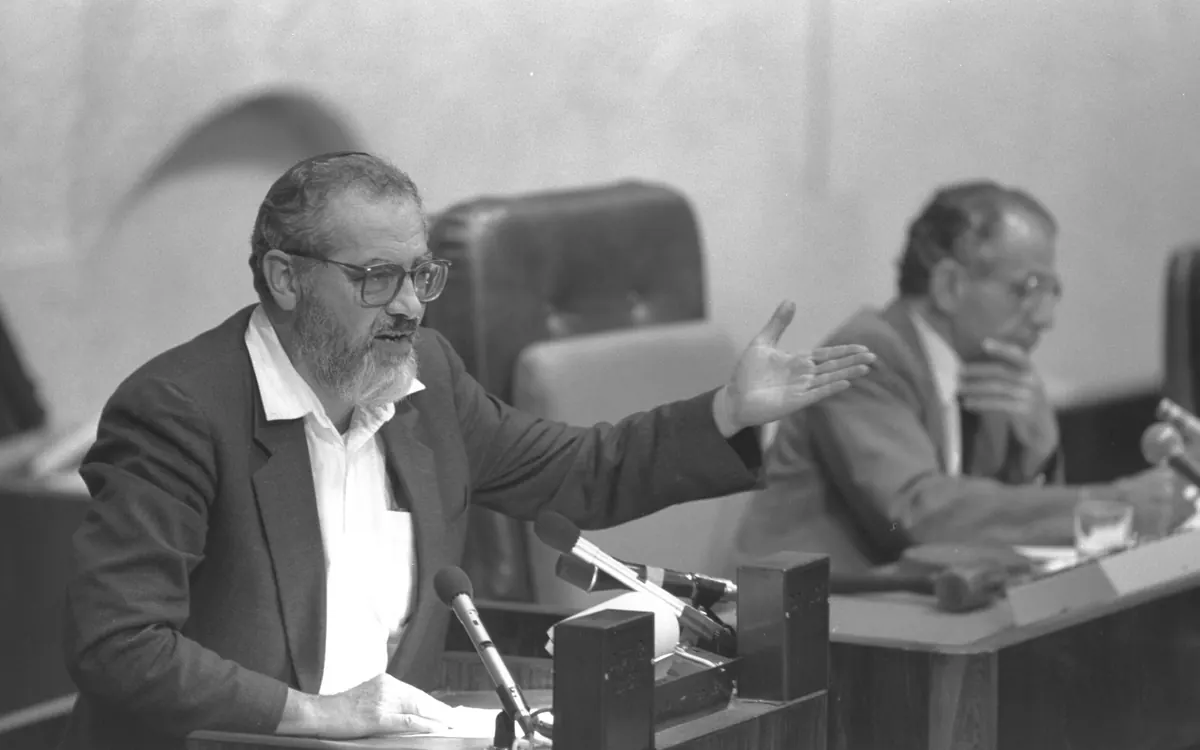
American Jewry in the Eighties were as safe and comfortable as a Jewish community had ever been - and yet the shadow of the Holocaust still loomed large over their identity. Here is an exploration of how the political power and personal charisma of Rabbi Meir Kahane intersected with this fear - and had explosive results.
About this episode
Bill Moyers on preferring a comfortable lie. Kahane published Uncomfortable Questions for Comfortable Jews in 1987 as a Knesset member for Kach, and Rav Mike comes to understand rather than praise or bury him, since questions that make us squirm deserve consideration. He labels the energy Kahane loosed as enthusiasm, the ardor that overcomes all boundaries for better or for worse, and roots it in pride, the hadar he absorbed from Jabotinsky and the spirit of Beitar. Kahane wrote that he felt no guilt, that he preferred winning wars to losing pogroms and living to dying, words that carry the shame and fear against which he fought, born in Brooklyn in 1932 and bar mitzvahed the year Auschwitz was liberated, with his slogan every Jew a twenty-two.
American Jewry in the eighties had never been less ashamed or afraid, yet the shadow of the Holocaust still loomed and fear was in the room. Much of that angst coalesced around Israel, which most still saw under existential threat, and around their children's survival against assimilation and intermarriage. Much of the investment in holding identity up went into remembering the Holocaust, in classes, community projects and liturgy, so dominant that public-school kids received it as a vicarious scarring and the core notion that six million died so you must marry a Jew. By 1981 the Holocaust had moved from whispers to an explosion of public discourse, with a half-dozen research centers, regular publications, and ninety-three college courses across America and Canada.
American Jewry split into three camps on the lesson. The survivalists, like Edward Alexander in The Resonance of Dust, read the Holocaust as a primordial energy of destructiveness not yet spent, demanding an alert militant Zionism, and this camp's extreme edge was Kahane's base. The radical left of the journal The Generation After read it as a message for all peoples, a world of holocausts where the chief lesson was unswerving universalism, never again to anyone. In the center stood Yitz Greenberg's Holocaust Resource Center and its magazine Shoah, holding universal and particular together with a focus on theology and education, its publication the widest in circulation and giving voice to the broadest swath of the conversation.
The American and Jewish stories of the Holocaust met on the National Mall, where the US Holocaust Museum was born, its cornerstone laid by Reagan and its two hundred million dollars raised privately, a sign that the Jewish story now mattered on the national scale. Yet not all were happy to build identity on horror. Jacob Neusner warned that American Jews had made the murder of Europe's Jews a principal component of their civil religion, risking a negative election and a shallow Holocaust-and-redemption theology built around an Israel they neither lived nor understood. Robert Alter feared the commercializing and academicizing of the Shoah, where a student could learn the final solution yet never meet the Haskalah or a page of Talmud.
Even Magneto, the most popular Marvel villain, was a Jewish boy whose powers awoke in the Holocaust, a credo of never again by any means necessary that many trace to Kahane. His own rise ran from five thousand votes in 1981 to a Knesset seat in 1984, where he was boycotted into an empty chamber yet drew crowds and American money, popular among young Mizrahi Jews. The Knesset amended the basic law to bar racist parties, and Kach was banned from the 1988 election. In November 1990 El Sayyid Nosair, dressed as an Orthodox Jew, rose and murdered Kahane mid-speech, and only after the 1993 World Trade Center bombing was Nosair convicted, so that the assassination opened a wave of terror that culminated in 9/11.
Key ideas
- Kahane rooted his enthusiasm in pride, the hadar of Jabotinsky, writing that he felt no guilt and preferred winning wars to losing pogroms.
- American Jewry in the eighties had never been less afraid, yet the shadow of the Holocaust kept fear in the room.
- Three camps formed on the Holocaust's lesson: the militant survivalists, the universalist left, and Greenberg's theological center.
- The US Holocaust Museum rose on the National Mall, a sign that the Jewish story now mattered on the national scale.
- Neusner warned that making the Holocaust a civil religion risked a negative election and a shallow redemption theology.
- Kach was banned from the 1988 vote, and Kahane's 1990 assassination opened a wave of terror that reached 9/11.
Chapters
- 0:00 Uncomfortable questions
- 2:19 Enthusiasm and pride
- 4:40 I feel no guilt
- 5:51 Brooklyn; every Jew a twenty-two
- 9:10 Comfort and the lingering fear
- 11:20 The Holocaust in public discourse
- 13:48 The survivalist camp
- 17:08 The universalist left
- 19:21 Greenberg in the center
- 20:26 The museum on the Mall
- 27:09 Neusner; a civil religion
- 29:17 Alter; horror in the curriculum
- 33:44 Magneto's never again
- 35:53 Kahane's political rise
- 39:13 Kach banned from the vote
- 44:34 Assassination and the road to 9/11
Who, where and when
People
Meir Kahane, Zev Jabotinsky, Edward Alexander, Yitz Greenberg, Jacob Neusner, Robert Alter, Ronald Reagan, El Sayyid Nosair
Places
Brooklyn, The National Mall, Givatayim, The Knesset
Texts
Uncomfortable Questions for Comfortable Jews, The Resonance of Dust, The War Against the Jews
When
1932 CE: Kahane born, 1983 CE: ground broken for the museum, 1984 CE: Kahane enters the Knesset, 1988 CE: Kach banned, 1990 CE: Kahane assassinated, 1993 CE: the World Trade Center bombing
Read the transcript
We seem, said journalist Bill Moyers, to prefer a comfortable lie to the uncomfortable truth. We punish those who point out reality and reward those who provide us with the comfort of illusion. Well, I'm not sure whether you're going to be looking to punish or reward when we're done. I'm Rav Malik Foyer, and this is The Jewish Story. Rabbi Meir Kahana published his book, Uncomfortable Questions for Comfortable Jews, in 1987, while a sitting member of the Knesset for his kach party. Now, before we get going, I just want to make one thing clear. I haven't come to praise Rav Ghanah, nor have I come to bury him, though he will be dead before we're through. I've come to try and understand. Because the discomfort caused by his questions deserves serious consideration, as does any question which really makes us squirm.
In my counseling practice, I'm always aiming to ask the questions which touch the deepest places, God willing, in service of healing. but sometimes the probe has to be sharp if it's going to go deep. And the energy that kind of loosed into the world is still making a lot of people squirm. So now more than ever, perhaps his questions need to be considered, whether you revere or revile the man and his ideas. That's a discussion which we'll perhaps have further in a coming conversation with a friend. Nonetheless, his assassination in 1990 in many ways represents the end of a phase in a number of elements in the American Jewish story I've been telling. Now, people are really quick to throw shade today.
Love to call others ethno-nationalists, religious zealots, racist, settler, colonialists. Oh, it's, by the way, not just good cathartic fun. It's also a way to seize power in a discourse and exclude the consideration of uncomfortable ideas. But of course, that type of name-calling often obscures just as much as it reveals. Think of the difference between throwing shade and shedding light on something. So since I'm looking to shed light, and certainly not to master, I will say that the broad definition for the energy loose by Rav Kahana into the world, I'll label as enthusiasm. Now, I mean that in its historical religious sense, and one which isn't always positive. Messianic enthusiasts of Jewish, Christian, and Muslim varieties have cropped up all along the way in the Jewish story, along with their secularized versions, so to speak, communists, socialists, Zionists, and Nazis.
An enthusiast is anyone who becomes so ardently attached to a cause that they are willing, basically, to do whatever it takes. it carries the connotation of someone so consumed by their belief, they're able to overcome all kinds of boundaries. Whether those are social constraints, structures of false consciousness, even the physical demands at which most of us balk. Self-experience miraculous is not just a myth. Let's just say that the human being is capable of far more than most of us will ever dream of doing. And enthusiasm can be an intoxicating mode which pops a person or a people into the higher gear which really makes change, for better or for worse. If I were to put a simple psychological base to my understanding of how Kahana, even well after his public shaming and murder, was able to ignite so much enthusiasm with his ideas, I would say that that base is the question of pride.
Now, you have to know a little bit of background. God had absorbed the essence of Jabotinsky's teaching from his own father, and perhaps the most essential of those teachings, known as the spirit of Beitar, was Hadar. Hadar has no easy translation from Hebrew. It encompasses aspects of respect, pride, and for Jabotinsky in particular, also represented an upright loyalty to the mission, and really the loftiest of values toward which were meant. to strive. Now, pride is a tricky inner dynamic, if there ever was one. I mean, witness the upwelling of militant gay pride through the parade movement of the last couple of decades. Now, Rav Kahana writes in his Uncomfortable Questions, to be a minority is to be the immutable victim of the fears, complexes, insecurities, and guilt.
It is impossible to escape this. It comes along with the least. No man, he says, can live believing he is as bad and obnoxious and terrible as his enemies say. From this terrible secret belief that perhaps his basic faith and very being are indeed rooted in evil comes forth the kind of self-hate which is awesome to behold, so compelling, so agonizing, so awful for these affected by it that they yearn to destroy the roots of that which causes the evil. And he says, in this case, it's the Judaism and the Jewishness that bring them such pain. Now, I'm not about to wade into the notion of the self-hating Jew right now, nor how it's been weaponized by certain elements of our own people as an ideal tool for fending off real critique of both Judaism and Israel.
But I do want you to just hear what he's saying. Kahana was born in Brooklyn in 1932, bar mitzvahed in the same year that Auschwitz was liberated, and 35 years old when the Six-Day War finally allowed the Jews of America to stand upright for the first time since that horror. His initial leadership roles were rooted in his willingness to stand up for himself and his fellow Jews on the streets of Brooklyn, using violence without shame to protect, hence his slogan, Every Jew a 22. Now, I'm willing to bet that amongst the Jews listening, very few remember a Jewish life before 1967, much less before 1945. It was a different world, in which old models of pride had run out from many Jews, and the ability to look oneself in the face as a Jew was by no means a given.
And for a small set of enthusiasts, Rav Kahana's charismatic mix of absolutist Torah and personal activism and his complete lack of shame was like water on dry land. He writes there in Uncomfortable Questions, I feel no guilt. He goes on to say not about the fact that he's a Jew, nor about the foundational idea of Jewish chosenness. And of course, he feels no guilt about giving exclusivity to the land of Israel and the denial, therefore, of Arab rights there. And even his willingness to, quote, use every possible means to ensure that they will never again murder Jews and threaten the existence of my state. And then he strikes a note which needs to be understood in the post-Holocaust psyche on the streets of Brooklyn and in the Knesset where he would be elected.
I feel no guilt over the fact that I prefer winning wars to losing pogroms, that I choose living over dying. It is infinitely more satisfying to win. Having lost, we've been losers for so many centuries. Too many Jews have difficulty dealing with winning. I have no such problem. It is infinitely more satisfying to be a winner than a loser. It is exceedingly more pleasant to live than to die. There is little, if any, positive value in the Holocaust or the pogroms. Now, if those aren't uncomfortable words, I don't know what are. And if you can hear the mix of shame and fear against which he's fighting, then you're listening well. Remember, you have to listen close if you want to understand. You don't have to agree.
Now, uncomfortable questions for uncomfortable Jews hit the bookshelves at a time when the American Jews were arguably the least ashamed or afraid in the history of exile. And truth be told, Kahane's impact was far greater in Israel than it was in Brooklyn. Nonetheless, despite the unprecedented social acceptance, wealth, and even political power of American Jewry, in 1987 the shadow of the Holocaust still loomed large for many, which means that one way or another, fear was in the room, as well as shame. And that means that Rav Kahana's ideas were present as well, whether people wanted to see them or not. After all, he was the one who brought to popularity that slogan of never again. And whether you take the universalist side of never again, meaning never again to anyone, or the more particular stance of you'll never do that to us again, it bespeaks something that you're afraid of.
One way to describe American Jewry in the 80s is things have never been better, and yet the fear lives on. I mean, fear and trauma are part of life, and the Jews have inherited more than their fair share of them from history. But when I say fear, I don't mean that the Jews felt threatened in the United States. On the contrary, the Anti-Defamation League, the ADL's annual anti-Semitism audit, showed 974 incidents of anti-Semitic vandalism in 1981. That was nearly triple what it was in 1980. But everyone understood this as a reflection of improved reporting. And, furthermore, it was a measure of vandalism, not personal violence. While a hardcore of haters was known to be out there in America, the vast majority of American Jews had never felt threatened in their personal or even seriously emotional life.
Nonetheless, the nature of trauma, be it historical or individual, is that fear doesn't just dissipate. It has to go somewhere. In the 80s, much of American Jewry's angst was actually coalesced around Israel. And with all my talk about splintering consensus and the new willingness to criticize, still, most American Jews saw Israel under existential threat even after Lebanon. They feared for the safety of the state. And that sense of fear, along with the ways in which the birth of the state was bound up with the immediate digestion of the horror of the Holocaust, meaning, well, at least we have Israel now, lent itself to a fear-tinged, survivalist stance. That stance was strong enough to carry the baby boomers through their radical adolescence as hawks on Israel while being doves on the war.
And the sense that survival of Israel isn't assured will persist well through the 80s. It will be the Oslo Accords that finally rips the lid off the discourse in America, or at least rips it back off, exposing the fault lines, which had always been there, between universalist humanists, religious nationalists, and everyone in between. But for now, in the 80s, a big chunk of American Jewry, especially its leadership generation, still fears for Israel's existence. And though they don't fear for their own physical safety, American Jews in the 80s, or at least that activist core, are also quite concerned about their children's survival. Assimilation, intermarriage, dropping rates of engagement and education, to many Americans, Jewish identity seems to be crumbling around them.
For better or worse, much of the investment in holding that identity up outside of the Orthodox world goes into remembering the Holocaust at this point. It will take many forms. Classes, community projects, liturgical innovations in the prayer book and the Passover Haggadah It so dominated the formal after Hebrew school education that public school kids like myself got that many still see the sum total of what they received as a bit of vicarious scarring and the core notion that six million Jews died, so you have to marry one. At the moment, I'm actually not so interested in the education. I'm more concerned about the public discourse. By 1981, the Holocaust had gone from something which Jews maybe spoke about in whispers to an internal conversation trying to cope with the presence of survivors among us to an explosion of public discourse.
There were a half dozen Holocaust research centers around the country by 1981, at least three regular publications devoted to Holocaust concerns, academic, political, and even public relations. A survey that year showed 93 courses on the Holocaust being offered in American and Canadian colleges and universities. Temple University had actually just launched the first full-fledged graduate program in Holocaust studies within its school of religion, which is quite telling, and not just because the theological implications of the Holocaust may or may not be weighty. In nearly half those institutions, the course in question was the only one at all given on Jewish religion, history, or culture. Within and beyond the Jewish community, people are talking about the Holocaust.
And that's not surprising, because as the power which defeated the Nazis, America also has its own Holocaust story to tell. We'll get to that perhaps in a moment. But for now, Jews being who we are, American Jewry had split essentially into three camps around how to frame the Holocaust memory, and thus the discourse around its present significance. The dividing lines go deep into questions of identity, theology, and present politics, and they should be fairly familiar to anyone who knows the history of American Jewry, or even just a bit of the Jewish soul. There is the survivalist camp, those for whom the Holocaust may have been incomprehensible in its particular horror, but was by no means unique in Jewish history.
And therefore, the lesson of the Holocaust is quite clear. Never again is a call to arms, or at least vigilance, against the ever-present threat of the next annihilation awaiting the Jews in the wings of history. Now, some within that camp will take a political tack. Excited by the advent of Begin's leadership and his perceived harder nationalist stance within Israel, they'll populate right-wing American political groups like Americans for a Safe Israel. The more extreme edge of this particularist camp will be Mayor Kahane's base of support amongst American Jewry, those who see the danger as near and immediate and therefore feel a moral call to prevent it by any means necessary. For many, this particular stance announced to the old Jewish assumption that if you scratch a goy, you'll find an anti-Semite.
That really, they all hate us. And so, of course, they're all out to get us in the end. Now, how that affects a person's behavior, I leave to your imagination. Or, perhaps, to your memory. There are, of course, deeper articulations of this hard survivalist stance. Like the one you can find in essayist and professor Edward Alexander's book, The Resonance of Dust, Essays on Holocaust Literature and Jewish Fate, published in 1979. The book is an engagement of the fiction, poetry, and diaries that came out of the Holocaust. But while the texts themselves receive an impressive exposition, ultimately Alexander's aim is the present, not the past. Any lesson of the Holocaust found its meaning in its immediate implications.
As he writes, the Holocaust let loose against the Jews a primordial energy of destructiveness that has by no means spent itself. The more I read of the novels, poems, memoirs, and diaries discussed in the essays that comprise this book, the more I felt I was reading, not of a past finished and dead, but of one continuous, though of course not identical, with the total form of our present life. now Alexander does explore some of the more diverse theological responses to the Shoah nevertheless the real message in his eyes is clear the Holocaust demonstrates that the world wants to destroy the Jews and the only reasonable response is an alert militant Zionism or as Rav Kahane said in the uncomfortable questions for comfortable Jews that he preferred quote a powerful and proud Jewish state that is hated by the entire world than an Auschwitz which is loved by one and all.
On the other end of the spectrum, from this militant particular stance, resided a universalism that was no less vehement. The radical left's perspective on the Holocaust was that it's a message applied to all peoples at all times. Holocausts have happened to many people and groups and are still happening, or at least threatening to unfold. In 1981, this stance and the call for an American Jewish identity that can be built upon it was articulated by a small quarterly publication called The Generation After. The journal declared under its title to be, quote, committed to the lessons of the Holocaust, and its editors pledged allegiance to their commitment to, quote, progressive Judaism, radical feminism, the anti-nuclear movement, and the third world.
When they looked back, they saw, as I said, a world of holocausts that had happened to far more than the Jews. In fact, any group that had stood in the way of what were they called the socioeconomic interests of capitalism had been subjected to systematic conquest and genocide. The recent particular experience of the Jews of Europe only made the horror easier for the modern mind to grasp. Hence, one writer claimed that the Gatling gun, early rotary cannon invented in 1861, had actually been created for the wholesale slaughter of the Plains Indians, and thus was the equivalent of the Nazi Zyklon B gas. In a world conceived as a continuing proliferation of holocausts, the chief lesson of Jewish suffering during World War II was unswerving universalism, never again to anyone, anywhere.
And God help you if you disagree. The present fear of this radical left was the new fascism they saw rising in America. The Jews, of course, were also threatened by that rising tide, but not particularly so. Pun intended, of course. This left pole of the spectrum was honestly just as unrepresentative of American Jewry in the early 80s as the JDL's right-hand pole. But it actually had far deeper roots in American Jewish culture, and thus will flourish far more in coming decades. Keep your eye out if you're unaware. Between those poles was, as always, the center. And in this case, it was represented by Rav Irving Gitz Greenberg's Holocaust Resource Center and its magazine Shoah. You can go back to my interview with Rav Yitz from Season 4 if you want a more extensive exploration of his stance.
But in simple terms of the topography of how American Jewry was recalling and responding to the Holocaust, he's in the middle, leaning toward theology. The members of the Holocaust Resource Center strove to strike a balanced outlook, in general, incorporating elements of universalist and particulist perspectives in their worldview. And their focus, as I said, was on theology and education rather than politics. Though in practice, they recognized that one of the lessons of the Holocaust was actually, you can't really separate them. They championed Israeli strength, and actively defended Jewish claims of persecution around the world, while at the same time calling for a politics of conscience that stood against genocide and the violation of human rights wherever they occurred.
In the early 80s, their publication, Shoah, had the widest circulation, and their resource center was the best funded. They were giving voice to the broadest swath of American Jewish conversation about how to digest the Holocaust. Now, the polls to the left and right may have mocked Rev Yitz for his establishment politics, But the attempt to hold some union between the universal in particular requires a connection to the mainstream. And so, like I said, the Jews are divided on the lesson of the Holocaust. Surprise, surprise. And, as I mentioned, the American Jewish struggle to digest the indigestible was further complicated by the fact that there was both an American and a Jewish story of how that horror is to be recalled.
By the end of the 80s, that resulted in an unprecedented elevation of the Jewish story onto the national stage. Back in November of 1978, President Jimmy Carter had formed a commission on the Holocaust, chaired by author, Holocaust survivor, and Shoah Circle member Elie Wiesel. A couple years later, Congress voted unanimously to form the U.S. Holocaust Memorial Council with a mandate to create, quote, a living memorial to the six million Jews and millions of other victims who perished. Almost two acres of land adjacent to the National Mall in Washington, D.C. were designated, and so the U.S. Holocaust Museum was born. Groundbreaking took place in 1985, and two milk cartons of soil and ashes from a number of concentration camps and killing sites were buried in the foundation.
Three years later, President Ronald Reagan laid the building's cornerstone. As human beings, as Americans, and in the case of many here today, as Jews, to keep the memory of the six million fresh and enduring. We must make sure their deaths have posthumous meaning. We must make sure that from now until the end of days, all humankind stares this evil in the face. That all humankind knows what this evil looks like and how it came to be. And when we truly know it for what it was, then and only then can we be sure that it will never come again. The entire cost of the construction, nearly $200 million, was paid for by private donations. And what could be a greater symbol of American Jewry's status in the 80s than a Holocaust museum on the National Mall?
We hadn't just arrived. Our story mattered on the national scale. The decision to place the museum in the context of America's national monuments was unprecedented. On one hand, no other minority group had a place there. On the other, it's a testimony to how America saw its own story in the 80s, vanquishers of evil, protectors of the weak. I can't help at this point mentioning that there is no national monument to slavery there. Now obviously, America's defeat of the Nazi is a far easier chapter of her story to tell than slavery, but still, that needs to be considered. And I'll say that the Jewish story of the Holocaust receives its own particular framing in order to make it fit there on the mall. I leave it to you to visit and decide how.
For now, I'll just mention that with all the energy and public effort going into remembering and understanding the Shoah, not all American Jews are so happy about building American Jewish identity on the memory of horror. personally i've done quite a bit of work trying to sort out my inner holocaust story how it informs my identity frames my decisions and sometimes warps the very fabric of my thinking and emotions this is no simple process and i really only mention it here to say that someone listening might benefit from a bit of simple reflection on how the holocaust was introduced to you and the impact it has had on all the aspects of your life. If you want to have a deeper conversation feel free to be in touch It a ripe question for spiritual counseling Also educators in particular I know any number of people who are scarred by their Holocaust education and not in a way which promotes a healthy living.
So be in touch if you want to discuss. For now, in the 80s, many Jewish communities across America had the practice of pairing a bar or bat mitzvah with one of the 1.5 million children murdered by the Nazis. Now that may sound like a powerful, beautiful idea. I mean, you're empowering a young person to bring to fruition another life, one which was cut short. You're introducing potentially a grateful perspective on the blessings of what it is to be born in a land which is both safe and free. But in practice, I wonder how many people could really handle it. I mean, first of all, most 13-year-olds lack the raw materials for that pairing to inspire a deeper and more meaningful Jewish life in the 80s. I mean, for the Jews engaging this new custom, the Bar Mitzvah was far more likely to be the end of their Jewish education than the inflection point that it's really meant to be.
And much of what they'd gotten up till now was about the Holocaust itself. Furthermore, it's a rare 13-year-old who's equipped emotionally and mentally to hold the contrast between their comfortable suburban existence and death in Auschwitz that's either meaningless or completely insane. So not surprisingly, as the attempt to grapple with the past became more comprehensive, a conversation sprung up around the role Holocaust memory was coming to play in educational and institutional life, in theology and in politics amongst a subset of American Jewish leaders. Now much of that conversation took place in the pages of Jewish journals like the Reconstructionists, Shema, Midstream, National Jewish Monthly, raise your hand if you've ever read any of them.
But, you know, Jews are always news, especially in America. So publications like the National Review, Newsweek, and the New York Times got involved. You know, in 1979, NBC broadcasts The Holocaust, a four-part made-for-TV miniseries, which followed the stories of a fictional Jewish family and an SS officer through the years 1935 to 1945. Holocaust, Gerald Green's best-selling novel, an epic drama, a story of terror and murder, of love and triumph. The series got generally positive reviews. It even won a few rewards. And it was seen as having had an enormous impact on bringing discussion of Holocaust into the general public sphere. But, of course, not everyone was enamored of the idea of a made-for-TV movie about Auschwitz.
Elie Wiesel wrote in the New York Times that it was, quote, untrue, offensive, cheap. As a TV production, the film is an insult to those who perished. and to those who survived. But right now, I'm interested in identity, not in theatrics. Jacob Neusner was a conservative rabbi, academic, and really a foundational scholar within American Judaism. He labeled this series as the Jewish equivalent of what the series Roots had been for black Americans. If you're not familiar, Roots was Alex Haley's 1976 novel that presented the black American story from Kunta Kinte, an 18th century African kidnapped into slavery and transported to North America, all the way down through history to his own life. Tonight, we present a landmark in television entertainment.
Roots, the true story Alex Haley uncovered in his 12-year search across the seven generations of his ancestry. Roots, starring Ben Vereen, Edward Asner, Lorne Green, Cicely Tyson, and introducing LeVar Burton as Kunta Kinte. In an article in National Review, Neusner called both shows, Holocaust and Roots, which was broadcast just a year before Holocaust, quote, a way of feeling ethnic distinctiveness, of rescuing out of a heritage of unspeakable suffering a kind of perverse collective pride. Note that notion, seeking pride in order to be able to live with your history. A year later, Neusner sharpened the implicit critique he gave there about building genocide into the base of Jewish, or for that matter, black identity.
And he wrote in The Reconstructionist, What we have done is to make the murder of the Jews of Europe into one of the principal components of the civil religion of American Jews. It was something that he was deeply disturbed by. You know, as academic courses, communal rituals, and after-school education programs became increasingly to center on the Holocaust, another voice chimed in, biblical scholar Robert Alter, who worried about it aloud in a 1981 article in the magazine Commentary. The new wave of interest in the Holocaust, he said, might be the epidemic excess of the necessity, and some of what is being done, at least in part, may help achieve in sort the painful knowledge of the past with which we cannot dispense.
Nonetheless, I would suggest that serious distortions of the Holocaust itself and, what is worse, of Jewish life occur when the Holocaust is commercialized, politicized, theologized, or academicized, which I think is a word. Now, one distortion that bothered Alter in particular as an academic was how study could naturalize horror and evil by making it part of the curriculum. As he quotes one historian in that article who observes, I can testify myself to the ease with which you can describe murder, and then turn it into a seminar paper. That's got to do something awful to our identity as human beings, much less as Jews. Alter also expressed his fear about radical over-focus. He noted that while some specialists proclaimed their conviction that it's important to study how the Jews lived, as well as how they died, that's not where the money was going.
and in academia, as well as in communal education, education follows funding. He pointed out that amongst those college and universities which were giving courses, there were 40 or more where, quote, a student may be instructed in the various phases of the final solution, but has nowhere to turn in the curriculum to find out what the Haskalah was, how a page of Talmud reads, or who Rabbi Yehud HaNasi might have been. Now that's bad enough for a non-Jewish student looking to encounter the richness of what Judaism has to offer. But what about a Jew trying to understand and flesh out their own identity? Jacob Neusner's comment about making the murder of the Jews of Europe into one of the principal components of American Jewish life was not just a soundbite.
It was an expression of a sense of mission, which was coming from one of America's most prolific scholars. From Neusner, the Holocaust could only have religious meaning if it became part of the larger covenantal experience of the Jews, as he called it. Not as a unique event that threatened to become a religion in and of itself. He pointed out that the more religious the Jewish community was, in fact, the less likely the Holocaust was to play a central role in their identity. He saw American Jews basically as having a one-two punch. They emptied the covenant of its classical meaning, meaning their thoughts and deeds were no longer shaped by it, and they were now struggling to replace it with genocide.
There were two dangers that he saw this posing to a healthy Jewish identity. One was what he called the problem of negative election. Jews may no longer be theologically enamored of the idea of being chosen, but they become unquestionably exceptional in having been marked by history with a unique horror like the Holocaust. The other danger he saw was the temptation of a superficial Holocaust and redemption theology built around the state of Israel, meaning this horror happened and out of it rose the state, where American Jews neither lived the reality or even really understood what it was like to be in Israel on the ground level. In his work, The War Against the Jews, Newsner writes, we became Jewish because of the Holocaust.
We act out our Jewishness by way of redemption, that is, by commitment to the state of Israel, that place which gives meaning and significance to our remission from the terror. See how he understands that fear underlies it all. The covenantal model that had sustained our history, that allowed us to assimilate historic suffering from Egypt through Spain to the present, was one which always had a redemptive component, even if that component were a noble martyr's death. But to the American Jews being inundated by Holocaust education, the European dead, says Newsner, were for the most part victims, not martyrs, trapped in a vast technology of mass murder with no sense of purpose, very often with no sense of being Jews altogether.
This is not the time or place to explore Newsner's vision of what a more life-giving American Jewish identity might be, one which didn't place genocide as its foundation, but it's a question which needs to be considered, as is the question of how this identity that indeed fuses genocide at its base, whether it's from a particularist or universalist perspective, has played out since the 80s in America. But right now, I've got a story to tell, and I want to get back into the flow, because as much as scholars worried about over-focus, and rabbis in America longed for an identity that American Jews could build beyond the Holocaust, the long arm of its fearful memory was not so easy to evade. Did you know that the most popular Marvel comic villain of all time, no question, was Magneto?
Now today, if I say Marvel Comics, most of everyone thinks of blockbuster movies, but when I was growing up as a Jew in the 80s, that term meant comic books, and it conjured up for me an image of hiding under the covers with a flashlight rather than sitting in a darkened theater. For many kids of my generation, comic books were our formative introduction to the ideas of good and evil, and to the notion that the definitive qualities within a person emerge when we're engaged in the titanic struggle between them. And Magneto's story was powerful because it was never simple. Now we're deep in the age of origin stories, and everybody knows where these characters come from. We know that Magneto began as a Jewish boy in the 30s in Germany, and that his powers were awakened by his torture in the horrors of the Holocaust.
But even back then, in the 80s, when we didn't quite realize that was going on, with all those Jewish illustrators working for Marvel, any X-Men reader did know his credo. He would prevent mutants from suffering by any means necessary. never again would mankind make them suffer simply for who they were sound familiar? it ought to because there are many who see Mayor Kahana as the formative personality in the shaping of Magneto's character someone who stood on the wrong side of the law but perhaps on the right side of historical justice someone for whom the horrors of the past served as justification for violence in the present and someone for whom the pursuit of power itself became intoxicating, and hence was bound to end poorly.
Rav Akhada's first attempt at political power ended poorly also, when he ran for Knesset in 1981 and received just over 5,000 votes. But his message of unashamed Jewish power, of a purity of commitment to the Jewish people and Torah, and his ability to tap the veins of fear and anger which a wounded people always carry, had a future. So much so that in 1984, when his electoral prospects looked significantly brighter, the Israeli Central Elections Committee attempted to bar Kahane from the race on the grounds that his Kach party was a racist faction In the end the Supreme Court of Israel struck down that ban on the grounds that the Electoral Committee lacked the authority to exclude a party on any grounds much less on racist ones The court did, however, in a very telling move, suggest to the Knesset that they pass a law which could exclude racist parties from future elections, and thus set up what needed to be done in their eyes.
Well, Koch managed to secure almost 26,000 votes in that 1984 election, giving them one seat in Knesset, which Mayor Kahana promptly filled. Meanwhile, the Knesset followed up just as quickly on the court's idea, and in 1985 managed to vote on an amendment to the basic law, Knesset. It reads as following. It's called the Prevention of Participation of Candidates List. It says, A candidate's list shall not participate in elections to the Knesset if its objects or actions, expressly or by implication, include one of the following. One, negation of the existence of the state of Israel as the state of the Jewish people. Two, negation of the democratic character of the state. Three, incitement to racism.
Now there's a whole discussion contained within those few words. For now, I'll suffice with two observations. One is that nowhere does the law define what racism is. And that means that if the powers that be decide to ban you as a racist, they require no standard of proof other than their own opinion or their discomfort with your words. Remember, this is 1985, well before the racist label became the trump card it now plays in American social and political discourse. The other observation I'll make is that the Knesset contains, even today, several members and at least one party that explicitly deny, quote, the existence of the state of Israel as the state of the Jewish people. And all efforts to have them banned have been consistently shut down.
But back to our story, because it's about to come to an uncomfortable and violent end. When Kana was sworn in to the 11th Knesset, he was called up to the podium, like all other members, and asked to recite the standard pledge committing him to public service. He took the oath, but then loudly added a verse from Psalm 119, So shall I keep thy law continually, forever and ever. He wanted to make it clear to all assembled that it was God's law, not the states that he intended to obey. The Knesset refused to accept this addition, especially when Kahn had made it clear in his reply to the Supreme Court query that indeed he intended to suggest that the laws of the Torah superseded those of the state. In the end, in order to take his seat and do the job he'd come to do, Rav Kahane was forced to take the standard oath of office.
But that simply opened the door to even further uncomfortable moments. Kahn proved an energetic and prolific legislator, proposing laws focused on Jewish education, on an open economy, and on certain points of Jewish law, which his fellow legislators found highly uncomfortable, to say the least, like forcible transfer of the Arab population out of the land of Israel, revocation of Israeli citizenship from many non-Jews, the banning of Jewish and non-Jewish marriage, and even sexual relations. Now, one thing is true. Rav Kahana knew his Torah, and he was fond of waiting the Rambam's works in particular as support for such radical and harsh ideas. But you know what? Few people ever saw him do it. The rabbi was boycotted across both aisles of the Knesset, and he would often end up speaking in front of an empty chamber.
The Israel Broadcasting Authority similarly placed an unofficial ban on any coverage of his activities. But boy, was he popular in the street. and that made him politically significant even if his peers attempted to ignore him for now. Kahane's political cess was built on his passion, on his understanding of those traumatized elements in the psychology of his listeners and on a fantastic ability to raise money in the States. After his election in 84, he began to bring in an estimated half million dollars a year from American supporters. I mean, everyone loves a winner, as he was fond of saying. These included small donations from those Brooklyn Jews he'd been protecting in the 60s, and much larger ones from wealthy businessmen like Ruben Mattis, founder of Haagen-Dazs Ice Cream.
If they, meaning the JBL, needed money, I gave it, Mattis said in 1985. In 1987, Khan opened a yeshiva, it was called Harayon HaYuudi, the Jewish Idea, with funding from the U.S. supporters. His goal was to teach what he called the authentic Jewish ideal. And, despite the political boycott, his popularity grew amongst the Israeli public, especially among young Mizrahi Jews who respected both his outsider role and his hard-line stance toward the Arabs. Rabbi Avram Hecht, a leader of New York's Syrian Jewish community in the 80s, enthusiastically endorsed Kahana. We are very much impressed with his integrity, and we believe his program is a Torah program which has every chance of succeeding in Israel.
While some of his preachments sound to be very radical, they are not contrary to what an Orthodox Jew should believe. A 1987 poll published in the Israeli magazine Monotin revealed that 21% of the Israeli public approved of Kahane's political views, and amongst youth between the ages of 15 to 18, it rose to 33. As the first intifada launched at the end of 1987 and violence began to grow, a story that we'll tell next season, Koch's message of power and fear gained even greater traction. Polls showed the party would receive anywhere from 4 to 12 seats in the coming November 1988 elections, making it a political force which no one could ignore. But as I said, the groundwork had already been laid to head that off.
And Koch's party was indeed banned from participating in that 1988 vote as a racist faction. This was way more than simply a political move. For many of his opponents, personal and political, Meir Kahane wasn't working to prevent another Holocaust. He was the new Nazi. We all know what you do to Nazis, right? In the introduction to Uncomfortable Questions for Comfortable Jews, Kahane describes his experience of hatred he received, in specific at one rally for Kach in Givatayim, an Israeli town. He talks about how leftist youth groups were called out en masse, bust in from surrounding Kibbutzim and Moshevim. The crowd of counter-protesters was so violent that eventually they mobbed his car, attacking until someone sent a huge stone through his windshield.
Only the intervention of the border police prevented Jews from spilling Jewish blood. Unless you think that this was a source of shame and regret for his opponents, the very next day, an editorial in Al Hamishmar, the newspaper of the far-left Mapam party, praised the return of what they called a violently militant left, declaring, to the holy canon that sank the Altalena was now added the holy stone, the stone that smashed the windshield of Kahanezakar. If you don't remember the story, you can go back to Season 2, Episode 40, to hear about the Altalena, how left-wing Jews murdered right-wing Jews in the name of the stability of the state, and how Ben-Gurit himself later said that the gunner who fired on the Altalena should be blessed, and that his canon, quote, should be positioned next to the Holy Temple.
That's what Al-Hamishmar was speaking about. But for now, the violence which ends our story might be called a foregone conclusion. You know, on daybreak, April 1st, 1987, not long after that window-smashing incident, a dozen FBI agents raided the New Jersey house of Murray Young, 60-year-old member of the Jewish Defense League. They seized 17 firearms, including rifles and Uzi submachine guns, stun guns, as well as JBL bank records, membership lists, and detailed notes about the bombings which they had both committed and had planned. JBL, by this point, had moved on from the role of Brooklyn street toughs. Through the 70s and 80s, they'd done everything from pouring blood over the head of a Soviet diplomat to planting a smoke bomb in a Carnegie Hall performance of a Soviet orchestra in their struggle to free Soviet Jewry.
In 1981, 20 members of the JBL took over the Atlanta offices of the ACLU to protest its representation of neo-Nazis in court, and later that year, eight of them attacked National Socialist Party of America leader Harold Covington with steel pipes as he approached the NBC studios in New York for an interview. With each incident, they would claim responsibility by phoning in their official slogan, Never Again. The same day that Young's house was raided, Mayor Kahano was soliciting donations at the West Side Jewish Community Center on 34th Street in Manhattan. Now, Kahano wasn't implicated in the charges. Upon entering Knesset in 1984, he'd actually stepped down as head of the JDL. But he surely heard the footsteps coming.
I mean, after all, not much later, his party was banned from those 1988 elections. In November of 1990, this part of our story comes to a close. When Rav Kahn was again dressing an audience of Orthodox Jews in Brooklyn, this time telling them it was time to immigrate to Israel before it was too late. In the midst of his speech, El-Sayed Nasser, an Egyptian-born U.S. citizen, dressed as an Orthodox Jew, rose from the crowd and opened fire, murdering the rabbi even as he warned his fellow Jews to take care of their lives. There is much, much more to this story. And as I said, I'm going to have to leave a discussion of the power and problematics of Kahana's legacy for a coming episode. But I just want to end on a political note.
Nosera was arrested on the spot, of course, but the court acquitted him of murder, claiming that though he was there with the smoking gun, no one actually saw him pull the trigger. It did find him guilty of assault and possession of an illegal firearm. But it was only three years later that justice was served. That was in the wake of the trial of Omar Abdelrahman for the 1993 World Trade Center bombing. were at work. The explosion has killed four, that is the number at this hour, and it has injured more than 200. All day long, a steady stream of survivors emerged from two of the world's tallest buildings, but many, of course, are still trapped inside, and rescue crews say it may be hours before they are all evacuated.
Nosser was convicted, then, of involvement in a terrorist conspiracy and further assassination plots, including that of Rav Kahana. He was given a life sentence. And so in a sense, Kahana's assassination was the beginning of a wave of terror that culminated in 9-11. That's an event that transformed the lives of Americans altogether and the Jews particularly amongst them. And what could be a more uncomfortable thought than that? I just want to thank a few folks before I sign up. I want to thank all the folks who give their hard-earned money to make this show possible. We'll keep it free and widely available. I want to call on you to join them right now. Go to my website, jewishstory.co. You'll see a button in the upper right-hand corner.
You can click on that to get a little bit of per-podcast support. Or contact me at robmikefoyer at gmail.com. I'm happy to share with you the details of how you can dedicate a show or to make a one-time donation. I want to thank the Land of Israel Network. That's thelandofisrael.com for building a center for global transcendence in the heart of Judea. I want to thank the Pardes Institute, P-A-R-D-S dot org dot I-L, for throwing the doors of the Beit Midrash open as wide as possible. And I want to thank you for listening. I'm Rav Mike Foyer, and this is The Jewish Story.
More from Season 5
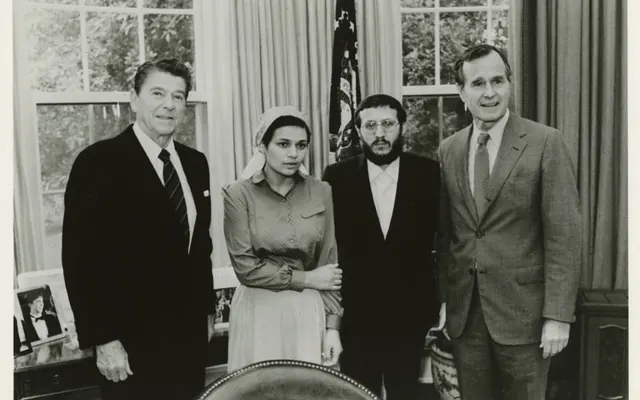
TJS S5E22 Soviet Jewry - the end game
Here is the third and culminating episode in a story that we have been following since season four. The Eighties saw a welding together of American Cold War...
Play Episode
TJS S5E23 The Jonathan Pollard affair
The 1980s saw many seismic shifts in the fabric of American Jewish society, and among them was the earthquake of the Jonathan Pollard affair. The 1985 arrest of...
Play Episode
TJS S5 Interlude 80s conversation with Rav Yehuda HaKohen
Here is a talk with Rav Yehuda HaKohen of the Vision Movement, the first in couple of conversations which will close our exploration of American Jewish life in...
Play Episode