
TJS S6 Interlude - On violence
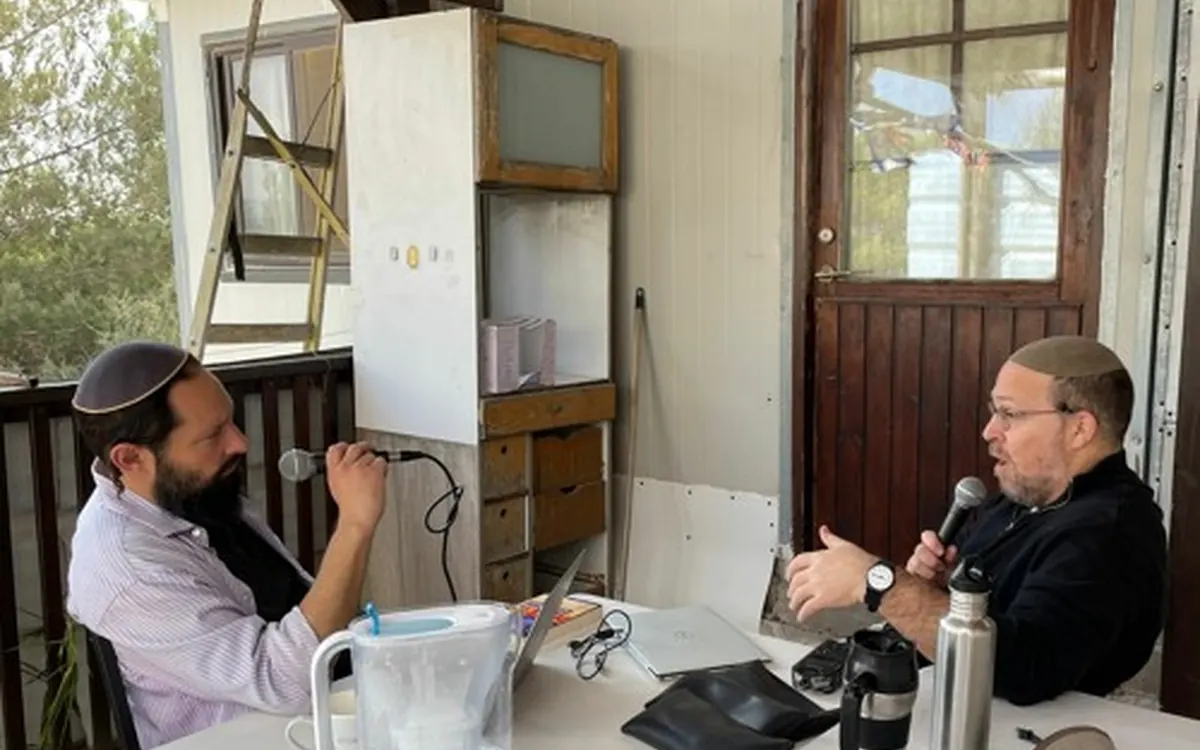
In this episode we take a break from tracking the evolution of Israel's separation wall to consider the deeper issues of violence on which it is built. Rav Yehuda Hakohen of the Vision Movement joins me for a conversation about Max Nordau, Zev Jabotinsky and Frantz Fanon. Along the way we consider issues of decolonization, settlement and the hope for a new Jewish consciousness that might soon emerge.
About this episode
When language fails, said Elie Wiesel, violence becomes a language. Rav Mike visits Rav Yehuda HaKohen, founder of the Vision Movement, on a hilltop above Beit El, and the topic is violence, not the Palestinians but the violence within Am Yisrael and the human story. He brings his own background with at-risk youth and therapeutic restraint. Rav Yehuda frames the bourgeois liberal reflex, the ideology of capitalism, which conditions us to believe the state should hold a monopoly on force, so that we sort violence into legitimate and illegitimate and often refuse to call the legitimate kind violence at all, preferring it clean and pretty rather than ugly and visceral.
Max Nordau called for a Jewry of muscles, the first since Bar Kochba, lamenting the mortification of our flesh in the narrow Jewish streets where our limbs forgot to move joyfully and our eyes developed a nervous blink. Rav Yehuda contextualizes Zionism as a Jewish liberation movement styled on flawed European nationalism, rising from a people layered in centuries of colonization. The physical atrophy was real. After the Bar Kochba revolt the sages downplayed force, and exile taught us to relate to Gentile aggression like a hurricane or a tidal wave, something you flee or hide from, never something you make bleed.
Regaining the capacity to fight was regaining agency and even humanity, since we are not physically inferior to other human beings. But force is applied to someone, and the Arabs of the land resisted. Jabotinsky saw this first. His 1923 Iron Wall was unashamed of colonial language yet understood violence as an act of clarity, that if you will not fight for what matters then it is not truly yours. In 1938, amid the Arab revolt, he wrote that every enemy soldier is as innocent as you, that every war is accursed, and that if you do not wish to die then shoot and stop prattling, a condemnation of violence as much as a call to it.
International law, Rav Yehuda argues, is a stick the strong use to beat the weak, a pretense that the world is a village of shared values, when in truth the international stage is still governed by raw power, and Israel's mission is to carry humanity past that world rather than pretend we already live beyond it. Yet power must not be fetishized. Israeli society relates to its soldiers as sacred, the deep emotion of a Jewish army after two thousand years of powerlessness, something many of us want to keep clean, even as that same soldiering is bound up with daily violence and the Iron Fist Rabin is about to order.
Fanon called violence a cleansing force that frees the colonized from the inferiority complex, usually applied to the Palestinians yet also, Rav Yehuda says, to Am Yisrael, as in Begin's 1944 Declaration of Revolt, we fight therefore we are. The wall is structural violence, so institutionalized it becomes invisible and therefore palatable, preventing a man from reaching his own field. It was Chaim Ramon's political magnet, us here and them there, embraced once polls showed a center that wanted it, dividing Arab from Jew and Jew from the heart of the land. The deepest gesture toward reconciliation, Rav Yehuda says, would be tearing it down, paired with real sovereignty.
Key ideas
- Rav Yehuda frames the liberal reflex that the state holds a monopoly on force, so we call the clean kind of violence by another name.
- Nordau's muscular Judaism answered a real atrophy, the exile habit of meeting Gentile aggression like a hurricane you can only flee.
- Regaining the capacity to fight restored agency and humanity, though force is always applied to someone who resists.
- Jabotinsky's Iron Wall treated violence as an act of clarity, and his 1938 lines condemned war even as they told the Jews to shoot.
- The soldier is sacred to Israeli society, the emotion of a Jewish army after two thousand years, bound up nonetheless with daily violence.
- Fanon's cleansing violence applies to Am Yisrael too, and the wall is structural violence that divides Jew from Jew and from the land.
Chapters
- 0:00 When language fails
- 1:09 Violence within Am Yisrael
- 3:18 The monopoly on clean violence
- 5:30 Clean violence versus ugly
- 6:40 Nordau and muscular Judaism
- 8:53 Zionism from a colonized people
- 11:10 Aggression like a hurricane
- 13:26 Regaining agency through force
- 15:39 Jabotinsky's Iron Wall
- 16:43 Shoot and stop prattling
- 18:54 International law as a stick
- 22:12 The soldier as sacred
- 28:45 Fanon; violence as cleansing
- 29:48 We fight therefore we are
- 36:22 The wall as structural violence
- 43:01 Tearing down the wall
Who, where and when
People
Elie Wiesel, Rav Yehuda HaKohen, Max Nordau, Zev Jabotinsky, Frantz Fanon, Menachem Begin, Max Weber, Yitzhak Rabin, Chaim Ramon, Ariel Sharon
Places
Beit El, The land of Israel, The West Bank, Jenin, South Africa
Texts
The Iron Wall, The Wretched of the Earth, Begin's Declaration of Revolt, Nordau's writings on muscular Judaism
When
135 CE: the Bar Kochba revolt, 1923 CE: the Iron Wall, 1938 CE: the Arab revolt, 1944 CE: the Declaration of Revolt, 2003 CE: the wall becomes policy
Read the transcript
When language fails, said Elie Wiesel, violence itself becomes a language. I never had that feeling. Well, I'm not as noble as he. Sometimes I just want to pound my fists and howl. I'm Rav Mike Foyer, and this is The Jewish Story. Season 6, Interlude, on Violence, with Rav Yehuda Hakohen. So I'm sitting here with Rabbi Yudhach Kohn, founder of the Vision Movement, friend, and at the moment, actually, my host. I'm really excited that we're live here in a hilltop above Beit El in Yerushukkah, which I'm not judging the fact that it's still up, because looking around, it might actually stay this way the whole year round. We'll just call it a clubhouse, as my friend likes to say when it's not Sukkot. It's my clubhouse.
It is a clubhouse. Welcome. Thank you so much. Happy to have you here. It's great to be here. We were just having a very wide-ranging discussion, as anyone who knows you is probably not surprised. And I want to actually bring the folks listening a little bit in line with what we were speaking about. Our topic for today is violence. And I'll tell you, on one level, I'm interested in the topic because how it fits into the story I'm telling in the Jewish story, which we'll come to in a moment. But on a more visceral level, I feel a rising tide. I've been here in Israel for 20 years. came in the midst of, I like to call it the Oslo War, but people don't know what I'm speaking about, so we'll call it the Second Intifada.
We have seen many waves of violence. People have a tendency when we speak about violence to assume that I'm talking about the Palestinians. And that's exactly what I'm not interested in right now. I'm not interested in it, although it'll come up along the way because it's inevitable. What I want to talk about is the violence that exists within Am Yisrael as part of the human story and as part of the Jewish story. A little bit of background, full disclosure, I worked for a couple of years with at-risk youth in a wilderness therapy environment where violence was always just below the surface. And I'm sure sometimes above. Oh, and I was trained with what's called so nicely therapeutic crisis intervention, right?
Which is either neatly restraining a child with another counselor or hitting him at the waist so he hits the ground hard enough that the kid who's twice my size can't overcome me as I assert my authority within the group for the sake of everyone's safety. And I've done both more than once. Not to mention the fact that growing up, I was not, let's just say, the kindest, gentlest child in my high school. And I've had my fair share of fisticuffs. And I'm also aware that I have young kids from the ages of 8 to 19, one who's off to the army in a matter of weeks. I'm aware that violence has a very live role within our youth culture today. Now, we could have a theoretical discussion about whether it's any more or less.
I'm also not so concerned about that right now. The reality is that violence permeates our world. And people have very few ways of speaking about it, honestly. And so what I'd like to do in particular is delve into this question of what role has the violence played in the process of national re-embodiment? That we're in this phase right now of returning to our land. Zionism as a political movement, Hamish Israel as a people, etc. That's a general. You can give a quick response and then I'll throw some quotes at you. Yeah, no, one thing I want to address, this idea of people not being honest about violence and maybe asking why, why aren't we honest about violence? Because I think there's something there we need to talk about.
You know, there is, you know, what we can call bourgeois liberal ideology, which is essentially, you know, liberalism is the ideological paradigm of capitalism, of the capitalist system. And I think this ideological paradigm conditions us to believe that the state should have a monopoly on force. You know the quote by Max Weber, the definition of the nation state is a monopoly on the legitimate use of force to maintain order. That's the post-ideological state that upholds liberal capitalism. So I think that we're conditioned to think in terms of legitimate violence and illegitimate violence. And the legitimate violence, we don't even categorize as violence a lot of the time. We just think of it as maintaining law and order.
And it's very important to many of us that it be clean and pretty. It shouldn't look ugly and dirty. Right. And that's also sometimes counterproductive because I think it's sometimes the ugly violence that's a lot more productive than the clean violence. A recent example was the ugliness of the pictures of a police officer kneeling on George Floyd's neck. triggered an explosion that had been simmering for an awfully long time. And I think a lot of it was the visual in that. It was an ugly situation. Right. What I would point to is maybe the difference between, let's say, on the one hand, a bunch of ISIS guys killing 50 people at a wedding with knives versus an American drone strike on a wedding, killing 50 people, which is like a video game.
Yeah. So the latter is cleaner violence. It's a guy sitting somewhere in Virginia. It's way beyond arm's length. Right. And I think the psychological impact on humanity is more detrimental when we detach ourselves. I think it's the same thing with how we eat meat. There's a difference between who's we in that equation. I don't eat meat. Right. So you don't eat meat. I barely eat meat. generally we eat lamb and usually we see it slaughtered ourselves. That's precisely why I stepped out of the meat train, so to speak, 25 years ago. Right. So I think there's a difference between seeing the animal die, knowing it's for you to be able to eat, and then appreciating that when you eat it versus picking it off a shelf in a grocery store.
That meat comes wrapped in plastic. That's where it's from. I want to use that as the pivot to get to our... That's cleaner, though. That's the cleaner violence. No, for sure. And it lacks blood and it's not visceral. And I actually want to use that as the sort of pivot toward the first piece that I'd like to chew on with you, pun intended. You know, when we look back at the history of Zionism, there are many streams. And one of the streams that people are less familiar with are the origins of political Zionism, and effectively the role that Max Nordau played. People can go back to season two if they want me to, you want to find the story that I've told about him. But Nordau is, if he's known at all, is known amongst many people as the originator of this idea of muscular Judaism.
He had a sense that when I use the word of the national movement for national re-embodiment, he had a sense that it was literally important. So I want to give you a couple of quotes from him, because I think they speak directly to the role that physicality and then ultimately violence play to removing ourselves from exile. So he says, Zionism has awakened Jewry to new life morally through the national ideal, materially through physical rearing. We must think once again of creating a Jewry of muscles. for the first time since Bar Kochba there exists amongst the Jews an inclination to show themselves, to show the world how much vitality they still possess and if that's not enough he goes on and he talks about how for too long we've engaged in the mortification of our flesh I'm expecting myself and precisely he says it was others who practiced mortification on our flesh and it was the greatest success as evidenced by the hundreds of thousands of Jewish corpses in the ghettos, church squares, highways of medieval Europe he says in the narrowness of the Jewish streets our poor limbs forgot how to move joyfully.
In the dimness of our sunless homes, our eyes developed a nervous blink. You're probably familiar with much of the romantic literature and the romantic experience that flowed from this, right? Jews leaving Europe, shedding the stoop-shouldered, you know, sort of like hooked-nosed stereotype and wanting to be clean-limbed and strong in the sun. And you're also familiar enough with this, you know, that that itself from the very beginning was bound up with a violent struggle for soil and control of land? From the very beginning is a good question. Okay. I don't know. I don't want to hang up on that. Right. Fairly quickly became and has maintained so to the point where it was quickly glorified as the plow in one hand and the rifle in the other.
And we'll speak a little bit about the more formal aspects of that war as we go forward. But what I'm curious is how you respond to the idea of muscular Judaism and where you might see it today. So I think when we talk about figures like Nordau or Jabotinsky, who came after him. Who we'll get to in a moment. All right. We have to understand, and this is something I think a lot of people miscontextualize, that they were, remember, Zionism was a Jewish liberation movement that was really styling itself after European national movements, which means it was already flawed and a little bit, again, we had to develop to a point to get to a place where we have any kind of liberation trajectory that's healthy and really metim for our identity, appropriate for our identity.
Okay, fair. So a lot of what Zionism did was really start from us being a deeply colonized people, a deeply, I mean, layers and layers and layers of colonization. What Mordor called the mortification of our flesh. We were ground down to these poor limbs, forgot how to move joyfully. You know, our eyes developed, nervous blink. That's a physical manifestation of the colonization you're speaking about. Well, when I talk about colonization, I mean not just things of that nature. I'm talking about even our self-identification. I mean, even this is post-Haskalah. No question, but I want to focus on the physical here because our topic is violent. But it's worth understanding the dialectical relationship between Zionism and the Haskalah and how both are really expressions of what we've talked about before is like the tribe of Yosef.
And we can say that the Zionism could not have come without the Haskalah first, yet at the same time, Zionism is very much a rejection of how the Haskalah rebranded our identity as a religious one. Just for listeners, when you say Yosef, in a sense, it's the way a Jew succeeds in exile, just in a very general sense. And there's a counterpoint to that, which is how does the Jew actually become the Jew at home, the Judean, if it were. Right. I'm going to expand on that briefly because I think there's the tribe of Yosef in our identity. It's like a tribal force, like all the tribes of Israel are forces in our identity that I think are a much healthier way to look at our sociopolitical map than right, left, religious, secular.
Well, we're not going to talk about elections right now, but it was definitely a tribal breakdown. Right. Definitely. No, but we need to understand it properly. And I think without talking about elections, I think the frustrating phenomenon I see is people constantly trying to apply Western political framings to Israel's. I'm with you on that. So in terms of Nordau and Zionism in general at that point, there's an attempt to fix the Jew. Yes. And without yet having the tools to understand deeply enough what's wrong with the Jew. fair but do you think he was incorrect that the literal physical atrophy meaning going from the time of our sages who certainly after the Bar Kokhba revolt that he's referring to downplayed at best the role that violence and physical force played.
We could ask the question of whether they considered weapons as a decoration for a man which could carry him out on Shabbat or whether they were simply a burden and a tool which was best put aside and we see that theme and to a certain degree reaching its natural conclusion in what Noroday was identifying as a person who can't use force even when they're called to. Right. It's a curse of exile, like in Parshat B'chukotay. We're taught that one of the curses of exile is that we will be incapable of physical valor, of being able to defend ourselves the way any normal human being can defend himself We began to relate to Gentile aggression as no different from an earthquake or a tidal wave or a hurricane It a natural disaster It something we can run from, we can hide from, we cannot fight back.
You don't make the hurricane bleed. There's no such thing as fighting back. And it was really figures like Nordau and especially Jabotinsky who restored to us the notion that we can actually fight back. We are not physically inferior to these other people. But when you look at these... pause for a second yeah so first piece is that that force and the violence that comes from it is a step of regaining agency it's not just agency but in a sense humanity because we are not inferior to other human beings and i think what a lot of people don't understand when they see quotes like this is that to heal ourselves to make ourselves like everyone else you know and I don't mean that in a negative sense here.
I'm saying just like a normal human being who would do what any normal human being would do in certain situations. We had to become comfortable with violence again. Now, the problem with having to go through that process is there's going to be somebody on the other end of that violence. You know, it's same thing. By the way, the same thing with the notion of Jewish labor, meaning that was a Zionist ideal, Jewish labor. So we know internally that we, the Jewish people in Europe, had been kept in certain positions and we were unaccustomed to manual labor, being farmers, being builders, etc. And we wanted to fix that in ourselves. And one of the ways the Zionist movement tried to fix that practically on the ground in Palestine was through this concept of Jewish labor and businesses.
The conquest of labor. That was the language that they used. Yivu Shavoda. But meaning from the inside, we understood that we were trying to fix ourselves by promoting the notion that Jews should be doing manual labor again, which we hadn't been for a long time, especially Ashkenazi Jews. Whereas from the outside, one could definitely see a population moving from Europe to Palestine, creating infrastructure, creating jobs and saying that these jobs are limited to our people and any business that hires the local population is shamed, is boycotted. And so what it is a lot like colonialism, not just and worse. what's the settler colonialism which is the language that is used today which is there's a difference but even a lot of settler colonial projects will enlist the native population as manual laborers South Africa being probably the best example you can think of so we didn't even do that because our goals were very different right because we're trying to fix ourselves and it's the same thing with violence so pause on that thought because you brought up the obvious problem meaning in a vacuum the idea that in Nordau's language, that our eyes had grown sort of nervous blink in the dim sunlight.
We want to learn to see again, so you've got to get out in the sun. You've got to atrophied elements to find exercise. Liv notuliva. Not is that phrase in Hebrew, to build and to be rebuilt ourselves through the process of becoming human again on some level. But you already pointed out, the problem here is that force is applied to something. and whether we want to have a quibble about if it started immediately or not fairly quickly into this story the Arab peoples of this land who see it as their own resist it they weren't going to just lay down and probably the first and certainly the most vocal of the Zionist leaders to recognize from the get-go that the Arabs were not just a ragtag bunch of randoms but saw themselves with a sense of people and a native status was Zanthi Abitinsky he wrote a classic essay in 1923 called The Iron Wall which if people haven't read it google it, read the whole thing, it's very important notice that he's not ashamed of the language of colonialism like you're pointing out, he just understood the vehicle of return to be in those structures but most importantly Gavitinsky understood that violence is an act of clarity that if something is important for a person they fight for it and if you're not willing to fight for what's important to you then it's not actually important to you if you want others to fight on your behalf, he had a major problem with that notion because of what you're speaking about, is that the Jews need to learn to take this responsibility upon ourselves.
One of the things, I want to say, I want to read you another piece. One of the things that Jabotinus also had going for him, in my eyes at least, is he was a tremendous realist on some level, despite his idealism. And so I want to read a quote for you that he wrote in, it was 1938, in the midst of what was known as the Arab revolt or the great uprising, depending on who you ask, but a time of tremendous violence. both between Jews and Arabs, between Arabs and Arabs, enormous slaughter of the British, walloping the Arabs mostly, but they weren't afraid to give a few licks to the Jews they got out of line too. A time of tremendous violence. He wrote, people say don't dare to punish the innocent. What superficial and hypocritical nonsense.
In war, any war, each side is innocent. What crime has he committed against me, the enemy soldier who fights me? And he's as poor as I, as blind as I, as much a slave as I. There is no war which is not conducted against the innocent. Therefore, every war and the tribulations it brings is accursed, whether offensive or defensive. If you don't wish to harm the innocent, you will die. And if you do not wish to die, then shoot and stop prattling. True statement? It's a clear statement. That's not what I asked. Right. It's true in the sense that we're living in a world where I'd say just like the dynamics in a family are governed by love and the dynamics in a society are governed by law and social norms. Which you wouldn't call fear.
Maybe. But I think it's maybe law more than social norms. But that's how you essentially the dynamics of a society function. But internationally, dynamics are governed by power. That's the raw power. That's the world we live in right now. That's why I think the concept of international law is such a lie. It's a stick that the strong use to beat the weak. Right, exactly. Because on the international stage, it's power that essentially determines what's going to be. Personally, I don't think it's just the national stage. We don't need to spin off into that. But when we create the illusion that it's a law, It's like we're pretending that the international community is a society, is a global village. That there's been potential legitimacy, that there's somehow a shared structure of values that we all buy into and are committed to.
You're correct. Whereas those laws will never be applied equally to Cuba and the United States. Nope. Or Libya and France. Or Israel and Iran. Right. That's a good question. How are they treated? Who's treated worse there? I guess you'd have arguments on both sides. Yeah, that's my point. Right. But yeah, so I think that ultimately we need to accept the fact that we're living in a world that is not ideal, where violence still governs a lot of what will be. And if you don't have power, you essentially don't have a say internationally. If you don't have power, you don't have a say. Now, I would also argue that Israel's function ultimately is to bring humanity into a better world where that's not the case. But right now we're living in a world of social Darwinism and pretending we're not isn't helpful to us actually fulfilling our mission of bringing humanity past it.
It's its own way of being Belcheta Ketz, meaning its own way of trying to skip the reality of the redemptive process toward its goal. And in doing so, it's an over-idealism. Meaning, I see this a lot in the liberal world, in which I mostly move, a lot of hand-wringing over the realities. And that's what I wanted to pull out here, is that Jabotinsky is not glorifying violence here. On the contrary, in many ways, he's condemning it. When he describes an enemy soldier as an innocent who's exactly like him, there's something very poignant in that recognition. But nevertheless, the whole driving force of Jabotinsky's reality was leave Galut or Galut, you know, liquidate Galut or Galut will liquidate you.
He recognized a pressing reality. It's a pressing reality, I think, that that's retreated from many Jews within Israel. Certainly is a pressing reality that not only has been retreated from, but has been reframed for most of American Jewry. and nonetheless what you're pointing out is that at least in the international stage and i think on the streets here is that without force what you get actually is more violence not less often often and uh but then the question becomes like in what the problem is you can't fetishize it either and i think one of our problems the jewish people one of our problems is that we're so not used to power we haven't had power in a long time and now we have power for the first time in thousands of years that we're not really sure how to use it properly.
It's not organic. That's a kind statement. No, no, no. Some of us fetishize it and romanticize over it, and some of us try to overuse it, and some of us try to underuse it. There are Jews and Israelis who want nothing to do with power and feel that we were better people before we had to struggle with the challenges of power. I'll give you a metaphor. I often think about, do you remember the first time he came to Israel? The first time? Yeah. The first time he came. How old were you? Um, 15. Right. Maybe also 15. Like a lot of, you know, American kids come here and there's a sense of almost intoxication. I didn't have that, I don't think. It depends. I know from my own experience, I know from many people, it may not with the first time.
I had it later. I had it later. Maybe not with the first time. At 20. That intoxication can come from the engagement with the land. That intoxication can come from this innocent sense of like, wow, I'll go from being a minority to majority. Even the cows speak Hebrew, even though the cows here probably speak Arabic. But the, you know, whatever it is. And one of the most intoxicating elements of that experience is the immediate presence of violence, right? Think about the role that the Israeli soldier plays in the imagination of so many people who are attempting to figure out what does it mean to be a Jew in your land. Why am I saying this? Because the model of intoxication fits all the categories you said.
Some people have that taste and it becomes addictive. They fetishize. That's the best experience. Other people wake up in the morning and they say, oh, what did I do? Right? Either way, no one has a healthy relationship with the very powerful thing that we call power. Yeah, but you're right. And for me, what's most important before we can even, you know, try to solve anything, we have to understand what we're looking at. And I think so many of us misunderstand what we're talking about when we have these conversations. Like, for example, there is a perception like when you look from the outside, if you were if you could imagine a tourist from somewhere else who's not Jewish, not Palestinian, visiting the country.
might, like walking around Jerusalem, walking on Ben Yudah Street, walking in the Mamila Mall, walking in the Old City, they might see a very militarized society because there are so many 20-year-olds walking around with assault rifles. He's a militarized society. Yes, although we don't see it, and that's the point I want to get to. We don't see it as a militarized society. We don't see ourselves as fetishizing violence, but we relate to our army as holy. Israeli society relates to our soldiers I think Israeli society broadly relates to Israeli soldiers as something holy I might offer sacred just because there's a nuance there that holy I think wouldn't meaning it's not uncommon for older people in places like Tel Aviv to stand up on the bus to give their seat to a soldier it's not uncommon for a soldier to have their meal paid for when they go in a restaurant with their friends people don't know this I'm telling them like you know I have my daughter who's about to head she's 19 she's about to head in the army and has been speaking about the fact that once you have the madim once you have the uniform it's like your role in society shifts entirely not just obviously when you actually in active duty but you you become a representation of something like you saying which it very important to a large swath of our society that it remains sacred So connecting this to the Nordau point it not because we fetishizing violence It's because there's something deeply emotional to the people of Israel to see a Jewish army after 2,000 years of powerlessness and vulnerability.
It strikes a very deep emotional chord. Like when I enlisted in the army, like it was important to me that my grandparents who had, you know, not been in Europe at the time, but who had lived at the time of the Shoah, right, and had lost family members in the Shoah and who had tremendous struggles in their worldview as a result. I can imagine. It was important for me as a soldier that they come to Israel and come to my techies and see their grandson as a soldier of Israel. I hear you. I see it. I share that value. I also want to add that that role as a soldier is bound up with daily violence. Yes. Next episode, I'm going to go into detail into what's called Yitzhak Rabin's iron fist policy. The decision after six weeks of the first Intifada uprising to give a clear order to the troops to start breaking legs and smashing kneecaps and kicking in doors because suppression through increased violence was the only way to control violence.
That's actually Rabin's legacy. General, yes. More than anything else. By the way, it flows directly into his decisions at Oslo. We'll talk about that going forward. Not you and I, but we can have that conversation too at some time. but my point is that it backfired on a grand scale and in many ways began to poison for a portion of our society the sanctity of the ability to have agency and independence which rests on force and yet violence you know what I'm saying is that in addition to the questions of the fetishizing and in addition to the real sacred nature which I share that notion with you I didn't actually have the privilege of serving the army I was too old by the time I got here I tried and they basically said stop trying we're not wasting the money to train you to bring you in how old were you i was 27 oh um you know i tried the there's also a very important gritty reality and i want to touch that gritty reality from a different angle because i know you speak in many places about this process of decolonization something that i'm interested in i would say less focus on but i'm interested in because i really have a desire to um as a people be who we need to be.
And I see the difficulty of that process. And I'm constantly praying to maintain my faith that it is a process which is driven by the Banush HaOlam, and therefore we are partners, but it doesn't simply rest with us. That being said, there's a very important thinker from the middle of the 20th century who wrote about the relationship between violence and decolonization. Of course, I'm speaking about Fanon. I always want to say Francis, and I know it's not, it's Franz. I don't want to mispronounce somebody's name. And we could go into a deep analysis, but one of the things I want to bring, I'm going to have a quote again for you, I want to think about, but the thing I want to point out is that so often today, Israel is being labeled out there in the public sphere as the settler colonial state.
And one of the things that I think was very important that you bring to the table that I share with you is the recognition is that we can take apart that accusation, and I believe there's both truth and incredible falsehood in it, right? But it's so often ignored, even by Jews, that we're also the natives attempting to free ourselves. We're unique in history. We're the only example of natives using, who have been displaced, never lost their identity, came close to losing their identity a couple of times, but maintained it for a long time, many centuries. Under inconceivable conditions. And actually used the tools of settler colonialism to return to our land and reestablish our independence. And that's like that whole Audre Lorde question of can the tools of the master be used to deconstruct the master's house.
But my point in bringing it up is that that process, as we see with Nordau's sense of one return to being normal, and Jabotinsky's recognition on a very gritty reality that if you're going to reestablish yourselves as a physical entity in the real world, like you said in the international scene, war is real, and that means there's an enemy. Innocent, guilty, don't kid yourself, he said. Either shoot and stop prattling or die. There's also this sense of internal transformation, which might be available specifically through violence. So Fanon writes, he says, the naked truth of decolonization evokes for us the searing bullets and bloodstained knives that emanate from it. He says that the well-known steps that characterize an organized society can only trump if we use all means to turn the scale, including, of course, that of violence, meaning to overcome the colonizer.
he's speaking in the classic sense violence is inevitable and then he says what I'm really interested at the level of individuals violence is a cleansing force it frees the native from his inferiority complex and from his despair and inaction it makes him fearless and restores his self respect now that's a quote you'll see usually applied in our situation to the Palestinians that all violence is legitimate in the pursuit of liberation I may or may not agree with it What I'm pointing out is that it's a quote which also applies, even today with the institutions that we're dealing with, to Am Yisrael's attempt to be a people in its land. Yeah. What do you say? Both. I think it applies in both directions.
I think Fanon is saying something very deeply true. In fact, Menachem Begin says something very similar. In 1944, when the Etzel joined the Lechis' fight against the British, he put out a declaration of revolt. Sure. and I think if I'm not mistaken, this is part of the Declaration of Revolt. It's possible he said it somewhere else, but I'm pretty sure it's here. It's been a while since I've checked. He quotes Descartes as saying, I think, therefore I am, and speaks about the fact that the Jewish people have been pushed so low to the point of being turned into bars of soap, that at this point in our national development, we fight, therefore we are, meaning the violence of the Jewish people against the British occupying our land, is actually a violence that contributes to making us humans, to making us exist.
Like we have to fight to exist. And I think that's very similar. I mean, obviously he's saying this at least a decade and a half or a little more before Fanon writes Wretched. But I think it's the same point. But it was the period where we were truly a people attempting a classic anti-colonial struggle. So it's not a surprise that the parallel is there. Although I'm not sure Begin understood it at the time in the same way that Lehi did, meaning the fighters for the freedom of Israel were, you know, there was no real post-colonial discourse at that time, but they were saying something very similar to what we would today call... Most of the world was not yet post-colonial. Right, but they were an early pioneer.
I would say that they were... We've always been early adopters, the Jews. Yeah. Even though, unfortunately, it's not attributed to them today the way it should be. because their legacy has been very superficially pushed to the more extreme version of Etzel. But they were far more advanced in terms of their political thought and their vision. And their tactics. And hence the fact that they splintered to the left and the right, meaning there was a sophistication there that couldn't easily be shoehorned into that dichotomy Western model you were speaking about. Right. I'd say they're still the best example of applying a Marxist-Leninist framework to Jewish issues as the Jewish people have understood ourselves authentically for thousands of years.
I think they're the best attempt so far. Talk to me about violence. Right. Meaning I heard you basically affirm that on some level, if you want to recognize that there's legitimacy in the Jewish use of violence, It's not just for the Jabotinsky pragmatism of, like, if you're going to be here, face the reality, but also for the sense, like, what I would trace to Nordau, as you're attributing to Menachem Begin, that we fight because we exist. And there's an assertion of self. Or to exist. To exist. Well, it's both, meaning it's an expression of existence. So that if one's going to accept that reality from the Jewish perspective, then on some level one has to accept it from the Palestinian perspective as well.
Well, you say of course, but I imagine there's people right now who are grinding their teeth, There may be people right now who are turning off the show and canceling their subscription, which don't do. People stick out for the story. But you understand that there's always a tendency to see ourselves as legitimate and our enemy as false at best, if not an animal at worst. That's a very, very human impulse. And I think that it's important for us to evolve past it, especially us, especially Amistre, especially in the position we're in, especially what we can call the more vanguard thinkers of the Jewish people who are a little bit ahead of the camp. Let's be honest. I know it takes like transcending the like generic narratives and who's right and who's wrong.
It takes courage and it takes intellectual honesty and it takes, I don't know, maybe it takes some psychedelics. It takes doing violence to the structures which make us feel safe inside our story. In our own hands. Yes. Yeah. Right. It's a difficult, but I think worthwhile process that we should all, especially those of us who are really concerned with advancing the redemption process, advancing Jewish history forward. By the way, I would also say on a more grounded level, I'm concerned in advancing to a world in which there's not a massive amount of often randomly applied violence that allows the society, which I love and cherish, to function. be it from the police toward citizens be it from the army toward non-citizens i have a dream there and i think that what you're pointing out is that so long as we sit within the comfortable world in which our violence is either legitimate or clean or it doesn't happen you know it's all lies we're all legitimized right yeah and and we're unable to recognize well violence is a human phenomenon the very fact that we're cheek and jowl with the people who have a fundamentally different perspective on what's happening then there's either violence or there's there or there is engagement, but there's no real separation.
Nobody's retreating to their corners here to lick their wounds, not anytime soon. Right, and I think we probably misunderstand what they're experiencing because I think from, in my experience, again, I'm not a Palestinian, or maybe we can broaden the definition of Palestinian to include me and you, but I do, what I see, and based on my experiences engaging with Palestinians, you know they don't perceive a like horizontal conflict they are playing out they they see themselves as having lost a long time ago yeah zionist one we're on top of them we're being jerks we um we uh create all these colonial structures that are oppressive and violent in and of themselves what you want to talk about structural violence we're gonna get there in a moment and um and and for them it's not like this like two-sided conflict it's really just like a few random acts of desperate violence that the Zionists then assert their continued existence.
And then we contextualize for ourselves as a war. Part of our ongoing struggle for survival, which is not an insane contextualization, let's remember. But it is often quite self-serving. And not necessarily even really self-serving. But it reinforces certain structures. So I want to pivot But actually specifically on that point because looking ahead to where I going with the sort of linear historical pieces of the Jewish story I want to understand the evolution of the separation barrier the wall as I just go and call it because it probably the best name the wall The security barrier. Whatever. The sanitization of language there, it makes me a little icky. It's a wall. Right. It's a wall. In some places it's a fence.
It's meant to separate. Fine. In the places where it counts, it's a wall. Yes. And if it counted and it weren't, they would make it one real quick. But the arc that I want to chart out for people is understanding from the 80s till today is a process of first suppression, like I spoke about in the attempts at the Iron Fist policy, then separation, which is the hallmark of the Oslo process, right? Attemptive separation. And then ultimately, all of it boils down to an avoidance of sovereignty. Suppression, separation, an avoidance of sovereignty, because in my idealistic world, sovereignty is the right relationship to power. a sovereign uses power to hold a context that allows all the pieces to come to right relationship.
That's the definition of malchut, of sovereignty, right? And we have yet to learn how to use that power. So in fact, we're trying to suppress or separate. We don't understand what it is to be sovereign. One of the greatest manifestations of that is the fact that we built a wall straight through our land, split it off in ways which, you know, it's twice as long as the so-called Green Line armistice boundary that was with Jordan. It follows a logic which is labyrinthian at best, and it is, in many ways, a concrete act of violence. Tarte Moshua with concrete. Yeah, I mean, there's a political story to the wall. Which we're going to give the backstory. So I want to focus on the way in which it manifests violence, and we got about five minutes so i want to i want to drill down again i mean if we're talking about structural violence we're talking about a social societal structure or institution that harms people by preventing them from meeting their basic needs right right so i want to explain right meaning if there were a palestinian man who needed to go to access their field you know uh 400 meters away and i was standing outside his house and every time he stepped out of his house i walloped him on the head.
Everyone would say, you're using violence to prevent from going to field. But I build the wall and people will say, that's not an act of violence. It's security. But on some level... Within a bourgeois liberal paradigm, yeah. Yes, but you get my point. But on some level, it's actually more complete violence. Right. And it's so institutionalized that it's invisible. Yes. And therefore clean. And therefore palatable. Right. So, So the wall really, I think my understanding of the wall is really not, first of all, I don't think it's done all that much for our security. I can give you the security story of the wall. But really the political story of the wall was when what you called the Oslo War, the Second Intifada, broke out following a little more than half a decade of the Oslo process.
Israelis were by and large kind of done with this experiment. We're not interested in giving up land for peace, which is a ridiculous idea to begin with because it tells us that our peace is invaluable. We need to give something for the other guy's peace, which is not a good position to be in. I want my peace to be valuable. But we by and large had rejected this paradigm that we're going to give up territory. Yet the Israeli government was still under tremendous pressure from the U.S. and others to continue down this path of giving up parts of our land, of dividing our country. Separation. Right. Well, that's not necessarily what they were pushing. They wanted us to divide our land into two separate states.
That's separation. Yeah. I mean, I don't think the Americans care that we're separated together with Palestinians. I think they care that we don't have the biblical lands. We give up the lands we won in the Six-Day War. And there's a long conversation we can have about that another time. But if you have a situation where the government of Israel is stuck between a population that's done with this paradigm and done with this experiment and an American government that's pushing this policy which yields tremendous power exactly and what they came up with Chaim Rimon came up with this idea of a wall a wall that's going to separate us from the Palestinians he pitched it to the leader of his party the Labour Party at the time which was Ben Yamin Ben Eliezer and he kind of laughed at the idea former general laughed at the idea he brought it to the leader of the Likud at the time Ariel Sharon, also a former general, laughed at the idea.
But then the 2003 elections were approaching and both parties saw that, because the media had promoted it, and both parties saw that there were a significant number of Israelis in the center who both supported this policy of a wall. Because the ultimate mantra in the center is us here, them there. It's just an argument about where they're here and where they're there. Exactly. Right. And that's why I don't think politicians like Itamar Ben-Gvir or Batella Smotrich want to get rid of Palestinians any more or less than Benny Gantz or Yir Lepid. That's what I meant. They might put the wall somewhere different. Right. But ultimately, still with the last of us here, them there. Exactly. And that became the security that was sold to the Israeli public as the security answer to the Intifada, to the Oslo War.
And so suddenly, because polls were showing that there were a significant number of undecided voters between Likud and Labour, although a lot of them might have gone to Shinui, the Shinui Party. I sure remember. Who favored this policy of a wall, who liked the idea. Suddenly, both parties adopted it and it became policy. It became a political magnet and therefore policy. And the Americans never opposed it because it contributes to what they want, which is basically a border between Israel and the West Bank. Right. And so it became, and I think psychologically what the wall has done to us is caused us to see this is two different places. Yes. You know, like, you know, like Holon is Israel and Netanya is Israel and Bethel is somewhere else.
Right. Yeah. That's like something. Maybe I call it Palestine. Maybe I call it the settlements, but it's somewhere else. Right. And it's therefore the us here, them there becomes a wall, not just running between Arabs and Jews, but actually between Jews and Jews. which was a big part, we'll speak about it another time, of the way in which the Oslo process was framed as well. And a lot of the security improvements that came from Operation Defensive Shield were attributed to the wall. And they had the opposite psychological effects on Israelis because if you tell the Israeli public, meaning what happened in Operation Defensive Shield, for the first time in roughly a decade, there was an Israeli security presence on the ground in Palestinian cities.
Yes. Right? We were able to kind of dismantle the... Aggressively so, yeah. No, it was a full-scale urban warfare in places in Janine and elsewhere. And if you tell the Israeli public, if you tell people in Tel Aviv and in Batyam that their buses and cafes are no longer blowing up because Israeli soldiers are in Tulkarim and Janine and Ramallah, then they'll probably support that continuing. But if you tell them that they're safe now because there's a big wall separating us. A hermetic barrier. They just kept them over there, us over here. Can I bring you another coffee? Right. And then they support that. And it was a way to kind of drive the Israeli public psychologically back into the partition camp. Yeah.
Yeah. And so, unfortunately, we're coming to the end of our time. But I want to I want to crystallize a couple of pieces of what I heard you say. First of all, it's important to understand that that politics and security are not the same thing. and that one of the things going forward that I feel I'm a responsibility of doing is help people keep their eye on how each operate in relationship to the other and that your assertion that the wall is fundamentally a political manifestation and not one of security leads into the next crystallization, which means that, therefore, the wall is not a tool of military force, which is its own particular type of violence, but rather is a tool of true political structural violence.
oriented in two directions is what I heard you say it's oriented toward controlling the Arab population by keeping them over there and that's the one that gets the popular attention of the injustice of the etc but it's also oriented toward Jews in order to force Jews to abandon a profound connection with the heart of our land yes I think that that that's an important piece, a place we can wrap up because, of course, this conversation is ongoing, thank God. Well, I would want to make one last comment. Yeah, I'd make one last comment that I think that in terms of us being able to move forward in reconciling with Palestinians, one of the most major, most significant gestures, Israel, Israel has the power, so we probably have to make the first move towards building trust.
One of the most significant gestures we can make is actually tearing down that wall. And I would point out that that will come together likely, at least in the short term, with a greater application of force on the ground. Because there will be a certain anarchy element that comes with tearing down the wall. Well, it depends how we do it and who we coordinate it with. I would ideally like to see our government speak to the organic leadership of Palestinian society, regardless of how you define that. Not to the stooge institution that we've created. No, exactly. To operate again with violence without restraint. That was Rabin's vision that we'll speak about. without the Supreme Court or the human rights NGO world.
But if we were, theoretically, if Israel were to engage with some kind of Palestinian leadership and say, you know, just to build trust, we're going to tear down this wall and then actually do it, but also present a process afterwards that requires us both learning to trust each other a little bit more and keeping our people in line and having, you know. Being sovereign. Which is ultimately, I think, the vision because when you don't have the ability to hold the whole situation and let the pieces come to right relationship, which is sovereignty, what people tend to do is carve out a little realm within the situation that they feel they can control. And it's a mistake to think that control and sovereignty are the same thing.
Control is a tool of sovereignty, no question. But it's one in the toolkit and there are many others. So we've reached the end of our time. I want to thank you. I want to just ask quickly, if people are more interested in accessing more your thought, being part of the vision movement, how should they go about doing that? Well, our programs can be found. We have a lot of educational programs online, classes we offer, et cetera. You can find that at visionmovement.org. But in terms of development of our ideas, my podcast, your podcast, and many articles and poems and videos, et cetera, you can go to visionmag.org. That's Vision Magazine. Two thumbs up. It's great content, people. Baruch Hashem and anybody who subscribes will also get in their email a recommended book list that I think is very important and I'm pretty sure it includes The Wretched of the Earth by Franz Fennel I bet it does you've got to educate yourselves people stretch the brains break down some barriers if you have to use a little violence on our story it's for the sake of healing in the same way that sometimes a surgeon opens things up to let out the ick so I want to thank you for the time that you spent and for making me a guest in your home today I also want to thank all the folks that are listening season 6 is underway I want your support.
Be part of the story here. Go to my website jewishstory.co and in the upper right hand corner you see a button that says Be a Patreon. You can click on that. Give a little bit of podcast support. I want your feedback too. RobMikeForey at gmail.com or you can find me on Facebook. Give me your thoughts, your questions. You can also dedicate shows. I'm happy to share the info on how to do that. I want to thank the Land of Israel Network. That's thelandofisrael.com no.org, sorry. They're building a center for global transcendence in the heart of the Judean Mountains. I want to thank the Pardes Institute, p-a-r-d-s.org.il for throwing the doors of the Beit Meadrash open as wide as possible, and I want to thank you for listening.
I'm Rav Mike Foyer, and this is The Jewish Story.
More from Season 6
TJS S6E4 Electoral dysfunction part III
Here is the final installment in the series detailing the evolution of Israel's electoral system. It brings us almost all the way to the present, touching on topics...
Play Episode
TJS S6E6 Boundary issues part II - the intifada
When the intifada erupted it caught the Israeli army and leadership unprepared. Part two of the series exploring the evolution of the separation barrier explores Defense Minister Yitzhak...
Play Episode
TJS S6E7 Boundary Issues part III
Violence often has an arc, and in this episode we trace how the intifada progresses together with the Israeli policies of suppression and separation. Along the way we...
Play Episode