
TJS S6E12 American Antisemitism part III
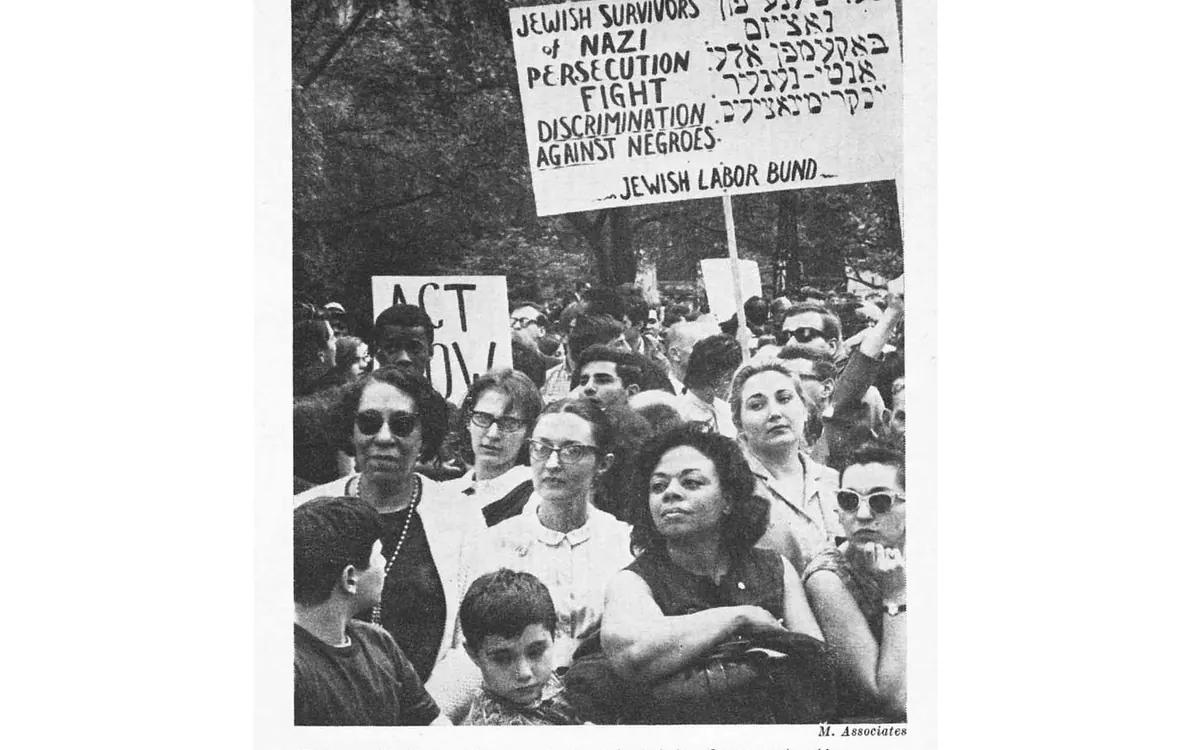
Jew-hatred has two fundamental elements no matter where it manifests - one connected to the role Jews play in society, the other the role we play in the mind of the hater. This episode opens a new facet of American Antisemitism as we turn from white hate to black, and try to understand the roots of them both.
Learn about James Baldwin, Malcolm X, the Nation of Islam, Louis Farrakhan, Elijah Muhammad, Ambassador Andrew Young, Jesse Jackson, the PLO, the 1968 New York City teachers' strike, pawnbrokers, landlords, race riots and the changing face of urban neighborhoods in American's north.
About this episode
What happens to a dream deferred, asks Langston Hughes, does it dry up or explode, and Rav Mike holds that question as he turns to black antisemitism. He frames all hate with two elements, the socioeconomic role the Jew plays in a society and the conceptual role the Jew plays in the mind of the hater. Reviewing the eras, the Romans faced the indigestible element of empire, the Middle Ages the obstinate refuser of salvation, modernity the alien other who fails to fit even as he succeeds. Each layer still lives in the world, in the Colosseum built by Jewish slaves and in the startup nation, in old religious hate and in the stubborn fact that the Jew remains other, since the melting pot is dead and our otherness is somehow never the right type.
In America the Jews became a liberal force of unprecedented power, shaped by an opportunity for influence unseen since Spain, with higher education as a magnifier. In today's narrative breakdown we have fragmented along with everyone, and the force we bring is found on every side of every issue, often in the lead, so that we are the enemy of everyone who stands opposite. The one thing uniting the radical left and the radical right is that both hate the Jews. And the deeper role is the story that will not die, the people who say it did not happen quite like that, who challenge self-serving narratives and keep faith that stories can unfold a richer world, blocking the easy retreat into relativism and nihilism that much of the culture prefers.
The socioeconomic root is old. Cecil Moore of the Philadelphia NAACP could call Jews Shylocks with their hands in his pockets, and the Great Migration brought millions of black Americans into northern cities just as the Jews were moving up and out of the ghetto. James Baldwin gave it voice in a 1967 essay titled negroes are anti-Semitic because they are anti-white, the landlord, grocer, butcher and pawnbroker all Jewish and all, in his word, exploiters, with race as the frame for power. Baldwin also pioneered the definition that would haunt the Jews, racism as prejudice plus power, so that the powerless can never be racist and the all-powerful Jew can never be the victim, an idea that turns an exact description of political antisemitism into received wisdom.
But socioeconomics is necessary and not sufficient, since it takes an ideology to make the Jew the face of white supremacy. Rav Mike traces the conceptual craziness to Malcolm X and the Nation of Islam, whose creation myth mirrors Christian identity, a tribe of Shabazz with inner divinity and a white race bred by a scientist named Yakub, with the white Jews cast as the draftsmen and architects of that supremacy. Elijah Muhammad taught that the Jews corrupted the Torah to master the black nation, and Farrakhan that the real children of Israel are black Americans. Malcolm X bent his energy to breaking the black Jewish alliance and bridging black suffering to the third world struggle on the back of the Jew, calling Zionist dollarism the number one weapon of twentieth-century imperialism.
The ideas moved from fringe to mainstream. The Ocean Hill-Brownsville teacher strike of 1968 loosened what Rabb called the control factor and let a student poem addressed to a Jew boy be read on the radio. Then in 1979 the resignation of UN ambassador Andrew Young, after an unsanctioned meeting with the PLO, was instantly blamed on the Jews, and the narrative that the Jews did it took hold with no evidence, voiced by Jesse Jackson and a gathering of black leaders who hailed their statement as a declaration of independence. The numbers followed, with black leaders agreeing that Jews choose money over people and polls ranking the young high on antisemitism, as the unity of all people of color moved to the center and buried beneath it the nefarious scientist Yakub.
Key ideas
- Antisemitism has two elements, the socioeconomic role the Jew plays in society and the conceptual role in the mind of the hater.
- In America the Jews became a liberal force on every side of every issue, so the radical left and right are united in hating them.
- James Baldwin voiced a hate rooted in the Harlem landlord and defined racism as prejudice plus power, which still haunts the Jews.
- Malcolm X and the Nation of Islam made the Jew the draftsman of white supremacy through the myth of the scientist Yakub.
- The 1979 Andrew Young affair was instantly blamed on the Jews with no evidence, fracturing the Black Jewish alliance.
- As the unity of all people of color moved to the center, antisemitism among black Americans rose even with education.
Chapters
- 0:00 A dream deferred
- 1:05 Two elements of antisemitism
- 4:16 The story that will not die
- 6:28 Everybody's enemy
- 9:43 Cecil Moore; the Great Migration
- 11:00 Baldwin and the Harlem landlord
- 13:10 Racism as prejudice plus power
- 18:44 The Jew boy poem
- 19:47 Malcolm X and the Nation of Islam
- 20:56 The scientist Yakub
- 24:17 Breaking the Black Jewish alliance
- 25:21 Zionist dollarism goes global
- 31:50 The Andrew Young affair
- 35:08 The Jews did it; the narrative
- 38:19 A declaration of independence
- 40:33 The numbers rise
Who, where and when
People
Langston Hughes, Cecil Moore, James Baldwin, Malcolm X, Elijah Muhammad, Louis Farrakhan, Andrew Young, Jesse Jackson, Amiri Baraka
Places
Harlem, Watts, Ocean Hill-Brownsville, The United Nations, South Africa
Texts
Negroes Are Anti-Semitic Because They're Anti-White, The Autobiography of Malcolm X, To Be Baptized
When
1967 CE: Baldwin's essay, 1968 CE: the Ocean Hill-Brownsville strike, 1965 CE: Malcolm X assassinated, 1979 CE: the Andrew Young affair, 1970 CE: the rising numbers
Read the transcript
What happens to a dream deferred, asks Langston Hughes. Does it dry up like a raisin in the sun, or fester like a sore and then run? Does it stink like rotten meat, or crust and sugar over like a syrupy sweet? Maybe just sags like a heavy load. Or does it explode? That's the question I have. I'm Rav Mike Foyer, and this is The Jewish Story. Season 6, Episode 12, American Antisemitism, Part 3. Before we dive into the next chapter of our exploration of American hate, I feel like I need to be a little bit theoretical, because it seems to me that antisemitism is always made of two basic elements. Call them the socioeconomic and the conceptual. There's the role the Jew plays in any given society, and then there's the role that we play in the mind of the hater.
If I was going to do a quick review of our stages, I'd say the Romans wanted to colonize our land and subsume our sovereignty into their Pax Romana of power, and our resistance made us in their mind the indigestible element of empire, refusing to be erased and therefore destined for destruction. Medieval hate was built, structurally speaking, on our competition in skills and trade and the role the Jews played in developing finance and capital around the world. But it was really fueled by our role as the obstinate refusers of salvation. A reminder of the suffering due to those who deny sacred truth. Modern anti-Semitism thrived in a world where the Jew was actually free to get ahead in unprecedented fashion.
And our diligence helped us move into key roles within many societies. And the passion of that modern hate came from our role as alien other. We would always fail to fit in, willfully or not, even as we succeeded. And that provoked a particular hate, the one that's aroused by a flaw which mars an otherwise perfect conception. So that's a reminder of the phases of hate that evolved along with the Jews since the very beginning. And remember, it's been with us, that hate, since we were truly born into the world as Am Yisrael long before we became Jews. There at Sinai, when the Torah of opposition first came down like the sages taught us. And each layer of this hate development has maintained some sense of residence in the world both in its socioeconomic and its conceptual roles.
The socioeconomic constructs of the Greco-Roman world may be long gone, but monuments like the Colosseum of Rome, for instance, built by Jewish slaves funded by the wealth of our plundered temple, still attest to the role we used to hold. Not to mention the fact that the struggle between state and empire is alive and well in our day. And watch Israel dance between the raindrops of that conflict as well as Herod did in his heyday. Now, certainly, the Jews have maintained our role in business, finance, and the like. The startup nation, really, has only scaled that effort upwards. and the old-fashioned religious hate fueled by that need to assert my God is bigger than your God is alive and well also.
And of course, the Jew remains other. There's nothing to be done about that. Secular humanist society opened a seeming path for what we call non-ideological assimilation for the Jews to just sink happily into the warm bath of general humanity but it didn't work. Not in theory and not in practice because Jews have never had the door to general humanity thrown open any more widely than it has been in today's America, which is why, of course, assimilation has made such inroads. But the American melting pot is dead. The tossed salad of identities, which is American today, finds the Jews' insistence on being other a cause for rejection, even by those who are ecstatically celebrating their own otherness and everybody else's that they can find.
Somehow, our other just isn't the right type. So, we've got all that to deal with, which, truth be told, seems to be enough. Nonetheless, here we are in the post-modern era, and there's a new layer of hate, where the Jew is the story that just won't die. So clearly, we have further roles to play in the world's drama of anti-Semitism. Now, practically speaking, the Jews have become a liberal force of unprecedented power in America, because the political experiment in the United States offered a scope of opportunity for influence unseen since really Spain. And there's a whole comparison to be made there. And as such, we've played an outsized role in the development of the socioeconomic, cultural, political life of the nation.
Also, the system of higher education. Don't forget that. That's a huge magnifier of our cultural force. And when I say liberal, by the way, I mean classic liberalism, individualism, liberty, equal rights, you know, leaning toward the free economy, even though, of course, there's an overwhelmingly left lean in the history of American Jewry. But you know what? That was then. This is now. In today's world of narrative breakdown, especially in the narrative breakdown of America, which is our focus, the Jews have fragmented along with everyone else. And the force we can bring to bear is found on every side of almost every issue and often in the lead. We're going to talk more about that when we get to the culture war.
So this thumbnail of our socioeconomic role in America is largely that of the elite, and they're always hated, right? Of an outsized power, both as a community and as individuals. It's an assumed liberalism, but that's begun to fragment into progressive, conservative, and everything else in between. Therefore, we're the enemy of everybody who stands opposite. And since we stand on every side of every conflict, we end up being everybody's enemy. A simpler way to say that is worthy of note that the one thing which unites the radical left and the radical right in America is that they both hate the Jews. And what about the story? What about my assertion that we're the story that won't die and that it's the hate evoked by our story that really characterizes the present era?
Well, it may be too soon to say, but I offer you the following thoughts. and they're fresh. So take them with a pinch of thought. But also let me know what you think of them. Write me, RobMikeFoyer, gmail.com. It's always helpful to have your insights. And frankly, while we're at it, I need your support. Go to my website, jewishstory.co. Season 6 is rolling along, but I could use your pledges. You can see the upper right-hand corner there as a button says, be a patron. Click on that. Give a little bit of per-podcast support. Meanwhile, my thoughts about the story. In history, our story is that we're here to tell you things didn't happen quite like that. No matter how much you want to reconstruct and airbrush the past, it didn't happen quite like that.
I remember as a young man saying that in my ninth grade world history class after we had a unit on the Crusades. And remember, no one likes to have their historical truths punctured. When it comes to identity, our story is here to challenge self-serving and dangerous narratives, be they individual or collective, because the Jews know many healthy ways to reconcile the I, we, us, which are neither brutally simplistic or life-suckingly abstract. Problem is, not everybody wants to be healthy. Like the Rambam said, to the sick, even the sweet tastes bitter, and we don't like those who tell us otherwise. When it comes to a faith in the possibility for what I call generative narrative, that human soul capacity for telling stories which actually unfold a richer world, well, the Jewish story, frankly, punches way above its weight.
so much above its weight, in fact, that whether you join it or not, it's a story that blocks any easy retreat into total subjectivity, into relativism, and even into the nihilism, which seems to be a favored place of much of our culture today. That's on the personal and the societal levels. And right, we don't like those who challenge our retreats. So all this is by way of a bit of a theoretical introduction to the further explanation of American anti-Semitism. And I labeled right at the beginning, white, black, and progressive hate. The time has come to open up a new facet. And I want to pick up our story of how Jew hate finds expression with black America. And I feel that this frame of the socioeconomic and conceptual roles which Jews play in the development of anti-Semitism can actually provide an opening exploration for us.
At the very least, I hope we can give some insight on how, within basically a generation or two, we went from the Jewish Black Alliance to a media superstar who feels so persecuted, even though he has twice as many followers on Twitter as there are Jews in the world, that he's got to blame the Jews. You know, plumbing the true origins of hate is well beyond the likes of me, but I could trace evidence for the first rumblings of black anti-Semitism to the 1950s in America. It was an era in which someone like Cecil Moore, head of the Philadelphia NAACP, and future mayoral candidate, could publicly characterize Jews as Shylocks with their hands in my pockets, their knives in my guts, their feet in my behind.
Moore, by the way, also would regularly boast that 90% of Philadelphia's black population were what he called anti-Jewish. And despite, or perhaps because of, these views, he remained much in demand as a speaker to black communities around the nation. Now Moore was expressing a hate rooted in how he experienced and understood the socioeconomic role that Jews played in his life and the life of his larger community. A bit of background, you know, from 1915 through 1970, what became known as America's Great Migration brought millions of people from southern black communities into the northern cities It was a massive process of dislocation and relocation one which was definitive in the evolution of black American culture and thus really too large for me to give a real look at.
Nonetheless, we need to understand something about how the Great Migration intersected in the urban ethnic ghettos built by the Eastern European Jews who had immigrated in their own millions from the late 19th century through 1924. In short, as the bulk of the urban poor in many cities became black, the Jews were already in the process of moving up and out of the world of factory workers toward, let's call it higher rungs on the socioeconomic ladder. And that led to an often uneasy relationship. I probably could give it best voice through the words of black American author James Baldwin, who wrote a 1967 New York Times article entitled, Negroes are anti-Semitic because they're anti-white. He wrote, When we were growing up in Harlem, our demoralizing series of landlords were Jewish, and we hated them because they were terrible.
Our parents were lashed to futurist jobs in order to pay the outrageous rent. We knew that the landlord treated us this way only because we were colored. and he knew we could not move out. The grocer was a Jew, and being in debt to him was very much like being in debt to the company store. The butcher was a Jew, and we often carried insults home along with the meat. We bought our clothes from a Jew and sometimes our second-hand shoes, and the pawnbroker was a Jew. Perhaps we hated him most of all. Not all of these white people were cruel. On the contrary, says Baldwin. I remember some who were certainly as thoughtful as the bleak circumstances allowed, but all of them were exploiting us, and that is why we hated them.
Well, it doesn't get more direct than that. Hate rooted in a socioeconomic relationship. Note, too, that Baldwin uses the race as the obvious frame for power. Negroes are anti-Semitic because they're anti-white. It's not because they hate Jews, it's because they hate the oppressor, who is white by definition, no matter how he looks in the mirror. Now, by the way, it's important to note that Baldwin was among the pioneers of a new definition of racism, which is causing the Jews no small amount of grief today. He wrote in 1972 in his work To Be Baptized, the powerless by definition can never be racist, for they can never make the world pay for what they feel or fear except by the suicidal endeavor which makes them fanatics or revolutionaries or both.
Whereas those in power can be urbane and charming and invite you to those homes which they know you will never own. The powerless must do their own dirty work. The powerful have it done for them. In case you're unaware, today, racism equals prejudice plus power. And since the Jews, of course, are all powerful, attacks on them are by definition not racist. We're going to take a full look at that idea in the episodes on progressive Jew hate. But even in 1969, at least one Jewish observer had the sense of the danger to come. He wrote, this is not the anti-Semitism which the black population shares with the white population. It is rather the abstract and symbolic anti-Semitism which Jews instinctively find more chilling.
Right? This isn't anti-Semitism, they say, meaning the black authors like Baldwin. The hostility is toward whites. When they say Jew, they mean white. But, our observer goes on to say, that's an exact and acute description of political anti-Semitism. The enemy becomes the Jew. The man becomes the Jew. The ideology of political anti-Semitism has always been one of poetic excess, and it has not prevented it from becoming murderous. So the hate which Baldwin described, and to which Cecil Moore ascribed, broke into the light of day in the mid-60s, as America erupted around the issue of its racial inequalities. And even as activist Jews were headed south to be freedom riders in the battle for civil rights, and Jewish institutions like the ADL were marshalling their political force behind federal civil rights legislation, the urban riots which rocked America were touched by some of the tropes of old-school European pogroms.
Cries of, let's get the Jews, were heard perhaps for the first time ever in U.S. cities in the riots of 64 and 65. And one observer noted that in Watts alone, 80% of the furniture stores, 60% of the food markets, 54% of the liquor stores which were burned and looted were owned by Jews. Now that's a testimony to two things, our socioeconomic role and the hate it evoked. as the decade progressed and violence increased the predictions became increasingly dire with some people speaking of an inevitable clash with the Jews as blacks fought for their freedom the stores that would be boycotted the tenements to be hit by rent strikes the collection agents to be driven out are mostly Jewish as are the remaining white politicians for the only whites left in the ghettos besides the police are Jews and this is the moment to bring back to mind sociologist Earl Rabb's analysis of how anti-Semitism actually becomes an active force within any given society I'm not going to review the entire four-step process that's for your homework I just want to remind you about what Rabb calls the control factor this is the strength of the social governmental structures that maintain order in society and thus inhibit the activation of anti-Semitism even if it's present in a latent form.
The upheavals of the 60s and 70s eroded the control factor in American society across the board, really without connection to the Jews. And so therefore it comes as no surprise that Jew hate could rear its head publicly, basically for the first time since the Holocaust. Now, like I said, some of this was an expression of the urban socioeconomic realities. American history has been nothing short of brutal to the black people. And in the cities of the North in the 60s, the Jews, like it or not, were often left holding that bag. Now, that pointing to economics as the root of black anti-Semitism is alive and well today, you should know. The stereotype of the exploding Jewish landlord has simply been reworked when certain media stars claim their careers have been profitable to and orchestrated by the Jews.
but Yi and Kai Ri were spouting more than the old cry of the Jew controls all the money they were also products of an ideology which lends a passion to anti-Semitism well beyond the bounds of economic competition because the Jewish socioeconomic role might be necessary to explain the rise of black hate but it's not sufficient now if you've been a dedicated listener to the Jewish story for some time which I hope you have You may recall Season 4, Episode 3, when we explored the explosion of the black Jewish tension touched off by the Ocean Hill-Brownsville teacher strike of 1968. That strike was way more than a manifestation of the socioeconomic struggle, which it was at the base, black parents seeking greater control of their children's school staff by mainly Jewish teachers.
in addition it loosened some of the control factor and opened the doors to public expressions of Jew hate to the extent that Julius Lester could invite a teacher from the school there to read a student poem aloud on his New York based weekly radio show in which one line declared, hey Jew boy with that yarmulke on your head you pale faced Jew boy I wish you were dead, you came to America landed the free and took over the school system to perpetrate white supremacy. And that's not the worst of it. Because it takes way more than socioeconomics to make the Jew the face of white supremacy. Now if I were forced to name a source to the conceptual craziness which lies at the root of black hate for the Jews, as opposed to its structural causes, I would have to pick a hero of the black power movement and Nation of Islam member Malcolm X.
Born as Malcolm Little in Omaha, Nebraska in 1925, he became Malcolm X while in prison in 1948 at the advice of Elijah Muhammad, self-proclaimed messenger of Allah and leader of the Nation of Islam. Muhammad's letters urged Malcolm to leave his slave name of Little behind and take the surname X in honor of the knowledge of the past of which he and his people had been robbed. Formerly joining the Nation of Islam upon prison, Malcolm X became its leading spokesperson for more than a decade until his fateful break with the organization in March of 64. Now, a quick sketch of the Nation of Islam reveals a striking parallel to that Christian identity movement we discussed two episodes back. The essential belief of the Nation is that there has been a series of mortal gods, as they call them, each a black man named Allah, and that their founder, Farad Muhammad, was the most recent incarnation.
They claim the original human beings were Arabic-speaking, dark-skinned tribe called the tribe of Shabazz, whose members actually possess what they call an inner divinity and from whom all peoples of color are descended. The white race, meanwhile, was actually created not by God, but by a scientist named, you guess it, Ya'aqob, and they not only lack inner divinity, they're intrinsically violent. Furthermore, the Nation of Islam claims that history has been shaped by the overthrow of the tribe of Shabazz by these falsely created white races and their rise to global dominance. Now, you may note, again, this strange mix of pseudo-scientific anthropology, racist theology and downright conspiracy. And, of course, you couldn't have missed the fact that the scientist was not coincidentally named Jacob.
Central to this creation narrative, because that's what it is, and central to how it's played out in politics and culture since are the nefarious white Jews who are labeled by the nation the draftsmen and architects of white supremacy Now the nation of Islam is in no way Orthodox Islam, but nonetheless, they do adopt a classic Muslim accusation. Elijah Muhammad asserted many times and in many ways that, quote, from the first day the white Jews received the divine scriptures, soon after they emerged, by the way, naked from the caves and hillsides of Europe, as he loved to say, they started tampering with its truth. And the purpose of this so-called counterfeit text of the Torah was to master the black nation and ultimately their own white brethren as well.
His later disciple, Louis Farrakhan, who we're going to meet in more detail next episode, taught and teaches, in fact, that through this corrupted Torah, the so-called Jews had usurped African Americans' position as the real chosen people of God. As he says, Almighty God Allah revealed that the black people of America are the real children of Israel, and unto us he will deliver his promise. The Jews of the Middle East, he says, are only the false Israel. Now that might sound familiar if you've been watching this hate unfold on social media lately. Meanwhile, back into history. Until Malcolm X's appearance, the nation remained a small, if radical, part of black American consciousness. But it was the struggle of the civil rights era that brought both he and the nation to prominence and helped install a vehement form of Jew hate right at its base.
Now, the nation of Islam had stayed outside of the mainstream fights of the late 50s and 60s. It had forbade from the outset any voting or participation in the political process as acts of collaboration with the white power structure, and now looked at the civil rights movement as nothing but a distraction from the real struggle. Malcolm X went so far as to call Reverend Dr. Martin Luther King a chump and labeled the other civil rights users as stooges of the white establishment. He even renamed the 1963 March on Washington the Farce on Washington. And he was fond of asking why so many people were excited about a demonstration, quote, run by whites in front of the statue of a president who's been dead for 100 years and who didn't like us when he was alive.
Now, the age of Islam had been calling for black Americans to be economically self-sufficient and separatist in their stance since its very inception. They saw the anti-segregationist colorblind dream of Reverend King and his nonviolent approach as simply new tools of white domination. tools, by the way, which had been shaped by the Jews. Because beyond the general tax on the civil rights movement, Malcolm X was bent on breaking the alliance he saw between blacks and Jews. He did acknowledge that Jews were, quote, among all other whites, the most active in the Negro civil rights movement. But he warned that the deceitful Jews had joined and subsidized that movement to, quote, control and contain the Negroes' struggles.
The Jews and what he called the Uncle Tom leaders they select ignited artificial fires in a desperate attempt to thwart the black revolution, which had already, quote, swept white supremacy out of Africa, out of Asia, and is now manifesting itself among the black masses of our country. notice that beyond the local hate an internationalization of the black struggle lies because in addition to his status as the most fearless proponent of black power in America up until his assassination in 1965 Malcolm X laid the groundwork for the transformation of the civil rights struggle into a part of the third world liberation movement in September of 1960 Malcolm met with Gamal Abdel Nasser of Egypt and leaders of several other African nations at the UN.
He also spent several hours in conversation with Fidel Castro, receiving a warm invitation to visit Cuba when he was through. All the while, in his writings and his speeches, he was constructing a bridge between black suffering in America and the anti-colonial struggle around the world. And that bridge was built on the back of the Jew. He loved to paint a picture of the Jew as a merchant fleeing after dark, with another bag of money, drained out of the ghetto, charging that they, quote, sap the very lifeblood of the so-called Negroes to maintain the state of Israel. In 1964, Malcolm X actually left the nation of Islam, becoming a traditional Sunni Muslim. He went on a tour of parts of Africa and the Middle East, and despite the ongoing existence of black slavery, he somehow saw places like Saudi Arabia as islands of racial paradise, lacking any color prejudice.
Now, his conversion did not dampen his hate for the Jews. On the contrary, it was supercharged, going global, so to speak. Quote, these Jewish people conduct their business in Harlem, but live in other parts of the city. They enjoy good housing. Their children attend good schools and go to colleges. This the Negroes know and resent. These businessmen are seen by the Negroes in Harlem as colonialists, just as the people of Africa and Asia viewed the British, the French, and other businessmen before they achieved their independence. The idea that the Jews were colonizing black urban communities, just like what Europeans did to the non-white countries of Asia and Africa, that the American Jews at home are simply a microcosm of what Israel is a broad and evil parasite, would be absorbed by far more than the thousands of Nation of Islam members that Malcolm had behind him.
Because he laid the foundation of the blame which Jews and Israel now take in many people's minds for the modern evil of neocolonialism. Quote, the number one weapon of 20th century imperialism is Zionist dollarism. And one of the main bases for this weapon is Zionist Israel. Malcolm X was assassinated on February 21st, 1965 and seen by many to be a martyr his memory was raised to almost instant sainthood not only despite his hateful ideas about the Jews but really often because of them his autobiography, rife with anti-Semitic charges characters of Jews which labeled Haj Amin al-Husseini, the murderous Grand Mufti of Jerusalem in the pre-state days as a cordial man of great dignity, sold more than half a million copies in the three years after his death.
His ideas had already spread like wild fire, even before he died. One example, popular black playwright and poet Leroy Jones, whose work was supported by federal grants, echoed Malcolm's views when he confessed in a 1966 television interview that he found Jews, quote, inimicable to the most beautiful qualities of the human spirit. I find them oppressing, oppressors. I find them connected with the worst filth in this country, in the world. Now that has nothing to do with socioeconomics. And in fact, when a member of the audience accused him of anti-Semitism, Jones replied, I'm not a Nazi. The Nazis were white people. That was your family quarrel. I was just a spectator. Sound familiar? You know, two decades later, Jones would now be known as Amiri Baraka, reflecting the shift toward the sort of third world consciousness, and confessed that he was a former anti-Semite.
He converted, he said now, to anti-Zionism. And how does that anti-Zionism sound? Well, listen to his quote from an interview in The City Sun in 1992. He says, a black man wants to put down the Zionists, and the Zionists control the radio, the television, the movies, the education, the intellectual life of the United States. The minute you condemn them publicly, you die. They will declare a war on you forever. This should have a familiar ring. If you really want to understand the full impact on the civil rights movement of the radicalization of black leadership away from Reverend Dr. Martin Luther King's colorblind vision toward Malcolm X's separatism, you have to go back to season three. Episode 22 is the center of it.
But for now, just know that as a power struggle erupted in the wake of the assassination, first of Malcolm X and then of Martin Luther King, the Jews and Israel were caught in the crossfire. Because racial consciousness replaced colorblindness as the 60s turned toward the 70s. And separatism gained ground over desegregation as the goal. And people found, leaders found, that in order to establish their credibility as militantly separatists, many had to distance themselves from their past as interracial activists, which made any link to the Jews in particular problematic. Add to that the reality of the economic conflict between blacks and Jews in the northern cities, and the sort of pivot toward pan-Africanism and third world liberation, And this is how it sounds in the words of Connie Matthews, international coordinator of the Black Panthers.
The white left in the USA is comprised of a large percentage of Jewish population. Before the Black Panther Party took its stand on the Palestinian people's struggle, there were problems. But the support of the white left of the Black Panthers was concrete. However, since our stand, the white left started floundering and has become undecided. That leaves us with no alternative then but to believe that a portion of these people are Zionists and are therefore racists. As these radical political views moved from the fringe into the mainstream, they carried with them the conspiracy-riddled hate of the nation of Islam as black nationalists mounted a full-scale assault on Jews as no longer allies but enemies and on the Jewish state as the number one colonial oppressor left in the world.
And by the way, the numbers show the results. A study conducted in 1970 ranked 73% of blacks in their 20s, as opposed to only 35%, 50 and older, as high on the index of anti-Semitism. Unlike during the Civil Rights Movement, by 1978, a survey of black leaders found that 81% agreed with the statement, Jews choose money over people. And as the 70s came to a close, pundits began to predict the collapse of what had been known as the Black Jewish Alliance a political concordat which had stood at the foundation of particularly Democratic Party power for more than a decade As it turned out their prediction wasn so long in coming In mid-August of 1979, Andrew Young resigned under pressure from his role as U.S.
ambassador to the United Nations. The departure of, quote, the highest-ranking black official in the country precipitated a crisis in black Jewish relations which brought with it more than a whiff of anti-Semitism and in many ways from which the black Jewish leadership relationship in America never recovered. Now, on a technical level, Young's job came to an end because he made a decision to meet secretly with Zeril Aviv Terzi, the PLO observer at the UN, an act that violated a long-standing U.S. policy of refusal to deal with the organization. It wasn't the first time that Young had chosen to swim upstream against the policies that flowed out of the State Department. He'd inherited leadership of the Southern Christian Leadership Conference from the Reverend Dr.
Martin Luther King, and as a younger contemporary, was part of that wave of leaders who looked now to the third world liberation movements as a model for the black American struggle, as opposed to the colorblind desegregation model. and hence his public statements which often got him in hot water with his bosses well before he met with PLO, like the suggestion that Cuban soldiers were only bringing order to Angola or his assertion that there were hundreds, maybe thousands of political prisoners being held secretly in the United States. Young might have weathered this far greater violation of U.S. policy if he hadn't doubled down on it and given a false report about the meeting with Terzi to his superiors.
Meanwhile, the state of Israel lodged a formal protest, as they were holding a pledge from U.S. leaders to ban the PLO in fear that a policy change might be in the wind, and American leaders grumbled, certainly quite loudly. But, despite the grumbling, almost all refrained from calling even for Young's resignation, much less his firing, because, as one of them explained, quote, he was Andy Young, because he was black, and we realize the significance of that. It was actually left to black Congressman Walter E. Fountroy to observe that had Young been judged, quote, as an official of the U.S. government, not as a black man, he would have not had to resign, because he would have been fired most likely long before this unsanctioned meeting with the PLO.
Now, despite the lack of evidence that the American Jewish community had anything to do directly with Young's departure, that's the narrative which took hold almost immediately. and accusations against the Jews were in the air as soon as his resignation was announced. The annual meeting of the Southern Christian Leadership Conference, Young's old organization, happened to be in session at the very time that he left his job. And when the news broke, Reverend Wyatt T. Walker, the SCLC's liaison to the UN, announced, quote, the perception on the street is that the Jews did this to Andy Young. The question is whether that was a perception that he perceived or one which he generated. In incoming days, the charge was repeated over and over again from increasingly high-profile platforms.
The New York Times even ran an op-ed claiming that Young's resignation, quote, brings into sharp focus the immense power of the Israeli lobby in this country. That's a good one, huh? Reverend Jesse Jackson, always a firebrand, attributed the resignation to, quote, a capitulation to pressure from our former allies, the American Jewish community. But he didn't stop there. he added, quote, that Klan didn't move on Andy and warned that blacks must now concern themselves with Jewish attitudes as well as with those of the Ku Klux Klan and the American Nazi Party. The public statements quickly spilled over the banks of the political stream into general Jewish accusations. Representatives of the SCLC blamed Jewish banks for exploiting blacks in South Africa.
the village voice rushed to print with a lead essay charging, quote, black writers can't get published, and black characters and experiences are never portrayed on primetime TV and in the most popular movies and novels because, quote, American Jews dominate the image-shaping industries of our era. The president of a national black sorority told the group's annual convention in New Orleans that as a result of the affront, as she called it, by Jews in the Young Affair, quote, we question whether their loyalties are first to the state of Israel or to the United States. That was basically every classic anti-Semitic trope you could find. Now, some black leaders were greatly distressed by this public breakdown, but others welcomed the anti-Jewish reaction to Young's resignation as, quote, a golden opportunity to discuss the whole package of black Jewish differences.
To Reverend Jesse Jackson, the source of these differences was obvious. He said they grew out of, quote, confrontations between blacks and Jewish landlords, blacks and Jewish merchants. And the feeling that Jews, while willing to do what he called shared decency during the civil rights movement, had become opponents once we began to push for our share of universal slots in institutions. It's a not so subtle reference to a conflict which had broken out between black and Jewish leaders only months before around the issue of affirmative action, where the Jews had come out against because of their bad history with quotas. The final blow, at least amongst leaders, might have come from a meeting of 200 black leaders assembled by the NAACP to examine how, quote, the successful demand for the resignation of Young, notice how the truth has already been established, had, quote, further damaged an already unhappy relationship between Jews and blacks.
The statement which they eventually crafted was labeled by psychologist Kenneth B. Clark as, quote, our Declaration of Independence, and received a standing ovation when it was read. It criticized Jewish organizations and intellectuals as apologists for the racial, quote, pitted to the international scene when it attacked Israel for its trade and military alliance with South Africa and southern Rhodesia, and then come back home with noting the responsibility for resolving black Jewish differences cannot be placed disproportionately on the backs of already overburdened blacks and demanded Jews show more sensitivity and be prepared for more consultation before taking positions contrary to the best interests of the black community.
Now, notice that powerful mix of national grievance, political power struggles, and international policy. It's a potent brew which is going to spill over into today's hateful anti-Semitism and political struggles. Before the Young Affair, most of the mainstream black leaders avoided any association with the PLO. And in fact, many were sponsors of Bayard Rustin's Black Americans to Support Israel Committee, called BASIC. It was a stance that they took, basically, because of a belief in liberal democracy and as a demonstration to their commitment to a political alliance which had gone on for well more than a decade and borne real fruits for their community. Meanwhile, Reverend Jesse Jackson's Operation Push and the Southern Christian Leadership Conference were holdouts.
They were the only civil rights groups which actually took a stand in favor of the PLO. And even in the aftermath of the Young crisis, no evidence existed of an immediate groundswell of support on the street for their position. But that's going to change quite quickly. Within weeks of Young's resignation, Jesse Jackson was on CBS's 60 Minutes mocking the claim that a black Jewish alliance had ever existed at all. And on September 23rd, he left for the Middle East, predicting that he himself could produce a major breakthrough in the search for peace. Now, upon learning that Prime Minister Menachem Begin had declined to meet with him, as he did with every supporter of the PLO, Jackson denounced the rejection as, quote, a racist decision based on skin color.
Ironic, since Begin was being denounced by his Ashkenazi opponents as a favoring people of culture in Israel, Meanwhile, after visiting Yad Vashem, Jesse Jackson claimed better understanding of what he called the persecution complex of many Jewish people that almost invariably makes them overreact. The suffering is atrocious, he acknowledged, but really not unique. And then, right there in the shadow of Yad Vashem, he declared genocide should not be allowed to happen to anyone, not even the Palestinians. From Jerusalem, Jackson left for Beirut, where he warmly embraced Yasser Arafat, went on to Cairo, and then over to Damascus, where he had a long conversation with President Hafez al-Assad, a man who knew more than a thing or two about mass murder.
We're going to have to pick up the thread of our story, likely with Jesse Jackson's political run. But for now, I want to throw some numbers at you right at the end so you can understand how this heated rhetoric began to impact perceptions. In 1981, polling indicated that 42% of blacks, as opposed to 20% of whites, agreed with the statement, Jews have too much power in the United States. Another survey found that blacks were actually the least favorable to Israel of any major subgroup in the population. 35% said unfavorable, and only 20% highly favorable. And indeed, the strongest racial differences show up on questions relating to the Palestinians as an oppressed, presumably racial minority. That narrative, which posited the unity of all people of color, considered interracial alliances as suspected best, had moved firmly into the center of the American black consciousness.
and buried, if not consciously, at least not so far beneath the surface, was the nefarious scientist Jacob, architect of white supremacy. So I want to thank some folks before I sign off. I want to thank all the folks who give their money to make this show happen. Keep it free and widely available. I want to call on you to join them right now. Go to my website, jewishstory.co. You'll see a button in the upper right-hand corner that says be a patron. You can click on that to give a little bit of per-podcast support. I also want to thank the Land of Israel that's thelandofisrael.com they're building a center for global transcendence in the heart of the Judean mountains I want to thank the Pardes Institute pardes.org.il for throwing the doors of the Beit Midrash open as wide as possible and I want to thank you for listening I'm Rav Mike Foyer and this is the Jewish Story
More from Season 6
TJS S6E10 American Antisemitism part I
Antisemitism It's an old topic, but somehow seems to be making yet another comeback in America. Here is the introductory episode in my quest to understand the rebirth...
Play Episode
TJS S6E11 American Antisemitism part II
In part 2 of our exploration of the new face of the oldest hate focuses on the history of Jewish response to American Antisemitism through a look at...
Play Episode
TJS S6 interlude: The inner tension of the present moment
Sometimes you have to get out of your own head in order to know what you really think. Here is an episode where my good friend Eitan Ben...
Play Episode