
Season 2: Episode 25 - One More Dunam One More Goat
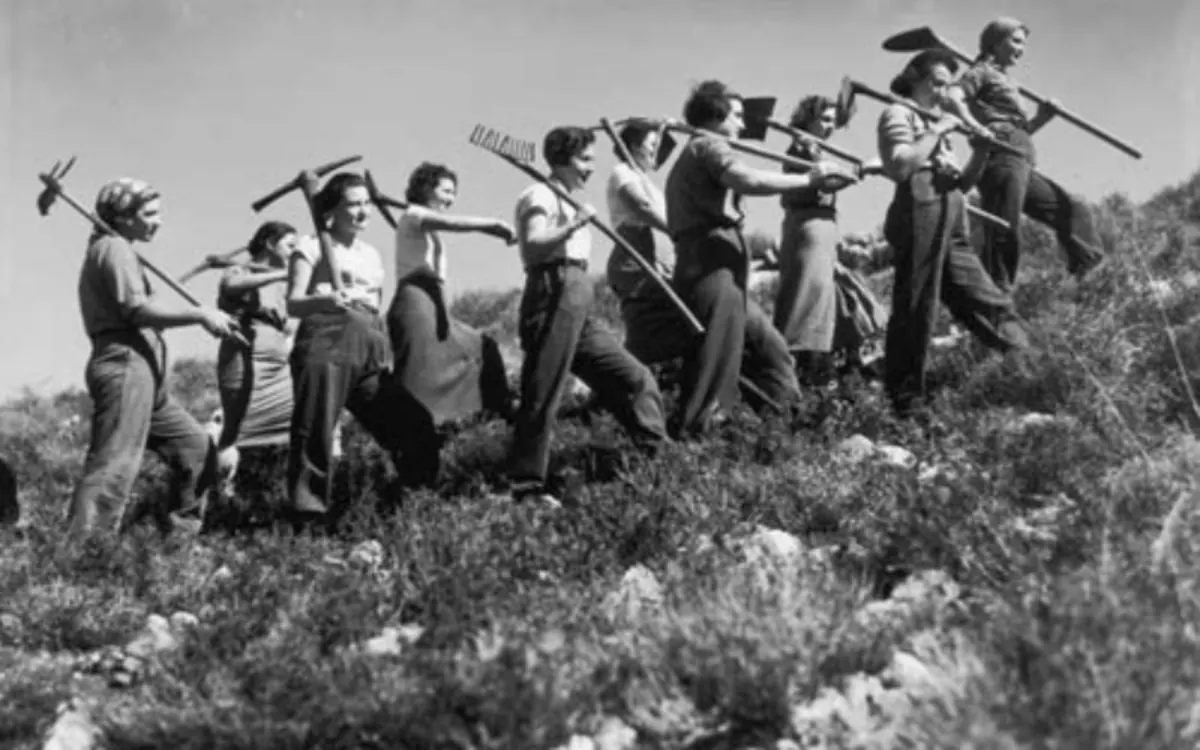
There are times in history which define us even now, and in the state of Israel the Second Aliyah is second to none in that respect. This episode tells of the chalutzim, the idealistic pioneers who came up to the land to build the world, one goat at a time.
About this episode
We must ourselves do all the work, said A.D. Gordon, and only then shall we have a culture of our own. Zionism so far has been big vision, Herzl's infinite ideal that holds the aspiration to moral and spiritual perfection even after we settle the land, and as Yishai Fleisher says of aliyah, arriving is where it begins. Against the near-messianic grandeur of political Zionism, which expected land and legitimacy almost at once, stood pioneers who swapped if you will it, it is no dream for one more dunam, one more goat: the Second Aliyah, 1904 to the First World War. Aliyah means going up, the verb Moshe uses to send the spies, since Rashi says the land is higher than all others, and every ascent joins hard work to an elevated state; the mystics made it ascent through levels of consciousness, and the Ramchal taught that the highest holiness is a gift after all a person's labour. The pioneers restored the geographic meaning without losing the spiritual, shifting the field of labour from religion to the soil. Think of them as Gordon's Hasidim: every swing of the hoe sacred in itself, each goat and well and road an accomplishment regardless of any grand design, and what begins as labour ends as a gift. That pragmatic messianism still runs the country, and today in Judea and Samaria it is one more caravan, one more paved road, and when asked what will be, back to work.
The Gemara in Berachot says three gifts come only through suffering, the Torah, the land of Israel and the world to come, and the Second Aliyah's suffering is awe-inspiring because it held no illusion of an easier road. Yosef Chaim Brenner gave the ethos its phrase, af al pi chen, despite it all: how could a few thousand Eastern European Jews divorced from the soil for generations build a Hebrew society a dunam at a time? Madness, and they knew it, and answered, true, but nevertheless. Ben-Gurion in 1956: in Israel, to be a realist you must believe in miracles. Brenner in 1917 told the youth the land is poor, hardly magical, wages low, food scarce, and that only the pioneer whose despite it all is part of his very being should be allowed to come. Chalutz is biblical, the armed vanguard of Reuven and Gad and those who circled Jericho, the spearhead of a sanctified conquest, and also the tip of the plough willing to blunt itself so later generations can take root. Historians count a few thousand to ten; all agree on their youth, idealism and crushing labour. They rejected their parents' religion, a movement of children against parents whose price Rav Mike still feels in the streets, but their spirituality found its outlet in cleaving to the land, horrifying the conservative First Aliyah farmers and the pious Old Yishuv; their egalitarianism included women, though the facts on the ground lagged the rhetoric.
One rabbi saw them for what they were. Rav Kook, rabbi of Jaffa from 1904 and thus the nearest authority to the new settlements, wrote Maamar HaDor in 1906: Jews have always left the Torah because it is hard to be a Jew, but no one who watched these men sink eucalyptus trees in neck-deep mud and die of malaria at night could think they sought an easier life. They sought gadlut, greatness, and turned from a Torah of exile too narrow to hold them, while the isms that moved them, nationalism, socialism, Zionism, had their roots in the Torah of the land of Israel, which he would spend his life expressing. Berl Katznelson, born 1887 in Belarus to a Chovevei Zion father, caught socialist messianism at fifteen, wandered between parties and youth groups, and in 1909 heard Gordon's religion of labour and went up to train himself as a tiller of the soil, convinced the first step toward solving the Jewish problem was proving the Jews still had the strength to be pioneers. The First Aliyah, twenty to thirty thousand between the pogroms of 1881 and 1903, had been saved by Rothschild and turned from farmers into farm managers; the chalutzim wanted kibbush haavodah, the conquest of labour, to be labour and not management, and to prove the Jew was neither fat capitalist nor rootless proletarian.
Avodah ivrit, Hebrew labour, is old: the rabbis treated employing fellow Jews as an extension of tzedakah, solidarity. Today it is cast as far-right and anti-Arab; the irony is that socialist labour Zionism made it a founding principle. When Katznelson found Jewish overseers on Rothschild farms undercutting Jewish labour with Arab labour he organized perhaps the first strike in the land, which began consolidating Poalei Zion, HaPoel HaTzair and the rest into one labour movement. In 1920 he co-founded the Histadrut with Ben-Gurion, the Kupat Cholim Clalit, the Hamashbir cooperative and the daily Davar; he also valued tradition, teaching that memory alone crushes us and forgetting alone leaves no culture, and he called every Jew he met abroad a brand snatched from the fire, haunted by the shadow over Europe. His formula: the emancipation of the Jewish worker is unthinkable without the emancipation of the Jewish people from exile. Then the slogan: a land without a people for a people without a land, a Christian restorationist phrase whose every article hides a fight. A land, since many at the Sixth Congress would have taken Uganda; and a people, since Zionism's work was to make a people of the Jews, and since the question is what constitutes a people, not whether Arabs lived there, as Jabotinsky's Iron Wall will show by taking the Arabs seriously as a people.
The Basel Program papered over the tension between consent of governments, national consciousness and appropriate means of settlement. Herzl, who put little faith in a farm here and a farm there, nonetheless backed a national fund in 1897, and when the Fifth Congress was still debating it in 1901 he told them to do it now or wait for the Messiah; the Jewish National Fund was born, the instrument of practical Zionism that would redeem the land piece by piece. The blue box replaced the Rabbi Meir Baal HaNes pushke: the coins before Shabbat candles no longer supported Torah scholars in the land but bought the land itself, so the working Jew who had lost faith in Torah institutions now owned a piece of Israel, an unparalleled educational tool; the JNF would plant two hundred million trees and own thirteen percent of the state. One tract on the shore of the Kinneret shaped history. Degania, founded 1909 to 1910 on JNF swampland where the Jordan leaves the lake, is the mother of the kibbutzim; Rav Mike worked there a month with his father and brother. Ten men and two women declared on October 28, 1910 an independent settlement of Hebrew workers on national land, a community without exploiters or exploited, round glasses, funny hats and knickers resolved to become peasants and change the world; the first night the cow bellowed and no one knew how to milk her, so they crossed to the Arab village of Umm Juni for help. The premise was that freeing people from the struggle for subsistence releases creative power, and it proved true: never more than 7.6 percent of the population, yet nearly every pre-state and early leader passed through a kibbutz, and they built the agriculture, absorbed immigrants, extended control over the land and were the backbone of the parties that ruled for thirty years. Weekly meetings of all members late into the night defined the beautiful life, equality, freedom from material worry, and no managers and no underlings; a child born there never imagined eating an orange without sharing it, and was woken at three to plant tomatoes. The kibbutz is Borochov's pioneering elite made flesh, and its children, one recalled, were raised with perpetual guilty consciences, responsible for themselves, for society, and for the whole world.
Key ideas
- Aliyah is going up: hard work joined to an elevated state, and the pioneers moved the field of labour from religion to the soil without losing the spirit.
- Despite it all, af al pi chen: the Second Aliyah knew its task was madness and welcomed the hardship as sacred; to be a realist in Israel you must believe in miracles.
- Rav Kook alone saw that the chalutzim left the Torah not for an easier life but for greatness, and that their isms had roots in the Torah of the land.
- Hebrew labour was a left-wing founding principle: Katznelson's strike against Arab labour on Rothschild farms began the institutions of labour Zionism.
- A land without a people for a people without a land: every article in the slogan hides a fight about what constitutes a people.
- The JNF blue box bought the land coin by coin, and Degania's twelve founders who could not milk a cow became the elite that built and ran the state.
Chapters
- 0:00 We must ourselves do all the work
- 1:04 Big vision and the infinite ideal
- 3:08 One more dunam, one more goat
- 4:13 Aliyah: going up, in geography and spirit
- 6:29 Gordon's Hasidim: every swing sacred
- 8:39 Pragmatic messianism, from goats to caravans
- 9:45 Three gifts through suffering
- 10:47 Despite it all: Brenner's letter
- 14:00 Chalutz: vanguard and tip of the plough
- 16:08 Children against parents; cleaving to the land
- 18:18 Rav Kook's Maamar HaDor: seeking greatness
- 21:30 Berl Katznelson goes up
- 22:39 Farmers into farm managers; the conquest of labour
- 24:51 The first strike; the Histadrut and Davar
- 27:00 Memory and forgetting; brands from the fire
- 29:08 A land without a people: the articles
- 32:29 The Basel tension; Herzl and the fund
- 35:52 The blue box
- 38:01 Degania: visit the museum
- 40:13 Twelve who could not milk a cow
- 41:18 Freedom releases creative power
- 43:28 The beautiful life: equality, freedom, democracy
- 44:30 Oranges shared; responsible for the world
Who, where and when
People
A.D. Gordon, Theodor Herzl, Yosef Chaim Brenner, David Ben-Gurion, Rav Kook, Berl Katznelson, Edmond de Rothschild, Ber Borochov, Zev Jabotinsky, The Ramchal, Rashi, Yishai Fleisher
Places
Jaffa, The Galilee, Degania and Umm Juni, The Kinneret, Judea and Samaria, Uganda
Texts
Numbers 13:17, Mesillat Yesharim, Berachot 5a, Brenner's letter of 1917, Numbers 32 and Joshua 6, Maamar HaDor, The Basel Program, The Degania declaration of 1910, The Iron Wall
When
1881 to 1903 CE: the First Aliyah, 1897 CE: the national fund proposed, 1901 CE: the JNF founded, 1904 CE: the Second Aliyah begins; Rav Kook to Jaffa, 1906 CE: Maamar HaDor, 1909 CE: Katznelson goes up, October 28, 1910 CE: Degania declared, 1920 CE: the Histadrut founded
Read the transcript
We must ourselves do all the work, says A.D. Gordon, from the least strenuous, cleanest, and most sophisticated, to the dirtiest and most difficult. In our own way, we must feel what a worker feels and think what a worker thinks. Then, and only then, shall we have a culture of our own, for then we shall have a life of our own. Well, I'm definitely looking to build a life of our very own. Because I'm Rav Mike Feuer, and this is The Jewish Story. Episode 25. One more dunam, one more goat. You know, up until now, Zionism has been about big vision. I mean, after all, Herzl himself called it an infinite ideal. And we've seen that before, along with, and even after Herzl, the dreamers of Zion dreamed big. I mean, listen, the rebirth of the Hebrew language, the renaissance of Jewish culture, the creation of a new Jew, it doesn't get any bigger than that.
And the isms have been flying fast, left and right, throughout the Jewish story for weeks. Communism, capitalism, socialism, nationalism, cosmopolitanism, more versions of secular messianism than you can shake a stick at. And of course, that's without even getting into the good old-fashioned dreams of traditional Jewry for the coming of the real Messiah. Let it be soon. Let it be now. And in some sense, this big-picture idealism which underlies the Zionist dream will never go away. At least, I hope not. As Herzl says in the continuation of that quote, Zionism will not cease to be our ideal even after we come to settle in the land of our forefathers in Eretz Yisrael. For within the Zionist idea is contained the aspiration to moral and spiritual perfection.
And, as we'll speak about in Season 3, this perfection is easier said than done. The components of Zionism, which are problem-solving approaches, will find it less than simple to continue thriving once they achieve their goal of a state. And even the visionary elements will be equally confounded by how difficult it really is to make utopian dreams into reality when you've got to feed the people and clean the streets. Nevertheless, it's good to have an infinite ideal toward which we strive, both as individuals and as people. Otherwise, achieving our goals means stagnation by definition. It's kind of like what my good friend Yishai Fleischer says about making Aliyah, about coming up to the land of Israel.
It doesn't end when you arrive in the land of Israel. That's actually where it begins. You've got to keep on keeping on. And we will talk about this notion of going up to the land in this very episode. So, Zionism starts out being about dreaming big. And we've heard the voices of a lot of big dreamers. Achada Am, Max Nordau, Ber Borakov, A.D. Gordon, and of course, above them all, Herzog himself with his mad notion of a mass transfer of Jews of Europe into the Middle East, and the resettling into a homeland that would be purchased, or preferably granted, by the world powers basically in one fell swoop. This is the heart and soul of political Zionism, which was practical in its focus on acquiring land and political legitimacy, but utopian in its expectation that such achievements could come almost at once.
But opposite this all-but-Messianic grandiose vision stood a core of Zionists who exchanged the slogan of If you will it, it is no dream, for the more pragmatic motto of One more dunum, one more goat. If you don't know, a dunam is, I think, a quarter of an acre. It's a measure of land. That's what matters. These were the pioneers of the second Aliyah, the wave of Eastern European Jews who went up to the land of Israel in the years between 1904 and the outbreak of World War I. Now, Aliyah means the act of going up, and it's a critical term for understanding the relationship between the people of Israel and the land of Israel, one that actually defines it in many ways. at the moment of our first national encounter with the land Moshe says to the 12 tribal leaders he's sending to spy out the place before we went in go up there into the Negev and up on into the hill country as Rashi points out in many places the reason that the verb La'alot to go up is used for entry into the land as opposed to Likadnes to go in is that Eretz Yisrael, the land of Israel is higher than all the surrounding countries.
Now, that could be a geographic reality, depending on which direction you enter from, but it's certain that going into Israel is always an uphill battle. And as with all uphill journeys, it combines two components, a lot of work, and the achievement of an elevated state. In exile, the term aliyah lost connection to the land as its central meaning, though the usage never completely disappeared. But rather, in the hands of the mystics, it came to denote ascent through levels of spiritual consciousness. And in such spiritual work, the higher you go, the more sanctified you become. But it's an important caveat that your own labor can only take you so far. As Rav Moshe Chaim Luzaru, the Holy Ramchal, says in his early 18th century work, Mestilat Yisharim, The Path of the Upright, The highest level of holiness is a gift.
All that man can do is to attempt it. It is attained when the Holy One, blessed be He, will guide him in the way that he wishes to follow and bring upon him his holiness. In other words, the work of spiritual elevation can only take you so far. But if you labor, you may be gifted by God with the crown of holiness. And somewhere in the early 20th century, the pioneers who began to return and work the land of Israel reawakened the geographic centrality of this term, aliyah, to go up to the land. But they didn't abandon its spiritual essence, God forbid. They just shifted the field of labor from religion to the soil. The halotsim that we're going to speak of in this episode were driven by the spiritual necessity of labor.
In the last episode, I named A.D. Gordon as the prophet of this new religion of labor, which is, in truth, not my term. So I want you to think of these pioneers as his Hasidim, as his devoted followers who transformed his ideas into a reality, and in so doing, transformed themselves and the land as well. And I want you to remember, for all the spiritual ideal of labor, these men and women were pragmatists. Every swing of the hoe, every swing of the pick, was an act sacred unto itself, no matter what ultimate goal it may achieve. These pragmatists made Aliyah, after switching their geographic location to land, by rising through the levels of devotion to that land as they built it and were rebuilt by it.
Each dunam reclaimed, each goat raised, every road built and every well dug was an accomplishment in its own right, regardless of how it fit to some grandiose vision of a state or universal worker society. And the pioneers could have this attitude because above all else, like I said, they'd come to the land to heal themselves through labor. And further, because they were in part fired by this mix of socialism and nationalism we've spoken about, rooted in secular messianic view, where the big picture of society was inevitably unfolding. It's not that they were unconcerned about the political horizons of Hertelian Zionism. It's just that they felt the need to work far more than they felt the need to dream.
And that need built a country one good at a time. And, of course, as had always been true of Aliyah, what begins as labor ends as a gift. Whether that gift is an intoxicated union with the land, or a nation state, or both. This pragmatic meccanism of the pioneers in the second Aliyah defines the political culture of the state of Israel in its early decades, and maintains its power down to our day. It finds its most powerful, and for some, you know, most challenging expression now, in the focus by the Jews of Yudah and Shomron on creating facts on the ground. One more dunam, one more goat, is now one more caravan and one more paved road. And when you ask these Jews, the so-called settlers, but what will be?
Don't you know that the demographics, or world opinion, or the danger of a binational state, more often than not, their answer will be, okay, now back to work, one more dunam, one more caravan. So we're going to explore the character of the second Aliyah and the institutions which it built in depth. And along the way, I want to be sure to articulate the elements of its worldview which continue to shape our country beyond pragmatic messianism. And so let's touch on one more right now. And that is how the pioneers of the second Aliyah related to the difficulty of life in the land. You know, the Gemara in Brachot says, The Holy One, blessed be He, gave Israel three precious gifts, all of which were given only by means of suffering, which purified Israel so that they may merit to receive them.
These gifts are the Torah, the land of Israel, and the world to come. The land of Israel is acquired through suffering. And why that may be is a question that we'll keep on the table, really, from now until the end of the second season of the Jewish story. And I'm sure we'll get into it in the third as well. But no matter how we relate to the question of why, when we look at the second Aliyah, the reality of the suffering which they bore in order to acquire the land is undeniable. It's not just undeniable, it's awe-inspiring, I have to admit. In particular, because it held no illusions about success or an easier road ahead. Yosef Chaim Brenner was an important author of the Hebrew Renaissance and a vocal supporter of labor Zionism, though, in truth, his own life was quite complex in its relationship.
But nevertheless, it was Brenner who popularized a phrase which continues to resonate down through the generations into modern Israeli society. Afal pichen. Nonetheless, this phrase encapsulates a critical element of the pioneering ethos that fired the halotsim of the second Aliyah. Not only were they not blind to the hardships that were created by their idealism, they welcomed the endless and perhaps even hopeless hardships as an almost sacred task. Just think about it for a moment. How is it possible that a small group of Eastern European Jews, the vast majority of which had been divorced from the soil for generations, even thought that they were going to build a new Hebrew society one dunam at a time.
It's madness. And they knew it. And their answer to the challenge was, true, but nevertheless. This attitude had such a profound effect on the Israeli ethos that David Ben-Gurion, certainly the most famous of the pioneers of the second Aliyah said in a 1956 interview when he was challenged by the feasibility of existence in such a hostile region He said in Israel in order to be a realist you must believe in miracles. Meaning, I know you told me it can't work, but nevertheless. And that was well after the one goat, one dunam approach had borne significant fruit. But in 1917, Brenner wrote the following. Our youth throughout the world must now know the truth about the land of Israel. They should know that the place is not a bed of roses, that the land is poor, hardly magical, settled by others wherever something could be done, hard to settle where it is unsettled.
Wages are low, food is scarce and expensive, the needs are greater than our capacity. All this should be known in the Jewish diaspora, and should give birth to a sentiment of Afal Pichin, despite it all, in the hearts of our youth. That same despite it all that should come at the end of all the negative calculations. Despite it all, especially when in Eastern Europe the future is very grim and the present is gloomy. For there's nothing to lose, for the yearning calls to start everything from scratch and whatever happens, happens. And only that pioneer, whose afal pichen, whose despite it all becomes part of his very being. Only that halutz, who is ready for everything. And not only in words, only he should be allowed to come.
He and no one else. The term halutz, pioneer, has biblical roots. As a verb, it appears at the end of the book of B'midbar of Numbers in the deal that Moshe struck with the tribes of Reuven and Gat. You may recall the story that they're about to cross into the land of Israel and up pop the tribes of Reuven and Gat and tell Moshe that they want to receive their inheritance on the eastern side of the Jordan, where land is good for cattle. And they promise in return, And we will go first, armed, before the children of Israel. They'll pass over first. And it was Hechalutz who led the priests and the people as they circled the walls of Jericho under Joshua's leadership, carrying the Ark of Covenant and blowing the Shovars until the walls came tumbling down.
And we've mentioned a number of times how Hebrew is word poor, but context rich. And so it's certainly not an accident that this word, Halutz, with its connotations of the spearhead of conquest, of a conquest sanctified by divine command, was chosen to characterize the pioneers of this period. And indeed, the leaders of the Second Aliyah came to be seen even in their own lifetime as mythic and even messianic figures, and they continue to cast a shadow on our country down to this very day. Just think of David Ben-Gurion. Furthermore, recall the importance that Berborkov in the last episode placed on the need for pioneers to exploit the breach he perceived having opened in history. I quote, The individual element plays a huge role.
For us, it is not the quantity of members that is important. Rather, we desire that they should possess a high quality of consciousness and devotion. They will be the pioneering foundation of the movement. And then, of course, the Chalutz has its simple agricultural meaning. They're the tip of the plow, willing to blunt themselves against the hard soil in order that all the generations which follow can take root. And so in the time of the Second Aliyah, these years between 1903-1904 and the First World War, the model of the spiritual pioneer was born, the dedicated worker whose simple but back-breaking labor made them larger than life. And there's no agreement amongst historians on the actual number of pioneers who made up the second and the third aliyah, which were characteristic of the halutzim.
Some say a few thousand, some say as many as ten. But all agreed that their youth, their idealism, and their absolute dedication to crushing labor defined this era. And you know, it's a truism that the halutzim rejected the religion of their parents. And in so doing, they were consistent with the majority momentum of the Zionist movement. I mean, in many ways, Zionism was a movement that was created by children who rebelled against their parents, and one could probably say that every major social movement is the same. And in some ways, I feel it in the streets that we're still paying the price today. We live in a society that is loath to tell its children what to do. The spirituality of the Chalatim, however, didn't disappear with their rejection of their parents' religion.
It's just that it was turned away from the traditional pursuits of Judaism, the ritual, the learning, the prayer, and found its outlet in cleaving to the land. And most of the Jews already residing in the land of Israel, when they arrived, were horrified by their behavior. That's because there was a general social conservatism of the farmers of the first Aliyah, which was challenged by the egalitarian socialism of the Chalutzim. Listen, in many ways, the Chalutzim wanted to build a truly egalitarian society. They were women as well as men, although the evidence seems to say that the rhetoric overtook the facts on the ground. women were too often relegated to women's work, even in the pioneer societies.
Nevertheless, they held the ideal. Or, it was the intent religiosity of the old yeshuv, the old settlement that preceded even the Zionist ways of immigration, that was horrified by the godless ways of these young people. But, there was one religious leader who actually saw them for what they were, unlike the other rabbis of Israel, our master and teacher Rav Avraham Yitzchak HaKohen Cook felt a great love for these pioneers. Not just a love, he actually felt a true affinity with them, despite the fact that most had completely broken with the Torah, and many were actually vehemently opposed to rabbis altogether. In 1906, Rav Kook published Ma'amar Haddor, an essay about the generation. It had been two years since he himself had made Aliyah come up to the land, when he took up his pen to explain why this generation of Halutzim, this generation of pioneers, was so different from all the rebels that had come before them, and so precious.
In the essay, Rav Kook notes that a group of Jews breaking away from the yoke of the Torah is hardly something new in Jewish history. In every generation there have been those who abandoned the Torah, either singly or in groups, and he points out that the reason was always consistently the same. It's hard to be a Jew. At some point it might have been easier to be Christian or Roman or simply secular, but no matter how you slice it, it's hard to be a Jew. But, says Rav Kook, no one who has seen the Chalutzim could believe that their break with Torah has anything to do with a desire for easier life. Now, Rav Kook came to Israel in 1904 to take up the position of Rabbi of Yafo, the port city on the northern coast of Israel.
And as such, he was the closest rabbinic authority to the new agricultural settlements, the Kibbutzim and Moshavim that we'll speak about later, springing up throughout the Galilee through the hard work of these pioneers. And he saw them. He saw them breaking their backs to clear the fields, sinking eucalyptus trees with their toes in neck-deep mud, all day long and dying from malaria at night. And it was very clear to Rav Kook that whatever you might say about these halutim, they were not seeking an easier life. On the contrary, he says, what they were seeking was gatlut, greatness. And they had turned their backs on the Torah because the Torah which they knew, which many of them had actually grown up with, was very narrow in its focus.
It was in Rav Kook's eyes the Torah of galut, of exile, and it had served its purpose. But he believes that the isms which motivated these pioneers, nationalism, socialism, Zionism, in their greatness, in their embrace of humanity as a whole, and their vision for redemption, actually had their roots in the Torah. Specifically in the Torah of Eretz Yisrael, the Torah of the land of Israel. Now Rav Kook was going to devote the rest of his life to expressing in his writings and his personal practice and his interactions, the Torah of Eretz Yisrael. And maybe we'll spend time in some later episodes speaking about him directly. But for now, there's perhaps no better pioneer that we can look at in order to understand how these great ideas, these world-spanning isms could be brought down into the real world than Beryl Kastnelson.
Katsonson was born in 1887 in Belarus, in the Russian Empire. His father was a member of Hovetzion, of that early pre-Zionist movement, the Lovers of Zion, and therefore he was raised on the dream of settling in the land of Israel. But not just on that. By age 15, he had caught the fever of socialist Messianism that was sweeping Russian Jewry in its wake. And for the next few years, he oscillated between the nationalist and socialist poles of his desire, wandering from youth group to youth group, from political party to committee meeting, searching for some sort of anchor for his dreams. And in 1909, he found it. He heard the call of A.D. Gordon's religion of labor and accepted the idea that the most important contribution that he could make to the Zionist dream and to the socialist dream was to train himself as a productive tiller of the soil of his native land, or his once native land.
And so he made Aliyah. He went up to the land and joined the ranks of the Chaludzim. He became a pioneer. And he saw clearly once he got there that the first step towards solving the big problem, the Jewish problem, or even the problem of the workers of the world was to prove that the Jewish people still possess the physical and moral strength necessary to be pioneers. And he was willing to sweat and labor for one more dunam and one more goat. so long as each drop of sweat contributed to the birth of a Jewish labor class. Now, unfortunately, the wave of immigrants who had preceded the second Aliyah did not necessarily see things the same. We spoke a bit about this first wave of Zionist Aliyah, the first Aliyah, and how between 20,000 and 30,000 Jews who left Europe between the pogroms of 1881 and those of 1903, largely guided by the Hovay Zion movement, tried to build a new life for themselves in the land.
We spoke about how the difficulties they faced in rooting themselves in the soil caused many of them to despair and turn back. And we described how those who stayed were able to do so largely because they were rescued by Baron Rothschild. He switched their farms from a homestead model that was focused on the subsistence production of wheat to a modern export agricultural model focused on vineyards Now Rothschild support saved the farmers of the first Aliyah but it transformed them from farmers into farm managers. And that model was anathma to the Halutzim. Their dream, their ideal, was kivush ha'avodah, the conquest of labor. They didn't want to just work. They wanted to master the ability to be workers.
They were labor, not management. And the Chaletzim had come to the land to prove themselves, and to prove to anyone else who cared to observe that the Jew was not what he was made out to be in Europe, the ultimate product of industrial society, whether it was fat capitalist or rootless urban proletariat. And certainly, they aimed to prove that no task was too hard for Jewish labor to overcome. You know, this notion of abudat yivrit, of Hebrew labor, is a very old one. Rabbinic sources from the classical to the modern have always seen the obligation to employ one's fellow Jews as an extension of the obligation to support them through tzedakah, through the act of charity. Not a great translation, but fair enough.
It's what's known as solidarity. We're meant to hang together. Now today, ironically, Avodah Yivrit has become a touchy subject, depending on who you ask. The desire to preferentially employ Jews is seen as the ideological stance of the far right, and is often cast by the media as a racist, anti-Arab attitude. Now, the historical irony is that it was the socialist founders of labor Zionism who, during the second Aliyah, made Avodah Yivrit, Hebrew labor, a fundamental principle of the pioneering life. And Beryl Castleson was a champion of Jewish labor. That's why, when he found the Jewish overseers of the Rothschild farms willing to undermine the value of Jewish labor, By exploiting Arab labor, he organized what may have been the first strike to occur in the land of Israel.
And in many ways, this strike paved the path for all of the institutions of labor Zionism in Israel. It began the process of consolidating Berborkov's Poletzi, the workers of Zion, if you recall, and the youth movement, Hapol HaTzair, the young worker, and other labor elements into a truly unified labor Zionist movement. and Kesselson's contribution to the formative structures of the Jewish labor movement and therefore really to the state of Israel are nothing short of astonishing. Now partly this was due to timing. In general this was the generation that laid the foundation of things to come. So anybody with a little bit of get up and go made an inordinate contribution but also it was his personality.
Now just to get a sense in 1920, which is a little bit ahead of where we are but I want you to understand who Ketelson was. In 1920, he went on to found, together with other leaders of the labor Zionist movement, including David Ben-Gurion, the Histadrut. That's the General Organization of Workers in Israel, which is to this day far and away the largest union in Israel. He also helped to found the first Kupat Cholim, the medical insurance fund, which is called Klaalit. He helped to create the consumer cooperative known as the Mashbir, and he helped to found the Davar, the daily newspaper that became the voice and in many ways spiritual guide of the Jewish worker. I mean, that's a lot of institutions.
But Ketzel was more than just a believer in labor or a talented organizer. He was also one of the few Chalutzim who saw value in Jewish tradition. And because of that, I believe he stands out from the crowd. He was able to lead because he was able to mediate between the pioneering desire to rush headlong into the future and the fear of so many Jews losing their past that kept them stuck in the present. As he said, man is endowed with two faculties, memory and forgetting. We cannot live without both. Were only memory to exist, then we would be crushed beneath its burden and we'd become slaves to our memories, to our ancestry. And were we ruled entirely by forgetting? what place would there be for culture, science, self-consciousness, and spiritual life?
But more than anything else, Beryl Kastlinson was known by his peers for his all-consuming passion, for bringing the Jews home. Every Jew he met when he traveled abroad on the mission of labor Zionism, he looked at him and he called him Ud Mutzal Minaesh, it's a brand snatched from the fire. Because Kastlinson was haunted by what is going to become an increasingly powerful presence in our story, and that's the shadow of destruction he saw laying across European Jewry. He felt a sense of urgency to save each Jew he could and get them safely to the land. So, in his essence, as almost the iconic Halutz, the iconic pioneer, Castleson managed to bridge the divide between these two great loves that ruled the hearts of this generation, socialism and Zionism.
And he did it with a simple formula founded on that passion. He said that the emancipation of the Jewish worker is unthinkable without the emancipation of the Jewish people from the exile. Well, it's time to talk about the land. And there's so much to say, but we can't really do any of it without taking at least a moment to touch on one of Zynum's earliest and perhaps most famous mottos. A land without a people, for a people without a land. It's just another proof that one good slogan destroys a thousand complex insights. And anyway, what does it mean? Now, you'd think it was a simple statement, but as someone who spends most of my time deep in the realm of textual analysis, I can tell you there is no such thing.
And this one in particular not. And the fact that this idea, at least, if not the phrase, seems to have had its origins amongst the Christian restorationists of the mid-19th century, those precursors to Zionist activism, adds its own layer of complexity. I mean, even empathetic Christians viewed Jewish national restoration in the 19th century through their own messianic lens, which didn't map well with Jewish visions of the future, whether they were religious or secular. And aside from the Christian element, in general, the European attitude toward people living in the lands of Asia and Africa is well demonstrated by the willingness to carve up those continents into colonies willy-nilly, and then to justify their acts as a righteous and even legal pursuit.
But aside from that layer, the parchanut, the interpretive battle over this phrase, is actually grammatical in its essence, and it hinges on one word. One letter, really. A. That definite article throws the whole slogan open to a debate which mirrors a split within Zionism, and really the world. Now, I won't get into how the A exactly modifies land, though please do remember that it was not obvious to everyone, even amongst the Zionists, that the Jewish problem must be solved through repatriation into our ancestral homeland. I mean, when the British offered Herzl Uganda in 1906, there were many in the Zionist Congress, including the religious Zionist candidates, who said, it's not Israel, but we'll take it.
And whether that was because they saw it as a negotiating chip, or that things were so bad for the Jews of Europe that they needed an immediate escape, or because they had no particular attachment to the land of Israel, and were just looking for somewhere to throw up a nation state, it indicates that a land is more complicated of the statement than it might at first appear. But the real zinger in this slogan is a people, in both its usages. Jews. A land without a people, for a people without a land. Now we know that a primary drive of the entire Zionist movement was to reawaken, or as some claim, create, a national consciousness amongst the Jews. And therefore the slogan is perfect. Once we succeed in making a people out of the Jews, then perforce they must have a land.
And it works on the other end as well. The question in general of how the Zionists related to the Arabs is a rich and complicated one, and we're going to approach it as we go along from a number of angles, but the slogan offers us an opportunity to touch on the question from a somewhat foundational perspective. There is no argument at this point that there were people living in the land of Israel when the Zionists began their movement of return, though there's quite a bit of controversy about how many and where they came from. But the phrase, a land without a people, doesn't bear on whether there were Arabs living in the land of Israel in the 19th century, or even on how many there were. It's addressing the question of what constitutes a people and how that relates to land.
And as we'll see, in particular, when we look at Jabotinsky's powerful essay, The Iron Wall, in an upcoming episode, there were Zionist thinkers who saw the Arabs of Palestine as as a people in the nationalist sense. It's not a coincidence that this slogan is most associated with our stage of the Jewish story. The theorists at this point have decided to put down their pens and pick up their shovels. The time for grandiose vision was almost past. Now is a time for action. But, as we noted at the outset of this episode, what's the proper scale of action? Is it land or a land? Are we people or a people? Recall the Basel platform. Those four principles that were meant to guide the efforts of the entire Zionist movement agreed upon at Basel in 1897 at the first Zionist Congress.
Number one, promotion of the means of settlement in Eretz Yisrael of Jewish farmers, artisans, and manufacturers. Number two, the organization and uniting of the whole of Jewry by means of appropriate institutions. Number three, the strengthening and fostering of Jewish national sentiment and national consciousness. And number four, preparatory steps toward attaining the consent of governments in order to reach the goals of Zionism. Now at this point in our discussion, you should be able to hear the tension between the political visionaries and the practical Zionists that was papered over in these principles. Is our goal the consent of governments? The fostering of national consciousness? or is it one more dunum, one more goat, the appropriate means of settlement?
Herzl's vision was a political one, it's unquestionable. He was looking to the world powers to grant the Jews a large chunk of the Ottoman Empire in Palestine. And the bulk of his pamphlet, The Jewish State, is taken up with outlining how exactly one was going to manage the mass exodus and whole cloth creation of a new society that he envisioned. He didn't put much faith in the practical approach that the Chove Tzion, the lovers of Zion, had taken before him. One farm here, one farm there. Nevertheless, when a proposal was made at the first Zionist Congress in 1897 to establish a national fund for the purchase of land in Israel, it received his support, even though, you know, you put a bunch of Jewish men in a room, and you give them a proposal that has legal complications, oi v five years later well four at the 5th Zionist Congress they were still debating it And the story goes that Herzl stormed into the room and said you have a choice either within the next year or two you can make this happen or you'll wait until the Messiah comes.
And so in 1901, the Karen Kayemet L'Yisrael, the Jewish National Fund, was established. And whatever grand schemes that Herzl pursued for the rest of his life, and it was brief, all his political efforts to receive a country in one fell swoop, kind of came to naught, but the creation of the JNF set the stage for the ascendancy of practical Zionism that would redeem the land one piece at a time. Now we will discuss the rebirth of this Herzlian-type political Zionism with its maximalist approach when we come to the story of Zeb Jabotinsky and the Zionist-British alliance, but for now, the pragmatists are taking over, and the JNF will be the primary instrument for their one more dunam, one more goat approach.
Now I just wonder, I gotta ask even though you can't tell me, how many people listening right now grew up putting money in the JNF Jewish National Fund blue box on Friday evenings, or carrying it to Sunday school to be emptied out? The idea of a pushka, of an omnipresent tzedakah collection box, was hardly invented by the JNF. For more than a hundred years, many if not most Jewish homes in Europe, had a Rebbe Mer Bal Hanes, Pushkit, a tzedakah collection box in which they were accustomed to drop a few coins to support the Jews learning Torah in Israel every week before they lit their Shabbat candles. What the blue box changed was that the money collected was no longer meant to support the Jews living in Eretz Israel, but instead to redeem the land of Israel itself.
And so now, the hard-working Jew, who was willing to squeeze himself to give a little bit more, but who in many respects had lost not a small amount of faith in the institutions of Torah but who used to receive a portion of merit gained through the Torah learning he supported now owns a little piece of the land of Israel. And as an educational tool the blue box was unparalleled. It created a sense of a collective redemption of the land of a national endeavor. I'm telling you, if I could make you raise your hands, I think you would all be astounded by how many of you participated. And by the by, the money didn't hurt either. Ultimately, the JNF went on to plant more than 200 million trees in the land of Israel, and at the turn of the 21st century, owned almost 13% of the land within the state.
But that part of the story lies far, far ahead. For now, the JNF began its land purchases, modestly, one dunam at a time. And you might think that that was a painstakingly slow process, but one particular tract on the shores of the Kinneret, the Sea of Galilee, was destined to shape the history of the Zionist project for generations to come. So we've made it clear that the driving truth of the Chabutzim, the pioneers of the second Aliyah, was that labor on the land was the only medicine which would cure the ills of the exile of the Jewish people. That they saw a return to the soil as the only way to erase a Jewish economic structure focused on commerce and finance, which their socialist Zionist vision saw as parasitic occupations that bred anti-Semitism.
And furthermore, we know that the Halotsim were outspoken about their national goals. Only striking root in a particular piece of the land would pave the way for the political goals of achieving mastery over its wholeness. That's all true and real, but easier said than done. I mean, if you want to appreciate the absurd idealism and the awe-inspiring bravery of the men and women who strove to make these ideas a reality, then I urge you to go and visit the museum at Kibbutz de Ganya. It's not much, it's really only a one-room affair, but in case you don't know, a kibbutz is an agricultural collective. It was a community based on the fundamental communist principle of from each according to their ability and to each according to their need.
And Deganya was the first kibbutz to come into being. It was founded in 1909, 1909, 1910, on a piece of swampland purchased by, you guessed it, the JNF, right where the Jordan River flows out from the Sea of Galilee. And the Ganya today is known as the mother of Kibbutzim. Full disclosure, I have to say, I spent an incredible month working on that Kibbutz with my father, and my brother. But this mother of Kibbutzim had many children, and her children made quite a mark on the future Jewish state. Because if the Halutzim were revered as the sacred pioneers of labor Zionism, and ultimately of the state as a whole once it was born, than the kibbutz nikim. These young men and women who gave up all personal property, who endured the hardest condition, broke the fiercest soil, settled the most far-flung and dangerous parts of the land, were the elite.
They were the pioneers of the pioneers. And if you go to that museum in Deganya, you will see an astounding picture of the young men and women who declared on the 25th of Tishrei, 5671, that's October 28th, 1910, we, ten men and two women comrades, came to Umjuni and received the inventory from the pioneering group. We proceeded to establish an independent settlement of Hebrew workers on national land, a cooperative community without exploiters or exploited. A commune. Take a look at their picture, if you make it there, and ask yourself how this group of petty Russian intellectuals with their little round glasses, funny hats, and knickers, thought that they could become peasants again. And how, through becoming peasants, they could change the Jewish people and the whole world.
And if you want to appreciate the madness which underlay their effort, I'll tell you a story that still circulates on the kibbutz that I heard. That the first night the original founders spent at their new home, they heard the cow mooing in pain. Now, they were smart enough to know that she clearly needed to be milked. But the problem was, none of them knew how to do it. They had to go across to the neighboring Arab village of Umjuni to ask for help milking the cow. How crazy do you have to be to move to the Middle East to become a farmer on a communist collective if you don't even know how to milk a cow? And how crazy do you have to be to succeed? Now the kibbutz was a radical experiment in changing human existence based on a simple premise.
They believed that if you broke free, that if you liberated the human being from the immediate struggle for economic subsistence, then their creative powers will become available to reshape the world. And it's astounding how true it proved. Now the kibbutzim were never a large proportion of the population, not pre-state and not post. By 1928, you know, only about 18 years after the foundation of the Ganya, there were 41 kibbutzim, with a population of almost 2,400 adults. That's less than 2% of the Jewish population. And there was a huge surge because kibbutzim played an important role in the pre-state struggle over the control of the land. But they only reached 7.6% of the total population at their peak in 1948.
Nevertheless, it is all but impossible to find a political or military leader of the pre-state and early state days who was not a member of a kibbutz at some point. Furthermore, the kibbutzim were central in developing the agricultural economy, in absorbing and training new immigrants, and extending Jewish control over the land. Not to mention the fact that they served as the backbone of the last-wing Zionist political parties that ran the country for its first 30 years. And Deganya was their mother. Now, as was true for all the kibbutzim in the beginning, the Ganya's economy was based on agriculture, and the goal was subsistence, self-sufficiency. They wanted to be what we call off the grid. And it was governed by a weekly meeting, at which all members, men and women, gathered.
In the early stages, every single decision was taken in common by all the members. Could you imagine trying to get that many Jews to agree on daily functioning? though as the kippos grew, it tended to generate a network of committees and sort of temporary elected officials. But in the beginning in particular, they say that there were long discussions held late into the night after working hours, until the principles of what they called the beautiful life emerged. Equality, that being of the different kinds of work done between people and in consumption. Freedom, of the individual from any material worry. and democracy. No managers and no underlings. This was about abolition of all hierarchy and rank.
And as one of the first children born on Dagania recalled in later life, it never occurred to me that I could have an orange and not share it with all the children. Studies were nothing special. When tomatoes had to be planted, we small children would be woken at three in the morning. And in many ways, the kibbutz is the ultimate expression of the second aliyah. Not just their commitment to agriculture or the values of socialism. And even more than their belief in the one dunam approach that allowed these tiny collectives to believe that they were redeeming the land of Israel one inch at a time and to succeed. The kibbutzim were an incredible embodiment of Ber Borchab's vision of the power of a pioneering elite.
Of the ability of a group of people who were unafraid to abandon the past, to leap into an uncertain future in order to change the course of their history. And because though these halutsim focused their labor on a small scale, their vision was absolutely redemptive. And you know, if you want to prove that the vision of the mother of kibbutzim was redemptive, all you need to do is ask one of her children. In the words of one of the first Kibbutz children ever born, we were raised with perpetual guilty consciences. We were made to feel responsible, not only for ourselves, but for society, for the whole world. I just want to thank a few people. I want to thank the people who give their hard-earned money to help make this show possible and freely distributed and widely available.
And I want to invite you to join them. go right now to robmike.com and in the upper right hand corner you will see a be a patron sign you can click on through to put a little bit of per podcast support behind the production I want to thank the Land of Israel Network that's thelandofisrael.com for creating a platform that allows me to reach so many amazing people I want to thank the Pardes Institute pardes.org.il for building a Beit Midrash an institution of learning that allows me to interact with such incredible young Jews and I want to thank you for listening I'm Rav Mike Boyer and this is The Jewish Story
More from Season 2
Season 2: Episode 24 -The Religion of Labor
The end of the 19th century was a time of dramatic ideological struggle - cosmopolitanism vs. nationalism, socialism vs. capitalism. Early Zionist thought shows such incredible diversity that...
Play Episode
Season 2 Interlude: Narrative Warfare
We live in a world at war, and the battlefield is your mind. Am Yisrael has been fighting narrative warfare since Jacob was in the womb - and...
Play Episode
Season 2 Interlude: Passover - Free to Be Redeemed
In this interlude we take a pause from the flow of history in order to consider whether Passover is the festival of freedom or the time of our...
Play Episode