
A 9 Days conversation with Rabbi Aaron Leibowitz
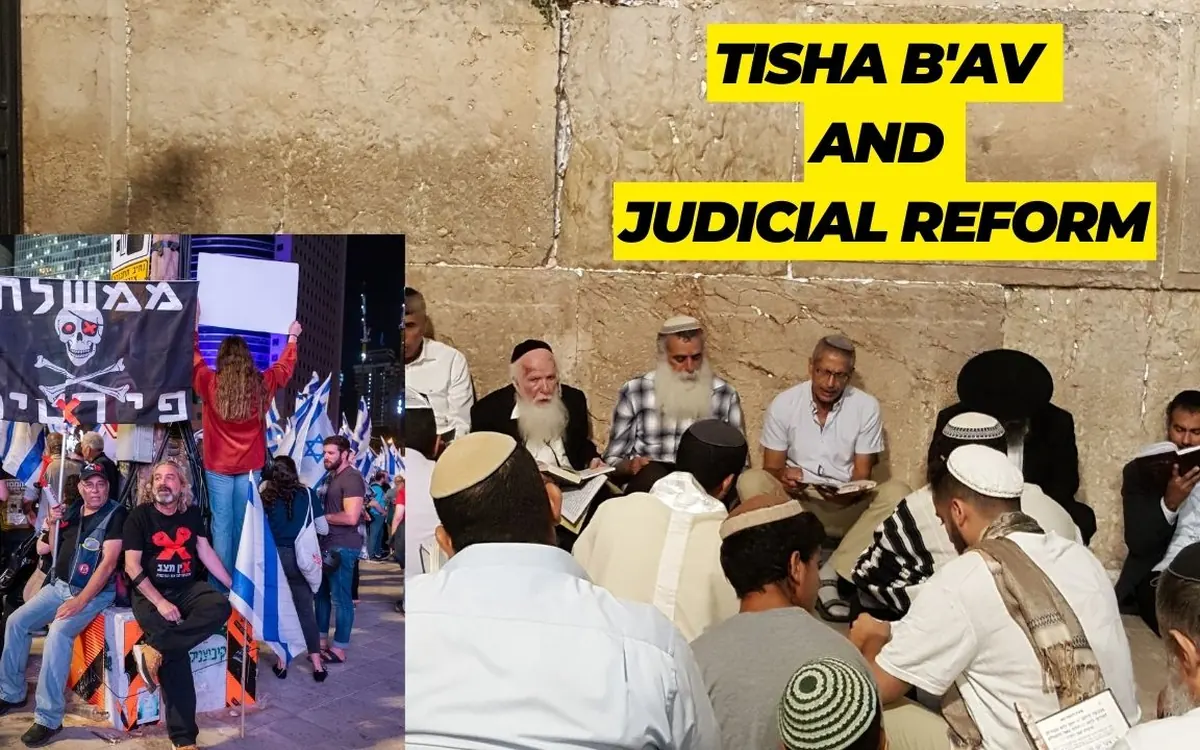
The Israeli Judicial Reform protests come the same week 18 years after the Gush Katif protests and 2,000 years after the destruction of the Holy Temple in Jerusalem. What can we learn from Tisha B'Av and the Nine Days about modern Jewish and Israeli unity? Sometimes the echoes of history are so loud that they seem to drown out the present. This conversation with Rabbi Aaron Leibowitz, former Jerusalem City Council member, was recorded in Jerusalem at a Jewish unity tent with the sounds protesters in the background.
About this episode
The Jewish story is over, Rav Mike says, but not done, and he promises a live monthly class to come. For now he sits in a downtown Jerusalem park with his friend and teacher Rav Aaron Leibowitz as a human chain stretches from the Kotel to the Knesset. It is the week of Tisha B'Av, and what drew both men out was a call to stop a tear in the fabric of the nation. Leibowitz names himself a moderate who opposes the current judicial legislation yet agrees the courts have carried a bias that needs amending, and who distrusts a reform led by men with a personal stake in its outcome. The setting is surreal, a peaceful park behind which a crowd waves flags, and over it hangs the sense that a people given the chance to draw lines with one another may end up drawing swords.
What is different now, Leibowitz says, is that this reaches well beyond Israel. The right and left face off across the whole Western world, from Brexit onward, as two visions of where democracy is headed meet in something that feels existential. The rhetoric troubles him, the raised fist on the posters, the song that pairs democracy with rebellion, the demonization that lets the extreme voices be heard while the moderate ones are drowned out. Moderation, he argues, is the most hopeful path toward a God of many faces, touching as many distinct expressions as possible. When Rav Mike raises a student's claim that the prophets of Israel were the origin of religious intolerance, Leibowitz reads the prophets differently, as seers who hold up a mirror, and points to Isaiah speaking of social justice, where the turning away from God is the corruption itself.
Rav Mike presses on the word democracy, worried it has become a club in a raw power battle rather than a banner for a freer society. Leibowitz answers that we face a liberal fundamentalism, one of the two extremes that flatten the conversation to a single dimension, alongside a sincere fear that the rules cannot be trusted when the players will not keep them. Rav Mike recalls ending up in a police van eighteen years earlier at Gush Katif, where Ariel Sharon turned his party into a vessel for the opposite of his mandate while the court did nothing, and asks whether the real argument is less about democracy than about who gets to make the rules. The two agree that much of what happens today began then, and that the expulsion unfolded at this same season, history rhyming rather than repeating.
Both men circle the trauma beneath the streets. Rav Mike offers a working definition, trauma as the collapse of the distance between past and present, a formative wound that stays ever present and robs a person of the future, like a driver frozen at the wheel months after the crash. The Jewish people's trauma runs structural and unprocessed, which is why these ruptures tend to fall in the nine days. Leibowitz describes the Sabra tough on the outside and soft within, whose bottled pain comes out in inappropriate ways, and reads the reaction to the reform as an overreaction, a post traumatic response that lives with a sense of impending doom. He learned his own trauma during Corona, and he longs for freedom marches rather than blocked highways and a resignation to a long term process whose downs are part of the learning.
Asked for the optimistic move, Leibowitz admits he is at a loss, a painful place when people look to you for an answer, and holds instead to the things he knows are good, his work in private kashrut and chuppot, leading a prayer community, seeking conversations meant for listening as much as teaching. Something bigger is called for, hard to pull off without a person of heroic stature, and he confesses he has come back to Mashiach as a person, since without someone who embodies a vision and elicits trust he cannot see how the two sides come together. A heroic call echoes, he says, since it is too big to keep private. Avraham heard the Lech Lecha that God was calling to the whole world. They close on prayer, on faithfulness to one another, and on letting Tisha B'Av cry some real tears.
Key ideas
- In the week of Tisha B'Av a human chain stretched from the Kotel to the Knesset, and what drew both men out was a call to stop a tear in the nation.
- The right and left face-off reaches beyond Israel into the whole Western world, and moderation is the most hopeful path toward a God of many faces.
- Leibowitz names a liberal fundamentalism as one of two extremes that flatten the conversation to a single dimension.
- Gush Katif, eighteen years earlier at this same season, is where much of today began, history rhyming rather than repeating.
- Trauma is the collapse of the distance between past and present, and the people's unprocessed trauma surfaces in the nine days.
- Without a person of heroic stature who embodies a vision and elicits trust, the two sides stay apart, and a heroic call echoes because it is too big to keep private.
Chapters
- 0:00 Exile from forgetting; a park in Jerusalem
- 2:20 Tisha B'Av; a tear in the nation
- 3:27 Too far too fast; a moderate's doubt
- 4:31 Are we a people who draw swords?
- 5:35 Not only Israel; a Western face-off
- 6:40 Demonization; the drowned-out middle
- 7:43 The prophets and the mirror; Isaiah
- 9:57 Liberal fundamentalism
- 11:00 Gush Katif; who makes the rules
- 14:24 Trauma and the poor tool of activism
- 16:38 A missing person; Mashiach and the heroic call
- 18:51 Trauma as collapsed time
- 21:01 Impending doom; a powder keg
- 23:18 At a loss; the things that are good
- 25:25 King David's faith; real tears
Who, where and when
People
Rav Aaron Leibowitz, Rav Mike Feuer, The Baal Shem Tov, Isaiah, Ariel Sharon, King David, Avraham
Places
Jerusalem, The Kotel and the Knesset, Gush Katif
Texts
The first chapter of Isaiah, Lech Lecha, The Book of Psalms
When
2005 CE: the Gush Katif expulsion, 2023 CE: the Tisha B'Av protests
Read the transcript
As it is with the individual, so it is with humanity, said the holy Baal Shem Tov. Exile flows from forgetting, and redemption from remembering. Oh, Rebunash HaOlam, good Lord, I have not forgotten our dreams of redemption. Let it be soon, let it be now. So I know that the Jewish story is over, but it's not done by a long shot. Those of you who are interested in staying part of that story, TJSLive monthly subscription is coming up. Send me an email, robmikefoyer at gmail.com or go to robmike.com or jewishstory.co and send me a message through there. I'm happy to help you sign up. when the time comes in the fall to be part of a weekly class that's live, recorded, audio and video, to get some thoughts from me as I am interviewed by my good friend Eitan in a series of explorations of the deeper parts of history we didn't get to touch, and maybe some other unexpected surprises.
So stay tuned. More is yet to come. Meanwhile, here's a taste of what's happening in the streets of Jerusalem today. Don't get too excited. Those of you who have been thinking that maybe you'd get me back for an encore in the Jewish story, that's not exactly what's happening here. But what is happening is very exciting to me. Because I'm sitting in downtown Jerusalem with a dear friend, a teacher, a mentor, and dare I say, a bit of a heroic personality here in our fair city. No pressure at all. But, Rav Aron Leibowitz, welcome to my world. Wow, Mike. Rav Mike, it's such a pleasure to be here with you. And it brings back so many memories. Also, share friendship at a really intense and difficult time. Yes, well, and unfortunately what brings us together is another very intense and difficult time, because as I look behind me, it seems that we may be succeeding in stretching a human chain from the Kotel to the Knesset.
Toward what end is exactly what I actually wanted to speak to you about now. So people don't know, there's been a bit of turmoil in the streets of late in Klal Yisrael, and there's arguments that cut, I would say, almost every single social division that we could put our finger on at this point. And here we are, I think both of us, I won't presume, I'll say I was drawn here, because there was a call to stop a split, a tear within the fabric of the nation. And of course, is the week in which Tisha B'Av falls out. That was enough to get me out of my hiding and avoidance of what I feel to be messy, complicated, and let's just see far from clear side-taking in our society. What brought you here? The same thing.
we've been going through months of very violent emotionally violent vocally violent protests people are people are very afraid people are very angry in the face of what they perceive as a threat to their core values when you say they are you speaking about one side or another at this point? I'm speaking right now about the protesters against the opposition to the judicial reform. And I've actually had a really hard time getting myself to go out to those protests, even though I am opposed to the current form of the legislation. I and many others agree that there are amendments that need to be made to the judicial system, and there are mistakes that have been made. The courts have had a bias, which has affected their judgment.
in the past. And at the same time, the current legislation goes too far too fast as far as I'm concerned. It's not considered. And I have very little faith when the people at the helm have a personal interest and a personal stake in the outcome that it's being led in good faith. That's an important point I want to put my finger on because you have experience in real politics in our country. I mean, here we are in this beautiful park in the middle of Yerushalayim, which is a little bit surreal, don't you feel? It's like, what could be more peaceful than where we're sitting right now? And we look behind us and we see, what is a peaceful group of people waving flags and holding hands? And it just feels so normal.
And yet, here we are in the week of Tushaba Av, on the edge of what some people are not only calling but encouraging to be a social revolution. It feels so normal. I veered from the political point just because I got overwhelmed by the environment. But your experience in politics, is it just a problem in the system? Are we a people who, when given the opportunity to draw lines with each other, we're just going to eventually also draw swords and face off? I mean, I ask this because it really feels like history is repeating itself right now. Well, I think what's different about our current times is that this isn't something which is only happening in Israel. When you ask, are we a people? We're going through our own moment, but I think that many North Americans can deeply identify with this right and left face-off, which seems to be existential, certainly ideologically existential, and maybe even existentially existential.
It's the sense that the Western world, that democracy has reached a face-off between two diverse visions of where we're headed. And this was true in the United Kingdom with Brexit. And it's been the story of world history, at least in the West, for a decade. And I think that it touches upon some very deep things. and I think that, you know, when you say, are we going to face each other and draw swords, I think that was your expression, that was your expression you used. Drawing lines. My question is, is it an inevitability toward drawing swords? I mean, listen, there's not for naught that we fast for five things on Tisha B'Av. Two of them are the destruction of two different temples. And the divisions in our people have a, there is a trope.
Two Jews, three opinions. Yeah. Well, that's the reason it's been hard for me to go to the protests. The rhetoric, and I would say even the posters of the advertisements on the press with an upraised fist, the sing-song that's been going on at the protests, not because I've been there, but because I've been told, O Demokratia Omeret, which is a popular song that's been adopted, which means democracy or rebellion, certainly raised the question of where are we headed. There's a demonization of the other side. There's a stereotyping of the other side. In other words, the voices that are heard are the extreme ones, and then the entire camp gets painted with those extreme stereotypes. Yeah, and the nature of our media is beating on that.
And the ones who are drowned out, the voices that are drowned out are the moderate voices, and that's my camp. Um and um you know I think you know we could speak about why I think that moderation is actually a compelling approach to a monotheistic God a God who you believe has many faces Moderation I think is the most hopeful path to touch as many of those distinct expressions as possible. It's funny you say that, because I had a student once who said to me that the prophets of Israel, great advocates of monotheism that they were, or let's say great advocates of one God. I'm not so fond of the monotheism thing, but said that they were the origins of religious intolerance. I mean, in fairness, before that, everybody's god was their god.
You do your god, I'll do mine. Mine might be bigger than yours. We might go to war over it, but explicitly sort of like denying existence and significance and labeling as wrong and set for annihilation. Maybe it's just in our kishkas. I can hear that. I can hear that, but it's not how I read the prophets. I read the prophets as, the prophets' role is to hold up a mirror and show us ourselves. It's not, the prophets aren't a camp within the people. The prophets are removed. They're seers. And as being a seer, your role is to see something and then reflect it back. And, you know, having somebody who's divinely inspired to reflect back where we are at. You know, we just read this, we read the first chapter of Isaiah, of Yeshayahu this past Shabbat.
And it's beautiful in that chapter because we know that while Isaiah lived, there was idolatry going on. Lots of it. Lots of it. But in this chapter, what Isaiah speaks about is social justice. And the only references that could perhaps be taken to be an idolatry are references about the fact that we've strayed from God and we've turned away from God. But I think if you read the pshat of the verse, being as idolatry isn't mentioned, that the corruption and social justice issues, that is in and of itself the turning away from God. I hear this. I want to use it as a springboard to go back to the term you brought up the other day, which is getting increasingly loaded, and that's democracy. This idea that there is a social construct, a governmental system, a way to run our country, nobody questions that democracy is the least bad option that's been evolved over the last hundred years.
But the co-option of that term in the tension you said in democracy or rebellion, the use of certain tools like blocking roads and the engagement of the army in refusal. I wonder if that very term has become a club in a fight whose angle isn't a more free society. Do you ever get that sense that there's a raw power battle going on out there in the streets right now? I think that we are facing a liberal fundamentalism, And that voice is one of the two extremes which I was speaking about. The fundamentalism, both on the right and the left, are very powerful. And they negate a more moderate and complex articulation of values. And they sort of flatten the conversation and the playing field, turn it one-dimensional.
And I think that democracy in that respect is being used that way. And at the same time, I think that there is a sincere concern for the trust in the compromise of a democratic system when you're facing a government which is largely fundamentalist and orthodox and has very extreme elements in it. I think that there is the fear that the rules of the game, I can't rely on the players playing by the rules. And I think that both sides feel that there's been a breach of contract. Yeah, it's a little bit hard for me to... Listen, the last time I went to anything like this, I ended up in the back of a police van outside of... They dropped us out of Ofakim because we tried to get through Tzirk Yusufim, through the entrance to Gush Katif.
And that was a time at which the rules were tossed completely out the window, right? I mean, you had Ariel Sharon, who I voted for, take his entire party, transform it into a vessel for his agenda, pursue exactly the opposite of what he was elected to do. The country applauded. People who even spoke about refusing were labeled as traitors. The court apparently saw it as completely reasonable, because they never did a thing to stop it. So it's true that there's a sense that facing a religious majority who have very different priorities and values and worldviews, and yeah, extreme elements, that I can imagine why a good chunk of the country feels nervous. But to say that they feel that the rules of the game have changed now indicates that they felt like what happened in 2005 was okay in the rules of the game.
And that's my point, that we're not talking that about democracy. we're talking about who gets to make the rules I think that I think that Gush Khatif is a really important event in this story and I want to point out that those events unfolded at the same time of year as we're in now that's what I'm saying when I say you know history may not repeat itself but it sure does rhyme last time I was out it was literally today 18 years ago yeah literally today I checked the calendar actually yeah and someone in Sharon's office finally woke up to the fact because then it was almost an entirely secular government, and no one realized that they'd actually scheduled the final expulsion for the day of Tisha B'Av.
And they were able to move it back by one day, but it was too much locked into the calendar to actually change the season. Yeah, so I would say that my sense around that is that a lot of what's happening today began then. My inner voice, when I face that, tells me, like in my father's voice two wrongs don't make a right and there also I was very opposed and I didn't go to Gush Katif and I think there is a place where when you have a moderate voice you feel like I want to speak about myself as having a moderate voice and the multitudes who are deeply engaged in these issues are not really open to hearing a voice of moderation And I think we discussed once, a few months ago, we discussed the trauma response, the trigger element of what's happening over here and how activism is a poor tool when you're facing a post-traumatic response.
Because when you push somebody who's traumatic, then they push back. They're not open to hearing anything. You're not sharing the same reality. And I really want to dig a little deeper on that because I do recall that conversation was important to me. What I have been doing is I think there a lot of people who are feeling similarly alienated by what unfolding and they very much in need of the moderate voice And that why I really treasure opportunities for conversations like this because I think there are people out there or maybe even caught up in the drama of what unfolding but might have questions about, like, is this extreme response taking us to a constructive and good place? you know, the religious Orthodox camp faced years of depression following the Gush Katif event I remember it well and part of that depression was born of the fact that they experienced the crumbling and disaster and thank God they had religious leadership who were able to see them through that and give them a vision I'm not sure that the Israeli left have that kind of leadership but I think that Amis what it'll do.
And I feel like that's an important role for spiritual leaders. I hope so. So they had religious leadership. They also had political. It's important to note. Meaning in another way, what we're looking at is a result of Gush Katif because there was a political organization and an intense focus on getting elected that followed. And over the last 18 years, lo and behold, the children of Gush Katif, so to speak, are running the government or significant elements within it. And that's actually one of the things I worry about most in a democratic hopeful society here, which is that if even the more radical elements are taken down by what is essentially non-elected force here, it could happen through a democratic process, I don't know, but we're looking at an attempt by even hundreds of thousands are not enough to get the mandates to win the government.
So if they're taken down, then what's left to the community that I really see myself part of? It's like, we protested. They threw us in jail, and that was reasonable. Then they uprooted, and they took away security, and that was reasonable. And then we said, okay, we're not going to quit. We're not going to take our ball and go home. We thank God, have leadership. And now we have votes in organizations, and apparently we can't do it that way either. What's left? I think that there's a... I mean, I have a big question about where do we go from here. I want to be honest about that. I feel that the crisis that's brewing has a lot of potential, a lot of potential to be a crucible from which a different vision or some kind of different wisdom is born and I'm praying for that, to get a taste of that and I don't have clarity on that I do, what's clear to me though is that we need we need some sort of voice of inspiration I feel like that, when I look at these protests I think to some extent what's missing maybe I'll say something here and I don't remember if I've shared this with you before of Mike for years I was really disenchanted with the idea of Mashiach being a person Mashiach became a metaphor in my mind it's easy for that to happen and today I really look around me and I say without a person without a person to inspire the masses and I think about Gandhi and Martin Luther King and Ben-Gurion and Golda Meir and Begin and Moshe Rabbeinu Moshe Rabbeinu, David HaMelech, without a person who can not only bring a vision, but who can embody it and make it tangible for people, and illicit trust, I just don't see how you bring these two sides together.
And so I'm going back and saying, you know, really there's like a very core basic human wisdom that is there in the fact that we have this concept of Mashiach, that it's going to be a person. There's this understanding of how people work, simply. It's a recognition of the heroic call. is that humanity is capable of way more than we deem ourselves. But we need to be called to it. And I think that you don't have an abstract call, right? That's what the Swasemist says about Abraham Avinu. What was so great about Abraham Avinu in Lech Lecha that he suddenly pops up and God starts promising to be the great people and the land. We don't hear anything really about him before. The answer is that God was calling Lech Lecha to the whole world all the time.
Abraham heard it. He heard the call. and that's where the greatness in humanity comes from. He heard the call and also the Midrashic character of Avraham was also a charismatic leader. He was able to inspire people to follow it. A heroic call echoes. You hear a heroic call, you start calling to others. A truly heroic call is nothing private. It must be shared because it's bigger than me or you or any person hearing it. I don't want to miss the trauma opportunity. I'm also jealous of your time because I think it's so important to emphasize. First of all, tell me if you find this a working definition of trauma. To me, the idea is that the distance between past and present collapses. There was some formative experience that you can't.
It's not getting past it. It's ever-present. And therefore, it robs you of the future. Like the person who has a, God forbid, car accident, who six months later thinks they're over their trauma. He goes with the key in and boom. And they can't drive their car. they can't get to the future they want. And I think that piece of what's happening in the streets right now is so strong, I don't even know where the healing could begin. Yeah, I think definitely that connects with the fact that these things tend to play out during the nine days, during Tisha B'Av. The trauma of the Jewish people runs so deep. It's structural. That's right. And it's unprocessed trauma. Maybe I'll just say something about Tisha B'Av which is coming up.
I feel like the deep work of crying on Tisha B'Av is really meant to give us an opportunity to process the trauma. And it's interesting, the image of the Israeli, the Sabra, who's tough on the outside and soft on the inside, served us well for the founding phases of our process. But when you're tough on the outside and you're soft on the inside, it also means you're not showing your pain. your pain is bottled up and you might even be denying it yourself to some degree you must be that's right and then it comes out in inappropriate ways and that's while I feel that the fear of the reform of the electoral reform is serious and significant and worrisome I feel like the reaction has been an overreaction.
It's a traumatic response because, I mean, my work is activism. What I do is I do things that are ostensibly illegal anyway. You just stretch the law. In my fight against the Rabbanut, the monopoly in Kashrut, the monopoly in marriage, grassroots activism is so hopeful and this sense that's been created that everything is defined by the court. Everything is defined by the Knesset. If we don't control the Knesset and we don't control the court, the world will end. That is what happens when somebody is post They live with this sense of impending doom that the world will end because as soon as your danger meter starts going off you intuitively know that it going to end as badly as you can possibly imagine and i was blessed to become very deeply acquainted with my own trauma during corona during the covid crisis and it was a blessing and i see the world differently now and i and i'm able to i shouldn't say i'm able to that's presumptuous because maybe i'm not diagnosing correctly but my my feeling is is that when i look around and i say this is an overreaction.
And what I would want to see are freedom marches, not blockings of highways. And I would want to see a certain resignation to the fact that the current government may very well do something, which I don't like, but we're in a long-term process. And there's learning that needs to be stewarded during the ups and the downs. And the downs are part of the process. And even if we speak about the extreme situations where the unprivileged will be disenfranchised and lose basic human rights. Well, the world has been there before. That is part of the human experience. It's there in many places now. And instead, we're creating cataclysmic energies, which could lead to who knows what. I really think there's a powder keg here.
I think we could face another political assassination. We could face a terrorist act within the Jewish people. And that's why I'm out here today. We're watching the, kind of just sort of share with the listeners, we're watching the line, the human chain from the Kotel to the Knesset dispersing slowly. And what brought me out today was the call that this is really a prayer. And first of all, I feel like prayer is a very appropriate response. Mamesh. Prayer is the one call that I will always respond to. And today there was a call to prayer at the Kotel. and it was also a sense of let's reignite our trust and the possibility of compromise and brotherhood. You said something so important and almost practical in a weird way, which is that activism is hopeful.
Optimistic. It's optimistic, actually. Thank you. It's optimistic, whereas the Trump response moves toward the cataclysmic and that's what really indicates that it's not hopeful. So what's the optimistic move right now? facing a country which really probably percentage-wise has more PTSD than any other non-war, I mean, like, you know, you could go to the South Sudan or something, God forbid, but the clinical level on the streets. And then you add to it, like you said, the structural trauma of the Jewish story. So what's the optimistic action that you would call people to now? Yeah, I'll tell you, I feel very much at a loss, and that's a painful place to be in, especially when people look to you for an answer to that question.
That's why I'm asking. And I feel at a loss. Not that I don't know things. There are things I know are good. And thank God, because the fact that I know that there are things that are good, like my work in Chupot, like my work in Ashka HaPratit, like leading a prayer community. Like being a Saba. Like being a grandfather. Malzah, malzah. Amen, thank you. looking for opportunities to speak with people, to have conversations, with the goal not only of teaching, but of learning and listening. And at the same time, something bigger is called for. It's really hard to pull off unless you're a person of heroic stature. Yeah. So I feel like, you know, today in Shavara Yisrael, praying in the silent to give us the kind of judges and the kind of counsel that we had once upon a time.
And some might view that as romantic. History has always been complicated. But we have heroes in our inner history, as we mentioned before. Personally, I very much look to King David. I want to point out that when King David had a rebellion, faced a rebellion, he left. he left it was his son and he left and he had a faith that if he's meant to come back he'll come back and that was also a weakness in his leadership and it fostered some unhealthy processes which his son had to deal with but with his which Solomon had to deal with but David the foundations are built by somebody who's able to inspire massive amounts of people and someone who doesn't feel threatened who's not afraid who places, he basically says there's a deep sense that Hashem runs at the show.
So this morning before Shecharit I got to the Kotel a half an hour early to say to Helem because the Psalms that David wrote are so full of that. I feel like being hopeful. And I would even say to the Israelis who don't have a God that they believe in to trust, then trust people. Trust the human intuition. Trust humanity. Let go of the need to force tikkun, to force reparation and reinstore your faith that process. I feel like this is something that Heschel and King there wasn't a sense that we have to the non-violent protest is about believing that you have the power to inspire and not trying and not frantically aspiring to force by strength. Humanity can change and grow and doesn't need to be remade in your image.
That's right. If it doesn't happen now, it will happen at the right time. Let it happen soon. Let it happen now. I mean, here we are at the middle of the nine days and I'm grateful to take the time to just be together in this moment and people can hear in the background the honking. There's still... There's an energy in Jerusalem which if you can't be here, you should pray for the peace of because when the center holds, then the world, I think, in the long run it's going to be okay. So I want to echo your call for prayer, your call for Muna, not just faith, but faithfulness to one another. And I want to thank you for taking the time to speak. Any last words for the folks out there? Just thank you for this opportunity.
Let's Tisha B'Av cry some real tears. The tears that are latent inside of us and wanting to come out. You know, every real tear that's shed is an appropriate response to the pain, which opens up a space for us to be considered and walk with care in choosing our steps and responses. Amen. Rav Aaron Liewitz, thank you so much for being my friend and for being together with me here. And Shem Yishmarinu. Amen.