
Season 2: Episode 27 - The Anglo-Zionist Alliance
World War One brought massive destruction and great change. When the smoke cleared from this great conflagration, the British Empire was left in control of the land of Israel. This seemed to be good news for the Jews, except that Her Majesty's government had promised this particular piece of Ottoman territory to three different parties.
About this episode
The dreamers of the day are dangerous men, said T.E. Lawrence. Beyond private property lies the question of a people's legitimate claim to a land. Legality only pushes it back a step, to faith in the legal regime, and the Jewish claim will be bound up with the first structures of modern international law, weak between the wars when seizing non-European land was still legitimate. Historic occupation sounds compelling until Rav Mike's Harvard dialogue partner, a Palestinian-Jordanian, swore he would not forget Palestine in a hundred, five hundred, two thousand years, which is precisely what he was dealing with. Indigeneity is the trump card of the post-colonial order and a slippery slope: no people sprang from its ground, the French descend from Germanic invaders, might plus time apparently makes right, the Turks came from Central Asia, and the Arabs reached Palestine, a name Hadrian invented to erase Judea, with Omar in the seventh century. The discourse of indigeneity borrows its categories from the colonialism it fights, native once meaning primitive and now meaning cool. Israel's own story is not indigenous: Abraham was told to leave Ur, and the tribes were told they would dispossess seven nations and drink from wells they did not dig. Sovereignty is full right and power over oneself without outside interference, each term a problem: legitimacy, the power to back a claim, and freedom from interference in an interdependent world. Since Herzl, Zionism has mixed one more dunam with the search for a patron.
In college the dining-hall debate on history's greatest idiot settled on Gavrilo Princip, whose one bullet killed tens of millions, until Rav Mike learned that the war was the breakup of multi-ethnic empires and the rise of the nation-state, which made Princip perhaps a genius. Allies against Central Powers: Britain's alliance with the hated Tsar kept many Jews from fighting for her, many founding Zionists were German, and Jews fought on every side but the Ottoman. The Zionist Organization declared neutrality and moved from Berlin to Copenhagen, taking itself off the field; Poalei Zion resolved to stay and Ottomanize and offered a Jewish force, and the Ottomans answered by banning Hebrew signs and Anglo-Palestine banknotes, forcing Russian nationals to flee or naturalize, and in Jamal Pasha's expulsion of foreign subjects from Tel Aviv and Jaffa, eleven thousand shipped to Alexandria. Others saw opportunity as Britain's star rose. Three documents set the board. The McMahon-Hussein correspondence, ten letters from July 1915 to March 1916 between the Sharif of Mecca and the High Commissioner in Egypt, promised Arab independence for revolt, with Lawrence sent to foment it, excepting portions of Syria west of Damascus, Homs, Hama and Aleppo, a vagueness that may or may not have excluded the land of Israel. Then Sykes-Picot, May 1916, secretly divided the empire between France and Britain with Russian assent before the war was won, out of greed and fear of clashing allies, and sliced the Palestine province five ways: a French wedge at the Jordan's headwaters, the Golan under French-protected Arabs, the heartland from Jaffa to Gaza as an international zone, Haifa and Acre red for a Baghdad railway, and the south with Transjordan under British-protected Arabs. The Yishuv was not mentioned; Weizmann called it fatal, a Solomon's judgment with both halves mutilated, Sacher wrote that they had been lied to all along, and Lawrence himself wrote that Britain's Mesopotamian administration was a disgrace near disaster. Britain would double-cross that bridge when it came to it.
Chaim Weizmann, born in Belarus in 1874 with twin passions, chemistry and Zionism, joined Chovevei Zion in 1890, took a Berlin doctorate, attended the Second Congress, and with Buber in 1902 wrote the blueprint for a Hebrew University whose cornerstone was laid in 1918. Devastated by Herzl's death, he moved to Manchester in 1904 as a lecturer and within a year met Arthur Balfour on the campaign trail; Balfour had backed the Uganda offer and dropped it when the Sixth Congress refused. Meeting again in 1916, Weizmann asked whether he would give up London for Paris, and when Balfour said the British had always lived in London, answered that we lived in Jerusalem when London was a swamp. A poor speaker and a phenomenal conversationalist, naturalized in 1910, he practised synthetic Zionism, settlement plus high politics, one more minister, one more cabinet secretary, and found his fiercest opposition among the assimilated Jewish elite who feared dual loyalty, and his deepest support in Christian Zionism, rooted since Menasseh ben Israel and renewed by the dispensationalists: Shaftesbury, who wanted conversion first, and Hechler, who introduced Herzl to the Kaiser and held that Christians were destined simply to restore the Jews. Balfour and Lloyd George were both raised evangelical. And chemistry: the Weizmann process fermented acetone for cordite when the German supply was cut, put shells back in British guns, made him the father of industrial fermentation, and, they say, made Lloyd George a Zionist.
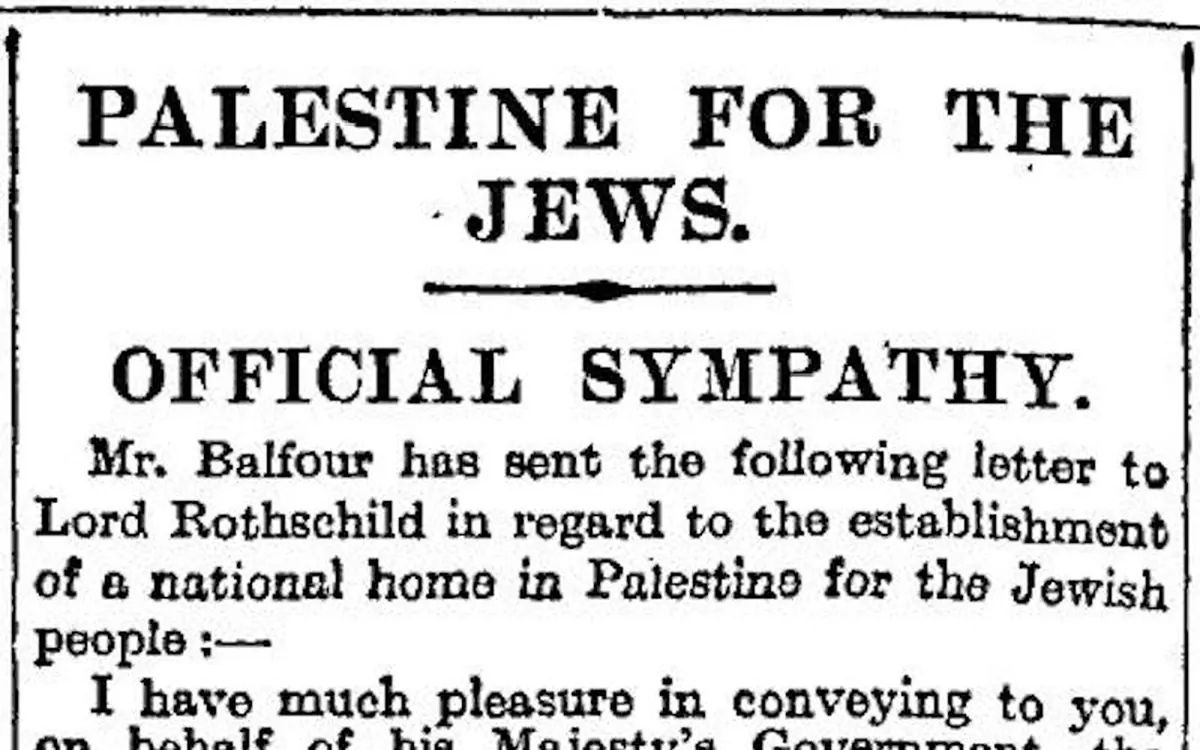
Zionism first reached the cabinet days after war with the Ottomans, raised by Lloyd George; Herbert Samuel, a secular Jew in cabinet and later first High Commissioner, told Weizmann his demands were too modest, railways, harbours, a university, perhaps a rebuilt Temple in modernized form, and circulated The Future of Palestine proposing conquest to guard Suez and to make a Jewish home. The myth of world Jewry's power became a real factor in 1917, when Russia wobbled after revolution and America hesitated, and ministers believed the Jews could keep one in and bring the other. Lloyd George, a maximalist who saw no reason to honour France when Britain paid in blood, became prime minister in late 1916 with Balfour at the Foreign Office, and Mark Sykes, author of the secret agreement, took Middle Eastern affairs in the war cabinet and began private talks with Sokolow and Weizmann, squaring Picot and the French, while Balfour in America worked with Brandeis for Wilson's support. In July 1917 Balfour invited a draft: Palestine reconstituted as the national home of the Jewish people. After rewriting to protect British prerogatives, on November 2, 1917 Sykes emerged from the war cabinet with the ink not dry, a letter to Lord Rothschild handed to Weizmann: His Majesty's Government view with favour the establishment in Palestine of a national home for the Jewish people, nothing to prejudice the rights of existing non-Jewish communities or of Jews elsewhere. Sixty-seven words with contradictions in them, a home in Palestine rather than Palestine as the home, and a majority whose rights are not to be prejudiced, which would break the relationship within three decades. For now, a clear promise.
Chaos precedes creation; the seed rots. The Paris Peace Conference of 1919, like Vienna a century before, sought a balance of power, punished Germany with reparations without the occupation that forces a national reckoning, bitter enough to try again, and built on the nation-state as the unit of world society, with the League of Nations, the UN's first draft, naming the new ideal of national self-determination. Its mandatory system treated the peoples of the Ottoman and German possessions as proto-nations to be shepherded by the victors, noble and too close to empire, and among the Class A mandates was Palestine, entrusted to Britain, which held it. Of the three promises, the French one was reneged before conquest, the Arab one depends on reading McMahon, and the Jewish one, a letter to a private citizen, became the law: the mandate text puts the Balfour Declaration into effect and recognizes the historical connection of the Jewish people with Palestine and the grounds for reconstituting their national home, with Weizmann in Paris to make it happen. No greater source of legitimacy, and yet the Arabs saw a piece of land that was not Britain's given to a people who did not live there, and the machinery of empire that reopened the door welded a colonial image of the Jews into the Arab mind, easy to sell to every nation emerging from empire. Balfour himself wrote in Sokolow's History of Zionism that no one proposes Buddhist colonies in India, because the Jewish case has no parallel: race, religion and country interrelated as nowhere else. Models may fail where there is no precedent. And the first Rashi on the Torah: it begins with creation so that when the nations call Israel robbers of the Canaanites' land, Israel can answer that the whole earth is God's, who gave it to whom he pleased and took it back. Not words for the UN or the mandate, but if you cannot look your own story in the face and find its legitimacy, no one else will either.
Key ideas
- Legality, historic occupation and indigeneity each push legitimacy back a step; Israel's story is not indigenous but a command to leave Ur and dispossess, and sovereignty is right, power and freedom from interference.
- Princip's bullet broke the empires; Britain promised the Ottoman spoils three ways, to France at Sykes-Picot, to the Arabs through McMahon, and to the Jews, and sliced Palestine five ways without mentioning the Yishuv.
- Weizmann's synthetic Zionism added one more minister to one more dunam, met its fiercest enemies among assimilated Jews, and found allies in evangelical dispensationalism.
- Acetone for cordite made Lloyd George a Zionist; the myth of Jewish world power, Samuel's memo, Sykes and Brandeis did the rest.
- Sixty-seven words of November 2, 1917 promise a home in Palestine while guarding a majority's rights, a contradiction that would break the alliance within thirty years.
- The League's mandate turned a letter into law and recognized the historical connection, and also welded the colonial image of the Jew into the Arab mind.
Chapters
- 0:00 Dreamers of the day; what makes a claim legitimate
- 2:10 Historic occupation: I will never forget
- 4:16 Indigeneity: the slippery slope
- 7:32 A product of colonialism; Israel's non-indigenous story
- 9:37 Sovereignty: right, power, no interference
- 10:41 Princip: idiot or genius
- 12:51 Jews on every side; neutrality and expulsion
- 16:12 McMahon-Hussein and Lawrence
- 19:20 Sykes-Picot: Palestine sliced five ways
- 22:39 Fatal to us; double-crossing the bridge
- 23:44 Weizmann: chemistry and Zionism
- 25:54 Manchester; London was a swamp
- 28:02 Synthetic Zionism and the assimilated opposition
- 30:17 Christian Zionism: Shaftesbury, Hechler, dispensationalists
- 33:29 Acetone wins the war
- 35:40 Samuel's memo; too modest
- 37:50 1917: the myth of Jewish power
- 38:58 Lloyd George, Balfour, Sykes, Brandeis
- 41:10 Sixty-seven words
- 43:23 Paris 1919 and the League
- 46:37 The mandatory system
- 48:45 Which promise became law
- 50:56 The colonial image welded
- 52:00 Balfour: no parallel; the first Rashi
Who, where and when
People
Chaim Weizmann, Arthur Balfour, David Lloyd George, Mark Sykes, Francois Georges-Picot, Sir Henry McMahon, Sharif Hussein bin Ali, T.E. Lawrence, Gavrilo Princip, Herbert Samuel, Nahum Sokolow, Louis Brandeis, Lord Walter Rothschild, Harry Sacher, Lord Shaftesbury, William Hechler, Jamal Pasha, Martin Buber, Marwan Daoud Hanania
Places
Manchester, Alexandria, Haifa and Acre, Transjordan, Paris, 1919
Texts
Seven Pillars of Wisdom, The McMahon-Hussein correspondence, The Sykes-Picot Agreement, The Future of Palestine, The Balfour Declaration, The Covenant of the League of Nations, article 22, The Palestine Mandate, History of Zionism, 1600 to 1919, Rashi on Genesis 1:1, Psalm 111:6
When
1874 CE: Weizmann born, 1904 CE: Weizmann to Manchester, 1914 CE: Jamal Pasha's expulsions; Zionism first in cabinet, July 1915 to March 1916 CE: McMahon-Hussein, May 1916 CE: Sykes-Picot, November 2, 1917 CE: the Balfour Declaration, 1918 CE: Hebrew University cornerstone, 1919 CE: the Paris Peace Conference, 1922 CE: the mandate confirmed
Read the transcript
All men dream, but not equally, says T.E. Lawrence. Those who dream by night in the dusty recesses of their minds wake in the day to find that it was vanity. But the dreamers of the day are dangerous men. They may act their dream with open eyes to make it possible. Now I'm trying to keep my eyes open and watch as my dream unfolds around me, because I'm Rav Mike Foyer, and this is The Jewish Story. Episode 27, The Anglo-Zionist Alliance. So we spoke last episode about land ownership, and we had that musical chairs metaphor, the idea that for most of human history, land was owned by taking it, but that at a certain point, everyone stopped the music and squatted on whatever piece they could grab and wrote their name on it.
But today, we need to take our discussion into a somewhat deeper and broader plane than that of simple private property. Because the question that we have at hand is, what are the sources of legitimacy for a people's claim to a land, for a national claim to a national home? Now, one perspective that the world brings to bear on this question is that legitimacy and legality are synonymous. So long as a people has a right legal claim to the land in which they reside, they're the legitimate inhabitants, and therefore the legitimate ruling power. That sounds good. But the problem with this is that it simply pushes the issue back one step, because now we need to establish the legitimacy of the legal system to which a people points in order to support their claims.
And the strength of a legal claim to be the legitimate ruling power over a piece of our planet basically becomes only as compelling as one's faith in the regime of law on which that claim is based. In the coming phase of the Jewish story, we're going to encounter the astonishing fact that the legal claims by the Jews to be the legitimate ruling power over the land of Israel are actually bound up with the very emergence of the first structures of modern international law at all. And if you look around the world today, and you think that international legal structures are somewhat weak and illegitimate, just imagine what they were like between World War I and World War II, when most of the Western world still saw it as a legitimate act to seize any piece of non-European territory they could and call it their own.
Hence, all the battles between the Arabs and the Jews to this very day about who is the legal power between the Jordan and the sea haven't really gone anywhere. And that's without even considering the fact that the coming phase of our story is fraught with the cross-currents of empire and colonialism as they affect international law. So that's one piece. But aside from questions of legality, historic occupation, and yes, I use that word deliberately, is often viewed as a source of legitimacy for a people in its land. I mean, it's ours because we've always been here, does sound like quite a compelling argument. But I want to tell you a story. It's a story. When I was actually at Brandeis University, I spent quite a bit of time at Harvard as well.
And during the beginning of the Second Intifada, or as some of us call it the Second, or rather the Oslo War, there was a group of us that got together and began an interfaith international dialogue to try to just talk through some of the issues that had come up. It was myself, a few other Jews, there was a Syrian student, a Palestinian student, and there was someone who called himself a Palestinian Jordanian, the good old hyphenated identity. His name was Marwan Daoud Hanania. And once, when we were in the middle of this argument, he spoke about what it was to be a refugee. And he said, you know, I will never forget Palestine. I said, really? How about in 100 years from now? No, I'll never forget. About 500 years from now.
never, never, we'll never forget 1,000 years? No, you can't make me 1,500? No, 2,000 years, you wouldn't forget your land? He said, absolutely not. And I said, well then, that's precisely what you're dealing with. Because for 2,000 years, we've been wandering far from home, and we haven't forgotten. And that tells us that just because a people is sitting upon a land doesn't necessarily establish a legitimate claim to be its inhabitants, which is connected to another more encompassing concept that has gained a lot of legitimacy as a source of legitimacy in our day and that's indigeneity. The claim to be the native people, the indigenous people of a place is the trump card of legitimacy in the post-colonial political order because if you're not from here, you don't get to make the rules and furthermore, since your brief stay as a foreigner in this region was brutal and exploitative, your only role is to lend your moral and financial support to the reconstruction of our indigenous culture.
And like I said, at first glance, this looks like an irrefutable argument. I mean, why should the Europeans have any legitimacy in the fact that they happen to fight their way into the southern portion of the African continent or Australia or South America and just call it home? And even if they stick around for hundreds of years and develop a local culture, they can call themselves Afrikaners all they want, but it's pretty clear at first glance they're not from around here. But you have to be aware that the indigeneity model legitimacy is a classic slippery slope. There is no such thing as a people that sprang up out of the ground, which it calls home. And we can go as far back as the people that crossed the land bridge between eastern Siberia and North America during the last Ice Age, or as recent as the European immigrants who slaughtered their descendants and brought forth a new nation conceived in liberty on the very same continent.
I mean, what makes the French legitimate occupants of France? After all, they're descendants of Germanic tribes that poured out of northern Europe in late antiquity. And if you tell me, yeah, yeah, but that happened long ago, well, I refer you back to my discussion with Marwan. And I'll point out to you that what you're really saying when you say that happened long ago is that if I hold out long enough now, no matter how I got the land to begin with, then it becomes mine. Might might not make right, but apparently might plus time does. So there are two examples of this problem of indigeneity that lie a little bit closer to the core of our story than America or France. The first is, are the Turks the native peoples of Turkey?
I mean, their history really is that of a nomadic invasion coming in from Central Asia. And of course, the empire that they formed, the Ottoman Empire, whose collapse we are about to witness, make the Turks a minority-conquering ruler, hardly an indigenous posture. And what about the Arabs in Palestine? Which, of course, is only called Palestine, because back in the 2nd century, the Roman Emperor Hadrian wanted to disconnect the Jews from their land in Judea by denying that such a place ever existed. If you've been following this story since Season 1, which you haven't, go on back and listen to it, then you know that it was actually Omar, the third Caliph, who brought Islam and the Arabs to the land of Israel, and that was in the mid-7th century.
Now, leaving aside the question of how many current Palestinian Arabs can actually claim descent from that original invasion, 1,200 years is a long time, but it doesn't make you a native. There's another piece to this, by the way, because in my opinion, the discourse around indigeneity is actually a product of the very colonialism which it claims to fight against. It was extremely important to the colonial powers, the European powers in Asia, Africa, and South America, to distinguish themselves from the natives, as they called them. And they used all kinds of tools of social exclusion and all kinds of pseudoscientific racial theories to do it. But whereas in the colonial era, to be native was to be primitive, backwards, and therefore undeserving of self-rule, today it's held out as the source of legitimacy not to mention as being cool and it's clear to me at least that there's a ripe social psychology there to be plumbed in the identification between oppressor and oppressed and it needs to be seen that on some level indigeneity is a construct which borrows its definitions from the very hated colonial structures against which it fights and this is why it fascinates me personally that our narrative, the narrative of Am Yisrael, the Jewish people and in particular of our relationship to the land of Israel, is not a story of an indigenous people I mean our father Abraham came from Ur-Kazdin his relationship with the land began with the command to leave where he was actually from in order to go there and when the tribes were approaching Eretz Yisrael after 40 years of wandering in the wilderness, God repeatedly tells them that the seven nations are living there and that we're going to dispossess them, that we will live in houses that we didn't build, drink from wells which we did not dig.
And why? Listen, we're going to have to discuss it in full at another time, but what the Torah offers as a source of legitimacy for the people in the land really deserves to be delved into. For now, let's put a term on all this talk, and that term is sovereignty. Now, sovereignty is defined as the full right and power of a governing body over itself, without any interference from outside sources or bodies. And that may sound simple at first, but that was actually quite a complex definition. There were a lot of pieces there. Full right, there's our question of legitimacy. The sources of which, as we saw, are not so clear. Power, well, this is just a reality, and probably will be until Mashiach comes. We all beat our swords into plowshares.
A legitimate claim without the power to back it up is nothing but a claim. Ask the Jews, we know. and that's why the rise of Zionism is so closely bound up with the question of Jewish militancy and power keep your eyes peeled probably next season for a bigger discussion on the nature of Jewish power because I'm going to need to devote some serious time to that and now's the time to remind you send me your questions, send me your topics tell me what you want to talk about next season you can send me to RobMikeFoyer at gmail.com or you can send me on Facebook just look for RobMikeFoyer so anyway, finally we have full right, we have power and we have without any interference from outside sources. That's sovereign.
And this is really the stickiest part of all. Because in a global society where economies are interdependent, where the environment clearly knows no boundaries, and where political legitimacy is expressed mostly by membership in certain international organizations, is anyone really free from outside interference? And does that undermine the idea of sovereignty? Now, the Zionist movement in the early 20th century had no such illusions. Since Herzl, the quest for sovereignty has been a mix of that pragmatic one more dunam, one more goat approach, and the seeking of a powerful international patron who can place us on the map. You know, when I was in college, we had a running debate around the table in the dining hall over who was the greatest idiot in world history.
And I won't bore you with all the options that we considered, but I will say that we finally settled on Gavrilo Princip, the 20-year-old Serbian nationalist, part of the Black Hand, whose assassination of the Austro-Hungarian Archduke Ferdinand triggered World War I. And why? Because with one bullet, this man killed tens of millions of people. But truth is, much later, when I was learning more about the complex dynamics of World War I, and about how much of its story is actually the story of the breakup of multi-ethnic empires and colonial possessions and the fading of the cosmopolitan ideal in the face of the rise of the nation-state, a process that began in World War I and really reached its culmination in post-World War II world.
Then I realized that, well, maybe Princip was actually the greatest genius ever. With one bullet, he changed the entire world. He brought the old order crashing down, and he paved the way, at least in theory, for the emergence of the state of which he dreamed. World War I is just too big a topic for us to take head on. But fortunately, for the sake of the Jewish story, there are just a few things that you have to know. First of all, remember that the war began as what we call the Allies versus the Central Powers. That is, France, Great Britain, and Russia on one side, and Germany and Austro-Hungary on the other. That's how it began. And that division is going to prove significant because when England appears as a potential wartime patron of the Zionist movement, her alliance with the hated Russian Empire is going to be a significant barrier to many Jews in fighting for Britain.
Not to mention that many of the founding members of the Zionist movement were actually German citizens. In fact, one of the great challenges that the war presents is that there are Jews fighting for more or less every power, with the notable exception of the Ottomans. At the opening stage of the conflict, a split actually developed within the movement. The official body, the Zionist organization that had grown out of the Zionist congresses, declared neutrality as an international body, and they moved their headquarters from Berlin to Denmark in hopes that neutrality would be respected. But, you know, when you're in war and you declare neutrality, you kind of take yourself off the playing field. The Poelei Tzion I hope you recall that that Marxist Socialist Workers Party that was the main political organization of the second Aliyah pioneers which though small in number will have a tremendous impact on the formation of the yeshuv, of the Jewish community there, and then ultimately the state.
They actually passed a resolution to stay in the land of Israel rather than to return to exile, and they wanted to Ottomanize, they wanted to become citizens of the Ottoman Empire. They even tried to gain support for a Jewish fighting force on behalf of the Ottoman Empire. But not only was this rejected, the Ottomans used the war as an excuse to crush the nascent Jewish national movement in their Syria-Palestine province, as they called it. Zionist symbols, like the Hebrew signs in Tel Aviv, and the banknotes issued by the Anglo-Palestine Bank, were prohibited. And since most of the pioneers were Russian citizens, and therefore enemy nationals, they were forced to flee or adopt Ottoman citizenship, which was hardly a privilege at best of times, and certainly not in war.
And finally, only two months after entry into the war, Jamal Pasha, the commander of the Ottoman 4th Army, expelled all foreign subjects from Tel Aviv and Yafo. It was a brutal process. Nearly 11,000 Jews were taken forcibly by ship to Alexandria. And it was also a process that would bear unexpected fruit, as we may see next episode when we finally talk a bit about Jewish military power. but neutrality and brutality aside meaning along with the official position of the Zionist organization and the immediate experience of the Jews of the Yishuv in the land of Israel there was another Zionist response to the war because there were those who saw the collapse of the world that was precipitated by Gavrilo Princip's bullet as a unique opportunity because Britain's star was rising in the Middle East and understanding the complex role that Great Britain played in shaping the modern Middle East is almost as gargantuan a task as grasping the fullness of World War I itself nevertheless fortunately we can hold on to three political documents documents whose history needs to be known in order to follow this chapter of the Jewish story and in order really to appreciate how the chessboard on which we're playing today in the Middle East was really set up during World War I so the first of these three is called the McMahon Hussein Correspondence if you're familiar with the story of Lawrence of Arabia then unbeknownst to you, you're familiar with the background of this fateful exchange of letters World War I was marked by desperation on behalf of the British almost from beginning to end and when the Ottoman Empire entered the war despite its discrepid state it represented a very real additional threat but the British also very quickly realized that there was a tremendous opportunity in the entry of the Ottomans into the war because there was really no need to take them head on at first there was a better way to break up the multi-ethnic empire than direct battle because after all, divide and conquer had been the watchword of empires for thousands of years so British colonial officers based in Egypt hatched a scheme to foster Arab nationalism in order to provoke a revolt that would shake the heartland of the Ottoman Empire and impair its ability to wage war.
And with that goal in mind, they sent T.E. Lawrence to Arabia, to the Arabian Peninsula, where he joined together with the sons of Hussein bin Ali, the Sharif of Mecca, a very important religious figure in the Arab and Muslim world, and they fomented revolt. now is not the time or place to weigh in on to what degree the guerrilla warfare they waged on the Ottoman railroads and communication systems actually assisted the British war efforts but by the way, you have to read Lawrence's Seven Pillars of Wisdom if you haven't done it it's a little bit challenging because he was after all a somewhat 19th century gentleman and his prose is thick nevertheless, it's a great read what matters for our story though, is the ten letters that were exchanged between July 1915 and March 1916 between Hussein bin Ali, the Sharif of Mecca, and Lieutenant Colonel Sir Henry McMahon, the British High Commissioner to Egypt, the highest government official of the British Empire in the Middle East.
And these letters express the British government's readiness to recognize Arab independence after the war in return for the revolt against the Ottomans during the war. And not just recognize, They defined the territory on which the Arabs would be allowed to establish themselves. The High Commissioner accepted the boundaries largely proposed by the Sharif, but he made one exception of, quote, portions of Syria lying to the west of the districts of Damascus, Homs, Hama, and Aleppo. And the vagueness of this description, which of course may or may not have included the land of Israel, was said to cause significant problems in the future. because the McMahon-Hossein correspondence wasn't the only deal that Britain was striking on the future of the Ottoman Empire.
In May of 1916, only months after that correspondence was concluded and the Arabs had indeed launched their revolt, Great Britain signed the secret Sykes-Picot Agreement, also known as the Asia Minor Agreement. That's a great colonial term for you. Sykes-Picot was named for its negotiators, Sir Mark Sykes of Britain and Francois-Georges Picot of France, and it was a classic expression of colonial imperial doctrine, not to mention incredible hubris. It was an agreement between France and Great Britain, with the ascent of Russia, to divide the Ottoman Empire into various French and British administered areas, even before the war was won. And in addition to imperial greed, there was also a healthy dose of fear that went into the agreement.
France and Britain were well aware of the potential for conflict in the race for new colonial territory. And so like gentlemen, they divided up the pie before they even sat down to table because they knew that a balance of power would be the only thing that would keep Europe from plunging right back into war if they ever won the one that they were involved with now. And as we'll see, the Zionist movement ultimately celebrated Sir Mark Sykes as one of its own. And there, Sykes-Picot is often viewed as a prelude to the third document that we're going to discuss, the Balfour Declaration. But in his memoirs, Chaim Weizman, the Zionist leader who midwifed not only the Balfour Declaration, but so much of Zionist policy in his generation, wrote of Sykes-Picot that it was, quote, fatal to us.
The Sykes-Picot arrangement was not a full treaty, but it was sufficiently official to create the single greatest obstacle to our progress. if there are any doubts that fear of clashing allies was a driver for Sykes-Picot you just need to look at how it treated the Palestine province of the Ottoman Empire instead of neatly falling into either the British or French zones of influence this corner of the map is divided into five different ways there's a wedge in the north which basically includes the headwaters of the Jordan and that's under direct French control, the east side of the Kinneret and the Golan are marked off as part of the Arab state which will be under French protection the bulk of the country, Jerusalem, Yafo Nazareth, Tveria, Gaza is colored brown which according to the agreement was to be established as an international administration, the form in which is decided upon after the consultation with Russia and other allies and subsequently in consultation and the representatives of the Sharif of Mecca whatever that means, then you have the ports of Haifa and Akko and the plain between them which are red meaning under direct British administration because Britain wanted this as the end point for a railroad from Baghdad to the Mediterranean.
And last, but certainly not least, the south of the country, including Kavron and Beersheba, as well as Transjordan, right east of the Jordan River, are all to be part of the independent Arab state or confederation of states under British production. Wow. Did you get how many ways this tiny piece of pie was sliced up according to the interests of every single stakeholder? Except one. Because by 1916, there were a significant number of Jewish agricultural settlements and quite a bit of momentum, if not actual weight, to the Zionist project, and they're not mentioned at all. And at this very time, Zionist leaders were deep in discussion about the land of Israel with sympathetic British officials, including Sykes.
When the secret agreement was finally leaked, British Zionist activist Harry Sacher wrote to Chaim Weizman and discussed, we've been lied to and deceived all along. The Sykes' pico partition completely divided the Yishuv. The most established Zionist settlements in Mithula, Rosh Pinan, Yesodamala, Mishmar al-Yarden, in the northern half of the country, ended up in the French zone. The internationalized zone took the heart of the country. White's been called the division a Solomon's judgment of the worst character. The child's cut in two and both halves mutilated. And he protested that the colonizing effort of 30 years was going to be annihilated by this agreement. And that's not to mention the fact that everyone knew at this time that France was wholly untympathetic to Zionism in general.
But the furor which erupted amongst the British Zionists, not to mention amongst the Arab nationalists, who also considered the agreement as contradicting the promises of High Commissioner McMahon, was short-lived. There were bigger developments on the horizon that basically condemned the agreement to the dustbin of history right after it was written. But in case you're wondering what Britain hoped to do with such contradictory commitments made to its allies, not to mention the third one we haven't even discussed yet, I give you the words of Lawrence of Arabia himself. The people of England have been led in Mesopotamia into a trap from which it will be hard to escape with dignity and honor. Things have been far worse than we have been told.
Our administration more bloody and inefficient than the public knows. It is a disgrace to our imperial record and may soon be too inflamed for any ordinary cure. We are today not far from disaster. And this means that the British basically were just following that age-old tactic of international politics. We'll double-cross that bridge when we come to it. Chaim Azriel Weizman was born in Belarus in 1874. And in his youth, he developed the twin passions that would define his activities and really provide the drive for the rest of his life. Chemistry and Zionism. In 1890, he joined that proto-Zionist movement, the lovers of Zion that we've spoken about. And in 1892, he left Belarus, but not as a pioneer to the land of Israel.
Rather, he was headed to Germany in order to pursue a PhD in organic chemistry, which you might not think was the most Zionist thing he could do. but as you'll see, it turns out to have been a pretty good move. So while Chaim was in Berlin, he joined a circle of Zionist intellectuals and even attended the Second Zionist Congress in Basel in 1898, where it is he meant to be at the first, he just had travel issues. In 1902, in fact, he'd become so involved in the Zionist project and its big vision that he and Martin Buber published a pamphlet entitled A Jewish University, which eventually served as a blueprint for the Hebrew University in Jerusalem, whose foundation stone was laid at the end of the war in 1918 and which still stands proud today amongst the world's better universities, I might add.
You know, it's funny, but Weizman's emphasis on intellectualism and the critical importance he saw in technological progress was one of the many ways in which he ran against the grain of the sort of salt-of-the-earth types that made up the second Aliyah pioneers. Nevertheless, Kaim Weizman's role in the Jewish story really took off with his move to Manchester, England in 1904. Apparently, he says in his memoirs that he was devastated by Theodore Herzl's death in 1904, and he needed a change. But it wasn't simply to move to England. He went to take up a position as a senior lecturer at the University of Manchester. And once again, in England, he passionately pursued his two avenues of chemistry and Zionism.
And only after a year after his arrival, fate would have it that he met Arthur Balfour, a conservative member of parliament, who was then serving as prime minister. He met him on the campaign trail. Now, you should know that even at the early stage of the Zionist movement, Balfour was always the supporter of the idea of a Jewish homeland. But at first, he was a backer of what was called the British Uganda program. It was that idea proposed by the colonial secretary, Joseph Chamberlain, to give the Jews a homeland in East Africa. And when that offer was rejected at the stormy Sixth Zionist Congress, which almost split the movement, then Balfour figured if the Jews didn't really want it, then it would never be real.
It was Weizman, it was Chaim Weizman, who will be credited with convincing Balfour, soon to be foreign secretary in 1916, to support Zionist aspirations for a home in Israel specifically. The story goes, when they met for the second time 10 years later in 1916, Weizmann asked Balfour, Would you give up London to live in Paris? When Balfour replied that the British had always lived in London, Weizmann responded, Yes, and we lived in Jerusalem when London was still a swamp. Now, you may wonder how some Jewish chemist found himself in a position to say something so cheeky to the foreign secretary of the world most powerful empire Now first of all in my eyes the answer always has to begin with These are the wonders of God and God works in wondrous ways.
And we can add to that, Chaim Weizman's legendary charm. He was known as a pretty poor speaker, but as a phenomenal conversationalist. By all accounts, everyone who came into his orbit was immediately seduced by his personality. and he used that to pursue an individual diplomacy that did not always jibe with the official Zionist infrastructure. In 1910, Weizman became a British subject, and he began to move in far more influential circles. He made a friend who made a friend who made a friend, and like I said, since he was so charming, everybody wanted to bring him along. And in that time, Weizman's approach to furthering the Zionist cause became known as synthetic Zionism, not in the sense of fake, but in the sense that it synthesized a support for grassroots settlement, along with a belief in the critical importance of high-level political negotiation.
It's very similar, in fact, to what his personal hero, Theodor Herzl, had espoused in the Basel program. You can go back and look it up. Basically, to one more dunham, one more goat, Weizman added one more minister, one more cabinet secretary. And that's precisely what he did. With any time he could spare from the lab, Weizman traveled Britain, promoting the Zionist cause to Jew and Gentile alike. But he soon encountered a surprise. He found that the greatest opposition to the Zionist vision actually came from Jews at the highest level of British society. Now remember, at the eve of the First World War, the Zionist movement represented a small minority of world Jewry. You can never forget that. Be careful of historical anachronism.
Today, we think of Zionism as the sort of natural extension of Jewish history. But at this time, they were really a radical fringe. And that's how many Jews in Britain saw them. A radical fringe, in fact, which threatened the security of their assimilated lives and their status as loyal British citizens. I mean, with all the anti-Semitic background to the notion of dual loyalty, there is something quite problematic about seeing oneself as a Jew and at least an extraterritorial citizen of the State of Israel, while being an American, let's say. But Weizman, in addition to finding that the Jews were going to be a struggle, found something else in his ceaseless political quest. He found that the roots of Christian Zionism ran very deep in England.
I hope you recall the story of Rav Menashe ben Israel and his quest to open the gates of England to Jewish immigration way back in 1651. If you don't, or even if you do, and you want a little review, check out episode 8 from this season for the full story. But for now, remember that for hundreds of years, various Protestant denominations in England have been fired by the idea of the return of the Jews to their homeland. And not just in and of itself, but as that return as a trigger for the return of their Savior and the advent of a heavenly kingdom on earth. In the 19th century, a new wave of Messianic thinking began amongst British Evangelicals, emanating from what was called the dispensationalist churches.
These dispensationalists saw the world as broken into different time periods, or dispensations, each of which was characterized by a different mode of divine relationship to humanity. And in 19th century England, as had been true in 17th century England in Cromwell's day, many believed that a new dispensation was at hand, one which would usher in the thousand-year millennial kingdom predicted in Christian scriptures. A few episodes ago, we mentioned Lord Shaftesbury, the Christian Zionist who was the likely origin of the phrase, a land without a people, for a people without a land. There in the early 19th century, he felt deeply that the return of the Jews to Israel was not only good for England, but that it was God's will.
However, as president of the London Society for Promoting Christianity Amongst the Jews, many found his brand of Zionist enthusiasm somewhat problematic. We also touched on the role that William Heckler, Anglican priest and chaplain to the British Embassy in Vienna, that city oh so important to Zionism, the role he played in introducing Theodor Herzl to the Grand Duke of Baden, and ultimately threw him to the German Kaiser Wilhelm II. Now, those negotiations in the end proved fruitless, but Heckler marked a radical shift in Christian thinking in England, away from the views of these early restorationists like Shaftesbury, who saw restoration to Israel as a consequence of Jewish conversion, to a simpler assertion.
Hechler simply believed that it was the destiny of Christians to help restore the Jews to Palestine. Now, he did believe that in the end would bring this millennial era, but that it wasn't contingent upon conversion. And if you're familiar with the discourse amongst Christian Zionists in America today, then you'll be astounded how history can repeat itself. Arthur Balfour and Lloyd George, who led England as foreign minister and prime minister, respectively, at the end of World War I, were both raised in evangelical homes, homes in which the idea that history is an instrument for carrying out a divine purpose was an ever-present truth. And they were influenced by the dispensationalist notion that the return of the Jews to Israel was a critical step in that divine purpose.
but Weizmann's adventures in British Zionism were about more than building on Christian Zionist feeling World War I was total war after all meaning that the entire British Empire was mobilized toward victory and as I said Chaim Weizmann was not your average British citizen he wasn't just a charming politician he was a scientist of formidable ability and in fact it was chemistry which brought fruition to Weizmann's Zionist dream There are those who say that Weizmann, in fact, single-handedly prevented Britain from losing the Great War through what became known as the Weizmann Process. It was a new method of generating acetone through fermentation of corn, or in the end, a certain type of nut that was gathered.
And acetone is a critical ingredient in the manufacture of cordite, which, of course, is the base ingredient for ammunition, which was in desperately short supply by the end of the first year of the war because the primary supply of British acetone was actually Germany. Weizmann revolutionized the acetone production capacity of Britain, and thereby he put the shells back in the British guns that won the war. And they say, in fact, that it was acetone that made Prime Minister Lloyd George a Zionist. In scientific circles, Chaim Weizmann is remembered as the father of industrial fermentation. in Zionist circles he competes with David Ben-Gurion for the title of the father of the Jewish state in 1917 Weizman became the head of the British Zionist Federation and in coming years he would serve twice as the president of the World Zionist Organization he would help to found both the Hebrew University and what became the Weizman Scientific Institute and he finally served as Israel's first president in 1914 maybe we'll talk later about his conflict with David Ben-Gurion and how that led to his placement in a largely ceremonial role.
But for this stage of our story, Chaim Weizman's greatest achievement was a 67-word sentence addressed by his friend, Lord Arthur Balfour, to Lord Walther Rothschild, leader of British Jewry. So as we said, the outbreak of war threw both of Weizman's passions into overdrive. There was the Weizman process, that chemical method of generating acetone and its impact on the British war effort, now we need to talk about the Balfour Declaration and its importance to the Zionist project. The first talk of Zionism within the British cabinet came only a few days after they declared war on the Ottoman Empire at the end of 1914. The issue was actually raised by Lloyd George, then head of the Treasury. Soon after, Chaim Weizmann met with Herbert Samuel.
He was a cabinet member, as well as a secular Jew, some say the first outwardly avowing Jew to rise to such a high level, and he was sympathetic to Zionism. Samuel, in fact, would go on to become the first high commissioner of the British Mandate of Palestine. Maybe we'll speak a little bit more about him, and the significance of the fact that he was the first Jew to rule in the land of Israel in nearly 2,000 years. But when Samuel heard from Weizmann, he felt that the chemists' proposals were simply too modest, as Chaim Weizman later recorded in his memoirs quote, he believed that my demands were too modest that big things would have to be done in Palestine he himself would move and would expect Jewry to move immediately the military situation was cleared up he suggested that the Jews would have to build railways, harbors, a university a network of schools he also thinks that perhaps the temple may be rebuilt as a symbol of Jewish unity of course in a modernized form and true to his word, one month later Herbert Samuel circulated a pamphlet among the cabinet entitled The Future of Palestine in it he suggested that Britain should conquer Palestine in order to do two things, protect the oh so important Suez Canal against foreign powers and to make Palestine a home for the Jewish people now it seems that it was at this point within the war cabinet that the idea of enlisting the support of world Jewry in the British war effort was first discussed.
You know, it's really funny how history works. Because along with Christian sympathy and Weizman's personal efforts in the lab and the drawing room, and the contribution of the Jewish Legion, which I think we'll talk about next episode, the mythic power of world Jewry to bend governments to their will was a real factor in garnering British support for the Zionist cause, in creating this Anglo-Zionist alliance. And this was particularly true in that dicey year of 1917. Because the Bolshevik Revolution had rocked Russia. And the interim government looked like it might actually pull out of the war. Meanwhile, America was still teetering on the edge of neutrality and had not really entered. And it's at that point that this classic anti-Semitic trope that the Jews really control the world gained significant power in the eyes and minds of the British cabinet.
You could say they were grasping at straws. Or you could say that they really thought that the Jews could both bring America into the war and keep Russia there as well. Now remember, as these Zionist cabinet discussions were going on, both the McMahon-Hussain correspondence and the Sykes-Picot agreement were happening as well. The Weizmann and British Jewry remained ignorant of both. Things really started to move at the end of 1916, when Lloyd George became Prime Minister and he appointed Lord Arthur Balfour as his foreign secretary. Now, you should understand, there had been an ongoing argument within the British Cabot about what to do with the Ottoman Empire. There was a reformist camp, who felt that it should be left intact and just simply upgraded, and there was this sort of deconstructionist camp, the maximalist camp, which felt that it should be completely dismantled.
Lloyd George was a maximalist to the extreme in his attitude toward what to do with the Ottoman Empire. Unlike his predecessor, he saw the goal as conquest and division, not reform. And, since Britain was the one paying the price in blood and treasure, he saw no reason to honor any agreement made with France about who got what slice of the pie. The final piece for the Balfour Declaration fell into place when Mark Sykes of the Sykes-Picot Agreement was promoted to the War Cabinet with special responsibility for Middle Eastern affairs. Sykes, claiming to be acting on a purely private capacity, then began to enter in discussions with British Zionist leaders, including Nahum Sochalov and Chaim Weizman.
Even though he knew of the secret agreement that had been drawn up with France, since he was its author, and of the British promises to Arab nationalists made by McMahon. Well, and the rest, as they say, is history. Weisman soon had the first of his meetings with Lord Balfour, that we mentioned before, while Sykes continued to pave the way with the French through his partner Picot, eventually convincing them to consider the Zionist aspirations. There's another piece that modern historians have brought out, that Balfour himself went to America as part of the effort to convince America not only to join the war in a symbolic sense, but actually to send its troops to kill and die. And there, together with Louis Brandeis, American judge and Zionist, Amongst his other tasks, he gained the support of President Woodrow Wilson for his plan.
There were many more layers of political negotiation within the cabinet international, but at the end of the day, in July 1917, Arthur Balfour, foreign minister of the British Empire, invited Chaim Weizmann, private citizen, chemist, and Zionist, to offer a draft proposal. And his response read as follows. Number one, His Majesty's government accepts the principle that Palestine should be reconstituted as the national home of the Jewish people. Number two, His Majesty's government will use its best endeavors to secure the achievement of this object and will discuss the necessary methods and means with the Zionist organization There were writings there were rewritings discussions negotiations in particular the foreign secretary held out on amending the statement to emphasize the prerogatives of the British government He wasn going to tie the hands of his own country, no matter how much of a Zionist he was.
And finally, on the 2nd of November, 1917, Mark Sykes emerged from a meeting of the War Cabinet, paper in hand, ink not quite dry. And even though the foreign Secretary had addressed his message to Lord Walter Rothschild, it was delivered into the hands of Chaim Weizmann, and this is what it said. His Majesty's government views with favor the establishment in Palestine of a national home for the Jewish people, and will use their best endeavors to facilitate the achievement of that object, it being clearly understood that nothing shall be done which may prejudice the civil and religious rights of the existing non-Jewish communities in Palestine, or the rights and political status enjoyed by Jews in any other country.
One sentence, 67 words, and a whole lot of complications, and perhaps even contradictions. I mean, how do you establish a national home for the Jews without prejudicing the rights of the majority Arab population? And what does it mean to establish a national home in Palestine, rather than reconstituting Palestine as the national home of the Jews? these are not small questions and as we'll see over the coming three decades of the Anglo-Zionist relationship they're going to lead to complete breakdown but now, as the First World War drew to a close and Britain was the undisputed conqueror of the Palestine province the Balfour Declaration appeared to the Zionists as a clear promise for a bright future From the second line of the book of Brashid of Genesis, it's been cleared that chaos always precedes creation.
The earth was unformed and void, and only after that does creation get going. And every mystic knows that the seed must rot in the ground before the tree can grow. And so, the devastation of the First World War broke enough of the structures of the world that a new word order began to emerge in its wake. or at the very least the idea of one. The Paris Peace Conference of 1919 ended the First World War and in a certain sense its purpose was no different than the Congress of Vienna only about 100 years previous which put Europe back together in the wake of the Napoleonic explosion. The victors were seeking solid ground some base on which they could build the 20th century and they knew that a balance of power is what the holy grail of European stability.
Now, that's not to say that there were no punitive measures against the defeated central powers. Whole books have been written on how the Paris Peace Conference, and in particular the reparations which Germany was made to pay, may have caused the war to come. And furthermore, how the failure to occupy Germany in the wake of its defeat allowed the social and political leadership there to avoid a society-wide cheshbon nefesh, a self-analysis, Basically, without the occupation that was the hallmark of the post-World War II era, defeat wasn't bitter enough for the German people to say that there would never be a round two. But it was just bitter enough to make it worth trying. So the solid ground that the Allied power wanted was in many ways built on the principle of the nation-state as the unit of measure of world society.
The age of empire is not over yet. But the birth of the League of Nations out of the Paris Peace Conference tells us by its very name that a new conception of world community was on the rise. The sacred value of national self-determination and the increasingly one-to-one identification between national self-determination and its embodiment in a nation-state is going to shape the composition of the League and its behavior and really is going to shape much of the 20th century. Now, history in general takes a pretty dim perspective on the League of Nations, particularly because it failed to replace or even mitigate the international politics of aggression that only spiraled upwards toward the Second World War.
Because, of course, the United Nations is the League of Nations 2.0. And I think because of that, we're going to leave a real discussion of the birth of the community of nations for World War II because that's when our nation will be born again. But the League was the first international organization with the avowed mission of fostering freedom and maintaining world peace, and as such, it does deserve credit for at least the idea. And not only that, there is one element of the League of Nations which plays a key role in the Jewish story, particularly in light of our discussion of legitimate sovereignty with which we began. I'm talking about the mandatory system. After the war, the victorious allies were left holding the pieces of the Ottoman Empire along with many of Germany's former colonies in Africa and Asia.
and rather than simply following the age-old tradition of to the victor gold of spoils, which they did a fair amount of they looked upon the liberated peoples in these diverse places as nations or proto-nations deserving of some measure of self-rule which was a revolution and in order to facilitate the transition from being the object of a foreign empire to the subject of their own national existence, the League created what they called a mandatory system It was a system that placed the Allied powers in the role of guardians, meant to shepherd the various peoples forward into the polity of nations. It was a noble idea, if a bit simplistic, and really it was just a bit too close to the system of imperial rule, which Britain and France in particular were already practicing all over Africa and Asia.
But you know, it's easy to sit here in the 21st century and dismiss the mandate system, and the League of Nations as a whole is a failure. Because among the Class A mandates, which the League recognized to be just on the verge of nationhood, was, of course, the Palestine mandate. With which Britain was entrusted, in recognition of the fact that it was her armies that were already occupying that slice of the Ottoman territory. And the only question we have to ask is, which nation were they meant to shepherd into self-rule within the boundaries of mandatory Palestine? And remember, the British had made three promises about Palestine. One just split it with the French in good old-fashioned colonial style, and they reneged on that one before they'd even conquered it.
The second was, or may have been, as we saw, to the Arabs, depending on how you read McMahon's words and what you think the imperial intention really was in stirring up Arab nationalism. And the third is to the Jews. 67 words of a statement of intent to a private Jewish citizen of the British Empire. which one received the stamp of approval in this new world order? Well you can hear it for yourself in this quote from article 22 of the Covenant of the League of Nations whereas the principal allied powers have also agreed that the mandatory should be responsible for putting into effect the declaration originally made on November 2nd, 1917 by the government of His Britannic Majesty being the Balfour Declaration, and adopted by the said powers in favor of the establishment in Palestine of a national home for the Jewish people, it being clearly understood that nothing should be done which might prejudice the civil and religious rights of existing non-Jewish communities in Palestine, or the rights and political status enjoyed by Jews in any other country.
And, last but certainly not least, whereas recognition has thereby been given to the historical connection of the Jewish people with Palestine, and to the grounds for reconstituting their national home in that country. And it was no accident that the Balfour Declaration became the basis for the British mandate over Palestine. You know, and Chaim Weissman was actually there at the parents' conference in order to help make it happen. In truth, when Sykes handed Weissman the original document, it was nothing more than a piece of paper, a statement of general intent by power which didn't even rule the land it was promising to three different peoples. But now, through the mandate, the international legitimacy of Britain's presence in the land of Israel as a whole was founded on their responsibility to shepherd the Jewish national home into being.
It would seem that there is no greater source of legitimacy. But I just can't resist adding one more point. Because the Arabs struggling for rule over the Palestine province of the Ottoman Empire will see the Balfour Declaration as a meaningless piece of paper. I mean, the British took a piece of land that wasn't theirs to begin with and gave it to a people who didn't even live there. And all the machinations of empire that opened the doors to the next phase of national return that will allow Zionism to grow and strengthen the land of Israel and create such an incredible community even before its estate, all those machinations are going to weld the colonial association between the Jews and their land into the minds of the Arab world.
the Anglo-Zionist alliance may explode in the 30s. But at this point, it's setting the mold for a colonial attitude. And, by the way, that will make the colonialist narrative that calls us foreigners on our own land easy to sell to the nations that are progressively emerging from under the yoke of empire in the coming half century. This is a real challenge. The challenge of how to understand and communicate the relationship between colonialism and Zionism and how colonialism was really a re-entry vehicle into our land is a critical challenge to be considered. And yet, as we noted in the introduction, and as the language of the mandate itself indicates, the connection of Am Yisrael to the land of Israel reaches much further back in history than either Arab or British nations.
And it therefore fails in the comparison into any other situation. This is a fact that Balfour himself recognized as he wrote in the introduction that he added to Nacham Sakhalov's book History of Zionism from 1600 to 1919. There Balfour said the following, None suggest that we should plant Buddhist colonies in India, the ancient home of Buddhism, or renew in favor of Christendom the crusading adventures of our medieval ancestors. Yet, if this be wisdom, when we're dealing with Buddhism and Christianity, why, it may be asked, is it not also wisdom when we are dealing with Judaism and the Jews? The answer is, he says, that the cases are not parallel. The position of the Jews is unique. For them, race, religion, and country are interrelated, as they are interrelated in the case of no other race, no other religion, and no other country on earth.
And this is another piece to keep in mind as we go forward. There's a tendency, a logical tendency, and sometimes helpful, to look for models. to say, well, we're in an intractable situation. How can we find something comparable that was dealt with well? But the problem might just be that there is no precedent to the situation in which we find ourselves. One last closing word. I know it's getting long, but hold out for me. Because I want you to remember the first Rashi on the Torah. Rashi, that great 11th century commentator, brings the words of the Midrash in his first comment. And he's asking, why does the Torah start with all these stories? You'd think it would just be a book of law. And he answers because of the verse in Psalms He declared to his people the strength of his works meaning he told the whole story of creation in order that he might give them the heritage of the nations.
So Rashi explains if the peoples of the world come to Israel and they say you are robbers, you're thieves you took by force the lands of the seven Canaanite nations Israel should simply say back to them the whole world belongs to God he created it and he gave it to whom he pleased when he willed, he gave it to those nations and when he willed, he took it from them and gave it to us now these are not words that you're going to read in the UN they aren't going to be written into the mandate of Palestine but they're words I believe every Jew needs to take to heart is that in a world like ours if you don't have some sense of your story and you're not able to look it in the face and find its legitimacy then no one else ever will either I just want to thank a few people I want to thank all the folks who give their hard-earned money to help make this show possible to keep it free and widely available and I want to invite you to join them go right now to robmike.com in the upper right hand corner you'll see a patron button and you can click on through for a little per-podcast support.
And I want to thank the folks for getting some good momentum who've joined that team. I also want to thank the Land of Israel Network, that's thelandofisrael.com, for creating an incredible platform that allows me to reach so many wonderful people. I want to thank the Pardes Institute, pardes.org.il, for building an institution that allows me to teach so many wonderful Jews. I want to ask you to reach out, give me your ideas, your questions, your thoughts on the coming season. You can do it at robmikefoyer at gmail.com or you can find me on Facebook at RobMikeFoyer. And I want to thank you for listening. I'm RobMikeFoyer, and this is The Jewish Story.
More from Season 2

Season 2 Interlude: Passover - Free to Be Redeemed
In this interlude we take a pause from the flow of history in order to consider whether Passover is the festival of freedom or the time of our...
Play Episode
Season 2: Episode 26 - Rumors of War
The world is starting to shake with the rumbles of the the coming world war. The destruction which is to come will sweep away much of the old,...
Play Episode
Season 2 Interlude: Rosh Hashanah and Crowning God King
In this interlude, Rav Mike talks about the intersection of memory and history, and how it can help us crown God king on Rosh Hashanah.
Play Episode