
Season 2: Episode 26 - Rumors of War
The world is starting to shake with the rumbles of the the coming world war. The destruction which is to come will sweep away much of the old, and open new horizons for the budding Zionist project. But the pioneers must be willing to fight for the land which they long to redeem.
About this episode
People sleep peaceably because rough men stand ready to do violence on their behalf, said Orwell. We are moving out of exile, and out of because of our sins into the second half of the prayer, we have been distanced from our ground. Why was it specifically the Jews who broke with the Torah who rebuilt the land, and what links breaking with religion to breaking with exile? Rav Kook saw religion as a product of exile, and the logic runs that redemption results in something else; every complex system reaches a watershed where it leaps to a higher order or collapses, and the narrow religion around him, he wrote, blunts the feelings and uproots the divine glory in the soul. Atheism he read as a pained cry to redeem a person from the pit of that estrangement, a dialectic in which narrow religion and the heresy that breaks it are both elevated and destroyed. His vision was a people resurrected in its land and, as proof of its divine nature, the return of prophecy, the sages' Torah of the Messiah before which this world's is vapour. Born in Latvia in 1865, the Netziv said Volozhin would have been worth founding for him alone. Exile is alienation from self, and the rerooting demands a new old face of the divine relationship. He read Spinoza's seed of truth, no need to seek God outside the world, as what Mendelssohn began to purify and the Baal Shem Tov purified without knowing for whom, and he knew prophecy exists only in the land as a seed flowers only in native soil. He went up in 1904 as rabbi of Jaffa, was caught abroad by the war in Switzerland and London, and wrote that when there is great war in the world the power of the Messiah awakens.
A listener called out the Ashkenazi trap: where are the Sephardim? Zionism was driven by Ashkenazi Jewry, and Season 3 will face the Eurocentric consequences, though the Yemenite immigrants of the first two aliyot, who knew how to farm and could bear the climate, deserve mention. Rav Mike also sees the parallel with Ezra: a few thousand built the institutions while most Jews stayed, as they stayed in Babylon, and the plot follows those who went up. The Ottoman Empire held some two hundred thousand Jews, Iraq the largest at sixty-five thousand, Egypt and Syria-Palestine twenty-five thousand each, while over eighty percent of world Jewry was in Europe. In 1908 the Young Turk revolution, triggered by fear that Edward VII and Nicholas II were carving up the Balkans, forced Abdul Hamid II to restore the constitution, and the Committee of Union and Progress took the government. Zionists hoped for eased immigration and land purchase, Weizmann wrote, and for a revival of political Zionism, since the Congress had become a fruitless conversation since Herzl's death. Ben-Gurion, burnt out by labour and fired by the chance of a parliament where the Yishuv could speak against rising Arab voices, left for law school in Istanbul with Ben-Zvi and Shochat, no money, no papers, a deserter from Russia, speaking no Turkish or Ladino, by way of Salonika.
Salonika was the CUP's home and a Jewish town whose port closed on Shabbat, and the sight of Jewish sailors, stevedores and porters gave Ben-Gurion his first picture of a multi-layered Jewish economy. The exiles of 1492 had flourished there, Shabtai Tzvi's fame grew from it, and the Donmeh fed conspiracy theories about the Young Turks. Three rail lines ended there and tonnage doubled by 1912, but until 1909 every load crossed a kilometre of bad road in the hands of seven Jewish porter guilds, each with its own goods, a shared ledger, prayers in their synagogue and arak at the pub, a world erased overnight when the rails reached the quay. Turkish Jewish socialism under Avraham Benaroya was Bundist and anti-Zionist, yet the Jews backed the CUP's centralized state and funded it, so closely that the British ambassador Lowther in 1909 called it the Jew Committee of Union and Progress and wrote that the Jew would offer to take over the Turkish debt in return for unrestricted immigration, antisemitic world domination fused with colonial contempt for Turkish self-government. Arab nationalists, who wanted a weak empire, grew doubly hostile to the Jews, and though Wolffsohn told the Ninth Congress in 1909 that Zionism sought to be the most loyal nationality in the Ottoman realm, Jacobson found Istanbul cool by 1910, a CUP insider warning that separatist aspirations could end the harmony with a very valuable element. Within years the empire was carved up anyway, Ben-Gurion never got his degree, and an Anglo-Zionist alliance was the wave of the future, until it was not.
Land purchase. The Tanzimat Land Code of 1858 and the Tapu law required registration of all land, and Israel's registry is still called the tabu. Rav Mike's image is musical chairs: possession by birth or by force, then ownership, then written title with legal weight, until modernity stopped the music between the world wars and whoever was standing grabbed a seat, wrote his name on it and took a high moral tone toward anyone still playing by the old rules; for Israel the shift is from tribal inheritance to Ezra's return under Persian law, and Jeremiah 32 is the homework. The 1858 reform went bad: fellahin held land by working it and proved ownership by living there, illiterate and distrustful; large owners evaded registry or registered fake identities, and corrupt men registered whole villages that were not theirs. By 1900 titles were concentrated in absentee hands amid documentary chaos, administered through thirteen kazas under the sanjaks of Acre and Nablus answering to Beirut or to Jerusalem's independent governor, with contradictory guidelines from Istanbul and endemic corruption. By the war the Yishuv was 85,000 Jews, 10.6 percent, with 12,000 agricultural workers in 43 settlements owning 420,000 dunam, 1.5 percent of the land. The pioneers, intoxicated by landscape and isms, saw the world as it would become and barely noticed the Arabs. The thought experiment: a Plonsk pioneer on a JNF tract bought from a Beirut owner with Istanbul paper, a fellah down the road who lives there because his father did, a cow that wanders once, twice, and is taken the third time, Jews with guns coming for stolen property, a man defending his trampled field. Who fires first in self-defence?
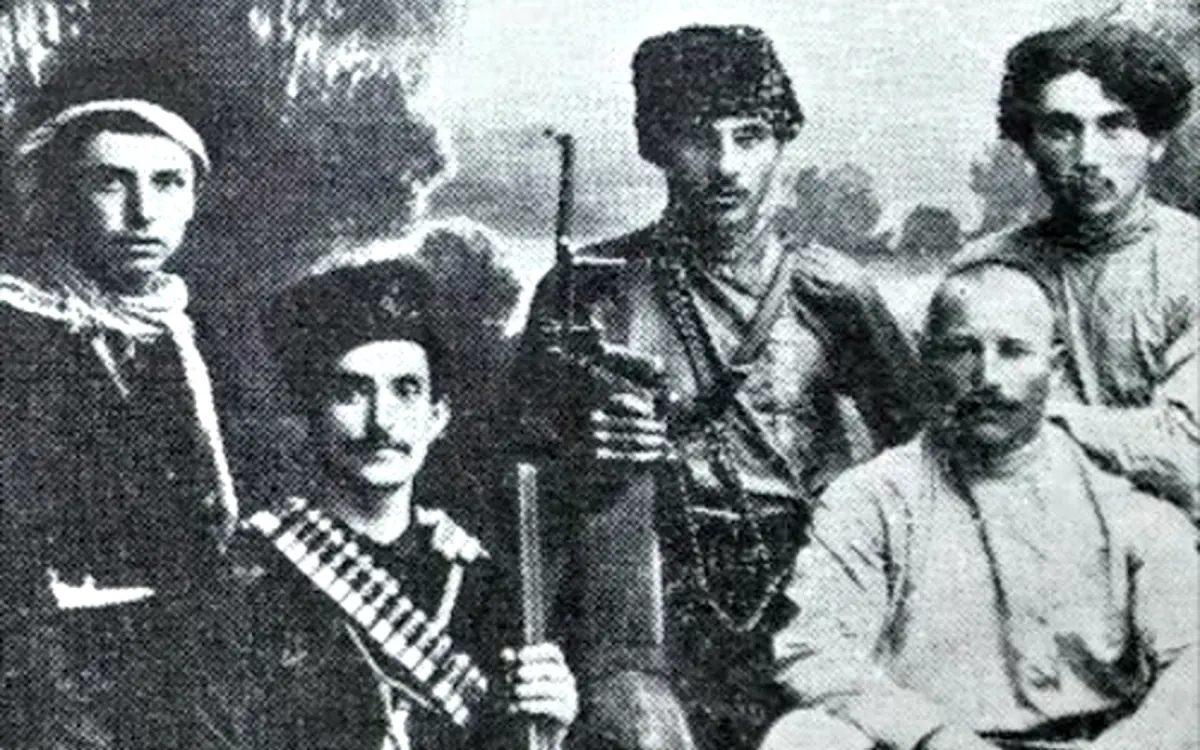
Manya Wilbushewitz was born a revolutionary: her brother fled to the land in 1882 after slapping a professor who taught that Jews sucked the peasants' blood; she was jailed in 1899 for Bund contacts, founded a Jewish Independent Labour Party in 1901, collapsed with it after Kishinev, and found healing on an expedition with her brother Nahum, her soul cleaving to the Hauran, which Rothschild had bought on condition that no Jews settle it. Touring the Baron's failing colonies she concluded that only collective settlement could make Jewish farmers; in Paris in 1905 she persuaded Rothschild instead to give fifty thousand gold francs for arms for Russian Jewish self-defence, smuggled eight cases of them into Russia disguised as a Frankfurt rebbetzin bringing books to yeshivot, shot an undercover policeman dead in Odessa with a silenced pistol, and lost not one gun. She returned in 1906 with collective settlement and self-defence welded into one. At Sejera, the JCA's moshavah and training farm in the Lower Galilee, she persuaded the manager in 1907 to let twenty workers, mostly Poalei Zion, run their own schedule and share pay, the first collective agriculture in the land. First Aliyah settlers had hired Arab watchmen and relied on consuls; these fugitives and deserters, shaped by self-defence against pogroms, would let no one else defend them. Yisrael Shochat, who admired the Circassians for cultivating and protecting their land with their own hands, had organized the first Jewish guards at Zichron Yaakov in 1906, and at Sejera in 1907 he and Manya founded the secret Bar Giora society, named for the general of the revolt against Rome, to replace the Arab watchmen. In 1908 they married and the Young Turk revolution weakened Turkish authority and exposed the tensions, with Purim clashes in Jaffa; in spring 1909 a Jewish photographer ambushed on the way to the Poalei Zion conference at Sejera shot his attacker and clashes killed on both sides. Bar Giora came out of the shadows as Hashomer, 1909, guards on foot and then on horseback, learning Arabic, wearing Bedouin dress with a Cossack swagger, resented by the Bedouin they stopped and the watchmen they displaced, and known for restraint: chase the thief off, fire into the distance, he is after a bag of grain, shoot only when your life is in danger. Never more than a hundred men, Hashomer became the Haganah in 1920 and the nucleus of the IDF. The old world is cracking, the spirit of the Maccabees stirs, and out of the ghettos and yeshivot the Jewish warrior rises again.
Key ideas
- Rav Kook read religion as a product of exile and atheism as a pained cry against its narrowness, and looked to the return of prophecy as the proof of redemption, possible only in the land.
- The Young Turk revolution raised Zionist hopes and sent Ben-Gurion to law school via Salonika, where Jewish porters showed him a whole Jewish economy; Arab nationalism and Ottoman suspicion closed the door.
- Ottoman land law was a good idea gone bad: absentee titles, fake registries and administrative chaos made the land ripe for purchase and for conflict.
- The wandering cow: the pioneer with Istanbul paper and the fellah who lives where his father lived can each fire first in self-defence.
- Manya Shochat shot her way through Odessa with Rothschild's guns and welded collective settlement to self-defence at Sejera.
- Bar Giora became Hashomer in 1909, a hundred riders in Bedouin dress with a doctrine of restraint, the seed of the Haganah and the IDF.
Chapters
- 0:00 Rough men and peaceable sleep
- 1:05 Why the Jews who broke with Torah rebuilt the land
- 2:08 Watershed moments; religion as exile
- 3:13 Atheism as a pained cry
- 4:17 The return of prophecy
- 6:29 Exile as alienation from self; Spinoza's seed
- 9:42 Rabbi of Jaffa, caught abroad; war and Messiah
- 10:44 The Ashkenazi trap; the Ezra parallel
- 13:04 Jews of the Ottoman Empire
- 15:11 The Young Turk revolution
- 17:23 Zionist hopes; Ben-Gurion to law school
- 20:37 Salonika: a port closed on Shabbat
- 22:47 Seven guilds of porters
- 23:49 Bundists, the CUP, and Lowther's conspiracy
- 27:02 Arab nationalism; Istanbul cools
- 29:11 Land: the Tanzimat and the tabu
- 30:22 Musical chairs
- 33:39 Fellahin, absentees, and chaos
- 35:51 The Yishuv by numbers
- 37:00 The wandering cow
- 39:03 Manya: born a revolutionary
- 40:08 The Hauran; the Baron's colonies
- 41:13 Guns through Odessa
- 42:18 Sejera: the first collective
- 44:23 Shochat, the Circassians, Bar Giora
- 46:37 1908 to 1909: violence and Hashomer
- 47:42 Horses, Bedouin dress, restraint
- 49:50 The Jewish warrior rises
Who, where and when
People
Rav Kook, The Netziv, Spinoza, David Ben-Gurion, Yitzchak Ben-Zvi, Chaim Weizmann, David Wolffsohn, Victor Jacobson, Abdul Hamid II, Sir Gerard Lowther, Avraham Benaroya, Manya Wilbushewitz Shochat, Yisrael Shochat, Edmond de Rothschild, Nahum Wilbush
Places
Jaffa, Salonika, Istanbul, The Hauran, Sejera, Zichron Yaakov, Odessa, Beirut, Acre, Nablus
Texts
Orot on atheism and narrow religion, Rav Kook on Spinoza, The Ottoman Land Code of 1858, Jeremiah 32, Lowther's dispatch of 1909, The Hashomer rules of engagement
When
1858 CE: the Land Code, 1865 CE: Rav Kook born, 1882 CE: Manya's brother flees Russia, 1904 CE: Rav Kook to Jaffa, 1905 CE: the guns from Paris, 1906 CE: first Jewish guards at Zichron, 1907 CE: the Sejera collective and Bar Giora, 1908 CE: the Young Turk revolution, 1909 CE: Hashomer founded; the Ninth Congress, 1920 CE: Hashomer becomes the Haganah
Read the transcript
People sleep peaceably in their beds at night, says George Orwell, only because rough men stand ready to do violence on their behalf. Now I'm here on your behalf, I'm not looking to do any violence, but I do want to stand for a few things, because I'm Rav Mike Foyer, and this is The Jewish Story. Episode 26, Rumors of War. we're moving out of exile. And that means, in some sense, we're also stepping out of that framework that I've been offering again and again as definitive of exilic life, that oh-so-powerful rabbinic phrase, because of our sins, we were exiled from our land. What's of real interest to the driving elements of the Zionist era is actually the second half of that prayer, v'nit rachachnu me'al atmatenu and we've become distanced or estranged from off of our land.
Now, that's not because Am Yisrael has suddenly become wholly righteous, mind you. On the contrary, the ideological waves of the second and third aliyah are characterized by a largely anti-religious attitude. And that's going to raise a big question, one that will follow us all the way into season three as we discuss present-day Israel and the Jewish story, is, why was it Davka, why was it specifically the Jews who broke with the Torah that succeeded in rebuilding the land? And on a deeper level, what's the connection between breaking with religion and breaking with exile? How is it that those who gave up on the notion that history is driven by sin and merit were the ones who overcame the hurdles to national re-embodiment?
Now our holy teacher, Rabbi Avon Hitzchah HaKohan, Cook, saw religion itself as a product of exile. which, if you've been following since season one, you know is a theme that we've been developing at least since the Greek encounter. And he never quite says it outright. But you can make the logical connection, I'm sure, because if religion is a product of exile, then redemption will result in what? You know, I have a little bit of background in systems thinking, and I want to tell you that every complex adaptive system at some point in its progress through life reaches certain moments in its development when the current configuration is inadequate to meet the task at hand. We call them watershed moments.
And that's when the system either leaps to a higher order or collapses in on itself. And when I look around, it seems to me that the religious system that has succeeded so admirably in bringing us to the 21st century is insufficient to take us to the next stage. Necessary, perhaps, but insufficient. Now, I'm not advocating heresy, or atheism for that matter, but Rav Kook did say that the shallow and narrow religion he saw around him confuses everyone who believes in it, depresses his spirit, blunts his feelings, inhibits the assertion of his sensibilities, and uproots the divine glory in his soul. If such a person should repeat all day that his faith is the faith in the unity of God, his statement would be empty and would register nothing in his soul.
Does that strike a familiar chord to anyone? And, Rav Kook also had a unique attitude toward atheism in particular. HaKfir Ba'a Ke'en Tz'aka Ma'atzemet Mahovim L'Gol At-Adam In Be'er Tzara Nochri'a Zo That heresy, specifically atheism, actually comes as some sort of powerful pained cry to redeem a person from the narrow pit of this estrangement. As always, Ralph Cook envisioned the clash between the narrow religion, which marks the end of exile, and the atheism that broke down its boundaries as a dialectic process, in which both are elevated and destroyed as they bring forth a new way of being. Because sometimes the situation is so broken that the only thing to do is destroy. And what lies ahead, then?
Well, Rav Kook says that the Torah of this world will be as insubstantial vapor in comparison to the Torah of our Messiah. Now, he's only echoing the words of the sages. Nevertheless, it's a sentiment that got a lot of people in trouble down through the ages. I mean, Jesus of Nazareth is the first to come to mind. Shabtite, Tzvi, we've talked about. Even the Baal Shem Tov got painted with that brush. And Rav Kook hardly presumed to be the Messiah. but he did have a passionate vision. The resurrection of Am Yisrael to its full glory is a people in its land. And as the crown jewel of that process, and really the proof of its divine nature, the return of prophecy. Now, that may sound crazy, the aspiration of a young ilu, a young Torah genius born in Latvia in 1865.
And it's true that legend has it, when he arrived at the Velozhan Yeshiva, that famous Yeshiva that we've spoken about, whose Rosh Hashiva at the time was Rabbi Natsali Tzvi Yehuda Berlin, the Nitziv. So the legend says that the Nitziv said that if the Yeshiva had been founded just to educate Rabbi Kuk, Dayenu, it would have been enough. And by age 23 he was already out. He'd assumed the rabbinate of Zaumel and he began to write his first essays while engaging the Maskeling, the enlightened Jews of his town, in a lively discussion. But prophecy? Really, Rabbi? Well, as I said, Am Yisrael at this point of our story was moving out of the mode of because of our sins we were exiled from our land and whether that was because something had changed within us or the world or God or all three the will to return to our land has been awoken and the actual return has begun therefore Rav Kook was focused on healing the damage described in the second half of the equation that estrangement from our sacred ground.
Because he knew that exile was about more than geography, or even more than the historical, sociopolitical reality in which we live. And he knew that way back when the temple burned, our shift from a national covenant with God to a religion entailed the loss of many critical aspects of our nature. Exile is also alienation from self. And in Rav Kook's eyes, estrangement from our land, the disembodied national state of exile had robbed us of our ability to express our essential spiritual nature. And the rerouting, the crossing of that distance between us and embodied reality in the land was going to demand a new face to the divine relationship. A new, old face, really. Prophecy. Now, do you remember Spinoza?
Go back to episode 10 in this series for his full place in our story. But for now, just recall that we labeled him the first modern Jew because he stepped out of religion altogether but maintained his identity as Jew, something unique in the early modern period. And that his doctrine of pantheism, God is world, world is God, made him the demon of religious Christian and Jew alike, as well as a philosophical hero for many generations to come, to our day even. The abstracted religion of exile was unable to embrace the truth that lay at the core of Spinoza's philosophy, that there's no need to seek God outside of the world. He's waiting to embrace us right here. But as I noted back in episode 10, if Cook could see the light in the darkness of Spinoza's heresy, and as a student of 19th century evolutionary philosophy, really, in many ways, a product of it, he also understood that it required a process of clarification through history.
Rabbi Moshe Mendelsohn began purifying it, but hasn't finished its repair. But the holy Baal Shem Tov purified it without knowing whom he was purifying, for he did not need its source. And the process is still not finished, but ongoing, and when it is entirely complete, Baruch Svinoza will leave the category of cursed and be among the blessed instead. And what blessing exactly could the man labeled as the prime enemy of religion offer to Am Yisrael? The seed of truth, which lies at the heart of Spinoza's pantheism offers a consciousness that itself can allow for a finite world to give voice to the infinite. Ralph Cook knew in the depths of his being the truth of the words of our sages who taught that prophecy only exists within the land of Israel.
And he knew this is not a technical issue, God forbid. or an expression of national chauvinism, as some would like to label it. It's simply what happens to a seed when it's planted in its native soil, and instead of just surviving, finally flowers. In Malkuk's vision, the consciousness which underlies creation finds unique expression when the healed, resurrected people root themselves in the soil of their land, the boundless divine desires our embodied existence to give its voice. but never forget embodiment is always a messy process anyone who's ever been present at a birth knows it's true and the seed must rot in the ground before any plant can grow so as we noted last episode Rav Kook made his way up to the land in 1904 as part of the second Aliyah as it's Rebbe in fact in many ways and he became the Rav of Yafo the spiritual pastor really of the new agricultural settlements springing up in the north of the country.
But, like our father Abraham before him, Rav Kuk didn't settle peacefully in the land. Traveling on behalf of the Yishuv, the community of Jews that was coalescing under the Zionist leadership, he was caught abroad by World War I. He spent quite a bit of time in both Switzerland and London, and it was very productive for his writing, but the seed was rotting. The old world was finally beginning to fall away, And even though they were wrong, there's a reason that the people of the early 20th century called this the war to end all wars. This war is going to open up many new avenues for the Jewish story, and its rumors are already being heard at this point. Now, this episode will focus primarily on the challenges of embodiment on the local scale, but don't lose the connection to the big picture.
As Rav Kook says, When there is great war in the world, the power of the Messiah awakens. The time of pruning has arrived, the pruning of the tyrants, and the wicked are being eliminated from the world, and it fills with a fragrant scent. And afterwards, with the cessation of war, the world is refreshed with a new spirit, and the footsteps of the Messiah become even more apparent. You know, I got called out recently. I want to thank everyone, by the way, who has responded to my request for feedback, in particular those who've shared their questions and aspirations for the coming season three, and keep them flowing. But I especially value it when you point out my shortcomings, as difficult as I might find it in the short term.
And a good friend and listener recently pointed out to me that I've fallen into the Ashkenazi trap. He asked, what's happening with our Sephardic brothers? Spinoza and the converso consciousness was our last real look, and that was 200 plus years ago. Now, part of the answer is I simply can't overwhelm you with everything. A story about everything isn't a story at all. And my goal from the beginning has been to tell a story of the past that helps us understand our present identity in an effort to point it toward the future we actually desire. And whether you're a friend or foe of our national rebirth, the process which led to the rise of the State of Israel defines the Jewish people today, even the struggle around it.
And Zionism was driven by Ashkenazi Jewry, for better or worse. And we will speak in Season 3 about the less-than-pleasant consequences of the xenophobic, Eurocentric side of our nationalism and how it continues to play itself out in our culture today. Have no fear. And truth is, last episode at least I should have mentioned the small but significant Yemenite immigration during the first two waves of Aliyah. There are those who actually say that the European idealists may never have succeeded in their desire to conquer agricultural labor if they hadn't been joined by their Yemenite brothers and sisters who actually knew how to farm and could handle the climate But beyond questions of the country of origin I actually fascinated by a historic parallel that exists between this phase of our story and where we began back in the time of Ezra two seasons ago.
Imperfect though the parallel may be. The second and third Aliyot will build the institutions and craft the cultural models on which the state of Israel shapes itself to this very day, and they're made up of a few thousand people at most, the majority of Jews simply did not come back to the land. Just as the majority of Jews stayed in Babylon in the time of Ezra. And nevertheless, in my eyes, the main plot line of our story follows the Jews that went up just as it did in the time of Ezra. Now, it remains to be seen whether the story ends the same way this time around, but either way, what we need to do is talk about the Ottoman Empire. It's not just an excuse to fill in the Sephardi backstory because we need to understand this critical non-European political context for the next chapter of our story.
A couple of numbers. In the early 20th century, there were an estimated 200,000 Jews scattered throughout the Ottoman Empire. Iraq was actually the largest community. It reached 65,000 by 1880 and would continue to grow, especially once the British show up. Egypt and the Syrian-Palestine province, which of course is of particular interest to us, contributed to each another 25,000 or so, and those were the major communities. And then there were small to mid-sized communities strung across North Africa and scattered throughout the East. But I have to admit that the other cause of my Eurocentricism is that the vast majority of the Jews at this point in our story were in Europe, by some estimates more than 80%.
It's the inversion of the situation that reigned during the height of the Islamic Empire of the Middle Ages. Population statistics aside, what we really need to do is talk about politics and a little bit of war, or at least revolution. Because the Sultan had been happily ruling in Istanbul for centuries when in 1908 the Ottoman Empire was rocked by the Young Turk Revolution. It's not just a media tag. The Young Turks were a real movement. The event that triggered this revolution was actually a meeting between Edward VII of the UK and Nicholas II of Russia in June 1908, nothing like two despots getting together to divide up the world. And the officers of the Ottoman Empire were actually afraid that the two were indeed plotting to carve up all the Ottoman holdings in the Balkans.
Remember, at this point, the empire extended into what we think of today as Greece and most of the Balkans. So the army units across the Balkan provinces of the empire rose in mutiny against Sultan Abdul Hamid II, motivated by the czar basically to strengthen and preserve the state. They weren't looking to take things down. It wasn't the full birth of a Turkish republic. That will have to wait until 1923, when Mustafa Kemal Ataturk fights the Turkish War of Independence. And who knows, maybe we'll talk about it, but there's a very interesting Zionist connection to him. But what this was, was the first wave of violence, or at least revolution, that washed away some of the structures of the past, holding back the future.
On July 24th, the Sultan capitulated to the revolutionaries, and he restored the Ottoman Constitution, something that had been suspended for decades, and thus the second constitutional era began, brief though it was. Underground societies began to declare themselves as political parties, the largest of which was the Committee of Union and Progress, a liberal reform movement, basically, whose goal was to modernize the Ottoman Empire on the lines of the Japanese success story if you're familiar with the turn of the 20th century, and return it to its former glory as a world power. And by the end of 1908, elections were held for the first sitting of the Senate of the Ottoman Empire in over 30 years, and lo and behold, the CUP, the Committee of Union and Progress, rose to the head of the government.
And that was good news for the Jews, or so it appeared, because the Young Turk Revolution stirred great excitement amongst the Zionists for two basic reasons. First, they expected that it would have an impact on Jewish immigration and land purchase in Israel. And in the end, this actually did prove to be significant, although perhaps not in the way they expected. We'll discuss that later. But for now, Chaim Weizman, future president of the State of Israel and icon of the practical Zionist approach, expressed the hopes that the revolution raised for him in a 1910 letter saying, of special significance were the anticipated changes in the administration of the provinces, perhaps presaging an easing of restrictions in Palestine, restrictions on immigration and land purchase.
The other shift triggered amongst the Zionists by the Young Turk Revolution was a revival in a sense of political Zionism. In the decades since Herzl had died, the Zionist Congress had come to be seen as a semi-annual excuse for a prolonged and somewhat fruitless conversation. Its leaders lacked the status that Herzl had had, or at least the will, to stand before the princes of the world and negotiate for a homeland. And instead, as we saw in the last episode, the energy of Zionism had moved toward the inch-by-inch, practical approach of creating facts on the ground. One more doom, one more goat, which is its own particular type of vision. But in 1908, the young David Ben-Grein, Of course, future prime minister and rightly known as the father of the modern state, he became so fired with the idea that the empire was moving toward democracy that he changed tax entirely from practical Zionism.
As we'll discuss in some later episode, Ben-Gurion never gave up on his belief in the Jewish worker as the primary unit of the Zionist ideal. But on the eve of the First World War, he did turn away from the pioneering model of redeeming the land through the conquest of labor to a political vision. And in the long run, this change in attitude inspired by what amounted to a half-failed rebellion may be one of the most significant events of the 20th century. But in the short term, in Ben-Gurion's eyes, the Young Turk Revolution was a golden opportunity for the Yishuv, as the growing Jewish community in the land had come to be known. Because when the Sultan ruled, the Jews were nothing more than another group of his subjects, and the Palestine province was way too far from the seat of power to be of any real interest to him.
But, a parliament would give the issue of real representation, and it would allow it to assert its cause against the rising Arab national voices of the empire, and to tout the benefits of Jewish nationalism to the newly liberated Ottoman Empire. Ben-Gurion even had dreams of uniting all Turkish Jewry into a real political force that could rally behind the Zionist cause. And so, fired by that revolutionary excitement, and frankly, burnt out from the poverty and back-breaking labor of cultural life in Israel, he and the future president Yitzhak Ben-Zvi and Yisrael Shokhat, who we'll discuss later, headed off to law school in Istanbul. But as Ben-Gurion had no money, no papers, he wasn't even a citizen of Russia anymore, he was a deserter, he didn't speak Turkish or Ladino, which he only discovered was the language of the Jews when he got there, he had to go by the way of the Jewish community in Salonika.
And we'll spend time talking about Ben Gurion, but I just want you to appreciate the power of the will that drove this man. No money, no papers, no language. I'm going to law school. So Salonika was actually the home base of the Committee for Union and Progress, and therefore really of the Young Turk Rebellion, but it was also a Jewish town. It was so Jewish that the port was closed on Shabbat. And Ben Gurion later would claim that the sight of Jewish sailors, Jewish stevedores, Jewish porters and Jewish mertens was his first glimpse, his first idea even, of what a truly multi-layered Jewish economy and society could actually look like. And it's worth pausing just for a moment on that image. Because Salonika was at a particular socioeconomic moment at this point in its history, and one that's expressive of a lot of the forces that shape the world of the day and are at play in our story, though we can't discuss them all.
It seems, first of all, just to get a little back story, that Jews had been in Salonika before the destruction of the Second Temple. But they really came in a significant number in the aftermath of the expulsion from Spain, when, if you'll recall, the Ottoman Empire was more than happy to welcome these industrious and intelligent refugees from Svarad. And they flourished throughout the 16th century. And hopefully, it wasn't so long ago, you recall Shabtai Tzvi, that false messiah. If not, go back to episode 9 for his story. But just know that his fame really grew out of the Salonika community, and even after his death, it remained a hotbed of Sabbatean heresy. If you want to do a little bit of research on crazy conspiracy theories, by the way, go look up the connection between the young Turks, Turkish nationalism in general, and the Donmeh, those secret followers of Shabtai Tzvi, who continued to worship him as a messiah even after he converted.
But back to modernity. Because in modernity, it was industrialization that brought life to Salonika. And that was what so moved Ben-Gurion. Late in the 19th century, three major rail lines, those which dominated the trade of the whole Balkan peninsula, placed their head at Salonika. And the ship tonnage passing through the port doubled to 2 million tons a year by 1912. But fascinatingly enough, until 1909, there was no direct rail access to the quay. Everything that wanted to be shipped had to pass over a kilometer of bad road from the rail station to the port, and it all went in the hands of various groups of Salonica porters, all of whom, of course, were Jews. Now, all told, according to the reports, there were seven major groups of porters, each of which handled a particular type of good, some dried food, others leather, soap and fat, a third bulk grains, you understand.
Each group kept a joint account book, and at the end of the day, they'd gather in their synagogue to pray together, change their clothes, and head to the pub to drink Arak and discuss the day's work. And when the Salonika Key Company and the Oriental Railways Company signed a deal to bring the trains all the way to the docks, this world disappeared just like that, a victim of economic efficiency. and these developments together with the power gained by labor unions in the wake of the Young Turk revolt made the Zionists cause pretty much an uphill battle in Salonika and amongst Turkish Jewry in general the Socialist Workers Federation was led by a Jew Abraham Ben-Eyora and one might think that they'd be a natural ally to Ben-Gurion and his Pole Zion brand of Socialist Zionism but one would be wrong these were socialists more along the lines of the Bund in Europe that he spoke about, staunchly internationalist, and therefore fiercely anti-Zionist.
Nevertheless, Zionist or no, the Jews saw the consolidation of the Ottoman state under the Young Turk reforms as a good thing. And whether that was simply because they wanted to live in a strong, centralized state, something we've touched on many times in this story, that is the instability of sort of multiple poles of power that tends to cause the greatest problems for the Jews in history, or whether they saw their own Zionist nationalist hopes as dependent on Ottoman grace. The Jews were a key minority community, to which the Young Turks looked as allies and aides in their plan of modernization, and the Jewish elite of Salonika were heavily involved in funding the Committee for Union in Progress.
Many went on, actually, to hold important political positions in the government through World War I and even up through the birth of the Republic of Turkey in 1923. And in fact, the link between the CUP and the Jews was so close that it gave rise to all kinds of conspiracy theories. The British embassy, which during the Young Turk Revolt actually supported the liberal wing of the Young Turks against the CUP, even labeled the CUP as the Jew Committee of Union and Progress. In the words of Sir Gerard Louther, British ambassador in Istanbul, in 1909. The Turk, devoid of real business instincts, has come under the almost exclusive economic and financial domination of the Jew. And as Turkey happens to contain the places sacred to Israel it is natural that the Jew should strive to maintain a position of exclusive influence and utilize it for the furtherance of his ideal In return for, in quotes, unrestricted immigration of foreign Jews, he's offered the young Turks to take over the whole of the Turkish national debt.
The Jew can help the young Turk with his brains, business enterprise, his enormous influence in the press of Europe, and money in return for economic advantages and the realization of the ideals of Israel, while the young Turk wants to regain and assert his national independence and get rid of the tutelage of Europe as part of a general Asiatic revival. Classic, huh? It's a prime example of the mix between anti-Semitic theories of Jewish world domination and the colonialist conviction that non-Western peoples were completely incapable of modern government without some European hand at the wheel. Also notice, by the way, how Sher Girard lumps together the practical Zionist aspiration for immigration and the hope to leverage Ottoman debt in service of the Jewish national dream that actually belonged to Herzl in political Zionism.
Whatever, you can't expect them to understand the difference. So at first, it indeed seemed that the Jewish connection to the CUP would bear real fruit for the Zionist dream. But it wasn't to be. Arab nationalism is on the rise, and it's rapidly becoming a major source of concern for the government in Istanbul and the stability of its empire. The Arab nationalists saw the potential of the 1908 revolution in a very different light than the Jews did. They thought that a weak empire was their only hope for national liberation, and they hoped that this instability would only grow. And thus, they developed a double hostility toward the Jews, not only over the specific competition for the land of Israel, but for their support of the new Turkish government in general.
And that hostility, in turn, poured cold water over any hopes that the Jewish connection with the Young Turks could turn into a Zionist windfall. In 1909, at the 9th Zionist Congress, in the wake of the Young Turk Revolution, David Wolfson, Herzl's friend, who had inherited the presidency of the Zionist organization, announced the following goal. We aspire to build within the framework of the Ottoman Empire a nationality like other nationalities in the Ottoman realm. Our ambition is to earn the reputation of being the most loyal, trustworthy, and useful nation amongst the national groups, but a Jewish nation. But when Victor Jacobson, the Zionist representative in Istanbul, returned to the city in 1910 after the dust of revolution and counter-revolution had settled, he felt a distinctly cool and guarded attitude toward Zionist aspirations amongst even Jewish leaders much less the Unionists.
In fact, he reported that a prominent member of the CUP inner circle told him that he still favored Jewish immigration into Turkey but evinced no sympathy toward Zionist aspirations which he implied were separatist. They could undermine the hitherto harmonious relations with the Jewish community. This he would regret, because the Jews were a very valuable element. You hear the threat? But you know what, in the end, man plans, God laughs, or cries. Because within a few years, everybody's hopes were overturned. Young Turks' political forms were not enough to save the empire from being carved up by the European colonial powers. David Ben-Gurion never got his law degree, but rather, together with so many other Zionists, wandered the world during the war years struggling with poverty, illness, and a political vision seemingly too large for any one man, unless that one man could embody the will of a whole nation.
And the Zionist hopes of attaining an instant home through Ottoman agency were swept away as well. When the smoke of war clears, it will appear that an Anglo-Zionist alliance is the wave of the future, at least until it doesn't. Okay, we need to talk about a complex subject, one with legal, moral, and emotional dimensions that in many ways still define the posture of Am Yisrael in Eretz Yisrael down to this very day. And what I'm speaking about is land purchase. And specifically, I want to take a look at the link between Jewish immigration, or as we Zionists like to think of it, repatriation, land purchase, law, and the nature of the Ottoman Empire. You got all that? Now you need to know that the Ottoman Empire was struggling to function well before the Young Turk Revolt in 1908.
And in the mid-19th century, it had gone through a period of governmental reform on every front. And the most significant element of these Tanzimat reforms for our story was the Land Code of 1858, which was quickly followed by what's known as the Tabu Law. The aim of these laws was basically to allow the Ottoman administration to better manage state lands and to collect taxes from private land. And at their heart were new procedures for registering, registering titles, land transfers, purchases of various types of land. After 1858, according to the law, no one in the empire could claim to own land without registry. And it's worth noting that the Lands Registration Bureau in the modern state of Israel is still known as the taboo.
You know, in general, I often think of the notion of land ownership kind of like a game of musical chairs. I mean, ownership of land is a funny thing. At an early stage of history, either you didn't believe in land possession, or you possessed land because you were born on it, or because you were strong enough to take it from someone and keep it down through the generations until everyone else recognized that you were the possessor. And then, somewhere along the way, along with the notion of possession, evolved the idea of ownership. And at some point, writing down the fact of land ownership gained what we call legal weight. And what's legal weight? It means that there's some overarching power that I can use to marshal moral or violent force, or both, on my behalf in order to get my property back from you if you take it from me.
And for Am Yisrael, this changing relation to the land is marked by the transition from the tribal inheritances of the first temple to the return by Ezra at the beginning of the second temple era under the ages of the Persian Empire. who are, of course, the legal context for the return. You can go back to the opening episodes of season one for that full story. But it's just another instance, by the way, in which these two returns to Zion have such a deep parallel. Anyway, if you want to do some real homework, I'll give you some homework. Do some homework, people. The textual root of actually this whole relationship between land, law, and redemption in the Hebrew Bible is the 32nd chapter of Jeremiah.
Go check it out. It's a revolt. Meanwhile, for most of the world, most of history was basically, as I said, a dance of musical chairs. People are taking land, they're taking it back, moving through, fighting wars, making peace, making sales, sometimes writing things down. They're going round and round, round and round. And then at some point, and I really like to peg it in modernity, between the two world wars, for all intents and purposes, at some point the music stopped. And just like in a game of musical chairs, anybody who was left standing or on the move when it stopped snagged the seat as close as possible and wrote their name down on it. And then, of course, they proceeded to take a high moral posture toward anyone who was still playing the land game by the old rules.
So the Ottomans tried to stop the music in 1858, but life isn't that clean, even in the best of circumstances, which this was not. The land reforms of 1858 are a classic case of good idea gone bad. The peasant farmers, who, in the Palestine province where we're concerned, what are known as Arab Thalihin, were living on lands whose general rule was you gain possession by working it. But that possession was not what we think of as private property, it was still subject to the government's will. Furthermore, they were mostly illiterate and the products of traditional society, and in those societies, residence and personal testimony, why is that your land? Because I live here. That is enough to support a claim to property.
That's one piece. The other piece, large established landowners distrusted the central government in Istanbul completely. They saw these reforms as simply an attempt to add taxes or even outright appropriate their property. Therefore, many evaded registry altogether or played complicated games registering fake identities and separate properties. And some historians and legal scholars claimed that corrupt people did not hesitate to register land that simply wasn't theirs. An entire village could be gained at the stroke of a pen in the Felihin, none the wiser. So by the turn of the 20th century, when the JNF, Jewish National Fund, and other Zionist land organizations started to seek out any and every purchase opportunity, there was a significant concentration of property titles throughout the Syria-Palestine region in the hands of absentee owners, people who lived elsewhere, who didn't work the land which they owned.
And not to mention that there was a tremendous confusion of documentation. Now add to this mess, the documentary mess, the bureaucratic chaos of the late Ottoman Empire, which had actually three levels of administration functioning at this time in the land of Israel. First, there were 13 local kazas, which all fell within one of two jurisdictions, either the Sanjak of Akko or that of Nablus. And those two Sanjaks were in turn accountable to the valley of Beirut. But sometimes they answered to the government of Jerusalem. Because Jerusalem was so important, his status made him independently responsible to the Ministry of the Interior in Istanbul. And even in Istanbul, there was no one address for the questions of land and immigration.
Guidelines were written, rewritten, conflicting, sometimes even contradictory, and often ignored. Because last and certainly not least, We have to throw the endemic corruption of Ottoman society into the mix. And so it's easy to imagine how this situation was ripe for the pursuit of the Zionist vision of one more dunam, one more goat, and ripe for conflict. By the time World War I rolled around, there were approximately 85,000 Jews in the issue. They made up about 10.6% of the population. 12,000 of them were agricultural workers scattered across around 43 rural settlements of various kinds, increasingly collective by the Bay. And at the outbreak of the war, the Yishuv owned 420,000 dunim, which was about 1.5% of the land which the empire defined as Palestine.
Now, it's a truism that the immigrants of the Second Aliyah were absorbed by the task of pioneering to the point of self-absorption, and were often intoxicated by the power and freedom of the homeland landscape, as Ben-Gurion called it, not to mention by the power of their isms. Nationalism, Zionism, communism, socialism, in their mix often led these idealists to see the world not as it was, but as it would become. And all this meant that the impact of their arrival on the Arab population, be it native, or they themselves economic immigrants, went largely unconsidered, unnoticed even by many. And we're going to have to discuss the national dimension of this failure at length, particularly with our discussion of Zev Jabotinsky, one of the more wide-eyed Zionists in this respect.
But for now, I want to contemplate the difficulty on the individual scale of a thought experiment. Picture yourself as a member of a collective farm, a young pioneer. we'll put you from Ben Gurion's hometown of Plonsk. You show up in the Galilee with your other idealistic pioneers. You're working extremely hard. Now, why are you in the Galilee? Because the Jewish National Fund has sent you this piece of land which they purchased from a man who lives in Beirut, who has, of course, a piece of paper registered in the tabu in Istanbul that says it was his, and now it belongs to JNF. In your mind, of course, you are the possessors of this land. Meanwhile, down the road, there's an Arab felahin. He lives there because he lives there, because his father lived there.
We'll just go one generation back, not to get into any polemics. And so one day, your cow wanders into his yard. He's a nice guy, brings the cow back. Next day your cow knocks over a bit of his fence A little bit annoying but you know these Jews have moved on to his property and hospitality is a value so he return the cow The third time the Jew, who in the mind of the Jews, sorry, the Jewish cow, in the mind of the Jews is just grazing on his own land, comes into the Bedouin's backyard, he gets upset, and so he takes the cow. Now, meanwhile, on the Jewish side of this picture, what's happened? Your cow was grazing, and it just got stolen. You see where this problem comes? So the Jews grab their guns.
They come to repossess their cow. Meanwhile, this Arab man sees these Jews coming after their cow has trespassed and trampled his fields, and he's being attacked. Who fires first in self-defense? You see the mess? Manya Wilbushowicz was born a revolutionary. Or nearly so. In 1882, when she was only two, her older brother left Russia, read, fled for the land of Israel after having been expelled from university. Why was he kicked out? He slapped a professor across the face after this man had the audacity to teach his students that the Jews were sucking the blood from the peasants of Ukraine. It beats the kids that used to break the nose of their teacher in the camp I worked for. By 1899, Mani was imprisoned herself because of her contacts with the Bund revolutionaries in the factory where she works.
And by 1901, she had founded her own Jewish independent labor party. She was a go-getter. The party collapsed in 1903, following the kitchen of Pogrom. And apparently so did she. And in her emotional distress, she had accepted an invitation from her brother Nahum, who was now well-established in Ottoman Palestine, to accompany him on an expedition to some of the wilder places of the land of Israel. and Mania not only found the land healing the beauty of it captivated her as soon as she arrived and in particular the settlement of the Huron which encompasses part of the mountains of Golan extending up into Syria and present day Jordan as she said the Huron remained without a redeemer and my soul cleaved unto this place the Baron Rothschild had actually bought the land quite some time ago but in the purchase agreement the Ottoman government stipulated that no Jews be allowed to settle there.
You hear our previous part of the story? You can sell it to the Jews, but the Jews can't live there. Now a small group of pioneers had disregarded that decision, but they were evicted. And the baron resorted to leasing out plots of land he'd purchased to Arab Felahin. Manya was crushed, and she decided to visit all of the baron's colonies and see for herself why they were in such financial trouble. And that trip made her amongst the first of the pioneers of the Second Aliyah to realize that only collective agricultural settlement would be the power to produce Jewish workers and Jewish farmers who could themselves be the basis for building a Jewish homeland. Always a woman of action, Mania left for Paris in 1905 with the hope of convincing Baron Rao Fowler himself of the error of his ways.
But she arrived there just before a wave of pogroms swept the Russian Empire, and she changed her goal. she actually convinced him instead to donate 50,000 gold francs toward the purchase of arms that the Jews of Russia could use to defend themselves. She went out and bought the weapons. But in order to smuggle them into Russia, Mania disguised herself as a young rabbinite, a young rabbi's wife from Frankfurt, bringing eight cases of books as a gift for the shivot, the religious academies of Ukraine. When, in Odessa, she was discovered by an undercover policeman, she shot him dead with a silent pistol before he could sound the alarm. The guns were successfully delivered to the Jewish underground of Russia.
Not one was lost. So, when Mania returned to the land of 1906, two ideas had possessed her mind. The idea of collective settlement and the idea of Jewish self-defense. And they'd welded into one model. But she realized that the only way to convince her fellow pioneers that these two were not only compatible, but were actually essential for the Zionist dream, was by putting them into practice. She was a quintessential practical Zionist. Sejera was the first agricultural community founded by Jews in the Lower Galilee. In 1901, the JCA, the Jewish Colonization Association, took over management of some land purchased originally by Baron Rothschild, and they developed there both a moshavah, like a sharecropper's colony, basically everyone privately owned the land on which they worked, but they worked together for harvest and distribution.
It was a moshavah and a training farm for unskilled workers. It was a very important place where many of the young agricultural pioneers actually learned how to farm. Now, a few years after its founding, most of the workers on the farm were members of the poelei tzion, this national socialist Zionist movement, and also the youth movement, Hapuel HaTzair. And when Mania joined them in 1907, she convinced her fellow idealists to join an experiment that would change the course of the Jewish story, and some might say human history. Mania managed to convince the Sejera farm manager to set up a collective which will allow the workers to organize their own schedule and share their pay. And 20 workers, mostly from the Polexion, joined the collective, which could rightly be called the first experiment in collective agriculture in the land of Israel.
But the socialism and the collectivism was only a secondary goal for Mania. She knew that in order to work the land, you have to be able to defend it. The settlers of the first aliyah had relied upon the political protection of the foreign consulates whose citizenship they claimed, and they had paid Arab watchmen to guard their farm settlements and crops. But the pioneers of the second aliyah, like Mania Willewschwitz, I can't say that name, were often fugitives. They had left their former countries and some had deserted from the Russian army. And they'd shaped their identities in the self-defense struggles against the pogroms in Russia. They were not allowed to let someone else defend them. And amongst the collective workers, Manya found an ally for her ideas in fellow member of that Sezera collective, Yisrael Shochat, Israel Shochat.
Now Shochat was a typical pioneer. He'd grown up in a religious home. He had joined Polizion, and he had come up to the land from Russia in 1904. Upon arrival, Shokhat became fascinated by the Circassians, who had settled in the Palestine province toward the end of the 19th century. Interestingly enough, to this day, the Circassians are one of the three minority groups in Israel that regularly serve faithfully and with honor in the Israeli army. But at the time, Shokhat saw them as a model of how a small minority could preserve its identity in a hostile environment. And the key for Sholchat was that they cultivated their land and protected it with their own hands. So, in 1906, Sholchat organized the first ever group of Jewish guards around the settlements of Zichon Yaakov.
And in the following year, he joined Manya and the other Polizion members at Segera in establishing not only a workers' collective, but the secret Bar Giora Society. Named for one of the more powerful Jewish generals of the great revolt against Rome back in the first century, the Bar-Gi-Ora Society was committed to Jewish self-defense, and they immediately began a campaign to replace the Arab watchmen of the settlements in the Galilee. At first, it was hard going. Nobody was convinced that Jews could do it. But 1908 was a fateful year for Jewish self-defense. First of all, Mania and Israel married, you should know, and she became Mania Shochat. And second of all, as you know, the Young Turk Revolution came about.
And the impact on practical Zionism was that the revolution, at least in the short term, weakened the authority of the Turkish government in the land of Israel, which in turn exposed the growing tensions between Arabs and Jews. During the Purim celebrations that year, clashes erupted between Jews and Arabs, violence in the streets of Jaffa. And, as that violence simmered, Bar Gior was able to make significant headway in taking over the defense of the settlements in the Galilee, although still as a clandestine society. But finally, in the spring of 1909, a Jewish photographer was ambushed by Arab attackers on his way to the Polizion Conference in Sejera. Now, he shot and killed his attacker, but that itself led to further clashes in with both Arabs and Jews were killed.
Now we can add to the very fact that the Jews were settling the land, their willingness to defend themselves instead of relying on the Arab protection racket. And we can see that the die is cast. In the wake of the violence and ensuing tension, a meeting of the Bar-Gi-Ora members was called, and a decision was reached to come out of the shadows. The result was HaShomer, founded in 1909, a society for Jewish defense, which immediately began to send its watchmen to settlements, first just in the Galilee, but eventually over the entire Yeshuv. Now, the first guards worked on foot, but they realized that that was not an effective method, not even tactically, much less strategically, so they soon acquired horses, which vastly increased their power and their profile.
And they worked to gain the respect of the Bedouin, who were, of course, the chief threat, by first learning to communicate in Arabic, and then adopting actual Bedouin garb, and assuming the swashbuckling posture of the Russian Cossacks, whom they remembered from home. Now, the older settlers worried that Hashomer might upset the status quo with the local Arab settled population, and indeed, they aroused the ire of both the Bedouin, by preventing them from stealing, and the Arab guards whose jobs they had taken, who were often, by the way, a little bit closer in league than one might like between the thief and the watchman. But, despite this, Hashomer was known, actually, for the restraint, the characteristic which would follow Jewish defense down to our day.
In fact, the Hashomer rules of engagement read as follows. You do not seek an encounter with a thief. You chase him off. And only when you have no choice do you shoot. After all, he's out to steal a bag of grain, not to murder you. So don't murder him. Drive him off. Don't sleep at night. If you hear footsteps, fire into the distance. If you feel he is a few steps away, and you can fire without him falling upon you, fire into the distance. Only if your life is in danger. Fire. now Hashomer never numbered more than a hundred men even at its peak but its impact on Jewish destiny and therefore really on world history was tremendous it was the first embodiment of Jewish self-defense in the land of Israel and really the nucleus of today's military at least in concept in 1920 Hashomer reorganized itself to become the Haganah the underground army which of course went on to be the backbone of the Israel Defense Forces, Tzavah Haganah LeYisrael.
But that's a story for another time, and we'll tell it along with the Jewish Legion and other pieces that you may be familiar with. For now, I just want to end on a note of astonishment at how well all these pieces are coming together. The old world is cracking, and there's a tremendous opportunity to build the new. And the spirit of the Maccabees is stirring once again that powerful and strange notion that sovereignty over geography is critical to Jewish destiny. And lo and behold, out of the ghettos and yeshivot of the palest settlement, out of a culture of intellectual abstraction and physical disempowerment, the Jewish warrior is rising once again. I just want to thank a few people. I want to thank all the folks that give their hard-earned money to help make this show possible, to keep it free and widely available, and I want to invite you to join them.
Go right now to robmike.com. In the upper right-hand corner, you'll see a Be a Patron button. You can click on through to get a little bit of per-podcast support. You can also connect with me, by the way, on Facebook. Send me your questions. For Season 3, I'm already trying to bubble over with ideas. I want to thank the Land of Israel Network, that's thelandofisrael.com, for creating a platform that allows me to reach so many wonderful people. I want to thank the Pardes Institute, pardes.org.il, for building a learning institute that allows me to touch the hearts and minds of so many amazing Jews. And I want to thank you for listening. I'm Rav Mike Foyer, and this is The Jewish Story.
More from Season 2
Season 2: Episode 25 - One More Dunam One More Goat
There are times in history which define us even now, and in the state of Israel the Second Aliyah is second to none in that respect. This episode...
Play Episode
Season 2 Interlude: Passover - Free to Be Redeemed
In this interlude we take a pause from the flow of history in order to consider whether Passover is the festival of freedom or the time of our...
Play Episode
Season 2: Episode 27 - The Anglo-Zionist Alliance
World War One brought massive destruction and great change. When the smoke cleared from this great conflagration, the British Empire was left in control of the land of...
Play Episode