
Season 2: Episode 29 - The Conflict Within
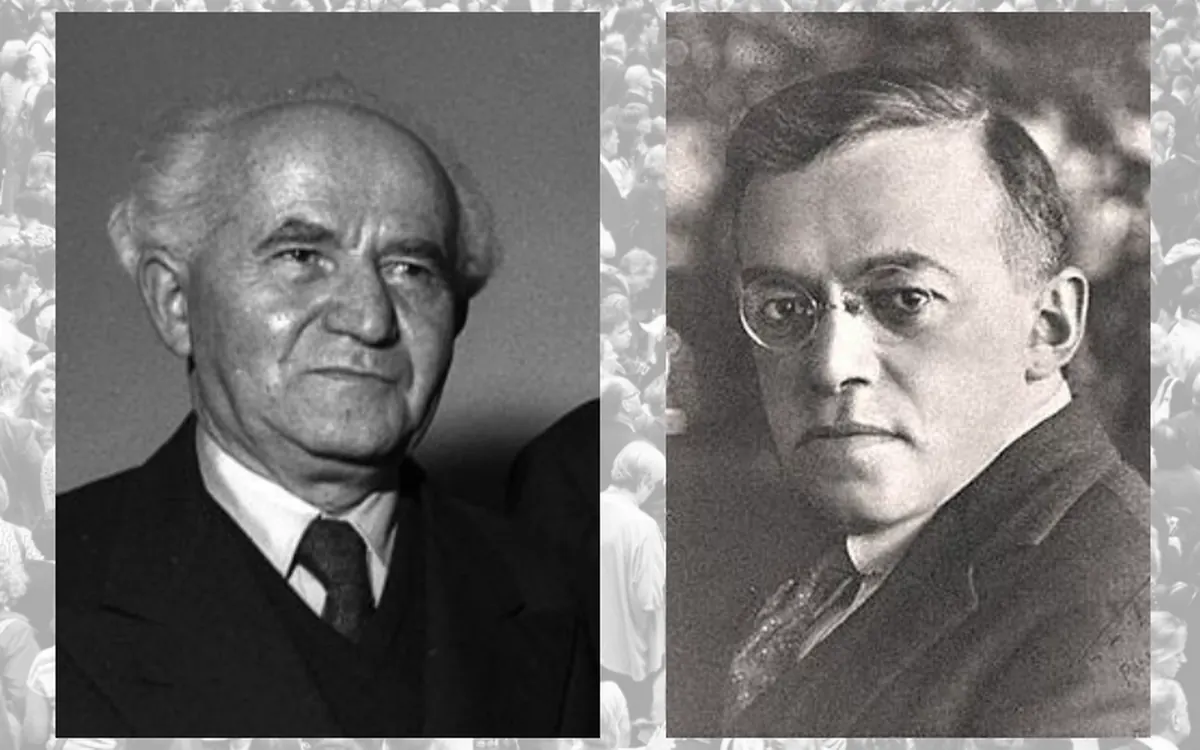
Each successive wave of immigrants that came up to the land brought with them their blessings, and their challenges. As the population grew, so did the nature of power politics. In the 1920's two leaders emerged whose opposing visions define many of the political conflicts in our State today. Here is an episode on David Ben Gurion and Zeev Jabotinsky.
About this episode
Give a man power to test his character, said Lincoln. Can one person make history? Carlyle's great man theory, history as the biography of heroes, and Nietzsche's highest specimens, tainted after Auschwitz, stand against Spencer's history from below, in which a great man is the product of the race and society that made him, no Napoleon without the starving poor of Paris. Beneath the frameworks lies agency: we are each the protagonist of our own story, yet we chose neither gender, ethnicity, class, nation nor endocrine system, and the postmodern pit says even our choices are products of those forces. Anyone who has made a real decision knows the power of will, and anyone who has been a hero to a single child knows heroism changes the world. This is a heroic period, of men who sought to embody a greater will, and Rav Kook taught that a man's will flows from the radiance of the divine will, and that the more one knows there is no will but that revelation, the more one's will can innovate and decree. Returning in 1919 he became rabbi of Jerusalem and the mandate's first Ashkenazi chief rabbi, a step in his eyes toward the Sanhedrin, and he wrote that the souls of the sinners of Israel who love the whole of the people and the land in the footsteps of the Messiah are more perfected than the souls of the merely religious. Stephen Jay Gould's punctuated equilibrium: long stasis, then crisis, then flourishing; historic leaders sense the space a cataclysm opens.
Two organizations claimed Trumpeldor. Gdud HaAvodah, the Labour Battalion in his name, founded August 1920, was the characteristic body of the Third Aliyah, tens of thousands who came between 1919 and 1923 on the hopes of Balfour and the upheaval of war and revolution, reinforcements and shock troops for labour Zionism. It absorbed the Shochats and Hashomer and sought the hardest work in the land, draining swamps, breaking rock, paving roads in scorching heat, sleeping in mud while building the kibbutzim they would live in; its veterans staffed Solel Boneh, which dominated Jewish construction for sixty years. With Hashomer Hatzair it pressed for one labour union to absorb immigrants, settle them and find them work, apolitical in theory and never in fact, and the Histadrut of 1920 set a cradle-to-grave pattern that began to break only in the 1970s. A body without a soul until 1921, when David Ben-Gurion returned from a failed London office to be its secretary general. Born David Gruen on October 16, 1886 on Goat Alley in Plonsk to a Chovevei Zion father who wrote Herzl asking aid for his son, he mourned Herzl in 1904 as the man with the will of the gods who joined the Maccabees' heroism to David's stratagems and Rabbi Akiva's courage, and already held that willpower makes greatness. At Warsaw in 1905 he joined Poalei Zion, no theorist but a superb debater with boundless energy, and in 1906 went up; his tombstone says only that he immigrated to Palestine in 1906, and at Jaffa David Gruen became Ben-Gurion after a general of the revolt against Rome.
The plough was mightier than the sword and both would serve the politician. Seized from a refugee ship in the war, he landed in New York among a million immigrants preoccupied with making a living and a second generation seeking the melting pot, Bundists skeptical of his socialism and leaders unmoved by his urgency; he took from America a wife, Paula, in 1917, and the conviction that American Jewry and Zionism had an unclear but important future. In 1917 every socialist Zionist was tested by Balfour and the revolution, and he was a socialist Zionist, not a Zionist socialist: he joined the Jewish Legion in Canada to fight his way home, and in the first of his readings of a historic moment concluded that one more dunam was petty and the Zionists must return to Herzl's path and demand all of Palestine as a national home while creating a Jewish majority within twenty years, vision married to practical work. The early twenties were heady: 84,000 Jews, eleven percent, in the 1922 census, eight thousand a year by 1923, Arab riots already a pattern to be treated next episode, and institutions: the biennial Congress, the Zionist Executive, and in 1929 the Jewish Agency bringing in non-Zionist philanthropists through Weizmann, the source of our semi-privatized governmental mess. The socialists dominated and believed in the shortcut: the Soviets seemed to have skipped capitalism, and with almost no capitalism in the Yishuv, Arab feudalism and pioneers bent on conquest of labour, collective ownership defined the institutions, with the JNF's largest purchase, the Jezreel Valley, sprouting twenty settlements within a decade.
In 1923 the Histadrut sent Ben-Gurion to the Moscow agricultural exhibition, where the Soviets admired the tomatoes and he admired the country until he saw Zionists persecuted and was nearly arrested; the revolution was also a crosswind, splitting Poalei Zion in 1919 into Achdut HaAvodah and a communist fragment still in the Knesset's joint list. Lenin became his model of heroic leadership until Churchill: a man who looks life in the face, thinks in facts and plucks the ruling powers of the future from reality, an iron will that spares neither human life nor the blood of innocent babes for the revolution, a description with prophetic echoes. He returned proposing the Histadrut as a universal workers' commune allotting work, taking all wages and paying each enough to live, owning all farms and organizing the party into a disciplined army of labour; his comrades refused, the first flash of the fiery absolutism beneath the cold exterior. Then the Johnson-Reed Act of 1924 shut America to Eastern Jews on racial quotas, giving the lie to Emma Lazarus, while Polish policy squeezed the Jewish middle class, and the Fourth, Grabski, Aliyah brought 67,000 between 1924 and 1929, half Polish, mostly middle-class and urban, when Tel Aviv crossed from beach town to city and pioneers dried up behind Soviet borders. Labour saw the death of the shortcut and a threat to its dominance, and the Poles brought a new Zionism with their capital.
Beitar, founded in Riga in 1923 as Jabotinsky quit the Executive, held that nations grant the Jews nothing they will not take or defend. Its name is Brit Yosef Trumpeldor and the last fortress of Bar Kochba, and its anthem promises a race proud, generous and fierce, Beitar, Yodefet, Masada rising again, to die or to conquer the hill. Within a decade it had forty thousand members and gave the revisionists, formed to revise pragmatic Zionism back to Herzl's statesmanship, an instant base. If labour flirted with Bolshevism, the revisionists danced at the edge of fascism, a word that now means anyone to my right; by the standard definition the only difference between the extremes was whether they took freedom in the name of the universal or the national. Beitar was military, obedient and leader-glorifying, and Jabotinsky himself was a libertarian with a cosmopolitan streak: in the beginning God created the individual a king equal among kings, every man a king, hence equality and liberty, which is why he never denied the rights of other peoples in the land. The label came from the crisis of 1925, the worst slump the Yishuv had seen, businesses collapsing, emigration twice immigration, last one out turn off the lights, and when Poland changed its currency laws a third of Tel Aviv's workers were unemployed overnight; to shouts of leader, give us bread, Ben-Gurion answered, I have no bread, I have a vision. The fight over diverting funds from agriculture to the middle class, pushed by general, religious and revisionist Zionists, met his Marxist paradox: national unity through class warfare. In 1930 Achdut HaAvodah and HaPoel HaTzair became Mapai, and at the 17th Congress of 1931 the two mass parties of Eastern Jewry faced off, 29 percent to 21, with the general Zionists leaning toward the revisionists; Jabotinsky's conditions and a sleepless night of wavering let labour slip into the coalition as junior partner, the closest he ever came to power, and by 1934 Ben-Gurion and Katznelson controlled the structures that became the state, unbroken until Begin's mahapach of 1977. Penniless Beitarim arriving with Jabotinsky's picture, demanding work without union membership, breaking Histadrut strikes at employers' invitation, Jabotinsky's article Yes, Break It, little atomic bombs in print, a coordinated attack on a Beitar parade that made Katznelson resign in protest while Ben-Gurion wanted only that the violence be under his control, the Yishuv can be destroyed so long as the Histadrut survives, and his turn from class to nation, mi-maamad le-am, as the Soviets condemned Zionism as imperialism. If Jabotinsky was a fascist, Ben-Gurion was a true national socialist, and neither wholly; they embodied Europe's left and right and were both wholly devoted to saving a people from the extinction they sensed, a fight half of this world and half for the sake of heaven, in which each side's heroes became the other's villains.
Key ideas
- Great men or history from below: the interwar years were a heroic period of focused will, and Rav Kook taught that human will innovates to the degree it knows itself as a revelation of the divine will.
- The Labour Battalion and the Histadrut set the cradle-to-grave pattern, and Ben-Gurion, who held that willpower makes greatness, gave the union its soul in 1921.
- He was a socialist Zionist, not a Zionist socialist: he joined the Legion rather than the revolution and read the moment as a demand for all of Palestine and a Jewish majority in twenty years.
- Lenin was his model until Churchill, and his proposal for a disciplined army of labour was the first flash of absolutism; the Fourth Aliyah and the 1925 crisis killed the socialist shortcut.
- Beitar's anthem and discipline earned the fascist label, though Jabotinsky's creed was every man a king; the 1931 Congress was the closest he came to power.
- Strike-breaking, street violence and from class to nation: each side's heroes became the other's villains, in a fight half of this world and half for the sake of heaven.
Chapters
- 0:00 Power tests character; can one person make history?
- 1:07 Great men versus history from below
- 3:18 Agency and the postmodern pit
- 4:27 A heroic period; Rav Kook on will
- 6:32 Chief rabbi, Sanhedrin, and the sinners' souls
- 8:43 Punctuated equilibrium
- 9:49 Two heirs of Trumpeldor
- 10:57 The Labour Battalion and the Third Aliyah
- 13:06 One union: the Histadrut
- 14:12 David Gruen of Plonsk
- 16:20 The will of the gods; Poalei Zion
- 18:30 Immigrated to Palestine in 1906
- 19:34 Salonika, New York, Paula
- 21:48 1917: Legion, Herzl's path, a majority in twenty years
- 23:59 Heady twenties: census, institutions, Jewish Agency
- 26:07 The shortcut and collective ownership
- 28:23 Moscow's tomatoes; the communist crosswind
- 30:36 Lenin as model
- 31:39 A disciplined army of labour
- 32:44 Johnson-Reed and the Grabski Aliyah
- 35:52 Beitar: covenant and fortress
- 38:09 Fascism, defined and misused
- 39:19 Every man a king
- 41:33 The crisis of 1925: I have no bread, I have a vision
- 43:40 Class warfare for national unity; Mapai
- 44:47 The 17th Congress: a sleepless night
- 47:58 Hegemony to 1977
- 49:03 Beitarim, strike-breaking, street violence
- 51:09 From class to nation
- 52:14 Heroes and villains
Who, where and when
People
David Ben-Gurion, Zev Jabotinsky, Berl Katznelson, Rav Kook, Chaim Weizmann, Manya and Yisrael Shochat, Vladimir Lenin, Winston Churchill, Menachem Begin, Thomas Carlyle, Herbert Spencer, Stephen Jay Gould, Emma Lazarus, Paula Ben-Gurion
Places
Plonsk, Goat Alley, Warsaw, Jaffa, New York, Moscow, 1923, The Jezreel Valley, Tel Aviv, Riga, Basel, 1931
Texts
Carlyle's On Heroes, The Study of Sociology, Rav Kook on will, Orot on the sinners of Israel, Ben-Gurion's letter on Herzl, 1904, Ben-Gurion's diary on Lenin, The Johnson-Reed Act, The New Colossus, The Beitar anthem, Yes, Break It
When
October 16, 1886 CE: Ben-Gurion born, 1906 CE: he immigrates, 1919 CE: Rav Kook returns; Poalei Zion splits, August 1920 CE: the Labour Battalion; the Histadrut, 1921 CE: Ben-Gurion secretary general, 1923 CE: Beitar founded; Moscow trip, 1924 CE: Johnson-Reed; the Fourth Aliyah, 1925 CE: the crisis, 1929 CE: the Jewish Agency, 1930 CE: Mapai, 1931 CE: the 17th Congress, 1934 CE: labour's control complete, 1977 CE: the mahapach
Read the transcript
Nearly all men can stand adversity, says Abraham Lincoln, but if you want to test a man's character, give him power. Well, I'm not really seeking power, and I don't need more than a little bit of adversity in life, but I'd like to believe I'm more than a bit of a character. I'm Rav Mike Foyer, and this is The Jewish Story. Episode 29, The Conflict Within You know, there's a deep question that plagues many historians, especially those of the 19th century. And in truth, it ought to give you an eye pause as well. And that question is, can one man, or woman for that matter, make history? And I think at first glance that most people who have at least a high school education will say yes. I mean, after all, even in the era of the post-modern narrative challenge, and the end of history as the doings of dead white men, Still, most of us can rattle off a few names of important people and the dates on which they did something.
William the Conqueror crosses the channel in 1066. Columbus sails the ocean blue in 1492. And amongst historians, this is known as the Great Man Theory. It was a highly influential framework for understanding history in the mind of many 19th century thinkers. Because they saw history as the saga of heroes, of men whose actions and influence shape the world around them for generations to come. As the Scottish writer Thomas Carlyle, who popularized the theory in 1840, said, the history of the world is but the biography of great men. And of course, Friedrich Nietzsche is probably the most famous proponent of this view, though his thought has been more than a bit tainted by the use to which the Nazis put it.
his statement that the goal of humanity lies in its highest specimens has frightening connotations after Auschwitz. So the great man's theory stands in contrast to the perspective of what's called history from below. The notion that an overwhelming mass of small events in the lives of individuals are actually what drives history. And it was Herbert Spencer, that massively influential social Darwinist, whose thought we've actually mentioned a few times that was the real proponent of history below. Spencer said that great men are nothing more than the products of their societies whose actions would be impossible without the social conditions built before their lifetimes. There's no Napoleon without the revolution and no revolution without the starving poor of Paris.
Or, as Spencer put it in his work, The Study of Sociology, you must admit that the genesis of a great man depends on the long series of complex influences which has produced the race in which he appears, and the social state into which that race has slowly grown. Before he can remake his society, his society must make him. And I sense in this battle of intellectual frameworks a deeper struggle about the meaning of agency in human life. We may not all be heroes on a historic scale, but we all see ourselves as the main character in the story of our lives. We're all heroes in our own eyes. And if I'm the protagonist, I'd like to believe that I'm calling the shots. That it's my personal agency which drives my story, not the socioeconomic, political, and biological frameworks into which I was born.
And yet, when I really look at the scale on which these forces act, and the limited space for my personal choice, I mean, after all, I didn't choose my gender, nor my ethnicity, didn't choose my social status, my nationality, my endocrine system, or my native language. When I look at life that way, it's not hard to fall into the postmodern pit of despair. The sense that my struggles against such overwhelming powers are not only futile, but they're meaningless. Worse, that even my decisions about where and how to struggle against those forces aren't free. They themselves are products of the very same forces. And yet, if you've ever made a real decision in your life, then you know the feeling and power of the human will.
And if you've ever been a hero, if only in the eyes of a single child, a loved one, a friend, or a student, you know the power that heroism has to change the world around us. So with the question, are heroes the product of history, or its producers? do they lie somewhere in between? And this era of the Jewish story is a time of heroes. It's a heroic period. A period marked by great men and historic leaders. By the way, within Am Yisrael and without. And by great men, I mean people who sought to embody a greater will. Who felt in their bones the truth of the unity of creation as a unity of will. And who were characterized, therefore, by a focused power of vision. and an all but indomitable drive to manifest that will in the world.
And the notion of national will, divine will, world spirit, call it what you will, has been discussed by philosophers and theologians throughout the ages. Its powers are well known, as are its dangers. The will to serve has produced amazing things in the world. But how many human beings have been sacrificed to the will to save humanity? and since Herzl's awakening and his being hailed by so many Jews as a downright messianic figure we've been tracing a story of great men and the will to return to embodiment and you know, in our period Rav Avram Yitzchak Cohen Cook had quite a bit to say about will man's will, he says is bound up with the divine will and flows from the radiance of its light only so long as one does not reveal this connection in himself the divine treasure within his will is not revealed.
But insofar as man sets his heart to know that we have no will other than a revelation from the light of the divine will, according to the extent that this is revealed, the precious ability of his will to affect, bring to be, innovate, and decree is revealed. And Rav Kook wasn't just a great man, he was also a historic leader. You know, when Rav Kook returned to Eretz Yisrael, to the land of Israel, in 1919, after being trapped in Europe, for the duration of World War I, he instantly became the Rav of Yerushalayim. And when the British mandate decided to add an Ashkenazi chief rabbi to the institution of what was called the Rishon Litzion, the first design that existed under the Ottomans, Rav Kook was the natural candidate.
And I know, I know the state rabbinate has left a bitter taste in the mouths of many people. And I'm going to devote at least one episode to its evolution and its challenges in season three. But just know that in Rav Kook's eyes, The rabbinate was the first step toward restoring the Sanhedrin, the great high court of Jewish law, which itself was meant to return Am Yisrael and the Torah to its state of glory. It was all part of his messianic vision that allowed him to see the secular pioneers, the nationalists, and the labor fanatics who led the Yishuv in his day as a vehicle for redemption. Just listen to what he had to say. A nefesh of poshe Yisrael b'ichvat the Meshicha, the soul of the sinners of Israel, those who break from the Torah, in the time of the footsteps of the Messiah, those who are connecting with love to the whole idea of the general purpose of Israel, to the land of Israel, and to the rebirth of the nation.
It's more fixed, it's in a more perfected state than the souls of those who basically are perfectly religious. Because they don't have this particular benefit of the powerful feeling and desire for the good of the whole and the building of the people and the land. This was the breath of vision which allowed him to be a Rebbe and not just a Rabbi, a spiritual leader as well as a religious authority. So great men of will and historic leaders. By historic leaders, by the way, I mean leaders who are known by the courage and consequences of their decision making. As a student of history, it seems to me that not every era is the same. It's a strange thing, but maybe history functions much like certain evolutionary biologists believe that life works.
The great thinker, Stephen Jay Gould, Jew, called it punctuated equilibrium. By the way, if you've never read anything that he's written, Google it. Amazing. What he says is basically most of the time things roll along without much change at all. And then periodically, bam, there's a crisis. Mass extinction, meteor, you name it, something happens. And in the space created by this crisis, life flourishes and evolves in all its glorious potentiality. And maybe, just maybe, history works the same way. Maybe historic leaders are made through their ability to sense that space of potentiality, the possibility for change which cataclysmic events can bring about. And so the interwar period is a time marked by greatness of will, power of vision, and weighty, even definitive decisions.
And historic leaders certainly understand the power of national myth as a means to harnessing collective will. We left off with that in the last episode, with the whole discussion of Yosef Trompelador's last stand at the Battle of Telchai, and not just with the battle, but also with the power that was beginning to swirl around the French, the British, the Arabs, the Zionist nexus that ringed the borders of the land of Israel, and with the struggle that erupted not long after his death over the meaning and the power of himself, Trompelador, as a symbol of the Zionist struggle. Was he a warrior or a farmer? Was the plow the quintessential Zionist tool or the gun? And there were two organizations which sprang up in the wake of the Battle of Telchai, each of them claiming Trompelador's name, and each also claiming to embody the truth of his story as a pioneer.
And the visions that these organizations embodied are struggling for control of the Zionist project down to our day. The first was founded only months after the Battle of Telchai, in August of 1920. It was called Gidun Ha'avodah Al Shem Yosef Trompeldoor, the labor battalion named for Joseph Trompeldoor. The second was the Beitar Youth Movement, founded by Zev Jabotinsky in Riga, Latvia, in 1923, whose name is in part an acronym for Brit Yosef Trompeldoor, the covenant of Joseph Trompeldoor, even though if you know Hebrew, they had to change his last name from a tet to a taf in order to do it. But we're going to start with the Gdud, the labor battalion. Now this was the characteristic organization of the Third Aliyah, the wave of nearly 40,000 immigrants who left Europe for the land of Israel between 1919 and 1923.
I say 40, I think it's more like 60 or 70. And these young pioneers were motivated by the high hopes born of the Anglo-Zionist alliance, remember the Balfour Declaration, as well as the general upheaval in Europe in the wake of World War I and the Russian Revolution. They brought with them a strong influx of the socialist ideologies that had characterized the second wave of Aliyah before them. And in fact, in many ways, they were really reinforcements for the labor Zionist cause. Reinforcements, or perhaps shock troops, because the Gdud, the labor battalion, quickly absorbed some of the driving pioneers of the second Aliyah and their collective labor efforts. People like Mania and Yisrael Shochat, who had started the first collective farms at Sejera, and of course the Hashomer guardsmen unit, they joined up and together the Gdud sought out the most fearsome physical challenges the land had to offer.
I want you to just picture it. They drained the swamps, they broke the rocks, they paved rows and cleared fields in scorching heat and driving rain, all in pursuit of the conquest of labor, a mastery of will over body as a means of gaining hold of the land. They slept in tents on hard ground or wet mud while they built the very kibbutzim in which they would live out their days. And after learning their trade in the battalion, many of the Gudud's more experienced members moved on to join the Soleil Bonnet. That was the construction company that would dominate the Jewish building labor force for the next 60 years. But the Gdud were more than fanatically hard-working pioneers. They were also idealists and ideologues.
And together with the other characteristic organization of the third aliyah, Hashomer Hatzair, the Young Guard political movement, which was an outgrowth of the socialist Zionist youth group Hashomer Hatzair, the same name, which still exists today, the Gdud began to pressure the labor leadership of the second aliyah to unite into one single labor union. The idea was that there should be a single organization that could tend to the essential needs of all the immigrants coming to the country settle them into place find them work and in theory it should be apolitical But as we going to see in the conflict between left and right that lies ahead nothing was left out of political fray. Any organization that could be a channel for will fell into one camp or the other.
The result was the Hizda Drut that we've mentioned, where the General Organization of Workers in Israel, formed originally by Bero Katznelson and the other labor leaders in 1920. You can go back to episode 25 for a bit more of the context. But the formation of the Histadrut as an immigrant absorption office, a labor union, eventually a health care provider, the builder of schools, etc., set a pattern of cradle-to-grave political association which only began to break up in our country in the 1970s and still exists in many ways. But back in 1920, the Histadrut was a young union lacking a dynamic leader, and an organization without a leader is like a body without a soul. So the Histadrude remained essentially lifeless until its head appeared, when in 1921, after a failed attempt to set up an office of the World Federation of Polition in London, David Van Gurren returned to the land of Israel to take up the position as its Secretary General.
David Grun was born on the 16th of October in 1886 in the Polish city of Plonsk. Does it get more Polish than that? And he grew up in a middle-class, mildly modern, but mostly traditional family in a house on Goat Alley. But the family were Zionists. His father had joined the Chibat Zion, the Lovers of Zion movement, when it first arose in the 1880s. And the sons were raised with the dream of building a home for the Jews in the land of Israel, a dream and a sense of mission. Now, by all accounts, young David's early life was completely unremarkable. Though we have preserved in the central Zionist archives in Jerusalem a letter from his father to Theodor Herzl, whom he addressed in a very high-flown Hebrew as King of the Jews.
The letter asked that his talented, diligent son be given financial aid to come and study in Vienna, so at least his father saw his greatness. And we know that the son had a love for great leaders himself, one that was going to shape his subsequent career. When Herzl's premature death rocked the Jewish world in 1904, young David Grun wrote to one of his friends, quote, There will never be another man as wonderful as he who combined the heroism of the Maccabeans with the stratagems of David, the courage of Rabbi Akiva, the humility of Hillel, the beauty of Rabbi Yehudah Nasi, and the fiery love of Rabbi Yehudah Halevi. It's a little over the top, I know. But then he adds a statement, one that's going to mark his own path as a leader in the days to come, and one which might be taken simply as an attempt to ape the Nietzschean thought that was so dominant in the intellectual circles of his day, were it not for the historic achievements that lay ahead in his life.
The desire to strive for the rebirth delegated to us by the man with the will of the gods, that's Herzl, will burn within us until completion of the great task for which the great leader sacrificed his illustrious life. It's clear from his early writings that in the eyes of David Grün, already from a young age, willpower above all is what made for greatness in leadership. And by 1905, David succeeded in becoming a student, but not in Vienna, rather at the University of Warsaw, And it was here that he first entered into political life, when he attended the founding conference of the Polish branch of the Social Democratic Jewish Workers' Party, the Polizion, the Workers of Zion. And if you recall, this fusion of socialist and Zionist idealism was the brainchild of Ber Borokov, whose story we told back in episode 24, Doolittle Review.
But David Grun was never a theorist. And the intricacies of Marxist thought and the challenge of reconciling them with Zionism really didn't move him. What he was, was a superb debater. He seemed to have boundless energy, and over time, he would become an extremely capable organizer. And so, his passion for the Jewish people, for Zionism, and his attachment to the socialist economic vision would be well served by his native talents. 1905 was a fateful year in Europe for socialist revolutionaries, and after nearly a year of frenetic activity as a member of the Polizion in Warsaw, David Grun decided to make his Zionist dream a reality and move up to the land. This great leader, who, between his pre-state and post-state independent activities, would lead the Zionist project for more than 30 years, who fought wars, who built institutions, who stood before presidents, prime ministers, and kings on behalf of Am Yisrael, asked that only one thing be written on his tombstone.
All it says, and I have spent quite a bit of time there, along with the dates of his birth and death, is immigrated to Palestine in 1906. And so he did. And like many others who joined him in going up to land, he left his old identity behind. No longer would he be David Grun, a name that recalled the lineage of petty lawyers from which he came, and the exile language which they spoke. When he arrived at the port of Jaffa, David Grun was reborn as David Ben-Gurion. Now this wasn't simply a romantic Hebraization of his name. Ben-Gurion was a leader and courageous fighter in the great revolt against Rome 1,800 years ago. Now back in episode 26, we mentioned how Ben-Gurion fared with pioneer life, and how after only two years of attempting to conquer labor, he made his way to Salonika in his quest for a law degree.
It was clear already in his eyes that while the plow was mightier than the sword, in the end, they would both serve the politician. And so, he rose in the ranks of the Poelezion movement, and he weathered World War I outside of the land. In fact, he was seized from one of the very refugee ships of Jews fleeing Turkish persecution in Jaffa, the ones that carried Trumpledore, to his meeting with Jabotinsky, that we described in the last episode. But in a twist of fate, Ben Grin landed in New York City. There, he attempted to continue his socialist Zionist work amongst the over one million Jews of New York City, most of whom were first-generation immigrants from Eastern Europe. But American Jewry was largely unmoved by the Zionist dream at this point.
They were preoccupied with all the things that an immigrant's life is occupied with, making a living, forwarding their children's education, and the demands of finding their way in a new world. Trust me, I'm an immigrant. I know how it feels. And the small number of the more established second and third generation immigrants wanted even less to do with Jewish nationalism. They were looking for acceptance into the melting pot of mainstream American society, not for expressions of ethnic particularism. This may sound a bit familiar. Now, it's true that certain prominent Jews, like, for instance, Supreme Court Justice Louis Brandeis, were vocal supporters of Zionism. but by and large American Jewry had solved the Jewish problem by coming to the home of the free and the land of the brave and they did not share Ben-Gurion's sense of urgency over the future of the Jews.
Now we're going to have to take an episode for the back story of American Jewry. I promise you, I know I've said it a lot of times but it's probably going to have to wait until the beginning of season 3. I mean I've got to get to 1948, I don't know if anybody else is sweating it right now. But Ben-Gurion's Zionist message didn't move the American Jewish leadership. That's what you've got to know. And furthermore, the working masses were skeptical of his socialism. They were Bundists. Their socialism was untainted by his strange admixture of nationalism. Nevertheless, Ben-Gurion did take two very important things from his brief time in America. One was his wife Paula, whom he married in 1917. And the other was the abiding sense that there was an important, if unclear, future for the relationship between American Jewry and the Zionist project.
He was one of the first to see it as such. And in the wake of the twin earthquakes of 1917, at least in the Zionist world, the Balfour Declaration, and the Russian Revolution, every socialist Zionist was put to the test. Where do your true loyalties lie? And for Ben-Gurion, there was never a question. He was a socialist Zionist, not a Zionist socialist. Not only did he not run off to join the revolution, as many of his peers did, He actually joined the battalion of the Jewish Legion, which was forming up in Canada in order to fight his way back into the land of Israel at the end of World War I. And the upheaval of the times produced an important change in Ben-Gurion's worldview. Until now, he had viewed the Zionist project through the lens of the small politics of Polizion and the spirit of Second Aliyah pioneering pragmatism.
But in these revolutionary times of the Great War, the goals of one more dunam, one more goat seemed downright petty. And in the first of a series of inner decisions which were characterized by his ability to sense the historic potential of a moment, Ben-Gurion saw that when the war ended, the Zionists must return to Herzl's path. That they shouldn't bargain for expanded immigration and settlement rights with the British, but rather they needed to demand that the nations of the world grant the entirety of Palestine to the Jewish people as a national home. This vision, by the way, this shift, rather, didn't undermine his practical side. And that was a powerful combination, his ability to hold a visionary picture, but to pour his energy into practical work, which would serve him well in the years ahead.
As he wrote to a friend, right before embarking with Elysian, over the next 20 years, we must create a Jewish majority in Palestine. That is the essence of the new historical situation. And so once again, Ben-Gurion went up to the land, this time in the uniform of a British soldier. And when in 1920 he took his place as Secretary General of the History of Jude, or 21 actually, right at the end of the year, a new era of Jewish politics began. The early 20s were heady days in the Yishuv. The influx of idealistic pioneers and the seemingly limitless possibilities to exercise power which were offered by the Anglo-Zionist alliance filled the Zionists with optimism. It's true that a pattern of Arab riots began in the early 20s.
It was a complex result of the rise of Arab nationalism, the growth of Jewish immigration, and an almost immediate deterioration in the relationship between the British and the Jews. But we're going to discuss the origins of what we call today the cycle of violence, in the next episode. For now, I want to focus on the wave of energy that came with the Third Aliyah as these young, idealistic pioneers began to pour into the Palestine mandate, looking to build not only a Jewish country, but a just society that could bring about world revolution. In October of 1922, the mandatory government held its first official sentence, and they declared that 84,000 Jews in the land compromised 11% of its population.
And by 1923, some 8,000 immigrants were arriving every year. This was a time of building of not just one more dunam and one more goat, but of institutions. The biannual Zionist Congress was still convening every year, or sorry, every other year, if it was biannual, and its political arm, the Zionist Organization, which we now know as the World Zionist Organization, the WZO, led the Yishuv through what was known as the Zionist Executive. And before the decade was out, in 1929, the Zionist Executive was renamed, restructured, and officially inaugurated as the Jewish Agency for Palestine. That was in the 16th Zionist Congress, largely through the activities of President Chaim Weizman. The Chiddush was, the innovation, was that Jewish Agency included representatives from a number of non-Zionist Jewish organizations.
It was an important accomplishment for the unity of the Jewish people, one that we could learn from today. They were interested in Jewish settlement in Palestine, but from a philanthropic rather than political perspective, most opposed the talk of a Jewish state that was popular in the 20s. And by the way, if you didn't follow all those acronyms, ZO, ZEWZO, Zionist Executive Jewish Agency, now you have a sense of why our current governmental system is so messy and seems often to be semi-privatized. So the Zionists added institution building to immigration and land purchase. And the outlines of the National Home for the Jewish People, which of course was the purpose toward which the British had been given the mandate in the first place, began to emerge.
And it was the socialist Zionists that dominated the land. Institutions like the Histadrut, which they had built in the wake of World War I, and which had often been little more than mutual aid societies in their origin, were given new life fresh purpose and power by the thousands of reinforcements pouring into the country And the socialist worldview in general received a powerful tailwind from the seeming success of the communist revolution in Russia. The third Aliyah, therefore, was a time of belief in what was called the shortcut. Now, if you're familiar with traditional Marxist theory, or even Berd-Borkov's combination of Marxism with Zionism, you know that it was assumed that a capitalist economic phase must precede the socialist revolution.
Remember, Marxism is dialectic materialism. It's a deterministic worldview. But, amazingly, the Soviet Union seemed to have bypassed the capitalist stage. It looked like they'd moved from quasi-feudalism of the Russian Empire to what appeared, at least from the outside, to be a communist success story. And the labor Zionists believed they could do the same thing. After all, here in the early 20s, there was almost no capitalist enterprise in the Yishuv to speak of. The Arab population lived in what they saw to be a traditional feudal society, and the Jewish immigrants came with the goals of conquest of labor and fulfilling the socialist dream. And the institutions of this period were defined by collective ownership of the means of production.
The capital raised by the Zionist organization was vastly increased by the Jewish agency and was being used for national projects. National land purchases were skyrocketing. Large-scale settlement had begun in the Jezreel Valley to this day, one of the agricultural heartlands of the state of Israel. It had been acquired by the Jewish National Fund in its largest acquisition date. Within less than a decade, there would be 20 new settlements in the Eshuv and the Jezreel Valley alone, all on land held in trust by the JNF on behalf of the Jewish people as a whole. And so when, in 1923, the Hesterdut was invited to send two representatives to the agricultural exhibition in Moscow to display their produce, Ben-Gurion was extremely excited to fill one spot.
It was a chance not to be missed, an opportunity to see with his own eyes the unfolding of the greatest social experiment ever attempted. Now, I'm not going to labor you with the details of his trip, but I will say that the Soviets were very impressed with our tomatoes. To this day, the Israeli agricultural prowess is one of its best ambassadors. And Ben-Gurin was equally impressed with the country, though the persecution of Zionist organizations that he saw from up close was really the beginning of the end of his love affair with the communist state. More than once, he was almost arrested just for attending their meetings. But the communist revolution wasn't only a tailwind for the labor Zionists, it was a bit of a crosswind as well.
the pull of the Communist Party, as I already mentioned, led to a split. And in the Poelei Tzion movement, already in 1919, it was a split that created, on one hand, Ahdut Avodah, the Unified Labor Political Party, but at the same time, it led to a fragmentation. You know, there's a communist representation, and to this day in the Knesset, it's part of a joint list together with the other radical left-wing and Arab parties, and they have no love from the Zionist labor perspective. But politics aside, perhaps the most significant impact of the Soviet Union on the emerging society in the Yishuv was the impression which the leader of the Soviet experiment, Vladimir Lenin, made on Ben-Gurion. In Ben-Gurion's eyes, Lenin was a model of heroic leadership, and he would remain so until he was supplanted by Winston Churchill during World War II.
After reading Leiden's words from the 7th Communist Party Congress of 1918, Ben-Gurion recorded in his own diary, the man possesses the genius of looking at life face to face, of thinking not in concepts and words, but rather in the fundamental facts of reality, and courage, and a keen far-seeing eye that plucks from the depths of reality the ruling powers of the future. And anyone who knows of the challenges which lay ahead for David Ben-Gurion, cannot but help to hear an almost prophetic echo in his description of Lenin as a man of iron will who will spare neither human life nor the blood of the innocent babes for the sake of the revolution, who never loses sight of the objectives of the great revolution, the fundamental that uproots the existing reality.
And perhaps it was his experience in the Soviet Union of the power of Lenin's personality as preserved there, and the impact of the very impressive achievements of wartime communism that led Ben-Gurion to articulate an extremely radical vision for the Histodruth upon his return. Fired by a sense of historic opportunity, Ben-Gurion spoke to the Histodruth committee about shaping their organization as a universal workers' commune. The idea was that the central leadership would allot work to every laborer, receive all their wages directly, and then allocate to each one enough to live on. He further suggested that the history take ownership of all farms and form the urban workers into cooperatives. And toward this end, he suggested as a first step, organizing all the present members of the political party, Ahdut HaVoda, the unity of labor, into a, quote, disciplined army of labor that organizes and manages the work, produce, and supply of its members.
The idea was rejected by his comrades. But this was only the first flash of the fiery absolutism which lay beneath Van Gogh's seemingly cold, rational exterior. In 1924, the United States Congress passed the Johnson-Reed Act, which revised American immigration laws around what they called individuals' national origins. In effect, the law set quotas which were calculated to privilege so-called desirable immigrants from Northern and Western Europe and limiting immigrants less racially desirable, including Southern and Eastern European Jews. In fact, many people born in Asia and Africa were barred from immigrating to the United States entirely on racial grounds. By the way, some things apparently don't change.
And the act gave the lie to the immortal words of the Jewish poetess Emma Lazarus, whose words still grace the pedestal on which the Statue of Liberty stands. Give me your tired, your poor, your huddled masses yearning to breathe free the wretched refuse of your teeming shore. The wretched masses in 1924 would have to seek their refuge elsewhere. And at the same time, nationalist policy in the newly reborn Polish state was making life extremely difficult for the Jewish middle class in what had been an ancient refuge. The result for our story was known in the Palestine Mandate as the Fourth Aliyah, actually nicknamed the Grabski Aliyah, after the Polish finance minister. And no matter what you call it, it was yet another wave of Jews tired of seeking a temporary home in exile and finally making the move back up toward their homeland.
But there was something very different about this wave to the ones which preceded it. Because half of the 67,000 immigrants who arrived between 1924 and 1929 were from Poland, and the majority of them were not pioneers, not the socialist idealists, but rather middle-class Jews seeking an urban rather than an agricultural life. This was the point, by the way, in modern history that Tel Aviv crossed the line between beach town to city. And the wave of pioneers had dried up, basically, in particular because of the restrictions on departure from the Soviet Union. This was the entrepreneurial aliyah. And the influx of human capital caused many arguments to break out in the Yishuv. The labor movement saw this aliyah as the death of the shortcut, the end of their hopes for an immediate socialist utopia.
Tens of thousands of immigrants looking to reproduce their middle class life meant that they could not escape the capitalist system in the land of Israel. It also meant the potential end of their cultural, political, and social domination of the Yishuv. Because the Polish immigrants brought more than private capital to the land of Israel. They brought a new type of Zionism. We started the episode by mentioning the two organizations which use Yosef Trompadour's name to claim legitimacy in embodying the true ideal of national settlement. And I spoke first about the Gdud HaAvodah L'Shem Yishel Yosef Trompadour, this labored battalion that exemplifies the labor Zionist ideal of settlement through collective agricultural work and the conquest of labor.
And Dev Ben-Gurion, though he didn't serve in the Gdud, was the leader of this vision who eventually transformed its institutions into the organs of government in the modern state. The second organization was the Beitar Youth Movement, which, as we said, was founded in Latvia in 1923 by the Zionist firebrand Zev Jabotinsky. He founded the movement in the same year that he quit the Zionist executive in Israel, and largely for the same reasons. In Jabotinsky's eyes, history demonstrated that the nations of the world would grant the Jews nothing which we were unwilling to take or unable to defend. And the name Beitar bears two meanings, both of which express Jabotinsky's Zionist vision. The first is an acronym, Brit Yosef Trompelador, the Covenant of Joseph Trompelador.
And recall that Jabotinsky had been Trompelador's companion in the Jewish Legion, and after his death, had fought to preserve the memory of his fall in the Battle of Telchai as an emblem of the gun as the primary tool of the Zionist project, as opposed to the plow. Now, Jabotinsky was not the first Zionist thinker to express the need for a return to a militant, muscular Judaism. And nothing expresses Max Nordau's vision of the new Jew capable of conquering our homeland as a proud warrior better than Shir Beitar, the Beitar anthem written by Jabotinsky himself. Just listen to this first stanza. With blood and sweat shall arise a race, proud, generous, and fierce, captured Beitar, Yod Vata Masada, those are three fortresses from the war against the Romans in the Great Revolt, shall arise again in all their strength and glory.
And the last line of the song will take us on to the other meaning embedded in the name Beitar. Lahamut o lichvoshetahar, to die or to conquer the hill. Because Beitar was also the last Jewish stronghold to fall during the failed Bar Kokhob revolt against the Romans in the second century. Go back to season 1, episode 11, for the full story. But we've already seen how militant Zionism revived the notion of death before dishonor, focusing on Bar Kokhba not as a false messiah as the sages on, but rather as a noble, if tragic, military leader. And now, Trompadour's last stand at Telchai gave Jabotinsky a modern-day model with which to inspire his followers, and followers he had. Within a decade of its founding, Beitar claimed over 40,000 members.
It was one of the largest youth movements in Poland. And when Jabotinsky founded the revisionist Zionist movement, at first within the Zionist organization, in an attempt to, as the name states, revise the pragmatic Zionism of Ben-Gurion and Chaim Weizmann back to what he considered the visionary statesmanship of Herzl, Beitar provided a base of support which made him an instant political force. And if the labor Zionists flirted with Bolshevism and the totalitarian side of left-wing politics, well, then the revisionists were often seen to be dancing at the edge of fascism. Now, I know that's an inflammatory word, so it deserves a bit of explanation. Today, fascism, like so many terms, has lost its meaning.
Basically, in our political discourse, anyone whose views you reject, who lies to the right of you in the liberal world, is a fascist. And if you accept the standard definition of fascism as authoritarian ultranationalism characterized by dictatorial power, forcible suppression of opposition, and control of industry and commerce, then you'll see that the only real difference between the extreme left and the extreme right in our story is whether their motivation to take away freedom is ultra-universalist, like the communist revolution, or ultra-nationalist like the Italian fascists. What's true is that Beitar was certainly focused on military organization, obedience to authority, and the glorification of its leader.
But if one actually reads Jabotinsky's thought, they'll find that, far from being a fascist, he was actually in many respects a libertarian with a healthy dose of the cosmopolitan intellectual thrown in there. In the beginning, he says, God created the individual a king who is equal among kings It is far better that the individual err vis the community rather than the opposite since society was created for the benefit of the individual Or, the first consequence of my belief, every man is a king, is obviously universal equality. The essence of your or my royalty is that there cannot be anyone above you or me in dignity or status. The second consequence is individual liberty. A king is nobody's subject.
And it's this belief that is why, as we'll see in the coming episode, that despite his passionist commitment to the Jewish people's right to the whole land of Israel, and his vision that that right would only be exercised through militant force, Jabotinsky never denied the rights of other people living in the land. So why then was he labeled as a fascist? I mean, at the height of their battle, Van Grint even called him Vladimir Hitler. And that's about as low as you get, although granted it was before the Holocaust. Much of that has to do with the conflict which erupted within the Yishuv with the onset of the economic crisis of 1925. The atmosphere of prosperity that had prevailed in the Yishuv in the early 20s convinced the socialists that a shortcut to utopia was on the way.
and it convinced the capitalists that the absorptive capacity of the Yishuv was basically limitless and could handle the masses of world Jewry. But their euphoria didn't last long. At the end of 1925, the fourth Aliyah crisis struck. It was the worst economic slump that the Yishuv had yet seen. Businesses began to collapse, the building industry slowed down, unemployment reached a peak and thousands of Jews began to leave the country. At a certain point, twice as many were leaving as were coming. The joke was, last one out, lock the door and turn off the lights. Desperate measures were clearly called for. It was this crisis, by the way, that drove the Zionist organization president, Chaim Weissman, to recruit those wealthy, non-Zionist American Jews to take action in Israel.
A pursuit that we saw culminated in the establishment of the Jewish Agency in 1929. But it wasn't enough. Because then the Polish government amended its currency laws, and almost overnight, thousands of Jews who had begun building a home in Tel Aviv were unable to pay their mortgages. A third of Tel Aviv's labor force was instantly unemployed, and when Ben-Gurion addressed a workers' assembly about the realization of Zionism and the primacy of the worker in it, he was interrupted by shouts of, Leader! Leader! Give us bread! And his only reply was, I have no bread. I have a vision. And so a fight began within the Zionist organization. At the beginning, it was primarily about diverting the funds, these funds that had been previously almost exclusively devoted to agricultural settlement, and were now demanded to be oriented toward helping the struggling new middle class.
A goal that was championed, by the way, by the general Zionists, who were still the dominant force, the religious Zionists, and Jabotinsky's newly formed movement, the revisionists. They claimed that the settlement of the land demanded a free and diverse economy. Ben-Gurion, on the other hand, countered their demands by saying that it was the capitalist aspiration for profit that was driving them to higher Arab labor, which was harming immigrant absorption. Remember, this was a time in which Hebrew labor was a left-wing ideal. And as the economic crisis deepened, so did the struggle for power. And Ben-Gurion's analysis of the situation led him to a paradoxical, though thoroughly Marxist, conclusion.
The way to realize national unity is through class warfare. It was a war that would take place on two fronts, a war within. First, Ben-Gurion and his friend and fellow labor organizer, Burl Katnelson, decided that they must finally take over the Zionist organization. Toward that end, they finally united the political fragments of the labor movement into one party. And when in 1930, Ahadut Ha'avodah, the unity of labor, and Ha'Poel Tzair, the young laborers, put aside their differences, they united to form the Mapai, the Mifleket Po'alei Eretz Yisrael, the party of the workers of the land of Israel. Now, only the communists on the extreme left remained outside the umbrella. And at last, the vehicle that would make Ben-Gurion the undisputed political master of the Yishuv had been born.
But he wasn't there yet, because at this point, the center of political power still existed outside of the land, in the International Zionist Congress. And so the 17th Zionist Congress in 1931 was witness to a political showdown that presaged the battles which waged in Knesset to our day. What happened? Well, the general Zionists, who had dominated the Zionist organization until now, were on the decline. And therefore, a struggle between Jabotinsky's revisionists and the new Mapai appeared inevitable. Both were enormously popular amongst the masses of Eastern European Jews, who were, by the way, the bulk of the voters in the Congress. Ben-Gurion and Jabotinsky saw this as more than a fight for votes.
It was a struggle for the soul of the nation, for whose vision would lean in a time of terrible crisis. I mean, it wasn't just the economics, which by the end of 1920s had actually begun to recover, But rather, as we'll discuss in detail in the coming episode, by 1930, the Anglo-Zionist alliance had almost completely unraveled, and the violence between Arabs and Jews was spiraling. The question at hand was whether the patience and restraint advocated by the labor pragmatists would win out, or whether Javtinsky's clarion call to arms would take the day. And when the votes were tally at that 17th Congress, the Workers' Party had received 29%, while the only 6-year-old revisionist party received 21%.
The general Zionists still held a clear plurality, but they were unable to form a Zionist executive without a coalition with either labor or the revisionists. Truth is, the general Zionists actually leaned toward the revisionists, as they shared the fear of allowing any workers' party into power that dominated the international bourgeois thinking of the day. But Jabotinsky was an uncompromising idealist, and therefore he placed numerous conditions on joining any coalition. Meanwhile, unbeknownst to him, parallel negotiations were taking place with the labor Zionists, who were also loath to compromise their integrity by joining a coalition, because both Jabotinsky and Ben-Gurion knew that politics is the art of the possible, but neither one was really willing to accept it yet.
So the negotiations dragged on, until after yet another sleepless night, Jabotinsky agreed to waive his conditions and finally join the coalition. But he was too late. The new Zionist executive had been formed while he wavered, with labor as the junior partner. And the 17th Zionist Congress was the closest that Jabotinsky ever came to political power. Ben-Gurion and Beryl Katnison pursued their quest for rule ruthlessly. And by 1934, their control over the Zionist political structures was complete. And since it was the Zionist executive, which evolved into the government of the State of Israel, This was a hegemony which would not be broken for another 43 years when Jabotinsky's disciple Menachem Begin led his right-wing Cherut party to a victory which is still known as the Ma'apach, the revolution.
Now there's one more pattern of Israeli society which was set at this fateful period that we have to discuss, and that's the terrible personal animosity and simmering violence which still exists between right and left. because the interwar period was a time of the rise of the political right in Europe. I mean, it was also the world economic crisis of 1929, and a sense of the creeping arm of the Communist Party spreading out from the Soviet Union over the world. And therefore, when penniless Beitaris began to arrive in the Yishuv in large numbers in the late 20s, carrying pictures of their charismatic leader Jabotinsky, singing his songs and organizing paramilitary-style parades, they were easily labeled by the dominant labor leadership as the Jewish branch of world fascism.
And it was a label that was not wholly unmarried. And of course, a good socialist doesn't mince words with fascism. And the Beitaris, on the other hand, those flooding the country, were certainly not socialists, but they were workers, and therefore they demanded the right to employment without joining the Hizdodrut. And when the Hizdodrut Employment Exchange refused to accept them without membership, Well, these young men simply went directly to the employers. And the employers themselves were more than happy to pay back the Histodrut for its labor militancy by employing non-union labor. You can see where this is going. The Histodrut declared a strike against the employers. The Beitari showed up for work anyway.
And so the stage was set. Now you should know that Zev Jabotinsky was a master of rhetoric, be it spoken or written. And in fact, the power and complexity of his personality is preserved for us in thousands of newspaper articles, aside from the major essays that he composed. Well after his death, one Beitari recalled, on the day that the newspaper was published, supporters and opponents alike would read his articles, and afterwards, the arguments would begin without end, because they were like little atomic bombs. An exaggeration, Jabotinsky explained in one of his articles, can sometimes be an entirely practical means to beat into our dull, drowsy heads a little bit of truth. And so, Jabotinsky stirred the pot with an article entitled Yes, Break It!
in which he urged the Beitardis to weaken the Hesterdruz's power through strike-breaking. And it was at this point that street violence emerged as a tool of political struggle within the Eshuv. So much so, that when Hesterdruz workers made a coordinated attack on a Beitar parade in Tel Aviv, Beryl Katnison resigned from the Mapai Central Committee in protest. But Ben-Gurion had no such qualms. His only concern was that the violence be supervised and under his control. In one stormy Hester-Drut debate, he even shouted, the Yishuv can be destroyed so long as the Hester-Drut survives. And it was at this stage of his political development that Ben-Gurion developed his famous slogan, Mim Ma'amad L'Am, from class to nation.
It was a transformation which was once again characteristic of his ability to see the emerging reality and shift fearlessly in response. At this point, the Soviet Union was condemning Zionism as a tool of British imperial colonialism, and the socialist revolution seemed to have no use for the Jews as Jews. Van Grin's socioeconomic vision remained based on the supremacy of the worker, but his political strategy became decidedly national. And as some have pointed out, if Jabotinsky was a fascist, well then Ben-Gurion was a true national socialist. And of course, neither is wholly true, or completely false. On some level, Ben-Gurion and Jabotinsky perfectly represent the tension within Jewish existence as a whole.
The Jews are a unique people on a divine mission, and the Jews are just like everybody else, only more so. And so these two leaders perfectly embodied the sociopolitical struggle taking place between the right and left in Europe at this very age. But at the same time, they were unique, wholly committed to the particular task of returning Am Yisrael to its land by any means necessary and saving a threatened people from the extinction that they both felt on the horizon. And so their fight was one half typical of the world, and the other half was L'shem Shemaim, truly for the sake of heaven. But it was a fight, and a bitter one at that. And sadly, part of what I take away is that when two sides are at war, it's all too easy for one side's heroes to become the other side's villains.
I just want to thank a few people. I want to thank all the people who give their hard-earned money to make this show happen, to keep it free and widely available, and I want to invite you to join them. As we're approaching season three, I want you to be a patron. Go right now to robmike.com. And up in the right-hand corner, you'll see a little button that says Be a Patron. You can click on through to give a little bit of per-podcast support. And I want to thank the Land of Israel Network, that's thelandofisrael.com, for creating a platform that allows me to reach so many amazing people. I want to thank the Pardes Institute, pardes.org.il, for building a teaching institution that allows me to touch the hearts and minds of so many wonderful Jews.
And I want to thank you for listening. Send me your feedback, especially what you want to see about Season 3. You can reach me at robmikefoyer at gmail.com, or you can find me on Facebook at Rav Mike Foyer. But basically, I want to thank you for listening. I'm Rav Mike Foyer, and this is The Jewish Story.
More from Season 2
Season 2 Interlude: Rosh Hashanah and Crowning God King
In this interlude, Rav Mike talks about the intersection of memory and history, and how it can help us crown God king on Rosh Hashanah.
Play Episode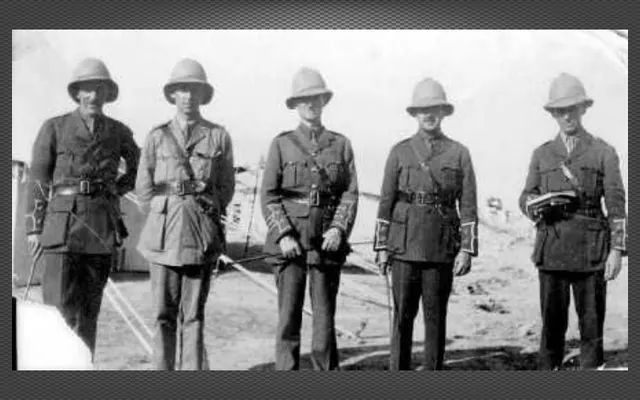
Season 2: Episode 28 - The Challenge of Jewish Power
The return of the Jewish people to the tools of political and military power was bound up with their return to the land of Israel. This episode explores...
Play Episode
Season 2: Episode x - Sukkot
The Sukkot holiday is a time of messianic expectation and prophetic inspiration. Here is an interlude with some musings on the meaning of war and prophecy. And as...
Play Episode