
Season 2: Episode 31- Interwar Jewry
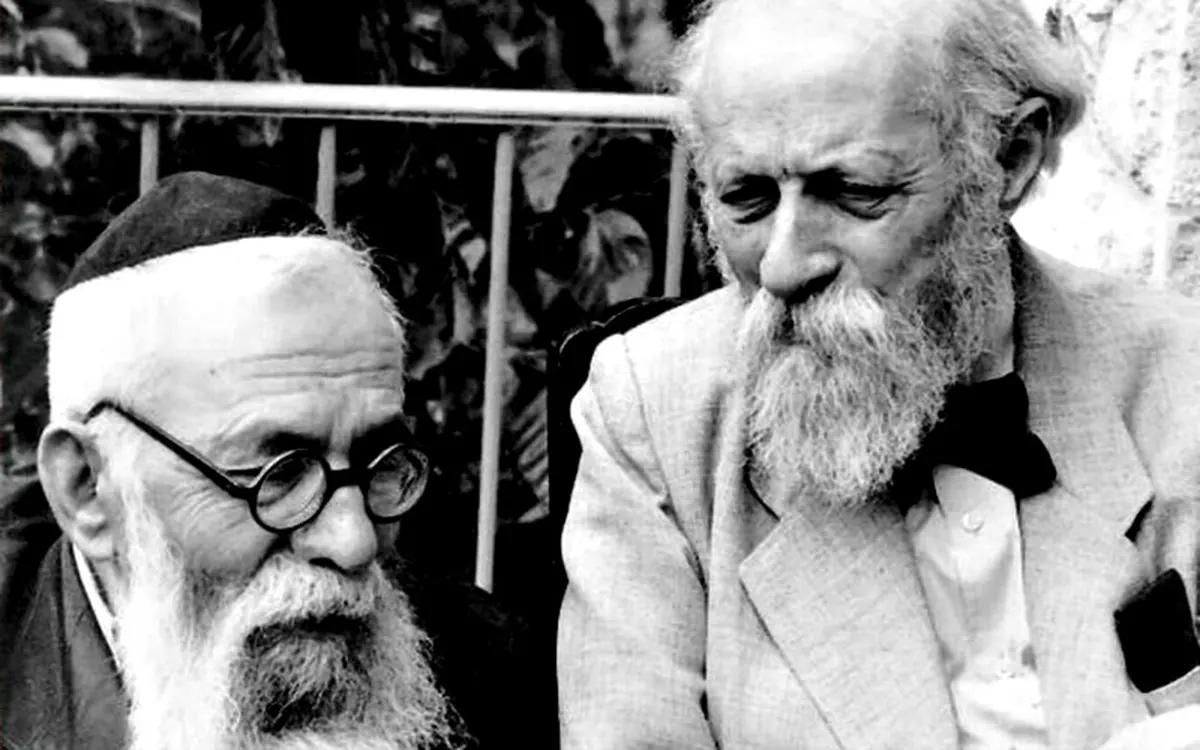
Though the land of Israel is the hinge around which the Jewish Story turns, there are many Jews whose future does not lie in Zion. This episode widens the scope of our story to consider the life of European Jews in the interwar period, and how they contributed to the nature of Jewishness outside of the Zionist dream.
About this episode
Evil triumphs through the inaction of those who could have acted, said Haile Selassie. Rav Mike is wary of Zionist historiography: its narrowness, which has had trouble taking seriously anything outside the land since Ezra, and its teleology, in which everything that was leads inevitably to what is; he holds that human beings are co-creators and that what was does not define what will be. So he widens the lens to the Jews who did not go to Zion and would not survive, and to the roots of ways of being Jewish that lead elsewhere; America, nearly five million by the war and intent on naturalization, waits for Season 3. The interwar period: Germany beaten but not down, Versailles a cause of the next round though the Jewish role is too painful for simple equations, capitalism against socialism, nationalism against internationalism, a communist empire more expansionist than the Tsar's, and British and French empires flourishing with the League's blessing. An aside on oil: found at Masjid Suleiman in 1908, the Admiralty's shift from coal, Kirkuk in 1927, Bahrain in 1931, the Gulf, a pipeline from Iraq to Haifa begun in 1938, OPEC and 1973; keep an eye on it.
Three Jews made the frames of the new world. Marx replaced religious salvation with inevitable economics; Freud, alive in Vienna, made conscious life the tip of an iceberg of archetypes and sublimated experience; Einstein, the Avraham of his era, had the conceptual courage to stand over against the whole world's assumptions. Together they made a new malchut, kingship in the Torah's sense, the context that lets the pieces reach right relationship, kingdoms unbound by territory. Martin Buber, born 1878, abandoned by his mother at four, raised by the Midrash scholar Solomon Buber and homeschooled by his grandmother, master of a dozen languages, suffered at fourteen a crisis of time and infinity from which only Kant's trust in one's own existence saved him from suicide; philosophy replaced religion, Kierkegaard and Nietzsche made him the first Jewish existentialist, and Zionism gave his Jewish soul an outlet until he edited Die Welt in 1902. His marriage to the Catholic writer Paula Winkler was no scandal in Western Zionism, as Nordau's Protestant wife was not, while Eastern families sat shiva. He left Herzl's abstractions for Hasidut, closer to Ahad Ha'am, and his Hasidic tales are a precious addition to the bookshelf.
His last Congress was Carlsbad in 1921, euphoric after Balfour, Weizmann crowned president and Sokolow head of the executive, London Zionism supreme, a resolution for harmony and sincere understanding with the Arab people passed while riots raged in the land and no one wished to hear Jabotinsky say that Zionist education begins with learning to shoot. Buber, who would help found Brit Shalom in 1925 for a binational state, closed the Congress with Nationalism: a nation is a group aware of belonging together, nationalism an overemphasized awareness of a lack, a sickness useful only as a program of healing, and an excess and a different disease if it outlives its program, which in his eyes Balfour had already completed. I and Thou, 1923: existence is interpersonal, the I-It uses and knows, the I-Thou encounters without purpose and makes the between where all real living is meeting; without It man cannot live, with It alone he is not a man. To Gandhi in 1939 he wrote that he had never ceased to strive for a genuine peace, that something higher than the people's life is bound up with the land, and that where there is faith and love a solution may be found. He resigned Frankfurt in 1933, held German Jewry together by education, left a month before Kristallnacht for the Hebrew University, and preached spiritual pacifism; Magnes said Buber thought Zion could be built by creative work, and it was built with blood and fire.
The Frankfurt School. Why had revolution failed in developed Europe and succeeded in semi-feudal Russia, and why was fascism popular in cultured Germany? The Institute for Social Research, 1923, under Max Horkheimer from 1930 drew in psychoanalysts, critics and music theorists, almost all of Jewish origin and little else, Marxism a brighter star than Jewishness in Jack Jacobs's phrase, though Scholem called them a remarkable Jewish sect. Critical theory crossed disciplines for a practical purpose, emancipation from slavery, downright redemptive, and redemption needs imagination, which is why the sages say the Messiah comes unlooked for, like a scorpion or a lost object. Erich Fromm, raised Orthodox and Talmudic, troubled after 1918 into doubting all official ideologies, welded Freud to sociology to explain why German workers would not resist fascism: a hierarchical character structure from father to Fuhrer, right about what they would do if not why. The school fled in 1933 to Geneva and New York's Columbia, seeded the New Left, and lives on in leftist academia and in the right's boogeyman of cultural Marxism. Horkheimer later said its refusal to paint the future society came from Judaism's ban on idols and on naming God, Abraham's stance over against the idols. A 1,500-page wartime study found American worker antisemitism far more prevalent than expected and was never published, too hot for scholars on emergency visas. Why not Jerusalem? Buber's universalism was an outlet for his Jewish selfhood; cosmopolitan Marxists needed no nation.
Vienna, imperial and cosmopolitan, its Ringstrasse lined with assimilated Jewish palaces, Jews five percent by 1914, the supranational people whose fortunes rose and fell with the liberal state, and also home to Herzl and, from 1908, to Hitler's theories of race. After the empire's breakup Red Vienna became a city-state in 1921 admired by socialists everywhere, then a decade of street war between the Republican Protective Alliance and the Home Guard until the Anschluss of 1938 was greeted by ecstatic crowds, the Jews overwhelmingly on the red side. Freud, after a war that desire and repression could not explain, posited eros against thanatos, and in 1934 wrote Zweig that faced with new persecutions he had found the formula: Moses created the Jews. Moses and Monotheism, 1939, made Moses an Egyptian priest of Akhenaten's sun god leading Semitic slaves who killed him in the wilderness; friends begged him not to publish. In his 1930 preface to the Hebrew Totem and Taboo he confessed ignorance of the holy tongue, estrangement from all religion and nationalism, and yet that he was in his essential nature a Jew with no desire to alter it, an essence science would someday reach; his answer was a biological archaic memory, guilt over the primal father, Lamarckian and uncomfortably close to race theory, though epigenetics now asks how trauma is inherited, which Rav Mike knows at the cellular level from a survivor he loves. What matters is what Freud sought: that Jews who rejected religion were still in essence Jews, the ethnic definition that crossed to America. Last, Poland, over three million Jews by 1931, a fifth of the world's, the heart of traditional Ashkenaz where Haskalah came late and Reform not at all. Sarah Schenirer, born in Krakow in 1883 to Belzer Hasidim, watched her friends from Polish state schools assimilate while traditionalism, Hasidut, the yeshivot, Musar, religious Zionism, built defences for men only. In wartime Vienna she heard Rabbi Moshe Flesch preach on Shabbat Chanukah about Judith and call on women to act, and something shifted. Her brother belittled the idea, then took her to the Belzer Rebbe at Marienbad, whose kvittel reply was blessing and success, balsam to her limbs. She opened the first Beis Yaakov in Krakow in 1917, trained the teachers herself, and in 1924 Agudat Yisrael, founded at Katowice in 1912 and in its political heyday, adopted the system, whether from progressive orthodoxy, the new women's vote of 1918, or daat Torah. The Chofetz Chaim's letter of support is dated 1933, sixteen years after she broke the rules: when the leaders will not lead, those who see the problem drag them along.
Key ideas
- Zionist historiography narrows and makes the past inevitable; Rav Mike widens the lens to the Jews who stayed in Europe and would not survive.
- Marx, Freud and Einstein built a new malchut, frameworks that hold the world together without territory; Einstein had Abraham's courage to stand against everyone.
- Buber, the first Jewish existentialist, taught I and Thou and Brit Shalom's binationalism; Magnes said he hoped for creative work and got blood and fire.
- The Frankfurt School's critical theory, Jewish in its refusal to paint the future or name the idol, seeded the New Left and buried its own finding of American antisemitism.
- Red Vienna fell to street war and the Anschluss; Freud's Moses and Monotheism sought the essence of a Jew who had abandoned everything Jewish and found an inherited memory.
- Sarah Schenirer opened Beis Yaakov in 1917 against the whole traditionalist world and dragged its leaders after her; the Chofetz Chaim's approval came in 1933.
Chapters
- 0:00 Inaction and evil; wary of Zionist historiography
- 2:14 Co-creators: widening the lens
- 4:28 The danger of inevitability
- 5:35 Beaten but not down; the interwar pot
- 7:52 Oil: from the Admiralty to OPEC
- 11:08 Marx, Freud, Einstein: a new malchut
- 14:26 Martin Buber: crisis of time and infinity
- 16:50 Existentialist, Zionist, husband of a Catholic
- 19:04 Carlsbad 1921: harmony resolved while riots rage
- 22:17 Nationalism as sickness and program
- 24:25 I and Thou: all real living is meeting
- 25:30 To Gandhi; blood and fire
- 27:44 The Frankfurt School's questions
- 29:56 Of Jewish origin; critical theory
- 33:19 Fromm and the German worker
- 35:30 Exile to New York; cultural Marxism; the buried study
- 38:42 Why not Jerusalem?
- 39:48 Vienna: supranational people, red and brown
- 44:17 Eros and thanatos; Moses created the Jews
- 47:34 In his essential nature a Jew; biological memory
- 51:51 Poland: a fifth of world Jewry
- 54:07 Sarah Schenirer watches her friends leave
- 56:20 Judith in Vienna; the Belzer Rebbe's blessing
- 58:26 Beis Yaakov and the Aguda
- 60:33 Daat Torah; the letter of 1933
Who, where and when
People
Martin Buber, Solomon Buber, Paula Winkler, Judah Magnes, Max Horkheimer, Erich Fromm, Gershom Scholem, Jack Jacobs, Sigmund Freud, Arnold Zweig, Albert Einstein, Karl Marx, Sarah Schenirer, Rabbi Moshe Flesch, The Belzer Rebbe, The Chofetz Chaim, Chaim Weizmann, Nahum Sokolow, Mahatma Gandhi, Haile Selassie, Otto Wagner, Carl Schorske
Places
Masjid Suleiman, Kirkuk, Bahrain, Haifa, Carlsbad, 1921, Frankfurt am Main, Columbia University, Vienna and the Ringstrasse, Krakow, Marienbad, Katowice
Texts
Nationalism, Buber's Carlsbad address, I and Thou, Buber's letter to Gandhi, Escape from Freedom, Totem and Taboo, Hebrew preface, Moses and Monotheism, Schenirer's memoirs, The Chofetz Chaim's letter of 1933
When
1878 CE: Buber born, 1883 CE: Schenirer born, 1908 CE: oil at Masjid Suleiman; Hitler to Vienna, 1912 CE: Agudat Yisrael founded, 1917 CE: first Beis Yaakov, 1921 CE: Carlsbad; Red Vienna, 1923 CE: I and Thou; the Institute founded, 1924 CE: the Aguda adopts Beis Yaakov, 1925 CE: Brit Shalom, 1933 CE: the Institute flees; the Chofetz Chaim's letter, 1938 CE: Buber leaves; the Anschluss, 1939 CE: Moses and Monotheism
Read the transcript
Throughout history, says His Imperial Majesty Haidli Selassie, it has been the inaction of those who could have acted, the indifference of those who should have known better, the silence of the voice of justice when it mattered most, that has made it possible for evil to triumph. Well, I'm definitely looking to defeat evil and bring the light of good into the world, because I'm Rav Mike Foyer, and this is The Jewish Story. Episode 31, Interwar Jewry. You know, I have to tell you, I'm really wary of Zionist historiography. That is, the way in which Zionist historians tell the story of our history, and in particular, of the tendency to tell about those parts of the past which feed directly into the success of the Zionist project in the present.
Not that I'm not down with the Zionist project, I just like a good story. So first of all, I'm wary because it produces a narrowness of focus. Have you ever noticed that even today, diehard Zionists have a hard time taking seriously anything that happens outside the land? And that's not a new phenomenon. We've been telling our story that way for quite some time. You go back to the beginning of season one, and you'll see that the same tendency was there with Ezra and the return to Zion at the end of the Babylonian exile. And if you listen all the way through to the Gaonic period, you can decide on whether the results were good or not. So I'm wary of that narrowness of focus. But I'm also wary of Zionist historiography because of its teleology, its tendency to understand everything which was as if it inevitably leads to what is.
There's always a powerful pull to let the present make a necessity out of past decisions, to believe that things could not have been otherwise, and I leave it to you to contemplate how that can serve present identity and even politics. And despite my commitment, as you've heard me say so many times, to telling a story of the past which builds an identity in the present pointed toward the future which we dream of, I don't believe that what was defines what is. And therefore I reject the notion that what is defines what will be. I know in the deepest places of my soul that human beings are co-creators with God. And even if you don't believe in God, I hope you agree that we all have the power to be free actors in life.
So I want to spend this episode widening the lens just a little bit before we dive back into the maelstrom around the rise of the modern state. And not only widening the lens, but also considering the European roots of ways of being Jewish that don't inevitably lead to Zion. Anyway, a few people have reached out to me recently and asked that I let them know what's The feeling is that we've moved pretty quickly into the internecine struggles of the Zionist movement, and they want to know the bigger picture. And I take this as an opportunity to invite you to reach out to me, so do it. Now, after all, American Jewry at this point is pushing 5 million by World War II, and I've barely given them more than a cameo appearance in the story.
That's mostly because the primary focus of those who sought refuge from Europe across the Atlantic, instead of in the Middle East, is naturalization. They're trying desperately to integrate into America at this point in a way which was never possible for our Jews in Europe. And thus their focus is largely inwards, with the notable exception of their commitment to sending money back to their brothers and sisters in Europe. Their active role in our story will really begin with World War II. We won't really start an intense discussion of American Jewish experience until Season 3. We'll spend plenty of time speaking about that widening gap, as people perceive it to be, between the Jews of Israel and the Jews of America.
But stay tuned, because today's episode is going to touch on some of the foundations of American Jewish culture as I see it. So there's America, and then there's the vast majority of European Jewry who are not living under the British mandate in Palestine. And, to my great sorrow, they'll never make it. They need to have a face at this stage of our story. or of course rather, faces. So I'll try my best to paint them into the picture, if only in broad strokes. As I said, there's an easy inevitability which can build into a story of the rise of the modern state of Israel, one which sees all events of the current phase of our story pointing toward the process of the formation of the state. And if you look close enough in the way the story is often told, even the form that that state will take can look like a foregone conclusion when looking back from the present.
But aside from the unbelievable arrogance of thinking that history could not have been otherwise, there's a deep danger to both the historian and the Zionist in this perspective. The historian may be tempted to devalue the elements of the Jewish story that don't make it to Israel, and the Zionist may be tempted to devalue the Jews that don't make it there. I want you to remember that, because it's going to come up in a later episode. The drama of the struggle for Zion really does dictate that our focus will remain there, especially because of where I'm sitting today, in the rebuilt Jerusalem. But I want to keep a critical eye on what exactly is taking form in the land, and who and what are driving that process of formation.
And in my eyes, one way to do this is to keep the broad scope of the Jewish story in sight. So, here we go. World War I left the economies of Europe in pieces, and the heart of a generation was dead in the trenches across the battlefields. When the guns went silent, Germany was licking its wounds, but she had not yet felt the indignity of full defeat and occupation. That would only come after round two. And it's a truism amongst many historians that the Versailles Treaty that ended World War I was a major cause of World War II. I mean, gutting the remnants of Germany's economy, stripping away her colonial holdings, and saddling her with crushing war reparations, seemed to have all but guaranteed that another round was on the way.
So I'm not going to argue with those historians. But the role that Am Yisrael is going to play in the next round of killing is so profound and painful that I refuse to reduce things to a simple equation. We'll keep talking about that as we go forward. But for now, let's just say that Germany was beaten, but not down, despite the fact that she lost. In the same sense, we could really say that the war may have ended, but the battle raged on. The struggle now is between capitalism and socialism, between nationalist and internationalist ideology, and it makes Europe look like a pot coming to boil during these two formative decades of what's called the interwar period. On one hand, a communist empire began to rise out of the ashes of the old Russian one, and it was even more expansionist than its predecessor.
After all, global revolution is a very aggressive stance, even if its goal is to free you from your chains, whether you like it or not. And on the other hand, the colonial empires of Britain and France are flourishing in the wake of World War I. We saw back in episode 27 that the Middle East is a ripe ground for their expansion. It's a bit of an aside, but it's worth it. to mention that the first oil was found at Masjid Suleiman in southwestern Iran in 1908. Not the first oil in the world, but the first oil in the Middle East. And from that moment, black gold began to move steadily toward the center of the economic dimension of our story. And I'm going to take a minute, because it's going to play a critical role not only in our story, but in world history in general.
So the 20th century quest for new sources of oil was in many ways begun actually by the British Admiralty, because even before World War I, they'd begun to convert from coal to oil, empowering their battleships. But the rise of mechanized warfare and the key role that naval power in particular played during the war made it clear to the whole industrialized world that oil was a strategic asset to be controlled at all costs. British imperialism received the international seal of approval from the League of Nations, I hope you recall, in the wake of the war, although now it was called the Mandate System instead of the Imperial Colonial System. And no matter what you call it, the British quest for control of the Middle East continued unimpeded, and now with a little additional glow of moral rectitude.
Nominally, they were in the Middle East responsible to guide the peoples under their mandatory authority toward national independence, including, of course, toward wise use of their resources. But hey, once an imperialist, always an imperialist. And a large oil field was discovered in 1927 near Kirkuk in British-mandated Iraq. And those discoveries were quickly followed as they moved down the Persian Gulf, beginning with Bahrain in 1931, followed by Saudi Arabia, and the rest of what would become the Gulf states. On the eve of World War II, in 1938, the British began construction on a pipeline and refinery that would connect the oil fields in their mandate in Iraq to the port in Haifa on the coast of their mandate in Palestine.
Convenient, no? We'll speak more of British imperialism and its hesitancy to hand off the mandate in coming episodes. But just to close off the resource picture, by 1970, Middle Eastern oil was 30% of world production. And since oil accounted for 41% of the world's energy consumption at that point, it was a major strategic consideration for all industrial nations. And we'll tell that tale in full when we get to the story of the 1973 Yom Kippur War. OPEC, the Organization of Petroleum Exporting Countries, was founded by Iran. Iraq, Kuwait, Saudi Arabia, and Venezuela. We knew it. And they now produce 40% of the world's oil and possess 70% of its reserves. So, keep an eye on the oil in our story. Okay, N parentheses, and back to the interwar period.
So overall, for Europe, the interwar period is the ultimate space in between. Though the people living those two decades certainly couldn't have known it at the time, what they did know is that after World War I, the old world was gone. Nothing would be the same. And because of its impact, the European society was struggling with any number of conceptions of how to put things back together, how to make sense of this new world. And by the way, seeing as they were in the process of conquering the remaining portions of the globe at the same time, they dragged the whole planet after them into this new world. And one of the most powerful new frames that was being offered to understand this world was the inevitability of economics.
Through his framework of dialectic materialism, Marx replaced the hope for religious salvation with that of economic redemption. And it was specifically the inevitability of the process that Marx mapped out, which offered hope and therefore power. But Marx wasn't the only Jew who offered a substitute for God in these tumultuous times. Anyway, he died decades before the Great War. Freud, however, is alive and well and living in Vienna during the interwar period. And for Freud, of course, God wasn't dead because he'd never existed in the first place. In his eyes, human behavior, including religion, was a product of the past events and unconscious desires that underlie them in our subconscious life. And we'll speak a little further on about what the father of psychoanalysis adds to a particularly Jewish conception of self.
But for now, just note that for European culture, Freud brought to the fore the notion that conscious life is just the tip of the iceberg in understanding the submerged subconscious life of archetypes and sublimated experiences that actually provide the primary plot of our personal story. So, Marx gave us the god of inevitable economics, and Freud gave us the god of the subjective subconscious self, And the last Jew who deserves at least a mention as a framer of the world which emerged out of the chaos of the war to end all wars is, of course, Einstein. Now is not the time for me to wax philosophical about his theories and how the theoretical unification of matter and energy and thereby time and space impacted human consciousness, but there is an interlude on post-modernity coming up somewhere in the future.
We'll do it then. For now, I just want to note how fundamental the shift in human consciousness really was that was triggered by Einstein's thought. In many ways, he was the Avraham of his era, and I don't grant that title lightly. Remember, Avraham was the Ivri, the Hebrew, and Ivri means ever, means he stood on one side, over against the whole world. His was the first Hebrew consciousness. Avraham was able to see the falsehood and idolatry even when it was the universal assumption. Just try to imagine being able to cut through and being so sure you were right that you could look the entire world in the eye and say, you're wrong. Einstein did the exact same thing. I mean, aside from his genius that brought him the Nobel Prize, I want to know where did he get the conceptual courage to look at reality differently than everyone else in the world?
So these three Jews, Marx, Einstein, and Freud, in a sense made the world that Am Yisrael lives in and by the way, most of the Gentiles as well or at least the physics, psychology and economics of it and that's saying quite a bit I mean, what does it really mean to say they created the world? After all, there was much more happening in the interwar period than the thought of these three men, no matter how profound what I'm saying is that they helped make a new malchut a new kingship In their own ways, Marx, Einstein, and Freud all offered a new framework for the integration of the wholeness of human experience. And that is the deepest definition of malchut, of kingship in the mind of the Torah.
Malchut is that which can hold the context, which allows the pieces to reach right relationship. And Marx, Freud, and Einstein birthed new conceptions, which even now allow us to hold the pieces of our world together. They created kingdoms unbound by any territory. And so in that spirit, onwards to our impressionistic take on interwar Jewry outside of the land. We might as well start with personal heroes. Why not? Martin Buber was born in Austria in 1878, a descendant of a leading rabbinic family of Ashkenazi Jewry, which traced itself all the way back to our holy master, King David. At age four, Buber's mother abandoned his father. It's a traumatic event that he would later claim shaped his entire theology of relationships.
And as a result, he was raised by his grandfather Shlomo or Solomon Buber who famed amongst those of us who spend a lot of time learning Midrash as the redactor of many of the sets of Midrash with which we familiar And of course by his grandmother Adela a dynamic and multi woman by all accounts who not only mothered Martin, but homeschooled him as well. The young man led an intensely religious life, and showed remarkable intellectual gifts, and by all accounts, was marked by a definitely inward-turned personality. And when he returned to his father home, at the age of 14, he brought with him a love of Hebrew texts, as well as a mastery of Greek, Polish, German, Old French, which, by the way, he later added English, Yiddish, Italian, Spanish, Latin, and Dutch.
Feeling bad about yourself yet? And what he failed to bring home, however, was his grandfather's Torah. Because upon his return, Boomer underwent what he described as a crisis of time and infinity, in which he was unable to contemplate either timelessness or a beginning and end to time and thus began to doubt the nature of his being. Now, before you start to roll your eyes and think that this was just some teenage angst, he later said that he was only saved from suicide by Kant's philosophy that taught him he could trust the intrinsic nature of his own existence as a starting point for life. Don't laugh. There are a lot of people adrift out there. Now this was a true existential crisis, not just the loss of a hold on meaning.
Trust in existence itself nearly slipped through his fingers, and if it had, the world would have lost a profound thinker. In the wake of this experience, philosophy replaced religion as Buber's passion. And in 1896, he left the University of Vienna in order to immerse himself in the thought of Soren Kierkegaard and Friedrich Nietzsche, amongst others. and because of that, Buber might rightly be called the first Jewish existentialist. It was also in Vienna that Buber found a new outlet for his Jewish soul, something that doesn't go away just because you abandon religion. The city was Herzl's home, after all, and in those early years, it was still the capital of official Zionism. Within two years, Buber joined the movement and became deeply involved in organizational work, so deeply, in fact, that by 1902, he was the editor of the weekly Die Welt, the central printed voice of the organized Zionist movement.
And it's noteworthy that while working hard for the national awakening of the Jewish people, Buber met his lifelong love and wife, Paula Winkler, whom he described as a brilliant Catholic writer from a Bavarian peasant family. And if that strikes you as strange, you just have to know that it's symptomatic of the assimilationist culture at the base of Western European Zionism that Buber's marriage to a Catholic woman, though she did eventually convert, was in no way a source of scandal. After all, even Max Nordau, that leading literary and cultural mind of the New Movement, was married to a Protestant woman, and she kept her faith to her dying day. Now this is at a time when much of Eastern European Jewry was still sitting Shiva mourning for a child that married out.
And if not everyone was so dramatic, even in Poland, intermarriage was still a near total rupture with all family and social fabric in the East, but not so in France, Germany, and Austria-Hungary. The tendency toward abstract notions of nationalism within Zionism began to be unappealing to Buber. And so he left his role as editor of Die Welt in the year that Herzl died and moved toward the mystic world of Hasidut, drawn by the Hasidim's commitment to spiritual experience through daily life and living. You know, even Buber's Zionism was spiritual. He was much closer to Achad Ha'am than Herzl, seeing a return to Zion as a means toward the social and spiritual enrichment of Am Yisrael, and not simply a refuge where they could find political force.
Buber's collection of Hasidic stories is a seriously precious addition to the Jewish bookshelf. I encourage you to find it, though some people consider his translations to be a bit controversial, nonetheless a worthy read. But aside from my desire to fill in Buber's backstory, He can teach us something about European Jewish culture, and in truth, about what I see to be a growing segment of American Jewish culture today as well. The last Zionist Congress that Buber attended was in 1921. It was the Congress held in Carlsbad, Czechoslovakia. It was the 12th Zionist Congress, but the first time the delegates had met since the end of the Great War, and spirits were high. I mean, why not? The British defeat of the Ottoman Empire had appeared out of the chaos of the war like salvation itself, and Chaim Weizmann's association with the Balfour Declaration made him the savior.
He was crowned president of the WZO, the World Zionist Organization at the Congress, and his compatriot and fellow worker toward Balfour, Nachem Sokolov, was named president of the ruling executive. And thus, London Zionism reigned supreme, as it will for some time, and the Anglo-Zionist alliance appeared a match made in heaven. Keep your eye on that for the coming episodes. Euphoria filled the delegates in Carlsbad, despite their discussions over whether armed protection was actually needed for the Jewish settlements now developing rapidly under the new British administration. The riots of 1920 and 1921 that we spoke of last episode that really marked the beginnings of a truly nationalist struggle in the land of Israel, must have seemed very far away from Czechoslovakia.
How else can we explain the fact that the Congress passed a resolution declaring that Zionism seeks, quote, to live in relations of harmony and mutual respect with the Arab people, and which called on the executive to achieve a, quote, sincere understanding with the Arab people? Well, I'd explain it by saying that Chaim Weizman's brand of political Zionism reigned supreme over the Congress, and the practical Zionism of Ben-Gurion, Ketnelson, and the Chaletzim ruled the facts on the ground actually in the Mandate of Palestine. In the land of Israel, the plow was certainly mightier than the sword as a tool of settlement at this point. And in the Congress at Carlsbad, Britain was seen to be more important than either as a solution to the Jewish problem.
No one wanted to hear the increasingly strident voice of Zev Jabotinsky. crying out that the ABCs of Zionist education had to begin with learning how to shoot. Now Buber belonged to a wing of the Congress whose goal went well beyond a sincere understanding of the Arab people. In fact, in 1925, Buber would help create the Brit Shalom, the Covenant of Peace. This small group of intellectuals was committed to a binational state as the fulfillment of the Balfour Declaration. And it was that perspective which infused Buber's closing address at Carlsbad, entitled Nationalism, in which he warned against the chauvinism he saw threatening all national movements in general, and Zionism in particular. Now, Buber's definition of a nation is worth contemplating.
He said it was basically a group that has achieved a certain degree of self-conscious association, whose members basically show awareness of belonging together. That's it. Simple self-identification with the group. Nothing intrinsic. And he says that nations may be an ancient mode of identification, but nationalism is quite modern. Nationalism, says Buber, is the awareness of some lack within the nation. And it's not just an awareness. He calls it an overemphasized awareness, and therefore, to some degree, an ailment. But he says, nationalism is a sickness that brings a particular potential benefit because it can lead to the founding of a program whose purpose is healing, i.e. Zionism. However, he warns, if nationalism persists after its program is completed, after healing is achieved, it is no longer a lack but an excess, and that is an altogether different category of disease.
And despite what might seem obvious to those of us outside Buber's viewpoint, in his eyes, nationalism had already served its purpose in 1921, The Balfour Declaration had declared that Her Majesty's government was committed to recreating a national home for the Jewish people in Palestine. What more need to be done by nationalism? You know, ultimately, Buber's whole worldview was relational. In his eyes, absolute divisions between individuals or nations were artificial and led inevitably to heartbreak, violence, and even tragedy. And so it should come as no surprise that only two years after the Carlsbad Congress, Buber published his definitive work, I and Thou. Now, I have to admit my great love and poor understanding of the book, but the essence of its teaching is as follows.
He says that human existence is fundamentally interpersonal. Human beings are subjects, existing in a perpetual, multiple, shifting relationship with other people, with the world and God. And life is defined by the push and pull of what we call intersubjectivity. Now, within this relational reality, there are two basic modes of existence, what Boomer calls the I-it and the I-thou. In the I-it mode, I engage you as something to be known or used, an object of my subjectivity. The I-thou relationship is more than an experience of you as a subject. It's a true encounter, which Boomer says, in which no purpose intervenes. It's a stance that can create a space where two people can truly coexist, what Buber calls the between.
And in this between lies the truest, most nourishing experience of human life. As he puts it, all real living is meeting. Buber saw much of the alienation of modern living as a result of over-reliance on the I-it. Without it, Buber wrote, man cannot live, but he who lives with it alone is not a man. And it was his sense that the highest form of human existence comes to expression through the encounter with other, and God, of course, as the ultimate encounter, that informed Buber's political vision as well. You know, in his famous response to Mahatma Gandhi's 1939 criticism of the Jewish claims to the land of Israel, Buber said the following, You, Mahatma Gandhi, who know of the connection between tradition and future, should not associate yourself with those who pass over our cause without understanding or sympathy.
I belong, says Buber, to a group of people who from the time Britain conquered Palestine have not ceased to strive for the concluding of a genuine peace between Jew and Arab. We consider and still consider it our duty to understand and to honor the claim which is opposed to ours and to endeavor to reconcile both claims. We could not and cannot renounce the Jewish claim, Something even higher than the life of our people is bound up with this land, namely its work is to find mission. But we have been and still are convinced that it must be possible to find some compromise between this claim and the other, for we love this land and we believe in its future. Since such love and such faith are surely present on the other side as well, a union in the common service of the land must be within the range of possibility.
where there is faith and love a solution may be found even to what appears to be a tragic opposition I'll leave it to you to decide whether those words are true in 1930 Buber became an honorary professor at the University of Frankfurt am Main but he resigned three years later when Adolf Hitler came to power he struggled for nearly five years to hold together the Jewish community around him through education and cultural work but finally in 1938 Only a month before Kristallnacht, the Night of Broken Glass, Buber left Germany and took refuge in Jerusalem, where he received a professorship at Hebrew University. And Martin Buber continued to teach his brand of spiritual pacifism, and together with the Brit Shalom to work toward a binational state.
But very few in his days were listening. You know, Professor Judah Magnus, president of the Hebrew University and fellow member of Brit Shalom, really said it best. Buber thought Zion could be built through untiring creative work. Instead, it was built with blood and fire. Buber is just a bridge into the Jews of interwar Germany. After all, he had one foot planted solidly in Zion. Perhaps a better example of the Jewish culture that had been simmering in Germany for over a century is found amongst the Jews of the Frankfurt School. You know, the general political turmoil of the interwar period came as no surprise to anyone. After all, the old world lay in ruins all across Europe. How could the result be anything other than chaos?
But as the smoke cleared and a new warring order began to emerge, there were two critical questions in the minds of sociologists, economists, and ideologues. One, why had the communist revolution failed to spark in the developed economies of Western Europe, where Marx had predicted it would take place, and instead taken off in the semi-feudal conditions of Russia, and two, how is it that the fascist ideologies like Nazism were so popular in culturally advanced nations like Germany? And these were, of course, not just problems of theory. Violence flared throughout the continent, and really around the whole world, as nations struggled to be born, and revolutionaries fought to free the world from all boundaries.
Europe was about to boil over into another round but the standard approaches of social research failed to bear any fruitful insight about what was happening much less what to do about it Marxist and nationalist thinkers alike struggled to make sense of what was happening around them and to provide guidance to their movements the Institute of Social Research was founded in Frankfurt-au-Main in 1923 with a focus on the study of economics, labor history and socialist history, its scholars approached those key problems, and others, with traditional tools through a Marxist perspective. And in 1930, Max Horkheimer became director of the Institute. Horkheimer was deeply bothered by the suffering of the world around him, and he saw that the traditional social scientific thought and methodology were simply insufficient for engaging its problems.
He realized that a new world was emerging in the wake of the war, and that in order to get his head around it, he would have to break the boundaries of traditional thought that he inherited from the old one. In order to do so, Horkheimer began to incorporate thinkers from the humanities, psychoanalysts, literary critics, and even people in music theory into the work of his institute. And thus, the Frankfurt School was born, an interdisciplinary intellectual association which gathered around the official scholars of the institute. and not surprisingly, considering the nature of the intellectual left of interwar Jewry, they were almost exclusively of Jewish origin. Now I say of Jewish origin deliberately We already well more than a century down the line from emancipation and enlightenment and some of the Jews of Germany are in their own ways more German than the Germans Well, except to the Germans, of course, who I promise you never lost sight of the fact that they were Jews.
But they were pursuing that path of enlightenment that meant to strip away the particularity of the Jew and allow him full entry into European culture. And there's not much debate over how these scholars saw themselves. Their origins may have been Jewish, but not much else. There are, however, deep questions over how much their Jewishness affected their thought. On one hand, Gershom Shalom, great founding scholar of Jewish mysticism and fellow German-Jewish intellectual of the interwar period, once defined the Frankfurt School as a remarkable Jewish sect. On the other hand, Professor Jack Jacobs, a contemporary scholar of the school, asserts that though most of the members of the Institute for Social Research were of Jewish origin, Marxism was a far brighter star, he says, than Jewishness in their constellation.
And by the way, that's without trying to nail down what either one thinks of as Jewish. But no matter what stance you take, these Jews developed a new interdisciplinary approach to thought and analysis, which became known as critical theory. By speaking across boundaries, they learned to see their respective disciplines from the outside, and to gain insight on the crossover concepts, limitations, and synthesis that was available through their discourse. And this was way more than just out-of-the-box thinking. It was thought as a springboard for social activism, or revolution as the case may be. In the words of Director Horkheimer, a critical theory is distinguished from a traditional theory in its relationship to a specific practical purpose.
As he says, a theory is critical to the extent that it seeks human emancipation from slavery, acts as a liberating influence, and works to create a world which satisfies the needs and powers of human beings. In my words, it's downright redemptive. And of course, redemption definitely needs out-of-the-box thinking. If you think you already know what redemption looks like, and just waiting for the rest of the world to catch on, do me a favor, keep it to yourself. I believe what's holding us back is lack of imagination and an inability to accept that there's more to come, much less imagine what it could be. That's why our sages say that there are three things that come behesechdat, when you're not looking for them.
A lost object, a scorpion, and the Messiah. So Professor Jacobs gives us an example of critical theory. It's an archetype, he says. Erich Fromm's inquiry into the mystery of why the German proletariat wasn't behaving the way Marxist thinkers thought they should. Why weren't the workers resisting the growing fascist parties in the name of their class interests? Now, unlike most of his colleagues at the Institute, Erich Fromm came from an Orthodox Jewish background. He was raised with a deep Talmudic and traditional education. But for Fromm, as for so many others, he turned away from the old world after the war. He said later in life, When the war ended in 1918, I was a deeply troubled young man who was obsessed by the question of how war was possible, by the wish to understand the irrationality of human mass behavior, by a passionate desire for peace and international understanding.
More, I become deeply suspicious of all official ideologies and declarations and filled with the conviction of, quote, of all one must doubt. Do you hear the postmodern world come? I wonder how many of you found his words resonant. So despite abandoning religion, Fromm did acknowledge the profound impact his early education and religious mentors had on his later work. And that's saying something, because he will go on to become one of the world's leading psychoanalysts, interpreters of Freud, thinkers, and even political activists. By the by, if you want some important reflections on the challenges which a democratic society faces today, it's worth reading his 1941 book, Escape from Freedom. Fromm's study of the German worker was a clear application of Horkheimer's critical theory.
By welding Freudian psychoanalytic insights to a sociological framework, he described what he called the character structure of German workers. Basically, Fromm posited that no matter what their class interests, these men were unlikely to ever challenge the power of social and political structure within which they lived, no matter what they were asked to do. He saw this as a result of the general hierarchical nature of German society. Psychology is stronger than Marx's economic theory in Fromm's eyes. And since this hierarchy extended from the rulers of society all the way down into the home, with children's relationships to their fathers at its base, German workers were inclined to accept and to support strong leaders who would tell them what to do.
Well, as we now know, Fromm was correct in his estimation of what they were willing to do, if not in his analysis of why. But, fortunately, Fromm and the Frankfurt School were wise, and as we say, a wise man has eyes in his head to see. Following Hitler's rise to power in 1933, the Institute decided that Germany was no longer safe for either Jews or Marxists, much less for those who were both. It went first to Geneva, and then to New York City in 1935, where it became affiliated with Columbia University. From here, the remaining core, and new associated voices that gathered around it, weathered the storm of World War II, and went on to heavily influence the rise of the New Left in both America and Europe.
And critical theory lives on today. The posture of left-wing intellectualism, of multidisciplinary critical analysis, of philosophical rebellion against all powers of structure and oppression, in many ways define the secular intellectual Jewish culture that emerges in post-World War II America. And as I said, the Frankfurt School lives on today, both in the thought of leftist academia, and by the way, in the dark fantasies of the right. They call it cultural Marxism now. It's the boogeyman that lies behind everything that they see as undermining traditional American family values. Toward the end of his career, To get back to the Jewish story, even director Horkheimer came to believe that the Jewish ideas formed the backbone of critical theory itself.
He told interviewers any number of times that critical theory had as a core contention that it was not their task to paint in great detail what a future society will look like. Their task was to point out what had happened in the past and what was happening in the moment. And he added that this orientation came from Judaism, from the central tenet that one does not worship idols, that one does not explicitly name God. In other words, it was a product, just like Abraham, of being an ivry, of standing over against all of the idols of society. So the Frankfurt School struggled against the worship of the false gods, of intellectual conformity, wherever they were. But even these Jews had to give the devil his due.
In the archives of the Institute, there's a 1,500-page manuscript written during their exile in America during World War II. It's a study on anti-Semitism amongst American workers, one which was never published. And it was never published because the study found that anti-Semitism was far more prevalent amongst American workers than expected. And as such, Professor Jacob calls it a bombshell that was too hot to handle. Wartime propaganda was painting the U.S. as a tolerant society, one in a death struggle with fascist Nazi Germany. And such claims of widespread anti-Semitism would only rock the boat. And seeing as many of these scholars were in the U.S. on emergency visas, their place on the boat was too tenuous for any rocking.
We're going to come back to this idea of American anti-Semitism and Jewish fear when we tell the story of the Bergson Group. But for now, we could ask, Why didn't this group of Jews take refuge among their brothers in the Palestine mandate? Why New York? I mean, after all, many of their thoughts and methods echo those of Martin Buber's. They could have followed him to the Hebrew University and become part of the wave of European immigration that gave the Yishuv one of the highest percentages of PhDs per capita in the world. But they did not. And in the end, Buber's universalism, his humanism, psychology, sociology, they were all outlets for his selfhood as a Jew. Though his Zionist vision may have landed him on the extreme left of the spectrum, it was expressive of a commitment to the spiritual significance of the re-embodiment of the Jewish people in the land of Israel.
Buber's was a particular path toward a universal human society, but not so the Jews of the Frankfurt School. As cosmopolitan Europeans, they saw no need for nationalist association, and as Marxists, They saw particulars thought as belonging in the dustbin of history. We're on a whirlwind tour of interwar Jewry here, and such an adventure would be incomplete without a stop in Vienna. Because on one hand, the city's place in the Jewish story comes through its cosmopolitanism. Vienna was an imperial city rather than a national capital. It sat at the heart of an Austro-Hungarian empire which straddled the lands, languages, and cultures of Central Europe. It was basically at the heart of European culture.
And in the fast industrializing age leading up to World War I, the Jews flocked into the city. Vienna's most elegant boulevard is the Ringstrasse, built by Emperor Franz Josef, when he knocked down its walls to let it expand in the mid-19th century. and that Ringstrasse is marked by the palatial homes of wealthy and assimilated Jews. By 1914, at the start of the war, Jews made up about 5% of Vienna and the surrounding province. And as Karl Schorch, the great historian of interwar Vienna, wrote, the Jews became the supranational people, whose fortunes rose and fell with those of the liberal cosmopolitan state. And that brings us to the other side of our story. Austria is also the home of some very serious nationalist momentum.
Of course, we know about Herzl, the Viennese father of the political Zionist movement. And Le Havtel, to keep an absolute separation, in 1908, Adolf Hitler arrived in Vienna from the provinces of Austria. It was there that he first developed his theories of race and power. Now, the end of the Great War brought the breakup of the Austro-Hungarian Empire in a nationalist upheaval. The populace of the surrounding provinces flooded into Vienna, and the city quickly became a pressure cooker. The challenges were huge, but nonetheless, at first, she overcame. And in fact, in 1921, Vienna separated from Lower Austria and became a city-state. Her mayor became state governor. The left-wing Social Democrats, who had dominated the city since the end of the war, consolidated their power, and Red Vienna, as they called it, quickly was born.
And it became a model of non-national political organization that was admired by socialists and internationalists around the world. But it didn't last. Maybe it couldn't. Because the power struggle between socialists and nationalist thinking roiling Europe, combined with the unrelenting economic difficulties to feed political radicalization, that's an equation that's going to mark all of Europe. the conflict between socialist nationalists the economic difficulties and political radicalization soon the sides began to arm themselves within the city and within a few years the left wing Republican Protective Alliance was facing off against the right wing Home Guard and street battles began their struggle tore the city apart for more than a decade some call it a civil war some call it a revolution you can call it what you will just know that stability didn't really return until Austria was annexed by the Nazis in the Anschluss of 1938.
Maybe that helps explain why in what was so recently called Red Vienna, Hitler was greeted by ecstatic crowds. And what about the Jews? Well, in the interwar struggle, the Jews of Vienna were almost overwhelmingly on the red side of the equation, as they'd been in Germany. At this point in our story, the bulk of Jewish nationalism has moved on to Poland and Palestine. And like the Frankfurt School in Germany, circles of creative intellectuality flourished amongst the Jews of Vienna. In the words of Otto Wagner, the architect who contributed so much to the appearance of the city, the intellectual pursuits of these Vienna circles was to show modern man his true face. And the best known Jewish contributor to this particularly Viennese quest for the true face of man was, of course, Sigmund Freud.
I already labeled Freud as the Jew who ushered in the era of the subjective self through his studies of the subconscious. And in his pre-war theories, Freud saw desire and suppression as the primary subconscious topography for human behavior. I want what I want, but society, my internalized parents, the rules, reality, won't allow me to have it all. And so I live a life in a tension between desire and dissatisfaction. There is truth to that. but not enough to explain the death of tens of millions who'd fought for years in the trenches across Europe. And so, in the interwar period, Freud posited that subconscious life was actually a struggle between two principles, eros, the life-affirming qualities like love, sexuality, and pride, and thanatos, the life-denying impulses of violence, brutality, annihilation, and death.
And whatever you think of Freudian psychoanalysis, That struggle between Eros and Thanatos bears reflection on all planes. When we last saw Freud in our story, it was through the lens of his relationship with Herzl, his fellow Viennese, and more specifically, through the tension between the European cosmopolitan and the Jewish nationalist. Go back to episode 21 to check in on it. For now, in order to keep deepening our understanding of the Jewish culture that didn't see its future in Zion, I want to mention Freud's last work. In 1934, the father of psychoanalysis wrote a letter to his friend Arnold Zweig, announcing that he'd begun a new work. Quote, Faced with the new persecutions, he wrote, one asks oneself again how the Jews have come to be what they are and why they have attracted this undying hatred.
I soon discovered the formula, says Freud. Moses created the Jews. The book was entitled Moses and Monotheism, published in 1939, and it shocked the entire intellectual world. In a nutshell, Freud's thesis was that Moses was an Egyptian, not an Israelite. A priest of the sun god who'd been elevated to the sole deity by the pharaoh Akhenaten may not know that there was monotheism in Egypt of a type And he goes on to say that when the Egyptian people rebelled against this monotheistic heresy and returned to their happy pagan ways Moses placed himself at the head of a tribe of Semitic slaves and led them in rebellion, fighting his way out of Egypt. But once out in the wilderness, as Moses attempted to impress his pure monotheism on these former slaves, what Freud calls the heights of intellectual spirituality, it was too much for them, and they ended up killing their fearless leader.
It's a pretty crazy thesis, and there's a lot more. But this is enough to know why, that when the work was published, many thought that Freud, at that point in his 80s and quite ill, had simply lost it. Or others attempted to put the author himself on the couch, seeking the subconscious elements of his selfhood in the story. The Jews in general were horrified that such a blow at their national narrative could come at the hands of someone so well-known at a time of such insecurity. Many of Freud's friends and colleagues begged him not to publish. And there's a small but rich secondary literature on Moses and monotheism, and I'm not really qualified to touch the depths of the questions around its significance.
But my question is, what did it mean to Freud to be Jewish? and how does his definition of Jewishness endure down to our day? Freud wrote in his classic work on religion, Totem and Taboo, in 1913. And in case you don't know his attitude in religion in general, the subtitle says it all, some points of agreement between the mental lives of savages and neurotics. And when Totem and Taboo was translated into Hebrew during the interwar period, he added an introduction with a critical self-observation. No reader of the Hebrew edition of this book will find it easy to put himself in the emotional position of an author who is ignorant of the language of the Holy Writ, who is completely estranged from the religion of his fathers, as well as from every other religion, and who cannot take a share in nationalist ideals, but who has never yet repudiated his people, who feels that he is in his essential nature a Jew and who has no desire to alter that nature.
If the question were put to him, since you have abandoned all these common characteristics of your countrymen, what is there left to you that is Jewish? He would reply, a great deal, and probably its very essence. He could not now express that essence clearly in words, but someday, no doubt, it will become accessible to the scientific mind. It's this access that Freud hopes to offer in Moses and monotheism, and he definitely attempts to take a scientific approach about it. In addition to his historical assertions about Moses' Egyptian origin and his religious thoughts about Judaism as based on abstract ideals, intellectual spirituality, and some pretty wacky notions of how to explain the seeming multiple names of God, Freud proposes the idea that the essential element of Jewishness, That which underlies any forms of religious expression or historical embodiment is constituted by the biological inheritance of an archaic memory.
To Freud, Jewishness is a biological memory, one that the Jewish people are inexorably compelled to transmit to future generations, consciously and unconsciously. And of course, in the story of Moses and monotheism, one of the most definitive elements of this memory is guilt. Guilt over killing Moses, the primal father. I know, it's so Freudian. And later critics of Freud will point out the uncomfortable resonance that a biological theory of Jewish essence creates with the racial theory of Judaism prevalent in Germany of his day. After all, he published the book in 1939. Some will mock Freud, actually. They'll make fun in particular of his Lamarckian evolutionary approach. Raise your hand if you remember Lamarck.
He was one of the precursors to Darwinian thought in evolutionary thought, and his theory was called the fear of acquired characteristics. That if a giraffe is hungry and it stretches its neck to reach the high branches of the tree, that's all that's left, then if it succeeds, its children will have long necks. Lamarck was supplanted by Darwin, even in his own day. And now no one thinks much about the idea of inheriting acquired characteristics. After all, how exactly could you pass down to me your memory of ancient guilt? Psychologically, maybe, but biologically? And before we mock, the truth of the matter is, today the study of epigenetics is breaking new ground in how our experiences may actually change our genetics and make them heritable.
And I can tell you, as the inheritor of a Holocaust trauma, from a beloved survivor she should be healthy and well, it's a cellular level impression that gets made. Aside from these speculations, what matters for our story is what Freud was seeking, not what he claimed to have found. In asserting a biological memory as the essence of Jewishness, Freud affirmed what so many of his non-religious Jews... In asserting a biological memory as the essence of Jewishness, Freud affirmed what so many of his peers so many non-religious Jews of his days wanted to know that even though they rejected the religion of their fathers they were still in essence Jews now that's a notion that will cross the Atlantic to America as an ethnic definition of Judaism though I wonder how many non-religious Jews still shared Freud's desire to be in essence Jewish Last stop, Poland.
And what a stop it is. The Pale of Settlement may have officially disappeared with the reordering of the map after World War I, but by 1939, there will still be more than 5 million Jews out of a total world population of 16.7 concentrated in that strip between the Baltic and Black Seas. And the Polish state that rose once again held the bulk of that Jewry, more than 3 million by 1931, one-fifth of world Jewry and the heart of traditional Ashkenazi culture. Now we spoke at length in earlier episodes about the progressive secularization of European Jewry, how the Haskalah, the Jewish Enlightenment, the Reform Movement, and then Jewish nationalism each broke like waves over the life of traditional society.
And though Polish Jewry bore the same pressures of modernity as the rest of Europe, the medieval conditions of the Pale had held back modernity. The Jewish Enlightenment came decades later here than in the West, and the Reform Movement basically not at all. Now, in a coming episode, we'll talk about Poland as the heartland of Jewish nationalism. But for now, I want to check back into religious life, lest we lose sight of the fact that a large portion of Am Yisrael is still looking toward God and Torah to understand the world at this point, and not toward Freud, the Frankfurt School, or any European intellectual construct. Sarah Schneerer was born in Krakow, Poland in 1883 to a family of Belzer Hasidim.
And though her life was one of religious devotion in the heart of Hasidic culture, in her memoirs she records her fear. It's her fear based on the experience of watching her friends assimilate at an alarming rate as they all grew up together. The forces of tradition in her day were already marshalling themselves against modernity. In fact, they've been doing so since the turn of the 19th century, much less 20th. And we've mentioned many of them. Hasidut, the Lithuanian yeshiva movement, Musar, even religious Zionism in its own way. Rabbis and educators were guiding a shift from traditional society toward traditionalism, toward a way of life that involved a self-conscious stance of religiosity as opposed to an unconscious one, taken in defiance of the alternatives offered by the lifestyle of other Jews.
Remember, Orthodoxy's stance of reaction toward modernity makes it just as much a product of the modern era as the reform movement. But all of these new traditionalist educational approaches were oriented toward men. And both the traditional and traditionalist mindsets dictated that women didn't need a higher Torah education. Sarah Schneera and her friends got their education from attending Polish state schools. And so she watched her peers dropping away from the Torah. And Sarah concluded that without a strong Torah education and a systematic grounding in tradition, girls had nothing to hold back, nothing to mediate the secular influence and ideologies that they were getting in school. But where was she to turn?
Traditionalist Polish culture offered no alternative for women. And so she held fast and wept at each loss to the world of the Torah. That was true until World War I, when during particularly bad fighting, Sera Shnira escaped to Vienna. There, she attended the shul of Rabbi Dr. Moshe Flesch. He was a neo-Orthodox rabbi in the style of Rav Shemsh and Raphael Hirsch, whose story we told back in episode 17. And on Shabbat Hanukkah, the rabbi spoke of the heroine Yudit, whose courage sparked the Maccabean revolt. Not only was he speaking of a Jewish woman as the hero of a story, which was enough to surprise Sera, The rabbi actually used the moment to beg his female listeners to follow in the path of Yudit and to take heroic action in the defense of Am Yisrael.
Sarah had never heard a rabbi directly addressing women from the pulpit, certainly not in Krakow. When she did, something shifted inside her. And when she returned home, she was consumed by the idea of creating an environment for women's Torah education. She had a brother who was very close to the Belzerabbi, and so she began to write back and forth with him on the idea. And at first, like the rest of traditionalist society, he belittled her concern. Like so many others of his day, he was completely blind to catastrophe consuming the daughters of his community, or at least to any acceptable solution. But Sarah would not relent. And as she records his final reply in her memoirs, Nu, he says, let us go to Meranband, where the Belzer Rebbe is now, and we'll hear whether the tzaddik of the generation agrees to it.
And she says, There was no end to my joy. Although I did not have much money, I hurriedly prepared myself for the trip. And when I arrived, I and my brother went immediately to the Belzer Rebbe. My brother, who was a Ben Baez there, he was welcome in his home, wrote in his kvittel, in the little request paper that you give to the Rebbe, She wants to educate Jewish daughters in the Jewish way. And I heard the answer from the Tzadik's holy mouth myself, Brachad Vatzlacha, blessing and success. The words were like the most expensive balsam oil, instilling fresh courage in my limbs. The blessing from the great Tzadik gave me the best hope that my strivings would be fulfilled. And so they would. Sarah Schneera opened the first Beis Yaakov school for young women in Krakow in 1917.
She trained the teachers herself and taught the students with her own work. Still fighting every inch of the way, she pushed the consciousness that only a grounding in Torah education would allow the women of Israel to survive and thrive in the modern world. And slowly she began to open schools in other European cities, gathering the support of Eastern European religious leadership one by one. The first true breakthrough came in 1924, when the Agudat Yisrael, or Agudas Yisrael, adopted the Beit Yaakov system, accepting financial responsibility for its operations. Now the Aguda was a political movement of Orthodox Jewry founded at the Katowice Conference in 1912. And the interwar period was its political heyday.
Branches were established in most countries of Western and Eastern Europe, also in the United States, and in the Yishuv in Palestine. And though the rabbis of Belz and Munkach denounced the very idea of founding a political party as a betrayal of tradition, the Iguda was backed by the bulk of the Rebbis and Rosh Yeshivot in Poland and Lithuania. No membership figures exist today for the Iguda, but its strength is best measured by its electoral achievements in Poland. Its members gained the control of many communities, including the major cities of Warsaw and Lodz. And on the national parliament level, Iguda was a consistent, if distant, second to the general Zionists in representing the Jewish vote.
One could say that on this question, Agudu was the progressive orthodoxy of his day, able to see the need for political engagement and women's education. Or, one could be cynical and note that Polish women had just been granted the right to vote in 1918, making the backing of the Beis Yaakov school system good politics. Or, you could say that there was a real Torah wisdom behind the decision. After all, it was the spiritual leadership of Agudus Yisrael that first brought the notion of Das Torah into Jewish politics. Now this idea may sound strange to the average secular intellectual, but anyone who has learned with a real tamid hachim won't find it surprising that a master of Torah may have unique insight on the proper path for the Jewish people concerning social and political questions, and not just religious ones.
Whatever the explanation, 16 years after Seresh Nira opened the first Beit Yaakov school, in defiance of public opinion and the vast majority of religious leadership, The great Chafetz Chaim, Rav Yisrael Meir Kagan, wrote her a letter of support, giving the ultimate official seal of approval for her vision. Now that may sound a little strange to those of you who knew this story already, since it generally explained that she first got the Chafetz Chaim's approval, and then went out and broke the rules. But the historical record doesn't bear it out. That letter from the Chafetz Chaim is dated 1933, and the first Yaakov school was opened up in 1917. You know, there's a lot more I could say about that, about Sarah Schneer, as yet another example of Hebrew consciousness, of the willing to stand over against an entire mindset and to break the mold in order to help bring redemption.
But this is actually a fine note to end on. Let's just say that sometimes when the leaders won't lead, those who see the problem have to drag them along behind. I just want to thank a few people. I want to thank all the people that give their hard-earned money to make this show possible, and I want to invite you to join them. Go right now to robmike.com, and in the upper right-hand corner you'll see a piece that says, Be a Patron. You can click on through to give a little bit of per-podcast support. I want to thank the Land of Israel Network, that's thelandofisrael.com, for creating a platform that allows me to reach so many wonderful people. I want to thank the Pardes Institute, pardes.org.il. It's the end of a great summer.
God bless you for building an institution that allows me to touch the hearts and minds of so many wonderful Jews. And I want to thank you for listening. I'm Rav Mike Foyer, and this is The Jewish Story.
More from Season 2

Season 2: Episode x - Sukkot
The Sukkot holiday is a time of messianic expectation and prophetic inspiration. Here is an interlude with some musings on the meaning of war and prophecy. And as...
Play Episode
Season 2: Episode 30 - Stories of Blood and Fire
Patterns are hard things to break, and we can learn much about ourselves by how they come about. Here is a look at the cycle of riots which...
Play Episode
Season 2 Interlude: On Authenticity
Sometimes I just gotta be me, but the problem is knowing just exactly where to find myself. In this interlude from the flow of the Jewish Story, Rav...
Play Episode