
TJS S3E1 The Evolution of American Zionism, part I
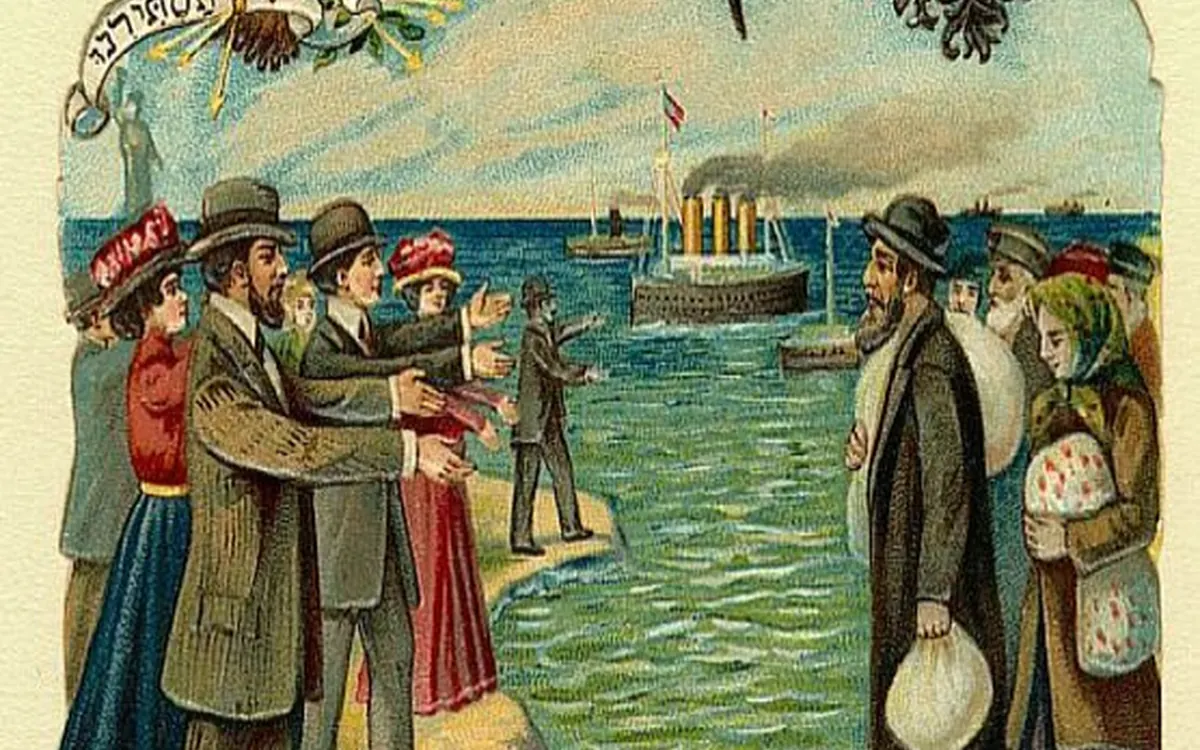
About this episode
You and I especially are descended from immigrants and revolutionists, said FDR. The American Jewish story, long promised in season two, is told here by tracing the evolution of American Zionism, a subplot that opens the whole arc of American Jewish life. Evolution does not mean survival of the fittest, a phrase Darwin never used, but the right adaptation to the environment of formation through the expression of inner resources and the potential for relationship. So to understand American Zionism one must first map America as a formative environment, as unique for Am Yisrael as Babylon or Spain. The founding fathers saw themselves living their own Israel story, a chosen people escaped to a new Zion; Franklin proposed a seal of Moses and Pharaoh at the sea with the motto rebellion to tyrants is obedience to God. Add the bedrock ideals of freedom, meritocracy and individualism, and the fact that the class structures of European feudalism and the dhimmi status of the Muslim world did not apply, and the Jews found an unprecedented opportunity free of fifteen hundred years of structural oppression.
America did not embrace Am Yisrael with open arms, because another framework of American life is race, which is not what you are but how you are labeled, bound up with systems of power and oppression, as Theodore Allen's definition of racial oppression makes clear. Racial hatred is not new to the story, from the blood purity laws of fifteenth-century Spain onward, and the Jews will play a complex role in the black-white basis of American conflict, moving from immigrant oppressed to marginally accepted to positions of power in what sociologists call the process of how Jews became white, not how they became American. Three waves of immigration are usually named: the Sephardic wave of seventeenth-century mercantilism, all but drowned by the Ashkenazi flood yet still present, as in Emma Lazarus, whose poem welcomed the huddled masses; the German wave of the early-to-mid nineteenth century; and the Russian and Eastern European wave of the late nineteenth and early twentieth, whose parallel is the first aliyot to the land.
The German Jews of the second wave, fifteen thousand in 1840 and fifty thousand by 1848, arrived amid the nativist politics of native-born Protestants who saw the foreigners as intrinsically other, classic racial hatred whose only solution was exclusion, the era of the Know-Nothings. Yet they flourished, choosing assimilation as their method, sensing that success lay in becoming more American than the Americans, finding in the founding fathers a replacement for German cultural heroes who shared the same story. Assimilation began as the reality of a tiny minority and became a virtue, from individual assimilation toward intermarriage to a communal assimilation that reshaped the corporate body of the Jews to resemble American society, easiest to trace in religion. As products of the German Haskalah their Jewish identity was entirely religious, and the Reform movement dominant among them suppressed the ethnic, the mystic and the legally binding to highlight the rational and universal, the temple taking on a Protestant cast with organs, choirs and Sunday services. Isaac Mayer Wise gave the movement its fullest American form, from family pews to Minhag America, and the Hebrew Union College's 1883 Treif Banquet of clams, crabs and frog legs expressed exactly what this wave was after, soon codified in the Pittsburgh Platform's declaration that the dietary and priestly laws belonged to ages foreign to the present mental and spiritual state.
Between 1880 and the 1924 immigration quotas over two million Jews fled Russia, Austria, Hungary and Romania, the third wave, received in a confused manner. The German Jews, poised as a cultural elite, found the unwashed masses convenient and built the infrastructure to absorb them, meaning by being a Jew mostly to give to other Jews, as Leo Franklin could announce the Jew is the keeper of his brother while declaring Judaism his religion and America his country. But the newcomers raised the question of the right sort of life: the Ostjuden were more traditional, painfully ethnic, obviously other and often content to stay that way, founding Yiddish schools and unions and workmen's circles, cherishing a religious life they no longer felt bound by. Philip Slomovitz described the divide: the Ostjuden saw the Yehudim as goyim, the Yehudim saw the Ostjuden as dirty ghetto Jews. Around this cultural divide much of American Judaism evolved. American society gave a mixed welcome, the nativists seeking to keep the other out, which they achieved in 1924, and the progressives, who saw human beings as capable of transformation and launched the Project for Americanization, the great age of the melting pot where everyone could join so long as they checked their culture at the door and dissolved into the WASP stew.
The framework that replaced Americanization, cultural pluralism, was first developed by a member of the third wave, Horace Kallen, born 1882 in Austrian Silesia, son of an Orthodox rabbi, the prototypical Jewish American success story who studied under Santayana and taught under Wilson at Princeton. Kallen saw the American spirit as still indistinct, a chorus of many voices, and rejected Americanization's unison for harmony: making everyone a faux descendant of the British colonists was antithetical to democracy and a great loss, since the common political and economic life should serve as the background for each ethnicity to express its distinct individuality. This was a direct reflection of his own life, an early member of the Zionist Organization of America, for whom Zionism was the third way between clinging to the religion of the past and melting into the America of the present, so that the American concept of cultural pluralism has Zionist roots. Nationality is to the group what personality is to the individual, and every nation must give its gifts to the polity of the world, a particularly American form of Zionism in which you could be an American Zionist in America. Rav Mike ends with The Jazz Singer, the first talking picture, made by the Warner brothers of the third wave, whose cantor's son Jakey chants Kol Nidre at his father's deathbed and then returns to the stage, an amalgamation in which the Jewish story is the American story, the Warners wanting to believe you could have it both ways, its premiere falling on Yom Kippur itself.
Key ideas
- Evolution is not survival of the fittest but the right adaptation to the environment of formation, and America was a uniquely free environment for Am Yisrael.
- Race in America is not what you are but how you are labeled, and the Jews moved from immigrant other toward the process sociologists call becoming white.
- The German second wave chose assimilation, from individual intermarriage to a communal reshaping of Judaism into a Protestant-cast Reform, crowned by the Treif Banquet.
- The Eastern European third wave was obviously other and often content to stay that way, and much of American Judaism evolved around the divide between Yehudim and Ostjuden.
- Nativists sought to exclude the other, progressives to assimilate it into the WASP melting pot, the same forces at play in Israeli nation-building to come.
- Horace Kallen's cultural pluralism, with roots in his Zionism, made it possible to be an American Zionist in America, a third way between the religious past and the melting pot.
Chapters
- 0:00 Descended from immigrants and revolutionists
- 1:04 A word on evolution
- 2:11 America as a formative environment
- 4:23 Race: not what you are but how you are labeled
- 6:43 Three waves of immigration
- 9:40 The German second wave; the nativists
- 11:12 Assimilation becomes a virtue
- 13:23 Reform reshapes Judaism
- 16:36 The Treif Banquet; the Pittsburgh Platform
- 18:48 The Eastern European third wave
- 20:00 The right sort of life; Yehudim and Ostjuden
- 22:05 Nativists and progressives
- 24:15 The melting pot and the tossed salad
- 26:23 Horace Kallen
- 28:35 Unison or harmony; cultural pluralism
- 30:57 Zionism as the third way
- 32:03 A particularly American Zionism
- 33:07 The Jazz Singer
- 36:28 Having it both ways; a premiere on Yom Kippur
Who, where and when
People
Franklin Delano Roosevelt, Benjamin Franklin, Theodore W. Allen, Emma Lazarus, Isaac Mayer Wise, Leo Franklin, Philip Slomovitz, Horace Kallen, George Santayana, Woodrow Wilson, The Warner brothers, Samson Raphaelson
Places
Charleston and Cincinnati, The Lower East Side, Hollywood, Austrian Silesia
Texts
Minhag America, The Pittsburgh Platform, Democracy versus the Melting Pot, The Structure of Lasting Peace, The Jazz Singer
When
1840 CE: fifteen thousand Jews, 1875 CE: the Hebrew Union College, 1883 CE: the Treif Banquet, 1885 CE: the Pittsburgh Platform, 1880 to 1924 CE: the third wave, 1915 CE: Kallen's essay, 1927 CE: The Jazz Singer
Read the transcript
Remember always, said President Franklin Delano Roosevelt, that you and I especially are descended from immigrants and revolutionists. We look for a younger generation that is going to be more American than we are. Now, I don't know that I could say I'm more American than FDR, but I can say that I'm a descendant of immigrants, and I've got more than a little bit of the revolutionist in me, because I'm Rav Mike Foyer, and this is The Jewish Story. Episode 1. The Evolution of American Zionism Part 1. The American Jewish Story. So I've been promising the American Jewish story for a good part of Season 2 off and on, and the time has finally arrived to make good on my word. We left off at the end of Season 2 in 1948, and don't worry, I'm going to be faithful to the forward momentum that we've gained over a lot of hard labor.
And that's why I actually want to tell this part of our story by tracing specifically the evolution of American Zionism. It's a subplot in the development of American Jewish life, but one that is going to allow us to get a broad story arc of the development of American Jewry. And God willing, we'll also land us right where Season 2 left off, with just enough information that we can integrate this critical community into the Jewish story as we know it up to now and carry on together. So sit back and relax, because this is going to take at least two episodes. So first, a word on evolution, because I said it's the evolution of American Zionism. And you have to remember that if you say evolution to most people, they'll probably tell you something like survival of the fittest.
But Darwin never said that term. It was Herbert Spencer. You can go back to season two to see how he fits into my thinking. But for now, just remember, Darwin would never say survival of the fittest. He would say survival of the most fit. And that's why, in my eyes, evolution means the right adaption to the environment of formation through expression of inner resources and the potential for relationship. And for our purposes in the Jewish story, that means if we want to understand the evolution of American Zionism, we have to map a few things and we have to start with America as a formative environment before we can even imagine what came out for Am Yisrael in that type of place. So with all the comparisons that could be made to the flourishing of Jewish life in Bavel or in Spain, I want to say that America was a unique environment for the evolution of Am Yisrael.
First of all, there's no exaggeration in saying that the founding fathers of the United States saw themselves as living their own Israel story. They were a chosen people in their eyes, escaped from oppression to the shores of a new Zion. You know, they say that on July 4th, right after the American Declaration of Independence was announced, Benjamin Franklin, John Adams, and Thomas Jefferson got together to form a committee on what the seal of that new country would be. And Franklin's first suggestion was actually an image of Moshe, Moses, and Paro at the sea with a motto that read, Rebellion to tyrants is obedience to God. And that image is just the tip of the iceberg of how deep the shared sense of story goes between the founding fathers and the children of Israel.
It's not for nothing that today, ancient Jerusalem is seen by millions of Americans as a heritage site of their own Judeo-Christian culture. Now add to that sense of shared narrative the bedrock American ideals of freedom, meritocracy, individualism. These are unique in world history, much less in the Jewish story. I know, it's true, that just like any nation, the U.S. has struggled to realize those ideals in its society, but they're nevertheless the founding principles of the country. And the simple fact is, for our story, the structural assumptions of European class society that grew out of feudalism and Christianity, and the religious status of dimitud, which the Jews held in the Muslim world, did not apply on the western side of the Atlantic.
and that means that the Jews founded America an unprecedented opportunity for development free from the baggage of 1500 years of structural oppression. Now, not that American society embraced Am Yisrael with completely open arms because in addition to truth, justice and the American way one of the fundamental frameworks of American life is race. I may have given you my definition of evolution but I'm not dumb enough to try to do the same with race. But I will say that whatever fuzzy genetic notions you might have about such a thing, Jews of all people ought to know that society is not so easily broken up into biological units, and that any attempt to do so is just downright dangerous. In the 20th century discourse, what I've learned is that definitions of race are bound up with an understanding of the systems of power and oppression that really underlie them.
And practically, that means that race isn't actually what you are, but rather how you're labeled. Here's a little taste of the language from Theodore W. Allen. He's a radical thinker on the American race issue. He says, the hallmark of racial oppression is the reduction of all members of the oppressed group to one undifferentiated social status. And it's a status beneath that of any member of any social class within the dominant group. Now, we're not going to take a deep dive into race right now, but I do need to note that it's a critical element of America as an environmental formation for the Jews. Now, racial hatred is nothing new for our story. It first appeared through the limpias de sangre, those blood purity laws in 15th century Spain.
And, of course, we know how it plays out in the modern era. And the Jews are going to play a very complex role in the white-black basis of racial conflict in America, and it's one that's going to be even further complicated by the waves of immigration which not only build the country in 19th and 20th centuries, but bring the masses of Jews to its shores. As part of our story in all of Season 3 going forward, we're going to follow the progress of American Jewry, pun intended, as they move from immigrant oppressed to marginally accepted to positions of power within what Allen called that society of dominant group. And it's an indication of the unique complexity of America as an environmental formation that sociologists call that progress of how Jews became white, not how they became American.
And if you're following the news today with the women's marches, Jews of color, questions of intersectionality, then you know that the cross current between American racial conflict and the Jewish immigration identity story is far from simple. So for now, this episode is going to focus on two waves of Jewish immigration and how their internal conflict and cooperation, as well as their interactions with broader non-Jewish society, will help shape American Jewish identity and ultimately give birth to a uniquely American Zionist vision. So there we have it. We've got a foundational shared story. There's an environment of freedom and opportunity, and there are racial and immigrant conflicts. All these make for a rich evolutionary environment.
Now all we need are the Jews. Scholars label three primary waves of Jewish immigration into America. The first is the Sephardic wave, whose context was 17th century mercantilism, and you go back to season two and listen to a few of the episodes to get a sense of how that fits into the Jewish story as a whole. And even though that wave is all but drowned by the Ashkenazi flood to come, the Sephardic roots of the American Jewish story are still there, not to mention the living experience of Sephardim in America that will last throughout the entire American Jewish story. If you want to de-Ashkenazify your understanding of the background, at least, of the Jewish story in America, go look up the history of Emma Lazarus, a Sephardiya whose American lineage reaches well back before the American Revolution, and who, of course, was famous as the woman who wrote the poem on the base of the Statue of Liberty that welcomed the huddled masses of the world, many of whom would be her Ashkenazi brothers and sisters.
But in reality, we're going to have to get a little bit of Ashkenazi-centric, or however you say that, because the second wave and the third wave will be just that. The second wave of Jewish immigrants to America came from Germany in the early, mid-19th century. They were a small stream in a torrent of nearly 3 million immigrants that poured into America at this point in history, driven mostly by the economic instability in Germany and the famous Irish potato famine. And all of them were seeking that promised land whose streets were paved with gold. The third wave was the Russian and Eastern European Jews who came in the late 19th and early 20th century. We've actually touched their story before already from a different perspective.
That was through our discussion in season two of the first four waves of Aliyah to the land of Israel. So you can go back and see the parallel there. And of course, there's going to be a fourth wave. Those are the remnants of European Jewry who arrive in America after the Shoah. But their tale deserves its own telling, and I think that's why they're usually not labeled as a wave. So let's start with the German Jews of the second wave. In 1840, Jews were a tiny and seemingly stable middle class minority of about 15,000 out of the 17 million Americans counted by the U.S. census. I say seemingly stable because by 1848 less than 10 years later the number was up to 50 And like I said they became admits millions of other immigrants The mid century immigration from Ireland and Germany gave birth to what known in America as nativist politics Essentially, native-born Protestants, who themselves were, of course, descendants of immigrants, but now saw themselves as the true Americans, In their fear and rejection of these immigrants, formed anti-immigrant and especially anti-Catholic groups in cities all across the country.
They decried and despised the religion, the race, the dirty and criminal behavior of these awful immigrants. And if you know a bit of American history, you might recall this as the period of the Know-Nothing Party. And if you read the news today, you'll know that this reactionary stance to immigration has been part of American politics ever since. Now, the brunt of Nativist fear and hatred was actually directed at the Catholics, but there was also a surge of negative stereotypes of Jews that appear at the time, newspapers, literature, popular culture. For our purposes, just keep in mind that Nativists were not only opposed to immigration, they saw the foreigners flooding America as intrinsically and therefore unchangeably other.
Classic racial hatred, whose only solution was exclusion. Nevertheless, despite that opposition and the general difficulty of immigrant life, the German Jews of the second wave flourished. Even the worst that these nativists offered couldn't compare to the Jew hatred of old Europe. And the chosen method of these German Jews in dealing with the antagonism of the nativist elements in society and also the barriers offered to any immigrant was assimilation. Consciously or not, they sensed that success lay in becoming more American than the Americans. And looking around, by and large, they saw a society which was much more compatible even than the Germany that they'd left behind. America espoused all the ideals of the German Enlightenment.
Freedom, reason, toleration, without all the baggage of the centuries of German-Jewish hatred. Now, the Founding Fathers were an excellent replacement for the German cultural heroes. They shared a same story, something that Goethe never claimed to do. So this was the perfect environment in which to finally build a new enlightened Jewish society. And if you go back to season two, you can see that round about this time, German Jewry was thinking about doing the exact same thing at home. Assimilation began as the unavoidable reality of any tiny minority in a majority culture, but it rapidly became a virtue to these German Jews. Individual assimilation finds its ultimate expression in intermarriage and lead somewhat inexolably toward dissolution into the non-Jewish society around.
And that was certainly an ongoing process. It may have been slowed by the racist and anti-immigrant stance of much of the culture around them, but it was never stopped. It's kind of a process which can't be stopped. But the German Jews, in their Enlightenment zeal, were not just interested in individual assimilation. In their own way, they were eager to make a new Jew. Well before the birth of the Zionist movement, they were just as excited to experiment with what a Jew could be in a free environment as any Zionist will ever be. And so, they began reshaping the corporate body of the Jews in order to resemble general American society. I'll call it communal assimilation. And the easiest place to trace that process is within organized religion.
Remember, as products of the German Haskalah, the Jewish Enlightenment, their Jewish identity was entirely religious. Zionism wouldn't rear its head for another half century, and when it did, these enlightened Jews would sneer at it. They were determined to be Americans, albeit of the Mosaic persuasion. And it wasn't just the Mosaic persuasion, the Reform movement was dominant amongst the German Jews, and their desire to refine Judaism, through, of course, a European intellectual and cultural lens, reached new heights in the New World, which meant practically they suppressed anything ethnic, anything mystic, or certainly anything legally binding in their religious practice, intended to highlight the rational, ethical, you know, the universal.
The synagogue, or rather the temple as they called it, took on a decidedly Protestant caste, as it had done in Germany, complete with organs, choirs, robed clergy, and by the turn of the 20th century, many congregations had moved their main service to Sunday, with the rabbi's sermon becoming its primary focus. The process so reduced Jewish culture to a religion in the white Anglo-Saxon Protestant mold that by early 20th century, one Chicago rabbi could actually state that he thought of himself as a Junitarian and not just a Jew. Now, the Reformed Society of Israelites was organized in 1824 in Charleston, South Carolina and was the origins of the American Reform Movement. But it would be in 1846, with the immigration of Rabbi Isaac Merwies, when the movement really got going.
We spoke back in Season 2, Episode 17, it's called Scientific Judaism, worth checking out, about Avraham Geiger as the founder of the Reform Movement. But in all fairness, the Reform Movement is going to find its fullest form in America. And therefore, Isaac Merowise might actually deserve the recognition as founder more so. If I thought it was okay, I might call Geiger the Altarebi of the Reform, but I'm not so sure that's going to float. Anyway, in 1854, Wise's synagogue, B'nai Yishurin in Cincinnati, became the first congregation in the United States to adopt the Christian practice of family pews, as opposed to the divided men and women of traditional Jewish prayer. And in 1857, only three years later, he wrote Min Hag America, the first prayer book specifically edited for American Jews in that classic reform mold of taking out anything which was offensive to modern sensibility and, of course, complete with English translation.
And I could detail the entire process of the evolution of European Judaism into American religion, but for the sake of our goal of understanding the evolution of American Jewish story, I'll mention just one more event. And it's one that, in my eyes, expresses the essence of communal cultural assimilation. The Hebrew Union College was founded in 1875 in Cincinnati also. It is, after all, the oldest Jewish community west of the Alleghenies. And HUC was the first permanent Jewish institution of higher learning in the New World. And its goal was to train American rabbis. Now listen to this to see what that means. Following the first HUC ordination of four rabbinic students in 1883, a celebratory dinner was held, attended by both the Jews and leading non-Jews of the city.
And the menu included clams, crabs, frog legs. The entree was a selection of meat dishes, followed by a dessert of ice cream and a selection of cheese. If you know anything about Jewish dietary laws, you know that this is off the map. It's off the charts. Nevertheless, it was an evening that expressed exactly what this wave of German-Jewish immigrants was after, a celebration of academic achievement, which was universally recognized, and fashionable enough to be attended by non-Jewish society, and of course, free from all archaic social or religious constraints. It's often dubbed the Treif Banquet, Treif in Yiddish meaning not kosher. Well, it means a lot more than that, but whatever. And while it's scandalized even the more traditional monks of the reform, it was not an accident nor an aberration.
The proof is that two years later, the reform movement would adopt the Pittsburgh platform. If you want to understand the essence of American reform, it's a must-read document. You can Google it quite easily. But for now, just hear this one single statement. We hold that all such mosaic and rabbinical laws as regulate diet, priestly purity, and dress originated in ages and under the influence of ideas entirely foreign to our present mental and spiritual state. This is the essence of cultural evolution. Here they are, consciously adapting the inheritance of their past to their present state. But there's really a very important question which remains unasked. Because it's always a mystery where wisdom resides.
Is it in the past, the present, or the future? Between 1880 and the shutdown of immigration through restrictive quotas in 1924, over 2 million Jews fled the violence and poverty of Russia, Austria, Hungary, and Romania for the new life in America. This was the third wave. They were received by the German Jews of the second wave, and by American society in general, in a somewhat confused manner. Now, after a half century of communal assimilation, the German Jews were poised to be a cultural elite. So therefore, the arrival of the unwashed masses on a certain level was convenient. However, well established in their second and third generations, many had moved out of the middle class in anything uniquely Jewish.
Their wealth and education allowed them to assimilate on a level that they had not yet imagined, while at the same time it facilitated the construction of a communal infrastructure that could actually absorb this third wave. These assimilated Jews saw the temple mostly as an important mark of affiliation, whether they ever went there or not. They engaged in communal politics often as an important and gratifying pastime But what it really meant to be a Jew for many of them was to give to other Jews And that why in 1899 at the founding of the United Jewish Charities in Detroit Leo Franklin, famous reform leader of that city, could announce the Jew is the keeper of his brother and responsible for him, and expect all the rich German Jews listening to open their pocketbooks.
While at the same time he could declare in his Sunday sermons, Judaism is my religion. America is my country. As long as the Jew leads the right sort of life in the community, he is as good as any other man. And this is exactly the issue that this new wave of immigrants raised. What is the right sort of life? These were the Ostuden, the Eastern Jews, as they'd been so condescendingly labeled back in Europe by the Western Enlightenment Jews. And here in America, they were everything that the Germans had tried to leave behind. They were more traditional. They were painfully ethnic. They were just obviously other. Now eventually, the Yiddish-speaking culture that the third wave brought is going to make a definitive contribution to the American Jewish story.
But around about the turn of the 20th century, the Yaudim, as the Germans were known, just saw their culture as irredeemably low class. At its heart, the problem was that these second wave immigrants had been so successful in their goal of Americanization. And right as they were achieving that goal, along came a massive influx of Jews, who, as I said, were obviously other and often interested in staying that way. The Eastern European immigrants founded Yiddish schools. They espoused the socialist values that they brought over from what was now soon or had become the Soviet Union, depending on when they got there. And they embodied those values in unions, workmen circles, often there were social conflicts between the capitalist owners of businesses who are now employing their fellow Jews who were socialists.
Many of them still cherish the religious life in Europe, even if they didn't feel bound by the finer points of the law any longer. In short, detention is best expressed by Jewish-American newspaperman Philip Slomovitz, who described the relationship between the two groups this way. He said, it was no secret. The Ostudin, meaning the Eastern European Jews, saw the Yehudim, the Germans, as Goyim, as non-Jews. And the Yehudim saw the Ostudin as ghetto Jews, religious zealots, superstitious, or dirty and uneducated, lower class. Now I can't speak everything out, but just know that a big part of the evolution of American Judaism took place around the cultural divide between that German-Jewish elite of the second wave and the Eastern European masses of the Third.
There are going to be conflicts and a process of communal democratization ahead. And we'll touch in more detail on a particular nationalist element within that struggle in the next episode. But for now, the immigrants of the Third Wave were always well cared for by their brothers, even if they weren't always so well received. Now, American society as a whole couldn't necessarily say the same, because they gave this massive influx of Jews a mixed welcome. We already noted the nativists, and their attitudes from the early 19th century hadn't gone away. In fact, the organized anti-Semitism that will arise in America in the 20th century will echo European racial and political anti-Semitism, which was proved to be so destructive.
But the nativist perspective that saw Jews as an absolutely different and racially inferior other was offset in the late 19th and early 20th century by the advent of what's called progressive era in American history. If you remember, and I hope you've studied a little bit of American history, this was a period of widespread social activism, political reform. It was the era of the muckrakers, my personal favorite, when politicians, journalists, social reformers all banded together to fight the problems caused by the modern era, industrialization, urbanization, and of course, immigration. While the nativists, as we said, saw the immigrant Jews as hopelessly other, and therefore their aspiration was to keep them out, something they succeeded in doing with the 1924 Immigration Act, the progressives had a somewhat different perspective on the question.
First of all, they saw a pressing need for industrial labor in order to build America into the great nation it would become, and they recognized that only immigrants could fill that role. But at the same time, they held many of the same racist and culturally superior attitudes as the nativists toward all these immigrants. Where they really differed is that progressives in general viewed human beings as capable of transformation, either of themselves or by others. And thus they launched what was called the Project for Americanization. This was the great age of the American melting pot. everyone is welcome to join the new society so long as they check their culture at the door and dissolve into the American stew which of course meant into the wasp the white Anglo-Saxon Protestant stew so the nativists wanted everyone to be like them and sought to keep anybody who wasn't out while the progressives wanted everyone to be like them and advocated Americanization meaning assimilation into their dominant culture remember those themes because when we shift our lens back to the land of Israel in the coming episodes, we're going to see the exact same forces at play in Israeli nation building.
So here we are. There's a massive influx of Eastern European Jews who carry a powerful ethnic identity. On one side, they're going to face the forces of rejection, both from without and from within. There will be the blatantly anti-Semitic nativists, and there will be, sadly, many of their fellow Jews who are afraid that their own ability to assimilate into American society is going to be ruined by these ethnic newcomers. On the other side are going to be the forces of assimilation, those progressives who are inviting them into the melting pot of Americanization, and the German Jews who've already paved the way and are reaping the benefits of membership into this new society. So the question is, what's a Jew to do?
You know, when I was growing up in the States, no one spoke about the melting pot anymore. We talked about the tossed salad. It was an image of a society made up of various elements that kept their independent character, but somehow managed to form a harmonious whole. Now, frankly, the racial violence in my high school belied the notion of its success, but nevertheless, today the tossed salad is triumphant. It has completely replaced the melting pot. In fact, I call it the new American religion. Group identity is an organizing principle of unparalleled power, and diversity has been elevated to a sacred ideal. And how many people are even aware that the framework of cultural pluralism that replaced Americanization was first developed by a member of the third wave of American Jewish immigration.
Horace Mayer Callen was born in 1882 in a small town in Austrian Cilicia, son of an Orthodox rabbi. At age five, Horace's family immigrated to the United States, and from here on out, he is the prototypical Jewish American success story. He studied philosophy at Harvard under George Santayana, famous for reminding us not to forget our past, and received his BA, Magna Cum Laude, in 1903. Upon graduation, Callen was personally hired by future American president Woodrow Wilson, who at the time was Princeton University's president, to become the first Jew ever to teach at that university. After two years, his contract wasn't renewed, but no matter, he returned to Harvard for graduate work and to be Santayana's assistant, where he lectured in philosophy for a number of years until he moved on to the University of Wisconsin-Madison and finally to the new school in New York City, where he was a founding faculty member.
And from the heights of this academic position, Callan saw a great challenge, and thus an incredible opportunity, which lay ahead for America. You see, he believed that the spirit of the American nation was still indistinct. As he says so nicely in his 1915 essay, Democracy vs. the Melting Pot, our spirit is inarticulate, Not a voice, but a chorus of many voices, each singing a rather different tune. How to get order out of this cacophony is the question for all those who are concerned about those things which alone justify wealth and power. Concerned about justice, the arts, literature, philosophy, science. What must, what shall, this cacophony become? Now, Callan saw two options ahead in answer to his question.
unison or harmony and he rejected the Americanization approach of unison he says the general notion Americanization appears to denote the adoption of English speech American clothes and manners of American attitude and politics it connotes the fusion of various bloods into beings similar in background, tradition, outlook and spirit to the descendants of the British colonists the Anglo-Saxon stock And in Callan eyes it was not only antithetical to the real spirit of democracy to try to make everyone in some foe descendant of the original colonists it was a great loss to the American nation Cultural diversity and ethnic pride were compatible in Callan eyes with democracy and he believed that diversity was a great loss to the American nation cultural diversity and ethnic pride were compatible in Callen eyes with democracy and he believed that diversity would only strengthen America The common life of the commonwealth, he says, is politico-economic and it serves as the foundation and background for the realization of the distinct individuality of each nation, each ethnicity that composes it.
In other words, He didn't see the strength of a nation to lie in each ethnicity absorbing and dissolving itself into some American ideal. He saw its strength in that American ideal providing a political and economic basis for each of those ethnicities to express itself. This is cultural pluralism. And Callan's idea wasn't simply an academics analysis of the American situation. it was a direct reflection of his own life as a chapter in the Jewish story. Horst Callen no longer lived the Orthodox life of his father, but he did not accept the assimilation path of the German-Jewish elite either. As a true child of the third wave, he held fast to his ethnic identity while searching for a new and particularly American way in which to express it.
And that's why Callen was actually an early member of the ZOA, the Zionist Organization of America. It was the Eastern Europeans of that third wave who brought Jewish nationalism to the shores of America. And the founding of the ZOA was a landmark moment in Zionist history altogether, much less in American Zionist history. In the coming episode, we'll talk quite a bit more about its development. But for now, it's critical to understand that the American concept of cultural pluralism actually has Zionist roots. In Callen's mind, Zionism was the third way. It was a path for Jewish life beyond clinging to religion of the past or melting away into the America of the present. As he says, Zionism is the solution of the Jewish problem.
Because if the past is any warrant for the future, there's every reason to believe that with the Jews as a free people in Palestine or elsewhere, that unique note which is designated in Hebraism has a chance to assume a more sustained, a clearer and truer tone in the concert of human culture and may genuinely enrich the harmony of civilization. There is that theory of cultural pluralism once again, except this time, the harmonious symphony of voices isn't made up of ethnicities within the American Commonwealth, but rather of nations within the global society. And it may seem strange to many today when Zionism has appeared as the ultimate bugbear to these advocates of cultural pluralism. But Callan's Zionist thought not only preceded his reflections on American society, it shaped them.
As he wrote in his 1933 book, Individualism, it's upon the foundation and against the background of my Jewish cultural milieu that my vision of America was grown. But that's only possible because of the uniquely American flavor of Callan's nationalism. He believed that ethnic nationality shouldn't necessarily be defined through the exercise of sovereignty on a determined area, or at least limited to it, but rather through the opportunity to express itself in a cultural way, meaning that you could be an American Zionist in America. As he wrote in The Structure of Lasting Peace, nationality is to the group what personality is to the individual. Tradition is its memory, custom its habits, history its biography, language, literature, the arts and religion are its mind.
Together these form its culture, and culture in the nationality is character in the individual. Now I want you to keep that definition in mind as we move forward in our story in Season 3, because that's a particularly American form of Zionism. And just as every individual adds their voice to a chorus in Callan's vision, and every ethnicity adds their element to the tossed salad of America, so too every nation must give its unique gifts to the polity of the world. There's much more to discuss in the evolution of American Jewry, and now you understand why we're going to do this in more than one episode. But I want to end with a last facet of the American Jewish story that was embodied by these immigrants of the third wave.
You know, I grew up, and maybe you did too, watching Neil Diamond star in The Jazz Singer. And for a Jew with a strong identity, and yet deeply embedded as I was in secular American lifestyle, the movie's just a heart-wrencher. Now, I was watching the 1980 remake, but the original jazz singer, you may not know, was produced in 1927 by the Warner Brothers, and it's considered by many to be the first ever talking picture. How the Jews came to dominate Hollywood is its own story, and we can't tell it right now, But just keep in mind that Harry, Albert, Sam, and Jack were once glossers before they were Warners, and that their family immigrated to Canada from Poland in the third wave. So the basic plot of the first talking movie is this.
Kantor Rabinowitz learns that his 13-year-old son has been singing at a local saloon on Yom Kippur Eve, and he beats them, and his son Jackie, therefore, or Jakey, runs away. Now that night, at the Kol Nidre service, the height of the religious moment of the year, the cantor tells his fellow congregant with tears in his eyes, my son was to stand at my side and sing Tanakh, but now I have no son. Scrolling forward a decade later, Jakey, now Jack Robin, is looking for his big break as a professional singer. When he meets Mary Dale, a nice Christian girl, she becomes his girlfriend and helps him land a starring role in the musical review on Broadway, no less. But of course, opening night is scheduled for Yom Kippur Eve.
And as the dress rehearsal the day before is getting underway, Jakey's mother reappears in his life, only to tell him that his father is dying, and to ask him to take the cantor's place at synagogue the very next night. Jakey's torn. He doesn't know what to do. On one hand lies his entire future and acceptance into American society. On the other, his father's deathbed wish. In the end, he decides to miss the show's premiere and hurries to his father's side before appearing in shul to chant Kol Nidre. And can you imagine the American Jewish audiences as they watch the Kol Nidre service on the talking screen? His father dies happy, but there's more to the story. You know, in Samson Raphelson's original 1917 short story, The Day of Atonement, on which the movie is based, the son's return to the synagogue is complete.
He returns to his father's world and gives up showbiz forever. But that wasn't the ending the Warner Brothers were after. In their movie, Jakey's mother has come to understand that jazz is Jakey's way of singing to his god. And so once Kol Nidre has passed, as has the father, she encourages him to return to the theater and to his non-Jewish girlfriend. This is a very different path than the simple assimilation of the German Jews, who would have never wanted Kol Nidre to be on the big screen. And it's obviously a break from the traditionalism of the Eastern European Orthodox, who would have never wanted Jakey to go into show business. And it's not even the ethnic pride identity of Horace Kellen. The Jazz Singer is the first talking movie, and the Jews are pioneering a quintessentially American medium.
This is an amalgamation. It's a place in which the Jewish story is the American story. The Warner Brothers wanted to believe that you could have it both ways. You could find success in American society and remain true to the faith of your fathers. Just as an epilogue, the evening premiere of The Jazz Singer took place on October 6, 1927, which was Yom Kippur. So I guess we would have to ask the Jews who filled the seats of that theater to watch the movie premiere rather than filling the pews of their temple in order to pray in the ilah, the closing service, whether one can really have their cake and eat it too. Or maybe, maybe just maybe, we need to trace down their grandchildren and ask where they are now in order to know whether it is really possible to dance at two weddings.
I just want to thank a few people. Here at the beginning of Season 3, I want to thank all the folks who give their hard-earned money to make this show possible, to keep it free, to make it widely distributed, and I want to invite you to join them. You can go right now to jewishstory.co. In the upper right-hand corner, you'll see a little box that says Be a Patron, and you can click on through there to give a little bit of per-podcast support. Check it out. There's a bunch of interesting incentives, depending on the level of your support. I also want to tell you I'm happy to dedicate shows, and in that case, I actually have to say this show is dedicated, that's right, to me, to Mike Foyer by Anonymous Patron on behalf of my own 45th birthday, which is coming up.
So happy birthday to me. If you want to dedicate the show to anybody, just send me an email at rovmikefoyer at gmail.com or you can message me on Facebook at rovmikefoyer or the Jewish Story Podcast. I also want to thank, as long as I'm at it, the Land of Israel Network. Yes, that's www.thelandofisrael.com for building a network that allows me to reach so many amazing people. I want to thank the Pardes Institute, P-A-R-D-E-S dot org dot I-L for building an educational place that allows me to touch the hearts and minds of so many wonderful Jews. And I want to thank you for listening. I'm Rav Mike Feuer, and this is The Jewish Story.
More from Season 3
TJS3 Interlude What is a Jew?
The art is by Dan Levkovitch מאת דני לבקוביץישראלי, יליד צרפת, 2002-1927 - The Israeli Cartoon Museum, CC BY-SA 3.0, commons.wikimedia.org/w/index.php?curid=32910158
Play Episode

TJS S3 Purim 5779: The Oldest Hatred, a practical analysis
Illustration attribution www.maxpixel.net/Aggression-Viole…ss-Attack-656795
Play Episode