
TJS3 Interlude What is a Jew?
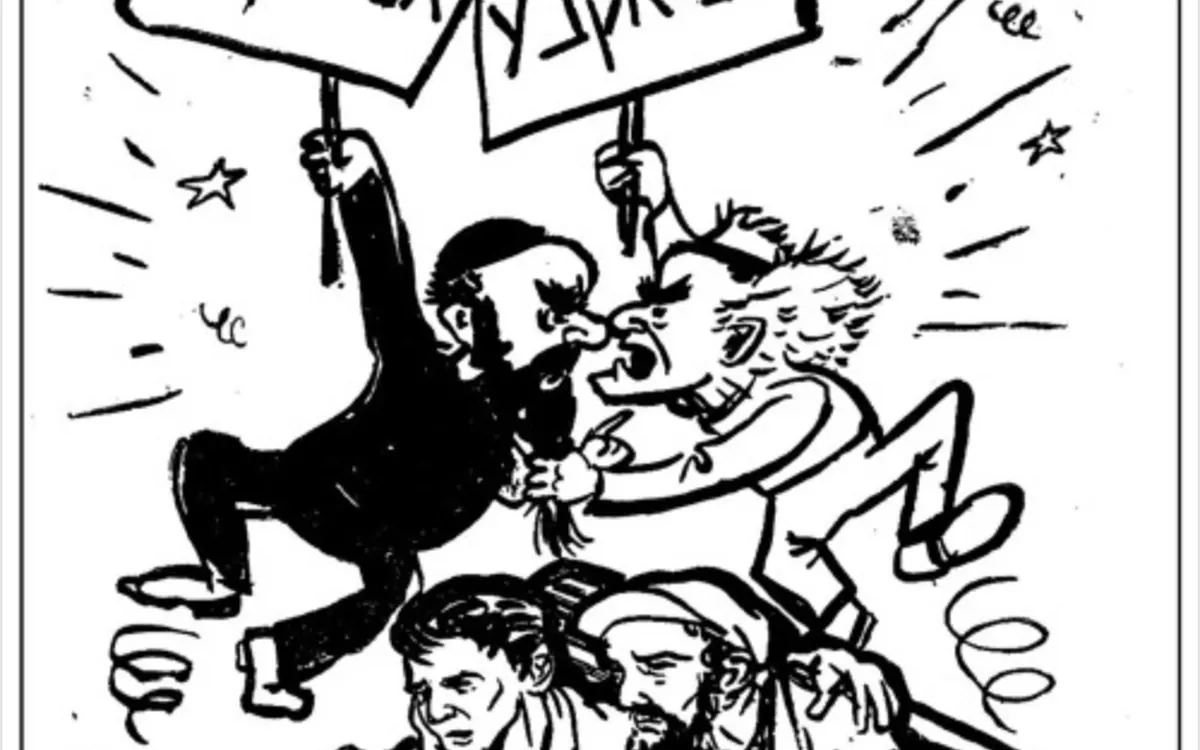
The art is by Dan Levkovitch מאת דני לבקוביץישראלי, יליד צרפת, 2002-1927 - The Israeli Cartoon Museum, CC BY-SA 3.0, commons.wikimedia.org/w/index.php?curid=32910158
About this episode
Most people are other people, says Oscar Wilde. Rav Mike is tired of the question who is a Jew, which has no answer and empowers the gatekeepers; he wants to ask what is a Jew, which may show where the story is headed. He takes the developmental approach. Abraham was not the first Jew but the first Ivri, the first Hebrew, standing on the other side against a whole idolatrous world to say there is one God: conceptual courage, the ability to cleave to the truth of your story until the world catches up, as Thomas Kuhn's paradigm shift and Natan Sharansky's refusal both show, the empire crumbling while the prisoner walks out free. Isaac adds life after the altar: his uniqueness is that he does not die, so every Jew who descends from him lives a life not entirely his own, and you can run but you cannot hide from history. Jacob, renamed Israel, struggles with God, an interesting contrast to Islam's submission, and introduces the tribal element, the origin of the word Jew, and the vision of union rather than unity, where the parts keep their integrity and are finally in right relationship, a particularist but inclusive worldview against the universalist exclusive worldviews of Christianity and Islam.
Judah, Israel's fourth son, finally brings the word Jew, from Leah's this time I will praise the Lord, and praise and witness become core elements of the mission, as Isaiah says, you are my witnesses and I formed this people that they might declare my praise. These are backstory; the first person actually labeled a Jew was Mordechai in the book of Esther, Mordechai the Yehudi though a Benjaminite, which shows two things: the word has shifted from a geographic and tribal meaning to a religious one, and the label is a product of exile, since to the Babylonians the tribal distinctions are irrelevant and all are just Jews. Exile means I am not where I belong, so Jewish identity is oriented toward surviving and not getting too comfortable, as Jeremiah told the exiles to build homes and pray for the city but return in seventy years. Haman defines the Jew from without, a people scattered and dispersed whose laws are different and who do not obey the king's law, and the rabbinic project defines from within, an absolute identification of law and identity, the Jew in exile a halachic astronaut who can live anywhere but clearly does not belong, which keeps us bound to one another.
The times are changing, with one foot out of exile and one in the land, which is why everything appears as a crisis, the sketchy moment of stepping from the boat to the shore. The religious definition that carried the Jews through exile is no longer sufficient to the people embodied today, shown through stories: an Arab Muslim who wants to convert to being a secular Israeli, which cannot be done; and the Russian soldier, Jewish by patrilineal descent and so by halacha not a Jew, who dies in combat and whose relatives would bury him apart, a real pain in the state. So the elements gathered are conceptual courage, a life not your own, struggling with God, union not unity, and the embodied historical reality, and the Ezekiel vision of the two sticks, Judah and Joseph joined in one hand, may mean a reunion of the tribe of Judah with everyone living in Israel's story. Rav Shlomo Riskin's story of Dan from Nigeria, who converted and fell in defense of a yeshiva out of tikkun olam, the fixing of the world, and whose parents came, converted and built a faithful house in Netanya, suggests the most essential answer: a Jew is one of the people God put in the world to fix the place, and we would do well to shift from the identity politics of who is a Jew toward a mission focus.
In the second half Rav Mike sits with Rav Aron Leibowitz, founder of Hashgacha Pratit and Chuppot, organizations breaking the chief rabbinate's monopoly on religious services. Rav Aron performs Orthodox, halachic weddings outside the rabbinate, the only kind of wedding actually illegal in Israel, carrying a risk of prison, for couples who cannot or will not marry through the rabbinate, many because one partner is not recognized as Jewish. Some four hundred thousand immigrants from the former Soviet Union are ineligible to marry, and for the first time the majority of immigrants under the Law of Return are not recognized as Jewish by the Ministry of Interior, people with a strong Jewish identity held behind the Iron Curtain, fully acculturated, serving in the army, yet only Jewish by patrilineal descent. Rav Aron's position is to tell such people not that they are not Jewish but that they are Jewish and simply not halachically Jewish, an often technical gap within overlapping circles of nationhood, peoplehood and religion, supported by the tradition of zera Yisrael that lends significance to patrilineal descent, while he would never perform a wedding across the halachic line, which for him remains essential.
Rav Mike presses: why bridge the gap rather than widen it, separating the Israeli national identity from the Jewish religious one with a civil ceremony. Rav Aron answers that to tell people who see themselves as Jewish that they are only Israeli ignores the power of peoplehood, the large part of the Jewish experience beyond religious practice, and the modern Orthodox insistence on brotherhood, so he goes out of his way to call his atheist cousin to the Torah while he would be more challenged by the intermarried in America, where intermarriage means assimilation into a non-Jewish culture rather than, as in Israel, into the Jewish majority. He is not concerned about the numbers because the work of Chuppot offers an address, and he believes the draconian rabbinate's days are numbered and the state is heading in a more civil direction, trusting more in God and less in control. Both close on mission: the covenant, the drive to be an exemplary society committed to justice, progress and life, what being Jewish has been about, so that a Jew is an exemplary human being, a mensch, and the gap between Israeli and Jew might be best served by a return to a positive tribalism, each tribe contributing its essence to the mosaic, putting down what divides us to get on the mission of fixing the world.
Key ideas
- The better question is what is a Jew, not who, since who is a Jew empowers the gatekeepers and dodges the real problem.
- The archetypes build the answer: Abraham's conceptual courage, Isaac's life not his own, Israel's struggle with God, Judah's praise and witness.
- Mordechai is the first labeled a Jew, a word that shifts from tribe and place to religion and is itself a product of exile, defined from without by Haman.
- The religious definition that carried exile is now insufficient to a people embodied in a state, as the Russian soldier and the would-be secular convert show.
- A Jew may most essentially be one of the people God put in the world to fix the place, a shift from identity politics to a mission focus.
- Rav Aron Leibowitz tells the unrecognized that they are Jewish but not halachically Jewish, an often technical gap, while holding the halachic line for marriage.
Chapters
- 0:00 What is a Jew, not who
- 1:05 Abraham the Ivri; conceptual courage
- 3:17 Isaac; a life not your own
- 4:26 Israel; struggle with God and the tribes
- 6:40 Union, not unity
- 8:48 Judah; praise and witness
- 11:02 Mordechai, the first Jew of exile
- 14:20 Haman and the rabbinic project; the halachic astronaut
- 17:38 One foot out, one foot in
- 20:51 The Law of Return left it undefined
- 22:56 Stories the religious definition cannot hold
- 25:08 The elements gathered; Ezekiel's two sticks
- 27:15 Dan of Nigeria; the people who fix the place
- 33:40 Meet Rav Aron Leibowitz
- 37:01 Weddings outside the rabbinate
- 42:15 Jewish but not halachically Jewish
- 47:34 Why bridge the gap, not widen it?
- 51:00 The power of peoplehood
- 55:16 Not concerned; a more civil direction
- 60:40 The gatekeepers and the mission
- 62:48 The covenant; the Jew as exemplary human
Who, where and when
People
Rav Mike Feuer, Rav Aron Leibowitz, Oscar Wilde, Abraham, Isaac, Jacob, Judah, Mordechai, Haman, Thomas Kuhn, Natan Sharansky, Rav Shlomo Riskin, Dan of Nigeria
Places
Shushan, Nigeria, Ephrat, Netanya, Nachlaot
Texts
The Book of Esther, Isaiah 43, Ezekiel 37, Fear No Evil, The Law of Return
When
1950 CE: the Law of Return left a Jew undefined, The Second Intifada: Dan falls at the yeshiva, 2019 CE: the majority of immigrants not recognized as Jewish
Read the transcript
Most people are other people, says Oscar Wilde. Their thoughts are someone else's opinions, their lives a mimicry, their passions a quotation. Now, I like to believe I'm actually who I am, and I'm saying what I mean, but sometimes I'm not entirely sure. So just to be confident, we're going to break a few molds, because I'm Rav Mike Foyer, and this is The Jewish Story. Interlude. What is a Jew? You know, I've gotten really tired of the question, who is a Jew? I mean, aside from the fact that it doesn't seem to have any answer, it just presents an intractable question. I see it as playing into the power of the very gatekeepers, those who are bothered by the question, want to disempower. And furthermore, it's actually avoiding the real problem that underlies the issue.
I want to talk about what is a Jew. Instead of playing identity politics and who gets to be in and who gets to be out, let's talk about what we are. And that might give us a little bit of an insight into where this story is headed. Now, there's lots of ways that I could answer the question, but I want to take a stab at first, at least, at the developmental approach. Let's start at the very beginning with Avraham Avinu. Our father, Avraham, was not the first Jew. He was the first Ivri, the first Hebrew. And that word in Hebrew means, of course, on the other side. Avraham Avinu stood opposite the whole world that believed in idolatry, and he said, there is one God. And we've said before that this is conceptual courage.
It's the amazing inner ability to look the entire world in the face and say, you're wrong. My inner sense of the truth outweighs all of the reality I see around me. And in such a fantastic fashion, Avraham, his inner commitment to truth was so strong that it changed the world. Now, this is what we call a paradigm shift. You know, if you've ever read Thomas Kuhn's book, Paradigm Shift, he was the American physicist and philosopher that really introduced the idea that the way we know the world changes over time. Then you'll appreciate what he meant with the following quote. He says, well, by the way, he's quoting Max Planck, father himself of quantum physics, talk about a major shift in the way we know the world.
He says, or Planck says, a new scientific truth does not triumph by convincing its opponents and making them see the light, but rather because its opponents eventually die and a new generation grows up that is familiar with it. In other words, on some level, the truth is that which lasts. And conceptual courage is the ability to hold on to your inner essence, to cleave to the truth of your story in the face of a world that's denying it and to allow that world just to fade away. If you want an example of this in our modern world, I give to you Natan Sharansky, the great refusenik, who sometime in the 70s decided he wanted to come to Eretz Israel out of the Soviet Union and for his troubles was thrown in prison.
If you haven't read his book, you've got to check it out. It's called Fear No Evil and it's really a monument in my eyes to exactly what I'm talking about. Just picture, Sharansky wants to go to the land of Israel, to the state of Israel, and the most powerful empire in the world tosses him in prison for his trouble. but inside he's free. He believes that he's a Jew, he believes that he's a human being, and he believes that his freedom dictates that he should be allowed to go and join his people in their land. And the whole power of the Soviet Empire is concentrated on keeping him imprisoned. He doesn't try to convince them that they're wrong. He doesn't rage against the machine. What does he do? He cleaves to that inner truth.
And lo and behold, the very empire which imprisoned him crumbled around him and he walked out a free man. So this lies at the base of the answer to the question, what is a Jew? That conceptual courage, that ability to cleave to our story, to the point at which the world eventually catches up. If we're going to keep going with the developmental approach, then the next step, of course, is Abraham's son, Yitzchak, Isaac. And there's a piece of what a Jew is, which comes from his being bound on the altar. The binding of Isaac, of course, is the definitive story of his life. And remember, martyrdom is far from unique to the Jewish story, right? What is unique, however, to our tale is life after the altar.
Yitzchak's uniqueness doesn't come in his ability to sacrifice himself or even in his father's willingness to do so. It's a complex story. We should discuss it sometime. It comes from the fact that he doesn't die, that his whole life is lived after the altar. And the message there is very simple. every Jew who descends from Yitzchak is living a life which is not entirely their own. Because when God stays Abraham's hand, this is why the Midrash says that he was actually consumed on the altar, that we ourselves, what it is to be a Jew, is to live a dual existence. I'm me. I was born where I was born. I am who I am. I live how I live. And yet, I am not entirely my own. And if you doubt that, then you need to go back and listen to the Jewish story because I think it shows that whatever a Jew is, you can run, but you can't hide from history.
So the third step in the developmental approach is, of course, Yitzhak's son, Yaakov, or better known as Yisrael, Israel. He receives his new name, Yisrael, which means struggles with God. And there's so much that can be said about it, but this is not an analysis of the biblical history. It's just a little bit of a touching on these archetypes that underlie the idea or the question of what is a Jew. And what Yisrael adds is this notion is what it is to be a Jew is to struggle with God. You know, it's an interesting contrast to Islam, which itself means submission to God. Because what it is to be an Israelite, not just an Ivry like Abraham, to stand opposite the world, and not just a living sacrifice like Tzitzchak, which means you're living a life which is not entirely your own, But to be an Israelite is to stand up to God every once in a while and say, no, it's not supposed to be like that.
So Yisrael also actually introduces into our story the tribal element. And that's, of course, where the word Jew has its origin. By the way, tribalism is a very important part of the Jewish story. It's one we haven't touched on, but it's one I want to start to bring back into the discourse. Because in my eyes, a positive form of tribalism is part of the solution to the problems the world faces. despite the bad name that the word has gotten. By the way, if you have a better name for tribalism, I'm working on a marketing project because it keeps getting shot down. So let me know. But for now, do you ever wonder, I mean, we're the people of one, one God, one people, one land, 12 tribes. What's up with that?
Not only 12 tribes, but when they were brothers, it was nothing but trouble. I mean, ever since Yosef's brothers beat him up, threw him in a pit, and sold him down into slavery, it seems that this division amongst the sons of Jacob, Israel, has been nothing but a problem. And if you trace it down through history, once the tribes built their home in the land, they didn't get along there either. It's a story of civil wars, split kingdoms, and ultimate destruction. So why would it be that God would ordain that it's specifically Yisrael who has 12 sons who will build B'nai Yisrael? We're not B'nai Yavraham. We're not B'nai Yitzchak. We're B'nai Yisrael. We're the children of Israel. Well, I want to offer this thought to you, and it's part of the answer to what is a Jew, is that what the Jews are about, what Am Yisrael is about, is union and not unity.
The difference between the two is that in unity, all the parts have to dissolve into the whole. But our vision of a redeemed world is one of union, in which the parts maintain their integrity, but they're finally in right relationship. And that's why, by the way, the ism that eventually springs from Israel's descendants, meaning Judaism, is what I call a particulars inclusive worldview as opposed to the universalist exclusive worldview of, say, Christianity or Islam. In brief, what do I mean? Well, I'll take the opposite, right? Christianity and Islam both welcome the whole world to enter into the covenant of the faith, into the community of the faithful. But each of them in their own way, at least in their classic formations, I am aware that both are quite diverse in their present worldview, but in their classic formations, each of them says, you're welcome to come in to our universalist community of the faith, but if you don't, then you're out.
There's the world of Islam and the world of the sword, and there's classically accepting the Savior or destruction. That's a universalist, exclusive worldview. But Judaism as a classic tribal religion is particularist but inclusive. We say, listen, we're the Jews and you're not. And if you're a Jew by choice out there, then you know that we're not particularly welcoming on the way in. And I hope they're treating you well once you've got on the inside. But the good news is you don't have to be a Jew to have a relationship to God. You don't have to be a Jew to be on the right path towards salvation. It's particularist, but it's inclusive. We'll come back to this because it's a very important consequence of the tribal stance.
But before we get there, Israel has one son who finally introduces the word Jew into our story. That's Yehudah, his fourth son. And when he's named, his mother Leah says, This time I will praise the Lord. This time I'll praise the Lord, and that's why she called him Yehuda, which of course means to praise the Lord. Now, this is a part of a definition that sticks with us well beyond Yehuda's personal origins. If you scroll all the way forward to the end of the first temple period, God will declare in the voice of the prophet Isaiah, I form this people for myself that they might declare my praise. It's a core element of what it is to be a Jew to praise God in the world. And by the way, get out there and do it, people.
Do it for your own sake. Do it for the sake of the world. And if you want to know why, well, Isaiah answers that question, actually the beginning of that chapter. It's chapter 43 if you want to look it up. A classic. when he says, You are my witnesses, says God, and my servant whom I have chosen. The other essential element of Israel's mission is to be witnesses, to bear witness to the existence of God and to bear witness to the existence of God through that giving thanks. Now these are two, like I said, essential elements of Israel's mission, the giving thanks that comes from Yehuda's name, and also the testimony that is embedded in there. I can't do a linguistic analysis, but you should know that to be modeh, which lies at the heart of Yehuda's name, can be both to give thanks and to acknowledge.
It's not a place for a full recapitulation of Jewish history, but for now, what I want to do is just get the pieces straight up to now, now that we've actually hit the word Jew, before we can move on. Number one, conceptual courage. Abraham's ability to cleave to his story in the face of a whole world and that world fades away and the truth of his story becomes known. Don't forget, there are literally billions of people half the planet who know Abraham's story now. Number two, a life not entirely your own. You can run, but you can't hide from being a Jew. Number three, we struggle with God. The submission piece is not so characteristic of what it means to be a Jew. And last but certainly not least, or second to last, is union, not unity.
We are a piece of the whole whose particularism is in service of the universal and not vice versa. And finally, like I said, we get the actual name Yehudah. That's to give praise and stand witness. But reality is, this is all backstory. We've got Abraham, we've got Israel, we even have Yehudah. But what is a Jew? So if you're up and up on the Bible, then you know that the first person to be labeled as a Jew was actually Mordechai. Mordechai Yehudi, which, by the way, I have a special connection to because that's my Hebrew name. I'm an Adar baby. And his appearance in the book of Esther in many ways sets the mold for what it is to be a Jew. Ish-yuh-di-ayah b'shushan ha-birah. Right? There was a Jew by the name of Mordechai who lived in Shushan, the capital.
And he gives his list. Son of Yair, son of Shimi, son of Kish. Ish Yemini, a Benjaminite. And then it says, he was one of the exiles from Jerusalem, carried away into exile along with King Yehonyav Yehuda, who'd been driven into exile by Nebuchadnezzar of Babylon. Don, don, don, don, don, don. So it's worth it to go back actually and look at that there at the second chapter of the Megillah. But if you're just listening, first of all, note that we already hear the transition from a geographical, tribal meaning of the word Yehudah, to the one with which we're more familiar. Religious. In the first temple period and beforehand, Yehudah was a place. It was either the tribal land under the United Kingdom, or it was the southern kingdom of Yehudah that had sort of coalesced around the primary tribe.
But here in the Megillah, it's already he's a Yehudi. Even though Mordechai is from Benjamin, he's a Benjaminite, he's called a Yehudi. Now, it's important to note that religion itself is a foreign concept to the Torah. The word for religion in Hebrew is dat, daled taf, and it's actually a Persian word, not surprising that it appears for the first time in relationship to the Megillah in the book of Daniel, because it's an import into the idea of the Torah. And that begs the question of what exactly Judaism, the religion of the Jews, is. There's a question that we can deal with another day. But for now, number one, he's been transformed from a geographic tribal meaning. He's not from the tribe of Judah or even from the place, but he's a UD.
And also, his labeling as a Jew, as opposed to as a Hebrew or an Israelite, is a product of exile. Remember, the hometown crowd, wherever Mordecai was from, knew that he was a Benjaminite. But to the Babylonians, such tribal distinctions are irrelevant. We're all just Jews. Now, to appreciate the role that exile plays in defining and answering our question, what's a Jew? You have to remember the essential fact of exile. Exile means, I am not where I belong. And so much of Jewish identity, both in strategy and in substance, is oriented toward both surviving and not getting too comfortable wherever you find yourself. Jeremiah, who was the prophet of the destruction and sent the Jews out into exile with his message, told them, pray for the peace of the city to which you've been exiled.
Build homes, plant gardens. But he also warned them, in 70 years, you're coming back. So there's a sense of inner alienation from the surroundings, which is meant to define the Jew. But there's also the external opposition. We can go right back to the Megillah to see the origins of that in the character of the Jews. Right? there's this certain people scattered and dispersed amongst the other peoples in all the provinces in your realm they're everywhere whose laws are different from those of any other people and who don't obey the king's law and it's not in your majesty's interest to tolerate them you know, in many ways as much as Mordechai is labeled the first Yehudi It's the words of Haman that begin the Jew as we know it, defined from the outside.
This is a story that we've traced in the first two seasons of the Jewish story. The indigestible element, the obstinate refuser of salvation, the alien other of modern history. And that's why I think much of those seasons, in my eyes, really are just the making of the Jew. And that external process has its own weight. and there's a parallel internal process which matches Haman's definition. The rabbinic project, the sages and all the rabbinic inheritors ever since have fought to create a Jew with an absolute identification of law and identity. They see the answer of our question, what is a Jew, as one who adheres to the law as construed by the rabbis. And in many ways, the suffering and exclusion of exile served them quite well in that project.
The Jew in exile is what I like to think of as a halachic astronaut. What do I mean? I'll give you an example. When I used to go visit my brother, he should be healthy and well, I would bring my own little portable kitchen with me. I had my own plates, my own pots, my own everything. And I would cook, but I would do it in a very controlled environment, kind of like an astronaut that goes off into space with his helmet and his suit. You can live, but it's clear that you don't belong there. Once upon a time he and his wife came and visited me in my home and she not Jewish So she looked around at my kitchen and at a certain point her confusion made me ask what going on She said, well, where's like all that stuff that you use to keep things separate?
And I realized she had no idea that it wasn't how I ate on an everyday basis. Here on my native planet, in my right environment, I was just like everybody else. But the Jew in exile is a halachic astronaut, and that keeps us bound to one another. that's so much of what the rabbinic project is about. But, hey, I don't know if you've noticed, the times there are changing. Because at this point in Jewish history, we have at least one foot out of exile and one in our land. And the question of what a Jew is has become pressing once again. I want you to appreciate that image of one foot out and one foot in. And I'm just going to push on it for a little bit so you can understand why it's so critical in my eyes.
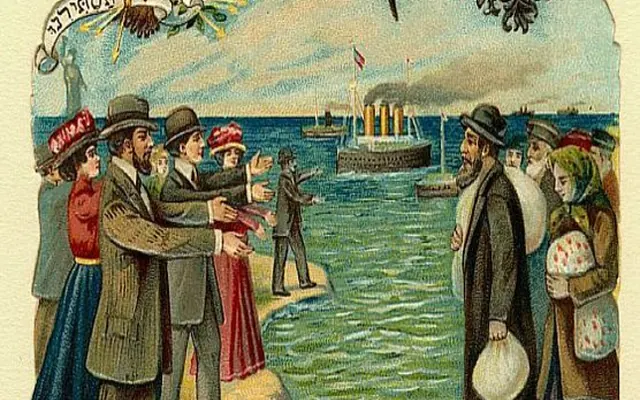
You know, if you've ever been on a boat, If you're a canoe or a sailboat, then you know when you're on the shore looking at the boat, you feel quite solid. When you're on the boat looking at the shore, you also feel quite solid, provided that you're not afraid. The real challenge is when you step out of the boat onto the shore. There's a very sketchy moment when you've got one foot in the boat and one foot on the shore, where suddenly every ripple of water, every gust of wind, every bit of contour on the shore is of critical importance on whether you're going to make it. picture the Jews in exile in I don't know 13th century Poland that's about as dark as it gets right now they were all the way adrift on the sea of exile but they held that inner conviction don't forget Abraham that their story was going to take them home if you ask them how they just said I don't know until the righteous redeemer comes not our problem we just got to survive and please God let it be soon let it be now when the temple is rebuilt and we can be a people in our land, we'll look back at exile almost like a passing dream.
But right now, we're neither here nor there. One foot in, one foot out. And that's why everything appears as a crisis. Don't forget that. We are in an important period of transition. So anyway, aside from the conceptual elements that I touched on in the first section, like the idea of what it is to be a Jew, and even aside from these pieces that Mordecai just added right now, the internal rabbinic project and the external pressure, right? We have to remember that the Jew always exists in history. We're an embodied people, and therefore we should be able to ask, what is a Jew? And answer by pointing and saying, there, that's a Jew. But if you've ever met any Jews, then you know we're a fractious and stiff-necked people, to borrow a phrase.
So it really depends on who you ask and which one you point to. Maybe next week, in honor of Purim, I should take a deep dive into anti-Semitism and the role that it plays in defining the Jew from without. But I want to actually end off this little diatribe with the deep consideration from within. What is a Jew now that you can actually just be an Israeli? So our question takes on an entirely new cast and power and urgency in light of the modern state of Israel. In the second half of this episode, I'm going to sit with a dear friend and rabbi and reflect on the gatekeepers in the rabbin in Israel, and the challenges which the existence of a modern state poses to what is, and frankly, who is a Jew.
And in a coming episode, and probably a few down the line, we'll discuss the law of return in its historical context and the development of the modern state. Just for now, we should know that in 1950, the Knesset, the Israeli parliament, passed a law which states every Jew has the right to come to this country as an ole, as an immigrant. But, due to the inability of those lawmakers, all 120 of them, to agree on any definition of what a Jew is, they just left it undefined, hoping somehow the issue would resolve itself over time. Boy, were they wrong about that one. That was one of the biggest ticking bombs that the Israeli parliament ever planted in our story. For now, I want to highlight how our religious definitions of what it is to be a Jew, that one-to-one identification between law and identity, which is really what carried the Jews through most of exile the last 2,000 years, is no longer a sufficient model to address the realities of the Jewish people as they're embodied today.
And I want to do it through a few stories. A couple of them true, and one make-believe. So here's the first one. I have a friend, this is a true story, who participates in an interfaith meeting here in Israel. and recently one of the Arab members, Arab Muslim members, in his group confessed to him that he wanted to convert to Judaism. So my friend was a little bit astounded, as someone who struggles at times with his own Jewish identity. So he asked this young Arab man, why? And he said, well, because he looks around and his dream in life is to be a secular Israeli. Oops. So my friend tried to explain to him gently that you can't really convert to a secular Israeli. total confusion ensued. And frankly, I can understand this frustration.
You can't convert to being an Arab. You can convert to being a Muslim or a Christian, but not to being an Arab. So it made perfect sense to me why this young Arab Muslim man was confused. How is it that someone who eats pork on Yom Kippur but happens to be born to a Jewish mother can be in, but a convert who wants to simply do the same thing is out by definition. So this idea of an Israeli identity sort of rooted in and resting upon a Jewish identity but embodying a far broader social space is a perfect question posed by a young Arab man who just wants to join the society in which he lives as a full citizen. There's another one, which is sort of made up, but frankly is true, and that's a discussion we've had before, which is the young Russian soldier whose parents came through that law of return whose father is Jewish in the rabbinic sense meaning the law defines him as Jewish but mother is not.
He himself is an Israeli and joins the army serves in a combat unit serves faithfully together with all of his brothers and sisters there and God forbid dies in combat. And when it comes time to burying him in the military cemetery having served his people oh so faithfully, perhaps just then his relatives discover that he's not actually a member of the tribe. And they want to bury him in a separate section of the military cemetery. This is, though I'm making this particular up, is a real story in the state of Israel. And it's deeply painful. Because it's true, and I don't want to falsify, that according to Halakha, according to Jewish law, this young man's not Jewish. But can you really say he's not part of the story of Israel?
This is what I mean when I say that our religious structures may be necessary, but they're insufficient to address the reality of what it is to be embodied as a people in our land, once again, and frankly, within a civil nation-state. And that, finally, brings me to our conclusion. I have one last story, but first, just for the sake of clarity, let's review and touch on these elements. Number one, conceptual courage. What it is to be a Jew is to cleave to our story in the face of the whole world. Avraham Ha'ivri, to stand on one side, even though the whole world says we've got it wrong. And not necessarily to attempt to conquer the world. We're not proselytizing. We're holding fast until the world changes.
Number two, you can run, but you can't hide. Once Isaac came down off that altar, on some level, our lives were not entirely our own. Number three, the Jews, the Israelites, struggle with God. That's not a surprise to anybody who's ever met a Jew. Number three, union and not unity. We're into a world in which the pieces don't lose their integrity in making up a whole. This is a positive model of tribalism, what I think of as the ecosystem model. We don't want the whole world to be the same. This is not a homogenizing universalism that offers peace, love, and harmony so long as everyone's willing to check their individuality and their culture at the door. On the contrary, this is a world in which we want the bats to be bats, the birds to be birds, and the trees to be trees.
but there needs to be a harmonizing principle that draws them all together. And I believe that harmonizing principle is what the Jew is meant to provide. And then, last but certainly not least, we have the embodied historical reality. These people that when you point and you say, hey, what's a Jew? People point at them. And that Jew, let's not forget, wherever he is now, or she, is only a fragment of what Israel once was. You know, there's a beautiful prophecy in the book of Ezekiel. If you haven't read the latter part of the book of Ezekiel, stop the podcast right now and go home and read at least chapters 37 and 38. You'll discover there many of the fundamental visions that shape our world today. And especially in chapter 37, right after the famous prophecy of the dry bones, so beloved of the Zionists who see the world in which we live today as a fulfillment that God opened up our graves in Europe and brought us out of exile and revived us as a people in the land.
But right after that, literally, the next line, you'll see the next great challenge. When God says, and you, Benadam, you, O mortal, take a stick and write on it of Judah and the Israelites. Jew in one stick. And he says, take another stick and write on it of Yosef, the stick of Ephraim, and all the house of Israel associated with them. You have the Jew, and you have the house of Israel, and they're two different things. Then he tells the prophet to bring them close together so that they become one stick joined together in your hand. And it's only then that the vision can be fulfilled, that there's a wholeness, that the world can actually hold the presence of God once again. Let it be soon, let it be now.
And it could just be that this messianic vision is a reunion of the Jews, the tribe of Judah, with everyone out there who's living in Israel's story. Are you living in Israel's story? Send me an email if you're living in Israel's story, even if you don't think of yourself as a Jew. But for now, my question is, how do we bring those pieces back together? And that brings me to the final story. You know, Rav Shlomo Riskin, great educator, Zionist leader, and rabbi, of course, of the city of Ephrat, he tells a story that at one point during the Asla War, during the Second Intifada, there were 40 soldiers stationed at Yeshiva Siach Yitzchak there in Ephrat. And Rav Riskin was in the habit of giving shir there every Thursday afternoon.
and a number of the soldiers would generally attend. One day he noticed that there was a young African man amongst these soldiers. Now, he didn't look like an Ethiopian, who's a well-established African community, Jewish, obviously, within the state of Israel. He looked somehow different. So, right after the end of the shir, Rav Rizkin stopped him and asked this young man his story, and it turned out his name was Dan, and he came from Nigeria. Now, as far as I know, there aren't so many Jews in Nigeria. and here he is in uniform in a time of combat. So Rav Riskin asked him, how did you end up where you are? And the young man's answer was very simple. tikkun olam, the fixing of the world. Rav Riskin said, I don't understand.
You have to explain. So the young man told him a story. He said, when he was a boy in Nigeria, one day there showed up in his village a group of Israelis. And amongst this group of Israelis was one kippah-wearing youth. He happened to be a leader in the youth movement, Bnei Akiva. Manekeva is a religious Zionist youth movement here in the land of Israel and all over the world, actually. And so this young man became very close with the young man, Dan, who wasn't his original name. And it turns out this was a post-Army program of Israelis spread all over the world who were bringing the latest knowledge in medicine and in agriculture to the developing world in order to just try to help people. So this young Nigerian boy became fascinated.
and in his discussions with this Israeli, he asked him, like, what are you doing here? And he said, well, I'm a Jew. This is what we do. And he said, what do you mean? He said, well, what's a Jew? Not so many Jews in Nigeria. And so this young Israeli man said, we're the people that God put in the world to fix the place. tikkun olam. Now imagine the impact of this young Nigerian boy who kept up a correspondence with the Israeli once he went back. And as he grew up, he became fascinated by the idea that the people that God had put in the world to fix the place had a country. Not only did they have a country, but they were fighting a battle. And so as this young Nigerian boy got older, he eventually came to the land of Israel, went through a conversion program, and enlisted in the Israeli army.
Now Rav Hruskin was so moved by that story that he asked this young man to come to him on Friday night so he could share Shabbat dinner with him, not only give him some hospitality, so that his own family could be inspired by such an amazing story. But it turned out that Friday night, the young man didn't show up. And after Shabbos, when Rav Rishkin tried to determine why he hadn't, it turned out that the young man had fallen that night in combat in defense of the yeshiva, Siach Yitzchak. And at the military funeral, where he was given full honors, Rav Rishkin tore Kriya, he tore his clothes, and committed to saying Kaddish, the prayer for the mourners, for an entire year, because as a convert, of course, he had no family.
Now, it's a powerful story, but there is a postscript. One day, Rav Ruskin is taking a nap on Shabbos afternoon, a nap which legendarily is zealously guarded by his wife because of how often he teaches on Shabbos day, when nevertheless, in come his wife to wake him up. Now, in his surprise, he says, what's going on? His wife said to him, listen, I know, I know, I shouldn't wake you up, but I think that you don't want to miss this. So he comes out into his living room, and he sees an elderly Nigerian couple. Turns out they are Don's parents. And they hadn't heard from him. They were just given a notice by the army that he died. And when they came looking for the answer of how it was their son had died on a battlefield around the planet, a place that they didn't know, they'd heard that the last conversation they'd had was with this rabbi.
And so he sat with them and he tried to explain that their son had died in order to fix the world because of tikkun olam. And frankly, after that painful exchange, Ravrishkin didn't think much about it, but two years later he received an invitation to Hanukkah to Bayit, a housewarming party. And it turned out it was this elderly couple, the parents of Don, who had stayed on in Israel, themselves entered a conversion program, and were now building Bayit Neiman by Israel, a faithful house in Israel, in the city of Netanya. And he went there and he helped fix the mezuzah to their door. And it might just be that this is the most essential answer to the question what is a Jew? The people that God put in the world to fix the place.
And furthermore, it might just be that in the battles which lie ahead, both for the state of Israel and for the Jewish people wherever they are, that it would serve us well to shift away from the identity politics of the question of who is a Jew and how that empowers the gatekeepers and causes us to divide up into camps and to want to exclude one another from participation in such a vital, vital task. away from that identity politics toward a mission focus. Not who's a Jew, but what is a Jew? And if we're willing to ask that question, well then, we could do a lot worse than answering it with this young man's message that we're the people God put in the world to fix the place. Now, I want you to hang on because there's another half to this show.
We're going to sit with my dear friend, mentor and teacher, Rav Aron Leibowitz, and we're going to talk a little bit about how this looks in the modern state of Israel. Before I do, I want to make an invitation. The first ever Jewish Story webinar is coming up. If you want to join in, there's only six spots. This is an exclusive opportunity to ask the hard questions that you're holding, religiously, historically, personally, to ask me directly and to hear the questions that our diverse audience also has, to basically not see and be seen, but to hear and be heard. I want you to send me an email if you're interested in joining that exclusive group from six people ravmikefoyer at gmail.com or you can hit me up on Facebook at Rav Mike Foyer on the Jewish Story Podcast.
But for now, stay tuned. There's more to come. You're listening to The Jewish Story with Rav Mike Foyer. Subscribe on iTunes or SoundCloud and leave a customer review to listen to Season 1 from Daniel to the Spanish Inquisition and Season 2 from the Diaspora to the founding of the State of Israel. Visit jewishstory.co Okay, we're back. And I hope that you are really chewing over some of your thoughts about this question of not only who is a Jew but what is a Jew And since it never good to think alone I reached out to a great friend mentor teacher colleague Rabbi Aaron Leibowitz Hi Raul how are you doing Hi, Rabbi Mike. It's awesome to be together. So I know who you are, and you know who you are, but it might just be that it's possible some of our listeners don't know.
So you are the founder and CEO of Hashkot HaKar Pratit and Chupot. Those are two organizations really devoted to breaking the monopoly of the Rappanut on religious services here in the land of Israel, in the state of Israel, and a social activist, I think is a fair title, not to mention also the Rabbi of Vani Tefillah, a wonderful community here in Nachlot. Did I miss anything? I think that's enough. Are you a Sox fan? Should we throw that in there? Father of five. There you go, father of five. Happy husband. There you go. Deep learner and wonderful friend. And I'm so happy that we're sitting here in another office. We've been in a few iterations of this office-type meeting. People don't know. You can go check out on the Internet, Rabbi's out of the box.
We have a whole series, about 20 shows, I think, if I'm not mistaking. Yeah, that was fun. It was a good run. Just like old times, though. Just like old times. I've got the coffee going, my head is spinning, and I really have a very basic question. In the arc of our story, in case you're not a listener, you don't have to admit it if you're not, in the arc of our story, we finally hit 1948. And, you know, there were a lot of arguments in the Zionist movement, outside of the Zionist movement, across Am Yisrael, leading up to 1948, about, what's a Jew? But this whole momentum of the new Jew, which I'm guessing you're familiar with, was an interesting theoretical construct. But now here we are in 1948, or 2019 as the case may be, and we've got a Jew, we've got the old Jew, we've got the new Jew, we have the Israeli, and perhaps things that I'm not even thinking of.
So the opening question I have for you is very simple. What is a Jew in 2019? Wow. It's a simple one, but big. Notice I didn't say who is a Jew, and we'll get to that, unless you want to start there. I mean, I think that the kind of stunned, stuttering, silence, the look was pressured there. That you're hearing from me now is because really I think there are multiple answers to that question, all of which are valid, and which to some extent may overlap, and which perhaps are not shared by everybody who defines themselves as Jewish today. Might even contradict. And might even contradict one another. And so it's very hard to give that answer. So map out some pieces for me. It doesn't have to be a complete thought.
I think maybe it's just to discuss one of the challenges that we face here in Chupot in our work. You know, we're performing weddings for couples who either choose not to get married through the chief rabbinate or cannot get married through the chief rabbinate. Now, some of those couples who cannot get married through the chief rabbinate of Israel, the reason they can't get married is that one of the members of the couple are not recognized as Jewish. By the chief rabbinate. By the chief rabbinate. And I just want to clarify for our listeners, but your weddings are Kedat Moshe di Israel. These are what people would call orthodox, halachic, legal Jewish weddings. Absolutely, which by the way are the only kinds of weddings in Israel which are illegal if they're performed outside of the chief rabbinate.
Wait, let me say that again. These are the only kinds of weddings which are illegal, meaning orthodox weddings which aren't done by the chief rabbinate are forbidden. Are forbidden. But if you wanted to get married, I don't know, in the Reform of the Conservative Movement or you had some, I don't know, internet minister that Astro projected into your hall there to join you in holy matrimony, that would be okay. So it would not be recognized as a valid marriage. It wouldn't be registered, but you wouldn't be liable to two years in prison like I myself and the couples whose weddings I perform. Wait a minute. Are they coming crashing through the store while we're in the middle of the show? Just tell me now because I want to pack my bag.
I sure hope so. That would make my day. That would be a great moment of radio. We can always hope. Unfortunately, I think they know that the best possible thing for our work, would be for them to arrest one of us. Oh, for sure. They're not looking for that publicity right now or, of course, for their case to fall apart in the Supreme Court. But tell me, what does it mean to do these weddings in defiance of the rebellion? Why are people seeking you out? Well, let's come back to this particular case, which I think is relevant to your topic today. You know, we have, it's no secret that there's been a vast immigration immigration from the former Soviet Union to Israel. And today there are, you know, we count about 400,000 immigrants from the former Soviet Union who are not eligible to get married in the chief rabbin of Israel.
When you hear a crazy statistic, I saw it, that this year, at the end of the year, the Israeli Bureau for Statistics said that for the first year ever, the majority of immigrants to the state of Israel were not recognized as Jewish by the Ministry of Interior. So this touches exactly on your point, because over here you have people who identify themselves as being Jewish, who have a very, many of them have a very strong identity of actually holding on to their Judaism behind the Iron Curtain, and who are not recognized by Orthodox Jewish law, by Halakha, as I practice it, as having a Jewish status. and I'll say even more than that when you talk about individuals that fit that bill who have been here already for a generation and whose children have gone to high school and served in the army here they are fully acculturated into Israeli culture view themselves as Jews, celebrate the Jewish holidays you're not talking here about a question of identity for a semi-assimilated Jew somewhere in the world.
You're talking about somebody who is putting their life on the line for the state of Israel, and who perhaps is only Jewish by patrilineal descent, and therefore not recognized by halakha. And, you know, we actually, my family, adopted such a young woman who was studying for conversion. And I was shocked to discover that she didn't even know that she wasn't recognized halakhically as Jewish until she went to join the army. And they said, well, instead of the regular service, would you like to take the conversion track? And she was like, the conversion track? And they're like, yes. Nativ, the conversion track. And she said, why would I need the conversion track? And that was the first time a young woman who was born in Israel.
Right, she's Israeli. She's in all definitions of the term. She is Israeli in all definitions. And her identity, you're saying, she's self-identified as a Jew. That's right. But the reality of halakhav, Israeli, or not Israeli Jewish laws, right? She was not. That's right. So over here, you know, I think we have to recognize that Judaism is a religion. Careful, there's Zionists around us. Well, Judaism is practiced by many Jews as a religion, and it manifests in our day and age as a religion. It manifests in our day and age as a nation. It manifests in our day and age as a people. It manifests in our day and age as a culture. Yeah, I'll tell you what, my father-in-law, she'd be healthy and well, who's not Jewish, but lived his whole life in the New York area, identifies culturally as a Jew because of the New York area thing.
That's right. So, you know, we can get into the question of which of those definitions are most meaningful to us and are there any of those definitions which we would seek to invalidate or delegitimize, it wouldn't change the fact that it is one of the presentations of the Jewish experience in this day and age. And I personally think that when you look at this particular case of our theoretical, you know, random second generation, former Soviet Union patrilineal descent, Israeli, I think that for me I can't help but come to terms with the fact that there are different definitions of what it means to be Jewish which speak to me. I'm sorry you're in the middle of the sentence. I'm taking the mic. Go ahead.
I could say one more sentence which I think would just lock in. I'm going to push it through. You're bigger than I am. So what I find myself telling such people, and here maybe this is what you would want to respond to, is not that they're not Jewish, but that they are Jewish, but they are just not halachically Jewish. In other words, to come to terms with the fact that there might be dissonance or tremendous overlap and only a small area, a small gap in those circles of nationhood, peoplehood, and religion, halakha, which needs to be looked at perhaps as technicalities to some extent, or if not technicalities, certainly not mutually exclusive definitions. We're hearing a lot of my inner voices, and I'm imagining some of our listeners cringing at the word technicalities when it comes to questions of definition in law.
And I'm wondering if I hear you correctly, in the sense that, say, a second-generation descendant, be it patrilineal descent or even less so, but someone who came into the state of Israel under the law of return, a concept which our listeners are going to hear a lot more about in the coming episode, but the basic principle in law that every Jew has a right of citizenship to the land of Israel that they just have to gain by physical residency. So they came here under that premise. they're not halakhically Jewish, but what I hear you saying is that that gap between halakhically Jewish and the participation in the life of the Jewish people as embodied in the state of Israel is so overwhelming that the gap is a technical issue.
I'm saying that any kind of resolution of the gap can be looked at as a technical need. In other words, the shared values, the shared experience, the shared destiny that that individual and I have, from my perspective, is undeniable. and I might have a harder time with this question if there was not a strong halachic tradition which we call Zerah Yisrael which does lend significance to patrilineal descent in other words does not define one as halachically Jewish because it weighs beyond being a non-Jew exactly, for instance we don't seek to evangelize in Judaism and convert people and yet we have a tradition that somebody who has a Jewish father there is an iñan, there is perhaps an interest or an incentive to connect them.
So I think that that makes the position that I'm suggesting a little bit easier, perhaps maybe for some of our listeners to palette, to recognize that there is the concept of somebody who is half-Jewish or part-Jewish is not totally foreign to our tradition. It's not just some American phenomenon. That's right. That's what came up for me. No offense to anybody listening. Yeah. So, you know, for sure that we have huge questions around this, and I think there's also huge confusion around it. And also, in order that our listeners not get confused, I want to say very clearly that I would never perform a wedding between someone who is halachically Jewish and someone who is not halachically Jewish. In other words, the halachic gap over there, which I've described as a technicality, is nonetheless essential for me.
So there are places where it's unbridgeable. There are places which, because of my halachic commitment, because of my commitment to the halachic path are unbridgeable. What do I know? Those of our listeners who have listened to some of our other podcasts may be familiar with my refrain, but then again, what do I know? It's the definition of a munah. It's not just a refrain. That's right. If we talk in our tradition about Mashiach is going to come, we've got this kind of image, which you could think literally, you could think metaphorically, Mashiach coming and sniffing people. And based on the sense of smell, saying who is really authentically Jewish and not, and what do I know about what's really going on, and who of us may be convinced absolutely of our pedigree, and who of us might have surprises in store, and where might Am Yisrael discover that what we thought were pure genetics in terms of who is your mother, might there be spiritual elements of, which haven't spoken about.
We have many, many sources about people who convert who actually had a spark of Judaism in them that had to be brought back, that had to be reconnected. So I look around at people, from my perspective, somebody who's here to stay, somebody who speaks Hebrew, somebody who celebrates the Jewish holiday, somebody who puts their life on the line for the Jewish state. Is there a halachic status issue which needs to be addressed? Yes. But are they Jewish? at least in most of what I mean when I say that word? My sense is yes. All right. You've had more than a sentence. I've got a couple of questions for you and I want to make them pointed because my first question is actually very simple. Nehi, let it be that there's a gap and that that gap on one hand is unbridgeable when it comes to certain halakhic categories like marriage or the need for conversion or participation in a minyan, a ritual quorum, what have you.
but why try to bridge the gap? why not actually widen it? why not say, Jewish Shmush you're Israeli this was the Zionist dream we've recreated a national identity get rid of this whole confusion between the Jewish religion and the Israeli national identity with the work you're doing here at Chupot is a religious ceremony that you're seeking but there's another alternative which is to create a completely civil ceremony and the reason I ask, I'll give you two examples then you can tell me what you think about them On one hand, I would note that you said, as long as you're here and you're speaking Hebrew and you're celebrating the holidays, you're defending the country, that terribly tragic situation where, God forbid, a young soldier dies in service of the state of Israel, and really the people of Israel, and can't get buried in the same place in the military cemetery as his comrades because he's not halakhically Jewish.
What could be more painful than that? At the same time, he's Israeli. Nobody questions that. So I'm wondering, number one, why not widen the gap? And in order to make that more clear, I see two sides. So the Hebrew participation in the State of Israel is irrelevant to a good portion of the Jews out there who are asking this question. My students at Pardes come from a very diverse background. Patrilineal descent, the definition which is not accepted by the halakha down through the ages, perhaps in times gone by, but Orthodox halakha today does not recognize patrilineal descent, but many of my students do come from movements where it is recognized, and their identity is certainly core Jewish identity.
They're not speaking Hebrew. They're not defending the State of Israel. Frankly, many of them have begun to turn away from the State of Israel, often for these very reasons. So maybe there just needs to be a clean separation. The flip side is, I'll give you a story. My wife, God bless her, is very concerned about the refugee issue here in the State of Israel. the Africans who have come, refugees, migrants, infiltrators, you can pick your word. Whoever's listening right now, fill in the blank to make you happy. That's not my issue. But she had an experience recently. There's a school in South Tel Aviv, which is devoted to the refugees who have gotten actual status in the country. And, you know, you have second generation who are saying Sudanese, Hebrew speaking, identifying Israeli.
She heard one of these groups speak. and when a young man, young Sudanese man, was asked, why is it important to have a state? This was, by the way, after he returned from his trip to Poland, having gone, as all Israeli high schools do, to see Auschwitz and experience the tragedy and trauma of the Jewish past. And his response was, it's important, I'm grateful we have a moledet, in order that we as a people can stand strong and defend ourselves so that nothing like this can ever happen to us again. You hear it? He's not Jewish. He isn't presumed to be Jewish. No one would call him Jewish, but that answer is Israeli. Yeah, I'm actually not really challenged by the question that comes up. Oh, well, I have to come up with it better.
You know, I think I have no doubt that there is a shared Israeli identity and a shared Israeli experience, which is shared by the Druze and many Bedouins and many Arabs. And of course you know it can also be relevant for a second or third generation migrant family from Africa For me, I insist that for us to take individuals who view themselves as Jewish and say you are not Jewish, you are Israeli, just as the Arab Israeli is, and just as is to ignore the power of peoplehood. In other words, there is a large part of the Jewish experience which expands beyond the practice of religion. And certainly since the time of the Enlightenment, when some Jews are practicing and some Jews are not practicing, we could take, and I think that there are ultra-Orthodox perspectives which say, you know, ultimately anybody who's not practicing Judaism is for all intents and purposes a-going until they find their ways back.
Oh, for sure. That's a growing voice out there. And, you know, I could bring examples from the world of Kashrut, which proved that that perspective is much more pervasive than we suspect. And yet at the same time, the insistence of the last 200 years, as the Jewish people have been kind of exploring these different avenues and these different halachic identities, or a-halachic identities, or secular identities. Our insistence has been, our consistent insistence has been, certainly in the modern Orthodox community, one of brotherhood, one of brotherhood, and one of insistence on brotherhood. Well, what is shared between me and my atheist cousin where I continue to insist and continue, for instance, if they show up in shul for a family simcha, give them, Davka, go out of my way to invite them to approach the Torah and say a blessing because they are Jewish.
But hang on, but not your nephew from the brother that married the Catholic woman. That's right, because once again, what if he identifies as Jewish? Because there is a gap over there which fits under the category of my religious practice, of the boundaries of my religious practice. And yet at the same time, if somebody comes and says, I feel that I am part of it, someone basically makes the same speech as Ruth, the Moabite, who basically said, I am committed to a shared destiny and that's where I'm at. Now, I do think that that can be weakened. I find it much less compelling, let's say, for, you know, I haven't thought long and hard, for instance, about the question of if I were an Orthodox rabbi in the United States, how would I relate to intermarried couples who wanted to be part of my community?
I know that I have colleagues who are really struggling with that question. And I'll admit I haven't worked it through. But I will say that I would be much more challenged there to say that this non-Jewish person who married a Jewish spouse, who has chosen to bind their destinies to the Jewish people, You know, I think I would have a harder time. I don't have that problem here in Israel. We're the majority culture here. Remember that case recently where this Arab TV anchor, I don't recall her name, married an Israeli TV personality recently, just recently, and there was all these people making statements, some of which were just downright offensive, and everybody was really worked up about it. And I saw one person, unfortunately I don't remember any names here, who said basically, what is everyone so worried about?
She's assimilating into our culture. This is a shift that the Jews have not yet made here, is that intermarriage in America means you're assimilating into the dominant culture, which is not Jewish. Intermarriage in Israel means at least culturally, we're not going to get into the religious question, that the non-Jew is assimilating into, and that's my question, Israeli culture, Jewish culture, both? this is our problem. That's right. Well, again, you know, I'd like to just wonder whether we need to get too worked up about this problem because... 400,000 people, Ravon, you said 400,000 people who can't get married according to Orthodox Jewish law as it's construed by the organs of the state, meaning the state, the national identity and the religious identity are welded together.
And I added to that the fact that this year for the first time ever more people defined as not Jewish immigrated under the law of return, meaning as Jews, than has ever happened. The first time was the majority. Where are we going here? That's 100% true, and nonetheless, I'm not concerned. And the reason I'm not concerned is specifically because of the work that we're doing here in Chupot. In other words, the shared project, which is the state of Israel, like I said before, is shared by many, many circles, and those circles overlap. Ultimately, there's a certain level of personal autonomy in terms of who will choose to marry who will require conversion in order to get married. It's a civil state to some degree.
That's right, yeah, and it's heading even in a more civil direction, I have no doubt. You mean that in the civic sense as opposed to the interpersonal sense? Yes, absolutely, absolutely. The days of the hardline draconian rabbanut, I think, are numbered. That's the work that I'm involved in the day-to-day and I'm definitely optimistic. By the way, I just want to plug for our listeners that if people are concerned about that issue, that you should know that I'm sitting in the room right now with someone who, with all honesty, has probably done more than any single other person in our generation to crack that monopoly. And if this is something you want to know more about, where should they go to find out so I don't forget?
Yeah, today I would send you to www.chupot.org.il. And there also is an English version of the website. If you click the EMG up at the corner, and you can see an updated version of the work that we're doing here. Great. And by the way, send your cautious too. Send your hard questions. I know that Rob Aaron's not shy, but I interrupted you. So you're not worried. You see we're moving toward a more civil direction. I think there's an organic path. I also really, you know, over here, I do want to say, and, you know, this is my soul, my spirit, my theology speaking, and I realize that not all the listeners might identify with it, but I passionately believe in God. I passionately believe in Torah. I think that religion is being misrepresented by most of the Orthodox world.
Certainly the established Orthodox world here in Israel is being misrepresented. I'm optimistic that the Jewish people ultimately will rediscover that the covenant of God is something which is crucial for our identity. And as there's more and more enlightened, and I say enlightened as light-filled, as light-filled messaging, love-filled messaging coming from the world of Torah, I think it will become clearer and clearer that it's a very powerful and compelling vessel for what it is that we seek to bring to the world. So I think that ultimately what we need is right now we need more moderate Orthodox rulings in order for them to be more inclusive. I think we need to let go of the exclusivity. I think we need to trust more in God.
Also something we've discussed, you and I have discussed in our previous podcast series. Yes, for sure. We have to trust more in God and be less caught up in control. And I think that if we take that approach, then when a halakhically Jewish Israeli desires to marry an Israeli who is in dissonance on that halakhic level, that is something which can be addressed. That is something which can be, as long as the individual is eligible for conversion in one of the independent Orthodox conversion courts, which are more flexible and more inclusive in terms of who they're willing to convert. That's not work that I do, but I have admiration for other organizations that are doing that work. Then they have an address for conversion.
They have an address for a halachic chuppah. I am absolutely convinced that they will draw closer to Torah. Not that they will become Orthodox. This is not a Kiruv operation. but that it will broaden and strengthen the shared identity. That overall, the process can be one not of divergence but of convergence to a stronger shared identity. So unbeknownst to you, you just hit on a major theme of the earlier section of the show when I sort of gave our listeners a piece of my mind. And I want to lay it out for you in the last couple minutes here, maybe you can just give us your thought, that a lot of what I hear you saying is about the gatekeepers. That right now, in the dissonance between the Israeli national identity and the Jewish religious identity, which exists.
And I do want to really emphasize that you're really only speaking to the situation here in the state of Israel. And there's a big question for you, Dei Chutzla, it's for America in particular, where there's a tremendous mixture and identity is very fluid in general in American culture, and the orthodoxy is, on one hand, the minority, numerically, on the other hand, culturally and communally, it's probably the strongest, most active element. And so there's a whole mix going on across the seas there. But nevertheless, a lot of what I hear you saying is, speaking about the gatekeepers, and the people who decide who is a Jew. And this is a big discourse. It's not a new one by any means. It's one that in the Jewish story we've been following since the Maccabees.
My contention is that the question first arose there. Actually, we can talk about it sometime. But I'm actually feeling in my kishkes that this discourse, though it's important because you're a social activist. You're in the field, the gatekeepers matter. Like I heard you say, more moderate Piscay Dean, more loving and accepting approach. And that's a healing process that will help us bridge that gap. And there might be tactical gaps which are unbridged, but those can be dealt with on a social level too. But I'm a Luftmensch, I like the ideas. And so what I'm interested in is shifting away from who is a Jew to what is a Jew. And through that, taking a bit of the power away from the gatekeepers and putting it into the hands of the mission drivers.
Meaning, I think a lot of the question that we're holding is that we are a people with, as you said, a covenant. And you used the term, I didn't ask for our articulation, because we've said Jew, we've said Israeli, and you threw out Am Yisrael. This idea that Am Yisrael, which is a spiritual entity in our tradition, has an intimate relationship with the Ramana Sha'olam, with God, that plays itself out in the physical manifestation of the Jewish people, but is more than that. right? so I'm going to let you have the last word here when I pose the question so if we move away from the gatekeepers and this question of the definitions of who is a Jew and we move toward a question of what our mission is then in the last couple of minutes will you tell me what's a Jew?
what's our mission? what are we here to do? and can we use that as a standard of measure for how we begin to bind all these very broken fragments of our people together? I think that ultimately when we talk about covenant and we talk about Brit the sense of partnership that we have had with the creator of the universe in our own kind of perception of ourselves and whether you want to take that literally or whether you want to view it mythically I think ultimately has been articulated in modern day in the secular Jewish vision as well in carrying a sense that we are meant to be an exemplary society for all of the world. And I think that that sense of commitment to life and the world and a commitment to justice, a commitment to progress, a commitment to soul, a commitment to life, the place where we have sought to be an exemplary expression of what it means to be a human being and what it means to be a human society I think is really what being Jewish has been about throughout history and I think that's something that we that I feel I share with humanistic Jews as well in other words the drive that they have to be active humanists and to realize the full potential of humanism or socialists in other words there's a certain drive that we have for a certain care that we have, a certain desire to not compromise on the things that we care about.
Stiff naked people that we are. That's right. And I feel like those are the elements which will stand us ultimately in good stead. Because I think that my sense of what monotheism was about was really about an insistence that all good things converge at a certain point. and whether you want to call that God or not I'm not so sure that we need to get stuck on that while we're on the path as long as we're all involved in good works and good works are works that seek to promote light and that don't seek to control and hold back that's what it means to be a Jew by the way I think that's what it means to be a human I think what it means to be a Jew is to be an exemplary human a mensch a mensch. And so ultimately, being a Jew is no different than being a human being.
But what it is, is it's a certain covenant again, whether for some of us it's with God and for some of us it's with destiny. And some of us with each other in the national covenant. It's a very important one. It's a certain covenant to simply do our best. And I think so far if you look at the big picture, we're doing a fairly good job of it. I think we have a long way to go. I think the state of Israel is a unique challenge and we're still in infancy. We are still immature and I think that our critics around the world have a lot to say that we would do well to observe. I think they also would learn a lot about those who seek to educate us. To presume to educate the Jewish people on subjects of Mercy, building a society, justice, the whole righteousness thing.
I sometimes lack patience with that. And at the same time, I also still see the manifestations of our own trauma from our experiences. Sometimes we inflict on others things which we would do well to grow past. So we've got a long way to go, but working on it. So this is the mission as I hear it, that the Jews are just like everybody else, only more so. that we as a people are meant to be exemplary human beings. And I'll offer this thought for you, and I hope it's a healing thought, because part of my mission in Season 3 and in life in general is to really heal some of that trauma in the way we tell our stories. I think that it might just be that there's a gap between the Israeli and the Jewish, between Am Yisrael, the state of Israel, and the Jewish people, might be best served by return to tribalism.
It might just be that what you're talking about here, most broadly construed the Jew as an exemplary human being, is Am Yisrael. And that we also have the state of Israel. And within that, there's the halakhic tribe of Judah. And that if we learned that each tribe contributes its particular essence of expression to that wholeness of mosaic, which is the divine will as it unfolds through our people in creation, we would be best served by putting down the things that divide us. To the extent, as you said, I'm not going to do a wedding for someone who I don't deem to be halakhically Jewish. But I might embrace them, not only as my fellow Israeli, but as my fellow Jew. It's tough, but it's a question. but putting down those differences and seeking the things that unite us in order to get on mission, which is, after all, to fix the world.
Okay, Rav Aron, thank you so much. You are Rabbi Aron Lewis, again, founder and CEO of the Hashgachah Pratit and Chupot. Folks who want to find more about that project, you can go to the website that we mentioned before. If it was too much verbiage for you to write down quickly, you can always send a message to me at ravmikefoyer at gmail.com or you can find me, Rav Mike, what's it called, Rav Mike Foyer, at Facebook or the Jewish Story Podcast at Facebook. and as long as I'm doing the roll down here I want to thank all the folks who give their hard earned money help make this show free keep it widely available and just to make it happen I want to invite you to join them now go to jewishstory.co up in the upper right hand corner you're going to see a button that says be a patron click on through for a little bit of per podcast support I want to thank the Land of Israel Network that's thelandofisrael.com for creating a platform that allows me to reach so many wonderful people I want to thank the Pardes Institute B-A-R-D-E-S dot org dot I-L for building an educational institute that allows me to touch the hearts and minds of wonderful Jews and I want to thank you for listening.
I'm Rav Mike Foyer and this is The Jewish Story.
More from Season 3

TJS S3 Purim 5779: The Oldest Hatred, a practical analysis
Illustration attribution www.maxpixel.net/Aggression-Viole…ss-Attack-656795
Play Episode