
TJS S3E10 1945-55 part II Shadows on the Golden Decade
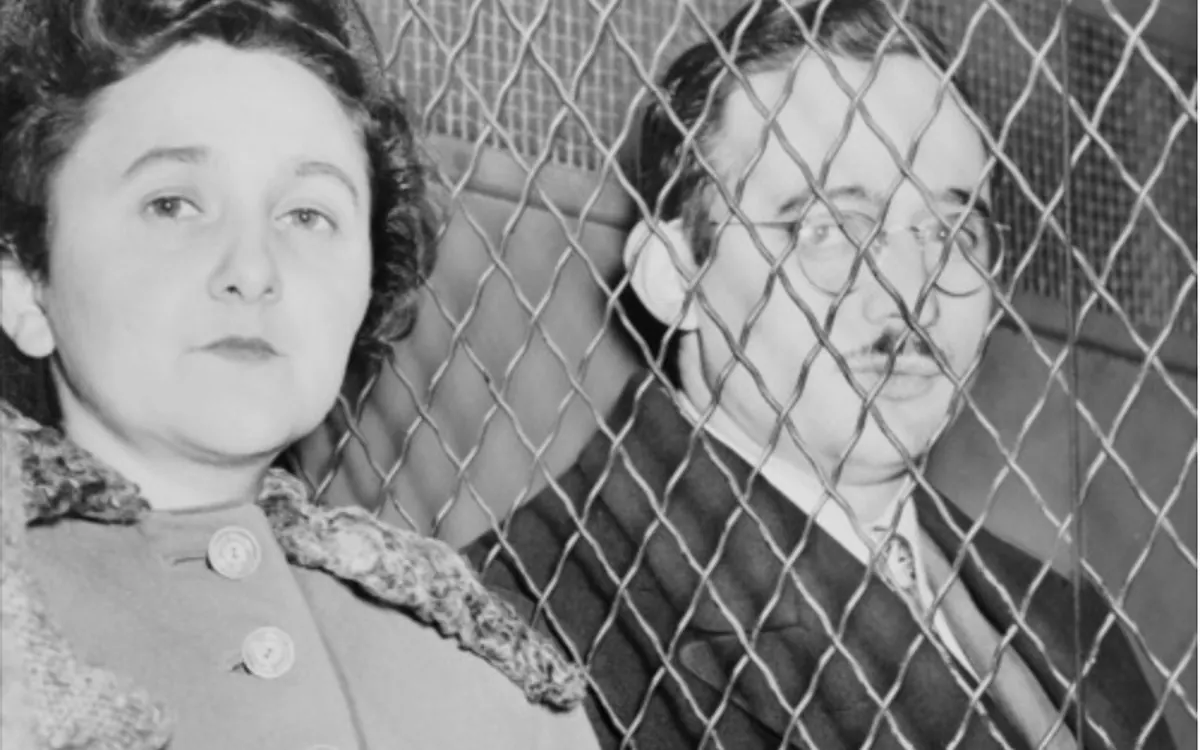
The decade after World War Two was a Jewish decade for America. Not only did the Jews achieve the suburban dream, but their culture stepped right into the middle of the American mainstream. Nonetheless, there were two things which dimmed this Golden Decade - the Red Scare and the shadow of the Shoah.
About this episode
Blessed is the match consumed in kindling flame, wrote Hannah Senesh. If political Zionism sought to make the Jews a nation like any other, suburban Judaism's spirit is that the Jews are just like everybody else, only more so. The whitening of American Jewry replaced Jewishness, the tribal ethnic community that had held Talmudists, Marxists and capitalists in one fabric, with Judaism, a religious identity, a deep parallel to the European response to emancipation when Judaism as a community of faith let Jews become citizens, except here the stake was full integration into being American, best achieved as an American of the Jewish faith. In 1955 Will Herberg's bestseller Protestant Catholic Jew argued America had become a triple melting pot, the three fighting faiths of democracy definitive to the national character, to be anything else somehow not to be an American, lifting Judaism onto a par with the mainstream and fostering real curiosity about all things Jewish.
The Jews made America's culture their own: Bess Myerson could be Miss America, Hank Greenberg a baseball star, Roth and Bellow the most Jewish and most American authors, and above all the musical, where Rodgers and Hammerstein, Irving Berlin and the Gershwins wrote the soundtrack of post-war prosperity, adding a Jewish perspective, as Oklahoma depicted taming the frontier into agriculture and South Pacific's You've Got to Be Carefully Taught preached against hatred. Yet the Jews were not really like everyone else, and the shine was dimmed by two things. The first was the shadow of the Holocaust, as when Rav Mike's great-aunt Helene, a survivor, feared a young Polish couple at her door in the nineties. American Jewry first confronted it financially, the urgent need to resettle the survivors merging with the struggle for sovereignty, federation campaigns leaping from 57 million in 1945 to 205 million in 1948, campaign Judaism's inflection point, and more than money, a change of heart spiced with guilt that pushed many to unquestioning support of Israel, fusing into collective memory the idea that Israel's survival and the destruction of European Jewry are inextricably linked, a link now coming uncoupled.
Some 92,000 survivors arrived between 1945 and 1951, dispersed by institutions to speed Americanization and dilute the discomfort they evoked, and the early literature spoke of concentration camp syndrome and survivor's guilt, a damaged class, though later empirical research overturned it, showing the survivors and their children functioned as well as any other Jew. The photographs of the camps had arrived first, Susan Sontag's negative epiphany at twelve, and the presence of the survivors made Americans face what they now knew, giving rise to a culture of commemoration. The divergence of Israeli and American responses shows in Hannah Senesh, the parachutist executed by firing squad, whose militant heroism belongs to an ethnic state, against Anne Frank, whose 1952 diary and 1955 Broadway play captured the American imagination because Jews could weep for her lost innocence without guilt, her story universalized, ending on people are really good at heart, which Rav Mike calls American but not sure it is Jewish. Emil Fackenheim, unable to articulate it until 1967, named the 614th commandment, that we are forbidden to hand Hitler a posthumous victory by abandoning survival, memory, God, or hope for the world.
The immigrant generation had flowed into the Jewish proletariat, so Jew and socialist became synonymous even to Jewish bosses, a worldview rooted in the Lower East Side and another victim of suburbia, though not entirely, since the messianic energies of unionism, socialism and communism were diverted into a passionate liberalism that sought to reform rather than overturn the system, groundwork laid by Brandeis and built on by a new post-war power in Jewish organizations. With antisemitism pushed underground by shame and a rise of philosemitism, the organizations turned toward universalism, adopting a theory of the unitary character of prejudice, that once you let hate in it has no boundaries, as the AJC's commissioned study The Authoritarian Personality made antisemitism inseparable from racism, so Jews could fight antisemitism by fighting all discrimination, combining tribal survival energy with universalist redemption energy into the realm of social action, the American Jewish Congress creating its Commission on Law and Social Action, the shift from a socialist standing outside society to a member of the Democratic Party, as American as apple pie.
But 1945 to 1955 was also the Red Scare: Truman's 1947 loyalty order, Whitaker Chambers' testimony, the 1949 Soviet bomb, Mao's China and the Korean War, McCarthy and Hoover seeing communists everywhere and blacklists barring suspected radicals. Not all Jews had made the jump from radical to liberal, and the hard left was disproportionately accused, so the mainstream professed loyalty loudly, the AJC defining communism as un-American and un-Jewish, and a bitter fight unfolded over aiding or persecuting the accused, until the arrest of Julius and Ethel Rosenberg, a red-diaper baby and his wife, convicted of passing atomic secrets and, in a sentence Judge Kaufman blamed for the Korean dead, condemned to die, executed on June 19, 1953, erev Shabbat, the first and only US citizens executed for peacetime spying, nearly everyone in the case a Jew. With them died mainstream Jewry's romanticization of its radical past, liberalism now the uncontested center. The third specter was whether suburbia was good for the Jews at all, Saul Bellow fearing Jewish values sucked into a fatty well-being, and Glazer calling the move to the suburbs a more serious break than the murder of six million, since Jewish history had known massacre but not the abandonment of the law, that we had not lost our faith but misplaced it in suburban life.
Key ideas
- Suburban Judaism made the Jews Americans of the Jewish faith, and Herberg's three fighting faiths of democracy lifted Judaism onto a par with the mainstream.
- The Jews wrote America's post-war soundtrack, adding a Jewish perspective from Oklahoma to South Pacific's song against hatred.
- American Jewry confronted the Holocaust first through money that merged with the struggle for Israel, fusing the two into a collective memory now uncoupling.
- Anne Frank became the American Holocaust heroine over Hannah Senesh because her universalized innocence let Jews weep without guilt.
- The messianic energy of socialism was diverted into liberalism and social action, the shift from radical outsider to Democrat, as American as apple pie.
- The Red Scare and the Rosenbergs' execution ended Jewry's romanticization of its radical past, and Glazer feared suburbia a deeper break than massacre.
Chapters
- 0:00 Blessed is the match; just like everybody, only more so
- 2:12 Protestant Catholic Jew; the triple melting pot
- 3:17 The Jews write America's soundtrack
- 6:31 The shadow of the Holocaust; Aunt Helene
- 7:36 Confronting it through money; campaign Judaism
- 10:58 92,000 survivors; concentration camp syndrome
- 13:12 Sontag's negative epiphany; commemoration
- 16:28 Hannah Senesh and Anne Frank
- 21:04 Fackenheim's 614th commandment
- 22:09 From radical to liberal
- 24:19 The unitary character of prejudice
- 26:35 Social action; radical to Democrat
- 28:44 The Red Scare
- 31:04 The Rosenbergs
- 35:27 The end of the radical past
- 36:41 Was suburbia good for the Jews? Bellow and Glazer
Who, where and when
People
Hannah Senesh, Will Herberg, Rodgers and Hammerstein, Irving Berlin, Susan Sontag, Anne Frank, Emil Fackenheim, Louis Brandeis, Julius and Ethel Rosenberg, David Greenglass, Saul Bellow, Nathan Glazer, Aunt Helene
Places
The suburbs, The Lower East Side, Los Alamos, Yugoslavia
Texts
Protestant Catholic Jew, You've Got to Be Carefully Taught, The Diary of a Young Girl, The 614th commandment, The Authoritarian Personality
When
1945 to 1951 CE: 92,000 survivors arrive, 1952 CE: Anne Frank's diary published, March 21, 1947 CE: the loyalty order, 1949 CE: the Soviet bomb, June 19, 1953 CE: the Rosenbergs executed
Read the transcript
Blessed is the match consumed in kindling flame, wrote Chana Senesh. Blessed is the flame that burns in the secret fastness of the heart. Blessed is the heart, with strength to stop its beating, for honor's sake. Why bless you with strength of heart? I'm Rav Mike Foyer, and this is The Jewish Story. Episode 10, 1945-55, Part 2, The Shadow on the Golden Decade. So if the driving vision of political Zionism was for the Jews to become a nation like any other, then I want to say that the driving spirit of suburban Judaism is the Jews are just like everybody else, only more so. In last episode, we talked a lot about white flight, the exodus of the Jews, and not just the Jews, by the way, from the urban enclaves into the suburbs.
We touched on how this was more than a geographic transition that moved to suburbia with both cause and effect in a shift to the middle class, college education, greater economic integration, and even a large degree of social acceptance. It was the whitening of American Jewry, if by white one means the cultural mainstream represented by Anglo-Saxon Protestant America. And in the suburbs, Jewishness, that sense of lived ethnic community, the almost tribal way of being, that in the previous generation of American Jewry had held together Talmudists, Marxists, Capitalists, and everything in between in one social fabric, Jewishness was largely replaced by Judaism, a religious identity. And there's a deep parallel between the rise of religious identity that came together with the mainstreaming of American Jewry and the response of the Jews in Europe that faced the first signs of enlightenment, or rather I should say emancipation, back in the 18th century.
Go back to season two, the episodes on Moses Mendelssohn and the Berlin Enlightenment, and you'll see that the development of Judaism as a community of faith was critical to the ability of the Jews to become citizens in the emerging nation states. It's not exactly the issue here. I mean, Jews have been citizens of the United States for as long as the countries existed. What's at stake here is full integration or assimilation into being American. And as we saw, the best way at this point in history to become a full-fledged American Jew without abandoning your Jewishness was to be an American of the Jewish faith. and thus we have American Judaism. In 1955, Will Herberg, Jew and former Marxist intellectual, wrote a bestseller entitled Protestant Catholic Jew.
It was an argument in favor of what we labeled last episode as the three fighting faiths of democracy. His point was really that America had become a triple melting pot, and he gave a new monolithic, or I guess trilithic, definition to what had been formerly diverse ethnic and national communities, the Irish, the Italians, the Germans, the Jews, now they were all communions or faiths. And Herberg went so far as to say that this new tripartite scheme of religion was definitive to the national character. In his words, to be anything else is somehow not to be an American. Now, we'll touch on the Cold War context of that idea perhaps further on, but for now, just know that the book captured the national imagination, and in particular, it succeeded in lifting Judaism from its position of a mildly despised religion held by a tiny minority of Americans and placed it on par with the religious mainstream.
This shift was both cause and result of a much larger change in status. The post-war embrace of a new American Judeo-Christian culture fostered an atmosphere of real curiosity about all things Jewish. Now, we talked a little bit about sociologist Nathan Glazer's 1957 work, American Judaism, which went on to become a standard textbook, by the way, of sociology of religion for almost 40 years. So you have to add to that and to Herberg's book, the explosion of popular works, magazine articles, television shows, and movies, which introduced the Jew to America. But these were all sort of everything you ever wanted to know about the Jew type works. And they were a drop in the bucket when you compare them to the impact that Jews had on American culture in its own right.
In the 50s, it seemed that everywhere you turned, you met a Jew doing the most American of things. Bess Meyerson could be Miss America. Hank Greenberg could be a great baseball superstar. Philip Roth and Saul Bellow were at the same time the most Jewish and most American of authors. And we don't even need to mention Hollywood, created largely by the Jews back in the interwar period and by the 50s pumping out American culture at a dizzying pace. Perhaps the most telling example from the golden decade is actually musical theater, because the 40s and 50s were the heyday of musicals in America. Works, which perhaps you like, like Oklahoma, South Pacific, The King and I, The Sound of Music, really defined the era, and all of those were written and produced by Richard Rogers and Oscar Hammerstein.
Rogers was outright Jewish, and Hammerstein, while he came from mixed marriage, was actually New York Jewish culture through and through. Add to them their predecessors, like the great American composers Irving Berlin, born Israel Berlin, and Georgian Ur Gershwin, and you'll see that the Jews actually wrote the soundtrack for America's post-war prosperity. And they added more than a drop of their Jewish perspective to that sound. In her history of the Jewish contributions to the musical, historian Andrea Most argues that Rogers and Hammerstein drew on the themes of Jewish exile down to the biblical themes to depict the evolution of American culture in Oklahoma. According to her, the message was simple.
Cowboys must settle down and become farmers, the frontier must be tamed into a useful agricultural resource, and young people should marry and bring up new Americans. And she also points out that the political liberalism of the Jews shaped the themes of many of these Broadway musical comedies. For instance, the hugely popular South Pacific even contains a sermon against hatred. It's a song called You Gotta Be Carefully Taught. You gotta be taught to be afraid of people whose eyes are oddly made and people whose skin is a different shade, you've got to be carefully taught. You've got to be taught before it's too late, before you're six, seven, or eight, to hate all the people your relatives hate. You've got to be carefully taught.
Now that's a message from Jewish culture if there ever was one. And it's also the perfect segue to our next section because despite suburban appearances and the best of cultural efforts, the Jews were not actually like everybody else. And the shine of the Golden Decade of 1945 to 55 was really dimmed by two things, each of which in its own way created a subtle inner difference amongst the Jews, one which often held them apart from their Jewish neighbors. While at the same time, they served to draw that tribe a little bit tighter together in their own collective identity. And the first was the shadow of the Holocaust. You know, one morning I was sitting with my great aunt Helene Engber. Now, she wasn't born Helene Engber.
She was born to Lene Feuerberger in the small Romanian town of Kresinev in 1927. But here we are, sitting in her beautiful suburban house in Pepper Pike, Ohio, on the east side of Cleveland. Quite a nice place, frankly, bigger than the house I grew up in. And as we're chatting, there's a ring at the door. And a moment later, a young couple, I don't know, in their 20s walk in. And she looks at me with a look of absolute fear and says, Michael, it's good that you're here, in her thick Eastern European accent. And I said, why, Aunt Lene? She says, they're Polish. I don't trust them. Can you imagine such a thing in the 90s? Now, if you think there's a shadow on our lives even now from what happened in the Holocaust, just imagine what it was like for all of American Jewry in the late 40s and 50s, not to speak of the survivors.
And the first way in which American Jewry really began to confront the reality of the wholesale slaughter of European Jewry was actually financial. Because the urgent need to resettle and rehabilitate the one-third of their brothers and sisters that had survived, demanded massive funds. And for reasons that we discussed at the end of Season 2, that task of fundraising and resettling merged almost immediately with the struggle for Jewish sovereignty in the land of Israel. Now, together, those two needs evoked an unparalleled rise in giving amongst American Jews. The records show that Federation communal campaigns, which happen on an annual basis, show a jump from $57.3 million in 1945 to $131.7 million in 1946, all the way to $205 million in 1948, a year in which 80% of those monies raised went for settling immigrants in Israel.
And this is the inflection point of what we called campaign Judaism last episode, and it's still a critical part of American Jewish life. But this was about more than money, because together with the financial support, there came a real change of heart amongst many, if not the majority, of American Jews. We spoke at the beginning of this season about the post-war evolution of American Zionism, and part three of this series on the golden decade will take us to its next stage. But for now, just know that that crying need of the refugees, coming as it did together with the recognition that their only real hope was the establishment of the Jewish state, spiced with a healthy dose of guilt that perhaps while the war raged on in Europe, American Jewry hadn't done enough, pushed many American Jews over the threshold of an unquestioning support for the new state of Israel.
And not just monetary and institutional support. Perhaps the biggest impact came because the push to save the remnant fused into the culture and the collective memory of perhaps two generations of American Jews. the idea that Israel's survival and the destruction of European Jewry are inextricably linked. And that's going to have a lot of consequences going forward. Read the news today. As the visceral experience of both Israel's survival and the destruction of Jewry start to fade, you can see that the two have become almost completely uncoupled. Anyway, as I said, the American Jewish response to the reality of the Shoah went well beyond money. Between 1945 and 1951 approximately 92 survivors arrived on the shores of the United States among them of course my relatives and their friends Initially the goal of the Jewish leadership was to have these survivors assimilate into society.
Their first concern was to prevent their ghettoization, so to speak. They all wanted to live together because they shared a certain aspect of life, let's just say, which wasn't available to other people. But in efforts to speed the process of Americanization, and perhaps even to dilute the shame and discomfort that their presence often evoked, many of the American Jewish institutions took a fairly heavy hand in dispersing them around the country. And reactions to the survivors ranged from empathy, horror, guilt, to fascination. Every communal resource was marshaled to help them. You have to say, credit where credit is due. But by this point in history, the research has pretty much shown that there was no possible way the Jews of America could have comprehended the actual physical, psychological, and emotional needs of these survivors.
So do the best that they could, it wasn't necessarily going to be enough. Now, if you look at the early literature, basically through the 60s, so it's really relevant to our decade, it's filled with references to what's called concentration camp syndrome, characterized by severe psychological and social impairment, and what they call the survivor's guilt, which they claim was brought on by the fact that those they were facing had survived the Shoah while relatives and friends had not. And there was almost a universal agreement. You can see amongst the professionals that the survivors would suffer lasting physical, psychological, and social damage. They would often actually quote many of their patients to that effect.
Here's a choice statement from one survivor. We've all been damaged, doctor, and I think we are all a bunch of rotten apples. We may look okay on the outside, but when you get to know us, you will see that we're different and sick inside, and no matter what happens, our lives will never be normal again. Now, it's worth noting that this first wave of studies has been almost entirely overturned by empirical research of the later generation. By and large, the survivors and their American-born children functioned just as well within suburban American society as any other Jew. and I can testify from my own experience that they were part of the normal fabric of life. But the perception that there was a damaged class of Jews was actually set in those first decades and it contributed to the kid gloves with which the Holocaust in general was treated at first.
This isn't the time to plumb the depths of the sociology and social psychology around the impact of the survivors on the fabric of American Jewish life and its self-conception. But I would encourage you to note the ongoing battles in America right now. Those battles around who owns the horror of the Holocaust and who gets to define the application of its message never again. Before the human remnants of European Jewry ever arrived on the American shore, the photographs and newsreels, those horrible pictures of living human skeletons, mountains of dead bodies, bulldozers pushing corpses into mass graves already arrived in the American Jewish consciousness. Jewish American writer, activist, philosopher Susan Sontag called it a negative epiphany.
She was only 12 when she first came across the photographs of the death camps, she says in July of 1945. She later wrote, nothing I have seen in photographs or in real life ever cut me as sharply, deeply, instantaneously. Despite attempts by people that we've spoken about, like Hillel Cook and Jan Karsky, go back, by the way, to Season 2, Episodes 34 and 35 for their stories, despite their efforts to awaken the world to the horror unfolding while he was still in the midst of the war, it wasn't really until 1945 that most Americans really opened their eyes. And it was the presence of nearly 100,000 survivors in their midst who made them begin to face what they now knew. And in the coming decades, right down to our day.
American Jews shaped what we call a culture of commemoration, a plethora of ways to try and honor and remember the six million. It was driven by many things. The need to at least try and give a place to the incomprehensible if it couldn't be understood. A basic sense of Jewish history that if it wasn't part of the liturgy in our calendar, it didn't really belong. Well, by the time I experienced this culture of commemoration, it was also the product of a desire to listen and give honor to the survivors as they struggled to articulate the unspeakable, something which I don't think was really possible in that first decade. This is what became the shadow over the golden decade. And it provoked a deep confusion over what it really meant to be a Jew.
I mean, here we are, 1950, living in suburbia, arguably the safest environment the Jews, or humanity for that matter, have ever known, but we're grappling with the reality of the darkest evil humanity has ever known as well. I'll put it this way. Have you ever seen someone mowing the lawn with a number tattooed on their arm? I have. It's downright surreal. And if you're an American Jew, particularly from the non-Orthodox world, then you know about the experiments with rituals and liturgy. When I was growing up, our Passover Haggadah may have been about the Exodus from Egypt, but its pathos revolved around the Shoah. and there were multiple survivors vouchers at the table. Add to this camp dramas, after-school educational programs, Holocaust day poems, songs, Ask a Survivor homework, six million paperclip projects I could go on.
It's no wonder that many of my generation insist that their whole suburban Jewish education was a mix between trauma and tribalism. Six million people died. You have to marry a Jew. My parents' and grandparents' generations held on to their hate as well in subtle ways, boycotting Germany, refusing to purchase products or even visit. And we're going to have to have an episode on the whole war reparation struggle within Israel, and in general, in Israel's response to post-war Germany. Now, one thing I will say is that Israeli and American responses were, let's just say, widely divergent. And perhaps the best way to illustrate that and get to our point about the golden decade is by contrasting Hannah Senesch, who I quoted in the introduction, and Anne Frank.
Hannah Sanisch, if you don't know her story, was one of 37 Jewish underground fighters who, under the command of the British, parachuted into Yugoslavia in World War II. Their official mission was to assist anti-Nazi forces in Yugoslavia, but all were also committed to the rescue of Hungarian Jews who were about to be deported to Auschwitz. And Sanisch was arrested at the Hungarian border and imprisoned. Even under extreme torture, she refused to reveal the details of her mission. She was eventually executed by firing squad. Now, many Americans don't know her story, but I'm willing to bet a lot of you are familiar with one of her more famous poems, Eli Eli. Oh Lord, my God, I pray that these things never end.
Yeah, ring a bell. So though Khan Asenich remains an Israeli national heroine to this day, her brand of militant heroism belongs to a Jewish ethnic state, not suburbia. American Jewry found its Holocaust heroine with the publication in 1952 of The Diary of a Young Girl, also known as The Diary of Anne Frank. And this window into the life of precocious and introspective Dutch preteen captured the American Jewish imagination in a way that the underground fighting martyr never could. Because these American Jews could look out the window at the world around them and weep for her lost innocence without feeling guilty about their safe and comfortable lives. In 1955, a dramatization of the diary premiered on Broadway, eventually winning the Pulitzer Prize, and four years later, it became a Hollywood film.
Through the play and the film, Anne Frank became an American inheritance, much as, through plays and films, certain aspects of Jewish culture became an American inheritance. And her story was presented as an example of triumphant humanity. She universalized her experiences of suffering rather than dwelling on her particular Jewish identity. Now, of course, anybody who knew the story knew that it were Jews, but there was no need to talk about it. Sound familiar? And now Americans of all backgrounds could identify with her adolescent dreams, her endurance, and therefore found it easier to frame, and in my opinion, reduce, the horror of what led to her death. The play ends with Anne's famous affirmation, in spite of everything, I still believe that people are really good at heart.
and has her father replying, she puts me to shame. It doesn't get more American than that, but I'm not so sure that it's Jewish. The universalizing of the Jewish experience in the Holocaust is not without its own consequences. I'll let you read the news and contemplate within yourself to decide what they are. For now, we'll have to come back to it. Even today, as the generation of survivors dwindles, we haven't even begun to scratch the surface of our real responsibility to this shadow. How do we transform its darkness? How do you take a period of such suffering and make it into a source of positive identity, which I see to be the primary call of our history from the Torah on down? But in the golden decade, we hadn't really come to that consciousness.
The suffering was ever-present, but a poorly understood shadow. Just recall that quote I gave you last episode from Melanie K. Kanchowitz. It was like a family secret, hovering, controlling, but barely mentioned except in code or casual reference. I wonder if that strikes a nerve with anybody out there. Now, I'm going to keep speaking personally about the need to heal and transform that shadow until the day I die. But for the purposes of our present story, just let it tarnish that shine of Jewish suburbia just a little bit. And we wrap up this section with this shadow over the golden decade with what philosopher survivor and reformed rabbi Emil Thackenheim saw to be the call of the hour Now I say call of the hour but even he was unable to articulate it until 1967 a date which is going to be significant in dealing with the Holocaust.
He made this call in the face of what he saw to be the Jewish suburban desire to assimilate, to let go of religion altogether, driven in no small part by the desire to leave that trauma behind, as if that's possible. And Fackenheim called it the 614th commandment. If you're not familiar, there are 613 commandments in the Torah. And he said the following, We are first commanded to survive as Jews, lest the Jewish people perish. We are commanded, secondly, to remember in our very guts and bones the martyrs of the Holocaust, lest their memory perish. We are forbidden, thirdly, to deny or despair of God, however much we may have to contend with him or belief in him, lest Judaism perish. We are forbidden, finally, to despair of the world as the place which is to become the kingdom of God, lest we help make it a meaningless place in which God is dead or irrelevant and everything is permitted.
To abandon any of these imperatives in response to Hitler's victory at Auschwitz would be to hand him yet another posthumous victory. You know, if you recall from our previous episodes, the Jewish immigrants who poured into America in the late 19th and early 20th century flowed more or less straight into the working class. We've been speaking of it off and on the whole season. This is the Jewish proletariat, those people who not only made up the labor force of certain economic fields like the garment industry, but had a disproportionate representation in the trade union movements, socialist and communist agitation of the time. And if you know anything about the history of early 20th century, you know it was a messy, messy time.
Big bosses, unions, Pinkertons, pickets, scabs, strike breakers, whatever you want. And the Jews were so much in the middle of that struggle that Jew and socialist became synonymous in many people's minds. And not just the anti-Semites. even Jewish bosses and capitalists of the era, and there were plenty, felt that the vision of a better world, the values of social solidarity which drove so many socialists and communists, were intrinsically Jewish notions. Now that worldview was rooted both in the mind and in reality in the Lower East Side New York Jewish culture. And thus it became another victim of the rise of suburban Jewry. Although not entirely. In fact, we could say that with the mainstreaming of American Jewry, the messianic energies of trained unionism and socialism and communism, which were ultimately anti-establishment, they were looking to overturn the world, were diverted into a passionate liberalism that was looking to reform the system.
Now, the groundwork for that transition had already been laid by, of course, Jewish liberals, people like Justice Louis Brandeis, who early in the century helped wean America in general away from its absolute faith on laissez-faire economics, through legal briefs that documented the actual consequences of unchecked capitalism. But he was no communist agitator. He, of course, was a Supreme Court justice. You don't get more establishment than that. So add to that groundwork, and there's more of it, you can take my word for it, a newfound post-war power within Jewish communal organizations. Now, many of these organizations have been built, particularly the ones that were focused outside of the community, to fight discrimination against Jews.
But thank God, antisemitism was out of style after the Holocaust. I'm not saying that it disappeared by any means, but it was progressively pushed into the shadows and underground through combination of shame at where it had gone in Europe. The horror of the Holocaust had a real impact on American culture. Also, the general mainstreaming of Jews, they were no longer some foreign, poorly understood entity. there was even a rise of what many scholars call Philosemitism, a real love of the Jews at this era. And even though the fight against anti-Semitism still drove many of these organizations to some degree, the very nature of the Shoah, of the Holocaust, pushed them also toward universalism. Because as they began to contemplate, many Jews, and in particular institutional Judaism, saw that the older ideas about the causes of Jew hatred seemed inadequate to explain what had just happened in the Holocaust.
And in seeking alternatives, some turned inwards, some turned toward religions, but many of the Jewish organizations within American Jewry adopted what they began to call a theory of the unitary character of prejudice, meaning once you let hate in, it has no boundaries. After the war, the American Jewish Committee, grandfather of all Jewish committees, commissioned two German-Jewish Marxist theorists of the Frankfurt School, which we've discussed before, Max Horkheimer and Theodor Adorno, to research what they felt to be the causes of anti-Semitism. And the result was a book called The Authoritarian Personality. It emphasizes the psychological forces behind racism, rather than the socioeconomic ones, which had been the primary explanation for the rise of political anti-Semitism within Europe.
And now this meant that anti-Semitism became inseparable from racism as a whole. And because of that, quickly the Jews began to see that any form of discrimination was a problem for the Jews, even if it didn't single them out. And conversely, Jews could and should fight anti-Semitism by fighting racism in any form. And now the stage was set to combine that tribal survival energy of post-Holocaust Jewry, which had quite a charge, with the universalist secular redemption energy of socialist Jewry, which was seeking a legitimate outlet. And we get the realm of social action in its broadest sense. The power of Jewish organization began to be applied towards social action, legislation against racial discrimination, in favor of social welfare programs, in favor of a foreign policy of internationalism.
In 1945, the American Jewish Congress created its Commission on Law and Social Action, committed itself to working for a better world, whether or not the individual issues touched directly upon so-called Jewish interests. That's a revolution for an organization that originally saw itself as representing the neglected Jewish interests. Now, soon after the AGC moved beyond its original purpose, which was expressed in its charter to, quote, prevent the infringement of the civil and religious rights of Jews and to alleviate the consequences of persecution, it declared its intent to join with groups in the protection of the civil rights of the members of all groups irrespective of race, religion, color, or national origin.
And the AJC wasn't alone. Beginning in the mid-40s, the reforming conservative movements began to place specific domestic issues and even international policy matters on their lay agendas. Now, add to this the fact that Jews in general voted in higher percentages than the public as a whole, that Jewish contributors at this point began to rise to prominence as financial backers for political candidates, and even an increase in the number of Jewish elected officials in the public eye. All this means that this is an era when what it meant to be Jewish shifted from a socialist or communist who stood outside of society and attempted to undermine it to a member of the Democratic Party in particular. And that was a critical piece of the process of mainstreaming of American Jewry.
Because no matter what your political position was, I mean, they definitely differed from many of their suburban neighbors in voting against what was perceived to be their immediate economic interests in favor of how they held their values. But no matter what, everything I just described to you is as American as apple pie. But there was a slight problem, because 1945-55 wasn't just the golden decade for the Jews, it was also the era of the Red Scare. On March 21st, 1947, President Harry S. Truman issued Executive Order 9835, known as the Loyalty Order. It was an executive order that mandated all federal employees be analyzed to determine whether they were sufficiently loyal to the American government that may make your flesh crawl.
And in fact, it was a pretty startling development in its time. I mean, America has always been a country that prized at least the ideals of personal liberty and freedom of political organization. But this was an act driven by raw fear. In 1948, Whitaker Chambers, former Soviet spy now turned anti-communist zealot, testified before the House Un-American Activities Committees, and he described the Communist Party as a many-headed monster dedicated unflaggingly to infiltration and overthrow of the U.S. government. Now that may sound like fantasy, but only a year later, in 1949, the Soviet Union successfully tested its own nuclear bomb. News of the test sparked fears of nuclear war throughout the country.
The L.A. Times declared that the Soviet's development of the bomb placed, quote, the very existence of the Western world at stake. Soon, communist forces under Mao Zedong were overrunning China. The following year, America entered the Korean War with tens of thousands of troops, and many Americans became convinced that the Reds were on the verge of taking over their country. Hysteria began to creep into the political and legal system. This is the era when Senator Joe McCarthy from Wisconsin and FBI Director J. Edgar Hoover were fanning the flames by seeing communists everywhere. People began to prepare blacklists to bar suspected radicals, not just from the government, but employment altogether. In certain parts of America, there was a downright inquisitorial atmosphere.
And now here we see yet another snake in American Jewry paradise of cultural acceptance Because not all Jews had made the jump from radical to liberal There was still a small but very vocal hard left voice, even within the organized Jewish community. And they were disproportionately represented amongst those accused of disloyalty and even espionage. Now the mainstream community professed loyalty in as loud a voice as possible. while the AJC declared its intention of protecting, quote, the American way of life from the encroachments of totalitarianism of both the right and the left. It defined communism not only as un-American, but also as un-Jewish, attacking what had been actually the secular faith of many Jews throughout World War II, and as we mentioned, seen as Jewishly so.
But not everyone was pleased with this kowtowing to intimidation, and so a bitter fight began to unfold within the Jewish community over aiding victims of the anti-communist crusade or jumping on the bandwagon and persecuting him. That fight continued right up until the 1950 arrest of Julius and Ethel Rosenberg for handing atomic secrets to the Soviet Union. I consider your crime worse than murder, said Judge Irving Kaufman to the Rosenbergs. Your conduct in putting into the hands of the Russians the A-bomb has already caused, in my opinion, the communist aggression in Korea, with the resultant casualties exceeding 50,000, and who knows but what millions more of innocent people may pay the price of your treason.
The sentence of the court upon Julius and Ethel Rosenberg is, for the crime for which you have committed, you are hereby sentenced to the punishment of death. Julius Rosenberg was born in 1918 into a poor family of Eastern European Jewish immigrants living on New York City's Lower East Side. What we have here is a classic red diaper baby, meaning he absorbed the vision of the Communist Party and its ideal world with his mother's milk. Later in life, while attending the City College of New York, he organized the school's chapter of the Young Communist League, and after graduating with a degree in electrical engineering in 1939, according to the FBI, he also joined the Communist Party, and he married his wife, Ethel Greenglass.
It was soon after, in 1941, in the midst of the war, that Julius became a spy that the Soviets codenamed Antenna. He was head of a cell of four, and their focus was primarily on obtaining classified information regarding radio engineering and aviation, even though the Soviet Union and America were allies at the time. But it wasn't until 1944 that he shifted his focus to the American atomic bomb project at Los Alamos, New Mexico. And less than two years later, Rosenberg was arrested on suspicion of espionage in 1950 together with his wife, Ethel, two months later. They'd been turned in by David Greenglass, Ethel's younger brother and a former army sergeant working as a machinist at Los Alamos. Greenglass had confessed under pressure to providing nuclear secrets to the Soviets and, according to many, was seeking clemency by turning in his companions.
I'm not going to drag you through the details of the trial because, frankly, even today, it's still a source of quite a bit of controversy. In 1951, at the end of their trial, the Rosenbergs, as you just heard, were convicted not only of conspiring to pass U.S. atomic secrets to the Soviets, but condemned to die. They refused to admit any wrongdoing, proclaiming their innocence right up until their execution, and the Jewish community, the country, even the international press, were split, to say the least, over the matter. In the eyes of those gripped by the Red Scare, the defendants were clearly symbols of the threat of subversion, which was everywhere. For those on the left, many of whom, of course, have participated in radical political labor movements in the 30s and 40s, the Rosenbergs were an example of government persecution.
Intellectuals, artists, writers, all protest the death sentence in particular, and they urge clemency based on belief that the Rosenbergs were innocent. They were victims of anti-communist hysteria. At the same time, there were members of Congress that denounced them as traitors from the House floor and called for the death penalty. One even sought to impeach Supreme Court Justice William O. Douglas after he granted the Rosenbergs a stay of execution to make sure that their trial was fair. I should say today, the evidence has been made public after the fall of the Soviet Union, which has proven that the Rosenbergs indeed spied for the Soviets. But it's also made it unclear how crucial the information they passed really was.
Let's not forget, these were the first, and I believe only, U.S. citizens to be convicted and executed for spying during peacetime. we're not going to go there right now for our story the Rosenbergs and their trial represent the end of an era for the American Jewish story it's the last lap on the transition from radical to liberal because not only were the Rosenbergs Jewish as of course was their betrayer David Greenglass the trial judge Irving Kaufman staunch anti-communist the US attorney and assistant attorney who handled the prosecution and would go on to political careers of their own and of course the lawyers for the defense, even the appeals court judge for the Second Circuit who affirmed the conviction, were all Jews.
And when, on June 19th, 1953, 8 p.m., Erev Shabbat, the Rosenbergs were strapped into the electric chair, what died along with them was mainstream juries' romanticization of its radical past. Liberalism was now the uncontested vital center. though it is interesting how that radical past is being a bit resurrected today. Truth be told, beyond the shadow of the Holocaust and the fear of red hysteria, there is a critical third specter that casts its shadow on the golden decade, that question of whether suburbia was really actually good for the Jews. When he wrote of the shift to suburban life, in the pages of the American Jewish Committee's magazine commentary, Arthur Saul Bellow said the following, To what can we compare this change?
Nothing like it has ever hit the world. Nothing in history has so quickly and radically transformed any group of Jews. He went on to say, My mother used to say of people who had a lucky break, in the old Yiddish metaphor, they've fallen into a schmaltzgrub, a pit of fat. But that's not all good. Because Bellow worried that the values that he knew as Jewish, love, duty, principle, thought, significance, were all being, quote, sucked into a fatty and nerveless state of well-being. A blissful ignorance characterized by overstuffed well-being. You know, as Nathan Glazer said in American Judaism, most American Jews are incapable of giving a coherent statement of the main beliefs of the Jewish religion and tend to call Judaism whatever views they happen to hold today.
That may sound a bit familiar. And the atomized nature of suburban life didn't foster what Glaser called the, quote, complete pattern of life that really was the hallmark of Judaism down through time. Daily prayers, rituals, Shabbat, holidays, and he labeled this as true Judaism, even though he saw religion as a secondary product and what we might call an ethnic culture to be its primary. In Glazer's assessment, the move to the suburbs was, quote, a more serious break in the continuity of Jewish history than the murder of six million Jews. He argued that Jewish history has known and been prepared for massacre. What Jewish history hasn't known nor is prepared for is the abandonment of the law. And like I said, this is despite the fact that he saw religion in general as a sociologist as a thing of the past.
Now, maybe he was just mourning Judaism as he saw it receding in the rearview mirror of history. But maybe, just maybe, he was on to something. Because when I was growing up, we used to joke that after school Hebrew school accomplished in two generations what a thousand years of Christian persecution couldn't achieve, that we'd lost our faith. And not only that, when I went to Camp Ramah, the flagship summer camp of the conservative movement, the running joke amongst the staff was, what do you call a successful conservative Jew? Orthodox. Because deeply implanted in the American mind was still the notion that the keeping of the law was the definition of what it meant to be a Jew. Now, we didn't break down in our faith.
I think we just misplaced it. We put it down in our suburban life, thinking it was no longer really important, and haven't yet managed to pick it up in a way that makes it relevant for our time. That's a discussion we're going to keep having going forward. But for now, I'll just say this. Next episode, we're going to see if American Zionism can breathe life into American Judaism in the golden decade. So I just want to thank a few people here at the end. I want to thank everybody who gives their hard-earned money to help make this show possible, to keep it free, widely distributed. And I want to invite you to join them. You can do that in one of two ways. One, you can go right now to my website, jewishstory.co, and up in the right hand corner there you'll see a button that says Be a Patriot you can click on through there for a little bit of per podcast support if that's too complex or overwhelming you can also send me an email rovmikefoyer at gmail.com or you can send me a message on Facebook that's rovmikefoyer at Facebook if you want to sponsor a show I'm happy to do it in the memory of a lost loved one or in honor of a person or a place or a time or an event in today so just send me an email we'll work the details out I also want to thank the Land of Israel Network That's thelandofisrael.com for creating a platform that allows me to reach so many amazing people.
I want to thank the Pardes Institute, P-A-R-D-E-S dot org dot I-L for building an educational institute that allows me to touch the hearts and minds of so many wonderful Jews. And I want to thank you for listening. I'm Rav Mike Hoyer, and this is The Jewish Story.
More from Season 3
TJS S3E8 Seventy years of constitutional crisis - part II 1992
In part two of this exploration of Israel's seventy year constitutional crisis we take a look at the revolution of 1992 and how it contributed to today's battles....
Play Episode
TJS S3E9 1945-55 part I Did the Jews turn white?
1945 to 1955 is known as the 'Golden Decade' of American Jewry. Here is the first of three episodes that aim to fill in the Jewish Story on...
Play Episode
TJS S3E11 1945-55 part III The reorganization of American Zionism
We spoke about the suburbs and the shadows, now it is time to talk about Zionism. The 'Golden decade' was a time of reorganization in general, and particularly...
Play Episode