
TJS S3E24 Levi Eshkol - a new face of leadership
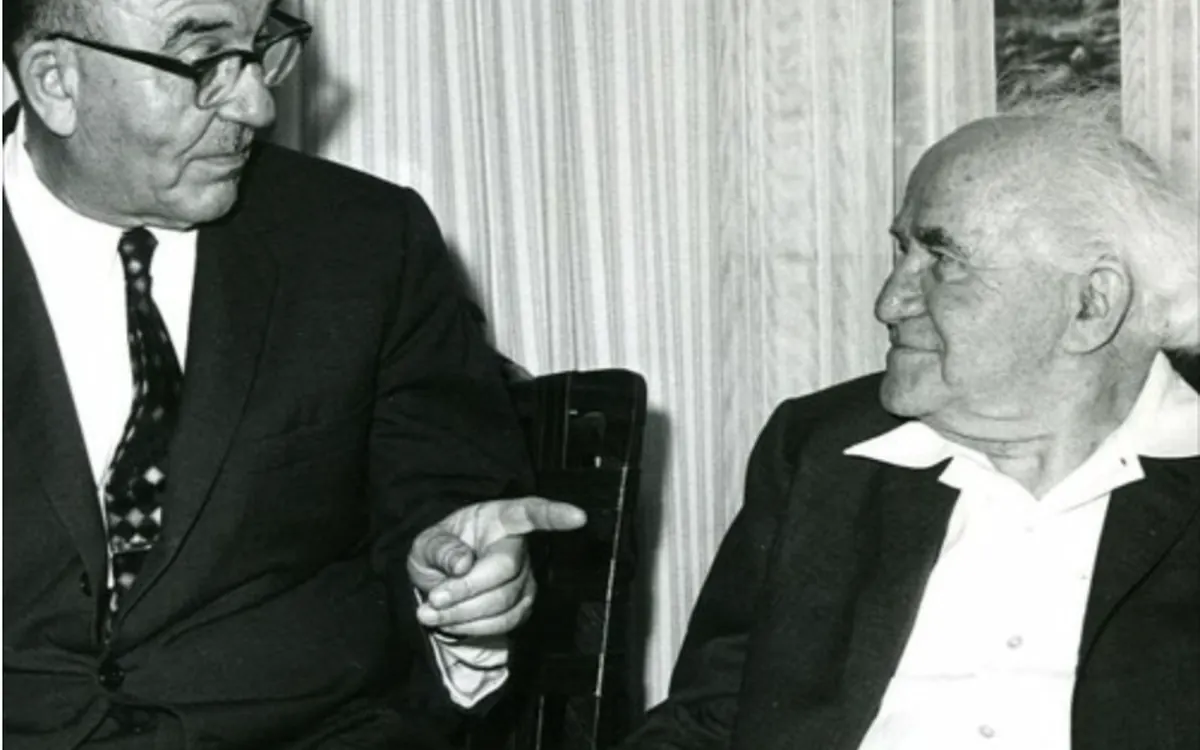
Old politicians never die, they just fade away. The era of Ben Gurion ended in 1963 and it appeared that his replacement, Levi Eshkol, could not live up to his legacy. This episode introduces a new mode of leadership for the State of Israel, and is the first step on the road to telling the tale of the Six Day War.
About this episode
Better pass boldly into that other world in the glory of some passion than wither with age, says Joyce. Bad business comes home to roost, and the esek bish, the Lavon Affair, did. It began with Operation Susanna, the false-flag failure, and the Olshan-Dori committee that found no proof Lavon gave the order but held him officially in charge, forcing his resignation. Ben-Gurion seemed unassailable, prime minister and defense minister through the Sinai War, Dayan a hero, Peres the architect of the French and nuclear programs, and in 1958 Ben-Gurion asked whether Mapai was democratic or autocratic, and was told the movement accepts everything you suggest in the most democratic way, an alarm bell. Mapai took 47 seats in 1959 with the slogan say yes to the old man, and through reparations, Eichmann and the nuclear struggle Ben-Gurion held the helm with everyone accepting his decisions democratically.
But you cannot run a democratic country as a personal fiefdom forever, and Lavon still felt he had taken the fall. When in late 1960 falsifications were discovered in documents submitted to the committee, Lavon, now secretary general of the Histadrut, demanded Ben-Gurion publicly absolve him, but Ben-Gurion insisted only a judicial hearing could decide, so Lavon took it to the Knesset Foreign Affairs and Defense Committee and painted a picture of plot and subterfuge, that Ben-Gurion ran the ministry by remote through Peres during his retirement, that Peres, Dayan and the private citizen Ben-Gurion waged a private war, and that they pinned the dirty business on him to bring the old man back to power, bombshells that were leaked and that the press, with scores to settle and a delight in the twilight of the gods, largely believed. Chaos erupted in Mapai; Ben-Gurion demanded a commission to clear his name, the party feared more dirt, and his doomsday weapon of threatening to resign backfired, taken seriously, and after nearly two years of paralysis, Lavon's dismissal, another election, and accusations of dictatorial tendencies, Ben-Gurion announced his final resignation in June 1963 and this time no one argued, selecting Levi Eshkol as his successor.
Eshkol could not have been more different, a bland technocrat and party man, whom Ben-Gurion seems to have seen as a caretaker to be easily replaced once the country realized it could not go on without the old man, a view Eshkol at first shared, looking around at receptions to find who was coming when the prime minister was announced. But he would lead Israel through a decade that again shook the world. Before his first meeting with President Johnson, the first official meeting between a president and a prime minister, he was nervous, and an aide read him a personality piece about a farmer who loves the soil, which Eshkol took for himself before learning it was Johnson, the tall Texan farmer who hit it off with the short Jewish farmer of the Galilee. Eshkol was born Levi Shkolnik near Kiev in 1895, made aliyah at nineteen refusing his father's money since only empty hands are ready to work, Hebraized to Eshkol after the clusters he picked, co-founded Degania Bet, Mapai and the Histadrut, ran the JNF land campaign and the Haavara transfer, but his love was water, inventing Mekorot with Simcha Blass to carry water to the farmers, becoming the first director general of the defense ministry in 1948 and finance minister in 1952.
In office Eshkol completed what he began with a pump and a pipe. In 1963 he financed a drip-irrigation pilot that saved sixty percent of water while increasing yield, the backbone of Israeli agrotech diplomacy, but he dreamed of flows, the national water carrier channeling fresh water from the Galilee through the center to the Negev, the ultimate Zionist dream Herzl foresaw, which became reality in 1964, the largest civilian investment Israel had made, carrying most of its drinking water. The original source station was to be on the Jordan's headwaters in the hills, but fierce Syrian opposition and UN pressure led Israel to move the intake down to the Kinneret, a costly choice of saltier water lifted 370 meters, and the conflict over water, the Syrian plan to divert the headwaters, would be a critical buildup to 1967. On the domestic front, Jabotinsky's will asked to be reburied in the land at the express order of a Jewish government, but Ben-Gurion, who had called him Vladimir Hitler, refused request after request, the land needs living Jews not dead bones, writing the revisionists out of the official history while Begin languished in the political wilderness.
This changed with Eshkol, who wanted to rule through unity, reaching out to Begin and establishing regular meetings, and when Begin presented Jabotinsky's will Eshkol, who had admired Jabotinsky in his youth, agreed two days later. The operation, Zev Jabotinsky Returns to the Homeland, brought the coffins from New York through Paris to Jerusalem, hundreds of thousands accompanying them, Begin at the head bearing his mentor's standard, removing Jabotinsky's sword before the burial in a separate plot southwest of Herzl, not in Ben-Gurion's plot of the great of the nation, a turning point in the public attitude toward Begin that paved the way for the unity government of 1967. Ben-Gurion could not lay down his enmity, writing in Davar that Herut distorts history, and that love is as strong as death but hatred apparently stronger, the pot calling the kettle black. The takeaway is about Ben-Gurion: he made one more return, a breakaway party in 1965 that won only ten seats and the perception of a bitter politician who would not go away, the decade of Ben-Gurion versus Ben-Gurion, doing damage to his own image, so that history has been kind to him for his work from 1948 to 1960 and in spite of what came after, a warning that old politicians never die, they just seem to fade away.
Key ideas
- The Lavon Affair came home to roost, Lavon's Knesset testimony of plot and subterfuge bringing nearly two years of paralysis and Ben-Gurion's final resignation.
- Ben-Gurion chose Eshkol as a caretaker he could replace, but the farmer-prime minister led Israel through a world-shaking decade.
- Eshkol's love of water built Mekorot and the national water carrier of 1964, the ultimate Zionist dream, moved to the Kinneret under Syrian and UN pressure.
- The Syrian plan to divert the Jordan's headwaters would be a critical buildup to the war of 1967.
- Eshkol ruled through unity, reaching out to Begin and reburying Jabotinsky, a turning point that paved the way for the 1967 unity government.
- The decade of Ben-Gurion versus Ben-Gurion did damage to his image, a warning that old politicians just seem to fade away.
Chapters
- 0:00 Better to burn out; bad business roosts
- 1:07 Susanna's fallout; Ben-Gurion unassailable
- 5:24 Lavon demands absolution
- 7:37 The testimony of plot and subterfuge
- 9:43 The doomsday weapon backfires; resignation
- 11:54 Eshkol chosen as a caretaker
- 12:56 Meeting Johnson; the two farmers
- 14:09 Levi Shkolnik; aliyah and water
- 16:19 Mekorot; carrying water to the farmers
- 19:33 Drip irrigation; the dream of flows
- 21:42 The national water carrier
- 23:56 Moved to the Kinneret; the water conflict
- 25:02 Jabotinsky's will; Ben-Gurion refuses
- 30:37 Eshkol reaches out to Begin; the reburial
- 33:55 Love and hatred; the pot and the kettle
- 34:59 Ben-Gurion versus Ben-Gurion
Who, where and when
People
Levi Eshkol, David Ben-Gurion, Pinhas Lavon, Shimon Peres, Moshe Dayan, Lyndon Johnson, Zev Jabotinsky, Menachem Begin, Simcha Blass, Theodor Herzl
Places
Degania Bet, The Kinneret and the Negev, The Jordan's headwaters, Mount Herzl, New York and Paris
Texts
Jabotinsky's will, Altneuland, Ben-Gurion's Davar article
When
1960 CE: the falsifications discovered, June 1963 CE: Ben-Gurion resigns, 1964 CE: the national water carrier, 1964 CE: Jabotinsky reburied, 1965 CE: Ben-Gurion's breakaway party
Read the transcript
Better pass boldly into that other world, says James Joyce, in the full glory of some passion than fade and wither dismally with age. Well, the other way to say that is it's better to burn out than fade away, and I'm looking to go full bore until I stop, because I'm Rav Mike Foyer, and this is The Jewish Story. Episode 24 Levi Eshol, a new face of leadership You know, it's a truism of politics and maybe even of life in general that bad business always comes home to roost. And in Israeli politics of the 50s and early 60s the bad business, Ha'esek Bish in Hebrew was the Lavon Affair. Now you might recall this story from way back in episode 13, and if you do, you probably remember that I warned you then it was far from over.
It all began with Operation Susanna, that false flag operation run by the Israeli military intelligence, which was meant to prevent Britain from pulling out of the Canal Zone. It was a dismal failure, if you recall, and another step on the road toward the Sinai War. Now, Susanna failed to produce the desired chaos in Egypt, and never even came close to toppling Nasher's regime, which was its kind of pie-in-the-sky hope. But it sure did bring down Ben-Gurion in the end. Back in episode 13, we saw the initial political fallout in Israel, how the Olshendori committee that was set up by the government to investigate the responsibility for such a messy operation was faced with a tangle of contradictory testimonies from Chief of Staff Moshe Ayan to the Director General of the Defense Ministry, Shimon Peres, and of course, Defense Minister Pinchas Lavon.
And not only were there testimonies contradicting, but there was a paper trail that was far from helpful in establishing who was exactly responsible for ordering a covert operation which ended with the execution of two Israeli agents, Moshe Marzouk and Shmuel Arzar. Hashem Yikom Damam. And in the end, The committee didn't conclude that Defense Minister Lavon had given the order, but rather that he was nonetheless officially in charge of all intelligence operations, and he was forced to resign, much to the dismay of Pinchas Lavon. But now it seemed that nothing could stop Ben-Gurion and his young protégés. He was Defense and Prime Minister, if you recall, right up through the Sinai War. Moshe Dayan maintained his position as chief of staff and really became a national military hero in the Sinai War, and we'll see more of that when we get to 1967.
And Shimon Peres, we saw as the architect not only of the French arms connection, but the Israeli nuclear program as well, and of all of them, was the last man standing in Israeli politics. So in 1958, during the celebrations of the first decade of statehood, a decade in which Ben-Gurion, by the way, had held the post of prime minister for more than eight of the ten years. We get an insight into his thinking. When he asked the Mapai party leader, Fritz Naftali, whether the Mapai was a democratic or autocratic organization. And since Mapai at this point was really synonymous with the state's institutions, you could say it was a question about the country as a whole. And the answer ought to sound an alarm, whether you're a student of history or an observer of present-day politics.
Ben-Gurion, he replied, the movement accepts everything you suggest in the most democratic way. So the steamroller kept going. And in 1959, Mapai went to the elections for the fourth Knesset with the slogan, say yes to the old man. And they took 47 seats, the most they'd ever achieved. The election was followed by some of the incidents we already discussed in previous episodes. The reparations agreement with Germany, which though controversial, certainly strengthened Israel's standing both economically and in international politics, the kidnapping and trial of Adolf Eichmann, the beginning of an internal reckoning with the Holocaust, the struggle with the American administration around Israel's nuclear aspirations.
And through it all, the old man had his hand firmly on the helm, with everyone accepting his decisions in a most democratic manner. It seemed that he was at the height of his power. Everyone loved him, except the opposition, of course. Now, you may know, maybe I've even said it here before, that one of Ben-Gurion's iron laws of politics, in particular of coalition formation, was without Herut and without Maki. Now, Maki is the Israeli Communist Party. And, by the way, if you believe Benny Gantz's commitment not to include the Arab Joint List in his coalition, they're still beyond the pale. After all, Joint List Chairman Ayman Odeh is actually the head of the Hadash Party, the core of which is Maki, the Israeli Communist Party.
Now, if you want a little bit of a discussion, by the way, as an aside, of what's coming up in Israeli politics, how we got there and where we might head, there's two spaces left on my webinar. You can get them if you sign up now. Send me an email, ravmikefoyer at gmail.com, or personal messaging on Facebook. I'll send you the details. Meanwhile, this rule of Ben-Gurion's, this iron law of coalition formations without Herud, without Maki, kept the far left out. And, of course, Herud was what he called the far right, the party headed by none other than Menachem Begin, underground leader of the Irgun, who Ben-Gurion consistently denounced as a fascist. Now, Begin will at least begin his process of reintegration into the political mainstream before this episode is over.
You'll have to wait until the upcoming elections to see if the same is true of Maki. So, in 1960, when the 4th Knesset convened with Mapai solidly at the helm, it seemed that the old man was unassailable. But, just like it's a truism, that bad business always comes home to roost. So too is the fact that you can't run a democratic country as your personal fiefdom forever. because Ben-Gurion may have forgotten the Essek Bish, that bad business, but the same couldn't be said of Pinchas Lavon. He still felt he'd taken the fall for the adventurism of Ben-Gurion and his protégés, Dayan and Perez, back there in the early 50s. And so when, late in 1960, falsifications were actually discovered in certain documents that had been submitted to the Olshendori Commission, all heck began to break loose.
At the time, Lavon was serving as the Secretary General of the Histodrut, the General Labor Federation of Israel. It's a very powerful position, and one that Ben-Gurion had helped him get, basically in compensation for losing the defense ministry. But it wasn't enough. Lavon wanted to clear his good name. And so when these new revelations came to light, he went directly to Ben-Gurion and demanded that the Prime Minister publicly absolve Lavon of any wrongdoing. It turned out that one of the primary witnesses against him had flat out lied and falsified these documents. But Ben-Gurion, despite the evidence, was unwilling to do so. Instead, he tried to shift the blame and insisted that only a judicial hearing could decide on Lavon's innocence.
Lavon refused that option for his own reasons, and instead he took the matter straight to the Knesset Foreign Affairs and Defense Committee. and his testimony there basically changed the nature of Israeli public discourse to this very day because what Lavon did was paint a picture of plotting and subterfuge in the defense ministry and in the prime minister's office he claimed that even though Ben-Gurin was technically in retirement in the Negev at the time of the Lavon affair he was still running the ministry by remote through Shimon Peres and furthermore Lavon claimed that Perez, Chief of Staff Mushtayan, and Ben Gurion, remember, then a private citizen, were engaged in what essentially amounted to a private war, intelligence gathering, retaliation raids, and covert ops like Operation Susanna, all of which was done without the knowledge or certainly approval of he himself, Pinchas Lavon, then defense minister.
Last, and perhaps most damning, Lavon accused Ben Gurion and his supporters of pinning that dirty business on him as part of a larger plot to bring Ben-Gurion out of his self-imposed exile in the negative and back to leadership of the country. Now, these were all of them bombshells. They were stirring mud that went right to the foundations of the country. And sure enough, the committee's discussions were leaked almost immediately to the press. And the vast majority of them sided with Lavon. If you ask why, the answers are somewhat obvious. Much of the press had some score to settle with Ben-Gurion and his boys, as they were called. It's impossible to have been a politician for that long and not earn the hatred of the media.
Others simply delighted in scandal in general, and they were particularly reveling in an opportunity to watch and publicize this area of what they call the twilight of the gods, the fading mystique of the founding generation. And it a question that we won dwell on right now but it worth contemplating on your own Why is it that people take such a joy in tearing down their old masters Okay, so political chaos now erupts throughout the country, certainly, but particularly within the Mapai Party. Ben-Gurion, of course, denies any wrongdoing and demands a commission of inquiry, which will now clear his name. But the party leadership feared that such a process would only uncover more dirt. and further weakened them in the eyes of the public.
After all, the opposition and Knesset were already sharpening their knives in expectation of the next election. And so they tried to convince the old man just to drop it, but he refused. And as tensions rose within the party, finally Ben-Gurion deployed what in the past had been his doomsday weapon. He threatened to resign. Except that this time, it kind of backfired. People took him seriously, others didn't. Some said, well, it's your right to resign if you think it's right. Some accused him of being a downright dictator. And what unfolded was nearly two years of political mess and paralysis, infighting, mudslinging. Lavone was dismissed from his post as the head of the Easter Drute in an attempt to appease Ben Green, but that failed.
So he continued to threaten, but he nevertheless held on to power through another election in 1961. I'm going to resign, but I'll run for election nonetheless. All the while, his power base was eroding, both within the party and within the eyes of the public, as even former supporters began to accuse him of dictatorial tendencies. It's a wonderful euphemism, isn't it? All the qualities, basically, that had made him a great leader, his resolve, his stubbornness, his ability to stand on principle, and the total identification between himself and the state, now made him a mockery in the eyes of much of the populace. And finally, in June of 1963, the old man once again announced his final resignation from the office of Prime Minister.
And this time, no one argued. Politicians in public, a life breathed a sigh of wreath and felt that the time had finally come. And in one of his final acts, Ben-Gurion selected Finance Minister and Mapai Party leader, Levy Eshkol, as his successor. It seemed a bit curious. Eshkol couldn't have been more different than Ben Gurion. He was a bland technocrat, a party man. He lacked Ben Gurion's charisma and his dynamism in leadership. But really, the reason behind it seemed to be clear right away. Rumor had it that Ben Gurion really only saw Eshkol as a caretaker, as someone who could be easily replaced when after a brief time in retirement, the public and the party realized that the old man had been right all along and the country couldn't go on without him.
Eshkol himself actually seemed to agree with that assessment at first, as he later said, In the first several weeks after I was appointed to the Prime Ministry, when the Prime Minister's arrival was announced during receptions or other public events, I used to look around and find who was coming. Little did the country know that Lady Eshkol would be a leader for the Israeli decade, which would once again shake the world. On the eve of his meeting with the President of the United States, Lyndon Baines Johnson, Prime Minister Eshkol was nervous. I mean, personally, I can understand. Johnson, by all accounts, was a large and very loud man. And Eshkol had only received the invitation for a state visit months before.
This was in fact the first official meeting between a president and a prime minister since the state was born. It's not that they hadn't met before. After all, Ben-Gurion had met presidents in his day, but only in unofficial circumstances, coincidental meetings arranged in people's apartments in New York. Those were what political analysts call illicit affairs. But no longer would the state of Israel be a secret mistress. Levi Eshkol was about to usher in the era of above-board relations between the United States and Israel. So, like I said, he was nervous. And in an attempt to calm him, one of his aides began to read to him a short personality piece from the New York Times without telling the Prime Minister who it was about.
Quote, he's a farmer. He's a man who loves the soil and growing things. He feels best when on his own farm and growing his crops. He likes people and is always straightforward and hearty. Mr. Eskall, the aide, asked him, Who do you think that is? But, he stammered, but, but, that's me. No, sir, his aide replied, that's the man you're going to meet, the President of the United States. And indeed, from all accounts, the tall Texan farmer in the White House hit it off with the short, chubby Jewish farmer of the Galilee. It could have been that personal chemistry, in fact, which paved the way for the most important political relationship that Israel has ever had. But if you want to appreciate that, you've got to let a little bit of the back story.
So Levi Eshkol was born Levi Shkolnick in a small shtetl, that's a village, near Kiev in 1895. He was the second of ten children, and he lived in a family that combined Hasidut, Orthodoxy, Zionism, and some of the winds of the new Jewish Enlightenment to boot. You know, your typical Jewish home. Barred as a Jew from attending the local public schools, Levi's parents sent him to the Hebrew Gymnasium in Vilna, where the secular Zionist Elmanid's upbringing really won out. Because there, he came under the influence of Yosef Sprinzak. He was the founder of Hapol HaTzeir. It was a socialist Zionist pioneer movement. And at age 19, Levi made his aliyah to the land of Israel, finally coming up and coming home.
Unlike many of his peers, his parents were actually quite supportive of this radical move, so supportive, in fact, that his father offered financial support. At this point, word had already come back to the Ukraine of the desperately hard conditions that those who moved in Israel lived in. Young Levy's response was indicative of the life of hard work and integrity which lay ahead. He refused his father's generous offer with the following explanation. Only if I come empty-handed will these hands be ready to work. And work he did. The next two decades of Levi Eshkol's life read like a primer in labor Zionist history. He quickly, upon arrival, changed Shkolnick to Eshkol in honor of the great clusters that he spent so much of his time picking.
A great cluster in Hebrew is an Eshkol. And he was part of the original group of Kibbutz Deganya Bet, not the original Deganya, but its extension along the shores of the Kinneret. He was amongst the founders of the Mapai Party, that's Ben-Gurion's party, and the Histotut Labor Federation. He headed the JNF campaign, purchasing land in the 20s and 30s. And in 1934, he traveled to Germany on behalf of the Yishuv to supervise the controversial Havara plan. That was the transfer of Jewish capital from Germany to Palestine, which, despite its controversy, contributed significantly to the economic development of the Yishuv. But his great labor of love, one which really defined him all the way through the premiership, was for water.
In 1937, Eshkol was responsible for one of Zionism's greatest pre-state accomplishments, the creation of a national water utility, Mikokot. The story goes that while he was living on Kibbutz Deganya, Eshkol and a friend used to drive every day a wagon, hitched to two mules to bring water from the Jordan River all the way back to the kibbutz. And that soon became tiring labor. And so they consulted with Srin Chablas, who was an engineer and fellow member of Deganya, And together, they invented a wholly new idea, carry water to the farmers instead of making the farmers schlep to the water. And so they bought a pump and a pipe, and together with Simcha Blas' technical help, Mekorot, the Israeli National Water Utility, was born.
And throughout the rapid political rise which lay before him, Levi Eshkol never neglected this dream of crisscrossing the country with pipelines that he called veins of the human body, Blood and water to him were always one and the same. He was Mapai Party's secretary, chairman of the Tel Aviv Labor Council, and ultimately the first director general of the Ministry of Defense in 1948, where he proved instrumental in transforming the underground Haganah army into the unified Israel Defense Forces. And all the while, he still found time to dig wells, lay pipe, channel springs. I mean, it's true that his hands were more often dirty with the ink of the paperwork to make it happen than the soil he loved so much to move.
But after the war, he worked at sustaining Israel's Akani as it absorbed over 700,000 immigrants, I hope you recall. And his success in public affairs led to Levi Eshkol's election to the Knesset for the first time in 1951. And soon after, in 1952, to his appointment as Minister of Finance. Once again, he was trying to keep the country afloat, wrestling with severe shortage of housing, foreign currency, and jobs. Hopefully you remember the story from previous episodes. He stabilized the national budget and created a workable tax system, which I suppose I should thank him for. And all the while he had his eyes on the prize He was supervising what known as the Arkon project pushing the government to finance a concrete factory which would ultimately craft the 66 pipes needed to make the desert bloom And as I said, Lady Eshkol was offered the position of prime minister when Ben-Gurion finally resigned in 1963.
He may have seen himself as Ben-Gurion saw him. Originally, it's nothing more than a placeholder. but there was a whole generation of younger leaders who saw in Eshkol the opportunity to break Ben-Gurion's monopoly over high politics and they were therefore determined to keep him in the Prime Minister's office and with that kind of political base, you can go awfully far and apparently, as Eshkol began to register real political achievements both within Israel and abroad he came to share their view that he wasn't just a caretaker but that rather, just like his beloved farms around Degania he could be a steward. We'll get back to politics, don't worry. We've got quite a bit of that time ahead of us until we get to 1967.
But let me glory in water resource management for one last moment. Some of you may not know that actually my second degree is in that, and that's why I came to Israel, really, to begin with. Well, anyway, in Eshkol's first year in office, he was completely devoted to the completion of what he'd begun with a pump and a pipe back in 1937. In 1963, the Prime Minister gave the go-ahead to finance a drip irrigation system for an orchard in the northern Nagav, a pilot project, something you'd think that a Prime Minister shouldn't be paying attention to. But you know what? It was a phenomenal success. It saved 60% more water than existing irrigation systems and did it while increasing the yield of the field.
And you may know that drip irrigation quickly became a backbone, not only of Israeli domestic agriculture, but of Israel's agricultural diplomacy all over the world. To this day, even though drip agriculture is at this point old school, even though the arms trade is the, let's say, less savory face of Israel's economic diplomatic push in the developing world, agrotech is actually our real face to many nations. I had the great merit of working with people who were pouring their heart and soul into doubling crop yields in small villages in the Horn of Africa. May they be blessed to succeed. But you know what? Levi Eshgul dreamed of flows, not of dripping water. His aim was nothing less than a national water carrier, which would channel fresh water from the Sea of the Galilee in the north through the highly populated center of the country and then on to the Negev Desert, integrating and expanding local resources along the way in order, like I said, to make the desert bloom.
It was really the ultimate Zionist dream. Even Herzl, back in his 1902 book, Alt Neuland, discussed massive projects which used the sources of the Jordan River for irrigation and channeled seawater for producing electricity. And if you will it, it is no dream. Now, if you're familiar, the Red Sea, Dead Sea Canal for generating electricity is still in the dream phase. But the national water carrier became a reality in 1964. I'm going to resist my desire to throw a massive heap of numbers at you. But for now, just know this. The cost of the project in its completion was 420 million shekel in 1964 prices. It was the largest investment in civilian infrastructure that Israel had yet made. And it originally carried 80% of Israel's irrigation water and 20% of the drinking supply.
Today, up to 72,000 cubic meters, that's 19 million gallons in the American measure of water, can flow through that carrier every hour. That's 1.7 million cubic meters a day, and it's carrying now more than half of Israel's drinking water. A critical piece, and one which we'll return to, is that the original plan called for the pumping source station to be on the headwaters of the Jordan River in the hills above the Sea of the Galilee. but it faced fierce Syrian opposition. The Jordan River at that point formed the border between Israel and Syria in the 1949 armistice agreement, which brought an end to the war. Notice, armistice agreement, not peace treaty. This isn't a border, it's a ceasefire line.
But nevertheless, as soon as 1949 passed, political and military clashes began to break out. And in 1953, in particular, things got hot when Israel began construction on the source pumping station. So when the United Nations joined the fray and demanded that Israel respect the disputed nature of the headwaters, the Israeli government made the rare decision to actually comply with international pressure, and they moved the intake for the national water carrier down to the Kinneret. This was a very costly decision. The move to the Kinneret required two things. First of all, the water is of a much greater salinity, which means it has a long-term impact on the soils. That means nothing to you. You can write me an email later.
But more importantly, or more immediately, I should say, that in order to take the water from the Kinneret instead of the mountains above it, they now had to lift it nearly 370 meters to the high point of the national carrier. You may be unaware that the Kinneret itself is more than 200 meters below sea level. To this day, the pumping stations that do that, Sapir and Salmon, are amongst Israel's most important electricity expenditures. But you know what? It worked. And you know how the country has blossomed from the vision of this farmer termed prime minister. You just have to take a little tour in the countryside to see it. And as we'll see in coming episodes, the conflict with Syria over water didn't end with that decision to change the source of the national war carrier down to the Kinneret.
One of the critical buildups to the outbreak of war in 1967 will actually be the Syrian plan to divert the headwaters of the Jordan in order to undermine this project at its source, so to speak. And we'll speak about Eshkol's retaliation policy and its role in the march to war. But for now, I want to wrap things up with a focus on his domestic struggles. I wish to be buried or cremated, it is the same to me, at the place in which death will find me. My bones, if I be buried outside of the land of Israel, should be transferred to the land of Israel only at the express order of the Jewish government of that country when it will be established. Those are the words from the last will and testament of Zev Jabotinsky, written when he was living in Paris in 1935.
If you don't remember who Jabotinsky was, or why the great leader of revisionist Zionism was in Paris rather than Jerusalem in 1935, then oily, I failed in my job. Go back and review the second half of season two. Or frankly, write me an email. I'll try to fill you in directly. But for now, we've got to move forward in time, not backwards. Jabotinsky actually died in the U.S. five years after he wrote those words, tragically, in 1940. Perhaps the Lord was merciful and took him away before he could see the disaster, which he had been shouting about for years. He was actually buried in the New York Montefiore Cemetery. Through the eyes of Jewish history, his request to be reinterred in the land of Israel is hardly exceptional.
I mean, many others had written the same in their wills before them, and they merited to be buried or at least reburied here. And even through the eyes of Jewish politics, it wasn't so strange. After all, the body of Jabotinsky's hero, Theodor Herzl, was moved from its Vienna grave to a hilltop on the edge of Jerusalem in August of 1949. The area around his grave was actually expanded quickly after into a plaza, where they held the first independent day ceremony in 1950. And when in 1952, Ben-Gurion ordered the finance minister, Eliezer Kaplan, to be buried nearby in what he then named Helkat G'dolei Ha'uma, the burial plot of the Great of the Nation, the first steps were taken toward Mount Herzl becoming what it is today, Israel's national cemetery.
So there, you might think that Jabotinsky's last request would have been easily fulfilled, and soon after Herzl, his remains would be transferred at the, quote, express order of the Jewish government of that country, now that it had indeed come into being. You might think that, but you would be wrong. And you would be wrong because if you think that, then you don't appreciate how extremely personal Israeli politics really are. Ben-Gurion had hated Jabotinsky in his lifetime. They had been fierce rival, and at one point he'd gone so far as to call him Vladimir Hitler. Those are really fighting words for someone who lived through the Holocaust. And the grudge didn't end with death. Like I said, Israeli politics then and now are all about the personal.
Maybe that's true everywhere, but somehow I feel like the sort of overgrown family argument that we are is a little bit more bitter. I mean, after all, one root of the antagonism between current Prime Minister Bibi Netanyahu and President Ruby Rivlin was a dispute between their followers over an academic job which only one of them can have But that holds no candle to the bad blood between the Haganah and the Irgun the left and right-wing underground armies between Ben-Gurion and Jabotinsky. They're both leaders and spiritual mentors. I mean, after all, we know, if you've listened to season two, that the Haganah did not shrink from spilling revisionist blood when it was a question of maintaining their power.
And I mentioned at the beginning of the episode Ben-Gurion's campaign slogan, without Cherut and without Maki, but recognized that this rejectionism wasn't just confined to politics and coalition formation. Ben-Gurion wanted the history of the state to be told without the memory of his rivals, and that meant without Jabotinsky's bones. When a member of Knesset, Mournchai Mourouk, of the religious Mizrahi party, first proposed to Ben-Gurion in 1951 that Jabotinsky's will be honored. His response was, quote, the land needs living Jews, not dead bones. Now, this was despite the long history of Jews being buried in the land of Israel, despite the fact that Herzl had been moved. In fact, Ben-Gurion himself had overseen the moving of the remains of the Zionist leaders, Nahum Sokolov and David Wolfson back to Israel in the first years of the state.
But despite his rejections, the requests continued. In 52, Jabotinsky's former secretary and professor of law, Benjamin Akzin, tried his luck. In 54, Interior Minister Israel Keach of the General Zionist Party made another plea. This time, Ben-Gurion's response was, quote, man originates in ashes and ends in ashes. It is desirable and better that he rests where he dies. Trust me, it rhymes in Hebrew, but either way, you can hear the bitterness of it. And these are only some of the requests. Now, as this is going on, you should recognize the revisionists were all but written out of the official history of the pre-state, so much so that their veterans had to form self-help groups in order to replace the non-existent government support, which did go to those who fought in the Haganah.
And their leader, Menachem Begin, was consigned to what seemed at this point to be a permanent role in the political wilderness. But all this, like so many other things, began to change with Levi Eshkol's election in 1963. I shouldn't say election, his appointment. Because in addition to his passion for agriculture and his well-known good nature, Eshkol had a great desire to rule through unity and not through division. And the first step, or at least one of the first steps toward healing the risks within his young society was to reach out directly to Menachem Begin and establish a regular meeting with him. In fact, on the very day that Eshkol married his third wife, librarian Miriam Likwitz, he met with Begin later the same day.
It was at this meeting where Begin presented the Prime Minister with Jabotinsky's will and requested the immediate fulfillment of his final request. Eshkol responded that he himself had admired Jabotinsky in his youth and asked for the Begin for a little bit of time to consider their quest. Upon reflection, he realized that there was perhaps no better way to begin extinguishing the flames of hatred which still smoldered between left and right. And so two days later, he returned to Begin with a positive response. And the result was an official burial operation entitled Zev Jabotinsky Returned to the Homeland. The coffins of Zev and Joanna Jabotinsky were transported from New York on Plain, with their first stop in Paris.
There they held a short ceremony in the presence of the Prime Minister. And from Paris, it was on to Tel Aviv, where the coffins were placed in Herbert Samuel Square while an endless line of people passed to pay their respects. And finally, on to Jerusalem, where hundreds of thousands of people accompanied the casket into its final resting place. Among them were Israel's former Prime Minister, Speaker of the Knesset, the head of the Shreem Court and, of course, the chief rabbis. But at the head of the crowd, bearing the standard of his great mentor, was Chayrut Party leader Menachem Begin. And just before the coffin was lowered into the ground, mind you, in a separate plot, southwest of Herzl's grave and not in Ben-Gurion's Chalkat Gedulei Uma, Begin removed Jabotinsky's sword from his coffin and presented it to the Jabotinsky Institute's honor guard.
The emotional event was actually beyond the symbolic. It was a turning point in the public attitude toward Menachem Begin, which began to become increasingly more positive and supportive. And in many ways, it paved the way for his entry into the unity government of 1967. But that's an important story which lies ahead. For now, even in his retirement, back there in Stable Kerr down in the Negev, Ben-Gurion could not lay down the sword of his enmity. In an article in the labor newspaper Davar in 1964, he wrote, Chebotinsky died 24 years ago, and few in the nation know the true character and deeds of the man who Begin calls the generation's teacher. Among the means, Cherut uses to strengthen its influence and prestige is distortion of history.
Perhaps it has to do so because, since its creation, it has not contributed a single fruitful project or concept to the strengthening of the state. It relies mainly on the generation's teacher to perform this, quote, glorified labor of distortion and fabrications. As the wisest of all men, meaning Solomon, said, love is as strong as death. But what of hatred, asked Ben-Gurin at the end of the article. That is apparently much stronger. and one wonders if this is not just a classic case of the pot calling the kettle black. You know, I don't have so much to say in conclusion here because there's way much more to say about Levi Eskel. We're far from done. We'll see him as a bit part in the story of the great spy Ellie Cohen, maybe next week, depending on how the research goes.
We'll know him as the leader who dismantles the military government that ruled over the Israeli Arabs from 1948 to 1966. A difficult story, but one that has to be told. And of course, we're going to need to spend quite a bit of time contemplating his complex role in the lead-up to and the execution of the war of 1967. But for now, as much as this episode is about his leadership, I think the important takeaway is really about Ben-Gurion. The old man did indeed make one more attempted return to politics. He formed a breakaway party from the Mapai in the 1965 elections in order to fight with his former protege. It's a complex story that I'm not going to waste my energy on. But suffice it to say that what resulted was a realignment of left-wing politics.
In fact, Levi Eshkol called his new party the alignment. And it's really the roots of the true Labour Party, which emerged from it in much later years. It's part of a much larger dynamic of consolidation on both left and right, which would give birth to Likud on the right as well quite soon. But Eshkol held off this challenge. Ben-Gurion only managed to gain 10 seats in that election, to gain 10 seats and the perception, widespread perception, that he was simply a bitter politician who refused to go away. You know, historians and biographers call the period in Ben-Gurion's life from 1963 to his death in 1973 the phase of Ben-Gurion versus Ben-Gurion. The man who had always been a fighter, who gave it all and who so identified with the state that he couldn't separate its well-being from his own, actually did quite a bit of damage to his own image in the last 10 years and perhaps even to the state.
Oh, I don't want to over-dramatize that. Now, it's true that history has been kind to Ben-Gurion, but that's really due to his work from 1948 to 1960, and in spite of what came after. So I guess I'll just end with that thought, that we should be wary of the fact that old politicians never die, they just seem to fade away. Okay, folks, I want to say thank you. I want to say thank you to the folks who give their hard-earned money to make this show happen, to keep it free and widely distributed. I want to invite you to join them. Go right now to my website, jewishstory.co. In the upper right-hand corner, you'll see a button there that says Be a Patron. You can click there for a little bit of per-podcast support.
I also invite you to dedicate a show in the honor of someone with us today or in the memory of someone gone. If you send me an email at robmikefoyer at gmail.com or you personal message me at Facebook and robmikefoyer, I'm happy to share the details of how you can make that happen. I also want to thank the Land of Israel Network, that's thelandofisrael.com, for creating a platform that allows me to reach so many fantastic people. I want to thank the Kardes Institute, pardes.org.il, for building an educational institution that gives me the privilege to teach so many wonderful Jews. And I want to thank you for listening. I'm Rav Mike Boyer, and this is The Jewish Story.
More from Season 3
TJS S3 Interlude - Redemption Rant
Sometimes you just have to let loose, so here is a rant in response to some listener questions. It touches on the Trump Plan, the current political crisis...
Play Episode
TJS S3 Interlude: some more questions
Why stop once with a good thing? Here is another interlude answering listener questions on Israel as a Jewish State. Hold out to the end hear what Rav...
Play Episode
TJS S3E25 Shifting identities in early Israel
The present is always built on the ruins of the past, the only real question is - how do we integrate this reality into our identity? This episode...
Play Episode