
TJS S6 Interlude - American Anti-Semitism - Interview with Ken Jacobson of the ADL
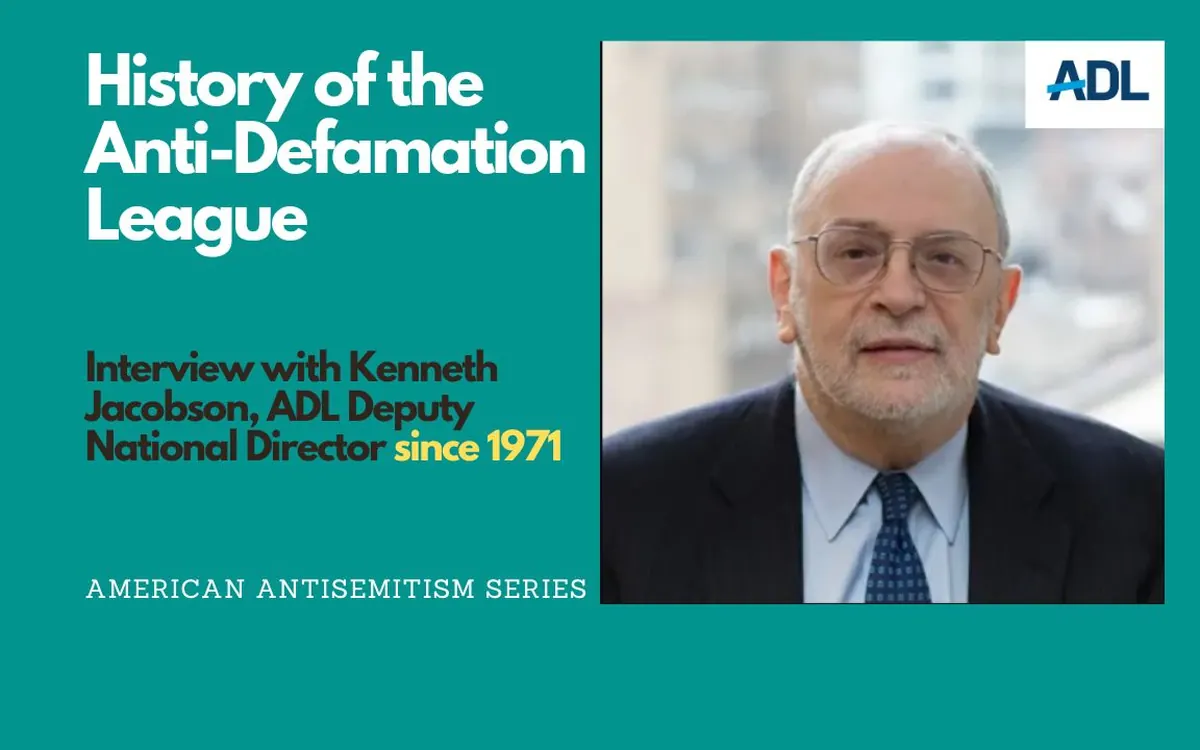
Is Judeophobia getting worse in the US? Kenneth Jacobson has worked for the Anti-Defamation League since 1971 and as deputy director, he shares his unique view on the history of Jew-hate in America.
About this episode
We don't receive wisdom, said Proust, we must discover it for ourselves. Rav Mike sits with Ken Jacobson, deputy national director of the ADL, who came in 1971 looking for a simple job before finishing a history dissertation and stayed fifty-two years. Raised in the Bronx home of an Orthodox rabbi who loved both Talmud and Shakespeare, Jacobson was drawn by an organization that dealt with Jewish issues and larger questions of equality alike. He holds that the mission has not changed since the founders wrote in 1913 that the ADL would stop the defamation of the Jewish people and work for equal rights for all, though the methods have shifted with the world, most sharply around free speech, where he divides the ADL's long history into continuity and change.
A classic ADL instinct, Jacobson says, was the anti-mask law its Atlanta office pushed through against the Klan, which let the hateful demonstrate while forcing them to remove the hoods, demystifying the Klan and exposing hate to the light rather than banning it. That purist free speech approach held until social media made replacing bad speech with good speech nearly impossible, and the ADL organized the Stop Hate for Profit boycott of Facebook, an edgy move for an organization that opposes the BDS boycott of Israel. He counts the great victory of the postwar decades as dismantling the unofficial institutional antisemitism of university quotas, housing covenants and glass ceilings, after which Jewish life in America became the most comfortable in two thousand years of diaspora.
The worst gap, he admits, was the Holocaust, when the ADL had no mandate to act abroad because B'nai B'rith had told it to stick to America, a loss that drove it to become an international organization. Turning to the present, Jacobson has no doubt antisemitism is rising, and his favorite word for its context is anxiety. When social, political or economic anxiety runs through society, conspiratorialists seize on the Jews, because the unique core of antisemitism is the belief that Jews are not what they seem, normal on the surface and secretly all-powerful and evil beneath. He points to the Protocols of the Elders of Zion, the brilliant and evil forgery of the Russian secret police that put down in writing what millions already believed.
This is why Jacobson warns against complacency even in good years, since the Black Plague once brought the blood libel of poisoned wells and COVID brought a fresh wave of conspiracy theories, the Jew serving as the convenient target to explain complicated situations. On the three facets Rav Mike has drawn, white, black and progressive, Jacobson prefers to say there is no monopoly on antisemitism, that it comes from right and left, majority and minority. The right is blatant and violent, witness the Pittsburgh manifesto that blamed Jews for the immigration it hated, while the left wraps its hostility in human rights and anti-Zionism and gains a respectability in mainstream media and politics that makes it harder to confront, since its believers think themselves free of bigotry.
The hardest challenge for Jacobson is hate from minority communities, where the ADL both works for equality and refuses to pull punches, condemning Kanye West and Kyrie Irving while naming the deeper source in the legitimacy that respected African American leaders long gave Louis Farrakhan. His advice to the diverse crowd of the Jewish story is plain, speak out when you see it, educate others about what makes antisemitism unique, and be non-partisan, since the real test is a willingness to call it out when it comes from your own side of the aisle. He worries less about antisemitism in a vacuum and more about the weakening of the American center, whose polarization and conspiracies damage democracy and Jewish life together.
Key ideas
- Ken Jacobson came to the ADL in 1971 for a short job and stayed fifty-two years, holding its 1913 mission of fighting defamation and working for equal rights.
- The Atlanta anti-mask law shows the ADL's instinct to expose hate to the light rather than ban it, an approach social media has strained.
- The postwar ADL helped dismantle the quotas, covenants and glass ceilings of unofficial institutional antisemitism.
- Jacobson's word for modern antisemitism is anxiety, and its unique core is the belief that Jews are secretly all-powerful beneath a normal surface.
- There is no monopoly on antisemitism: the right is blatant and violent, while the left gains respectability through human rights and anti-Zionism.
- His advice is to speak out, educate, stay non-partisan, and strengthen the weakening American center.
Chapters
- 0:00 Proust; fifty-two years at the ADL
- 2:16 The mission in 1971; a rabbinical family
- 3:33 Continuity and change; free speech
- 5:50 The anti-mask law against the Klan
- 8:12 The social media turn; Stop Hate for Profit
- 10:27 The great victory; institutional antisemitism
- 12:52 Quotas gone; the most comfortable diaspora
- 14:04 The worst gap; the Holocaust
- 16:15 Antisemitism rising; anxiety
- 18:52 Jews are not what they seem
- 21:18 The Protocols of the Elders of Zion
- 27:17 Three facets; no monopoly on hate
- 30:02 The Pittsburgh manifesto; the right
- 33:12 The left; respectability
- 35:19 Minority communities; Farrakhan
- 40:52 What people can do; the center
Who, where and when
People
Marcel Proust, Ken Jacobson, Louis Farrakhan, Kanye West, Kyrie Irving, Robert Bowers
Places
The Bronx, Atlanta, America
Texts
The ADL mission statement, The Protocols of the Elders of Zion, The Pittsburgh manifesto
When
1913 CE: the ADL is founded, 1971 CE: Jacobson joins the ADL, 2018 CE: the Pittsburgh massacre, 2022 CE: Kanye and Kyrie
Read the transcript
We don't receive wisdom, said Marcel Proust. We must discover it for ourselves after a journey that no one can take for us. I'm just looking to keep my feet moving as the road unfolds ahead. I'm Rav Mike Foyer, and this is The Jewish Story. Season 6, Interlude, an interview with Ken Jacobson, Deputy Director of the ADL. Okay, I'm sitting here with Kenny Jacobson, Deputy National Director of the Anti-Defamation League, the ADL, and longest-serving professional in that glorious institution. Kenny, thank you so much for taking some time to speak to me this morning. Pleasure to be with you. Before we dive into the question at hand, which is your take on American anti-Semitism today, I just have to ask, how long have you been at the ADL?
A short period of time, 52 years. 52 years which wait don't make me do the math you came what year in the sometime in the 70s 1971 I was a I was up to my dissertation for a doctorate in history and in famous last words I said you know I've been in school too long I got to take just get some simple job somewhere for a year or two and then come back and do my dissertation and famous last words so 52 years later, I'm still at ADL. Did you finish the dissertation? I never went back to finish my dissertation. I didn't make a faux pas by not calling you doctor then. Yeshiva University, where I went undergraduate, awarded me an honorary doctorate actually this past year at their graduation. Some people are saying we can now officially call you, but I don't particularly care about that.
I will be with you in spirit. a great lover of history myself. So 1971, and you came there essentially looking for a job, a little bit of real-world experience, as you said. Do you recall what you felt the mission of the ADL was in 1971? I knew something about ADL. Again, I wasn't coming to spend my career there when I entered the organization. But yes, I was aware. Well, let me just give a little context of my own life, which is I come from a rabbinical family. My father was an orthodox rabbi in the Bronx, New York. And we used to always say about my dad that he knew Tom Wood by heart and he knew Shakespeare by heart. And so that we grew up in a family where religious and secular learning was considered critical.
As a matter of fact, my father used to get angry at us kids when we had books on the floor. If we had religious books, of course, he would get angry. But even secular books, you would say that's not the way. So I grew up in a family where there was tremendous respect, not only for learning, but for both broader subjects and as well as more specifically Jewish ones. And ADL, early on, I realized, dealt with issues related to Jews as the primary purpose of the organization, but also dealt with larger issues of equality and dealing with hatred towards other groups. So that was something, even when I had no intention of making a career out of ADL, something that did attract me. And the other element that also was similar to what I had done as a graduate student, my two doctoral fields of history were American history and Jewish history.
It's a combination of dealing with broader American society and dealing specifically with the Jewish environment. In the course of five decades, how have you seen that mission change? What would you say that it's become today? Is it consistent? Has it shifted? You know, often institutions that have been around for a long time suffer from mission creep. What have you seen in that span of time? I don't think our mission has changed. I think the way we carry it out and the way we approach certain things may have changed somewhat and should change because the world has changed. But the fundamental mission, and it's not, I'm sort of the unofficial historian of ADL, and I just just literally, the other day, I gave a one-hour talk on the history of ADL to many of our national supporters.
And I always talk about the fact that that history, which goes back 110 years, is a history of continuity and change. The continuity is really in the mission statement that was issued by the founders of ADL in 1913, that ADL will attempt to stop the defamation of the Jewish people and work for equal rights for all. In that sense, the mission has not changed. We are doing that. Obviously, there are so many things that have changed in the practical world that, you know, we could talk about it. But, you know, there have been, of course, changes. I think from a conceptual point of view, one of the biggest and most complicated areas is the area of free speech. ADL historically, and when I arrived, surely was, we were a big organization in free speech.
Obviously, the American Civil Liberties Union was the famous group. Talk about mission creep. In the old days, the American Civil Liberties Union just had that mission of protecting free speech. Later on, they became ideological on a whole host of issues. But we were not like that. And yet we were big defenders of free speech. So, for example, when we fought hate activity of all kinds, there's a famous thing that happened before I arrived at ADL, which was the Ku Klux Klan was very active in the South when the civil rights movement was beginning to germinate. And as soon as all the talk was in the late 40s, early 50s of the possibility of changing what has been a horror of Jim Crow and segregation in the South, the Klan had a tremendous revival and they created all kinds of havoc early on in the South.
ADL had an office in Atlanta, and our office took an initiative, which speaks to the point I'm trying to make. The office went to the state legislature and proposed a law which eventually was passed known as the anti-mask law. The anti-mask law said that the Klan has the right to demonstrate as hateful as they are, And that was the element of ADL saying, we're not going to ask you to pass a law to ban the Klan from having their terrible, frightening demonstrations. So that was the ACLU side of ADL, free speech. But we have to do something about it. And so what we got passed was a law said they could demonstrate, but not with those infamous hoods over their heads and those tortures, which was so intimidating.
so that they had to show who they were. And that played a tremendous role, first of all, in demystifying the Klan, but it turns out these scary people were your next-door neighbors. And secondly, it really was the way that ADL went forward to deal with hate, which is not to try to ban hate, because we believed in that First Amendment of the Constitution, the right of free speech, even the worst kind of speech, but to expose it literally and figuratively to the light of day and then get people to have it. The point I'm making here is that was the way we conducted ourselves pretty consistently until the last six or seven years. That has taken a turn. When you're asking me about things are staying the same and changing, that has taken a bit of a turn in recent years because of social media and the internet.
because before the internet and social media, the basic way to fight bad speech was to replace it with good speech. You hear someone saying something hateful, you communicate to the people who are hearing it with saying this is a lot of garbage and here's what the real reality is. That was possible in the real world. In the virtual world, that becomes almost impossible because people are exposed to a million things and you can't get to them, people who are hearing everything. And so it just forced us to take a little bit of a turn away from a purist free speech approach. And the example of this was something we did last year, a year ago in the summer. We have a series of folks who work in Silicon Valley and they work in order to deal with hate on the internet.
We deal regularly with Google, Twitter, Facebook, you know, all of them. And we were frustrated, particularly with Facebook. They were not taking their own rules seriously and the worst kinds of stuff was appearing and causing havoc. So we decided to organize a month, which again was a turn in which we advocated, We said stop hate for profit. That's what we called it. And basically, we got over a thousand companies and institutions here and around the world to boycott Facebook in terms of advertising for one month. Basically, to send a message to Facebook that you really have to do something. Now, that was, as I said, not the purest kind of approach towards free speech, but it was a recognition in the changing situation that we had to do something about it.
That's an edgy move for an organization that has pushed back fairly hard on the BDS boycott, divestment and sanction movement against Israel. Yes, that also, we're very conscious of that. But we didn't want to let that stop us since we think that BDS is an illegitimate thing and that this was legitimate. Obviously, you're going to have that argument made with some people. For sure. At the end, we got so much more support than we anticipated. That's fantastic. A quick one more historical question when we think about today together is that what would you say in this span you've seen has been the greatest victory against anti-Semitism, whether it's by the ADL or in partnership or just something you feel like it really changed things in America?
Well, I would say, look, I often, as I said, I just gave a talk on the history of ADN. I divided that history into three periods. And the middle period that I call which is from post War II till about the early 70s was the major transformative period where ADL moved from a kind of fledgling organization into a sophisticated group in many many many ways One of the things that we did during this period was we took on the challenge of what I refer to as non-official institutional anti-Semitism that was fairly pervasive in America in the early 50s. And what I mean by that is there were three particular areas of life for Jews in America that were severely affected by, as I said, unofficial institutional.
What I mean by unofficial is it was never openly admitted, but everyone knew. So these three areas were university admissions. Every Jewish family back then knew there were quotas, particularly in the Ivy League schools, but in other schools as well. that universities had quotas on the numbers of Jews. And so that had a huge impact. Second was in housing. Everyone knew that the neighborhoods had secret covenants in which homeowners agreed not to sell homes to Jews. And so there were neighborhoods that Jews just couldn't buy homes. The third one was employment. Everyone knew there were glass ceilings in different professions, particularly banking and insurance and oil. where Jews were known that they either couldn't get jobs or they were limited in what they could achieve.
We took on the challenge of each of these in the 50s. And by the end of that next decade, they had largely disappeared. The universities had become open to Jews. We used to always talk, I remember, about how the president of Princeton, in one of the major universities that had such quotas, was a Jewish guy by the name of Shapiro in the early 70s. A lot of his ancestors in the university would be turning over in their grades to think of a Jewish president in a university that had such restrictions on Jews. Universities became open. Secret covenants largely disappeared. Employment became open to Jews. And I'm not going to suggest that we were the only ones to do it, but we played a significant role in each of these areas in exposing them and shaming institutions just after the period of the civil rights movement.
And America was opening up and it wasn't accepting of some of the limitations on minority groups that existed before. Well, obviously, the vast majority of that were in African Americans, but Jews benefited from that. And as a result, so it's not like a specific incident as much as a trend that developed over 15, 20 years. And I always say that at the end of this period, Jewish life in America became the most comfortable, not only the most comfortable it had ever been, and the most comfortable in any Jewish community in the world. but I would argue until about the last seven or eight years, the most comfortable in the history of the Jewish diaspora for 2,000 years. I want to come back to that shift shortly, but before I do, if this sort of piece of the whole civil rights shift, as you're saying, was really a change in American culture as a whole, that I hear you saying that the ADL was an active participant, if this was the great time of victory, what would you say to be the worst defeat?
or if not an actual dramatic defeat, the battle you feel that perhaps remained unthought. I would say by far the worst thing, though, wasn't our fault, was when you read about the role of the American Jewish community during the Holocaust, there's a huge amount of criticism of Jewish organizations that we didn't do enough. And there isn't a lot of criticism of ADL. and that's not a compliment to us because ADL was founded by B'nai B'rith in 1913 and B'nai B'rith was an international organization and they basically said to this new part of you just stick to America and they weren't a political advocacy group they were a social group but they were the ones who dealt internationally so when the Nazis came into power in the 30s, ADL was very active in combating Nazis in America.
Matter of fact, there's a book that came out a few years ago called Hitler in California, which talks about so much of the way either ADL or former ADL people in the 30s counteracted Nazi violence in that state. But we didn't have a responsibility for what was going on over there. And our leadership after the war said, this is unbelievable. Here it is. we like to think of ourselves as a major organization protecting Jews and fighting anti-Semitism, and we had no jurisdiction to deal with the murder of six million Jews. So we became an international organization. So to me, it's the absence of what we weren't entitled to do at the most critical moment, which to me is by far the biggest gap. And again, it really wasn't our fault since we weren't mandated to do that.
But still, I hear the sense of a loss there. Okay, so that's a little bit of the look of the past. Let's talk about the present, because I've been delivering to my listeners a bit of a walk through the history of the last few decades in American anti-Semitism. And one of the things I keep hearing from people, and I'm even seeing in statistics, including some of the reports that the ADL puts out annually, that at the very least there's a perception that anti-Semitism is on the rise once again in America. And I'm curious, you're at the center of an organization which would know whether that is indeed true, and perhaps you might have some ideas about if so, then why? What do you think? Well, there's no doubt that anti-Semitism is on the rise.
That is not even a question. I don't think anybody who's involved with it would deny that. The question is how much and how bad is it and how extensive is it? Look, for years, I would hear from many of our biggest supporters financially and otherwise who would say to me, listen, why don't we worry about anti-Semitism? It's no longer a problem. And I would say, look, thank God, as I said to you a little while ago, we made tremendous progress in this country and Jewish life had become more secure than it ever had been. I would say to folks, look, we should be thankful for that. We like to feel that we play a role in all that. But I would then go on to say, do not be complacent about it. And I would explain to folks that you have to understand the unique nature of anti-Semitism to know that if things change in society in some significant ways, you can be sure that anti-Semitism will come roaring back.
And basically that is what has happened. And my favorite word for modern anti-Semitism, the context for modern anti-Semitism is the word anxiety. Explain, please. When there's social, political or economic anxiety going through society, you can be sure that conspiratorialists and others will seize on the Jews as the reason why all this is happening. I'm very familiar with that, but why do you think that is? The unique element, look, we deal with anti-Semitism and other forms of hate, and I always like to say that anti-Semitism shares certain characteristics with other forms of hate, like racism and xenophobia. You know, it's treating the Jews as the other, or stereotyping or discrimination. But what makes Judaism so different and unique and so much more legal about anti-Semitism is the very core concept that has existed for centuries.
And it probably started with the Christian anti-Semitism and found its way in other ways. But just this idea that Jews are not what they seem to be. Jews seem to be normal people like you and me but the reality of the Jew is something hidden something evil, something all powerful and that means that any time there's a challenge in society someone can always conjure up you think you're suffering from this or this it's really the Jews doing this A classic example of this was in the 90s in Asia, where they suffered a recession in a country with no Jews. The whole point was that in a country with no Jews, the head of the country in a recession said, you think you're suffering from certain trends. In fact, it's the control of the international currency markets by the Jews.
All powerful Jews are the reason you're suffering. There is the ability to conjure up this aspect. And, of course, these seminal moments in the history of anti-Semitism intellectually, if you will, which really explains all of this and really speaks to all of this, was the production of the infamous document, The Protocols of the Learned Elders of Zion. It was produced by the Russian secret police. It was the most, not only, of course, the most evil document that had such terrible consequences for Jews, but it was the most brilliant document because the writer understood what millions of people around the world had believed forever, that Jews were secretly all powerful and trying to take things over.
And now they put it down in a 23-chapter document basically describing how the Jews secretly, they said, we discovered the real plans and meanings of the Jews to take over the world and went through different categories, banking, media, government. And, of course, the reason it was so powerful was, again, because so many people already believed it. And so that the unique element of anti which is why I would say to people you know if things are going smoothly in society fortunately things will but if there is a growing insecurity I don know and this has been a reflection in the economic things in the role of the internet in the polarization in politics and including as well the fact that we are now you know 70 years after the Holocaust.
And one of the inhibiting factors on anti-Semitism over many decades after World War II was the shame that existed after seeing the pictures of Auschwitz. It's not that people became less anti-Semitic, but they became less willing to act out their anti-Semitism because of having seen what anti-Semitism had led to in Auschwitz. And so that, too, is becoming a distant memory for so many people. So many statistics show that so many young people don't know anything about the Holocaust. cost. And, you know, that too is, so when you combine all these elements together, the role of polarization, the internet, the social media, all kinds of anxieties in society, it shouldn't be shocking that anti-Semitism is back.
So, in essence, it sounds like the model of anti-Semitism that you're building on is kind of that almost social psychological disease, that somewhere in the darker corners of the mind of society lurks fear. And as long as things are stable, that fear is kept in the darker corners. As soon as there's an instability, the anxiety that you named, the Jew is the perfect target because the characterization of the Jew is that there's something mysterious, something hidden, something where the Jew may appear normal but actually represents more. But it still begs the question of where that perception of the Jews comes from. Well, I mean, look, as I said, it mostly, I think, came from the way Christianity portrayed Jews for centuries leading up to the Middle Ages.
You know, it was no accident that when the Black Plague broke out, rather than dealing with the biological and medical elements of it, there's a huge amount of blaming the Jews, accusing the Jews of poisoning the well. because, again, the Jews had been portrayed as, you know, they were killers of Christ. They were fundamental. Look, the fundamentals of the early Christianity about Jews were basically that Jews were evil sources and that they had to walk the earth in shame. You know, all of that stuff, I think, really played out on society. And once it became embedded, that became a favorite way of explaining challenging circumstances that really were very difficult to deal with. And so the Jew became the easily targeted conspiracy figure.
You know, I don't want to overplay the social psychology part as much as simply say that looking for a target to explain complicated situations is a very normal kind of thing in society. And the Jew has historically been the most convenient target. And so look what happened during COVID. so many conspiracy theories about Jews controlling it or causing it or Israel benefiting from it, you know, out of nowhere. So all of that, I think, has always existed. But as I said, when society is sort of, as you say, smooth and stable, they sort of lie dormant. And that's exactly why I said when people would ask me about anti-Semitism in the good years, I would always end up by saying, don't be complacent. And I would talk about some of these things, not knowing exactly what it turned out to be, but knowing the historical trends.
And that's one of the things that's complicated when we try to explain anti-Semitism, particularly to minority communities who have to deal with issues of discrimination and stereotypes. And they see how well Jews seem to be doing. So what are complaining about? Look, first of all, we have some issues, but there's no doubt in many ways, but you have to understand that Jews sometimes are most in danger exactly when they are doing well. It's one of the unique elements of anti-Semitism. That's right. But again, it's exactly connected to what I've been talking about. And so that's not an easy thing to explain. It gets complicated, but the truth is people are seeing it today. it's not that Jews are still suddenly, when we say anti-Semitism rising, it's not like Jews are suddenly also not getting jobs or not succeeding in their professions and mostly Jews are having fairly normal lives some pretty successful communities and dealing with all these things, but that doesn't negate the fact that Jews are targeted for violence and other kinds of forms of hatred.
So this brings us I think mostly to today In the last five episodes of my podcast, I've been laying out a picture of what I call the three facets of American antisemitism, which in most broad strokes, I've been calling them the sort of white antisemitism, black antisemitism, and progressive antisemitism. Those are very broad categories, obviously, and each one I've tried to give a more nuanced treatment to. But, you know, as you mentioned, trying to explain to minority communities the very strange status that, you know, today in a world where racism is coming to be more and more defined as sort of prejudice plus power, right, that this idea that there's an inherent power in nature and that if the Jews are in a powerful and successful position, as you said, that anti-Semitism can't be racist.
These kind of cross-currents make an explanation of these three facets of anti-Semitism even more difficult. Now, that being said, which of these three do you feel to be the most clear and present danger? Or do you not feel that that division really holds water? I'm happy to be challenged at the source. Yeah, I don't quite put it that way, even though I'm saying in many ways the same thing, but I don't quite state it that way. What I say is that there's no monopoly on anti-Semitism. It can come from the right. It can come from the left. It can come from majority communities. It can come from minority communities. And so that's sort of the simple way that I, maybe I'm saying the same thing, But that's sort of the way.
And then I say, look, you don't simply throw everything into the same bucket. They have sometimes different origins and different manifestations. And I'm not terribly happy trying to say which is worse and which is better. I would just simply say that the challenges generally from the right, the white supremacists and all, are very in your face. They are not subtle about their anti-Semitism. If you read the manifesto of the Pittsburgh massacre, you know, really in the classic kind of things I've been talking about, you know, what did he write as to justify his murder of the Jews in the synagogue that day? he wrote that Jews were responsible with their all power as again, again coming back to that point for creating the immigration problem in the south of all kinds of migrants and illegal immigrants coming in in other words, the murderer didn't like all the immigrants coming in but he blamed the Jews for creating the problem through their powers You know, that's the kind of classic thing I've just been talking about.
So you see the two elements of the white supremacist thing that are very frightening and a part of the insecurity that Jews have today in America are the open anti-Semitism, no playing around with it, classic anti-Semitism, and the willingness to engage in violence to support their beliefs and all that. we saw that in a whole way we've seen that manifest in a variety of places and you know it's part of what's been happening in the Jewish community which is a level of insecurity that hasn't existed for decades you know whether it's schools or schools or institutions everybody is spending a lot on security and rightfully so but the whole mentality has changed significantly. And again, don't want to overstate that because I still believe that Jewish life in America in so many ways remains intact, but there is a level of insecurity there.
And then you have, when you have coming from the left, of course, you know, the left exists in a world where they try always to portray themselves on the right side of justice and history. And so the challenge there is that they don't admit to anything and they can be very, very dangerous and anti-Semitic, but you're always up against the challenge. So, of course, people who really believe that they're not bigots. That's right. And they basically either try to talk in terms of human rights or, you know, and then all the anti-Israel stuff. And they frame everything in a way that justifies their hatred of Jews, you know. And so that's tougher to deal with because of the fact that, number one, they're not just openly saying the worst things about Jews the way the white supremacists are.
And number two, as we all say, Israel's a country like other countries, and there's room for criticism of Israel. And then you have to start defining what is legitimate criticism, whether you agree with it or not, and what becomes a kind of a cover for the old-fashioned anti-Semitism. So it's a challenge. It doesn't mean it's less important at all. As a matter of fact, I would say it's not as openly threatening to Jews in a direct violent way, even though there is violence coming from the progressive world, but nothing, I think, compared to the white supremacy side of things. But what makes it more difficult is the respectability it gets in mainstream society and the media. In other words, you know, the white supremacists, despite Trump's infamous comments after Charlottesville sort of suggesting that he equated two sides, even though he kind of denied it.
But the fact is largely speaking these haters are rejected by the broader mainstream society But the stuff coming from the progressive world they framed of course in human rights and anti terms gains a lot of respectability. And that makes it very hard to deal with it and the challenges of our base. So I would say the right is more problematic because of its blatant nature and its violent nature. The left is more problematic because it gets justification and legitimacy from sources that should know better, but don't. And then there's the element of the minority community. It's one of my, sort of a subject that I've really been interested in for a long time, and that is how do you deal with anti-Semitism when it comes from minority communities, especially for an organization like ours that sees as part of its mission to work for equality for other minority groups.
I always believed there were some in the Jewish community who would want us to first of all there were some who would say what are you doing South African they never do anything for you and you should just stop all that stuff and our answer is look it's complicated the relationship between African Americans and Jews but simply to say they don't do anything with us it's not accurate but aside from that we believe in the you know in the morality of equality for all groups and all individuals. The history of America towards African Americans is obviously not a pretty one. And we've made tremendous progress. We want to continue to work on behalf of issues that we think are important in terms of racism.
Having said that, we should never pull any punches when anti-Semitism comes. So an example of this was the Kanye West whole business, and I'm sure you're aware of it took place. So we were very strong in condemning Kanye West and then condemning Kyrie Irving, who was the basketball player who also did his own thing. And we were very strong. But the real issue for me went beyond Kanye West and Kyrie Irving. And at the root of what happened there was what has taken place in certain sectors of the African-American community with regard to Louis Farrakhan over many, many decades. Louis ADL has characterized Farrakhan for years and years as the leading anti-Semite in America. And we've done all kinds of reports.
We've exposed it. And we simply we say that not only because of the horrors that he disseminates all the time on a regular basis about Jews, but more significantly about the fact that he was the only significant anti-Semite who had a huge following, including for many respectable leaders in the African-American community. And I think we are paying a price today for the fact that so many responsible leaders in the AFP gave legitimacy to an out-and-out anti-Semite. my argument is if we want to see something positive come out of the Kanye West Kyrie Irving episodes the major thing is to get African American leaders to be willing to recognize the impact of the reaction to Farrakhan and to step away and say this is unacceptable and we must completely separate ourselves from that we will see whether anything like that will happen but that to me is a classic example of a challenge.
This is a big challenge because as we've spoken about in a couple of previous episodes, there seems to be a historical narrative that Farrakhan has managed to peddle, for lack of a better term, which gives a sense of grievance and a channel for anger in the African American community which, as you said, the Jew plays a very powerful role in that narrative. And I wonder, as you're saying, this relationship of legitimate mainstream politicians to Farrakhan for their own political and cultural reasons, I wonder if that mistake is being repeated today in the progressive world. You know, I hear some folks out there seeing a mission creep in the ADL, you know, that sort of tension that you mentioned in the original mission statement about a commitment to fighting the defamation of the Jewish people and fighting for the equality of all in the so-called woke world of American progressive politics, there are those who think that the ADL is leaning more toward the universalist and not enough toward the particular defense of the Jews, and itself is to some degree giving cover to people who claim to only be anti-Zionists but anti-Semites in reality.
What would you say to voices like that? Yeah, that's largely a distortion of my radio. First of all, we've invested hugely, hugely over the last few years in our work on anti-Semitism. We created a whole new center on anti-Semitism research where we've hired. We have our head of that department is a YU graduate like me. and we have a bunch of staffers who are experts. We have a whole thing on anti-Semitism from the left that we've been focusing on. We've invested hugely in trying to deal with the surge of anti-Semitism. So I just don't think it's an accurate thing to say. Having said that, look, I will admit that at times there's a hesitation sometimes to criticize some folks in a certain way because they come from the minority or progressive side, as opposed to there never is a hesitation at all when you're dealing with white supremacists.
And, you know, there's always arguments about, well, we have relationships. My argument, and if you have a relationship, that really requires honesty from you about what's going on. So I would say I think we could do better. I'm not going to say that we can't. But the argument that we simply have ignored anti-Semitism just doesn't ring true. Fair enough. One last question for you, then we'll wrap it up here. You know, think how the Jewish story reaches a diverse crowd of people. we get Jews and non-Jews, we get the religious and the secular, people on the right, people on the left. And I think what unites them all is a sense of concern about the Jewish story and the fact that they're listening. So what message would you send to this diverse group of people about what they can do to help combat anti-Semitism?
The ADL is a militant organization in that sense, right? Your stance is one of combating a problem. So what message should we send people what they need to think about or what they can actually do to take a stance against the hatred of Jews, wherever they see it? Well, look, I think it remains very basic stuff for the average person, which is when you see it, speak out about it. If you see any manifestation of anti-Semitism reported either to an ADL office or to law enforcement, also to use your own understanding of these things, particularly the things I talked about with regard to what makes anti-Semitism unique and also something that you have to explain. Educate other people about it. If you pay attention to these issues and you care about them, you should try to educate other folks about them.
And another element is be non-partisan. I always get asked, how do you know when someone is serious, someone in politics or religious leadership or whatever, a culture, how do you know when they're serious about fighting anti-Semitism? And my answer is, I'll know it when I see them being willing to criticize it when it comes from their own political side, from their own community. It's easy for people on the right to blame it all on progressives. It's easy for people on the left to blame it all on right supremacists. Are you ready to stand up when it comes from your side the aisle, if you will. And to do that kind of thing, I think is really, is really. And the other element that I spent a lot of time on is don't be hysterical.
Call it like it is, but don't overstate it. I always say the single most important asset that ADL has is our credibility. And that means to call it like it is, but not to overstate or understate the problem. It doesn't mean you get it right, but you should always have as a goal to get it right and not to either make people think it's worse than it is or better than it is. That's a challenge, by the way. So for the last, really last 30 seconds, call it like it is for us. What do you see on the horizon for American Jewry? I worry not so much per se about anti-Semitism in a vacuum, but I worry about the nature of democracy in America and the weakening of the center. And I think the most important challenge, which will have an impact on anti-Semitism, is to strengthen the center and get away from the polarization and the conspiracies that each side has about the other.
That is so damaging to democracy and ultimately is damaging to Jewish life in America. So that, I don't mean to say it's an easy test, but we should think in those terms. How do we strengthen the center in order to strengthen Jewish life in America? I think that's an excellent message to close on. Kevin Jacobson, Deputy National Director of the ADL, thank you so much for taking the time to share your thoughts and your insights over the long professional career you've had with the Anti-Defamation League. I also want to thank, as long as I'm doing it, all the folks that give their hard-earned money, make the show happen, keep it free, widely available. I want you to join them. Now, you can go to my website, jewishstory.co.
In the upper right-hand corner, you'll see a button that says Be a Patron. You can click on that to give a little bit of her podcast support. Send me an email, ralphmikeforage.com. Happy to share more information about dedicating shows. I want to thank the Land of Israel Network. That's thelandofisrael.com. They're building a center for global transcendence in the heart of the Judean mountains. I want to thank the Pardes Institute, pardes.org.il, for throwing the doors to the Beit Midrash open as wide as possible. and I want to thank you for listening. I'm Rav Mike Foyer, and this is The Jewish Story.
More from Season 6
TJS S6E13 - American Antisemitism part IV
When the cracks start to open up in American race relations, Jew-hate seeps into the mainstream. Here is an episode about Reverend Jesse Jackson, Minister Louis Farrakhan and...
Play Episode
TJS S6E14 - American Antisemitism part 5
This episode opens up our exploration of the third face of American antisemitism with the backstory of progressive Jew-hate. Listen in to uncover the ongoing impact of Soviet...
Play Episode
TJS S6E15 - Progressing Towards Anti-Semitism
American Anti-Semitism part 6 - Anti-Jewish and Anti-Israel leftists and progressives. Learn why Jews vote Democratic, and how Tikkun Olam became the civil religion of liberal American Jews....
Play Episode