
TJS S6 interlude - Constitution Now!
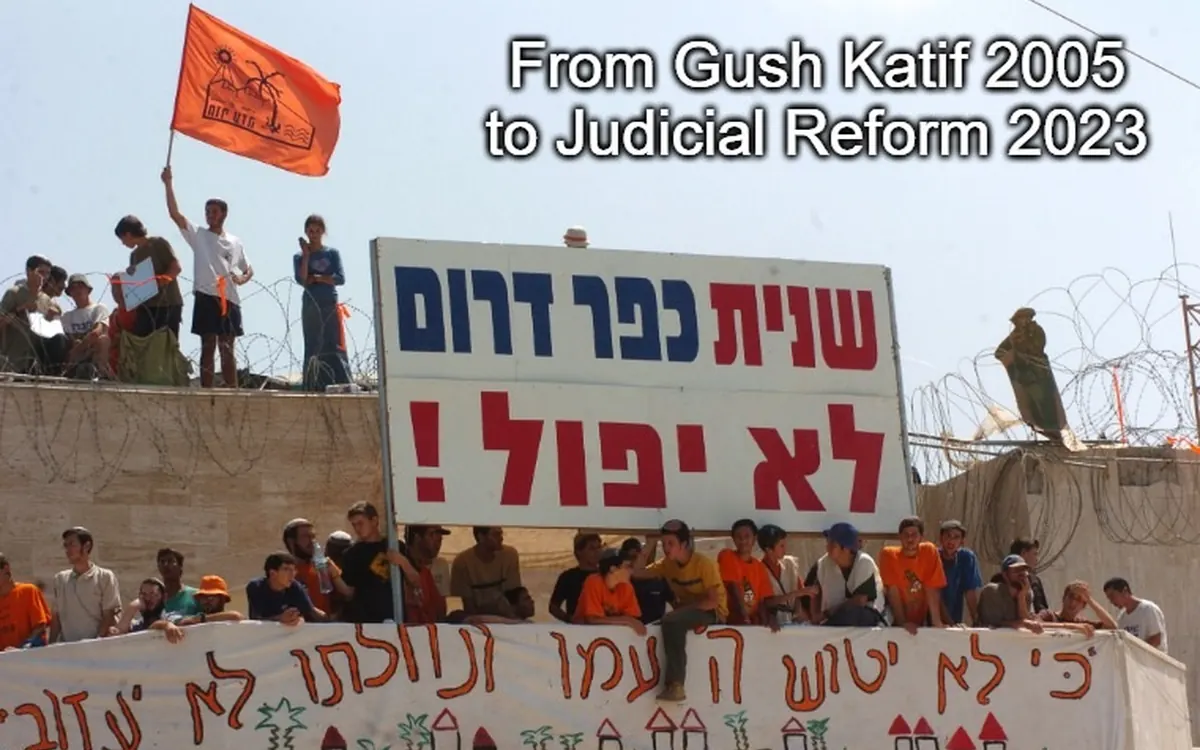
Rav Mike Feuer calls for a constructive alternative to the current mass protests against judicial reform being debated in Israel's Knesset. Along the way he touches upon some historical context about Prime Minister David Ben Gurion, Supreme Court Justice Aharon Barak, Meir Kahane's Kach party and what the Israeli Declaration of Independence actually says. On the way toward a new model of national covenant, the Jewish State needs to learn to speak to one another again, and that also requires understanding how the Disengagement from Gaza and destruction of Gush Katif in 2005 affect the current political situation.
About this episode
There is no greater tyranny, said Montesquieu, than that perpetrated under the shield of the law. Rav Mike finally says it aloud, constitution now, and then slows himself, shwaya shwaya, since any falsehood in that urgency is dangerous. He borrows the model from his couples work, de-escalation, then rebuilding communication, then mapping a new covenant, a document specific enough to be stable, grounded enough to be real, and inclusive enough not to require a tribal war. He urges letting go of fear through a Reb Shlomo story of Reb Aron of Karlin, whose Hasidim davened mincha at midnight in a forest inn, where an old man revealed that the Baal Shem Tov had stood there a hundred years before and left a message for them, do not be afraid, you have been here before.
The battle of our time is fought in language, which is good news for Jews who know how to argue facing one another, and the word making him crazy is democracy. Liberal democracy does not mean rule of the liberal left, and the illiberal left has never aspired to democratic rule by definition. Protesters march with giant copies of the Declaration of Independence as if it were sacred, yet the word democracy did not survive its first drafts, and there is no tripartite separation of powers written into the Megillat Haatzmaut or anywhere in Israeli law. The Declaration is largely an articulation of the bond between Jewish history, the people and the land, so regressive it is nearly biblical, and behind it stands Ben-Gurion, for whom a return to statehood mattered far more than any form of government.
The word democracy first entered Israeli law only in 1985, in an amendment to Basic Law the Knesset that listed who may not run, barring anyone who negates Israel as a Jewish and democratic state. It was passed to keep Meir Kahane out after the High Court ruled there was no basis in law to ban his party Kach, and the amendment left the court to decide what is racist and what a Jewish and democratic state even means. The firmer grounding came in the 1992 Basic Law Human Dignity and Liberty, ratified by fifty-four members present, thirty-two in favor. So the character of the state was defined twice by less than a clear majority, which is exactly the legitimacy question a Knesset now raises again with its own simple majority.
What truly brings hundreds of thousands to the streets, Rav Mike argues with his wife at their third-meal table, is a panic of identity rather than only a fear of curtailed rights. He names scarcity of identity, the feeling that for me to be me, you cannot be you, between Israeli and Palestinian, between secular Tel Aviv and the Haredi world, a zero-sum stance that stays tolerable only while one side holds power. The Begin revolution took parliamentary power from the left, a parallel economic liberalization stripped the old guard of its leverage, and the court became the last perceived bastion of an identity now leaning toward individualism and universal values more than toward Am Yisrael and Eretz Yisrael, and toward protecting its own position in society.
What is to be done returns to the counseling model, de-escalation first, which is enormous when leaders see no gain in compromise. Rav Mike counsels the right to play the long game, recalling the religious officers who served through the disengagement and now help lead the country, and to heed Leviticus, you shall not take vengeance or bear a grudge, so reform cannot be a strike back for Gush Katif. The verse ends love your fellow as yourself, and he borrows Erich Fromm's steps toward love, care, responsibility, respect and knowledge, where respect means seeing the other as a subject of their own story. Only then can a new covenant discuss every real question, Torah, economy, state and land, because if you will it, it is no dream.
Key ideas
- Constitution now, but slowly, through de-escalation, rebuilding communication and a new covenant, the model Rav Mike uses in couples work.
- Reb Aron of Karlin's midnight prayer carries the Baal Shem Tov's message, do not be afraid, you have been here before.
- Liberal democracy does not mean rule of the liberal left, and no tripartite separation of powers is written into Israeli law.
- The word democracy entered Israeli law in 1985 to bar Kahane, grounded again by a thin majority in the 1992 Basic Law.
- The streets are moved by a panic of identity and scarcity, the feeling that for me to be me, you cannot be you.
- The right should play the long game and heed Leviticus, since reform cannot be vengeance for Gush Katif.
Chapters
- 0:00 Montesquieu; Constitution now
- 1:06 De-escalate, communicate, covenant
- 3:17 Reb Aron of Karlin; you have been here before
- 5:22 The battle over democracy
- 6:30 The Declaration misused
- 8:50 No tripartite democracy; the three-cornered hat
- 10:04 Ben-Gurion; statehood over form
- 12:14 The Begin revolution; judges in Jerusalem
- 14:24 1985; Jewish and democratic in law
- 16:37 The exclusion list; Kahane
- 18:47 The court decides; Article 7a
- 21:15 A vibrant democracy; the illiberal tide
- 22:28 1992; a simple majority
- 26:53 The second paragraph; existential truth
- 29:10 How we got here; the economic revolution
- 31:26 What is to be done; de-escalation
- 33:45 Vengeance and grudge; Leviticus
- 37:12 Love your fellow; Erich Fromm
- 40:32 A new covenant; if you will it
Who, where and when
People
Montesquieu, Reb Aron of Karlin, The Baal Shem Tov, David Ben-Gurion, Menachem Begin, Meir Kahane, Benjamin Netanyahu, Erich Fromm
Places
Karlin, Jerusalem, Gush Katif, Tel Aviv
Texts
The Declaration of Independence, Basic Law the Knesset, Basic Law Human Dignity and Liberty, Leviticus 19, The Art of Loving
When
1948 CE: the Declaration of Independence, 1985 CE: the amendment barring Kahane, 1992 CE: Basic Law Human Dignity and Liberty, 2005 CE: the disengagement, 2023 CE: the protests
Read the transcript
There is no greater tyranny, said Montesquieu, than that which is perpetrated under the shield of the law and in the name of justice. Well, I'm just your average law-abiding citizen. Nonetheless, that seems far from simple to me. I'm Rav Mike Foyer, and this is The Jewish Story. Season 6, Interlude, Constitution Now. Well, I've been thinking it kind of forever, muttering it under my breath for years and shouting about it with my wife at our apocalyptic third meal discussions for months. So it's come time to say it out loud. Constitution now. And as much as the now piece makes me nervous, I've said it many times, it's dangerous to have any falsehood in that urgency. See, nonetheless, the time has come to take a stand and say, Constitution now.
Fantastic. Now what? Because the problem here is every good idea faces the question of implementation. And I want to offer a model which I use in my couples counseling work. And that's really quite simple, although deceptively so. It begins with de-escalation. It moves to rebuilding communication. And finally, it aims to map out a new covenant, a new way in which we, as who we truly are, can commit again to living together. Now, how might the text look? I mean, inevitably, there's going to be something that has to come out of it. And here's where I say, Constitution now, but shwaya, shwaya, slowly, slowly. I set out running, but I take my time, if you know what I mean. We're talking about a document, yes, a text, which will have to be specific enough to be stable, grounded enough to be real, and inclusive enough not to require a tribal war in order to establish.
And that will take a profoundly committed and widespread process. By the way, one which is going to go well beyond weekly demonstrations. Nonetheless, it's important to keep at least one eye on the question of what the text will ultimately be, because on some level, the hottest battles of our time are in language, which is, by and large, good news for the Jews. I mean, a battle of language waged in text, especially when we're facing each other, at least it's familiar. I will add that another cautionary note, which is we have to let go of fear. And one of the ways in which we need to let go of fear is understanding that in many ways we've been here before. Rather than explaining, I want to tell you a quick story.
It's from Reb Shlomo, so you really have to hear it in full. But he speaks about Reb Aron of Karlin, that great Hasidic master who took his Hasidim on a wild ride when it was really time to David Mincha to pray the afternoon prayer. Now you may know that Hasidim are not the most careful when it comes to time in prayer. They're more interested in being ready. But nonetheless, as the woods around them grew darker, and the wagon seemed to go further and further away from anywhere in which they'd possibly find somewhere to pray, and the stars came out, the Hasidim started to say, Rabbi, I think it's time to pray. Rabbi, it's getting even for us a little late until finally, after putting them off for almost forever, it seemed to be about midnight.
And Rev'an of Karlin and his Hasidim reached an inn. and out of this inn came a very old man who seemed, in fact, to be waiting for them. And so the Hasidim jumped down and they asked for permission to daven mincha, which, of course, you get. Now, you may not know that the Karlina Hasidim, when they daven, they shout at the top of their lungs. They start to howl. They're calling out to God. Now, what happens in the middle of a forest in, you know, some place in Poland when you start to shout in a town at the edge of a town at least that's made of wood. Everybody thinks there's a fire. So all the Hasidim come, and all the Jews come, and all the non-Jews come, and they think they're putting out the fire, but it's a fire which can't be extinguished with water, like Rabbi Shlomo used to say.
And so they go through a very beautiful scene where ultimately the people bring fruit, and they all eat together, and it's deeply rejoicing. Why am I telling you this story now? Because of the end. Because the Hasidim are totally confused why they had to wait till midnight in this small inn at the edge of a town in the middle of somewhere nowhere in the forest until they all get back on the wagon and they're about to leave. And Rabbi Aaron looks at this old man who had greeted them and says, no, tell us already. And he says, Rabbi, today is my 107th birthday. A hundred years ago, on this very day, the holy Baal Shem Tov came here and his chassidim, just like you, in the middle of the night, they jumped off, they dave in the afternoon prayer, they started to shout and scream and all the people came together in a beautiful celebration.
and he told me, remember this day, as the holy Baal Shem Tov was getting on the wagon, he put his holy hand on my head and said, a hundred years from now, there'll come another group of Hasidim, and I want you to tell them from me, don't be afraid, you've been here before. Of all the battles taking place in language right now, the one that's really making me crazy is over the word, democracy. Forget for a minute whether it means a set of social cultural values, a system of government, or a sacred cow. Forget any attempt to define it at all, in fact. But just agree with me that liberal democracy does not mean rule of the liberal left. And please recall with me that history demonstrates quite clearly that the illiberal left by no means definitionally aspires to democratic rule.
A sad irony is that, in text at least, this linguistic conflict is happening within Israel's Declaration of Independence out on the streets. People are marching with gigantic copies even, as if it were a sacred text in defense of democracy. Now the fact that this is the center of the textual storm is the inevitable outcome of a lack of constitution. And I get that. But its use in defense of democracy, holding up Megillah Ha'atzmout, the Declaration of Independence, as it's called, as a rallying cry, is actually reflective of a more fundamental problem amongst Israelis and Jews alike. Gross ignorance. Ignorance both of the actual basic workings of our government and the details of the current dispute around changing it.
So just for the record, there is no tripartite democracy, not written into the Megillat Atzmout, nor enshrined anywhere, really, in Israeli law. That includes, by the way, any form of common law, because it simply doesn't exist here. There are executive, legislative, and judicial aspects to how we run the country, but they're indistinct forms. They're somewhat awkward relationship, and the distribution of powers between them is what the current mess is all about. Now, I've heard from one American Jew who's quite knowledgeable that most, if not all, of her liberal friends reflexively relate to Israel as an American-style democracy. And many even insist we must have a constitution. Everyone does. I get that, but it's wrong.
And I've also heard from a protester here in Jerusalem that last Mosay Shabbat, she heard Israelis singing, La Kovach Shelly, Shalosh Pinot. That's it, oh, my hat, it has three corners. Three corners has my hat. But instead of three corners to my hat, it was my government which had three corners. In fact, the end of the song, And if it didn't have three corners, it wouldn't be my government. Well, sweet and gone reminiscent and all, but then it's not actually your government because it doesn't really have three corners, Which is honestly what they're saying. Since the current Knesset, the best defined and grounded of all these purported three corners, belongs to the people making the controversial legislation that got them out in the streets in the first place.
By now, most people are aware that the word democracy actually didn't make it past the first few drafts of the Declaration of Independence. Moshe Charade and the leadership of the Assembly of Representatives that gathered there in 1948 did manage to craft what we might call a progressive liberal text, hallmarked by the promise of complete equality of social and political rights to all its inhabitants, irrespective of a religion, race, or sex, and containing a pledge to build a society, as it says, faithful to the principles of the Charter of the United Nations. But cherry-picking those lines to make my point, or the point of the protesters, shouldn't obscure the bulk of the text of the Declaration of Independence, which is actually an articulation of the inseparable relationship between Jewish history, the Jewish people, and the land of Israel.
Because even the commitment to freedom, justice, and peace were envisioned by the prophets of Israel. The text, in fact, could be seen as the furthest thing from progressive. It's so regressive that it's biblical, for goodness sake. But before I take sides, let's also recall that the secular humanist promise of equal rights applies as much to communist totalitarian state as it does to liberal democracy in 1948 when that document was written. both in their idealist aspirations, each of them had a vision of how to give the best to humanity, and in their grim realities. Remember, 1948 was the time of both Stalinist Russia and Jim Crow's self. So if you want to understand the real issues of identity, government, and social power, you need to remind yourself that behind the text of the Megillah T'Hatzmut stands the personality and vision of David Ben and that democracy was far from his chief concern in 1948 and frankly for at least a decade after He wasn above throwing lip service comments or even downright lies, to achieve his aim in text or in other media.
That real aim, by the way, was made quite clear from the very first words of the Declaration of Independence, which reads, The land of Israel was the birthplace of the Jewish people. Here, their spiritual, religious, and political identity was shaped. Here, they first attained to statehood, created cultural values of national and universal significance, and gave the world the eternal book of books. A return to statehood under those terms, or rather, as an extension of that story, was far more important to the old man than any particular form of government which might achieve it. Let's also not forget that in his messianic pragmatism, Ben-Gurion left Israel's borders undeclared in 48 as well. In that text or in any other, he preferred to trust to the fortunes of war.
And he also left the future structure of government to similar fortunes and frankly, the social cultural fabric. Not to the fortunes of war, of course, but to the fortunes of victory. Let's live first and ask questions later. So we've actually traced the story from there in the Jewish story, how the original National Assembly, chosen to write a constitution, declared itself to be the first connexate, an act that only Hillel Cook had the independence of thought to label as a push. and then the decades of labor left leadership that built the country run as a quasi-feudal kingdom by Ben-Gurion and his party. He and they were the opposition to a constitution that would only have hindered the freedom of the legislature that they used to rule.
That's the era, by the way, in which the court actually became the bastion of individual rights, pushing back constantly against the collectivist exces of both socialism and national need. Then we touched on the Begin revolution, that Mahapakh, that first brought the right to political power. And when the left first made explicit its posture of cultural superiority over the sort of lowly masses and began howling about losing their country and threatening to leave if they couldn't be in charge. Now, ironically, Begin's Likud were great champions of the liberal democratic conception at that point, one in which the rule of law was sacrosanct. Begin held that truth of the sacred nature of law just as closely as he held his Jewish vision of a kingdom which stretched from the Mediterranean to the Jordan, not to speak of the whole rakah of the East Bank thing.
This apparent contradiction is why Begin could declare there will be many more Elon Mores at the celebration of the first new Jewish settlement in the Shomron, and almost with the same breath he could berate his cabinet, and the activists of Gush Emunim, who called to ignore a high court ruling on the actual illegality of Elon Moreh, shouting them down by saying, Yesh Shoftim BeYerushalayim. There are judges in Jerusalem. If it sounds like a contradiction, you're right. But Menachem Begin was a big enough Jew to hold that stira, that inner conflict, no matter how profound. And don't miss the point. On some level, holding intercontradiction is what it means to be a Jew. And lest we forget, by the way, Begin had felt in his flesh what a government unrestrained by law can do, whether it was from the Soviets, the British, or Ben-Gurion's world.
So Begin was actually far more a Democrat than Ben-Gurion and his Kishkes. And the advent of real political power on the right diversified Israel's political scene, making it much more culturally democratic. All this without a constitution or even a written commitment in law to democracy. That writing actually had to wait until 1985. And though it may seem like a small point in my larger picture of the pursuit of a constitution, In light of the importance of history in general, and the role that bad blood plays in fueling the dangerous passion out on the streets today, I have to make it. Plus, I can't resist a good point of narrative revelation. Sometimes, the story just says it all. 1985 was the year that an amendment was added to the Basic Law Knesset, which characterized Israel as a Jewish and democratic state.
Now, the Basic Laws are as close as Israel comes to constitutional law. Go back to Season 3, Episodes 7 and 8, to hear how far they actually are from a true foundational legal social covenant. The fundamental legislation that details the structure and function of our parliament and electoral system seems to be a reasonable location for democracy's first official appearance in Israeli law. I mean, better late than never, after all. But you might be a bit surprised by the context of this first appearance. Because there amongst the articles of the Basic Law Knesset is one that deals with people who are ineligible to be candidates, certainly an important question. Some are barred from running for Knesset for technical reasons.
The president, the state comptroller, judges in civil and religious courts. Others are on the list in order to avoid conflict of interest and protect parliamentary independence, high-ranking military police and civil servants, top national corporation employees. And some are there because, quote, explicitly or implicitly, in their goals or actions, they hold positions unacceptable to the state. And this category of exclusion is where democracy makes its initial appearance. There on the list is support for an armed struggle by an enemy state or a terrorist organization against the state of Israel. There's the incitement to racism, not running. And then there is negation of the existence of the state of Israel as a Jewish and democratic state.
Now, I want to say, it makes perfect sense to me that a state, no matter how tolerant, has the right and even the responsibility to ban certain elements of society from attempting to hold parliamentary power. And I want to add that this list seems eminently reasonable, especially that last bit about support for an armed struggle by an enemy state or terrorist organization shouldn't be part of your parliament. Seems like a no-brainer, right? Nonetheless, it's a bit of an odd location for the first appearance of not just democracy, but what seems to be an assumed definition of the state of Israel as Jewish and democratic. So assumed, in fact, that opposition to that combination puts you beyond the political pale, which was, of course, the point of the amendment.
Now, I'm not necessarily arguing with the definition of Israel as Jewish and democratic. and whether it's actually truly possible at the moment to hold that. It's just that if it were the case in law, especially as a fundamental assumed principle, I would have hoped for a more prominent placement and perhaps for a first appearance earlier than 1985, though in a country lacking a coherent constitution for more than 70 years, maybe that's a nickel and dime complaint. The way in which this amendment to basic law kinesic came about and the subsequent reinforcement of the Jewish and democratic definition in a 1992 basic law illuminate the identity struggle, which is fueling so much of what is overflowing into Israel's streets today.
We actually discussed the amendment's backstory at the end of Season 5. Do some review, people. How fear of Mayor Kahane's rising popularity led the Central Elections Committee to try and stop his party, Kach, from running, only to be thwarted by none other than the High Court. There was, said the judges, no basis in law currently for such a ban. Kach indeed entered Knesset in that election, campaigning on a vision that included stripping Arabs of citizenship as part of a larger transformation of Israel away from a democracy into what we might call a quasi-biblical theocracy, and immediately afterwards, 62 members of Knesset voted this amendment into law in order to ensure that Mayor Kahana would never sit in Knesset again.
Now, in that episode, Season 5, Episode 24 for the Curious, I pointed out the problematic use of such a powerful and indistinct term like racist as a foundation for any ban, and I stand by that point. I mean, witness how the definition of racism has evolved in the American discourse from 1985 until now. The calls for separate racial spaces come from anti-racists today, not from the Klan. Nonetheless, the amendment at least recognized the problem of definition by adding a simple clause. A decision by the Central Elections Committee to the effect that a candidate is barred from participating in elections must be approved by the Supreme Court. The court is responsible for deciding what is racist, for deciding who is truly expressing support for our enemies, and apparently for what it means to be a Jewish and democratic state.
So in a sense, those protesters blocking the ILO and Hiale, or those marching en masse before the Knesset, need to ditch that giant copy of the Declaration of Independence and replace it with a massive facsimile of basic law, Knesset Article 7a, Clause 1. I'm joking. Sort of. You could really make an argument that the amendment defending Israel as a Jewish and democratic state was ratified by the duly elected Knesset. I don't care where it's located. There it is. But then you're going to have to be open to the idea that parliamentary moves, definitive of the character of our state, passed by a simple majority 62 out of 120 in this case are indeed legitimate Hmm I could add also that the liberal progressive values enshrined in the Gilad Ha in the Declaration of Independence, the commitment to protect rights irrespective of religion, race, or sex, itself define Israel as democratic in the modern world.
But like I said, equality of political and social rights could actually be achieved by lowering them across the board, just as easily by raising everyone's to an equally high level. And though it's sad and more than a little bit frightening to say it, in the complex and diverse national situation in which we find ourselves, it's the tempting path for many. You might also rightly demand that I have the reality of Israel's vibrantly democratic society, one which, with all the problems, even of the so-called occupation, I still hold as an achievement for the democratic model in human history, witness the passion on the streets today. Now, this is really what underlies that amendment, which is expressive of a fundamental assumption of the society that elected the Knesset to pass it.
And that is, no one in 1985, in their right mind, wanted Kahana's world. that even if it had never been made explicit, Israelis wanted to be both Jewish and democratic. But apparently, not all Israelis, because they needed to ban Marikana's party. There was what we might call an illiberal rising tide, fueled by deep religious sentiment, ethnic solidarity, nationalist fear, And that was in 1984, before Oslo, before the disengagement, or before the high court's constitutional revolution. That's the other piece, by the way, to keep in mind here. With all my jokes about marching with Article 7, Clause 1, the real grounding of Israel as a Jewish and democratic state in law came through the 1992 Basic Law Human Dignity and Liberty, which declares its purpose as, quote, to protect human dignity and liberty in order to embed the values of the state of Israel as a Jewish and democratic state in law.
Now, there we go. That sounds both straightforward and robust, foundational even. But again, go back to the episodes in season three there to learn about how that law was ratified. In the third reading on March 17, 1992, 54 Knesset members were there to participate 32 voted for, 21 against and one abstained, just in case you're doing the math leaving aside the way in which the president of the high court Arun Brock subsequently employed this law once again, you're faced with the legitimacy of a foundational move toward defining the state's character this time by less than a simple majority and here we are, 40 years after Kahana was banned, 30 years after Arun Barak's judicial buccaneering, as it was called by many experts of American constitutional law.
And once again, we have a Knesset that wants to make definitive decisions about the nature and function of our society using a simple majority. And they're expressive in electorate, and frankly, a global moment, whose relationship to the tension of values between peoplehood and democracy has shifted in profound ways in the last few decades. And yes, they are also expressive of gross personal political interests and revenge politics as well. Maybe we'll touch on that before we're done. But before we do, I want to make a plea about the nature of the political project here. And I too want to hold up the Declaration of Independence in order to do it. Please, Jews, don't forget our story. Because when we do, things get ugly quite quickly.
And what it means to stick with the Jewish story is far from simplistic or monolithic in my eyes. And of course, always requires machloket l'shem shemaim, a sense of constructive conflict which pushes that story forward. If I've demonstrated anything in six seasons of the Jewish story, I hope that's it. Nonetheless, with all that complexity, there's also something quite simple about our story. And my proof text is actually the second paragraph of the Declaration of Independence, one which wasn't a matter of belief or opinion for Ben-Gurion, the assembly representatives that wrote it, or any other Jew of their generation. It was an existential truth. After being forcibly exiled from their land, The people kept fate with it through their dispersion and never ceased to pray and hope for the return to it and for the restoration in it of their political freedom.
So, I was talking to my wife at this apocalyptic third meal. It's been happening for a long time, by the way. I mean, gosh, I could count on two hands the number of apocalyptic events that I've seen since we've been here. Let's go 9-11, the second Gulf War, the disengagement, how many rounds of war in Aza, another war in Lebanon, the second Intifada. It feels like things are constantly falling apart. And yet, when you go out on the streets, life, people, life, it's robust. Anyway, so we were talking just last week about the question of what actually gets people out into the streets on the scale that we're seeing. I'm talking about hundreds of thousands weekly for over two months. She wanted to argue that it was all about their protecting their rights.
My contention was that a fear of curtailed rights isn't enough to get that kind of energy together. That in fact, whether founded or not, the dark fantasies of a dictatorship that's coming, which will strip us of our rights, are actually expressive of a much deeper fear. And that's a panic of identity. We've reached the type of perilous social moment when at least two aspects of our society, and in reality, far more, feel a sense of scarcity of identity. And if you're wondering what that means, it's important to understand. In the simplest of terms, scarcity of identity means that in order for me to be me, you cannot be you. Allow me to explain. The easiest way to do it is between national Israeli identity and national Palestinian identity.
You may have heard the minister of our government recently say that there are no such thing as Palestinians, even though, of course, I could introduce him to quite a number. What he's asserting is in order for there to be a secular Israeli state, these other people simply can't exist because their narrative is in direct conflict with ours. And, by the way, vice versa, Palestinian nationalism, as opposed to Islam and more complicated aspects of the Arab identity that's out there, cannot allow for the existence of the state of Israel because it negates their very own identity. On the flip side, we could look at secular Israeli society and its need to keep the Haredim at bay or vice versa. Any zero-sum stance in identity is dangerous.
But it remains tolerable so long as you're either on the top or even totally disempowered. I mean, just think, the Haredi world could look at non-religious Israel as Hebrew-speaking Goyim, so long as they themselves have no power and responsibility to make real-life decisions for all those fellow Jews who don't happen to share their attachment to Torah. And on the other side, the high-tech Tel Aviv world could dismiss the Haredi world as annoying parasites, so long as their numbers don't begin to translate into real political power, which is, of course, one of the major underlying issues to what's happening today. By the way, we could, of course, apply that same dynamic to Israelis and Palestinians in our seeming inability to come to any type of accord.
But right now, I'm focused on the tipping point amongst Jews. How did we get here? Well, Fagan's revolution that we mentioned of the 70s, 80s was political. It took the absolute parliamentary power away from the left. And though it remained shared up through the 90s, the demographics are such that the Zionist left can't really lead the country through the parliament any longer. And people often forget that together with this political change, there was a parallel economic revolution that Begin tried to put into effect, the gradual liberalization of the economy. Remembering that the definition of liberal economy is personal liberty, private property, and limited government interference, the exact opposite of the world that Ben-Gurion and his Labour Party imagined.
Those are expressive of a deeper classical liberal principles of individualism, liberty, and equal rights, none of which were either important, or overwhelmingly so, to the Socialist Labor Party, dedicated to the collective endeavor of state building, and then, of course, inevitably, to the collective endeavor of protecting their own power. It was, by the way, Netanyahu, Bibi, in his role as both finance minister and prime minister, who carried that economic revolution home with all its successes and failures, the wealth gap and the startup nation. It stripped the old guard economic and cultural leadership of much of the power that their political compatriots had already lost, which left a court historically dedicated to progressive values and the amorphous notion of Jewish and democratic as the last perceived bastion in defending their identity, now focused on the particular instead of the collective, since they were no longer in charge.
And, of course, protecting their position in society. And that is about as genuine a threat to identity as it gets. Identity is expressed, by the way, not as an abstract, but as a way of life one which leans far more toward individuality secular humanism and universal values than it does toward Am Yisrael toward Yisrael, and Eretz Yisrael. So what's to be done today when people are experiencing, and legitimately so, a sense of scarcity in their identity? Remembering that identity battles are life or death, and therefore no less alarming than what you might feel should you realize you're running out of food and you're going to die. Well, I refer you back to that marriage counseling model with which I began.
De-escalate, rebuild communication, and then face each other to forge a new covenant. I said constitution now, but I set out running and take my time. The present challenge is de-escalation and it's enormous. You may have noticed that part of the current issue is that our leadership in Knesset, both in the government and in the opposition, see no personal political gain to be had from compromise. In general, we're in a time where the idea of divisiveness has suddenly been raised to a value. Even a supposed moderate like Thomas Friedman had the unmitigated gall and stupidity to tell people from his platform in the New York Times, it's time to take sides, as if he hadn't done so long ago. I would point out that on some level, compromise is always the prerogative of those with power.
Those without it are really being offered a chance to surrender peacefully. And if you know Israeli history, then you know that the most famous acts of surrender actually laid with Menachem Begin. He did it twice in order to thwart the civil war. And I mention it now because if you think that the hunting season and the shelling of the Al-Talena, go back to season two, people, aren't looming large in the background of this identity struggle, even if only subconsciously, then you simply don't know Israeli society. So, should the right just cry again and let the left have its way? Drop its vision of reforming the court? One answer I would give is that any identity group which identifies itself so deeply through Torah needs to take quite seriously the two prohibitions articulated in Leviticus, in Vayikra 1918 when it says, lo tikum ve lo tito et b'nei amecha you shall not take vengeance or bear grudge against the members of your people and that means that whatever the sort of abstract political vision behind the current attempt to reform the court it cannot be a strike back against those who threw 10,000 Jews out of their houses who did it while the court stood on one side and ignored not only Ariel Sharon's wrenching of the democratic process, but his massive violation of their human dignity and liberty supposedly protected by a basic law.
This can't even, in fact, be a moment in which the religious traditional world say to the protesters blocking the I alone during Oslo and during the disengagement, You busted our heads with clubs and rode over us with horses when we dared to think about crossing the road. We won't do that because we're not like you. That would be the bearing a grudge part. So if those are not options in the eyes of the Torah, what then? Well, one answer is I would counsel those on the right to simply have the patience to play the long game. Now, I remember hearing a debate between two veteran national religious Israelis, as we were all lurking in the orchards outside the gates of Gush Katif in the days preceding the expulsion, still cherishing dreams of, Hayo, Lo, Ti, Yeh, it won't happen.
And by the way, it happened. And they were arguing over whether the religious members of the officers' training course from that summer should refuse to participate in the upcoming uprooting. Now, you need to know that that summer saw the largest cohort of graduates from the yeshiva system ever to enter the officer's course. Leaving aside the fact that back then, at least, people considered refusal to serve in the army as the ultimate breaking of the national covenant, their real question was one of absolute idealism versus pragmatic politics. On one side, there's someone saying, listen, this is a sewer. It's forbidden from the Torah, right? That's the end of the discussion. You cannot uproot Jews from their home in the land, or at least you can't participate in it.
The other one said, yes, I don't disagree. But this is what we've been working toward for 30 years, for 30 years of patience, of compromise, of small incremental growth, of hard work. We need to stay the course, he said, with our commitment to lead the whole country. And that comes perhaps at the cost of a painful and profound compromise of principle. I don't recall personally how they resolved their argument. I mean, frankly, as good yeshiva products, I assume it's still ongoing. But sociologically speaking, the right bit its tongue. Very few people refused to serve, even in the action of the uprooting itself. And certainly no one threatened to abandon the Zionist project. And here we are, 20 years later, and those people are part of leaving the country.
Love it or hate it. So never forget, politics is the art of compromise. Anything else begs for disaster. So everyone take a deep breath out there. that's a bit on de-escalation what about the communication and ultimately this new covenant well you know the second half of that verse warning against vengeance and holding grudges is actually it's better known half if you didn't get it when I said it the first time it says love your fellow as you love yourself because I am God and I'm bigger than all divisions in his fantastic book The Art of Loving Eric Fromm gives a formula for how we can learn to love one another. By the way, if you want to do that work in your life, in couples or on your own, robmikefoyer, gmail.com.
Send me a message. I'm happy to make an appointment. But for now, just know that Fromm says the steps toward love are for care, responsibility, respect, and knowledge. If you don't care about your fellow Jews, especially the ones who are different then frankly, I can't really help you except to say, don't be a fool I don't need theology to prove that we're all one people I just need to point to history about the fact that we are and the consequences that come when we forget Responsibility is the activist stance of care It's a call to do something in order to support your fellow Jews take responsibility for all of us, especially the ones that aren't like you. Respect is actually where things start to get sticky in relation work.
Because, frankly, respect is where love breaks down. Consciously or not, many, if not most of us, offer our care and responsibility on a conditional basis. So long as my children listen, so long as my spouse does what he or she is expected to do, so long as my fellow citizens stay in their lane, literally and metaphorically. Real respect, though, is rooted in the recognition that the person or people you're facing aren't about you and your expectations. In fact, they exist as their own entities. They're not objects of my story, but independent subjects of their own. And only once I accept that truth, which, by the way, becomes no less true when I ignore it, It only becomes a more destructive element in any hope for a healthy relationship.
Only when I recognize the person I'm facing as an independent subject of their own story and not a bit part in my movie, can I actually hope to know them and in knowing come to love. And then, and only then, within the bonds of care and the commitment of responsibility that hold us together, fueled by a deep stance of respect that allows us to keep a healthy distance even within that binding relationship, then we can begin to discuss a new covenant, one that encompasses every question, not just judges, not just the parliament. It needs to discuss the role of Jews and non-Jews in the land. It needs to talk about Torah, economy, state all the real questions. Now I know that may seem like a big task.
Perhaps when you hear it, it appears impossible in face of the fear you're feeling about your identity or the divisions that you perceive within our society and the world. But remember, a wise Jew once said, If you will it, it is no dream. I just want to thank some folks before I sign off. I want to thank all the folks who give their hard-earned money to make this show happen keep it free, widely available. I want to call you to join them right now. Go to my website jewishstory.co. In the upper right-hand corner, you'll see a button that says Be a Patron You can click on that to give a little bit of per-podcast support, or you can send me an email, robmikefoyer, gmail.com or find me on Facebook, robmikefoyer Happy to share with you the way in which you can dedicate a show or make a one-time donation.
I want to thank The Land of Israel Network. That's thelandofisrael.com. They're building a center for global transcendence in the heart of the Judean mountains. I want to thank the Pardes Institute, pardes.org.il, for throwing the doors of the Beit Midrash open as wide as possible. And I want to thank you for joining me. I'm Rav Mike Foyer, and this is The Jewish Story.
More from Season 6
TJS S6 Interlude - Purim Epistemology
Just a little touch of pre-Purim madness! Rav Mike Feuer discusses the Jewish holiday of Purim, the Book of Esther (Megillah) and how it relates to us today.
Play Episode
TJS S6E16 - American Antisemitism part VII - The Endgame
The final installment in the series on the tri-partite part nature of American Antisemitism. This episode revisits all three forms of Jew-hatred characteristic of society in the United...
Play Episode
TJS S6 interlude: The Crisis of Israeli Sovereignty
A live webinar on behalf of for Fuel For Truth: Israel Education & Advocacy Training, on "The Crisis of Israeli Sovereignty." First Rav Mike lays out his innovative...
Play Episode