S2:E37 - Survivalist Zionism: How the Zionist Struggle Looked After the Holocaust
Once World War Two ended all the promises of the allies were put to test - would they find a solution to the Jewish problem now that the war was won? This episode describes the escalation of the struggle against the British in the land of Israel in the wake of the greatest disaster the Jewish people have ever suffered.
About this episode
Extinction is the rule, says Carl Sagan, survival the exception. Through the Shoah the Germans wrought a great selection on Am Yisrael, exceeded in our history only by the four fifths the sages say did not leave Egypt. Before the war a rich argument ran through European Jewry over where the future lay, and most were never sold on the Zionist dream, which is why only a handful reached the land before the gates shut; the Bund socialists were for a time the largest group, the rest split among Zionists, communists, traditionalists, assimilationists and the very poor. When the slaughter ended a third of world Jewry was gone, and not just any third, since the centre of Torah and culture had shifted from the land to Babylon to Spain to Europe, and now a smoking crater sat where Europe had been. That part of the people in the meteor's path broke into three pieces.
The first piece is Am B'artzo, the people in the land, who seized a central role: the Zionist instinct about Europe had been confirmed, the tidal wave of hatred that Herzl and Jabotinsky and the revisionists sensed below the surface had proven true beyond their darkest guess, and into the vacuum left by the murder Zionism flourished. The six hundred thousand in the mandate, only six percent of world Jewry by 1948, would play an outsized part, as returnees to Zion always have. The political impact was specific: the millions Jabotinsky and Begin spoke for at the last Beitar conference in Warsaw in 1938 were no more, so labour's dominance in the Yishuv became all but a dominance over Zionism itself. The second piece is the survivors, whom Bergson saw as the Hebrew nation chewed up and spat out, destined to join the Hebrews of the mandate and evolve into a people in its land; the Zionists saw potential population, every able body a potential soldier, since the ones who came through the most unnatural selection of the ghettos were by definition the fittest. Repatriation was the general policy, but home was not an option, and Jacob Trobe of the Joint estimated that eighty percent of survivors wanted to leave at once for the land. Ben-Gurion visited the camps and left certain of it, and certain too that nearly all agreed with his words: what happened in Poland could not happen in Palestine, every boy and girl would have shot at every German soldier. A new Zionism was surfacing, call it survivalist Zionism, and it would prove all but unstoppable.
The third piece is American Jewry, on pins since the final solution first reached them, now absorbing the survivors. As the horror percolated into public consciousness sympathy for Zionism grew in the West, and films of the liberated camps broke box office records in London, lines stretching into the night; a sense that the Jews had been abandoned by the collective will of governments arose, and with it a desire that the moral will of individuals make amends. Hopes ran high that Britain would open the gates, and the Labour Party fed the dream, its 1944 conference ringing with calls for a Jewish state and even for transfer of the Arabs, a notion that seemed feasible in a decade of the India-Pakistan partition and the expulsion of Germans from Czechoslovakia. But in 1945 Attlee swept Churchill from office in the largest landslide in British history, and the new government declared no change in Palestine policy. Attlee was no Zionist; in his eyes the Jews were a dispersed religious group without national status, and he needed the cooperation of tens of millions of Arabs and Muslims to rule.
Ernest Bevin, the foreign secretary the Jews love to hate, built his policy on two premises: do nothing to set the Arab world against the empire in the opening of the Cold War, and keep the Jews in Europe to do their share in its rebuilding. Between the pressure of the displaced, which he could not ignore while his economy hung by an American thread, and the realities of empire, with anti-Zionist riots from Syria to Libya where a mob murdered almost a hundred Jews, Bevin's one hope was to make Palestine someone else's problem, and so the Anglo-American Committee of Inquiry was born, twelve men awkwardly called the Twelve Apostles. Bevin prejudiced it before it began, promising to give up the mandate for an international trusteeship evolving into a Palestinian state and capping immigration at fifteen hundred a month, which so provoked the Jewish Agency that they formally endorsed illegal immigration. The committee toured the camps and the Middle East; the Arab Office cast Zionism as European colonization of North America and Australia, the Agency's thousand pages cast it as enlightenment, and the Americans came away stunned by what the Jews had built, hearing in it the roots of today's Hasbara. In the end the plight of the survivors tipped the scales, and Richard Crossman concluded that the injustice of dividing the land was less than the injustice of the 1939 White Paper. The committee rejected partition, called for a binational framework and UN trusteeship, and recommended a hundred thousand immigrants at once, but Bevin and Attlee would accept no mass immigration until the undergrounds were disarmed, and Truman's support for partition without American troops meant no joint solution came.
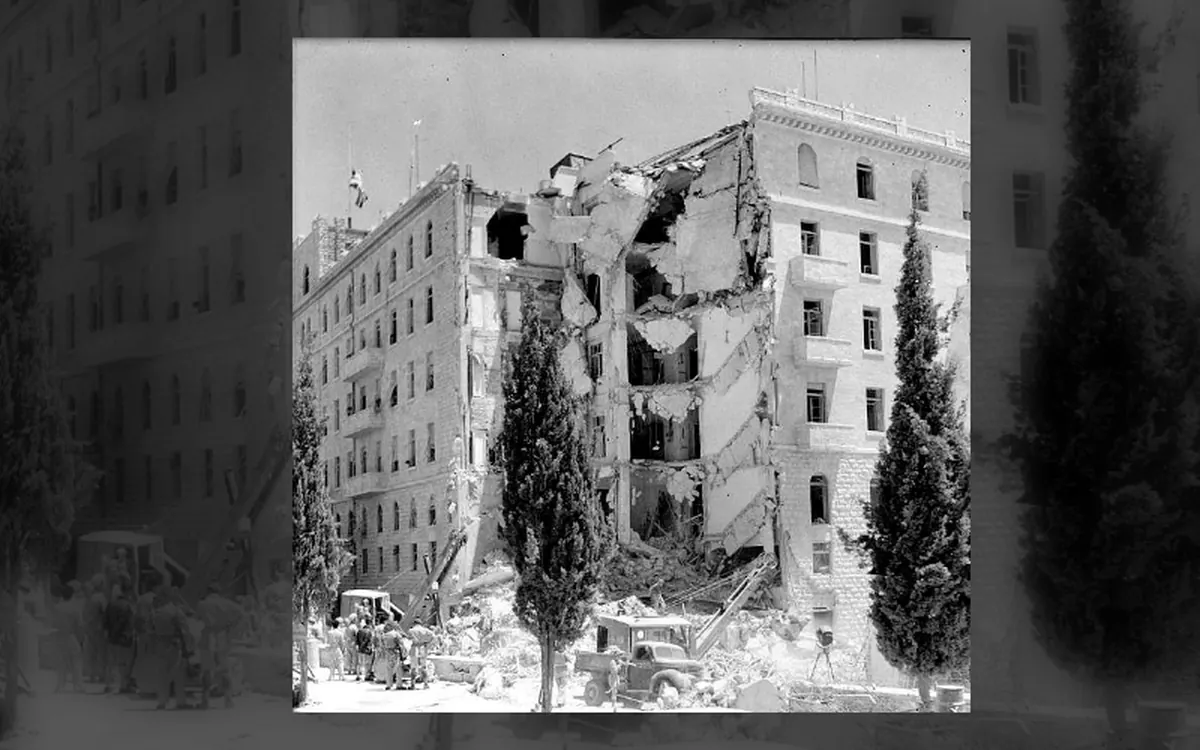
Labour's about-turn felt like a slap, and on September 23, 1945 Moshe Sneh cabled Ben-Gurion in London proposing a grave incident; Ben-Gurion's reply demanded uniform authority and total discipline, constant, bold and calculated reaction over a considerable period. Sneh called off the Hunting Season, and by late October the Haganah, Irgun and Lehi signed an agreement forming the United Jewish Resistance Movement, with Galilee and Sneh, Begin and Yellin-Mor at its head, the Irgun and Lehi required to submit their plans to a joint body in deference to Ben-Gurion's insistence on civilian control. The movement entered the war on the Night of the Trains, November 1, 1945, sabotaging a hundred and fifty points on the rails, and over ten months struck the airfields and, on the Night of the Bridges, severed the mandate from its neighbours. Britain answered with the Defense Emergency Regulations of 1945, turned now against the Jews, the same regulations Benny Morris notes still live in Israeli military rule over Judea and Samaria. On Black Sabbath, June 29, 1946, seventeen thousand soldiers searched the Yishuv, seized arms at Yagur and, more damaging, documents at the Jewish Agency proving its leadership of the resistance, carried to the King David Hotel. The Haganah command resolved to strike back before intelligence could analyze the haul, and Sneh ordered Begin to attack the hotel. On July 22, 1946 Irgun fighters disguised as Arab workers placed explosives in milk cans in the basement, telephoned a warning that went unheeded, and the entire southern wing came down, ninety-one dead, British, Arab and Jew. The Agency, whatever its secret role, denounced it in the strongest terms and Ben-Gurion called the Irgun the enemy of the Jewish people; after the wave of condemnation the executive met in Paris on August 5 and ended the armed struggle, the ten months of united resistance over, while the survival strain of Zionism drew an ever larger part of the people after it.
Key ideas
- The Shoah broke European Jewry into three pieces: the people in the land, the survivors, and American Jewry, each now central to the story.
- Survivalist Zionism surfaced from the camps, every able survivor seen as a potential soldier, and it proved all but unstoppable.
- Attlee's 1945 landslide and Bevin's policy turned Labour's promises into betrayal, keeping the gates shut to serve imperial and Cold War interests.
- The Anglo-American Committee recommended a hundred thousand immigrants, but Attlee and Bevin demanded the undergrounds disarm first, and no joint solution came.
- The United Resistance united Haganah, Irgun and Lehi from November 1945, striking the trains and the bridges until Black Sabbath.
- The King David Hotel bombing of July 1946 killed ninety-one and brought the ten months of united resistance to an end.
Chapters
- 0:00 Extinction is the rule; the great selection
- 2:06 A third gone; the smoking crater
- 2:50 The first piece: the people in the land
- 5:23 Beitar's millions gone; labour's dominance
- 6:29 The second piece: the survivors
- 8:38 Where to go; no road home
- 9:45 Ben-Gurion in the camps
- 10:51 Survivalist Zionism surfaces
- 12:56 The camps break box office records in London
- 14:10 Labour's dream; transfer and Evian's shadow
- 15:16 Attlee defeats Churchill; the about-turn
- 17:32 Attlee: a religious group, not a nation
- 18:36 Bevin's two premises
- 20:51 Truman and the hundred thousand
- 21:48 The Anglo-American Committee is born
- 24:08 Prejudiced before it begins
- 26:21 The Jews impress the Americans
- 27:25 Crossman's conclusion
- 30:44 No joint solution; Truman backs partition
- 30:50 Sneh's cable; the United Resistance forms
- 33:01 The Night of the Trains
- 35:07 The Night of the Bridges
- 37:24 The emergency regulations, alive today
- 41:54 Black Sabbath
- 44:00 The documents at the King David
- 47:15 The attack on the King David Hotel
- 52:47 The warning unheeded; ninety-one dead
- 55:00 Barker's order; the Agency condemns
- 57:17 The resistance ends; survival draws the people
Who, where and when
People
Carl Sagan, David Ben-Gurion, Jacob Trobe, Peter Bergson, Clement Attlee, Ernest Bevin, Winston Churchill, Harry Truman, Richard Crossman, Moshe Sneh, Menachem Begin, Natan Yellin-Mor, Yisrael Galilee, Chaim Weizmann, Benny Morris, Aunt Helene
Places
The displaced persons camps, Bergen-Belsen, London, Alexandria and Libya, Kibbutz Yagur, The King David Hotel, Latrun
Texts
The Anglo-American Committee report, The Defense Emergency Regulations of 1945, The United Resistance agreement, Sneh's cable of September 23, 1945
When
1945 CE: Attlee defeats Churchill, November 13, 1945 CE: the Anglo-American Committee announced, November 1, 1945 CE: the Night of the Trains, June 17, 1946 CE: the Night of the Bridges, June 29, 1946 CE: Black Sabbath, July 22, 1946 CE: the King David Hotel, August 5, 1946 CE: the resistance ends
Read the transcript
Extinction, says Carl Sagan, is the rule. Survival is the exception. And I can tell you as a graduate of a geology department and a teller of the Jewish story, that this is not a small fact. I'm Rav Mike Foyer, and this is the Jewish Story. Episode 37, Survivalist Zionism In my eyes, Darwin and Herbert Spencer effected one of the most profound shifts in how humanity knows the world. Because the consciousness that evolutionary thinking offers in the biosphere, in the world in which we actually live, are as fundamental as they are revolutionary. And their potential implications for sociology and history, how we live in that world, are just downright frightening. Now the Nazis and the eugenics were without question the most self-conscious and extreme application that any society has ever seen of biological, evolutionary approach towards social construction.
And that's what makes them really the quintessential modern evil. But at the same time, they were the most primeval expression of the dark gods in man, of that lust of the barbarian horde to conquer and consume. But no matter how we paint them, through the Shoah, the Germans wrought a great selection on Am Yisrael. one that was really exceeded only in our history by the four-fifths that our sages teach us didn't make it out of Egypt. Now, before the war, we know that there was a rich conversation going on, particularly amongst the Jews of Europe, over where does the future of Am Yisrael lay? And it's important to remember that most of Am Yisrael was not sold on the Zionist dream, not even to the very end, and thus the relative handful that made it to the land before the gates of Europe were shut.
Now back in Europe, the Bund socialists were, for some time, the numerically largest group. And the rest were split between nationalists of various sorts, Zionists, of course, chief amongst them, communists, traditionalists, assimilationists, and lots and lots of very poor people just trying to feed their families. But once the slaughter had ended, one-third of world Jewry had been destroyed. And that wasn't just any third, it's more than the numbers. If you've been following the Jewish story since the beginning, so you've watched the center of Torah and culture shift from the land of Israel to Babylon, from Babylon to Spain, from Spain to Europe. And now, that transition from the destruction of Spain to the building of Europe, which was really first season and second season for us, has left us with a smoking crater in the center.
and that part of Am Yisrael that was directly in the path of a meteor has basically been broken into three pieces so that first piece of European Jewry is actually Am Ba'artzo it's actually the people in the land even though many of them were not born in Europe because they've now seized a very important role in the Jewish story first of all abundantly confirmed that the Zionist instinct about the future of Jewish life in Europe had been sound Remember, since Herzl, there's been an awareness of a tidal wave of Jew hatred lurking just below the surface of society in Europe that had served as a motive force for both political and pragmatic Zionism, not to mention Jabtinsky and the revisionists, who he's been screaming from the rooftops forever.
But none of them could have possibly known how right they would be. And if you want to get a sense of the really chilling depth of their premonition, go back and listen to the first few minutes of episode 1 of this season and see what the Maharsha said to the Jews of Poland about what they could learn from the story of the Gemara and Baba Batra. That's your homework. But for now, the worst fears of the Zionists had been proven true. Though only Uri Svi Greenberg, the poet-prophet, could have possibly guessed at how dark they would actually be. But, in a strange and perhaps uncomfortable way, the disaster of Europe was also their great evolutionary opportunity. Because the arguments that had divided European Jewry weren't over, as we can see just looking around us today, but most of its voices were gone.
Think of it as the Jewish intellectual and spiritual biosphere that gets hit by a meteor. It's not like everything died. I mean, thank God our brothers and sisters of the earlier dispersions of our history are scattered all over the world, particularly in North Africa and the Middle East, and it's not for naught that they're playing an increasingly important part of the story right now, but in 1945, so much was wiped out. And into that cultural and conceptual vacuum that was left by the Nazi mass murder, Zionism will flourish. Its adherents right now at this point in our story are the majority of the Jewish population in Eretz Yisrael, virtually holding all the reins of power that the British haven't kept tight to their own chest.
And though the 600,000 or so Jews that are in the mandate at this point will only be 6% of world Jewry by 1948 they're going to play an outsized role in the coming chapters of the Jewish story as, by the way, those who choose to return to Zion always have in this story. And though it is an important question that we're going to return to Whether the traits, cultural, biological, or otherwise, that push people to jump ship from Europe early and allow them to take root and fight to hold the land and survive are the same traits you want running our country right now? At this point of our story, the future of Zionism is looking bright. And I just have to note, for the sake of our particular location in the narrative, the political impact of the extermination of European Jewry will have a very specific application to the ongoing struggle between the labor and revisionists within the Zionist movement.
Because the millions that Jabotinsky and Begin represented at that last Beitar conference in Warsaw in 1938 are no more. And so labor Zionism's dominance within the life of the Yishuv, of the community in the land of Israel, will now be all but a dominance within Zionism altogether. So that's the first third. and those millions of Beitaris are gone. But of course, their remnants represent the second piece into which Am Yisrael was split by the Shoah, the survivors. Now looking from over in America, Hillel Cook, Peter Bergson, I hope you recall, saw them as the Hebrew nation, chewed up and spit out of Europe by its great nationalist cataclysm. And we're going to speak in coming episodes about how exactly Hebrew nationalism was forged and what it was forged into in these the hottest fires the earth had ever known.
But for now, in Bergson's eyes, the survivors were destined to join with the Hebrews of the mandate and to evolve together into a new national identity of a people in its land, something that would be wholly other than the religious identity of exile that had preceded it. And if you don't really get what I'm talking about, substitute Israeli for Hebrew and read the news today about the gap between the Jews of here and there, and you'll get the picture of what he saw coming. Now, the Zionists in Eretz Yisrael saw these survivors as potential population because even in their decimated or more properly tertiated, right, a third were gone, numbers, the huddled masses of the displaced persons camps of Europe could still tip the scales in favor of that longed-for Jewish majority within the mandate.
And the Zionists saw every able-bodied man, no matter how wracked right now by disease and starvation, as a potential soldier in the conflict sure to come. Don't forget that in the War of Salghetto, where after the liquidation, it was really only the young and strong who survived, the fight was to the end. And if they weren't the fittest, then who was? And how do the survivors see themselves? That's a hard question. You'd have to ask each and every one of them who they were and what it meant that they'd seen the gates of hell. and you'd have to follow the arc of their lives down to our very day to see the places which they went. Now, because it's so close to my heart, we will speak in the coming episodes about the fear, the shame, the anger and the miraculous hope and choosing of life.
But for now, here at the end of the war, the immediate question that weighed on this second piece of European Jewry was where to go. The general momentum of refugee policy in Europe in the immediate wake of the war was repatriation. We were sending people home, and the Jews were no exception in that. Except, for the mass majority, returning home wasn't even an option. First, many simply would not. Could you imagine going back to the places you're slaughtered to live? Also, many tried and failed. Like, for instance, my great Aunt Helene, who when she returned to her parents' home after seeing both sides of the gates of Auschwitz, was shooed away by the non-Jews who'd moved in. Or, like those who actually succeeded in returning to their lives in Poland, only to flee once again from post-war violence.
You know, the 1946 Kielce Pokrom, in which dozens were killed and wounded, was only the worst single event. There were over a thousand Jews murdered by Poles in the year after the war's end. So, Europe didn't look too inviting. Now, many will make it to the Americas, and those that do will make a vast contribution to American Jewish culture, as I'm sure many of you listening know, their story lies further ahead in Season 3. For now, Jacob Trobe, the first JDC Joint Distribution Committee representative to arrive in Bergen-Belsen, estimated that 80% of the survivors wanted to leave immediately for the land of Israel. And the truth is, no one doubted this. Ben-Gurion was the first official Zionist leader to visit the DP camps and when he did, he got there just as the quota of 75,000 Jews over five years that had been promised by the 1939 White Paper promised or stipulated probably better was used up and he was coming on the wake of a Jewish agency declaration that the British blockade of Eretz Israel continuing even after the war was tantamount to a death sentence upon these liberated Jews still languishing in the internment camps of Germany.
So, he saw the brutal truth with his own eyes. And he left with the certainty that at least 80% of the survivors wanted to come home. And what's just as important, or perhaps more so for our story, he saw that nearly 100% agreed with them when he said, quote, Hitler was not far from Palestine. There could have been terrible destruction there. But what happened in Poland could not happen in Palestine. They would not have slaughtered us in synagogues. Every boy and girl would have shot at every German soldier. Do you hear it? There's a new type of Zionism coming to the surface. Let's call it survivalist Zionism. And it's going to prove an all but unstoppable force. And by the way, survivalist Zionism will have its impact on American Jews as well, those who don't feel the flames of Europe or the war of the Middle East.
And they're the third piece into which European Jewry has been broken post-Holocaust. And we mentioned a bit of the story of the complex relationship to the Shoah happening within American Jewry in the last episodes, and that is only going to deepen as they absorb so many of the survivors. But no matter what you think about the reaction of the American Jewry actually during the Shoah, we can all agree that they've been on spilkas, they've been sitting on pins since where did the final solution first reach them, as have been the Zionists in the land, although they had the outlet of war against the British to at least focus on. But with the end of World War II, the moment of truth has come. What do the Allies really think?
All the claims that the only solution to the Jewish problem, aside from the final one, was to win the war against the Nazis, are now going to be put to test. Okay, they won. Now what? And the survivalist Zionism that emerges from the flames of the Shoah is going to play a large part in the decisions to come. As the evidence of the extent and horror of the Shoah percolated into public consciousness outside of continental Europe, sympathy for the Zionist cause began to grow throughout the Western world, and in particular in Great Britain. When films of the liberated camps reached London just as the war ended, their public viewing actually broke all previous box office records. Imagine it, lines stretching for blocks late into the night as people come one by one to witness what the incomprehensible actually looks like.
And think about this, as they left the theaters, a sense that the Jews had been abandoned through the collective will of government began to arise with all these individuals who saw those undeniable horrors on the screen. And along with that recognition arose a desire that the moral will of individuals must now make amends. And before the war's end, even, hopes were running high amongst the leaders of the Zionist movement that the horror of the final solution would force the British people, and therefore the British government, to finally recognize the justice of their cause and open the gates of immigration to the Palestine mandate. The Labour Party, in particular, which counted many Jews in its ranks, was extremely encouraging of this dream.
At the 1944 party conference, the hall rang with emotional calls for a Jewish state. And the growing evidence of the extent of the Nazi murder, along with significantly the Soviet Union's then strong endorsement of the Zionist cause, gave the idea of a Jewish socialist state rising from the ashes of Europe a revolutionary, if not messianic, glow. That very same year, 1944, the party executive actually argued for a transfer of the Arabs out of the mandate in order to make way for the Jews post-war. Quote, Let the Arabs be encouraged to move out as the Jews move in. Let them be compensated handsomely for their land, and let their settlement elsewhere be carefully organized and generously financed. The Arabs have many wide territories of their own.
They must not claim to exclude the Jews from this small area of Palestine, less than the size of Wales. You may think of it as a dark right fantasy now but population exchange was first mooted by the Peel Commission back in 1937 and was presented as the most feasible approach to ending this conflict within the mandate And don forget in a decade that witnessed the expulsion and integration of millions of people through the splitting of Pakistan and India, through the splitting of North and South Korea, and of course the Germans driven out of Czechoslovakia post-war, not to mention tens of millions of war dead and displaced, this notion appeared not only feasible, but logical as well. But no matter, because it was not to be.
The hopes of a Zionist wave washing over the British government, along the lines of the one that brought about the Balfour Declaration and the Anglo-Zionist alliance in the wake of World War I, died quickly. In 1945, Clement Attlee was the head of the Labour Party. It was he who brought Labour into Churchill's unity government in 1940, and he'd served as Deputy Prime Minister since 1942. Now, during the war, Churchill was the undisputed head of the nation. He took center stage in diplomacy, military policy, broad social issues. That's what people picture, his voice, his face. But Attlee was actually its hands and brain, working tirelessly backstage on all the details and organizational work of making that vision happen in Parliament.
And with Germany's unconditional surrender on May 8, 1945, the coalition government in England was dissolved. And only two months later, Atlee swept Churchill from office in that completely unexpected landslide victory. Actually, the 12% national swing from conservative to Labour remains to this day the largest ever achieved by any party at a general election in British history. So, during the campaign, Labour promised, pledged even, to revoke the white paper and permit the survivors to immigrate without delay. They also promised to finally act toward the establishment of a true Jewish national home, which was, after all, the express purpose for which they'd received the mandate. But this landslide victory ended that talk.
Once installed, the new labor government declared that there would be no changes in Britain's foreign policy, nor any concessions in regard to Jewish immigration to the Palestine mandate. The new prime minister knew full well that campaign promises are one thing, imperial interests are entirely another. The Jews may have helped Atlee get elected, but he needed the cooperation of the tens of millions of Arabs and Muslims in his empire in order to rule. Now, in general, Atlee did not define himself as a Zionist, unlike certain of his predecessors. In his eyes, the Jews in Palestine were not an emerging nation to be fostered toward independence along the model of the other national groups demanding such a thing in the wake of the war.
They were part of world Jewry, a cluster within a dispersed religious group without national status. After all, as he pointedly asked, how many British Jews were really ready to pick up and move to Israel? And in order to enact this new foreign policy in general, and the Palestine policy in particular, Attlee appointed Ernest Bevin as his foreign secretary. and the mandate was transferred de facto from the ages of the colonial office to that of the foreign office which already heralds big changes to come. Now, Ernest Bevan is one of those historical figures that the Jews love to hate and in truth, he may deserve it. Born in a poor village in Somerset, England Bevan worked his way up from laborer to lorry driver to organizer to founding leader of Britain's largest train unit but, lest you characterize him overly quick Bevin was no leftist.
He had an almost obsessive opposition to communism, and some say due to its nature as a Jewish plot against Britain. And therefore, his right-wing labor stance made him the perfect partner for Clement Attlee, both during the war, where he served as Minister of Labor, and now when Attlee was Prime Minister as Foreign Secretary. Bevin's Palestine policy was based on two premises. First, nothing should be done which might set the Arab world against the British Empire and the West in general. And that wasn't just cold imperial interest. It was Cold War thinking. It's important to note that Bevin could rightly be called one of the architects of the Cold War. His advocacy led in a large part to NATO, the North American treaty organization that was founded in the wake of the war, and he pushed a militantly anti-communist stance within the British Parliament.
So, in his eyes, the Arabs could not be lost as allies in the global struggle that was now taking place with the Soviet Union in particular and communism in general. So that's one piece. The other piece is that Bevin believed that Palestine was not the solution to the Jewish problem. He felt the Jews should stay in Europe and thus do their fair share in the reach of destruction, by the by. and in that light it's important to note that Bevin was also a driving force behind the Marshall Plan that massive structure of aid to post-war Europe for rebuilding so that was Bevin's policy number one, don't rock the boat with the Arabs and Muslims number two, the Jews belong in Europe and in order to make this happen aside from the Zionists who were advocating on the world stage for repatriation to the land of Israel and militarily attacking the power symbols of the empire on the ground, Bevin had only one problem, and that was the United States.
By the end of the war, the Zionists had fixed on the demand of the immediate permission for 100,000 refugees to come into the mandate. And U.S. President Harry Truman, who took over at Roosevelt's death during the last months of the war, had been convinced by the Intergovernmental Committee on Refugees that this was what the people in the DP camps actually wanted, and lo and behold, it mattered to him where they wanted to go. Suddenly, Clement Attlee and Ernst Bevin were between a rock and a hard place. On one side, they saw the pressure building in the DP camps of continental Europe, and certainly could not afford to defy the U.S. president, as their war-torn economy hung by an American financial threat.
On the other side stood the realities of empire. You know, on November 2nd, 1945, Balfour Declaration Day, there were anti-Zionist demonstrations in Syria, Egypt, Lebanon, and Iraq. In Alexandria, crowds attacked Jewish shops, homes, and synagogues. And in British-governed Libya, the mob murdered almost 100 Jews. So Bevin's hope that the Jews would play their part in the reconstruction of Europe as a whole, and not, quote, over-emphasize their acceptance from other peoples, fell completely flat in the ears of the American. And furthermore, the underground war, which is growing in Palestine, as we'll speak about, is threatening to explode. He's got only one hope at this point, and that is to make Palestine someone else's problem.
And so, the Anglo-American Committee of Inquiry was born. On November 13, 1945, Ernest Bevan announced the formation of an Anglo-American commission on Palestine. And a few months later, six Americans and six Britons, each chosen by their government and awkwardly called the Twelve Apostles, gathered in Washington, D.C. to receive their charge. And their task was, quote, to examine political, economic, and social conditions in mandatory Palestine as they bear upon the problem of Jewish immigration and settlement therein and the well-being of the peoples now living therein. to consult representatives of Arabs and Jews and to make other recommendations as may be necessary for an interim handling of these problems as well as their permanent solution.
This was to be the solution, the permanent solution to the Jewish problem. And in launching the committee, Ernest Bevin made clear the British governmental policy toward Palestine before they even began. Number one, Britain aimed to give up the mandate as soon as possible in favor of an international trusteeship, as they called, which after time would evolve into a Palestinian state, specifically Palestinian and not Jewish. He told Jews that the whole world was in shambles in the aftermath of the war and warned them not to try and, quote, push to the head of the queue, lest they provoke an anti-Semitic reaction. And, last but certainly not least, Bevin declared that there would be a cap of 1,500 immigration permits per month in the meantime.
These statements amounted to a prejudicing of what the committee might even see, much less recommend. And they so provoked the Jewish agency that they formally endorsed illegal immigration, which up until now they'd only clandestinely aided as a response. So the committee toured the DP camps, traveled to the Middle East to hear testimony from Arabs, Zionists, and British representatives, collected massive amounts of documentations. And unlike previous commissions, which the Arabs of the Palestine mandate had often ignored or just rejected out of hand, this time the Palestinian Arab Propaganda Agency, the Arab Office, submitted a three-volume survey entitled The Problem of Palestine. Maybe it's that Haj Amin al-Husseini and his radicalism had been totally wiped away by their association with the Nazis.
But anyway, this survey warned the committee regarding, quote, Jewish colonization in Palestine and Arab resistance to it in terms of white colonization of North America and Australia and the resistance of the indigenous peoples there. So, aside from the ominous implication that the Jews were aiming to wipe out the natives, as, in sad honesty, was done in the Americas and in Australia, This statement exposes the entire model of how the Arabs viewed the Zionists as nothing more than European colonizers and rejected out of hand any indigenous ties the Jews might happen to have to the land of Israel. So the Arab office also asserted that any alleged prosperity that the Jewish influx might bring, which had been a big selling point of the Zionists for almost 100 years, would never persuade the Palestinian Arabs to acquiesce to their dispossession.
As Zev Jabotinsky had warned in his essay, The Iron Wall, back in 1923, you can't buy a man's homeland. But not to be outdone, the Jewish agency submitted a thousand-page volume entitled The Jewish Cache Before the AAC of Inquiry on Palestine. The focus was on Zionism's role as a bearer of enlightenment and progress in a backward region. It was, of course, supported by reams of statistics and graphs and by tourists of the countryside. The Americans in particular were deeply impressed by what the Zionists had done for the country. One of their committee members later wrote, I left Washington pretty strongly anti-Zionists. But when you see firsthand what these Jews have done in Palestine, the greatest creative effort in the modern world, the Arabs are not equal to anything like it and would destroy all the Jews had done.
This we must not let them do. there you can hear the roots of today's Hasbara today's Israel advocacy right? Sure it's a morally complicated situation but have you seen the cherry tomatoes we grow? and the new intel research lab? and the pioneering spirit? but Zionism's appeal to the American imagination was more than its sort of can-do capacity as another committee member, Frank Bruxon said, how my Vermont father would have been amazed at the greater deeds of the Palestinian Jews. I came away from those farms less cocky and more humble, and not quite so certain that American pioneers left no successors. So the committee read, talked, traveled, they even visited Abdul Aziz Ibn Saud, the Saudi king whose family had recently taken over the Arabian Peninsula, who warned them that the Jews are our enemies everywhere.
Now could you imagine a more overwhelming task? There's a reason that every effort for the last hundred years to bridge the gap between Arab and Jew in the land of Israel has failed. But, in the end of the day, it was the plight of the Jewish refugees, the survivors of the death camps, now huddled in the DP camps, that tipped the scales. Richard Crossman, a leading academic, appointed by Prime Minister Attlee himself, and therefore not an advocate of the Zionist cause, put it this way in the end. What stuck in my gullet was the idea that British troops should be used to hold the Arabs down while the Jews were given time to create an artificial Jewish majority. Sure enough, I did at last come to the conclusion that the injustice done to the Arabs by dividing the country and permitting the Jews to achieve a majority in their portion would be less than the injustice done to the Jews by implementing the 1939 White Paper.
But this was a complicated, terribly difficult decision to reach. so the committee in the end did indeed reach a decision they rejected partition as unworkable recommended actually independence when it was feasible within a binational framework and called for United Nations trusteeship in the meanwhile but in the more immediate they called for immigration of 100,000 displaced persons as rapidly as conditions would permit as well as an annulment of the regulations that restricted Jewish purchasing of any land within the mandate. But there was to be no joint Anglo-American solution to the Jewish problem. The Jewish agency greeted the report with limited approval, as it seemed to deny a Jewish state, but they in particular endorsed the immigration recommendation.
The Arabs rejected it out of hand, and there were even riots in Baghdad, Palestine, and Beirut. Now, Bavinet told the committee that he would accept their decision if it were unanimous, which it was. But he and Prime Minister Atlee opposed any mass immigration until the underground movements of the Yeshuv were disarmed. And as we'll soon see, the report did not even slow the rising tide of the revolt against the British power in Palestine. They weren't about to give up their arms. So the British struggled to make the mandate a joint responsibility, threatening to reject the report altogether unless its implementation rested on military and financial assistance from the US. Meanwhile, the United States War Department estimated that an open-ended US troop commitment of 300 personnel would be necessary to assist the British government in maintaining order against an Arab revolt Can you imagine the cost of logistics as we see going forward in the story It's not a small part of the Zionist victory.
And so, even though the committee's plans spawned further plans down the road, like the Morrison-Grady plan for federalization, the realities of the U.S. government's desire to rapidly demobilize its citizens still under arms meant that American might would not make it happen. Instead, Truman formally enunciated U.S. support for partition and Jewish statehood, and he called for an immediate start to significant immigration. It was increasingly clear to Atlee and Bevin that without American support, their position in Palestine was untenable, and that support was not going to be forthcoming. Meanwhile, the pressure of the Arab street grew, as did Britain's cost in blood and treasure as the underground war progressed.
The Labour Party's about turn after their 1945 victory was seen as nothing short of betrayal by the mainstream Zionist leadership. During the war, they'd stood shoulder to shoulder as good socialists ought in the face of fighting fascism, and they'd received Atlee's commitment to the 1939 White Paper, therefore, as a complete slap in the face. On September 23, 1945, Moshe Sne, head of the Haganah General Headquarters, cabled David Ben-Gurion, who was then in London, the following. It has been proposed that we stage a grave incident. Then we will issue a statement declaring that this is only a warning, and hint at much more serious incidents to follow. Ben-Gurion's reply was unequivocal. should be invited to collaborate on condition that there is uniform authority and that total discipline is observed.
Constant effort is required to ensure solidarity within the Yishuv and above all among the fighters for the sake of the struggle. Our reaction should be constant, bold, and calculated for a considerable period. And so, upon receiving this cable, Sneh immediately called off the hunting season, whose internecine strife was increasingly dividing the Yishuv. And then, despite the open wounds in the relationship, discussions began on collaboration between the Haganah, the Irgun, and the Lehi. By the end of October 1945, an agreement was signed between the three organizations for the establishment of the United Jewish Resistance Movement. Now the leadership of this movement consisted of two representatives of the Haganah, which ended up being Yisrael Galilee and Moshe Sneh, an Irgun representative, who was Menachem Begin himself, and a Lehi representative, Natan Yellen Moore.
Their goal was to keep a united military front in the struggle against the British occupation. But they would do so by maintaining their own structures and operations. However, as a reflection of Ben-Gurion's absolute insistence, which we heard on the subordination of the military to the civilian, meaning his authority, the Irgun and Lehi were required to submit all their plans of action beforehand to a joint body. And that's what it looked like. The United Resistance actually made its entrance into the war on November 1st, 1945, with what's known in Zionist history as the Night of the Trains. That night, Haganah units sabotaged some 150 spots along railway tracks throughout the country. They blew up patrol launches in Jaffa and Haifa ports, and a joint Irgun-Lehue unit attacked the main railway station at Lida.
The operation not only temporarily paralyzed all rail transport and the mandate, it made a strong impact back home in Britain. The newspapers published detailed articles on almost every act of sabotage, and the government loudly denounced the perpetrators. And when called upon as the Jewish representatives of law and order, Van Gogh and the Jewish agency issued the following statement. It is a tragedy that matters in Palestine have reached such a pass. The Jewish agency abhors the use of violence as a weapon in the political struggle, but realizes that its ability to impose restraint has been severely tested by the continued policy of the British government, which the Jews regard as fatal for them.
Now, it's important to note that after the war, the mandate had become an increasingly important center of activity for the British Air Force in particular, always the strongest arm of empire in this new age. And so it was only natural that the United Resistance would want to strike at such a critical symbol of imperial power. On a cold, rainy night in February 1946, a Leche unit attacked the airfield near Kfar Sirkin and set eight aircraft ablaze, while at the same time an Irgun unit destroyed 11 military aircraft on the ground with a raid on the Lita airfield. And that was the opening of a year of relentless pressure placed on the British imperial forces. Army and police scrambled to contain this rising threat of the Jews united and largely failed.
But I can't detail for you all that happened during these ten months of glorious resistance. However, the height of the Haganah's operations within this framework of the United Resistance also proved to be its end. On the night of June 17th, the Haganah's commando arm, the Palmach, destroyed 11 bridges linking the mandate to the neighboring countries, effectively cutting Palestine off from the region and the empire as a whole. It became known as the Night of the Bridges, and Oz, the illegal paper of Achtut Avodah, the most activist of the socialist parties, put it this way. The recent operations attest to the fact that the struggle has reached a more acute stage. These were no longer mere cautionary acts.
They were aimed at immobilizing transportation between this country and its neighbors, and it was, in fact, suspended. These activities have demonstrated that as long as there is no Zyma's solution for this country, the government will not be able to rule. Now, no empire goes down without a fight. They'll always strike back. But the powerful negative feedback cycle that Begin and the Lech had both foreseen was already hard at work. I hope you remember that last episode I described the strategy of the Jewish underground as the same as that of many revolutionary movements before and after them. A relentless wave of guerrilla attacks which aimed to humiliate the British and damage their prestige rather than actually destroy their power.
And these blows would force the British to resort to ever more repressive measures, which in turn would alienate the Jews of the Yishuv, pushing them into the arms of the underground, while at the same time attracting the attention and condemnation of the international media. And so as the Jews stood united against British oppression, global sympathy would swell, and with it, international pressure. And all this was before the DP camps and the recommendations of the Anglo-American committee. The underground, like their contemporaries in Gandhi's Indian independence movement, knew that the British were not just a simple, brutal occupier. Great Britain was a society of law, a democratic society which would eventually come to hate the very measures they were forced to take in order to keep the peace.
And, in particular, because of the parliamentary structure of Britain, that legal element ends up present even in its most oppressive colonial culture. we've mentioned a few times that the mandatory government had already taken major legal steps to enhance its power in the mandate during the Arab Revolt of the 30s the Palestine Order and Council 1937 authorized the British High Commissioner in Palestine in the wake of the Arab Revolt to enact such regulations as appeared to him in his unfettered discretion to be necessary or expedient for securing public safety the defense of Palestine, the maintenance of public order, and the suppression of mutiny, rebellion, and riot, and for maintaining supplies and services essential to the life of the community.
That order was a blank check to the forces of control, and the immediate result was the establishment of a military court, I think you'll probably recall, which in turn declared the shooting of firearms at any person, the possession of weapons at all, and acts of sabotage and terror, to be capital crimes. Now, but we're eight years later. The Arab Revolt is over. And in 1945, those regulations and others that had followed were consolidated into the Defense Emergency Regulations of 1945 and applied in full force against the Jews. Now, we've reached an important but somewhat delicate part of our story as a whole. I don't just mean in the immediate narrative. I mean in where the Jews are at. because it opens out a relationship between oppression, liberation, power, and the rule of law.
Historian Benny Morris, among many others, notes that the emergency regulations of 1945 are actually alive and well in Israeli law as part of the Israeli army's civil administration, through which it rules Yudah and Shomron's mechanism for rule. That's because in this case, as in so many others, mandatory law was adopted as general law by the state of Israel. And the tools that are used to fight terror, housing demolitions, censorship, extensive powers of search and seizure, administrative detention, widespread collective curfews, are all deemed legal even by the liberal Israeli Supreme Court, because the emergency regulations enacted by the British against the Jews back in the 40s are now applied by the Israelis against the Arabs.
Now this deserves some serious thought, particularly if you're interested how we can move as a people past the posture of occupying our own land. Now Morris also notes, interestingly enough, that it was under the Likud governments that we'll speak about in the third season, 1977 to 1984, which were led by underground veterans like Menachem Begin and the Lechis Yitzhak Shamir, the use of the emergency regulations actually fell off very sharply. And I'm holding a question. Was that because Begin and his followers were deeply committed to democratic norms in a way in which perhaps the labor Zionists were not? Or was it that they themselves had suffered from those very same laws? Or was it both? Either way, the legal framework for the application of British power was well in place by the night of the bridges, and therefore their retaliation was swift in coming.
In the early hours of Shabbat, Saturday, June 29, 1946, a countrywide curfew was proclaimed. 17,000 British soldiers began to enter institutions and settlements throughout the land in order to confiscate weapons and documents and to arrest leaders of the Yishuv and Haganah activists, as they like to be called. Now, in military terms, the British had their greatest success at Kibbutz Yagul. There, the search lasted for a week. It seems that the CID, that Criminal Investigative Department, had prior information about the arms caches that they eventually found there. And it included more than 300 rifles, some 102-inch mortars, more than 400,000 bullets and some 5,000 grenades and 78 revolvers. At this point in the struggle, this was real armament.
Public figures were detained all through the country and brought to a special camp built for them in Latrun. In Tel Aviv, a thorough search was conducted at the Histodude Executive, those are the Union offices, at the offices of the Davar newspaper, and even at Banka Poalim, the workers' bank. In Jerusalem, British troops ransacked the Jewish agency building, confiscating an extremely large number of documents, which were loaded onto three trucks and taken to the government secretariat and military command in the King David Hotel. Now, these documents may be said to be a far greater blow to the official Zionist movement than the loss of the Haganah arms catches at Yegur. Why? Because guns can be purchased again, but political legitimacy is a currency not so easily regained.
Among the many papers taken were cables that clearly demonstrated the role of the Jewish agency in the leadership of the United Resistance Movement, as well as even the text of the agreement between the Haganah, the Irguin and the Lehi, and messages that were approving specific Irguin and Lehi operations. There was no longer plausible deniability. The Zionists called it Black Sabbath, and the Haganah command, who, being as they were already in an underground war, remained largely untaken, gathered to discuss their response to such a massive show of British force. Led by Moshe Sneha, the debate was resolved in favor of continuing the armed struggle. In their eyes, it was critical to prove to the British that they had not succeeded in breaking the United Resistance.
And perhaps there was another motivation. The documents that the British had sieved proved conclusively that the official Jewish leadership of the Yishuv, which publicly deplored and contemned the violence of the underground, was secretly directing its course, and thus, there was a potential catastrophe, political, on the horizon. You can imagine that the leaders now sitting in prison, or those watching from safe places abroad, were trembling at the thought of what would happen when British intelligence got around to analyzing their hull. And so in a letter to Menachem Begin, Moshe Snedd wrote the following, At the earliest possible opportunity, you are to carry out the operation at the Chick, a codename, and at the house of your servant and Messiah, another.
Inform me of the date, preferably at the same time. Do not reveal the identity of the implementing body, either by announcing it or by hinting. The time had come to strike at the heart of the British occupation before it was too late You know, the very scale and oppressive nature of the British response to the Night of the Bridges showed that the United Resistance was on the path to success. And so, rather than retreat in the face of the Occupier's new methods, the logical next step was escalation. And as I already hinted at, the plan was in effect a three-pronged revenge. The first was to be a palmach raid on the Bat Galim army camp, where according to Haganah intelligence, all the weapons confiscated at Kibbut Yagul were being stored.
The second mission was entrusted to the Yagun, as we saw in the letter just a moment ago, and that was to blow up the King David Hotel, which held the offices of the mandatory government and in particular the British military command. The third piece was allotted to the Lehi, the task of destroying the adjacent David Brothers building that housed even more government offices. But word of the coming steps leaked back to the Yishuv's political leadership. I hope you remember that even amongst the labor Zionists, there's been a long-standing split between the activists, so to speak, led by Ben-Gurion, and the moderates who still at this point put their hopes in diplomacy and the legitimacy of British rule in the mandate.
This latter group was headed by Chaim Weizmann, who, though he identified with the general Zionists, claiming to be the carriers of Herzl's original apolitical vision, was nonetheless revered by all, with the personal exception of Ben-Gurion, as we'll get to down the line, as president of the WZO, the World Zionist Organization, and therefore as the closest thing to a chief executive that the movement had. And so, when a messenger from the president arrived at Moshe Snez's underground hideout, everyone turned to listen. Weizman's message was a demand, a demand that all plans for vengeance against the British cease, and a threat that if they did not, he would immediately resign and publicly declare his reasons for doing so.
The United Resistance was shaken to its roots. From the very outset, the Haganah had sought to dominate that struggle in order, as we saw, to keep it subordinated to the Jews' political leadership. but now the politicians had balked and they were looking to subordinate the Haganah's own operational vision the ex-committee, the political body that oversaw the operational plans of the resistance and which did not include any members of the Lehi or the Agun debated through the night and in the end they voted to recognize Chaim Weizmann's status as president of the WZO and therefore accede to his demands the politicians had spoken there would be no revenge. Or, at least, not officially. Because though Moshe Sneh resigned his post as head of the Haganah in protest to the decision, he kept his role as the liaison officer to the Irgun and the Lehi, even though, unbeknownst to them, the united resistance was crumbling.
And furthermore, he didn't inform Begin and the Lehi of the political developments within the Haganah. Instead, he sent a message ordering them to just delay their elements of the planned three-pronged assault strike. The coming days were filled with fits and starts, delays and confusion. As a result, the Lehi canceled their attack on the David brothers' building. But Begin and the Irgun remained cocked and ready. Now, the King David Hotel in Jerusalem was built by the Moseri family, wealthy, influential Jews from Egypt, and it was meant to be the finest hotel in the Middle East. In fact, it was such an expensive and unprecedented project that they set up a shareholding company of Egyptian businessmen and wealthy Jews from around the world just to finance its construction.
And in 1931, the luxurious seven-story, 200-room building was opened to the public. Now, the value of such a location was obvious to the mandatory government. And in 1938, they requisitioned the entire southern wing of the hotel to house its military command and government secretariat. Then the British built a military communications center in the basement and added a side entrance linking their offices to an army camp just south of the hotel. When they were finished, less than a third of the rooms were left for civilian use. In the eyes of the mandatory authorities, the King David Hotel was the perfect headquarters. Spacious, comfortable, centrally located, and easy to guard. Or so they thought. At 7 a.m.
on Monday, July 22, 1946, Irgun fighters began to gather at the Beit Aron Talmud Torah school in Jerusalem. They slipped silently through the streets, arriving one by one to give their password and assemble in one of the classrooms. Looking around at who was gathered, it became quickly clear that a major mission was afoot, but nonetheless none of them knew their target. But soon, the senior command arrived and announced that after several delays, they were finally to strike at the heart of the British occupation in the land of Israel, the King David Hotel. The first group set out by bus and took up their position near the hotel's side entrance. Disguised at Arab porters, they would help to unload the explosive when they arrived.
The strike force left next in a van loaded with seven milk canisters, each one packed with 50 kilograms of explosives. The commander of the operation, Yisrael Levi, also known as Gidon, rode shotgun, dressed as a Sudanese waiter, while the other members of the unit appeared to be Arab workers riding in the back. The van wound its way through the streets of Jerusalem with its deadly cargo and came to a stop at the side entrance of the hotel, which also served as the delivery door for La Régence restaurant in the basement. Leaping from their cover, the fighters overcame the guards at the gate and rushed into the basement, quickly searching all the rooms until they'd assembled the workers in the restaurant kitchen.
Then, together with the porters, they brought down the explosives, setting the canisters carefully against all the supporting pillars of the building. Guidon set the time fuses for 30 minutes in order to his men to retreat, and then he told the staff gathered in the kitchen to run in 10 minutes in order to avoid injury. Discovered as they were exiting, the team withdrew under fire, one man dying later of his wounds. but so far the mission was a success. And so, safe outside, Gidun put the last piece in place. He sent two female fighters running to the nearby telephone booth and they delivered the following message to the hotel operator and to the office of the Palestine Post. I am speaking on behalf of the Hebrew Underground.
We have placed an explosive device in the hotel. Evacuate at once. You have been warned. They also called the French consulate which sat adjacent to the hotel and warned them to open their windows in order to prevent any blast damage. And then the team scattered. 25 minutes later, all of Jerusalem shook with a shattering explosion, and a column of smoke and dust rose high into the air. When it cleared, the damage was plain for all to see. The entire southern wing of the King David Hotel, all seven stories, was completely destroyed. you know in his book The First Tithe Yisrael Eldad the ideologue of the Lehi actually derides Begin's decision to give the British time to evacuate their headquarters in general he called the Irgun's focus on the destruction of infrastructure useless at best and a product of their lack of ideological vision as he said buildings are not the occupying enemy but rather the people in them and as we saw in a previous episode that this ideological clarity and the ferocity and war that accompanied it was one of the major elements that led to the original split between the Irgun and Lehi.
But in this case at the King David Hotel, though it was the hand of the Irgun and Begin who pulled the trigger, it ended up being the vision of the Lehi that carried the day. Because, for reasons that remain unclear even now, the staff of the government secretariat and the military command remained in their rooms. And after 10 days of clearing the wreckage, the British Engineering Corps announced that they'd recovered the bodies of 91 people, British, Arab, and Jew, from the rubble. At first, the mandatory government denied ever having received any message. But testimonies submitted during the subsequent investigation made it clear that a warning had in fact been given. Furthermore, the Palestine Post telephone operator attested under oath that, immediately after receiving the telephone message, she had telephoned the duty officer at the police station.
And not a window of the French consulate was broken in the end. All this, combined with Israel Dodd's testimony in his book that Menachem Badim himself told him with pride that they'd warned the British, raises some deep questions about why the hotel was not cleared of people. But either way, the heads of the Jewish agency were stunned by the scale of the attack, as was everyone, and filled with a fear over a retaliation that would be even worse than Black Sabbath. And therefore, despite the fact that the bombing of the King David was carried out as a part of the activities of the United Resistance, and on the explicit instructions of Moshe Sneh, not to mention that it served to erase much of the evidence that would have incriminated them, the agency denounced the operation in the strongest terms, issuing a statement the next day which expressed their, quote, feelings of horror at the base and unparalleled act perpetrated today by a gang of criminals.
In an interview at the same time to the French newspaper François, given from his retreat in Paris, Ben-Gurion declared that the Irgun was the enemy of the Jewish people. Now, in accordance with the original plan, the Irgun had issued a leaflet accepting responsibility for the operation, which stated, among other things, that warning had indeed been given. And at this stage, they chose to ignore the duplicity of the Yishuv's leadership, which perhaps was unfortunate, because as we'll see in coming chapters, this pattern of accusing the Irgun and using its atrocious force will establish itself in the struggle ahead. But in addition to the Jewish agency's response, the British reaction was also swift in coming.
Only hours after the explosion, General Sir Evelyn Barker, British army commander in Palestine, ordered all Jewish places of entertainment, restaurants, shops, and homes out of bounds for all British officers and soldiers. And his instructions ended by saying, the aim of these orders are to punish the Jews in a way the race dislikes as much as any, namely, by striking at their pockets. Now, the Irgun's intelligence service got hold of Barker's orders and immediately publicized them both in the mandate and throughout the world. The anti-Semitic tone of the letter was a great embarrassment to the British government. Questions were asked in the House of Commons about it, and the London Daily Herald actually wrote that if General Barker had in fact written the letter, he was, quote, demonstrating his unsuitability for his position.
And in fact, it was officially rescinded two weeks later. But public opinion had already been diverted by that time from the attack on the King David Hotel. Nevertheless, as a result of Black Sabbath and the wave of condemnation, which the King David bombing provoked, the moderates now held the upper hand on the Jewish agency executive. And when they met in Paris on August 5, 1946, it was decided to terminate armed struggle against the British in Palestine. The 10-month period of united resistance had come to an end. The Haganah will continue their struggle, but their focus will be on illegal immigration, as we'll see in the story of the exodus that lies ahead. And the Irgun and Lehi will continue their armed battle, as we'll also speak about.
And as the flames of war increase within the mandate, and the pressure of the displaced in Europe continues to rise, that survival strain of Zionism is going to draw after it an ever larger part of the people. Just as a postscript for your thought, a year after the King David operation, the Irgun issued the following statement. The truth about the King David Hotel. On July 1st, two days after the British raid on the national institutions and on our towns and villages, we received a letter from the headquarters of the resistance movement demanding that we carry out an attack on the center of government at the King David Hotel as soon as possible. It was finally approved on July 22nd. But notwithstanding this, days later, Kol Yisrael broadcast a statement in the name of that resistance movement abhorring the high death toll at the King David caused by the actions of the dissidents.
We have kept silent for a whole year. We have faced savage incitement such as this country has never before known. We have withstood the worst possible provocations and remained silent. We have witnessed evasion, hypocrisy and cowardice and remain silent. But today, when the resistance movement has expired and there is no hope that it will ever be revived, there are no longer valid reasons why we should maintain our silence concerning the assault against the center of Nazi-British rule, one of the mightiest attacks ever carried out by a militant underground. Now it is permissible to reveal the truth. Now we must reveal the truth. Let the people see and judge. I just want to thank a few people as I'm wrapping up I want to thank all the folks who give their hard-earned money to help make this show happen to keep it free and make it widely available and I want to encourage you to join them go right now to robmike.com in the upper right-hand corner you'll see a button that says be a patron, you can click on through there to give a little bit of per-podcast support and I want to encourage people out there who are interested that you can dedicate a show to a loved one someone who's here with you now that you love and you want to honor or someone who's left the world and you'd like to bring honor to their memory, just be in touch with me at or you can get your personal message to me at I also want to thank the Land of Israel Network, that's thelandofisrael.com, for creating a platform that allows me to reach so many amazing people.
I want to thank the Pardes Institute, for building an educational institution that allows me to teach so many wonderful young and less than young Jews. And I want to thank you for listening. I'm Rav Mike Foyer, and this is The Jewish Story.
More from Season 2
JS S2:E35: Jewish Resistance in the Warsaw Ghetto
By 1942 there was no escape from Europe for the Jews, and even if they had managed to run - who would take them in. This second episode...
Play Episode
JS S2:E36 The Revolt Against British Rule and the Struggle Within the Underground
As European Jewry was consumed by the Shoah, the Zionists in the land of Israel gradually came to see the British blocking the gates of Israel as their...
Play Episode