
JS S2:E35: Jewish Resistance in the Warsaw Ghetto
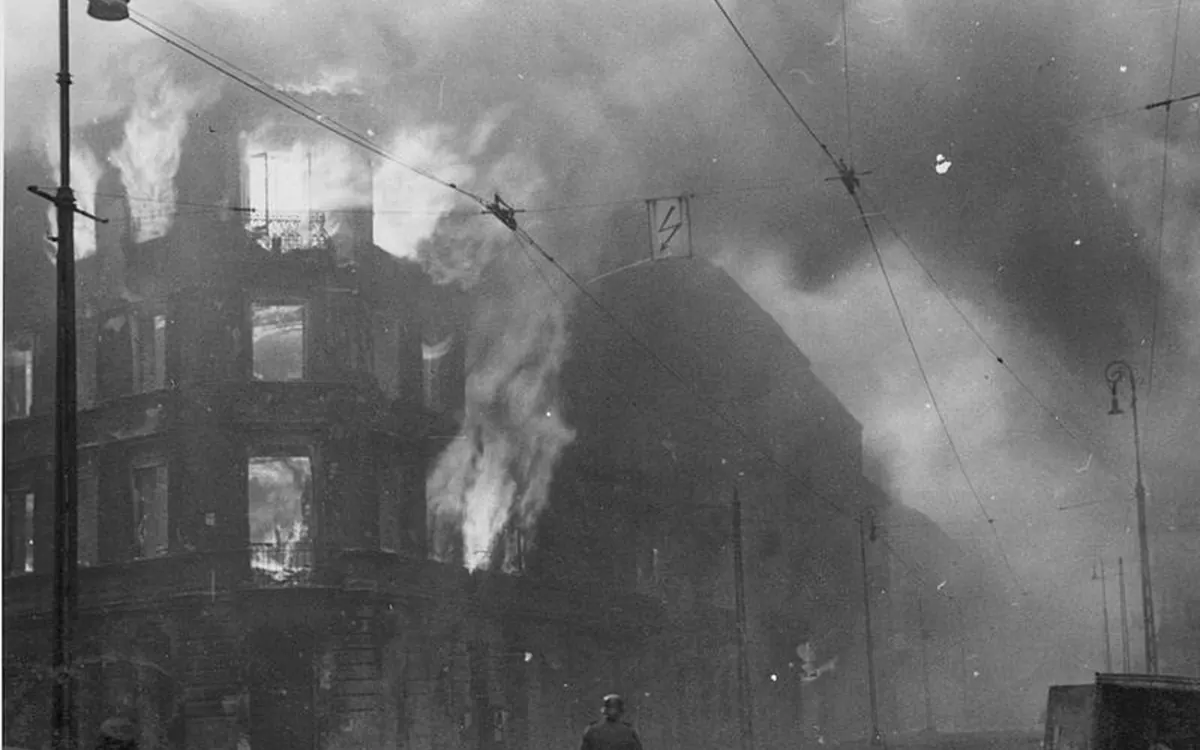
By 1942 there was no escape from Europe for the Jews, and even if they had managed to run - who would take them in. This second episode on the Holocaust explores the message of the Warsaw Ghetto Uprising and finally brings American Jewry into the picture of the Jewish Story.
About this episode
Let there be comradeship among you, says Wiesel in Night; the same smoke floats over all our heads. By the end of 1941 any Jew in Europe with eyes knew it was too late to run. West lay Fortress Europe, three years from Normandy; east the Germans and Soviets were mauling each other after the invasion, but for Jews the east meant death. The conquered territories became what Snyder calls the bloodlands, where double occupation destroyed every structure that might restrain the beast and fourteen million noncombatants died between 1933 and 1945; the death camps were mostly back west, but most Jews died in the open east by crude local means, Babi Yar outside Kiev the best known, more than thirty-three thousand killed on September 29 and 30, 1941, unceasing day and night. Rav Mike declines the debate over Snyder's equivalence, because the numbers are not the point: the aim was to kill every Jew on earth and erase their memory, and six million were all they reached before they were stopped. The significance lies in the role of the Shoah in the Jewish story, still unclear seventy years on. One glimmer: on December 12, 1941 the Struma sailed from Constanta with 769 souls, commissioned by the New Zionist Organization and the Irgun, the last boat out of wartime Europe; Turkey refused to let them land, towed her back into the Black Sea on February 13, 1942, and she was lost with all aboard but one. Then the first call, from Vilna: do not go like sheep to the slaughter, all roads of the ghetto lead to Ponar and Ponar means death, the only reply to a murderer is resistance.
Warsaw embodied European Jewish life more than any city, piety beside cosmopolitanism, Jews thirty percent of it, three and a half million in Poland of whom ninety percent would die. The Zionists knew: Jabotinsky had warned the summer before, and Uri Zvi Greenberg burst into Der Moment days after the invasion shouting that it was all over. Some fled south after him to Romania, more north to Vilna, where the Soviets sent many to the gulag, Menachem Begin among them; most stayed, since why run when you are at the centre, and some took comfort when the wall went up. Construction began April 1, 1940, largely ignored by Christian neighbours happy to see competition vanish; the ghetto was sealed November 15 behind brick and wire, four hundred thousand in 1.3 square miles, a hundred and eighty-four calories a day against seven hundred for Poles and twenty-six hundred for Germans, disease everywhere, and yet life thrived through smuggling and mutual aid, schools, hospitals, soup kitchens, orphanages, and Ringelblum's Oneg Shabbat archive, buried and recovered, which gave us the Esh Kodesh of the Piaseczno Rebbe, who plumbed suffering as he lived and died there. Spiritual resistance, the backbone of exile, let Jews grow in the darkest place, until July 22, 1942, the eve of Tisha B'Av, when the Wannsee resolution met a population already concentrated. Volunteers to the Umschlagplatz were promised bread and jam, and the starving came, since who could believe the Zionist rumours; when they stopped coming, blocks were cordoned and emptied, and by Yom Kippur, September 21, some 265,000 had gone to Treblinka. Sixty thousand remained in a strange calm, with bitterness, shame and survivor's guilt.
Mostly the young and strong survived the most unnatural selection, and a new creature was forced into being, the fighting Jew. Three Zionist youth movements formed the first cell, Poalei Zion joined in October 1942 to make the Jewish Fighting Organization, the ZOB, and even the Bund and the communists united under twenty-three-year-old Mordechai Anielewicz, while the revisionists' Jewish Military Union fought alongside and never within. Their manifesto: the hour is near, not a single Jew to the railway cars, all are ready to die as human beings. On January 9, 1943 the Germans launched new deportations and were met by bullets and Molotov cocktails; after days of house-to-house fighting they withdrew, a second attempt was repulsed, and for a few months the ghetto was sovereign Jewish territory. On April 19, 1943, Passover eve, troops with tanks entered and were driven back, the Polish flag and the blue and white Star of David flying over Muranowski Square where the revisionists held; on the third day the Germans burned them out, and on May 8 the command bunker at Mila 18 was gassed and the fighters took their own lives, still sealed there. The Great Synagogue fell May 16 and victory was declared; a handful escaped through the sewers. Rabbi Alexander Zusha Friedman of the Aguda had foretold Amos 5:3, the city that goes out a thousand strong will have a hundred left. What is the story? The ghetto held longer than many countries, and 1943 was too late for resistance to be more than a feeble example; some survivors reached the mandate and fought on, Zivia Lubetkin testified at Eichmann's trial, and the Knesset fixed 27 Nisan as Holocaust and Ghetto Fighters Day, attaching the Shoah to the uprising. Rav Mike marks it as the end of the shtadlan's quiet diplomacy: the decision to fight was an assertion of autonomy, a cry that the Jews who came next would never let enemies define them, a line from the bunkers to 1948.
Across the ocean the doors were not quite shut and quiet diplomacy lived. World War II marks American Jewry's emergence as a separate player, and the debate over whether they did all they could, thwarted by powerlessness and antisemitism, or abandoned their brothers out of distance and Zionist focus, still raises blood pressure. Roosevelt's America of 1932 was in Depression and isolationist by character; distance from Europe was part of its draw for Jews, the goldene medina of opportunity and freedom from hatred and tradition both, which traditionalists called the treife medina, where Reform served as the founding religion because it let Jews keep identity while immersing fully, and the Jews became more American than the Americans, witness Hollywood and New York. Rav Mike says thank you, America, and advises anyone making aliyah to do something big to say thanks first. Isolationism's dark side is fear of foreigners, each wave barring the door behind it; in the late thirties sheltering Jews looked un-American and very Jewish. Father Coughlin reached thirty million weekly, praised the Axis as the antidote to a Jewish conspiracy of communism, and serialized the Protocols until the administration shut him down. Roosevelt was a hero to Jews, appointed Morgenthau to Treasury and befriended Rabbi Stephen Wise, godfather of American Jewry, Reform rabbi, early Zionist, founder of the World Jewish Congress and co-founder of the NAACP. After the Anschluss Roosevelt called the Evian conference of July 1938, thirty-two nations, which broke up when Poland and Romania claimed the right to expel their Jews too; Golda Meir, an observer not allowed to speak, hoped to live to see her people need no more expressions of sympathy.
After Warsaw the issue was mass escape, and the American Jewish Committee and Wise's Congress counselled a great deal of necessary caution; whatever historians argue, there was no concerted campaign to change immigration law, and America's gates shut. Fear of backlash was not unfounded, and presentism must be avoided, though revisionists charge that capital was saved for Zionism and that Wise's world did not want the embarrassing unwashed masses. On August 8, 1942 Gerhart Riegner of the World Jewish Congress in Geneva cabled an alarming report that the Nazi leadership planned to exterminate three and a half to four million Jews; the State Department did not deliver it, Wise learned of it from Britain, Sumner Welles asked him to keep it confidential pending verification, and release came only in November, the press conference running on page ten of Sulzberger's New York Times; Chaim Kaplan's ghetto diary joked that Wise had ordered American Jews to say the memorial prayer for Polish Jewry. Hillel Kook, born 1915, nephew of Rav Kook, a founding Irgun member, went with Jabotinsky to America and on his death in 1940 led the mission, a cut-off battalion whose task was Jabotinsky's Jewish army, taking the name Peter Bergson to spare his uncle. The Committee for a Jewish Army, launched December 1941, claimed the stateless Jews of Europe had the right to fight as a co-belligerent, a point with weight under the United Nations declaration, and drew a distinction between those Jews and the Americans and British with nations of their own, a seed of the Israeli-Jew tension to come. Press releases, full-page ads, non-Jewish allies and, with Ben Hecht, pageants, unheard of among Jewish officialdom. In November 1942 Bergson read page ten over coffee and called an Assistant Secretary that morning; told there was no doubt, he asked what you are going to do, and got a shrug, nothing until we win the war, the majority view for four years. He refused it, and the Emergency Committee to Save the Jewish People of Europe multiplied the lobbying; on March 9, 1943 forty thousand filled Madison Square Garden for Hecht's We Will Never Die, and after this there could be no conspiracy of silence. After the failed Bermuda conference a full-page ad demanded a government rescue agency, absurd to official Jewry; then Treasury officials found State undermining rescue, Morgenthau commissioned a report on the acquiescence of this government in the murder of the Jews, and on January 22, 1944 Executive Order 9417 created the War Refugee Board under John Pehle, which with aid, visas and bribery may have saved two hundred thousand, among them through Raoul Wallenberg in Budapest. How many more if it had existed in August 1942. Bergson's story and the Hebrew-Jew distinction continue in the struggle to force the doors of the land.
Key ideas
- By 1941 the gates were shut east and west; the bloodlands, Babi Yar and the Struma say the numbers are not the point, since the aim was every Jew on earth.
- The Vilna call, do not go like sheep to the slaughter, was the first awakening; Warsaw's ghetto thrived on spiritual resistance until the eve of Tisha B'Av 1942, when 265,000 went to Treblinka.
- The survivors of the most unnatural selection became the fighting Jew: January 1943 repulsed the Germans, April's uprising flew the blue and white over Muranowski Square, and Mila 18 was sealed on May 8.
- The uprising marks the end of the shtadlan's quiet diplomacy, an assertion of autonomy that runs straight to 1948.
- America, the goldene medina, barred its doors out of isolationism and fear; Evian's failure, Wise's caution and the buried Riegner telegram tell the cost.
- Peter Bergson, Rav Kook's nephew, broke the conspiracy of silence with ads and pageants and forced the War Refugee Board, which may have saved two hundred thousand.
Chapters
- 0:00 Comradeship under the same smoke; the gates shut
- 2:13 The bloodlands and Babi Yar
- 4:26 Numbers are not the point
- 5:30 The Struma
- 6:36 Vilna: do not go like sheep
- 8:49 Warsaw: the fullness of Jewish Europe
- 12:06 The wall sealed
- 13:16 Life thrives; Ringelblum and the Piaseczno Rebbe
- 14:18 Tisha B'Av eve 1942: bread and jam
- 16:31 Sixty thousand remain; survivor's guilt
- 17:34 The fighting Jew: the ZOB
- 19:46 January 1943: sovereign ghetto
- 20:52 Passover eve: the flag over Muranowski
- 22:00 Mila 18; Amos 5:3
- 23:03 What is the story? 27 Nisan
- 25:16 The end of quiet diplomacy
- 27:31 American Jewry: the debate
- 28:39 Depression, isolation, the goldene medina
- 32:56 Father Coughlin; Rabbi Stephen Wise
- 37:25 Evian; Golda's hope
- 41:44 The Riegner telegram and page ten
- 44:58 Hillel Kook becomes Peter Bergson
- 47:11 The Committee for a Jewish Army
- 51:31 The Emergency Committee; We Will Never Die
- 53:41 Blood guilty; the War Refugee Board
Who, where and when
People
Mordechai Anielewicz, Zivia Lubetkin, Emanuel Ringelblum, The Piaseczno Rebbe, Rabbi Alexander Zusha Friedman, Uri Zvi Greenberg, Menachem Begin, Rabbi Stephen Wise, Gerhart Riegner, Sumner Welles, Arthur Sulzberger, Chaim Kaplan, Peter Bergson, Hillel Kook, Ben Hecht, Henry Morgenthau, John Pehle, Raoul Wallenberg, Father Charles Coughlin, Golda Meir, Timothy Snyder, Elie Wiesel
Places
Babi Yar, Constanta and the Black Sea, Vilna and Ponar, Warsaw, the Umschlagplatz, Muranowski Square, Mila 18, Treblinka, Evian, Madison Square Garden, Budapest
Texts
Night, Bloodlands, The Vilna proclamation, The ZOB manifesto, Esh Kodesh, Amos 5:3, The Riegner telegram, We Will Never Die, Executive Order 9417
When
September 29 to 30, 1941 CE: Babi Yar, December 12, 1941 CE: the Struma sails, July 22, 1942 CE: the great deportation begins, August 8, 1942 CE: the Riegner telegram, January 9, 1943 CE: first ghetto fighting, April 19, 1943 CE: the uprising, May 8, 1943 CE: Mila 18, January 22, 1944 CE: the War Refugee Board, July 1938 CE: Evian
Read the transcript
And now, a prayer, says Elie Wiesel in his book night, or rather, a piece of advice. Let there be comradeship among you. We are all brothers, and we are all suffering the same fate. The same smoke floats over all our heads. Help one another. It is the only way to survive. Well, I want to echo his call that we should all be brothers and sisters, and we should give each other that helping hand. I'm Rav Mike Foyer, and this is The Jewish Story. Episode 35, The Gates Are Shut. By the end of 1941, any Jew left in Europe who had eyes in his head to see recognized that it was too late to run. They hadn't heeded Jabotinsky's warning, and now Poland was long overrun by the Nazis, and the doors of Europe are shutting fast.
Off to the west, fortress Europe looms, and it's going to be nearly three years before the unbelievably brutal Normandy invasion manages to crack the Nazi defenses facing the Atlantic. And when they do, don't forget, more than 200,000 Allied troops will die on the beaches of France, not to mention an even greater number of Germans. But by the time the Allies arrive in Western Europe, few Jews will remain, just those hiding in holes or attics or fled to the woods as partisans. Off to the east in the other direction, the door is definitely shut. I mean, the Germans and the Russians have been mauling each other since Operation Barbarossa's sneak attack ended the Nazi Soviet non-aggression. It's true that the German offensive stalled at Moscow and eventually that the tide of war will actually turn against them through the bloody Battle of Stalingrad toward the end of 1942.
But nonetheless, death lay to the east for the Jews. not freedom. In the initial phase of that invasion, Nazis gained the Lebensraum, the living room they were looking for, and the economic resources they were racing across, the breadbasket of Ukraine toward the oil of the Caucasus. That's what it was about. And they also gained millions more Jews. These newly conquered territories, together with the rest of the Nazi-Soviet battlegrounds that will emerge, will become what historian Timothy Snyder calls the Bloodlands. His claim is that as the Nazis and the Soviets first collaborated and then clashed, they turned Poland, Ukraine, Belarus, Russia, and the Baltic states into gigantic killing fields. The double occupation destroyed any apparatus of state or even fabric of society that could or would stand in the way of the beast which these totalitarian societies unleashed in their men.
What followed was a sustained campaign of killing men, women, and children, the likes of which had been unimaginable in Europe up until now. I mean, just for context, more than 2 million combatants were wounded, captured, or killed at the Battle of Stalingrad alone. But the bloodlands were not about combat deaths. They were soaked with the blood of the victims of ideological mass murder. The Nazis innovated the industrialized, smoothly administrated killing of the Jews in the death camps of Treblinka, Auschwitz, Trezienstadt, Belzec, Maddhausen, Sobibor, most of which were back actually in Western and Central Europe. But it was here in the open lands of the East where the most Jews died, where the Germans perfected the crude and local means of murder like mass shootings.
Babi Yar, outside of Kiev, is only the best known. Maybe that's because 33,771 Jews were killed in a single operation on September 29th to 30th, 1941. 703 per hour, almost 12 per minute. And that's the gunshots rang out unceasingly day and night. According to Snyder, more than 14 million non-combatants died in the bloodlands from 1933 to 1945. victims of the Nazi and Soviet ideologies and the presence in the heart of Europe of a world which existed without law or even human morality. Now there are pundits and historians who criticize Snyder's thesis saying that his numbers and the equivalency he draws between the murderous nature of the Soviets and the Nazis reduces the significance of the Holocaust.
And I'm not going to weigh in on that debate because despite the overwhelming idea of 6 million Jews murdered one third of our people dead for the sole reason of being who they were in my eyes the numbers of the Holocaust are actually not what matter because the fact is that Hitler and his men aimed to kill every Jew on the planet and they would have done it the 6 million were simply all they managed to get to before they were stopped and don't forget the Nazis weren't just after our death they wanted to erase our memory to remove all traces of the Jewish infection from their culture establishing a pure race in a new world. To me, the significance of the Holocaust lies not in the numbers or even in the chilling modern means of murder that the Nazis innovated, but rather in the role that the Shoah plays in the Jewish story and therefore in the story of the world.
And what that role is is still far from clear, even 70 plus years later. But you think the dinosaurs knew that it was all over right when the asteroid hit? So Europe is closed. There was, alas, a glimmer of hope in the illegal ships that the Zionists were still trying to launch toward the mandate. On December 12, 1941, only a month or so before the fate of the Jews under Nazi rule was given its final bureaucratic form at the Wansi conference we discussed last episode, a ship loaded with escapees actually managed to sail from Constanza in Romania. With 769 souls aboard, the struma aimed to reach Turkey and from there to await certificates of entry for British Palestine, which even under the harsh rule of the MacDonald white paper was still a last hope for refuge.
The vessel was commissioned by Jabotinsky's New Zionist Organization. Those are the revisionists. In the Irgun underground militia, it was the last boatload of Jews to leave Europe in wartime. They shut the gates behind them. Now, the Turkish authorities refused to allow the passengers to disembark when they arrived, for fear that the British wouldn't give them the certificates, and then Turkey would be forced to take the Jews in. And despite the pleading of the captain that his ship was unfit to continue on its way, the Turks towed it back to the Black Sea on February 13, 1942. On the following day, a mighty explosion was heard, and the ship went down, all hands aboard. Only one survivor ever reached Eretz Israel to tell its tale.
So the doors are shut, and some scattered where they would. Many laid down and died. But there were those whose eyes were opened by the shadow of death to a new reality. Listen to the words of the first call, of the original awakening of the Jews to the inconceivable reality that confronted them. Let us not go like sheep to the slaughter, O Jewish youth. Do not believe those who are deceiving you. Out of 80,000 Jews of the Jerusalem of Lithuania, that's Vilna, only 20,000 remain. In front of your eyes, our parents, our brothers, our sisters are being torn away from us. Where are the hundreds of men who are snatched away for labor by the Lithuanian kidnappers? Where are those naked women who are taken away on the horror night of the provocation?
Anyone who is taken out through the gates of the ghetto will never return. All roads of the ghetto lead to Panari, and Panari means death. O despairing people, tear this deception away from your eyes. Your children, your husbands, your wives are no longer alive. Punnery is not a labor camp. Everyone there is shot. Hitler aims at destroying the Jews of Europe. It turned out to be the fate of the Jews of Lithuania to be the first. Let us not go like sheep to the slaughter. It is true that we are weak, lacking protection. But the only reply to a murderer is resistance. Brothers, it is better to die as free fighters than to live at the mercy of killers. Resist. Resist to our last breath. More past than any other city in Europe, Warsaw embodied the fullness of European Jewish existence.
Traditional piety stood shoulder to shoulder with modern cosmopolitanism. Learning, literature, and art bubbled up on every street corner. life, life itself, every facet of Jewish culture, thrived there. And it was no ghetto. Despite the traditional and widespread Polish anti-Semitism, Jews could be found in the full range of social, civic, and cultural life at almost every level. And so, with the destruction of Warsaw Jewry, came the end of European Jewish life as we know it. On the eve of the Nazi invasion, Jews made up 30% of the city's population. There were nearly 3.5 million Jews in Poland altogether, and 90% of them would be murdered before the war's end. These Jews had helped build Warsaw's society.
They fought in its wars of freedom. They even sang its patriotic songs when they drank. But all that ended on September 29th, when after weeks of fighting, the siege of the city ended, and the German armies entered Warsaw's gates. Truth is, the Jews knew it was all over, even before the Nazis arrived. or at least the Zionists knew and those willing to listen to them. Hadn't Jabotinsky warned just last summer to get out before it was too late? And when Uritz V. Greenberg, already known as the poet-prophet to Jewish youth and whose extreme revisionist views only made him all of the more a hero in their eyes, burst into the offices of the Yiddish-language daily Der Moment, only days after the Germans crossed the Polish border, he shouted, What are you doing here?
it's all over. And the words of the prophet can't be ignored. Those who could scattered, some fleeing south after Uritzvi, hoping against hope that the Romanian border still lay open. He actually made it there to Israel. Many more headed north to Vilna, hoping that the Jerusalem of Baltic Jewry offered safety from the Nazi threat. They suffered first under the Soviet occupation, many disappearing into the Gulag prisons of the East, concentration camps, USSR style, Menachem Begin, whose story we'll see in the next episode, took that path. And those that remained, well, many died at the hands of the Nazis at Poneri, like we heard about at the end of the last segment. But most of the Jews of Warsaw stayed put.
Why run when you're already at the center? And they had dismissed the words of the prophets long ago. And when the Germans began to build the ghetto wall around the traditional Jewish quarter, I'm willing to bet that there were more than a few who took comfort from this barrier being put up between them and the non-Jewish world. But as the wall rose, and the remaining Jews outside the ghetto were herded in, until more than 400,000 human beings were packed into an area of only 1.3 square miles, as the amount of food which passed the ghetto walls dropped steadily and disease spread, life became increasingly desperate. It seems that the ghetto began as a holding pen, a place to quarantine that Jewish infection, and where mass death was really only a side benefit.
And the very ambivalence of its first phase was expressive of the lack of clarity amongst Nazi leadership in the first phase of the war. What were they going to do with the Jewish problem? Were the Jews to be walled off, slowly starved, exploited as slave labor? Or had the time come for a final solution? The construction of the ghetto wall began on April 1, 1940. By most accounts, despite the scale of the building, the construction of the ghetto was largely ignored by the Christian former neighbors and friends of Warsaw's Jews. Most turned a blind eye to their disappearance into the world of the ghetto, and many were not sorry when the gates finally shut for good and Jewish competition was erased forever.
On October 16, the creation of the ghetto was officially announced by the German Governor-General Hans Frank. And by November 15th, only a month later, the Jews of Warsaw were completely sealed off from the outside world behind three meters of brick topped with barbed wire, escapees to be shot on sight. The ghetto entailed a cruelty of control that is hard to imagine. Only 184 calories per day per Jew were even allowed through its walls, Just to give you a sense, that's compared to almost 700 for the Poles and 2,600 for the Germans. Disease spread rapidly in the tight pack and starving and unhygienic conditions. Nevertheless, through smuggling and mutual aid, life in the ghetto actually in many ways thrived.
Educational and cultural activities flourished. Hospitals sprang up, soup kitchens, orphanages, even recreation centers came into being. There was even a school system. And then there was the Onig Shabbos Circle. This is a circle of intellectuals and writers and thinkers organized by Emanuel Ringelbaum, whose writings and archives were actually buried and gradually retrieved after the war through great miracles. And by the way, if you want a fictional work which deals with that topic, perhaps the most moving and gripping book I've ever read about the Holocaust, John Hersey's The Wall. But you have to know it's not actually true. Those archives, however, were real, and they brought us the holy book of the Eish Kodesh, the Piyaz Netzer Rebbe, who was the spiritual master who delved deep into the nature of suffering as he lived and died in the Warsaw Ghetto.
So the posture of spiritual resistance, which was the backbone of traditional Jewish culture for much of European history, in my eyes is what allowed the Jews to grow, even in this, the darkest of places. But that all changed on July 22 1942 the eve of the 9th of Av Tisha B Tafshin Bet The Wanti Conference had just resolved the ambivalence of the Nazi hierarchy Mass murder could begin And their victims had already been concentrated in one place. The only major logistical challenge which remained was how to move those Jews from the ghetto to the death camps. At first, the Germans promised that those who would voluntarily to the Umschlagplatz, the collection point that they established within the ghetto, for transfer to the east, as they called it, would receive three kilo of bread and one kilo of jam.
Now, there were enough Jews hovering at starvation level that it brought in many thousands. After all, they still had no idea as to where they were being taken. And hard labor at the war front didn't sound so bad. At least you feed your slaves, right? And even when the Zionists began to circulate the rumors of gas chambers and crematoria, Who could possibly believe such madness? But, after a few days, the volunteers actually stopped coming. Maybe it was the sight of their brothers and sisters, packed into cattle cars squeezed so tight that many died standing up. Maybe it was the Zionist propaganda telling the people that cooperation meant certain death. Either way, the Nazis switched tactics. Now whole city blocks were cordoned off, and Jewish police were sent in to remove the residents.
Once they were on the streets, it was the Germans that carried out the selection, while they sent Polish and Ukrainian policemen to just ransack the buildings after them. Panic rolled in waves through the ghetto. Confusion, anger, despair. Those who could hid, those who could not, died. By the time the action, as the Nazis called it, ended on September 21, Yom Kippur Day, nearly 265,000 souls had been deported to the Driblinka extermination camp. There, they were either gassed and cremated upon arrival or worked to death through a brutal combination of slave labor and starvation. After the deportations, an estimated 60,000 Jews remained within the ghetto walls and a strange calm settled over that shrunken ghetto.
With it came a sense of bitterness and shame. Many survivors blamed themselves for a well-known phenomenon, survivor's guilt. And if you're a Jew out there listening to me who knows a little bit about your story, you should look inside yourself and ask, where are you carrying that guilt? So many of the survivors there in the ghetto blamed themselves for not resisting as they'd watched their family and friends be taken and all knew that sooner or later they would share the same fate. Now it was largely the young and strong who had survived natural selection of the evilest and most unnatural kind. And as with all such evolutionary processes, a new creature was forced into being, the fighting Jew. It began when the members of three Zionist youth movements, who we've actually met before, Hashomer Hatzayir, Dror, and Akiva, established the first cell.
And when the Poli Tzion joined them in October of 1942, the Jewish Fighting Organization, a.k.a. the Z-O-B, was born. Within a short time, even the Bund, the socialist anti-Zionist and the communists, put aside the ideological differences and united behind 23-year-old Mordechai and Elevitz of the Hashomer Hatzair movement, who became commander of the Jewish Fighting Organization. Though, even here in the ghetto at the last desperate moment, the divisions that racked Am Yisrael were not left wholly behind. The right-wing revisionists formed their own organization, the Jewish Military Union, which did fight alongside, but not within, the ZOB. Desperate, the fighters worked with smugglers to purchase any weapon they could.
Though the home army, the Polish Underground, which was fighting an ongoing battle with the German occupiers at the time, had first stood aloof from their uprising, refusing to coordinate or even contribute. The Jews were not their problem. Or perhaps they were, but the Germans were the solution. In addition to gathering what arms they could, the underground fighters needed to communicate their message to the Jews who remained scattered throughout the ghetto. In addition to gathering what arms they could, the underground fighters realized that they needed to communicate their message to the Jews who remained scattered throughout the ghetto. One manifesto that they plastered to the wall reads as follows.
Jews of Warsaw, the hour is drawing near. You must be prepared to resist. Not a single Jew should go to the railroad cars. Jews of Warsaw, the hour is drawing near. You must be prepared to resist. Not a single Jew should go to the railroad cars. Those who are unable to put up active resistance should resist passively and should go into hiding. Our slogan must be, all are ready to die as human beings. On January 9th, 1943, the Germans launched another round of deportations. The underground leadership believed it was the beginning of the final liquidation of the ghetto, and they decided to come out fighting. Just imagine the surprise on the faces of the Nazis when they were met not by cowering victims, but by a hail of bullets and Molotov cocktails.
The last stand of Polish Jewry had begun. Now, the Germans managed to shoot some 600 Jews and remove 5,000 more for transport to the death camps. But after a few days of fierce house-to-house fighting, they were forced to retreat. A subsequent attempt by the German army to retake the ghetto was actually repulsed, and for a few precious months, the Warsaw Ghetto became sovereign Jewish territory. The quest for arms now became even more desperate. The home army changed its attitude toward the Jews in the light of these initial victories, and they sent a small quantity of arms and explosives in through the wall. The network of underground bunkers and tunnels was extended and strengthened, and the life of the Jews moved truly underground.
But the resistance fighters knew that there was only one conclusion to this drama. A handful of rebellious youth would not defeat the German war machine. And so, on April 19, 1943, Erev Pesach, the final battle began. Several hundred German troops, escorted by tanks and armored cars, and preceded by Ukrainian auxiliary units, moved into the ghetto. Once more, their initial approach was repulse, and Warsaw watched as ambulances carried the German wounded and dead out of the ghetto. And then a sight appeared which no one could have imagined, even in their wildest dreams. The Polish flag and the white and blue Star of David were raised high on a house stop on Murankowski Square, where the revisionists had halted the German advance.
On the third day of the uprising, Jurgen Stroup, SS leader in Warsaw, decided that the only way to break the resistance was to burn them out. So special units equipped with flamethrowers were sent through the gates. Sappers blew up the ghetto building by building as others burned around them and poison gas filled the sewers. On May 8, 1943, the Germans reached an 11th bunker at 18 Miele Street and they began to pump poison gas in through the air ducts. The remaining fighters actually took their own lives rather than die at the hands of their prospective murderers. And their bodies are still sealed underground even now at Miele 18 in the remains of their own personal gas chamber. With the destruction of the Great Synagogue of Warsaw on May 16th, the Germans declared victory.
The ghetto was in ruins, and its remaining 60,000 Jews either murdered on the spot or sent to die in the camps. A few buildings still stood above the smoking rubble, and even a handful of Jews had survived, escaping through the sewers. The prediction made by Rav Alexander Friedman Secretary General of Agudas Israel in Poland and one of the Torah leaders who was there in the Warsaw Ghetto had indeed come true. Now Friedman had been amongst the first to try and inform world Jewry about the death that awaited them saying that the Warsaw Ghetto would be the fulfillment of the awful prophecy found in Amos 5.3 The city that goes out a thousand strong will have a hundred left and the one that goes out a hundred strong will have ten left to the house of Israel.
So, now I'm left with a question. What is the story of the Warsaw Ghetto? The Jews of the ghetto held out against the German army longer than many European countries. But would we call it victory? Certainly the uprising became an example for the Jews in other ghettos and camps, but the struggles that followed were feeble and doomed from the start. 1943 was too late for the Jews of Europe to take the path of resistance. some of the survivors of the ghetto did indeed live and I can call that victory they made their way actually to mandatory Palestine continuing their armed struggle for liberation in the land of Israel and inspiring their brothers and sisters to fight the last drop of blood in their eyes there was only freedom or heinous death and when the camps were liberated they were joined by thousands more who'd been to hell and back and had no intention of returning One, Zivia Lubetkin, the only female leader of the Jewish war underground in Warsaw, would later testify at the trial of Adolf Eichmann, the architect of the Final Solution.
So I might call that victory. And you need to know that when the modern state of Israel established a day of memory for the Holocaust in the national calendar, the following declaration was made on the floor of the Knesset. The First Knesset declares and determines that the 27th day of the month of Nisan, every year shall be Holocaust and Ghetto Fighters Day, an eternal day of remembrance for the House of Israel. The date and the name attach the Holocaust specifically to the Warsaw Ghetto Uprising. Now, there is so much to explore there. In the decision of the Zionists to include armed resistance as a core element of the memory of the story in which, all honesty, it appears to be a sidelight. And we're going to have to leave a discussion of the challenge that the model of spiritual resistance, which had defined exile life, poses to the activist Zionist Esau to another time, and furthermore, how it relates to their subsequent need to define European Jewry as weak and passive.
Now certainly, most people are aware of the power that resistance offers as a moral model, and a beacon of nobility that can light our way down through history. But for the sake of our story now, I can't answer the question of what's the story of the Warsaw Ghetto, but I want to mark it. I want to mark the Warsaw Ghetto uprising as the end of a certain model of, call it quiet diplomacy, of the Stadland's acquiescence to the reality of authority and the need to bow to the power of the non-Jews and beg just to save a little bit. In my eyes, the decision to fight was not premised on hope for victory, or even on the expectation of survival. That decision was an assertion of autonomy. It was a cry to history and to the future that the Jews who came next would never allow their enemies to define them.
And the fires that destroyed the Warsaw Ghetto forged a Jew who would no longer look to the world for help or salvation or even kindness. And as such, there's a direct line that we're going to have to trace from the bunkers of the Warsaw Ghetto to the Declaration of Independence in Israel in 1948, and to the many, many problematics that exist even now in the relationship between Jew and non-Jew in the State of Israel. But for right now, no chapter, be it ever so tragic, is the last. Not all the Jews of the world were in Europe when the drawers shut, or even in the Land of Israel. The time has come to glance across the ocean to America, where the doors are not quite closed yet, and the path of quiet diplomacy is alive and well.
In many ways, World War II marks the emergence of American Jewry as a separate player in our version of the Jewish story. And as is true of any element of significance in history, there's a deep debate over what exactly their role is in the present chapter. What do I mean? I mean, did American Jewry do everything they could to save their brothers? Were they making the best effort only to be thwarted by their relative powerlessness within the American political system, compounded by widespread anti-Semitism and the challenge of making any waves during wartime? Or did they abandon their brothers due to a sense of distance and alienation from the Jews of Europe, jealousy for communal position and power, and an over-focus on the Zionist project as the solution to the Jewish problem?
There are historians, politicians, and present-day communal leaders who will line up on both sides of that debate. In fact, if you want to stir up a lively reaction from a certain generation of engaged American Jews, just start tossing out provocative comments about whether U.S. Jewry did enough to stop the Holocaust or not. Don't tell them I told you so, though. Okay, so the issue of immigration was the first phase of the question, and that actually began well before the war broke out. The country that elected FDR, Franklin Delano Roosevelt, president for the first time in 1932, was a deeply troubled place. Let's not forget that. The economy was paralyzed deep in the grip of the Great Depression, and nearly 25% of the workforce was unemployed.
Furthermore, it was still licking its wound, physical, psychological, and political, from the First World War. And you could say that a deeply isolationist element has actually always existed in American culture. After all what rugged individualism if it not rooted in the desire to be alone Think of Davy Crockett and Daniel Boone And this characteristically American disposition after all, no one's ever heard of a French isolationist, had a deep root in the physical isolation of the New World from the Old, and that also played a formative role in launching American Jewish culture. After all, America's distance from Europe was part of its attraction for the Jews as it had been for so many waves of immigrants before them.
For many Jews, America was the golden medina, the golden state that existed on the edge of their dreams, a place of big opportunity, bright future. And that was true for so many waves of immigrants, and also a place of freedom, where the bonds of the past, be they hatred, tradition, or both, could be left far behind. And for those same two reasons, the attraction of the future and the possibility of abandoning the past, many other Jews called America the Trefe Medina, the impure state. And as American society opened up more and more to the Jews in each decade of the 20th century, to pre-war Jewry, it appeared that traditional European religious life had no place in the New World. I mean, the soil just didn't seem fit for such a foreign transport.
It's true that certain major yeshivot, schools of Orthodox Torah learning, we'll manage to make the jump from the iconic Tel Shesiva open its doors in my hometown of Cleveland but that was at the height of the war in 1941. And maybe in season 3 we can discuss the rise of the Kolel movement the community learning model and the other factors that created American Orthodoxy. But for now, just know it was Reformed Judaism that served as the founding religion of the majority of our American Jewish forefathers. And that also deserves its own full story. But for the present purpose, the key element that Reform Judaism offered American Jews was a way of being Jewish that allowed them to maintain their personal and communal identity while still immersing themselves as deeply as possible into American society.
And indeed, the Jews succeeded, proving once again that the Jews are just like everyone else, only more so. And we are more American than the Americans. I leave it to bigger scholars than I to give you the hard stats. but I only have to say two things that will prove to you that the Jews had an inordinate impact on American culture Hollywood and New York City so it was love at first sight in a manner for which I see no parallel in this exile maybe if I knew more about what life was actually like for the Jews after the destruction of the first temple I would make comparisons but for now as an American Jew as well as an Israeli citizen I can really say it doesn't get better than the U.S. in the Jewish story.
I actually want to take a second and just say, thank you, America. Now, the words aren't enough, and I want to let you know that there was a phase of my life, two years, in fact, before I left, that I spent living in the woods with the at-risk youth of America who've been taken out of their schools by the court system. And I'm not telling you that to make me sound cool or make myself feel good. I'm telling you because it's very important, it was very important to me at the time, to have hakarat hatov, to recognize the good that has been done to us as a people by society that, with all the complexities, received us with open arms. I want to give this advice to anyone listening who's thinking of joining the team and coming up to the land of Israel.
Do something big to say thank you before you go. But for now, in our story, all is rosy between Americans and Jews so long as American and Jewish interests coincide. Because isolationism has a much darker side. It finds political expression in the desire for a foreign policy that leaves the world to deal with its own problems, and hence Congress's rejection of membership in the League of Nations after World War I. But its social manifestation is fear, dislike, and exclusion of foreigners. It's a characteristically American story. The communities which themselves had been immigrants felt the need to turn and bar the door behind them, not only because the economic thinking of competition for scarce resources, but also out of the cultural desire that they could become white, as it were, if I wanted to use a racial term to characterize what's really a social-cultural group.
The power of this mix in American culture is crazy complex and strong, because, of course, there are two significant elements of American history that don't fit that immigration normalization model, the Native Americans and the African Americans. And I'm going to resist diving too deep into this messy question. But I will say that when the struggle against President Trump's policies of immigration produced the slogan, we are all immigrants, I felt the raw rub of history on behalf of those two peoples, whether they themselves looked at it that way or not. But anyway, for now, American immigration law in the years leading up to the Holocaust reflected the desire to bar the door. And in the late 30s, the desire of American Jews to find shelter for their brothers and sisters was not considered so American, but it was seen as very Jewish.
As the situation in Europe deteriorated, the anti-foreigner isolationist sentiments in the United States grew, and American Jewry began to walk on eggshells. Anti-Semitism in the United States never reached the intensity that Jew hatred saw in Europe, But large numbers of Americans did look upon Jews as a foreign and undesirable element. And in the 30s, anti-Semitic leaders and movements began to grow around the fringes of American politics, as will happen when questions of immigration become pressing. Take, for example, Father Charles Coughlin, probably the best known. He was a charismatic priest and political organizer, who was actually the first American political leader to use radio to really reach a mass audience, to create his following.
During the 30s, an estimated 30 million listeners tuned in to his weekly broadcasts. At first, Coughlin was a vocal supporter of President Roosevelt and his New Deal that looked to get America out of the Depression. But as the decade progressed, he became a harsh critic, accusing the president of being too friendly with the bankers, read Jews. and after the 1936 election, which FDR won again, Coughlin began to express sympathy for the governments of Hitler and Mussolini, labeling them as the only antidote to the Jewish conspiracy of communism. His periodical Social Justice even reprinted the classic anti-Semitic tract The Protocols of the Elders of Zion as a weekly installment. Now after the outbreak of World War II, the Roosevelt administration finally managed to force the cancellation of Coughlin's show and they banned the distribution of social justice.
But the Jews know that 30 million dedicated listeners don't disappear overnight. Roosevelt himself was a hero to American Jews and remains so for many today and they gained unprecedented access to the White House during his term in office. He even appointed a Jew, Henry Morgan Thau, as his Secretary of Treasury and he developed a personal relationship with Rabbi Stephen Wise. Now, Rabbi Stephen Wise was the godfather of American Jewry in his day. He was a leading Reform rabbi and an early American Zionist at a time when the two were a very unlikely match. He was president of the Zionist Organization of America, honorary president of the American Jewish Congress. He helped to create the World Jewish Congress.
He was even a co-founder of the NAACP in 1914. And so, the Jews had a leader, and they felt that their leader had the ear of highest power in a way which they'd never yet had in America. And when the Germans marched unopposed into Austria in March of 1938, President Roosevelt was determined to do something about it. Nazi policies toward the Jews of Germany since their rise to power in 1933 made it clear that the Anschluss, as they called it, put Austria's 185,000 Jews in immediate and serious danger. President Roosevelt called for an international conference on the issue of immigration. And the Avion Conference was convened in July of 1938 in Avion, France, quote, to facilitate the immigration from Germany and Austria of political refugees.
It was attended by representatives of 32 countries and 24 voluntary organizations, and even now is seen to be a study in the potential emptiness of international politics. When he heard that the world had gathered, Adolf Hitler responded by saying that if the other nations would agree to take the Jews, he was happy to help them leave. I can only hope, he says, and expect that the other world, which has such deep sympathy for these criminals, will at least be generous enough to convert this sympathy into practical aid. We, on our part, already put all these criminals at the disposal of these countries for all I care, even on luxury ships. And at first it appeared that the world would rise to the challenge.
The Dominican public right away offered to give sanctuary to 100,000 refugees, right from the start. But then came the word of disaster. The Polish and Romanian governments, watching what was happening, announced that they also claimed the right to expel their Jews. Now the 475,000 Jews or so left in Germany and Austria might be absorbed by the more than 30 nations which had gathered. But they held out no hope for the millions of Eastern Europe. And so the conference broke up in confusion. Gulda Meir was actually there as a representative from British Mandatory Palestine. And even though the topic was saving the Jews, she wasn't permitted to speak or even participate in the proceedings, except as an observer.
But before she departed, she told the press, There's only one thing I hope to see before I die, and that is that my people should not need expressions of sympathy anymore. Do you hear the echoes to the Warsaw Ghetto? Within months, the Nazis swallowed the Sudetenland, and a year later, they were in Warsaw. Organized immigration was no longer the issue. The time for mass escape was at hand. And the threat of war, and the fear of waves of foreign refugees flooding America roiled Congress. But despite the growing sense of urgency, the Jews kept silent on the political front. The American Jewish Committee, dean of American Jewish organizations, and Rabbi Stephen Wise's American Jewish Congress advised their people to observe, quote, a great deal of necessary caution as Congress was holding stormy debates over how their immigration policy should respond to the global crisis.
And whatever debates historians may have, the numbers give us a certain bottom line. There was much hand-wringing, back-door negotiating, and a lot of fear. But there was no concerted, large-scale, ongoing communal political effort to change immigration policy. And so, the gates of America were shut as well. Now, the Jews' fear of potential explosive anti-Semitism anti-Semitism as a backlash, was certainly not unfounded. And we shouldn't fall prey to what historians call presentism, the tendency to look at the past through the lens of the present. Remember, in the late 1930s, the Jewish community's political cloud, or even any minority community's political cloud, was minor at best. Now, some historians and revisionist thinkers say that less wholesome motives drove official Jewish passivity.
They say that these Jews were looking to save their political capital for Zionist goals, and that the Jewish communal organizations were more engaged in infighting than the immigration battle. Some voices go even further, claiming that the Jewish world of Rabbi Stephen Wise didn't want the unwashed masses of Eastern Europe. As Samuel Merlin, a key member of the Bergson Group, whose story we're going to hear in a moment, said, they were not interested in people who were behaving in embarrassing ways. But 1942 was very different than 1938. And on August 8, 1942, the following telegram reached both the British Foreign Office and the American State Department. It was sent by Gerhard Reigener, Secretary of the World Jewish Congress's office in Geneva, to his New York and London offices.
received alarming report stating that in the Führer's headquarters a plan has been discussed and is under consideration according to which all Jews in countries occupied or controlled by Germany numbering three and a half to four millions should after deportation and concentration in the East be at one blow exterminated in order to resolve once and for all the Jewish question in Europe stop action is reported to be planned for the autumn Stop. Ways of execution are still being discussed, including the use of prussic acid. Stop. We transmit this information with all the necessary reservation, as exactitude cannot be confirmed by us. Stop. Our informant is reported to have close connections with the highest German authorities, and his reports are generally reliable.
Stop. Please inform and consult New York. The head of the American branch of the WJC at the time was Rabbi Stephen Wise, but he didn't receive the telegram sent him. The State Department did not deliver it, at least not until the rabbi learned of Reigner's terrible message from Jewish leaders in Great Britain. And when he did, he immediately approached Undersecretary of State Sumner Wells, who asked Wise to keep the information confidential until the government could verify it. Wise agreed, and it was not until November of 1942, three months later, that Wells authorized the release of Reigner's message. Hundreds of thousands of Jews may have died while he waited. Rabbi Wise held a press conference on the evening of November 24, 1942, and the next day's New York Times reported it on its tenth page.
Now the paper at the time was owned by the famous Arthur Salzburger a Jew committed to assimilation and deeply opposed to Zionism He receives a ton of criticism in the literature for having buried the story of the murder of the six million on the back page, as does Rabbi Stephen Wise himself, primarily for failing to risk his close relationship with Roosevelt in order to push to save his fellow Jews. But the Rabbi's press conference was not the only effort. Mainstream American Jewish organizations, including Rabbi Wise's American Jewish Congress, did sponsor rallies and mass meetings in the coming years, but they never directly challenged American policy. And there's a grim comment recorded in the diary of Chaim Kaplan, which he wrote in The War of Salghetto.
A joke is making the rounds, he writes. Rabbi Stephen S. Wise is helping. He's ordered American Jews to say the memorial prayer for the departed souls of Polish Jewry. His foresight is accurate. But not every Jew was willing to let his brothers in Europe go quietly into the night. Peter Bergson was born Hillel Cook in Lithuania in 1915, son of Rabbi Dov Cook, and therefore nephew of Rav Avram Yitzchak Cohen Cook, the first Ashkenazi chief rabbi of mandatory Palestine, and a personal spiritual hero. In 1924, Pilo and his family made Aliyah. They went up to the land of Israel, where his father became the first chief rabbi of the Israeli city of Fula. Pilo was raised in the way of his fathers, as befits the youngest son of a rabbinic dynasty, and therefore it was only natural that when the time was right, he was sent to Jerusalem to attend his uncle Rav Kook's Merkaz Harav Yeshiva, while at the same time attending classes at the Hebrew University.
And it was at the latter where he became a member of a small group of students who would later become core members of the revisionist movement, including David Raziel and Abraham Stern, who we've mentioned and we'll discuss more. And in fact, as the situation between Arabs, British and Jews deteriorated, the story of which we've told in previous episodes, Hillel Cook became a founding member of the Irgun Tzavai Leumi, the organization of the national military. in 1931. He served as a post commander for the Etzel, or just the Irgun as it's usually known, in 1936, air revolt, quickly rising to become a member of the general staff. And Hillel met Zev Jabotinsky himself in Poland in 1937, where he had gone to organize and fundraise on behalf of the Irgun.
Roche Betar, as Jabotinsky was known, eventually asked Hillel to accompany him to the United States. And, with Jabotinsky's sudden death there in 1940, Hillel Cook became the head of the Irgun and revisionist mission in America. Cut off by the war from anything but the most sporadic communication with the general staff back in the land of Israel, Hillel saw himself and the men with him as a cut-off battalion. A cut-off battalion whose mission was absolutely clear. They'd inherited it from Jabotinsky himself. Their goal was to raise the Jewish army that had been Jabotinsky's life dream and core foreign policy goal since his limited success back in World War I. And since this was a mission that classed with the mainstream Zionist leadership vision, with British imperial interests and even in many ways with American foreign policy, Cook changed his name to Peter Bergson in order to disassociate from his famous uncle.
On December 4th, 1941, three days before Pearl Harbor and Americans' official entry into the war, the Committee for a Jewish Army was officially launched. their claim was that the Jews of the Mandate there in the land of Israel and those of Europe who had become stateless because of Hitler had the right and duty to combine into a distinct fighting force that could join the Allies as a co-belligerent now that may sound strange but remember the word United Nations has its root in the agreement which was made by all the Allies to fight together and not make separate pieces with Germany Therefore, there was a tremendous political significance to the Jews being a co-belligerent. And Bergson's plan stressed that point, that the Jews of Europe needed an independent army, because they had no other nation than the Jewish one.
Unlike, for instance, the Jews of the United States, who were joining the American army in large numbers. The link between stateless European Jews, and the Jews in the Jewish homeland of Israel, and the distinction between these Jews and the American, British, etc. Jews was actually a critical point in Bergson's thought which developed during his time in America and one that we're going to return to, particularly in Season 3. You can already feel within it a distinction rising between Israeli and Jew, one that's causing a lot of friction today. And speaking of friction, Bergson's committee made waves right off the bat. I mean, press releases, full-page advertisements in major newspaper, alliances with non-Jews and aggressive lobbying, were all unheard-of tactics amongst Jewish officialdom.
And when Bergson's committee was joined by famous journalist and Hollywood screenwriter Ben Hecht, large-scale plays and pageants also became part of their strategy, and the struggle for a Jewish army began to build real momentum. But in November of 1942, Bergson changed his course. Now I mentioned the press conference called by Rabbi Stephen Wise in the wake of the Reigner Telegram, and how it was buried in the back pages of the New York Times, where hopefully no one would notice it. No one but Peter Bergson, that is. Because as he was sitting, sipping his coffee before a meeting on Capitol Hill, destined to push the committee for the Jewish army forward, Bergson flipped to the back of the paper and saw the story.
Now, the idea of Nazi murder surely wasn't new. Bergson's work over the last two years had brought him plenty of word of the great slaughter occurring in Europe. But somehow, this was different. A telegram, confirmed officially by the U.S. State Department, that described the program for the systematic extermination of European Jewry, was like nothing he had ever imagined. Without thinking, he picked up the phone and called the assistant secretary of state, Adolf Berl, awkward name, huh? With whom he had met on many occasions to discuss the Jewish army, and he made a meeting for that very morning. Now, that may sound impressive, but you should know, despite the attempts that had been made by Jewish officialdom, and even the British government itself, to discredit Bergson over the last two years, the doors of Washington were open to him.
Why that is, depends on who you ask. but many people described him as diplomatic and bearing, certainly incredibly charismatic, and most importantly, persistent like a force of nature in pursuit of his goals. Bergson immediately asked Burrell when they met if the news of the extermination was correct. And when Burrell replied that there could be no doubt, Peter Bergson had only one question. What are you going to do about it? But a shrug, and the response, what can we do, was all the answer he received. In fact, this would become a majority voice within the policy community of the United States government and even amongst many American Jews over the next four years. Nothing can be done to save the Jews until we win the war.
Now, I'm not here to weigh in on the accuracy of that judgment or the motivations which underlie it, but I can tell you without doubt that Peter Bergson refused to accept it. and the result was the emergency committee to save the Jewish people of Europe. Bergson and his men were able to overcome the incomprehensibility of such a crime and the inertia of conventional thinking about how to react to it in a miraculously short period of time. And if the efforts of that committee for a Jewish army had been strenuous, then the activities of the emergency committee were positively frenzied. Lobbying and propaganda efforts tripled, quadrupled, as did the necessary and successful fundraising. On March 9, 1943, only a month before the liquidation of the Warsaw Ghetto began, 40,000 people filled Madison Square Garden to watch Ben Hecht's production, We Will Never Die.
The Emergency Committee had convinced New York Governor Thomas Dewey to proclaim the day of the pageant an official day of mourning in New York State. and the production struck such a chord that it toured six major cities after the opening. Eleanor Roosevelt, diplomats from over 40 nations and hundreds of congressmen, filled Constitution Hall in Washington, D.C. and listened and rapped as the narrator declared, Before our eyes has appeared the strange and awesome picture of a folk being put to death, of a great and ancient people in whose veins have lingered for so long the earliest words and image of God. They shall never die. Though they were slaughtered with no weapon in their hands, though they fill the dark land of Europe with the smoke of their massacre, they shall never die.
Like the rest of the world, the American public would only discover the full horror of the Shoah when the Allied armies liberated the concentration camps at the end of World War II. But, thanks to the Bergson Group, there could never again be a conspiracy of silence around the mass murder of European Jewry. However, Bergson's goal was not just to raise awareness. It was to change policy and save lives. In the summer of 1943, after the failed Bermuda Conference, which sought once again to address the issue of Jewish refugees, a full-page ad appeared in the New York Times declaring that, quote, we all stand before the bar of humanity, history, and God, and will be judged blood guilty if we do not create the machinery to save the Jewish people of Europe.
The emergency committee was demanding the creation of a governmental agency, one empowered to save the Jews of Europe, something which seemed like an outrageously unachievable goal to the rest of Jewish America, especially here at the height of the war. But fortunately for the Bergson Group, they didn't agree. and fortunately for them and the Jews, President Roosevelt soon found himself under pressure from another source. While working on projects to provide aid to European Jews, Treasury Department officials discovered that their colleagues over in the State Department were actually undermining the rescue efforts for Jews. When they brought their findings to the Secretary of Treasury, Henry Morgenthau, who you will call as Jewish and a long-time supporter of the President, He directed them to prepare an official report entitled, Report to the Secretary on the Acquiescence of This Government in the Murder of the Jews.
I love a good title. Morgenthau then presented that report to Roosevelt and requested that he establish a rescue agency, as the Berkson group had demanded. And at last, the pressure reached critical mass. On January 22, 1944, FDR issued Executive Order 9417, creating the War Refugee Board. John Pell of the Treasury Department was appointed as first Executive Director. Now, it's getting late, and now's not the time anyway to go into the arguments about it was as much as could be done, or it was a little too late, especially as the already overwhelming amount of information is still growing daily. Nor can I detail for you now all that the Refugee Board did achieve. Estimates are that the WRB may have saved as many as 200,000 Jews.
The best known example of how they employed their mix of economic aid, visa wrangling and outright bribery was their support of the heroic efforts of Raoul Wallenberg, the Swedish diplomat who used his position as special envoy in Budapest to save tens of thousands of Jewish lives. And we can only speculate as to how many more might have been saved had the War Refugee Board been established in August 1942 when Gerhard Reigner's telegram reached the United States and the State Department confirmed it was true. But that's a question of speculation. Peter Bergson's story doesn't end with the WRB, or even with the end of World War II. and certainly the growing sense that I mentioned of a fundamental distinction between what he called Jews and Hebrews which will soon be known as Jews and Israelis has lost none of its relevance even in our day but the next chapter of Bergson's life and the next chapter of the Jews who managed to survive the fires of Europe is bound up in the struggle for Jewish national independence in the land of Israel the forcing of the doors of Eretz Israel.
And that will have to be told in the coming chapter of our story. So before I thank a few people, I actually just want to give honor to whose memory should be for a blessing for their children and for the Jewish people and their children's action to be a blessing for them. I want to invite you, if you'd like to sponsor a show, in the memory of your loved ones, to be in touch with me at robmikefoyer at gmail.com. And in general, I want to thank the folks who give their hard-earned money to make this show possible, and I want to invite you to join them. You can go right now to robmike.com. In the upper right-hand corner, you'll see a button that says Be a Patron, and you can click on through for a little bit of per-podcast support.
I want to thank the Land of Israel Network, that's thelandofisrael.com, for creating a platform that allows me to reach so many amazing people. I want to thank the Pardes Institute, p-a-r-d-e-s dot org dot i-l, for building an institution that allows me to touch the hearts and minds of so many wonderful Jews. And I want to thank you for listening. I'm Rav Mike Foyer, and this is The Jewish Story.
More from Season 2
Season 2: Episode 33 - The Arab Revolt
The 1930's saw the hate triangle of Arabs, British and Jews explode into an unprecedented scale of violence known as the Arab Revolt. The revolt brought on yet...
Play Episode
JS S2:E 34: The Holocaust
There are things which need to be spoken about no matter how difficult and questions which need to be asked, no matter how unanswerable. Here is the first...
Play Episode
JS S2:E36 The Revolt Against British Rule and the Struggle Within the Underground
As European Jewry was consumed by the Shoah, the Zionists in the land of Israel gradually came to see the British blocking the gates of Israel as their...
Play Episode