TJS S2 E39: Pre-Independence 1948 - The Battle for the Roads and the birth of the War of Narratives
1948 was a year of Biblical proportions, which means the stories told about what happened often have more power than the events themselves. This is part one of a two-part treatment of this momentous time with which we will close season two. Listen in for the civil war which precedes the War of Independence and the origins of the narrative conflict we are still fighting today.
About this episode
Memory, says Faulkner, believes before knowing remembers. November 29, 1947 is a date that went down in history, and what it means depends on whom you ask, which is the task here: the import of the events leading to independence and the impact of how their story is told. That day the UN General Assembly voted on UNSCOP's recommendation of partition into a Jewish state, an Arab state and an international Jerusalem, a map whose gerrymander puts congressional districts to shame. Told as it is today, it was the day the nations judged whether the Jews had a legal right to be a people in their land again, and from the frame of the three oaths it marks the end of the binding nature of exile, since the undergrounds had already come up like a wall and Auschwitz had broken the pledge not to oppress Israel too much. Resolution 181 met mixed feelings among Zionists, accepted by the mainstream and rejected outright by the Irgun and Lehi, though almost all held in their hearts the longing for a homeland from the river to the sea; for the pragmatists some of a homeland beats none, and for Ben-Gurion it was a beginning, a potent lever toward the whole country. The Arab leadership rejected everything in 181, warned of war, and saw the UN as colonialism in new legal garb making them pay for the Holocaust. The vote carried thirty-three to thirteen with ten abstentions, Ben-Gurion called it the greatest achievement in Jewish history, Golda cried mazel tov to the crowd, and the Arabs stormed from the hall warning of bloodshed.
One event, two stories, and the narrative conflict was not new: are the Jews returning home or colonial invaders, are the Palestinians a separate nation or an extension of the Arab people. What this chapter adds is how a story can gain a life more powerful than the event. Ben-Gurion could not dance that night, knowing they were all going to war, and the next day a gang out of Jaffa ambushed a bus. At first the leadership hoped it was another round of disturbances like the twenties, but the final phase of the struggle had opened, a civil war between the populations of the mandate, each taking what it could regardless of the map, with the real threat the surrounding Arab states once the British left. As 1948 unfolded the violence escalated into the Battle of the Roads: the Jews held their settlements and the towns, but the roads ran through Arab areas, and by March almost every major road was blocked, Jerusalem cut off, convoys ambushed, a vicious war of sniping and roadblocks that scarred both peoples and shaped the narratives of today.
The best known incident is the failed attempt to break the siege of Gush Etzion, the Walk of the 35, the Lamed Hay. Kfar Etzion's plantation scroll had declared its founding in 1943 the fulfillment of Ezekiel's prophecy, inspired exegesis of a kind not heard since Rabbi Akiva, a power that would return in 1967. After the UN vote the bloc was cut off; the mothers and children were evacuated, and on January 16, 1948 thirty-five men of the mountain platoon set out on foot with supplies. Delayed by an injury, caught by dawn and discovered by Arab women gathering wood, they made their stand on Battle Hill and fought until their ammunition ran out, some said with rocks in their hands. The British found their bodies mutilated, and Time magazine likened the scene to the war crimes photographs. Two stories then spread: the mutilation, recalling the Hebron massacre, with the message that the enemy is a barbarian and the choice is victory or a fate worse than death; and the nobility of releasing a captured old Arab man and dying rather than harm an innocent, with the message that our soldiers are fearless and pure. Yitzhak Sadeh told the second story, Ben-Gurion first told it, and the term tohar haneshek, purity of arms, moved to the centre of the army in the making. According to many historians the old Arab man never existed, the 35 were discovered by the two women, but it did not matter, because the story placed purity of arms at the heart of the IDF and of Israeli society to this day. Gush Etzion held four more months and fell to the Arab Legion on May 14, 1948, its surrendered defenders among the dead, its houses razed so that no Jew would return, and the hills stayed empty of Jews for almost twenty years.
The Palestinian refugee issue was born in this civil war phase, and the truth lies in the middle between the order-to-flee story and the ethnic-cleansing story. The first wave was the middle and upper classes who could afford to leave, the families of governors and most of the Arab Higher Committee, fleeing as the fighting intensified just as they had in the revolt of the thirties, expecting to return; perhaps a hundred thousand by the end of March, and their flight broke the fabric of Arab society and set the stage for the larger exodus to come. The sharpest case of how story outweighs event is Deir Yassin. On April 9, 1948, as part of Operation Nachshon to break the siege of Jerusalem, Irgun and Lehi fighters attacked the village, which they framed as an act of conquest rather than reprisal and where the commander cautioned against harming women, old people and children. The warning loudspeaker went unheard, the villagers did not flee, and fierce house-to-house fighting left the attackers pinned down until a Palmach unit with mortars ended it. After the fight the Haganah condemned it as a massacre and moved to hide the Palmach's role; the number of dead swelled from around a hundred toward two hundred fifty-four in the retelling because everyone had an incentive to inflate it, the Haganah to blacken the Irgun, the Irgun and Lehi to spread terror, and the Arabs to rouse the surrounding states.
Hussein Khalidi, the senior Arab authority in Jerusalem, told his assistant they had to exaggerate to give a picture, and he succeeded in making Deir Yassin a rallying cry, but the distortion helped fuel the catastrophe he feared, demoralizing the Arabs and accelerating the flight the IDF later called a decisive factor in the exodus. 1948 was a year of biblical proportions, the war, the rise of a state, the birth of the refugee issue, and the difference between a biblical event and a world-shaping one is the power of how the story is told. Rav Mike offers three stances toward 1948: the prophet, who sees the words of the prophets fulfilled, powerful, intoxicating and dangerous, as at the plaque of Amos beside the plate-glass windows of the Pisgot winery; the historian, who takes the critical deconstructionist approach, satisfying but careful not to do more damage than can be handled, remembering Renan's warning that getting its history wrong is part of being a nation; and the sage, to whom the facts always matter but for whom where the story is headed is what binds them into something coherent. Prophet, historian or sage, the one essential ingredient is a healthy dose of humility, since we are experiencing both the events and the documentation of events whose consequences may not be known for centuries.
Key ideas
- November 29, 1947 is told as the day the nations judged the Jewish right to return, and from the frame of the three oaths, the end of the binding nature of exile.
- The Battle of the Roads was a civil war for control of the mandate; the Jews held the settlements and towns while the Arabs held the roads.
- The Walk of the 35 placed tohar haneshek, purity of arms, at the center of Israeli society, carried by a story of nobility that may never have happened.
- The first wave of refugees was the elite who could afford to leave, expecting to return, and their flight broke the fabric of Arab society.
- Deir Yassin shows the story outweighing the event: the toll swelled in the retelling because every side had an incentive to inflate it.
- Toward 1948 one can be prophet, historian or sage, but the essential ingredient is humility before events whose consequences are still unknown.
Chapters
- 0:00 Memory before knowing; November 29, 1947
- 2:17 Resolution 181 and the Zionist response
- 4:30 The Arabs reject 181; colonialism in new garb
- 6:41 The vote carries; two reactions
- 10:01 One event, two stories
- 11:08 Ben-Gurion cannot dance; the war begins
- 13:16 The Battle of the Roads
- 14:21 The siege of Gush Etzion; the plantation scroll
- 18:49 Inspired exegesis
- 19:54 The bloc cut off; no retreat
- 21:59 The Walk of the 35
- 24:09 The bodies found; Time magazine
- 25:18 Two stories of the Lamed Hay
- 27:26 Purity of arms
- 29:34 The old Arab man who never existed
- 30:38 Gush Etzion falls; the hills emptied
- 31:44 Behold Our Bodies
- 32:53 The refugee issue; the truth in the middle
- 34:04 The first wave; the elite flee
- 35:09 Deir Yassin: Operation Nachshon
- 40:33 House to house; the battle ends
- 42:51 Condemned as a massacre; the numbers swell
- 45:18 Khalidi: we had to exaggerate
- 48:13 The story accelerates the exodus
- 49:18 Prophet, historian, or sage; humility
Who, where and when
People
David Ben-Gurion, Golda Meir, Yitzhak Sadeh, Haj Amin al-Husseini, Chaim Guri, Hussein Khalidi, Hazem Nusseibeh, Mordechai Raanan, Faisal al-Saud, William Faulkner, Ernest Renan
Places
Jerusalem, Gush Etzion and Kfar Etzion, Battle Hill, Deir Yassin, Jaffa, The Pisgot winery, Binyamin
Texts
UN Resolution 181, The Plantation Scroll, Ezekiel 36, Behold Our Bodies by Chaim Guri, Operation Nachshon orders, Amos 9
When
November 29, 1947 CE: the partition vote, November 30, 1947 CE: the first ambush, January 16, 1948 CE: the Walk of the 35, April 9, 1948 CE: Deir Yassin, May 14, 1948 CE: Gush Etzion falls
Read the transcript
Memory, says William Faulkner, believes before knowing remembers. Believes longer than recollects, longer than knowing even wonders. And sometimes I wonder what I even know, and how I came to know it. Because I'm Rav Mike Foyer, and this is The Jewish Story. Episode 39, Pre-Independence 48, The Battle for the Roads and the Birth of the Narrative War. So everyone agrees that the 29th of November, 1947, is a date that's gone down in history. Why that's so depends on who you ask. And that's going to be our task for today. We've got to try and understand the import of some of the events leading up to the Israeli independence and to consider the impact of how their story is told on the world as a whole. So November 29th, 1947, was the day that the UN General Assembly voted on the recommendations of UNSKOP, that UN Special Commission on Palestine.
And I hope you remember that the majority of the commission had recommended partition as the solution of the chaos in the Palestine mandate. And it was going to be an independent Jewish state, an Arab state, and if you look at the maps, it puts the gerrymandering of congressional districts of our day to shame. But in the eyes of Jewish history, at least how it's told today, that makes November 29th the official day of judgment by the nations of the world on whether the Jewish people had a legal right to once again be a people in their land. And it wasn't just a judgment by the nations. Because we spoke last episode about the three oaths that the Gemara introduction says define Israel in exile. They were, one, not to go up kechoma, en masse in battle.
Number two, that the nations would not oppress Israel too much. And number three, that Israel never rebel against the nations. And from that perspective, November 29th is really the end of the binding nature of exile. Because for better or worse, the underground armies have already come up like a wall through armed revolt. And we've been following that story for a while. And Auschwitz, as we said a couple weeks ago, surely broke the nation's pledge not to oppress Israel too much. And now here on November 29th, the world is going to vote yay or nay on the legality of national return. Means it won't be a rebellion. So the unscotted recommendations were compiled into UN Resolution 181, the so-called Partition Plan.
And the details of the plan were greeted with, at best, mixed feelings by the Zionists. The mainstream leadership was willing to accept it. That says nothing of the Irgun and the Leche who immediately expressed their absolute opposition to dividing the homeland. But truth is, all but the most pragmatic of Zionists had somewhere in their heart the longing for a return to the glory of old, a homeland stretching from the river to the sea, if not the biblical borders from the Nile to the Euphrates. But true to the pattern that we've seen since the beginning of the 20th century, the Jewish agency and the World Zionist Organization endorsed Resolution 101 despite their misgivings. For some it was, like I said, simple pragmatism.
After all, tefasta merubah, lo tefasta, if you grab too much, you end up holding nothing. And any comparisons that people might like to make to the wisdom of Solomon, if you don't know the story, that's 1 Kings chapter 3, and how the real mother doesn't settle for half the child may make for good rhetoric, but after 2,000 years of wandering, some of a homeland is definitely better than none. And unlike the baby in the story, the land doesn't die when it's divided. For others, it wasn't just pragmatism. Endorsing the partition plan was smart tactics. Yasser Arafat was not the one to first imagine a phase strategy for the conquest of the land of Israel. I mean, Ben-Gurin wrote to his son Amos back in 1937 when the Peel Commission first proposed the idea of partition as a solution to the chaos in the mandate.
He said this, A Jewish state and part of Palestine is not an end, but a beginning. Our possession is important not only for itself. Through this we increase our power, and every increase in power facilitates getting hold of the country in its entirety. Establishing a small state will serve as a very potent lever in our historical efforts to redeem the whole country. So, in general, that's how the Zionists saw this vote. The unlocking of the gates of exile for the few religious minds in the room, the pragmatism of taking a bit when you can't have it all, and the first step on the way to conquest. Now, the Arab leadership was actually united in the rejection of everything in Resolution 181. In fact, they warned loudly that its acceptance was going to lead to war.
And at this point, this is no idle threat anymore. Already back in June of 1946, the Arab League had secretly pledged funds, arms, and men to the Palestinian cause. And only a couple of months ago, in September 1947, they formed the Arab Liberation Army for a mix of Palestinians and volunteers from the Arab states and was waiting just north of the Syrian border to enter. But the hope that war actually offered more than partition would was not the only source of Arab opposition to 181. Because we have to understand that many in the Arab world looked on the whole UN mechanism from the beginning to end as nothing more than an extension of pre-war colonialism, dressed up in a new legal garb. And therefore that Resolution 181 was a perfect example of how the old game of power could be played with new means.
It was just the European powers using the tool of international law instead of war to expiate their guilt over the suffering of the Jews at the expense of their formal colonial subjects by coincidence. As one Palestinian historian will later write, the Arabs, quote, failed to see why they should be made to pay for the Holocaust. They failed to see why it was not fair for Jews to be a minority in a unitary Palestinian state, While it was fair for almost half of the Palestinian population, the indigenous majority of its own ancestral oil, to be converted overnight into a minority under alien rule. Now, I could deconstruct a lot of things in that statement, not the least of which this indigenous people and ancestral soil, but it's not my point right now.
Now, if even a small group of the Arabs living in and around the land of Israel saw the story that way, then we can say for sure that the elements of today's narrative conflict that you're reading about in the newspaper between Arab and Jew were all but locked in on November 29, 1947. So the voting was broadcast live on radio around the world. And until the last minute, it was a cliffhanger. No one knew for sure exactly how it would come out. All the testimonies before commission, all the begging, all the pleading, all the strong-armed politics of the last few years were now being put to the test. And you could picture it hearts arose and fell as each country announced its vote. Lebanon, no. Soviet Union, yes.
United Kingdom, abstain. The United States, yes. the sense of victory or defeat that was causing it to do so would depend, of course, on which outcome the listener desired. But in the end, the two-thirds majority required to pass the resolution was carried. 33 in favor, 13 against, 10 abstentions. Even the Zionist leadership itself was stunned at victory. By the grace of God, through the power of guilt over the Holocaust, and a sense of historic justice amongst the nations, not to mention a unique moment of Soviet-American agreement in the UN over the Middle East, had given an international warrant for the Jews to reclaim a small piece of their homeland. Ben-Gurion called it the greatest achievement in the history of the Jewish people.
And I'm not going to start arguing with him right now. And when Golda Meir addressed the cheering crowd that gathered outside her office in Jerusalem, she declared, for 2,000 years we have waited for our deliverance. Now that it's here, it is so great and wonderful that it surpasses human words. Mazel tov, mazel tov, Jews, mazel tov. The Arabs, on the other hand, saw no cause for celebration. In their eyes, this was a moment of historic injustice. The UN had followed on the heels of the Balfour Declaration by taking a piece of land that wasn't theirs and giving it to someone who didn't own it. As His Royal Highness Amir Faisal al-Saoud, that's the king of Saudi Arabia, said, we came to the General Assembly filled with hope that both the large and small nations would direct their efforts toward the elevation of moral standards.
We came here filled with hope that all nations would unanimously respect and uphold human rights and justice, and that this organization would be an instrument for establishing international peace and security. But alas, today's resolution has dissipated our hopes. we have pledged ourselves before God and history to fulfill the Charter in good faith, thereby respecting human rights and repelling aggression. However, today's resolution has destroyed the Charter and all the covenants preceding it. Now, I may take talk of respecting human rights a bit hard to swallow from the early days of an oppressive monarchy, which only recently gave women the right to drive. But we have to remember that not so long ago before this speech, all the Middle East were subjects of foreign empires, and in fact, much of it still is.
Those very empires which now, surprise, surprise, control the UN. So the Arabs declared Resolution 181 entirely invalid, along with the UN as a whole by proxy, and stormed from the hall, warning of bloodshed to come. One event, two stories. And in truth, if you've been listening, you know that this isn't the point of divergence for the Zionist and Arab narratives around the return of the Jews to the land of Israel. We've been watching that for some time. After all, are the Jews returning home? Or are we colonial invaders? Are the Palestinians a separate nation? Or an extension of the Arab people spread throughout the Middle East? And now, is the birth of a Jewish state in law the correction of a historic injustice?
Or is it itself a new historic injustice encoded in law? Were the Jews jumping out of the burning building of Europe? Landing on the back of the Arabs of Palestine? or were they actually coming home? And by the by, if they jumped out and landed on the backs, did they start to beat them while the world looked on in approval? So the narrative conflict isn't new. What our chapter is going to add is how stories can gain a life of their own, more powerful even than the events themselves. Later in his life, well after the establishment of the state, Ben-Gurion wrote about the celebrations on that night of November 29th. I could not dance. I could not sing that night. I looked at them so happy dancing, and I could think only that they were all going to war.
He knew that the celebrating Zionists were dancing on a powder keg, and that their victory in the UN had lit the match in their hand. And he wasn't surprised when on November 30th, the very next day, an eight-man gang out of Jaffa ambushed a Jewish bus driving on the coastal plain near Kephar Sirkin. Five passengers were killed, several more wounded. Half an hour later, they struck again a second bus, killing two more. And the day after that, the Arab higher committee declared a three-day general strike and at its outset, a large mob burst out of Jerusalem's old city gates and ransacked the Jewish commercial quarter in the new city. Lots of injuries, buildings torch. But at first, the Zionist leadership hoped that this was just another round of disturbances.
This should sound familiar. Kind of like the cycle of riots that had rocked the Yishuv in the 20s, which were scary but went nowhere. And there was certainly little thought that this might be the opening of a war. But since the British had crutched the Arab revolt from 36 to 39, the Arabs of Palestine lacked the will or even the capacity for organized struggle. And as we know, for the last few years in the 40s, the violence was between the British and the Jews. But it quickly became clear that we were entering into the final phase of the struggle for control of the land of Israel. and the culmination of that awful love triangle of hatred and violence that we've been witnessing between Arab, British, and Jew.
And it was clear to Ben-Gurion that night and every moment forward, as well as the military men around him, that the real threat looming over the Yishuv was actually from the surrounding Arab states, if and when they chose to go to war. They had threatened to do so on the floor of the General Assembly, but everyone knew that there would be no quick invasion so long as the British were still officially in charge. and no one in the Arab world wanted to pick a fight with the empire. And when the British announced that they were pulling up their pull-out date from the August 1st mandated by the UN to May 15th, the clock began to tick. But so far, nominally, they're still in charge. And so the first stage of the struggle between Arab and Jew was a civil war between the populations of the mandate, each one attempting to take control of what the UN had divided between them, regardless, by the way, of what the map said.
And as 1948 unfolds, the violence between the two groups is going to escalate into the phase of Israeli military history known as the Battle of the Roads. The Arab forces were basically local militias and irregulars based in the villages as well as the Arab Liberation Army that I mentioned which was organized up in Syria and already infiltrated the country before May 15th. On the Jewish side we had the Haganah which Ben was rapidly shaping into the skeleton of a regular professional army Universal conscription is only months away And there were the guerrillas and terrorists of the Irgun and the Lehi whose reprisals were still ongoing, both toward British and Arab, and continued to strike fear into the heart of the Arabs, and add fuel to the fire of everybody's hatred.
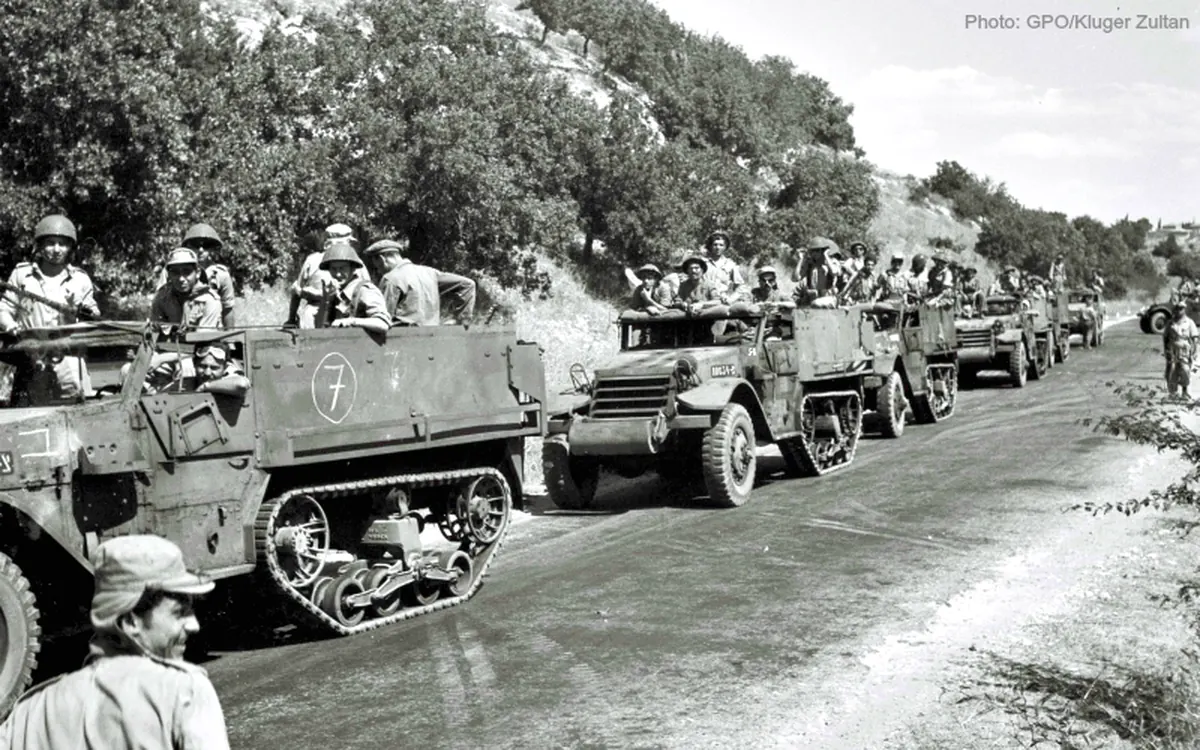
This phase is known as the Battle of the Roads, though, because by and large the Jews were able to defend their settlements and generally maintained the upper hand in the urban areas, except where they were totally boxed out in terms of population. But the vast majority of the mandate roads ran through areas heavily populated by the Arabs. And so by March, the Arab forces held almost every major road in the country. The route to Jerusalem was blocked. Many of the settlements in the Judean hills and the Galilee and the Negev were cut off. And resupply convoys were the constant target of attacks. and this is fighting of a particularly vicious type sniping on the roads, roadblock ambushes, bombs in public spaces murder and mayhem it's the brutality of two people bent on possessing the same land and it's going to give rise to some of the strongest narrative elements of our current conflict as well as many of its deepest scars not to mention a lot of the, well I don't know if I want to call them successful but a lot of the tactics And perhaps the best-known incident of the battle for the roads was a failed attempt to break the siege of Gush Etzion, the Etzion bloch south of Jerusalem.
It's known as the Walk of the 35, the Lamed Hay. On this, the 26th day of Shabbat 5704, in the fifth year of the Second World War, at the close of the first year of our occupation of this site, We, sellers of Kfutzat Avraham, of Hapoel Hamizrachi, are planting fruit and forest trees in Kfar Etzion, observing the injunction of the Torah, when you come to the land you shall plant, because he did not create it for chaos, he created it for habitation. The trees we're planting today are a symbol, a symbol of the path that we tread as pioneers of our people, a symbol of our covenant with the soil of our homeland. For man is like under the tree of the field, The roots these trees will strike deep into the soil will always remind us to engage in the practical work of construction.
The lofty treetops will inspire us with high thoughts to know our Creator. Two thousand years ago, these slopes reverberated with the sounds of a multitude of trees in life that teemed all about. Today, they stand bleak and desolate. We have taken this oath upon settling in Kfar Etzion. We shall not rest nor know peace until we cast off the shame of barrenness from these highlands, until we shall cover them with fruit and forest trees, which together shall give forth a song of rebirth, which the prophet Ezekiel foresaw. But ye, O mountains of Israel, ye shall shoot forth your branches and yield your fruit to my people of Israel, for they are at hand to come. For behold, I am for you, and I will turn unto you, and ye shall be tilled and sown, and I will multiply men upon you, all the house of Israel, even all of it, and the cities shall be inhabited and the wastes shall be builded.
Blessed be he who has kept us alive, sustained us, and enabled us to see this time. Kibbutz of Kavaretzion is the original settlement of Gush Etzion, the Etzion block, a group of kibbutzin, collective agricultural communities, that was built along the Bethlehem-Hevron road, which ran south from Jerusalem on the rich and strategic hills of Judah. And the reading of the plantation scroll that I just read part of, marked a momentous day. Not just because the 1943 establishment of a new Jewish community in the land of Israel was a powerful expression of light in the face of the Nazi darkness, but also because the kibbutz had seen two previous attempts to strike root in 1927 and 1935, and they'd been thwarted by Arab violence.
But this time, they stuck and they knew they had. And over the next four years, they were joined by more kibbutzim, until the population of the Etzion bloc was some 470 at the time of the 1947 partition vote. A vote which, by the way, placed them outside the proposed borders of the new Jewish state. But what I just read you is more than a speech dedicating a new settlement. No matter how hard-fought the process, you heard the tone. It's the echoes of a relationship between Am Yisrael and God through sacred texts, that we haven't heard basically since Rebbe Akiva back, the failed revolt of Bar Kokhba back in the second century. To the author of the Plantation Scroll, and those listening to its declaration, this wasn't just an act of settlement on the land, it's the fulfillment of prophecy.
And what you hear when you hear that scroll is inspired exegesis. The author of the Plantation Scroll didn't claim to be a prophet, but he did assert that the founding of Faryat Zion was the fulfillment of Ezekiel's prophecy. That's about as inspired an interpretation of word you're going to get. And this type of historical interpretation remains fairly rare at this stage of our story since Rebbe Akiva, despite the downright biblical proportions of the events that have been happening around us. So just keep in mind this power of inspired exegesis, the Pesha documents, if you're interested in the Dead Sea Scrolls. Because in 1967, when religious Zionism finally breaks out of the conventional box that it had squeezed itself into, we're going to see its power in full.
And of course, the return to the settlements of the Etzion Bloc will be central to that awakening of the so-called settlement movement. But that's a story that lies much further ahead. For now, the siege of the Etzion Bloc was one of the opening moves of the Battle of the Rhodes. and in the days after the UN vote, the Arabs immediately began to cut the communities off. As December progressed, the Etzion bloc became completely isolated. It was surrounded by hostile Arab villages and there was no easy route of retreat. Everyone there knew that defeat in the coming battle wouldn't just cost them their homes, it would likely cost them their lives. But retreat was not an option. As 1948 dawned, the Haganah's motto became no Jewish outpost must be abandoned.
Every settlement was seen as critical. And the position of these kibbutzim on the southern flank of Jerusalem made them even more important. They were essential to the Haganah's plans for defending the city in the war that they knew was soon to come. So on January 5th, the mothers and children were evacuated from the block. And the remaining residents, reinforced by Haganah units that snuck in, dug in for the fight to come. 400 men and 100 women awaiting the coming assault. less than two weeks later Arab forces led by Jayash al-Jihad al-Muqadis the army of the holy war the proxy army of our old friend Haj Amin al-Husseini former Mufti of Jerusalem, Nazi collaborator and now fugitive from British justice his army closed in on the Gush and it became nearly a thousand men mustered for a simultaneous assault on Kfar Zion, Masuat Yitraq and Ein Tzughrim it would actually be the largest Arab attack on any Jewish settlement to date.
On the night of January 14th, the surrounding hillsides erupted in smoke and flame as the opening volley began, and the fighting raged through the night. But, despite the fearsome odds, when the smoke cleared, the defenders had carried the day. But, they'd exhausted their supplies and ammunition. Nevertheless, their houses still stood, and so victory was theirs. Everyone in the Etzion bloch knew that another wave of attackers was just a matter of time. And they knew that without immediate resupplies, there was no way they'd hold out. But every paved road between Jerusalem and Guch Hestion was in the hands of the besieging Arab forces. So therefore, when they sent their message out, a desperate plea for resupply and support, the response was a foot convoy.
On January 16, 1948, 1948, a group of 38 men from the Haganah's Machleket Ahar, that's the mountain platoon, set out on foot to deliver supplies to the besieged kibbutzim of the Gush. Carrying massive packs and taking a winding route in order to avoid detection, there was a British police fort that actually dominated the hills immediately above their outset point. The unit set out in the dark of night from the settlement of Khartuv. And in the darkness, one man soon sprained his ankle. He was sent back with two of his companions by Commander Dani Hass, and now they were 35. What happened next has been reconstructed from British and Arab reports and has become the stuff of legends. And I mean that. I've sent my oldest daughter off to join with tens of thousands of other teenagers from B'nai Kiva, her youth movement, to hike the path of the Laman Hay, the 35, in the dark, to follow the trail of these 35 heroes, and, of course, to be taught their message about life and death.
so delayed by injury the light of dawn actually caught the unit somewhere between the villages of Jabba and Sarif and they were quickly discovered by two Arab women out gathering wood in the pre-dawn light they fled before the forward scouts could grab them and they sounded the alarm as they ran the rest as they say is history masses of armed villagers reinforced by hundreds of Arabs from a nearby training base gathered around the hill on which the 35 took their stand known today as Battle Hill. The men of the mountain platoon battled the attackers into the afternoon until they ran out of ammunition. Some die, they say, with rocks in their hands. And the first rumors of the fate of the 35 that reached the ears of the Jews was actually a phone conversation intercepted by the Irgun.
It spoke of fighting in which many were killed and some wounded, but well into the next day, no one was really sure what had happened to the 35. When wounded Arabs began arriving in Hevron and the word of a major battle spread, the British remembered that they were actually in charge of law and order in this region and dispatched a platoon of the Royal Sussex Regiment to investigate what exactly was going on. The regiment, after threatening the village Mokhtars into cooperation, was led to Battle Hill, and there they found the bodies of the 35, mutilated beyond recognition. You know, describing what they saw, the February 2nd issue of Time magazine read, The picture was reminiscent of the terrible black and white mass of photographs that had illustrated the war and the war crimes trials.
It also recalled the fierce word pictures of how Old Testament warriors dealt with their enemies. It showed the mutilated bodies of 35 young Haganah fighters who had been ambushed by Arabs at Kfar Etzion in the lonely hills of Hevron. Now it took all the political and military force the British were willing to muster, but on Monday, January 19, 1948, a mass grave was dug in the cemetery of Kvaretzion, and the 35 were laid to rest. Rav Aryeh Levine led the service. Now there's, of course, more to the story, but there are two postscripts I actually want to tack on to the event, each of which in its own way contributes to making the story of the Lamed Hay even more powerful than the events of their lives.
The first one occurred on February 18th, when Palmach commander Yitzhak Tzadeh published an article in the newspaper Al Hamishmar glorifying the squad of 35. Tzadeh wrote, Arabs tell with awesome admiration about the supreme heroism of those who fell in battle. They also tell why the evil bethel the fighters. An old Arab man who met them on the way and to whom they did no harm sounded the alarm in his village and the surrounding villages. There is no doubt that armed Arabs would not behave thus if they met a Jew on the road. Our fighters are not only brave souls, they are also dear souls. They are very humane. It's a story that originated with Devon Ben-Gurion who had told it first when eulogizing the Lamed Hay in an address to his political party the Mapai a few days after their murder.
Ben-Gurim himself claimed that its source was the testimony of an Arab who was interrogated shortly after the battle. And so, two stories of the death of the 35 began to circulate widely in the Yishuv, and they're still being told today. The first was the mutilation of their bodies. Hearing it, anyone who was of a certain age could not fail to recall the horror of the Hevron massacre almost 20 years before, when former neighbors had gouged out the eyes and driven nails through the skulls of Jews in Hevron. And the message was clear. The enemy is a barbarian and there's no hope for mercy. What we face is victory or a fate worse than death. The second story of the Lamed Hay that became part of the lore of Israel was the fatal nobility of releasing a captured old Arab man and thereby risking their lives rather than harming an innocent.
And here the message is clear as well. Our soldiers are fearless, powerful, and above all, pure. And the discourse around purity of arms is something we encountered before Go back to episode 33 where we discuss the evolution of the term in the context of the debate between the Jewish underground militias and how to respond to the rising violence of the Arab revolt in the 30s. But for now, just recall that the term tohar haneshek, purity of arms, was coined by the labor Zionists to draw a clear distinction between the types of military action used by the Haganah, their military arm, and those used by the Irgun and the Lehi. Meaning that everyone but us, the Haganah, are immoral, stop-at-nothing terrorists while we are soldiers whose arms are pure.
And as we move deeper into an even more serious round of war, Tohar and Neshach, the purity of arms, is going to become the central moral organizing principle of the Israeli army in the making as the Independence War breaks out. and is meant to distinguish them from both the Arabs and the so-called ideological deviance of the right. And the noble death of the 35, something that shook the entire Yashuv to its core, is going to add a powerful emotional driver to the acceptance of this principle as supreme, and, by the way, of those as supreme who adhere to this principle. And that's true to this very day. I mean, you just have to read the news to see how important it is to Israel that we have the most moral army in the world.
And you have to picture the tens of thousands of teenagers in my daughter's youth group sitting in the dark on Battle Hill, hearing about the nobility of their morals and the horror of their death. Eighty percent of those kids will be in the army within three or four years. And so it's clear that the story has far more impact than perhaps what amounts to a failed attempt to break the siege of the Etzion bloc. And there's one more wrinkle. According to many contemporary historians, the old Arab man never existed. No one's exactly sure where Ben-Gurion got the story from, but it seems, as I told you, that the 35 were discovered by two women out collecting wood. But it doesn't matter. because it was the story that Yitzhak Sadeh told welded to the heroic death of the 35 and, of course, the horrid end that placed purity of arms at the center stage of the IDF's moral doctrine and therefore a large part of Israeli society to this very day.
So the other postscript to the story is, of course, the end of the siege. Gush Etzion held out for four more months as the Battle of the Roads raged throughout the land of Israel until finally, hopelessly surrounded and starved to arms and supplies, it fell to an all-out assault by Jordan's Arab Legion on May 14, 1948, the day that the state was declared. Now, legionnaires were an army, not a local militia, and they were British-trained. Nonetheless, even the conflicting reports of what happened at the end of the siege agree that among the 127 dead of the defenders were many prisoners who had surrendered before they were shot. The legionnaires rooted and razed all the houses and buildings of the entire Etzion bloc.
And the order was clear, leave not one stone upon another to prevent the Jews from ever returning. And indeed, the hills of Yudah remained free of Jews for almost 20 years. During those years, if you know the story, the few survivors and their children of the Etzion bloc took to gathering on the Israeli side of the border to gaze in longing at that land where they had sought to cast off the shame of barrenness. And that longing for the land that they had tried to cover with fruit and forestries, which they believed was even now giving forth a song of rebirth, is going to help shape the story of the soon-to-be-born state just as much as the martyrdom and memory of the Holy 35. I just want to end this section with the final stanza of the poem, Behold Our Bodies, written by the most respected Israeli poet of the generation of 48, Chaim Guri, a man who did more to put the institution of martyrdom at the center of Israeli culture, perhaps, than any other artist.
Behold, our bodies are laid in a long, long line. We do not breathe. But the wind is now in the hills, the wind breathes, morning breaks, and the shining dew sings. We shall return again, we shall meet, we shall return as scarlet flowers. You will know us at once, our silent mountain platoon. Then we shall blossom, when the last shot has been silenced in the hills. So when I was growing up, I received a good Zionist education. And I don't mean the cheap propaganda and sloganeering that passes for public relations today. I'm talking about a real in-depth look at the history of the last 150 years and the great merit of walking the length and breadth of the land while learning it. So the question of what effective Zionist education looks like today is a complicated one.
By the by, it's one I'm quite committed to. You can shoot me an email if you want to think it through, or if you're actually serious about it, you can book a consulting session and we can do some real work together. But for now, as part of that education, I was taught that the origin of the Palestinian refugees was the order which they received from their very own leadership and that of the armies invading to get out of the way so he can push the Jews into the sea. And as I got older, I encountered some of the competing narratives to Zionism. I discovered that there are many people, lo and behold, who say such a thing never happened, but rather that the origin of these refugees was the ethnic cleansing by the Zionist army.
And as I've gotten older still, I've learned that the truth, as always, lies somewhere in the middle. It was during the War of the Roads that the first wave of Arabs fled the land of Israel. The early victories in the battle for the Roads may have boosted the morale among Arab combatants, but it appears that the mood in the months following UN Resolution 181 wasn't shared by their politicians or civilian population. As the fighting intensified as the winter deepened, the UN-Palestine Commission, set up to implement 181, reported, quote, panic continues to increase throughout the Arab middle classes. and there is a steady exodus of those who can afford to leave the country. This was the first wave.
It was the middle and upper classes who had the resources to relocate that were the first to flee. Among them, by the way, the families of local governors and most of the members of the Arab Higher Committee. It was a pattern that had been established already in the Arab Revolt of 36-39, and they had every reason to believe that now, as then, they'd be able to return when the situation calmed down. After all, they could afford it. The estimates are that between December 1947 and January 1948, perhaps as many 75,000 fled, and that by the end of March, the number had grown toward 100,000. Now, the mass flight of the economic and political elite was a huge blow to the fabric of Arab society in the land of Israel.
Schools, businesses, hospitals all shut down. The resulting social disruption, along with the example set by the leadership, is what sets the stage for a second, much larger wave that will occur with the invasion of the Arab armies and the outbreak of formal war. Now, we're going to discuss that full picture in a coming episode. But for now, my focus is on the relationship between events and stories and how, with the events of biblical proportion, as we call them, the power of story so often proves much greater than the power of the events themselves. And if we want to understand how that principle applies to the emergence of the refugee issue in the midst of this first Civil War phase of the struggle for independence, then we couldn't choose a better story than that of dear Yassin.
The brutality of the battle for the Rhodes only increased as the winter of 1948 moved towards spring, and the siege of Jerusalem was growing desperate. The Haganah commanders actually feared food riots if it wasn't broken soon. And so on April 5, 1948, Operation Nachshon was launched. Its immediate aim was to break the siege by opening the Tel Aviv-Jerusalem Road, and that meant conquering the Arab villages, mostly to the south, but really on both sides of that road. But the operation didn't exist in a vacuum. It was also part of a larger shift in approach on behalf of the Jewish armed forces who are now completely organized into the Haganah, which became the Tzavah Haganah L'Israel, the Israel Defense Forces.
This was the opening of the first phase of the Haganah's Plan Dalet. That's Plan D. The plan was formulated by the political and military leadership of the Haganah under the guidance of Ben-Gurion and likely General Yigal Yadin. And its objective was quite simple. Quote, To gain control of the areas of the Hebrew state and defend its borders. It also aimed to gain control of the areas of Jewish settlement and concentration that are outside the borders that have been assigned by 181, and the goal was to defend against what was called regular, semi-regular, and small forces operating from bases outside or inside the state. In other words, what we have here is a document that represents the Haganah's shift into a true military posture as they prepared to move from civil war to international war.
and Operation Nachshon was the first step. So when about 70 Irgun fighters assembled at the Eitz Chaim base at the entrance to Jerusalem on Thursday, April 8th, the excitement was high. It was the first time that so large a number of the underground fighters had gathered openly without fear of British policemen or soldiers, which was a major change unto itself. And the atmosphere was optimistic because after four months of a defensive posture, the moment for retaliation was finally in sight. They were joined by dozens of Lechi fighters, and furthermore, they were there at the behest of the Haganah, which had given them a specific assignment in Operation Nachshon. The fact that two underground movements were acting together, in coordination with the Haganah command, enhanced the sense that a fundamental change had come about.
And in fact, the password chosen for the day reflects it. It was Achdut Lohemet, fighting solidarity. Mordechai Rangan, commander of the Irgun in Jerusalem, opened the meeting of his men by explaining that their target was the village of Deryasin and that their objectives in taking it were twofold. The first was military. Deryasin occupied an important strategic position that dominated the western half of Jerusalem, and they were meant to liberate that part of Jerusalem from the military threat, emanating from what was now a fortified village. The second objective was political. This was no simple retaliation operation. like the Irgun had known before, it was an act of conquest with the aim of holding on to territory.
The entire world, in Ra'anon's eyes, must know that the Jews were not going to give up Jerusalem despite UN Resolution 181 that had placed the city under international rule. Now, according to Irgun accounts, Ra'anon also added that the operation was an act of conquest, a military operation, and not a reprisal. And therefore, unlike previous doctrine, the fighters were to avoid inflicting needless injury. In particular, he cautioned against harming old people, women, and children. Now at 2 a.m., the Irgun fighters, under the command of Ben Sion Cohen, also known as Giora, moved into the Wadi Riverbed below Dir Yassin. The squads began to climb slowly up the terrace slope above them. At the same time, the Leche unit had assembled at Givat Shul and proceeded from there down the main road toward the target.
Their force was advancing behind an armored car that preceded them along the road into the center of the village. Now, in an unusual twist to a military operation, the armored car was actually equipped with a loudspeaker meant to inform the inhabitants of Deryasin that the village was all but surrounded, that only a route toward Ainkarm was left open, and their choice was clear. Flee, surrender, or fight. Close to 445, the village guards spotted the suspicious movement on the road. One of them called out in Arabic, Mahmoud? But an Irgun fighter thought that someone had shouted out the password, and responded with the second half of the password. In Hebrew, The guards opened fire, and the battle began.
As the Irgun men were trying to climb the wadi side, the armored car was stopped by a trench 30 meters from the entrance to the village, and it seems that its ultimatum was left unheard by any of the inhabitants. and the situation deteriorated from here. Not only didn't the villagers flee, every house became an armed fortress and fierce house-to-house fighting began. Many of the attackers from the Lechi were injured in the first onslaught, including a number of their commanders that had been advancing at the head of the men. And the Irgun force that had tried to enter Diracin from the riverbed below was pinned down at the edge of the village under heavy fire. After two hours of fierce hand-to-hand combat, they hadn't even reached the center of the village and the Lehi was plowing their way through the main road.
In desperation, the Irgun fighters sent a courier back to base, calling for evacuation of the wounded, for explosive reinforcements, perhaps even for a retreat. But once the explosives, TNT, arrived, they began to dynamite the houses at the edge of the village to allow their advance toward the center throwing grenades into many others But still the wounded piled up and the message from the Lechi was that the center held Finally, a Megin David ambulance arrived to begin evacuating the Jewish wounded, and after it came a Palmach force, two armored cars with two-inch mortars and large submachine guns. And as the fighters said later, in the last six minutes of the battle, that did more than we could in the last six hours.
Their assault on the Mukhtar's house with the mortars ended the battle in moments. But the real story of Deryasin begins after the fight. Because Deryasin is remembered not as a key battle in the effort by the Jewish armies to gain control over critical strategic ground, but as a cruel massacre perpetrated by bloodthirsty rites. the Jerusalem commander of Shai the Haganaz intelligence unit reported after seeing the site the conquest of the village was carried out with great cruelty whole families, women, old people, children were killed and there were piles of dead he even reported rumors of rape by the Irgon soldiers and the reports change from day to day the number of dead, the tales of cruel and unusual behavior even in the documentary trail grow with each telling And it's noteworthy by the by that this was the commander of the Haganah intelligence unit, Shai, which only a few years ago had imprisoned, beaten, and turned over the men of the Yirgun to the British.
The Haganah leadership immediately condemned what happened at Diryassin as a massacre, while moving swiftly to hide the role that the Palmach played in deciding the battle. The Jewish agency actually sent a formal letter of apology and explanation to King Hussein of Transjordan as their representative of the Palestinian Arabs. Overnight, in the midst of a conflict marked by extraordinary cruelty, among Jews, Deryasim became the one atrocity about which it was permissible to write and speak. And when you look at the early reports, the frame is always the same. It was the Irgun, the men of Menachem Begin, who in their bloodthirsty fierceness fierceness perpetrated this crime. In fact, the name of Diyasin became instrumental in keeping Beginis and his party out of the political mainstream in the years ahead in a way in which the Lehi mostly did not suffer.
But the question is, did it happen? Was there a massacre at Diyasin? You know, if you have been following the more recent decade of the Arab-Israeli conflict, you might remember the massacre of Jenin, or so-called, back in 2002, 2003 in Operation Defensive Shield. I had a good friend who was there who told me what it was like to dynamite their way from house to house to avoid the Hamas buoy traps. And he told me with absolute certainty there was no massacre. But the whole world thought it was true. So here, that was a few years ago. What about 1948? By the time the War of Independence erupts in May, participants, journalists, observers of the Deerocene were all claiming that as many as 254 villagers were killed on that day.
Now you should know, recent research by both Arabs and Jews suggests that the number was actually more like 100 or 110, the majority of whom were killed in house-to-house fighting. So how does that number more than double closer to the attack? Well, everyone had an incentive to inflate the figures. The Haganah wanted to inflate the figures in order to blacken the name of the Irgun and the Lehi for the reasons that we've already mentioned and we know from many episodes back. The Irgun and the Lehi wanted to inflate the numbers in order to strike fear in the hearts of the Arabs so that they would either break or flee. And the Palestinian Arabs had intended to inflate the numbers in order to blacken the names of the Jews and muster the support of the surrounding Arab states who are right now wavering over whether to intervene.
Hussain Khalidi was the senior Arab authority in 1948 in Jerusalem. and at the time he said we must make the most of this. In a 1998 interview, his assistant, Hazim Nusaiba, reported that Khalidi said, we should give this the utmost propaganda possible because the Arab countries apparently are not interested in assisting us and we are facing a catastrophe. So we are forced to give a picture, not what is actually happening, but we had to exaggerate. And in fact, on that level he succeeded. Diryassin did indeed become a rallying cry for the Arab invaders. And when the Etzion bloc finally fell and many of its defenders were murdered with their hands up, the villagers who shot them down were said to be crying, Diryassin, Diryassin.
But Khalidi's distortion of the facts not only failed to prevent the catastrophe he feared, it helped to fuel it. Because ultimately, the story of the Battle of Diryassin was summed up in the following way by the history of the War of Independence as a document prepared by the History Division of the IDF's general staff. Quote, The Deryasin Affair was publicized throughout the world as the Deryasin Massacre, causing great harm to the reputation of the Yishuv. All the Arab propaganda channels disseminated the story at the time and continued to do so to the present day. But the battle indubitably served to expedite the collapse of the Arab hinterland in the period which followed. More than the deed itself, This was achieved by the publicity it received from Arab spokesmen.
They wanted to demonstrate to their people the savagery of the Jews and to instill in them a spirit of religious fervor. In fact, however, they intimidated and alarmed them. They themselves now admit their mistake. In other words, we can debate how many people died at Yassin and what exactly happened on the battlefield and off. We could talk about morality in war and the different political systems and visions that go into shaping it. But everyone agrees on the results of the battle. The Haganah wanted to besmirch their political opponents. The Irgun and Alehi wanted to terrorize their enemies, and the Arabs aimed to evoke empathy for their cause. And because of this, the story of Diri Yassin was told, repeated, exaggerated in the Jewish, Arab, and world media for weeks, more so than any other story of the spring of 1948.
And in truth, by the way, the battle over the story of Diri Yassin is still being told, exaggerated, and debated today. Go check it out on Wikipedia. But in real time, the result of the inflation of the story was a deep demoralization of the Palestinian Arabs, and it became a major factor that drove the massive flight out of the country in the weeks and months ahead. so much so that the IDF's intelligence service later concluded that the story of Deryasin was, quote, a decisive, accelerating factor in the Arab exodus from the land of Israel. There are so many more stories that I could tell, but I have to stop. I'm actually curious how the few that I've shared here have landed with you. Send me your reactions on Facebook at the Jewish Story Podcast or to my email, robmikeathejewishstory.co or robmikefoyer at gmail.
We'll talk. But for now, I just want to reiterate what I see to be the major lesson here. 1948 was a year of biblical proportions. The war, the rise of a Jewish state, the birth of the Palestinian refugee issue. These are world-shaping events. But the difference between biblical events and world-shaping events is in the power of how the story is told. I have this discussion with my students all the time. No matter what your theology about the authorship of the Bible and its historicity, we can all agree that what you're looking at there is how the story got told, and thus, how it impacts the world. I want to leave you with this thought. When we're approaching events such as those of 1948, I believe our responsibility is not just an honest look at what really happened, but also an honest approach to how the story shapes our world.
Basically, in my eyes, we can choose between being prophets, historians, or sages. Now, prophets aim to speak divine reality. And though in our generation we're no longer privy to such deep exposure of God's plan, there is always what we heard in the plantation scroll, inspired exegesis. There's always that opportunity to see the words of the prophets being fulfilled in our days. And it's a powerful and important and intoxicating approach to the world. And frankly, can be somewhat dangerous. I sometimes go up to the Binyamin Visitor Center at the heart of southern Shomron, the West Bank, the occupied territories, not interested in what you call it, just want to know where it is. And I often think of this idea.
The Visitor Center there is the home of the Pisagot Winery, which is a truly beautiful place, and I highly recommend the wines. But on the wall next to the entrance is a plaque with the last two lines of the book of Amos. It says, I will restore my people Israel. They shall rebuild ruined cities and inhabit them. They shall plant vineyards and drink their wine. They shall till gardens and eat their fruits. Beautiful words and true. All you have to do is look out the huge plate glass windows and see the words of the prophets coming to fruition before your very eyes. But if you want to understand the power and problematics of the current political complexity of the state of Israel, you have to read the next line.
And I will plant them upon their soil, never more to be uprooted from the soil I have given them, said the Lord your God. So I guess I know which party God will be voting for in the coming election. So we could choose to be prophets or we could choose to be historians and take the critical deconstructionist approach to our national stories. I see the intellectual and emotional satisfaction that progressive academics take in bursting the bubble of national mythology kind of like a thrill of debunking the tooth fairy on a far greater scale. But whatever pleasure you may get out of such a deconstruction, be careful you don't do more damage than you can handle. And never forget the warning from Ernest Renan, that great 19th century giant of thought in history and nationalism and so many other things.
He says, So in a world which is still far from kind and gentle, the power and protection we receive from our myths and what rallies around them should not be thrown away lightly, sacrificed on the altar of historical objectivity. So we could be prophets, we could be historians, or we could choose to be sages in our relationship to the events of 1948. To the wise, the facts always matter, because without them, you have no real story. but where the story is headed is what helps you put those facts together in something which is coherent so we can choose to tell a story of the facts today that will put us in any number of places one of them is in right relation to the past and this is of course as you know what will get us to the future but prophet, historian or sage there is a critical ingredient in how we relate to the events of 48 at least in my eyes we have to have a healthy dose of humility.
How could we not, when we're experiencing not just the events, but the documentation of events, whose consequences may not be known for centuries to come? And I just want to say, with a thousand apologies for the delay, that this episode of The Jewish Story is dedicated in loving memory of friend, holy teacher, Harav Abetzvi, ben Chaim Kaumann. May his neshama merit to rest in the highest of places, and may as light reach his students wherever they are. And if you want to sponsor an episode of The Jewish Story, you can be in touch with me on Rob and Mike Foyer at Gmail, and I'll give you the details. I just want to thank a few folks. And before I do it, actually, I want to do a redirect. Go check out all the new great digital platforms that the launch of The Jewish Story brand has brought into the world.
That's www.jewishstory.co.co or Jewish Story Podcast on Facebook. You can find the Jewish Story on iTunes. You can even find it on Twitter. I'm wavering there. If you want me there, tweet away. I'd also like to really thank the people who give their hard-earned money to help make this show happen, to get it free and widely available. I want to encourage you to join them. Go to jewishstory.co in the upper right-hand corner. You'll see a button that says Be a Patron. You can click on through for some per-podcast support. I also want to thank the Land of Israel Network. that's at thelandofisrael.com for creating a platform that allows me to reach so many amazing people I want to thank the Pages Institute P-A-R-D-E-S dot org dot I-L for building an educational institution that allows me to teach so many wonderful Jews and I want to thank you for listening I'm Rav Mike Hoyer and this is The Jewish Story
More from Season 2
S2:E37 - Survivalist Zionism: How the Zionist Struggle Looked After the Holocaust
Once World War Two ended all the promises of the allies were put to test - would they find a solution to the Jewish problem now that the...
Play Episode