
TJS S2E40: Made in 1948 - Three historic decisions that shaped the birth of modern-day Israel
About this episode
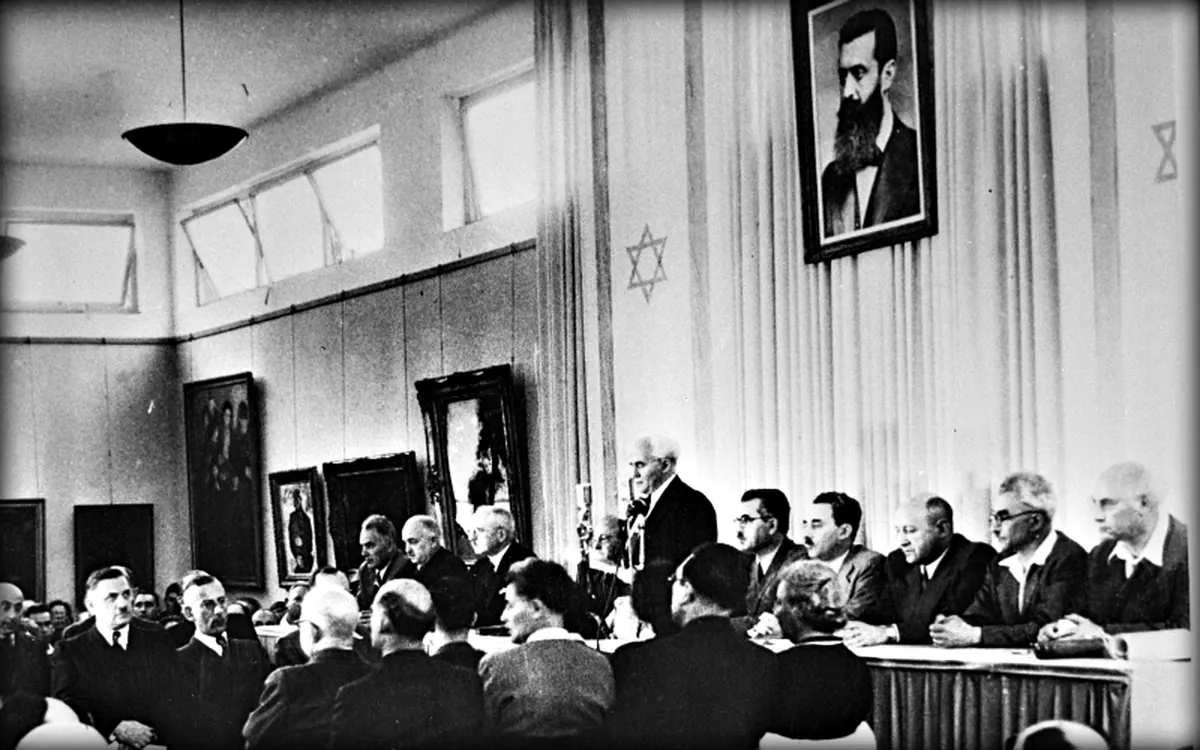
Decision, says Paul Tillich, is a risk rooted in the courage of being free. This last episode of season two looks at three months after the Declaration of Independence, May through July 1948, and the decisions that still shape the state. There is a great difference between declaring a state, which takes an instant, and birthing one, which is a prolonged and bloody process. The declaration itself on May 14, 1948 in the Tel Aviv Museum was low-key, suppressed for fear the British or the Arabs would spoil it, broadcast live on the first transmission of Kol Yisrael, and over in under an hour since they had a war to fight and Shabbat coming. But the birth traces back to the People's Administration meeting on May 12, two days before, where ten Jews made decisions that still define the state. The reports were grim: Sharett brought George Marshall's warning that America offered no help and now pushed for a ceasefire and continued trusteeship, which Sharett read as a yellow light not a red one; Golda, smuggled into Amman dressed as a peasant, could not keep Abdullah out of the war; and Yigal Yadin gave the forces fifty-fifty odds against the coming invasion. A civil war among Jews also loomed, with Begin warning he would back the government unless it gave in to threats.
The decision was never whether to declare, which the force of events had settled. The meeting gave Israel its final name by a vote of seven to three, and shaped the Declaration, from which the word democratic was deliberately removed, so Ben-Gurion declared a Jewish state and not a Jewish and democratic one, a tension that still strains the social fabric. But the more influential choice was about borders. The jurists Pinchas Rosen and Behor Shalom Shitrit argued that a state must define its scope within the framework of the partition plan; Ben-Gurion refused, pointing to the American Declaration that names no borders and arguing that the UN by doing nothing and the Arabs by making war had torn up the map of 181. Why commit, he asked, when the western Galilee and the corridor to Jerusalem could become part of the state if they had sufficient force. He called a vote, five to four, resolved not to include the borders, and they have been unresolved ever since, set by the fortunes of war rather than by treaty, a pattern that still largely holds.
Certain elements of the war must be known to understand the state born from it. In human terms it was Israel's most devastating war, 6,373 dead before the final ceasefire, almost one percent of the Yishuv, only three years after the Shoah, and the two losses together left an indelible mark and a clarity around life and death that dwarfed other moral questions. The war created the IDF, more than a people's army, the greatest tool of social construction Israel knows. Ordinance Number 4 of May 26, 1948 named it the Defense Army of Israel, placing Ben-Gurion's Haganah at its core so that we are the state, casting the struggle as purely defensive, demanding an oath to the provisional government so that military power is subordinate to political authority, and forbidding any armed force outside it, since by Max Weber's definition a state holds the monopoly on the legitimate use of force. That meant eliminating the undergrounds: the Lehi dissolved quietly, and the Palmach, its own elite army dominated by Mapam, was broken when Ben-Gurion threatened to quit mid-war unless its generals were removed, the origin of the assumption of a secular Ashkenazi elite leading the state.
The second decision was the refugees. The war unfolded, the Battle of the Roads won, the invasion by Egypt, Syria, Jordan and Iraq halted at Degania, Yad Mordechai and the edge of new Jerusalem, and a UN truce came into effect June 11. During it the provisional government met on June 16 to discuss the hundreds of thousands already uprooted, and whether to bar their return. The debate set Ben-Gurion's Mapai against the far-left Mapam, which believed in coexistence and supported return at war's end; Ben-Gurion opposed its idealism with pragmatism, holding that survival dwarfed all other moral questions, and cited the ongoing expulsion of some twelve to fourteen million Germans from Eastern Europe as precedent, the very reason a clause on forced transfer was dropped from the 1948 Genocide Convention. The cabinet decided to bar the return, at least for the duration, a clause added to placate Mapam but treated as a formality since the Haganah reported 390,000 had already fled. When the IDF went on the offensive, Operation Danny took Lydda and Ramla, towns that threatened Tel Aviv and the Jerusalem road; the attack was designed to induce flight, and after renewed fighting and a wave of sniping left some 250 dead in Lydda, Ben-Gurion made a dismissive gesture and said garish otam, expel them, and the inhabitants, having endured battle, abandonment and in Lydda a massacre, were driven out, the heart of the roughly 700,000 who left.
The third decision was the Altalena. On June 20, during the first truce that forbade importing arms, the Irgun's arms ship reached the coast with over nine hundred men and a great cargo of weapons. Begin, having signed the agreement folding the Irgun into the IDF with Jabotinsky's own pen, asked that twenty percent go to the Jerusalem battalion, which Ben-Gurion granted, but his request that the rest go to the incorporated Irgun battalions was read as building an army within an army, a threat to the monopoly on force. The government resolved to use force; fighting broke out at Kfar Vitkin and then on the Tel Aviv beach, where the ship was shelled and set ablaze, sixteen Irgun and three IDF dead, Rabin among the commanders under orders that, he later admitted, included killing Begin if the chance arose. But the decision that in Rav Mike's eyes still defines the state, or need not, is Begin's: in the wake of the killings, with Tel Aviv on the edge of civil war, he reached the Irgun's secret transmitter, called the affair a crime and an act of folly, wept, and pleaded with his supporters not to answer with vengeance, choosing tears over blood, far better one Jew shed tears than many weep over graves. The three decisions, borders set by war, the refugees barred, and the Altalena held back from civil war, are the ground on which season three will unfold, and Begin's plea that a democratic decision never be defied by force carries the people forward from strength to strength.
Key ideas
- Declaring a state takes an instant; birthing one is prolonged and bloody, and the May 12, 1948 meeting made the decisions that still define Israel.
- Ben-Gurion carried a five-to-four vote not to declare borders, so they are set by the fortunes of war rather than by treaty, a pattern that still holds.
- The IDF was founded as the Defense Army of Israel, the state's monopoly on force, which meant breaking the Palmach and dissolving the undergrounds.
- The June 16 cabinet barred the refugees' return; at Lydda and Ramla, Operation Danny's expulsion was the heart of the roughly 700,000 who left.
- The war cost almost one percent of the Yishuv three years after the Shoah, giving a clarity around life and death that dwarfed other moral questions.
- At the Altalena, Ben-Gurion fired to assert the monopoly on force, but Begin's choice of tears over blood held the people back from civil war.
Chapters
- 0:00 Decision and the courage of being free
- 1:07 Declaration versus birth
- 2:13 The low-key declaration
- 4:25 The May 12 meeting; the grim reports
- 7:50 A civil war looms
- 10:01 No choice on independence; the name Israel
- 11:07 Democracy removed from the declaration
- 13:15 The decision not to declare borders
- 15:32 Ben-Gurion calls the vote, five to four
- 18:45 Borders set by war; Begin's independence speech
- 19:50 The war's cost; one percent of the Yishuv
- 21:58 The IDF: the Defense Army of Israel
- 23:01 An oath to the state; no army but one
- 25:11 Weber and the monopoly on force
- 27:23 Breaking the Palmach; the general's rule
- 29:30 The refugee issue; the outline of the war
- 32:43 The June 16 cabinet; Mapai against Mapam
- 35:57 Precedent: the expulsion of the Germans
- 38:15 Barring return; Operation Danny
- 42:36 The sniping; expel them
- 45:50 Alon's strategic logic
- 48:03 What exile looked like on the ground
- 49:07 The Altalena reaches shore
- 52:21 The shelling; sixteen dead
- 54:31 Alon defends the fire
- 56:42 Begin chooses tears over blood
- 60:57 Three decisions; from strength to strength
Who, where and when
People
David Ben-Gurion, Moshe Sharett, Golda Meir, Yigal Yadin, Menachem Begin, Pinchas Rosen, Behor Shalom Shitrit, Yigal Alon, Yitzhak Rabin, George Marshall, King Abdullah, Max Weber, Benny Morris, Paul Tillich
Places
The Tel Aviv Museum, Amman, Degania and Yad Mordechai, Lydda and Ramla, Kfar Vitkin, The Tel Aviv beach
Texts
The Declaration of Independence, Israel Defense Army Ordinance No. 4, Operation Danny orders, The 1948 Genocide Convention
When
May 12, 1948 CE: the People's Administration meets, May 14, 1948 CE: independence declared, May 26, 1948 CE: Ordinance No. 4, June 16, 1948 CE: the refugees barred, June 20, 1948 CE: the Altalena, July 12, 1948 CE: expel them
Read the transcript
Decision, says Paul Tillich, is a risk rooted in the courage of being free. Now I'm feeling pretty free right now and I've got the courage to take some risks because I've made a decision. This is the last episode of Season 2. I'm Rav Mike Foyer and this is The Jewish Story. Episode 40, The Decisions That Birthed the State and Still Shape It Today. You know, it seems to me that history offers decisive moments. And with all due respect to the titanic social, economic, political, and spiritual forces that have carried our story up to now and make up the world in which we live, there's a particular gvura exerted by individuals who find themselves in a moment of decision. And by gvura, I don't just mean it's literal translation of might.
I mean the traditional understanding of the power to draw lines. And decisions, by definition, always lie in the hands of an individual. Somebody has to pull the trigger. And that's what we have ahead of us here in the last episode of Season 2. We've got a few decisions to make and some to look at and the context within which they're embedded. And I have to admit, I'm feeling a little bit overwhelmed by the task of trying to finish two years of a project, So we'll just do the best we can by looking at the three months that come in the wake of the Declaration of Independence. May, June, and July of 1948. We're going to see, like I said, the decisions that still shape the state today. We're going to meet the characters who guide it in its process of formation.
And maybe, just maybe, we'll get some insight on how we arrive to where we are now. But before we talk about the present, let's think about the past. It's important to remember that there's a very big difference between the declaration of a state and its birth. I mean, all the first one really requires is an announcement, and therefore it can be done in an instant. No matter what comes afterwards, you pop up, you declare a state, and then come what may. The birth, however, is a product of powerful decisions and decisive actions over time. and like other births, it can be a difficult process, painful, bloody, and prolonged. Now, the official declaration of the State of Israel took place on May 14, 1948, at 4 p.m.
E'er Shabbat in the Tel Aviv Museum. And despite the historic nature of the moment, it was actually a very low-key event. The provisional government was a little bit concerned that the British might try to throw one last spoke in the wheel before they left, or maybe that the Arab armies, who were already sharpening their knives, would decide to invade a day early just to spoil the party. So they suppressed any publicity of the event. Invitations were sent out by messenger to a few hundred people, but the event was broadcast live as the first transmission of the Kol Yisrael radio station still broadcasting today. The crowd responded to Ben-Gurion's opening gavel with a spontaneous round of hatikvah of the rose.
And then, when the quiet came, Ben-Gurion announced, I shall now read to you the scroll of the establishment of the state, which has passed its first reading by the National Council. It took him all of 16 minutes for such a historic event. And then he called on Rabbi Yehuda Leib Maimon, head of the Mizrahi party, to recite the Shehecheyanu blessing, that blessing where we give thanks that God has given us the strength and allowed us to be at the moment where we find ourselves. It's something that has to be heard in order to be appreciated. But once Moshe Sharet, the last of the signatories, had done his job, the Israel Philharmonic Orchestra struck up another round of Hatikvah, after which Ben-Gurin again arose and declared, the state of Israel is established, this meeting is adjourned.
It took less than an hour, Sachaqo, altogether. I mean, after all, they had a war to go fight, not to mention Shabbat. But the birth process, as opposed to that declaration, is to some degree still ongoing. And we could stretch it as far back in the Jewish story as we really want, certainly to the three Roman Jewish wars where we saw the last vestiges of an independent commonwealth here in the land of Israel. And if we wanted to get existential, we could probably go back to the six days of creation. But for the purpose of our story now, and for understanding the state as it is today, I just want to reel back the process of birth to a meeting of the People's Administration on May 12th, two days before the Declaration of Independence.
Now, the administration was a proto-cabinet that had established, along with the People's Council, or the National Council, as I called it before, itself a proto-parliament, but ordered the Zionist executive a month earlier on April 12th, 1948. And the decisions that were made by these 10 Jews in this meeting in the lead up to Ben-Gurion's declaration really still shape our state today. Now, I can imagine when I think about it, it was a pretty tense group that gathered that Wednesday. They felt the full weight of history. They felt the full pressure of international diplomacy, and they knew that death was in the room. After all, the War of the Roads was already boiling over into regional conflict, and two of their members couldn't even attend because they were trapped in besieged Jerusalem.
But before they could make any decisions or really even have a discussion, first had to come the reports. Moshe Sharet, soon-to-be foreign minister and already de facto playing that role, had just come back from meetings in Washington, and he stepped forward to give his full account of the international diplomatic situation. His responsibility was to assess whether the world would recognize their state upon declaration, much less whether anyone would assist in its birth. And central to what he had to say were the words of the American Secretary of State George Marshall, given just a few days earlier. They weren't just words, they were a warning. He said there was no warrant to expect help from the United States, which had warned them of the grave risk which they were running.
At this point in the lead up to the declaration, America had backed down from the idea of partition that it had helped make happen, and they were now pushing for an immediate ceasefire, brokered by the United Nations, and an extension of what they were calling a UN trusteeship, meaning the continuation of the mandate. Nevertheless, Shari described George Marshall's sign as a yellow light, not red. I mean, after all, it was a warning, not a command. Next up was Golda Meirison, better known as Golda Meir, who spoke about how she'd been smuggled into Amman, dressed as an Arab peasant woman just a few days earlier. The purpose was a secret meeting with King Abdullah of Transjordan, whom she hoped to convince to stay out of the coming war.
But her words were not positive. She quoted him as saying, I'm very sorry, I deplore the coming bloodshed and destruction. Apparently not bad enough to stay out of it, though. Now, this was bad news. But unquestionably, the most disturbing report was that from the military chief, Yigal Yadin. Yadin was head of operations for the Haganah, that's why I'm searching for his name. And he would soon be the IDF's first chief of staff, and now he's just the military chief. His assessment of the situation on the ground was downright grim. Bottom line was he gave the forces marshaled under the Jews a 50-50 chance against the invasion that they all knew would be triggered the moment they declared independence. And when Ben-Gurion asked if it was then advisable to accept the ceasefire that the Americans were trying to broker, Yadin said yes, but only if they used it to prepare for the next round, because in his eyes, the future held only war.
This wasn't the only war that was causing concern in the room, because the fear of a civil war between Jews also clouded the atmosphere. Less than a week before their meeting, Menachem Begin, head of the Irgun, had published a warning to the People's Administration. Quote, The Hebrew government will be established. There is no maybe. It will rise. If the official leadership establishes a government, we will back it. But if the government gives in to the threats, our forces and the majority of the land's youth will back the free government that will grow from the underground. Now, these might sound like a lot of bluster and maybe empty words from an underground leader, but Behor Shalom Shittrit, who was the representative of the Svardim, the Middle Eastern Jews in the room, and in fact the only native-born Jew there, knew exactly what was going on, and he put it like this, We are alert to the street, and we know the mood there, and if we now seem to go soft and retreat from what the street hopes from us, we'll unleash war.
in the street. So there were clearly some decisions to be made. But I want to make something clear. Not over-declaring independence. There was no doubt in the room on that score. The force of events had already overtaken them. Later, in his memoirs, Moshe Sharet would describe the feeling he had in these moments as though he were standing on a high cliff with a gale blowing up all around him and nothing to hold on to except his determination not to be blown over into the raging sea below. The future founder of the Bank of Israel, David Horowitz, would write the following, There was no other real alternative course. It seemed that the narrow path on which we trod hadn't been chosen by us of our own free will, but was imposed upon us by hidden forces over which we had no influence.
So like I said, there was no choice being made about independence. But the birth process was not nearly as clear. Because the minutes of that meeting testify to the power, depth, and importance of the decisions which the People's Administration did make on that day. Because their question they were facing wasn't whether to declare a state, but what sort of state to declare. This is the meeting, by the way, where Israel received its final name. The competitors were numerous, Ziyo and Yehuda, even Zabar. Thank God that didn't win out. But someone suggested Israel, and a quick vote was held 7-3. And I know somebody out there asked me specifically about this story. I can't go into it now, but send me an email, and I'll shoot you the link.
That's robmikefoyer at gmail. There's another very important decision that was made here. This is where the Declaration of Independence began to reach its final form. Now, the Declaration is a text which deserves proper study as a text, that being one of my passions in life, especially as, in the absence of a constitution, you should know that the Declaration serves as the standard of measure for Israeli jurisprudence. But a true analysis would distract us from our story right now. I do have a thought about giving it a proper treatment at some point, maybe in an interlude. Send me your opinions if you have them. But the one word that we have to mention before we get to the really important decision about to be made is democracy, which of course is not in the Israeli Declaration of Independence.
An early draft of the document did propose declaring the state of democracy, and there are several commitments to a liberal democratic character which remain even now, but the word democratic was deliberately removed from the Declaration. now soon to be justice minister Pinchas Rosen was the one who oversaw the legal framework of the declaration and soon to be foreign minister Moshe Sharet wrote the final draft so without unraveling the entire story we can say with confidence that between the two of them they felt that the word wasn't so central and that's why when Ben-Gurion stood up on May 14th in the Tel Aviv Museum and declared we are here assembled and hereby declare the establishment of a Jewish state in the land of Israel to be known as the State of Israel.
He said a Jewish state and not a Jewish and democratic one. Now, this is a hot topic and one that we're going to return to quite a bit in the coming season, trust me, because I know better than most that the tension between the vision of Israel as an ethnic nation state and the vision of a civil nation state is a primary strain on our social fabric, more so every day. But it's still not the decision I want to talk about. Because in terms of the birth process of the state and the decisions that were taken, which still define it in our day, there was a choice made on May 12, 1948, which was even more influential than removing the word democratic from some document, no matter how influential. Now, when you look at the Declaration of Independence, it's clear that the Jewish people could never craft such a text which didn't address history, and the declaration does not disappoint on that score.
It mentions Israel as the birthplace of Am Yisrael, the Jewish people. It speaks of our long exile and the faith which we kept with the dream of our home. It names Herzl. It gives a shout-out to the Balfour Declaration, and of course gives a place to the massacre of millions in Europe. It even includes the United Nations. Quote, Again, the jurist Pinchas Rosen, ever a legal mind, who insisted that the state be declared within the framework of the UN partition plan. And he further insisted that its borders be defined accordingly. It was a matter of law, he argued. It's impossible not to treat borders. He found assistance from Behor Shalom Shittrit, who we already mentioned, who was himself a lawyer and judge, and soon to be minister of police, who declare that it's not credible to declare an authority without defining its scope.
This can draw us into complications. What the state publishes is the law in the territory of the state. When a state arises, it declares the limits of its borders. It sounds like a solid argument, but David Ben-Groen was having nothing of it. He pointed to the U.S. Declaration of Independence as his greatest piece of evidence, which, of course, doesn't say anything about borders, and told them, quote, if we decide not to say borders, then we won't say it. There is no need and no such law as that. I, too, learn from law books that a state is made up of territory and population. Every state has borders, but we're talking about a Declaration of Independence, and whether borders must or mustn't be mentioned, I say there's no such law as that.
But Ben Gurion didn't stop there. He went on to point out that the UN, by doing nothing to implement the partition plan, and the Arabs, by declaring war on Israel, had essentially torn up the map of Resolution 181. In his eyes, there was no reason whatsoever to limit the boundaries of the future state under the current circumstances. Quote, we don't know what will happen. If the UN stands its ground, we won't fight the UN. But if the UN doesn't act, and the Arabs wage war against us and we thwart them, and we then take the western Galilee and both sides of the corridor to Jerusalem, all this will become part of the state if we have sufficient force. Why commit ourselves? And then he did something he hadn't done during the entire session.
He called for a vote. Who favors including the issue of the borders in the declaration? Four raised their hands. And who is opposed? Five. And the minutes there read, resolved not to include the issue of the borders in the Declaration. And the borders have been an unresolved issue ever since. You know, there's a widely accepted legend of an initial vote that took place right at the beginning of this meeting, a vote on independence for or against. All of Ben-Gurion's biographers claim he turned tide in favor of the state and thus saved our future. but interestingly, Ben-Gurion himself never claimed any such responsibility, and in fact, modern historical research has cast a lot of doubt that such a vote ever actually occurred anyway, as I pointed out to you, the context dictates that that decision had already been made but the decision not to define the borders of the state is a well reality one in which Van Gogh took eternal pride In fact when telling the story and he told it often, he was always careful to mention that though his own law studies had been cut short by World War I, he had prevailed over the jurist Rosen and the judge Shittrit.
It was almost as if he wanted to show that it was the power of his clarity of decision which had saved Israel from being forever trapped in a partition map by its very own lawyers. In that decision, and in carrying the vote to make it happen, Van Gogh set the new state on a path to establishing its borders through the fortunes of war, and not necessarily through treaty. And one wonders how he would feel to know that 70 years later that pattern still holds largely true. Well, there's no way we can. But I suspect, at the time, Ben-Gurion would have agreed wholeheartedly with what his arch-rival, Menachem Begin, had to say when he gave his own independence speech on Motzei Shabbat, the night of May 15th.
The rule of oppression in our country has been defeated, uprooted. It has crumbled and been scattered. The state of Israel has arisen in bloody battle. The foundation has been laid, but only the foundation for true independence. It is difficult to set up a state. It is even more difficult to keep it alive. Scores of generations and millions of wanderers from one land of massacre to another were needed, it seems. There had to be exile, it seems, burnings at the stake and torture and dungeon. We needed the sweat and toil of generations of pioneers and builders. We had to have an uprising to crush the enemy. We had to face the gallows, the banishments across the seas, the prisons, and the cages in the deserts.
All this, evidently, was necessary so that we might reach the present stage where 600,000 Jews now dwell in our homeland, where the rule of oppression has been driven out and Jewish independence declared in part of our country, the whole of which is ours. Now, I'm many things, but a military historian is not one of them. So if you're looking for the detailed description of the War of 1948, you'll have to look elsewhere. But if we're going to understand the decisions that shaped the state, and we're going to set the groundwork to watch it unfold in Season 3, then there are certain elements of what happened in 1948 that you simply have to know. Because the Israel born out of the War of Independence will be the one that unfolds as a state in the coming phase of the Jewish story.
First of all, simple, obvious, and tragic. In human terms, the War of Independence was Israel's most devastating war. 6,373 men and women were killed in action before the final ceasefire on July 20, 1949, and more than 1,500 wounded. That's almost 1% of the population of the Yishuv that died. And don't forget, we're only three years after the end of the Shoah, the end of World War II, in which one-third of the Jewish people as a whole world over were murdered, there were many survivors among the dead on the battlefields of 48. And these two losses, coming one on the heels of the other, will have a deep impact on the phase of the story which lies ahead of us in this episode and will leave an indelible mark on Israeli and, frankly, Jewish consciousness for generations to come.
And this isn't the time for a national psychoanalysis. But it is important to remember that there is a relationship between the two. The shadow of the Holocaust made the Jews of the Yishuv take the threats of annihilation that were part of the War of Independence very seriously. So when you add that shadow to the actual sacrifices made on the battlefield, you'll see that for Israelis and Jews all over the world, the birth of the State of Israel was both a scarring event and an incredible moment of clarity. There was a clarity around questions of life and death that dwarfed all other moral problems that could be posed by the nature of such a birth in war. So that's one piece, and we're going to see it both in this episode and in the coming.
But a larger piece that needs to be known is that the War of Independence created the Israel Defense Forces, the IDF. And the IDF is not just an army. It's not just a people's army which functions through universal conscription. It is the greatest tool of social construction that Israel knows. Even today, it has an educational arm, has an arm for history. It sees itself as not just a servant of the society, but as its shaper. And its formation was far from a simple process. On May 26, 1948, less than two weeks after independence was declared, the provisional government issued Israel Defense Army Ordinance No. 4. It's a simple document, straightforward, eight clauses, but it deserves a bit of attention.
The first clause is very simple. Number one, there is hereby established a defense army of Israel, consisting of land forces, a navy, and an air force. Simple, but note the name, Defense Army of Israel. It speaks volumes about two essential elements of our story at this point. First of all is the fact that the Haganah, which of course is the word for defense in Hebrew, is the underground army loyal to Ben-Gurion and the labor Zionist leadership, and it becomes the core of Tzavah Haganah to Israel, the Israel Defense Forces. You know, you may be familiar with the phrase I am the state, attributed to Louis XIV, son king of France. Well, Ben-Gurion had no such personal pretensions, but he was absolutely committed to the rule of the state and his party within it.
So placing the Haganah at the core of the most powerful institution in this new state was his way of saying, we are the state. The other lesson we can learn from the name of the IDF is how the Zionists conceive their struggle. This is a defensive war. And if the Arabs would just leave us alone, we wouldn't fight them. Now we have discussed many times the doctrine of purity of arms that's been at the center of the internal Zionist debate since the Arab revolt of the 30s. You can go back to the last episode and revisit the story of the 35 martyrs if you want a refresher. But this is deeper than purity of arms in battle. This is about purity of national purpose. It tells a story of returning home after a long and brutal exile, only to find the door barred by violent squatters.
So of course we're only looking to defend ourselves. And we'll speak much more in Season 3 about the psychological need of Israeli society to believe that our posture is purely defensive, and we'll ask the question about whether it's actually serving anyone, us or the Arabs. But for now, just note the significance of a name. Clause 2 of the Ordinance says, In a state of emergency, every person serving in the Defense Army of Israel shall take an oath of allegiance to the State of Israel, its constitution, and its competent authorities. Well, 70 years later, there's still no constitution. But, by demanding loyalty to the provisional government, Ben-Gurion laid a cornerstone of democratic society for which I, for one, am grateful today.
Military power must be subordinate to political authority. And that leads us on to our last point here from Ordinance 4. Most of the rest is purely bureaucratic. But Clause 4 deserves one more comment. It is forbidden to establish or maintain any armed force outside of the Defense Army of Israel. Now that may seem stunningly obvious, but if you've been following the Jewish story for any length of time at this point, then you know that there are at least three underground armies operating within the territory of the new state, and that's just the Jews. Max Weber, foundational thinker of sociology, defined the state as the only human organization which lays claim to the monopoly on the legitimate use of physical force.
And he goes on to add that that monopoly is limited to a certain geographical area. And in fact, that this limitation to a particular era is one of the things that defines a state. In other words, what he means is that if anyone else claims to be a legitimate force within your boundaries, you are not a state, my friend. That deserves some reflection. And we've already seen in our story that Ben-Gurion was not so interested in tying himself down to boundaries at this point in independence. But trust me when I tell you, he was totally committed to having a monopoly on the use of physical force. And so, establishing a unified army, IDF, necessitated eliminating the underground forces one way or another.
This was no simple process. Just picture it. You can't lump together Red Army veterans, ghetto fighters, terrorists, and guerrillas and think that they'll simply gel into an army or a state. And a lot of the story of Season 3 is going to be following the seam lines within both those institutions. But for now, just know that the Lehi, more or less, went quietly into the night, dissolving itself with the creation of the state and allowing its members to join the IDF on an individual basis. We'll see more of them at the beginning of Season 3 when we pick up in 1949. They don't totally go away. and we'll tell the story of how Menachem Begin's Irgun made its way into the IDF at the end of this episode. But in order to set the stage for the next decision being made, I want to say one word about the Palmach.
Now, nominally, the Palmach was the striking arm of the Haganah and therefore should have been smoothly incorporated into the IDF by Ordinance 4 along with the rest. But in reality, the Palmach was its own elite army dominated by the Mapam, the United Workers' Party that had broken away from Ben-Gurion's Mapai Party in 1944. In politics, the Mapam remained Ben-Gurion's staunch coalition allies on the left for decades to come, but he was not about to leave them with their own private army. Yigal alone, commanding officer of the Palmach, along with five of its brigade commanders, were all Mapamnik, and they saw themselves as the military and ideological elite of the new society. This is where, if you're familiar with present-day Israeli society, you get this assumption of the secular leftist Ashkenazi elite that leads the political and military echelon.
It starts here. And that's why Ben-Gurion was willing to go all the way in his fight to integrate the Palmach into his authority. And in fact, in the end, he had to use his doomsday weapon. Ben-Gurion threatened to quit as prime minister in the middle of the War of Independence if they didn't remove the generals that he didn't want from the headquarters of the IDF. It's called the General's Rule, by the way. If you want the details, you can send me an email. But for now, just take this, that the Palma represents, on one hand, a left-wing, almost internationalist ideology, although there are some serious territorial maximalists there, right? And on the other hand, it represents a real challenge to Ben-Gurion's unified authority.
And for the immediate story, the shakeout in military leadership that happened when Ben-Gurion broke their back is going to contribute heavily to the confusion that lies in the story ahead. So here we have just a few elements that will help us. First of all, the scarring sacrifice of 1% of the population. in the shadow of the Holocaust and the real belief that annihilation was possible combined with the birth of the Israel Defense Forces the IDF, most powerful institution to this day within Israel, not just in service of the state but in shaping it and the last element created by the War of Independence that we need to know in order to understand the coming decision is of course the Palestinian refugee issue which seems to weigh more on the Jewish story every single day.
In order to understand the birth of the refugee issue, we actually have to understand the outline of the war. Israel declared independence on May 14th. At midnight of the 15th, the British mandate officially ended, and several hours later, the combined armies of Egypt, Syria, Jordan, and Iraq invaded the newborn Jewish state. Now we know actually before this, there was the Battle of the Rhodes, which had been won decisively by the Jews. But at this point, they faced the Arab states. This was the war in which Yigal alone had given Ben-Gurion 50-50 odds, not a victory of survival. And the question that we need to touch before we go on is, was that an honest assessment? Were the Jews David or Goliath in 1948?
Now certainly, the classic version of 48 is the Jews were definitely David. Outgunned, outtanked, outplaned. we held out against the combined might of four Arab armies with a slingshot, two bottle rockets, and some chewing gum. Today, it's actually fashionable amongst revisionist historians to paint Israel as Goliath, better armed, better organized, unified, and highly motivated by having our backs against the wall. Now, I'm not going to throw my hat in on either side of the argument, but I will note that the need by the Jews to see ourselves as weak and the Arabs as strong, and of the Arabs to feel the opposite is part of the psychological struggle that goes on in our state even today. And we'll pursue that in season three, especially the question when exactly Israel became Goliath in the public imagination.
But for now, it's beyond question whatever the military lineup actually was that the Jews believed they faced overwhelming odds and that defeat meant certain death. After all, only a month before the partition vote, the Secretary General of the Arab League, Azam Pasha, had declared this will be a war of extermination and a momentous massacre which will be spoken of like the Mongolian massacre and the Crusades. Apparently, he felt that it would be bad for him to add, like the Holocaust. But trust me when I tell you that in 1948, every Jew in the room heard him say it, and they had no reason to doubt his words at this point. So the war unfolded like that, Battle of the Roads, the invasion, but in the end, the newborn state and its freshly formed army managed to hold off the Arab armies.
The Syrians were stopped at Kibbutz Degania in the north, the Egyptians at Yad Mordechai in the south, and the Jordanians managed to take the old city of Jerusalem, but they were stopped at the border of the new. Only two weeks after the opening of the hostilities, the United Nations managed to broker a truce. And it came into effect on June 11th. Now, no one thought that this was peace. It was a truce designed to last for 28 days. It was a breathing room, which included an arms embargo and prevented people from making any gains. But, of course, neither side cooperated. It was only an opportunity to position himself for the next round of battle. And it was during this first truce that the cabinet of the now provisional government met to hold its first forthright discussion on the refugees that had already been uprooted by the war.
And here we come to the second mighty decision that shapes the state of Israel even today. The question at hand was whether the hundreds of thousands of Arabs who had fled their homes should be barred from return. Now, we spoke last episode, if you recall, about how the initial victories of the Arab forces in the battle for the Rhodes did not prevent the economic and political elite of Arab society from fleeing the war, much as they had done during the revolt in the 30s. They were the ones with the economic resources to assume that they could go away and come back. And this is really the origin of that rumor, unsubstantiated, that the Arab armies broadcast a message of get out of the way so he can push the Jews into the sea, and he'll come back when we're done.
But we did speak about how, indeed, they fled, perhaps as many as 100,000, and how their leaving laid the groundwork through a social breakdown for a much larger exodus. And that first wave only grew as the underground pre-state armies moved on to the offensive in the weeks leading up to the Declaration of Independence. As the fighting swept through the north, the Arabs of Tzfat, Tiberi, and the Galil all followed their leaders into exile heading north and east into Lebanon Syria Transjordan where many of their descendants remain today A particularly dramatic flight and well took place when the Irgun conquered the city of Jaffa. Almost its entire population took flight. Now, all but the most vehement revisionists say that there was no clear government policy of expulsion during the Battle of the Rhodes or the first phase of the War of Independence.
But all but the most Pollyanna historians recognize that the Jews were far from being sorry to see their enemy flee. And that was the tone when the cabinet met on June 16th to finally discuss the refugees. And it boiled down to a fierce debate between Ben-Gurion's Mapai and his far-left ally, Mapam. Now a central tenet of the Mappam party platform was the possibility and necessity even of Arab-Jewish cooperation and coexistence in the Jewish state. They had many times publicly and strongly opposed expulsions, and in this meeting they supported the return of the Arab refugees at the war's end. And this wasn't just politics. As we pointed out, many of the major generals, even after Ben-Gurion had broke the back of the Palmach, were Mappam Nekim.
they were commanding in the field. Van Goghian opposed the ideology and idealism of the Mapam with his classic pragmatism. Now, the partition plan had left nearly 400,000 Arabs amongst 540,000 Jews. And after six months of brutal civil war and the subsequent invasion by the Arab states, in his eyes, the only real question at hand was the viability of the state that they had declared and were still in the process of birthing. Survival dwarfed all other moral questions. And as for his general opinions, he'd answer that many times. Take, for example, this quote from a letter to his son in 1937. We never wanted to dispossess the Arabs, but since England is giving part of the country promised to us for an Arab state, it is only fair that the Arabs in our state be transferred to the Arab area.
And if he wanted to look around, for a legal precedent in the world, it certainly wasn't lacking. In the argument, Ben-Gurion cited the expulsion of ethnic Germans from Czechoslovakia and large parts of Eastern Europe, which was ongoing even as they argued. Already at the end of 1944, Churchill had announced the Allies' intent to carry out what became the largest forced population transfer in human history. What was planned was, quote, the total expulsion of the Germans. For expulsion, it's a method which, so far as we have been able to see, will be the most satisfactory and lasting. And then over the next five years, between 12 and 14 million people, the overwhelming majority of whom were women, children, and elderly, were driven out of their homes or forcibly prevented from returning.
Conservative estimates suggest that some 500,000 people died in the process. This is actually why a clause outlawing forced and systematic exile of individuals representing the culture of a group was deleted from the UN's 1948 Genocide Convention at the insistence of the U.S. delegate. He pointed out that it, quote, might be interpreted as embracing forced transfers of minority groups such as have already been carried out by members of the United Nations. So this is not a simple moral equation. Because with all the scars, Europe is stable today. But no matter how you feel about that, Ben-Gurion's combination of hard pragmatism, moral clarity, and rhetoric carried the day. It was decided in the meeting to bar the return of the Palestinian Arabs, at least for the duration of the hostilities.
Now that clause was added in order to placate the MAPAM. It's very clear from the notes of the meeting that it was just a formality. Because the Haganah had presented an estimate that 390,000 Arabs had already fled the country by June. And that it lacked only a political decision to complete the process. The first truce that had held off the Arab armies and the Jewish armies ended on July 8th. Now, the war had been won on the Battles of the Road. and the invasion forces halted, now was time for the freshly equipped and reorganized IDF to go on the offensive. And when they looked around, the IDF general staff saw the first priority on their map as relieving the pressure on Jerusalem. And that meant they had to secure the whole length of the Tel Aviv-Jerusalem highway.
Prime Minister and Acting Defense Minister David Ben-Gurion agreed. and a closer look at the map showed that this meant that the two Arab towns of Lida and Ramla must be taken. And in fact, it had been true for months that when Ben-Gurion and the IDF brass looked at the maps, they saw these two towns which lay to the south and east of Tel Aviv as a thorn in the side of their entire new state. And they weren't just cutting off the Jerusalem road, they were threatening Tel Aviv itself. The towns had a combined population of between 50,000 and 70,000, which at this stage included some 15,000 refugees who had fled the conquest of Jaffa. And since they were allotted by the partition plan to the Arab state and garrisoned with Transjordanian Arab Legion units supported by local militia, they were deeply hostile to Jewish rule, not just in their town, but frankly anywhere.
And so a decision was made to launch Operation Danny on the night of July 9th as part of a larger effort to free the city of Jerusalem from siege. But our focus is on the fact that from the first shot, it is clear from the documentation that the attack was designed to induce civilian panic and flight as a means of achieving the military goals. the ground battle opened to the north of the town while at the same time the IDF began to drop bombs on both Lida and Ramla Operation Danny headquarters radioed the IDF general staff that there was quote a general and considerable civilian flight from Ramla there is great value in continuing the bombing inform us of possibilities of aerial bombardment of Ramla now later that afternoon they radioed the Yiftach Brigade headquarters which was the brigade actually in the field.
Flight from the town of Ramla of women, the old and children, is to be facilitated. The males of military age are to be detained. Just how many civilians had fled Ramla and Lidda before the capture is unclear. But we do know that the exodus gained serious momentum during the night of July 11th when the Arab Legion company defending Ramla finally retreated. And by the morning of July 12th, both towns were in the hand of IDF, the victims of a formal surrender, or so the soldiers thought, because Ramla was indeed subdued. But that morning, around 1130, two Arab Legion armored cars entered the center of Lida, and renewed fighting erupted. The IDF managed to push the enemy out after sustaining a couple of dead and many wounded.
But noise of that battle sparked a wave of sniping by armed townspeople in Lydda against the Israeli troops. Apparently, at least some of the inhabitants believed that this was the beginning of an Arab Legion counterattack and they were eager to help drive the Jews out. Now you have to picture it. Three to four hundred Israeli troops in a town dispersed in semi-isolated pockets, surrounded by tens of thousands of hostile people, some of whom were armed. Suddenly vulnerable and very angry, they thought the town had surrendered. The commander immediately ordered suppression of the sniping with utmost severity. They were told to shoot, quote, at any clear target or, according to some versions, anyone seen on the streets.
Well, you can imagine in the midst of battle, with the type of pressures that were already brought to bear, what followed afterwards? Two hours later, there were nearly 250 dead, and the trickle fleeing the town began to grow into a stream, as the soldiers encouraged the inhabitants to flee toward the Jordanian lines for their own safety. July 12th, David Ben-Gurion was actually at Operation Danny headquarters, together with the IDF Operations Head General Yigal Yadin, and much of the senior staff, including, once again, the commander of Operation Danny, Yigal Allon, Palmachnik, and his fellow Palmachnik and deputy, Yitzhak Rabin. Now, according to the best account of that meeting, Someone proposed expelling the inhabitants of the two towns, but Ben-Gurion said nothing, and therefore no decision was taken.
And then Ben-Gurion Alon and Rabin left the room. Alon finally asked Ben-Gurion flat out, what shall we do with the Arabs? And Ben-Gurion made a dismissive, energetic gesture with his hand and said, Garish Otam, expel them. it was a decision which as we saw had already been made in the cabinet meeting almost a month before but had just been waiting for the right military moment to put it into effect and so at 1.30 in the afternoon on July 12th before the shooting had even completely died down Operation Danny headquarters issued the following order to the Yiftach Brigade in the field 1. The inhabitants of Lida must be expelled quickly without attention to age they should be directed towards Beit Nabala.
The Iftak Brigade Headquarters must determine the method and inform Dany Headquarters and the 8th Brigade Headquarters. 2. Implement immediately. Within a 72-hour period, the inhabitants of the two towns had undergone the shock of battle, unexpected conquest by the Jews, abandonment by the Arab Legion, and in Lidl what amounted to a large-scale massacre. They needed little encouragement to leave. In fact, many of the notables of Lida actually approached the IDF offers and asked for permission to leave, along with the guarantee of safe passage. And the officers agreed, adding that they themselves would make an announcement saying, everyone is leaving the town today. Now whether that's an order or an invitation, I leave up to you.
Shmariah Gutman of Kibbutz Naan, former commander of the Palmach's Arab platoon, was the one who conducted this negotiation. and he described the scene as follows. The Lydda townspeople dreaded their fate. Now, meaning after this agreement, signs of satisfaction and concealed joy appeared on the notables' faces. Not one of them protested about this. Gutmann then told the leaders where to muster and he announced that the thousands of detainees would be released and free to leave the town with the rest of the inhabitants. According to him, everyone was overjoyed. Only a few months after Deryasin and considering the brutality of the war, they certainly expected the worst. We are going into exile, they said, but we are grateful to you, he recalled one of them, saying.
So the bulk of the exodus from Rama and Lida, known as Lida now, took place on July 13th. Most of the troops involved knew that the operation was an expulsion rather than a voluntary exodus. Operation Danny headquarters informed the general staff around New on the 13th, Quote, Lida police force has been captured. The troops are busy. Busy expelling the inhabitants. Now, a report written by Yigal Allon, soon after the end of the operation, laid out the strategic advantages of the exile of Lida and Ramla's inhabitants, beside the long-term benefit of freeing Tel Aviv from the threat of a neighboring hostile population. His military thinking was simple. The IDF had just captured its two main initial objectives, Lida and Ramla, but the 3rd Brigade, which was the one in the field, was stretched incredibly thin and had run out of steam.
In fact, the records show that after the horrors of what happened here, they actually were taken out of the field for a day or two of what's called Cheshbon Nefesh, of self-assessment. But for now, the great fear was that the Arab Legion was expected to counterattack from the east at any moment. and Alun knew that filling the main axis of possible approach with refugees was the best way to frustrate such a counterattack. He also knew that the major new wave of refugees would sap the Jordanian resources during the crucial days and weeks of war that lay ahead. So such was the impression from the heights of command. And we know what it looked like from the heights of politics because as I said, Ben-Gurion had already taken a decision which in his eyes was vital to victory in war and to the viability of the state that would be born out of it.
Such was the second decision. But what did it look like, this expulsion from Ramallah and Lod, which really lays at the heart of the 700,000 Palestinians who left the land at that point? What did it look like to the soldiers on the ground? And to the Arabs who afterwards saw this as the defining moment of their nakpa, of their national catastrophe. Well, five months after Operation Danny, Shmaryag Gutman wrote the following. Women walk burdened with packages and sacks on their heads. Mothers dragged children after them. The faces of the walkers did not express hatred or sympathy. We tried to make things as easy as possible for them. Occasionally you encountered a piercing look from one of the youngsters walking in the stream of the column, and that look said, We have not yet surrendered.
we shall return to fight you. He went on to say that as an archaeologist the scene conjured up the memory of the exile of Israel. Although the Arabs were not in chains were not uprooted by force were not led to concentration camps although they went this time of their own free will toward their fellow Arabs out of fear of staying at the front but their fate was the fate of exile. So there's one more decision that lies ahead of us before we can bring 1948 and Season 2 to a close. And it, too, involves blood and tears. In the late afternoon of Sunday, June 20th, the Altalena arms ship reached Kvar Wittgen on the coast between Haifa and Tel Aviv. Don't miss the sequence, by the way. We started in May with the decision not to declare the borders.
We jumped to July with the decision to actually put into effect the vision of expulsion. And now we're back in June in the middle. So on June 20th, the Altalena armship reached the coast between Haifa and Tel Aviv. Loaded down with over 900 men, 5,000 rifles, 250 machine guns, 5 million bullets, 50 bazookas, and 10 armored cars. It was a ship with the potential to turn the tide in favor of the Jews, at least in terms of arms. and if you're paying attention you'll notice that June 20th is at the heart of that first ceasefire which came after the initial wave of invasion one which expressly forbid the importation of arms but the Alta Elena had followed a very winding path to reach the coast that day it was initially purchased by the Irgun by Menachem Begin's underground army and intended to reach Israel on May 15th in time for the opening of the war but it had been delayed time and time again.
And by the time the Altalena arms ship arrived, not only was that ceasefire in place, there had been an agreement signed about absorbing the Irgun into the IDF. It would no longer be its own army. And one of the clauses of that agreement stated that the Irgun must cease all independent arms acquisition activities. Begin, Menachem Begin, had actually signed that agreement with a fountain pen owned by Zev Jabotinsky. And he later said that he was deeply moved to have lived to see the fulfillment of what had always been his mentor's dream, the birth of a Hebrew army. And when he informed Ben-Gurion about the Altalena, after all the delays and the complications, the Prime Minister agreed to Begin's initial request that 20% of the weapons be sent to the Irgun's Jerusalem battalion, who were still fighting on as an independent army as was true of all the underground armies in Jerusalem at that point But Begin second request was rejected out of hand He wanted the remainder of the arms to be transferred to the newly incorporated Irgun battalions of the IDF, so that they could join the army with honor.
Remember, there's a lot of bad blood here. But Ben-Gurion interpreted that request as a demand to reinforce an army within an army, and therefore he saw it as a threat to his hegemony over both army and state. And what follows is a tragedy. As the Altalena reached the shore, the government convened in Tel Aviv for its weekly meeting. Ben Gurion reported on the situation and repeated his demand that Begin surrender and hand over all of the weapons. Quote, we must decide whether to hand over power to Begin or to order him to cease his separate activities. If he does not do so, we will open fire. Otherwise, we must decide to disperse our own army. Now, clearly, the government wasn't giving up at this point, and so they resolved to empower the IDF to use force to overcome the Irgun and confiscate the ship and its cargo.
The next morning, as Irgun men were busy unloading the ship's precious cargo, the Alexandre Brigade surrounded Kvarvitkin, and Commander Don Evan issued the following ultimatum. By special order from the Chief of the General Staff of the Israel Defense Forces, I am empowered to confiscate the weapons and military materials which have arrived on the Israeli coast. Hand over the weapons to me for safekeeping. If you do not agree to carry out this order, I shall use all the means at my disposal in order to implement the order and to requisition the weapons which have reached shore and transfer them from private possession into the possession of the Israeli government. I wish to inform you that the entire area is surrounded by fully armed military units and armored cars, and all roads are blocked.
I hold you fully responsible for any consequences in the event of your refusal to carry out this order. You have ten minutes to give me your reply. Now, Begin was never one to back down, and he refused to respond to that type of ultimatum, and unfortunately, fighting ensued. there were even a number of deaths and in order to prevent further bloodshed the people of Kvarvitkin managed to negotiate a ceasefire between Begin's lieutenant and the army which involved the transfer of the weapons already onshore to a local IDF commander Begin, however, jumped aboard the Altalena and they sailed down to Tel Aviv he claims that he hoped to get a more fair hearing at the center of the country whereas rumors began to swirl that what was intended was a push a military takeover of the newborn government.
David Ben-Gurion ordered the army to concentrate large forces on the Tel Aviv beach and to take the ship with any means necessary. General Yigal Allon and his assistant Yitzhak Rabin were in command. Remember that when you listen to the section we just talked about, about Ramla and Lod. So at four in the afternoon on June 21st, Irgun men concentrated on the beach to receive their leader and the Altalena, while the IDF formed an armed perimeter, and the shelling of the Altalena began. Within minutes, one of the shells actually hit the ship, and it began to burn. Fearing that the fire would spread to the holds filled with explosives, the captain ordered all aboard to abandon ship before he scuttled her.
People began to jump into the water. Nevertheless, the firing from the shore continued, and the Irgun comrades on shore set out to meet them in rafts. Menachem Begin stayed on deck, agreeing to leave only when the last of the wounded had been evacuated. Sixteen Irgun fighters were killed in the confrontation with the army, six at Farvitkin and ten on the Tel Aviv beach. Three IDF soldiers died in that battle as well. In the following weeks, in an article in the newspaper Haaretz, General Yigal alone described the artillery fire as an unavoidable measure. Quote, The Altalena Affair was a rebellion against the agreed-on institutions of the sovereign state in its earliest days, at a very grave junction in the War of Independence.
In every departure from national discipline lie the seeds of the calamity of schism, fraternal discord, and a grave threat to the very essence of democracy. And he continued, had this phenomenon of self-exclusion not been restrained, the entire struggle of the Yishuv could have ended very badly. This is the kind of thing that an individual, a nation, and a leadership do with a heavy heart, but a clean conscience. What he's saying is the decision made by his political superiors, which he carried out, was not a cause for regret. Now, Holocaust survivor Shmuel Feldman was on board the Altalena that day, and when he read Alon's article in Haaretz, he wrote the following furious response. My personal conclusions from the Altalena tragedy were that the problem wasn't the planning of a rebellion by the Irgun, but rather the desire to destroy a political body that was a rival of the leadership.
Feldman claimed that their goal was to label the Irgun as rebels against the state of Israel, which had just been established and in that way eliminated politically. It should be noted that this stratagem was partly successful. Feldman then mourned the death of his comrades, at least one of whom had survived Auschwitz only to die at the hands of Jews on the shores of Tel Aviv. And the newspaper returned his letter with no explanation. Now, the IDF and Prime Minister Ben-Gurion were victorious that day. The Irgun was broken as an independent institution, and in the weeks after the confrontation, enlisted whole cloth into the IDF as individuals. And its political arm were successfully labeled as dangerous extremists.
Menachem Begin will wander in the political wilderness almost for the next 20 years. By and large, the reading public believed Igala alone's assertion that Ben-Gurion's decision had saved the democracy. Ben-Gurion himself later said that the gunner who fired on the Altalena should be blessed, and that the cannon should be positioned next to the Holy Temple. But the decision to fire is not the one in this story which in my eyes still defines our state, or at least it's not the one that has to. because whether Bacon's intent had been insurrection or not, in the wake of the killings off the coast of Tel Aviv, there was a real danger of civil war. Just picture the streets of Tel Aviv. Gun battles are going on.
There's a dark plume of smoke rising from the coast as an arms ship burns. And if such a thing had occurred, if a real civil war had broken out in the midst of the first ceasefire, just imagine how the war would have opened again on July 9th. not with Yigal alone and Yitzhak Rabin commanding the attack on Ramla and Lod. You know, decades after the events, by the time he was already prime minister, Yitzhak Rabin gave an interview in which he admitted that his orders had not been just to fire on the ship, but to kill Menachem Begin if the opportunity arose. And in my eyes, it's fortunate for the state of Israel and the Jewish people that he failed. because in the chaos of the burning ship Begin managed to escape and reach the Irgun's secret transmitter somewhere in Tel Aviv and there he broadcast his story of what had happened aboard the Althalena which he called a crime an act of folly and sheer blindness and then he wept and pleaded with his supporters not to raise their hands in vengeance just as he had pleaded with them during the hunting season when the Haganah had handed over his men to the British not to fight back.
Less than a year later, speaking to a crowd in a theater in Teveria, he described the situation like this. To this day there are enemies who mock me because of the tears I shed in public that night in my radio address. Let them jeer. I feel no shame. There are tears of which no man need be ashamed. On the contrary, there are tears of which a man can be proud. Tears do not come only from the eyes. sometimes they well up, like blood, from the heart. Whoever has followed my story knows that fate has not pampered me. From my earliest youth, I have known hunger and have been acquainted with sorrow. Death, too, has often brooded over me. But for such things, I never wept. I did weep that night, however, for the Altalena.
Why? I wept because there are fateful times when a choice has to be made between blood and tears. During our revolt against the British, blood had to take the place of tears. But at the time of the Altalena, Jew against Jew, tears had to take the place of blood. Far better for one Jew to shed tears from his heart than to cause many Jews to weep over graves. So what's the moral of the story? Here are three decisions that shaped the birth of Israel and still shape our society today. And trust me when I tell you that Season 3 in many ways will be an unraveling of the events that we've spoken about now. The first was actually the most straightforward, Ben-Gurion's choice to allow Israel's borders to be defined by war and not by declaration.
and it's important to remember that the dream of a wholeness to the land of Israel is powerful, seductive, and ever-present it's one part biblical one part the rectitude of history one part psychology and one part real politique and we'll follow the consequences of Ben-Gurin's decision through the wars of 56 and 67 until he drops off the world stage and we'll see their echoes in the treaties and wars of more recent decades But for now, I'm holding the question of whether everyone in our world today isn't simply posturing for the final round of 48 in order to set the borders that we can all live with. So the second decision was the decision not to allow the refugees of 48 to return to the Jewish state, as exemplified by the expulsion from Ramla and Lida.
now whoever you see as responsible for the exodus of nearly 700,000 Arabs from a newborn state at war we have to recall that it was the creation of this refugee population and their maintenance by the Arab world in a state of expected return as opposed to their rehabilitation that created a Palestinian national identity which was deep and broad enough to finally penetrate past the surface layer of politicians and intellectuals. In other words, the expulsion and the Arab response created the biggest problem we face today, a group of people who have a competing national narrative over our land and who believe that they were born out of our greatest victory. But before you or I or anyone sits in strategic or even moral judgment on the decisions that were made in 1948, I want to make two more comments.
One is something about the pragmatic real element in this history. You know, I've been relying a lot on the research of Professor Benny Morris for the last few episodes. Some of you were pleased, some of you not so much. As the founder of what's called the New Historians in Israel, and one of the first to delve into the military and political archives of 48, Morris is often reviled by the right as a burster of national bubbles, if not a downright hater of Israel. But I'm going to tell you, nothing could be further from the truth. Anyway, now the left hates him too. Because in 2004, in the wake of the horrors of the Second Intifada, or the Oslo War, as it's also known, Morris gave an interview to Haaretz correspondent Ari Shavit.
If you want the whole interview, send me an email, I'll send you a link. But for now, in it, he summed up his position on Ramla, Lida, and all the refugees of 48. and I'll give it to you in his quote. There are circumstances in history that justify ethnic cleansing. I know that this term is completely negative in the discourse of the 21st century, but when the choice is between ethnic cleansing and genocide, the annihilation of your people, I prefer ethnic cleansing. You don't have to agree, but it needs to be considered. The other piece I'd throw into the pot is that There's something downright biblical in this whole series of events. After all, if you open up the sixth chapter of Deuteronomy of Debarium, you'll see that it says there that God will give us a great and flourishing cities you did not build, houses full of all good things you did not fill, hewn cisterns you did not hew, vineyards and olive groves you did not plant.
Now what to do with that, I'm not sure. But I would give a fervent prayer that the line which follows it, we should merit to see some point in our day. Take heed that you do not forget the Lord. So we have the borders, or lack thereof, and we have the refugees, and then there is the Alta Lena. Now there are actually two decisions there, as we said, one to pull the trigger and one to hold fire. And it's important to know that the element of incitement in our politics between left and right didn't come into being with the Oslo process as some like to say. It goes right back to the underground struggles and you know this if you've been with me for the last few months. And you know that there are people today on the right who claim that the assassin's bullet that killed Prime Minister Yitzhak Rabin was an echo of the battle for the Old Talena.
They call it historic justice. Now, the question I have for those people is are you following Begin's lead or Ben-Gurion's? Because remember, it's far easier to declare a state than birth it. But the decisions needed to declare, and even the decisions needed to keep it born, are far more difficult than those needed to raise it into maturity. And so here, at the end of more than two years of work, and I feel like I should say, Thank you God who's given me the strength and sustained me and allowed me to see this day. here at the end of this phase of the story. I want to just give you a few more words from Menachem Begin about the Altalena, which will carry us forward into Season 3. I say to you Tanakh, God forbid that a decision of a democratically elected government of Israel should ever be defied by force.
Whatever our differences, however strongly held are our differing convictions, however raucous the debate, These shall be expressed only through the legal avenues of legitimate dissent, as befits our parliamentary democracy. It is thanks to this democracy, set in a sea of despotism, that we shall weather every storm, overcome every hurdle, and withstand every test, as we shall, with God's help, go from strength to strength. Mikhail El Chaal I want to invite you to help me go from strength to strength here at the end of season 2 moving toward season 3 you've got to check out the new website jewishstory.co you've got to find Jewish Story Podcast on Facebook, like, follow, and share I want to invite you if you go to the website there jewishstory.co that up in the upper right hand corner there's a button that says Be a Patriot you can click on through to give a little per podcast support But Season 3 needs your help because I got a lot of research to do.
That's many hours on the line. And I want to thank a few people here at the end as well. I want to thank the amazing people who are patrons right now, who give their hard-earned money to help make this show possible, help keep it free and widely available. Please, think about joining them. I want to thank the Land of Israel Network, who've been there for me from the beginning. And I want to bless them. That's thelandofisrael.com. I want to bless them that they should be successful in growing and spreading that amazing platform. I want to thank the Pardes Institute, P-A-R-D-E-S dot org dot I-L, for building an educational institute that allows me to teach so many wonderful Jews. And I want to thank you for listening.
And I want to thank God for making it happen. I want to thank it all here at the end. Because I'm Rav Mike Foyer, and this is The Jewish Story.
More from Season 2
TJS S2 E39: Pre-Independence 1948 - The Battle for the Roads and the birth of the War of Narratives
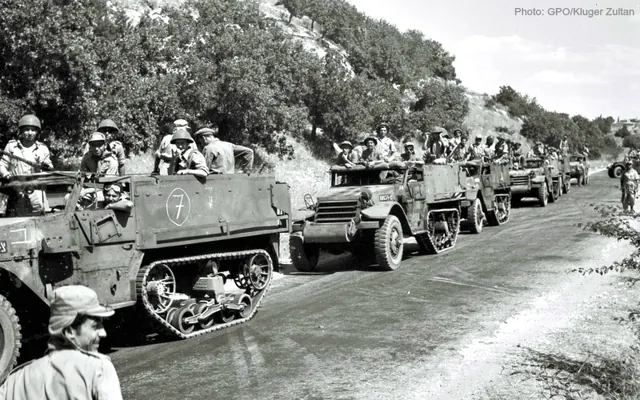
1948 was a year of Biblical proportions, which means the stories told about what happened often have more power than the events themselves. This is part one of...
Play Episode
TJS S2 Interlude: Who is Rabbi Mike Feuer and why is he telling the Jewish story?
Every story has a teller, and a good listener knows that you can't really separate the two. In this podcast, Rav Mike sits down with his old friend...
Play Episode