
TJS S3 E20 The Spirit of the 60’s part I: pragmatism and prophecy
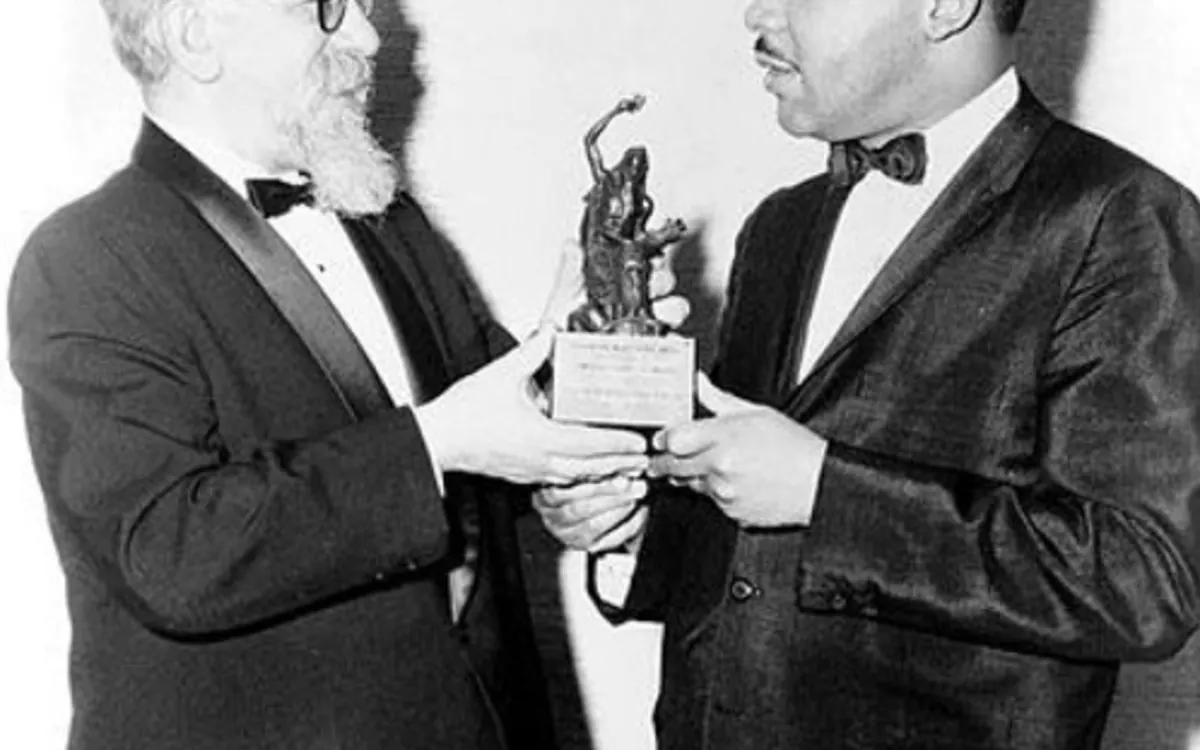
The 1960s were a revolutionary period in American history, and since the Jews were so deeply involved it is a turning point in the Jewish Story as well. This episode begins our slow march toward 1967 with a look at how the twin spirits of prophecy and pragmatism moved Jewish leadership during the Civil Rights movement.
About this episode
We must always take sides, says Elie Wiesel, silence encourages the tormentor. The march toward 1967 begins, and the divergence between American and Israeli Jewry, where June 1967 was the summer of love in America and a summer of war in Israel. Before the anti-war movement comes the civil rights movement, and it turns on the Holocaust: the phrase never again had in Israel a simple, universal meaning, you will never do this to me again, the answer to Auschwitz is the IDF, I will never be a victim, so when Nasser threatened annihilation the lesson was to believe him. But as Atina Grossman notes, the Holocaust was a shadowier presence for American Jews, whose childhoods in the fifties were haunted more by the bomb and McCarthyism, so that to the young activists of the sixties never again meant never again a good German, never a faceless cog in a machine of oppression, never a bystander, what Arendt called the banality of evil. So Israelis said never again a victim and American activists never again a bystander, two readings that do not contradict but prefigure the conservative-progressive divide of today.
Jewish involvement in civil rights was not a given, with vigorous debate in the late forties and fifties, some opposed on pragmatic grounds fearing antisemitism or the communist label, some in the Orthodox world arguing the Jews were too small and should look out for themselves, and others making the pragmatic case for involvement, Stephen Wise arguing that solving discrimination for blacks solves it for Jews, and idealists like his daughter Justine Wise Polier holding that by our heritage we are committed to the battle for human freedom whether or not it is good for Jewish survival. The institutional world largely took the father's pragmatic stance, yet its fingerprints are on the major battles: the American Jewish Committee commissioned Kenneth Clark's study behind Brown v. Board of Education, three Jewish organizations filed an amicus brief, and the Civil Rights Act of 1964 and the Voting Rights Act of 1965 were drafted in the conference room of the Religious Action Center of Reform Judaism, so the late fifties and early sixties were the heyday of the Black-Jewish Alliance.
A key figure was Rabbi Joachim Prinz, born in Germany in 1902, a popular Zionist preacher at Berlin's Friedenstempel whose pulpit the Reform establishment took away days before the Nuremberg Laws, brought to America by Stephen Wise, rising to president of the American Jewish Congress and chairman of the Conference of Presidents. Touring the South in 1937 he was shocked to hear Jews, classical victims of racial persecution, speak as racists, and he fought that battle within the community his whole life, but he wanted to fight as a Jew: against the idealists who would support civil rights despite the risk, Prinz held the fight against racism critical to Jewish survival, yet he feared that many took refuge in the civil rights program as a way to belong to a Jewish organization without a Jewish program, equating Jewish survival with segregation, and that the dominance of political issues could lead to the community's disintegration. At the 1958 convention where he was elected he invited Martin Luther King, the first time King addressed a white southern audience, and on August 28, 1963, before King's dream, Prinz told the March on Washington that the most shameful problem is silence.
To contemplate a theology for the Jewish people after the Holocaust took a more prophetic personality, Rabbi Abraham Joshua Heschel, born in Warsaw in 1907, a scion of Hasidic dynasties who left the bounded world of Torah for Berlin, where his 1933 doctorate on prophetic consciousness, against a theology that erased the divine personality, drew out pathos, the suffering God shares with the prophet, and the prophetic critique of social injustice, that to us a minor injustice is to the prophet a disaster. He was deported in 1938 and escaped through Warsaw, London and New York, a brand plucked from the fire, never returning, yet a spiritual optimist. Though Christianity had helped fuel the fire, he refused the stance of never again a victim and saw the Christian struggle for black liberation as critical to Jewish survival as Jews, consistent with his ecumenical role shaping Nostra Aetate at the Second Vatican Council. At the 1963 Conference on Religion and Race he said the first such conference's participants were Pharaoh and Moses and the exodus is not complete, and republished his thesis as The Prophets, carried in the back pockets of young activists.
Heschel's moral clarity raised him to national status in the movement, his telegram to Kennedy a modern prophet addressing the king, demanding personal involvement and a declared moral emergency, the hour calling for moral grandeur and spiritual audacity. He was not on the podium in Washington but marched beside King at Selma in 1965, one of the most violent and defining episodes, of which he said he felt his legs were praying. Yet in that same journal entry he named the problem American Jewry still faces, a false dichotomy dividing religion from social conscience, since the vast majority of Jews active in the movement were unaware of what it meant in terms of the prophetic tradition, Jewish religious institutions again missing the chance to interpret the movement in terms of Judaism. The Rambam's first degree of prophecy is the divine assistance to deliver the good from the hands of evildoers, the Spirit of the Lord, and Heschel asked where in America today we hear a voice like the prophets of Israel, answering that Martin Luther King is a sign that God has not forsaken America, while King called Heschel a truly great prophet.
Key ideas
- Never again meant never again a victim to Israelis and never again a bystander to American activists, prefiguring today's divide.
- Jewish involvement in civil rights was debated, but the institutions' fingerprints are on Brown and the Civil Rights and Voting Rights Acts.
- Joachim Prinz fought racism as a Jew and at the March on Washington named silence the most shameful problem, fearing politics could eclipse Jewish life.
- Abraham Joshua Heschel, child of the prophets, drew pathos and the prophetic critique from the biblical text and saw black liberation as a shared spiritual struggle.
- Heschel marched at Selma feeling his legs were praying, and named the false dichotomy dividing religion from social conscience.
- Heschel called King a sign that God had not forsaken America, and King called Heschel a truly great prophet.
Chapters
- 0:00 We must always take sides; the summer of love and war
- 2:15 Two meanings of never again
- 5:46 Jewish involvement debated
- 9:00 The institutions and the civil rights laws
- 11:10 Joachim Prinz
- 13:18 Racism within; fighting as a Jew
- 16:35 Prinz invites King; the March on Washington
- 20:11 Prinz's doubts; politics eclipsing Judaism
- 21:18 Heschel at the Conference on Religion and Race
- 23:29 Heschel, child of the prophets
- 26:41 The Prophets; carried by activists
- 27:45 Deported; a brand plucked from the fire
- 29:55 Nostra Aetate and the ecumenical struggle
- 32:05 The telegram to Kennedy; Selma
- 34:15 My legs were praying; the false dichotomy
- 36:22 The Spirit of the Lord; a sign God has not forsaken us
Who, where and when
People
Elie Wiesel, Atina Grossman, Hannah Arendt, Stephen Wise, Justine Wise Polier, Joachim Prinz, Martin Luther King Jr., Abraham Joshua Heschel, Kenneth Clark, The Rambam
Places
Berlin, Newark, Warsaw, Washington, Selma
Texts
The Prophets, Brown v. Board of Education brief, Nostra Aetate, The Guide for the Perplexed
When
1954 CE: Brown v. Board, 1958 CE: Prinz invites King, August 28, 1963 CE: the March on Washington, 1963 CE: the Conference on Religion and Race, 1965 CE: Selma
Read the transcript
We must always take sides, says Elie Wiesel. Neutrality helps the oppressor, never the victim. Silence encourages the tormentor, never the tormented. And if you've been listening for any time at all, then you know I'm not one to keep silent. Because I'm Rav Mike Foyer, and this is The Jewish Story. Episode 20, The Spirit of the Sixties Part 1, Pragmatism and Prophecy. So I've said it many times, and I'm sure you know, that you can tell a storyteller about where he begins and where he ends. And just as a reminder, for those of you who weren't around from the beginning, we started our journey way back at the beginning of Season 1 in the book of Daniel, when the last sparks of prophecy were fading from Am Yisrael, and they found their expression in that unique ability of the wise to read the writing on the wall.
And in some sense, our discussion today is going to be a continuation, if not a culmination of that, because I feel in my guts that the spirit of prophecy is stirring again within Am Yisrael and that there are certain leaders who show a remarkable ability not only to see what lies ahead, but who are moved to take action. And if the beginning of our story was back in Daniel and the fading of prophecy, so then where is the end? Well, today, drumroll please, we officially mark the beginning of the march toward 1967. And for this season at least, that's going to be the end. And as long as I'm talking about it in the meta sense, I want to make a little plug for season four, because you know what's unique about the Jewish story?
There are Jews and Christians, progressives, conservatives, religious and secular, all listening to one story. You're all listening to this right now. And if you have the sense that the narrative divide that splits our society is only getting deeper, this is your chance to support my efforts to bridge the chasm by telling a story everyone can hear, One is what's going to build a common future, which of course is the goal of the Jewish story. So put your money where your ears are, people. Go to Patreon. Put a little backing into Season 4. Okay, meanwhile, back to our regularly scheduled programming. I ended the last episode with the observation, which in speaking to people, many of you missed, that in June 1967 in the United States, it was the beginning of the summer of love.
While in Israel, it was actually a summer of war. Many American Jews were chanting, make love, not war, while most Israeli Jews were just glad to have the power to win in battle against their enemies. And this is way more than a case of parallel lives. In my eyes, it's the beginning of divergent narratives. And I want to lay the groundwork in the last phase of this season for understanding how that came about and for understanding the effect it continues to have even today. But in the annals of the Jewish American 60s, before the anti-war movement, actually comes the civil rights movement. So that has to be our topic today. And we'll introduce another critical piece in how the worldviews of America and Israeli Jewry split in the 60s.
It wasn't just about war, because once again, it will come back to the Holocaust. If I said to you, never again, how would you understand that phrase? You know, I'm actually putting a class together on this right now. If you're curious and you want to do some distance learning, you can be in touch with I'm happy to do it with you or your community, but for now, take this as a frame. In Israel, at least at this point of our story, never again had a very simple and largely universal meaning. You'll never do this to me again. The answer to Auschwitz is the IDF, and I will never again be a victim. To this day, the majorities of Israelis, consciously or not, understand the phrase in that way. And so, when in the 60s, President Nasser of Egypt began once again to threaten a war of annihilation, promising to wash away the shame of 48 in Jewish blood, the lesson of the Shoah was extremely clear.
Believe him. But, as Jewish American historian Atina Grossman points out, the Holocaust was a far more shadowy presence for American Jews than it was for Israeli Jews. She says even for the second generation of the survivors, which she herself is counted among, many of whom grew up with the obvious, if never spoken about, presence of both the murderers and the dead in their homes, their childhood in the 50s was haunted much more by the bomb and the Red Scare McCarthyist hysteria than by the thought of concentration camps. And by the 60s, nuclear war, racial injustice, American imperialism, all seemed to be much more dangerous and therefore demanding of action than the memory of a defeated Nazi regime and the suffering of their ancestors, no matter how recent.
And as Grossman says, to the young activist Jews of the 60s, products of that golden decade we spoke about at the beginning of this season, never again meant never again a good German. Meaning, never again should anyone be a faceless cog in a bureaucratic machine of oppression, of an unjust regime engaged in racial persecution and aggressive wars. Never again a participant in what Hannah Arendt labeled as that banality of evil. You know, Bob Ross, famous TV painter, recalled about his student days at the University of Michigan that he joined the picket line boycotting a segregated Woolworths lunch counter because, quote, it was the Jewish thing to do. If you're silent, you're complicit. So when Israelis were saying never again, it was never again a victim.
But the Jewish activists of the 60s cried out never again a bystander. Now, of course, these two don't contradict. Nor is it true that every Israeli sees it in one way and every American Jew the other. But this distinction might just sound familiar to anyone who's been listening to the growing narrative divide that's out there between conservative and progressive Jews today. And in my eyes, it really begins at this phase of our story. So therefore, we have a lot of work ahead of us. I want to do it well. It's going to take more than one, perhaps even more than two episodes, to map out the role of American Jewry in crafting and channeling the spirit of the 60s and understanding how this really laid the groundwork for the split between American and Israeli Jewry even today.
In essence, I see ahead of us three tasks. Number one, what does the Torah have to say about the spirit of the times? Or maybe, stating it more correctly, what did the spirit of the times manage to draw out of the Torah? Number two, how did the civil rights and anti-war movements become such a new religion, as it were, for so many Jews who were estranged from the traditional modes of Judaism? And number three, in light of their emergence in these movements, what will be the impact of the 1967 Six-Day War on American Jewry? Now for me, I hope you know at this point, the Torah is always the right place to begin. So whether it's laying down the law or crying like a prophet in the wilderness, I want to know what the Torah has to say about our story.
So this episode is going to be dedicated to the tension between the pragmatic and the prophetic spirit. A bit of pragmatic background before we dive in the prophetic divine. Despite the 2020 hindsight about how American Jewish community was a liberal community, about how the descendants of the oppressed people simply knew that civil rights was the right thing to do, about the lessons of the Holocaust, Jewish involvement in the civil rights movement was not a given by any means. If you look back at the record, we can see that the late 40s and early 50s were a time of vigorous debate amongst Jews about the wisdom of what we now call black Jewish relations. Some people, they were opposed involvement on just pragmatic grounds.
They were afraid of an upsurge in anti-Semitism. They were afraid that by supporting civil rights, Jews would be labeled as communist agitators, which, by the way, when you look at the record, that one was definitely true. And another pragmatic argument, which was repeated particularly within the Orthodox and more traditional community, was that Jews are too small to take on this battle. and they simply become more vulnerable when they dissipate their strength in other movements. We need to look out for ourselves and let everybody else look out for themselves. Now, just as there were pragmatic arguments against, so too there were practical reasons for. Reform rabbi Stephen Wise had argued all the way back in the 40s, the end of his life, and you can go back, by the way, to season two, episode 35, for a little bit of his story.
He argued that, quote, quote, solve the discrimination problems of blacks, and you solve those problems for Jews and for other groups in society. Meaning there's a pragmatic argument to say that a racial policy is a problem for all minorities, and therefore solve it for one, and you solve it for all. Now there were those who took a more idealistic stance on the matter. Wise's daughter, actually, Justine Wise Paulyer, was one of them. And she would assert during a panel discussion in 1958, quote, by dint of our heritage, our faith, the intuitive and all but instinctive reaction of the Jew against injustice or the violation of human dignity, we are committed to the battle for human freedom, whether it is or is not good for the survival of the Jewish people.
Now, for better or worse, in the end of the day, the institutional world of Judaism took the stance of the father and not the daughter. You can trace many of the major legal battles of the 60s, and you'll find, if not at their base, certainly as a strong sidecar, the institutional Jewish community. For instance the American Jewish Committee commissioned the study by black sociologist Kenneth Clark that lay at the heart of the landmark 1954 Supreme Court case Brown versus the Board of Education. This was the breaking the back of the segregation laws in education. Clark's work basically demonstrated that segregation placed a stamp of inferiority, as he called it, on black children. Here's a quote from the amicus brief that was filed actually by the American Jewish Committee and the American Jewish Congress and the Anti-Defamation League, three of the largest Jewish organizations in the country at the time.
They said, The unchallenged finding that segregation irreparably damages the child lifts these cases out of the murky realm of speculation on the issue of equality of facilities into the area of certainty that segregation and equality cannot coexist. That which is unequal in fact cannot be equal in law. And think about the fact that aside from the support that they received from major Jewish institutions, both the Civil Rights Act of 1964 and the Voting Rights Act of 1965, pillars of the legal battle of the civil rights movement, were drafted in the conference room of the Religious Action Center of Reform Judaism, which actually served for a couple of decades as the home for the Southern Christian Leadership Conference.
So because of these things, and many others that we're just going to leave outside the details, the late 50s and early 60s were known as the heyday of the Black Jewish Alliance. And one of the most important personalities of this alliance, at least from the Jewish side, was Berlin-born Rabbi Joachim Prinz. Joachim Prinz was born in 1902 in a small village in Upper Cilicia, Germany. And despite growing up in an assimilated Jewish family, his father was actually a passionate German patriot of all things, Prince discovered Zionism in around 1918. A few years later, in 1921, he started his rabbinical education at the Jewish Theological Seminary in Breslau, and a year later, his university studies. And by 24, he was both doctor, PhD, and rabbi.
And by 1927, at the tender age of 24, Prince was inaugurated as rabbi of the liberal Jewish community Friedenstempel in Berlin. And within a short period of time, he actually became one of the most popular and famous Jewish preachers in the whole city. The Freedom Stemple Synagogue, according to the records, accommodated 1,500 people. But they say that sometimes on the high holidays, the police actually had to block off the crowd of pushing people who were trying to get in to hear him speak. Now, Joachim Prince's life in Berlin is actually a story unto itself. It's pretty wacky. Like his reform colleagues, he didn't observe Jewish law. But unlike them, he also didn't recognize the power of the reform rabbinical establishment of the time.
There were lots of other issues as well. It's actually the Prince affair, as they call it, is worth looking into. But for our purposes, suffice it to say that despite being one of the most important Zionist voices amongst German Reform Jews, two days before the Nuremberg Laws of 1935 took away the rights of many Jews, the Reform Establishment of Berlin took away Prince's pulpit. Now, fortunately for him, he wasn't left without a parachute, because Joachim had maintained a correspondence with American Reform Rabbi Stephen Wise, who we mentioned earlier, And they actually finally met at a Zionist conference in 1935. So when the axe fell in Berlin, Wise brought Prince to the United States in 1937. And hey, with one of the most powerful Jews in America as his mentor, Joachim Prince rose quickly through the ranks of institutional Jewry.
Wise got him his first congregation, Newark, New Jersey, congregation B'nai Abraham. And he also introduced Prince into the American Jewish Congress, which Wise, of course, had helped to found. and the young German rabbi was soon holding leading positions, not only there, but elsewhere. He was elected as AJC president in 1958, a post he kept until 1966. And along with certain other roles, he was also chairman of the powerful Conference of Presidents of Major Jewish Organizations from 65 to 67. So he became a big Jew. And frankly, Joachim Prince was not shy to call out the problems of the society which he had come to lead. A couple weeks after his arrival, back in 1937, new immigrant to the United States, Prince toured the South.
And when a Zionist group invited him to a gathering in Atlanta, before going to the city, he first stopped for a long talk with the black Methodist bishop, scholar, and author, Willis Jefferson King, and he was interested in his theology. But when his southern Jewish host learned of the meaning, one of them approached the rabbi and insulted King in blatantly racist language. Prince later wrote about his experience in his autobiography. I was completely speechless, he writes. I was amazed to hear such words from a Jewish group welcoming a Hitler refugee whose people had been persecuted in the country of their birth because of their race. I added that I simply did not understand, nor had I known that Jews, the classical victims of racial persecution, could themselves be racists.
I said that what was evidently happening to the black people of America was the very same thing that was happening to the Jewish people in Europe. Now, this was a battle which Joachim Prince would fight from within the Jewish community his entire life. And unfortunately, it's a battle against racism within our community, which isn't over yet. However, Joachim Prince wanted to fight this battle as a Jew. He felt, unlike the idealists, who saw the civil rights movement as something which should be supported despite the risk to Jewish welfare, Prince felt that the fight against racism was actually critical to Jewish physical and moral survival. He actually shared the podium in that panel discussion that I quoted earlier with Justine Weiss-Pagliar when she said, we're committed to the battle for human freedom, whether it's good or it's not good for the survival of the Jewish people.
And that was part of an argument which she made and many others like her that the pressing needs of the civil rights struggle should actually rule out any specific Jewish activities. They should be the one and only political task of the American Jewish Congress. Prince's response was that, quote, too many of us find refuge in the Congress civil rights program because it affords an opportunity to belong to a Jewish organization without being involved in a Jewish program. See, this was the problem. People were taking refuge in that struggle with which they could identify as Jews but didn't have to do anything actually Jewish. Whereas Prince's vision was that the AJC should return to its fight for Jewish survival and democracy, its core mission, and he saw the civil rights struggle as an aspect of that.
In a letter to the former AJC president, Israel Goldstein, who he eventually replaced, Prince condemned Jews who had abandoned their obligation toward Jewish survival, saying, The only kind of Jewish living they understand and is important is the participation of the Jews in the solution of the problem of the American Negro. I cannot possibly equate Jewish survival with the problem of segregation, and I refuse to admit that the American Jewish Congress cannot make a contribution to creative Jewish continuity, to alerting American Jewry to the problems inherent in diaspora living. You see what he's saying? He knew deeply that the energy which many Jews brought to the struggle for civil rights, though they felt that they were doing it as Jews, could also become a substitute for being Jewish.
So the debate between Prince and Wise's daughter took place actually in the 1958 National Convention of the AJC in Miami Beach, Florida. That's the convention where Prince was elected president for the first time. And it speaks volumes about his vision for Jewish survival that he actually invited the Reverend Dr. Martin Luther King Jr. as the special guest speaker for this crowning event of his political career. In fact, this was actually the first time that Reverend King spoke to a white audience south of the Mason-Dixon line. And this is what he said. My people were brought to America in chains. Your people were driven here to escape the chains fashioned for them in Europe. Our unity is born of our common struggle for centuries, not only to rid ourselves of bondage, but to make oppression of any people by others an impossibility.
And aside from that idealistic tone, Reverend King didn't fail to remind the rabbi and his audience of the pragmatic element of their alliance, since, quote, the segregationists make no fine distinctions between the Negro and the Jew, as he said. And he concluded with a vision of the American dream. Our common fight, said Reverend King, is against these deadly enemies of democracy. America, the first nation to electrify the world with a new concept of man's capability of self-rule without monarchs or regents, must fulfill the promises of its Constitution and the Declaration of Independence. Now, Reverend King's speech obviously made a deep impression on Rabbi Prince because he echoed it on August 28, 1963, in what he later recalled as the greatest religious experience of his whole life.
That date, in case you don't recognize it, is the day of the March on Washington for Jobs and Freedom. And just before the Reverend Dr. Martin Luther King took the stage and spoke about his great dream, Rabbi Prince stood up in front of that audience of more than 200,000 people and insisted it was, quote, not merely sympathy and compassion for the black people of America that motivates us. It is above all and beyond all such sympathies and emotions, a sense of complete identification and solidarity born of our own painful historic experience And then he told them The most urgent, the most disgraceful, the most shameful, and the most tragic problem is silence. Now I promise you that the Jews in the audience understood his message.
Never again means never to be a bystander. But did they know that Joachim Prince, even as he spoke and moved the crowd, had deep doubts about what he was doing. Not about his support of Reverend King and the movement. Those were sacred tasks in his eyes. What worried the rabbi was his almost prescient sense that the dominance of political issues within American Jewry could eventually lead to its disintegration. Because he believed, as I said, that the civil rights program must not be carried out at the expense of Jewish values and Jewish religion. but on the contrary, it had to become an expression of them, part of a larger program for what he called the reconfiguration and strengthening of Judaism in the post-Holocaust world.
Now, Prince was a political leader and a fantastic speaker, but in order to contemplate what a world post-Holocaust could look like, what a theology for the Jewish people could be in the aftermath of such a horror, that would take a slightly more prophetic personality. The National Conference on Religion and Race was held at Chicago's Edgewater Beach Hotel in January of 1963. Now, the goal of the conference was, quote, bringing the joint moral force of the church and the synagogue to bear on the problem of racial segregation and to deal with the distinctive role that religion and religious institutions have to play in removing racial segregation and securing acceptance for all Americans. There were Catholic, Protestant, and Jewish organizations all gathered together.
And not surprisingly, the Reverend Dr. Martin Luther King was the centerpiece speaker. Already famous at this point as a leader of the Civil Rights Movement, the March on Washington is less than a year away. Now, Reverend King's speech was entitled, A Challenge to Churches and Synagogues, and he threw down the gauntlet to the assembled religious leaders. The churches and synagogues have an opportunity and a duty to lift up their voices like a trumpet and declare unto the people the immorality of segregation. We must affirm that every human life is a reflex of divinity and every act of injustice mars and defaces the image of God in man. It's a strong, strong voice. And the most powerful Jewish voice of the conference was actually Rabbi Avram Joshua Heschel who in a sense saw Reverend King's opportunity and duty and raised him the religious stakes.
Heschel said, quote, at the first conference on religion and race, the main participants were Pharaoh and Moses. The outcome of that summit meeting has not come to an end. Pharaoh is not ready to capitulate. The exodus began, but it's far from having been completed. In fact, it was easier for the children of Israel to cross the Red Sea than for a Negro to cross certain university campuses. Now speaking to the Jews in the room, Heschel had just told them that nothing less than the completion of the redemption from Egypt, or the denial of its significance, nothing less than that was on the line. Racism, he said, is the test of our integrity, a magnificent spiritual opportunity for radical change. those are powerful worlds but how is it that this white bearded German rabbi like Joachim Prince, a refugee from the Nazis, came to be standing on the same podium as the Reverend Dr.
Martin Luther King and from where did he draw the inspiration to speak like that? Now Abraham Joshua Hessel was born in Warsaw in 1907, youngest of six children and his home was the model of classic Eastern European Hasidut pious, humble and largely removed from the world certainly from the non-Jewish world. He himself was a scion of several Hasidic dynasties. In fact, he's named for his great-great-grandfather, the Rabbi Avraham Yeshua Heshal of Ep, the Apeter Rabbi. Now, young Avraham received a traditional yeshiva education, as was befitting his lineage, and of course achieved also a high degree of learning there. But his mind and soul would not rest quietly within the guarded and bounded world of Torah.
And so, from Warsaw, he moved to Berlin, pursuing both a secular education at the University of Berlin and a liberal rabbinic ordination at the Higher Institute for Jewish Studies. It's a reform rabbinic seminary that was founded by none other than Avram Geiger, whose story, if you want, you can go back to Season 2, Episode 17, to get it. Now, once Heschel left the removed and religious world of his childhood, he never really returned, though it remained a wellspring for his inspiration to his dying day. In 1933, he completed his doctoral dissertation on prophetic consciousness. Now you have to know that Berlin University at this point was an environment where biblical criticism ruled, and where liberal theologians were striving to understand God in the modern world, and their major tool for doing that was to erase the divine personality.
In contrast to all that, Heschel's thesis engages the prophetic text with seriousness and integrity, as befits his tradition, and he draws out from it a very important focus, a focus on pathos, the depth of not only religious experience, but emotional experience, which is shared by the prophet and the living God. And most importantly for our present story, Heschel brought to the fore in that work the centrality of the prophetic critique, their worry about social injustice as an expression of religious experience. As he writes, In other words, most of us function in the world through rationalization and blinders. We walk by the hungry on the street because we don't have food in our pockets. We fail to clothe the naked because it would be too expensive to take care of them all.
And that's fair. That's part of survival. But the prophet is the one for whom all those rationalizations, all those blinders have been torn away by the reality of God's suffering in the face of such injustice. Now Heschel wrote those words in 1933, three. But he'd have to wait almost 30 years and move to another continent to see their impact. Because unbeknownst to him, his disdain for current Protestant theology and the way in which their notion of God, not as being but as ground of being as they called it, left man helpless in the face of injustice, would be shared by the Reverend Dr. Martin Luther King. Even though the Reverend was only for when the Rabbi's thesis was first published, they would ultimately share a conservative theology, meaning a focus on the reality of the biblical God and liberal politics.
Meaning, as Heschel would say in 1963, you can't worship God and at the same time look at a man as if he were a horse. Reverence for God is shown in reverence for man. To be arrogant toward man is to be blasphemous toward God. Now, Heschel actually republished an expanded version of his thesis as a book called The Prophets. It first appeared in English in 1962. And by the way, you have to read it. It is a very important and fantastically enjoyable work. He was quite aware of the civil rights struggle while he was preparing it, and though most Jews were, and sadly still are, ignorant of its importance, young activists in the nonviolence movement, famous names like Andrew Young, James Lawson, Bayard Rustin, were among those who later told his daughter that they carried a copy of the paperback edition of his book in their back pocket during the struggle for inspiration and consolation as life got rough.
In October 1938, Heschel was rounded up and deported along with many other Polish Jews living in Germany. Put on a packed train, standing for the duration of his three-day journey. Denied entrance into Poland, these Jews were held at the border in miserable conditions, many of them remaining there for months. Now, little did they know that for all their suffering, they were amongst the lucky ones. Fortunately for Heschel, his family soon secured his release and he was able to join them in Warsaw. but not for long. Warsaw to London, London to New York, it was a refugee's journey. But again, he was amongst the fortunate because many of his family didn't escape. In wake of the destruction, Heschel never returned, not to Germany, Poland, or Austria, and he explained later in his life, quote, if I should go, every stone, every tree would remind me of contempt hatred murder of children killed mothers burned alive of human beings asphyxiated Now despite this pain and the judgment it applied Rabbi Abraham Joshua Heschel was a spiritual optimist a posture that he would bring to the coming struggle.
Heschel arrives in the United States as a refugee from Hitler's Europe in March of 1942, a brand plucked from the fire. Ud Mutsalmi'esh, as he wrote. It's fitting, by the way, that he'd draw from the prophet Zechariah to understand his own life. And I have to say, it would have been natural in my eyes for Heschel to turn inward, to identify as a victim and point his finger in blame wherever he felt it lay. In particular, as a brand plucked from the fire, there could be no question in his mind that Christianity had helped supply the fuel for the fire that consumed the Jews of Europe. I mean, after all, he'd seen with his own eyes there at the University of Berlin how German Protestant theologians actually debated eliminating the Old Testament from their canon and declaring Jesus an Aryan.
So how is it that he refused to take a stance of never again as a victim, meaning you'll never again do this to us, but rather came to see the struggle for liberation of black Americans, a deeply Christian struggle, by the way, as a critical issue for the survival of the Jewish people as Jews. Now, first of all, it's important just to note that the Civil Rights Movement wasn't the only outlet for Heschel's general ecumenical view of an attempt to try to bring together a Judeo-Christian accord. From 1961 to 65, the Catholic Church, ancient antagonist of the Jews, was engaged in a process of theological self-reflection known as the Second Vatican Council. It's a rich and deep story. I'm not going to tell it now.
But in short, the Council dealt with many things. And there are many questions, both amongst Catholics, about its legitimacy and questions about what was achieved. But for our stories, it was Nostra Aetate, the declaration of a new posture of relationship toward other religions, which was most significant. And the section on Jews, which is worth reading, is a complex statement. I mean, it deals with replacement theology, the charges of deicide, the phenomenon of anti-Semitism. and if the result was complex, you can imagine that the process of crafting it was even more so. And that's where Heschel actually came in. He was a major voice in shaping that statement, both through his general writings, his theological thought, and documents were submitted directly to the church in the process of crafting the statement, and even a personal audience with the Pope.
And when Heschel was part of encouraging the church to declare their acknowledgement that, quote, according to God's saving design, the beginnings of her faith and her election are found already among the patriarchs, Moses and the prophets, and, quote, that she draws sustenance from the root of that well-cultivated olive tree onto which have been grafted the wild shoots, the Gentiles? Then we can understand a bit more of his presence on the podium next to Reverend Dr. Martin Luther King. It's actually quite consistent. Heschel was a product of the rabbis, but he was a child of the prophets. When he heard the Reverend King speak, he saw the centrality of the Exodus from Egypt in the narrative of the civil rights movement.
And then Heschel understood that this might just be the dawn of a new era. That the civil rights struggle might actually be a shared spiritual struggle which had the potential to transform Jew and Gentile alike. and like any good prophet during his lifetime there were many particularly in the Jewish community including many of his leaders who were openly critical of Heschel and many others who didn't even know who he was some leveled that old accusation who made you boss of us you can go back by the way to the second chapter of Exodus 14th line to see the origins of that accusation they said he had no right no right to speak to the Vatican on behalf of Jewry no right to accuse institutional or even just the masses of Jews of moral failure in the face of racism.
But, like a good prophet, Heschel was undeterred. He wasn't universally accepted by the Jews or even all that widely well-known, but his words of moral clarity had actually elevated him by the early 60s to his national status within the civil rights movement. When President John F. Kennedy called for a meeting of religious leaders to discuss civil rights, in June of 63, only months before the march on Washington, Heschel was a rabbi invited to attend. And his telegram, in response to the invitation, might as well be a modern version of a prophet of Israel addressing its king. He says, Please demand of religious leaders personal involvement, and not just solemn declaration. We forfeit the right to worship God as long as we continue to humiliate Negroes.
Church and synagogue have failed. They must repent. ask of religious leaders to call for national repentance and personal sacrifice. And even as I propose that you, Mr. President, declare a state of moral emergency in our nation, the hour calls for moral grandeur and spiritual audacity. Now, perhaps due to his failure to build a political base which matched his moral force, Heschel was not present on the podium there in the Washington March, or, according to his daughter Susanna Heschel, present even in Washington at all. But one of the most famous pictures, one which captures so powerfully the religious face of the Black Jewish Alliance, is that photo of the white-bearded rabbi marching next to the Reverend Dr.
King at Selma in 1965. If you don't know anything about the American Civil Rights Movement, then you just need to know that the Selma March was one of the most violent and powerful episodes of the movement, and some would call it a defining moment for America as a nation. It was about Selma that Heschel made his famous statement that he felt as though my legs were praying. But more importantly for our story, in that very same journal entry where he made the statement about his legs praying, Heschel put his finger on the fundamental problem which American Jewry faced in his day, and frankly, which we still face even now. It's a problem which sadly forces many Jews into a false dichotomy, a dichotomy that divides between religion and social conscience, a dichotomy which Heschel identified as the cause of the failure of his voice and others like him to capture the religious imagination of the 60s generation.
He says about Selma, I felt a sense of the holy in what I was doing. But then he added the following, I felt again what I have been thinking about for years. that Jewish religious institutions have again missed a great opportunity, namely, to interpret a civil rights movement in terms of Judaism. The vast majority of Jews participating actively in it are totally unaware of what the movement means in terms of the prophetic traditions. Now, there's a much longer discussion that lies ahead of us. Much of it wrapped up in the story of activism and how it was that so many Jews were so central to the movements of the 60s and yet so ignorant of Judaism at all, much less the role that it might have played in their struggle.
So I think it's just fitting to end this first episode on the following note. You know, in the guide for the perplexed, in the Morin of Uchim, the Rambam describes 11 levels of prophecy. For my purposes, though, all we need to know is the first step on that ladder toward divine consciousness. He says, the first degree of prophecy consists in the divine assistance which is given to a person to deliver a congregation of good men from the hands of evildoers. He finds in himself the cause that moves and urges him to this deed. This degree of divine influence is called the Spirit of the Lord. Now, was the Spirit of the Lord there in the 60s? Once introducing Martin Luther King to an audience, Heschel once asked, Where in America today do we hear a voice like the voice of the prophets of Israel?
Martin Luther King is a sign that God has not forsaken the United States of America. God has sent him to us. His presence is the hope of America. His mission is sacred. His leadership of supreme importance to every one of us. And, in response, the Reverend King replied that Heschel, quote, is indeed a truly great prophet. Here and there we find those who refuse to remain silent behind the safe security of stained glass windows, and they are forever seeking to make the great ethical insights of our heritage relevant in this day and in this age. So there's much more story ahead, but you'll have to stay tuned for next week. Meanwhile, I want to invite you to put your money where your ears are and help make Season 4 happy.
You can go to my website, DrewStory.co. You'll find a button in the upper right-hand corner. You can click on through for a little bit of per-podcast support. or if you want to dedicate this show to the honor of someone who's around today or the memory of someone who is not, I invite you to send me an email at robmikefoyer at gmail.com or you can personal message me on Facebook and I'll shoot you back the details. I want to thank the folks that are already doing that. You help make this show happen. You keep it free and widely available. I want to thank the Land of Israel Network. That's thelandofisrael.com for creating a platform that allows me to reach so many fantastic people. I want to thank the Pardes Institute, pardes.org.il for building an educational institution that gives me the privilege of teaching so many amazing Jews.
And I want to thank you for listening. I'm Rav Mike Foyer, and this is The Jewish Story.
More from Season 3
TJS S3 Interlude Government - a crisis of faith
No matter where you turn, it seems that democracy is in crisis. Here is an interview with Rav Mike which touches on the global situation as well as...
Play Episode
TJS S3E19: The Samson Option
In the first decade of the state, Prime Minister Ben Gurion was haunted by one thought - that a second holocaust could come at the hands of Israel's...
Play Episode
TJS S3 Interlude Hannukah - releasing the light within
Here is a live interlude from Rav Mike - his annual class in memory of his father, Charles Feuer ob'm. It is an exploration of the Hannukah light...
Play Episode