
TJS S3 Interlude: Am Yisrael and the postmodern challenge
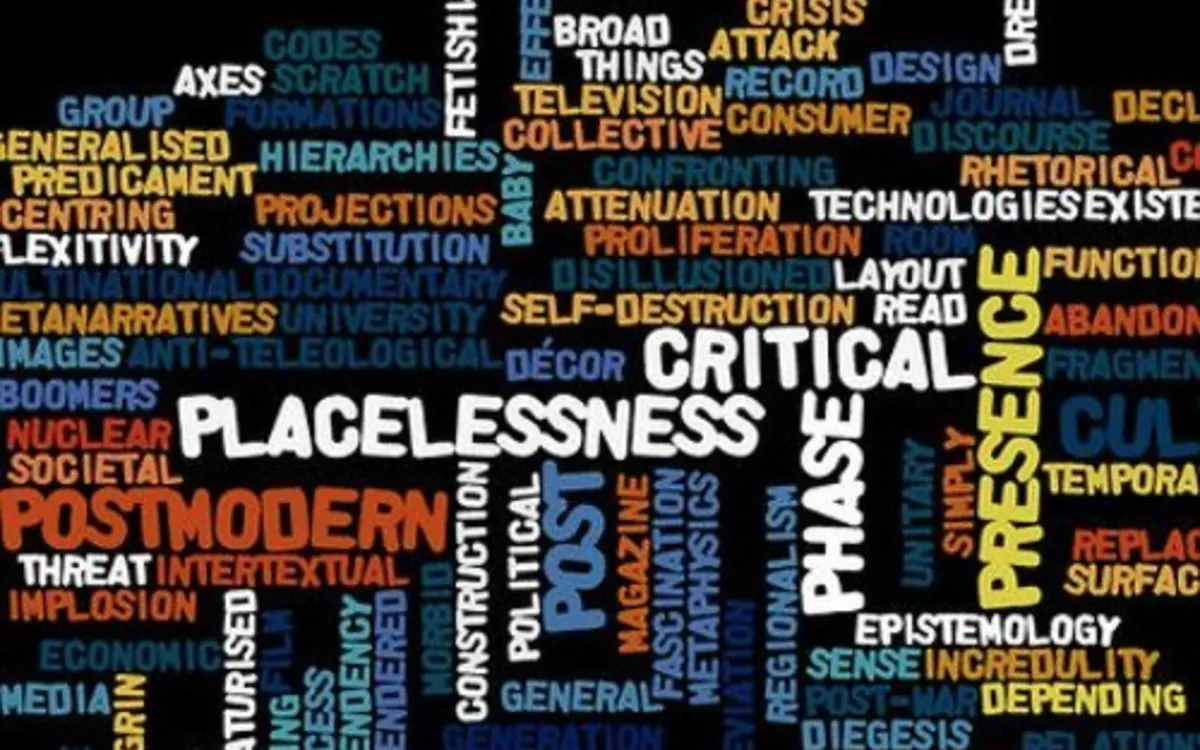
graphic attribution: www.flickr.com/photos/versionz/2596831861
About this episode
In postmodernism the media validate reality, says Brad Holland. There is a widespread feeling that the institutions escorting humanity for centuries are breaking down, and no one can go home, since someone built a strip mall and now denies you ever lived there. Postmodernism defies a neat definition because at its heart lies the assertion that anything claiming to be absolute is a social construction, truth, meaning, narrative, identity. Rav Mike approaches it on three fronts. As a culture, picture people zipping about in shades and earphones, each the star of their own movie and everyone else a bit part, the fragmentation of a multiple-narrative world, joined to a consumer society where late-stage capitalism creates the need in order to fill it and consumption gives meaning, and to the erosion of the line between fantasy and reality, fake news and reality TV.
As history, recall the epistemological breakdown that defined modernity, the uncoupling of knowledge from tradition, Galileo saying look through the telescope and tell me what you see before what you believe, and the lifting of the horizons of thought. But the seeds of the postmodern collapse were in those modern efforts: Heisenberg's uncertainty principle showed that measuring the world changes it, the anthropologist's participant-observer problem that you cannot know a culture without altering it, and Derrida's deconstruction, so Jewish it channels the Midrash, reading a text for the elements that run counter to its intended meaning. These three unite into a definition: the death of the grand narratives, which Lyotard named in 1979, the collapse of belief in the overarching stories, above all the secular messianism of progress, which died with the images that dawned the postmodern age, the mushroom cloud over Hiroshima and the gates of Auschwitz, after which it became hard to claim humanity moves inevitably toward truth and liberty.
The first challenge to Am Yisrael is identity. Reducing identity to a social construct, an internally defined status rather than an objective reality, yields the power to identify as something and the critical lens that deconstructs how society uses identity as a tool of power. Since the Second Temple, Am Yisrael has kept its identity through an us-and-them model, a wall, and who is a Jew has been wrapped up with identity, the rabbinic project producing a one-to-one relation of law and identity until the conversos complicated it and emancipation and assimilation eroded even the genealogical definitions, so today someone can wake up and identify as a Jew. Another angle is organic lived experience and inherited collective memory, as Rav Mike became a Jew when his great-aunt whispered Auschwitz into his ten-year-old ears, and as a 1973 lesbian conference split when Robin Morgan refused to call a transgender woman sister, saying thirty-two years of suffering earned her the title of woman, a truth to be honored. For Am Yisrael it is more complicated, since conversion means someone can decide to become a Jew in all respects, but who controls it, and the most dangerous aspect is who gets to speak for the Jews.
The second challenge is power and authority. For two thousand years the story and identity of the Jews were bound up with rabbinic authority, the belief that God cares about everything and the rabbis can know what God wants, so what happens when God is reduced to a construct, text has no definitive meaning, and authority is seen as oppression. The primary casualty of the death of the grand narratives is legitimate authority, heroism, since to be a hero is to wield power in the service of good, which rests on a story of good and evil that is not purely relative, and in the postmodern world a hero is just a villain with good PR, hence the race to the bottom of victimhood, since moral clarity lies only in powerlessness. The assault on the founders of America shows it: both sides are partly right, but deconstruction by its nature cannot build, only a story rooted in belief can, and the same lens could serve Israel's complicated story without destroying it.
The third is the story that will not die. Am Yisrael has never fit the worldview, the indigestible element of empire, the obstinate refuser of salvation, the alien other of modern society, and now, against the images of Auschwitz and Hiroshima that launched the postmodern consciousness, stands the Israeli flag over Jerusalem, a story that from the ovens to a world-class power, from the Torah on the ropes to thriving, defies deconstruction and so is a finger in the eye of all who believe the grand narratives are dead, which is why they hate us for asserting meaning. But the postmodern era also offers a blessing: the ancient world was God-saturated to the point that the self could barely exist, modernity brought Weber's disenchantment and a religion of certainty while God receded, and when modernity failed to remove doubt, uncertainty rushed back, which is fine, because the opposite of doubt is not certainty, which shrinks the world to the mind, but wonder, the ability to hold a world larger than we can grasp. This offers a new emunah as faithfulness, a daily decision to live in relationship with a God wrapped in mystery, a subject-to-subject relationship, paralleled by a pluralism beyond mere tolerance, an abundance of identity big enough to hold space for others without shrinking.
Key ideas
- Postmodernism is the death of the grand narratives, grounded in three awakenings: the uncertainty principle, the participant-observer problem, and deconstruction.
- Identity reduced to a construct lets one identify as a Jew, yet organic lived experience and inherited memory are another angle, as is who gets to speak for the Jews.
- The death of the grand narratives kills legitimate authority and heroism, since a hero becomes a villain with good PR and victimhood becomes the only moral clarity.
- Deconstruction cannot build; only a story rooted in belief can, and Israel's complicated story could be served by that lens without being destroyed.
- The Israeli flag over Jerusalem is the story that will not die, a finger in the eye of those who believe the grand narratives are dead.
- The blessing of postmodern uncertainty is wonder, a new emunah of faithfulness and a subject-to-subject relationship with God and with others.
Chapters
- 0:00 The media validate reality; you can't go home
- 2:14 Postmodernism as culture
- 5:30 A history: the epistemological breakdown
- 7:45 Uncertainty, participant-observer, deconstruction
- 11:00 The death of the grand narratives
- 13:08 Challenge one: identity
- 16:23 The conversos and assimilation
- 18:34 Organic experience; who is a woman, who is a Jew
- 21:49 Who speaks for the Jews?
- 23:00 Challenge two: power and authority
- 25:09 The casualty of victimhood; a villain with good PR
- 27:30 Deconstruction cannot build
- 29:00 Challenge three: the story that will not die
- 31:03 Indigestible, refuser, alien other
- 32:03 The flag over Jerusalem
- 34:11 The blessing: wonder over certainty
- 37:25 A subject-to-subject relationship with God
- 38:32 A pluralism of abundance
Who, where and when
People
Brad Holland, Galileo, Werner Heisenberg, Jacques Derrida, Jean-Francois Lyotard, Robin Morgan, Max Weber, Friedrich Nietzsche, George W. Bush, Aunt Helene
Places
Hiroshima and Nagasaki, Auschwitz, Jerusalem
Texts
The Postmodern Condition, The Midrash, Orot HaKodesh
When
1979 CE: Lyotard names the death of grand narratives, 1973 CE: the West Coast Lesbian Conference, 1945 CE: the postmodern consciousness dawns
Read the transcript
In modernism, says the artist Brad Holland, reality used to validate media. In post-modernism, the media validate reality. If you don't believe this, just think how many times you've described some real event as being just like a movie. Well, I have to admit, sometimes the line between fact and fiction gets a little bit funny for me. Because I'm Rav Mike Foyer, and this is The Jewish Story. Interlude, Am Yisrael in the postmodern era. You ever have the feeling that the world has become just a bit unhinged? You know, because of the things that I do, I get to speak to a lot of people. And no matter what they call themselves, liberals, progressives, conservatives, secular, religious, it doesn't matter. There's a widespread feeling that the institutions which have escorted humanity for the last several hundred years have begun to break down.
And no matter whether you're on the side that's saddened by the loss of tradition and its wisdoms, or that which is ecstatic about the systems of power and oppression that are crumbling, we can all agree that there's no going back to what was. Welcome to the postmodern era, when it's never been more true, that old adage that you can't go home. Not only did somebody knock your house down and build a strip mall, now they're denying you ever lived there in the first place. And this is what I want to speak about today. the challenges of post-modernism, and in particular, their impact on Am Yisrael. But not just the challenges, because as I hope you know by this point, I'm a believer in history. And to me, that means that every era has an invitation.
There's some possibility of deepening the divine relationship, and because they're so closely connected, the human one as well. So I'm confident by the end of this episode, we'll be able to figure out some blessing which the post-modern era offers. And I want you to know from the outset, this is going to be a bit of a different type of interlude. Because to be perfectly honest, I'm not entirely sure where we're headed. It'll be one part reflection, one part rant, and one part a bit of speaking out some deep confusion. But I can say the following with total confidence. If we're going to discuss the challenge and perhaps the promise which the postmodern era offers for Am Yisrael and the world, then we have to come up with some kind of definition.
The very nature of postmodernism defies a neat philosophical definition. Because after all, at the heart of this amorphous intellectual movement lies the primary assertion that anything which claims to be absolute is actually just a social construction. Truth, meaning, narrative, identity, you name it. And therefore it should come as no surprise that many of the adherents of postmodernism refuse to give it a simple definition. Now, don't worry, I'm not just avoiding. It's more than verbal footwork you're feeling. Because in a few minutes, I will try to offer what I see at least to be a defining element which we can chew on. But if you want a comprehensive perspective, the sort of overall view of postmodernism, then we have to look at that breakdown of the absolutes into relatives on at least three fronts.
First, as a culture. Then give it some context of historical development. And last, as a philosophy. As a culture, rather than try and explain, I want to paint you a picture. Because in many ways, postmodernism is a product of the technological and cultural changes of the last hundred years. Picture it like this. Have you noticed how many people these days are traveling around from place to place, shades covering their eyes, earphones filling their ears, zipping back and forth as if everyone is in their own movie? And that means that I'm just a bit part. That type of fragmentation is the physical representation and the technological facilitation of a multiple narrative world. Now, add to this type of cultural picture the consumer society in which now everything is a commodity.
You know, we're talking about late-stage capitalism was find the need and fill it. Late-stage capitalism is all about creating the need in the first place and then filling it. Because consumption in our world has become an end unto itself. It's no longer meeting a need, it's giving meaning. And even though a growing swath of the world's most powerful consumers are increasingly well informed about how our quest for the next new thing is undermining the environmental and social structures that hold up our world, on some level, we just don't care. Because the need to consume is the need to find meaning. You know, the postmodern novelist Thomas Pynchon said, late-stage capitalism is a pyramid racket on a global scale, getting the suckers to believe it's all going to go on forever.
So that's another important part of this postmodern culture, which is gradually eating the foundations out from under its very being. You know, even identity is a commodity today, and we're going to have to touch on that for real. So we add to this the erosion of the division between fantasy and reality, which was one of the hallmarks of modernity. Fake news, reality TV, media personalities running countries. I could go on, but I'm guessing that you get the picture of the postmodern culture. People running around in their separate narratives. Everybody, the lead star in their own movie, looking out from their shades at the bit players around them. this desperate need not just to consume because we need, but to create needs in order to consume, and the blurring of the boundary between the real and the fantasy.
So where did this postmodern culture come from? I'll give it two minutes of history. I hope you've been a listener to the Jewish story for a little while, and if you have, then you might recall the definition that I gave at the dawn of modernity. If not, you can go back to Season 2, Episode 4. It's one of my personal favorites. It's called the epistemological breakdown. Not only is that fun to say, but it's an important thought of what modernity actually did to the way in which we know the world. Because epistemology is the investigation of what distinguishes justified belief from opinion. And if you've been paying attention in the postmodern era, the distinction between justified belief and opinion is all but gone.
So the offer that I made for an understanding of modernity at the time was the uncoupling of knowledge from tradition and the lifting of the horizons of thought. Now what I mean by the uncoupling of knowledge from tradition is best embodied by Galileo Galilei, right? He wasn't the originator of the heliocentric principle, but he was the one who made the instruments that allowed him to really prove, despite the opposition of the church, that indeed the earth went around the sun and not vice versa. And what does it mean to uncouple knowledge from tradition? It's very simple. Picture Galileo saying to you, look through the telescope. don't tell me what you believe. First, tell me what you see, and then we'll discuss what you believe.
That's the uncoupling of knowledge from tradition. It starts with an empirical attempt to know and moves into what we know as the scientific method. Now, you add to that the lifting of the horizons of thought that happened at the early modern era, the printing press bringing massive amounts of information to the average person, of course, nothing compared to your smartphone, and the great age of exploration, actually expanding physically the horizons of the map. And last, but certainly not least, the scientific revolution, which completely transformed the way in which man understood the world around him. Now, this is all the hallmarks of modernity. And the arrogance of the modern era was in believing that once the cobwebs of superstition were brushed away by the light of reason, Once the darkness of a religion no longer substituted ignorance for knowledge, then humanity could really know the world.
But if you're listening closely, you might hear that the seeds of the postmodern collapse of knowledge were laid already by those modern efforts. Because once I get you to feign no hypothesis, in the words of Sir Isaac Newton, and to dare to know, as Kant demanded of us, then what's to say that the world which reason uncovers which brushes aside the false knowledge of the traditional past this world isn't just a contingent best understanding as well and not actually the world and if you know a bit about the progress of the sciences in modernity that's precisely what happened we'll take them one by one in the physical sciences by the time the 20th century rolled around Heisenberg revealed the fact that if you keep trying to pin the world down with objective measures, eventually at a small enough scale, you begin to change it.
It's called the uncertainty principle, which of course is the perfect scientific principle to launch the postmodern era. If you don't know anything about physics, that's fine. Just know that if you want to measure both the velocity and the direction of electron, you can't do it because by measuring one, you change the other. meaning on some level, knowing the world is changing the world even on the physical front. If that's too much hard science, you can picture the same realization reached by the anthropologist. You know, I often like to laugh about this European attempt to get to know the cultures of the world as if you could parachute some white guy in safari trousers into a native village in Peru and think that he was actually seeing normal behavior and not how people would react when you parachute a white guy in safari trousers into their village.
it's called the participant observer problem and the anthropologists realize there's no way you can come to know the world as it actually is because your very presence in so-called native environments changes what happens you can't know the world without changing it and last, but certainly not least after the uncertainty principle of the hard sciences and the participant observer problem of social sciences comes the great Jewish thinker Jacques Derrida father of the method of textual analysis known as deconstruction. Now I feel like I'm going to have to give Derrida and what he represents in the Jewish story a full treatment at another time I mean in a nutshell he was born in an Arabic Sephardi family in French North Africa Algiers He came of age I think he was born in 1930 which means he came of age at the birth of the State of Israel.
But he was the one that moved to Paris rather than Tel Aviv in 1949. That's a story at some point we're going to have to come to. But for now, just know that deconstruction is the last piece, which together with the uncertainty principle and the participant-observer problem laid the groundwork for the emergence of post-modern thought. And the definition of deconstruction is so Jewish, I don't know whether to laugh or cry. The dictionary says, deconstruction is an approach to understanding the relationship between text and meaning, explored by readings of the text that seek out elements which run counter to the intended meaning or the structural unity of a particular text. I'm not sure if Derrida had ever encountered the Midrash, but if he hadn't, he was certainly channeling his holy ancestors.
There's more to say about that. But for our purposes, these three intellectual awakenings, uncertainty in physics, participant observer problem in the social sciences, and this tool of deconstruction, which started in literary theory, but went everywhere in thought, they unite to give us a relatively solid definition of postmodernism, which I'll call, borrowing a term, the death of the grand narratives. The general collapse of belief within Western society, in all overarching narratives. Now, the religious narratives that claimed revelation as a source of absolute truth and knowledge had already been chucked in modernity. In fact, that was one of the hallmarks of modern Western culture. But in 1979, Jean-François Lyotard, which I'm sure I pronounce wrong, introduced the concept of the death of grand narratives in his work The Postmodern Condition, and he was specifically referring to the philosophical, culture, and even scientific stories, which modernity used as a basis to root their truth and understanding in something objective.
And he specifically targeted secular messianism of progress, that idea that humanity was somehow moving toward greater freedom, and that our knowledge would give us a true picture of the world, which would empower the enlightened side of humanity to finally rule over our destiny, had died a brutal death not long before he wrote the paper. You know, in my eyes, the postmodern era dawned into the consciousness of the average person on the planet with two images. One was the mushroom cloud over Nagasaki and Hiroshima, and the other was the gates of Auschwitz. Because once you see those two things, it became very difficult to claim that humanity is on an inevitable progress toward truth and liberty.
And that's our state today. The fragmentation of communities once held together by stories, resulting in some fierce identity politics that we'll touch on. The hopeless blurring of fact and fiction that you see on your Facebook feed every day. And of course, what really frightens most of us is the darker desires of humanity, which were once held in check by internalized stories of good and evil, now on the rise and spreading rapidly. So let's get to the point and talk about the challenges which postmodernism poses to Am Yisrael. The first problem I want to address is probably the one that gets the most press, and that is identity. Now I want to warn you, it's bound up closely with the second, the issue of authority, but I'll do my best to disambiguate.
It's a fun word, it means separate. In brief, the reduction of identity to a social construct, religious identity, national identity, gender, sexuality, to the idea of an internally subjectively defined status, as opposed to one rooted in an objective reality which exists outside of the self, leads to two complementary phenomenon. One is that subjective power to identify as something. Identify as is an expression of the internal subjective experience being definitive of identity. The second result of that posture is the critical lens, which is able to deconstruct the way in which society uses identity construction as a tool of power. Now, I want to mainly touch on the first right now, because if you've been following the Jewish story from the outset, then you know I've been making a contention for quite some time that since the beginning of the Second Temple, Am Yisrael has maintained his identity through an us-and-them model, through building a wall which allows us to construct an identity within and to hold off the challenges of the world without.
And furthermore, because of that wall, since the struggle between the Greeks and the Maccabees, The question of who is a Jew has been closely wrapped up with identity, as it logically almost must be. This is not a modern phenomenon, a problem of the birth of the State of Israel, or the split up which people claim to be imminent between American and Israeli Jewry. Because the model of identity as us and them has gone through many phases. There was an era of formation, you can go back to the beginning of Season 1 for that one. Then we can follow the arc of the rabbinic project, which ultimately aimed to and succeeded in producing a one-to-one relationship between law and identity. To the rabbis and the halakha, which they so loyally served, the ideal Jew is a Jew is what a Jew does.
Now, it's true. When pushed, they'll fall back on notions of genealogy and birth, if necessary, in order to define a Jew. but in the tight social fabric of pre-modern life in exile, that problem was the exception, not the rule. And if you've been listening, you may recall my assertion that this us-and-them model began to break down, really, with the rise of the conversos, a group of Jews who, because of Christian oppression, outwardly acted and looked Christian, but inwardly adhered to Judaism. And how over time, through generations of oppression, that Judaism became a powerful mix of outward oppression and inner identification. That may sound familiar. And the converso model of identity was no longer a clean-cut us versus them.
It was rooted in that complex interaction between us and them, as well as the inner identification as a Jew. And it spread out in early modernity. Go listen to season two. I'm not going to recapitulate all Jewish history right now. But suffice it to say that it added a significant element to modernity, which of course brought with it the breakdown of the rabbinic model of Jew is what Jew does. By the time modernity came around, law no longer defined the Jew. But for a while, the social fabric held, because even though the Jew was nominally no longer bound in their legal communities, people didn't want to mix. But emancipation progressed, which led to assimilation. And now, even the genealogical definitions of Jew have become ever more tenuous and contentious.
And that's our situation in the post-modern era. Today, and you see it all over your social media feeds, someone can identify as a Jew. They could wake up in the morning and decide that's what they are, or they could join a community and be affirmed in the fact that their inner conviction is what it takes to be a member of Am Yisrael. Now, traditionally, it was structures of authority that defined who's a Jew. The rabbis, their gatekeeper role with the law, even the social fabric. And like I said, we're going to have to look at that challenge of authority, which postmodernism poses momentarily. But I want to close out this piece with another element of what makes one a Jew. It's a different angle on the question of who is a Jew, and I think it speaks to the postmodern problem.
and that is organic lived experience and the inherited collective memory that comes with it. Because on some level, despite the fact that I was born to two Jewish parents and that I've received a Jewish education and I've always been embedded in a Jewish social fabric, on some level I became a Jew when my great Aunt Helene began to whisper her stories of Auschwitz into my 10-year-old ears. And when I realized that the Halloween carols, those thin adaptations of Christmas carols that we were singing in school, weren't my culture. And Jews of every culture and every time have received similar defining inherentices, perhaps not as brutal and traumatic, but nonetheless. And along with their own experience, of course, of what it means to walk as a Jew in the world, as a minority within a majority culture.
And if you want to understand the depth of that challenge, actually, we can pull out of the story of Am Yisrael and look at a rather contentious topic within the world today. And that's some of the feminist critiques which are being leveled at the transgender movement today. I don't want to go too far with it, but I'll give you an example. It's actually a critique which has been going on for some time. Here's an example from 1973. Picture that it's the West Coast Lesbian Conference in L.A. And the entire conference broke up in a bitter split over the scheduled performance by a folk singer who happened to be a transgender woman named Beth Elliot. And if you want to understand why they broke up over something which nominally should have been supported, hear the words of Robin Morgan, the keynote speaker who led the walkout.
I will not call a male she. 32 years of suffering in this androcentric society and of surviving have earned me the title of woman. One walk down the street by a male transvestite, five minutes of his being hassled, and then he dares. He dares to think he understands our pain? No. In our mother's names and in our own, we must not call him sister. This is a warning to all of us who step in a facile fashion into today's attitude that one inner identification can be definitive of their identity Because even if you reject the right of gatekeepers to wield authority in defining identity and you think that you can wake up in the morning and declare yourself a Jew or a woman or what have you, do you hear Robin Morgan's assertion?
32 years of suffering in this androcentric society and a surviving have earned me the title of woman. I think that there's a truth in there which needs to be honored if not agreed with. Now for Am Yisrael, coming back to our topic, the issue is even more complicated. Because of course, despite what I'm saying about organic experience, we have an institution of conversion. Even the most law-bound Jew, even the most raw product of a particularly Jewish historical experience, will recognize the fact that someone can indeed decide that they are a Jew and become one in all respects. But of course, we know what's happened to our social fabric in the modern and postmodern world. The question is, who controls the process?
Is it an Orthodox conversion? Conservative reform? And as if that weren't bad enough, even amongst the nominally Orthodox, do I trust the court? Were you sincere? Was it done my way? We have a history of objective standards of law which define membership within Am Yisrael, but that's broken down. And who's to say we haven't all fallen prey to this idea that subjective experience defines Judaism. You know, the problem is so perfectly put by a cartoon I saw right before Pesach. There's a guy, he looks a little bit charedy, sort of mildly ultra-Orthodox, got a white shirt, black kippah, and he's searching for hametz, for leavened bread, before Pesach. And in his hand he's got a candle and a feather, and he's picking up a piece of bread, and there's a face coming out of the bread, and it looks at him and says, but I identify as matzah.
This is the postmodern problem which Am Yisrael faces. In an era where who is a woman is a matter of full-scale social war, how on earth do we assert who is a Jew in a meaningful fashion? And that's a question of objective standards of law, but it's also a question of subjective historical experience. Now, aside from the technical issues of communal acceptance, marriage, halachic status, and the like, I see the most painful and potentially dangerous aspect of this problem emerging in the question of who gets to speak for the Jews. And because it's too explosive for a one-sided monologue, I'm going to leave this problem as a question. I give it to you and I invite you, by the way, to write me back and let me know what you think.
Just ask yourself, when you see a Jew espousing an idea or a worldview with which you disagree and you see that person doing so as a Jew, how often does your sort of antagonistic response to their opinion follow quickly upon the heels of a question, conscious or not, are they really Jewish? The second challenge that I see, which the postmodern era poses to Am Yisrael, is the issue of power and authority. And there's no reason to make this problem overly complex. For the better part of the last 2,000 years, our story, and our very identity as Jews, have been bound up with rabbinic authority. And that's what I meant when I said that the rabbinic project of saving and strengthening Am Yisrael, in order to preserve and really succeed in our divine mission, was bound up with their effort to create a one-to-one relationship between law and identity.
Jew is, as Jew does, is rooted in the belief that God cares about everything which we do and that we, meaning the rabbis, can know what God wants. But what happens to us, to our identity, to our mission, when God is reduced to a social construct in the eyes of many Jews? When text has no definitive meaning and when the assertion of authority is seen as an act of oppression? How on earth can we engage in the discourse of values and their transformation into actions, which is the heart of the Torah's project, if we have no shared basis for leadership, narrative, or authority at all? Now, we'll touch on God as a construct at the end, and maybe even the challenge of text without meaning. But right now, I want to put a few things on the table about authority.
Have you noticed that a certain subset of Western culture has begun to worship a victimhood? In particular, that progressive politics and the intersectionality perspective have reduced the world to a binary of victim and perpetrator? I think that's because it's often missed that the primary casualty, which dies its death at the hand of the destruction of the grand narratives, is legitimate authority. Heroism. Because to be a hero means to wield power in the service of good. And to do that rests on some story of good and evil, which isn't purely relative and therefore subject to the critique that it's just self-serving. If something's actually good and something evil, then there's a possibility of the use of power which is legitimate and maybe even holy.
But in our postmodern world, such concepts are just seen as constructs in a discourse of power. You may not remember, but I recall, when George Bush the Younger labeled Iran, I think it was Iran, Korea, North Korea, and maybe Iraq, I don't remember, he labeled them as the axis of evil. Now, he was doing so in order to marshal the focus of the United States for a struggle that he felt was imminent. But he was laughed at by the world media. How could a world leader use the word evil? And when the laughter faded, then the accusations came that really all he was doing is hiding his own use of power behind a facade, behind a narrative which was self-serving. Because in the postmodern world, a hero is just a villain with good PR.
There's someone who has duped you into buying a story in order that they can gain power over you and wield power without shame. And that's why, in my eyes, we're seeing a race to the bottom of victimhood right now. Because if anyone with power can only be a perpetrator, then moral clarity lies only in the powerlessness of victimhood. And, by the way, to these postmodern skeptics, what's true now was always so. What do I mean? Well, take, for instance, the assault on the past of America. I got to tell you, I, for one, revere the founding fathers of America. I see them as men of tremendous courage, wisdom, and even divine inspiration. Men who launched the boldest and most successful political experience humanity has yet known.
And yet, the forces of postmodern deconstruction want to paint them as misogynistic, racist capitalists who are only interested in consolidating their own hold on power. And here's the kicker. To some degree, we're both right. To deny the misogyny, racism, and class status in the founders of America is to ignore the reality of their historical context and oftentimes their personal behavior. But to deny their idealism and their success in creating a country which succeeded in progressively extending the franchise to ever wider parts of the populace, and which fostered the freedom to deconstruct them as is done today, is to ignore the reality of their success. The bottom line problem of postmodernism in relation to authority is that deconstruction by its very nature cannot build anything.
It's a critical lens. It tears down. Only a story, which is rooted in some belief, has the power to build. Now let's turn that lens on my home country, Israel. Because I could tear this society apart in a way which would shock you, whether you're on the left or the right. Trust me when I tell you that to the extent to which I can stomach it, I know exactly what's going on around me. But I also see the grand arc of the story which is unfolding here. I believe it's right that Am Yisrael has returned to dwell in its land. But that doesn't mean that everything which we do to be here is therefore right by definition. This is a very complicated story. One which actually could be served well by a deconstructionist critique, but not destroyed by it.
Remember, only the story builds things in the world. And it's the story that gives us some sense of authority that allows us to wield power in the service of good. And that brings us to our final problem. So like I said, if you've been following the Jewish story for some time, then you're probably familiar with an arc that I've traced throughout our history about how it is we never seem to quite fit within, the worldview. you. Back in the good old days of the Roman Empire, we were the indigestible element of empire. The Jews fought three wars against Rome when the rest of the world had either submitted or been beaten into submission to the Pax Romana, that great piece of empire. Basically, we opposed imperial force with our desire for political independence.
One, two, three strikes, and we were out. We lost that war, but we became, in the mind of the Romans, the indigestible element of empire. We just didn't fit, so they had to wipe us off the map. Now, scroll forward a bit in history, and we lost our political independence, so that was no longer the thing which made us the odd man out of the political system of the world. Lo and behold, the Roman Empire adopts Christianity, and the question becomes a religious one. And suddenly, instead of indigestible element of empire, we're now obstinate refuser of salvation. We oppose the homogenizing religious force of Christianity with our spiritual independence. And so we go from indigestible to obstinate refuser.
Now you keep scrolling forward through time, and you see that once Western Christian culture sheds the Christian element and enters into this notion of civil society and citizenship we become the alien other of society Because Am Yisrael opposed that facade of universal acceptance, which was really contingent on abandoning our culture. We insisted with a fierce particularism of being who we are and demanding our rights to enter into society as Jews and not just as human beings. And so from the indigestible element of empire, we lost our political base, and we went on to being the obstinate refuser of salvation, and we survived as a religion until the world moved on from religion, and we simply became the alien other of society in the modern era.
And what now? What is it that makes Am Yisrael not quite in tune with the post-modern era? Well, I'll tell you, I came to this realization quite recently, where the story that just won't die. I mean, how fascinating is it that for Am Yisrael, those pictures of Hiroshima and Nagasaki, and particularly Auschwitz, that I said are really the visual launching of the postmodern consciousness, are offset by another very powerful image, the Israeli flag flying over Jerusalem. And it makes no sense on so many levels. To go from the ovens of Europe to a world-class military power in a matter of decades, to see the Torah on the ropes in post-war Europe and America, to watching it thrive today, even amongst people that declare themselves to be secular, and most of all, to have the Jews once again in our land, playing an active role in world political history, just as our prophets promised it would be so long ago.
That's quite a story. And if you deconstruct it, it makes no sense at all. Oh, we could come up with bits and pieces that are logical, But the overall picture simply defies imagination. And because of that, it's a finger in the eye of all those who consciously or not believe that the grand narratives are dead. And so, they hate us for asserting meaning. They must wield us as villains for our temerity in their attempts to wield power in the service of good. But most of all, that hate, I believe, is rooted in the fear that Am Yisrael has a knack for telling a story which the whole world can share. So, we had a bit of a definition in this death of the grand narratives. I've named a couple of problems, issues of identity, issues of authority, issues of power in the narrative.
and now believe it or not I actually want to touch on one of the many possible blessings which the post-modern world offers to Am Yisrael I can give you a full treatment if you want actually you can view the second half of the webinar I just offered on the topic you can find it on my Patreon page for the low low price of $1 per podcast then you can actually get access to the entire well second half because the first was a failed capture, go to my website it's jewishstory.co in the upper right hand corner you'll see a box that says be a patron. You can click on through for a little bit of per podcast support. But for now, here at the end, I just want to touch about one blessing. And that's the blessing that the very uncertainty which lies at the heart of this new world in which we find ourselves offers us for our relationship to God.
Once again, we're tracing that arc of time. The ancient world was God-saturated. whether you were an idolater and you saw angels, demons, gods and goddesses under every rock and tree or whether you were a member of Am Yisrael neither way, the world was so filled with God that the modern notions of selfhood, individuality, autonomy could hardly exist there was divine intimacy but it was an overwhelming force which subsumed the individual and didn't allow for the real fullness of relationship well, moving forward came modernity. And we know that the hallmark of modernity is what that great sociologist Max Weber called disenchantment, making everybody leave what he called the enchanted garden of the pre-modern world.
Rationalization, reason replacing relief, humanity replacing God at the center of thought. Everything becomes neat and clean. And even religion took on the face of modernity. Because if the goal of science was to offer certainty, well then religion figured we'd better do the same. And this is the point at which our modern concept of the individual emerges, but it comes at the price of God receding, either dead at the hands of Nietzsche, or reduced to a doctrinal certainty instead of a live presence. And you're probably familiar with the symptoms of modern religion. A desiccated legalism on one side, the reduction of the synagogue to a social club on the other, even a passion for fixing the world found in tikkun olam, but a lack of clarity about what a repaired world of holiness actually could look like.
Now, the truth is, though, that as we know, modernity failed in its task of removing all doubt. And with the collapse of the grand narratives, uncertainty came rushing back in with a vengeance, which is just fine, because the opposite of the doubt and the darkness and the uncertainty which modernity so deeply feared is not certainty. Because if you want to gain certainty in order to banish all the unknowns of the world, then you have to reduce the world to the dimensions of your own mind. You have to shrink it to fit yourself. And you will always live in a very small world. The opposite of doubt isn't certainty. It's wonder. Just think of the difference between saying, what's going to be today? And saying, I don't know.
Or, I don't know. The ability to hold a world which is larger than we can grasp is wonderful. And it's something which the post-modern posture actually offers. It's a new type of relationship to God. Not one based on a certainty of knowledge. And the reduction of what we call a munah to belief. and therefore the lack of any curiosity, the lack of any mystery in the relationship. What the postmodern posture offers in the relationship to God is an emunah which is truly faithfulness. It's a constant inner decision to live in a world together with God and not a God that you're certain about which you can reduce to an object that we call an idol, but rather a God toward whom you're constantly striving, before whom you stand in humility knowing that there's much you don't know and who's always wrapped in a beautiful mystery.
This is the heart of what I think of as a subject-to-subject relationship with God. You don't have to just submit to some idea of God, nor do you have to claim that all God is is a social construct. You can make a daily decision that indeed you are in relationship and strive to know better, through your whole subjective experience, the objective reality of God, which lies just beyond our grasp. And what's amazing to me is that this postmodern model of Emunah, of which I could say a lot more, but I'm feeling like we're at the end here, is actually paralleled to a postmodern model of how we relate to people who aren't like us. You know, the pluralism of the modern world was characterized by tolerance.
And I'm not dissing tolerance, but tolerance basically says, listen, I know you're certain about what you believe and I'm certain about what I believe. So but instead of killing each other or insisting that I erase the other, I'm just going to shrink a little bit and make space for other to be. It's fine, but it's not a thriving relationship. The postmodern humility and that sense of uncertainty together with my passionate commitment to the deep belief that I do indeed have some grasp on my truth, that allows for pluralism which is actually built on my obligation to hold space. I can actually not shrink in order to allow another be, but I can expand my identity through that uncertainty to a place where I'm actually big enough to hold space for people who aren't like me, that their existence doesn't contradict mine.
It's not a scarcity of identity which demands that in order to be me, you can't be you. It's an abundance of identity which allows me to be me, knowing that you're you, and to just hold the question which arises with that. Now, I know that this may sound a little bit confusing, and I can warn you that at the end, it's just going to take me where I go. But I want to leave you with that image, that it's the very uncertainty and the humility and the constant striving and the embracing of mystery which can lie at the positive heart of postmodernism, which could offer us a new model of relationship with both God and the rest of humanity. let it be soon let it be now And say you want to dedicate the memory of someone who's passed on or in the honor of someone who's still with us today, and I'll shoot you back to details right quick.
I also want to thank the Land of Israel Network. That's thelandofisrael.com for building a platform that allows me to reach so many amazing people. I want to thank the Pardes Institute, P-A-R-D-E-S dot org dot I-L, for building an educational institution that gives me the privilege of teaching so many amazing Jews. And I want to thank you for listening. I'm Rav Mike Boyer, and this is The Jewish Story. .
More from Season 3
TJS S3E10 1945-55 part II Shadows on the Golden Decade
The decade after World War Two was a Jewish decade for America. Not only did the Jews achieve the suburban dream, but their culture stepped right into the...
Play Episode
TJS S3E11 1945-55 part III The reorganization of American Zionism
We spoke about the suburbs and the shadows, now it is time to talk about Zionism. The 'Golden decade' was a time of reorganization in general, and particularly...
Play Episode
TJS S3 Interlude: 9th of Av
Some timely questions for a difficult day. How do we reach redemption if we don't know what it looks like? How do we transform suffering into a source...
Play Episode