
TJS S3 Interlude Purim - Own your story
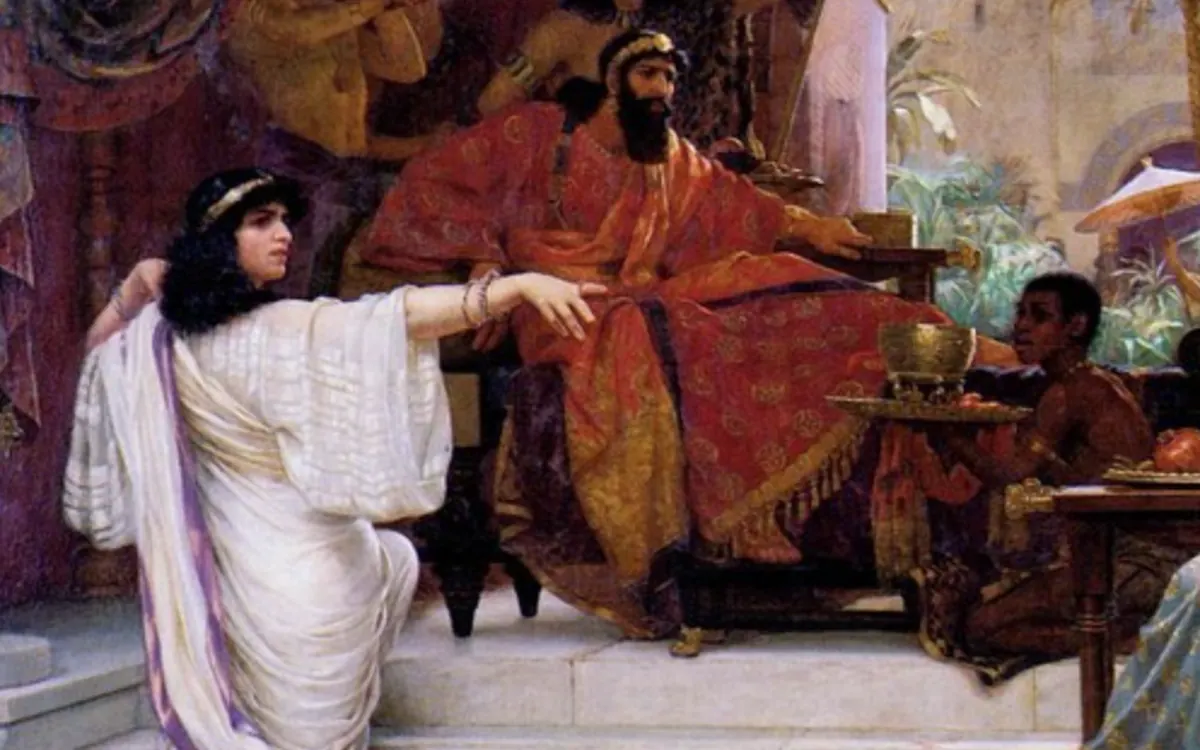
The Jewish Story is narrative therapy for a nation, but how can it also serve each of us in our quest to be actors in our lives instead of objects? Listen in to this great Purim Torah, an exploration of what the conversation between Mordecai and Esther can teach us about owning our own story.
About this episode
If you had felt yourself sufficient it would be proof that you were not, says C.S. Lewis. The Persian period is the black hole of Jewish history, a mystery whose layers only deepen, and the wormhole out of which the world we know emerges, Am Yisrael going in one end and the Jews coming out the other, engaged by Ezra, Nehemiah, Daniel and the Megillah of Esther. The story began with Daniel and Nebuchadnezzar's dream of the idol, the false face of malchut, tracing where the crown of kingship would go once taken from Israel and given to the nations, beginning a process by which the kingdom of God moves within, no longer the task of Am Yisrael as a whole but of every individual Jew. So the Purim question is what Esther can teach us about owning our story and becoming a vessel for the larger divine story, moving from an object acted upon to a subject and all the way to a co-author with God, since every story has a topography of inherited structures, the present landscape with its driving questions, and the visions of the future that guide action, which is why Rav Mike calls the Jewish story narrative therapy for a nation.
The Gemara in Yoma asks why Esther is compared to the dawn, the end of the night, teaching that Esther is sof kol hanissim, the end of all the miracles, and the message is that you must know the backstory before acting in the present. A nes in biblical Hebrew is not a miracle but a flag, something that rises above the present perspective to remind us of the broader horizon toward which we struggle, since every story plays on multiple scales, cosmic, planetary, national, communal, familial, personal, and owning one's story means asking how those scales work together. Esther's story appears intensely personal, an orphan and exile behind the silken bars of a harem who hears of Haman's plot and pleads her inability to act, since to enter the king unsummoned is death and she has not been called in thirty days, viewing it through the lens of personal fear, which makes sense since there is no national body or army. Mordechai's reply is the critical line, his one message in the Megillah, perhaps the most important statement from the mouth of man.
Mordechai says do not imagine that you of all the Jews will escape in the king's palace, since you cannot hide even in a safe base from the larger story, as the monks and nuns carried to the gas chambers show; and if you keep silent, relief and deliverance will come to the Jews from another place, hamakom, a name of God meaning God is the context of reality, the cosmic scale taken care of, and the national project not in jeopardy either, but you and your father's house will perish, the family scale on the line, the varied scales tipping us off to an essential message. Though God is absent from the Megillah and Am Yisrael is in an exile Daniel's dream said would not soon end, and the only thing in plain sight to Esther is her personal story, the miracle is that she goes for it, assembling the Jews to fast and saying if I perish I perish, mustering enough faith in the scales she cannot see to overcome the obvious threat to her personal story and give her life that the larger plan unfold, truly the last nes, a flag raised above the horizon, the last signpost of acting out the divine drama on the individual stage.
Knowing the scales is not enough to own the story, since knowledge of the larger events can be paralyzing, the recycling problem: even if most of the world does not recycle, bringing your bottles to the bin matters, for the educational reason of a behavioral tipping point from a critical mass of consciousness, the moral reason of acting on your values regardless of success, and above all because you never know. Rav Mike tells of his brother who dropped out of college in disgust and ten years later met the woman who had sat beside him and, seeing him do it, found the courage to leave for cooking school, now the chef of the restaurant, which is the depth of Mordechai's message that you never know the impact of what you are about to do. Mordechai's strange motivational speech, everything will be fine, you are in danger, not sure what will happen, ends on the power of a moment, who knows if it is for just such a moment that you have attained royal position, like Archimedes who introduced the concept of a moment with the lever, the question of what will move around what axis if I apply force, so that I may think I am saving or sacrificing myself but could be saving the whole world, and the very uncertainty frees me to act.
Finally malchut, and the association of Purim and Yom Kippur from the Zohar, that at redemption Yom HaKippurim becomes a day of joy like Purim, even readable as the day that is like Purim, the higher level being Purim. The ultimate moment of divine intimacy is the high priest entering the Holy of Holies, one man on one day in one place uniting the three dimensions of world, year and soul, around which all existence rotates, which raises what relevance it has to the rest of us who will never be the high priest. The answer is in Esther, who after the fasting enters the inner royal sanctum just like the high priest, at risk of her life, and on the third day clothed herself in royalty, embodying the scales of her story, the cosmic hamakom we cannot change, the national promise playing out slowly, and the personal scale where she could act, embracing the uncertainty of who knows and taking action to realize her dreams. That is owning your story, the place Purim and Yom Kippur meet: Yom Kippur sets the biblical ideal that done rightly heaven and earth connect, but one might think it the province of one man at one time and place, while Esther teaches it is the promise of every person at every time in every place, if we do the work of bringing together world, time and soul, to connect heaven and earth.
Key ideas
- The Persian period is the black hole where Am Yisrael becomes the Jews, and the kingdom of God moves within, the task of every individual Jew.
- A nes is a flag raised above the present horizon, and Esther is the last nes, the final signpost of acting out the divine drama on the individual stage.
- Every story plays on multiple scales, cosmic, national, family and personal, and owning it means asking how they work together.
- Mordechai's message is that you cannot hide from the larger story and that you never know the impact of what you are about to do.
- The power of a moment is Archimedes' lever, the question of what moves around what axis, and uncertainty frees us to act.
- Purim and Yom Kippur meet in malchut: the intimacy of the high priest is the promise of every person who brings together world, year and soul.
Chapters
- 0:00 The black hole; Am Yisrael becomes the Jews
- 2:08 Daniel's dream; the kingdom moves within
- 4:23 Narrative therapy; the scales of a story
- 6:30 Esther is the end of the miracles
- 7:41 A nes is a flag
- 9:49 Esther's personal fear; Mordechai's reply
- 11:00 You cannot hide; hamakom
- 13:13 The scales on the line; the last nes
- 16:30 The recycling problem; you never know
- 18:40 The brother who dropped out
- 20:49 The power of a moment; Archimedes
- 23:02 Malchut; Purim and Yom Kippur
- 27:30 The high priest in the Holy of Holies
- 29:38 Esther clothed in royalty
- 31:46 Every person, every time, every place
Who, where and when
People
C.S. Lewis, Esther, Mordechai, Daniel, King Nebuchadnezzar, Haman, Archimedes, Rav Mike's brother
Places
Persia, Shushan, The Holy of Holies
Texts
The Book of Esther, The Book of Daniel, Yoma on Esther and the dawn, The Zohar on Purim and Yom Kippur
When
The Persian period, The Purim story, the day of redemption
Read the transcript
If you had felt yourself sufficient, says C.S. Lewis, it would have been a proof that you were not. Well, I may not be sufficient, but I'm kind of hoping I'm adequate to the task at hand, because I'm Rav Mike Foyer, and this is The Jewish Story. Quorum interlude. Own your story. You know, I've said it once, I've said it a thousand times. the Persian period is the black hole of Jewish history. And I mean that first and foremost in the sense of it's total mystery. All you have to do is begin to scrape away the layers, and it just keeps getting deeper. You can go all the way back to the beginning of the Jewish story if you want to get my take on the problems of chronology, the conflict, or at least apparent conflict, between the traditional Jewish chronology that emerges from the Hebrew Bible and the contemporary chronology of the academics that is really rooted in the Greek historians.
That's true, and you can do it there. But the other aspect of why I see this as the black hole of Jewish history is because it really is the wormhole out of which the world we know emerges. In one end goes Am Yisrael, and out the other comes the Jews. And there are a few books of the Bible that engage this most mysterious of all time periods. Of course, if you've been listening to the Jewish story from the beginning, you've heard about a few. Ezra, Nehemiah, and last but certainly not least, Daniel. We haven't yet spoken of the Megillah. Esther's story remains to be told. You may recall, way back at the beginning of season one, this whole story started with Daniel, a young boy, taken from his home, forced to stand before the king in a world filled with visions and dreams.
Now, I don't have the capacity right now to recap three seasons of the story because I want to talk about Esther. But in order to understand her story, and most importantly, in order that we can learn from her how best to own our own stories, we need to at least touch where we started. And that was with Daniel. Daniel and King Nebuchadnezzar's dream. You may recall that Nebuchadnezzar was the king of Babylon, whom God sent to take the kingship away from Am Yisrael, the Malchut. He destroyed the temple. He exiled the people. it was really in his era that the prophets ceased to function. He brought to end that period in which our national mission was to build a kingdom of flesh and blood which could embody the kingdom of God on earth.
And Nebuchadnezzar's dream, whose interpretation is actually what brought Daniel to his position of power, was a vision of where that crown of mauchut, of kingship, would go in the world once it was taken from Israel and given over to the nations. And if you recall, that vision, if you don't, by the way, look up the second chapter of Daniel, but if you recall, his vision traces the form of an idol. It's a false face to Malchut, which might rule the world of flesh and blood, but is actually obscuring the kingdom of God. Because from the time of Daniel on, establishing that kingdom became much more of a personal matter. We spoke about it, like I said, long ago at the beginning of this journey, that the book of Daniel begins a process of the kingdom of God moving within.
And it would no longer, from that point on, be the task of Am Yisrael as a whole, at least for the foreseeable future, we'll see how season three ends, to actually establish the kingdom of God on earth. Now, that job lay in the hands of every individual Jew. And that's the Purim Torah I want to talk about right now. What can Esther teach us about owning our story? and through that about becoming a vessel for that larger divine story to unfold? How do I move from being an object which is acted on by the world around me to a subject which is empowered to engage the world and perhaps all the way to a full co-author, a partner with God in unraveling the tale which is my life and through that unfolding something even greater?
Now, it's critical to recall that every story has a topography on which it plays out. You can go to my Facebook page, the Jewish Story Facebook page, and watch the six maps that make up the Jewish Story video. It's a worthwhile watch on its own if you want a bit of a look at all the elements of that topography. But in essence, every story plays out on the structures we inherit from the past, social, spiritual, economic, biological, etc. It takes place in the present landscape with all its richness of culture, geography, sociology, and spirit. And that context, of course, is always made more complex by the driving questions which give energy to the day. And then there are the visions of the future, those hopes, dreams, and aspirations which actually guide and inspire our action in the present.
Now, I could do the deep dive into this right now. It is, after all, why I call the Jewish story narrative therapy for a nation. My goal is to help whoever's listening right now and has been for the last few years to map the terrain of our national past, which underlies the personal, national, and global present. And the goal is to give us a prayer of a chance to actually move our present toward the future we really desire. And as with the nation, so with the individual. This is what I do as a spiritual counselor. I help people own their story. And the truth of the matter is, I found out recently many people listening don't realize that this is an option. It's what I do. I offer the service of spiritual counseling to help you understand the deeper will which you may not be able to express, the driving questions with which you're grappling, and to set clear, actionable goals to get to that future you want.
If you're interested in engaging in such a process, you can write me, rovmikefoyer at gmail.com. You can send me a personal message on the Rav Mike Foyer page on Facebook, or I don't know, smoke signals. Get in touch if you want to start a process which will allow you to really own your story. But right now, I want to talk about Purim. Oh, by the way, did I warn you that I'm an Adar baby? I was born on Vav Adar, the sixth Adar, which means that basically once the beginning of this month comes, all bets are off. And that's doubly so in what's about to come. Ooh, which also reminds me, I have a dedication. It's a little odd. I think that's why I was suppressing it. I have a dedication. This show is dedicated in honor of me, of my birthday.
My wonderful in-laws have decided to dedicate this show in my own honor, so I'll do the best that I can. So right now, let's talk about Esther, how she came to own her story, and what that process can teach us about owning ours. The Gemara in Yoma says, Why is Esther compared to the dawn? Shachasof kol halayla teach you that just as the dawn is the end of the night, so to Esther is the end of all the miracles. Esther sof kol hanissim. Now, there is a tremendous amount to be learned from this somewhat obscure statement. If you want a thought on how strange it is to compare the age of miracles to the dark of night, meaning Esther's like the dawn because she comes after the dark, she's the end of the miracles, then send me an email, rovmikefoyer at gmail.com.
I'll shoot you back a short one called Blinded by the Light. But for now, the message I want to take is you have to know the backstory before you try and take action in the present. Esther Sof Kol Anisen. Yeah, we usually translate it as Esther's the end of all miracles. But we need to look a little bit closer at what exactly a nace is. Because a nace, if you look into biblical Hebrew, is really in its essence not a miracle, but rather it's a flag. Now what lies between a flag and a miracle is actually quite simple because a flag is something which rises above the present perspective in order to remind us that there's a broader horizon on which we're moving and toward which we're struggling to achieve.
Just think of the role that a flag plays on the battlefield or if you an American right the flag was still there meaning in the midst of the struggle and the dirt and the dust of daily life or even national existence it's important to see that which lies above for which we're struggling at all. Because there's a scale of the story that we're living in, which we're often unconscious of, but it's nevertheless influencing the narrative that we think we're in. Remember, every story takes place on multiple scales. We could go cosmic, planetary, national, communal, familial, personal, and those are just common examples. I'm sure we could come up with others. And really, one of the critical tools for owning one's own story is to ask how those scales work together as overlapping terrains for the life that I actually live.
So Esther's story appears intensely personal. She's an orphan, an exile. Not only that, but she's been kidnapped into the palace of a king who's indulging in systematic rape and imprisonment of women. Don't miss that side of this story. And it's from behind the silken bars of her harem that she hears of Haman's plot to destroy the Jews. Mordecai sends word, and then when he calls upon her to act, Esther pleads her inability to save anyone, and she does it from a personal perspective. She says, all the king's courtiers and the people of the king's provinces know that if any person, man or woman, enters the king's presence in the inner court without having been summoned, there is but one law, that he be put to death.
Only if the king extends the golden scepter may he live. Now I have not been summoned to visit the king for the last 30 days. You hear the intensely personal fear, the lens through which she's viewing what's happening right now? It makes perfect sense. Her entire people is in exile. There's no national action going on. There's no political body. There's no army. Mordecai is, some would be, a self-appointed leader. Furthermore, the whole world, 127 nations, are subject to this king. What's one woman, no matter how well placed, going to do? And Mordecai's reply is actually the critical line of the Megillah. You may be unaware that despite his role as a main character, he only gets one, it's not even spoken, but one direct message in the entire Megillah.
And since, in a sense, the Megillah is the keystone that holds together the entire Hebrew Bible, one might say that this is the most important statement made out of the mouth of man. Now take a good look yourself at the fourth chapter of the Megillah of the Book of Esther, lines 13 and 14. It begins and he says, don't imagine that you, of all the Jews, will escape with your life by being in the king's palace. He says, you might read your personal situation as one of safety, but just remember, just because your individual story has landed you in what appears to be a safe base, you can't hide, even there, from the larger story unfolding. And unfortunately, we know that the Jewish story is full of tragic reminders of that reality.
Just think of the monks and nuns, converts out of Judaism, who were carried off to the gas chambers along with the rest of their national story. So, but Mordechai has more to say than simply that warning. He says, You keep silent in this crisis. relief and deliverance will come to the Jews from some other place you and your father's house will perish so he says the cosmic scale is all taken care of God is bigger than the world he says of course he doesn't use the word God God doesn't appear explicitly in the Megillah but Hamakom is a particular and powerful name of God It's the name of God that says God is the context within which reality takes place. Or as our sages said it so beautifully, the world is not the place of God.
God is the place of the world. And since the cosmic scale is all taken care of, that means the national project is not actually in jeopardy either. You might have thought that's what this story was about, says Mordecai. I mean, after all, Haman wrote the writ to kill every man, woman, child, and take all their stuff. All the Jews are going to go down. But, says Mordecai, the divine promise is not subject to your success or failure or even to Haman's evil plot. What is, however, on the line, he tells her, is your family story. You and your father's house will perish. Now, the varied scales in his statement alone, his personal, cosmic, familial, national, ought to be enough to tip us off that there is an essential message coming through here.
But in case we missed it, the sages wanted to drive home to us how important that moment really was. Because while Mordecai could affirm his faith, like we said, God is not there in the Megillah. And he can attest to his belief in the national covenant. But let's face it, Am Yisrael is in exile. An exile that Daniel's dream told us isn't going to end anytime soon. And we're kind of struggling to end it right now. And it's a nice narrative to connect the war between Esther's holy ancestor, King Saul, and Amalek, to the present struggle between Mordecai and Haman. But that relies on a knowledge and belief in the background narrative. The only thing available to plain sight in that moment in the harem to Esther is her personal story.
And the miracle is, she goes for it. She takes the risk. go she says, assemble all the Jews who live in Shushan and fast on my behalf she tells him not to eat or drink for three days and says her maidens will do the same and then I shall go to the king though it is contrary to the law and if I am to perish, I shall perish Esther is able to muster enough faith in the tale Mordecai is telling her in all the scales which she cannot see that he claims are intersecting in this moment to overcome the very obvious threat to her personal story. Not only that, she's willing to give her life in order that the larger plan unfold through her. And that is truly a nace. It's not just a miracle, it's the last nace.
Not a miracle in the sense of the Torah, that act of divine intervention which tips us off to God's omnipresence and, of course, the contingent nature of reality. It isn't the splitting of the Red Sea meant to forever challenge that slavish attachment we all have to a one-to-one relationship between perception and reality. No, no. This is a nace in the sense of a flag raised above the horizon of our story. You know, it's true, by the way, in case you ask, that the Hanukkah miracle does lie ahead chronologically, which the Gemara does protest. I didn't actually read that part to you because the Gemara goes on, says, What about Hanukkah? The answer is, No, we're talking about miracles that were given to written down.
Esther is the last Nes written down in the Hebrew Bible. This is the last signpost of what it looks like to act out the divine drama on the individual stage. The Megillah is meant to be our boundary marker. Esther, she's the last flag. It's the last letter sent to the nation before exile really sets in. and the scale of the story, at least as we experience, becomes dominantly personal. It's meant to teach us how we should see the multiple scales underlying our personal existence and how to act accordingly. Esther, Sof Kol Hanissim, the last signpost to remind us that there's always more to the story than meets the eye. Knowing the skills of the story is critical but it not enough to own it In fact for many people I find that knowledge of the larger events which are playing themselves out in their life can actually be a disincentive to action.
It can be downright paralyzing. I think about this as the recycling problem, which I'm sure I've said to you before. It goes like this. Do you believe a person should recycle? If your answer is no, so you can stop listening. If the answer is yes, however, first of all, thank you. I appreciate your concern. But I have a challenge. Let's just assume that three-quarters of the planet has never heard of the idea of recycling. Okay, you want to say two-thirds? Fine. And then amongst the third that's left, let's say two-thirds of them don't have access to the infrastructure to recycle. And amongst the third which are left of them, two-thirds or three-quarters don't even do it. So now are you going to tell me that it makes a difference that you bring your bottles to the bin?
My answer to you is absolutely yes. But the question is why? Now we could make the educational argument that what we're working for is social change. And through my behavior, I'm able to influence the people around me. And that's important to remember. You don't need everyone to change. My experience is that there's a behavioral tipping point which comes from a critical mass of consciousness. If you get enough people doing the right thing, it becomes the right thing, and a lot more folks will jump on board. And then there's a good argument there. I could also make a moral argument. I could tell you there's a value in acting in accordance with my values, regardless of the utilitarian question of whether those actions succeed in changing the world.
And then I do also believe that. So there's an educational argument, and there's a moral argument. But there's one more factor, which is so critical to our ability not to be frozen by the scales of our story, but to actually be inspired by them. And that's the fact that you just never know. I'll tell you a quick story about my brother. God bless him. He should be healthy and well. Don't worry, he's a successful professional, married and happy at this point. But when he was a younger man, he was miserable in college. I won't name the university in New York City that he went to. But one day, it might have been his beginning of his sophomore year, He was sitting in an introductory philosophy class, and the teacher asked whether David Hume believed in God.
And one of the peppy young students in the front raised his hand, and a snotty voice said, of course not, no one intelligent could possibly believe in God. Now, my brother is not exactly the from type. Nevertheless, he was so disgusted with the sort of intellectual closed-mindedness he'd found in university that he shut his philosophy textbook, and he said, that's it, I'm done. Now, there was a young woman sitting next to him, and she said, what do you mean you're done? He said, that's it, I'm done. I'm never coming back again. I'm dropping out of college. And indeed, he did. The next day, he went to the registrar, withdrew, started on a world travel, which is legendary in the Foyer family. At a certain point, he decided he didn't want to be, in his own words, 23 and degree-less.
So he went back, and he finished college, and he actually still lives in New York City to this day. But one day, about 10 years after that incident, he's sitting in a restaurant with his, I think, then girlfriend. And the waiter comes up and says that the chef would like to speak to you. Now, if you've ever been in a restaurant, you know that it's not unusual in a good restaurant for someone to want to compliment the chef. But why on earth would the chef want to speak with a customer? So a young woman walks out about his age and cooks wife looking so excited. And she says, I can't believe it's you. I can't believe it's you. And he, of course, has no idea who she is. She says, you don't remember me. She says, ah, no.
She said, I was sitting next to you in our sophomore year introductory philosophy class. And you shut your book and you said, that's it, I'm dropping out. And the next day I saw that you actually did it. You weren't there. And that gave me the courage to do the exact same thing the next week. Because she said, I never wanted to go to college. I actually always wanted to go to cooking school. But I was afraid to make that leap against the will of my family. But once I saw you do it, I just couldn't hold back. And I did it. And I got this great job. And here I am. And now here you are. True story. And it's important. It's important not just because it's cool. It's important because on some level, this is the real depth of the message which Mordecai sends to Esther.
You just never know the impact of what it is you're about to do. Don't assume, even though you know the topography on which you're moving, don't assume that you can see the outcome of the action. you're about to take. I mean, if you look at his words, they seem quite strange as a motivational speech. He starts off, if you keep silent in this crisis, don't worry, everything's going to be fine. Relief and deliverance will come to the Jews from somewhere else. That's strange. But you and your father's house will perish. Ooh, so not only will everything be okay, but I'm in danger. And who knows? Maybe that's why you've attained royal position for just such a crisis. It's strange. Everything is going to be fine.
You're in danger. Not sure what's going to happen. That's the worst motivational speech ever. But for right now, I want to focus on that last line. Because it's that last line. Who knows if it's for just such a moment you've attained royal position. Because here, Mordechai opens up for Esther the power of a moment. Act now, because you never know what lies in this moment. You know, it was Archimedes in his explanation of the power of a lever, that amazing ability to move something we never thought we could move, who first introduced into physics the concept of a moment. Now, the physics definition of a moment, don't be scared, is a measure of its tendency to cause a body to rotate around a specific point or axis.
In other words, what lies in a moment is the question of what exactly will move if I apply force on the personal scale? What body am I moving around what axis with this action? I may think I'm saving myself or I may think I'm sacrificing myself, but I could be actually saving the whole world. My brother thought he was only moving himself. He was blessed to learn. Otherwise, most of us will never see the effect we actually have in the world. But just because we don't know doesn't mean it isn't there. On the contrary, that's the depth of Mordecai's message to Esther. Do the best you can to understand that all scales are always present, divine, national, family, personal, etc. But don't kid yourself that you know.
In fact, it's the very uncertainty which frees you to act in a way which can cause the whole universe to rotate around your axis. Who knows if this isn't the moment you've come to kingship. And now, last but certainly not least, we need to talk about Malchut. There is a beautiful and powerful association between Purim and Yom Kippur, whose roots go at least as far back as the Zohar. Like the Zohar says, at the time of redemption, Yom HaKippurim will become a day of celebration, joy, goodness, and the eating of all sorts of delicacies, just like Purim. I mean, because you could read, even though it's grammatically incorrect, phonetically it sounds right, Yom HaKippurim as the day which is like Purim.
Purim. And that's strange because we have as we say, it's always the lesser which is dependent on the greater. The implication here is not just that Yom Kippur will become a day of celebration, but that it is a day which is like Purim. That the higher level, in fact, is Purim. Now there are endless perils that can be drawn in order to explain the relationship between these two powerful days. And in fact, if you want a source sheet that lays them out for you, You can send me an email. Remember, it's ravmikefoyer at gmail.com. I'll send you a Sepharia source sheet on the whole question. But for now, in order to finish our exploration of just how Esther came to own her story, and to derive from that a little bit of guidance in how we can do the same I want to focus on one detail that connects these two days Now we started with the question of scale When Mordecai says to Esther don imagine that you of all the Jews will escape with your life.
On the contrary, if you keep silent, there's this other quarter, Makom Acher, from which redemption will come while you and your father's house will perish. And don't forget, this is the essential precursor to owning your story, to gain the ability to act instead of simply being acted upon. In order to do that, you have to know what's happening under, around, inside of you. And understanding those skills is the first step. It's why, if you ever work with me, the first thing we'll do is talk about what's your story. But, as we saw, you don't want to think you know it all. This isn't a deterministic mapping, something which locks the present into the past. On the contrary, that would be terrible. It would be paralyzing.
Never forget that the definition of hope is our belief that what is does not necessarily define what will be. And that means in order to become a subject acting in my story rather than an object being acted upon, mapping the topography on which we're walking is not enough. We have to know that we don't know. We have to embrace the wonder of uncertainty. It's true. Uncertainty and doubt can truly be scary. I mean, not knowing can mean I spend most of my time knowing my fingers in doubt. What will be? I don't know. But you know what else not knowing can be? It can be absolutely wonderful. It can be the source of wonder. Hey, what will be? I don't know. And that shift in tone of I don't know to I don't know, that opening to the power and possibility of uncertainty, as opposed to the fear and closing down which come with doubt, is what allows that mapping to become a field of play, as opposed to a deterministic topography, which forces us toward a future that we can't choose.
And that's why Mordecai says to Esther, Who knows if it's actually for this very moment that you've arrived to the kingship. Which brings us finally to malchut, to kingship and the deep connection between Purim and Yom Kippur. Now every student of the Torah knows that the ultimate moment of divine intimacy that the Torah describes is when the Kohen Gadol, the high priest, enters into the Holy of Holies. lifnai u lifnim. This is a moment in the spiritual sense, in the metaphysical sense, one which parallels in many ways the concept of moment in physics that we mentioned, except all existence rotates around this axis. And that axis really exists in three dimensions. One particular man, on one particular day, goes into one particular place and unites the three dimensions which the Kabbalists call world, time, literally year, and soul.
It's beautiful and powerful, and it's a critical avoda, by the way, which can be practiced. A big part of owning one's story is being able to locate where am I in all those three dimensions at any given time. Now, the description of the Torah is intense. You've got to read Ahre Mot, the parasha, which gives the details of it to really, really appreciate it. But every time I read these sections on the high priest, I'm always left with a very simple but essential question. What does this have to do with you and I? I mean, even if you dream of rebuilding the temple, let it be soon, let it be now. And I do. but nevertheless I'm pretty sure that the overwhelming vast majority of people listening right now will never have the chance to even stand as a candidate for the Kohen Gadot much less to actually enter to go into that inner space so then what relevance is there to this notion of Ashan to the possibility of uniting world, year and soul of bringing together the physical, temporal and spiritual dimensions in one action in order to establish, as on Yom Kippur, a true intimacy between God and creation?
What relevance does it have to me? And why does it only happen once a year to one guy in one place? The answer is found, actually, in Esther's response to Mordecai's call to action. Because what does she do after that? After all the fasting and prayer, Esther enters the inner royal sanctum as well, just like the high priest. And as the sages taught, by the way, the high priest who was found unworthy would die upon entry to the Holy of Holies. So too, Esther knew she was risking her life. She was relying on the grace of the king to be received. So how did she prepare herself? How did she unify that spiritual moment of ashan, olam shana neshama, in order to be the right person at the right place at the right time, to make the change, to cause the world to rotate around the axis which would bring redemption specifically through her?
Well, it says at the beginning of the fifth chapter, the first line, On the third day, after all that prayer and fasting, that she closed her cell in royalty. She was able to embody the scales of her story, to appreciate that there was Hamakom. God is the place of the world, the cosmic scale, which we cannot change. Also the national scale, which is playing itself out through the promise. Although, if you've been listening to the Jewish story for any amount of time, you realize it's a slow process. But then there was that personal scale, her ability to act. And in order to act, she embraced the uncertainty of life. Right? Who knows? And then she took action to realize her dreams in reality. That's the work of owning your story.
It's the place that Yom Kippur and Purim meet. Yom Kippur sets up that biblical ideal. God's promise is that done rightly, heaven and earth will always connect. But one might be deceived if they read the Torah of thinking that this was only the province of one man at one time in one place. Esther's story teaches us actually that that is the promise of every person at every time, in every place, that if we do the work of owning our story, of bringing together the world and the time and the state of soul in which we find ourselves, that we are able to connect heaven and earth. That's the message of Purim. Esther Sof Kolanissim. She's a signpost to us all. And this is an invitation. If you want to own your story, send me a message, robmikefoyer at gmail.com or find me on Facebook.
and we'll get to work. And meanwhile, you should have a Freilich Purim. Purim Samer. I just want to thank a few folks before I sign off here. I want to thank all the folks who give their hard-earned money to make this show happen. I want to invite you to join them. You can go to my website. That's jewishstory.co and you'll see a button in the upper right-hand corner that says Be a Patron. And you can click on through for a little bit of per-podcast support. And if that's a little bit too much, you can always dedicate a show in honor of someone alive today or in memory of someone who is no longer with us, if you want the details on that, send me an email at ravmikefoyer at gmail.com or find me on Facebook.
I'll shoot them right back to you. I also want to thank the Land of Israel Network. That's thelandofisrael.com for creating a platform that allows me to reach so many amazing people. I want to thank the Pardes Institute, P-A-R-D-E-S dot org dot I-L for creating an educational institution that gives me the privilege of teaching so many fantastic Jews. And I want to thank you for listening. I'm Rav Mike Foyer. And this is The Jewish Story.
More from Season 3
TJS S3E24 Levi Eshkol - a new face of leadership
Old politicians never die, they just fade away. The era of Ben Gurion ended in 1963 and it appeared that his replacement, Levi Eshkol, could not live up...
Play Episode
TJS S3E25 Shifting identities in early Israel
The present is always built on the ruins of the past, the only real question is - how do we integrate this reality into our identity? This episode...
Play Episode
TJS S3E26 Eli Cohen, hero of Israel
Historians may argue about whether one person can shift the course of history, but everyone agrees that a hero can change the world. Here is the story of...
Play Episode