
TJS S3E18: The Eichmann Trial
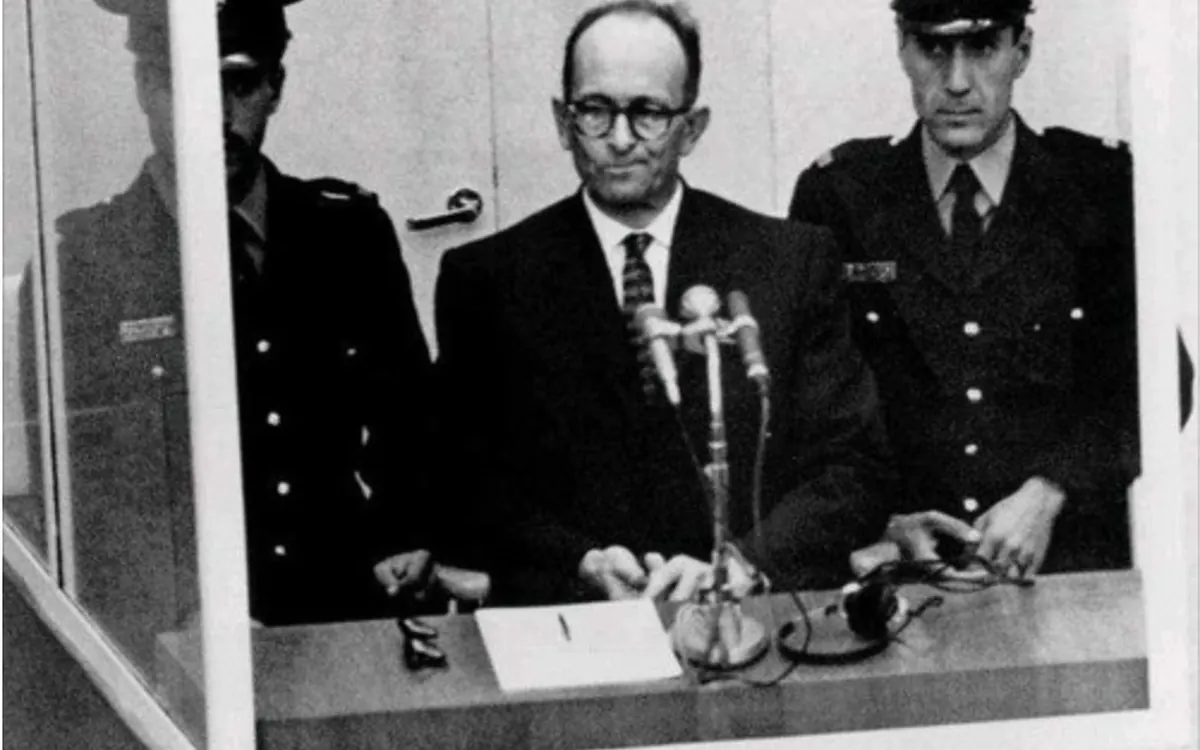
The Holocaust was so dark and vast that the Jews struggled to integrate it into their consciousness, despite the hundreds of thousands of survivors in their midst. One of the turning points in even addressing this issue was the capture and trial of Adolf Eichmann, architect of the Final Solution. He was taken and tried, but was it for justice, vengeance or education?
www.flickr.com/photos/huntington…atreco/6238852798Rav MikeJewish HistoryHolocaustEichmann
About this episode
The world is dangerous because of those who do nothing, says Einstein. Isser Harel, born Isser Halperin in Belarus, embodied the negation of exile, Hebraizing his name to Har El, mountain of God, after reaching the land in 1929 carrying a pistol hidden in a loaf of bread. He rose through the Haganah's intelligence to head both the Shin Bet and, from 1952, the Mossad, the Institute founded on the verse that by stratagems you shall wage war, making him one of the most powerful men in Israel. In 1957 a chain of calls reached him: Lothar Hermann, a half-Jewish German in Argentina whose daughter befriended Klaus Eichmann, became convinced the boy's father was Adolf Eichmann, architect of the final solution, and the letter passed through Frankfurt to the survivor attorney general Fritz Bauer, who, knowing West Germany's denazification had left many Nazis in place and that his superiors would tip off the fugitive, took it to Harel. Harel, who barely knew who Eichmann was, stayed up all night reading the dossier of the head butcher, and the hunt was on.
After the war Eichmann had slipped from an American POW camp under false names, lived as a woodsman as Nuremberg made him famous, and escaped to Argentina in 1950 through a network of SS officers and elements of the Church, bringing his family and living as Ricardo Clement, building a house at 14 Garibaldi Street. Harel established his identity beyond doubt, the shape of his ears giving him away, and with Ben-Gurion decided not to assassinate but to try him, a unique chance to teach the world the horrors of the Holocaust, under the 1950 Nazi Collaborators Law, which meant snatching him off the street and suffering the diplomatic fallout of violating Argentine sovereignty. The final confirmation came on March 21, 1960, Eichmann's silver wedding anniversary. A team of over thirty agents, many survivors, flew in for the Argentine independence celebrations, and on May 11, 1960 the snatch squad on Garibaldi Street seized Eichmann when his bus came late, Peter Malkin the first Jew to lay hands on him, Eichmann saying I have already accepted my fate, and after days he signed a statement agreeing to be tried in Israel.
On May 20 Eichmann was drugged and smuggled aboard the El Al flight disguised as a steward who had celebrated too hard, and landed in Israel on May 22, Ben-Gurion announcing to the Knesset that the architect of the annihilation of six million was behind bars, the transport minister blurting in Yiddish how does one do that. Mickey Goldman, born in Poland in 1925, was the model of the survivor, through Auschwitz and the death march, the Soviet army, a DP camp and the Hatikvah immigrant ship turned to Cyprus, who enlisted in the Israeli police and was attached to Bureau 06 investigating Eichmann, wearing short sleeves so Eichmann could see his tattoo, and refuting Eichmann's claim to be a small cog with document after document, including the railway letter recording that on July 22, 1942 trains began carrying Jews to Treblinka and Belzec, four days before his own parents and sister were sent to Belzec. Goldman also served as aide to chief prosecutor Gideon Hausner, whose opening on April 11, 1961 said that with him stood six million accusers whose blood cries out but whose voices are not heard.
An estimated five hundred journalists covered one of the world's first global media events. The defense lawyer Servatius attacked the court's jurisdiction, that Jewish judges could not be fair, that Eichmann had been kidnapped, and that the offenses were committed outside Israel before its establishment, all rejected: a judge is bidden to overcome his emotions, and Israel now represents all Jews, the people is one and the crime is one. Eichmann pleaded not guilty on every count, and through over a hundred witnesses and sixteen hundred documents the prosecution proved his role, but the trial did more, telling for the first time the story of those lost and those who survived, giving the victims a public voice and Israelis listening, 83,500 visiting the courtroom to see the man in his glass box. As testimony showed resistance was often impossible, the image of victims who went like sheep began to weaken, the public grasping that there is more to resistance than physical opposition, though the heroic image of the ghetto fighters did not disappear but grew more complicated; Chaim Guri was grabbed by the throat, Yehiel Dinur testified of the planet Auschwitz and collapsed, and Goldman said the worst blow was the 81st, the Israelis who did not believe the survivors.
The court found Eichmann guilty on all counts and sentenced him to death on December 15, 1961, the Supreme Court rejected his appeal, the president denied clemency, and he was hanged and cremated on May 31, 1962, his ashes dumped beyond Israel's territorial waters, the first and last death sentence in Israel's history, Goldman noting we could only hang him once. Serving justice for the evil of the Holocaust is a strange and confusing notion: some held that Israel had no right to try crimes against all the Jews, but with a quarter of the population survivors Ben-Gurion wrote that the Jewish state is the heir of the six million, the only heir; others, including Isaiah Berlin, Buber, Scholem and Hugo Bergman, held that victims may take reprisals but cannot try, and petitioned against the execution in vain. The trial marks a turning point in the discourse, yet the 1963 textbooks still demonized the perpetrators, accused the free world, extolled the fighters and condemned the victims, failing to ask what we do with this reality and what future a people can have with such a past, a question that is not going away, as Ben-Gurion said, the reward for a mitzvah is the mitzvah itself.
Key ideas
- Isser Harel's Mossad traced a tip from Argentina to Adolf Eichmann, whom Ben-Gurion chose to try rather than assassinate to teach the world.
- Operation Finale seized Eichmann on Garibaldi Street on May 11, 1960, and smuggled him to Israel disguised as an El Al steward.
- Mickey Goldman, a survivor turned investigator, refuted Eichmann's small-cog defense with his own signed documents.
- The trial gave the victims a public voice for the first time, weakening the image of victims who went like sheep.
- Eichmann was found guilty, hanged and his ashes dumped at sea, the first and last death sentence in Israel's history.
- Some argued victims may take reprisals but cannot try, yet Ben-Gurion held the Jewish state is the only heir of the six million.
Chapters
- 0:00 Those who do nothing; Isser Harel
- 2:00 The Shin Bet and the Mossad
- 3:27 The tip from Argentina
- 7:53 Eichmann's escape; Garibaldi Street
- 10:01 Operation Finale; trial, not assassination
- 12:09 The silver anniversary; the team
- 14:26 The capture on Garibaldi Street
- 16:34 Smuggled to Israel; Ben-Gurion announces
- 18:42 Mickey Goldman, the survivor-investigator
- 22:02 Hausner's six million accusers
- 24:09 The defense; jurisdiction rejected
- 26:16 The victims given a voice
- 27:24 Guri, Dinur, and the 81st blow
- 30:40 The verdict and execution
- 31:42 Should Israel have tried him?
- 33:51 A turning point; the textbooks unchanged
- 34:55 The reward for a mitzvah
Who, where and when
People
Isser Harel, Adolf Eichmann, Fritz Bauer, Lothar Hermann, David Ben-Gurion, Rafi Eitan, Peter Malkin, Mickey Goldman, Gideon Hausner, Robert Servatius, Yehiel Dinur, Isaiah Berlin
Places
Buenos Aires and Garibaldi Street, Argentina, Auschwitz, Jerusalem
Texts
The House on Garibaldi Street, The Nazi Collaborators Law, Hausner's opening statement
When
1957 CE: the tip reaches Harel, May 11, 1960 CE: the capture, April 11, 1961 CE: the trial begins, December 15, 1961 CE: the death sentence, May 31, 1962 CE: the execution
Read the transcript
The world, says Albert Einstein, is a dangerous place to live, not because of the people who are evil, but because of the people who don't do anything about it. And I say that one thing you can always do is tell the tale, because I'm Rav Mike Foyer, and this is The Jewish Story. Episode 18, The Eichmann Trial. Iser Harrell's early life story reads like a standard biography of the labor Zionist movement. Born Isser Halpern in Belarus in 1912, his family's fortune was confiscated by the Bolsheviks in 1922. In the wake of these and other hardships, they sought refuge in Latvia, where Isser became involved in labor Zionist youth organization. He trained on a model kibbutz and dreamt of the day that he and his friends would go up to the land of Israel.
And when, in 1929, word of the Hevron riots reached Isser and his friends, they decided that time had finally come. Each made their own way toward Israel. Isra himself crossed Europe north to south in order to take ship from Genoa in Italy. The whole journey, he would later say that he carried his most important possession, a pistol hidden in a loaf of bread. Upon arrival, like so many other young Zionists, Isra Halperin Hebraicized his name to Isra Harrel and quickly joined an actual kibbutz. Now he was no longer Halperin, son of the Russian Jewish merchant, whose name derived from the German city Helbon. now he was Har El, meaning Mountain of God, and he'd become a child of the land. It's the perfect embodiment of Shlilat HaGalut, that negation of exile, which underlies so much of the Zionist worldview.
And by all accounts, Har El never looked back. So then Isser joined the Haganah soon after his arrival, and was quickly recognized for his exceptional abilities, moving into the highest echelon of the intelligence division. With the establishment of the state, I hope you recall that the Haganah, which had been the underground army of the left-wing labor Zionist movement, became the backbone of the new Israel Defense Forces, the IDF. And, of course, its intelligence organs moved into the same role on national stage. Haral was now the first commander of the Shabak, Israel's internal intelligence agency, the equivalent of the FBI, for those of you living in America. In 1951, Prime Minister David Ben-Gurion created the Institute for Intelligence and Special Operations within the Prime Minister's office.
It's known simply as the Institute, or perhaps better known as the Mossad. And this new service was tasked with intelligence collection, covert operations, and counterterrorism. Their original model was actually B'tahpulot Taseel Hamilchama, by stratagems, you shall wage war. You can look it up in Proverbs 24.6. And a year after its founding, this organization, looking to wage war through strategy, found its perfect head when Isser Haral was appointed director of the Mossad. He did so, by the way, without resigning from his position as the head of the Shabak, of the internal security servants. And it was a dual position he would hold until his resignation in 1963. by being head of the Mossad and head of the Shabbat, Harel became one of the most powerful men in Israel for its first 15 years of statehood.
There are many stories I could tell you of his exploits and the heroic lengths to which he and his agents went to protect the security of the young state, and I'm sure there are many, many more that I'll never know. But our story begins in 1957, when Harel received a phone call from Walter Eitan, the Director General of Israel's Foreign Ministry. Eitan himself had just recently received a call from Fritz Bauer, the Attorney General of the central German state of Hesse. And Bauer, in turn, had just received a letter forwarded to him by the judicial authorities in Frankfurt. The letter was from one Lothar Hermann, resident of Argentina. Now, it seems that Hermann's daughter, Sylvia, had struck up a friendship with a young German man by name of Klaus Eichmann.
Now, there was nothing unusual about that in and of itself. At this point, there was a significant expatriate German community in Argentina, mostly made up of former Nazis that had sought refuge with the sympathetic Peronist government in the early 50s. Lothar Hermann himself was a German, but his story was different, because he was also half-Jewish and had spent a brief spell at a Nazi concentration camp before he managed to flee the country for warmer pastures in South America. And upon speaking with his daughter's new boyfriend, Klaus, and then finally meeting the father, Lothar became convinced that the father of his daughter's new boyfriend was none other than Adolf Eichmann, senior SS commander and architect of Hitler's final solution to the Jewish problem.
Shocked and confused, Lothar sent a letter back to Frankfurt. Frankfurt passed it on to Attorney General Fritz Bauer. But Bauer himself was also a survivor of the camp. And furthermore, as a high official in the German state, he knew that the post-war denazification program, meant to remove the stamp of Hitler's men from rule in West Germany, had been a rush job. There was a need to create a strong state that could stand as a bulwark against the Soviet unit, and thus they'd left many Nazis and their sympathizers in place. And if Eichmann had truly been spotted, then Bauer wanted justice done. And he knew that if he told his superiors, it was just a guarantee that word would get back to the fugitive in time for him to flee.
And so, that's how it came to be that Walter Eitan, Director General of the Israeli Foreign Ministry, arranged a meeting between Bauer and the powerhouse of Israeli intelligence, Isser Harrell. And here is the sad part of Harrell's life story as standard biography of young Zionists. Even though it was 1957, the very year that his agency had investigated and solved the murder of Yisrael Kastner, as we spoke about last episode, Yisrael Harrell had almost no idea who Adolf Eichmann was. In his book about Eichmann's capture, called The House on Garibaldi Street, which I highly recommend reading, Harel says that before the meeting with Bauer, he stayed up all night reading Eichmann's dossier. It's a quote.
I didn't know what sort of man Eichmann was. I didn't know what morbid zeal he pursued his murderous work or how he went into the fray to destroy one miserable Jew with the same ardor he devoted to the annihilation of an entire community. I didn't know that he was capable of ordering the slaughter of babies and depicting himself as a disciplined soldier, of directing outrages on women and priding himself on his loyalty to an oath or of sending helpless old men to their deaths and classifying himself as an idealist. But I knew when I rose from my desk at dawn that in everything pertaining to the Jews, his were the hands that pulled the strings controlling manhunt and massacre. I knew that at all the Nuremberg trials of Nazi war criminals, this man was pointed to as the head butcher.
Harrell also reports that in light of Eichmann's mastery of police methods, his professional skill and total lack of conscience, he would be an exceedingly dangerous quarry and hard to catch. It was almost as if his whole life he had been trained to find one man. And so, the hunt was on. After the defeat of the Third Reich at the end of World War II, Adolf Eichmann was actually arrested by American forces and placed in a POW camp. But he was placed there, because of his mastery of disguise, as Luftwaffe Corporal Barth. In the camp, he quickly realized that officers were exempt from compulsory labor, and so overnight, he became SS Untersturmführer Otto Eichmann. But Eichmann knew he was far from safe.
His face was too well-known, and there were too many mildly bad Nazis who would be more than happy to save themselves by ratting out the devil. And so, with the help of senior SS officers, he escaped that camp as well. Traveling now as Otto Henniger from Breslau, Eichmann lived an itinerant life for more than two years, traveling around Germany working as a woodsman and a laborer. But, in the interim, the Nuremberg trials had made him famous. His face was plastered on almost every police station in Germany. And the search for surviving high-level Nazis was in full swing. Eichmann knew he had to get out of the country. And the means were provided by a network of former SS officers, working together with elements of the Catholic Church, who had established safe routes from Germany to Italy and on to Argentina.
So Eichmann arrived in Buenos Aires in July of 1950, and a few months later he contacted his wife Vera by coded message, telling her he was alive and well, and asking that she and his three sons join him in Argentina For the next several years Eichmann lived the life of a German expatriate He and his family moved from place to place He was quite adept with his hands and he managed to find work wherever he went. But he found it wasn't necessary to hide his Nazi past. On the contrary, he maintained friendships with a small circle of former SS comrades who had also escaped to South America and even educated those who hadn't realized what it was they were actually doing to the Jews. In the late 50s, Eichmann finally decided it was time to settle down under his new name, Ricardo Clement, and so he bought a plot of land in the Ban Calari district of Buenos Aires, and together with his sons built a house, number 14 Garibaldi Street.
It had been a decade since Nuremberg, and maybe he felt that the pursuit had finally faded. but unbeknownst to Eichmann by this time Issa Harrell and the Assad were fast on his trail when Harrell received Eichmann's address from Fritz Bauer he had immediately set about establishing Eichmann's identity beyond a doubt agents were sent to Argentina to get photographs to be compared to his SS file by the way it was the shape of his ears that gave him away others began to gather every scrap of relevant information they could find in Israel, Germany or elsewhere Meanwhile, Harrell began a discussion with Prime Minister Ben-Gurion. And slowly but surely, they decided that if indeed they'd found the mastermind of the final solution, they were not going to assassinate him.
Ben-Gurion and Harrell knew that this was a unique opportunity. Here was a chance to teach the world the horrors of the Holocaust. And so, Eichmann wouldn't be killed, at least not at first. First, he'd be put on trial. Now, the legal diplomatic barriers were enormous. Because of the number of Nazi sympathizers in South America, they realized that extradition by diplomatic means was a non-starter. The only way to get Eichmann into Israel was by snatching him off the street, and that meant suffering the diplomatic fallout of violating Argentinian sovereignty. Furthermore, after consulting lawyers and doctors of jurisprudence, neither man was sure that Israel had the jurisdiction to even try Eichmann, certainly not under international law.
and so they planned to do so under the Israeli-Nazi and Nazi collaborators law that was passed back in 1950. We discussed it in the previous episode. But despite all their doubts, the operation crept slowly forward and a thick file began to grow on Isra Harrell's desk. Its title was Operation Finale. The final confirmation of Eichmann's identity came on March 21, 1960. By this time, Ricardo Clement was under constant surveillance, and so the agents took note when he got off the bus and walked slowly toward home with a bouquet of flowers in his hand. They saw Clement give the flowers to the woman who greeted him at the door, flanked by children all dressed for a special occasion. Later, they could hear the sound of laughter and rejoicing coming from the windows of the house on Garibaldi Street.
March 21st was the date of Eichmann's silver wedding anniversary, and now Issa Harrell had doubt no more. Luba Volk was an upstanding member of the Argentinian Jewish community, wife of engineer, stay-home mother of a three-year-old son, and so, by all accounts, she was thrilled when in the early 1960s, 1960, a representative of Israel's national airline, El Al, contacted her with an offer of employment. The 150th anniversary of Argentinian independence was just about to be celebrated that summer, and the El Al representative told her that in light of Israel's desire to strengthen her international relationship, she was looking to set up a regional office for the airline in Buenos Aires, an office that could handle all official travel for the anniversary celebrations.
and, unbeknownst to her, all unofficial travel. Because Harrell had already put together a team, more than 30 agents, all experienced, many themselves survivors of the Holocaust. First arrived in Argentina was field commander for the operation, Rafi Eitan. And over the next few weeks, with the unwitting help of Luba Volk, Israelis began to fly in from all over the globe, ostensibly for those celebrations. except that no two came from the same city and none arrived directly from Israel. All rented safe houses when they got there and were constantly changing cars. There was a doctor, a forger, a technician with expertise in constructing cells and of course enough muscle to overcome any problem that might present itself.
After a final briefing with Ben Gurion, Harrell flew to Argentina at the beginning of May 1960 to oversee the mission. Now, the task force informed him that Clement, meaning Eichmann, turned out to be a man of quite regular routine. It established that the bus dropped him off from work every day at exactly 7.40 p.m., by which time this time of year, it was already dark, and that Eichmann walked from the bus to his house along the usually deserted Garibaldi Street. On Wednesday, May 11, 1960, the task force took up their positions around Eichmann's house in two cars, one on Garibaldi Street itself, the other parked nearby behind a railway bridge for support. The car on Garibaldi contained the members of the Snatch Squad.
You can imagine how the tension built as the sun went down and the minutes ticked towards 7.40. And when the time came and went without the bus appearing, panic began to tremble through the team. Rafa Eitan was there in the car on Garibaldi Street, and he made the decision to wait. He was not about to miss his chance at this prey. Finally, at 8 p.m., the bus pulled into the stop late and Eichmann descended. The snatch team was ready. One man was already under the hood simulating a breakdown, another crouched behind the open door. As Eichmann approached, Peter Malkin, who'd been given the honor of being the first Jew to lay the hands on the mass murderer, pounced. He gave out a shriek as they tumbled into the ditch by the side of the road.
but there was no one to save him. The rest of the snatch team grabbed him and bundled him to the car, binding his hands, shoving motorcycle goggles covered with tape over his eyes. And as they threw a blanket over him, Rafi Eitan warned Eichmann in German not to resist. His response was, I have already accepted my fate. The Israelis took their captives to a safe house where he was examined by a doctor in order to ensure he'd taken no harm and that he had no means on him to commit suicide. They were not about to lose him to his own hands. And then the initial interrogation commenced. According to Eitan, after some hesitation and lies, Eichmann confirmed his true identity, but insisted he would only stand trial in Argentina and Germany.
It took a few more days before he agreed to sign the following letter. I, the undersigned Adolf Eichmann, do freely state, now that my real identity has been revealed, I see there is no point in trying to evade justice. I state that I am willing to travel to Israel and be tried there in court. It goes without saying that I will be granted a defense and will be able to express the facts from my last years of service in Germany so that the coming generations will be given a true picture. I am giving this statement of my own free will. I have not been promised anything and they did not threaten me. I want, at long last, to achieve internal peace. On May 20th, more than a week after he had been grabbed, Eichmann was drugged and driven to the Azizia airport, supported by two Mossad agents.
Their plan was to switch Eichmann with the steward on the El Al flight that had arrived that very day on the flight which brought the Israeli representatives to the Argentinian independence celebration. There was nothing suspicious about an airline steward who'd celebrated too hard and needed to be helped back on board by his friends, and so the trio were waved easily through security. In fact, the only real challenge that Raffi Eitan faced, we said later at least, was maintaining discipline amongst his group in face of their desire to take personal revenge on a man who many saw as the murderer of their own family. The aircraft took off just before midnight and following a stop at Dakar for refueling, landed in Israel on the morning of May 22nd.
And the next day, Prime Minister Ben-Gurion stood up before the Knesset and made the following announcement. I must notify the Knesset that, some time ago, Israel's security forces located one of the most infamous Nazi war criminals of all, Adolf Eichmann, who, together with the Nazi leaders, was responsible for what they called the final solution of the Jewish question. That is, the annihilation of six million of Europe's Jews. Adolf Eichmann is already behind bars in Israel and will soon be placed on trial in Israel in accordance with the law regarding the prosecution of Nazis and their collaborators Can you imagine the shockwave that rippled through the room It really best expressed by the reaction of transport minister Yitzhak Ben When the cabinet was informed in a private meeting that preceded the public announcement, Ben-Aaron blurted out in Yiddish, Ben-Machmandas, how does one do that?
In a cabinet session six days later, Ben-Gurion outlined the framework for the trial. Quote, live through it. It is essential, not just for us, but for the entire world. The world wants to forget what happened and is even tired of hearing about it. If Iser Harrell's life was a model of Zionist youth, Mickey Goldman's life was the model of the survivor. Michael Mickey Goldman was born in 1925 in Karwiz, Poland. And after the outbreak of the war, he, his parents, his brother, and eight-year-old sister escaped to Premizil, and from there he became separated from his family and was eventually himself deported to Auschwitz. After surviving a month and a half in a place designed for death, Mickey was transferred to Bunomonowicz, the so-called Auschwitz III, where he worked in the IG Farben factories until the evacuation of the camp in January 1945.
Mickey actually managed to survive the subsequent death march by escaping and hiding where the Polish family, and in February 1945, after liberation, he volunteered to fight in the Soviet Army, eventually becoming wounded in combat. In September of 1945, Mickey reached the Pocking DP camp in Germany, and in May of 1947, he boarded the immigrant ship Hatikva on his way to Israel. But if you recall the end of the second season, you know that that ship was not going to make it. The ship was eventually taken at sea by the British Navy and forced to change course to Cyprus, where Goldman spent another year and a half in Her Majesty's Finest detention camp. After the establishment of the state, the Cyprus prisoners were finally released, and Mickey settled in Tel Aviv, where he quickly enlisted in the police force.
In 1960, he was attached as an investigation officer to Bureau 06, a special unit set up to conduct the investigation against Adolf Eichmann. Goldman reports that the first time he sat in the interrogation room, he made sure to wear short sleeves, just so that Eichmann could see the numbered tattoo on his arm. And he said, quote, To this day, I remember how Eichmann never stopped lying and tried to prove he was a small cog in the wheels of the killing machine, that he was only borrowing orders out of loyalty to his flag and his Führer. But despite Eichmann's claims, the police were able to refute all of them one by one. There was no end to the documents that they produced, signed by Eichmann, on which he wrote things like, I've decided to do this, or we should do that.
Goldman and his team were satisfied that they'd proven beyond a shadow of doubt that Eichmann was personally involved in trying to find every last Jew that could be found in any corner of Europe. They also proved that Eichmann had personally visited the murder sites in Mintz, Kovno, Auschwitz, that he was fanatical about his efforts to send every Jew to the death camps or the pits wherever they could be killed. And most chillingly, amongst the documents which Michi Goldman unearthed during his investigation was a letter sent by Germany's railway director to his superiors stating that on July 22, 1942, trains began carrying thousands of Jews from Warsaw to Treblinka and from the ghetto of Przemysl, Poland, to the extermination camp at Belzec.
and as Goldman would later state on July 26, 1942, only four days later, my 17th birthday, my parents and my 10-year-old sister were put on a train to Belzec and never saw them again. The trains on which these Jews, including my parents, were transported bore the name of the Jewish Affairs Department at Gestapo headquarters in Berlin, headed by Adolf Eichmann. But Goldman wasn't just a survivor and he wasn't just a police investigator. he also served as personal aid to Gideon Hausner, Attorney General of the State of Israel and Chief Prosecutor at the Eichmann trial. One can only imagine his feelings as he listened to Hausner give his opening statement when the trial began on April 11, 1961. As I stand here before you to lead the prosecution of Adolf Eichmann, I do not stand alone.
With me stand six million accusers, but they cannot rise to their feet and point an accusing finger, for their ashes are piled up in the hills of Auschwitz and in the fields of Treblinka, or washed away by the rivers of Poland. Their grays are scattered over the length and breadth of Europe. Their blood cries out, but their voices are not heard. Now, it wasn't only the Shades of the Six Million that watched these proceedings. An estimated 500 journalists gathered for the trial. It was one of the world's first global media events, televised and broadcast on radio throughout the world. Now, even before the trial began, controversy swirled. Diplomats and editorialists of papers all over the world asked about the legality of kidnapping a man from one country to stand trial in a second for crimes committed in a third.
And that was exactly how the defense began. Defense lawyer Robert Servatius, who himself had been an attorney for the defense at Nuremberg, attacked the jurisdiction and objectivity of the court with three different points. Number one, there was reason to doubt whether the three judges, who were Jews and citizens of the state, were able to give the accused a fair trial. Number two, the trial must not be held at all, because the accused had been kidnapped from his place of residence in Argentina and illegally taken to Israel. And finally, number three, he asserted that the offenses listed in the Bill of Indictment had been committed outside the borders of the state of Israel and before the state's establishment, and therefore it had no jurisdiction to try his client.
All of these arguments were rejected by the court. On the contention that the judges might lack objectivity, they actually replied, quote, when a judge sits on a bench, he did not cease to be flesh and blood with human emotions, but he is bidden by law to overcome these emotions. If this were not so, no judge would ever be qualified to sit in judgment in a criminal case evoking strong disgust, such as a case of treason or murder, or some other heinous offense. Or, as the Time Magazine reporter, said it. Although the Israeli state did not exist when the crimes were committed, the judges argued that Israel now represents all Jews. The people is one, and the crime is one, they said. To argue that there is no connection is like cutting away a tree root and branch and saying to its trunk, I have not hurt you.
After the court's rejection of these preliminary arguments, the accused was ordered to state how he pleaded on the counts in the indictment. Eichmann's answer on each one was not guilty. And what followed was the body of evidence against the accused. In 11 sessions, by means of more than 100 witnesses and some 1,600 documents, many bearing Eichmann's own signature, the prosecution presented their case. But it wasn't just their case they were presenting. And the court didn't just prove beyond a shadow of a doubt that Eichmann himself was in charge of all the steps taken to implement the plan for the final solution. his trial was the first ever to tell the story of those who were lost and those who survived.
It was the first time the victims were given a public voice. And it was the first time that Israelis were listening. 83,500 people visited the courtroom during the proceedings to see the man in his glass bulletproof box. Hundreds of thousands more followed the trial through daily radio broadcasts and newspaper coverage. For the first time, the Israeli public heard the stories of the survivors and not just the stories of the ghetto fighters. As testimony followed testimony, it became evident that in most cases, resistance was simply impossible. Who could imagine resisting when life itself was terror, starvation, humiliation, isolation? Slowly, the prevalent image in Israeli society of the victims who went like sheep to the slaughter began to weaken its hold on their imagination.
The public started to comprehend that there is more to resistance than just physical opposition. Now, nonetheless, the heroic image of the ghetto fighters and its role in the Zionist narrative of the strong new Jews was not about to disappear but it did become just a bit more complicated For many the submissiveness of the victims was the most difficult part to handle. The poet Chaim Guri, who was covering the trial for La Merchav, newspaper of the left labor party, Achter Avoda, wrote the following, I had no desire to listen to this broken, decrepit man go on about his afflictions. I would prefer being present at the Nachal at the Army Pioneer Corps, the Nachal ceremonies taking place today at the stadium and seeing attractive and strong young people.
But Morris Fleischman's testimony grabs me by the throat with incredible force and says to me, sit down and listen to every last word. And who can imagine the impact of the testimony of Yichel Dinu? He was the first author, really, who began to publish works on his experience in Auschwitz in Israel. And he did so under the pseudonym of Kei Tzenech, a nickname that was given to him by the concentration camp guards. When they asked him the first question on the stand, he just ignored it and declared the following. I do not see myself as a writer who writes literature. This is a chronicle from the planet Auschwitz. I was there for about two years. The time there is not the same as it is here on Earth. And the inhabitants of this planet had no names.
They had no parents, no children. They did not wear clothes the way they wear here. They were not born there and did not give birth. They did not live according to the laws of the world there and did not die. Their name was the number K. Tzenek. And then he collapsed with a stroke on the witness stand. Now I could go on, but I want to end with the testimony of Mickey Goldman, police investigator, assistant prosecutor, witness, survivor. At the end of his testimony, Goldman recalled being once beaten 80 times by the Nazi commander of the Premzol labor camp. But then he looked out of the audience and he said that the worst blow of all was the 81st blow, the fact that there were Israelis who didn't believe his story and those of other survivors.
The tale was told, and the court found Eichmann guilty on all counts, and on December 15, 1961, sentenced him to death. Eichmann lodged an appeal against the verdict and was heard by the Supreme Court but on May 29, 1962 the court rejected that appeal and confirmed the judgment of the lower court the president of Israel, Yitzhak Ben-Tzvi then denied Eichmann's request for clemency Eichmann's death sentence was the first and last in Israel's history to date and it filled the country with both relief and disappointment as Mickey Goldman later said we could only hang him once. We couldn't hang him six million times. But hang him they did. And Goldman was one of the two witnesses sent by the police to be present at Eichmann's execution and later at his cremation on May 31, 1962.
He then, together with another policeman, set out to sea in a police boat, crossed the border of Israel's territorial waters, and dumped his ashes on the waves. May his name be blotted out forever. The very idea of serving justice for the evil of the Holocaust is a strange and confusing notion. And the acts taken in order to do so leave many people feeling less than comfortable. And I personally wonder, what role could the Eichmann trial play in our struggle to somehow find place for the horror in our memory. And remember, if you can't find place for something in your memory, then it will continue to disturb your present and warp your vision of the future. Now, there were those who felt that Eichmann had perpetrated crimes against all the Jews of the world and not just against Israel.
And as such, Israel had no right to try him. He should somehow be placed in a world court or perhaps not be tried at all. But at the time of his trial, nearly a quarter of the population in Israel consisted of Holocaust survivors and as Ben-Gurion would later write the Jewish state is the heir of the six million murdered the only heir now that's an attitude that lies between the Israeli and American Jewry to this very day there are also those who felt that justice in this case was simply impossible and therefore like I said Eichmann shouldn't even be tried at all and certainly not executed British Jewish philosopher Isaiah Berlin wrote a letter to his friend future Jerusalem mayor Teddy Kalik, who was also confidant of Ben-Gurion.
And the letter was actually addressed to Ben-Gurion. He says there is the purpose, quote, to remind the Jews that they are one and that they are in danger in the diaspora. And then he answers his own question by stating they either know or they don't know this. And this trial won't convert anyone. Then he asks, is the trial intended to remind the world about the slaughter? And replies, in his view, the world is already irritable about the efforts, quote, to bring up the ghosts of even the recent past. Now imagine that was back in 1961. And then Berlin questions, is it justice for its own sake? And he replies, then the victims may not sit in judgment. According to Berlin, victims can take reprisals, they can assassinate, they can punish, but they cannot try.
After Eichmann's death sentence, President Ben Zvi's office received a petition demanding that the Nazi war criminal not be executed. Among the signatories were Isaiah Berlin, Martin Buber, Schmuel, Hugo Berman, Gershon Scholem, but their plea fell on deaf ears. There were those for whom the trial was a wake-up call about how deeply the Jews had failed in the educational response to the Holocaust, and in many ways the Eichmann trial marks a turning point in the discourse around the Holocaust within Israel and America as well. But despite the fact that in 1963, in the wake of the trial, two new high school history textbooks were introduced into the Israeli school system, each of which included a substantial section on the Holocaust, nevertheless, when you look at them, you can see not much had really changed.
They failed to ask the challenging question of what on earth do we do with this reality and what type of future can we have with a past like this? Instead, if you look at them, there's a well-known pattern. Demonize the perpetrators, accuse the free world of complicity, defend national pride by extolling the fighters of the Zionist youth mints, and still condemn the victims who went like sheep to the slaughter. It may be understandable, but I don't know how useful those attitudes are. And so the question of how to integrate that darkness still remains. and one wonders what justice in the face of such evil even means. That's a question that's not going away and it's one, as you can probably sense by now, I'm going to keep returning to.
But I want to end on this note. You know, the transcript of the cabinet meeting where Ben-Gurion first announced Eichmann's capture is actually public record. You can look it up and there you'll see the following exchange between Prime Minister and his soon-to-be successor, Levi Eshkol. The question came up in their discussion of how were they going to reward those men and women who had risked their lives to bring Eichmann to justice. Eshkol says, I already said they deserve congratulations. I don't know if it's a person or a group, but I suggest that the Knesset session, the Prime Minister expressed special appreciation for this action, maybe with some kind of token. Ben-Gurion asks, What kind of token?
Eshkol replies, We don't have medals. And then Ben-Gurion says, Shachar mitzvah mitzvah. the reward for a mitzvah is the mitzvah itself it's my honor and pleasure to dedicate this show with the following statement you shall love the stranger for you were strangers in the land of Egypt Mazal Tov Hadassah Bat Avram Vassara welcome to Am Yisrael and to the Jewish Story and now I want to thank a few folks I want to thank all those folks who give their hard earned money to help make this show happen to keep it free and widely available and I want to invite you to join them right now go to my website jewishstory.co in the upper right hand corner you'll see a little button there that says be a patron you can click on through for a little bit of per podcast support we're trying to get to 100 patrons by Hanukkah help make it happen put your money where your ears are people you can also dedicate a show as you just heard me do if you want details on that send me an email at or a personal message at I also want to thank the Land of Israel Network that's thelandofisrael.com for creating a platform that allows me to reach so many fantastic people I want to thank the Pardes Institute, P-A-R-D-E-S dot org dot I-L, for building an educational institution that gives me the privilege of teaching so many wonderful Jews.
And I want to thank you for listening. I'm Rav Mike Foyer, and this is The Jewish Story.
More from Season 3

TJS: S3E16 Israel at age ten
Life offers so few opportunities to stop and reflect that we need to seize every chance. What better time to look back at the questions with which we...
Play Episode
TJS: S3E17 The Kastner affair
The memory of the the Holocaust is dark and traumatic enough that it threatens to overwhelm even the light of the present. Here is the first part of...
Play Episode
TJS S3 Interlude: War, what is it good for?
Sometimes in life, and in history, it is time to step back and reflect. I have seen five rounds of conflict since I moved to Israel, all of...
Play Episode