
TJS S3E32 Six-Day War part VI The power of determination
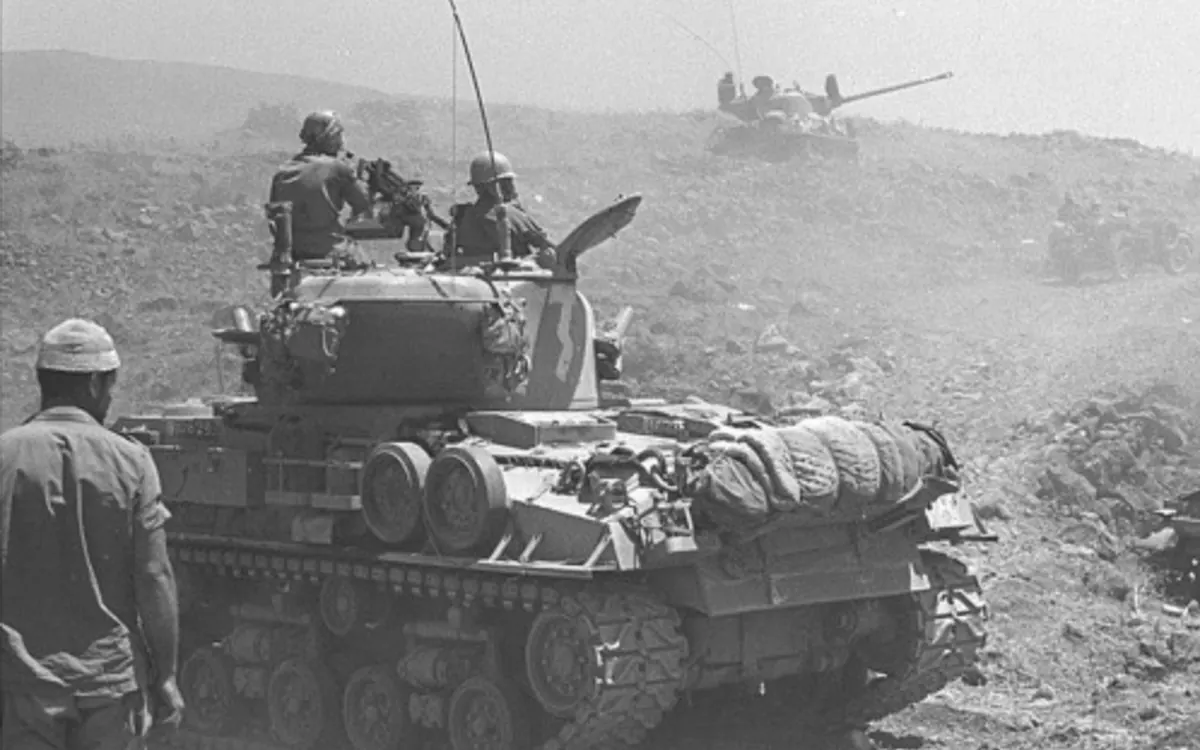
There are certain qualities which, when they manifest, define one's story -determination is one of them. Here is the story of the conquest of the Golan and the close of the war, events which will determine much of the chapters to come.
Image By Government Press Office (Israel), CC BY-SA 4.0, commons.wikimedia.org/w/index.php?curid=59598576
About this episode
If you would hit the mark, said Longfellow, aim a little above it. Rav Mike is fascinated by will, the driving force always seeking to manifest, and the continuum between will and desire, since to find what we truly want we can search for the source or look at the embodiment in our lives and the world, a messy but instructive relationship. Determination is the key concept, the bridge between essential will and its manifestation, a funny word since to determine is an act of analysis and to be determined is a commitment to make something happen, and the two usages link because the world as we determine it to be determines who we are and the world we live in, never a neutral process, since a deep determination of will creates a determination to make that will real. And that is exactly where the story stands, since there is a deep will of Am Yisrael to re-embody in the land, and the Six-Day War is the high point in that process.
We said a wholehearted thanksgiving, but we are troubled, since we have not been redeemed from the Syrian nightmare, were the words of Yaakov Eshkoli, chairman of the Upper Galilee Regional Council, who had hazarded the roads to Tel Aviv on the night of June 8. Head of the council since 1955, he knew the doh miklatim, the generation of the shelters, who had held the northern line since 1948 absorbing shelling and then cross-border terror. By day four Egypt and Jordan had received a knockout blow, but Syria remained untouched and might even frame its shelling as the great Syrian victory of 1967, intolerable to many in the room. Eshkoli, glued to his telephone to Yigal Allon, finally got his yes and was ushered into the cabinet meeting, sworn to secrecy on the Tanakh and given five minutes. Knowing Dayan stood against him, he made a bold threat, that if the IDF did not take the Golan he would recommend every Galilee kibbutz pack its bags and leave, and no one doubted he meant it, so Eshkol grabbed his hand and said his words had entered the heart of Levi Eshkol.
Dayan objected, that he would not change state borders to make things easier for the settlements, and warned the extremist Syrians with their firm Soviet ties would not reconcile and the war would not end, a reference sharpened by Chuvakhin's threat that afternoon to review relations. But Yigal Allon insisted the scale of victory itself would force acceptance, and Chaim Bar-Lev put the opposition most essentially, I do not want the war to end without the Syrians getting what they deserve. Dayan, who held a veto and had intercepted Nasser's telegram to the Syrian president conceding defeat and urging a ceasefire, finally came around as dawn approached, making the decision unanimous, and whatever his reasons he said he saw no justification not to act according to the will of most of the government. Eshkoli, racing home, stopped at Northern Command at 5 a.m. and heard the phone ring, Dayan's order to Dado Eleazar, climb the Golan and succeed.
At 7:30 on June 10 the hotline teletype at the White House spat out Kosygin's message, that a very crucial moment had arrived forcing the Soviets to adopt an independent position including military, since Syria was a more valuable client than Egypt. Johnson turned the Sixth Fleet toward Israel's coast to show America was not intimidated, replied diplomatically, and then kept choice words for Israel, a triple crown of diplomatic press: the pragmatic warning that grasping too much ends with nothing, an appeal to global responsibility, and the threat of world opinion. Chuvakhin burst into Eban's office, broke relations and then burst into tears, soon to be ousted to Siberia, and nine communist bloc states followed. Meanwhile the determined climb up the heights succeeded, the only way being kadima, forward, and Rabin refused Dado's urge to drive on Damascus, insisting only on Mount Hermon, the eyes of the nation. Dayan bought a critical hour by changing the ceasefire meeting's location, and Colonel Pinchas Noy planted the Star of David atop Mount Hermon.
No war exists in a vacuum, least of all in how its story is told, and the narrative warfare recognized no ceasefire. Rav Mike ends with Foreign Minister Abba Eban's address to the special UN assembly on June 19, which the Soviets had called to punish Israel. The crisis has many consequences but only one cause, Eban opened, that Israel's very right to exist had been forcibly denied, and he accused the Soviet Union of a key role in creating the problem. He employed the educator's most important tool, reconstituting the frame for knowledge itself, inviting every state to ask how it would have acted that morning, and resting his story on the assertion that from 1948 no Arab representative had indicated readiness to recognize Israel's right of existence. He defended Israel's resistance as a just and righteous cause, as righteous as the defense of freedom at Valley Forge, called out the Arab obsession with Jewish sovereignty as destructive above all to the Arab states themselves, and ended with a vision of an entirely new story across the eastern Mediterranean, the guardian of Israel neither slumbering nor sleeping, let the opportunity not fall again from our hands.
Key ideas
- Determination is the bridge between essential will and its manifestation, since the world as we determine it to be determines who we are.
- Yaakov Eshkoli's threat that the Galilee would pack up and leave if the Golan was not taken entered the heart of Levi Eshkol.
- Dayan objected that the Syrians on the fourth day were no threat, then reversed and made the decision to climb the Golan unanimous.
- Kosygin's ultimatum threatened military action over Syria, met by Johnson's turned fleet and a triple diplomatic press on Israel to accept a ceasefire.
- The determined climb up the heights succeeded by kadima, forward, and Rabin refused to drive on Damascus, insisting only on Mount Hermon.
- Abba Eban told the UN the crisis had one cause, the denial of Israel's right to exist, reconstituting the frame and defending a just and righteous cause.
Chapters
- 0:00 Will, desire and determination
- 2:14 To determine and to be determined
- 4:24 The will to re-embody in the land
- 5:27 Eshkoli's plea for the Galilee
- 7:41 The Syrian problem; into the cabinet
- 9:52 The threat that entered Eshkol's heart
- 12:08 Dayan objects; the Soviet ties
- 14:16 Nasser's telegram; Dayan reverses
- 16:35 Climb the Golan and succeed
- 17:40 Kosygin's ultimatum; the turned fleet
- 20:03 The triple diplomatic press
- 22:14 Chuvakhin breaks relations
- 24:27 The determined climb; kadima
- 29:46 Take Kuneitra; Rabin refuses Damascus
- 32:59 Narrative warfare; Eban at the UN
- 37:25 A vision of a new story
Who, where and when
People
Yaakov Eshkoli, Moshe Dayan, Yigal Allon, Levi Eshkol, Dado Eleazar, Alexei Kosygin, Lyndon Johnson, Abba Eban
Places
The Upper Galilee and the Hula Valley, The Golan Heights and Kuneitra, Mount Hermon, The United Nations
Texts
Nasser's telegram to Syria, The Soviet hotline messages, Eban's UN address, Deuteronomy 28
When
June 8 1967 CE: Eshkoli's plea, June 9 1967 CE: the Golan attack, June 10 1967 CE: the Soviet ultimatum, June 19 1967 CE: Eban at the UN
Read the transcript
If you would hit the mark, says Henry Wadsworth Longfellow, you must aim a little above it. Every arrow that flies feels the attraction of Earth. Well, I'm definitely aiming high, because my target is in Shemayim. I'm Rav Mike Foyer, and this is The Jewish Story. Episode 32, Six-Day War Part 6, A Whole New World. You know, I have to tell you that I'm fascinated by the notion of will, the sense that there's always a driving force inside of us and inside the world just seeking to manifest. And of course, it's a truism that we all have a deeper will, that when we look at our lives or we see what's manifest in the world, we're actually only seeing a layer on top of what could be exposed as perhaps more fundamental.
This is a lot of the work I do, both as a spiritual counselor and, of course, in the Jewish story. I'm trying to understand what's really driving the bus, and perhaps on a deeper level, what we want to. Because of course, there is a continuum between will and desire, between what we want, what we need, what we must have to be. And if we're trying to figure out what we actually want, there is essentially two ways to go about it. You can search for source, try to get down deep to what's really going on, or you can also look at the embodiment in our lives and in the world. You have to remember, though, that the relationship between source and manifestation is never perfect, often messy, but always instructive.
There is so much to be learned when we tell a story or we look at ourselves to ask what we want and why we want it. I mean, it's the heart and soul literary analysis, isn't it, when you look at the characters? But of course, be warned. Going deep might be a fruitful process, but it's far from simple. That's due to the layered nature of will, that sort of onion model you may be familiar with, and of course, the fact that multiple legitimate desires can be experienced at once, and that strangely human knack we all have for cultivating negative and even destructive desires. I mean, do I really want that pint of Ben & Jerry's ice cream standing at the freezer at 11 at night? So, taking a complete clarity of will is a precious and rare achievement in consciousness.
That's why, to me at least, in the work I love to do, there's another way to get at what we really want. And that's by taking a good hard look at what my life actually looks like. If I can determine what's real to me, by looking at what I've built, what I maintain, at the stories that uphold and drive my own process of figuring out what I want and how to make it be in my world, then I can have a sense, really, what the deeper drivers in my life or in the story going on in the world around me might actually be. And determination is the key concept. I would call determination, in fact, the bridge between essential will, between those truths that are so fundamental that they push us along, and the manifestation of that will in life and world.
So it's a key concept, but determination is actually a funny word. I mean, you know, of course, that to determine is an act of analysis. We look at a picture in all its wholeness and its parts. We see its links and the subsystems and hopefully sense potentially emergent elements. And we say, this is what I have determined it to be. Contingent or not, every moment demands that on some level. But that's what it is to determine. to be determined is to have a commitment to make something happen in the world. The link between the two usages, to determine and to be determined, might be obvious to you, but I think it's important to make it clear. When you make an analysis and determine a situation, a person, the world, to be so, that in turn will determine who you are.
Now, that's true in the sense that others will label us based on our beliefs, or we all, to some degree, have a desire to join teams of like-minded people. So what we see in the world indeed determines our identity. But on a deeper level, it's an essential cognitive truth. Because in profound and sometimes frightening ways, the world as we determine it to be determines who we are and the world in which we live. The kicker is this. This is never a neutral process. Because if I trust my analysis, I'll often find a deep determination to make the truth I perceive in my own life and in the world more manifest. We'll be driven, whether it's to declare the one God, to be more loving to my spouse, or to simply pursue the part of me that has been neglected for a significant portion of my life.
A deep determination of will creates a determination to make that will real in the world. and that's where the messy and imperfect relationship between true will and our ability to embody it in life and the world starts to kick in and we're right there in our story right now in case you were wondering what the connection was there's a deep will of Am Yisrael to re-embody in the land of Israel and the six day war will perhaps be the high point in that process and certainly it's as high as we're going to get in the story up until now We said a wholehearted thanksgiving, as did the Prime Minister at the Western Wall. But we're troubled, because we have not reached a time for thanksgiving with regard to the border alongside which we live, and have suffered because of it for many years.
We cannot continue in this way. We're told that the day will come, and we too will be freed from this nightmare. The long-forward day has come, and we in the Galilee do not know why we have not been redeemed from the Syrian nightmare. These are the words of Yaakov Eshkoli, chairman of the Upper Galilee Regional Council, head of a delegation of leaders who had just hazarded the roads between the Hula Valley and Tel Aviv in order to plead their case before the Israeli government on the night of June 8th. Eshkoli is an interesting character unto himself. He'd been the head of the council since 1955, and his tenure will go until 1971. And that means that he, better than perhaps anyone else, knows the nightmare of which he speaks.
His was the Doha Miklatim, the generation of the shelters, as they're called, the people, the communities, who held the line along Israel's northern border since 1948, absorbing intermittent shelling for nearly two decades as they struggled to plow, plant, and harvest the land. And in the last 10 years, Eshcoli had seen the rise of cross-border terror as well to come along and disrupt their lives. We spoke in previous episodes about how the PLO actually emerged in that shift from the Fed'in raids sponsored by Egypt out of Gaza to the Fatah squads that came out of Syria and Jordan. So in this moment, as he spoke, Eshcoli was filled with a righteous anger, The product of two decades of steadfast endurance, and he'd come expecting action.
Which, at this point, was not an unreasonable expectation. By day four, it was clear that the Egyptian and the Jordanian armies had received a knockout blow. In fact, King Hussein's focus had turned from conquering West Jerusalem to preserving the East Bank of the Jordan, and with it his crown. Egypt was basically just in confusion. Its citizens were dazed by the first misinformation and then the word of their catastrophic defeat, and the leadership was just pointing fingers at one another in hopes of surviving. But Syria remained untouched. In fact, it was actually in position to label its shelling of four days and maybe a small border incursion to come as attempted conquest and then call it quits.
She might even be able to frame it as the great Syrian victory of 1967. And that was intolerable, not just to Yaakov Eshkoli. In the eyes of many people in the room, as he spoke, the evil had come from the north, as we say. Don't forget, we've talked about serious years of cross-border fire, its sponsorship of the Fatah terror, which actually led to that disastrous Samu Redu story told, and its aggression against Israel's sources of water. And bottom line, it's never a good idea to leave the instigator of a real problem unpunished. So every resident of the 31 settlements in the Upper Galilee region had spent the first four days of the war deep underground, glued to their transistor radios. They listened to the miracles of Operation Moked and the conquest of Jerusalem as their homes were destroyed from above.
They were glued to their transistor radios, but Ashgoli was actually glued to his telephone, making constant calls to Labor Minister and Deputy Prime Minister Yigal Allon, demanding action on the Syrian front and begging the opportunity to speak with Prime Minister Levi Eshkol. He called Alon because his was a sympathetic ear. He himself had been the general in command of the conquest of the Galilee in 48, and his Ahdut Ha'avodah party had been driven by a secular vision of an expansive homeland since its inception. It was actually foundational. So Alon was sympathetic, and he was really only holding off the chairman until the moment was right. And that moment came on the evening of June 8th, when after four days and innumerable phone calls, Eskoli finally got his yes.
He was invited to join the cabinet meeting taking place that very evening in Tel Aviv. And, like any good commander preparing his troops, Alon added a choice piece of intelligence that at least one senior minister who would be present at that meeting was dead set against him As soon as he got word Eshkoli leapt into an army jeep and his shells continued to rain down He raced south, picking up a few critical supporters along the way. His heart was filled with a sense of urgency, as he imagined the rest of the country dancing in the streets while his hula valley was burning around him. When he arrived, Prime Minister Levi Eshkoli greeted Eshkoli with a hug and ushered the full delegation of four past security and into the cabinet meeting.
There, they were sworn to secrecy on the Tanakh, and the chairman was given five minutes to speak. Now, like I said, Eshkoli knew the lay of the land into which he was stepping, and therefore he planned to pull no punches. In particular, he had no doubt that it was Defense Minister Moshe Dayan who stood against him. After all, everyone knew that from the outset of the conflict, Dayan had forbidden OC Northern Command Major General David Dado Eleazar to attack the Golan in any manner, quote, lest this cost us 30,000 dead and risk a war with the Soviet Union. And they also knew that Dayan was not a man to be easily swayed. And perhaps that's why, after the opening words we just heard, Ashkoli moved directly to a bold threat.
Looking around at the assembled ministers, he announced that if the IDF did not remove the Syrians from the Golan Plateau, he would recommend that all the upper Galilee kibbutzim pack their bags and leave. And he added, it was a certainty the people of the city of Kiryat Shmona on the Lebanese border would follow quickly behind them. Silence fell over the room as everyone present contemplated the vast implications of such a national retreat. And it's a measure of Ashkoli's character that no one doubted he meant what he said or that he could make it happen. It was all he really had to say. So Eshkoli then turned to leave the meeting. As he did so, the prime minister jumped up, grabbed his hand, and declared that, quote, the words of Eshkoli have entered the heart of Levi Eshkol, and they will play a crucial role in what we decide to do on the Golan Heights.
But the truth is, not everyone was quite as moved by Eshkoli's emotional appeal, or by his threat. Moshe Daan, of course, was the first to reply, quote, if we go into Syria to change the border in order to make things easier for our settlements, because the Syrians fire on? I object, he said as the Prime Minister took his seat. It was an explanation that came quite shocking to some in the room, and he followed it up with an even more surprising statement. If we now want to change state borders, I don't think the Arab world will reconcile with it, and I don't think it will end with the war. Tonight, the delegation gave us an emotional presentation, but in my opinion, it's better to move 10 settlements 15 kilometers to the side and say we're not dealing with this now if we can't.
He received immediate pushback. Chief amongst his opponents was, of course, Yigal Allon, who insisted that the scale of their victory itself would force the Arabs to accept Israel in the region. But Dayan held fast, and he added a Cold War note to his opposition. The Syrians, who are known for their extremism, will not come to terms with it, not today and not in a few years. This would mean the creation of a new political and military front, while Syria has firm ties with the USSR. And the reference to the Russians were not idle words in the ears of those present. Just that afternoon, Soviet Ambassador Chewbacca had presented the foreign ministry with a denouncement of Israel's refusal to date to accept any and every ceasefire proposal, and he added to it a warning.
If the government of Israel does not abide by the decisions of the Security Council, the Soviet Union will review its diplomatic relations with Israel and consider additional steps necessitated by Israel's aggressive policy. Now don't forget, Soviet threats of intervention played a crucial role in backing Israel down at the end of the Suez campaign back in 56. But Ighal alone was not so easily overcome, and most of the room was already behind him. No one really believed at that point that a super-power conflict was imminent, and the fear of international wrath could always be allayed with the very idea that it helped alone overcome the cabinet's initial hesitation to declare war. The world will condemn us, but we will survive.
Dayan later described the decision about to happen in an interview in 1976 with Yidiot Ahronot newspaper. He said, the capture of the Golan Heights was unnecessary. Look, we can speak in terms of the Syrians are scoundrels, they should be screwed, now's the time, and so forth. But that's not policy. You don't screw the enemy because he's a scoundrel, but because he threatens you. And the Syrians on the fourth day of the war were no threat to us. And in saying this, Dayan felt he had proof. On the night of June 8th, as the cabinet meeting was already progressing, Israel intercepted a telegram from Nasser to the Syrian president, Nur al-Din al-Tassi, and it read, I believe Israel stands to concentrate all its forces against Syria in order to destroy the Syrian army.
and I must advise you to agree to a ceasefire and notify Uthant at once in order to preserve the great Syrian army. We have lost this campaign. May God be with us in the future. Your brother, Gamma Abed al-Nasr. Nonetheless, though Dayan as defense minister essentially held a veto, even he couldn't defeat the forces at play against him. Lieutenant General Chaim Bar-Lev expressed the opposition in its most essential sense. I do not want to think of a situation where the war ends without the Syrians getting what they deserve. And so, as the dawn approached and the argument drew on, the defense minister finally came around, making the ultimate decision to attack unanimous. Now, there's endless scholarly speculation on why Dayan changed his mind.
The shifter in reports from the Egyptian and Jordanian fronts about overwhelming victory, internal political considerations, personal collapse under the pressure of united opposition. In that interview I mentioned, Dayan himself simply said, I saw no justification not to act according to the will of most of the members of the government, of the prime minister and of the chief of staff. That might be noble and it might be an evasion of responsibility. Yitzhak Rabin put it best, I think, in his memoirs, Moshe Dayan, the unpredictable, whose moves were unforeseeable, surprised us once again. But chairman of the Upper Galilee Regional Council, Yaakov Eshkoli, couldn't possibly know that. As the argument raged in the cabinet, he was already headed north on those dangerous roads back home to Far Giladi.
I can only imagine the fear and uncertainty that gripped him. I mean, surely his words had entered the heart of everyone listening, not just the Prime Ministers, but he couldn't know whether they'd be enough to overcome the calculus of war. At 5 a.m., Eshkoli passed Northern Command's bunker and decided to stop and check in with Dato Elezar. He found the general slumped over at his decks. But Dato perked right up when Eshkoli arrived, eager to hear the report on the cabinet meeting. And as they were speaking, the phone rang. It was the Defense Ministry. Eshkoli watched Eleazar's face shift as he listened, and he himself could hear Moshe Dayan's resonant voice on the line. He had one simple order, climb the Golan and succeed.
At 7.30 a.m. on June 10th, the hotline teletype at the White House came to life, and the message it spit out from Soviet Prime Minister Alexei could not be misinterpreted. A very crucial moment has now arrived, which forces us, if military actions are not stopped in the next few hours, to adopt an independent position. We are ready to do this. However, these actions may bring us into a clash which will lead to a grave catastrophe. We propose that you demand from Israel that it unconditionally cease military action. We propose to warn Israel that if this is not fulfilled, necessary actions will be taken, including military. And in case President Johnson somehow missed the point, another telex followed a couple hours later, asserting that Israel's real intent was to conquer Damascus and demanding that she be stopped.
Clearly, Syria was a more valuable client state to the Soviet Union than Egypt. And as the reports came in and the president's advisors gathered, all indications were that these were not idle words. With the crushing of Egypt's army and the conquest of Jerusalem, the time for Cold War bluster in this conflict has long passed. Johnson took two actions in response to the Telex. First, he ordered the two carrier groups of the Sixth Fleet, which was steaming west between Crete and Rhodes at that point, to turn back toward Israel's coast. The Soviets needed to see very clearly that America was not to be intimidated. But then he replied with a brief and cordial message. there was no mistaking in Johnson's eyes the disastrous potential of the moment and so the president promised the premier that the US was doing its absolute utmost to restrain Israel and then he encouraged the Russians to do the same with Syria there were a few more tense exchanges across the telix line but in the end no one wanted nuclear war and perhaps because Johnson was forced to be so diplomatic with the Soviets he kept some choice words for Israel because the message went out on every conceivable channel and in no uncertain terms right after he got off the line.
That morning, when Foreign Minister Abba Ibn updated American Ambassador Wally Barbour, the latter refused to accept Ibn off assurances that of course Israel agreed to a ceasefire just as soon as the Syrian guns went quiet Instead he told the foreign minister Israel must prove its acceptance of the ceasefire on the ground before the Security Council meets this afternoon. Otherwise, it will jeopardize its gains on all other fronts. UN Ambassador Arthur Goldberg from the U.S. put it this way to his Israeli counterpart, Gideon Raphael. First, he told Raphael that the U.S. was fully convinced the Soviet government was indeed prepared to use any and all means necessary to make Israel respect the coming ceasefire resolution.
And then he delivered a personal message from the President. The United States government does not want the war to end as the result of a Soviet ultimatum. This would be disastrous for the future, not only of Israel, but of us all. It is your responsibility to act now. Finally, Israeli Ambassador to the U.S., Abe Harmon, was informed that Israel alone bears responsibility for the ongoing fighting with Syria. World opinion is turning against you, and Congress, quote, has had its full of the failure to stop the fighting. Did you hear it? It was the triple crown of diplomatic presser. First, pragmatic advice of what we call tefasta merubelot tefasta, that if you try to grab too much, you're going to end up with nothing.
It's an idea, a concept, that we're going to revisit many times in the coming season. Trust me. Then, there was an appeal to political sophistication and an appreciation of global responsibility. The Cold War is and will remain a weighty reality in our story for some decades to come, not something lightly ignored. Ultimately, we're going to have to consider in the coming season whether the Cold War was good news for the Jews, but for right now, it certainly can't be avoided. And finally came the threat, couched in terms of international judgment. Now, world opinion may or may not have been important personally to Eshkol and his ministers, but on some level, they all knew that without the American diplomatic shield, Israel stood naked before the nations.
Even before this current crisis, Raphael had warned Abba Ibn that without a clear declaration of policy, quote, not only is Israel's credibility at stake, but we're in danger of being condemned by the Security Council, including the United States. And, frankly, with France dropping an arms embargo in place right with the outbreak of war, Israel surely recognized that American weapons were going to be critical in at least the near future. So on the heels of this one-two punch from the Americans, a cable from Moscow arrived on Levi Eshkol's desk, condemning Israel's criminal violations of the UN ceasefire resolutions and threatening sanctions of every type if she did not cease, quote, her treasonous advance on Damascus.
Finally, in case the gravity of the situation had somehow still evaded the Prime Minister, Soviet Ambassador Chuwakin burst into Foreign Minister Abe Ibn's office. Refusing to sit, he instead declared in a shaky voice, in light of the continued aggression by Israel against the Arab states and the flagrant breach of the Security Council's resolution, the USSR government has decided to break diplomatic relations with Israel. Ibn, ever quick to respond, acknowledged the deep divide between Israel and the Soviets, but he urged them to strengthen their ties rather than cut them. Chuvakhin responded that indeed his words were logical, quote, but I haven't been sent here to be logical. I've come to tell you about the rupture of relations.
And then he burst out in tears. I wonder if Chuvakhin actually in that moment saw his future in light of Israel's victory. He was soon to be ousted from the Foreign Service and off to Siberia for his failures. Now, nine out of the ten communist bloc countries followed suit in breaking off diplomatic relations with Israel, Romania being the sole exception. The process of restoration of those relations would only begin with USSR reestablishing their link in 1991, two months before their own national collapse. It was a diplomatic implosion of catastrophic proportions. But it was only the beginning of Lady Eshkol's day. At 10 a.m. on June 10th, just as America was receiving its second menacing message from the Soviets, Northern Front Commander Dado Eleazar was updating the Prime Minister, Defense Minister, and portions of the General Staff on the situation in the north.
First, they needed to note that the IDF had succeeded in the ultimate uphill battle. Now, I leave it to your reading of military history to get into the details of how exactly Israel took the Golan Heights. But if you can't picture the terrain, do yourself a favor. Pause right now and Google an image or two in order to imagine what advancing up that rampart in arm and on foot must have actually been like. There could be no profound expression of that heroic side of the Israeli character embodied best within the IDF, but not solely so, which is Kadima, forward, because that's the only way to go. I mean, to say that it took determination to conquer the lung isn't just an understatement. It's actually definitive.
The will of Am Yisrael to re-embody in its land is expressive of sources that lie deep in creation. And the taking of that ridge was determinant of how powerful that will really is. So at this early hour, on June 10th, the Syrians weren't exactly on the run yet. But Israel Radio's Arabic channel was actively rebroadcasting the false Syrian claim that Kunitra, the capital of the Golan, had actually already fallen. Their goal was clear, to break the will of the remaining defenders, already panicked by Israel's advance. And indeed, the city was essentially abandoned when the IDF tanks finally rolled in. And depending on your perspective, I imagine the scene looked much like a fulfillment of the prophecy you find in Davarim 28.7.
Yiten Hashem et oivecha ha'kamelecha nigafim lifanecha. God will cause your enemies who rise up against you to be beaten before you. They're going to come out against you in one direction, in this case, with one will, but they'll flee from you in seven. You know, I didn't tell the story, but for me, one of the most powerful images of the whole war is Rav Shlomo Goran, chief military rabbi. After that famous shofar photo at the wall, you may know that the Rav jumped in a jeep, horn in hand, and sped south toward Hevron, blowing as he went. and that essentially the city fled before him. I'll tell the story maybe when we get into the impact of this unprecedented victory on religious Zionism. But for now, up here in the Golan, it's Yigal Allon and not Rav Gorin who's driving the process.
After Dado's initial report, Eshkol said to him, we must finish quickly. We're under heavy pressure from the UN. The general assured the prime minister that his men could achieve their objective by four in the afternoon. He was aiming for a line from Majl Shams on the shoulder of the Hermon through Kunitra South, but to Elzar in that moment, anything seemed possible. The Prime Minister almost balked even at that line. If you say four, it could be five or six, he protested. But Dado simply smiled. Sir, if I say four, I mean two or three. Deputy Operations Chief, Rehavam Zevi, was seated right next to the Prime Minister while Elzar spoke. Yigal Allon and Mosh Carmel were also listening closely. Everyone had high hopes for this moment.
Zevi put it this way when later describing the scene. He said, My job was to keep squeezing Eshkol for another hour, and then another hour of fighting. And that was far from easy at this point. The diplomatic collapse we described had already put half of his cabinet in open revolt. They were demanding Israel agree to an immediate ceasefire. Even defense finisher Moshe Dayan, having okayed the initial invasion, was now skeptical of pushing any further into Syrian territory. Nonetheless, Dayan ultimately agreed to the Prime Minister's proposal that they give Dado four more hours of fighting, and that at two o'clock, he would approach UN General Adbul and announce Israel's acceptance of a ceasefire, which meant that for the maximalists in the room, the clock was ticking.
By the time Yikal Alon arrived in the Golan, the Syrian army was in full flight. The Syrians had tried to use the Security Council's suddenly willingness to confront Israel in order to stiffen their troops' fighting resolve, but it was too little, too late. The route was so bad that thousands of men in uniform took refuge in Jordan and Lebanon. Add to that, nearly 95,000 civilians who took flight deeper into Syria out of fear and on evacuation orders from their own national guard. Only the Druze and Circassian communities remained. which, in Yigal Allon's eyes, was the perfect outcome. Beyond questions of border security and the opportunity to expand the homeland, Alon had a larger vision of what such a victory might mean.
He and other Israeli generals and politicians dreamed of an alliance of minorities in the Middle East, a tribal coalition, if you will, of non-Arab peoples bound by common interests and facing a common enemy. Now, such a vision might seem crazy, but it's not as crazy as it looks through the rear view of 2020 hindsight. Remember that in 1967, the Druze and Circassians of the Golan had kinsmen who were serving loyally in the IDF army advancing upon them in that moment. Anyway, the Syrians were in such a panic at this point that even their general staff and political leadership fled from Damascus to Aleppo in fear of the Israeli conquest of the capital. Despite all that, the actual linear progress of Israeli troops on the ground was still quite slow.
Too slow for Yigal alone. At one point on his tour of the front he came across a company of IDF soldiers halted on the side of the road to Kunetra He jumped down grabbed the reconnaissance officer and asked what they were doing sitting there Waiting for orders came the reply Don just stand there Run Now, bellowed alone, the former general. Take Kunitra! And it was quite an effective command. By 12.30, the IDF had entered the city without significant resistance. Far from it. What they found were empty streets and abandoned houses, some with hot lunch still on the table. Now at this point, there was nothing between the Israeli armor and Damascus. And in his fervor, Dado actually urged Chief of Staff Yitzhak Rabin to authorize a thrust deep into Syrian territory proper, and perhaps even surround the capital.
Rabin outright refused, and instead insisted that Dabo stop the advance immediately. The sole exception was to be Mount Hermon, which Air Force Commander Moti Hod, present at their discussion, called the eyes of the nation, because up there you can see it all. Defense Minister Moshe Dayan wasn't there for the conversation. He might have balked at such a bold staking of claim, but, you know, maybe not, because he wasn't there because he himself was buying time in a pretty underhanded fashion. Dayan had informed Adbol hours ago that Israel was ready for a ceasefire, and the two agreed to meet in Tiveria on the shores of Galilee at 2 p.m. for a formal adoption. Only, as the U.N. general was already en route from Jerusalem, Dayan changed the location.
When they finally met up in Tel Aviv after the mix-up, it was already three in the afternoon, and Dado had gained a critical hour of advance. Now, things almost broke down right away when General Bull announced that what was needed was to break the cycle of Israeli advances, which triggered Syrian defensive actions, which in turn served as an excuse for further encroachment by Israel on Syrian territory. Dayan rejected that narrative out of hand and said that the IDS activities would stop immediately and absolutely the minute the Syrian guns went silent. He also made it clear that no violations of that condition would be accepted, not even if there were units who had yet to receive the order. In the end, after some arguments, the two men agreed that fighting would cease at 6 p.m., and then they went their separate ways, never really having liked each other.
The defense minister's first call was to Dado Eleazar in the north, filling him in on the conditions of the agreement and warning that he would tolerate no excuses from the IDF either. And then Dayan ordered Ezer Weizman and Rehav Amzevi to draw up a map of Israel's new border with Syria. He gave them a warning as well, control yourselves. As the clock took the way, Dado shoved a helmet on every available man, not accepting cooks and supply curbs, and had them run, jeep, or even helicopter to every strategic hilltop within reach. The high-water mark of his momentum, perhaps of these determining events altogether, was when Colonel Pinchas Noy of the 13th Golani Battalion arrived by helicopter at Mount Hermon and planted the Star of David at its peak.
No war exists in a vacuum. Not when it comes to causes or consequences, and certainly not when it comes to the question of how we tell its story. In the case of the Six-Day War, we spent some time on causes already. And in fact, if you see this war as an expression of Am Yisrael's will to re-embody in our land, then it's kind of what I've been talking about since day one. And I can promise you that much of season four are going to be about its consequences. After all, these are the six days that shape the world in which we live, much like the six days of creation. But I want to say a word now about how the story is told. because the narrative warfare, which accompanied the actual battle, was taking place well before any shots were fired, and it recognized no ceasefire.
Israel's foreign minister, Abba Eben, charges UAR President Nasser, plotted the murder of a state. The vote is finally taken, and the resolution adopted unanimously. Word continues to come from the battle zone, telling of sweeping Israeli victories. There are many rounds of diplomatic struggle ahead in our story, culminating in the UN Resolution 242, the Security Council's effort to secure, quote, a just and lasting peace in the region. We're going to talk about it, don't worry. But I want to end this particular episode with the words of Foreign Minister Abe Ivin, as he addressed a special assembly of the United Nations called by the Soviet Union on June 19th, less than two weeks after the war. In recent weeks, he opened, the Middle East has passed through a crisis whose shadows darken the world.
This crisis has many consequences, but only one cause. Israel's right to peace, security, sovereignty, economic development, and maritime freedom, indeed its very right to exist, has been forcibly denied and aggressively attacked. This is the true origin of the tension which torments the Middle East. Now that's a pretty clear statement. And you may know that in coming decades, it's going to be refuted with another equally simple assertion, that Israel, in fact, is the cause of all that ails the Middle East. No coward even went on to accuse the Soviets, who had actually called that special assembly in order to punish Israel, of having a key role in creating the problem to begin with. All the conditions of tension, all the impulses of aggression in the Middle East have been aggravated by the policy of one of the great powers, which, under our charter, bear primary responsibilities for the maintenance of international peace and security.
I shall show how the Soviet Union has been unfaithful to that trust. The burden of responsibility lies heavy upon her. He speaks it out, but then even goes on to employ what I see to be the most important tool that any educator really has, challenging and reconstituting the frame for knowledge itself. The General Assembly, he says, is chiefly preoccupied by the situation against which Israel defended itself on the morning of 5 June. I shall invite every peace-loving state represented here to ask itself how it would have acted on that day if faced with similar dangers. But if our discussion is to have any weight or depth, we must understand that great events are not born in a single instant of time.
In his speech, even then details the conflict of the last 20 years, mixing facts, analysis, and stirring prose in the way in which really only he could. But the whole story he tells rests on this primary assertion. From 1948 to this very day, there has not been one statement by any Arab representative of a neighboring Arab state indicating readiness to respect existing agreements or to recognize Israel's sovereign right of existence or to apply to Israel any of the central provisions of the United Nations Charter. The exploits of Israel's defense forces on that day will be told from one generation to another with the deepest pride. Today again the Soviet Union has described our resistance as aggression and sought to have it condemned.
There is no accurate foundation for this assertion. We reject it with all our might. Here was armed force employed in a just and righteous defensive cause, as righteous as the defense of freedom at Valley Forge. now it's a long speech and I really do encourage you to read it in full I'll try to do my best to finally update the bibliographies on these last few shows even concludes by first calling out the destructive nature of the Arab world's obsession with Jewish sovereignty destructive by the way not to Israel but to the Arab states themselves it's an obsession which has warped their culture hobbled their economies and inspired the oppression of their own people and then at the very end he offers a vision an expression of what the government for whom he speaks the people from which he springs really want he says that an entirely new story never known or told before would unfold across the eastern Mediterranean it's a story where all are endowed with sovereign freedom it may seem he concludes that Israel stands alone against numerous and powerful adversaries we have faith in the undying forces in our nation's history which have so often given the final victory to spirit over matter, to inner truth over mere quantity.
We believe in the vigilance of history which has guarded our steps. The Garden of Israel neither slumbers nor sleeps. The Middle East, tired of wars, is ripe for a new emergence of human vitality. Let the opportunity not fall again from our hands. I want to make an invitation even before I thank anybody. We're almost here at the end of this season, and I want your questions, I want your comments. More than anything else, I want your commitment. If you feel like these thoughts deserve a future, then I'm going to ask you to put your money where your ears are. Even $1 can help push this story forward. Imagine if the couple thousand people I know are out there listening would do that. Well, there's no end to what we could achieve.
So I'm going to invite you to go right now to my website, jewishstory.co. In the upper right-hand corner, you'll see a button that says Be a Patron. You can click on that for a little bit of per-podcast support. If you like, I'm also happy to dedicate shows. You can send me an email at robmikefoyer at gmail.com, or you can find me on Facebook at robmikefoyer, and I'm happy to share the details with you of how you can dedicate a show in the honor of someone with us today or in the memory of one who's passed on. I want to thank the Land of Israel Network, that's thelandofisrael.com, for creating a platform that allows me to reach so many amazing people. I want to thank the Pardes Institute, p-a-r-d-s.org.il, for building an educational institution that gives me the privilege of teaching fantastic Jews.
And I want to thank you for listening. I'm Rav Mike Foyer, and this is The Jewish Story.
More from Season 3
TJS S3E30 Six-Day War IV The waiting
Going into battle may take bravery, but waiting demands a certain type of courage as well. This episode lays out the final steps of the build up to...
Play Episode
TJS S3E31 Six-Day War part V - something miraculous
What do you see as the greatest miracles in Jewish History? In many ways, how you answer indicates your understanding of history altogether. This episode deals with the...
Play Episode
TJS S3E33 Six Day War part VII On the Seventh Day
Just as surely as Shabbat follows the six days of the week, there was a day after the Six Day War. When the guns ceased and the discussion...
Play Episode