
TJS S3E30 Six-Day War IV The waiting
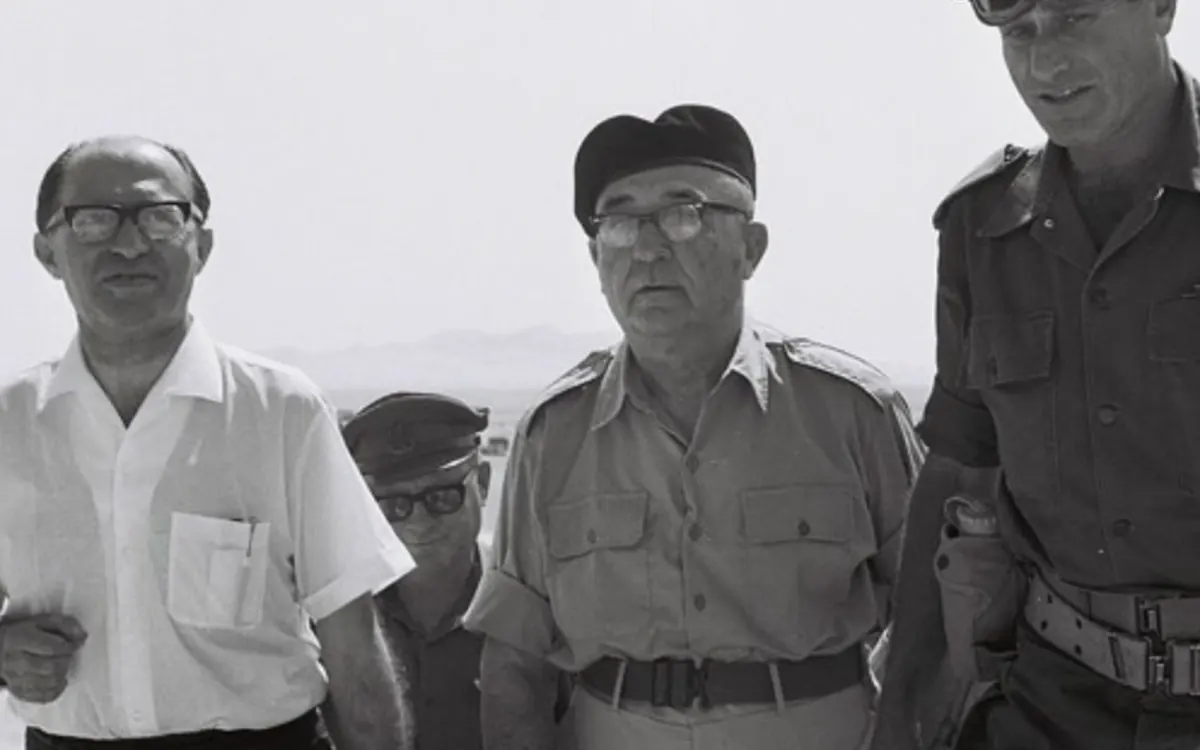
Going into battle may take bravery, but waiting demands a certain type of courage as well. This episode lays out the final steps of the build up to war, known in Israeli history as "the waiting, and the tension which builds in these three weeks will soon explode into war.
About this episode
Being terrified but doing what must be done, said Piers Anthony, is courage. Rav Mike reflects on courage, which Plato called an endurance of the soul, a very Jewish notion that the pure divine essence within us gives the power to overcome, its Latin root in cor, the heart that leads when the head is paralyzed by fear, and in the Tao, from caring comes courage, the mother bear defending her cubs. In Hebrew ometz first appears when God tells Rivka that two nations are in her womb and one people shall overcome the other, uniting the first appearance of leom, nation, with the root of courage in the verse that sets the national struggle still fought today. So the essential Hebrew definition of courage is the power to struggle no matter the odds, the inheritance of Avraham who stood on one side against a whole world of idolatry, a commitment to something larger and more important than oneself, which welds individuals into a people with the power to create a new world.
The noose is closing around our necks, were the words that greeted Foreign Minister Abba Eban at the cabinet meeting of May 27, where a wild-eyed Rabin, just recovered from a minor breakdown explained away as nicotine poisoning, was speaking. Eban had traveled a third of the way around the world buffeted by two thoughts: the Americans had refused a joint military liaison, leaving no doubt that Israel stood alone, yet Johnson's friendly welcome and promise to use any measures to open the Straits held out hope for the regatta plan. On his way to the airport Arthur Goldberg had warned him the regatta would find no other nations and that Johnson could not get congressional approval because of Vietnam, and handed him a note from Rusk whose last line was crystalline, Israel will not be alone unless it decides to go alone. The American advisors believed Israel could and must absorb the first blow, fearing a preemptive strike would bring in the Soviets, so Israel's only major ally was tying her hands.
In what Israel Lior called the longest night, eighteen ministers gathered in smoke and sweat, Chaim Moshe Shapira threatening to quit if they voted for war and the army warning of disaster if they failed to strike first, while outside the wives and mothers called for Eshkol to step down for Dayan. Eban detailed his understanding, hold fast for the few weeks the regatta would take, leaving Goldberg's off-the-record warnings aside, and when the general staff pushed back about lost prestige he cut them down, there are no widows or orphans from prestige. Yigal Allon put his finger on the raw nerve, does anyone really think we should let the enemy strike first just to prove to the world they started it, a question that has not gone away since. At four in the morning Eshkol recessed, dismissing his colleagues with the heartbreaking words that they must decide into whose hands to place this generation, fate's, America's or Chuvakhin's, leaving out whose hands were truly missing, where is God. Two telegrams from Washington tipped the balance to wait up to three weeks.
The country was gripped by siege, a grim joke about the last one out of the airport turning off the lights, windows taped, parks consecrated as emergency cemeteries and timber yards readying coffin boards. Eshkol decided the people needed leadership and addressed the nation, but this uncharismatic speaker, suffering a cold, stumbled and mumbled through the papers until soldiers smashed their radios and wept, horrified that Israel had placed its fate in another country's hands, and Haaretz called for Ben-Gurion and Dayan. Worse followed at the pit, where Ariel Sharon shouted that with our own hands we have destroyed our most powerful weapon, the enemy's fear of us, and the generals so nearly ousted the Prime Minister that Lior feared for civil government itself, yet Eshkol was made of sterner stuff and held his ground, deterrence means having patience and endurance. In doing so, with Israeli democracy, the Prime Minister prevailed, since once the military sees the government as an impediment to its mission the clock is ticking on democratic governance.
The weeks between the closing of the Straits and June 5 teach much about diplomacy and national fortitude. The Cold War played out through proxies, and by June 2 Field Marshal Amr wrote his troops that in view of the Soviet readiness to intervene it was no longer to be expected that America would join a military adventure on Israel's side, so Egypt was willing to go to war because it felt the Soviets had its back. International diplomacy had rolled over and played dead when Uthant conceded the UN force's expulsion, and the armies gathered, the PLO's Shukeiri estimating that none of the Israelis would survive, Iraq's Aref declaring the goal to wipe Israel off the map. By June 1 Israel faced some four hundred and sixty-five thousand men, three thousand tanks and eight hundred planes on three fronts, and though later historians note the Arab armies were ill-equipped, that analysis was unavailable to a populace that assumed it faced destruction. When the regatta plan foundered at sea and Johnson confirmed America could not fulfill the commitment, Eshkol accepted a national unity government with Begin and Dayan as defense minister, and on June 4, armed with Meir Amit's report that the professionals raised no objection and Johnson's I read you loud and clear, the cabinet voted to strike, Yigal Allon's words the last, the world will condemn us but we will survive.
Key ideas
- Courage in Hebrew is ometz, the power to struggle no matter the odds, a commitment to something larger than oneself that welds a people together.
- Goldberg's note to Eban was crystalline, Israel will not be alone unless it decides to go alone, since America feared a strike would bring in the Soviets.
- Allon named the raw nerve, whether to let the enemy strike first just to prove to the world they started it, a question that has not gone away.
- Eshkol's failed radio address horrified a nation that Israel had placed its fate in another country's hands, and the generals nearly revolted.
- Eshkol's patience prevailed with Israeli democracy, since when the military sees the government as an impediment the clock is ticking on civil rule.
- After the regatta foundered, a unity government with Dayan formed, and on June 4 the cabinet voted to strike, the world will condemn us but we will survive.
Chapters
- 0:00 Courage as endurance of the soul
- 2:24 From caring comes courage; ometz
- 4:31 The power to struggle; Avraham
- 5:40 The noose closing; Eban returns
- 7:55 Goldberg's warning; the Rusk note
- 9:02 The longest night; the divided cabinet
- 11:13 No widows from prestige; Allon's nerve
- 13:25 Into whose hands; the recess
- 15:31 The country under siege
- 16:36 Eshkol's failed address
- 18:44 The revolt at the pit; Sharon
- 20:51 Eshkol holds his ground; democracy
- 22:00 The Cold War; Amr's confidence
- 24:11 The armies gather; the three no's of threat
- 27:28 The regatta founders; the unity government
- 31:49 Amit's report; the decision to go alone
Who, where and when
People
Abba Eban, Yitzhak Rabin, Levi Eshkol, Arthur Goldberg, Ariel Sharon, Yigal Allon, Moshe Dayan, Meir Amit
Places
Washington, Tel Aviv and the pit, The Straits of Tiran, The three fronts
Texts
Genesis 25 on the two nations, The Rusk note, The Khartoum of threats
When
May 27 1967 CE: the cabinet meeting, May 28 1967 CE: Eshkol's radio address, June 1 1967 CE: the armies gather, June 4 1967 CE: the decision to strike
Read the transcript
Being terrified, but going ahead and doing what must be done, says author Piers Anthony, that's courage. The one who feels no fear is a fool, and the one who lets fear rule him is a coward. Well, I'd like to believe that I'm not a fool, and God forbid anyone should ever call me a coward. I'm Rav Mike Foyer, and this is The Jewish Story. So we are almost there. You can hear the clock ticking, the pressure mounting, and in this episode, we're going to walk right up to the brink of war. And when I think about such a terrifying and awesome event, I think a lot about the courage bound up with the needs of the hour. Courage is a fascinating idea to me. I mean, where does it come from? This capacity within the human spirit to overcome what the rational mind tells you is a terrible chance of survival.
Not only that, but I think a lot about the courage embedded in our history, about the endurance which it takes to consistently overcome the obstacles life puts in our way in pursuit of the things which we believe are most sacred. And when I started to do a little bit of research about what courage actually is, I found that in Western culture, the idea reaches its first crystallization in Plato's early writings. And there he calls it a sort of endurance of the soul. And you know, despite the fact that we and the Greeks parted ways long ago, if anybody makes the bridge, it's certainly Plato. And that's a very Jewish notion, that courage is an endurance of the soul, that that pure essence, the embodiment of the divine element within human existence, is what gives us the ability to overcome all the challenges, physical, emotional, mental, and even spiritual.
You know, and of course, it's not a surprise that the origin of the word in Latin is from col, right? Meaning heart. That somehow, courage means that you lead from the heart. That the head will get itself wrapped up in fear sometimes and find itself paralyzed in the face of events and its ability to make a decision. But you can rely on the heart to know and push forward. Another piece of what courage is, or that I found in my research at least, actually comes from a completely different culture, from the Tao Te Ching of Lao Tzu. And he says, from caring comes courage. Where do we get courage from? When we feel that that which matters to us most is under threat. Think of the mother bear defending the cubs.
Think of the amazing things that we're all capable of in the name of love is a very important idea because it tells us that the powers of the human spirit don't always find their most powerful focus within the mind. Sometimes, like I said, the heart has to lead the way. And of course, since this is the Jewish story, I would be remiss if I didn't point out the origin of the word Ometz, which is the Hebrew for courage, and where it shows up first in our own tradition. Vayom HaShem La, shnei goyim bevitneich, u shnei loomim be'mimeaich yiparedu. This is Breshit, Genesis 25.3, if you want to look it up. It's God's answer to Rivka. When she has a notes to her, twins in her stomach, and she feels the ruckus going on in her womb, and she goes to ask what's going on, and she learns that two nations are in your womb, two separate peoples shall issue from your body.
U laom milaom ye'ematz, And one people shall be mightier than the other. They shall overcome. And the older shall serve the younger. Now, if you're familiar with this verse, this verse is speaking about Jacob and Esau, Yaakov and Esau, before they were ever born. It's the titanic struggle within the Jewish soul and within that aspect of the world soul embodied by the Jews between these two faces of what humanity might be. I don't want to go too far with that right now. If you're curious, I believe I could find you a rather long discourse I've given on this idea. But what I will point out is that it's significant to me that the first appearance of the word le'um, which means nation, in modern Hebrew, le'umiut is nationalism, and le'uma is the nation.
The first appearance of the word le'um and the root, which becomes courage, they come together in the same verse which sets the stage for the national struggle that Am Yisrael is still fighting to this very day. Now here in the verse, it's used in the sense of struggle. One people shall overcome the other. And I think that gives us an idea of the essential Hebrew definition of courage. It's the power to struggle no matter what the odds or situation. It's that power to continue to strive even when every aspect of the rational mind tells you, you have lost the game. It's an inner fortitude. It's really our inheritance from Avraham Avinu. Think about the courage it must have taken to stand on one side and declare God's unity while the whole world stood opposite him, mired in the illusion of idolatry.
This type of courage is a readiness to enter the fray even when the odds are beyond grim. It's a readiness that doesn't just help an individual or a people to overcome. It ultimately is meant to serve as a moral compass for the world. And that's because beyond simple perseverance or even deep care, courage is ultimately a commitment to something larger and more important than whatever obstacles I may face and even larger and more important than myself. And it's that commitment and the clarity of heart which it provides, which allows us to weld individuals together into a people and gives those people a power to take actions which can create a whole new world. The noose is closing around our necks.
These were the words that greeted Foreign Minister Abba Ibn as he walked into the cabinet meeting of May 27th, 1967. Ibn saw that Chief of Staff Yitzhak Rabin, who was speaking when he entered, was looking more than a little bit wild around the eyes. He didn't know that Rabin had just recovered from nicotine poisoning. That was the story put out to explain the minor nervous breakdown that Rabin, a chain smoker, had suffered in the wake of Israel's failure to respond immediately to the closing of the straits. he actually had to be removed from his command for a few days. As Ibn looked around the room, he quickly sensed with the eye of a seasoned diplomat that he'd returned to a house divided. And that, in many ways, mirrored his own thoughts.
Since his conversation with President Johnson, little more than a day before, Ibn had traveled a third of the way around the world, constantly buffeted by two thoughts. On one hand, the Americans had refused Israel's request for a joint U.S. military liaison, and even Ibn's suggestion of a press announcement which emphasized American commitment to Israeli security had been turned down. And that left him with little doubt that in any fight to come, Israel stood alone. On the other hand, the President's friendly welcome, his promise that, quote, the President, the Congress, and the country will support a plan to use any or all measures to open the straits, held out hope to him that the Regatta plan was a viable international approach.
if they could break the blockade of the Straits of Tehran in Ibn Ay's, the causes of Bala would be removed and war could be headed off altogether but just as he was leaving for the airport Abba even received a visit from UN Ambassador Arthur Goldberg who, as we've noted, was not only the ambassador of the UN but as a close personal advisor of Johnson and it seemed to be at first an unofficial communication from one Zionist to another, as it were Goldberg warned him against relying on what he called the rather impetuous remarks of Johnson's advisors who were pushing to break the blockade. The ambassador was convinced that no other nations in the end were going to join that regatta plan, and he told Ibn bluntly, because lives are going to be lost and your security is involved, tell your cabinet that the president's statement means a joint resolution of Congress and the president can't get such a resolution because of the Vietnam War.
Or, as President Johnson himself had said to F.B. Efron only two days before, I, Lyndon Johnson, have to get congressional approval if I want to act as president of the United States. Otherwise, I'm just a six-foot-four Texan friend of Israel. But then, Goldberg gave the foreign minister a note from Secretary of State Dean Rusk. Clearly, this wasn't entirely an unofficial visit. Its last line was meant to make the American position crystalline. crystalline, Israel will not be alone unless it decides to go alone. The general feeling amongst Rusk, Secretary of Defense, Robert McNamara, and the other senior advisors was that Israel could and indeed must absorb the first blow in any coming conflict. Their estimation was that she would survive and even emerge victorious, which is easy for them to say.
Their fear was that a preemptive strike would bring the Soviet Union in on the side of the Arabs, and that the US then might be drawn in as well, risking a direct super conflict which in 1967 was the bug bear of everybody nightmares So Israel only major ally at this point was actually tying her hands. These were the thoughts swirling through Ibn's mind as he was whisked off the plane in Tel Aviv and rushed straight into the cabinet meeting. In his diary later, the Prime Minister's military attaché, Israel Lior, called it the longest night. The room filled with smoke and the smell of sweat as 18 cabinet ministers gathered through the night to discuss the fate of their nation. On one side, those who firmly imposed any preemptive strike, led by the National Religious Party head Chaim Moshe Shapira, who actually threatened to quit the government for the cabinet to vote for war.
On the other side was the army, whose intelligence warned not only of inevitable war, but of the disastrous consequences if they failed to strike first and now. Outside, the streets were filled with the mothers and wives of mobilized soldiers. Ibn had heard them as he exited his car, calling for Eshkol to step down as defense minister and begging him to be replaced with Moshe Dayan. And over everything hung the assessment that every day of hesitation drained the country of another $20 million in mobilizing costs alone and, once the war broke out, would result in thousands of additional casualties. The question on the table when he entered was whether to declare war that very night. And, as I said, into the middle of it all stepped Foreign Minister Abba Eben.
His meeting with President Johnson was for many in the room the last hope for salvation, and so he was greeted with urgent cries. First, Eben handed over the written protocols of all of his Washington meetings, and then he proceeded to detail his understanding of their position, which was, in a nutshell, hold fast and wait for President Johnson to come through on the regatta plan. Eben left Ambassador Goldberg's warnings about the impossibility of gaining congressional approval off the record. I mean, after all, they've been given off the record. He focused, rather, on the President's firm commitment to breaking the blockade and his unequivocal opposition to an Israeli first strike. In conclusion, which is, of course, how he spoke, the foreign minister recommended that the army hold fast for the few weeks it would take to muster international support for the Regatta plan.
When he was done, a representative of the general staff leapt up to push back, warning that beyond the costs of holding the mobilization, to hesitate any longer would be to lose any remaining respect that Israel held in the eyes of the world, but even cut him down with a few words. There are no widows or orphans from prestige, he said. In his eyes, the world would only respect them if they acted in self-defense, and that meant not striking the first blow. Now, the ministers began to chime in. Some questioned the army, asserting that Israel was too weak to fight the Arab world without American support. Chaim Moshe Shapiro declared, I have more confidence in the American promises than I do in the IDF's ability to break the Egyptian army.
Others declared that the IDF was their only hope. Israel can only be saved by destroying Egypt's power, said Minister of Transportation Moshe Karmel, in a strikingly historical reference, anyone who says we can't stand alone is saying that we can't exist here. Finance Minister Pinchas Sapir didn't take a clear stance. He only added a grim warning. It's hard to create a state, he said, but easy to lose one. And then, Yigal alone put his finger on the raw nerve underlying their debate. Does anyone around this table, he said, really think that we should let the enemy strike first just to prove to the world that they started it? And if you've been reading the news for the last, I don't know, 50 years, you know that this question hasn't gone away.
It was there in 73, in Lebanon, it's there in Gaza now. We wouldn't have allowed a massive army dedicated to our destruction to position itself on our northern border if there weren't a huge element in our national psyche which wants the world to believe we're right and is willing to take terrible blows to prove it so. Now remember, courage is more than the ability to push through fear. It's a clarity of heart which allows for right action in complex situations. So the cabinet was split, the army was decided for war, and Prime Minister Levi Eshkol needed to make a decision. At four in the morning, worn out and depressed, he called a recess in order to give everyone a few hours of sleep before voting.
And the Prime Minister dismissed his colleagues with the following words, We must decide in whose hands we will place this generation, into fates, Americas, or into Chewbacca's? That was the Soviet ambassador. Now, it's noteworthy of the Cold War context that he mentioned America and the Soviets and left the United Nations out. But it's even more noteworthy and, frankly, to me, heartbreaking to hear whose hands were missing from that evaluation. Fate, America, Russia. Oy am Yisrael. Where is God? Now, I know it may sound like we've finally reached decision time, but once again, Eshkol, saved by the bell. During the recess, two top secret telegrams arrived from Washington. The first was basically a repetition of Abba Ibn's report that the president was willing to pursue, quote, any and all means in his power to reopen the straits, and the other was a warning, hand-delivered by the American ambassador himself.
It read, It is essential that Israel not take any preemptive military action and thereby make itself responsible for the initiation of hostilities. Preemptive action by Israel would make it impossible for the friends of Israel to stand at your side. Those words were enough to tip the balance. When the ministers saw them upon reconvening, they were evenly split. And though Prime Minister Eshkol actually sided with those in favor of declaring war, the decision was taken to wait for up to three weeks for the U.S. to act on its promises. And so, our clock ticks on. While the cabinet was debating, the country was gripped by a sense of siege. Many who could leave did, leading to grim jokes about a sign hung up in Lod International Airport which read, Last one out, please turn off the lights.
Those who remained dug in, often literally, windows were taped as reinforcement against bomb blasts, sandbags were filled on street corners. The Heber Kedisha, the religious burial societies, began consecrating parks in Tel Aviv as emergency cemeteries, and timber yards had been instructed to ready coffin boards for the expected tens of thousands of dead. In the midst of all these grim preparations, the announcement was made that Prime Minister Eshkol was going to address the nation. Eshkol had made the decision when he left the cabinet meeting, knowing that despite his exhaustion, despite the cold which he suffered, despite his lack of skill as a public speaker, the people of Israel needed leadership.
Now this was a generation which had been raised on the speeches of Ben Gurion and Menachem Begin, who had witnessed Churchill's famous declaration of defiant courage, after the defeat at Dunkirk, we shall go to the end. Whatever the cost may be, we shall fight on the beaches. We shall fight in the fields and in the streets. We shall fight in the hills. We shall never surrender. And it's in moments like these that national courage finds its voice. But unfortunately for the hundreds of thousands of Israelis who tuned in to hear the address, Levi Eshkol had more or less lost his. Amidst the costs and the shuffling of papers, Eshkol sought to explain the situation to the nation. He described the massing Arab armies in the blockade of Elat, attempting then to explain the government's decision to wait on the American-led regatta plan.
As he spoke, the Prime Minister seemed to become more confused. never a dynamic speaker began to mumble, seeming to lose his place or perhaps even his train of thought. And as he struggled, his coughing grew worse until finally, with some half-hearted phrases about responsible decision-making and national unity, he signed off. The nation was stunned. News stories later would tell the story of how Arabs rejoice while the soldiers in the trenches of Israel smashed their radios and broke down into tears. Aside from the disastrous delivery, which shook the confidence of everyone listening, the nation was horrified that Israel had actually placed its fate in the hands of another country. It is amazing, wrote columnist Zev Schiff the next day, how a people who suffered a holocaust is willing to believe and endanger itself once again.
The calls for Eshkol's resignation mushroomed, and the day after the speech Haaretz, at the time Israel's leading daily paper, wrote the following, If we could truly believe that Eshkol was capable of navigating the ship of state in these crucial days, we would willingly follow him. But we have no such belief after his radio address last night. The proposal that Ben-Gurion be entrusted with the premiership and Moshe Dayan with the Ministry of Defense seems to us a wise one. The failed speech was only the beginning for the Prime Minister. His day was about to go from bad to worse. Leaving the broadcast studio Eshkol headed for the pit as the Tel Aviv headquarters of the general staff was known He now had to inform the army of the results of the cabinet deliberations and he knew they weren't going to be happening.
And he wasn't wrong. With our own hands, we've destroyed our most powerful weapon, the enemy's fear of us, shouted General Ariel Sharon when he heard the decision. We will have to pay a far higher price in the future for something that we in any case have to do now. The people of Israel are ready to wage a just war. The people understand and feel that they have to pay the price. The problem is not the straits. The problem is the survival of the people of Israel. Sharon was seconded by all others present. They all agreed that the government was abandoning its historic duty and endangering the state. The argument grew so heated that Colonel Israel Lior later recorded that there was more than one moment in which he feared that the Prime Minister might be ousted by his own army, or else collapse in the face of physical and mental exhaustion.
But the truth is, as the days ahead will prove, Eshkol was made of far sterner stuff than any of them guessed. He'd taken his decision, and he was going to carry it through. It is not politically, diplomatically, and even morally logical to start a war, he declared. We now have to restrain ourselves and to maintain our forces for a week or two or even longer. He went on to outline the Regatta plan, emphasizing America's commitment to breaking the blockade, and warned of the vast losses, financial, material, human, that Israel might suffer in war. I understand you commanders are discontented, but maturity dictates that we stand up to this test. In two weeks the straits will still be closed and we'll be in a worse situation, charged Mater General Yishai Ho Gavish, chief of the southern command.
More of our men will die. Then the Chief of Central Command, Major General Uzi Narquis, added another concern. The problem lies not with us, but with the younger generation. They'll never understand why the IDF did not attack. And then, finally, Major General Arun Yariv, Chief of Intelligence, made the most pointed accusation. Israel cannot expect anybody else to do its dirty work. We alone can break the stranglehold tightening around us. Eshkol absorbed their blows for over an hour but like I said, he stood his ground he reminded the generals the IDF had not been created for waging wars of choice and that the mere presence of Egyptian army in Sinai was insufficient grounds for a preemptive attack deterrence means having patience, he insisted endurance and in the end, the prime minister prevailed and with him, by the way, Israeli democracy it takes a vast personal courage to stand up to such an assault I wonder if Eshkol had a sense that the fate of civil government altogether in Israel hung in the balance.
I mean, divisional commander Avram Yofi's assertion that, quote, the IDF was created to defend the state, but the government is not letting the army carry out its mission, a mission that the people want, that might have been the beginning of the end. As soon as the military sees the government as an impediment to achieving its mission, no matter how noble or necessary that mission may be, the clock is ticking on democratic governance. But, as I said, Ashkel prevailed, and the countdown of the waiting period continued. If we look at it closely, the weeks between May 23rd and the Straits of Tran were closed, and June 5th, when war finally broke out. They can teach us much about the nature of both international diplomacy and national fortitude.
First, we can't forget the Cold War, because the American-Soviet struggle is playing out all over the world through its proxies, and at this point, the Middle East is only really beginning to fall in line with that division. From the outset, the Americans had seen this crisis as made in the USSR. As the CIA director, Richard Helms, said in a brief note, prepared for the White House on May 23rd, unrest and tension are and have been exceptionally useful to the Soviets in their attempt to erode Western influence in the Middle East. By the end of the waiting period, the Egyptians had completely hitched their wagons to the Soviets. By June 2nd, Field Marshal Abdel Hakim Amr, Deputy Supreme Commander of Egypt's Armed Forces, was writing to his troops, in view of the strong position of the government of the Soviet Union and its readiness to intervene immediately if any big power should go to war against Egypt, It is no longer to be expected under any circumstances that the United States government should join in a military adventure on Israel's side.
Accordingly, and here's the key, I've completed my plans and issued my orders for the organization of the operation. Meaning Egypt was willing to go to war because it felt the Soviet Union had its back. I mean, even the rhetoric coming out of Moscow had taken a violent turn. attacking, quote, the reckless activity initiated by warmongering circles in Israel and warning of grave consequences that result from any Israeli aggression. So that's the Cold War. Meanwhile, the organs of international diplomacy had rolled over and played dead already when Secretary General Uthant acquiesced to Egypt's expulsion of the UN's emergency force in Sinai. Of course, and it was never to revive. Never to revive, that is, until after Israel won the war and it came time to roll back her achievements.
By the beginning of June, the Secretary had all but given up efforts at mediation between Israel and Egypt, and the Soviets obstructed any Security Council efforts to do the same. Meanwhile, IDF Intelligence reported that yet another Egyptian armored division had entered the Sinai. Not only that, but that the Sudanese, Iraqi, and Kuwaiti troops were all en route to the front. The Syrian forces were poised to invade the Galil. Furthermore, units of the Palestine Liberation Army had taken up those former UN emergency force positions along the Gaza border. When they were questioned by reporters about the potential fate that Israelis could expect after the Arabs won the coming war, which they all expected, would be quick, PLO Chairman Ahmad Shoukari replied the following, those who survive will remain in Palestine.
I estimate that none of them will survive. President Abdel Rahman Muhammad Aref of Iraq was no less clear. The existence of Israel is an error that must be rectified. This is our opportunity to wipe out the ignominy which has been with us since 1948. Our goal is clear, to wipe Israel off the face of the map. We shall, God willing, meet in Tel Aviv and Haifa. Air preparations for war actually climaxed quite early on May 30th, when King Hussein of Jordan, last of the moderates, But if you recall, undermined by Israel's actions before the war broke out, signed a mutual defense pact with Egypt, a pact that placed his army directly under Cairo's command. He returned from Cairo to Amman with a troop of Egyptian commandos ready for action and declared, quote, all of the Arab armies now surround Israel.
And these words were no exaggeration. By June 1st, Israel faced armies totaling some 465,000 men, Nearly 3,000 tanks, 810 planes, all staged on three fronts. This is a force several times the size of the IDF. Now, many subsequent historians have tried to undermine the image of David and Goliath, which is so central to the way in which Israel perceives this battle, and point out that despite those numbers, many of the Arab armies were ill-equipped, poorly trained, and perhaps not ready for battle. On one hand, I don't have access to the first-hand documents, and I know enough to know that there's always two sides to every story, but I'll point out something very simple. Whatever a historian in 1998 or 2003, etc., is able to glean from their analysis of the documents was unavailable to much of the Israeli populace and even to the intelligence of the IDF.
The assumption was that they were facing destruction. And in case they didn't believe it, the very day on which the mutual defense pact was signed, Nasser made the following declaration to the Egyptian Popular Council. We are ready to settle the problem of Palestine. It is we who will decide the time and the place of the battle, and we will not leave the decision to Israel, as was the case in 1948. Meanwhile, the blockade of the Straits of Tehran had begun to take its toll, adding shortages of oil and essential food items to the mental and financial strain of mobilization. For a few more days after that fateful cabinet meeting, Prime Minister Eshkol pinned all his hopes on President Johnson's promises of an international regatta.
But sooner rather than later, news reached him that the plan had foundered at sea. Nations who at first seemed supportive, Britain, the Dutch, the Canadians, had quickly backed off, fearing the economic and political results of backing Israel, especially considering the power of the Middle Eastern oil producers. The truth finally struck home. Final proof of the Regatta Plan's failure came in the form of an exchange of messages between Prime Minister Eshkol and President Johnson The Prime Minister wired the White House welcoming Johnson pledge to open the straits by all and every means and he reminded him that Israel fully expected that that meant any Egyptian attempt to block the international convoy would be answered with naval power.
The President quickly instructed his advisors to inform Israeli Ambassador Avram Harman that the United States could and would in no way fulfill such a commitment, meaning that the international plan was dead in the water. The ambassador pleaded with the Americans, asked them to recall Foreign Minister Abba Ibn's fateful move when he'd restrained his own government from war. On the strength of Johnson's word, what you've told me now will be received with great bitterness in Israel, he said, and will certainly generate momentum for unilateral move. The Israeli public cannot stand it any longer. And that was true. On the very day of the exchange of those messages, IDF Operations Chief Ezer Weizman burst into the Prime Minister's office and shouted, if you give the order, Jewish history will mark you as a great leader.
If you don't, it will never forgive you. In that moment, Justice Minister Yaakov Shimshun Shapiro, who was present, burst out into tears. At this point, Eshkol finally gave into pressure and accepted the need for a national unity government. Opposition leader Menachem Begin's Gahal and Ben-Gurion's Rafi party joined the new government, and both agreed on the condition that Moshe Dayan become defense minister. The coalition now accounted for 111 out of the 120 seats in Knesset, an unprecedented display of national consensus. Though Eshkol gave up on the title defense minister, he didn't abandon his determination to set policy on these crucial questions, and therefore he extracted from Dayan a promise not to approve any operations beyond the general war plan sanctioned by the cabinet.
And as a further counterweight to Dayan, Eshkol enlisted Yigal Yadin, the IDF's legendary second chief of staff, as his special advisor on defense. Well, as soon as he took his seat, Dayan wanted to attack at once. But the prime minister was still determined to maximize American sympathy by exhausting every diplomatic channel. He met once again with the IDF general staff on June 2nd, urging restraint, and was again greeted with harsh words from Arik Sharon, who told him that he was kowtowing to the powers. If we want to survive here, we have to stand up for our rights, Sharon declared. Undaunted, the Prime Minister reminded him that this very same kowtowing had brought to Israel the arms it now needed to defend itself.
And then he said words which will echo down through time. In a country of two million souls, we have to ask ourselves, if we have to fight every 10 years will we have an ally to help us? Can we consult with an ally today and tomorrow say we thumb our noses at you? In reality, unbeknownst to the army, Eshkol and Dayan had already agreed in principle they would attack the following Monday, June 5th. The goals were to be eliminating Egypt's air force and its military presence east of the Midland Giddy Passes in the Sinai. There would be no advance to the Suez Canal, no probe into the West Bank or up onto the Golan Plateau. Now all they waited was a final impression of the American stance, which was to be delivered by Mossad Chief Merameed due to return from Washington that very night.
When the cabinet met on Sunday, June 4th, it was clear that decision time had arrived. Uncertainty still hung over that vital question of whether the United States would condemn or condone a preemptive strike, And no one knew for sure how far the Soviets would be willing to go in their reaction. But one thing was clear. The time for waiting was over. The unbearable strain, the mounting costs, and the erosion of the last shreds of Israeli deterrence were forcing their hands. And as Arik Sharon had shouted at the Prime Minister less than a week before, the problem at hand was the survival of the people of Israel. Now, Levi Eshko wasn't flying completely blind in regard to the U.S., Though the messages which he was receiving came through multiple channels, and they were complex and even somewhat contradictory, Mossad head Mayor Amit had returned from Washington with important information.
Amit had met with more than 30 American intelligence and security experts, including Secretary of Defense Robert McNamara and Richard Helms, the director of the CIA. And in every meeting, Amit did his best to be as provocative as possible, telling Americans that he intended to go back and recommend war. And what he found was that there was no strong American opposition to unilateral Israeli military action, at least amongst the professional class. On the contrary, in his joint meeting with Helms and McNamara, a meet was received warmly. They listened closely to his explanation of why Israel had to strike first and now, and they raised no objections. I read you loud and clear, is what McNamara had to say.
His evaluation was confirmed once again by UN Ambassador Arthur Goldberg, who quietly told Amit that the president knew they had no choice and would have to defend themselves. But for Prime Minister Levi Eshkol, the real vindication came from Supreme Court Justice Abe Fortas, another Jewish friend of Johnson. He told Epi Efron, director of the mission at the Israeli embassy, Eshkol and Ibn did a great service to Israel by giving the U.S. a chance to explore options other than Israeli force. If they had not done so, it would have been difficult to secure the president's sympathy. And considering the coming 50 years, a special relationship between the two nations, those are words that carry real weight.
Amit's report, together with the rapidly disintegrating situation, were enough to convince Foreign Minister Abba Ibn, who led the opposition to the war, that the time had finally come. It was enough for him that the United States appeared to be staunchly behind in Israeli attack. Now, oddly enough, Amit himself seemed to balk at the last minute, recommending that they send a ship through the Straits first to draw Egyptian fire and thus technically avoid shooting the first shot. But he was shut down by Defense Minister Moshe Dayan. Whoever waits for the Egyptians to start the war has got to know that we'll lose the land of Israel. And his voice raced to a shout as he added, It's lunacy to wait! Chaim Moshe Shapira continued to hold out, citing Ben-Gurion's doctrine of never going to war without an ally amongst the great powers.
But Dayan dismissed this as well. Then let Ben-Gurion go and find us an ally. I'm not sure we'll still be alive. Yigal alone's words were the last amongst the minister and he counseled against further delays closing with these fateful words the world will condemn us, but we will survive finally, the prime minister rose to speak for almost three weeks, he'd played for time chased diplomatic fantasies, resisted enormous pressure from within his government and suffered relentless scorn from the press and the public Ashkol may have lacked the charisma of Ben-Gurion, or Dayan's heroic flair, but it takes a certain type of leader who can stand steadfast in such a situation. And now, in this final moment, the knowledge that Israel had done all it could, had proven that war was the only choice, created consents in his cabinet, and ultimately in the nation.
others might have relished the moment taking their time to review the painful but necessary process of the previous weeks and pointing out that it was his temperance which had won the support of a superpower, support that was going to prove crucial not only in the coming days of wars but in its aftermath but that wasn't Levi Eshkol he said simply, I'm convinced that today we must give the order to the IDF to choose the time and manner in which to act and with that, the discussion was over. The following proposal was presented for a vote. It is therefore decided to launch a military strike aimed at liberating Israel from encirclement and preventing the impending assault by the United Arab Armies.
Twelve ministers voted in favor and at first, two against from the left-wing party Mapam but Eshkol insisted on another round and they subsequently changed the position providing him with the unity he had striven for. and so after three unbearable weeks the waiting period was over Israel had decided to go it alone I just want to thank a few folks before I sign off I want to thank all the folks who give their hard earned money to help make this show possible to keep it out there free and widely available I want to encourage you to join them you can go right now to my website that's www.jewishstory.co in the upper right hand corner you'll see a little box that says be a patron you can click on it to give a little bit of per podcast support.
Put your money where your ears are, people. If that's a little bit too much, you can also contact me at rovmikefoyer at gmail.com or at Facebook, rovmikefoyer, and I'm happy to share with you the details about how you can dedicate a show in honor of someone who's with you today or in memory of those who've passed on. I also want to thank the Land of Israel. That's thelandofisrael.com for creating a platform that allows me to reach so many amazing people. I want to thank the Pardes Institute, pardes.org.il for building an educational institution that gives me the privilege of teaching so many fantastic Jews. And I want to thank you for listening. I'm Rav Mike Foyer, and this is The Jewish Story.
More from Season 3
TJS S3E29 Six Day War III Israel dwells alone
The countdown to war is progressing, and the pieces are almost all in place. As the pressure mounts, some of the fundamental flaws which lie at the heart...
Play Episode
TJS S3 Interlude - George Floyd and the burden of history
I can't watch what is happening in silence, but nor am I willing to simply be a cheerleader for chaos. Here are some thoughts on structural violence and...
Play Episode
TJS S3E31 Six-Day War part V - something miraculous
What do you see as the greatest miracles in Jewish History? In many ways, how you answer indicates your understanding of history altogether. This episode deals with the...
Play Episode