
TJS S3E29 Six Day War III Israel dwells alone
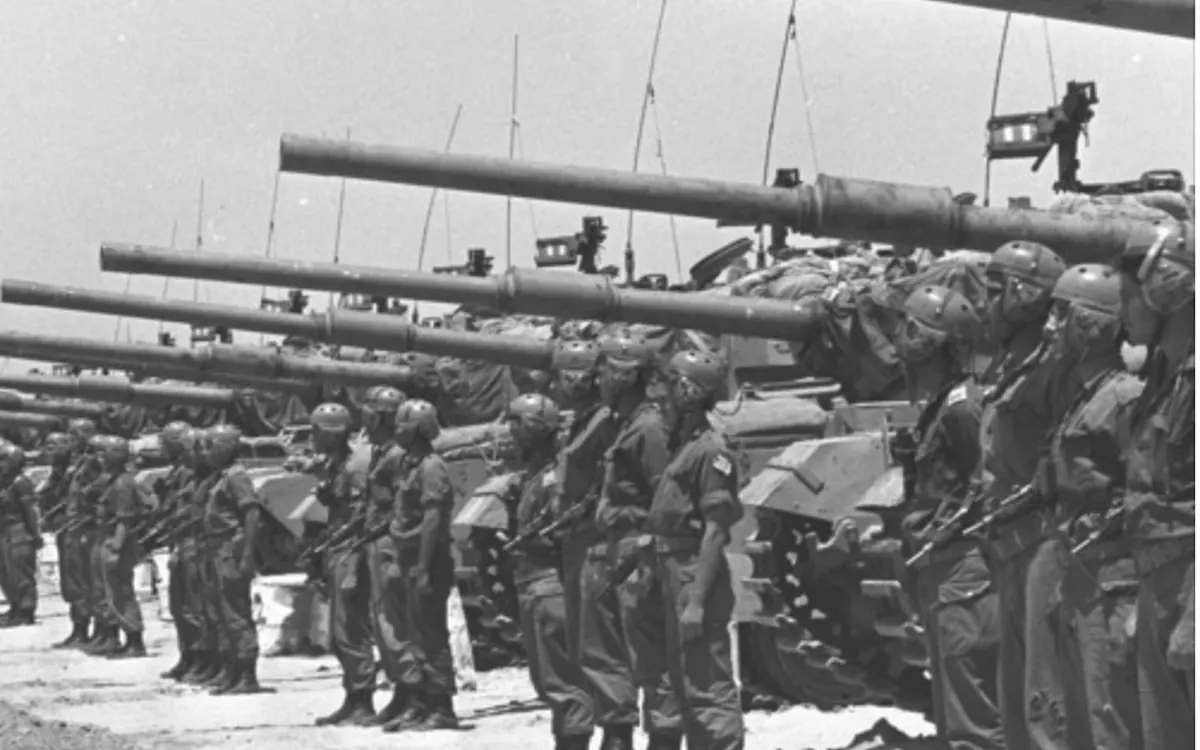
The countdown to war is progressing, and the pieces are almost all in place. As the pressure mounts, some of the fundamental flaws which lie at the heart of the Zionist project are exposed. The question which arises in this episode is - will Israel go it alone?
Picture from: By Government Press Office (Israel), CC BY-SA 3.0, commons.wikimedia.org/w/index.php?curid=22807330
About this episode
Not by might nor by power but by my spirit, said the Lord of hosts through Zechariah. A listener who read Michael Oren's Six Days of War asked to learn something new about the nation of Israel and the war, which is exactly Rav Mike's task, though a full analysis must wait until the bones are laid out, since this is a turning point in the history of Am Yisrael and the whole world. The government ruling in 1967 was the direct product of the Zionist movement with all its strengths and weaknesses, and that movement had two primary impulses, problem-solving and the visionary redemptive. There were those who saw the Jews as a people with a problem to solve, antisemitism or assimilation, and those who saw us as a people with a vision to fulfill, and the problem solvers were by far the majority who took the reins when the smoke cleared. The original sin of Zionism, from the perspective of Jewish history, was kochi ve'otzem yadi, it was my hand and the strength of my own arm that did this, the auto-emancipation Pinsker proclaimed, a break with the notion that we are at least partners with God, and its hidden weakness is that one who makes his way by his own strength may give up on his greatest dreams as unachievable.
On that same Independence Day night, while Rabin and Eshkol reviewed the troops and made their pragmatic plans, Rav Tzvi Yehuda Kook spoke to his students, a visionary son of the visionary Rav Avraham Yitzhak HaKohen Kook, destined to shape the post-67 reality. He opened with gratitude and a call to see God both without and within, then shared the deep pain he felt in 1948, when on the night of the UN partition decision he could not go out and rejoice but sat alone and silent, unable to accept that they had divided his land, and after nineteen years he cried out, where is our Hevron, our Shechem, our Yericho, have we the right to give up one grain of the land of God. Unlike Ben-Gurion, who also did not rejoice that night but feared the Jews lacked the will, Rav Tzvi Yehuda felt the heart-rending pain of treating the land as a means to an end, and this was the messianic voice long underground in the story. The question of 1967 may have been existential, to be or not to be, but perhaps better, if we are to live in this land, who then are we meant to be.
Israeli society is always seeking the moral clarity of 1948, the simple sense of a back against the wall where you do whatever it takes to survive, and it takes a different clarity to strike your enemies before they attack, which is still preemptive self-defense, get up early and kill the one who comes to kill you. But a proactive stance that shapes the world demands something beyond moral clarity, a sense of mission and tzidkut haderech, which will be a major topic of season four. For now the government hesitated because in their eyes conflict was not yet inevitable, or they wished to believe so, while Rabin and the general staff saw war as a foregone conclusion and pressed for a preemptive strike on Egypt's airfields. Mixed messages came from Washington, assurance that Israel did not stand alone alongside warning that a preemptive strike would be a serious mistake, and Eshkol recalled the Eisenhower sanctions that forced the 56 withdrawal. After a letter from Johnson, Eshkol promised no military move unless Egypt closed the Straits of Tiran, drawing his line in the sand through that narrow passage, the terminus for Iranian oil and the outlet to Africa and Asia.
Closing the Straits was casus belli, an occasion of war, and by drawing the line there Eshkol was building a case to justify war while throwing down the gauntlet to the Western powers, also abandoning all initiative and agreeing to play by the rules of an international community that had done nothing while his family was slaughtered in Poland and had stood aside in 1948. On May 22 Nasser announced the occupation of Sharm el-Sheikh and the closure of the Gulf, welcoming war, and made clear in the National Assembly that the issue was not the Straits but the aggression of 1948 itself, the readiness to erase that shame. Rabin presented a two-stage plan, the lightning airstrike Operation Moked followed by an armored thrust, warning that waiting would mean attacking an entrenched army with casualties as high as fifty thousand, but the cabinet was evenly split, fearing to go to war without unequivocal American support, I am willing to fight said Chaim Moshe Shapiro but not to commit suicide. Here lay the other fatal flaw, the colonial mentality built in since the Basel program that Zionist aims required a world-power patron, so they were looking to the world powers instead of the real power of the world.
An American note raised hope of a multilateral approach, so the cabinet sent Foreign Minister Abba Eban, born Aubrey Eban in Cape Town, raised in Britain and schooled at Cambridge where his oratory shone, a world-class statesman seen at home as a pretentious outsider whom Eshkol called the learned fool who gives the right speech but never the right solution. Eban's itinerary ran through Paris, where de Gaulle told him do not make war, do not be the first to fire, insisting closure was not casus belli and that France had pivoted to a post-colonial policy, 1967 is not 1957, later halting all French arms even those paid for. In London Harold Wilson agreed Nasser must not triumph but would act only in concert with other maritime states, and in Washington Eban, handed an alarming message from Eshkol of an imminent coordinated attack, delivered it to Dean Rusk only to have US intelligence find no evidence, a blow to Israel's credibility. Johnson told the number-two Efron that Israel as a sovereign state could act but on her own responsibility, and in the Oval Office assured Eban he would use any measures to open the Straits yet needed weeks and could not act as king without Congress, closing with the words Israel will not be alone unless it decides to go alone, and 2020 hindsight shows how much lay ahead that no one could imagine.
Key ideas
- The 1967 government was the product of Zionism's problem solvers, who outnumbered the visionaries committed to a mission larger than themselves.
- The original sin of Zionism was kochi ve'otzem yadi, my own strength did this, whose hidden weakness is giving up on dreams that seem unachievable.
- Rav Tzvi Yehuda Kook's cry for Hevron, Shechem and Yericho was the messianic voice long underground, pained at treating the land as a means to an end.
- Closing the Straits of Tiran was casus belli, and drawing the line there built a case for war while abandoning all initiative to the international community.
- The colonial fatal flaw built in since Basel was the assumption that Zionist aims required a world-power patron, so they looked to the powers not to the real power of the world.
- Abba Eban's mission to Paris, London and Washington came back empty, Johnson telling him Israel will not be alone unless it decides to go alone.
Chapters
- 0:00 Not by might; a listener's challenge
- 2:11 Problem solvers and visionaries
- 4:19 The original sin; my own strength
- 5:22 Rav Tzvi Yehuda's drasha; where is Hevron?
- 9:43 The messianic voice; who are we meant to be?
- 10:48 The moral clarity of 1948
- 13:03 Why the government hesitated
- 15:17 Casus belli; the line through the Straits
- 18:38 Playing by the rules of the world
- 20:52 Nasser welcomes war; the shame of 48
- 23:10 Rabin's two-stage plan; the split cabinet
- 24:17 The colonial fatal flaw
- 26:29 Sending Eban; the learned fool
- 30:56 De Gaulle; 1967 is not 1957
- 33:03 Wilson; Washington and Rusk
- 37:24 Johnson; Israel will not be alone unless it goes alone
Who, where and when
People
Rav Tzvi Yehuda Kook, Rav Avraham Yitzhak HaKohen Kook, Yitzhak Rabin, Levi Eshkol, Gamal Abdel Nasser, Abba Eban, Charles de Gaulle, Lyndon Johnson
Places
Hevron, Shechem and Yericho, The Straits of Tiran and Eilat, Paris and London, Washington
Texts
Six Days of War, Zechariah 4, The Basel program, UN casus belli doctrine
When
1948 CE: the partition decision, May 22 1967 CE: the Straits closed, May 24 1967 CE: Eban meets de Gaulle, May 26 1967 CE: Eban meets Johnson
Read the transcript
This is the word of the Lord, said the Prophet Zechariah, Lo v'chayel velo v'choach, not by might nor by power, ki'im beruchi, but by my spirit, said the Lord of hosts. Oh Lord, I'm trying to bring just a little bit more of your spirit into the world. I'm Rav Mike Foyer, and this is the Jewish Story. Episode 29, Six-Day War Part 3, Israel Dwells Alone. You know, recently, a listener reached out to me with some feedback about the Jewish story, which, by the way, everybody should do. Rav Mike Foyer, gmail.com, Facebook, find me. I want to hear it. But in this case, he was specifically interested in the story of 1967 that we're telling right now. So he'd read Michael Oren's excellent work, Six Days of War.
I highly encourage everyone to pick it up. And he had a request. He said, Oren's emphasis was on the way Israel fought the war. I expect to learn something new about the nation of Israel and the war from you. So that's a big task. But in all honesty, it's exactly what I've taken upon myself. A full analysis of the meaning of the Six-Day War for Am Yisrael, for who we were, who we became, and what that means for us in the world, is going to have to wait until we at least get the bones of the story laid out. Because after all, not everyone has read Michael Orrin's book yet. But you must do so. Read it and read a lot of others. because I'm not able or even interested in giving you a comprehensive military history of 1967.
You've probably begun to sense at this point it's both too big and not exactly my cup of tea. But I am happy to be challenged by your knowledge and questions as I lay out my understanding. So like I said, RalphMikeFoyer at gmail.com, Facebook, RalphMikeFoyer. Send me your thoughts, your challenges. Don't be shy, people. I've got quite a thick skin. But what I am able and interested in speaking out about 1967 is as a turning point in the history of Am Yisrael and, in my eyes, of the whole world. So as I said, the full picture is going to have to wait until the story is told. In fact, it seems to me that much of it belongs to the coming season and not this one. More on that later. Keep your breath baited.
And so anyway, there is one important frame that I think we need to revisit right now in order to appreciate the dynamics which drove much of the decision-making of Israel's leadership in the lead-up to war. Because as go the people, so go the leaders. We can understand quite a bit about the psychology of what was happening in 1967 through the decision process that actually led to war. And since we could see the modern state of Israel as many things, the fulfillment of the nationalist project, the fruit of world guilt, the fulfillment of a divine promise, right, there's much we have to learn. And one thing's beyond question. The government ruling the state in 1967 is without doubt the direct product of the Zionist movement.
And as such, it embodies all the strengths and weaknesses which that movement contained. I encourage you to go back to Season 2, review the episodes on Zionism, or frankly, you can send me an email, I can share a recent five-part live series I just finished on the predecessors to the rise of Zionism. You'll get much of the same content live, as they say. But for right now, recall this. There were two primary impulses at the base of the Zionist movement, problem-solving and the visionary redemptive elements. If you listen to those episodes about the pre-state phase, about the various groups and ideologies which struggle to drag themselves and our people out of exile, you'll discover that, as my friend Yehuda Cohen likes to say, there are those who saw the Jews as a people with a problem to solve, be it anti-Semitism, assimilation, etc.
And there were those who saw us as a people with a vision to fulfill. Now, of course, life never divides all that neatly. Every movement, every group has some sort of mixture between, in this case, the visionary and pragmatic elements that drove the Zionist movement. But bottom line is, the problem solvers were by far the majority. And deserving or not, when the smoke cleared from the War of Liberation, they were the ones that took the reins of power from the British mandate. The mandate, by the way, which the visionaries had actually defeated. And some would say it was the pragmatism of these problem solvers which left the subsequent war of 1948 with the Arabs unfinished and place the Jewish people half-settled on a truncated homeland with a divided Jerusalem at our heart.
And if we're going to identify an original sin which lies at the heart of Zionism, at least from the perspective of Jewish history and thought, I would say that the unquestionable front-launner is It was my hand and the strength of my own arm which did all this might for me. This idea that we are going to auto-emancipate, as Leon Pinsker said toward the end of the 19th century, that we can pick ourselves up out of exile and do it for ourselves, a break with the notion in Jewish history that at the very least we're partners with God in creation, if not actually simply an expression of God's own will. We're going to see a competitor for Original Sin before the episode's over, but go with this for right now.
Because with all the power of politics and militarism that can emerge from such a perspective, it's often missed that there's a potential weakness that lurks within Kokhidu Otzumi Adi as well. Because if I believe that it's slowly through my own strength that I make my way in the world, then sometimes I'm going to give up on my greatest dreams because they seem unachievable. And that's a problem that the problem solvers will face. as opposed to the visionaries who will always be committed to something larger than they can do themselves. Now, we spoke last episode about Independence Day in 1967 and how it marks the beginning of the march to war. Well, you may not know that while Chief of Staff Yitzhak Rabin and Prime Minister Levi Eshkol were reviewing the troops in Jerusalem and making their pragmatic plans, estimating whether the IDF, and only the IDF, was strong enough to save the state, one of the chief visionaries of Am Yisrael was speaking to his students of his yeshiva at the very same time.
Now Rav Tz Yehudah Cook wasn't just a visionary. He was a visionary son of a visionary. Heir to the wisdom and status of his holy father Rav Avam Yitzchak HaKohen Cook and destined to be a key moral and spiritual force in shaping the post 67 reality. We will see him in season 4. But right now all you need to know is that he was just as upset as Prime Minister Eshkol on the night of Independence Day 1967, but for entirely different reasons. He opened his drasha, his speech, with words of gratitude and a call to consciousness. We are accustomed from time to time, he says, to act in accord with the closing lines of Psalm 107. The psalm which the rabbis have decreed were to say on Israel's Independence Day, those who saw the works of the Lord and his wonders in the deep, the upright see it and are glad.
and all iniquity stops her mouth. Whoso is wise, let him observe these things and let them consider the mercies of the Lord. He goes on to say that to the degree that uprightness is lacking, so too is the ability to see and recognize the works of the Lord. We must observe much, he said to his students. We must consider much the works of God and the works of divine providence. We must look into our own inner life. we must examine the life of Klai Yisrael. See, Rabbi Tzvi Yehuda understood that if you want to know the world, there's two things you have to do. You have to see God without, and you have to see God within. And then, the rabbi went on to share the deep pain that he had experienced over the results of the pragmatic approach to the land of Israel in 1948, a land which his Holy Father had taught should never be seen as a means to an end, no matter how lofty that end may be.
He said, 19 years ago on the night when the news of the United Nations decision in favor of the reestablishment of the state of Israel reached us, when the people streamed into the streets to celebrate and rejoice, I could not go out and join in the jubilation. I sat alone and silent. A burden lay upon me. During those first hours, I could not resign myself to what had been done. I could not accept the fact that they have divided my land. It's a quote from the prophet Yoel. Now, there was another person we spoke about once upon a time who also didn't go out and rejoice on this night, and that was David Ben-Gurion, chief pragmatist of the Zionist movement. But Rav Tzvi Yehuda is not experiencing a fear that the Jewish people might not have it in them to make a statement.
he is experiencing the heart-rending pain of treating the land of Israel as a means to an end. And the students tell a story that at this point, Yetzirah fell silent, shaken by inner pain. They said he could have heard a pin drop when suddenly he cried out, Yes! And now after 19 years, where is our Hevron? Have we forgotten her? Where is our Shechem, our Yericha? Where? Have we forgotten them? Have we the right to give up even one grain of the land of God? On that night 19 years ago, during those hours, I sat trembling in every limb of my body, wounded, cut, torn to pieces. I could not then rejoice. Now this isn't just the visionary voice of Zionism speaking, the one which understood that the Jewish people have a mission in the world to fulfill and that the state would be a platform for that mission.
This is the messianic voice. It's a voice which has been underground in our story for quite some time. Quiet, lurking in the corners, a bit player in the political pragmatic program of state building for the last 20 years, which by the way is not necessarily a bad thing, because if you've been listening to this season since the beginning, then you know that there's been no lack of problems to solve Immigration economy international politics terror and when it comes to those types of challenges I take the pragmatists almost every time But the problem which now presents itself, the problem which took the form of Nasser rolling his tanks into the Sinai, was somehow of a different nature. You know, Israeli military historians like to frame the question of 1967 as an existential one, to be or not to be, as Chief of Staff Rabin said.
And I certainly don't deny that truth. But I have a feeling that there's another perspective. That perhaps the question was indeed existential. But rather than to be or not to be, we should say, if we are to live in this land, who then are we meant to be? I have a theory that Israeli society is always seeking 1948. I'm sure we've spoken about it before. Trying to return to that simple but profound sense of moral clarity that comes from having your back against the wall. I mean, after all, if someone jumps in you in the dark, draws a gun, threatens to kill you, you do whatever it takes to survive. And if you save yourself at the expense of their life, it's possible you may feel guilty for having taken a life but you will always be able to comfort yourself to stand on the fact that well, it was him or me it takes a different type of moral clarity to strike your enemies before they attack though in the end, this is really just preemptive self-defense I'll never forget when my teacher Rav Shlomorishkin, she'd be healthy and well told us in the midst of the second intifada the Oslo War, as we not so fondly call it that the most profound statement of moral clarity that the Torah teaches is If someone's coming to kill you, get up early and kill him first.
Now, those are just two sides of the same coin, though. They're really self-defense. When it comes to taking a proactive stance towards shaping the world around you, rather than making a reaction to the threats of your enemy, your primary guide, that requires something beyond simple moral clarity. It demands a sense of mission and tzitkut haderech, of a righteousness of your cause. Now, that idea that we need to find a way in which we can become a heroic people once again and wield power in the service of justice, both for ourselves and the world, is going to be, once again, a major topic of the fourth season. So stay tuned. meanwhile for our story one way to understand the hesitant stance of Israel government in the weeks following Independence Day 1967 is to recognize that in their eyes at least conflict was not yet inevitable or at least they wanted to believe it was not yet inevitable because from their perspective the remilitarization of the Sinai that began on May 14th may have been just a political ploy and not the opening moves to a war of annihilation.
Even the expulsion of UN emergency force from Gaza and the Sinai a few days later could have been nothing more than brinksmanship. The army intelligence assessments were uncertain, but nevertheless by and large, Chief of Staff Rabin and the General Staff saw war as a foregone conclusion. They were pressuring Prime Minister Eshkol to approve that preemptive strike on Egypt's airfields, warning that a failure to seize the initiative now would lead to tens of thousands of dead later. But, you know, in a democracy, for better or worse, going to war is a political decision, not a military one. And the Prime Minister's cabinet was more or less evenly split. Some were calling for total war, others for maximum restraint.
To make things worse, mixed messages were coming to the Prime Minister from the United States, messages which could not be ignored. On one hand, Israel's ambassador to Washington, Abraham Harmon, received an assurance from the Undersecretary of State Eugene Rostow that the Jewish state did not stand alone. On the other hand, he was warned that the Egyptians were well within their rights to transfer troops into the Sinai and that a preemptive strike by Israel would be a very serious mistake. And that was no empty threat. Eshkol and his ministers had been in government long enough to recall the Eisenhower administration threats of economic sanctions that had forced Israel's withdrawal from the Sinai and Gaza in 56 after the Suez War.
And now Israel was looking to the U.S. and not France to arm them. And that gave them even greater leverage. After receiving a letter from President Johnson on May 17th, warning that the U.S. quote, cannot accept any responsibility for situations which arise as a result of actions on which we are not consulted, the Prime Minister informed the Americans that Israel would make no military move, quote, unless the Egyptians take action to close the Straits of Tehran. Similar messages were sent on to the British and the French. The message was clear. If the Straits of Tehran were blocked, Israel expected the U.S. to fulfill its commitments of 1957. And that meant Israel would have full backing in reopening them by whatever means necessary.
Now, if you don't know, the Straits of Tehran are a narrow sea passage between the tip of the Sinai and the Arabian Peninsula. It's right where the Gulf of Akba, or Eilat, depending on what you want to call it, empties out into the Red Sea proper. And aside from the massive political capital that Nasser stood to gain from closing the Straits, which had only been opened to Israeli ships through the Suez War itself, and therefore was yet another chip after remilitarization and the kicking out of the UN emergency force, aside from that, by the late 60s, the port town of Eilat had become a vital factor in Israel's economy. it was most importantly the terminus for imports of Iranian oil. Irony of irony is people may be unaware that Iran at this point was Israel's strongest ally in the Middle East and the source of most of our oil.
Along with the oil, there were other essential goods. Of course, Eilat was also the outlet for Israeli exports to Africa, Asia, and beyond. Prime Minister Eshkol, when he sent that letter, was reminding the Western powers of something that Israel had fought to establish in the 56 campaign, that closing the straits was causes belli. Now, causes belli, literally, an occasion of war, is defined in legal terminology as an act or event that provokes or is used to justify war. The difference between provoke and justify, by the way, is a distinction I made above. If your enemies start shooting, that's clear provocation. If they do something you deem to be unacceptable, then war is justified. And, of course, the key question is justified in the eyes of whom?
The notion of causes belli entered Western jurisprudence in the 17th and 18th centuries. It was due to the rise of the just war theory, the idea that a nation must have a just cause for war rather than the old school approach of just going to war when it suits your interests. For clarity, today, modern international law recognizes only three lawful justifications for waging war. Self-defense, defense of an ally required by the terms of a treaty, and approval by the United Nations. So, in 1967, by drawing his line in the sand right through the Straits, Prime Minister Eshkol was simultaneously building a case to justify what would come if Egypt made that move of blocking them, and he was throwing down the gauntlet to the Western powers to do everything they could to prevent the situation from deteriorating to that point.
He was also, of course, abandoning all initiative. and at least temporarily agreeing to play by the rules of the international community. Now this is no small thing for Israel in 1967. This was the same international community that had done nothing while the Prime Minister's family was slaughtered by the Nazis in Poland and had also stood aside in 1948 when the combined Arab armies invaded Israel looking to finish their job. There will be many people, both amongst the general populace and the political elite, who will remind Eshkol of this fact in the coming weeks. The Prime Minister actually, it seems, had little hope that his threat would stop the coming war. Quote, the Egyptians intend to close the straits or to bomb the atomic reactor in Damona, he told his cabin on May 21st.
A general attack will follow in which the first five minutes will be decisive. The question is, who will strike the other's airfields first? And despite that assessment, and despite the crippling cost of keeping the country mobilized, Eshkol resisted taking decisive action. He was determined, but he was determined first to convince the world, and America in particular, that there was no alternative to war, that this was a moral clarity of 1948's situation. As the pressure mountain, the press and the public began to actually call for his resignation as defense minister. It was a post that had combined with Prime Minister since Ben-Gurion's day. In fact, people were actually calling for the old man, now 81 years old, to return to his post.
Ben-Gurion's nag of retreat was inundated with letters requesting that he return and save the nation. We are asking you, great captain, read one anonymous message from a group of soldiers stationed on the southern front, to liberate the ship of the people of Israel, which has run aground, and lead it to safe shores. But it was Eshkol who stayed his course, insisting Israel would defend its right to free passage, quote, whatever the sacrifice, but simultaneously calling for mediation based on, quote, respect for the sovereignty, integrity, and international rights of all Middle Eastern nations. Now, Eshkol may have seen this as the moral high road, but unfortunately, Nasser took it as a sign of weakness.
In his eyes, Israel was crumbling before the Egyptian might. She'd failed to respond to the buildup in the Sinai. She'd also failed to respond to the expulsion of the United Nations emergency force. This could only mean that the awesome IDF actually feared a fight. Now add to this the praises of the entire Arab world the entire developing world really which were ringing ever more loudly in Nasser ears And finally the invincible might as he perceived it of the Soviet Union which he felt urging him on from behind. In Nasser's eyes, there was only one thing to do. And so on May 22nd, as UN Secretary General Uthant was actually en route to Cairo to make another attempt at mediation, Nasser made a surprise visit to an airbase in the Sinai in order to make the following announcement.
Yesterday, the armed forces occupied Sharm el-Sheikh. What does this mean? It is an affirmation of our rights, of our sovereignty over the Gulf of Aqba, which constitutes Egyptian territorial waters. Under no circumstances can we permit the Israeli flag to pass through the Gulf of Aqba. The Jews threaten war. We say they are welcome to war. We are ready for war. our armed forces, our people, all of us are ready for war. These are our waters. Perhaps war will be an opportunity for the Jews, for Israel, for Rabin, to try out their forces against ours and find out that all they wrote about the Battle of 1956 was a lot of nonsense. Now, lest the world think that this was just another dose of hot air, a third piece of political maneuvering, Nasser made clear what was really at issue in his speech to the Egyptian National Assembly later that day.
If we had been able to restore the conditions to what they were before 1956, God will surely help and urge us to restore the situation to what it was in 1948. We are now ready to confront Israel. We are now ready to deal with the entire Palestine question. The issue now at hand is not the Gulf of Aqba, the Straits of Tehran, or the withdrawal of the UN emergency force, but the aggression which took place in Palestine in 1948. I can only try to imagine the chaos of the cabinet meeting over which Prime Minister Eshkol was presiding. Everyone had heard on the radio Nasser's declaration of his readiness to erase the shame of 48, and few doubted that he meant it. Chief of Staff Yitzhak Rabin presented a two-stage plan to the assembled ministers.
It opened with a lightning airstrike against the Egyptian Air Force, codenamed Operation Mokkid, to be followed by an armored thrust into Gaza and western Sinai, whose goal was to capture territory which could then be exchanged for reopening Tehran and the reinstatement of the UN Emergency Force. If we wait, warned Rabin, we will be attacking an entrenched and fully prepared army. Casualty estimates were as high as 50,000 men. Meanwhile, he knew that Israel's power of deterrence was already eroding and with any more hesitation could be completely lost, leaving Nasser in a position to attack at will. The chief of staff was supported by his old Pamach commander and Ahdut Ha'vodah leader, labor minister Yigal Allon.
The Yigal was unable to convince a majority of the members of the cabinet. Most of them preferred to continue searching for a diplomatic solution, despite the dangers of delay. They argued that even if it was successful, the Mokid airstrike would leave northern Israel totally exposed to a Syrian attack. And they feared that going to war without unequivocal American support was nothing short of foolhardy. I'm willing to fight, said Interior Minister Chaim Moshe Shapiro of the National Religious Party, but not to commit suicide. Now this might be the moment to point out that other original sin of Zionism I hinted at. I mean, truth be told, original sin might be a bit overdramatic in this case. Let's call it a fatal flaw.
From the time of Herzl and the Basel program that emerged out of the first Zionist Congress, political Zionism has been built upon the assumption that its aims cannot be achieved without a world power patron. Now, I'm not dismissing the reality of international power politics, nor am I suggesting that you can simply declare, if you will it, it is no dream, and poof, you'll have a state in the face of the reality of international politics. But we could, if we wanted to, trace a line of potential weakness, a fracture line, if you will, built into our state along this colonial mentality from Basel through the breakdown of the Anglo-Zionist alliance onto the Suez fiasco and right into Levi-Eshkul's seeming paralysis in the face of Nasser's act of war.
Because remember, Israel made it clear to the powers of the world that closing the Straits of Tehran was causes bell-eye and now it looked like Nasser was calling their bluff. And a lot of where they were hesitant was the fear of going it alone. And this is kind of what I meant. And it's that darker side of weakness which lies within the notion of that my hand made all this might, that you learn to rely upon yourself. They weren't really relying upon themselves. They were looking to the world powers instead of looking to the real power of the world. Now, in the midst of this intra-governmental struggle in the cabinet, U.S. Ambassador Walworth Barbour delivered a message from the State Department addressed directly to the Prime Minister.
It was a note that assured the Prime Minister that America viewed Israeli navigation through the Straits of Tehran as a matter of international law, that, quote, U.S. views on the gravity of the situation have been fully and forcefully set out in Cairo and in Moscow. And it said that their diplomats were even now seeking a multilateral approach to protect Israel's rights. Ding, ding, saved by the bell. In light of what seemed to be an American proposal that could keep them out of war, the cabinet decided to send Foreign Minister Abbe Eben to Washington. And since we have yet to meet this critical character of a number of the chapters in the coming drama, a quick word. Abbe Eben was actually born as Aubrey Eben in Cape Town, South Africa, 1915, but moved quickly to the United Kingdom, and that's where young Aubrey was raised.
And it's also where he found the two loves of his early life, frankly, of his entire life, languages and Zionism. He had an interesting identity because despite being deeply rooted in his Jewish selfhood, Ibn pursued his higher education at Cambridge, hardly a Jewish institution, where in student debates, he quickly became known for the power of his oratory. Leaving Cambridge, Ibn veered back to his roots, and in World War II found him working for Haim Weizmann at the World Zionist Organization headquarters in London. It was from there that he was recruited into the British Army Intelligence and sent on to Jerusalem to serve as a liaison to the Haganah, the underground army, which really expressed the worldview of labor Zionism.
In many ways, Ibn's time in Jerusalem embodied the contradictions of the British stance in Israel. By day, he was helping to train the militia against the coming German invasion. And by night, he was writing articles for the Palestine Post decrying British repression and publishing, by the way, under the pseudonym of Politicus. After the war, Ibn moved to the Jewish Agency's Information Department. And it was in that capacity he became involved in the 1947 UN Special Committee on Palestine, UNSCOP. And he was instrumental in attaining that committee's approval for the partition plan. Now, whatever you may think of the partition plan, Ibn was quite happy. And in fact, it was in response to that plan he changed his name from Aubrey to Abba, to father of the state in many ways.
It was from that point, the world of international politics became Abba Eben's home. He served as Israeli ambassador to the United States from 1959, as well as ambassador to the UN. His mastery of languages, polished style, and quick wit made him a popular figure in every circle, except at home. When he returned to Israel in 1959, Eben ran for Knesset on the Muppet High list, and he won. In fact, he didn't just win, he served as a minister of education and culture under Ben-Gurion, and in 1966, Prime Minister Levi Eshkol appointed him as Foreign Minister. But like I said, though he was seen as a world-class statesman abroad, Abba even was always looked upon as a pretentious outsider at home by that inner circle of Mapai leadership that really ran the country.
And frankly, pretentious outsider is putting it kindly. Levi Eshkol, with his penchant for sharp Yiddishisms, called him Der Gelentenar, the Learned Fool. Now, everyone recognized Eben's sophistication, and no one questioned his eloquence, but they all doubted his strategic thinking. As Prime Minister Eshkol once said, Eben never gives the right solution, only the right speech. So the choice to send the foreign minister to Washington at this critical juncture, which should have been obvious, was far from it. It was a political moment that called for extraordinary action, not sensitivity to diplomatic niceties. Frankly, the Prime Minister would have preferred to send Golda Meir, who had preceded even as Foreign Minister, was also a trusted decision-maker and had a proven ability to stir the support of American Jewry.
Nonetheless, the last thing Ashgol needed at this point was an internal political crisis in the Mapai. And so, the learned fool it would be. Abba Ibn's itinerary was Paris, London, and only then on to Washington. Israel hoped that her allies from 1956 would recall the service she had rendered them, as well as how they balked in the clutch, in many ways setting the stage for the current crisis. On May 24th, only 24 hours after the closure of the straits, Ibn arrived in Paris and went immediately to meet with President Charles de Gaulle. But his reception at the Elysee Palace was not exactly what he expected. Do not make war. Do not make war. In any event, do not be the first to fire, were de Gaulle's opening words.
He went on to insist that closure was not causes belli, and that the four powers of U.S., France, Britain, and the USSR should be allowed to resolve the crisis on their terms. Now Eben didn take that declaration lying down He politely but firmly reminded the president of France 1957 assurances of free navigation assurances which had been key to Israel withdrawal after the Suez War De Gaulle response was nothing short of a slap in the face. 1967, he said, is not 1957. And he added that there were no purely Western solutions in 1967, and that the Soviets must be included in any resolution. What de Gaulle left unstated was the pivot France had already made toward its post-colonial foreign policy. There was a lot of bad blood to be washed away before she could regain her status as a trusted power in the eyes of the Arab world.
And that meant that her old ally of 57 was a liability only 10 years later. Even saw that there was nothing more for him to do in Paris. And so he took his leave with diplomatic nicety, thanking the president for all France has done and is doing by enhancing our moral and our military strength. His failure to threaten serious Israeli action, along with that awkward mention that France was still Israel's chief arms supplier, may have been a fatal mistake. because nine days after their interview, when Reuters news service ran a small story about the flow of French arms into Israel, de Gaulle ordered all shipments to stop, even the ones that had been paid for. So from Paris, Ibn traveled on to London, and there he found Prime Minister Harold Wilson far more welcoming than de Gaulle.
Ibn quickly laid out Israel's options to surrender, to fight alone, or join with others in an international effort to force Nasser's withdrawal. And to his joy, Wilson agreed that Nasser must not be allowed to triumph, and he stated that Britain was firmly in support of free navigation in the Gulf of Akba. But the Prime Minister added a critical stipulation to his support, that he was only prepared to act upon it in concert with the other maritime states. And so it was on to Washington. Upon arrival, the Foreign Minister was met by Israeli Ambassador Abraham Hartman, who handed him a top-secret message from Prime Minister Levi Eshkol himself. The message said that Israel was now facing an all-out coordinated attack from Egypt and Syria and that was imminent.
In fact, it could start at any moment. He even was instructed to drop the issue of maritime passage through the Straits of Tehran and rather to ask for, quote, an immediate application of the U.S. pledge to Israel backed up by a public declaration as well as practical actions. What the Prime Minister wanted was for America to state that an attack on Israel is equivalent to an attack on the United States, and to back up that statement with an order to U.S. forces in the region to coordinate their activity with the IDF. His belief was that only such a warning would be enough to deter Nasser, and only a sense of crisis would be enough to make the United States issue it. Even did indeed do his duty and deliver that message during his first meeting with Secretary of State Dean Rusk.
But he himself was skeptical that the situation could have possibly deteriorated so rapidly in the only 48 hours since he'd left home. The foreign minister suspected that the prime minister was using him to goad the Americans into action. And when the U.S. intelligence services told Secretary Rusk that there was no evidence of an imminent attack on Israel, the real result was a blow to the foreign minister's trust in Eshkol and to Israel's credibility in the eyes of the Americans. And the truth is, Abibin's arrival was problematic. it had placed the Johnson administration in a seriously awkward position. The president was well aware, as were his advisors, of the decade-old American assurances of Israel's rights to navigation in the Gulf of Aqba and how that had been a cornerstone in resolving the 56 conflict.
The U.S. had also at the time promised to guarantee Israel's security against Arab attack. From one perspective, Ivan was in town simply to collect on those promises. Promises had both legal and moral weight, not to mention political significance. Johnson could not afford to alienate any more Jews at this point in the Vietnam War. And speaking of Vietnam, to renege on those pleasures would amount to abandoning an ally to Soviet aggression, and that would deliver a serious blow to American international standing at a time in which the containment policy was shaky at best. Nevertheless, the equation in politics is never one-sided. America had invested massive amounts of energy and money into rebuilding its relationship with the Arab world, particularly in the oil industry, over the last decade.
And the signs of success were finally starting to emerge. To take a strongly pro-Israel stance in the current crisis would destroy all that work in the blink of an eye, with potentially significant negative effects on the U.S. economy as well. Now add to this America's deep involvement in the already unpopular Vietnam War. Any U.S. guarantee of Israeli navigation could possibly involve the American military in a second conflict, the scale of which was completely unpredictable. So it seems that faced with this rather unpleasant set of options, the Johnson and his advisors decided that the best course was actually to do nothing, to allow Israel to go it alone, but without ever making any statement to that effect.
The hope was that the Americans would be seen as neither abandoning an ally nor as encouraging conflict. At worst, it would look like they were dithering in the face of a complex situation. And toward that end, the president tried to avoid meeting with the foreign minister at all. So Abbie even spent the next 24 hours in continuous talks, but not with Johnson, with people from the State Department, with the Pentagon. and as he did so, it became quite clear to him that the 1957 assurances upon which he'd staked so much importance were of no value whatsoever. America was not going to war on behalf of Israel's right to sail through the Gulf. The State Department, rather, was advocating an initiative that had been floated originally by the British, which called for a declaration by the World Maritime Powers, reiterating their commitment to free navigation across the globe, and then would be followed by a joint naval task force, which would sail through the straits, showing that the blockade was indeed non-existent.
But international efforts need weeks to coordinate, and a seasoned diplomat like Eben knew that it was just as likely to sink as it was to swim. Meanwhile, during this delay, Johnson did meet with an Israeli, but not with the foreign minister. Rather, he invited Ephraim Effie Efron to meet with him at the White House. Efron was the number two man at the Israeli embassy, and over the years had developed a quite close personal relationship with the president. And therefore, he was the perfect person to hear the other half of what Johnson wanted to tell the foreign minister, in case even misunderstand the truth of his message. With regard to the possibility of an Israeli assault, the president told Efron, Israel is, of course, a sovereign state.
if it decided to act independently, it could obviously do so. However, this will be made on her own responsibility. I, as President of the United States, must act in the best way which would serve the American interests. Well, he gave his message to Efron, but even wasn't giving up. After a full day of insistence that they meet, as well as significant pressure leveled by American Jewish organizations, the Foreign Minister was ushered into the Oval Office on May 26. He was treated to a warm and even friendly reception. After all, Johnson was a true and tried friend of Israel, but it was also a reception that distinctly lacked substance, even open with clear statement of the situation. There has never been a moment for my country such as this time.
We were on a footing of grave and anxious expectancy. He then went on to detail the situation to date, including his meetings with President de Gaulle and Prime Minister Wilson. And he concluded with these words, I would emphasize, Mr. President, that these problems relate not to our welfare as a country, but to our very existence as a country. In response to this grim measure, the President assured Abba Eben of the American commitment to use any and all measures in his power to ensure that the Straits and the Gulf will be open to free and innocent passage. That being said, Johnson insisted he needed time, weeks even, to test the feasibility of an international convoy. He also reminded the foreign minister that though as president he was indeed commander of chief of the armed forces, he wasn't king.
Any use of the military required congressional approval, and that was a vote which was unlikely to go his way at this point in the Vietnam War. From there, the conversation moved on to the talk of military liaisons and details of international politics involved. It was only in his final words that the president made clear what he really wanted to say. I must emphasize, he said, the necessity for Israel not to make itself responsible for the initiation of hostilities. Israel will not be alone unless it decides to do it alone. I cannot imagine that it will make this decision. well as it turns out from here, 2020 hindsight there was quite a bit of what lay ahead which no one could imagine I just want to thank some folks, I want to thank all the folks that give their hard earned money to help make this show happen, to keep it free and widely available I want to invite you to join them you can go right now to my website jewishstory.co in the upper right hand corner you'll see a button that says be a patron, you can click on that to give a little bit of per podcast support every dollar account to people.
Or if you'd like, you can be in touch with me at robmikefoyer at gmail.com or at Facebook, robmikefoyer, and I'll pass you on the details of how you can dedicate a show in honor of someone who's here today or in the memory of one who's passed on. I also want to thank the Land of Israel Network. That's thelandofisrael.com for creating a platform that allows me to reach so many fantastic people. I want to thank the Pardes Institute, P-A-R-D-E-S dot org dot I-L for building an educational institution that gives me the privilege of teaching so many wonderful Jews. And I want to thank you for listening. I'm Rav Mike Foyer, and this is The Jewish Story.
More from Season 3
TJS Interlude - Yom Haatzmaut Interview 2020
Here is an interview of me by Rabbi Yonatan from the RRG Beit Midrash at Hebrew University in which we reflect on Israel Independence day from the historical...
Play Episode
TJS S3E28 The Six Day War II - The point of no return
The causes of war may be many and the road to its outbreak long, but every conflict has a tipping point. In this episode the noose seems to...
Play Episode
TJS S3 Interlude - George Floyd and the burden of history
I can't watch what is happening in silence, but nor am I willing to simply be a cheerleader for chaos. Here are some thoughts on structural violence and...
Play Episode