
TJS S4E16 Yom Kippur War IV: A stunning blow
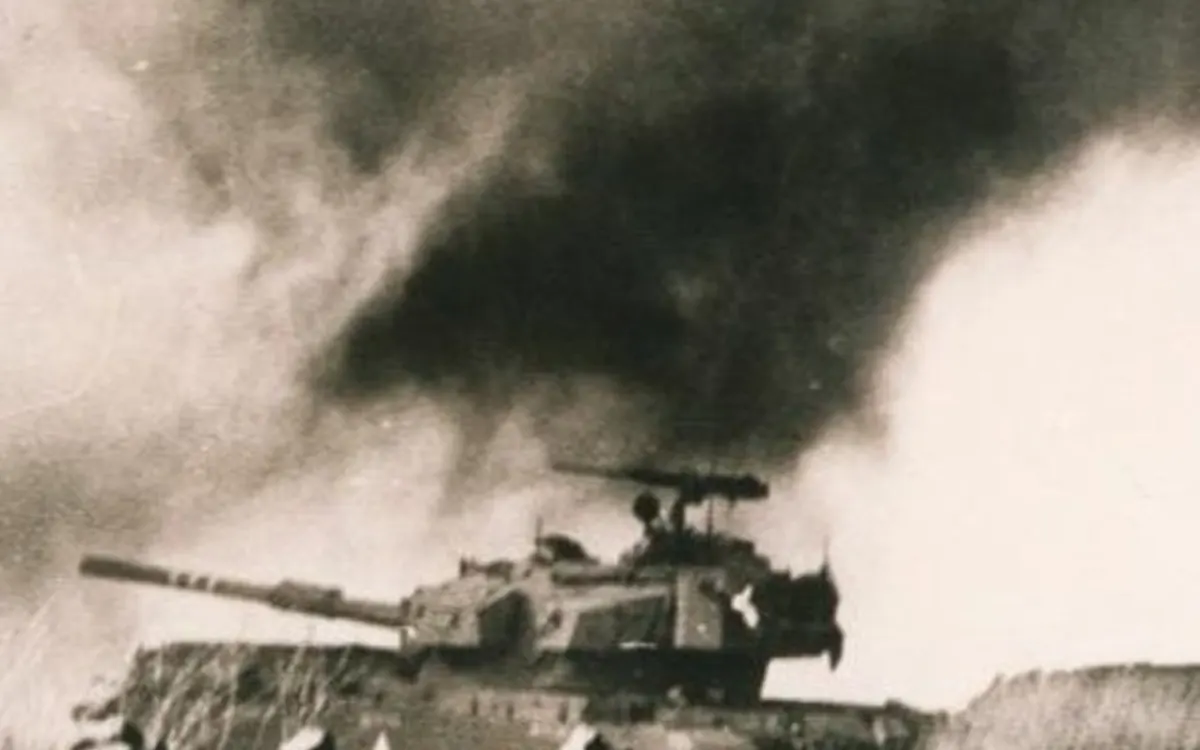
A surprise blow is always the hardest to absorb, even if it's not so powerful. The first strike of the Yom Kippur War will be massive, and it will come close to stunning the entire nation of Israel. Listen in to hear how the shock nearly caused leaders like Golda Meir, Moshe Dayan and Chief of Staff David Elazar to lose their way, while the common soldiers of Israel held on for the very life of the nation.
About this episode
Churchill said success is not final and failure is not fatal, and the episode opens with a dedication and the phone calls that woke Israel's leaders in the dark hours of Yom Kippur morning. Zvi Zamir had spent the night meeting the angel in a London apartment, and by half past two he was sure: war before sundown, a near certainty, his only doubt whether this was one more false alarm. The chain moved fast to the prime minister's aides, to Dayan, to Chief of Staff David Elazar, who ordered the general staff to headquarters and told the Air Force commander to ready a preemptive strike. Permission for that strike would prove far harder to win than anyone expected, and the dread in Elazar only deepened as the morning wore on.
By morning the arguments were joined. Elazar wanted full mobilization and a first strike, remembering how the air had won 1967 in hours. Dayan refused both. The political ground had shifted, American intelligence still insisted the Arabs would not move, and calling up the reserves or striking first would brand Israel the aggressor and cost it the arms it would need to survive a long war. Golda Meir split the difference. She granted most of the mobilization and withheld the strike, judging that establishing beyond doubt who started the war mattered more than the advantage of the first blow. Kissinger himself had wired that there would be no war and that America opposed any preemption. At one fifty-five that afternoon, four hours early, a note reached her hand. War had begun.
The blow was stunning in its weight. Ten thousand artillery rounds fell on the Barlev line in the first minute, and four thousand commandos crossed the canal chanting Allahu Akbar as they threw ladders up the sand wall. When the Israeli tanks rolled forward in their well-rehearsed drill, they met a hail of Sagger missiles. For the first time since the tank entered the battlefield, individual infantrymen could blow the turret off armor at three thousand yards, much as the English longbow once brought down the mounted knight. Overhead the vaunted Air Force flew into the thickest surface-to-air missile umbrella the world had yet seen, exactly as Menachem Begin had warned the Knesset it would, and its dive-in, dive-out sorties made no dent in the crossing while the bridgeheads multiplied.
As the Barlev line fell and Southern Command clung to a dead plan of stopping the enemy at the water, attention turned north, where minutes separated the Golan from the heart of Israel. There a hundred and seventy-seven Israeli tanks and a handful of strongpoints faced fourteen hundred Syrian tanks and three divisions. Elazar had once boasted that a hundred Israeli tanks could handle eight hundred Syrian, and he was about to be tested. Young Shmuel Askarov, whose warning of war had been brushed aside ten days before, leapt into his tank and destroyed the Syrian bridging vehicles at the ditch, racing from ramp to ramp, hit four times, claiming thirty-five kills before the day was out, trying to make a few tanks look like an entire army.
The night belonged to Tzvika Greengold, a survivor's son who hitchhiked to the front in his dress uniform and took two repaired tanks up the Golan alone. For twenty hours Force Tzvika fought in the dark, leaping from burning tanks into fresh ones, hiding his desperate solitude on the radio, holding the road to Nafakh and saving the base. He was gripped by the sense that his parents' Holocaust had suddenly become relevant again, and that he alone stood between the enemy and his people. Decades later a senior officer claimed the legend had been invented to rebuild a shattered brigade, and the nation split over it. Rav Mike leaves the real question open, whether the lesson is to distrust our heroes, or that when history knocks we all must rise to the occasion.
Key ideas
- Zvi Zamir's night meeting with the angel gave a near-certain warning, yet the preemptive strike proved far harder to win than the mobilization.
- Golda Meir withheld the first strike, judging that proving who started the war mattered more than the advantage of the first blow.
- The Sagger missile let individual infantrymen destroy tanks, much as the longbow once ended the age of the mounted knight.
- The surface-to-air umbrella over the canal crippled the Air Force, exactly as Begin had warned the Knesset it would.
- On the Golan, a hundred and seventy-seven Israeli tanks faced fourteen hundred Syrian, and young Shmuel Askarov fought to make a few look like an army.
- Tzvika Greengold held the road to Nafakh through the night, and the later fight over his legend split the nation over whether to trust our heroes.
Chapters
- 0:01 Success is not final
- 1:08 The phone calls wake Israel
- 3:22 The preemptive strike refused
- 10:53 War begins four hours early
- 11:58 The crossing; God is great
- 13:04 The Sagger ends the age of armor
- 14:10 The missile umbrella; Begin was right
- 16:23 The Barlev line collapses
- 17:34 The Golan; a tank ditch
- 21:02 Elazar's boast; the odds
- 22:14 Askarov at the ditch
- 27:35 Tzvika Greengold goes to the front
- 29:44 Koach Tzvika alone in the night
- 31:53 Debunking the legend
- 34:06 Trusting your heroes
Who, where and when
People
Winston Churchill, Zvi Zamir, David Elazar, Moshe Dayan, Benny Peled, Menachem Begin, Shmuel Askarov, Tzvika Greengold, Yair Nafshi
Places
The Suez Canal, The Barlev line, The Golan Heights, The Purple Line, Nafakh
Texts
Begin's warning to the Knesset, The legend of Koach Tzvika
When
6 October 1973 CE: Yom Kippur, war begins, 1973 CE: the Egyptian crossing, 1973 CE: the Golan stand, 2016 CE: the debunking interview
Read the transcript
Success is not final, said Winston Churchill. Failure is not fatal. It is the courage to continue that counts. And I'm going to continue telling my tale, no matter what may come. I'm Rav Mike Foyer, and this is The Jewish Story. Season 4, Episode 16, Yom Kippur War Part 4, A Stunning Blow. Before we get started on the show, I want to make a dedication in honor of the memory of Gary Segal Palavoy. Gary lived a life of kindness and volunteering, yet sadly passed on too soon. Truly, her life was part of the Jewish story. Her children, family, and friends miss and love her dearly. And I want to add that Gary was an American Ola and the mother of two current IDF soldiers. May her memory be for a blessing for all of us and the sacrifice of our children an inspiration in the coming story.
The phone calls started to wake Israel's military and political leaders in the early hours of Yom Kippur warning. Freddie Aimey, Mossad bureau chief in Tel Aviv, was the first to be woken. His call came directly from his boss, head of the Mossad, Zvi Zemir. Now Zvi Zemir hadn't heard the traditional kol nidre service the night before, nor was he fasting. But I can imagine that his sense of imminent judgment was about as real as any Jew could muster on this great and terrible day of the Lord. Because he'd spent the better part of the night first meeting with the source, that secret, highly placed Egyptian intelligent asset, in a London apartment, and then discussing the intelligence he'd received with a case officer.
The message seemed clear. there was a 99.9% chance that Egypt would go to war before the sun set on Yom Kippur Day. The only thing Zamir had to work through was his concern that this was yet another false alarm. He reviewed all the mounting evidence, including the most recent and alarming alert that the families of Soviet advisors were being evacuated from Cairo and Damascus, and by 2.30 a.m., Zamir's mind was made up. He reached Freddie Amey at 2.40, using an unencrypted phone line in order to save time and gave him an obtuse and yet clear message of what was to come. Amy heard it loud and clear, and the phone chain moved rapidly from there. First the Israelior, the Prime Minister's military aide, and then on to Moshe Dayan's aide-de-camp.
Chief of Staff David Eleazar got the call at 4.30 and immediately issued an order to the General Staff and commanders of the Northern and Southern Fronts to meet him at headquarters by 5.15. And then Dotto called Jenner Beli Pellid, commander of the Israeli Air Force. We have information that there will be war with Syria and Egypt by Tanakh. Are you ready, he asked. I'm ready, was all the answer that El Azar really needed. But Pellet went on to detail a plan for a preemptive strike on the Syrian and Egyptian air defenses. Roll it, was the chief of staff's reply. I'll get permission after. Pellet said that he could have the Air Force ready to strike by 11 a.m. But as it turned out, permission for that strike was not so easy to achieve.
As he rushed to headquarters, the chief of staff was filled with a growing sense of dread. The IDF's basic assumption had always been there would be five or six days of warning before war, ample time for a full mobilization and integration of the reserve unit into the standing army. At the very least, their defense plan along the canal, dubbed Dovecot, required a minimum of two days warning for any hope of an effective success. A half day's warning had the surreal sensation of a nightmare. a feeling that would only deepen in the coming days. Eliezerah, head of the Israeli military intelligence branch Amman, arrived at headquarters directly on the heels of Eliezer, and he lost no time in expressing his faith in the concept, that idea that Sadat simply wouldn't go to war.
But despite his dread, the fog of uncertainty that had clouded David Eliezer's mind in the preceding week had finally lifted. He was no longer clinging to this concept in the face of mounting evidence, and he was no longer interested in Amman's assessments. Let's act as if there will be war, was Dato's reply. Once the general staff began to gather, the chief of staff activated the network which would carry out a full mobilization. Though he hadn't received approval for such a move from the prime minister, he even issued call-up orders for several thousand key personnel. By 5.50, Defense Minister Moshe Dayan had arrived, And to Eleazar's surprise, he saw the situation in a radically different light.
Supported by Eleazar's continuing confidence that there would be no war, Dayan rejected the chief of staff's demand for a preemptive strike. He in fact said no almost out of hand. We're in a political situation in which we can't do what we did in 1967, said Dayan. He went on to explain that Amman was not alone. The American intelligence agencies were also still insisting that the Arabs were not going to war. In 1967, when Nasser was openly declaring his intention to destroy the Jewish state, President Johnson had still warned Israel against the initiation of hostilities, saying Israel will not be alone unless it decided to do it alone. What would Nixon and Kissinger do now if Israel struck first while the CIA and the NSA, and the National Security Agency were certain that Sadat had no such plans, or at least they said they were.
Knowing that the ultimate decision on preemption lay with Prime Minister Meir, El-Azhar shifted his focus, proposing the immediate and almost complete mobilization of the reserves, 200,000 to 250,000 men. We don't order full mobilization just on the basis of a report by Tzvika, said Dayan, meaning Suiz Amir, the head of Mossad. In the absence of active hostilities, He thought that such an act itself was likely to trigger war. The most Dayan was willing to consider was calling out 30,000 men to buttress the defenses on the Sinai and the Golan. General Eleazar returned to his office, determined to take whatever action he could. He pushed off his meeting with the Prime Minister in order to confer with the commanders of the Northern and Southern Fronts and then met with the heads of the Air Force, the Navy, and the Armored Corps.
Though the issues for each were different, everyone received the same essential message. war was coming and it was going to be brutal 6pm was set as zero hour by 8am the chief of staff and the defense minister were ready to present their cases before Prime Minister Meir the first question was mobilization I suggest calling up all the air force reserves as well as the armored corps division in the Golan and another in Sinai that can amount to 50 to 60 thousand people said Dayan if during the night we want to call up more, we will when Elisar protested insisting in the strongest terms that the safety of the nation depended on full mobilization. Dayan replied, I believe we complete the call tomorrow.
It's not like in 1967, he said. The war will begin in the Suez and on the Golan Heights. It's important that they don't say we started. Calling all reserves to duty before one shot has been fired, they'll immediately say that we're the aggressors. And David Elazar's response sounds like it could have been said today. As far as the international diplomatic impact is concerned, he said, it doesn't matter if we call up 70,000 or 200,000. A call-up itself incriminates us. They'll say we called up the reserves to start a war. I prefer that they say we started it and that we win. They'll say it anyway. The Prime Minister then asked their opinion on the Air Force's plan for a preemptive strike like the one that had given Israel its stunning victory in 1967.
To unleash the air force now would give Israel a huge advantage and save countless lives, insisted General Eleazar. We can wipe out the entire Syrian air force by noon. We need another 30 hours to destroy the missiles. This is what we're capable of. We can't afford it this time, responded Ayan. Based on the information I've obtained, we cannot launch a preemptive strike, not even five minutes beforehand. if we're in a situation whereby Egypt starts the war, we'll be able to strike Syria as well. If they don't open fire, we don't open fire. Prime Minister Meir was in an unbelievably difficult position. Aside from how she was meant to decide between the defense minister and the chief of staff, throughout the spring and summer, she had given repeated assurances to the United States that Israel would not initiate hostilities no matter what came.
In many ways, Israel's stunning victory of 60 years before was now working against her. Because even then, in her position of weakness, many voices in the international community had labeled Israel the aggressor simply for striking first. What would they say now if Israel struck first from a position of strength? Furthermore, as late as 1 p.m. on the eve of war, Prime Minister Meir received a message from United States Secretary of State Kissinger assuring her that there would be no war and stating emphatically that the United States was opposed to any preemptive action on Israel part a stance that he had communicated to the Soviets the Egyptians and other regional leaders Now, Golda Meir knew well that if the war ahead proved longer than the Six-Day War, and by all odds it would, a steady flow of American arms would be essential to Israel's survival.
If we strike first, she said, we won't get help from anyone. And as it turns out, at the close of the war, Kissinger told Moshe Dayan that Israel, quote, had been wise not to stage a preemptive strike on Yom Kippur. If it had, it would not have received so much as a nail from the United States. We'll discuss in the coming episode the extent and importance of the American arms airlift, but I'll leave it now to you to contemplate whether the lives lost were worth it. The clock was ticking, and by 9.30 in the morning, Prime Minister Meir had reached her decision. A message would be sent to Egypt, a warning that Israel was aware of their plans and ready to meet them. General Eleazar would get almost his full mobilization, but there would be no preemptive strike.
The Prime Minister agreed with the Defense Minister that success in this war would depend on establishing beyond doubt that Israel did not want war and did not start it, even at the cost of forfeiting the advantage of first strike and the heavy blood flow which would result. At noon, the members of the cabinet were summoned, and Prime Minister Meir outlined the situation and the probability of war breaking out later that evening. At 1.55, Prime Minister Meir's military secretary interrupted the meeting to hand her a note. It was four hours earlier than predicted, but war had begun. When the first blow finally landed, it wasn't just the surprise which made it so stunning. It was the overwhelming punch that it packed.
The first to feel it were the forces manning the forts of the Barlev line, but its impact would ripple through the entire Sina Brigade and up through the country in the coming days. A wave of bombers came first, aiming to knock out Israeli anti-aircraft radar stations and any sort of command base. They were followed immediately by a massive barrage of artillery, more than 10,000 rounds in the first minute alone. Their target was the canal side section of the Barlev line, where the defensive forts were large and relatively close together. The defenders were driven inside by that murderous hail, and with the exception of a few intrepid lookouts, didn't see as 15 minutes later, 4,000 commandos and crank infantry slid down into boats and began to motor and paddle across the water.
General Shazli, Egypt's chief of staff, had ordered loudspeakers set up at the crossing points in order to facilitate the organization. But in the opening minutes of the attacks, they blasted Alu Ahbar, God is great, over and over again. It was Ramadan, after all. The troops soon picked up the chant, and as the attackers threw ladders up the sand wall on the east bank of the canal, the water echoed to the sound of their voices. This initial wave of 4,000 was the knuckle in the face from the Egyptian fist. Quickly scaling the towering sand embankment, they raced to take up positions about a mile inland, most reaching the Israeli firing position before Israel's own tanks. The Egyptian intelligence had long ago known precisely where they would head.
And this is where the shock really began. Israeli intelligence was aware that the Soviets had supplied the Egyptians with large quantities of Sager anti-tank missiles, but they were unaware of how great those quantities actually were, or just how deadly a weapon the Sager would prove to be. As the Israeli armor left their staging areas along the artillery road running parallel to the canal, they could see that their firing positions were already occupied. Infantry to the front, called out the platoon commanders. Attack! It was a well-rehearsed drill, one whose outcome was assumed to be obvious. Like the armored knights of old on their warhorses, the tanks would simply roll through, crushed the unmounted enemy with overwhelming weight and force.
But, just as the British longbow, in days gone by, had allowed a peasant behind a rock to bring down a mounted knight by putting an arrow through his plate mail, thus ending the supremacy of the mounted cavalry, so too, during the Yom Kippur War, the Sagar shoulder-fired missile shifted the balance of power between infantry and armor. As the Israeli tanks approached, they were met with a hail of these shoulder-fired missiles. The saggers were accurate to a range of 3,000 yards, and their explosive power was strong enough to blow the turret right off a tank. And the Egyptians had them to spare. For the first time since tanks had rolled onto the battlefield in World War I, individual infantrymen could stop them in their tracks.
And that's exactly what happened. The Egyptian tanks on the opposite bank added their fire, and the artillery began to zero in ever more closely on the Israeli positions along the Cal. And what about the all-powerful, dreaded Israeli Air Force? Well, I hope you remember the end of the War of Attrition. You can go back to episode 10 for a full review, but for now, just recall that after the ceasefire was signed, the Egyptians, with the collusion of their Soviet patron, rushed batteries of surface-to-air missiles right up to the western edge of the canal, a gross violation of the agreement, which was nevertheless ignored by Israel, mostly due to American pressure. And I also hope you recall the grim and prophetic warning that opposition leader Menachem Begin had issued at the time.
The Egyptians, he said, with the aid of the Russian advisors, have violated the ceasefire in a manner so gross it threatens our security and future. They've already deployed nine batteries of their enhanced SAM missiles and are presently installing a further nine, all penetrating to a depth of 10 to 15 kilometers over our side of the canal. Hence, the conclusion has to be drawn, and the Knesset and the people have to be aware of the implications of this conclusion, that when Egypt decides to reopen fire, and knowing the realities as we do, we have to assume that such a day shall surely come, it will have a decisive advantage over us. Given the expanded missile umbrella, it would be very difficult for our Air Force to hit back without sustaining substantial losses in pilots and aircraft.
And, to the great sorrow of everyone involved, Menachem Begin was now proven to be absolutely correct. The Israeli Air Force flew 120 sorties over the Egyptian battlefield in the first day, losing only four planes. but the SAM umbrella made it impossible for them to circle, and their dive-in-dive-out tactics made no impact on the invasion whatsoever. By 5.30 in the afternoon, the final wave of the initial assault had crossed the canal. 32,000 men setting up the bridgeheads for the five divisions which would come after them more than 100,000 Egyptian soldiers. At 6.30, pump trucks were rolled down to the water side, and hoses began to blast breaches through the sand on the Israeli side of the canal.
Within two hours, 60 passages had been opened up. The first bridge was completed at 8.30, and the gates to the Sinai were opened. The tanks of the Sinai Brigade were reeling, their numbers dwindling under withering rocket fire. The forces of the Far Lev Line were all but surrounded, on their way to becoming the death traps which General Ariel Sharon had warned that they would be. Confusion reigned not only on the battlefield, but even further up the chain of command. When Chief of Staff Eleazar got word of the collapse of the Bar Lev line, he ordered the immediate evacuation of all the canal side forts. But Head of Southern Command General Shmuel Gonan never issued the order. Rather than pulling back the regroup and rethinking their strategy, Gonan and his staff were still trying to stop the Egyptians at the waterline.
This had been the heart and soul of Israel's battle plan from the outset, stop the enemy at the canal and then take the fight to his homeland. Its irrelevance in the face of the overwhelmingly successful Egyptian crossing should have been obvious. But that's where shock and a deeply ingrained attitude can lead to disaster. As one deputy division commander later said, you break into a cold sweat and your mind freezes up. You have difficulty getting into gear and you react by executing the plans you've already prepared, even if they're no longer appropriate. We will take time to delve into the disastrous consequences. of the failure of the command structure to assimilate a new reality, as well as the heroism of the soldiers in the field that saved the Sinai.
But we'll do it next episode. For now, despite the drama that I've described, no matter how brutal the initial assault, Israel has time in the South. It's a long way from the Suez to Tel Aviv. But from the Golan Heights to the heart of Israel might be a matter of minutes. Ten days before Yom Kippur, General Yitzchak Hofi, commander of the Northern Front, hosted a delegation that included Defense Minister Moshe Dayan the head of Amman Eliezer and other senior military personnel They were touring the so Purple Line the 1967 ceasefire line between Syria and Israel on the Golan Heights which serves as a de facto border even today At one point, they stopped at a hilltop overlooking Syrian positions to receive a briefing by Major Shmuel Askarov.
Askarov was the deputy commander of a tank battalion, and at 24, he was the youngest deputy battalion commander in the entire army. Confident in his status as a fast-rising star, and self-assured as only a military man can be, he pointed out the large Syrian deployment on the east and described the extensive exercises their armored units had been engaged in for days. War, he said, is a certainty. Dayan turned to Zera, who replied, There won't be war for another ten years. Askarov will remember his words for the rest of his life. We heard last episode how the Chief of Staff's confidence in the concept and Zeyra's assessment that there would be no war had begun to fray as the evidence mounted in the first week of October.
And fortunately for Asgharov, Northern Commander Hoffi, and frankly, the rest of the country, El-Azar had already ordered the armed forces into a Gimel alert, the highest state of alert he could issue without the Prime Minister's authority, on the day before Yom Kippur. It didn't involve mobilization, but all military leaves were canceled. Most servicemen had planned to be home for Yom Kippur, and staffs were told to prepare for immediate mobilization of their units. And not only that, in the lead-up to Rosh Hashanah, almost two weeks before, and in the wake of the air battles over Syria on September 13th that we described last episode, the defense minister had ordered a reinforcement of the armored forces along the Golan Plateau.
The hundred tanks of the 7th Brigade that made their way to the Golan in the following week brought Israel's total forces up to 177 tanks, 600 infantrymen stationed in 10 strong points along the Purple Line, and the support of 15 artillery pieces. On the Syrian side of the line stood 1,400 tanks, 115 artillery batteries, and three infantry divisions with a total of 40,000 men. And that's without even considering the two additional armored divisions held in reserve only a few hours from the front. Unlike in the Sinai, where the crossing of the canal itself was a major military accomplishment, all that stood between the opposing forces on the Golan was a tank ditch, five mirrors deep, five mirrors wide, lined sporadically by minefields.
It was a barrier, but hardly a decisive one. Chief of Staff David Eleazar had been known to boast that 100 Israeli tanks were sufficient to handle 800 Syrian on the Golan, and he was about to find out whether he was right. The Syrians estimated it would take Israel at least 24 hours to mobilize their reserves, and they planned to have conquered the entire Golan by then. In the wake of that alert, General Hovey had assembled his senior commanders. Discussions centered on the 188th Armored Brigade, commanded by Colonel Yitzhak Ben-Shoham, whose 70 tanks were dispersed in threes and fours along a line between the front-line bunkers. The 100 tanks of that newly arrived 7th Brigade, commanded by Colonel Avigdor Ben-Gal, were to be held in reserve.
It was a standard deployment, fit for countering what they were used to, small-scale incursions, battle days, as they were known. The scattered groupings, though, were going to prove totally inadequate for the full-scale war they were about to face. At 1.56 p.m., the quiet of Yom Kippur was shattered by the scream of jet fighters and the shock of exploding bombs. And as the Syrian MiGs wheeled in the sky, artillery shells began to rain down on every military target in the Golan. Major Shmuel Askarov, whose prediction of war had been brushed off by El Ezerah only 10 days before, was ready. He and his crew leapt into the tank they'd left parked only a few feet from his office door, and gathering six more vehicles, they raced to their firing positions.
At first, Askarov couldn't see a thing. The Syrian bombardment had raised a cloud of dust and smoke, but as his vision cleared, he couldn't believe his eyes. Five bridging tanks were already at the tank ditch, and what looked like the entire Syrian armored corps was coming in fast behind. His gunner managed to destroy three of the bridging tanks in the first moment, and soon all of the tanks in his platoon were opening fire. The Syrian armor was bunched so thick it felt like shooting fish in a barrel, except it was far more dangerous. As the Israeli gunners landed shot after shot, the Syrians zeroed in on their positions and began to return fire. The field before him was littered with blown-out tanks, but one by one, the armor of his own unit were struck, and most of their commanders instantly killed.
Oskarov himself was hit four times, but somehow his tank remained operational as he raced from firing ramp to firing ramp, attempting to stem the flood and to give the Syrians the impression that they faced a much larger force. Within two hours, the Major would claim 35 tank kills. A few hours after that, the Syrian breakthrough appeared catastrophic. Their armor was pouring through the gaps in the thin Israeli line, and by evening they were threatening the approaches to the bridges over the Jordan, the control of which would give them access to all of northern Israel. At a certain point, General Haufey decided the 188th couldn't contain the Syrian tank alone, so he threw the 7th Brigade into battle out of reserve.
But even this wasn't enough to stop the advance. At 6 a.m. on Sunday morning, Defense Minister Moshe Dayan arrived at northern headquarters and found Khafi himself near the breaking point. There were no forces in the southern Golan capable of stopping the Syrians from pushing into the Sea of Galilee region. Now Dayan himself was born there on Kibblistagania, as was Moti Hoth, former Air Force commander, and now in the north as the Air Force liaison to Northern Command. We can't let that happen, said Hoth. Only the Air Force can stop them now, replied Khafi. Hoth contacted current Air Force commander General Penny Pellet and asked for direct control of a Skyhawk squadron. When Pellet protested that every plane he had was committed to stopping the Egypts, who were even then threatening to overrun the Sinai, Dayan grabbed the phone and shouted at him, The third temple is in danger!
That was enough to get the planes. But unfortunately, the planes weren't enough to stop the Syrians. As the first squadron of Skyhawks roared over the Golan, they were met by a swarm of ground-to-air missiles from the Syrian lines, and two of them fell immediately. In the coming hours, it would be made painfully clear that on both the Syrian and Egyptian fronts, the Egyptian missiles wielded by the Arab armies made close air support of ground troops all but impossible. Now is the moment to praise the quality of the Israeli soldier. In the coming days, it will become very clear that the future of the Golan, Indeed, the entire country rested not on elaborate planning of the general staff or sophisticated weaponry, but on improvisation against odds sometimes as great as 9 to 1.
There was no plan for a battle like this. And in the end, virtue or defeat would hang on the instincts of the officers and the men in the field. In many ways, the story of this war is one of two institutions, the army and the government, which let down a nation, but were saved by the power of the people. It's a story that will play itself out down in the Sinai, as well as here in the Golan. Everywhere, the Israeli armored units were outnumbered, but they were never outgunned. And that was because of the quality of the soldiers. The tank gunners were trained basically as snipers, and the loaders were experts in rapid fire. This meant that, at times, one Israeli tank could get off as many as three or four shots before the enemy could even return fire, and all of them were more accurate.
And as we'll see next episode, the irresponsibility and even corruption of the previous six years left many reserve units without basic equipment as they rushed to the front. No blankets, binoculars. Sometimes they lacked sufficient ammunition. When the call began, many units arrived to find their vehicles weren't even in working order. The situation was so desperate that rather than wait for the organic three-man units in which they'd been trained, as men and tanks became available, they were simply thrown together willy-nilly and sent to the front, often to die with brothers whom they'd only just met. And, nevertheless, the men made it happen. They scraped, borrowed, and begged. They MacGyvered, jimmied, and fixed.
People donated, volunteered, and sacrificed. And it was the heroism of these soldiers, fighting not for abstractions like God or country, but for realities like family, home, and one another, which won the day against overwhelming odds. There will be a political reckoning that flows from this disparity between the people and their trusted institution, but that story lies ahead. For now, I want to end with a true Israeli legend. Tzikha Greengold was born on Kibbutz Lohameha Geteot a ghetto fighter kibbutz established by Holocaust survivors including some who fought in the Warsaw Ghetto Uprising He himself was the son of survivors. At 21 years old, Suika had been invited to begin a course for tank company commanders and thus was unattached to any unit when war broke out.
In fact, he was at home, enjoying two weeks of leave before the course was meant to begin. But when the air sirens sounded, Tzvika knew that there was only one place he belonged, at the front. Grabbing his dress uniform, which was the only one he had, he raced out onto the road and hitchhiked to the main tank base near Nafakh, at the edge of the Benot Yaakov Bridge, at the foot of the northern Golan. And when he arrived, he saw that chaos had already begun to reign. There were no tanks immediately available, but when three damaged centurions came down off the heights, Tzvika supervised the removal of the dead crewmen, saw that their blood was washed clean, and gathering enough men to staff two of the tanks, headed up to battle.
His mission was clear. Head for strongpoint 111 along the purple line and gather all the tanks you can along the way. Headquarters told him that every single officer in that sector was already dead and he would be taking over from the sergeant who was now in command. Oh, and by the way, destroy every Syrian tank you meet. What follows remains to this day one of the classic stories of Israeli military lore. Given the codename Koach Tzvika, Force Tzvika, the two tanks set off down the tap-line service road that marked the route of a buried oil pipeline which traverses the Golan Plateau. It was only a matter of a few miles before Tzvika encountered the enemy, and in fact it was an entire company of Syrian tanks advancing toward the command center at Nafakh.
He opened fire at close range, scoring several direct hits, but the recoil of the last knocked electricity out on his turret. Suika leapt out, ordered the commander of the other tank to take the damage readable back to repairs, and continued forward. As he advanced into darkness, the knights swarmed with Syrian tanks. Alone, Gringold's only advantage was that everything he saw, he knew was a target, and he exploited that advantage to its utmost. Racing back and forth, firing at a manic pace, often not even knowing whether he hit, he wreaked havoc amongst the advancing Syrian armor. And as he was monitoring communications, Zviqa began to realize just how desperate the situation really was. At one point, Colonel Ben-Choham, commander of that 7th Division, made contact with the Zviqa force in order to ascertain its strength.
Assuming that Koh-Zviqa was at least a company, Ben-Choham ordered them to press forward toward the western end of the Syrian forces in order to push them back against a waiting Israeli battalion. Zviqa didn't want to reveal the truth, that he was desperately alone, and the only tank at the moment that stood between the Syrian force and the command center at Nafakh. And so he gave an invasive answer, saying only, the situation is not good. Sikha fought on through the night, at times leaping from a destroyed tank into a new one, only to continue his defensive action. Burned, wounded by Shrapnel, he nonetheless held his position against overwhelming odds. Later he would say that even in the midst of the fighting, he was gripped by an awareness that the Holocaust his parents had survived was suddenly relevant again, and that only he stood between the enemy and the annihilation of his people.
After more than 20 hours of battle, Green Gold pulled his tank back in the Nafak base, which he had defended, and collapsed as he left the turret. It's estimated that during the course of that fateful night, he and his crew destroyed 20 tanks and many more Arnold Regal, some say as many as 60, and may have single-handedly saved the Nafak base. At one point, joined by the eight tanks commanded by Lieutenant Colonel Uzimor, they charged an entire Syrian division, that's 360 tanks, and forced them to turn back. It was for these actions that Sfika Gringold was one of the few men awarded the Medal of Valor in the aftermath of the war. Now, I could stop here, and perhaps I ought, But there's another layer to this story, which I believe opens up an important element of the Yom Kippur War.
Not the war itself per se, but the role that it plays in the development of the Israeli national psychology. Because I told you that Koch Zvika is an Israeli legend, and that Zvika himself is an Israeli hero. And as such, in our postmodern era, there's always going to be someone whose aim is to debunk the legend, to slay our heroes. Now, truth be told, there were those who questioned the idea that one man took out 60 tanks right from the start. And according to all accounts, Fiki himself never claimed such a thing and never boasted of what he'd done. But the story of his heroism, the power of one individual to stem the tide and save the nation, spread like wildfire from the moment he got back to base.
And in the years since, there have been investigations which attempt to establish the facts, all of which actually supported the story. But in 2016, only five years ago, Yair Nafshi, a senior officer of the 188th Battalion that was decimated on the Syrian front, gave an interview on Channel 2 News here in Israel. We put the whole story of Tzvika together because we wanted to rebuild the brigade, he claimed. The commander was killed. His deputy was killed. The brigade's chief of staff was killed. The operations officer was killed. Two battalion commanders were out of commission. we needed to rebuild, to restart from scratch. So what could we have done? We needed a story. We wanted him to walk around for people to point at him and admire him.
Nashi went on to say that when a reporter for the Army's magazine, Bamachaneh, arrived at the front, he sent him to Tzvika, and he said that it was the reporter, not Tzvika, who made the whole story up. Now needless to say, this attempt to debunk the legend of Koch Tzvika divided the nation. and they divided it along lines which may sound familiar. On one side stood the so-called sober realists, those who had taken the lesson from 1967, that mythic victory and its deflation in 1973, that legends are dangerous, that whatever inspiration our actions may provide is offset by the tragic result when they inevitably drive us to collapse. Better a painful and debilitating truth, they said, even if it leaves you weaker when facing the future than a fantasy that drives you to an unsustainable risk.
Now, on the other side stood the idealists, the ones who saw Tzvika and his story as an embodiment of dreams. Just like 1967 had been filled with dreams, so too, Koch Tzvika, it was an embodiment of the idea's greatest virtues, of Israel's best self-resourcefulness, dedication, fearless sacrifice, and an appreciation that history makes an invitation to individuals as well as nations. Now, I'm not interested right now in weighing in on the academic debate, so to speak, over the veracity of the story. Suffice it to say that the army has yet to find enough evidence that it was withdrawn the story of Kohach Zvika from its curriculum. But I will point out that in many ways, the struggle over the story of Koach Zvika parallels the struggle over stories altogether here in Israel.
Because for many in Israel, 1973 burst the bubble of 1967. And the lesson they took is that the stories that have made us a people, the stories that have driven us forward beyond all odds, are dangerous because they create an inflated sense of self which takes risks and moves forward in situations perhaps we ought not. On the other hand, there's a side of our country, a side of our people, which appreciates the fact that without our stories, we are not what we can be. In fact, it's our stories which give us strength and fuel for the future. I leave it up to you to ask the question of whether the lesson that we should take from Koach Spika is that you shouldn't trust your heroes or that when history knocks at the door, we all have to rise to the occasion.
I just want to thank a few people before I sign off. I want to thank all the folks who give their hard-earned money to make this show happen, to keep it free, make it widely available. I want to invite you to join them. You can go right now to my website. That's www.jewishstory.co. In the upper right-hand corner, you'll see a button that says Be a Patron. You can click on that to make a little bit of per-podcast support. or you can contact me at robmikefoyer at gmail.com or on Facebook at robmikefoyer and I'm happy to share with you details how you can dedicate a show in the honor of someone who's with you now or in the memory of those who have passed on I want to thank the Land of Israel Network that's thelandofisrael.com for building a platform that allows me to reach so many wonderful people I want to thank the Pardes Institute P-A-R-D-E-S dot org dot I-L building an educational institution that gives me the privilege of teaching so many amazing Jews and I want to thank you for listening I'm Rav Mike Foyer and this is The Jewish Story.
More from Season 4
TJS S4E15 Yom Kippur War III - breaking the concept
Sometimes the ideas we hold most dear are those which prevent us from seeing t hat which is most important. Here is an episode about the 'concept,' the...
Play Episode
TJS S4 Interlude Yom Ha'atzmaut: whom do you serve?
Like Bob Dylan said, everybody's gotta serve somebody and like the Sages said - it will be your stomach, your country or your God. Here are some thoughts...
Play Episode
TJS S4E17 Yom Kippur War V: Down but not out
This is the story of how close the end really came during the Yom Kippur War. Even as Israel's tanks held out in the north, turning a stretch...
Play Episode