
TJS S4E17 Yom Kippur War V: Down but not out
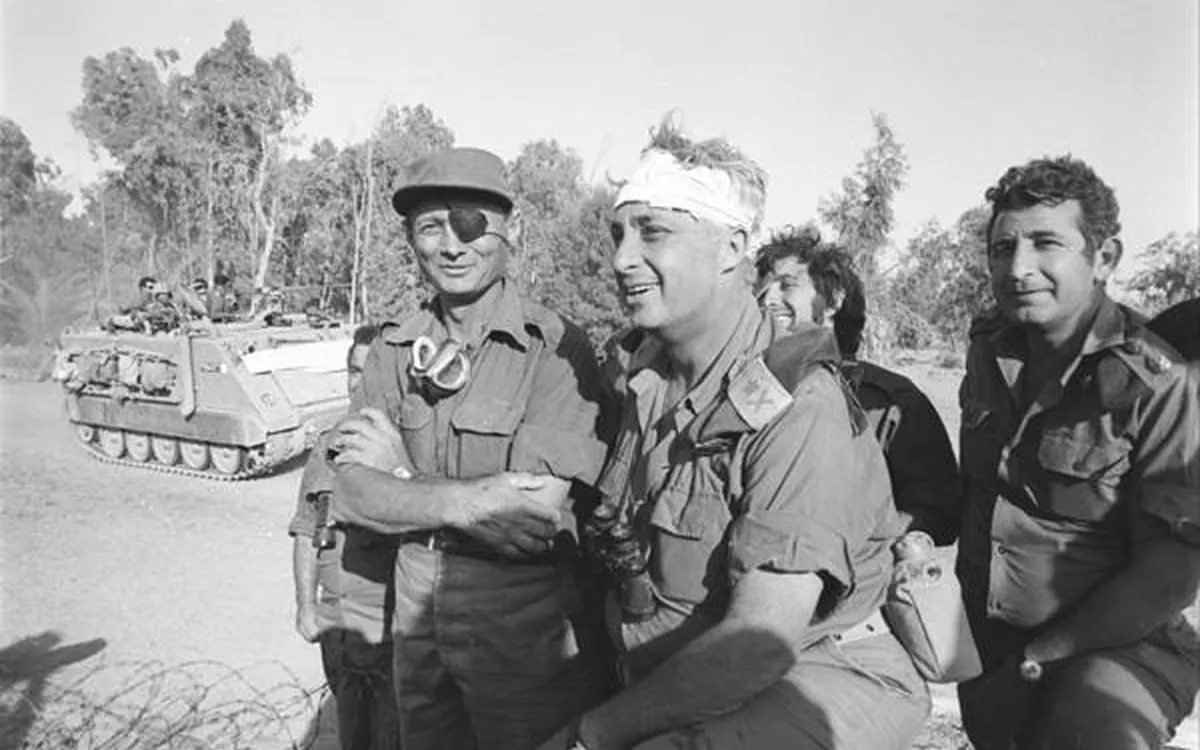
This is the story of how close the end really came during the Yom Kippur War. Even as Israel's tanks held out in the north, turning a stretch of the Golan Heights into 'The Valley of Tears,' the forces in the south were stretched to the breaking point. Nonetheless, an American airlift will provide the arms, and the impetuous general Ariel Sharon the means, to yet snatch victory from the jaws of defeat.
About this episode
Tommy Lasorda said the difference between the impossible and the possible lies in determination. Eighteen hours into the war, Defense Minister Moshe Dayan rode back from the fronts in despair. The southern Golan was all but overrun, the bridges over the Jordan were being mined, and in the Sinai Southern Command still clung to a dead paradigm, imagining it would stop the Egyptians at the canal and counterattack. Dayan had ordered a fallback to a line it could actually hold. His darkest fear reached past this round to a future of endless Soviet-armed assault that would grind Israel down over the coming years, and he carried that gloom into Tel Aviv, where he began to spread it through the senior command even as the reserves slowly gathered.
The gloom reached Golda Meir, who later wrote that Dayan spoke of surrender and that thoughts of suicide crossed her mind. The word surrender itself shook the foundations of a culture built on the spirit of Tel-Chai, on Aaron Sher's cry that one does not desert a place or give up what has been built. The next day, Monday the eighth, a disastrous counterattack along the canal, remembered by many as the worst day in Israeli military history, ended any illusion of a quick turn. Fears ran so deep that some in the government are said to have contemplated the nuclear option, if only to rattle the saber. Golda began reaching for Nixon and for immediate American arms, and the questions of scale that Dayan had raised now pressed on everyone.
On the Golan the tide slowly turned. The men of the 188th and 7th Brigades had fought with a heroism Rav Mike reads through Sadeh's words and the Rambam's first degree of prophecy, the spirit of the Lord resting on those who deliver the many from the hand of the wicked. In the Valley of Tears the hundred tanks of the 7th Brigade were worn down to six, firing their last rounds when a patchwork of fifteen repaired tanks under Yossi Ben-Hanan appeared, and the Syrians, taking them for a fresh wave, broke. By Wednesday the tenth a Syrian commander was shelling his own fleeing men, and the attack that had begun as near collapse had drawn the enemy into a giant killing trap as Musa Peled's reserves arrived in time.
The Sinai told a harder story. Rav Mike turns to Frank Herbert's Dune, where the undefeated Sardaukar meet their first loss and the hero sees that continuous victory without ever tasting defeat is itself a weakness. That was the IDF after 1967, an army that had internalized that it could not lose and so froze when its back hit the wall. For seven years it kept an offensive posture fit for narrow borders while holding the whole Sinai, as Barlev's 1968 doctrine insisted the best defense was a good offense. Only mavericks like Sharon and Tal had argued for a true defensive line well back from the canal, and the failed counterattack of October eighth was the bursting of that bubble of invincibility.
Then came a gift hidden in the wreckage. One of Sharon's battalion commanders stumbled onto a seam a mile wide between the Egyptian Second and Third Armies, right at the Chinese farm, the gateway to a crossing. Meanwhile Henry Kissinger weighed the war through three lenses: Israel's survival, though not by too much, relations with the oil-producing Arabs, and detente with Moscow. As the Soviet airlift swelled and Israeli losses mounted to hundreds of tanks, he grasped that the Arabs were now reaching for total victory, and that American standing could not survive its client falling to Soviet arms. Nixon ordered Operation Nickel Grass. Golda later said she was glad she had refused the first strike, because without it there would have been no airlift to save so many lives.
Key ideas
- Dayan's despair reached Golda Meir, and the word surrender shook a culture built on the spirit of Tel-Chai.
- The failed counterattack of October eighth is remembered by many as the worst day in Israeli military history.
- In the Valley of Tears the 7th Brigade was worn to six tanks before a patchwork force under Yossi Ben-Hanan turned the Syrians back.
- Rav Mike reads the Golan stand through the Rambam's first degree of prophecy, the spirit of the Lord resting on those who save the many.
- Like the Sardaukar in Dune, the IDF had internalized that it could not lose, and froze when its back hit the wall.
- A seam at the Chinese farm opened the way across the canal, and Nixon's airlift, Nickel Grass, helped turn the war.
Chapters
- 0:00 The impossible and the possible
- 1:08 Dayan's dark return from the north
- 3:19 The Air Force fails the Sams
- 5:32 Spreading fear; thoughts of surrender
- 6:38 The spirit of Tel-Chai
- 7:43 The problem of scale; the Samson option
- 11:09 Assad begs for a ceasefire
- 13:24 The spirit of the Lord on the Golan
- 16:49 The Valley of Tears
- 19:01 The Syrian resolve breaks
- 20:05 The Sinai in smoking ruins
- 21:16 The worst day; Dune and defeat
- 23:35 The illusion of permanent victory
- 28:02 The seam at the Chinese farm
- 30:35 Kissinger's three lenses
- 33:57 Operation Nickel Grass
Who, where and when
People
Tommy Lasorda, Moshe Dayan, Golda Meir, Shmuel Gonen, Musa Peled, Yossi Ben-Hanan, Ariel Sharon, Henry Kissinger, Richard Nixon
Places
The Golan Heights, The Valley of Tears, The Sinai, The Chinese farm, The Azores
Texts
Dune by Frank Herbert, The Rambam on the degrees of prophecy, The words of Aaron Sher, Barlev's 1968 doctrine
When
7 October 1973 CE: Dayan's despair, 8 October 1973 CE: the failed counterattack, 10 October 1973 CE: the Syrian collapse, October 1973 CE: Operation Nickel Grass
Read the transcript
The difference, says Tommy Lasorda, between the impossible and the possible lies in a man's determination. Well, I'm determined to do all that's possible to tell this tale. I'm Rav Mike Foyer, and this is The Jewish Story. Season 4, Episode 17, Yom Kippur War Part 5, Down But Not Out. As he headed back to Tel Aviv from his Sunday, October 7th, dawn tour of the northern and southern commands, dark thoughts filled the mind of Defense Minister Moshe Dayan. The war was only 18 hours old, and already everything was shock and disarray. The southern Golan was all but overrun. He'd given orders to mine the bridges across the northern Jordan, lest the Syrians seize them and with them an unimpeded approach to the heart of the country.
The situation he'd found in the south was nearly as bad. The forts of the Barlev line that still stood were now behind Egyptian lines and the mighty armor of Israel was being battered by shoulder-fired rockets. General Kofi of the northern command was nearly incapacitated by the situation, but Dayan had heard the breezy optimism from the southern command general Shmuel Gonen as actually more frightening than Hofi's panic. Gonen was still living in a dead paradigm, assuming that within hours he would stop the Egyptians at the canal and counterattack. And we'll speak soon about the deadly consequences of this failure to recognize and appreciate the nature of a defensive war. But for now, Dayan had ordered Gonen to abandon his attempts at retaking the canal, to tell the surrounded forts to evacuate in the night as best they could, and to fall back to a defensible line along the artillery road that ran parallel to the canal.
The commander had balked at the very idea of retreat, a doctrine foreign to both the ethos and the planning of the IDF, and protested that anyway the artillery road wasn't a good fallback position. Normally known for his informal style, Dayan had become severe. It is within my authority, he said, to order you to form a line that you can hold. Otherwise, we will end up on Israel's border. Nonetheless, he left it to Gonen and the chief of staff to work out the details as he headed back to Tel Aviv to brief the prime minister. Perhaps the greatest shock of the opening hours from his perspective had been the failure of the vaunted Israeli Air Force. Since the war of attrition, the Air Force had been working on two complicated plans meant to deal with the surface-to-air SAM umbrellas over the canal in the Golan Heights.
And in the last 18 hours, both had effectively fails. Now, there were many factors for that breakdown. The challenge of the mission itself, the weather, conflicting demands of the battlefield situation, but no matter what the cause, bottom line, the result was the same. The IAF was managing to protect Israel's airspace, and in fact, they had gained superiority over the enemy's forces over all of Syria and Egypt as well, except over the Suez Canal and the Golan, where right now, the life of the nation hung in the balance. These missile arrays were of the latest Soviet technology, and many say the thickest the world had ever seen at that time. As one squadron commander said while addressing his pilots after the first day of flying over the Sams, take a good look at each other.
When this war is over, a lot of us won't be here. So we can understand Dayan's mood as he approached Tel Aviv. More than anything else, it seems to me there was a psychological shift which he and the rest of the Israeli leadership had to undergo. Their assumption had been that no matter how the Russians armed them, the Arabs remained the same Arabs who'd taken flight in 1967 and in 1956, and that assumption had been shattered. Basically, seizing the initiative and executing a meticulously planned action had put a backbone and fighting spirit into the Arab armies, which Israel never imagined could be there. Dayan's darkest thoughts extended well beyond the immediate conflict. Even if they managed to survive this round, the defense minister feared that no matter where they held the line in the end, Israel would be worn down in the coming years by rounds and rounds of 80 million Arabs worldwide with access to endless Soviet arms.
Only the day before, he had actually boasted to Israeli newspapers saying, the Egyptians have embarked on a very big adventure they haven't thought through. After tomorrow afternoon, when the reserves would begin to reach the front, I wouldn't want to be in their place. Well, now it was almost tomorrow afternoon, and the defense minister didn't exactly like where he was sitting. Dayan began to spread his fear and gloom around the senior leadership with his arrival back in the pit, the army command center in Tel Aviv known as the Kiriyah. Speaking to Eleazar and the other senior officials, he said, Do you know what I fear most in my heart? that Israel will be left without sufficient arms to defend itself, regardless of where the new line is drawn, that there won't be enough tanks and planes, that there won't be enough trained personnel.
Chief of Staff Eleazar was less pessimistic, or at least was more focused on the practical questions, because it lay to him to decide where to draw the fallback line and when to organize a counterattack in the south. And he was deeply concerned with how to get the 188th and 7th Brigades up in the Golan to hold out until the reserves arrived. General Holfi had been sending distress signals all night. The reserve armored division commanded by General Musa Peled was on its way, but it would be Monday morning before they began to climb the heights of the Golan. Meanwhile, Moshe Dayan took his apocalyptic gloom to the Prime Minister. The sight of Israel's iconic military hero quaking in his boots pushed Prime Minister Meir almost to despair herself.
She later wrote that her reaction was so strong, thoughts of suicide crossed her mind. Calling her personal aid out of the office after meeting with the defense minister, Mirir told her that Dayan is speaking of surrender. Now, clearly she didn't mean actual surrender, but her choice of words speaks volumes about how deeply the foundations of Israeli culture were shaking. The very idea of surrendering territory, in this case, of accepting that they could not push the Egyptians back across the canal, and that they could conceivably lose the Golan Heights, was a cataclysmic shock. The whole Zionist project, since its inception, or at least since the last 50 years up to this point, had been driven by what's called the spirit of Tel-Chai.
You can go back to Season 2, Episode 28, for the story if you don't know it. But right now, I'm not actually speaking of the well-known words of Yosef Trumpledor, hero of the final battle of Telchai, but rather of the lesser known words of Aaron Sher, a defender who preceded him in death by only a few days and said, one does not desert a place nor give up that which has been built. This is the rallying cry of the struggle of the last half century. So you can imagine that Prime Minister Meir, whose life was the very embodiment of labor Zionism was shaken at the thought of even a tactical retreat. And, I'm sorry to say, but there's much worse ahead. In particular, the next day, Monday the 8th, which would bring a disastrous attempt at a counterattack in the Sinai.
With its failure, the hopes of a quick turnaround finally appeared for what they were, a foolish illusion. The thoughts of Israel's leaders turned to the problems of scale, which Dayan had mentioned to the chief of staff from the outset, even if they could hold the line and regain the offensive in this round, would they have the man-in-arms to do it? By Monday night, when news of the disaster in the Sinai reached her, Prime Minister Meir would be sending messages through her ambassador to U.S. Secretary of State Henry Kissinger requesting a visit with President Nixon so she could personally plead for immediate arms. Commander General Israel Tal, who was in charge of one of the two reserved armored divisions now forming up in the Sinai, put it this way, We didn't have any reserves left.
There was nothing left. The war was perceived not just as a critical, almost hopeless stage, but as a struggle for our very physical survival. There are, in fact, credible reports which say that apocalyptic fears grew so deep that some within the government contemplated the nuclear option, at least to rattle the saber, if not to actually pull the trigger. And I'm not going to weigh in on the scholarly and political debates about what really happened. Suffice it to say that it's not hard for me to imagine Moshe Dayan considering the Samson option in those dark hours. Better to die with one's enemies than witness defeat. Either way, thank God this wasn't the option which emerged. On Sunday night, October 7th, not long after Moshe Dayan began to spread his dooming gloom through Tel Aviv, Syrian President Hafez Assad summoned Soviet Ambassador Mouhdinatov and requested that the Soviet Union move immediately for a ceasefire in the UN.
Now, considering it had been little more than 24 hours since the opening surprise attack of the war, I might be tempted to view Assad's move as the diplomatic equivalent of the kid on the playground who sucker punches his enemy and then jumps behind the teacher saying, Stop him! Stop him! Truth is, though, at least in Assad's eyes, this had been part of the plan all along. As late as October 4th, before the war, he'd requested from Foreign Minister Andrei Gromko that the Soviets call for a ceasefire 48 hours after the initial strike. His hope was to lock in Arab gains quickly before Israel's reserves came online, and they actually had to fight for them. And now, as General Musa Pellet's Armored Reserve Division was approaching the foot of the Golan, the Syrian president was feeling a little bit desperate.
For reasons military historians still struggle to explain. His advance had stalled before reaching the northern Jordan on the first night of the war, and that was when only Tzvika Gringold, Shmuel Askarov, and the other handful of the heroes of Israel stood in their way Despite overwhelmingly superior forces they also failed to break the hastily formed Israeli defensive line on Sunday morning and now the cavalry was fast approaching The Soviet ambassador in Cairo relayed Assad request to Egyptian President Sadat the next morning, on Monday, but Sadat had no interest in such a move. If Assad wanted to bail out now, that was his problem. The Israelis were reeling in Sinai, and the Egyptians were set to pummel them again today.
When asked what exactly his goals were, Sadat replied that his strategic goal was to exhaust Israel. His territorial goal was to reach the Gideon Mitla passes that controlled passage through the Sinai Peninsula, and his diplomatic goal was peaceful settlement of the Middle East conflict. Now this was no small order, but at this point, of all the actors in our drama, President Sadat was the one who not only had a clear plan, but was executing it with precision and success. in the end nothing came of this initial ceasefire appeal and ironically in the long run it will be Egypt that is saved by Soviet intervention but for now we can at least give Assad credit for his sense that he was best off getting out while the getting was good despite the successful surprise opening the war for the Golan had not progressed the way in which the Syrian military had planned like I said with a ratio of 8 to 1 armor in their favor the architects of the war had assumed they would conquer the entire Golan in 24 hours, including the bridges over the northern Jordan.
And subsequent research has shown that their plan was most likely to halt there, perhaps with a thrust down to Nazareth, but there's no way that Israel could have known that at the time. To all appearances, the Syrian war machine was aiming to roll all the way to Haifa, and in the opening hours of the fighting, it looked like they might succeed. In those same hours, as we spoke about last week, the men of the 188th and 7th Armored Brigades had shown a heroism which was simply beyond imagination. In my eyes, it was a pure embodiment of those moving words of Yitzchak Sadeh that I quoted in my last interlude. Lo ha-pachtanut hi ha-pucha shel-gvura, ela ha-anokhiyut, that fear is not the opposite of heroism, but rather selfishness.
And these men had been completely selfless. Not just selfless, because he goes on, he says, Ha-kisharon le-hitgaber al-ha-pachad mikoro ba-abat zulat. The ability to overcome fear has its source in the love of one another. And those men within those tank crews weren't just fighting for the love of abstract country, but they were fighting for one another's truly brothers in arms. Their actions also bring to mind the words of the Rambam, who divides the prophets of Israel into sort of hierarchy of various categories. He says the first degree of prophecy consists in the divine assistance which is given to a person and induces and encourages them to do something good and grand, like delivering a congregation of good men from the hand of evildoers.
He finds in himself the cause that moves and urges him to this deed. This degree of divine influence is called the Spirit of the Lord. And of the person who is under that influence, we say that the Spirit of the Lord rested upon them. Well, as far as I can tell, the soldiers who held the Golan in those first few desperate hours certainly merited that a spirit of heroism came upon them as they sacrificed themselves to save Israel. And I myself would indeed say it was the spirit of the Lord. And when General Musa Pellet's reinforcements began to arrive on Monday morning the 8th, the momentum began to shift. Truth is that when he arrived, Pellet found the northern commander Hothi on the verge of collapse.
As I said, much as the Golan itself was, The command center at Nafah had been abandoned, and Pellet found Hophie lying on a cot in the semi-darkness of the new base at Mount Canaan. Feeling himself fresh and spoiling for battle, Pellet announced, My division arrives Tanakh. Where do you want us? And he was aghast at the reply he received. Hophie told him to form a defensive line along the Jordan, implying that in his eyes the Golan had already been abandoned. He also told the newly arrived general that engineers were preparing the bridges there for demolition in case of a Syrian breakthrough. Pellet saw that Hovi had nearly succumbed to an apocalyptic despair. I don't believe in defense, he replied.
I believe we have to attack. Now, Pellet wasn't the only one who sensed the cracking of Hovi's resolve. Chief of Staff Eleazar had sensed it in his communication. and Moshe Dayan, who as I said had seen him Sunday morning, described his state as collapsing. Their solution was to send former chief of staff Chaim Barlev, now serving as a minister in the government, up to the Golan, not to replace Kofi, but to serve as his special assistant. Barlev arrived only a few hours after Musa Pellet, and the message he carried from Jerusalem was clear. There will be no dissent from the Golan. In a delicate sidestepping of military hierarchy, Pellet brought his plan for a counterattack to Barlev rather than Hofi, who relayed it directly to the chief of staff down in Tel Aviv, who after asking some sharp questions, gave his approval.
We're going to counterattack, Barlev told Musa, and then he handed him a cigar. Smoke it when the time is right. Just a few miles this side of Sasa, Israeli soldiers arrived at a deserted hut just off the main road. After a brief inspection, they shot open the doors, expecting to find, no doubt, Syrian soldiers. But they found instead the headquarters of the Russian advisors who'd been directing the war operations for the Syrian army in this area. There were posters to Lenin, Moscow newspapers. There were propaganda leaflets and posters. there was also a long and very carefully drawn list of the week's activities at three o'clock israeli jet fighters flew past on their way to attack syrian artillery positions five miles on and minutes later we saw high in the sky a jet on fire and we assumed it was a Syrian MiG hit by Israeli Akak.
Now the fighting on the Golan would rage for the next four days. And the plateau, by the end, was a literal post-apocalyptic nightmare. Hundreds of Syrian and Israeli tanks smoking over the graves of countless dead. On one section in the north, on the plain that stretches between Mount Ben-Tal to the feet of Mount Hermon, the fighting was so intense that the men who lived through it renamed it Emek HaBaha, the Valley of Tears. There, the hundred tanks of Israel's 7th Brigade were wheeled down to only six as they stood alone between the Syrian forces and all of northern Israel. These men were actually firing their last rounds of ammunition when a reinforcement of 15 more tanks came to their support.
When the Syrians saw them, they believed it was the first wave of coming reserves, but the reality was no such reserves existed any longer at that point. They were actually a patchwork force of repaired tanks, crewed by soldiers, many of whom injured, that had been culled from destroyed vehicles themselves. They were thrown together by Lieutenant Colonel Yossi Ben-Hanan, a veteran tank commander who'd rushed home from his honeymoon overseas at the outbreak of war. Now, there are a hundred more stories of such determination. The wounded men carried to the rear, only to escape the hospital and sneak back to the front, single tanks that held out against whole companies, I could go on and on. As I said, the intensity of the fighting raged from October 6th through October 9th, and it seemed no matter how many tanks that the Israeli gunners destroyed, the Syrians kept throwing them forward with a mindless ferocity.
Until, on Wednesday morning, October 10th, electric monitors picked up a very strange order coming from the commander of the Syrian 1st Armored Division. It was a command to shell one of his own units, the 91st Brigade that had been spearheading the division's attack. Apparently, the goal of the shelling was to stop its men from abandoning their tanks and fleeing on foot. The Syrian resolve had broken. And there's no good explanation for why, or for why then. Certainly, Syrians didn't know, they couldn't know, that the Israeli forces they were facing were exhausted and at the breaking point when they suddenly withdrew. By mid-morning on Wednesday, the Israeli tanks in the central sector had pushed the Syrians back to their original position at the Purple Line, the 1967 ceasefire line, leaving behind the shattered core of the Syrian armored strength.
What had begun as a near-fatal collapse had actually drawn the Syrians forward into a giant killing trap as Musa Pellet's armored reserves arrived in the nick of time. Now the fighting in this war is far from over. But at least in the north, from here on out, until the ceasefire which ends it, it will take place on enemy territory, just how the IDF likes it. And as the tank hatches popped open, and Israeli soldiers emerged to watch their enemy disperse like clouds, they cheered and fired their weapons in the air. Musa Pellid, sitting on the hatch of his tank, reached into his pocket for the cigar Chaim Barlev had given him. Clearly, the time was right. While Musa Pellet was lighting up his cigar in the Golan, the Israeli forces of the Sinai lay in smoking ruins.
Now that may be a bit of an exaggeration, but not overly so. The Egyptians have followed up their initial success of the crossing by pushing their line forward to the edge of their surface-to-air missile umbrella, expanding the five brigade bridgeheads to a depth of nearly 15 kilometers and more in certain places. On October 8th, Israel launched a counterattack with the goal of pushing the enemy back to the canal. The more aggressive commanders, like General Ariel Shalon, even called for a countercrossing. They wanted to land a force on the western bank and get behind the Egyptian lines. Now, I'll leave it to military historians to tell you the details of how and why but for now suffice it to say that the counterattack was an unmitigated disaster When Chief of Staff David Eleazar had addressed the cabinet on that first dark night of the war, he'd seen the shock and fear in their faces.
It wasn't just the surprise of the attack. It was a sense that the IDF didn't know how to respond, and he told them they should understand that this was the first time the army was actually undertaking a defensive battle. We know how to do it, he said, from the books, but we've never actually done it before. And since then, things had only gone from bad to worse. The failed counterattack of Monday, October 8th along the canal is considered by most military historians to be the worst day in Israeli military history. And before we look at the consequences of such a failure, I want to consider one of its root causes. You know, I am a science fiction fantasy junkie. If you don't know that about me, now you do.
And one of my favorite books is Frank Herbert's novel, Dune. If you haven't read it, stop right now or at least hit pause. Go get the book and sit down and read it, people. And if you have, then you'll appreciate this on a whole different level. Because one of the driving forces in the universe that Herbert creates is the elite Sardaukar troops, the soldier fanatics whose might in battle upholds the power of the empire. And in the culminating scene of the book, the culminating battle at least, the Sardaukar suffer their first defeat ever at the hands of the Fremen. In the midst of the battle, as he sees the shock on the face of his enemies, the main character, the commander of the Fremen, Paul Mahudib, realizes a very important fact, which is relevant for our story.
He realizes that continuous victory without ever having tasted defeat was itself a dangerous source of weakness. And that is what I think of when I think of the IDF in this moment. They had given in to their own legend and really believed they were invincible. You know, wars, at least when the opponents are somewhat evenly matched, are won most often by those who realize that they must win. Because when your back is truly against the wall, you discover you're capable of far more than you ever dreamed. That's the spirit of 1948, in which the Israeli Defense Forces had been forged. But since 1967, they, and Israeli society, had been in danger of internalizing a very different idea, that they couldn't lose.
Which meant now that their backs were actually against the wall, they didn't know what to do. At this bursting bubble of illusion, the failures of an overly forward posture. We spoke about this a bit, at least, back at the beginning of the war attrition, episode 8 of this season. How the unprecedented victory of the Six-Day War changed Israel's strategic reality, but did not essentially affect its military posture. The attitude that prevailed in the IDF general staff immediately after 67 was one of permanent victory. They basically created a new reality, and yet, nonetheless, for seven years, in that new reality, they clung to the same posture which had preceded the war. When its mission had been to defend the state along precarious ceasefire lines with a narrow nine-mile waist, it was obvious that the best defense was a good offense.
But that's not so obvious when you have the entire Sinai in your hands. At least not to you and I, but hear the words of Chief of Staff, then Chief of Staff, Chaim Barlev, in September of 1968. He said, if we hang on to some defensive conception, it's an optical illusion, because in the final analysis, we've always said we will stop the enemy's attack and we will shift the war to its land. I think that this was valid during the period of the Green Line and is also valid today, and our forces need to be trained to stop a surprise attack and switch to an offensive response. He actually went on to say that if another war should erupt, it might become necessary to occupy targets forward of the canal, like Cairo or Alexandria.
Now, we're seeing the challenge of this assumption that they would be able to stop a surprise attack and move quickly to the offense right before us in this failed counterattack of October 8th. You know, it had only been mavericks, like Ariel Sharon and General Israel Tal, who advocated taking a truly defensive posture down in the Sinai. Both were actually opposed to maintaining the forts of the Bar Lev line, suggesting rather that Israel's defenses should be based on mobile patrols along the canal and a truly defensive line well back from it. Then, rather than being perched with the chin stuck out over the water, waiting for that first punch, the IDF would have been back on its heels, ready to absorb whatever came and return double for what they'd received.
But such a posture was militarily and politically inconceivable to most after 1967. That is, right up until Monday, October 8, 1973. Chief of Staff David Elzar helicoptered down to Southern Command headquarters close to midnight on Monday. The confused reports he'd been getting from the battlefield and the poor execution of the plans he had ordered left him with the feeling that a much firmer hand on the wheel was required. But it was only when he arrived that the full extent of the disaster became clear. Ariel Sharon immediately urged Elzar to authorize a cross-canal attack. Despite the mauling that he and the other forces had taken during the day, nothing could dim his fighting spirit. He rejected the operating assumption that in order to cross the canal, they'd have to seize one of the Egyptian bridgeheads, something which the day's defeat had made seem all but impossible.
Sharon was convinced, and would remain convinced, that the IDF could bring forward their own bridging equipment. Such an aggressive move, in light of the day's failures, seemed beyond absurd to most assembled. Sometimes it got to gamble, was all Sharon replied. Subsequent analyses of the day's events would place the burden of failure squarely on the soldiers of southern commander Shmuel Gonan, and certainly many of the men in the room now looked at him through skeptical eyes. Nonetheless, when Gonan insisted on the impossibility of Sharon's plan, pointing out that not the least of its tasks would be towing Israeli bridges five miles through the Egyptian lines before ever reaching the water, his words carried weight.
It may not sound popular, Gounen said, but I'm against crossing the canal with our present strength. And the chief of staff agreed. As the argument went back and forth, Eleazar had been reviewing the reports of the day and only now appreciated the blow which the IDF had received. He heard out the rest of the opinions in the room and then gave his orders. Southern command would restrict itself to defensive action in the coming days. The goal was to contain the Egyptian advance while minimizing losses and building up strength as the reserve forces continued slowly to arrive. Don't forget, the Suez Canal is much further from the bases in the heart of Israel than the Golan, and the Egyptians still had two armored divisions in reserve on the west bank of the canal.
Eleazar wasn't opposed to resuming the offensive later in the week, but meanwhile, he needed to focus on knocking Syria out of the war. The chief of staff's orders were more or less honored. And as we know, the IDF did indeed succeed in pushing Syria back to their original positions before the week was out. But to General Ariel Sharon, whose maverick personality made his only real loyalty to victory, a defensive posture could look like many things. After all, hadn't he been trained together with Eleazar himself to believe that the best defense was actually a good offense? And so on Tuesday morning, when his division rolled out again, he took what could be best described as an active defensive posture.
So active, in fact, that at a certain point, Gonin had to helicopter out and then take a jeep to find Sharon's field command center in order to tell him to break off contact with the enemy immediately. But by the time Gonin managed to rein in Sharon, a small but crucial event had occurred. During their advance, Lieutenant Colonel Yoav Brom, one of Sharon's battalion commanders, had taken shelter in a complex known as the Chinese Farm. The Chinese Farm was an experimental agricultural station at the southern end of the Suez Canal, right where it meets the Great Bitter Lake. The name had been given by Israeli soldiers that captured the position in 1967 and couldn't differentiate between the Japanese writing that they were actually seeing and what they thought to be Chinese.
But the name may have been a mistake, but Brahms' arrival there was nothing short of a miracle in Sharon's eyes. Because when he received word of the battalion's location, Arik knew that he had found the weak spot in the Egyptian armor. The Egyptian battle plan called for an unbroken front along the canal. But while the third army was bunched up properly along the northern end of the Bitter Lake, right where it meets the canal, To their north, the 2nd Army had established its southern flank not adjacent, but rather along the Tirtour Road, which offered a convenient boundary. And that left a gap almost a mile wide between the 2nd and 3rd Army, at the end of which, up against the canal, was the Chinese farm.
The perfect place for Sharon's long-for cross-canal counterattack. Now that story of that attack will lie with our next episode. For now, before we finish, there's one more element of our unfolding drama. I can only imagine Henry Kissinger's reaction when he was awakened at 1.45 in the morning on Tuesday, October 9th, with a desperate phone call from Israeli ambassador Simcha Dinetz. By all accounts, the two had a warm relationship, but such an hour is stretching friendship to a point. Furthermore, Dinitz himself had given the Secretary of State a briefing on the war just that evening, and it presented the situation if, if not in a positive light, at least in a sound one. And now the ambassador wanted to know whether the armed shipments that they had discussed earlier could be expedited, and his urgency only added to Kissinger middle confusion How could things be going well and yet be desperate at the same time With an edge to his voice he told them that they speak about it in the morning and hung up His phone rang again only an hour later It was once again the ambassador with the same request.
Clearly something had changed. Well, what had changed was the briefing which Prime Minister Golda Meir received from Defense Minister Moshe Dayan on Tuesday morning after Eleazar had reported the extent to the IDF's failure in counterattack in the Sinai. Despite the turnaround in the Golan, all illusions of a quick victory were now gone. Her first call was actually to Simcha Dinetz, ordering him to call the Secretary of the State. When Dinetz pointed out that it was the middle of night in America, the Prime Minister replied, I don't care what time it is, call Kissinger now. Tomorrow may be too late. The State Department and the Defense Department had received Israel's original quest for arms at the outbreak of war without much of a sense of urgency.
The initial amounts requested were small, and the myth of Israeli invincibility was nearly as strong in Washington as it was in Tel Aviv. Kissinger himself later wrote that he assumed the Israelis would have the upper hand by Tuesday or Wednesday at latest, 9th or 10th of October, and would have their original borders reestablished. In light of that, there was clearly no rush. In fact, both he and the Secretary of Defense, James Schlesinger, saw a potential benefit in moving slowly on any armed shipments. Since Israeli defeat was inconceivable, their biggest concern was actually an overwhelming victory. A weak win, or even a draw, was far more in the American interests as they saw it, because it might open new possibilities for Middle East peace.
Furthermore, aid delivered too soon, or in too great and obvious a manner, might damage cooperation with the Arab nations and even risk an oil embargo. Together with his arms requests and a briefing on the battlefield situation, Dinesh delivered a personal message from Prime Minister Meir the next morning. She said, you know the reason we took no preemptive action. Our failure to take such action is the reason for our situation now. Now, I find it doubtful that Kissinger took her words too much to heart and certainly don't believe that they changed American policy, but they certainly drove home Israel's desperation. It was well known to the U.S. that the Soviet Union had been supplying their Arab clients with arms since before the fighting had started, but Kissinger was willing, at first, to accept the scale of their support.
From the outset, the Secretary of State had viewed this war through three lenses, and it's important to understand them. The first was the need to ensure the survival and security of Israel, Although, as I said, not by too much. The second was to maintain relationships with the moderate Arab states, particularly the major oil producers. The U.S. could not afford to risk an oil embargo. Almost 15% of the American oil needs were supplied by Arab wells, and the percentage was far higher for her allies in Europe. The third was to maintain detente with the Soviet Union. always a delicate balance, which meant bouncing between a show of strength and a making of space for their independent policy. But as he watched the situation develop in the days following his urgent meeting with Dinitz, Kissinger's calculus began to change.
Because what had seemed on Wednesday, October 10th, as a moderate Soviet airlift of 200 tons per day to support the Egyptian and Syrian war efforts, would shift to a massive effort of more than 1,000 tons per day already by October 13th. Furthermore, it became increasingly clear the effect this aid was having on the battlefield, hampering Israel's ability to mount an effective counteroffensive in the Sinai, and thus perhaps even influencing the ultimate outcome of the war. That had international implications. The U.S. military had already received a whipping in Vietnam. To allow its client state in the Middle East to be defeated by Soviet arms was to risk its international standing. The final impetus to action came when, on the 10th, the Secretary of State received a secret and very intense joint briefing from Ambassador Dinitz and Israeli military attache Muttagur, hero of the capture of Jerusalem in the Six-Day War.
They told Kissinger that the loss's experience had been nothing short of staggering. Nearly 500 tanks and 50 fighter planes in the first three days of war. It was a rate of attrition which was not only totally unexpected, but completely unsustainable. And now Kissinger finally understood something which had bothered him. Why hadn't the Arabs yet asked for a ceasefire? In his eyes, he had assumed they would, and it would be a good move. They could get a big win without having to fight much more. But now apparently, beyond a big win, they tasted total victory. and that was unthinkable. In order to ensure maximum cooperation of all necessary parties, Kissinger went directly to President Nixon to get a, quote, direct presidential order.
Now Nixon at this point was drowning in his own sorrows. The Watergate scandal was at its height and it was clear to most that he didn't have so many days left in office. Nonetheless, the American policy of support for Israel was clear to them both. As the President said, we will not let Israel go down the tubes. And the result was Operation Nickelgrass, a strategic airlift operation carried out by the American military over 32 days, which by its end would deliver more than 22,000 tons of tanks, artillery, ammunition, and other supplies to America's embattled ally. We obtained information which led us to believe that the Soviet Union was planning to send a very substantial force into the Mideast, a military force.
When I received that information, I ordered shortly after midnight on Thursday morning an alert for all American forces around the world. This was a precautionary alert. The purpose of that was to indicate to the Soviet Union that we could not accept any unilateral move on their part to move military forces into the Mideast. At the same time, in the early morning hours, I also proceeded on the diplomatic front. In a message to Mr. Brezhnev, an urgent message, I indicated to him our reasoning, I urge that we not proceed along that course, and that instead that we join in the United Nations in supporting a resolution which would exclude any major powers from participating in a peacekeeping force. Initially, the Pentagon wanted to keep a low profile and use only three C-5 aircrafts, the largest existing aircraft at the time.
It would allow them to avoid direct confrontation with the Soviets and perhaps an oil embargo. But the President and the Secretary of the State quickly nixed such half measures. Their feeling was that the war was a crucial stage, and as Nixon put it, we would take just as much heat for sending three planes as for sending 30. In this effort, by the way, America would stand alone. Almost every European ally denied them help, even giving them overfly rights for the planes. Germany did allow the U.S. to pull its own military equipment, out of its stocks on German soil in order to ship it to Israel, so long as they promised to do it on a very low profile. Most crucially, Portugal allowed the United States to use its airbase in the Azores.
It was an island base that provided a refueling stop and allowed the planes to carry a maximum amount of cargo. Even so, the denial of landing and overflight rights by the entirety of the European nations meant that every American plane traveled 14,000 nautical miles for a complete round trip, and all of them made far more than one. Mind you, the Soviet Union had no such problems. Most of the Russian flights were held down to about two hours and they even overflew Turkey without getting permission in order to take the most direct route to their destination. This was happening, by the way, while the Turks continued to deny the United States over flight rights. There's no question that this massive shipment of American arms helped Israel to turn the tide of war.
Even though only 39% of the total material shipped would arrive before the ceasefire, the very fact that it was coming would allow the IDF to expend what arms they had without consideration. Furthermore, it would send a message, both to the Arabs and to the Soviet Union, that America was not going to sit idly by and watch the state of Israel be consumed by her enemies. There's a rich and beautiful story in and of itself here, but this episode is at the end. I want to give the last words to Prime Minister Meir, who remarked toward the end of the war, thank God I was right to reject the idea of a preemptive strike. It might have saved lives in the beginning, but I am sure that we would not have had that airlift, which is now saving so many lives.
I don't know about you, but that sounds to me like a very heavy cost to pay for arms. And, as we'll see in the coming episode, the American support also came with a price. I just want to thank a few people before I sign up. I want to thank all the folks who give their hard-earned money to help make the show possible and keep it widely available and free. I want to invite you to join them. You can go to my website, jewishstory.co In the upper right-hand corner, you'll see a button there that says Be a Patron. You can click on that to make a little bit of per-podcast support. Or, if you'd like to dedicate a show in honor of someone alive today or in memory of those who've passed on, send me an email at RobMikeFoyer at gmail.com or a message on Facebook and I'm happy to share with you the details of how you can do so.
I want to thank the Land of Israel Network, that's thelandofisrael.com, for creating a platform that allows me to reach so many wonderful people. I want to thank the Pardes Institute, pardes.org.il, for building an educational institution that gives me the privilege of teaching so many amazing Jews. And I want to thank you for listening. I'm Rav Mike Foyer, and this is The Jewish Story.
More from Season 4

TJS S4 Interlude Yom Ha'atzmaut: whom do you serve?
Like Bob Dylan said, everybody's gotta serve somebody and like the Sages said - it will be your stomach, your country or your God. Here are some thoughts...
Play Episode
TJS S4E16 Yom Kippur War IV: A stunning blow
A surprise blow is always the hardest to absorb, even if it's not so powerful. The first strike of the Yom Kippur War will be massive, and it...
Play Episode
TJS S4 Interlude Yom Yerushalayim (live)
Here is a LIVE Yom Yerushalayim class given in honor of the 10th yartzheit of Fruma Raizel bat Genendel and Nehemia haKohen. It explores the relationship between Yom...
Play Episode