
TJS S5E10 Menachem Begin 1977 election aftershocks
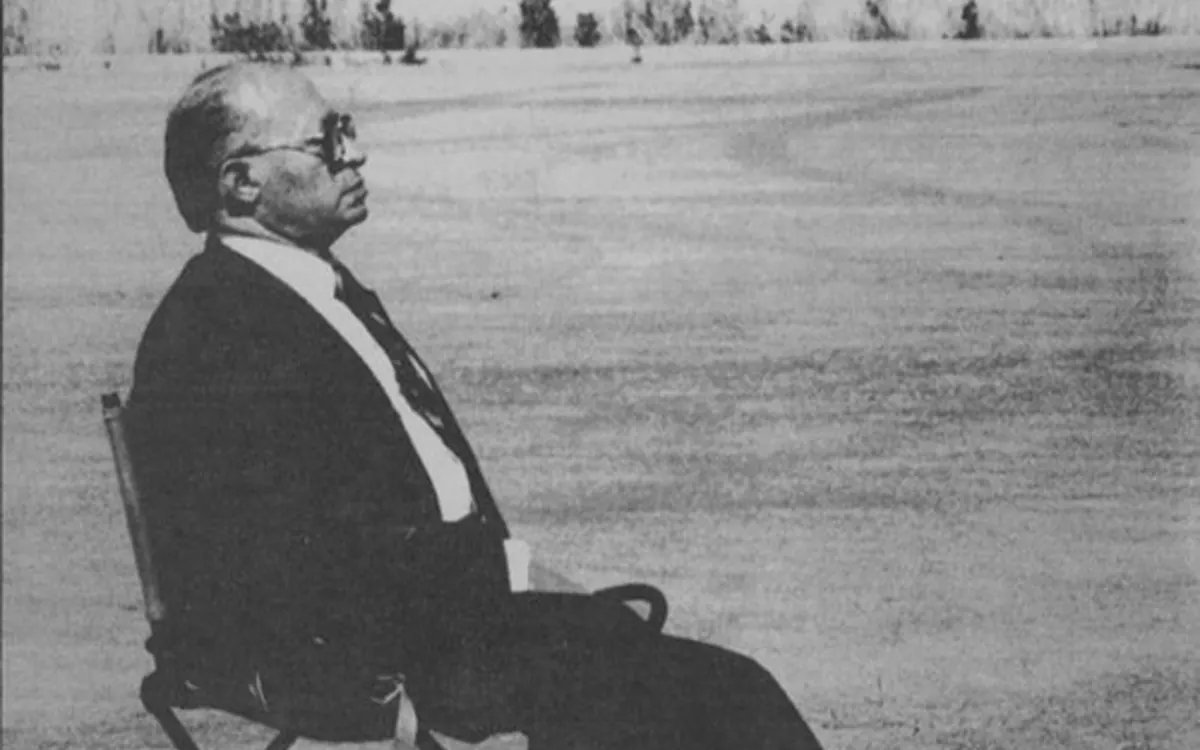
Menachem Begin's upheaval victory in the 1977 Israeli elections was the beginning of revolutionary change for the Jewish State, not the end. Some who rejoiced will be bemused, others who were skeptical will be surprised. This episode explores the aftermath of Begin's election as it intersected fault lines within his society and within himself.
Learn about the Vietnam boat people, the path towards the Camp David Accords with Egypt, the assassination attempt on Anwar Sadat and the Gush Emunim,
About this episode
Rav Mike reads Begin's leadership through the frame of inner conflict, since identity on every level is how the pieces are put together. Begin carried powerful contradictions, the horror of the Shoah beside the glory of liberation, a classical liberal's love of personal liberty beside a firm belief in Jewish sovereignty over all the land, a Zionist who cherished the Torah and culture born in exile. One of his first acts in office was to welcome sixty-six Vietnamese boat people rescued at sea by an Israeli ship, and then hundreds more. He cited the St. Louis, the ship of nine hundred Jews turned away from harbor to harbor before the war, and said it was natural to give these refugees a haven in the land of Israel.
That same Holocaust memory would cut in another direction. On the eve of the 1982 invasion of Lebanon, Begin told his cabinet the alternative was Treblinka, and there would be no more Treblinkas. He would come to office as the feared warmonger and sign Israel's first treaty with its largest enemy, managing the conflict of his own dreams, since Sinai might be a worthy sacrifice to hold the heartland of Judah and Shomron. No one was more excited at his victory than the activists of Gush Emunim. Two days after the election Begin came to Elon Moreh and declared there would be many Elon Morehs, renaming the administered territories the mountains of Judah and Shomron, an integral and liberated part of the land of Israel.
Everything looks different from the driver's seat. Gush Emunim proudly handed Begin a plan for twelve settlements in the Shomron, and he lingered on the biblical names of Beit El and Shiloh, promising to raise them with President Carter. His cabinet committee recognized Elon Moreh, Ofra, and Ma'alei Adumim. But Carter was an idealist with a near-messianic vision of comprehensive peace, firmly opposed to settlement, and the meeting was not all roses. Begin told the Knesset that American Jews could visit Hebron and Shiloh, so a Jewish government could hardly bar a Jew from building a home there, while insisting that Jewish settlement did no harm to the Arabs of the land, a classic expression of the Zionist faith that Jews bring only good.
As weeks passed with no action on the twelve-point plan, the activists heard only wait. Then Begin summoned Hanan Porat and explained he was under enormous pressure, courting Yadin's DMC, and could not move without cabinet support. He urged Porat to settle clandestinely, so he could later claim they got the better of him, since no one would believe that Menachem Begin would drive Jews off Jewish land. Porat was stunned and refused, saying Gush Emunim wanted state settlements and would no longer act like thieves in the night. Meanwhile the Mizrahi activist Yamin Suissa raised the tent of Ohel Moreh, echoing Elon Moreh to protest that shekels for Ashkenazi settlements came at the expense of starving children in the poor neighborhoods where Begin's own voters lived.
Change was coming on an international scale. Egypt's President Sadat needed peace to feed a population he could not employ, and his economic opening had collapsed into deadly bread riots. Begin's choice of Moshe Dayan as foreign minister, a hawk who held no mystical attachment to Sinai, intrigued Sadat and hinted at a trade, the Sinai for a free hand in Judah and Shomron. The path opened through small events. When the Mossad uncovered a Libyan plot to assassinate Sadat, Begin shared the warning through King Hassan of Morocco, warming the atmosphere with genuine gratitude. On November 9, 1977, Sadat told his assembly he was ready to go to the Knesset itself, and two days later Begin answered on Egyptian radio, closing in the spirit of their common faith in God with a single word, shalom.
Key ideas
- Rav Mike reads Begin through inner conflict, the Shoah beside liberation, liberty beside sovereignty, Zionist beside lover of exile's Torah.
- Begin welcomed the Vietnamese boat people, citing the St. Louis turned away before the war.
- He promised many Elon Morehs and renamed the territories the liberated mountains of Judah and Shomron.
- From the driver's seat Begin stalled Gush Emunim's twelve-point plan and even urged them to settle clandestinely.
- Yamin Suissa's Ohel Moreh protest warned that settlement shekels came at the cost of the Mizrahi poor.
- Small events opened the road to Sadat, from the Libyan plot through Morocco to the offer to come to Jerusalem.
Chapters
- 0:00 Identity as how the pieces fit
- 2:11 Reading Begin through inner conflict
- 4:25 Welcoming the Vietnamese boat people
- 6:44 From the St. Louis to Treblinka
- 7:48 The terrorist who signs a treaty
- 8:55 Gush Emunim's elation
- 11:05 Presenting the twelve-settlement plan
- 13:21 Meeting Carter; Hebron and Shiloh
- 15:31 We will not dispossess the Arabs
- 17:46 Begin urges clandestine settlement
- 19:58 The tent of Ohel Moreh
- 23:23 Carter's dream of Geneva
- 25:30 Sadat's skepticism and hunger
- 27:49 The World Bank and the bread riots
- 33:30 The Libyan plot against Sadat
- 36:45 Sadat offers to go to Jerusalem
Who, where and when
People
Menachem Begin, Jimmy Carter, Moshe Dayan, Hanan Porat, Yamin Suissa, Anwar Sadat, King Hassan II of Morocco, Zev Jabotinsky
Places
Elon Moreh and Ofra, Ma'alei Adumim, The Sinai, Judah and Shomron, Morocco and Egypt
Texts
The Geneva Convention, UN Resolution 242, Begin's Knesset address
When
June 1977 CE: the Vietnamese boat people, 1977 CE: the meeting with Carter, November 1977 CE: Sadat offers to come to Jerusalem
Read the transcript
When the individual remains undivided, said Carl Jung, and does not become conscious of their inner opposite, the world must perforce act out the conflict. Well, I always try to keep one eye inwards, and yet nonetheless, the world seems to be quite divided. I'm Rav Mike Foyer, and this is The Jewish Story. Season 5, Episode 10 1977 Upheaval Part 2 The Aftershocks You know, one of the fundamental challenges of life is how we put together all the aspects of ourselves I know it in my own life I see it regularly in my counseling practice and it all but screams to me in what I look at of the world through media and events around me. On some level, I could really say that that's what identity is, be it personal, national, or as a species.
Identity is how the pieces are put together. And I find, both in study and practice, that if we focus on how the conflicts between the pieces of self are managed, It can prove quite illuminating on all three of those levels of organizations. And if done rightly, it offers an action plan toward deeper integration and therefore healing. And that's what I'm after. Now think about what my life looks like on the personal level. When I try to balance conflicting aspects of myself, I'm introverted and yet I feel a deep need for connection. How I hold that emotionally. And what behaviors it comes to express. The structures I build in my life are a lot about who I am. Or a society. What does it look like when it tries to reconcile beliefs?
For instance, that God is good while the world is broken and filled with suffering. What's its social fabric look like? Its religion? Its philosophy? What do they teach? How do we act as people? And of course, how does a nation go about its existence when it aspires to both sovereignty and liberty? What are the laws and modes of government? What does it actually look like on the street when these two somewhat contradictory ideas come into the world together? So since the Jewish story is always after that question of how consciousness emerged in its historical context, and personally, I have a mission of healing my people through narrative therapy for a nation, I think it's worthwhile to look at Menachem Begin personally, together with the era of his national leadership, through this frame of the conflicting elements of inner existence.
because Begin himself carried some fairly powerful contradictions on the personal level. His beliefs and experiences as well created a lot of dissonance. I mean, he lived both the debilitating horror of the Shoah together with the empowering glory of the war for liberation. He was a liberal in the classical sense, deeply committed to the value of personal liberty. It's a term that's much misused today. while at the same time a firm believer in the right and necessity of Jewish sovereignty over all the land of Israel. Begin was a Zionist who saw the rebirth of Am Yisrael in Eretz Israel as the expression of Jewish national existence, and yet a Jew that deeply cherished the traditions of Torah and culture which emerged from the exile.
And those are just a taste of his contradictions on the personal level. With the 1977 upheaval, Menachem Begin took the helm of a ship of state which itself didn't lack for conflict, be it internal or external, in terms of the inner divisions. Bacon's actually been at the heart of them since before the state was born, and in the five years before he resigns, the conflicts between the aspects of himself will intersect with the conflicts between the aspects of Israeli society and Jews with the world in powerful and problematic ways. Ben-Gurion and his political inheritors built the body of the state for 30 years, shaping and shaped by the narrative of Am Yisrael in their day, And Begin and his heirs will do exactly the same.
That's on some level what it means to lead a people. But they don't get to do so from the ground up. And I think this is why Begin will spend so much of his energy and vision on the questions that reside at the fault lines within his own selfhood and for his people. For instance, did you know that one of the first things Menachem Begin did after taking office was welcome Vietnamese refugees into Israel? After 1975, the communists took over our country. They put myself in jail, my family, and all of the members worked with the Republic of Vietnam regime, I mean the Tew regime. We escaped from our country by boat, so we are called boat people. On June 10th of 77, weeks after he was elected, an Israeli cargo ship en route to Japan came upon a boat full of 66 Vietnamese refugees.
They were part of the so-called boat people fleeing the 1975 communist takeover of their country. And they were in desperate straits, out of food and water, adrift, leaking. Their SOS signals had been ignored by passing ships of several other nations. but the Israeli captain immediately not only offered them food and water, he took them on board for transport to Israel. These were the first of what proved to be approximately 360 boat people who found permanent refuge in Israel. And on granting them permission, Menachem Begin cited the Jewish experience, of course, in Europe. He said, We have never forgotten the boat with 900 Jews, the St. Louis, having left Germany in the last weeks before the Second World War, traveling from harbor to harbor, from country to country, crying out for refuge, they were refused.
Therefore, it was natural to give these people a haven in the land of Israel. The government, and especially the Prime Minister Ben-Hembegin, to give us a homeland, while the other country was still reluctant to take us, when we left our country, to flee from the barbaric regime of communism. Now, that's his Holocaust experience, driving Menachem Begin to what I see to be moral heights. But the inner conflicts of how one relates to refugees, and how that passes through the lens of the Holocaust, will be central to Begin's entire leadership. And the state and the story which he leaves behind will continue to carry his imprint. I mean, just compare the anecdote I gave you with Begin's words to his cabinet on the eve of the invasion of Lebanon in 1982, a conflict which we'll discuss, but for now you just need to know, was deeply bound up with the question of Arab refugees.
He said, the alternative to this invasion is Treblinka, and we have decided there will be no more Treblinkas. Now that's a theme that we'll explore in coming episodes, but for now, hear the inner and the outer as they intersect. Begin, of course, is also going to play a crucial role in how Israeli society manages the tension between its vision of peace and its need for security. He will come to office as the terrorist warmonger, feared by peace-loving folk at home and abroad, who actually signs Israel's first treaty with its largest enemy. Now, that's more than just a change in attitude. Begin is himself managing the conflict of his dreams. The Sinai will appear a worthy sacrifice if it offers hopes of holding on to the heartland of Judah and Shomron.
But of course, there are a goodly number of Arabs in that heartland, many of whom he sees as the enemy. And that will place Begin, once again, personally and nationally, at the crux of another struggle between his belief in territorial integrity and his commitment to civil liberty. And this conflict over the central mountains of Israel won't just be between Jews and Arabs, of course, or it won't even be an internal struggle between Begin's liberal heart and his historic vision. It will become a Jew versus Jew struggle on the ground as well, which you already know. Because when Begin takes office in the upheaval, outside of his own party, perhaps no one was more excited than the activists of Gush Emunim.
The Rabin government had both thwarted and supported Gush Emunim, but now they hope that Menachem Begin, inheritor of Zeb Jabotinsky's vision of greater Israel, was going to throw the door wide open to their aspirations. And it was a reasonable hope. Two days after his election, Begin came to Elon Moray, the settlement whose story we told back in episode 5, and to the cheers of all assembled declared, there will be many Elon Morez. And I'm sure he meant it. And perhaps most significantly, in that moment, he introduced a shift in how the government would refer to what had been known as the West Bank. These were no longer administered territories of the West Bank. They were to be recognized as the mountains of Judah and Shomron, the Jewish heartland.
All occupied territories, if you mean Judea, Samaria, and the Gaza Strip, They are liberated territory. They are part, an integral part of the land of Israel. But you know what? Everything looks different once you're in the driver's seat. By 1979, less than two years later, Begin would not only be building settlements at the same time he would be calling Gush Emunim a group of quote liars afflicted by a messiah complex in the press So we have much to learn about how Begin himself negotiated the conflicts within his heart and how he steered the Israeli ship of state between the conflicts within his society and how those two intersect. These are in many ways the aftershocks of the upheaval. The election of 1977 left the activists of Gush Emunim positively elated.
The National Religious Party came out of elections with a record 12 seats in Knesset, profiting from what was really an essentially false public perception that they had flexed their muscles in support of the struggle over Sebastia. They may have been capitalizing on someone else's success, but nonetheless, the NRP was now the fourth largest party in Knesset, sure to play a key role in forming Begin's government and shaping its policies, a strong political voice for Gush Emunin's social and ideological base, if not an active supporter of settlement. The Likud numbers were also somewhat buoyed by this new settlement movement. Some of its leaders even stumped for Likud, eager to give Begin a chance to fulfill their vision on a governmental scale.
And no matter who they voted for, A week after the earthquake, Gush Emunim leader and Rav of the new Jewish community of Hevron, Rav Moshe Levenger, was telling his fellows, let Menachem Begin be responsible for settlement. We've done our part. Now we need to work with the government. As appealing as it may have sounded, it wasn't obvious to all involved that a national spiritual revolution would take to an institutional approach. They weren't sure government was the way to fill their dream of a million Jews living in Israel's heartland. Nonetheless, it did seem foolish not to try. And so even before Begin's cabinet was formally presented to Knesset, the leaders of Gushu Munim proudly presented to him a detailed plan for settling 12 core towns in the Shomron Mountains.
Begin was excited, and as he looked over the list, he paused particularly on Beit El and Shiloh. I will bring these names up with President Carter, he said, referring to his upcoming first trip to the White House that was due in a few weeks. These are biblical names, said Begin, and there's no way we won't be allowed to settle there. Now, I can imagine that his phrase, won't be allowed, grated on the ears of the Gushemunian activists. But still, the thought of the Prime Minister presenting their plan to the President of the United States was a big step from the muddy battles around the Sebastian train station. And indeed, when Begin returned from Washington, the situation looked promising. One of the first things he did was have his Cabinet Settlement Committee officially recognize the settlements of Elan Moray, Ofra, and my humble home, Ma'alei Adumim.
His meeting with Carter had not been all love and roses. Gone was the piecemeal pragmatism that had been fostered by Henry Kissinger. The new president was an idealist, and he had an almost messianic approach to a comprehensive peace in the Middle East. Therefore, Carter was amongst those who looked more than a little bit askant at Begin's victory, thinking that the disciple of Jabotinsky was likely to take a hard line on all questions of territorial compromise. And furthermore, President Carter firmly opposed Begin's commitment to settle Jews in Yudah and Shomron. As the Prime Minister said in his address to the Knesset following the trip, True, we were requested not to establish settlements. But we explained our position with absolute clarity.
Namely, there are in the United States places called Hevron, Shiloh, Beit El, Beit Lechem, and the like. These names manifest the proud connection of the American people with the Bible. Let us imagine that all citizens of America could come to these places with the exception of one category of American citizens, the Jewish citizens. There would be an outcry all over the United States, and justly so over this discrimination against the Jews. Therefore, we ask, is it conceivable that a Jewish government shall prevent a Jew in this country, in Eretz Yisrael, acquiring land or building its home in the original Beit Lechem, in Hevron, in Shiloh? The Prime Minister also reported to the Knesset that he had rejected out of hand Secretary of State Cyrus Vance's assertion that establishing settlements was contrary to international law, and it rather asserted to him the inalienable right of Jews to live in Eretz Yisrael.
Begin followed these bold words with profound expression of one of those inner conflicts, personal and societal, that I named in my introduction. He said, The Geneva Convention of 1949 was designed to protect the civilian population in occupied areas. I must say, first of all, that Jewish settlement does not in any way, under any circumstances, do harm to the Arabs of Eretz Israel. We have not dispossessed and will not dispossess any Arab from this land. Really? It was a classic expression of the Zionist belief that Jews bring only good to this region. And the spiritual mentor of Gush Emunim, Rav Tzu Yehuda, was well known for teaching his students that there was a fight for national sovereignty happening here, not over private property.
Nonetheless, governments act in ways and have tools of sovereignty which individuals lack. And national policies are notoriously often found to step on the toes of residents and citizens. In the aftermath of Begin's address, at least immediately so, it seemed to the activists of Gushmanin that their dreams had come true. But as the weeks passed, and no action was taken on their 12-point plan, doubt began to settle. The responses they received when they reached out to the Prime Minister's office were, Wait. Wait until Begin comes back from Washington. Wait until Motion Dayan returns. Wait, wait, wait, wait, wait. And the feeling began to grow that, whatever his bold words before the Knesset, in Washington, Begin had promised to bring a halt to settlement in Yehuda and Shomron.
And then, late in the summer, one evening, Gush Emunim leader Hanan Porat received a surprise summons to meet with the Prime Minister at his home. And as they sat together, Begin explained to Porat that he was under enormous pressure, both international and domestic, which among other things meant that he could not move forward on the 12 settlement plan without government approval. Furthermore, in Begin's eyes, it was deeply doubtful that he would receive the support of his own cabinet on this matter. That's in part because at the moment, the prime minister was actively courting Yigali Adin's democratic movement for change that we spoke about last episode. Bottom line, the current coalition was barely more than 67 seats, and that gave Begin very little leeway for political maneuvering.
If he could add the DMC's 15 seats, he'd have a lot more breathing room. Of course, Begin didn't mention Nechran Perat that it was the increase in settlement building that was the primary obstacle to Yadin entering the government. He simply made it clear that without solid domestic support, there was no way, even as Prime Minister, he could face up under international pressure. But there was another way to get what they wanted. Do it clandestinely, Begin urged Perat. Then, after the fact, it will be easy for me to say, they got the better of me. After all, no one would imagine that I, Menachem Begin, would drive Jews off of Jewish land. Hanan Perat was stunned. Secret action might have seemed like an elegant solution to a difficult problem in the Prime Minister's eyes, but he told Begin that Gush Emunim was no longer interested in acting like thieves in the night.
We want not Gush Emunim settlements, but State of Israel settlements, he protested. The way you are telling us to act will not reflect to the government's credit. for Begin the ideology of greater Israel had run smack into the reality of sovereign politics he could no longer afford to declare his ideals from the opposition now he was responsible either to act on them or violate them and his attempt to dance at two weddings to show a happy political face to the world while maintaining a secret ideological purity behind their back seemed to Hanan Perat a failed approach to reconciling the conflict that existed not only within Begin's heart, but within Israeli society as well. Nonetheless, he thanked the Prime Minister and left.
Now, before I wrap this section up, I want to mention one more social fault line that underlay Begin's support for the settlements. It's not going to tremble for another few decades, actually, but the first little tremors came immediately after the upheaval. And maybe we'll find time. In a coming episode to discuss the economic situation that Begin inherited and whether he succeeded or failed in management, for now, in order to understand this fault line, you just need to know that things had gone from bad to worse. And of course, new economic hardship falls most heavily on those who were already disadvantaged. Weeks after Begin took office, Mizrahi activist and Israeli Black Panther Yamin Suisa organized a tent protest.
He got the people out on the streets to raise awareness about the plight of Israel's urban poor, and he called his protest O'Hel Moray, the tent of Moray, consciously echoing the name of the flagship settlement, Elon Moray, for two reasons. The first was that Suisse had seen in real time just how effective Gush Amunim's activism was. He watched as these knitted, kippa-wearing idealists caught the imagination of the entire nation and brought out thousands, not just into the streets, but into the muddy hills. As he told the press in one interview, When all is said and done if you take a look at our protests and their protests you really have to salute them They consistent They follow their beliefs And where there belief people succeed They always win And there was another reason the tent was called oil more, a little bit less positive.
Suiza and his fellow activists weren't just calling attention to the suffering of the poor. They were challenging a specific government policy that they saw developing in Begin's cabinet. how much money was going to go to building the many Elon Mores that Begin had promised. I mean, there are only so many shekels in the budget. And the Oel Mores protests claimed that those going to build houses for Ashkenazim in the Shomron came directly at the expense of starving Mizrahi children in Israel's poor neighborhoods. Neighborhoods, by the way, where Begin's core constituency lived, lest we forget. Charlie Bitton, also a Panther activist, turned member of Knesset in the latest iteration of the Israeli Communist Party known as Hadash, put it this way.
I also want to address the party known as Gachal. That was Begin's party that sat at the core of Likud, which gets all its votes from the Mizrahi community. What are you doing to get all those votes? You focus on Hevron, on not returning the territories. What about the people who support you? What about them? Today, the left might resonate to those themes. But in its time, the Oemore protests fell flat without so much fanfare or even really much notice. The Mizrahi voters, whom they tried to represent, were focused elsewhere. They were focused on the entree that Begin gave them into national politics, not to mention the redeeming aspects to their communal pride we spoke about. And they frankly simply weren't so interested in Elan Moray one way or another.
And so that split in society over the socioeconomic cost of settlement will have to wait to closer to our day. Meanwhile, Prime Minister Begin will continue to fight his inner battle between the vision of greater Israel and the realities of national leadership. And we'll have to speak in the next episode perhaps about how the activists of Gush Emunim responded to the report that Hanan brought back from his meeting. How will they reconcile loyalty to the state with loyalty to the land? But for right now, there are larger forces at play, of which no one in this story is yet aware. Change is coming on an international scale. And when it does, the task of reconciling conflicts, personal, social, and societal, will become even more complex.
For many observers, the election of Menachem Begin spelled the end of hope for peace in the Middle East, and perhaps for none more than the incoming administration of American President Jimmy Carter. Carter's dream was to reconvene the Geneva Conference, that failed effort that had been defunct since December 1973. He wanted to pick up the momentum of specifically international diplomacy and bring all parties together, including the PLO, under American, Soviet, and UN sponsorship. When the president had floated this notion to Yitzhak Rabin in his visit in March of 1977, he'd received a chilly reply, in particular regarding the participation of the PLO. Begin's victory only lowered the temperature.
And on his trip to Washington, he made Israel's position quite clear. Any participant in an international conference would have to commit themselves to UN Resolutions 242 and 338, which in Begin's eyes meant the mutual recognition of each nation's right to live in peace and security, something which the PLO would never do. In turn, President Carter pointed out that Begin's insistence on excluding the West Bank from negotiations with the Arabs ran contrary to the principle of negotiations without preconditions that was embodied in 242. A State Department spokesman made that position clear three weeks before the Prime Minister arrived in Washington. He said, within the terms of Resolution 242, Israel clearly should withdraw from occupied territories.
We consider that this resolution means withdrawal on all three fronts in the Middle East dispute, Sinai, Golan, West Bank, and Gaza, with the exact borders and security regiments being agreed in the negotiations. He went on to say, These negotiations must start without any preconditions from any sides. This means no territories, including the West Bank, are automatically excluded from the items to be negotiated. This strikes us as contradictory to the principles of negotiating without precondition, nor does it conform to the spirit of Resolution 242, which forms the framework for these negotiations. Or as we say, touche. It was the beginning of a rocky relationship between the Prime Minister and the President, and it might have spelled the end of hope for a negotiated settlement altogether if it weren't for the fact that they were not the only actors in this little drama.
Egyptian President Anmur Sadat had also initially greeted Begin's victory with profound skepticism, let's call it. It wasn't Begin's violent past as a terrorist that gave Sadat pause. I mean, after all, he himself had not only been a revolutionary today, but a Nazi supporter in his youth. What worried Sadat was what appeared to be Begin's hardline territorial stance in the present. and the Egyptian president had more at stake in pushing a political process forward than perhaps any other leader in the Middle East. His victorious crossing of the Suez in 73 had restored Egyptian honor in the eyes of his citizens and he'd managed to capitalize on it to gain American political patronage. That patronage had led, as you know from previous episodes, to Kissinger's shuttle diplomacy and the disengagement of forces grievance signed with Rabin, which saw Israel cede the bulk of the Sinai already to Egyptian control.
But this political progress could not solve Sadat's fundamental domestic problem. His population was increasing at a rate which he simply couldn't feed, much less put to work. In April of 1974, Sadat presented what he called the October Working Paper. It described his vision of Egypt's future, and at its core was a new economic policy which was known as infida. And if somebody's listening that actually speaks Arabic, you can correct me at my email, robmycornergmail.com. However you say it, it was a spectacular failure. Soviet purchases of Egyptian wheat were over once they'd come over into the American camp. And American subsidies were essentially welfare on an international scale, not all that affected.
What Egypt needed was foreign investment. They needed to build up long-term agricultural and industrial projects, and that could only be done with massive capital. And that required the type of stability that only a real peace could offer. In late 1976, Sadat turned to the World Bank for loans, often the kiss of death for dictators and their economies. It's not the time to go into it right now, but I can tell you, two years of grad school studying international development has taught me much skepticism toward the IMF, the World Bank, and their impact on our economies. But I digress. What you need to know is that the bank sets strict conditions on government spending in return for any loan it makes.
And in its eyes, there's nothing worse than governmental subsidies. And so, in hopes of securing the investment funds he so desperately needed, in January of 1977, President Sadat announced the end of any government subsidies on flour, rice, and cooking oil, as well as the cancellation of bonuses and pay increases in the public sector. The results were predictable. Egyptians took to the streets in rage. Anti-government demonstrations shouting slogans like, Hero of the Crossing, where is our breakfast? And Thieves of the Intfita. the people are famished when the police moved in to suppress the crowds it became a riot in the end 800 were killed and thousands wounded and Sadat was forced to restore both the subsidies and the pay increases that he cut so like I said he was having a bad year already when Begin was elected and he needed to make a deal things started to look up a bit when Begin announced his choice of foreign minister To the great surprise of observers, both foreign and domestic, he appointed former general Moshe Dayan.
Now, Dayan was not part of the Likud camp. He'd run on the labor slate in the election. Nonetheless, throughout the process, he'd been wavering between the two camps, with the issue in question being the status of Yudah and Shomron, the West Bank. Now, recall that as defense minister, Dayan had been the architect of the civil administration in these conquered territories. His policy of open bridges, as it was called, set the mold for their socioeconomic but not political integration into Israel. And therefore, he was quite upset by the Labor Party's stated readiness to give away the West Bank in a peace settlement. But he also considered the Likud's demand for asserting formal Israeli sovereignty over the entire area as too extreme to be effective.
And so it was that he wavered. And then after being elected on the labor slate, Dayan declared himself an independent, and with the promise of a cabinet post, defected into Begin's camp, becoming, by the way, overnight, one of the more hated men in the Knesset. In general, as foreign minister, Dayan brought a weight of international status to Begin's cabinet, which was sorely lacking. And specifically on the Egyptian front, the choice intrigued Anwar Sadat. Dayan may have been the most prominent hawk in the labor camp, but when he was in Likud, he looked positively middle of the road. Furthermore, as an advocate of continued Israeli control over the mountain Heartland he was intimidating but Dayan was also known as an arch who attached no mystical significance to the Sinai whatsoever In fact the Egyptian president knew well that even between 67 and 73, Dayan had been the lone voice in the labor government opposing holding on to the Suez.
He made quiet but real overtures to Egypt about trading and withdrawal from the canal for their commitment to non-belligerency. Obviously those had come to naught, but now that Begin had chosen Dayan as chief negotiator, there was a hope that a different type of exchange might be worked out. The Sinai in return for a free Israeli hand in Yudah and Shomron. The Likud government was not slow in making its intentions known. In late August of 77, Prime Minister Begin made a four-day visit to Romania, where he held talks with President Nikolai Ceausescu. Ceausescu is a fast fascinating character who you should look into on your own. For now, just know he was making a play for international visibility. He wanted to be a leader of the so-called non-aligned movement.
And in pursuit of this, he'd made it known that he was ready, willing, and able to play broker for any potential Middle East settlement. So it was that along with meeting with Ceausescu, the Romanian president arranged for Begin in Bucharest a meeting with Said Meri, representative of the Egyptian National Assembly. Begin expressed to both men his willingness to offer what he called extensive satisfaction to Egypt regarding the question of Sinai, and even perhaps to negotiate on some form of autonomy for the Arabs of the West Bank and Gaza. The message was conveyed to Sadat, and Moshe Dayan was instructed upon Begin's return to formulate what he imagined to be a draft Israeli-Egyptian peace treaty.
It turned out to be a 46-point document and was quickly sent to U.S. Secretary of State Cyrus Vance, who then shared it with President Carter. It was then passed on by these men to Sadat, together with a personal letter from Carter, urging the Egyptian leader to test Begin's sincerity. Carter wanted Sadat to do so by Sadat agreeing to an immediate revival of the Geneva Conference. Basically, he wanted to call Begin's bluff. You want to make peace? Come to Geneva. Now, unwittingly, Carter couldn't have struck a more sour note if he'd tried. Sadat had seen firsthand at Geneva the failure of diplomacy, how the Soviets, together with the Arab rejectionist front, had made a mockery of the entire process. It was only by excluding Moscow, and by the way, his fellow Arab leaders, and putting Egypt's fate in the hands of Henry Kissinger, that Sadat had made the gains in Sinai, which had already been achieved, and now Carter was issuing joint communiques with the Kremlin about reviving that failed effort?
All this momentum, the economic pressure, the promise of Dayan, the potential for a deal involving the Sinai and Israeli rule in Yudan Shemron may have actually come to naught if it weren't for the nature of history, in which small events have that insane opportunity to make, or at least cause, real change. In May of 1977, the director of the Mossad, Israel's external security force, General Yitzhak Kofi, uncovered the details of a Libyan plot to assassinate Egyptian President Anwar Sadat. Now, relations between Libya and Egypt had been spiraling downward for a couple of years, as the Libyan dictator Muammar Gaddafi strove to pull Egypt away from its new relationship with the Americans and from its non-belligerent posture toward Israel, which it entailed.
Now, Gaddafi, despairing of traditional diplomacy, had assembled a hit team to take a more direct approach to the problem. But unfortunately for the Libyan leader, the trained Palestinian assassins he chose had long been under the Mossad's scrutiny. Gizal Kofi informed new Prime Minister Menachem Begin of the plot, and Begin in turn suggested an incredibly bold idea, that they share the details of the plot with the Egyptian president, saying, this may warm the atmosphere between us. Now the natural avenue for such communication was Morocco, whose King Hassan was a great admirer of the Jews, had always taken pride in protecting his Jewish minority, and, perhaps most importantly, had clandestinely accepted Israel's help when fighting Algerian-backed guerrillas in Western Sahara not so long ago.
For a few years, Hassan had harbored the hope of bringing Egypt and Israel together in a non-radical alliance that could help offset his own enemies. And as early as 1975, he had in secret hosted Prime Minister Yitzhak Rabin when he was seeking the king's assistance in brokering a conference with Sadat. Then it was premature. But now, just a few years later, it appeared that time was right. In June of 77, King Hassan arranged a meeting between Mossad Director Hothi and the head of Egyptian military intelligence, General Kamal Hassan Ali. Ali was stunned by what the Israeli revealed to him. Not just its details, but the very fact that he was doing it all. And he moved swiftly to follow up on the information he received.
The result was a total liquidation of the assassination plot, meaning they all died, as well as four days of border fighting between Libya and Egypt, and an atmosphere of genuine gratitude in Cairo. Sadat sent word through Morocco that he was prepared to hear a serious Israeli proposal. And so on September 16th, Foreign Minister Moshe Dayan met in Fez with Egyptian Deputy Prime Minister Hassan Tuhami. Now, no agreement was reached, but the offer on the table basically amounted to return of the whole Sinai in return for the peace treaty. But just remember, there's many a slip twixt the cup and the lip. Even with such momentum, an agreement could have easily not been derailed, but never taken off. I mean, what about the status of the Israeli settlements in the northeastern Sinai along what's known as the Rafiak salient, the border with Gaza?
Or her crucial air bases along the Gulf of Akba all the way down to Sharm el-Sheikh? And of course, there's the Palestinian question. It may not have been personally so close to Sadat's heart, but he wasn't so foolish as to allow it to be ignored. And yet, here we are when another beauty of history enters. As Sadat later wrote, It was then that I drew, almost unconsciously, on the inner strength that I had developed in Cell 54 when he was imprisoned under the British. A strength, call it a talent or a capacity, for change. So it was that in the course of a speech to the Egyptian People's Assembly on November 9th, President Sadat announced that he was ready to go to the ends of the earth, to Jerusalem itself, in order to pursue peace.
I state in all seriousness that I am prepared to go to the end of the world, and Israel will be surprised to hear me tell you that I am ready to go to their home, to the Knesset itself, to argue with them, in order to prevent one Egyptian soldier from being wounded. Members of the People's Assembly, we have no time to waste. Now, Menachem Begin had also suffered under British colonial rule, and he had a courage and capacity for change no less than Sadat's. So it was that only two days later, Begin replied not only to Sadat, but to the entire Egyptian people via a radio broadcast made in English. Ever conscious of the significance of history in general, and particularly conscious of how important it was that there be a grasp of the Jewish story, without which you couldn't possibly hope to understand the rebirth of the modern state of Israel, Begin began with a historical review.
But at the end, he spoke from the heart. We, the Israelis, stretch out our hand to you. It is not, as you know, a weak hand, but we do not want any clashes with you. Your president said two days ago that he's ready to come to Jerusalem to our parliament, the Knesset, in order to prevent one Egyptian soldier from being wounded. It is a good statement. I've already welcomed it, and it will be a pleasure to welcome and receive your president. And I, for my part, will of course be ready to come to your capital, Cairo, for the same purpose. No more wars. Peace. A real peace and forever. It is in the Holy Koran, in Surah 5, that our right to this land was stated and sanctified. May I read it to you, this eternal surah?
Recall when Moses said to his people, O my people, remember the goodness of Allah towards you when he appointed prophets amongst you. O my people, enter the Holy Land, which Allah hath written down as yours. It is in this spirit of our common belief in God, ended Begin, in divine providence, in right injustice. It is in this human spirit that I say to you with all my heart, Shalom. no more war no more bloodshed the road to peace will prove quite long I mean in many ways we're still on it now but you know if we say that the journey of a thousand miles begins with one step well then I'd say the reconciliation of two people can start with a single word I want to thank some folks before I sign off I want to thank all the folks who give their hard-earned money to make this show happen to keep it free and widely available I want to invite you to join them right now go to my website jewishstory.co in the upper right hand corner you'll see a button that says be a patron you can click on that to give a little bit per podcast support or if you want to make a one time donation you can do it via PayPal my email is rovmikefoyer at gmail.com or send me a message there on email on Facebook at rovmikefoyer I'm happy to share with you the details of how you can dedicate a show I also want to thank the Land of Israel Network that's thelandofisrael.com building a center for global transcendence in the heart of Judea I want to thank the Pardex Institute, pardes.org.il, for throwing the doors of the Beit Midrash open as wide as possible.
And I want to thank you for listening. I'm Rav Mike Foyer, and this is The Jewish Story.
More from Season 5

TJS S5 Interlude: Empires come, empires go
Many people look at the world today and feel the foundations of American power shaking - and most are afraid. Here is an episode about empires, made in...
Play Episode
TJS S5E9 The Upheaval Election of Menachem Begin in 1977
There are few events in the history of Israel's democracy which have had a greater impact than the elections of 1977. When all the votes were counted three...
Play Episode
TJS S5E11 - The Camp David Accords
The domestic political upheaval of the Menachem Begin victory in 1977 was followed quickly by an international earthquake in 1978 when Israel and Egypt agree to make peace....
Play Episode