
TJS S5E11 - The Camp David Accords
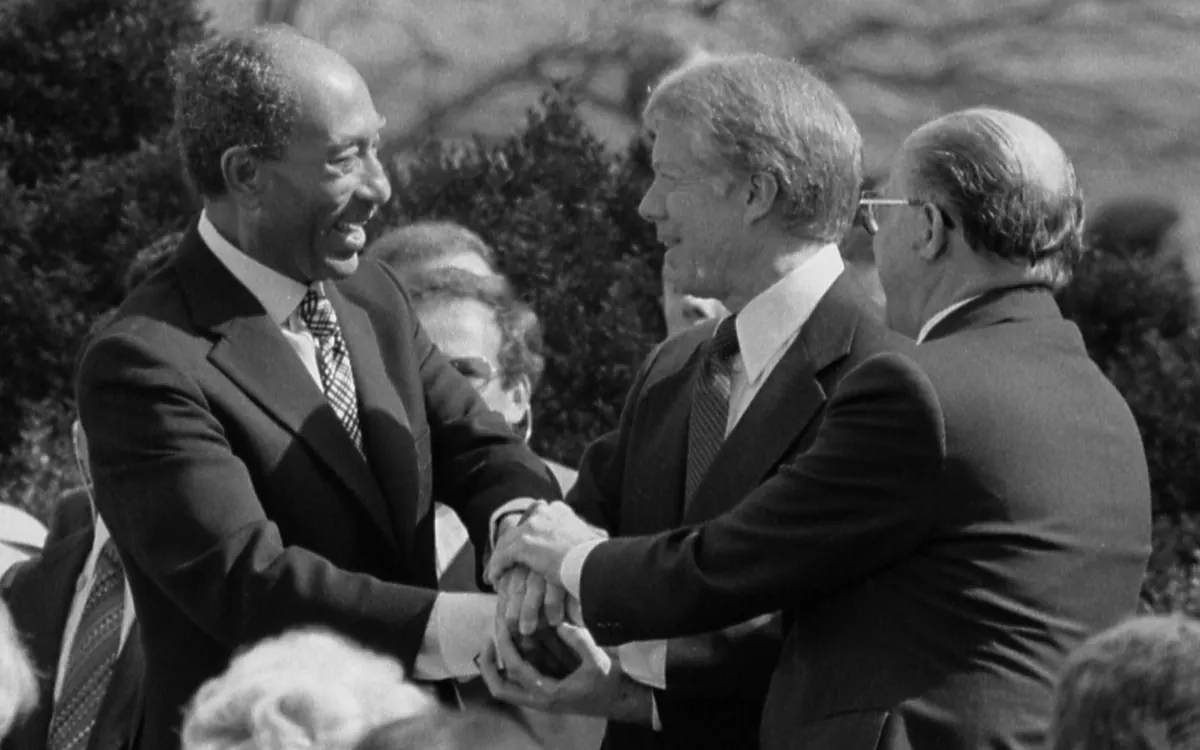
The domestic political upheaval of the Menachem Begin victory in 1977 was followed quickly by an international earthquake in 1978 when Israel and Egypt agree to make peace. Here is the story of how shifts within two societies, and two leaders, led to the signing of the Camp David Accords. Learn about the tension Egyptian president Anwar Sadat felt in his crumbling economy, the involvement of United States President Jimmy Carter, the reaction of the international media and the fear of what territorial compromise would mean for the Jewish settlers of the Sinai Peninsula.
About this episode
Much of Israel's story has been shaped by the experience of siege, an unbroken wall of enemies, held in place by a powerful inner narrative. Rav Mike notes the fine line between a story shaping who we are and who we are requiring the story to stay true. The siege perspective built solidarity and bold action through the re-entry phase, yet not every foe was implacable, and some might have become partners, as the Abraham Accords now show. Being the people that dwells alone, we learned to fight alone and feel good about it, since never again also meant never relying on anyone. Yet the one whose only tool is a hammer sees every problem as a nail, and that story began to crack months after Begin took office.
Moshe Dayan, the archetypal soldier-citizen who once eulogized Roy Rothenberg with a call to live armed behind the furrow of the border, became an architect of the first peace. When Sadat announced on November 9, 1977 that he would come even to Jerusalem, Israel answered with jubilation, skepticism, confusion, and raw fear. Chief of Staff Motta Gur publicly warned that the visit might be a trap masking preparations for war, and Yigael Yadin wanted a reserve division mobilized. Rav Mike hears in it the Torah's double language for Jacob returning to meet Esau, afraid and distressed, afraid to be unarmed, and distressed that an armed posture might itself provoke the war he feared. The stories in our head can create facts on the ground.
On November 19, 1977, an Egyptian Boeing landed at Ben-Gurion Airport, cannons booming, the IDF band playing an anthem learned from Egyptian radio. Sadat greeted old battlefield enemies and kissed Golda Meir's cheek. Israelis danced in the streets and lined the road to Jerusalem, while shockwaves rattled the Arab world. The next morning Sadat addressed the Knesset, calling for a life where every lost life, Israeli or Arab, is a human life, and laying out four conditions, full return to the 1967 lines, Palestinian independence, security for all, and an end to belligerency. Begin answered with his eternal theme, that the bond between the people and the land was created at the dawn of history and never severed, and that they would negotiate as equals, with no victors and no vanquished.
Sadat had expected his grand gesture to be met with a withdrawal, and received a lecture on Jewish history instead. The process bogged down fast, since Begin the lawyer knew the devil was in the details, and his careful pace struck Sadat and Carter as foot-dragging. Carter brought both men to Camp David for twelve days that Begin called a concentration camp deluxe. When Carter pressed Begin to divide Jerusalem, Begin told the story of Rav Amnon of Mainz, who asked that his tongue be cut out for merely implying doubt of his commitment, making clear he would sooner lose his tongue than discuss dividing the city. Carter called him a psycho, while Secretary Vance called him one of the finest poker players he had ever seen.
The American plan offered much, an end to war and the boycott, normalization, demilitarized Sinai watched by American technicians, and five years before the final status of Palestinian autonomy. It also demanded bitter pills, the inadmissibility of acquiring territory by war on all fronts and recognition of Palestinian rights. In the end Dayan and Weizmann pressed Begin, Weizmann saying he would go tell the Sinai settlers to leave himself, and Sharon's phone call sealed it. The accords were signed on September 17, 1978. At home Begin faced black umbrellas and shouts of Munich, and Gush Emunim set up a protest settlement at Rujeb even as he signed. With a heavy heart and head held high, he brought it to the Knesset, which approved after a seventeen-hour marathon.
Key ideas
- Israel's siege story built solidarity and bold action, yet held some foes as enemies who might have become partners.
- Dayan the soldier-citizen became an architect of the first peace, while Motta Gur warned the visit might be a trap.
- Rav Mike hears Jacob's double fear, afraid to be unarmed and distressed that arming might provoke the war itself.
- Sadat flew to Jerusalem and offered four conditions, and Begin answered with the eternal bond of people and land.
- At Camp David Begin played poker over every detail, sooner losing his tongue than dividing Jerusalem.
- The accords were signed in 1978, and Begin faced shouts of Munich and Gush Emunim's protest at Rujeb.
Chapters
- 0:00 The siege story and its hold
- 2:20 The biggest enemy declares peace
- 5:34 The people that dwells alone
- 6:37 Dayan the soldier turned peacemaker
- 11:00 Motta Gur warns of deception
- 13:08 Jacob afraid and distressed
- 15:15 Sadat lands at Ben-Gurion
- 19:41 Sadat's address to the Knesset
- 22:01 Four conditions for peace
- 23:03 Begin's eternal bond to the land
- 26:12 A lecture instead of a withdrawal
- 28:17 Carter's invitation to Camp David
- 32:34 The American plan
- 34:48 Jerusalem and Rav Amnon
- 37:00 Dayan and Weizmann press Begin
- 42:20 A heavy heart, head held high
Who, where and when
People
Anwar Sadat, Menachem Begin, Jimmy Carter, Moshe Dayan, Motta Gur, Golda Meir, Ezer Weizmann, Cyrus Vance, Ariel Sharon
Places
Jerusalem, Ben-Gurion Airport, Camp David, The Sinai, Rujeb
Texts
Sadat's Knesset address, UN Resolution 242, The Unetaneh Tokef prayer
When
November 9, 1977 CE: Sadat's offer, November 19, 1977 CE: Sadat lands at Ben-Gurion, September 1978 CE: the Camp David Accords signed
Read the transcript
A leader, said Napoleon Bonaparte, is a dealer in hope. Well, I don't know if anybody's following after me, but I do try to deal out that precious commodity as often as possible. I'm Rav Mike Foyer, and this is The Jewish Story. Season 5, Episode 11, The Camp David Accords you know when I look at it it appears to me that much of the story of the Israeli state has been shaped by the experience of being surrounded by an unbroken mass of enemies and that's just the story of the state that says nothing of the character of its citizens now there's much truth to the reality of the siege experience since well before independence there have been no lack of implacable foes bent on our destruction But a close look at life in the land since the arrival of Zionism also shows that this sense of total siege is held up by a powerful internal narrative.
And that gives me pause, because there's a fine line between the truth of a story shaping who we are, and who we are requiring that that story be true. The siege perspective has certainly helped tackle the problems of the re-entry phase of Am Yisrael into the land. The level of solidarity it generates, the focus demanded by the experience of constant threat, and the capacity for bold action, which is evoked by the feeling your back is against the wall, have all been critical to rerouting Am Yisrael in Eretz Yisrael. But that truth doesn't also deny the reality that not all our foes are implacably opposed to our existence, and perhaps some never were. Some of Israel's enemies had understandable opposition to our national rebirth, even though I'm not sorry for it.
And others might have actually become potential partners along the way if things had played out otherwise. I mean, witness the once inconceivable reality of today's Abraham Accords, and look back at the Sinai Accords with Egypt that we need to speak about today. The Gulf states were faceless enemies to me growing up, even though I lived in Cleveland, and now my native-born Israeli kids are hocking me to take them to Dubai. To the average Israeli, at the beginning of 1977, the states surrounding them were an unbroken wall of Arab enemies. And before the year was over, the leader of Egypt, biggest and baddest enemy of them all, would be declaring from the Knesset plenum, peace and the mercy of God Almighty upon you.
And may peace be for us all, God willing. Peace for us all on the Arab land and in Israel as well, as in every part of this big world. Now, I know that neither of these accords were a simple victory, nor is the world they created an intrinsically better place. I mean, you could easily question whether the interest-driven friendship of a quasi-monarchical state where a fraction of citizens rule an army of service workers is an expression of peace in every part of this big world. But it does beat pointless conflict. I mean, why were we at war with the UAE to begin with? And we might question the wisdom of the retreat from the Sinai Peninsula and whether it will bring Am Yisrael closer to its redemptive mission.
But it, too, was better than war. No matter how you judge, please note that each of these accords involved a shift in attitude from both sides. The birth of a new narrative, if you will. Now, rather than the Jews being a usurper of Arab lands, we're all children of Avraham. And in the 70s, though, the shift was harder to define. And that's what really interests me when we look at the Camp David Accords and everything which comes after it. In the next few episodes, we're going to have to understand how it happened politically, economically, socially in order to tell its story. Like I said, though, I really want to understand how our stories about ourselves shifted in response to these events and how its changing nature in itself helped shape them.
Is peace possible? What does life look like beyond survival? And who are we when we're not in conflict? What's our mission? These are the questions that I would like to see really drive our story. No matter how powerful leaders can be, peace is never really top down. And no matter how sophisticated the story we tell, if it doesn't express some subtle social shift, then the new narrative will never take hold. Of course, there is a chicken and egg debate to be had here. what comes first, the new story or new behaviors. Well, I can say from my counseling experience that a new narrative remains a useless fairy tale at best if it isn't embodied in meaningful actions. And I can also say that action unguided by an inspiring narrative is hopelessly limited in its scope and efficacy.
In terms of changing the narrative and behavior of nations, it seems to me that once a new story is available, those sort of amorphous shifts and changes in society gain focus and clarity and thus power. And that the new story must emerge from those very vague shifts and changes if it's going to make anything real in the world. And so, as I said, much of the story of the first three decades of the Israeli state was one of siege and well-deserved. It's a story, by the way, which is hardly new to the Jews. I mean, we became the people that dwells alone back when Balaam labeled us as such on the way in to conquer the land from the Canaanites. and we served as outcasts in multiple civilizations over the last 2,000 years of exile.
As a benefit, added cross-current, the Zionist iteration welded the siege story together with the rebirth of Israelite military tradition. Here in Israel, not only do we dwell alone, we fight alone, and we feel good about that. Because never again also means never again having to rely on anyone to protect me. But, just as a man whose only tool is a hammer sees every problem as a nail, so too one whose only story is of siege sees all their neighbors as enemies. That's the story, and the reality which supports it, which began to crack only months after Menachem Begin took office, and the march toward peace with Egypt began. Now, I find it fascinating that Moshe Dayan, who was the archetypical soldier-citizen determined to thrive in life under siege, was one of the prime architects of Israel's first attempt to make a peace treaty.
Now, way back in Season 3, Episode 15, we heard then Chief of Staff Dayan give a eulogy for Roy Rothenberg, a young man murdered in 1956 while standing guard over the village of Nahal Oz near the Gaza Strip. In many ways, his words were the ultimate expression of this foundational story. Beyond the furrow of the border, he said, a sea of hatred and desire for revenge is swelling, awaiting the day when serenity will dull our path, for the day when we heed the ambassadors of malevolent hypocrisy who call upon us to lay down our arms. Roy's blood, he says, is crying out to us, and not only to us, from his torn body, although we have sworn a thousandfold that our blood shall not flow in vain. Yesterday again we were tempted, we listened, we believed.
We will make our reckoning with ourselves today, says Dayan, We're a generation that settles the land, and without the steel helmet and the cannon's maw, we will not be able to plant a tree and build a home. This, he says, is the fate of our generation. This is our life's choice, to be prepared and armed, strong and determined, lest the sword be stricken from our fist and our lives cut down. Now that's pretty clear. And I can't help but wonder if Moshe Dayan thought of Roy and so many other men and women he knew, when a little more than 20 years later, as foreign minister, he responded to a question in a press conference about the unfolding process with Egypt. He said, I meant what I said, that this time, perhaps, I hope so, we shall really arrive at true negotiations for peace agreements, peace treaties, perhaps in this I'm not sure of with all the Arab states.
And we must decide our last-ditch attitudes, so we shall not fail or frustrate the negotiations for peace, which I believe are close at hand, at least with Egypt. Now, another reporter called out to Mr. Dayan a personal question. Do you think you may change any of your conceptions from the near past? Essentially, the question was meant specifically to clarify Dayan's well-known stance about controlling all of Yehuda and Shomron. But he took it as part of a larger query. He said, I once said that Sharm el-Sheikh without a peace is preferable to peace without Sharm el-Sheikh. But I was also one of those involved after the Six-Day War in our proposal to return Sinai and the Golan Heights. He says then each period has its considerations.
So the question is, what will be the alternative proposals to the present situation? Meaning, how can we imagine that things might be otherwise? And what's the risk if we refuse to, if we're not able to tell a new tale? Egyptian President Anwar Sadat's November 9, 1977 declaration of his willingness to come quote, even to Jerusalem in search of peace, was greeted by an explosive cocktail of emotions in Israel. Jubilant excitement, profound skepticism, much confusion, and believe it or not, raw fear. That fear came in two forms, as far as I can tell. One which is spoken about, and one that I'm supposing. There was the trauma of 1973, and the fear of facing our national identity outside of a context of unbroken conflict.
The first was a reflection of Israel's collective experience of surprise in the Yom Kippur War, felt, of course, most acutely by her military and political leadership. Four days before Sadat's plane was due to touch down in Tel Aviv, Chief of Staff Mottagur gave an interview to the Israeli daily Yidiot Ahronot. Now, Gur spoke without the approval or even prior knowledge of the defense minister, and once he did, many feared his words would cause Sadat to change his mind, and perhaps some hoped they would. Gore opened by warning of multiple signs that indicated Egypt's readiness for war, signs that only he, as the Ramat Khal, the chief of staff, could truly appreciate. And when he mentioned that there were exercises being performed by the Egyptian army the very ruse they used in the lead to 73 many people listening were quite ready to believe what was his primary fear that Sadat visit was actually a trap.
The Egyptian president, he said, should realize that if what he has in mind is another deception, like that on the eve of Yom Kippur War, his intentions are quite clear to us. We know that the Egyptian army is at the height of preparations for a war in Israel to be launched in 1978, in spite of President Sadat's declaration that he is prepared to come to Israel. Gore added that, like all Israelis, he would rejoice if the Egyptian president were to come to Israel with the sincere aim of a peace treaty. However, reliable information is reaching us, pointing to the very opposite intention, he said. The Israeli and international public should be careful not to get carried away with too much enthusiasm, in the wake of which will come bitter disappointment or perhaps something even worse.
That last grim note included fantastic fears, fears as dark as the idea of Sadat's jet door flying open to a plane full of commandos on a suicide mission bent on wiping out Israel's leadership assembled to greet him. Unless you think that these were lone fantastic fears, even if they did come from the chief of staff, remember that almost every single person in a role of significant military and even political leadership at this point lives daily with a heavy trauma of the Yom Kippur War. Deputy Prime Minister and Acting Defense Minister Yigali Adin shared Gaur's fear that Sadat's visit was somehow a trick. And he suggested to the Prime Minister that at the very least they needed to mobilize a reserve division in readiness for his arrival.
It's not an insane perspective, but nor is it an entirely healthy one. and it risked pouring a bucket of ice water on Sadat's bold risk. His willingness to speak about speaking with Israel, to offer to make peace in the Knesset itself, would ultimately cost him his life. Even announcing the idea had been dangerous. You know, my dad used to love the joke that a healthy dose of paranoia can add years to your life. But we also have to remember that fear has the power to rob us of real opportunities as well. and sometimes when our story is a fearful story it can create a reality which we do not want or one that confirms the identity which we need to cling to this dilemma between what ultimately means the meeting of Sadat and Dagon puts me in mind of another fateful meaning not long past in our weekly readings it's that when Yaakov is coming back to the land of Israel 20 years after deceiving his brother Esau and stealing his birthright Yaakov is understandably a little bit nervous about this reunion.
And as the Torah says, He was very afraid and it disturbed him. It's a double language which everyone has to explain. Neorchai Mechodesh has a fantastic insight about why Yaakov was both afraid and disturbed. He says, Yaakov was afraid not to prepare himself for war in the event that Esau planned to kill him while he was unarmed. Meaning it's logical. and it was not entirely unreasonable for Muttagur to stand up and say listen, the Egyptians fooled us once shame on them. Fool's twice would be shame on us. However, the Orchaiim goes on and he says, on the other hand, it distressed him. The Yetzelot. What distressed him? That the very fact that their encounter would be an armed one might precipitate a war which Esau had not really intended until he saw Jacob armed.
What does he mean? Jacob is afraid to die so he has to defend himself. But he's also distressed by the fact that a defensive posture might evoke the violence from Esau, which he feared. The stories in our head can create facts on the ground. And that is an important idea to contemplate. It's something I work a lot with people on in my counseling. Thought to ponder, but fortunately for our story, perhaps, Sadat didn't let Gur's fear affect him. And on Saturday evening, November 19th, 1977, An Egyptian air force, Boeing 707, landed at Ben-Gurion Airport for the first time. Cannons boomed in salute as the Egyptian president descended from the plane where he was greeted by Prime Minister Begin and President Ephraim Katsir.
They escorted him past an honor guard made up from all the branches of the Israeli Amr services, and toward the end of the line, Sadat, dressed in civilian clothes, actually turned to salute them. And as he reached the row of waiting dignitaries, The IDF military band struck up the Egyptian national anthem. Now, the scramble to figure out what exactly the protocol would be when receiving a leader of a nation with whom Israel was actually still at war had been quite intense. Despite a desperate request to the American ambassador in Cairo for sheet music, the band had had to resort to Egyptian radio to learn their anthem. Nonetheless, it was all smiles as Sadat greeted old enemies from the battlefield as he worked his way down the line, Moshe Dayan.
Yitzhak Rabin and Ariel Sharon, he and former Prime Minister Golda Meir, exchanged a few words, after which the Egyptian president stooped and kissed her cheek. Sadat's journey began only ten days after he'd offered in Parliament to travel anywhere for Middle East peace. His motive was to break the current deadlocked situation. Sadat needs peace and stability to rebuild Egypt's economy, crippled by military spending. So when Israeli Premier Menachem Begin sent a formal invitation, Sadat accepted. But first he flew to Damascus to explain his motives to Syria's President Assad. He assured Assad that Egypt sought no separate peace with Israel. Security throughout the country was higher than it had ever been.
And there was no question that the whole world was watching. An unprecedented 2,500 journalists had poured into Israel for the occasion. And now whatever lay ahead, the moment of Sadat's arrival had already changed many things. There was a whole generation of Egyptians who had grown up knowing Israel as an illegitimate, temporary Zionist entity, watching as their president humanized the faceless enemy in a dramatic and personal fashion. And Israelis fairly danced in the streets. they lined the path along which Sadat's motorcade traveled up to Jerusalem just to get a glimpse. Egyptian flags were everywhere. Meanwhile, shockwaves rattled the Arab world, and not just in the rejectionist state, and the international community simply stared in disbelief.
During the visit of President Sadat to our country and to Jerusalem, a momentous agreement was achieved already. namely no more war, no more bloodshed, no more attacks and collaboration in order to avoid any event which may lead to such tragic developments. When I addressed directly the Egyptian people, I said, let us give a silent oath one to another. No more war, no more bloodshed, no more threats. May I say that that mutual pledge was given in Jerusalem. And we are very grateful to President Sadat that he said so from the platform of the Knesset, personally to me, and today also to my colleagues in Parliament, both the supporters and the opponents of the government of the day. From the airport, the President and the Prime Minister were taken to the King David Hotel for their first conversation.
In the eyes of many, it proved to be the most important meeting they would have until the ultimate signing of the Accords at Camp David. Certainly, by all accounts, it was their most cordial get-together. No substantive issues were raised, which is perhaps why they got along. But when Begin suggested that whatever may happen between them, that they agree to solve the problem between Egypt and Israel by peaceful means, Sadat replied, yes, this is what we will do. And so they emerged from the meeting smiling and repeating the same phrase to the assembled press, no more war, no more war. And with all the difficulties and disagreements that lay ahead, and no matter what you may think of the treaty ultimately signed, that consensus has held to this day.
The next morning, Sadat gave his famous address to the Knesset. I come to you today on solid ground, to shape a new life, to establish peace. We on this land, we all on the land of God, Muslims, Christians and Jews worship God and no one but God. He went on to speak of the surprise and even opposition which he had received toward his decision to come to Jerusalem, noting that utter suspicion and absolute lack of confidence between the Arab states and the Palestinian people on the one hand and Israel on the other still surges in us all. This is going to be a long process. We agree upon the principle, upon security. We agree. But the meaning of security, we differ on it. I think we can reach an agreement.
Let us hope that what I have said already today in the Knesset, Let us hope that the two slogans that I want everyone to say is, let us have no war after October, and let us agree upon security. I think those are the main issues. But, he noted he had come as the leader of the Arab world, quote, to exhaust all and every means in a bid to save my Egyptian Arab people and the entire Arab nation the horrors of a new, shocking, and destructive war. In place of hatred and division, Sadat wanted to offer a new story, a picture of what might emerge in the Middle East, one which recognized any life lost in war is a human life, irrespective of its being that of an Israeli or an Arab. That a wife who becomes a widow is a human being entitled to a happy family life.
Innocent children deprived of the care and compassion of their parents are ours, be they living on Arab or Israeli land, they command our top responsibility, today and tomorrow. Now there was much more, both in substance and style, to what Sadat had to say. And not all of it was well received by Begin and his government. Because in the midst of his speech, the Egyptian president laid out four essential conditions which he saw for peace. Israel's complete return to the 67 lines, independence for the Palestinians, the right for all to live in peace and security, and the end of belligerency throughout the Middle East The speech is easily accessible and highly worth reading You can send me an email robmikefoyer at gmail and I happy to share a link if you don want to Google it Begin, of course, was no less elegant nor less firm in his reply.
Let us live together, he declared, in this land, and together advance toward a life of freedom and happiness. Our Arab neighbors do not reject the land which is outstretched to you in peace. And, as always, Begin had at least one eye on history. Ever appreciative of the power of our story, he wasn't about to miss a chance like this when the eyes of the entire world were watching. He needed to make a few things clear. Mr. Speaker, he said, addressing the head of the Knesset, it's my duty today to tell our guests and all the nations who are watching us and listening to our words about the bond between our people and this land. The president, meaning Sadat, mentioned the Balfour Declaration. No, sir, said Dagon.
We took no foreign land. We returned to our homeland. The bond between our people and this land is eternal. It was created at the dawn of human history and was never severed. In this land, we established our civilization. Here our prophets spoke. Here the kings of Judah and Israel prostrated themselves. Here we became a nation. Here we established our kingdom, and when we were exiled from our country by the force that was exercised against us, even when we were far away, we did not forget this land. we long for it. We have believed in our return to it ever since the day. These words are spoken. When the Lord brought back the captivity of Zion, we were like those who dream. Then our mouth was filled with laughter and our tongue with joyful shouting.
And of course, the Holocaust was ever-present for Begin as well. That morning, before his arrival at the Knesset, Sadat had been taken first to pray at the Al-Aqsa Mosque, and then to visit the Church of the Holy Sepulchre, and then on a tour of Yad Vashem, the Israeli National Holocaust Memorial. So Begin said, what happened to us when our homeland was taken from us? I accompanied you this morning, Mr. President, to Yad Vashem. With your own eyes, you saw what the fate of our people was when this homeland was taken from it. The Prime Minister's reply to the Egyptian President struck two essential notes of his character, his integrity and his faith, because he finished by saying, we will conduct the negotiation as equals.
There are no vanquished and there are no victors. All the peoples of this region are equal and we will relate to each other with respect. And then he closed, on this day, with your permission, worthy and learned members of the Knesset, I wish to offer a prayer that the God of our common ancestors will grant us the requisite wisdom of heart in order to overcome the difficulties and obstacles, the calumnies and slanders. With the help of God, may we arrive at the longed for day which all our people pray, the day of peace. For indeed, As the psalmist said, righteousness and peace have kissed, and as the Prophet Zechariah said, love, truth, and peace. I mean, who doesn't love truth and peace? The trick is that the truth tends to shift when viewed from other perspectives, and there are some wildly divergent definitions of peace out there in the world.
When Sadat had visited Romania, shortly after Menachem Bekin, before he came to Israel, Romanian President Nicolai Ceausescu had given him a promise and a warning. Let me state categorically he said that he wants peace. Begin is a hard man to negotiate with, but once he agrees to something, he will implement it to the last dot and comma. You can trust Begin. Now clearly, it was enough of a promise to go on, as in less than a year Sadat was addressing the Knesset. But it was only in the aftermath of his speech that the Egyptian president came to appreciate the warning in Ceausescu's words. Sadat had come to Jerusalem expecting that his grand gesture would be reciprocated, perhaps even by Begin announcing that Israel intended to withdraw to the pre-67 lines.
But he was mistaken. As you heard, instead he received a lecture on Jewish history and nationhood from the prime minister. And remember, Begin wasn't just a statesman, he was a lawyer, which meant he knew well that when it came to negotiation and treaties, the devil is in the details. The process launched by Sadat's visit bogged down very quickly, and even with American mediation, became tense and even antagonistic. Sadat was unprepared for a prolonged give and take over so many details, which Begin considered essential. And so Carter pushed Begin to just accede to Egyptian demands, but thank God the Prime Minister was a rock. The issues on the table were the ones that had determined his entire life, one for which he'd watch friends fight and die.
He wasn't about to abandon them willy-nilly for peace with Egypt, no matter what the pressure or the prize. Begin also faced a complex domestic political situation. I mean, as much as Sadat may have called himself president, Egypt wasn't exactly a democracy. And Carter had just been elected. He was in no vulnerable position. Not so, Menachem Begin. Abroad, people may have been stunned by the idea of Israel's number one terrorist turned peacemaker and happy about it. But at home, many of Begin's closest allies were horrified at the thought that the territorial maximalist might turn traitor. And so he was playing careful chess, a lifelong love. But his pace struck Sadat and Carter simply as foot dragging, and the substance of his objections made them wonder if he really wanted to make a deal.
In fact, at the end of a December 26, 1977 joint summit at Ismailia in Egypt, it came clear that the two sides faced what one pundit called an unbridgeable abyss of misunderstanding and deadlock. Sadat was distressed, wondering if he'd risked his political career and perhaps his life on a mistaken estimation of his enemy. Begin himself was depressed and physically struggling. Not for the first time. He'd been treated for heart issues during the election campaign of 1977, and in May 1978, he collapsed once again and went back to the hospital. President Carter had his own problems. His fear was that the collapse of the current peace talks would send Egypt right back into the orbit of the Soviet Union.
So, in good old American fashion, he decided on a Hail Mary pass, pass and extended an invitation to the two leaders to join him personally on September 5, 1978, for a summit in the secluded mountains of Maryland at the Camp David presidential retreat. And now, Mr. President, we both know that the real prize is peace itself. Carter hoped that away from the press and political domestic attention, the two leaders could focus on the substance rather than on posturing to their public. He also hoped that the intensity of what became a 12-day retreat would allow him to bring maximum personal pressure to bear on making a deal. And so began their almost two-week stay in what Begin eventually came to refer to as a concentration camp deluxe.
On the first night, Carter met with Begin alone, and their conversation set the stage for much of international argument still ongoing today. Despite the fact that Israel and Egypt had come to discuss peace between their individual countries, the American president was focused on pressing Begin on the issue of settlements in Yudah and Shomron. One could easily ask Maad Kesher, what's the connection? To Carter it was clear. He insisted that everything was about UN Resolution 242. It was the only basis for negotiated peace. Begin agreed in theory, but he insisted that the phrase which sat at the heart of 242, at least as far as the Arab War was concerned, declaring the inadmissibility of acquisition of territory by war, didn't apply to a defensive war like the 1967 Six-Day War.
The next day, Carter met with Sadat, who presented a hard-line stance, demanding Israel withdraw to the 67 lines on all fronts, evacuation of all settlements, return of the refugees, compensation for war damage to Egypt, and the establishment of a Palestinian entity. In return, he was willing to offer full diplomatic relations and was open to an arrangement with the Palestinians which was based on autonomy rather than true sovereignty. But still, it didn't look good. When the three leaders had their first meeting together, Carter had warned Begin in advance that the proposal he would hear from Sadat was going to be unacceptable in his eyes. And he asked only that Begin view it as an opening position and not react on the spot.
Now, Begin did succeed in holding his tongue in the moment. But at their next meeting, he announced that the proposal was a recipe for the destruction of Israel and demanded that Sadat take it back. Things kind of went downhill by there. And within a couple days, disagreement between the two leaders and their teams had degenerated to the level of a shouting match. Begin repeatedly attacked the Egyptian proposal. While Sadat in turn declared that Begin didn't want peace, only land, it was clear to Carter that no direct dialogue was possible between the two. And that meant that America would have to lead the way. Which, according to many accounts of the Southern, was exactly what he'd planned to do from the outset.
We've had trouble in recent hours with the Israeli settlements issue on the West Bank. The Egyptians had decided to withdraw their negotiators. I contacted President Sadat last night and said, leave your negotiators in Washington. He sent me word this morning. I'll do what my friend Jimmy Carter asked me. They're going to stay there and negotiate. So Carter met separately with Begin and Sadat once again. From the Egyptian leader, he managed to extract a promise to accept any reasonable proposal made by the Americans, but not so from Begin. However, when Carter promised to show any proposal to Begin first, it dawned on the Israeli team that an agreement Israel reached with the American president in advance would be very difficult for Sadat to refuse.
Furthermore, in a brilliant move, Foreign Minister Moshe Dayan convinced Secretary of State Cyrus Vance that the only way to move forward was to leave the issue of settlement in Yudan Shemron to the end, which he agreed to do. Vance and Carter knew it was going to be next to impossible to change Begin's personal attitude on their own. Their aim was to craft a proposal that would be acceptable to Egypt and which would be sufficiently attractive to most of Begin's team and then let them press for concessions. Now, the American plan, in the end, had much to offer. An end to the state of war between the two countries, commitment to full normalization, secure recognized borders, and a peace treaty within three months.
It also included promises of an end to the Arab boycott, freedom of passage for Israeli ships through the Straits of Tehran and the Suez Canal, and a demilitarization of the Sinai even after it returned to Egyptian hands That last most importantly was to be enforced with early warning stations manned by American technicians thus giving Israel and Begin in particular the most concrete expression of American commitment that they could really ask for. And as for the Palestinian question, which wasn't just the elephant in the room, it was the finger in the eye of the negotiation, in the West Bank and Gaza, the Arab residents would receive full autonomy, not defined, with the IDF withdrawing to certain security locations also not defined.
And only after five years would the final status of the area be determined. Now, this was a far cry from the Palestinian state which Israel feared. And even though no one on the Israeli delegation was happy with it, a lot can happen in five years. After all, it was just short of five years ago that Egypt and Syria had launched the Yom Kippur War and now here they were with Sadat in the hills of Maryland. On the other hand, the American plan had some pretty bitter pills for Begin to swallow. It insisted on that principle of the inadmissibility of acquisition of territory by war, and furthermore, that it applied on all fronts, including the West Bank and the Golan Heights. It also demanded Israel recognize, quote, the legitimate rights of the Palestinian people, and thus their right to determine their future with the representatives of their choice, meaning even the PLO.
It stated that the final status agreement would include Israeli withdrawal to the 1967 lines with minor modifications. Now, the proposal also tried to tackle the problem of Jerusalem, which Carter quickly came to understand was a hill on which Begin was willing to die. When the American president broached the topic of dividing the city once again, Begin refused to even discuss it. Instead, he told Carter a story. It's one you might know about Rav Amnon Amens. The Orzerua reports that at the height of the Crusades in the 11th century, Archbishop of Mainz pressured Rav Amnon to convert to Christianity. Hoping to void the question and offending his sometime friend, Rav Amnon asked the Archbishop for three days to consider his request, promising to return after having done so.
But once he reached home, he was heartbroken that what he had done might even be interpreted as possibly considering what was an unthinkable act. So when he was dragged before the Archbishop three days later, and accused of breaking his pledge to return, Rabbi Amnon didn't defend himself. Rather, he asked that they cut out his tongue, because it had sinned by even implying doubt of his unbreakable commitment to Torah. The Archbishop instead ordered that his hands and feet be cut off in punishment, and he was taken home to die. There, Rabbi Amnon asked to be brought to the synagogue, as it was Rosh Hashanah. And with his last breath, he recited the Unetana Toketh prayer, a prayer that speaks of both the frailty of human life and the awesome power of God.
And then he died. Now, I can imagine that Carter was more than a bit bewildered by this response, as he was by Begin in general. I mean, he got the point that Begin would rather have his tongue cut out than talk about dividing Jerusalem. But he was rapidly losing patience and even regard for the Israeli leader. and he reportedly said later, Begin is a psycho. But Secretary of State Cyrus Vance took another view. Watching Begin take apart the American proposal brick by brick, arguing over substance as well as subtleties of language, and stonewalling the American president to the breaking point, he declared that the Israeli Prime Minister was one of the finest poker players he'd ever seen. But no matter how good a game is, you only get to play the hand you've been given.
And this one is moving toward its end. The American tactic of relying on Begin's team to push him for concessions began to work. Begin tried to stand firm on the issue of keeping Israeli settlements in the Sinai, as well as rejecting the U.S.'s demands on Palestinian autonomy in Udon Shomron. But Moshe Dayan accused him of forcing his own views on the delegation. It's become impossible, said Dayan, to express any views which are different from yours. Begin protested in response, since the war of attrition on the Suez Canal, such a war of attrition is never directed at one man. He felt they were ganging up on him. Defense Minister Ezer Weissman declared that if the settlements in Sinai were what stood between Israel and an agreement, he was in favor of peace, quote, even if the settlements have to go.
If I can reach a peace treaty with Egypt today based on a united Jerusalem, open borders, and diplomatic relations, Sharm el-Sheikh opens Israeli shipping, I'm willing to go to the Rafiach salient myself and tell them to leave. Begin's initial response was, I understand you, and it's not agreed. Only the government and the Knesset will decide. But the Weizmann insisted they call Ariel Sharon to telephone Begin and to give his approval for the evacuation of the settlements in Sinai. Sharon did indeed call Begin, and though there's no record of what exactly he said, in the end, the Prime Minister accepted the American proposal, saying, it will all fall on my head. I will ask Ezer, Ezer Whiteman, to protect me from Geulakon, one of the radicals of his own party.
And you can see in this that Begin, leader of the Jewish state, well understood who was the real challenge ahead. In the end, the Camp David Accords were signed on the evening of September 17th on the White House lawn. I'm fairly confident you've seen the picture. Well, the long days at Camp David are over. But many months of difficult negotiations still lie ahead. I hope that the foresight and the wisdom that have made this session a success will guide these leaders and the leaders of all nations as they continue the progress toward peace. Thank you very much. In essence, there were two agreements involved. The first was a framework for negotiation between Israel and Egypt on a final peace treaty. And the second was a framework for an overall settlement of the Middle East, and specifically a solution to the Palestinian problem, as it was called.
Egypt, America, and Israel could all agree that this was good news. Or at least, they could sign the papers there with a smile. But Begin was the one who had to go home and convince his supporters that what had happened at Camp David was good news for the Jews. Even before Begin returned to Israel public debate on the agreement which he had signed and in particular on the evacuation of the Sinai settlements was well underway. When he stepped from the plane in Tel Aviv the Prime Minister was buoyed by a mass demonstration mostly there in support but he couldn't avoid that there were many brandishing black umbrellas and shouting Munich, essentially accusing Begin of repeating the evil mistakes of Britain's agreement in appeasing Nazi Germany in 1938.
And there could be nothing more painful to Menachem Begin than to be linked to Nazi Germany. Nothing more painful, perhaps, than also the way in which he was castigated by the activists of Gush Emunim. Now, they didn't wait for Begin's plane to land to make their position known. Even as he was signing the Camp David Accords on the White House lawn, The activists of Gush Emunim were setting up a protest settlement at Ljeb, just south of Shechem. When Defense Minister Ezer Weizman was helicoptered out to the site hoping to defuse the situation, he tried joking that he'd expected to be greeted with screams of traitor. The fact that we didn't say it doesn't mean we're not thinking of it, was Yehuda Etzion's angry response.
The situation deteriorated from there, and after a few days of siege, the army ejected the activists. It was the first in the many rounds of struggle to come. The desire for all-out resistance on the behalf of Gush Emunim was, however, tempered by three important words of wisdom offered by their spiritual mentor, The nation isn't with us. Remember, like I said in the beginning, much of the struggle ahead is how the narrative will be crafted. On September 24th, Menachem Begin presented the Camp David Accords to his government. sharing with them his personal struggle particularly in regard to the settlements in Sinai he said with a heavy heart but head held high I made this proposal why is my heart heavy?
because we fought for these settlements in every way possible and in the end we're faced with only one other choice to give up the agreement with Egypt itself I came to the conclusion that it's better this way than to leave the settlers with all the heartache and deep sorrow involved but I believe that in this we are serving the people Israel. And the question was, did his constituents and the country believe so? Many of his former Etzel comrades who had fought with him for liberation and independence were devastated. It took a full seven hours of heated debate to convince his cabinet to sign off on an agreement so it could be brought to Knesset. Three days later, on September 27th, Begin brought the Camp David Accords together with the proposal to evacuate the settlements of Sinai should a peace treaty be achieved, to the Knesset for approval in a single motion.
What followed was a 17-hour marathon, where despite the misgivings he felt, Begin defended his position with typical passion. Speaking of the imperative of peace, the enduring vulnerability of the Jewish people, and how the state of Israel would be perceived if they turned down this deal. Throughout, he was heckled both by the opposition and his own party. Likud member of Knesset Geulakon, whose story we're going to tell in a coming episode, became so angry she had to be removed from the chamber. But in the end, Begin summed up his argument and a roll call was taken. 84 in favor, 17 abstained, and 19, mostly from Begin's own Harut party, voted against. The people has spoken, or as close as you can get in a democracy, but the story is far from over.
I just want to thank a few folks. I want to thank all the folks who give their hard-earned money to make this show possible, keep it free and widely available. I want to call on you to join them now. Go to my website, jewishstory.co and in the upper right-hand corner you'll see a button that says Be a Patron. You can click on that to give a little bit of per-podcast support. Or you can be in touch with me, robmikefoyer at gmail.com. I'm happy to share with you the details on how to give a one-time donation or how to dedicate a show. I want to thank the Land of Israel Network. That's thelandofisrael.com. they're building a center for global transcendence in the heart of Judea. I want to thank the Pardes Institute, pardes.org.il, for throwing the doors of Beit Midrash open as wide as possible.
And I want to thank you for listening. I'm Rav Mike Foyer, and this is The Jewish Story.
More from Season 5
TJS S5E9 The Upheaval Election of Menachem Begin in 1977
There are few events in the history of Israel's democracy which have had a greater impact than the elections of 1977. When all the votes were counted three...
Play Episode
TJS S5E10 Menachem Begin 1977 election aftershocks
Menachem Begin's upheaval victory in the 1977 Israeli elections was the beginning of revolutionary change for the Jewish State, not the end. Some who rejoiced will be bemused,...
Play Episode
TJS S5 Interlude - Don't lose the thread
Is anyone else feeling a little frayed around the edges? Here is an interlude where I give some insight on how to avoid snapping under the pressure of...
Play Episode