
TJS S5E17 - Lebanon War part II
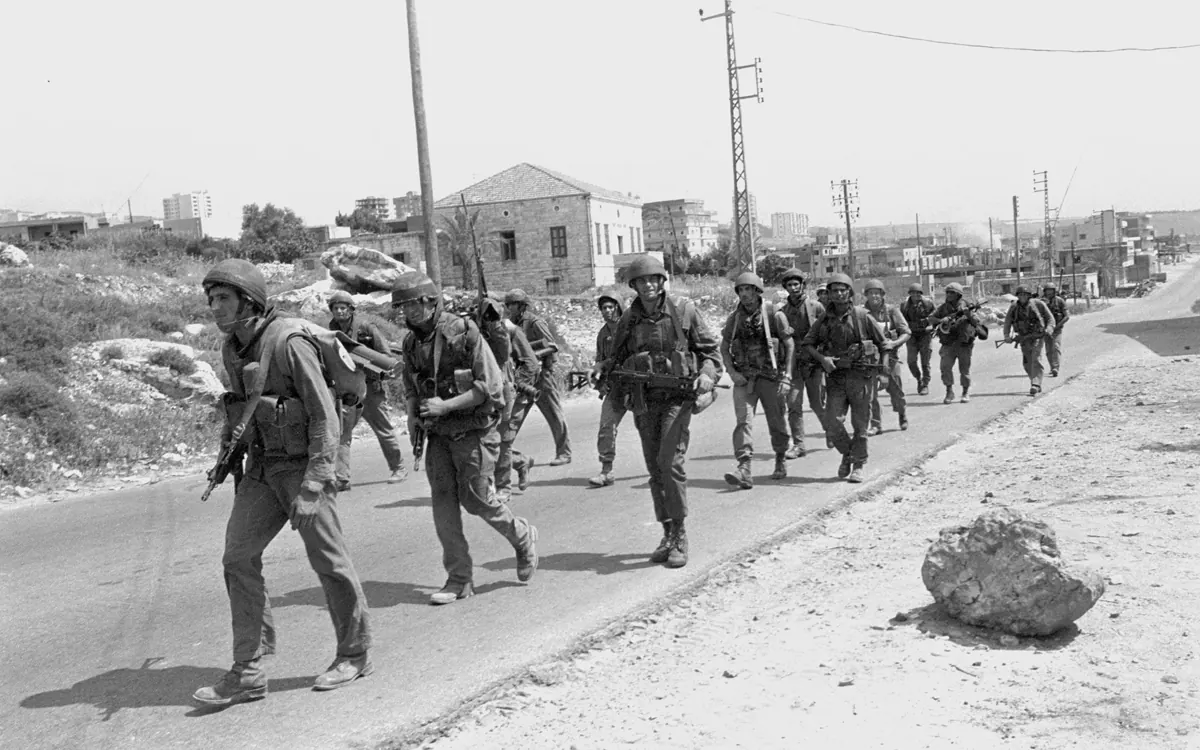
Operation Peace for the Galilee begins with Israeli jets pounding Yasser Arafat's PLO bases in southern Lebanon, but there is always a backstory. In this episode learn about the complicated history Lebanon's civil wars fought between Christians, Moslems and Druze. Meet Ariel Sharon in his new role of Defense Minister, ever the bulldozer and now hoping to stabilize Israel's northern border together with Maronite leader Bachir Gemayel. Hear also how Prime Minister Menachem Begin's personal experience with the Holocaust drove him to support a war of choice for the first time.
About this episode
Insubordination may be evidence of a strong mind, said Napoleon, and Rav Mike turns to the inner world where the big stories really unfold. Begin's pathos, his inability to surface above the waves of memory, clouded his reading of Lebanon, as when he told the cabinet the alternative to invasion was Treblinka. Sharon too had pathos, and a propensity for insubordination in service of a higher good. Rav Mike frames it through the Zohar, the gap between malchut, true kingship that holds reality in a higher and more stable state, and Ana Emloch, the ego's cry I will be king, where we take God off the throne and bow to our own image. What makes the difference is how we define the higher good we claim to serve.
Lebanon takes the cake for tangled national histories, Shia against Sunni against Christian against Druze in endless combinations of war and alliance. The Maronite Christians trace themselves to Saint Maron and claim Phoenician roots, holding apart through geography and marriage within the clan, keeping independence and Aramaic speech through the Muslim conquests. The first civil war of 1860 left the survivors convinced it was self-rule or suffering, and French power carved out an autonomous province tilted toward them. As French strength waned and Arab nationalism rose, they settled for an independent Lebanon under the National Pact of 1943, a binding agreement making the presidency Maronite, the premiership Sunni, the speaker Shia, and the army chief Druze, with a fixed ratio favoring Christians. The problems began at once.
Israel's periphery doctrine drew it toward minorities and non-Arab states, and the Maronites looked like a natural ally, their Phoenician story lending romance to the pragmatism. Fantasies of a Maronite revolt alongside an Israeli invasion were raised and shelved through the fifties. Then Black September pushed another hundred thousand armed Palestinians into Lebanon, and the Third Civil War erupted in 1975, Christians fighting to hold their dominance against a Muslim and Palestinian constellation. The massacre of the Christian town of Damour and the Phalangist massacres in return claimed some hundred twenty thousand lives in two years. Syrian intervention finally separated the factions in 1976, at the price of an occupation force forty thousand strong and a conflict with Israel made ever more likely.
When Begin took office in 1977 he saw the Maronites through the eyes of a survivor, as victims of a genocide perpetrated by the PLO, whom he saw quite literally as the new Nazis. Rabin's policy of helping the Maronites help themselves, which Begin had always backed as a moral duty, slid toward helping them help Israel destroy the PLO. He placed Raful Eitan, who shared his analysis, at the head of the army. Rav Mike dwells on the danger of totalization, the reduction of reality to invasion or Treblinka, a binary that always deserves to be questioned. Begin's experience of the Holocaust worked as a lens on the present rather than a memory of the past, and it bound him to the plight of the Maronites.
Ariel Sharon built his whole life on the belief that no barrier could resist enough force, surviving Latrun, revered as Israel's great field commander, and earning the name bulldozer in Gaza by sending bulldozers through the refugee camps first. As defense minister in 1981 he absorbed the Mossad's rosy vision of a Western, Christian Lebanon and set three goals, crush the PLO, drive out Syria, and install Bashir Gemayel as a Maronite president who would sign a peace. He showed the cabinet Little Pines, a forty-kilometer raid, while keeping Big Pines, the march to Beirut, in his back pocket. Yehoshua Saguy warned of an unavoidable clash with Syria and a quagmire like Vietnam, but momentum won, and after Argov was shot, Operation Peace for the Galilee launched on June 6, 1982.
Key ideas
- Rav Mike reads both leaders through the Zohar, the gap between malchut, true kingship, and Ana Emloch, the ego's cry to be king.
- Lebanon's National Pact of 1943 fixed power by sect, a fragile formula whose problems began at once.
- Israel's periphery doctrine and the Maronites' Phoenician story made them seem a natural, romantic ally.
- The Third Civil War and the Damour massacre claimed some 120,000 lives and drew a Syrian occupation of Lebanon.
- Begin saw the Maronites as victims of a PLO genocide and the PLO as the new Nazis, a totalization worth questioning.
- Sharon set three goals and hid Big Pines, the march to Beirut, behind the forty-kilometer Little Pines he showed the cabinet.
Chapters
- 0:00 Insubordination and the inner world
- 1:06 Begin's pathos; invasion or Treblinka
- 2:09 Malchut and Ana Emloch
- 3:33 Lebanon's tangled sects
- 4:39 The Maronites; Saint Maron and Phoenicia
- 5:45 1860; self-rule or suffering
- 7:56 The National Pact of 1943
- 10:12 The periphery doctrine; a natural ally
- 12:28 Black September; the Third Civil War
- 18:03 Damour and the massacres
- 19:09 The Syrian occupation
- 21:20 Begin and the Maronite genocide
- 22:40 Sharon the bulldozer
- 30:28 The Mossad's vision of Lebanon
- 32:45 Three goals; Little and Big Pines
- 37:16 Saguy's warnings; the war begins
Who, where and when
People
Menachem Begin, Ariel Sharon, Raful Eitan, Bashir Gemayel, Pierre Gemayel, Yehoshua Saguy, Yitzhak Rabin, Yasser Arafat, Fuad Shehab
Places
Mount Lebanon, Beirut, Damour, The Beqa Valley, The Shuf Mountains
Texts
The National Pact of 1943, The Zohar, The Camp David Accords
When
1860 CE: the first Lebanese civil war, 1943 CE: the National Pact, 1975 CE: the Third Civil War, 1976 CE: the Syrian occupation, June 1982 CE: Peace for the Galilee
Read the transcript
In subordination, said Napoleon Bonaparte, may only be evidence of a strong mind. Well, Lord knows, I've never been one to simply follow orders. I'm Rav Mike Feuer, and this is The Jewish Story. Season 5, Episode 17, The Lebanon War, Part 2. You know, the more I learn, be it of the past or people's lives in the present, the more I see that the really big stories in our lives and in our histories more often revolve around our inner experience. The world through which we move can sometimes be nothing more than the topography for what's unfolding inside us, often mild responsive and other times immovable as stone. but nonetheless the context for that inner world. And you know, what was Menachem Begin's pathos if it wasn't an over-immersion in his own story and the story of his people?
An almost inability to surface above the crashing waves of historical and personal memory well enough to get a good view on the present. That, without question, clouded his judgment in relation to the complex situation to his north in Lebanon. I mean, witness his words as he advocated before the cabinet that they take immediate action on the eve of the invasion in June of 1982. As he said, the alternative to the invasion, the alternative is Treblinka, and we have decided there will be no more Treblinkas. And if Begin's obvious pathos casts a bit of doubt on how we view his decision-making up to and through the Lebanon War, Well then, Ariel Sharon's track record of decisions should make us sit up and question his wisdom altogether, and perhaps even his honesty.
Sharon himself didn't lack for personal pathos, but in the case of the Lebanon War, it was his propensity for insubordination in service of the higher good that we're going to need to keep an eye on. Now sometimes, those acts of service were true malchut thinking, a sense of kingship, as the word implies, a willingness to conceive of reality in a higher and more stable state than it is currently found, and the will to make it come to be. At other times, these acts are simply going to be ego-driven moments of Anna Emloch, as the Zohar says, I will be king. Those moments in which we take God off the throne of reality, put ourselves there, and end up bowing to our own image. And of course, so much of what distinguishes between acts of Malchut, those moments of giving real kingship, and the moments of Ana and Loh, when we take the reins in our ego-driven fury, so much that makes the difference between those for Sharon and, frankly, for all of us, is in how we define the higher good we're serving.
And when Sharon and Begin looked north to Lebanon in 1982, Can we really be sure that through all the pathos, through the questions of who will be king and how that will manifest itself in the world, can we be confident that they understood what they saw or how a greater good might possibly come out of it? In a region of complicated national histories, Lebanon takes the cake. Jews against Shia, Shia against Suri, Shia against Sunni, Sunni against Shia, Sunni against Christian, and rinse, wash, repeat, in a mix and match of war and alliance down through the centuries. A complex social fabric, to say the least. And in the coming war, the idea that enemy of my enemy is my friend will reach new heights of significance in Israel's practical decision-making.
That principle holds as true in Lebanon as it does anywhere else, But the problem there is to determine whose friend and whose enemy in any given moment. And in what unfolds, Israel desperately wants to believe the Maronite Christians are their friends. Maronite Christians, if you're unaware, are an ethno-religious group, which trace its roots to the earliest days of Christianity, named for Saint Macron, who came from Antioch to Mount Lebanon with his followers. Some of their Christians say he evangelized the Phoenicians there, and that the Maronites are their descendants. hence the ethno in that ethno-religious grouping. Not Arabs plays a very strong and somewhat messy role in the Maronite story.
In modernity, the Maronites have held themselves separate as an ethnos, mostly through their geographic concentration around Mount Lebanon and through what we call endogamy, that's marrying within the family and clan. They may not appear all that powerful in 2022, but at times they ruled a strong region around Mount Lebanon and the coastline. Strong enough that even the Muslim conquests of the 7th century didn't break their power or erase their culture. They kept a significant political independence for centuries and maintained their native Aramaic speech. The conquest brought Islam in all its facets in the coming centuries to that area around the Lebanese mountain range. And when in the early 11th century the Druze religion went public, as they say, its adherents became yet another ethno-religious group in the mix of what would one day be Lebanon.
Now, in general, Christians and Druze stood as allies facing Muslim political and religious hegemony, fighting to maintain aspects of independence clinging to the mountains and the coast. But Lebanon being what it is, not always. I mean, the Druze did help massacre the Maronites in what's called the first Lebanese civil war of 1860, but no one takes that personally anymore. that war ended what was called the Mount Lebanon Emirate, a mildly autonomous Christian Druze entity, which had stood off and on for centuries. Some estimates say that more than 10,000 Christians died and over 100,000 fled. The slaughter set the tone for many things in the coming century, and in particular, the Christian survivors were left with the conviction that it was self-rule or suffering, a notion that dovetailed quite nicely with French colonial interests in 1860, because French power had in fact ended that war, the Ottomans being too weak to do so on their own, and it now forced the creation of an autonomous Lebanese province, one with a political system heavily tilted toward the Christian majority.
The empire disintegrated during World War I, I'm sure you know the story, and many Maronites were ready to go for broke with an independent state in the Wilsonian excitement post-war. But, like so many others, they were caught in the web of French and British colonial ambition, and rising Arab nationalism, a mix whose story we know so well from the events here in Israel. Over the years, as French colonial power waned and Arab nationalism grew, Maronite leaders were forced to abandon the aspiration for an independent Christian Lebanon and settle for an independent Lebanon altogether. That shift opened the way for what's known as the National Pact of 1943, a not written, but binding agreement, which defines Lebanon as the only multi-confessional state in the region.
In the big picture, the Christians agreed to accept that Lebanon was also an Arab country, and as such, part of the Arab world. They would no longer seek Western intervention on their own behalf, any time things looked dicey. The Muslims, in their turn, abandoned the aspiration to unite with Syria, or to have an Islamic state, depending on which way they leaned. The details of the pact, of course, revolved around the interests of the leadership elite, unsurprisingly, and amount to a highly specific division of power. I want to see if you can say this back to me. The President and Commander-in-Chief of the Armed Forces must always be a Maronite Christian. The Prime Minister must be a Sunni Muslim, Speaker of the Parliament, a Shia Muslim, and his Deputy, that's the Deputy Speaker of the Parliament, a Greek Orthodox Christian.
The chief of staff of the army has to be Druze. God bless the warrior culture. And last, a ratio of six to five must be maintained in favor of Christians to Muslims and Druze. That's Druze plus Muslims versus Christians in the Lebanese parliament. Did you get that? The problems, of course, began at once. First off, many Muslims rejected the pact outright as unrepresentative of its majority population, similar to the reaction of the Arabs of the British Mandate of Palestine. at the exact same time, by the by. Every political group of even mild ideology and aspirations saw the pact not as a binding constitution, but as either a tool to power or a barrier toward it. And of course, just because formal colonialism had gone out of fashion, that didn't mean world powers were finished mucking around in Lebanon.
Post-World War II, we had to add to the classics, Syria, Egypt, and the USSR. are. Intercommunal tensions erupted into a second civil war once again in 1958. That was the year, you may recall, that Nasser's pan-Arabist movement seemed ascendant in the region. The United Arab Republic came into being between Egypt and Syria. Now, many Arabs saw the addition of Lebanon as only natural. Then, once the Jewish state was removed, the Arab world will once again be united across continents as it dreamed to be. Now, as a result, the war was mostly fought between Maronites and Muslims once again. Fortunately for everyone, Druze leader Fuad Shehab managed to keep the Lebanese army in their barracks. The crisis of 58 was actually resolved by a landing of U.S.
Marines in Beirut, the first but certainly not the last time they'll come to the city. And of course, by 1958, the state of Israel was in the Lebanese mix as well. The massive influx of Arab refugees caused by the birth of the state, had thrown the intercommunal mix of Lebanon completely off-kilter in 1948. Now, once the PLO was born in 1964, that will become a more classic military threat to everyone involved. But at this stage, they were simply perceived as a demographic threat, so much so that fantasies of a Maronite revolt in conjunction with an Israeli invasion were raised several times between 1948 and 1950. Ben-Gurion and company were willing to entertain those fantasies coming out of Beirut because they resonated with the periphery doctrine that guided so much of Israel foreign policy in its first decade Israeli leadership felt that survival depended on leapfrogging the Arab confrontation states surrounding her to build economic and political ties with states in the periphery of the region like Iran, Turkey, and Ethiopia.
Now you'll notice that in addition to being non-border states, these are all non-ethnically Arab states. And so, even though technically Lebanon was a border confrontation state, the Maronite leadership was seen as a fellow minority in the Arab world, and thus as a natural ally. The notion that the Maronites descended from Phoenicians and weren't even Arabs lent a romantic note to this pragmatic perspective. And hey, wouldn't it be great if they had a state? Solomon's great ally was Hiram of Tyre, after all. You could probably see where this headed. In the end, invasion at that stage was deemed unwise. And so the government sufficed itself with giving financial support to the Maronite Falange political party in Lebanon's 1951 parliamentary elections.
And in 1958, when the Falange leadership appealed for help, Israel feared Lebanon might become part of Nasser's pan-Arabist takeover of the region, and was quite quick to provide the Maronites with arms. At some point during the fighting, artillery support was even given to their Lebanese army in South Lebanon, and an emergency invasion plan was drawn up, it too was scrapped in the end. But the heat in Lebanon will just keep rising. Recall from back in Season 4 of Episode 11 how in September of 1970, the Jordanian government crushed the PLO mini-state that had taken shape within their territory, killing thousands and sending tens of thousands in flight to Lebanon. That failed Black September uprising placed another nearly 100,000 Sunni Arabs into the mix in southern Lebanon, complete this time with their own armed and blooded guerrilla force.
Now, the Lebanese, truth be told, had already lost control of the refugee camps after clashes with the PLO in 1969. At this point, the PLO's fighting strength had just doubled. We got a little taste of what this meant for Israel with the coastal world massacre of 1978 and the Latani operation ordered in response that we discussed back in the episode on Yamit. But the real scale of disaster for Lebanon, and ultimately Israel, began to unfold a few years before that massacre, with the outbreak of the Third Lebanese Civil War of 1975. As with Menachem Begin, so with us all. Our source of strength is so often a cause of weakness. Fagin's pathos gave him his power, there's no question. It was the lived experience of Jewish history that allowed him to make fateful decisions, gave him the strength to overcome inconceivable challenges, and made his words resonate in a way that could move others to action.
Nonetheless, any experience of the past strong enough to give us all these powers always risks overwhelming the reality of our present. And without looking what is, as it is in the face, to the extent that that's even possible, how can we ever hope to make clear decisions about what might be? And for Menachem Begin, orphan, survivor, lifelong warrior, to save the Jewish people, this problematic inner dynamic always revolved around the memory of the Shoah, of the Holocaust. Now, I mentioned this in the intro in his totalization of the question presented by the PLO threat in Lebanon. Invasion or Treblinka? There's no other options. The horror and confusion of the comparison between the actual threat of Treblinka versus what the PLO mustered in Lebanon put to the side.
Such reduction of reality into binary oppositional truths always deserves to be questioned in our thinking. We call it totalization, and it's almost never a good sign. You've got to unearth the passionate roots, causing you to narrow reality into such a passion. But at this point, the need to save Am Yisrael from the ever-present threat of annihilation wasn't the only pathos operating as Begin looked north. By the time he took office as Prime Minister in 77, when Begin looked at Lebanon, he saw it through the eyes of a survivor of genocide. Lebanon's civil war, third civil war, more properly speaking, whose most brutal phase raged between 75 and 76, should have been a warning to all of Israel's leadership in more ways than one.
Now, I don't pretend to any mastery of such a messy conflict, but for present purposes, the primary struggle was once again waged between Christians and Muslims. Led by the Maronites, the Christians were fighting to preserve their dominance over the political system, threatened by the organic population ships, Syrian intervention, and of course that influx of Palestinian refugees. Pierre Gamayel and his Valange party were the strongest force, joined by a number of other Christian groups at this stage to be a political party meant to have your own militia. Against them stood the Muslim constellation, a mix of nationalists aiming for an Arab Lebanon, pro-Syrian forces driving for a union into greater Syria, Nasserist, pan-Arabist, so-called leftist, and of course, the Palestinians, whose largest force was Yasser Arafat Fatah, the fighting heart of the PLO.
And just for the sake of wholeness in our picture, we have to add the Amal, a Shia group led by a Druze leader fighting to carve out political equality with the Maronites and the Sunni Muslims. But wait, there's more. The Christians were receiving arms from Western European states and Israel, while the Muslims got weapons from the Soviet bloc through Syria. Meanwhile, the Palestinians used a hefty annual stipend from the Arab Gulf states to buy all the arms they could possibly ship along the so-called Arafat route from Damascus to their Fatah land stronghold on the north side of the Hermon Ridge. Are you getting the picture? If not, it's okay. Just know that this third round of intercommutable killing claimed an estimated 120,000 lives in two years and drove an exodus of almost a million Lebanese from the country.
If we were going to go into detail of two years of war, which don't worry, I'm not, you might do it under the title Many Phases, Many Massacres. and as the bloodletting reached new heights, it drove a strengthening of Israel's alliance with the Maronite Christians. From the very outbreak of war, Prime Minister Rabin decided to supply the phalange with military aid as they requested, pursuing a policy he labeled, Helping the Maronites Help Themselves. And they needed it. One of the most horrific episodes of the war was the massacre of the Christian community of Damul. Led by PLO forces, the Muslims killed an estimated 580 Christians in a horror show of rape, mutilation, desecration of graveyard, burning of churches.
Now, I'm not taking sides, because trust me when I tell you that in their quest to gain and maintain power, and get rid of the PLO, the Falangists gave as bad as they got when it came to massacres. I mention them more, because I want you to recall the words of one Christian leader, whose men would take part later in a far better known and more infamous massacre, Sabra and Shetila, that we'll discuss likely next episode. He said the Damur brigades of the Lebanese forces vowed to avenge their fallen townsmen and relatives. They swore not to stop the fighting until all Palestinians were driven out of Lebanon. It's a warning that Israel and everyone else ought to have taken to heart. In October of 1976, Syrian intervention finally managed to separate the warring factions.
A relative calm was reached, which was clearly desirable, but it came at the price of a Syrian occupation force 40,000 strong. Not only was that a big step toward the Syrian goal of swallowing, or if you like, reclaiming Lebanon, the move made a conflict between Israel and Syria increasingly likely. So, what does all this passionate local hatred within Lebanon have to do with Menachem Negan's pathos and the stumbling block it represented to his leadership? First of all, we can ask the simple question, what kind of fool would get involved in a mess like this? More on that when we turn to Ariel Sharon. But the simple answer is that when Begin took office in 1977, he saw the Maronite Christian community as victims of an ongoing genocide, and therefore felt a profound identification with and moral obligation to them to help.
This was a genocide, by the way, being perpetrated primarily by the PLO, an entity that Begin quite literally saw as the new Nazis of the world. I mean, recall the Prime Minister's words to the press after the Coastal Road Massacre, just before he authorized Operation Latame and sent the first Israeli invasion force into Lebanon in the summer of 1978. He said they came to kill Jews. They are Nazis and perpetrated a Nazi deed. Had they been able, they would have destroyed all the Jews in Eretz Israel, but they are not and will not be able. They are determined, but not able to destroy the Jews. For any persecuted Jew, whether he's living in Syria or in the Soviet Union, we care for our brethren, wherever they live, and the country is open to them.
We only pray that it will be possible to give them a haven, because this is the raison d'etre of the Jewish state, to save Jews from persecution. But the Third Civil War showed the PLO was both determined and able when it came to slaughtering Maronite Christians. So how could Begin's traumatic experience of the Holocaust, not a memory of the past, but a lens on the present, not bind him to the plight of the Maronites? And practically speaking, anyway, Israel and the Lebanese Christians are both fighting the PLO. Enemy of Miami is always my friend, right? When the Prime Minister appointed Raful Eitan Chief of Staff in 1978 he placed at the head of the army a man who shared his strategic analysis of the PLO threat in Lebanon Slowly, Rabin's policy of helping the Maronites help themselves, which Begin had always supported wholeheartedly as a moral obligation, became one of helping the Maronites help themselves and help the Israelis to eliminate the PLO.
With future developments in mind, Israeli Defense Minister Ariel Sharon declared on June 16th that Israel will not pull back from its present positions until there is a political settlement to its liking. And that means a political arrangement keeping the Syrians and the PLO permanently out of Lebanon. All that was lacking was a grand vision that could put these pieces of pathos and politics together in a decisive fashion. And when, in 1981, Ariel Sharon finally bulldozed his way into the defense ministry after Likud election victory, there was someone in place who was more than willing to drive things forward. Ariel Sharon's entire life was built on his belief that there was no barrier which he could not push through with greater application of force.
Not only did he grow up as the quintessential political outsider, always pushing his way into whatever was happening, and survive getting gutshot and left for dead at the Battle of Latrun in 1948, he spent his military and political careers ignoring, defying, or plowing over anyone and anything that stood in his way. We saw back in the episode on Yamit that his unstoppable momentum was just as capable of clearing the way to build as it was of knocking down what he himself might have put up with his own hands. Hence, the bulldozer. Sharon had the physical presence, the dynamic personality, and absolute self-assurance to make that nickname both accurate and a source of personal pride. In general, Sharon held a special place in Israel's national psyche by 1982.
He had formerly been known as the go-to man to take matters in hands, especially in the 50s when those things weren't so talked about, and had since been widely revered as Israel's greatest field commander following his performance in 1967. And when Sharon came out of retirement to the head of a tank brigade in the Sinai at the crisis point of the Yom Kippur War, his very presence on the field shifted the momentum of combat for many of his soldiers. That sense of confidence in his own unstoppable momentum will not translate well from the field to the general staff, much less into the cabinet. And, frankly, there are those who question whether Sharon's field record even stands up to his legend. At the very least, moments of audacity, like pushing for the counter-crossing of the Suez in 73, were clearly offset by acts of insubordination so severe that they cost countless lives, like his attack on the Mitla Pass in 56.
Now, Sharon was undoubtedly a hero of Israel's 67 campaign in the Sinai, but like I said, it's far less clear what role he played in 73 in the same place. Despite the public perception that he had saved the country, most of his commanders came away from the Yom Kippur War convinced he'd all but ruined the chain of command. Listen to these words, given at a press conference during the last stages of the fighting, when questions about Sharon's conduct toward his superiors were already roiling the army. He said, when I receive an order, I treat it according to three values. The first, and most important, is the good of the state. The second value is to my subordinates, and the third value is to my obligation to my superiors.
I wouldn't change the priority of these values in any way. Now, another problematic aspect of Ariel Sharon was his shocking willingness to obfuscate an even outright lie in pursuit of his mission, or even in pursuit of his own glory. Back when Sharon was still a junior officer, Ben-Gurion wrote in his diary, an insightful young man, innovative. If he were to smound his weakness of not telling the truth in his reports, he could be an exemplary military leader. With a problematic relationship to the truth and an almost pathological willingness to question or ignore orders, it's a wonder Sharon rose in the ranks at all. But rise he did. Bottom line, he was Israel's ultimate bitzuist, the ultimate doer, the man who can get it done no matter what the personal cost or the price in blood, and people in power want those types around.
Sharon's heroism in the Six-Day War brought him to his peak in the army as GOC of the Southern Command in 1970. It was there that he commanded a sustained operation against terrorism in the Gaza Strip, and many say it was there he earned the nickname of Bulldozer. When his men complained that they were unable to drive jeeps through the narrow alloys of refugee camps like Han Yunus, and thus were vulnerable to ambush and unable to consistently patrol and control the area, Sharon's response was quite simple. Send bulldozers through first. He achieved the goal. He brought calm to Israel and Gaza. But the criticism leveled at his heavy-handed and often bloody tactics pushed Sharon to finally retire from the army for good and go into politics.
We heard back in Season 4, Episode 20, how it was Sharon who drove the formation of the Likud bloc. And we saw this season how he helped Menachem Begin into the Prime Minister's office in the 1977 upheaval election. Jerome began his cabinet-level career as Minister of Agriculture, not an unfitting role for a man who loved the land in such a visceral way. But his real impact at that stage came from his position as Chairman of the Ministerial Committee on Settlement Affairs, where he oversaw the expansion of Jewish life in the territories conquered in 1967, often working as we saw hand in hand with Gush Emunim. When Ezra Weizmann resigned as defense minister in 1980, largely in protest of those very policies, Shroo saw himself as the natural candidate to replace him in the defense ministry.
Not only did Begin refuse, but legend has it that his response to the very idea was, who would vote for Arik's appointment if I were to propose appointing him as minister of defense? He can't control himself. In the end, Begin followed in the footsteps of Ben-Gurion and took the portfolio to himself. But after the 1981 elections, he could no longer deny Sharon the job. Partially, this was the reality of political gratitude. It had been a hard-fought and narrow election victory, and Sharon's wild popularity had certainly helped push Likud over the top. And partially, it was the reality of Ariel Sharon. The peace with Egypt was signed and sealed. All that was required for the delivery was the settlements of Sinai.
And who better to uproot them than the bulldozer? Sharon's orders to the troops on the day that Yamit was destroyed perfectly encapsulate the personality I'm trying to understand here. Number one, pragmatic. As he said in Yamit, we've reached the limits of our concessions. We shall turn to strengthening our security. We shall turn to increasing, consolidating our settlements in the Golan Heights, in Judea and Samaria and the Gaza districts, integral part of our security, settlements that are true basis for political plans, all in the framework of the government's avowed policy. Settlements, of course, that 20 plus years later, he himself would uproot. He was not just pragmatic, though. He was also a bold believer in the idea that national force was the fundamental driver of history.
No Arab army, declared Sharon, has ever succeeded or will ever succeed in destroying an Israeli city. only we ourselves have been forced to destroy Yomit with our own hands we've been forced to wipe it off the face of the earth in order to implement the peace treaty on time and without shedding Jewish blood pragmatists, bold believer in national force and last but certainly not least, visionary who may have bordered on the delusional we are not retreating from Sinai, declared Sharon we're demonstrating our desire to move forward toward peace Now if to Sharon, a withdrawal and destruction in the Sinai could be a move forward, hopefully for peace, then it should come as no surprise that a move forward into Lebanon, no matter the destruction which ensued, could be seen as a path to peace as well.
The notion of a friendly Christian state on Israel's northern border had floated like a sweet fantasy through the dreams of many its leaders since pre-state days. But none took it more seriously than Ariel Sharon. Now, relations with the Maronite community had been managed by the Mossad since the 1960s. And their perception of Lebanon's Christian community as cohesive, homogenous, and downright Western came to define how the political and military leadership understood Lebanon as a whole. In their eyes, it was pro-Western, democratic, basically a Christian country, more Levant than the Middle East, as they loved to say. So the Mossad, and by extension the Israeli government, believed that the Maronites held the majority of political power in Lebanon, and not only could strike a peace agreement with Israel, but really must do so if they wanted to maintain their religious and ethnic identity, meaning if they wanted to survive.
Much of that analysis rested on the notion that Lebanon, meaning the Maronites, had always been friends with Israel. And remember, friends, enemies, Lebanon. Their analysis also rested on an overestimation of the power of the presidency in Lebanon's political hierarchy, an office held exclusively by the Maronites under that 1943 National Pact. So it was that when Ariel Sharon became defense minister in 1981, he had already absorbed the Mossad's vision of Lebanon, and had long ago conceived the grand vision of what could be done there, not just there, but through there in the Middle East altogether. First, and perhaps foremost, in Sharon's mind, the time had come to crush the PLO once and for all.
After all, that's what enemies were for. The need to secure Israel's northern border was evident, but Sharon saw the elimination of Arafat and his forces as part of a much larger picture. With the PLO out of the way he saw the possibility that a more moderate and pliable leadership might emerge amongst the Arabs of Yudan Sharon a leadership that would allow he and Begin to pursue the autonomy talks that had been mandated by the Camp David Accords in a way in which would work in their favor Later analysts would even claim that Sharon saw a total war on the PLO in Lebanon as paving the way for the realization of his true dream, the birth of a Palestinian state in Jordan, and the subsequent annexation of Udan Shomron.
And beyond questions of the Palestinians, Sharon also shared that vision of Lebanon as an independent Christian state living in peace with Israel. Now, of course, that required way more than crushing Arafat. It also meant driving the Syrians out of Lebanon as well. Only then could a responsible government, as Sharon called it, emerge in Beirut. These then are the three goals which will drive the war in Lebanon. There's going to be a quiz later. Pay close attention. Number one, destroy the PLO's military capability, and hopefully with it, their political legitimacy. Number two, get Syria out of Lebanon. Number three, make an alliance with the Maronite Christians to reshape Lebanon's politics, hopefully forever.
And all Israel had to do to achieve these goals was find a potential Christian leader in Lebanon and undertake a full-scale invasion in order to destroy the PLO, drive out Syria, and secure his power. What could possibly go wrong? Sharon already had his candidate picked out for leadership in Bashar Gamayel. We are not going to ask for foreign troops. We are not going to ask for weapons. We are not going to ask for money or for any material support. All what we want and all what we are seeking is a moral support and a political support and sympathy for the cause of the Lebanese resistance. Youngest of the six children of Pierre Gamayle, leader of the Maronite Falanges political party, Bashar should have been destined by history for obscurity, because by Lebanese custom, it was the oldest son who was in line to inherit leadership of the party and its armed forces.
But in 1976, Bashar took charge instead. No one's entirely sure why. I mean, perhaps it was his reputation for savagery, a quality much admired in Lebanon's violent intercommunal politics. In 78, Gamayle's forces struck the summer home of political rival Tony Franje, killing him, his wife, their two-year-old daughter, the bodyguards, and the entire domestic staff. In 1980, he led an amoration that came close to wiping out the forces of his fellow Christian leader, ex-president Kamil Chamoun. Or maybe it was Basher's legendary charm. I don't know. Either way, by 1982, at the tender age of 34, Basher Gamayal had become one of Lebanon's most powerful and charismatic leaders. And with a Lebanese presidential election scheduled for September of 1982, Ariel Sharon felt that the time was right and the clock was ticking.
I don't think that the Shora Agreement is going to be implemented because it's not the first agreement we have had with the Palestinians since 1968 until now. If all the agreements signed with the Palestinians since 1969 have not been implemented, I don't see any reason why the Shtora Agreement is going to be implemented now. And on the other hand, I don't know if it's in our best interest to see if the Shtora Agreement is going to be implemented or not. Now, there's an enormous question, which at this point will never be answered. You'll just have to take your side in all the academic debates. And that question is whether Menachem Begin, as prime minister, was fully aware of his defense minister's grand plans.
Now, there's no question that he shared Sharon's sense of urgency toward destroying PLL power to the north. And there's no question that when it came to saving the Maronites, Begin was on board. I mean, since 1979, he'd been speaking publicly about Israel's obligation to save the Christians from genocide. and those two were enough in combination that Begin dispatched Sharon to Beirut in January of 1982 for a secret meeting with Bashar Gamayel there, according to most accounts Sharon informed the phalangist that Israel was prepared to march the IDF all the way to the outskirts of Beirut if the Maronites were prepared to take the opportunity that would present Gamayel was ecstatic to say the least and the very next month, IDF Chief of Staff Raphael Eitan and a group of senior officers were in Beirut to visit Gamayal at his headquarters in the eastern part of the city.
This time, they were greeted with a full-scale military parade, complete with a band playing Hatikva, and Bashar Gamayal urged his honored guests to launch their invasion soon, as he would require at least three months in a cleansed Lebanon, as he called it, to organize a successful presidential campaign. Over the coming months, liaison officers went back and forth between Tel Aviv and Beirut. The invasion of Lebanon would prove to be the most thoroughly planned campaign in Israel's history. But, like the poet said, the best laid schemes of mice and men often go askew. Not every voice within the military and intelligence services was so keen on the idea of invading Lebanon, and especially not on launching an operation that relied on the Maronites.
Everyone knew of their dismal performance as allies in the 1978 Litani operation. Most had simply disappeared when they're fighting again. And the head of military intelligence, Yoshua Sogoy, saw the Maronites as expert schemers within the never-ending swirl of Lebanese sectarian politics, this time primarily intent on drawing Israel into Lebanon in order to offset Syrian power. GOC Northern Command, General Amir Drury, supported Tagoi's evaluation. He himself had overseen transfer of weapons to the Maronites through the 70s and warned it was out of question to depend on the Christians. From a military standpoint, he said, they were in very poor shape. Their capability was limited solely to defensive war, and they could not be expected to participate in the mobile war.
Nonetheless, plans moved forward, And by May, Segoi was all doom and gloom in the cabinet, warning that a clash with Syria was unavoidable if they went into Lebanon, that the Maronites would be no help, and that ultimately, even the PLO infrastructure couldn't be destroyed. He further warned the cabinet that Sharon's grand strategy of going all the way to Beirut would do nothing more than get the IDF bogged down in Lebanon, as the Americans had been in Vietnam. But the idea of change has its own momentum. As we saw last episode, the trigger for the war was provided on June 3, 1982, when an Abu Nidal agent shot Israeli ambassador to the UK, Shlomo Argov. But as you can see by this point, that may have been the trigger.
The plans were laid long in advance. With their ambassador critically ill in hospital after being shot in London last night, the Israelis have taken swift action in retaliation. Mr. Shlomo Argov was shot outside the Dorchester Hotel in Mayfair, and four men are now helping the police. The Israeli government showed their anger with deeds rather than words. Their jets bombarded targets around the Lebanese capital, Beirut. Later, Palestinian guerrillas struck back against Jewish settlements in the north of Israel. Demonstrators from the Union of Jewish Students and Border Deputies protested this afternoon outside the London office of the Palestine Liberation Organization. But PLO spokesmen in London and Beirut have denied any involvement in the shooting.
Israel's immediate retaliation came in the form of massive bombing raids on PLO positions in Lebanon, even though Abu Nidal was the PLO's sworn enemy. And the PLO, of course, responded with heavy shelling of Israel's northern towns. So on June 5th, Ariel Sharon and Menachem Begin insisted to the cabinet that the army must strike immediately and finally decisively clear a 40-kilometer strip along the border. Only that would push PLO artillery beyond range of Israel's northern communities and provide peace and quiet once and for all. When several ministers insisted that even a limited entry into Lebanon clearly risked wider involvement, maybe even regional war, Sharon assured them that Israel's response would be localized and complete within two or three days.
He showed them his operational plan, dubbed Little Pines. And even though many present knew, Sharon also had a Big Pines plan in his back pocket, one that involved far more than 40 kilometers. In fact, involved marching all the way to Beirut, taking out the Syrians along the way, and installing a Christian president. They nonetheless accepted his promises of a limited engagement. So the Prime Minister received the approval of his cabinet, and that of Shimon Peres and Yitzhak Rabin when he consulted the opposition leaders, and Operation Peace for the Galilee was launched. On June 6, 1982, three Israeli divisions, 80,000 troops, closed in on Palestinian forces from all sides, up the coastal road, by amphibious landing above Sidon, and through the mountains of the central sector.
how the war unfolds from there will be a story for a coming episode I just want to thank a few people before I sign up I want to thank all the folks who give their hard-earned money to make this show happen and keep it free and widely available, I want to ask you to join them right now you can go to my website jewishstory.co and in the upper right-hand corner you'll see a button that says be a patron you can click on that to give a little bit of per podcast support or you can write me at rovmikefoyer at gmail.com or you can find me on Facebook rovmikefoyer and I'm happy to share with you how you can give a one-time donation or dedicate a show in honor of those you love. I'd also like to thank the Land of Israel Network.
That's thelandofisrael.com. They're building a center for global transcendence in the heart of the Judean Mountains. I want to thank the Pardes Institute, pardes.org.il, for throwing the doors of the Beit Midrash as wide open as possible. And I want to thank you for listening. I'm Rav Mike Foyer, and this is The Jewish Story. Thank you.
More from Season 5

TJS S5 Interlude Purim 5782 In search of joy
Adar is the month when we increase our joy. The question is, in an increasingly bewildering world, where is it to be found? Learn about the Jewish holiday...
Play Episode
TJS S5E16 - Lebanon War part I
Before we can discuss the outbreak of war between Israel and the PLO in Lebanon, we must lay out the political context. As Yasser Arafat and his Palestinian...
Play Episode
TJS S5 Interlude: What Makes Someone a Jewish Leader?
Sometimes a listener question can cause a whole interlude. Here is an exploration of Jewish leadership and its roots in the Jewish story. Along the way we touch...
Play Episode