
TJS S5E19 Lebanon War part IV - Sabra and Shatila
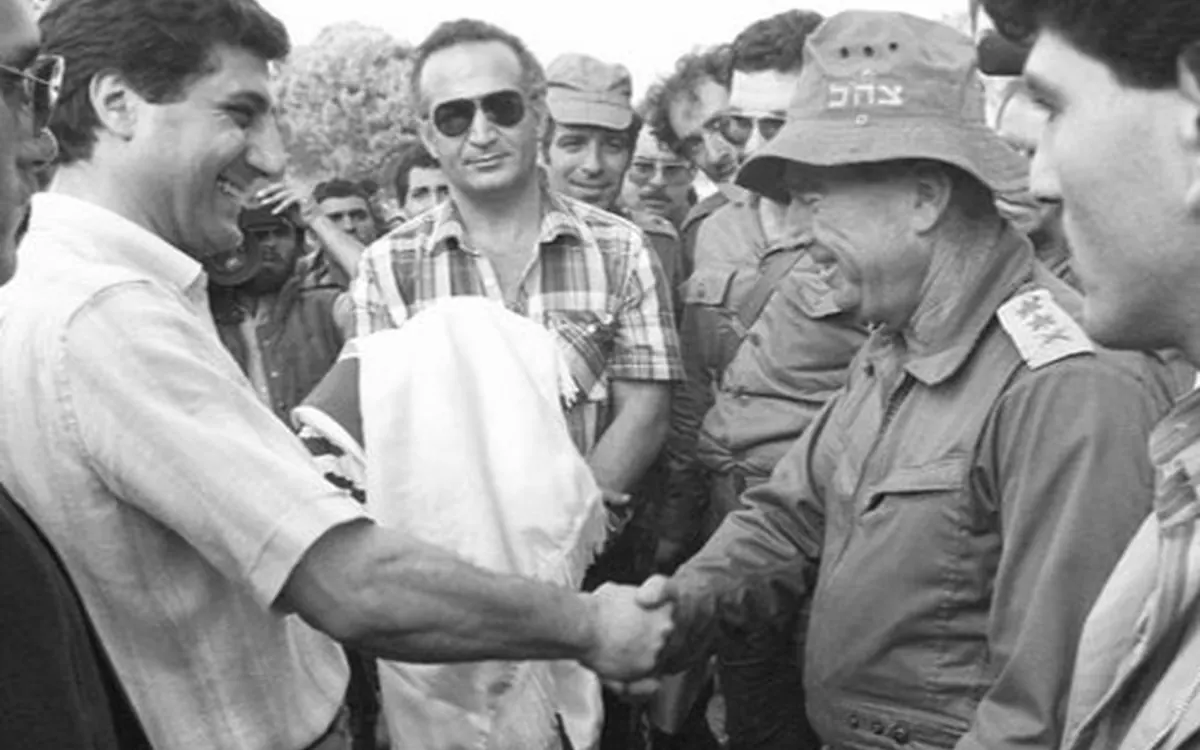
The assassination of Christian Lebanese Phalangist leader Bashir Gemayel was an explosion which rocked the region, and the massacres at Sabra and Shatila which followed in its wake horrified the world. This episode touches on a rabbinic debate over the morality of war, the political struggle over its consequences and sets the stage for a sea-change in Israeli society.
About this episode
You cannot escape the responsibility of tomorrow by evading it today, says Lincoln. On September 14, 1982, a bomb at the Phalange headquarters in East Beirut killed President-elect Bashir Gemayel along with twenty-two others, and with him died the peace treaty Begin and Sharon had hoped to harvest from the invasion. Gemayel had already soured on the alliance, proposing a non-aggression pact at the tense Nahariya summit, where he held his arms out to Sharon and told him to put the handcuffs on. Begin had assured American Jewish leaders of a coming triangle of peace from Sinai to Mount Lebanon, and polls showed ninety-three percent of Israelis backed the operation even as casualties mounted. The Syrian-backed bomber Habib Shartouni ended that vision, and the assassination set off a secondary explosion in the refugee camps whose shockwaves still move the region.
Rav Mike pauses over power and its exercise through war, since the return to sovereignty revives a conversation dormant for fifteen hundred years. Professor Leibowitz had taught that using force is the ultimate reality test, and comparing the destruction of Kibya to the slaughter at Shechem, he warned that there are deeds which can be justified and are nevertheless accursed, as Jacob justified his sons in the moment yet cursed their anger at the end of his life. His reference point stays the biblical narrative, the faith that the Torah remains the organic source for questions of warfare now that we have come home. That prophetic warning escorts the whole story, the recognition that an act defensible in the crucible of survival may still carry a curse, a frightening ethical reality that deserves contemplation before we plunge into the darkness of Beirut.
On the battlefield the war raised its own questions. Colonel Eli Geva, the youngest brigade commander, refused to lead his tanks into Beirut rather than expose his men and the civilians to urban warfare, a resignation that shook the nation. Rav Shlomo Goren ruled the siege itself forbidden, leaning on the Rambam's law that a besieged city be surrounded on three sides so anyone who wishes may flee for his life. Rav Shaul Yisraeli answered that from the moment Israel became sovereign, Jewish law required it to fight within international standards, a tacit agreement where the combatant responds in kind, and he called the aspiration to wage war by independent Jewish ethics a dangerous delusion. Goren rejected adopting another nation's standards, and when pressed how such a war could be won, he answered that we do not understand the secrets of God.
Within a day of Gemayel's death, Sharon ordered the IDF to seize West Beirut, his order stating that the camps were not to be entered and that the searching would be done by the Phalange. Everyone knew the Maronites planned to break the last PLO opposition, and almost every militiaman had lost family to the fighters. The intelligence unit of Eli Hobeika, ruthless and fiercely loyal to the slain Gemayel, was sent into Sabra and Shatila, and for two full days it pursued a bloody revenge. Reports of indiscriminate killing reached the command post almost at once, and a militiaman boasted of two hundred fifty terrorists killed where the soldiers had heard almost no shooting, until someone said they must be counting civilians, and the laughter stopped. Buildings were dynamited with people inside, and the dead were bulldozed into hastily dug graves.
Estimates ran from three hundred to three thousand, each number serving a narrative. When the news reached Israel, Begin, enraged at his nightly BBC broadcast on Rosh Hashanah, cried that Christians kill Muslims and the nations blame the Jews, yet a crowd gathered outside the synagogue and shouted murderer as he left. On September 25 more than four hundred thousand poured into Tel Aviv, roughly a tenth of the country, a turning point in Israeli politics. The Kahan Commission, opening with the biblical heifer whose neck is broken, found the Phalange directly responsible yet held the leadership grossly negligent for failing to foresee a massacre they were obligated to foresee. Sharon lost the defense portfolio, and while no Israeli had raised a hand, neither were our hands clean of the blood that flowed.
Key ideas
- The assassination of Bashir Gemayel killed the peace treaty Begin and Sharon hoped to harvest from Lebanon and set off the explosion at Sabra and Shatila.
- Leibowitz taught that a deed justified in the crucible of survival may still be accursed, like the sons of Jacob whom he justified in the moment yet cursed at the end.
- Rav Goren ruled the siege forbidden by the Rambam's law of the open corridor, while Rav Yisraeli held that sovereignty binds Israel to international standards of war.
- Sharon's order sent the Phalange into the camps, and reports of massacre reached the command post almost at once while the leadership failed to act.
- The Kahan Commission found the Phalange directly responsible and the Israeli leadership grossly negligent, costing Sharon the defense portfolio.
- More than four hundred thousand Israelis filled Tel Aviv in protest, a tenth of the country and a turning point in the nation's politics.
Chapters
- 0:00 The shot heard around the world
- 1:09 The blast that shook the region
- 2:23 Nahariya; put the handcuffs on
- 4:34 Begin's triangle of peace
- 6:42 The bomb; a second explosion
- 7:47 Power, war and Jewish ethics
- 11:18 Leibowitz; the luxury of exile
- 13:31 Vindicated yet accursed
- 14:37 Eli Geva refuses Beirut
- 15:46 Rav Goren; the open corridor
- 16:55 Rav Yisraeli; the tacit agreement
- 21:30 The Phalangists enter the camps
- 23:51 Hobeika; a mission of revenge
- 26:02 The cabinet; revenge foreseen
- 31:41 Rosh Hashanah; the cry of murderer
- 34:58 The Kahan Commission; our hands
Who, where and when
People
Bashir Gemayel, Menachem Begin, Ariel Sharon, Rafael Eitan, Yishayahu Leibowitz, Rav Shlomo Goren, Rav Shaul Yisraeli, Eli Geva, Eli Hobeika, Yitzhak Kahan
Places
East Beirut, West Beirut, Sabra and Shatila, Nahariya, Tel Aviv
Texts
Deuteronomy 20, The Rambam's Laws of Kings, The Kahan Commission report
When
1953 CE: the Kibya raid, 1982 CE: Gemayel assassinated, 1982 CE: the massacre at Sabra and Shatila, 1982 CE: the Tel Aviv protest, 1983 CE: the Kahan Commission report
Read the transcript
You cannot escape the responsibility of tomorrow, said Abraham Lincoln, by evading it today. Well, today or tomorrow, I'm looking to take my responsibilities one day at a time. I'm Robin Mike Foyer, and this is The Jewish Story. Season 5, Episode 19, Lebanon War Part 4, Sabra and Shantir. You know, when I was in high school, we learned about the shot heard around the world. If you're not familiar with it, that was the opening salvo in the battles of Lexington and Concord that began the American Revolution. And the noise of that first shot was heard around the world because it led to the creation of the United States. It was the opening of a wave of revolutions in the 18th and 19th centuries and frankly has shaped much of our world even today.
And of course, every student of European history has heard about the impact that one bullet from the gun of Gavrilo Princip had. With a single shot, he ignited the war to end all wars, which apparently didn't work because, according to many, he caused World War II as well. Now, here in the modern Middle East, we actually have a somewhat similar definitive explosive moment, though this time it was a bomb and not a bullet. I would call it the blast that shook the region, and for some reason or another, most people are quite unaware. On September 14, 1982, President-elect Basha Gamayal turned up at the Falanges Party headquarters in East Beirut to give his weekly lecture before a Maronite women's group.
Now, Gamayal, you may recall, had been elected president on August 23, and though there were less than two weeks until he officially took office, it hadn't been exactly an easy ride. I imagine the appeal of preaching to the hometown crowd on a quiet Tuesday evening was quite strong. The Israeli army was in slow process of withdrawal from Beirut, but still firmly entrenched in Lebanon, which, despite his nominal status as an Israeli ally, didn't really thrill Gamayal. The peace treaty which Shonin Begin saw as the true fruits of their invasion was far from the top priority to this phalangist leader. He himself had explained it to the Prime Minister and the Defense Minister after being flown to Nariya for a summit meeting on September 1st.
There, the accuracy of military intelligence head Yehoshua Segoi's analysis of the Maronites as unreliable allies had finally become fully clear. Because when Prime Minister Begin asked Gamal, where do we stand on the peace treaty? The leader had, with some embarrassment, proposed a non-aggression pact instead. Begin then pointed out the essential role that Israel had played in the Phalanges leader's ascension to power, comparing him to Major Saad Haddad, commander of the Christian militia in Lebanon's buffer zone on the border with Israel, a man whom the Prime Minister said at least knew on which side his bread was butter. Offended, Gamayl explained that as president, he might well put Haddad on trial for treason, and things went downhill quickly pretty much after that.
As the Prime Minister and the President-elect began to shout at one another, Defense Minister Sharon weighed in, reminding Gamal that the IDF had Lebanon in its grasp, and he would be wise to do as he was told. Fully enraged at being treated as a bellboy, as he would later describe it, Gamal held out his arms to Sharon and told him to put the handcuffs on. I'm not your vassal, he shouted, as the meeting came to a quick end. Now, despite the tumult, Begin and Sharon still hoped to realize the political fruits of their military venture. In a sense, both of them were depending on it. In the first weeks of the war, national sentiment had run high, and Israel's stance amongst American Jews and Americans in general was fairly solid.
On June 21st, Prime Minister Begin went to Washington, and he assured a gathering of American Jewish leaders that the day was near when an independent Lebanon would sign a treaty with Israel, creating what he called a triangle of peace with open borders from the Sinai through to Mount Lebanon. I have read in some newspapers in this great country that Israel invaded Lebanon. This is a misnomer. Israel did not invade any country. You do invade a land when you want to conquer it, or to annex it, or at least to conquer part of it. we don't covet even one inch of Lebanese territory and willingly we will withdraw our troops all of our troops and bring them back home as soon as possible as soon as possible means as soon as arrangements are made that never again will our citizens men, women and children be attacked, maimed and killed by armed bands operating from Lebanon and armed and supported by the Soviet Union and its satellites.
There is hope to believe that such arrangements will be made and that all foreign forces without exception will be withdrawn from Lebanon and there will be an independent, free Lebanon based on its territorial integrity and a day is near and such a Lebanon and Israel will sign a peace treaty and live in peace forever. And in a television interview that very same month, Begin declared that Operation Shalom HaGalil, the peace for the Galilee, had healed the nation of the trauma of the Yom Kippur War. Frankly, polls showed that he might have been right. 93% of the Israeli public felt the operation had been justified and so far successful. But casualties were very high, over 1,300 dead and wounded in the first 10 days of fighting.
And there are unprecedented actions of political protest, which we will discuss in a coming episode on the horizon. As the siege of Beirut unfolded, Israel's status in the world deteriorated, which we spoke about last week, and so did the Prime Minister's status at home. he and Sharon had pinned their hopes on peace which, despite his duplicity might still have been possible before Gamal and 22 other people were killed by 400 pounds of high explosives detonated in that women's meeting at 4.10pm on September 14th though no one took immediate responsibility and bombings were far from unusual in Beirut it soon became clear that this wasn't just personal revenge. It was an act of political warfare. Eventually, it was known that Habib al-Shartoui, a member of the Damascus-backed Syrian Social Nationalist Party, had planted the bomb.
The Syrians had spoken there would be no peace with Israel. Gamal's death and the collapse of the political vision underpinning the Lebanon invasion would have been impact enough of that bomb. But is assassination set off a secondary explosion in the Palestinian refugee camps of Sabra and Shatila, whose shock waves are still moving the Middle East today? There is no question that power is a central element to life in general, and therefore no less so to the Jewish story. And when it comes to the specific application of power, which we know as war, the rise of the modern state of Israel has made the need for a consideration of the issue of power acute. We're at the century mark of a hundred year conflict and it doesn't look to be ending any time soon.
Beyond the questions of wisdom and pragmatism, any consideration of power and how it ought to be exercised through war means asking questions of ethics and morality. Now, I'm not at the present moment interested in the moral dilemma over if and when war ought be waged. Lebanon is labeled by many historians as Israel's first war of choice. And in a coming episode about the birth of the Israeli anti-war movement, we will touch on how true that may or may not be. For now, I want to pause to think a little bit about the ethical principles that mark the boundary between legitimate and illegitimate action in war, and where we might seek them, right before we plunge into one of the darker moments that Lebanon really offers.
Inter arma silent legis, says the Latin proverb, which I'm sure I mangled in pronunciation. It means during war, the law is silent. One could simply say that war is not part of human civilized life, and therefore not subject to legal constraint at all. Now remember, that's a saying which comes from a culture which first conquered the known world by the sword, and only afterwards attempted to rule it through law. I would suggest that if we found a similar sentiment within the Torah, it would come from Davarim chapter 20, line 1, Ki tei tzei la milchama ol al oivecha, right? When you go out to war against your enemy, on which our sages teach, let them be in your eyes as enemies. have no pity upon them, for they will have no pity upon you.
That's a reality of war. If you go out feeling bad for the enemy, it's unlikely to end well, frankly, for either of you. And yet, if you're familiar with Davarim, then you know the following verses are filled with constraints on how Israel may wage war. In fact, both the narrative and the legal portions of the Torum Bible are filled with thoughts on how war ought and ought not be pursued. Now, leaving aside any metaphysical considerations of why that might be, it simply reflective of the fact that these books are telling the story of the struggle for Jewish sovereignty over the land of Israel And sovereignty has always been And until Mashiach comes let it be soon, let it be now, always will be bound up with war.
But when we lost our land after the destruction of the Second Temple, the legal and ethical conversation around war more or less ceased. There is some halakhic legal discourse around the ethics of war, which can be found after the biblical era, but nothing comparable to the development of more classically religious topics. And so it is that with our return to sovereignty, we're left to pick up a discussion which has been dormant for 1,500 years at least, and thus we're lacking somewhat in guidance. Now you may recall that we first touched on this challenge back in Season 3, Episode 6, with the story of Kibya and the complicated and messy nature of the policy of retaliation that Israel pursued in the early 50s.
At the end of that episode, I shared with you Professor Yishayahu Leibovitz's ethical perspective in the aftermath of a raid that had killed dozens of civilians. Leibowitz started by recognizing what I'll call the spiritual luxury of exile, a situation where, by living under foreign rule, we were somewhat protected by our political powerlessness, able, as he says, to, quote, cultivate values that did not have to be tested in the crucible of reality. Now, using force as a sovereign state is, in many ways, the ultimate reality test, One that Labus feared Israel had failed when Kibbeah was left in rubble. Now to be clear, he wasn't pining away for some easy life of exile, or lamenting the necessity of war altogether.
As he wrote there, only one prepared to justify historically, religiously, or morally the continuation of the exilic existence could refuse to take upon him the moral responsibility for using the sword to restore freedom. Notice, in his eyes, there is a moral responsibility of using the sword which comes with sovereignty. But the professor, as he was known in Israeli society, believed profoundly in the importance of sovereign Jewish existence. And because of that, he feared just as deeply the potentially corrupting influence of the sword which came hand in hand with that sovereignty. In his essay, Leibowitz compared the destruction of Kibbeah to that of Shechem. You may know the story. Its inhabitants were slaughtered by the brothers Shimon and Levi after the rape of their sister Dina.
And most crucially, he compared the fact that when the brothers defended their action in the moment, their father Jacob stood silent. But at the end of his life, Jacob cursed their anger. And so the professor noted that Israel could indeed justify its actions at Kibbea in light of the relentless war survival it was facing. just as the Americans only a few years earlier had justified dropping an atomic bomb on Nagasaki in order to end World War II. But, rather than doing so, he declared, Although there are good reasons, and ethical justifications, for the Shem Kibya action, as he called it, the curse of Jacob when he told his children what would befall them in the end of days, is an example of the frightening, problematic, ethical reality.
There may well be actions which can be vindicated and even justified and are nevertheless accursed. That type of prophetic warning deserves consideration. And I mention it here not just as an introduction, but so that it will escort us through the story to come. It's also critical to me that you note Leibowitz's reference point for a discourse on the ethical issues. It's the biblical narrative. because despite the long years of exile, when our tradition was not forced to engage questions of power and warfare, he has the faith that the Torah remains the organic source for approaching those questions now that we've returned to our land, even if it demands we act differently than the rest of the world does in battle, as it so often does in other areas of life.
Now, as with all wars, Lebanon raised ethical issues on the battlefield. First of all, you have to remember that the IDF, the Israeli Defense Force, is a citizen's army. And as the average person was exposed, be it directly through their own experience or indirectly through their peers, to the scale of death and destruction which is brought about by the full-scale invasion, public protests in the time of war occurred for the first time within Israel. Like I said, that's our topic for next episode. Chief of Staff Rafael Tan and Defense Minister Ariel Sharon had created a steamroller offensive, as they called it, one which evoked unprecedented opposition even from soldiers in the field. The most publicized incident of such opposition came from Colonel Eli Geva, the IDF's youngest brigade commander and son of a distinguished retired general considered to be a rising star.
He refused to lead his tank brigade into Beirut, not wanting to expose his men or the civilian population to the horrors of urban warfare. Instead, Geva requested that the chief of staff relieve him of command, demote him to the status of a regular tank officer. And neither Eitan, nor Sharon, or even Prime Minister Begin could dissuade him. It was a resignation that shook the nation. Furthermore, during the siege of Beirut, Rabbi Shlomo Gorin, then Chief Askenazi, Rabbi of Israel, and well known as the IDF's chief rabbi during the Six-Day War, published a newspaper article in which he claimed that the siege of Beirut was actually prohibited by Jewish law. Now that may sound surprising, but his stance was based on a ruling of the Rambam, Maimonides' 12th century sage, who actually did give us one of the few post-biblical texts dealing with the laws of war.
You can look it up in his Law of Kings and Their Wars, Chapter 6, Law 7, where he says, When besieging a city, you should not surround it on all four sides, but only on three sides, allowing an escape path for anyone who wishes to save his life. Now, let's be clear. It's obvious that innocent civilians should be allowed to flee. The Maimonides' understanding of this law is that even your enemy should be left a corridor for escape. and according to Rav Gorin, the PLO should have been allowed to flee if they chose to do so. Such a radical stance made so public was not going to be left unchallenged. And indeed, a response was soon published by Rav Shaul Yisraeli, the Rosh Yeshiva of Merkaz HaRav Yeshiva, of Rav Kook fame, and a leading halachic authority of his day.
Now back in 1954, not long after Professor Leibowitz made public his thoughts on Kibya, Ravi Yisraeli had published a lengthy article on the relationship between Jewish law and international law in questions of war. In 54, this was the early stage of anyone in the world considering notions of international law. And there, the Rav stated that the very willingness of Jewish law to deal with the concept of war is rooted in a recognition that humanity as a whole has adopted war as a means to solve conflicts. As a result of that, the ethical boundaries of conduct and war are basically defined by what he calls a tacit agreement. When you initiate a conflict, you accept the idea that the combatant is going to respond in kind.
In essence, there are unstated rules of war. And therefore, in Rabbi Yisraeli's eyes, from the moment Israel became a sovereign state, Jewish law required it to function within the parameters of international standards. Even if one could make an argument that the Torah itself demanded a higher standard of behavior, it was a parallel to what we call Dina de Malchuta Dina, that the law of the land is indeed the land. The Torah may dictate behaviors between individual Jews when we're in exile, but it can't constrain the non-Jewish environment. And therefore, the law between Jew and the non-Jewish environment is to recognize the binding law of whatever land in which we find ourselves, always provided it doesn't violate the Torah.
And the same held true in the eyes of Rabbi Yisraeli between Israel as a sovereign state and the nations of the world. In fact, he believed there was a dangerous delusion, as he called it, in the aspiration to conduct wars according to independent Jewish ethics. Basically, to wage war according to different standards than those of your enemy, like laying a three-sided siege around Beirut, was to risk bringing catastrophe upon Israel and its army. Now, Rav Gorin rejected the notion that Jewish law should ever adopt the standards of another nation. In his eyes, the whole significance of the Jewish state hinged on the degree to which it reflects the halakha, which it reflects Jewish law. In 1966, he declared in a public debate, Rav Sa'ad-Jag'on said, Our nation cannot be called a nation but by its law, meaning that the Jewish people can be considered a nation only in as much as it's loyal to the Torah.
The Jewish people did not create the Torah of Israel. The people exist as a result of their keeping the Torah. It was born out of the metaphysical need to implement the values which are represented by the message of the Torah, the ethics of the prophets, and the vision of mankind. Now, it's clear from a tactical standpoint that there's absolutely no logic in laying siege to a city while leaving one side open. And that exactly how Rav Yisraeli attacked Rav Gorin position But when pressed as how it would be possible to win such a war Rav Gorin simply replied we do not understand the secrets of God It's worth it to contemplate Rav Yisraeli and Rav Gorin's positions, as well as Leibowitz's warning. But for better or worse, it was politicians making decisions in Lebanon and not rabbis.
And And so I'll leave the final word on the Torah's ethical take on warfare to what was quoted in an opening statement from the report of the Kahan Commission. That'll be the governmental body convened to investigate whether Israel was responsible for the massacres which occurred in the wake of Bashar Gamal's assassination. The report quotes the case of the broken-necked heifer. It's an act of atonement which is required to be offered by the elders of a city when But a corpse has been found and no one knows who was responsible for killing. After breaking the neck of the calf, the leaders joined together, washing their hands and declaring, Our hands did not shed this blood and our eyes did not see it.
Word of Bashar Gamayel's assassination reached Jerusalem only a few hours after the bomb went off. The leaders were in shock. Because despite that confrontation I described, there had still been hopes to salvage a peace treaty out of the wreckage of Beirut. But those hopes died that day with the Falangist leader. In less than 24 hours after Jamal's death, Defense Minister Sharon instructed Chief of Staff Rafi Eitan to seize the key junctions commanding West Beirut. And his order for the day included the fateful sentence. The refugee camps are not to be entered. searching and mopping up the camps will be done by the Falangis Lebanese army. The next morning, September 15th, the IDF entered West Beirut and Sharon himself helicoptered north to the forward command post to meet with the chief of staff and leaders of the Falangis militias.
What happened next is the subject of endless controversy and much confusion. There is no question that both the IDF and the Falangis had long known that the PLO maintained a base of power, including a significant armed presence in the West Beirut refugee camps of Sabra and Shetila even after nominally they had withdrawn from the city. And furthermore, there's little doubt that even without the assassination of their leader the Maronite Christians planned to break the back of this last opposition within the city. A plan which perfectly matched Israel's aspiration to eliminate the PLO altogether. According to some, the defense minister addressed the phalangist leaders before they entered the camps, emphasizing that their mission was to leave no terrorists left alive.
Now, considering the history of intercommunal murder in Lebanon, the widespread feeling amongst the Lebanese that the Palestinians had brought down a decade of suffering on Lebanon, starting, remember, well before Israel's invasion, and the fact that almost every member of that phalangist militia had lost family members to PLO fighters, what followed should have come as no surprise. In fact, it should have been seen coming. On September 16th, a coordinating session for the phalanges entry in the camp was held early in the morning, and it was agreed that a company of approximately 150 fighters would be allowed to enter the camps with the IDF holding the perimeter. Brigadier General Amos Yaron, commander of the division in place, was more than a little bit disturbed, as he described it later, by the potential for violence.
And so facing the phalanges, he reviewed with them known terrorist locations in the camps and warned them against harming the civilian population. Jeroen then pointed out the lookout posts he'd placed on the roof of his forward command position and on another nearby position, even though to many present, it was quite clear that from those points, it was all but impossible to see what was going on in the camps below. The intelligence unit, headed by Eli Hobeka, had been chosen to enter Sabra and Shetila, largely because the Falangis had difficulty recruiting any other force willing to do so, and that his unit was considered to be specially trained, as they say, in discovering terrorists. Hobeka figures heavily in the mystery of what's about to unfold.
He was chief of security and intelligence for the Falangis forces of more than 12,000 militiamen, and personally controlled its best-trained corps, Extremely well organized, with a vast knowledge of the patchwork of armed forces operating in Lebanon, as well as the endless number of personal enemies he held, Hubeka was known to be tough, direct, completely ruthless, and fiercely loyal to assassinated leader Basha Gamayel. In the wake of the massacres, when questions of American complicity, or at least knowledge, bubbled to the surface, The New York Times published a report claiming that Hubeka wasn't just Gamal's liaison to the Mossad, but to the U.S. Embassy as well. Now, it's important to know that Bashar Gamal had been a lifelong pariah in Washington, but somewhere toward the end of 1981, that had changed.
And before his death, Hubeka was managing his relationship not only with the Reagan administration, but with the CIA as well. But now, the boss was dead, and Obega was leading his men into Saber and Shatila on what could only be seen as a mission of revenge. The Falangists entered the camps on September 16th, and that very evening, just on the eve of the Rosh Hashanah Holy Day, the cabinet met in Jerusalem, even as the first reports of a massacre unfolding began to reach the IDS forward command post. Chief Ustaf Eitan laid out the situation to the Prime Minister, assembled cabinet minister and the heads of the Mossad and military intelligence who were present. He said that the order had been given for the Falangists to enter Sabra and Shetila and that fighting would likely begin early that evening with their own methods.
And in a foreshadowing of what was to come, the chief of staff addressed the possible consequences of allowing those Maronite Christians into West Beirut immediately in the wake of Bashar Gamal's assassination. A thing that will happen and it makes no difference whether we are there or not is an eruption of revenge which I can imagine how it will begin but I do not know how it will end it will be between all of them and neither the Americans nor anyone else will be of any help he went on to say today they already killed Druze there one dead Druze is enough so that tomorrow four Christian children will be killed they will find them slaughtered just like what happened a month ago and that is how it will begin and finally he said Despite those grim words, the only person present to question the phalanges' entry into the camps was Deputy Prime Minister David Levy, who warned, We would come out with no credibility.
When I heard the phalanges had already entered a certain neighborhood, and I know what the meaning of revenge is for them, what kind of slaughter, then no one will believe we went in to create order there and we will bear the blame. Prophetic words, but no one was listening. No one responded to his concerns. And instead, the meeting ended with a cabinet resolution that attributed the entry into West Beirut to the continued presidents in the city of, quote, some 2,000 terrorists equipped with modern and heavy weapons in flagrant violation of the evacuation agreement. Eli Hobeka and his men pursued their bloody revenge for two full days. Later, investigations would show that reports of indiscriminate killings began to work their way to the IDF command post almost immediately, but that the first attempt to control the flanges didn't occur until September 17th, when Major General Amir Drury, head of the Northern Command, telephoned the chief of staff and told him that the flanges had, quote, perhaps gone too far.
Members of a mortar unit, assigned to cover the camps from the outside, later told a Jerusalem Post reporter about a militiamen who had returned to their position during the night to request a stretcher. He boasted of having already killed 250 terrorists, a number of the Israeli soldiers considered absurd. We know how much firepower we have to use before we kill a handful, and they're claiming to have killed 250 and there had been almost no shootings, said one soldier, the reporter? But none of those IDF veterans were thinking about knives and bulldozers. Quote, we laughed amongst ourselves when he left until someone said, they must be counting civilians. Then we stopped laughing. Now, despite Drury's misgivings, operations continued in the camps until September 18th.
By that point, American pressure on the Maronites had begun to mount. and an order to vacate the camps was finally given. No question was addressed to the departing Falange's commanders about any of the rumors or reports of civilian death. But when the press and medical personnel were finally able to enter Sabah and Shetila, they met a scene of horror that rivaled any which even Lebanon's bloody history could offer. Buildings had been dynamited with their inhabitants inside. alleys were filled with mangled corpses, bodies bulldozed into hastily dug mass graves. Estimates of the dead would range from 300 to 3,000, with each number serving a partisan narrative, much like that of the story of Dear Yassin, which we told back in Season 2, Episode 39.
And, much like that story, the story of Sabra and Shatila quickly took on a life of its own one often only loosely related to the reality of the event Just take a quick look on the internet and you'll find everything from balanced approaches to the very ugly and complex story, to the notion that Sharon himself drank the blood of Palestinian children. One thing is certain, though. When the story began to reach the people of Israel, there was a swift demand for reckoning. Prime Minister Menachem Begin was well known as a man of tradition, by all accounts deeply connected not just to the Jewish story, but to its custom and even law. Nonetheless, in his whole life, there were certain areas where he forged his own path.
And one of them was in his insistence on listening to the nightly BBC broadcast, even on the holy day of Rosh Hashanah. And so it was that when his aide Yehuda Avner met Begin at the door of his home to escort him to the great synagogue, the Prime Minister was already enraged. Has to gehert, Izemaysa, Begin declared in Yiddish. Have you ever heard of such a thing? Christians kill Muslims, and the nations blame the Jews. The BBC was already reporting that the Christian militia had killed hundreds, and soon Begin's complaint that the Jews would be blamed filled media outlets around the world. And not just the media. Days after the massacre, U.S. Senator Alan Cranston, one of Israel's strongest supporters in the American government, published an open letter addressed to the Prime Minister.
I did not condemn Israel's initial move into Lebanon for the avowed purpose of protecting Israel's citizens against repeated PLO attacks, it read. And I have framed, despite deep misgivings, from commenting publicly on your siege of Beirut. I am reluctant to criticize a treasured friend and ally in the midst of a military struggle. But the massacre of hundreds of men, women, and children is another matter. Perhaps the most somber consequence of the current strife in Lebanon is the dimming of the inspiring moral beacon which shone so brightly from beleaguered Israel. Needless to say, such words from a supporter in such a public fashion scored the Prime Minister deeply. Now, in the long run, Begin rejected Cranston's criticism, and, on a broader level, rejected what he called the hypocrisy of the world, which only seemed to care about the death of people in Lebanon, where the Jews could somehow be implicated.
But that day on Rosh Hashanah, Begin had more immediate issues. because during the davening, an angry crowd had gathered outside, incensed by the pictures of death and destruction from Sabra and Shetila, which were already appearing in the Israeli news. And despite the advice of his security detail, the Prime Minister refused to slip out the side door of the synagogue, choosing rather to face the crowd at the end of the services. After hours of prayer, reflecting on God's judgment of who shall live and who shall die that year, the Prime Minister now heard the people's judgment as they cried out at him, Murderer! And their shouts filled the air. Public sentiment was all but unanimous, and it was loudly magnified by the press in their demand for the resignation of Vence Minister Sharon and Chief of Staff Rafi Eitan, ringing in the ears of the Prime Minister.
The Labour Party, leaders of the opposition, actually demanded the entire government resign. And at first, Begin held fast, insisting that there would be no dismissals, no resignations at all. On September 22nd, Defense Minister Sharon addressed the Knesset in an attempt to defend his and the IDF's role in Lebanon. The IDF, its soldiers and commanders, have been performing for three months a wonderful operation in Lebanon, which has brought and will bring great security gains, insisted Sharon. Every movement of our soldiers was known to us and was reported immediately. That is the tragedy of the camps. we did not know exactly what was taking place. But claims of ignorance, just like in the eyes of the Torah, were no excuse in the eyes of the Knesset.
Even the National Religious Party's cabinet members joined in pressing for an official inquiry. President Isaac Navon broke the mold for his office, transcending its ceremonial limits and traditionally apolitical boundaries by appealing for a thorough and impartial judicial inquiry, as he called it, and declaring he would resign if that demand wasn't met. The final straw came on September 25th, when more than 400,000 protesters poured into Tel Aviv's municipal square. Organized by the new movement Peace Now, also Soldiers Against Silence and members of the labor alignment, this protest marks a turning point in Israeli politics, and frankly, in Israeli social fabric, one that I said we'll explore in next episode.
For now, just picture it. Roughly 10% of the population gathered in the center of Tel Aviv. No such demonstration of public anger had ever been seen in Israel's history, not even in the wake of the failures of the Yom Kippur War. Three days later, a shaken Prime Minister Begin announced the appointment of a commission of inquiry under the chairmanship of Yitzhak Kahan, president of the Israeli Supreme Court. The three-man panel began its proceedings within days, and over the course of the coming months, sat for 60 sections, heard 58 witnesses, soldiers, journalists, politicians from Israel and from Lebanon, and reviewed countless official documents. in keeping with its task as delineated by the cabinet resolution that created it, the commission refrained from drawing conclusions with regard to various issues connected with activities during the war that took place in Lebanon from 6 June 1982 onward or with regard to policy decisions taken by the government before or during the war if that didn't make sense to you, it's actually quite simple the only question they were empowered to ask was who bore responsibility, be it direct or indirect, for what happened in Sabra and Shatila.
The Kahan Commission issued its report in February of 1983, and the conclusions were in essence twofold. The first was that, quote, the only group directly responsible for the massacres was a Lebanese Maronite Christian militia known as the Falanges, or the Kitab, founded by Pierre Jamal and led by his son, Bashir. Commission did note that Bashar Jamal had declared he would eliminate the Palestinian problem, as he called it, when he became president, quote, even if that meant resorting to aberrant methods against the Palestinians in Lebanon. Meaning that even before the invasion of Lebanon, the intention of the phalangist leaders was to remove the Palestinians from Lebanon by any means necessary.
And of course, that led directly to the second conclusion. because the commission noted that there was a long and symbiotic relationship between Israel and Jamal's Christian forces. They further noted that the prime minister, the defense minister, and the chief of staff, while never taking direct action, had been grossly negligent in sending the phalangists into Sabra and Shatila. Quote, the decision on the entry of the phalangists into the refugee camps was taken without consideration of the danger, which the makers and executors of the decision were obligated to foresee as probable that the phalanges would commit maskers and pogroms against the inhabitants of the camp. Furthermore, they criticized the leadership's inaction once the reports began to come in, saying it's clear from the course of events that when the reports began to arrive about the actions of the phalanges, no proper heed was taken, the correct conclusions were not drawn, and no energetic or immediate actions were taken to restrain the phalanges and put a stop to their actions.
In sum, while making clear that no Israeli had actually raised their hand in violence, neither were our hands clean of the blood that had flowed there. The commission then recommended specifically the dismissal of Defense Minister Sharon, sparing Chief of Staff Eitan a similar fate, only because his term of service was due to end within weeks. They also urged that Generals Yehoshua Sagoy, Amir Drori, and Amos Yaron be removed from their posts. Now, true to his bulldozer name, Sharon rejected the conclusions of the commission, insisted that neither he nor the army held any responsibility for what had occurred in Sabra and Shetila, be it direct or indirect. And when the Prime Minister brought the question to his cabinet, each member was invited to speak their mind.
Over the course of three consecutive sessions, for hours, Sharon sat and stood and listened to their voices until the vote finally came. 16 to 1 in favor of adopting the commission's findings in their entirety. Sharon lost the portfolio of defense minister, though he was not forced to resign from government, and military heads were indeed made to roll. But the public was not appeased. They wanted more. They wanted Sharon gone and begging with him too. And in fact, many wanted what they called their country back. And as we will soon see, there was yet more blood to be spilled over Lebanon. I just want to thank a few folks before I sign off. I want to thank all the folks who give their hard-earned money.
Make the show happen. Keep it free and widely available. I want to ask you to join them now. Go to my website, jewishstory.co. In the upper right-hand corner, you'll see a button that says Be a Patron. You can click on that to give a little bit of per-podcast support. I also want to thank the Land of Israel Network. That's thelandofisrael.com. They're creating a center for global transcendence in the heart of Judea. I want to thank the Pardes Institute, p-a-r-d-s.org.il. for throwing the doors of the Beit Midrash open as wide as possible, and I want to thank you for listening. I'm Rav Mike Foyer, and this is The Jewish Story.
More from Season 5
TJS S5 Interlude: interview with Ambassador David Friedman
We are all actors in the Jewish Story, and part of the art of becoming a main character is knowing how to seize the moment. Here is an...
Play Episode
TJS S5E18 Lebanon War part III - the invasion
Crossing into Lebanon to destroy PLO started as a successful mission, and when the IDF destroyed the Syrian SAM belt in the Bekaa Valley through Operation Mole Cricket...
Play Episode
TJS S5 Interlude Historical Obligations Yom Ha'atzmaut 5782
The RRG Bet Midrash Torah Cafe hosts Rav Mike Feuer for a live word of Torah on Yom Haatzmaut - Israel Independence Day. How does history create obligations,...
Play Episode