S2 Epilogue: The re-emergence of Jewish political theology and messianism in 1948
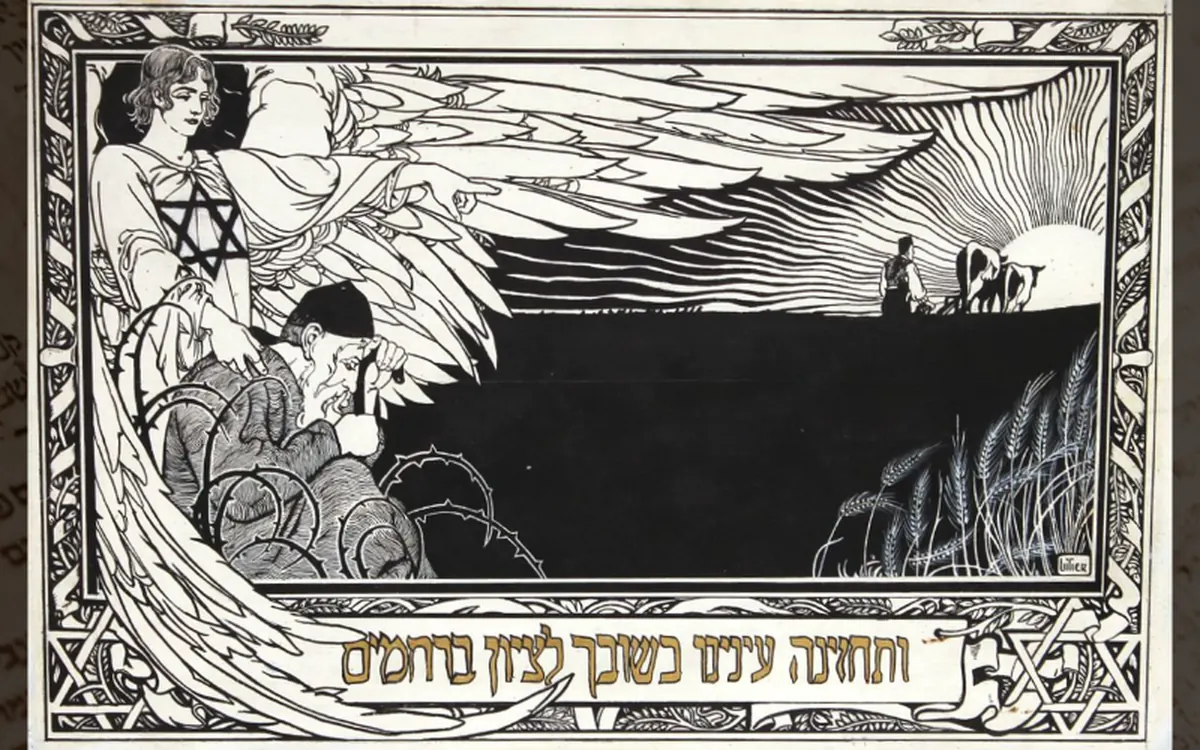
What better way to wrap up season two than to talk about the messiah? Here is an exploration of the power of the messianic idea and its centrality to Jewish thought. It also includes the introduction of political theology to our discussion, in light of the birth of the State of Israel.
About this episode
Three things come when you are not paying attention, says the Gemara: a lost object, a scorpion, and the Messiah. Rav Mike wants to talk about the Messiah, about the power of a dream of a better world, and about the potential and danger of seeing that hope realized in a concrete vehicle like a state. The full history of messianic thought is too big to review, but the story has touched its major points: the Maccabean and Bar Kokhba ventures with their apocalyptic edge, the second temple as a boiling pot whose welded lid became a bomb, the hope that lit the darkness of exile, and since the expulsion from Spain the rise of movements explicit and implicit, Menasseh ben Israel's hope that full dispersion would trigger return, the explosion of Shabtai Zvi, the rise of Hasidut and the Enlightenment. Underlying them all is the Arizal's doctrine of tikkun, which taught that our actions can do more than fix the world morally, they can bring a redemption of a world that has not yet been, empowering the individual in historic time.
To appreciate how foundational messianism is, Rav Mike uses Gershom Scholem's distinction between the catastrophic and the utopian. The catastrophic holds that the redeemed future is built on the ruins of the past, a discontinuity between history and the messianic world in which our role is only to hope and wait, the perspective that sees the third temple descending from heaven and condemns any attempt to force the end, a warning that can also guard against limiting the redeemed future to an idea rooted in our unredeemed present. The utopian believes in completing creation by building the world as we know it, not a mere restoration but possibly a perfection never yet seen, and though it says humanity cannot master its future it adds that we must try, keeping human agency alive even in exile. The sin-and-exile frame, now emblematic of Jewish guilt, is really the last stand of agency: it was our actions that caused exile and our actions that will redeem us. But Jewish messianism never accepted that true redemption is found within, one of the major places it split with Christianity, because the drive to perfect the human essence must always be coupled with perfecting human society, the kingdom of God without as well as within. The Rambam adds a third note, pushing the restorationist element forward, a world simply set in order.
So the real question: is Zionism a messianic movement? Scholem links the messianic hope to the endless powerlessness of Jewish history, a life lived in deferment, so political Zionism can look like a rejection of the messianic idea altogether, which is why the first work of political Zionist thought was called Auto-Emancipation. Leon Pinsker, once an advocate of assimilation, was turned by the pogroms to nationalism, and he named the belief in a Messiah and in bearing divine punishment patiently as the very thing that must be overcome for a people to think of itself as a nation. Yet for many political Zionists the rejection of messianic redemption was itself a move to seize the reins of history and force the end most concretely, and Rav Mike suspects they misdiagnosed the Jewish problem as merely the external ones of antisemitism and assimilation. The socialist and Marxist streams were messianic in their thinking if not their theology, utopian visions of global redemption with a catastrophic touch of inevitability, and A.D. Gordon's religion of labor cast redemption as releasing the potential energy of the ground and ourselves through labor, the nation as prophet and man as savior. Add the intoxication with the land in the poets like Uri Zvi Greenberg, who called a steamroller paving the roads the carriage of the Messiah.
Running through all of it is shlilat hagalut, the negation of exile, expressed in getting out physically, in the Hebrew renaissance that needed to erase the language of exile, in Nordau's muscular new Jew replacing the hunched Torah scholar, and in the breakdown of traditional life, since the Zionist thinkers saw Torah learning and Jewish law as the ultimate embodiment of exile, labyrinthine and irrelevant. That erasure of what came before is a catastrophic element, and it is also, Rav Mike notes, at the heart of the coming breakdown between Israeli and American Jewry, since classic Zionist thought depends on the non-existence of the diaspora, yet the diaspora lives on and religion thrives. On September 20, 1948 Haaretz published the first prayer for the State of Israel, composed by Chief Rabbi Herzog with Agnon, standard sentiments except for three words, the beginning of the flowering of our redemption, the hope and the hesitation of a new-old phase.
Our re-embodiment as a nation marks the revival of political theology, the application of theological concepts to practical questions of politics and society, which pushes against the assumptions of the liberal democratic state by letting the sacred embody itself in mundane structures. Ben-Gurion and Rav Kook were both its advocates from opposite ends: Ben-Gurion politicized the theological, mobilizing the ingathering of exiles and the biblical borders for the practical goal of building the state, a secular national messianism, while Rav Kook theologized politics, harnessing secular pioneers and state-building to a mystic vision of the coming of the Messiah, a classic messianism in the national religious sense of Rabbi Akiva and Bar Kokhba. The danger is that political positions which should be ephemeral become sacred, since pragmatism and compromise are inherent in politics but look like weakness from a theological view, and that is what destroyed the last commonwealth. But rejecting political theology outright risks surrendering to the post-modern crisis of liberal politics, adrift or exposed as a gross struggle for power. The word for independence, atzma'ut, can also be read as self-actualization, the power offered by harnessing the state to a messianic dream, a power we have not had on the road to redemption for nearly two thousand years, and also the great danger. Scholem asks whether Jewish history can endure this entry into the concrete realm without perishing in the crisis of the messianic claim, and Rav Mike answers that the third commonwealth must become an incubator for the Messiah understood as a language, the sanctuary of awe and hope, so that, in Zephaniah's words, the peoples may be made pure of speech and serve God with one accord.
Key ideas
- Messianism is not a sidelight of Jewish thought but foundational, from the Arizal's tikkun that empowers the individual to bring redemption in historic time.
- Scholem's two poles: the catastrophic builds the future on the ruins of the past and waits, the utopian completes creation by building and keeps human agency alive.
- Zionism can look like a rejection of messianism, yet forcing the end concretely is itself a messianic move, and its socialist and labour streams were redemptive to the core.
- Shlilat hagalut, the negation of exile, is a catastrophic element, and it underlies the coming breakdown between Israeli and American Jewry.
- The prayer for the state's three words, the beginning of the flowering of our redemption, hold both the hope and the hesitation of 1948.
- Ben-Gurion and Rav Kook embody two political theologies, and the danger is that ephemeral politics becomes sacred, as it did in the last commonwealth.
Chapters
- 0:00 Three things when you are not looking
- 1:09 A brief history of messianic thought
- 3:16 The Arizal's tikkun empowers the individual
- 5:28 Scholem: the catastrophic
- 6:31 Scholem: the utopian
- 8:41 Sin and exile as the last stand of agency
- 9:51 Without and within; the split with Christianity
- 11:54 The Rambam's restorationist note
- 13:07 Is Zionism a messianic movement?
- 14:13 Pinsker: ditch the Messiah
- 16:26 Socialist and Marxist messianism
- 17:43 Gordon's religion of labour
- 18:54 Intoxication with the land
- 20:02 Shlilat hagalut, the negation of exile
- 22:20 The diaspora lives on
- 23:22 The first prayer for the state
- 25:30 Political theology revived
- 26:34 Ben-Gurion and Rav Kook, two directions
- 27:40 The danger: ephemeral politics made sacred
- 31:52 Atzma'ut as self-actualization
- 34:01 The Messiah as a language; pure of speech
Who, where and when
People
Gershom Scholem, The Arizal, Leon Pinsker, A.D. Gordon, Uri Zvi Greenberg, Max Nordau, David Ben-Gurion, Rav Avraham Yitzhak Kook, Rav Yitzhak Herzog, Shai Agnon, Rivka Schatz, The Rambam
Places
Spain, The land of Israel, The Kinneret
Texts
Scholem's Toward an Understanding of the Messianic Idea, Auto-Emancipation, A.D. Gordon's writings, The Prayer for the State of Israel, Zephaniah 3:9
When
1882 CE: Auto-Emancipation, 1905 CE: Borochov and the Russians, September 20, 1948 CE: the prayer for the state, 1956 CE: Ben-Gurion's messianic dialogues to come, 1967 CE: the settlement movement to come
Read the transcript
Three things, says Gemara, come when you're not paying attention. A lost object, a scorpion, and the Messiah. Well, I hope you're paying attention now, because I might say a few things that are going to surprise you. I'm Rob Mayfoyer, and this is The Jewish Story. Epilogue, the re-emergence of Jewish political theology and messianism in 1948. If anybody knows me well, knows it doesn't take much to get me talking about the Messiah. And that's what I want to do right now. I want to talk about the Messiah, about the importance of hope and the power of having a dream of a better world. And I want to think together a little bit about the potential and dangers of seeing those hopes realized in a concrete vehicle like a state.
Now, the full scope of history of messianic thought in Am Yisrael is far too big for us to review right now. In truth, the Jewish story has touched on all of its major points in the last two seasons. Back in season one, in the second commonwealth, the second temple times, we saw the Maccabean struggle, which certainly had messianic pretensions. We witnessed the birth of Christianity and rabbinic Judaism, a fairly obvious story there. And of course, the Bar Kokhba revolt, that last effort at a messianic military venture since, well, frankly, our day. And the hallmark of all of those three was their element of apocalyptic thinking. that question of how the whole scope of divine thought, as revealed in the words of the prophets, was going to finally come to realization in their day, in history.
And, of course, how the living individuals who felt that the end was so near were going to make it happen, or perhaps even whether they ought to do that at all. So then we spoke about how the attempts to hold the national vessel together at the end of the Second Commonwealth were basically the national historic equivalent of trying to keep a lid on a boiling pot. You remember, I'm sure. You put the water on, turn up the heat, it boils over. You put on a lid, it throws the lid off. You weld it on and keep cranking up the heat, kaboom, it's a bomb. And that's kind of how we ended the Second Temple Period. Now, Rastro Season 1 was by and large devoid of major messianic episodes. But we did see the sparks because the hope of redemption was always there.
It's really what gave light to the darkness of exile in many ways. And we've spoken about that sustaining power of hope. But it was only when the situation in Spain began to deteriorate that that hope began to turn toward expectation. And beginning with the emergence of the Zohar in the 13th period, the mystics themselves began to boil over. And since the expulsion that for us lay on the edge between season 1 and season 2, we've seen the rise of several messianic movements, explicit or implicit, We saw, first of all, the breakdown of the primary identity of us and them that emerged out of the Second Temple period that allowed Am Yisrael to stay ourselves and have a clarity of purpose even in exile crack under what we call the Murano consciousness that came out of Spain.
We heard about Rav Menashe ben Israel's hope that once the dispersion of the Jews reached the full extent of the globe, that in the 17th century that the return would be an inevitable result. It's like a theological version of the old school vision of the Big Bang that when it ran out of steam was just going to collapse back in on itself. We saw the mystic explosion of Shabtai Tzvi, that messianic movement, which rocked Am Yisrael for more than a hundred years. And of course, we mapped in its wake the rise of Hasidut, the Enlightenment Judaism of Moshe Mendelssohn, each one a redemptive perspective in its own right. And underlying all these movements, not to mention the Reform Movement and, of course, Zionism that we're going to discuss momentarily.
So underlying all these movements is the thought of the great Arizal, the Lion of Sput. I want you to remember, and you can go back and listen to that episode, the mystic who gave us a cosmology that finally united the classic elements of Jewish Messianism from the prophets with the mystic conceptions in such a way that now the individual was empowered to bring Messiah himself through their personal actions in historic time. It was the Ari's doctrine of tikkun, of life as putting the pieces back together, reconstructing the universe into an unbroken vessel that could finally hold the redemptive light. It was that doctrine that finally taught Am Yisrael that not only do our actions matter in a moral sense, that they can fix the world better than fix the world.
They can bring about redemption of a world that has not yet been. And so that empowerment, which in many ways is the Jewish version of the rise of the individual within modern society, underlines our whole story at this point. So, like I said, there's no way to do a full review of the Messianic idea. But I do want you to have some sense that Messianism is not just a sidelight of Jewish thought and experience. It's not another marker on a list of doctrines, as conventional religiosity, by the way, often makes it out to be. Have you ever noticed that rabbis and community leaders get a little bit edgy when you start talking about the Messiah? And in order to appreciate the foundational nature of Messianism, I want to take a look at some distinctions that Gershom Shalom makes in one of his classic episodes toward an understanding of the Messianic idea in Judaism.
And there he makes a distinction between what he calls the utopian and the catastrophic elements of Messianic thought. So the catastrophic, I've got to start there because it's my favorite. The catastrophic thought in Jewish Methodism is that which necessitates the redeemed future being built on the ruins of the past, that there's a discontinuity between historic life and messianic world. The utopian element is that which believes in completed creation through building of the world as we know it. Now, that doesn't mean that it's simply a restoration of lost glory, although the restorationist impulse, of course, is there. It might actually mean a revelation of a perfection which has never yet been, but nevertheless, it's within the world we know.
The truly catastrophic perspective, like I said, sees a complete discontinuity. And therefore, not only must the world as we know it disappear, there's no real active role we can take in bringing about redemption. Oh, we could participate in destroying the old, but the new agency belongs to the divine. Our role is to simply hope and wait. Like it says in Habakkuk, Ki od chazon lo mo'ed, vi'afech l'ketz lo yichazev, im yitma'mah hakelo, ki bo yabo lo y'achher. Right? Wait for him, or if I should say. It shall surely come, it shall not delay. And that's the perspective you might be familiar with in certain elements of the religious world that sees the third temple descending from heaven, not built by the hands of man.
And it's the same perspective that will vehemently condemn any attempt to so-called force the end. Now, if you're hearing that and you have a little bit of a twinge, that's because there's a tendency in Zionist thought and religious Zionist thought in particular to mock all these warnings against pressing for the end, to label them as weakness, cowardice, frankly, gallus, exile mentality, which may or may not be true, but for our purposes, you also have to understand that these warnings against pressing the end can also be a warning against limiting the redeemed future to an idea based in our unredeemed present. The catastrophic camp offers the hope of discontinuity, like I said, of a belief that what is doesn't have to limit what may be.
And that's why those warnings are so strong. It dreams a world for which we have no precedent, and which therefore we cannot actively seek. It can only be found as an act of divine spontaneity, like that quote I started with, Shalosh pa'im behesech hadah. There are three things that come when you're not looking. Mashiach, the lost object, and the scorpion. So that's the catastrophic. Then there's the utopian. It's a term, of course, coined by Sir Thomas More back in 1560 in his book, Utopia, which described a fictional island society in the South Atlantic. Now, he derived it from the Greek, literally meaning no place. But it's come to mean in our society, no place which yet exists, but one of which we dream and toward which we can strive, most importantly, for our story.
Because, as Shulam says, even though a truly utopian element in Messianism does say humanity can't master their future, it's a very high goal. Nevertheless, they add to it, but we must try. And this is the current within Messianic thought that keeps human agency alive, even in the darkest places of exile and disempowerment. We've spoken many, many times in the course of this series about this notion of that because of our sins, we were exiled from our land. And at this point, how it has become emblematic of Jewish guilt, of the sense that we're suffering for things we never did in a generation that we never knew. But really how its core meaning, at least in my eyes, is the maintenance of historical agency.
That it was our actions which caused exile, not the Romans that destroyed the temple, and therefore it is our actions that will redeem us. It's the last stand of Jewish agency. Just picture in the depths of 14th century Germany that you could still do the mitzvot in order to move the redemptive story forward. But there is a danger of that stance because Jewish Messianism never accepted the idea that true redemption is found within. In fact it one of the major pieces that we split with Christianity over It is true that in our discussion in the last two seasons from the transition from the first temple to the second and the second temple to the long exile we have been tracing what I've called the movement of the kingdom of God within.
It's a very important part of the rabbinic project, the halachic project of believing that everything matters to God and that humanity can actually know what God thinks about everything, and therefore empowering the individual to act in every aspect according to the will of God. This is a necessary but insufficient conception of redemption for Am Yisrael because our drive to realize a perfect human essence must always be coupled with the drive toward perfecting human society. It's the kingdom of God without and within. And frankly, the goal is to remove that dualism because the perfected society will be the expression of the perfected human being. however there's an important challenge here in the historic arc much of our religion today's practice was developed in response to the experience of exile and the need to preserve some sort of kingdom of God even when we lack one of flesh and blood or brick and mortar as the case may be and so it should come as no surprise that there's always a little bit of an anarchic element in utopian messianism, there's always a sense that you're gonna have to break some stuff to get the job done because redemption, by definition, is going to involve the dissolution of many old ideas and relationships.
This is the idea that you can see all the way back in the Midrash and certainly up to the time of Rav Kook that the Torah of the Messiah will make the Torah of our world seem like heaven, like empty vapor. Rav Kook hints at it in a number of places but I've never seen him say it quite outright. In his great historical work, The Progress of Ideas in Israel, he traces the arc of the spiritual ideal, as he calls it, And when we go into exile, it becomes religion. So if religion is a product of exile, you tell me what redemption looks like. So there's a challenge in the Messiah to normative Judaism. But not all of the thinkers agree. There's one last little hook we've got to throw in. Of course, that's the Rambam.
The Rambam, who does have a utopian vision of a world filled with divine knowledge, an ideal that, not surprisingly, dovetails quite nicely with the philosophical rationalism that was the other part of his thought. But his utopian state of consciousness is actually based in or really facilitated by a real-world, non-utopian reordering of society. That's why the Rambam is the one who pushes the restorationist element of the messianic vision all the way to the front. It's throwing off the yoke of exile, rebuilding the temple in real time, and basically the world just getting in order. Nothing, as he says, will change. So we have the catastrophic element, we have a purely utopian element, and we have this restorationist piece which we always have to keep our eye on.
And of course, no one, even the Rambam, falls completely into one category or another one. Everyone wants the hope that's offered by the dream of a world unbounded even by our imagination. Everyone needs the sense of agency rooted in utopian activism. and of course, at least up now, the conversation we've been having is bound by a sense of allegiance to the continuity of Jewish tradition and history. So we can't ignore the longing to renew our days as of old, like Jeremiah says at the Book of Lamentations, the end of Echa. So with this very brief review of Seasons 1 and 2 in mind, and these elements of Sholom's analysis in our hands, I want to ask the real question that's going to drive us going forward.
Is Zionism a Messianic movement? Gersh Mshon links the Messianic hope to what he calls the endless powerlessness of Jewish history. In his eyes, exile and the Messiah combine to create a very stable, what he calls, life-lived in deferment. And in that light, political Zionism and the state that it birthed can easily be labeled as a rejection of the messianic idea altogether. Now, in my eyes, it's no accident that the first work of political Zionist thought was entitled Auto-Emancipation. We're going to do it ourselves, thank you. Leon Pinsker, its author in 1882, which I'm sure you remember, began his activist life as a passionate advocate of assimilation. For him, the solution to the Jewish problem was a dilution amongst the nations.
And it was only the pogroms, that wave of violence that swept Russia in the late 19th century, which convinced him that the nations of the world were not going to cooperate with his desire to dissolve. So he found another solution, and that, of course, is nationalism. But in order to put his new nationalist solution into action, there was a core element that Pinsker identified which must be overcome. Quote, The belief in a Messiah, in the intervention of a higher power to bring about our political resurrection, and the religious assumption that we must bear patiently divine punishment, caused us to abandon every thought of our national liberation, unity, and independence. The people without a country forgot their country.
Is it not high time to perceive the disgrace of it all? I mean, aside from his feeling of shame, notice the precision of what he said. First of all, that we're waiting for intervention of a higher power. That's that catastrophic element. Second of all, that the religious assumption we must bear patiently divine punishment, that's that transformation of because of our sins we were driven from our land, away from historical agency, into guilt. And so, in order to get the people over the hump and begin thinking of themselves as a nation, Pinsker says we gotta ditch the Messiah. And in general, political Zionism was founded by the Jews who were tired of waiting. And for them, the rejection of messianic redemption wasn't just another part of their general rejection of Jewish culture and religion.
For many of them, rooted in that assimilationist past. It was their move to seize the reins of history and force the end in a most concrete manner, not just force the end to deny the process. But you know what? Frankly, I suspect that the political Zionists, for all their success in creating a state, for which I'm grateful, were actually misled in their definition of the Jewish problem. It's true. It's true. Anti-Semitism and assimilation are major problems even today, but they're external ones. I believe there's a deeper, more internal need, a mission, if you will, that drives us. And we're going to follow in season three the consequences of this mistaken notion that the state will be a sufficient solution to the Jewish problem, that it could possibly quench really the thirst for redemption.
will follow it for quite some time. That's just one, political Zionism, which, like I said, might appear not to be messianic, but in many ways becomes the fulfillment of Jewish history just in historical time. I don't think there's any need to make a serious argument about the socialist and Marxist elements in Zionism. They were messianic in their thinking, for sure, if not in their theology. I mean, Marxism and socialism are utopian visions of global economic redemption. And particularly the inevitability of Marxist thought gives it a nice touch of the catastrophic. You don't have to do anything. It's going to come to be. Ber Borokov was the Zionist who combined Marxist and Zionist thought and in many ways opened the door for a whole generation of Russians in 1905 to leave Mama Russia and become Zionist.
And he says in his famous work, Our Platform, Zionism is a psychic process, meaning natural objective. Our only task is to remove all the obstacles which interfere with this process. So there's no question there, and we will follow what remains a socialist Marxist strong vision into the days of the state of head. So one more piece, and I think it's actually relatively easy to see, is the personal messianic element in the pragmatic stream of labor Zionism. This is A.D. Gordon's religion of labor. And you could easily argue that despite the rejection of Jewish law and the classic structures of Jewish thought and community that the laborites saw, that Gordon in particular actually conceived of Zionism as an extension of the Ari's doctrine of tikkun, as a way of fixing the world through one's actions.
And since he was the prophet of the religion of labor, we ought to give his words some weight. Because to Gordon, the task of the Jew is no longer what the Ari saw it to be, raising up sparks in some otherworldly fashion through religious acts, commanded acts, and esoteric intentions. Now, redemption would come from releasing the potential energy of the ground and ourselves through labor. And amazingly, he paraphrases how the Gemara speaks about the Torah and says of the ideal of labor, if man is worthy, it becomes the spice of life to him, and if he is unworthy, it is a deadly poison. And in case that's too subtle and doesn't make my point well enough, In Matter and Spirit, Gordon actually says the nation is the prophet, man is the savior.
So there's more to this, however, than simply philosophy. I think that if you look at the words of many of the poets, for instance, Uris V. Greenberg, the classic poet-prophet, who actually referred to a steamroller paving the roads of Eretz Israel as the carriage of the Messiah, if you look at their imagery, you can see there's another very important element, and that's an intoxication with the land. Remember the ecstatic waves of worshippers that Shabdite Zvi inspired He doesn hold a candle to what happens to these Jews when they get to Eretz Yisrael It a topic that we going to have to actually discuss rationally at some point but for now, if you want to feel the redemptive pull that the physical reality of the land had on the early Zionists to appreciate the messianic fervor that they were living, listen to these words that one halutz, one pioneer, wrote back to his brother in Europe from his settlement on the shores of the Kinneret.
When the Shekhinah permeates you, the presence of God, Your focus within yourself and all the clamor around you that reaches your ears is but a distant echo, like the song of the birds in the forest or the croaking of the frogs in the marsh. Sounds indeed strike the eardrum, but one simply senses the harmony that makes them part of the song of the entire universe, the song that awakens and lifts the soul higher and higher, taking pleasure and dissolving in longing. so we have a seizing of the reins of history by the political Zionists which even though it may seem a rejection of Messianism we'll see that it could just as much be constructed as its practical fulfillment we have the secular Messianic perspective of socialism and Marxism which we're certainly looking to bring about a redeemed world and we have certain elements in the religion of labor that saw ecstatic union with the land as a vehicle for messianic realization, at least on the personal level.
And there's one more piece I want to throw into the puzzle here. And it's a critical piece that actually runs throughout Zionist thought. And we first identified it actually in the movement of Shabtai Svi. And that was Shlilat HaGola, the negation of exile. And there are so many ways that this finds its expression in Zionist thought. One, of course, the first obvious is physically get out while you can. But it's much bigger than simply physically getting out. Because you know the old saying, you can take the boy out of exile. So we also see the Hebrew Renaissance, the revival of a language and a culture that gives us our own tools to articulate a national experience. Of course, it depends on erasing the language of exile.
We see the new Jew, and in particular, Nordau's muscular, Muscul Yudin. And that image of the fighting Jew that will replace the iconic image of the hunchback Torah-learning Jew all over the world in less than 100 years. It's astounding. And when you put those together in the land physically and give them a very powerful arc of national historical experience, plowing, planting, fighting, you're going to create a new existence which for its legitimacy will either have to or certainly desire to eliminate the old. Oh, we have to add to this another obvious piece, breakdown of traditional life. In the eyes of the Zionist thinkers of the early 20th century, and frankly many of them to this very day, Torah learning, and in particular Jewish law, are the ultimate embodiment of exile thinking.
Sometimes labyrinthine, always rigid, normative, and irrelevant. So this Shvilat Agolah, this idea that what came before must be erased, effaced in the face of the future, should be very clearly a catastrophic element of those messianic parts in Zionism. And it's also, interestingly enough, something that we're going to follow in Season 3, because I think it's at the heart of the breakdown between Israeli and American Jewry. many of both sides aren't aware that classic Zionist thought depends on the non-existence of American Jewry. But since the diaspora lives on, and frankly, religion is thriving, thank God, this simplistic notion of Shilata Galut has to be re-examined. I'll give you a little taste of it just to close out.
Shimon Peres, former president, prime minister, and hardly a raging religious man or particularist, nevertheless said this. he described the diaspora after statehood in saying a famous Jewish philosopher by the name of Yonke Levitz said once that Jewish life in the diaspora was similar to a voyage in a subway you travel underground you don't see the scenery and nobody sees you in the train it was a pleasure because it's disconnected from the rest of life it wasn't a normal place to live and a dream because we weren't living there mentally our hearts were in Israel The shtetl, and by extension, all diaspora, was like a passing station. On September 20th, 1948, the Haaretz newspaper published an article which was the first appearance of the prayer for the State of Israel.
Now there's a whole historic discourse around who actually wrote it, but bottom line, it seems today that it was composed by the chief Ashkenazi rabbi of the State of Israel, Rav Yitzchak HaLevi Herzog together with his friend, the novelist Shai Egnon. And the article said that the prayer was a call from the two chief rabbis to be read in synagogues throughout the country. You may know it because we still say it in shul today. It's a powerful composition. It invokes God's blessing on the new state, prays for the strength of her defenders and the wisdom of her leaders, and calls for the dispersed Jews all around the world to come home. Powerful, but nothing new. it's mostly standard sentiments that can be found in the liturgy throughout the ages just repackaged for a particular historical moment all except three words the opening line our father in heaven rock and redeemer bless the state of Israel the characterization of the state of Israel as the beginning of the flowering of our redemption can you hear the hope?
Do you hear the hesitation? The beginning of the sprouting of smichah is really sprouting. In 1948, Marx a new old phase in that Herzl sense of alt-noy. A new old phase in many things, but you hear in this in the messianic dream. Because our re-embodiment as a nation in the land marks the revival of political theology as a vehicle for the messianic vision. And that's the hope and the hesitation. As an idea, political theology is very simple. It's the application of theological concepts and ways of thinking to practical questions of politics, society, and economics, something which simply wasn't possible when we didn't have a state, except obviously on the communal scale. But in practice, certainly at the time the state of Israel not only came into being but is functioning today, political theology pushes against some of the foundational assumptions of the liberal democratic state because it's seeking to allow the sacred and the absolute to embody themselves within the mundane and finite structures of the state.
That's very old school. If you don't know what I'm talking about, I'll give you an example, and hopefully it will become clear. David Ben-Gurin, first prime minister and founding force of the state, and Rav Avram Yitzchak Cohen Cook, first chief rabbi of the Palestine mandate, were both advocates of political theology, but on different ends of a spectrum. Ben-Gurion was a political leader, but he didn't hesitate to appropriate the sacred into the political. He mobilized ideas like the ingathering of the exiles and the biblical borders of Israel in order to achieve the very practical goal of building the state. And in fact, we'll speak further on in season three about a series of dialogues that he had with intellectuals in the months leading up to and following the 1956 Sime campaign, where Ben-Gurion declared that messianism was not only the central teaching of Judaism historically, that it should become the central doctrine of the state of Israel.
Now, Rav Kook approached political theology from the other direction. He was a religious leader, but one who harnessed secular pioneers and practical policies of state building to a mystic vision of the coming of the Messiah. So basically, Ben-Gurion worked for the politicization of the theological, and that made him an advocate of secular messianism, national messianism, while Rav Koch worked for the theologization, if you can call it that, of politics, which made him a classic messianist, but in a national religious sense, in the sense of Rabbi Akiva and Bar Kokhba, of attempting to embody the religious vision in the national. So, so far I hope this makes sense. And if it does, then you probably already sense the danger lurking in the re-emergence of political theology in the 20th century.
I say re-emergence because, of course, both the First and Second Commonwealth existed in a time when it was taken for granted that the divine will should manifest itself in mundane reality of politics, but neither ended well. And in fact, we could say that the First Temple era was a failure in that respect because of the failure of individual humanity, our inability to live up to the Torah's standard of holiness. That's why our sages teach that the first temple was destroyed for bloodshed, sexual immorality, and idolatry. And so, of course, the political structures that held us together couldn't last. And that the second temple era was actually a failure of a different scale. That even though the individuals may have adhered to those standards of holiness in a higher level, they were unable to build them into a body politic.
And that's why our sages said that it was causeless hatred that destroyed the second temple. We were fighting each other, right? Jerusalem burned from within before the Romans ever breached the walls. And so now here we are in the 21st century or 1948 we call it the 20th in the era of the Third Commonwealth And once again we have concrete organs of state And that means that we once again not only can but must take practical positions on social, economic, political questions. And for many Jews today, theology guides them. Whether it guides them like Ben-Gurion, in a way in which the theological concepts have been secularized, whether it guides them like Rav Kook in an ecstatic messianic sense, or somewhere in between.
But because these theological concepts are ultimately rooted in a striving for the absolute, there is a danger that particular political positions, which would otherwise be seen as ephemeral, things of the moment, become sacred. Now there's more here than the old joke, what do you get when you mix politics and religion? Politics. There's a danger that the very sanctification of politics, made possible by adopting these theological concepts, will lead to the destruction of the political system. Because pragmatism and compromise are inherent in political discourse. But from a theological perspective, they can easily be perceived as weakness and dilution of will and purpose. And that's what happened the last time we had a Commonwealth.
So you might think, it's not worth it. And in fact, those voices are out there. But I've got news for you. If we reject political theology out of hand, then we run the risk of our society succumbing to the post-modern crisis of liberal politics. Read the news. Rejecting any visionary or absolute element as its application to the political order doesn't necessarily bring peace and happiness. I could say that secular society has lost all its frameworks for making sense of the relationship between the sacred and the mundane, and that's why it struggles to integrate morality and values into its practical life. And the result is either politics adrift or politics exposed as just a gross struggle for power.
Now, the political theology of Ben-Gurion and Rav Kook imagined a third way. They, in their own very different respects, imagined that the state might offer a new redemptive synthesis of the holy and the mundane. And that is a messianic vision of the classic type. So I hope you can hear now that early Zionism was political theology of the highest order, whether from the secular universalist perspective or the more traditionalist redemptive type. And I'm sure you can sense how the founding of the state will open the door to an even more practical expression of political theology. The first flowering of our redemption is when we get to make decisions about borders, military, economics, and social policy.
And if you read the papers today and have been looking back in the last 40 years, you know that the settlement movement founded in the wake of the 1967 Six-Day War and infused with the messianic euphoria of the conquest of greater Israel is a powerful political theological driver of our society right now. But let's not get ahead of ourselves. It's only 1948 in the Jewish story after all. So I'll just close this section with one last thought. You know, the Hebrew word for independence is atzma'ut, but could just as easily be translated as self-actualization. And in my eyes, this is the power that's offered by political theology, harnessing the organs of the state in service of a messianic dream. We haven't had that kind of power on the road to redemption for nearly 2,000 years, but it's also the great danger.
I would not want to shrink the Messiah to petty politics. And frankly, as Gershom Shalom taught us, is it even possible to imagine what our destination looks like? or where it lies? Gershon Shalem ends his essay toward an understanding of the Messianic idea in Judaism with the following warning. Little wonder, he says, that overtones of Messianism have accompanied the modern Jewish readiness for irrevocable action in the concrete realm when it set out on the utopian return to Zion. That's his worry about political theology, the overtones of Messianism that have begun to creep into his utopia. He goes on, it is a readiness which no longer allows itself to be fed on hopes. Born out of the horror and the destruction that was Jewish history in our generation, it is bound to history itself and not metahistory.
It is not given itself up wholly to Messianism. And this is what drives not only Shalom, but so many of the Zionists, the desire to ground ourselves in time. And he finishes, whether or not Jewish history will be able to endure this entry into the concrete realm without perishing in the crisis of the messianic claim which has virtually been conjured up? That is the question which out of his great and dangerous past the Jew of this age poses to his present and his future. Meaning, the power of the vessels of the state are just like that pot on the stove and the messianic desire is the fire. Shalom's pointing out that way back when, the first time, or even the second, that we were a people embodied in our land, the Messianic question was a practical question.
How are you going to make this happen? But we know that the last chance was the Bar Kokhba revolt. And it's not for nothing, I gave you that metaphor, of welding the lid on a boiling pot until it blew up. It's not beyond imagination here, God forbid. And then, when we look back at the exilic image of the Messiah that came to us as we were uprooted from our land and was driven really by expectation rather than action, which allowed us to imagine a much bigger world, we end up with this explosion of Shabtai Tzvi, unbridled religious freedom that really became unhinged thinking. So how do we harness that fiery vision, unbounded, and put it into a vessel that can actually make it productive. What we need is a strong vessel.
You know, my metaphor of the pot boiling on the stove wasn't entirely accurate. Those of you who have a little bit of physics background know that things don't just go from solid to liquid to gas and then blow up. If you make a strong enough pot, it might turn to plasma. And you could look it up, but plasma is an entirely different game. It's when the constituent elements really begin to break down and something entirely new can emerge. Now, how it is that we could do such a thing is the challenge of the third commonwealth. How do we build a vessel which has the fidelity to hold on to the inheritance of the past, allows for the imagination that we're going to need to step into a future which isn't just a reworking of that past, and fosters the courage to stay the course through the very practical and complex challenges of present day.
Riv Cheshatz one of the great students of Gershom Shalom and herself a professor of Jewish mysticism at Hebrew and an ideological supporter of the Gush Emunim the Bach of the Faithful who we'll discuss as we go forward in season 3 said that the messianic idea is greater than can be understood with the tools of scholarship we possess rather than a principle that can be described it's a language through which hidden desires are revealed it is the ultimate depth It is the sanctuary of awe and hope where the dreams are stored which are not revealed in history. And this is what speaks to me. The idea of the Messiah as a language, a language that we can use just like God to bring forth a world. And therefore, the third commonwealth, and for me personally, the third season, become an incubator for that language.
They become a context in which we can learn not just to speak to each other of the past, or even to share our visions of the future, but to have a conversation together that builds the present. And I love that notion because it's rooted for me in what I see to be the most powerful expression of the Messianic vision that the words of the prophets offer us. And we'll close with those in Tzvaniya, chapter 3, line 9. For then I will make the peoples pure of speech, so that they all invoke the Lord by name and serve God with one accord. Well, here we are, actually at the end of Season 2. It's the epilogue, and I want to invite you to help me make history. First of all, go to jewishstory.co. You can check out Season 1 and Season 2 and get yourself all geared up for Season 3.
and when you're there, you'll see in the upper right-hand corner a button that says Be a Patron. You can click on through there for a little bit of per-podcast support. Even if you're already on Patreon or you've seen it before, check it out. There's a whole new structure of incentives. You might find something there that makes you want to click. So I want to thank you in advance for doing that, together with all the people who give their hard-earned money to make this show free and widely available. Chazak v'amatz, strong and prosper. I want to thank the Land of Israel Network for creating a platform that allows me to speak to so many amazing people. That's thelandofisrael.com. I want to thank the Pardes Institute, pardes.org.il, for building an educational institute that allows me to touch the hearts and minds of so many wonderful Jews.
And I want to thank you for listening. I'm Rav Mike Foyer, and this is The Jewish Story.
More from Season 2
TJS S2 Interlude: Who is Rabbi Mike Feuer and why is he telling the Jewish story?
Every story has a teller, and a good listener knows that you can't really separate the two. In this podcast, Rav Mike sits down with his old friend...
Play Episode