
TJS S3 Interlude Jerusalem Day 5779
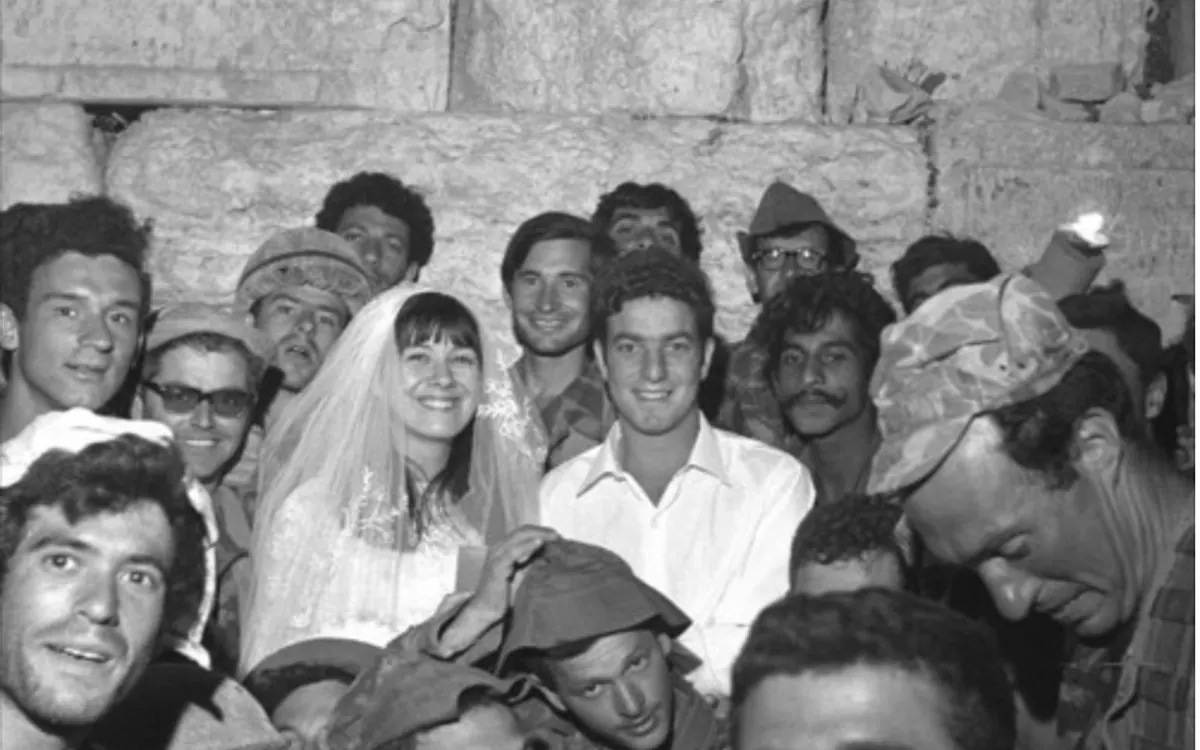
Every once in a while you have to get out of the house, and even out of the box. Where better to do that than Jerusalem, and who is a better partner than Yehudah Hakohen. Here is a free-flowing conversation on Jerusalem, redemption and the process in which we find ourselves day. In honor of the reuniting of the eternal city!
photo credit: Aharon Tzukerman 09/06/67 National Photo Collection of Israel, Photography dept. Goverment Press Office (link), under the digital ID D327-048.
About this episode
The view of Jerusalem is the history of the world, says Disraeli. Out of the box and onto a bench before City Hall, Rav Mike speaks with Yehuda HaKohen about Jerusalem Day. He sees a modern city and also the dreams and prayers of two thousand years, a realization in progress; Yehuda names an energy more than the sum of its parts, the fire sensed even in a quiet morning, a city with a psychological syndrome of its own, a magnet for certain souls and a mixed salad of them. It is also a real city holding ancient tradition and a bubbling modern energy, as a protest over Shabbat and Eurovision showed, both distorted features of our identity, a real cultural conflict where both sides champion a true value, which is why it is a real conflict and painful.
On the history, Yehuda argues the provisional government's decision not to take the Old City in 1948 was a loss. Israel won the ten-year urban war against Britain, largely fought by Lehi, who revolted against British rule and against Zionist ideology itself, seeing the Jewish people not as an object with a problem whose solution is a state but as a subject with desires and a mission in history, real characters in the same story as Judah Maccabee and Rabbi Akiva. Lehi, from Marxist backgrounds, used a critical materialist analysis to drag the Yishuv into war behind them, and by 1944 Begin's Irgun was also fighting the British, Begin something between revisionism and Lehi. But Jerusalem cannot be liberated by Lehi or the Irgun alone, because Jerusalem represents the unity of Israel; we lost it to Rome because we were not a unified people's army, and the Maharal teaches we cannot hold it without unity. So in 1948, however far ahead of the camp, Lehi could not liberate Jerusalem, and it was only in 1967 that a people's army could.
The decision marks a turning point: Israel won against Britain and the Palestinians lost far worse in the Nakba, but the real victors over Israel were Egypt and Transjordan, who expanded their territory, armed and led by British officers. Because of our tragic history we confuse survival with victory, surviving 1948 and thinking it a victory. Rav Mike pulls the lens back: survival as an end is a dead end, yet in 1948 it deserved gratitude, and the lack of unity that cost the Old City begs the question of how a fragmented society holds it. Machloket is part of the national culture, and Jerusalem Day has become a source of division, seen by many of his Pardes students as the beginning of the occupation; Yehuda answers that most Palestinian grievances concern 1948 and after, not 1967, which was an opportunity to correct, and that between 1948 and 1967 Israeli society was not even interested in Jerusalem or Hebron, so happy with survival and a bomb-shelter state, until Naomi Shemer climbed Mount Scopus where Rabbi Akiva had stood and wrote Yerushalayim shel Zahav, a sad song that raised the nation's spirit and made it care, and once we cared, history opened the door to the miracle of the Six-Day War, which smashed the idol of Christianity.
Western civilization, founded on a Christianity it has rejected as faith but kept as culture, finds the Jewish return to Jerusalem deeply threatening, and the obsession with a two-state solution is really about snatching the historical significance from the Six-Day War; in 1948 the West gave the Jews a bomb-shelter state on the beach, not biblical Israel, out of temporary compassion like Esau's for Jacob, and the biblical-style miracle of 1967 can only be repaired if that war loses its significance. We came back but were not mature enough, and for fifty-two years have been ready for a deeper awareness we have not had, so Palestinians are victims of a Jewish identity crisis. Yehuda offers two ways to shift Jerusalem Day from mourning to gratitude: the message that our history is unpaused, that people added days of holiness to the calendar through their actions and so can we; and the need for a post-colonial conversation among all the tribes of Israel over who we are, shifting from a narrow Jewish nationalism to a Hebrew universalism, declaring victory and moving on, since 1967 was the victory and the end of Zionism and we await a new Jewish liberation ideology.
Rav Mike adds that we are still on defense, unable to contemplate Jewish power in a world that reduces everything to victims and perpetrators, where a hero is painted as a villain with good PR. The way to resist the international attempt to divide the land, Yehuda argues, is to unite with Palestinian actors who also reject the two-state solution, so that Jews and Palestinians speaking in one voice would strip the international push of its moral credibility. The real essential way is a post-colonial conversation that clarifies identity and crafts real Hebrew models of universalism to transcend the friction between Jewish nationalism and Western liberalism. Rav Mike closes on the Omer: Jerusalem Day falls on chesed of malchut, malchut being the capacity to hold the context that lets the pieces come to right relationship, and Jerusalem the keystone of that capacity; the day of chesed is pure grace given before we deserved or could receive it, a blessing we may choke on, so it carries the responsibility to do the work from here to Sinai, a real messianism that believes the conditions now exist to build a better world and share it with humanity.
Key ideas
- Jerusalem holds an energy more than the sum of its parts, and a real cultural conflict where both sides champion a true value.
- Lehi saw the Jewish people as a subject with desires and a mission, but Jerusalem cannot be held without the unity of a people's army, which 1948 lacked and 1967 had.
- Because of our history we confuse survival with victory, and Jerusalem Day has become a source of division rather than unity.
- Naomi Shemer's song made the nation care, and once it cared history opened the door to 1967, which smashed the idol of Christianity.
- The way forward is a post-colonial conversation shifting from narrow nationalism to a Hebrew universalism, declaring victory and moving on from Zionism.
- Jerusalem Day falls on chesed of malchut, pure grace given before we could receive it, carrying the responsibility to do the work from here to Sinai.
Chapters
- 0:00 The history of the world; out on a bench
- 1:07 The energy of Jerusalem
- 4:23 A real city; the Shabbat and Eurovision clash
- 7:43 1948; the Old City not taken
- 9:56 Lehi: a subject with desires
- 12:04 Jerusalem held only by unity
- 14:19 Survival confused with victory
- 16:45 Jerusalem Day and division
- 19:19 Not mature enough; Naomi Shemer's song
- 21:26 The miracle smashes the idol of Christianity
- 23:35 The bomb-shelter state; Esau's compassion
- 26:57 History unpaused; the post-colonial conversation
- 29:04 Hebrew universalism; declare victory and move on
- 32:22 Still on defense; uniting with Palestinians
- 36:01 One voice against partition
- 38:23 Chesed of malchut; the keystone
- 41:41 A blessing we may choke on; real messianism
Who, where and when
People
Rav Mike Feuer, Yehuda HaKohen, Benjamin Disraeli, Avraham Stern, Menachem Begin, Zev Jabotinsky, Naomi Shemer, Rabbi Akiva, The Maharal, Yishai Fleischer
Places
Jerusalem and City Hall, The Old City, Mount Scopus, The West Bank, The Temple Mount
Texts
Netzach Yisrael, Yerushalayim shel Zahav, Vision Magazine
When
1948 CE: the Old City not taken, 1967 CE: Jerusalem liberated, 1967 CE: the victory and end of Zionism, 2019 CE: fifty-two years on
Read the transcript
The view of Jerusalem is the history of the world, says Benjamin Disraeli. It's more. It's the history of Earth and Heaven. And here I am, sitting at the center of Heaven and Earth, feeling a whole lot of gratitude. I'm Rav Mike Foyer, and this is The Jewish Story. Interlude. Jerusalem Day 5779. So every once in a while, you've got to get out of the house. I know that you're probably used to hearing me in the safety of my own living room, and you might be a little bit alarmed at the strange sounds you hear in the background in multiple languages, birds chirping, and even the light rail, because I'm out of the box. I'm out on the streets of Jerusalem. If you're going to get out of the box, my experience is it's best to do it when you're not alone.
And who better to do that with than Yehuda Akon. How are you doing, Yehuda? Good to be with you. Thank you so much for joining me here on a park bench in front of City Hall, perhaps one of the contenders for capital of the world. And we can talk about that later. it. So we're here. It's almost Jerusalem Day. And I asked you to meet me because I've got a bunch of stuff I want to talk about. I'm going to dive right in. You ready? Sure. Because when I look around me, on one hand, what I see is a beautiful city. It's a modern city. I see security guards. I see the light rail. I see trees and birds and grass and cafes selling coffee for five shekels apiece, which is impressive in and of itself. But do you know what else I see?
What do you see? I see the dreams and prayers and hopes of 2,000 years. It's something that is very present in my consciousness. Frankly, when I walk around Israel as a whole, but Yushalayim, perhaps more than any other place, that this is a place for which the people that we belong to has longed for a couple of thousand years. And I'm curious, first of all, do you feel it? Do you sense that in there? Yeah, every day. The truth is that is Jerusalem. What you're describing is Jerusalem. That is, it's the realization, but it's a realization of 2,000 years of longings in progress. It's realization and progress. It's not necessarily like realization full stop. No doubt. And we're going to come to the progress progressive element of this very day.
At the end, I want to save it for the end. But where do you see it in particular? Because when I look around, part of this is just in the architecture, right? You know, when you walk up to City Hall, the part that faces the old city walls of Jerusalem, there's like a little face-off going on there. Plus, of course, City Hall itself on that side is riddled with bullet holes from the failed attempts to take the old city in 1948 and all the sniping. So I feel like I see it in the architecture. Where do you find this sort of sense of moving past and present? I think we can see it everywhere. We can see it in the architecture, certainly. We can see it in the people. We can see it. But the truth is I think all of those things are really just expressions of an energy that's much more than the sum of its parts.
I think there's an energy Jerusalem has that we're sensing in everything, whether it's the architecture, whether it's the cafes, whether it's the proximity to the old city. The people, I think that there's an energy that shines through all of that, this energy of fire that we sense even in quiet, even on a quiet morning like this one. There's this just very, very intense energy that Jerusalem has that is undeniable. No doubt. I mean, do you think there's any other city in the world that has a psychological syndrome named for it? I mean, Jerusalem syndrome is a real thing. People come here, and one can say they're a selected group, meaning that there's a certain imbalanced nature that is attracted to Jerusalem.
But I think it's more than that. People come here, and some are unable to keep the veil over that energy, and it really overwhelms them. You get people prophesying in the streets. Well, maybe. You get people speaking in a way in which the rational world is not accustomed to receive them. Yes, that's true. And what's coming out is a big question. And I mean, that's a different topic for another time. But I think that's just the unique energy of Jerusalem. But I think that many cities all over the world have this energy. In our country, I think Hevron has a very distinct energy. I think Tzfat has a very distinct energy. But I think also Paris has a very distinct energy. New York has a very distinct energy. No question.
Like San Francisco has a very distinct energy. Well, listen, I wasn't joking when I said that this is a contender for capital of the world. Right. And I think there are certain kinds of souls that are attracted to certain types of cities. I think that there are just people who just are drawn, like magnetized to cities like Jerusalem. You might be one of those people. I might be one of those people. And I think Jerusalem obviously becomes somewhat of a mixed salad of those type of individuals who are just like drawn, magnetized to Zion. Oh, it is a mixed salad. And it's also a real city. I mean, one of the things I find fascinating, I don't know if you saw it. I wasn't going to bring it up, but why not? There was an image floating around on the Internet this week.
of, there was a protest of ultra-Orthodox Jews against the desecration of Shabbat that was bound up with the Eurovision event. Did you know where I'm going with this? And the police were unable or unwilling to break up this protest, and four young women whipped off their shirts and exposed themselves, not entirely naked, to this sort of group of ultra-Orthodox men who, of course, their culture and religious practices forbid them from seeing such things. It's not just their religious practice. Their culture and their sociology. But it's also the values of thousands of years. Okay. I don't want to get into the full discussion. We could have that again or another. You might not have wanted to bring it up.
But my point is I want the image. It's a huge can of worms. It is a can of worms. I have no problem with that. But I want the image, meaning both those people are Jerusalemites. That's all happening here. There is the ancient tradition and the desire for purity and cleaving to God. There is a very sort of lively, bubbling, modern energy. Okay, I mean, I think that there's problems of self-respect on both sides of that equation. Yes, no, I think both sides of that equation are unfortunately distorted or distilled features of our identity. Yes, they are attenuated, I would even call them. We're not going there, I'm cutting it off. No, no, but I think that really is, that there is a real cultural conflict within Israeli society.
I definitely understand both perspectives. I think there's truth in both. That's part of the problem. That's part of my problem. Well, that's why it's a real conflict. Right. It's a real conflict. Both have something very true to say. Both have a real value that they're championing. But I think there are certain guidelines I wish both sides can kind of maintain, because I really do. It's painful for me. It really is painful for me. Having Eurovision in our country is painful for me. Oh, yeah. Not just the desecration of Shabbat. No, the Etzim Dava. I don't know if you listened to Yishak Fletcher and I had a conversation about this last week. I did not hear it, but we have a show on it as well. Yeah, it's a problem.
It's a problem. But I want to focus on, if not the positive, at least on Yerushalayim. And I agree with you that one of the challenges we have is that what's the container that can really hold all those disparate parts that have become so attenuated, both in our exile and our tendency to go to the extreme in a way which is productive. And it might just be that Jerusalem is that. But let's talk a little history, because in the Jewish story right now, people who are following season three in a linear fashion, we're in the early 1950s. We passed through the wake of the War of Independence. We're not yet in the solid ground of the, say, post-67 existence here, where there's a little bit of a retreat of the existential fear, really in the heart of the insecurity.
And Jerusalem plays a very interesting role in that. I've heard you say before that you feel in many ways that the failure or the decision, depending on how you look at it, not to conquer the old city in 1948 on the behalf of the provisional government. Mind you that the Leche and the Irgun, the two other elements of the underground army, maintained their presence in the old city and indeed tried to hold out. But the decision of the provisional government not to either hold on to or perhaps reconquer the old city in 1948 constitutes a loss. meaning that perhaps we lost the war of independence in some way. Well, we did lose the war of independence. I mean, no, we won the war of independence against England.
Yes. We won probably what we could call a 10-year urban guerrilla war against England. Sure. That Lechi fought. The Lachamech Herut Yisrael, the fighters for the freedom of Israel, the Stern Gang. You're going out of that altogether? Not altogether, but they were against the revolution. You have to remember, for the first few years of this conflict, the Etzel, the Ergun Tzvai Lumi, was not only not fighting the British, they were... Aiding the British in their World War II efforts. And aiding the British against Lechi. Yeah. So, you know, the revisionists, what we'll call the revisionist Zionism, stood with the British. and Lehi was not only revolting against British rule in our country, Lehi was also revolting against what we can call Zionist ideology, including revisionist Zionist ideology.
Like Zionist ideology, which views the Jewish people as an object of the problem. The solution to that problem could be a state. A nation state or what have you. Right, whereas Lehi looked at the Jewish people as a subject with desires. That's an excellent formulation. I think you've thought about that before. Yeah, sure. But really, they saw themselves as real active participants in the same story that Yudah Maccabee was a character in, and Rabbi Akiva, and David Amelech, and Yerushua bin Nun, and all of our heroes throughout history. And they saw themselves as real characters in that same story. The next chapter of this ongoing story. I want to make sure I got it straight. We're not an object with a problem, but a subject with desires.
A subject with desires. I'm going to quote you on that. We have a mission in history. so they won this 10 year urban war well part of it and I think this is where a lot of their political sophistication remember most of the leaders of Lehi came from Marxist backgrounds and by the late 1940s they were kind of back there I think we can look at Lehi as almost like a proto-Maoist type of organization but they definitely used historical materialism they used a very critical scientific analysis in order to not only defeat the British Empire, but also to drag the Jewish community of Palestine in a war behind them. So by 1944, you have to remember also, by 1944, Menachem Begin, who had escaped Poland, he becomes the leader of the Etzel.
He becomes the leader of the Irgun Tzweilumi here in Palestine. And he wasn't exactly a revisionist, even though Begin likes to present himself as the heir to Zev Jabotinsky and as the leader of revisionist Zionism, the truth is Begin was something in between revisionist Zionism and Lechie. He was in the camp that pushed against Jabotinsky while he was still alive. Right, but still saw himself until his death as a student and a follower of Jabotinsky, whereas Lechie even from the late 1930s He made a clean break Avraham Stern and his followers had they were look a lot of these people were people who had actually come from Marxist backgrounds into labor Zionism rejected labor Zionism because it was really too soft in terms of what they saw the revolutionary needs of the Jewish people as being at that time they saw Zev Jabotinsky in revision of Zionism having a much more masculine Jewish nationalism, so they did go there for a moment.
But it became very clear to them very quickly that this was not really their home. It was a shallow vision, ultimately. Exactly. It was a shallow vision. Let's bring this back around to Jerusalem. However, they did see it as a great place to recruit from. Yeah, oh yeah. So the Yair Stern and his followers were able to recruit from the Etzel in the land of Israel and from the Beitar movement and the revisionist movement in the diaspora. but really when it comes to 1948 when it comes to Jerusalem by that time Lehi had already dragged the Edsel behind them from the time Begin took command and by 1944 the Edsel was also fighting the British even for a moment the Haganah was by 1948 it became very clear that the Jewish leaders who had collaborated with British imperialism were going to take power now that the British were leaving and they had made a strategic decision probably in collaboration with the Hashemite Kingdom of Jordan that they would not fight to liberate the old city of Jerusalem.
Lehi, of course, rejected that, and Lehi was determined, and the Etzel as well, to liberate Jerusalem. But, you know, Jerusalem can't be liberated by Lehi. It can't be liberated by the Etzel. Jerusalem represents the unity of Israel throughout history. We lost Jerusalem in the great revolt against Rome because we weren't united, even though many of our... Sure, it burned from within, before the Romans ever broke the walls. Right, and even though we had so many different factions committed to fighting for our freedom and fighting to free our land from the Romans, because we weren't a unified people's army, we lost Jerusalem. You know, the Maharal is very clear about this in Netzeh Yisrael, in his book on Tisha B'Av, that we cannot hold on to Jerusalem if we are not unified.
And I think that's what happened in 1948. Lehi, no matter how ahead of the camp they are, are not able to liberate Jerusalem without the rest of the nation of Israel behind them. It was only in 1967 that Tzahal, a people's army, the army of the Jewish people, was able to liberate Jerusalem. So that's a story that lies ahead for those of you who are keeping track of the Jewish story in its linear sense. So what I would take from this then is that the situation in 1948 is a stage. It's a turning point. Well, I would say we lost the war against the Arabs. We lost the, well, we lost a round of that war. Well, I'll say this. We won against the British. We made the British leave. We forced the British to leave.
According to their documents, they left Palestine because of Jewish terrorism. The Palestinians lost worse than us. Oh, yeah. In terms of the Nakba, the Palestinians definitely lost much worse than we did. But the big winners of that war who defeated us were really Egypt and Transjordan. Because they increased their area significantly. And they were armed, trained, and led by British officers. We were still fighting the British in the war. No, for sure. and we're creeping slowly in my story toward the tripartite aggression, the 1956 Suez War. So I want to leave that story on the horizon. But something deep I think we need to be able to appreciate is because of our tragic history, we confuse survival with victory sometimes.
Oh, no question. We survived the war of 1948. No question. We survived. And we thought that was victory. We had a state when the smoke cleared, even though it was less than the territory we conquered from the British. But I want to use that as a jumping off point because it's true that survival as an end unto itself is, in my eyes, a dead end. Nevertheless, first of all, it does deserve a significant dose of gratitude, especially in 1948. This is a major topic. No, I agree. As I've been introducing my readers to some of the more difficult moral challenges that Israel faced in defending its borders, particularly from the phenomenon of infiltration, which had a conversation, or not a conversation, I just told the story of Kibya, if you're familiar with the sort of massive retaliatory raid that happened in 1953.
And I put out there for people to think about, And I'm reminding folks, I asked you for your feedback, that though today the value of survival may not present itself as particularly pressing, although it might still be, in 1953, less than 10 years after Auschwitz, and certainly only five years after the War of 1948, it was a legitimate and pressing need. But I want to take a pull back again on the lens. So a little bit of the sense of why we didn't take 48 deserves to reflect. I want to emphasize that lack of unity because as we were speaking about before in the sort of very fragmented nature of our present society that begs the question of how we hold on to it. But I also want to just – It's actually very challenging because part of our nature, part of our national culture is machloket.
Oh, yes. That's really part of the culture of Israel is to disagree with each other. You've heard this two Jews, three opinions. That's a real part of our identity. So let's go there right now. I was going to wait for this point later, but I wanted to point out that I am a teacher in a sort of a liberal and somewhat even progressive Jewish environment in the Pardes Institute, wonderful place that I get to teach. And Jerusalem Day, in the eyes of many of my students, is not just Jerusalem Day. It's the beginning of the occupation. because I think one of the reasons that Yom Yerushalayim has been so difficult in finding its way, even in the Israeli society and certainly outside of Israel, is that the sense of euphoric victory and sort of divine intervention, which was a widespread sense at the time, and even for many people well after, there's a whole conversation to be had of the impact of 67 on American Jewry, has dissipated.
And what's replaced is a sense of almost achsavah, of a disappointment and frustration around what it is to be a people sort of sitting with our foot on the back of another people, rightly, wrongly. I don't want to do an analysis of the occupation right away. Let me finish my point. what is interesting to me in light of the sort of introduction you gave about 1948 is that if we accept the premise that Jerusalem cannot be conquered other than by a united people then what does it mean today that the day of the capture or the six days of the recapture at which Jerusalem sits at the heart of has become once again a source of tremendous division in Am Yisrael What does this tell us about the future of this day, which I personally celebrate wholeheartedly, and we'll speak about that at the end in my eyes, the importance of celebrating.
But nevertheless, if Jerusalem is held or captured through unity, what allows us to hold it? Because you pointed out that in our nature as a people, and I agree with you, the difference between machloket and l'shem shamaim, of a sacred disagreement based on the belief that the truth is larger than you or I, and therefore it's necessary that we disagree in order that we come closer to that large truth. And makol geshe'in a'lashim shemayim, like a really divisive argument. Who's going to be the leader? Right. Who gets to own the argument, right? That Greek model where if I'm right perforce, you must be wrong. Yes. As opposed to the Jewish model, which is he is right and he is also right. Right? So what do you think that says about the situation in which we sit today?
That Yom Yerushalayim is seen also. So it's kind of like Columbus Day used to be a happy day for the origins of white European America. And then someone woke up one day and said, well, it also happens to be the day when the native peoples of this continent began their end. I think the comparison makes me a little bit uncomfortable. But I want to just get back to something you said, maybe in terms of some of the students at Partez or others who look at Yom Yerushalayim as the beginning of the occupation. I think that any Jew who looks at Yom Yerushalayim, the day we liberated Jerusalem in 1967, as the beginning of Israel's occupation over the Palestinians or any injustices over Palestinians have probably not spoken to Palestinians.
because in my experience, most Palestinian grievances have much more to do with 1948 and Israeli policies during that war and a lot of Israeli policies following that war. 1967 was maybe an opportunity to correct. I also agree that we haven't yet figured out, you know, we came back to the cradle of Jewish civilization in 1967 and we might not have been mature enough as a society to do so. I also point out, I think it's really interesting how sometimes history forces things on us. Between 1948 and 1967, to my sorrow, embarrassment even, the Jewish people as a collective, Israeli society, was not interested in Jerusalem or Jericho or Bethel or Hevron or Shechem. They didn't feel the lack. They weren't feeling it because I think we were just so happy with survival, so happy to have a nation state, a bomb shelter after all of the persecutions.
Licking a lot of wounds. Right. And it wasn't, you know, and I think that we were insensitive. There were people, there were individuals, a lot of the veterans of Lehi, especially people like Dr. Yisrael El-Dad, Rav Tziuda, Kouin Kouk. There were people who were pushing, who did speak about what's next, about where we need to go next. I felt the pressing vision. But most of Israeli society wasn't there until a woman named Naomi Shemr. Yeah, amazing. Climbed Mount Scopus and stood exactly where Rabbi Akiva stood with his friends when they looked down at the Temple Mount and saw foxes coming out of the Holy of Holies. And she wrote a song. She wrote a sad song that actually elevated the spiritual level of the nation of Israel.
It's a phenomenal thing. You know, Yerushalayim Shalazahav. She wrote, you know, after this piece of jewelry that Rabbi Akiva bought his wife before going out to war to free Jerusalem from the Romans. And she writes this song, and it's a sad song, that really speaks to the soul of the Jewish people about the loss of Jerusalem, not having Jerusalem. And I think that song inspired the nation to care. And once we cared, history opened the door. Now, in that, we experienced biblical-style miracles during that war. In six days, we liberated so much of our homeland, and I think we also smashed the idol of Christianity, which is something maybe we can talk about. Maybe another time. I think you are correct. There's a major, major sort of shikhou that happened.
There was a liberation from old conceptions. On a very deep subliminal level, I think Western civilization's obsession with a two-state solution here is really all about snatching the historical significance away from the Six-Day War. So pause on that because many of our listeners won be aware that up until 1948 and even for a number of years after arguably to this very day the Vatican was driving an effort to internationalize Jerusalem There was a sense that anything but Jerusalem we can let the Jews have this we can let that but Jerusalem belongs to the whole world even though of course for many years perhaps since the Crusades, it hadn't been such an issue. And the temerity of the Jewish people to return to what had only ever been our capital was a driving force within certain elements in the Christian world to attempt to prevent that.
And so therefore in 67, when history, as you said so nicely, responded to our care, it really sort of broke the back of that religious conception and perhaps has been replaced, as you're saying, by a political conception, which once again looks to divide. Well, I think that Western civilization is really founded on the base of Christianity, even though Western civilization has rejected Christianity as a religion, as a faith, Yeah, but it's a culture and a foundation for their history. You can't get away from it. Correct. And I think the Jewish people coming back to Jerusalem is deeply, deeply offensive and deeply threatening to Western civilization. And I think that what essentially happened was in 1948, the way the West related to all of this was the Jewish people, you know, they deserve a bomb shelter.
We're going to give them the bomb shelter. There's a lot of guilt. Just kind of like in Parshat Vayishlach when Yaakov comes into the land of Israel and he meets Esav. Rashi says there that Esav really felt sorry for Yaakov at that moment. Yaakov comes into the land limping and Esav responds with compassion. But it was temporary compassion and Yaakov was aware enough to get away from Esav before that temporary compassion kind of wore off. So I think Western civilization, number one, said they're not really in Eretz Israel. They're not really in the biblical Israel. They're not in Bethlehem. They're not in Bethel. They're not in Jerusalem. They're on the beach. Let them be in Tel Aviv. Let them be in Haifa.
We give them a bomb shelter state. And that's the way Christianity and Western civilization kind of dealt with this. But then in the Six-Day War, the world experienced a biblical-style miracle according to the Jewish interpretation of Scripture. And that really smashed the idol of Christianity in a way that can only be repaired if that war and those miracles lose their historical significance. But I'll say we came back for us. When we came back to these places, we weren't mature enough. We had the desire suddenly because of Naomi Schemmer's song maybe, but we didn't have the understanding of what we're doing here. So for the last 52 years, we've been ready for a deeper conscious awareness that we haven't had.
So this is exactly what I want to pick up on because there's two elements in what you said that I think need to be engaged. One is the sense that history responds when we begin to care. And the other one is that we lacked the maturity or the consciousness to really receive the enormity of what happened. And, you know, you used the phrase, you said, sometimes history forces things on us. I think history always forces things on peoples as a whole. And I think one of the tensions between leadership and sort of like large-scale culture in history is that the art form of leadership is to read the writing on the wall. And so it's not just – history isn't forced upon leaders. A wise leader is able to see the way in which the currents are moving and perhaps even guide their people sort of through them.
So here's my thought for you is that for sure we haven't absorbed – and even after 52 years, we haven't absorbed the enormity in the scope of Jewish history. Right, and I think that Palestinians are very much victims of that. Very much so. And in my eyes, that plays itself out in sort of the lack of clarity of identity that we have. Palestinians are victims of a Jewish identity crisis yeah and so therefore we're on one hand dismissive of them on the other hand deeply threatened by them the one thing that we can't do is look them in the eyes and say wow it's amazing that's how you see it we need to talk about this because that's a position of inner wholeness and strength that's a position of strength and a theme that I've been developing all through season 3 which we should probably at one point take a direct charge at is that the one thing that we're not really able to do is contemplate Jewish power because especially now with the rhetoric of the progressive world which wants to reduce everything to this binary of victims and perpetrators and where we as a people are living a heroic story.
The difference between a hero and a villain is a hero uses power in the name of good and right, but in the eyes of the progressives, a hero is just a villain with good PR, which is so often what we're being painted as and unfortunately sometimes falling into the behavior of. But anyway, I want to say these two elements of his response to our care, and yet we lack the calium, we lack the vessels to absorb the enormity. What do we do in order to transform Yom Yerushalayim as a day? Because right now, even in Jerusalem, even in Israel, and certainly much less in Chuflar, it's in the diaspora, Tisha B'Av, the day of mourning for the destruction of the first temple and the second temple and so many historical events, strikes a much more powerful chord in the hearts of most Jews than Yom Yerushalayim.
What is it? How do we shift from that posture of mourning toward the posture of gratitude, even though recognizing it will end on the note that we're not done. Temple's not standing where it belongs. We as a people are far from united, and there's much suffering in our own lives and the lives of the Arabs around us that comes from that. But nevertheless, how do we begin to shift in response to that enormity? I have two answers. Great. Number one, I think the most important message I think we can take away, the Jewish people can take away from Yom Ha'atzema'ut, Independence Day, the day the British left and we declared independence, and Yom Yerushalayim, the day we liberated Jerusalem 19 years later, is the idea that our history is unpaused.
Now we are living in a world where you and I can do things in our lives that can put new Chagim on the Hebrew calendar. We can add days of Kedusha, days of holiness, to Israel's calendar through our own actions, through the things we do in our lives. And I think that's a very empowering message when we look at Yom HaTzmud, when we look at Yushalayim, that people did something that actually added days, added holidays to our calendar, shows us that we can also do that, number one. Number two, I think that what's really left for our society to do and what would probably clear up a lot of the confusion and solve many of our problems is engaging in this kind of post-colonial conversation. We haven't done that, you know, when we defeated the British, we kind of took down their flag and then we put our flag on their system.
Very common act, by the way, in world history. Right. I don't think we're the only ones, but we need to engage it. We need to kind of clarify our identity. We need to have a national conversation with all of the different tribes of Israel, all the different sectors of Israeli society in the broader Jewish world, and have a conversation over who we are, what we came back to life for, what this project is all about, where we hope this leads the world. We have to kind of shift, I think, from narrow Jewish nationalism, which is what Zionism was, to Hebrew universalism. I think that in 1967, when we returned to Jerusalem, it was the victory of Zionism. It was the end of Zionism. And since then, we've, of course, been waiting for a new Jewish liberation ideology that we need to encourage our young people to participate in formulating, rather than just kind of train them to be like Zionists.
And that's, I think, a lot of what's going on in the Jewish world today. Oh, yes. We're freaking out because some of our youth are too smart and too passionate to go for this kind of like pre-canned Zionist talking point campus stuff. Regurgitated nationalism. Right, where they're looking for something bigger and we need to provide something bigger. And I think that's what I, you know, 1967 we came back. On the one hand we were like these are the places we've been yearning for for 2,000 years. On the other hand, the Americans and Europeans don't want us here. But on the other hand, like, we need these mountains to defend ourselves. But on the other hand, there are too many non-Jews here. What are we going to do with them?
What about our kind of, like, ethnostate? And we've been hung up in that back and forth ever since. 52 years later, here we are. There are still refugee camps. Things have gotten actually much worse for the Palestinians. In many ways, sure. And I think now we need to kind of really engage in this post-colonial conversation and encourage our youth to see themselves as the thought leaders of a new Jewish liberation ideology that can pick up where Zionism left off and actually bring our people the rest of the way forward, protect Zionism's positive achievements while cleaning up its mess, and actually trying to figure out what we're doing here and what we have to share with the world now that we're back on the stage of history.
So, fantastic. I want to respond to both those points, and then we'll hit one last piece, and then we're going to have to wrap it up because, you know, Jerusalem is also a city where we both go to work. Well, I also want to let listeners know that if they want to hear more of these ideas, they can check out our podcast. We just started a podcast. Where can you find it? Well, Vision Magazine, visionmag.org, or on SoundCloud. I think they should just search Vision Magazine. If they want to be in touch with you directly, you've got an email they can find you. My name is Yudah Hakohen. It's yudahhakohen at gmail.com, but also through Vision Mag. Things can get to me, visionmag.org, the Brit Chazon Movement.
We just launched a podcast. I don't know if we're doing it right. I hope we're doing it right. It's all right. In the beginning, it's always messy. Yeah, okay. So it's messy. And listen, folks, if that was too much information for you, Absorb Mosley, you know how to find me and I can find you, Huda. I highly encourage you not just to tune in but to share, right? Because if the things that we're speaking about here strike a chord, if you agree, you disagree, it doesn't really matter. If it strikes a chord, respond, right? That's what we're looking for is looking for a conversation. Exactly. And so in that light, I hear you laying out a very different type of post-Zionism than the one most people are familiar with.
My experience is that you are correct that the regurgitation of sort of like cold nationalism, right? Nationalism is a dish best served hot, right? And right now it doesn't really appeal to people. And the sort of ability to stir the embers through fear and through slogans is limited for people of intelligence and sensitivity. Well, it works better on Israelis and diaspora Jews. Because Israeli Jews do actually experience themselves as the right. Exactly. And diaspora Jews don't see it. It's antithetical to the culture they're living. But the problem is that if we fail to offer an alternative, so then post-Zionism becomes a deconstruction of Zionism. Right. It shouldn't be a retreat from Jewish liberation, but we should advance to the next stage of Jewish liberation.
And I really do believe that at this point in history, Jewish liberation and Palestinian liberation are intertwined. So to me, what needs to be done is we need to declare victory and move on. Meaning to keep fighting the battle of 1948 and 67 is a mistake. You declare victory and move on to the question of what lies next. Now, the question of, as you called it, Hebrew universalism, which in my mind really is sort of the emblematic symbol of that is the Temple Mount and this idea that Zionism was about returning to Zion in terms of Jerusalem We could call it even Moriahism as I heard Yishai Fleischer say that there a visionary element of uniting the world the Malchut Shaddai, which is there. There's another piece that I wanted to respond to, is that this power of making history, and putting days of holiness, of Kedusha, sanctity, into our calendar ourselves, it's worth noting that one of the reasons I believe that we haven't yet absorbed the enormity of the world in which we're living is because it's deeply threatening to normative religion.
Meaning a religious person functions oftentimes through the sanctity of routine, which has been sort of clarified and codified through ages. And there's a deeply challenging element in religion. It's deeply challenging to change things. I think that's just part of what we're facing. Now, on one hand, that's good because it allows you to preserve much of the wisdom that has been clarified and sanctified over the ages. On the other hand, it can be downright stultifying. One of the things I find so frustrating is, and it's less, actually, I find, than since I came here about 16, 17 years ago, are the arguments that simmer around whether you should say a bracha or you should say a blessing when you say halel.
the Psalms of praises on Yom Yerushalayim and Yom HaTzuh. I do, by the way. I do. I belt it out. In the morning, not at night. And frankly, I haven't done it at night in years. We did it in the beginning, and then it kind of faded in my community. I frankly find it a little bit bizarre that I'm expected with a full heart, at least because I'm Ashkenazi, to say a bracha on Rosh Chodesh when I say halal. But on the day that I genuinely feel God has touched the planet within our time, well, I'm not so sure. But a part of that is just the nature of religion. And I think that there is just some breaking. So that's a deep, deep question because I don't think we have a religion. I think that this portable version of our national culture that we took with us into exile was rebranded as a religion a couple hundred years ago when we wanted to be Germans and Frenchmen with full rights.
Sure, we've spoken about that a lot along the way in the Jewish story. Nevertheless, functionally for many people, it is what it is. I'm with you. I'm with you. That's part of this decolonization process. I think when we stop thinking of this religion called Judaism and actually kind of relate to ourselves as part of this rich, ancient civilization that's impacted human history so much and is back on the stage of the international community to impact history again. And to start thinking about not – I think part of the problem, one of the things that's really in our way is we're still on defense, like you said. Oh, yeah. And I think part of it is because we're experiencing the international community trying to, like, take away part of our land.
Push us back into the box. Right. Reverse our victories of the Six-Day War. I actually think, you know, if you take all the Jews living in the West Bank, we're a very diverse group. You know, I know you live in the West Bank. I live in the West Bank. Our communities aren't the same. Some of my best friends live in the West Bank. But I think that there's a common denominator that a lot of us share. And that's that we see ourselves as this proud ancient people that was unjustly displaced from our land. We somehow managed to return home after 2,000 years against all odds. Yet the international community is trying to displace us again through a two-state solution. And the only way we figured out so far how to resist that is to populate as many mountains as possible to make it logistically hard for them to remove us.
Exactly. That's right now. Now, I've been part of that. I've spent the last 18 years of my life being part of those efforts to populate these different parts of the West Bank and East Jerusalem. But one conclusion that I've reached is that in addition to those efforts, I think the real essential way to defend ourselves from international attempts to divide our land is to unite with Palestinian actors who are looking to resist the two-state solution as well. if Palestinians and Jews are able to speak in one voice against partitioning this land, against a two-state solution, then I think the international community, especially the United States, will lose all moral credibility in trying to push these top-down solutions on us.
This is a powerful stance, and it's something if people want to know more about, I highly recommend that they tie in to Vision Magazine and that they be in touch with you, because I know many of the people out there probably heard that or are thinking, a lot. I've never really heard anyone who's in favor of populating hilltops with Jews talk about uniting with the Palestinians. Something else I would add to that is that we need to learn to speak in a language which can unite the world in new ways. So many of the paradigms that we inherited from World War II, the sort of post-colonial problems, as you name them, are already dead in the water. They're dead men walking, but we have not yet offered a vibrant alternative.
It's so much of what Jerusalem offers and I want to use that as a segue to the last point. You know, we're in the middle of counting the Omer. We're not in the middle. We're moving toward the end. This sort of like sacred period in our calendar and aside from questions of whether we're a religion or not, one of the great gifts that we've inherited from our past is the Hebrew calendar. It's a tremendous tool for tying into the spiritual rhythms of the universe. And here we are moving from the time of liberation toward a time of full freedom and the receiving of the Torah. We're going out of Egypt at Pesach and standing at Sion on Shavuot and it happens to be that each day if people are unfamiliar, has a particular characteristic.
Each day in those 49 days, and the day of Yom Ibrosh Laim falls out on chesed-ship of Malchut. Malchut, of course, is that kingship. It's the capacity, as I like to say, to hold the context that allows the pieces to come to right relationship. That is my understanding of the way our tradition frames Malchut. And Jerusalem is the keystone in our history for our ability to hold the context for the world that will allow the pieces to come the right relationship. And Yom Yerushalayim is the chesed sheba malchut. It's the day in which, like you said, we were ready for it. Perhaps we didn't even deserve it. But God said, you know what? It's time. Here, take this. And one of the great challenges of any act of chesed, of course, is that people can choke on it.
If you give someone something they're not prepared for, even with the greatest of intentions, God forbid, you can do a lot of damage. Right. We say that a curse is like a blessing we're not ready to receive. Yeah, for sure, because we believe kol mei tashem, Everything's from God, and therefore there are really no curses per se. There are only those which we don't have the vessels to receive. So I want to offer this to you, that this is the process holiday. This is the holiday of the in-between, of how do we embrace the joy and gratitude for being where we are? And I just want to emphasize to the listeners who maybe can just hear the noise in the background and don't appreciate the fact that the grass is green, the sky is blue, the trees are fantastic, the birds.
people of every description, religious, non-religious, Jews, Arabs, people of all persuasions, just living their lives here with a richness which I think, forget it, 2,000 years ago, 100 years ago, we would not have been able to imagine. And yeah, underlying that, we can talk about... It is miraculous, and yet underlying, we can talk about structural inequality. We can talk about the larger problems of social injustice. We can talk about religious tensions, and they're all real and true. But I'm grateful to be having those discussions within the context of renewed Hebrew sovereignty in Eretz Israel. This is it. This is why I think that Yom Rosh Hashem falls out on the chesed, because we now have capacity.
Right. The conditions exist. Yes, and that was a gift. It was grace, and we didn't really deserve it. It was true chesed. But with it comes a great responsibility to now do the work to get from here to Sinai. So that's what I think, what you're expressing, I think, is what I would call real messianism. messianism as it like christianity messianist don't worry about that christianity is not messianism marxism is messianic whereas christianity is not and i think we're you're gonna get in trouble with somebody for that one out there i'm saying messianism to me to be messianic is to believe the conditions exist to create a better world so i would say that just like we can argue you know western liberalism and capitalism are better than what came before it better than the feudalist system etc you know israel came back to life in order to present something new to the world, in order to influence the world with something better.
That is what I see as Hebrew universalism. That's what I think Yom Yerushalayim should be the beginning of, that now we think about not just our own survival and our own defense and our own nationalist aspirations, but our universalist aspirations. A lot of the conflicts within Israeli society are between the forces of Jewish nationalism and the forces of Western liberalism. I think that ultimately we're going to be able to transcend those ostensible opposites when we unpack real Hebrew models of universalism. Meaning like minority rights in the state of Israel don't have to go according to western models. And if we try to impose western models of, I'm just using minority rights as one example, but if we try to use western models of minority rights, that will threaten the forces of Jewish nationalism but satisfy the forces of western liberalism.
If we create a system and a society that's inherently unjust and favors one ethnic group over another, that will obviously upset the forces of Western liberalism, but please, the Jewish nationalists, we need to create models of real Hebrew universalism that can transcend that ostensible friction and satisfy the forces of liberalism and nationalism within us. And I think the driving force to that, I'll just repeat back what you said, is a real massism. The real belief that the world can actually be a better place. Not that salvation lies beyond, but that salvation actually will come to fruition within. and here we are sitting in the not yet fully rebuilt, but certainly fantastic city of Jerusalem.
Listening to children playing, as Rabbi Akiva said. Rabbi Akiva was able to laugh when he saw the foxes on Harabite. Even though they were messing with his recording. This is a fulfillment of prophecy, people, and I want you to be part of it wherever you are. You can be part of it with Yudah Cohen by finding him at Vision, say it again? Vision Magazine, the next stage podcast at Vision Magazine. Just search Vision Magazine on SoundCloud or go to visionmag.org. or you can reach out to me and I'll put you guys in touch. You can always find me, you know where, I'm on Facebook and Twitter, Jewish Story Podcast. Just get in touch, people, Rav Mike Foyer at gmail.com and I want to thank a few people before we close out.
I want to thank all those folks that give their hard-earned money for helping to make this show happen, for keeping it free and widely distributed. I want to ask you to join them right now. Do a little something for the sake of your marriage line. Go to my website, jewishstory.co. In the upper right-hand corner, you'll see a button that says Be a Patron. You can click on through for a little bit of per podcast support. If that's a little bit more than you're looking for, I'm happy to sponsor the show in the memory of the deceased or in honor of the living. Send me an email, and I will set you up with the details. I also want to thank the Land of Israel Network for creating a platform that allows me to reach so many amazing people.
That's thelandofisrael.com. I want to thank the Pardes Institute, P-A-R-D-E-S dot org dot I-L for building an educational institution that allows me to touch the hearts and minds of so many amazing Jews. And I want to thank you for listening here on this wonderful Jerusalem Day. I'm Rav Mike Foyer, and this is The Jewish Story.
More from Season 3
TJS S3E5 1949 Boundary issues - part I
In 1949 Israel was in the dangerous position of winning the battle and losing the war. Though ceasefire agreements were in place, peace remained elusive. This episode opens...
Play Episode
TJS S3E6 The limits of retaliation
Every value has a boundary and every state a border, which means that often we have to fight to maintain them. Here is the story of Israel's struggle...
Play Episode
TJS S3E7 70 years of constitutional crisis part I - 1949
If I asked you whether Israel has a constitution are you sure that you would know the answer? This episode is the first half of answering the question...
Play Episode