
TJS S3E7 70 years of constitutional crisis part I - 1949
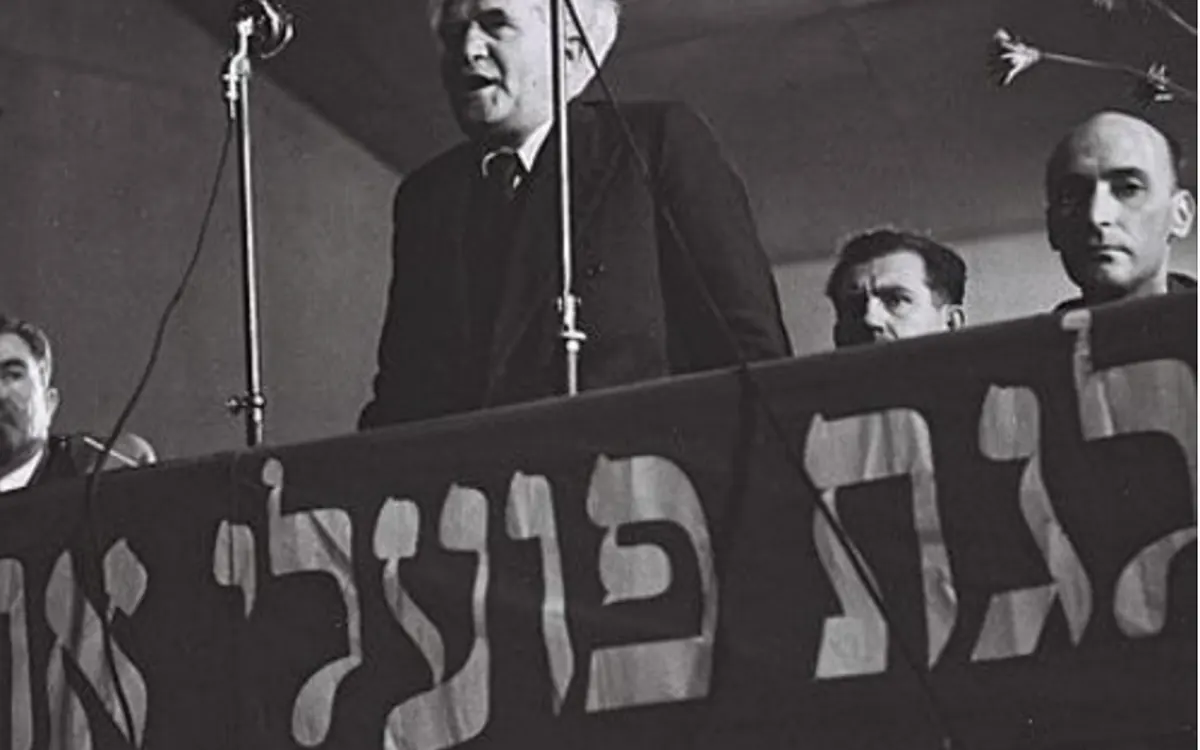
If I asked you whether Israel has a constitution are you sure that you would know the answer? This episode is the first half of answering the question by delving into the history of Israel's 1949 Constituent Assembly.
Picture by Hugo Mendelson - This is available from National Photo Collection of Israel, Photography dept. Government Press Office (link), under the digital ID D715-035.
About this episode
What is government but the greatest reflection on human nature, says Madison, if men were angels no government would be necessary. Of the UN's members, only a handful lack a written constitution, and whether Israel is among them is so Jewish a question that it is a machloket: from the outset the state sidestepped its commitment to write a constitution in 1948 and took a process approach, writing basic laws as need arose, until in the mid-nineties the Supreme Court ruled that the eleven basic laws now function as a constitution, giving the court the power of judicial review, so that Israel is the only country whose constitution was promulgated by the judiciary. To understand why that matters, start with the Federalist Papers, the essays of Hamilton, Madison and Jay that framed the US Constitution as the lasting contribution to the science of politics. From their worldview come two lessons, a sense of human greatness, the belief that societies can establish good government from reflection and choice rather than accident and force, which let the Constitution progressively empower an ever broader swath, and a belief in God, the hand of providence that lent humility and gravity.
From their process come two more lessons: the relationship between crisis and opportunity, since states adopt constitutions in crisis, which compels discussion of basic questions and readiness to compromise, a boat Israel missed in 1949; and ratification, since a constitution must address the state's basic principles, the status of the individual, the nature of the government, and the values that bind it, answers reflective of fundamental values and binding for generations, requiring broad consensus that cannot come through ambiguity. The Declaration of Independence committed Israel to a constitution adopted by an elected constituent assembly no later than October 1, 1948, now seventy years past the deadline. The war ran until March 1949, so the deadline was unrealistic, but the country tried: a census under seven-hour curfew counted half a million voters, and on January 25, 1949 elections for the Constituent Assembly, HaAsefa HaMekhonenet, were held in a festive atmosphere at nearly 87 percent, Mapai dominating with 46 of 120 seats.
The assembly first met on Tu BiShvat at the Jewish Agency building, an act of defiance against the UN's claim on Jerusalem, Weizmann opening with honor and awe. But in its first real act, on February 16, it passed the Transition Law, reconstituting itself as the Knesset, the legislature, before dealing with any essential question of what government Israel would have, as if the US Constitutional Congress had metamorphosed into the US Congress without a vote. Only Hillel Kook, the hero who had tried to mobilize American Jewry to save European Jews, cried out that a putsch had taken place, since writing the constitution would force the clarification of the relationship between religion and nationality and between Jew and Israeli; as a classical Zionist he cared not for who is a Jew but for what is an Israeli. The Declaration had mandated a three-stage process, provisional council, then a constituent assembly to draft a constitution and disperse, then elections under the new system, but the assembly jumped to the end, and a Maariv editorial lamented that the first assembly since the destruction, meant to give Israel a Torah and name the purpose of independence, could run a state but could not say for what purpose.
The best decision available may have been a legislature now rather than a long constitutional debate in the midst of war, infiltration and mass immigration. The Knesset did re-form the Constitution, Law and Justice Committee, but now to answer first whether to enact a constitution at all, and a legislature has a vested interest against entrenched laws that curb its power, which is why successful constitutions are written by ad hoc bodies that disperse. After a year and a half the Knesset reached an eminently Israeli decision, the salami method, and on June 13, 1950 the Harari decision assigned the committee to prepare the constitution chapter by chapter as basic laws, which together would one day constitute the constitution; in essence they punted, avoiding the hard work of building consensus and leaving their own power unchecked. A constitution embodies the highest values, sets boundary conditions on policy, and serves an educational function, and against writing one stood several reasons. First, democratic confusion over the demos: the Declaration both calls Israel a Jewish state and promises complete equality to all inhabitants, the real tension of Jewish versus democratic being whether the Jews are the demos and non-Jews protected inhabitants, or all are part of the demos, sharpened because a sizable minority had yesterday been the enemy, with the reconciliation of security and civil rights one of the thorniest areas of constitutional law.
The common claim that religious opposition prevented a constitution is largely a bugbear created by Ben-Gurion for political purposes, since most religious politicians were not opposed in principle; he was likely more frightened of the romantic spiritual currents within his own party. The real causes were power politics and Ben-Gurion's conception of democracy: a child of the French Revolution who like Rousseau read his own intuition as the general will and like the Jacobins held that democracy means unrestricted parliamentary majority rule, horrified that a court could annul a law, wary of a discourse of rights, preferring a bill of civil obligations, deeply Jewish in that classical Hebrew has no word for rights and the Torah establishes them by mandating obligations, seeking to make the individualistic immigrants into a people of whom demands could be made. And there was identity confusion: Sharett argued a state cannot function without a concrete image, yet those who opposed a constitution did so for the same reason, that in the wake of the Zionist revolution we did not know who we were, as Hugo Bergman cried what is Judaism and Eliezer Steinman said all of us have been shaken to the depth of our being, so the elite agreed with Ben-Gurion that identity must form organically through the ingathering, the army, the schools and Hebrew culture, and a binding constitution at so tender a stage was foolish if not dangerous.
Key ideas
- Israel took a process approach to its constitution, and the mid-nineties court ruling that the basic laws are a constitution made it the only one promulgated by the judiciary.
- The Federalist Papers teach a belief in human greatness and in God, and that crisis drives the compromises a constitution needs, a boat Israel missed in 1949.
- The Constituent Assembly reconstituted itself as the Knesset before writing a constitution, and only Hillel Kook objected that a putsch had taken place.
- The Harari decision of 1950 punted, building the constitution chapter by chapter and leaving the Knesset's power unchecked.
- The deepest obstacle was the demos: whether the Jews are the demos and non-Jews protected inhabitants, or all inhabitants share equal political rights.
- Religious opposition was largely a bugbear; the real causes were Ben-Gurion's Jacobin majority rule, his preference for obligations over rights, and identity confusion.
Chapters
- 0:00 If men were angels; does Israel have a constitution?
- 2:09 Lessons from the Federalist Papers; worldview
- 5:26 Crisis and ratification
- 7:43 The commitment and the missed deadline
- 9:54 The census and the elections
- 10:58 Tu BiShvat; the Transition Law
- 13:12 The assembly becomes the Knesset
- 14:17 Hillel Kook cries putsch
- 16:24 The Maariv lament
- 17:31 Perhaps the best decision available
- 18:40 A legislature's vested interest; the Harari decision
- 20:55 What a constitution does
- 21:58 Democratic confusion; the demos
- 26:17 Religious opposition as a bugbear
- 30:34 Power politics; Ben-Gurion's democracy
- 33:51 Obligations over rights
- 36:05 Identity confusion
- 38:15 Shaken to the depths; form organically
- 39:19 A vacuum for the next episode
Who, where and when
People
James Madison, Alexander Hamilton, David Ben-Gurion, Chaim Weizmann, Hillel Kook, Yizhar Harari, Moshe Sharett, Hugo Bergman, Eliezer Steinman, Aharon Barak
Places
The Jewish Agency building, Jerusalem, The United States
Texts
The Federalist Papers, The Declaration of Independence, The Transition Law, The Harari decision
When
October 1, 1948 CE: the constitution deadline, January 25, 1949 CE: elections for the Constituent Assembly, February 16, 1949 CE: the Transition Law, June 13, 1950 CE: the Harari decision
Read the transcript
What is government itself but the greatest of all reflections on human nature, says James Madison. If men were angels, no government would be necessary. If angels were to govern men, no external nor internal controls on government would be necessary either. Well, I don't know from angels, but I got a whole lot to say about men. Because I'm Rav Mike Foyer, and this is The Jewish Story. Episode 7, 70 Years of Constitutional Crisis, Part 1, 1949 You know, at the dawn of the millennium, there were 193 members of the United Nations, only 8 of whom didn't have a formal written constitution. And amongst those, only the United Kingdom is a democracy. But the truth is, when you pick a way at it, that number is a little bit deceptive.
Because the question that we have at hand is, does it include Israel? And oh, how I wish I could see you now, just to get a little bit of input. Okay, everyone, raise your hand. How many people think that the state of Israel has a constitution? Yes, no, maybe. Well, truth is, the right answer is so Jewish that I don't know whether to laugh or cry. Of course, it's a machloque. It depends on who you ask. And as we're going to see as we move on, From the outset, the state sidestepped its commitment to writing a full-blown formal constitution in 1948 and took what I'll kindly call a process approach instead, writing basic laws as the need arose ever since. But as we're also going to see in the second half of this two-part presentation, in the mid-90s, the Israeli Supreme Court ruled that the 11 basic laws that have been written since independence now function as a constitution.
and not coincidentally this decision gave the court the opportunity to exercise the American style power of judicial review but that's just a story for next week to let you know why I think this is so important today and not just a question of the past. For our present purposes it's enough to know that Israel is the only country in the world with a constitution that was actually promulgated by the judiciary and the question I want to tackle in the coming two episodes is why does that matter? Not just why does it matter, but what does it say about our society in 1948 and all the subsequent years? And of course, what can it teach us about where we find ourselves today? Before we can ask that last critical question about our present situation, and maybe even hypothesize about possible futures, we have to understand the past.
This is, after all, the Jewish story, not just our own past, right here in the state of Israel, because of course, the very idea of a Constitution was born in the United States of America. And anyone who's read the Federalist Papers knows that the founders saw the notion of a written Constitution as the lasting contribution that they would make to the science of politics, really to human society as a whole. And I want to make a plug right now, by the way. Anyone with an aspiration to do it better in governance should pick up the Federalist Papers. If you don't know, it's a collection of essays written by Alexander Hamilton, James Madison, and John Jay that were written to promote the ratification of the U.S.
Constitution largely oriented toward New York State that was sitting on the fence. But I'm going to stop myself from geeking out on 18th century political philosophy and just focus. There are two points that we can take from the worldview represented by the Federalist Papers and two more from the process that brought them about. In terms of worldview, the first is a sense of human greatness. The founders of the American Constitution knew full well that their vision in the United States was a unique experiment in human governance and that it held out untold potential for humanity as a whole, not just for the state that they were framing. As the first of the Federalist Papers actually declares, the question at hand is, quote, whether societies of men are really capable or not of establishing good government from reflection and choice, or whether they're forever destined to depend for their political constitutions on accident and force.
And as much as it's fashionable today in certain circles to deride these framers of the Constitution as misogynist, slave-holding old white men who are just looking to lock their privilege into place, in my eyes, you have to appreciate the depth of their belief in humanity. This is what allowed them to craft a Constitution which would so progressively empower an ever broader swath of the society that they built to the point that America could have an African American president. But it wasn't just these framers, these founders' belief in humanity that gave the Constitution its power. It was also their belief in God. Because they saw the hand of providence, as they call it over and over again, as guiding their own in its making.
And the sense of humility with which this imbued them, along with the gravity that it lent to their task, is one from which we could learn much in the modern state of Israel. So that's what I want to put on the board from their worldview, that deep belief in human potential, which can find its expression in a constitution, and the profound belief in the nearness of God, which should always guide Am Yisrael. So what about their process? So first is the relationship between crisis and opportunity. Holy Christ-atunity, as a wise man once said, history shows us that states tend to adopt constitutions in crisis circumstances. And America, of course, was no exception. There's never been such a thing as a fully unified society.
And therefore, emergencies can help by compelling a discussion of basic questions and increasing the readiness of competing groups within society to compromise with one another in order to reach an agreement that will get them to the safe shore on the other side of whatever crisis it is that they face. And sadly, as we'll see, the young state of Israel missed that boat in 1949. So the last piece of wisdom I want to take, the second from the process of formation of the U.S. Constitution, is the idea of ratification. You know, according to constitutional scholars, there are four central issues which a constitution must address. First are the basic characteristics and principles of the state being born.
The second is the status of the individual within that state, meaning there have to be clear guidelines that determine the relationship between individual and state. Third is the nature of the government authorities acting on behalf of the state. Is it going to be legislative, parliamentary, presidential? You get it. And the last, but certainly not least, is a setting of guidelines for the values that will bind the state, meaning you have to have a status of the Constitution as compared to other primary legislations and the relationship between the branches of government. So any answers provided by a Constitution to these issues are going to be reflective of the fundamental values and models of social vision of the people shaping it.
And once they're locked in, they're meant to be binding for generations. Now it's true that an amendment process is usually part of framing a Constitution, But for very good reasons, you don't want it to be too easy to amend such a document. And because of this formative and binding nature, a constitution needs as broad a consensus as possible. But that consensus can't be gained through ambiguity. Because a mealy-mouthed document that everyone agrees on, but which doesn't take any stand on questions of value and the nature of government, will be unable to uphold a functional state. This may sound familiar. And that tension must be negotiated by every society that determines a constitutional framework.
And as the Federalist Papers attest, the process can be just as important as the product. So, in 1787, the framers of the U.S. Constitution had the Constitutional Congress. And in 1949, Israel had its constituent assembly. we declare that with effect from the moment of the termination of the mandate being Tanakh, the eve of Sabbath 6 of E.R. 5708, that's the 15th of May 1948 until the establishment of the elected regular authorities of the state in accordance with the constitution which shall be adopted by the elected constituent assembly no later than the 1st of October 1948, the People's Council shall act as a provisional council of state. And its executive organ, the People's Administration, shall be the provisional government of this Jewish state to be called Israel.
I know that was a mouthful, but this is the paragraph in the Declaration of Independence with which Israel committed itself to writing a constitution. No later, as you heard, than October 1st, 1948. Which is good news, because if we hurry, we can still get in only 70 years past the deadline. Better than 71, right? How did such a thing happen that we made a commitment and 71 years later we still haven't fulfilled it? Now first of all, in all fairness, the War of Independence didn't end until March of 1949, so it may have been an unrealistic deadline. But nevertheless, the country did try. In November of 1948, the very first census of Israeli citizens took place with the goal of determining the number of eligible voters.
and in order to complete such a task as quickly as possible, in wartime no less, the residents of the entire country were put under curfew for seven hours and the census takers went from house to house. In the end, the number of people entitled to vote was around about a half a million. But due to the fighting, elections were postponed twice until finally with the stabilization of the Southern Front toward the end of January 1949, elections could finally be held. And on January 25th, 1949, the first elections for the Constituent Assembly, remember what's called HaSefa HaMikhonene, not the parliament, but rather the body meant to create a constitution, were conducted in an atmosphere that people compared as festive compared to a Chag, to one of the festival holidays.
And the voting percentage was almost 87 When the results came in the Mapai representatives that Ben party the Workers Party of Israel dominated the assembly of 120 with 46 seats. Now, the constituent assembly gathered for its first meeting on February 14th, which also happened to be Tu BiShvat, for those of you who love the Jewish calendar, at the Jewish Agency Building in Jerusalem. This itself was an act of defiance, since the UN was still insisting that Jerusalem was international territory and not the capital of Israel, somehow things never quite change around here, Mechaim Weizman, president of the Provisional State Council and soon to be first president of Israel, delivered the opening address.
It is with a sense of honor and awe, he said, that I rise to open the constituent assembly of the state of Israel, the first Jewish assembly of our day in Jerusalem, the eternal city. At this great moment in the history of our people, we give thanks and praise to the God of Israel, by whose grace we've been privileged to see redemption after generations of suffering and misery. Knesset members, I congratulate you on your first meeting. Remember that the eyes of the whole Jewish world are upon you, and that the yearning and prayers of past generations accompany you. May we all be worthy of this great moment and this immense responsibility. And the responsibility was indeed immense, and quite specific, the Constituent Assembly was mandated to lay the foundations of the new state in a constitutional framework.
And the question before us is whether they acted in a manner worthy of the trust placed in them at this historic moment. Now, the first orders of business were purely procedural. The Assembly didn't hold its first substantive meeting until two days later on February 16th. And on that day, in what amounts to its first real act, the Constituent Assembly passed the Transition Law, by which it reconstituted itself as the Knesset, thereby becoming the legislature of the State of Israel. Now the word Knesset, of course, comes from Anche Knesset HaGedolah, the men of the Great Assembly. This was the body of leadership that had actually guided Israel in its transition back into the land of Israel after the Babylonian exile 2,500 plus years before.
It's a fitting name, but not at all the task for which they had been elected. Remember, this is the constituent assembly which had been elected to create a constitution, and before it's even begun to deal with any essential issues of what type of government Israel would have, the Mapai-led assembly declared itself as the legislature. The only thing I can compare it to is as if, in 1787, 1787, the U.S. Constitutional Congress had just metamorphosed into the U.S. Congress without a vote or any agreed-upon legal framework. And strangely enough, the only one who seemed to notice that something was amiss was Hillel Cook. Now, I hope you remember this great hero of Israel, the man who with a small group of fellow Irgun activists struggled to mobilize American Jewry during World War II to save their European brothers from mass destruction.
Go back to Season 2, Episode 35, for a bit of his story, and you'll understand, perhaps, why only Hillel Cook cried out in the chamber that a push had actually taken place. In his eyes, the process of writing the Constitution was critical, because it would force the Jews, now Israelis, to debate the burning issues which had become so clear to him when he and his cut-off brigade were fighting the battle to save the Jews of Europe. the clarification of relationship between religion and nationality, a legal structure that would make Arabs part of the Israeli nation and not just residents with the right to vote. As a classical Zionist, Cook felt that the state came into being in order to rectify what was called the abnormal situation of a people in exile.
There could be no Jewish state, only Israel. And therefore, he wasn't concerned with religious questions of who is a Jew, but with the political question of what's an Israeli. But rather than doing this its duty, the assembly had seized power. The Declaration of Independence had mandated a three-stage process. First, the Provisional Council of the State, which came into being actually even before the Declaration of Independence, was to be a temporary legislative branch. You have to have a government. Second, and in parallel, elections were to be held for a constituent assembly charged with drafting a constitution. So far, so good. But after completing that task, the constituent assembly was meant to disperse.
And only then, at the third stage, would elections for a legislative authority, according to whatever electoral system that had been determined by the constitution they wrote, then they would be held. But the constituent assembly had jumped all the way to the end, and no one but Hillel Cook seemed to mind. It's not entirely true. When word of the decision became public, an editorial in the newspaper Mariv gave the following lament. It's a little bit long, but it's worth listening close. The Knesset decision was one of the saddest marks of discredit in this generation. It testifies to the level to which our spirit has declined in only a year and a half. After all, it's for this purpose that we elected this constituent assembly.
It is for this reason that we went in such elevated spirits to the polls, because we wanted and we said that this assembly, the first since the destruction of the temple, would give Israel a Torah. It would sit and write down the meaning of all our struggles. It would remind us of the objective for which we wanted independence, the moral justification for the act that we carried out, and the lessons learned by a nation well-versed in suffering in 2,000 years of wandering. And so we thought, we shall prove that we do not intend this to be a country like those surrounding us, rather the fulfillment of the visions of prophets and the dreams of generations of the oppressed to the country of a free man, a country of social justice.
And after but a few months, we're raising a trembling hand to inform the nation and the world, we can't do it. Oh yes, they're able to legislate laws on traffic, on dentist exams and licenses for grazing goats, and they can run a state. But to say for what purpose? To express the uniting ideal? this they cannot do. Now, before I take too judgmental a tone, I do want to say that this may have been the best decision which was available. Maybe in 1949 the country needed a legislature right now more than it needed a lengthy debate in a constitutional assembly. Because while it's true that I noted above the very important role that a crisis plays in promoting the compromises which are so critical to producing any viable foundational document, the level of crisis that the U.S.
Constitutional Congress faced in 1787 pale in comparison to Israel 1949. I mean, the war is not really even over. The borders are porous with infiltrators. The waves of mass immigration have already begun. We've described some of this in previous episodes. And it's not that the First Knesset completely ignored its duty to craft a constitution. They immediately reformed the Constitution, Law, and Justice Committee that had existed within the Constituent Assembly. But the difference is that the Constituent Committee had been tasked with drafting a document to be debated, while the Knesset Committee was assigned to first answer a question of principle. Was it even proper to enact a written constitution which would be accepted en masse by the first Knesset?
Would it not be preferable to postpone the enactment of a constitution for years and in the meantime, they could regulate the action of government through ordinary legislation. And in this question, we can already begin to see the beginnings of the dynamic which put us here in the 21st century without a formal written constitution. There are many constitutional scholars who note that by definition, a legislature has a vested interest against any entrenched set of laws that curtail its powers. And that's why successful constitutions are written by ad hoc bodies, which disperse upon completion of their task, which, of course, was the original plan of the constituent assembly. But now the constituent assembly is the Knesset.
And as the debates went round and round about if, how, what makes the constitution, one could get a sense that they weren't necessarily so interested in making it happen. But anyway, finally, after almost a year and a half of fruitless struggle, the Knesset came to an eminently Israeli decision, Shitat Salami. It's the Salami method. If you can't have it all, let's just get it slice by slice. And on June 13, 1950, a member of Knesset Yitzhar Harari made a proposal, henceforth known as Haklatat Harari, the Harari decision, according to which the first Knesset assigns to the Constitution, Law, and Justice Committee the preparation of a proposed constitution for the state, A constitution which will be made up of chapters, each of which will constitute a separate basic law.
The chapters will be brought to the Knesset as the committee completes its work, and all the chapters together will constitute the constitution of the state. In essence, they punted. By choosing to pass basic laws that need arose, the first Knesset not only avoided the difficult process, difficult but perhaps critical process, of crafting social consensus around the constitution, They left their own legislative power almost completely unchecked. Now we're going to discuss the modern consequences of that decision in the next episode. But for now, what I want to take a look at in the rest of this episode are all the reasons for this avoidance. The good, the bad, and the ugly. Because I believe that through understanding this decision not to decide, we can gain a crucial insight into the culture of the state in its moment of formation.
So let's just remember, legally, a constitution embodies in law the highest values of the state. Politically it sets boundary conditions on public policy mostly by establishing rights and rules that aren subject to the political considerations of the day And finally it serves an educational aspirational function Basically, it tells the citizenry what their state is actually about. So with these three points in mind, let's consider the reasons that were marshaled against forming a constitution, either at the time or the way scholars understand it today. and I want to do it in no particular order of importance. Though I do want you to keep these points in mind because we're going to revisit them in the coming episode through the lens of Israel 1992 and 2019.
So first, there are a number of challenges that Israel faced in 1949 and some of them are actually embodied in the text of its own Declaration of Independence. Perhaps the most fundamental one that you'll find there is democratic confusion. Now, of course, the word democracy doesn't appear in the text of the Declaration of Independence, though it's clearly implicit. And the democratic structures of the Zionist movement, therefore, morphed quite easily into the democratic structures of the state. But, while the constituency of the Zionist movement was easily defined as anyone who bought into it, who exactly is the demos of this democratic state? Now, Demos is, as the word implies, the populace of a democracy seen as a political unit.
And when you look at the Declaration of Independence and ask, who is the Demos of this democracy? At first, the narrative seems pretty straightforward. The land of Israel was the birthplace of the Jewish people. Here, their spiritual, religious, and political identity was shaped. Here, they first attained a statehood, created cultural values of national and universal significance, significance and gave the world the eternal book of books. And in case you missed it, the conclusion can't be any clearer. We hereby declare the establishment of a Jewish state in Eretz Yisrael to be known as the State of Israel. So far, so good. But then the Demos confusion sets in. Because just a few paragraphs later, it says the State of Israel will foster the development of the country for the benefit of all its inhabitants.
It will be based on freedom, justice, and peace as envisioned by the prophets of Israel. Well, that's great. Freedom, justice, peace. That's where the democratic culture comes in. But the problem's in the next line. It will ensure complete equality of social and political rights to its inhabitants, irrespective of religion, race, or sex. And this is the crux of the tension within Israel, as whether it is a Jewish or democratic state, or both. It's often presented as an issue of religion and state, but as far as I'm concerned, that's a bit of a red herring. And I think we might have to look at that soon. Because in my eyes, at its heart, the tension between Jewish and democratic is a question of whether the Jews are the demos of the country, and non-Jews are inhabitants who will be benefited and protected, etc., or whether all inhabitants have, as it says, an equality of social and political rights.
Now, before you democratic true believers out there answer too quickly, remember, this isn't just an abstract question of political philosophy or even one of morality. Because as the saying goes, the first duty of government is to afford protection to its citizens. And in 1949, when they're considering this issue in the context of a constitution, a sizable minority of Israel's citizens belonged to a people who just yesterday were the enemy in a particularly drawn out and bitter war. A war that we see now from the perspective of 2019 was far from over. Therefore, the theoretical question posed by the apparent contradiction embedded in the Declaration of Independence, it's between Israel as an ethnic nation-state, a Jewish state in Eretz Israel, to be known as the State of Israel, where the Deimos is clearly the Jews, whatever protection of rights you provide to other inhabitants, and Israel as a civic nation-state, which provides complete equality of social and political rights for all its inhabitants, therefore all of whom are part of the Demos.
And that question was enough of a reason alone for many members of Knesset to push off writing a constitution which by definition would have to define the Demos. Listen, like Hillel Cook said, very few people were prepared to clarify the relationship between Jew and Israeli. And we'll see that one down the line, by the way, with the rocky relationship between the Israeli government, the Zionist movement, and American Jewry. So even less we're equipped to think about what it meant to be an Israeli Arab in a full sense. And that's just a question of politics. You have to add to it the fact that in general, one of the thorniest areas of constitutional law, even in peaceful context, is how to reconcile the duty of the state to defend its citizens and its obligation to defend their civil rights.
If you're an American listening, just look into the internment of the Japanese in World War II or the Patriot Act of 2001 for some local context on that question. Even former Chief Justice Arun Barak, who, as we'll see in the next episode, might rightly be called the father of Israeli constitution, said a constitution is not a recipe for suicide and civil rights are not a vehicle for national destruction. And he said that in the 90s. The first Knesset had just survived the onslaught of 48, which came, of course, on the heel of the waves of violence in the 20s and 30s. The Arab minority did become citizens in 1949, just like other residents, and they even sent representatives to the constituent assembly.
But many continued to live under military rule well into the 1960s. So it's not hard to understand how both the fundamental question of who is the demos in this democracy, and the ever-present tension between security and civil rights would militate against making any decisions on a binding constitution. So we've got the problem of the demos and the struggle between law and keeping order. I want to add to this the common assertion that Israel has no constitution because of the opposition of the religious parties. And basically, this is a claim which is made all the time, that the religious establishment refused to accept any foundational and binding document that rested on something other than the laws of the Torah.
And furthermore, that if the secular majority force the issue, as they certainly could have from a numbers perspective, the opposition would lead to a culture war which could weaken, if not tear, this new and fragile social fabric of the state. Now, it's true in my eyes that the religious-secular split does lie at the foundation of the state. I mean, just witness the battle over whether or not to mention God in the Declaration of Independence. The compromise term, which was eventually chosen, Tzul Yisrael, which is a name of God, but whose literal meaning is the rock of Israel and could refer to the land itself, speaks volumes about this split. And I see ahead an episode on religion and state, one in which we can actually examine the question of what role Jewish law could rightly play here.
Maybe I'll make it part of the next episode, I'm not sure. But for now, let me say that religious opposition to a constitution was largely a bugbear, one created by David Ben-Gurion for his immediate political purpose, but since then it's become fuel in the blame game down through the generations of the secular religious battle. The record pretty clearly shows that most religious politicians, as well as many rabbis who took public stances, were not opposed in principle to a constitution. Of course, they had strong opinions about what it should contain, but that's true of everybody. Ben-Gurion offered this fear that the religious would split as a tool to leverage those amongst his Mapai party who actually supported the constitution.
He told them that he was afraid that if they pushed for a constitution, it would damage their ruling coalition with the religious front and they would basically lose their government. In reality, there's reason to believe that Ben-Gurion was actually more frightened of the sort of romantic spiritual currents within his own party than he was of traditional rabbinic opposition. I can imagine that both he and the rabbis were quite alarmed by statements like this one, from the Mapai member of Knesset, Hasia Dorit, who argued in the first hours of the constituent assembly that it had not only the right, but the duty to act on behalf of the generations. The patriarch Moshe gave the tablets of the covenant, not when the generation was fit for them, but right up to our own time, generations have been taught by the light of these tablets.
Whoever compares this event to the revelation at Mount Sinai sees it as everything. We are living according to it as we wish to build our lives. This is what we wrote on our banner. And the entire course of our lives has been like this. We must establish the basic constitution. These things must also be inscribed for eternity. so for now I'm going to put aside the secular religious divide as a real cause of our constitutional failure we have the Arab Jewish question and the religious secular divide in there and we have to add into it power politics Yudhut Pintas Cohen was one who wrote the draft that served as the basis for the debates in the Constitution Law and Justice Committee in the First Knesset and he said that the framework of a constitution is more than a system for organizing governmental processes.
To a large extent, it's a tool for clarifying and consolidating the political will and thoughts of the public. Now, no one in the First Knesset knew what it meant to clarify and consolidate the public will better than David Ben-Gurion. In fact, despite the many injustices he committed within Am Yisrael, he's remembered in a positive light almost across the board, largely because it was his indomitable will and remarkable ability to make fateful decisions that carried the country through its birth struggle. But if democracy means bowing to will of the people, then David Ben-Gurion was no Democrat. Once way back when in the second season we spoke about his admiration for Lenin whom he characterized in his journal as quote a man of iron will who will spare neither human life nor the blood of innocent babes for the sake of the revolution That's kind of chilling, huh?
Don't worry, because in the end, the oppression, which quickly emerged as the primary means of the Communist Party for maintaining its rule over the will of the people, turned him away from Lenin as a role model. And it was the leadership of Winston Churchill in World War II that taught Ben-Gurion what it meant to be a leader, and really what a democratic society was fully capable of. Now, those were his role models. But intellectually, Ben-Gurion was a child of the Enlightenment and the French Revolution. And like Rousseau, he understood his own intuition as an expression of the people's general will. And like the Jacobins, he believed that true democracy meant majority rule within a parliament, unrestricted by other bodies or even constraining laws.
and hence his fundamental opposition to crafting a constitution at all. Now it's true, part of this was just power politics. After all, the Mapai, his party, had dominated the leadership of the Zionist movement since the early 30s. And now they controlled the first Knesset with the stroke of a pen instead of the constituent assembly. Why go ahead and constrain their leadership by boxing it in with a constitutional structure? But it wasn't just power politics. There was also an element of genuine fear. Remember, democracy is a newcomer to the world at this point in history. I mean, it's true, America's been around for a while, but it's still a relative newcomer, and it's certainly new in the Middle East.
Ben-Gurion's sort of simplistic concept of majority rule made him extremely wary of the rise to power of non-democratic elements within society through the use of democratic means like a constitution. He was horrified by the idea that the U.S. Supreme Court could annul a law enacted by Congress. In his eyes, this was a gross violation of democracy. It placed an appointed court above the country's elected legislature. Now, I can only just imagine how Ben-Gurion would have reacted to the following statement by U.S. Supreme Court Justice Robert Jackson, who says the very purpose of a Bill of Rights was to withdraw certain subjects from the vicissitudes of political controversy, to place them beyond the reach of majorities and officials and to establish them as legal principle to be applied by the courts, fundamental rights may not be submitted to a vote.
They depend on the outcome of no elections. But in addition to the desire to keep his party's absolute rule, and a somewhat, will we kind, childlike notion of democratic governance, Ben-Gurion was deeply wary of the discourse of rights, which naturally flows from the writing of a constitution. and from the outset he protested against the inclusion of basic rights in any proposed constitution. Now that may sound odd, but let me explain. In Ben-Gurion's eyes, a free democratic state doesn't need a bill of rights because he believes that they guarantee the rights of their citizens by definition through citizen control of the legislature. But what he does think a democratic state needs is a bill of civil obligations.
Ben-Gurion saw the fundamental obligations for the state to be to the motherland, to the nation, to the ingathering of the exiles, to building the land, to security for fellow members of society and for the weak. And in this, his attitude was actually deeply Jewish. You may know that there's no word for rites in classical Hebrew. They had to borrow it in modern Hebrew. Because the concept as we know it is largely a product of the European Enlightenment discourse. Now, I'm not saying that the Torah doesn't agree with the idea of rites. It's just that it sees the best way in which to establish them as mandating every individual's obligations. And Ben-Gurion agreed. He saw the Jews in general, and especially those who were arriving from the diaspora and hadn't passed through the fires of the pioneering process, as fundamentally individualistic and anyway concerned with protecting their rights.
In his eyes, the only way they would be able to build a worthwhile society was to have these individuals undergo a fundamental change. Instead of making demands, they had to become a people of whom demands could be made. And as was true with so many things in the early days of the state, if the old man backed it, it happened. And if he didn't, it didn't. And so politics, in both the raw power and the visionary sense, played a key role in preventing the Constitution. Okay, we need to close this out for now. We've got the Arab-Jewish question. we have the religious-secular divide, and of course we have politics. And I want to add to that identity confusion. You know, as he was struggling to convince his fellow Mapinex to overcome Ben-Gurion's opposition to the Constitution, Foreign Minister Moshe Sheret made the following statement.
This is unacceptable, he said. The State of Israel must not be deprived in this way. The ingathering of the exiles and future generations must not be deprived. We must impose it on the generations to come. It is not to be countenance that future generations will enter this country as if they were coming to some unprotected house, some unshaped society lacking an image. A stranger that comes to the country, he wants to get to know the state. He'll ask, what's your constitution? What is your image? What shall we say to him? We'll send him to the Knesset record? Charest strongly felt that a society could not function without a concrete identity. However, those who opposed writing a constitution did so almost for the exact same reason.
Basically, they said, we don't know who we are in the wake of the Zionist revolution. How are we supposed to fix the character of a state for generations to come? They felt it was better to just wait and see and craft a constitution when we're ready. As I said, shi t'at salami, take it slice by slice. Back in episode three, we mentioned that in 1949, Ben-Gurion convened a series of meetings with writers and intellectuals to consider the implications of the birth of the state, and in particular, to begin to craft a collective identity that could absorb and integrate the flood of immigrants pouring into the country. And from the outset, the notes show he rejected the notion that collective identity can be shaped by government fiat.
Ben-Gurion believed identity formation is an organic process, and he put his faith in the power of the pioneering ethic, which was a product, of course, of the world he came from, to generate a sustainable new Jewish identity. The new Jew would come from the engagement of building the land. Now philosopher Hugo Bergman, who was there, felt the same, at least about the need for a lengthy and profound process. But unlike Ben-Gurion, the pioneer and pragmatic politician, Bergman, the thinker, was pushed by the problem onto the brink of a state of spiritual crisis. What is Judaism, he cried out at one point. What does it consist of? What is a Jewish state? What is the meaning of a Jewish state? Writer and journalist Eliezer Steinman argued also against making decisive moves because, as he said, all of us are in need of a new spiritual integration because we have all been shaken to the depth of our being.
He added that for the time being we've been unable to define Israeliness or the image of the future Israeli, and we're hardly able to imagine them even in a vague way, but it's quite clear that Israeliness is a completely new kind of entity. And by the end of the first meeting, it was also quite clear to everyone there that the cultural elite were in agreement with Ben-Gurion. The purpose of the new state had not yet been established. The implications of its birth for Am Yisrael were completely unclear. And that vacuum could only be filled by ingathering the exiles and letting the process unfold. Basically, a nation would be formed through the army, which made sense because, after all, it was the underground movements that provided the basis for national culture during the mandate.
They performed through the schools, which is true of every democratic state, and especially through literature and Hebrew culture, that critical element of the Zionist revolution. After all, that's why the prime minister was discussing how to integrate new migrants with writers and intellectuals and not politicians. And in all of their eyes, it appeared to be a foolish, if not downright dangerous notion to think that a constitution which would be binding on all future generations could be written at such a tender stage of formation for the new Israeli Jew. So here we have it. And I hope you see how this snapshot of a society hanging fire, moving forward with rapid growth but unable to seize the moment to lay permanent legal and social foundations for the state, provides us with a deep understanding of the situation of 1949.
It's one, hopefully, which will serve us well as we move forward. But this episode is not really over. It's only part one. Because politics, like nature, abhors a vacuum. And what stepped into the gap left by the failure to write a constitution in 1949 is exactly what we'll discuss in the next episode. So, first off, I want to make an invitation. There's a Jewish story webinar coming up on June 23rd and June 30th. And if you want to be part of it and have a discussion about religion in the postmodern age, send me an email at rovmikefoyer at gmail.com or you can personal message me on my Facebook page it's rovmikefoyer or the Jewish Story Podcast and let me know that you're interested I'll shoot you over the details.
That being said I want to thank some folks I want to thank all the folks who give their hard-earned money to make this show possible to keep it free and help me distribute it as widely as I can. I want to invite you to join them. Go right now to my website jewishstory.co in the upper right-hand corner you'll see a button there that says be a patron you can click on through there to make a little bit of per-podcast support. Another way you can do it is by sending me an email and saying that you want to sponsor a show. I can do it in honor of the living or in memory of the dead. Send me an email. I'll send you back the details. Do so now. I also want to thank the Land of Israel Network. That's thelandofisrael.com for creating a platform that allows me to reach so many amazing people out there.
I want to thank the Pardes Institute, P-A-R-D-E-S dot org dot I-L for building an educational institute that gives me the privilege of touching the hearts and minds of so many amazing Jews. And I want to thank you for listening. I'm Rav Mike Foyer, and this is The Jewish Story.
More from Season 3
TJS S3E6 The limits of retaliation
Every value has a boundary and every state a border, which means that often we have to fight to maintain them. Here is the story of Israel's struggle...
Play Episode
TJS S3 Interlude Jerusalem Day 5779
Every once in a while you have to get out of the house, and even out of the box. Where better to do that than Jerusalem, and who...
Play Episode
TJS S3E8 Seventy years of constitutional crisis - part II 1992
In part two of this exploration of Israel's seventy year constitutional crisis we take a look at the revolution of 1992 and how it contributed to today's battles....
Play Episode