
TJS S3E12 The Reparations Controversy
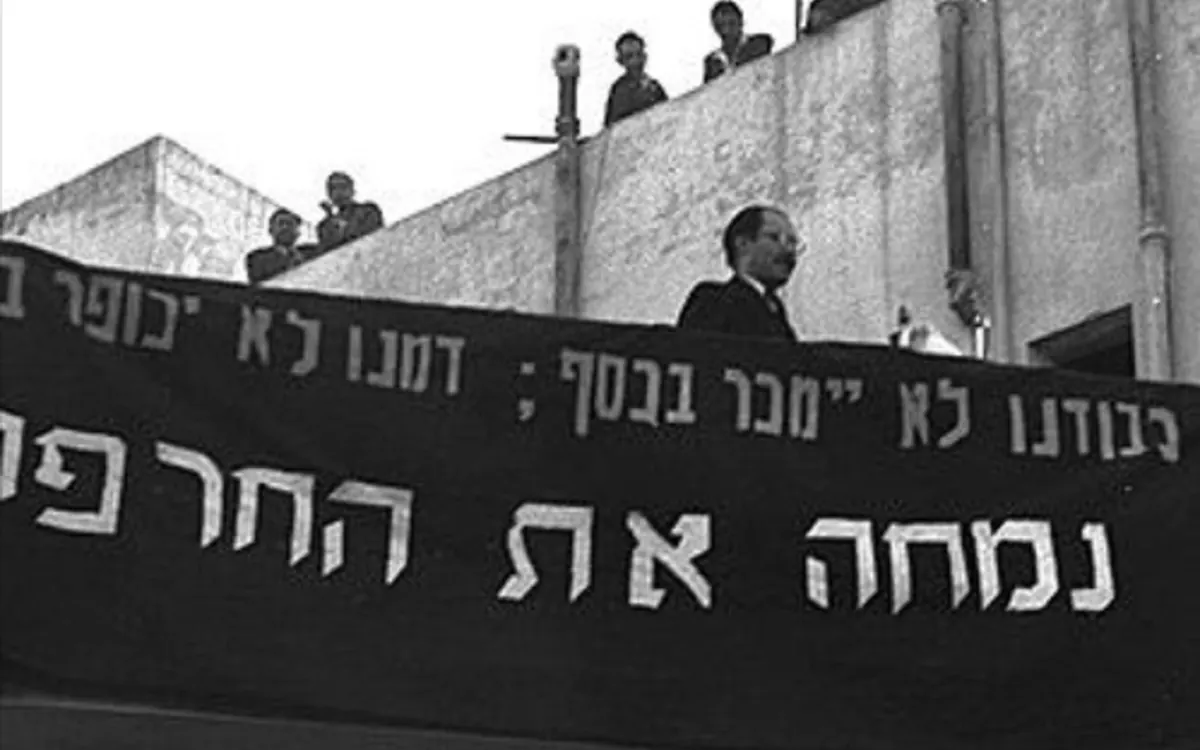
The focus of our story has returned to the land of Israel, where it is once again a time of controversy. Despite the population growth, the economic hardships and the security challenges, the most divisive political issue of the early 1950's was whether to accept reparations from the reborn German state. Here is an exploration of whether pragmatic survival or idealism should be the guiding lights of the first Jewish government in two thousand years.
About this episode
All compromise is based on give and take, says Gandhi, and any compromise on fundamentals is a surrender. Rav Mike touches the tension between pragmatism and idealism through reparations, after first catching up with Am Yisrael. On security, the War of Independence is far from over, the 1948 borders are ceasefire lines, and the infiltration and retaliation cycle is escalating toward the Sinai War, deepening a siege mentality. On population, numbers rise at unprecedented rates while an economy always a step from disaster, a deepening Ashkenazi-Mizrahi divide, the religious-secular tension and the Arab citizens under military rule strain the social fabric, held together by the grace of God and a clear external enemy. On politics, since Ben-Gurion and Berl Katznelson took over the Zionist executive in 1934 the labor left has ruled, so the state emerged from a bitterly divided movement into a cradle-to-grave model where party affiliation defines school, youth group, job and health fund, Mapai the natural ruling class that filled every significant post, erasing the stories of the Irgun and Lehi, while Begin's Herut kept an opposing vision alive but finished fourth with 14 seats.
In the July 1951 elections for the second Knesset, the first proper parliamentary vote and a test of democracy's smooth transfer of power, Mapai took 45 seats while Herut lost nearly 40 percent, dropping to eight, and after the crushing defeat Begin announced he was retiring from public life, applying for a license to practice law and planning to leave for Europe with his wife Aliza. His comrades begged him through the night not to abandon them, but he was not moved, and when the Knesset reconvened on August 20, 1951 he was not there, entrusting his friend Yohanan Bader a letter of resignation to deliver after his departure; Bader never delivered it, hoping rest would return their leader. What brought Begin back was not time but an unforgivable political sin. The plunder of Jewish possessions, businesses, slave labor, unpaid insurance and claimed savings was the greatest theft of the twentieth century, and while the war still raged Jews began planning to demand restitution, the Jewish Agency's first claim going nowhere because Britain, fighting to keep Jews out of the mandate, was an occupying power.
Things shifted in 1949 when West and East Germany were founded, the same year 700,000 impoverished immigrants, many broken survivors of the German state, reached Israel, and by 1950 the situation was desperate, so David Horowitz of the finance ministry raised the idea of turning to the Federal Republic for reparations and convinced Sharett and then Ben-Gurion that negotiations were unavoidable, though a total boycott of all things German still reigned, passports stamped good for all countries except Germany, the idea seen as a deal with the devil. World events tempered ideology: the Korean War of June 1950 turned the Cold War hot and pushed West Germany's return to the family of nations, so Israel could no longer sit on the sidelines, and officials warned that as memories of the past fade the world would view a lone boycott as pathetic and quixotic and the only chance for compensation would vanish. The most vehement opposition came from the minister of religious affairs, Rav Maimon, who called the Germans Amalek, but within the halls of power his was the lone voice, and in March 1951 a note demanded 1.5 billion dollars, which was rejected but used to float the issue, Sharett invoking Elijah's rebuke to Ahab, haratzachta vegam yarashta, will you murder and also inherit.
In April 1951 a secret Paris meeting with Chancellor Adenauer, who had struggled against the Nazis, won his readiness to acknowledge German responsibility and accept the 1.5 billion dollar claim, even as a week earlier the Knesset had fixed the 27th of Nisan as Holocaust and Ghetto Fighters Day, never forgive and never forget on one hand, negotiations on the other. On September 27, 1951 Adenauer told the Bundestag that unspeakable crimes imposed the obligation to make moral and material amends, endorsed by deputies rising from their seats. To push through the wall of opposition Mapai drove home three points: the catastrophic economy, the closing window as the Cold War returned Germany to the nations, and that reparations were no atonement but a refusal to let the murderer inherit the victim's property. January 7, 1952 was the greatest day of chaos the Knesset has seen: Begin addressed thousands in Zion Square, told them the police had German-made gas grenades, and sent them to the Knesset where everything in their way would shatter like glass on a rock, then on the floor called every German a murderer and Ben-Gurion's deal the selling of Jewish honor, invoking the Altalena when he had ordered no return of fire but now gave the order yes, there are things dearer than life, as the crowd stormed the building and tear gas and shattered glass filled the floor.
Ben-Gurion's reply held that a crime of such proportions can have no material compensation, but the German people must not continue to enjoy the fruits of the massacre, haratzachta vegam yarashta, and Sharett had the last word, linking reparations to immigration and arguing that heirs of the Nazi regime negotiating with a sovereign Jewish state is the ultimate proof of the Nazis' failure. That night Ben-Gurion denounced Begin on the radio as undermining democracy, and in the morning won the vote 61 to 50, so on September 10, 1952 the Luxembourg Agreement was signed, the basis of German restitution. The dispute expressed two opposite attitudes toward having a state: Ben-Gurion the pragmatist and father of the state felt the burden of the present, build, build, build, and saw reparations as the price of sovereignty, difficult choices that could be avoided in exile must now be made; Begin the idealist lived the burden of history, seeing the state as the repository of two thousand years of moral responsibility, Jewish blood spilled on German money, the shame remaining forever. For us the question is moot, half the taxis Mercedes, and Rav Soloveitchik, who opposed the agreement as treating Germany as Amalek, later admitted the reparations saved the state, but the underlying question endures: is survival the state's highest purpose, or does Israel bear a mission for which it must take mortal risks, a dilemma Begin addressed to the religious parties who held the balance.
Key ideas
- Mapai's cradle-to-grave dominance made party affiliation define a whole life and erased the stories of the Irgun and Lehi.
- Begin retired after Herut's 1951 defeat, and only the reparations question brought him back to politics.
- The desperate economy, the closing Cold War window, and the refusal to let the murderer inherit drove Mapai's case for reparations.
- January 7, 1952 saw Begin rouse a crowd to storm the Knesset, invoking the Altalena, before Ben-Gurion won the vote 61 to 50.
- The Luxembourg Agreement of 1952 pitted Ben-Gurion's pragmatism, reparations as the price of sovereignty, against Begin's idealism of honor over money.
- The enduring question is whether survival is the state's highest purpose or whether Israel bears a mission for which it must take mortal risks.
Chapters
- 0:00 No compromise on fundamentals; catching up
- 2:12 Population and the social fabric
- 3:16 Politics; Mapai's dominance
- 6:38 Herut keeps the opposing vision
- 7:45 The 1951 elections; Begin retires
- 9:54 The letter never delivered
- 11:12 The greatest theft; the first claims
- 13:28 1949; the idea of reparations
- 14:32 The boycott; a deal with the devil
- 15:37 Korea turns the Cold War hot
- 17:54 Rav Maimon's lone voice; the note
- 20:16 Elijah's rebuke; the Adenauer meeting
- 22:22 Adenauer at the Bundestag
- 23:29 Three points; the Knesset riot
- 29:00 Every German a murderer; the Altalena
- 33:28 Ben-Gurion's reply; Sharett's last word
- 35:44 The vote; the Luxembourg Agreement
- 36:50 Pragmatist and idealist
- 38:45 The money taken; Soloveitchik's reversal
- 40:09 The enduring question; Begin to the religious parties
Who, where and when
People
Mahatma Gandhi, David Ben-Gurion, Menachem Begin, Moshe Sharett, David Horowitz, Konrad Adenauer, Rav Maimon, Yohanan Bader, Rav Soloveitchik, Yehuda Avner
Places
Zion Square, The Knesset, Paris, Bonn, Luxembourg
Texts
The note demanding reparations, Elijah's rebuke to Ahab, 1 Kings 21, The Luxembourg Agreement
When
July 1951 CE: the second Knesset elections, April 1951 CE: the Adenauer meeting, January 7, 1952 CE: the Knesset riot, September 10, 1952 CE: the Luxembourg Agreement
Read the transcript
All compromise, says Mahatma Gandhi, is based on give and take, for there can be no give and take on fundamentals. Any compromise on fundamentals is a surrender, for it is all give and no take. Well, I'm feeling pretty ready to give whatever it takes to tell this tale, and I'm fairly uncompromising on the topic, because I'm Rav Mike Foyer, and this is The Jewish Story. episode 12 the reparations controversy okay so we've got a major issue to touch on today it's the tension between pragmatism and idealism as guiding principles for the jewish state and i want to do it through a very specific instant but before we can get there we've been away from the story of amba art so the people in their land for quite a few episodes so i want to touch base with what's happening to Am Yisrael, to the Jewish people, as we're trying to adapt to this newly embodied national life.
And we'll do that briefly before we dive into our story. So first, and unfortunately foremost, is the question of security. Because the War of Independence may have ended in 1948, but it's far from over at this point. I mean, frankly, read the news. In many ways, it's far from over today. We're still fighting so many of the same battles. And that's true, But for our purposes right now, just remember that Israel's borders in 1948 were not the product of peace treaties. They were ceasefire lines. And therefore, in the early 50s, the infiltration and retaliation cycle that we discussed back in Episode 6 has not ended. On the contrary, it has been escalating. Terrorist attacks and massive cross-border raids, now primarily on military targets by Israel in response, are going to keep those 1948 borders contingent and will contribute to the growing siege mentality within the country and the sense of the Arab countries surrounding that Israel is a militant state.
In many ways, you can think of the next three or four episodes as a march toward the Sinai War of 1956, if you want. But that's the security situation in a very small nutshell. The next question is the question of population. And the numbers are going to continue to rise at unprecedented rates right through that Sinai War. But as we've seen, there are a lot more factors at play in the ingathering of the exile than simple numbers. Now, one is the economic, even though the rationing of that true Tsenna program, the austerity program we discussed back in episode 4, will end only a few years after the War of Independence. The 50s will be marked by an economy that appeared to be always one step away from disaster.
So add to that economic tension within the population story, the growing socio-cultural and economic divide between the Ashkenazi and the Eidot and Mizrah, the Sephardi Jews, something that's going to stay largely unaddressed for the first three decades of Israel's existence. We'll take on the real story of that tension when we get to the late 70s. I guess that's going to be season four. there will be, finally, a political upheaval that removes the Ashkenazi-dominated labor left from its position of rule. But for now, just know that this split is there, and it's getting deeper. Add to it the religious-secular tension, and, of course, the challenge of the Israeli Arabs, many of whom at this point in the early 50s are living under military rule, despite the fact that they are citizens.
And now we can ask the obvious question, which is, how on earth does a social fabric which is so divided and torn manage to survive the repeated crises of the 50s? But of course, the answer is also fairly clear. Aside from the grace of God, which in my eyes and my daily experience is the only thing that really allows our crazy little country to function, it was these very crises, and in particularly the existence of a clear external enemy that held things together. So there we have, like I said, in a very small nutshell, the security and population picture, now let's talk politics. If you really want to appreciate the emergence of a political culture within the democratic state of Israel in the 50s, you've got to go back to Season 2 and review a few things about the conflicts between labor Zionism and revisionist Zionism.
Between the competing visions of David Ben-Gurion and Zeb Jabotinsky, you'll be best served by Season 2, Episode 29, if you want to do the homework. If not, for now, just recall that since David Ben-Gurion and Beryl Katnelson, his partner within the more sort of labor organizing side of the labor movement, since they engineered a takeover of the Zionist executive in 1934, the labor left has ruled the Zionist movement. and because the structures of state power, political, military, and cultural, all emerged out of their predecessors in the Zionist movement, this means that David Ben-Gurion and his worldview rule the state as well. Now, this evolution of a state out of a movement, a bitterly divided movement split along ideological lines, means at this point in Israel, your party affiliation defines way more than just who you vote for.
It will define what school system you belong to. The youth group you join will certainly constrain your job opportunities. It's even going to identify what health insurance collective you belong to. It's a cradle-to-grave model of politics. And when you combine it with nearly two decades already at this point in the early 50s of labor dominance, It means that the labor view of politics and culture defined what's even considered legitimate in Israel in the 1950s. It wasn't just that Ben-Gurion's Mapai party held 46 seats in the first Knesset, and therefore got to make all the critical political decisions. I'll tell it to you in the words of Yehuda Avner, lifelong diplomat, advisor of five prime ministers, and by the way, author of the awesome book, The Prime Ministers, he said it like this.
Mapai was no mere political entity. It had but one idea of government, to preserve intact its absolute grip on the political power bequeathed to it. It constituted the natural ruling class of Israel. Mapinex married into each other's families, supported each other, appointed each other, and kept outsiders outside. Mapai members filled the ranks of the civil service, the city halls, the local councils, the university's senates, the officer corps, the industrial plants, and every other significant job on offer. So it was a complete cultural dominance. So much so that in the years after the revolt against the British and the War of Independence, no one ever told the stories of the Irgun and the Aleche.
The songs weren't played on the radio. Even the stories of the martyrs who went to the gallows singing Hatikvah were erased from the history books. Politically, it was largely Menachem Begin's Cherut party that kept alive any opposing vision within the Knesset. And this wasn't just political, they were also the ones who actually cared for the physical needs of the Irgun and Lehi veterans on the streets, who were unable to draw government benefits. Now, despite Begin's feeling that half the country was behind him, or more than half in his eyes, his party, Cherut, finished fourth in those first elections, winning 14 out of 120 Knesset seats. It is true that the new immigrants, especially the more religiously traditional Jews from North Africa and the Middle East, who are natural Begin supporters, but like I mentioned, it's going to be another couple decades or more before they have the level of political organization that will bring Begin to power.
Until then, he'll remain a voice howling in the political wilderness, articulate but powerless, really, in the opposition. So in July of 1951, elections were held for the second Knesset. Now, of course, it's always important to remember that the second election is the first test of a democracy. In this case, these were actually the first proper elections for parliament. You may recall that the original vote was actually for a constituent assembly. That's just my issue. Anyway, as an election, these second elections were successful in providing for a smooth transition of power, which is one of the defining characteristics of democracy. Now, granted, it was fairly easy because it was Ben-Gurion handing the keys back over to himself because his Mapai party once again took 45 seats.
They lost one, but that was nothing compared to Cherut, who lost almost 40% of its mandate, dropping to eight seats. And after what he viewed as a crushing defeat, Menachem Begin assembled the Cherut party leadership and those elements of his Ergun fighting family that had stayed out of politics and announced that he was done. He was retiring from public life. In fact, he told him he'd applied for a private license to practice law, and while he waited for it, he and his beloved wife Elisa were going to head off to Europe and just get out of town. Now to say that his former comrades in arms were horrified is a deep understatement. The one thing that everyone has always said about Menachem Begin is that he had a magnetic power to fill people with purpose.
And so they stayed up the entire night begging and pleading with him not to abandon them in the face of what they saw as a real crisis. But Menachem Begin was not a man easily moved, even by the pleas of his most loyal followers. So, when the Knesset reconvened on August 20, 1951, he was not there to take his oath of office. Instead, he was at home, saying a final goodbye, and despite the anger and sorrow of his friends and supporters, he insisted that his failure in the election required him to step aside, and nothing would change his mind. However, we don't always get to map out the course of our future, because not everyone believed that Begin's era of leadership had passed. He entrusted his dear friend Yochanan Bader with a letter of resignation addressed to the Speaker of the Knesset and asked him to deliver it after his departure for Europe.
Menachem Begin left, but the letter never made it to the Speaker of the Knesset because Bader and others hoped against hope that perhaps some time away, a little bit of rest, would give their leader the rest and perspective he so desperately needed and that he would return with new energy. Little did they know that it wasn't time, but rather unforgivable political sin that would bring Menachem Begin back from his exile. You know, when we throw around the number 6 million in order to try and quantify the number of Jews murdered in the Shoah, on one level, it serves its purpose well. I mean, who can really conceptualize such a number, let alone the industry of death that it would take to kill them all in such a short space of time.
But because of the size of the number and its roundness and its almost magnetic nature, it easy to forget that each and every one of these six million were individuals every single one a world unto themselves And I not just speaking on the personal and spiritual level of course that's true, but right now I want to take a moment to think about the economic plane. Because the plundering of possessions and businesses, the use of slave labor, the non-payment of insurance policies, the quiet claiming of savings that had never been withdrawn by the Nazis and their accomplices throughout Europe was actually the greatest theft of the 20th century. And already, while the war was still raging, Jews around the world began making plans to demand financial restitutions for the Holocaust victims.
And only months after VE Day, the Jewish agency made its first formal claim for reparations and property reimbursement to the four Allied powers that occupied Germany. Their proposal was very simple, that a certain amount of the defeated state's assets should be allotted for the resettlement of the survivors of its brutality. But those survivors were largely settling in Israel. And seeing as Britain, which was vehemently fighting to keep the Jews out of mandatory Palestine, was one of those occupying powers, the Jewish Agency's proposal went nowhere. There was actually one military order passed in the American zone of occupied Germany in 1947, which called for the restoration of identifiable property that had been seized on what they called racial, political, or religious grounds.
But it's awfully hard to restore property to the dead, especially when they died together with every single one of their next of kin. Things started to shift in 1949, when the Federal Republic of Germany, that's West Germany to you and I, and the German Democratic Republic, East Germany, were formally founded. Now, they were founded, but they weren't quite independent. For another year or more, West Germany in particular remained under Allied occupation. Now, add to this that 1949, of course, that first year after the birth of the state, was also the year in which 700,000 new immigrants reached Israel. Most were impoverished, and many were the broken remnants of European Jewry who had been smashed by the previous iteration of the German state.
Now, we talked back in episode four about how these waves of immigration actually threatened to sink the ship of state before it ever really got out of port. And we've touched on how Ben-Gurion, Moshe Sharet, and the entire Mapai leadership were moving heaven and earth to raise funds abroad and cut consumption at home. But by 1950, the situation had turned desperate. Without massive and immediate aid, it appeared that the third Jewish commonwealth would be a short-lived experiment. So it was David Horowitz, Director General of the Ministry of Finance, who put two and two together. He was the first one to raise the idea of turning to this newborn Federal Republic of Germany for reparations. And therefore, he was the one who convinced first Moshe Sharet and then Ben-Gurion that negotiation with Germany were unavoidable.
Now, that may not sound like such a big thing to you, or maybe it does, but it's important to know that at this point, less than five years really after the Holocaust, the total boycott of Germany, Germans, and all things Germanic, which had begun back in 35, still reigned in Israel. In fact, it really reigned amongst Jews across the world. You might have even caught a little bit of a taste of it in our culture. There are many Jews today who are opposed to buying German goods. But in 1949-1950, this was a ban so complete that Israeli passports were stamped good for all countries except Germany. And so, no matter how pressing the economic need, it was no simple matter to convince the Mapai leadership that this financial salvation of the country lay in opening relations with Germany.
It was literally seen by most of world Jewry as making a deal with the devil. But, you know, world events have a way of tempering ideology. And the attitudes that drive a political movement or an underground army are not always fit to guide a state that strives to be a member of the global community of nations. So let's add to this mix one more important event. On June 25, 1950, the Korean War broke out. And with it, the Cold War went hot. It didn't just go hot. It became the defining context for global politics and would remain so until the fall of the Berlin Wall in 1991. Now, the integration of the Federal Republic of Germany into the Western Bloc was seen as a keystone in the strategy to contain the Soviet Union.
And as a consequence, the return of West Germany into the family of nations was pushed rapidly forward. In July of the very same year, less than a month after the Korean War broke out, American, Britain, and France announced the end of their state of war with Germany and the impending end of their occupation. Suddenly, the world was lining up, and Israel could no longer afford to sit on the sidelines as part of the non-aligned movement, as it was known. Truth is, even before the outbreak of the war in Korea, Ben-Gurion and Shari had been major advocates of abandoning the policy of non-alignment and joining the Western Bloc. It was a move that they saw as critical, critical for obtaining the American aid that Israel so desperately needed, and critical for maintaining the intimate contact with the other half of world Jewry, which was resident in America.
But, in October of 1950, the occupying powers asked Israel to add its signature to the announcement of ending the state of war with Germany. Now, alignment with the West meant joining the German team, and many, many government ministers balked. El-Yashiv Ben-Khorin, a senior foreign ministry official based in Western Europe, warned them, quote, if we seek to continue our extreme political boycott of Germany, we shall soon find ourselves totally isolated. Of course, we won't be able even to slow down Germany's giant strides toward the status of a power. Germany will go from strength to strength, while we will remain in a situation that the world will view as pathetic and as memories of the past fade, even quixotic.
You know, aside from the immediate issue, it's important to take to heart that phrase, as memories of the past fade, because the world is not going to hold on to the Holocaust in the same way the Jews do, and we see the challenges of that in our world today. Michael Amir was the Israeli consul in Brussels, And he wrote to the foreign ministry at the end of 1950, saying that if Israel's boycott policy didn't change, they would not only look odd and pathetic in the eyes of the world, we would miss a one-time opportunity. Because he said that if Israel was the only country voting against Germany and the UN and other international organizations, quote, we will be unable to delay or even significantly slow Germany's rehabilitation.
And thus, the only possibility of obtaining compensation will vanish. it was clear in the upper echelons of the foreign service consensus had emerged direct contact with Germany was unavoidable not just unavoidable if a claim for reparations weren't made right now before Germany regained its status as a legitimate member of the international community it would never happen that's not to say that everyone within the government agreed the most vehement opposition actually came from the minister of religious affairs he said in my opinion we must not have any connection with the Germans, for we are in a war against the Amalekites from generation to generation. They murdered six million Jews. Shall we talk with these murderers?
The government of the Jewish people, the government of Israel, must declare that we will have no contact with them. Their murderous deeds will not be expiated, neither by millions of marks nor millions of pounds. There is no more to be said about a delegation to Germany. Passionate words. And we'll see that Rav Maimon was not the only one in Israel who viewed modern Germany through the lens of our eternal war with Amalek. But within the halls of powers, his was the lone voice. Ben-Gurion, Moshe Sharet, and the rest of the Ma'apai leadership had become convinced of the inevitability of reestablishing relations with the new German state. And they saw the need to do so quickly if they wanted to reap the benefits.
The first move was to make a last play to the occupying powers. And so, in March of 1951, a note was sent to these occupying powers in which the state of Israel presented itself as the sole representative and heir of the million of Jews murdered in the Holocaust and demanded the imposition of $1.5 billion in reparations from both East and West Germany. It was a request that was rejected, but in many ways it was used to raise the issue first publicly, because the next day, Foreign Minister Sharet appeared in the Knesset to, quote, bring to the attention of the Knesset, and also to the attention of the public in Israel abroad, the existence and content of the note, meaning he was trying to float the idea of dancing with the devil.
And at the same time, Sharet introduced the primary moral assertion, which he and Ben-Gurion would use again and again to justify breaking the German boycott in order to obtain reparations. He basically quoted the words of Elijah the prophet to King Ahab after he murdered Navot and took his vineyard for his own. If you don't know the story, you can look it up in the first book of Kings in the 21st chapter. Haratzachta v'gamyarashda? Will you murder and also take possession? As Charit said, it's inconceivable that the German people continue to enjoy the spoils while rehabilitation of the victims those who were saved and remain alive after the Holocaust are a heavy burden on that same Jewish people, right?
How could they murder and then take our possessions, he said. So meanwhile, the train moved forward a month later, on April 19th 1951, a secret meeting was held in Paris between the West German Chancellor, Conrad Adenauer and the finance minister David Horowitz and the Israeli ambassador to France, Maurice Fischer. In the course of the meeting, Adenauer, who himself had struggled against the Nazis, expressed his readiness to open direct contacts with the representatives of the state of Israel. But Horowitz and Fischer set two conditions for this. Number one, public acknowledgement by Germany of the German people's responsibility for its crimes against the Jewish people. And number two, the acceptance of the Israeli claim for reparations in the sum of one and a half billion dollars.
The Chancellor immediately agreed. He agreed to publicly acknowledge the German people responsibility and he said he could see no serious difficulty regarding the size of the compensation they were demanding Now by the way it worth noting that only a week earlier, on April 12th, a member of Knesset, Moshe Nurach, had passed the following resolution on the floor of the Knesset. The first Knesset declares and determines that the 27th day of the month of Nisan, every year, shall be Holocaust and Ghetto Fighters Day, an eternal day of remembrance for the House of Israel. And so on one hand, there's a focus of never forgive and never forget. On the other hand, they're already opening negotiations with Germany.
On September 27th, 51, one day before his first visit to the United States, Chancellor Adenauer, the first chancellor of the now independent Federal Republic of Germany, addressed a special session of the Bundestag in Bonn. The federal government and the great majority of the German people, he said, are conscious of the immeasurable suffering that was brought to bear upon the Jews in Germany and in the occupied territories during the period of National Socialism. Unspeakable crimes were perpetrated in the name of the German people, which opposed upon them the obligation to make moral and material amends, both as regards the individual damage which Jews have suffered, and as regards Jewish property for which there are no longer individual claimants.
The Chancellor's words were endorsed overwhelming by the deputies, not by raising their hands, but by actually standing up from their seats. The German people appeared ready to bury the hatchet. And now the stage was set for a Knesset debate over whether the same could be said of the Jews. Now, in order to push through the wall of opposition, a wall which was held up by boundless hatred, inconceivable pain, and vast moral indignation, the Mapai leadership knew they had to drive home three points. First of all, the catastrophic state of the Israeli economy. That's the real politic. The money's got to come from somewhere. Second of all, the reality that if Israel didn't claim reparations from the Germans now, she would miss the boat forever.
Because the Cold War heating up meant that Germany would soon return to the community of nations with or without paying its debt to the Jewish people. And the third point was that payment of reparations to the state of Israel was in no way atonement for Germany's sins. On the contrary, allowing the murder to inherit the victim's property was adding insult to injury. Haratsachta v'irashta? Will you murder and also inherit? Now, Ben-Gurion and Sharet knew that the question of reparations was far from settled, even within their own party. But these three points make a solid argument, and they were counting on the opposition to lack the leadership of that classic thorn in their side. But they were wrong, because the question of German blood guilt and Jewish honor may have been the only issue powerful enough to bring Menachem Begin back to politics.
January 7, 1952 was without question the greatest day of chaos that the Parliament of Israel has ever witnessed. The time had come to finally raise the question of signing a reparations agreement with Germany in the full Knesset plenum, and it seemed that the social fabric of the country might not bear the strain. The day began with Foreign Minister Moshe Shari presenting the issue of direct negotiations to the Knesset Foreign Affairs and Defense Committee. All the discussions of the previous two years, even the secret negotiations with Germany, had been held within a closed circle of Mapai politicians. This was the first time that the subject had been discussed in a forum that included representatives of the opposition, and it appeared that both ends of the political spectrum were vehemently opposed.
The Zionist and non-Zionist left, meaning the MAPAM and the Israeli Communist Party, if people are familiar, argued that negotiations with the Federal Republic of Germany was a desecration of the memory of their victims. They also, in line with their own politics, asserted that any agreement would clearly prove Israel's subservience to the, quote, imperialist capitalist bloc of the West by serving its policy of rehabilitating West Germany in order that it serve as a military tool against the Soviet bloc in a future Third World War. It may sound a little bit heady, but it's not entirely unreasonable. That's on the left. At the other end of the spectrum, on the right, Menachem Begin's Cherut party argued that the Germans were the modern Amalekites, and that any discourse with them was a grave stain on Israeli national honor.
Their slogan was, our honor will not be sold for silver, nor will atonement for our blood be purchased by goods. Now, even among Ben-Gurion's party, the Mapai, there were many who opposed any contact with Germany, particularly, of course, among the survivors. So facing this broad front of opposition stood Ben-Gurion, Sharet, and the leadership of Mapai. And there was a feeling in the air that this struggle wasn't just about the specific issue of direct negotiation. This was about the Mapai government's very legitimacy and perhaps about the strength of Israeli democracy altogether. Now, before the debate within the general Knesset even got underway, the fight outside the walls had already begun. Because on the morning of January 7th, While that Foreign Affairs and Defense Committee was holding its discussions, Menachem Begin was addressing a crowd of thousands in Zion Square, not so far away.
Meanwhile, as he was speaking, the police were forming a cordon around the Knesset building, encircling it with barbed wire and arming themselves with nightstick and tear gas grenades. Now, before Begin even opened his mouth, the crowd's mood was angry and confused. So, when, in the middle of his speech, an assistant handed Begin an envelope, an expectant silence fell as he slowly opened the note. After a few moments, Begin looked up and he announced in a shaking voice, I have not come here to inflame you, but this note, which has just been handed to me, states that the police have grenades which contain gas made in Germany, the same gas which was used to kill our mothers and fathers. He went on to say that we're prepared to suffer anything, torture chambers, concentration camps, and subterranean prisons, so any decision to deal with Germany will not come to pass.
He called out condemnation of, quote, that maniac who's now prime minister, and urged that, quote, a war of life or death be waged against the reparation agreement. Go to the Knesset, he called out to the crowd, and everything that stands in your way will be shattered like glass on a rock. With these words, Bacon himself headed to the debate. I mean, after all, he was a member of Knesset. And this is what he had to say on the floor of the Parliament of the first sovereign Jewish government in 2,000 years. Today, the Jewish Prime Minister is about to announce that he will go to Germany and receive money, that he will sell the honor of the Jewish people for monetary gain, casting eternal shame upon it.
There is not one German who did not murder our parents. Every German is a Nazi. Every German is a murderer. Adenauer is a murderer. All his aides are murderers. But their reckoning is money, money, money. This abomination will be perpetrated for a few million dollars. And the Goyim will see only one fact, Begin went on. You sat at one table with the murderers of your people. You admitted that they're capable of signing an agreement, that they're capable of keeping an agreement, that they are family in the family of nations. You know, he said, the Goyim not only hated us, not only murdered us, not only burnt us, were not only jealous of us, it was especially contempt that they felt for us. And in this generation, which we call the last of servitude and the first of redemption, in the generation when we gained a position of honor in which we came out of slavery to liberty, you come, and because of a few million defiled dollars, because of foul goods, throw away the little bit of dignity which we have earned for ourselves.
You cut the ground from under our feet. You endanger our honor and independence. how we shall be scorned. And then, Begin turned to the Prime Minister. His arch-rival, a man who, remember, had fought against him as brutally as they had both fought against the British. I appeal to you not as a political rival, he said. As rivals, there's an abyss between us. There is no bridge, and there will be no bridge. It's a bloody abyss. I appeal to you at the last moment as a Jew, as a Jew to a Jew, as the son of an orphan nation, of a mourning nation. Stop. Don't do this. It's obscene. There has been nothing like this since we became a nation, and I'm trying to give you a way out. As an adversary, I would not give it to you.
As a Jew, I will. Go to the nation. Hold a referendum. And it was this point that the crowd reappeared, because fired with anger and passionate hatred, they'd taken Begin at his word. And since he'd begun to speak, thousands of people, armed with their fists and with stones, had closed in on Knesset. The police fired tear gas, warning shots, but the people would not be deterred. Shattered glass from the windows fell across the Knesset floor, and the smell of tear gas filled the air. Ben-Gurion and Begin began to scream insults at one another as the police struggled to regain control. Hundreds of protesters and police were wounded. it took more than an hour to return calm to the Knesset floor. And by that time, Begin was ordered by the speaker to return to his seat, a demand he rejected, shouting, If I'm not permitted to speak, no one will.
The session was actually completely halted and allowed to continue only after Begin agreed to apologize. And he did it, not as he said, out of fear of losing his seat, but rather, quote, Because there are things I must say, a role I must fulfill, perhaps my last, but I must do it. and so he turned to Ben-Gurion with a reminder of recent history when you aimed your gun at us he said and I was standing on the deck of the Altalena as it burned I gave the order no, do not answer fire with fire today I give the order yes, for there are things dearer to a man than life just as there are things more terrible than death these reparations are an issue for which we will give our souls for which we're willing to die We will leave our families say farewell to our children, but there will be no negotiations with Germany.
We who saw our fathers dragged to the gas chambers, we who heard the rattling of the death trains, we who saw our fathers thrown into the river with 500 Jews from glorious Brecht Litov, we who saw events unequaled in history, shall we hesitate to sacrifice our souls to prevent negotiations with the murderers of our fathers? And then Begin made his final threat You have power he said You have prisons and concentration camps army police detectives guns and machine guns no matter On this issue all your power will crumble like glass against rock. We shall battle this issue of right until the end. Physical power in such battles has no value. Power is vanity. I know you'll drag us off to concentration camps.
You've arrested hundreds today. You could arrest thousands. It doesn't matter. They will go and serve their sentences. We shall go with them. And if necessary, we shall die with them, but there will be no reparations with Germany. And then he announced that he was relinquishing his parliamentary immunity that could keep him out of jail and return to his seat. Now, Ben-Gurin's reply to Begin's attack sums up the essence of his moral stance on the issue. He said over six million Jews were put to death by torture, starvation, massacre, and before, during, and after this systematic mass murder came the pillage. This too, on an unprecedented scale, a crime of such enormous proportions can have no material compensation.
Any compensation, of whatever size, is not restitution to the loss of human life or expiation for the sufferings and agonies. However, even after the defeat of the Hitler regime, the German people continue to enjoy the fruits of that massacre and pillage of the plunder and robbery of the Jews who were murdered. The government of Israel considers itself bound to demand of the German people restitution for this stolen Jewish property. Let not the murderers of our people also be the beneficiaries of its property. Ha-Ratzachta, the Erashta. It was actually Foreign Minister Moshe Sharet who had the final word in the debate. He linked the reparations with the immigration to Israel, saying that just as we open our gates to every Jew who comes to us with only the shard on his back after all his property has been plundered we must open wide our gate with our own hands return that property whose owners didn't live to bring it his self.
And then he made the point which for many in the room became decisive asserting that this was not a stain on the honor of the Jewish people or a capitulation. On the contrary, when the heirs of the Nazi regime sat down to conduct negotiations with the representatives of an independent Jewish state, this is the ultimate proof of the failure of the Nazis. Now that night, the Prime Minister denounced Begin on the radio, accusing him of undermining democracy in Israel, assuring the nation that, quote, we have taken and will take all appropriate measures to safeguard the security and peace of our nation. Words that have a familiar ring in the fight between left and right, even 70 years later. And in the morning, Ben-Gurion won the vote on reparations 61-50 with 9 abstentions.
So, on September 10, 1952, the Federal Republic of Germany and the State of Israel signed the Luxembourg Agreements, which served as the basis for the German federal restitution programs for Holocaust survivors. the political question of whether or not to accept reparations was clearly far more than a dispute between bitter rivals because in many ways Ben-Gurion and Begin were taking stances that expressed two fundamentally opposite attitudes toward what it means to have a state at all and in particular for what it means for Am Yisrael to have a state Ben-Gurion was the pragmatist He was the secular Zionist, and he always felt the burden of the present most strongly. Build, build, build. The call of the present was clearly to save the state from drowning under the burden of immigration, in order that the two-thirds of world Jewry that had survived the war could now come home.
And Ben-Gurion is rightly called the father of the modern state. Whether you agree with his tactics or decisions or not, He had given every ounce of energy of the last four decades to bring that state to birth. And what compromise would we not make for the sake of our child's survival? Ben-Gurion viewed the decision to negotiate with Germany as the price of sovereignty. As he said many times, difficult choices which could be avoided in the exile must be made now that the Jews are a free, sovereign people in their land. It's not just real politique. It's the reality of politics. Begin, on the other hand, was ever the idealist, and he lived the burden of history. Listen, no less than Ben-Gurion, he'd given his life to bring Israel into being.
But Begin saw the modern state not as a lifeboat, but as the repository of 2,000 years of dreams and moral responsibility. He didn't question the need for the German money. He questioned its price. As he said, in the bottom of hell, we heard the voice of the devil. What else has this nation brought upon itself after its destruction? Jewish blood spilled on German money. Why and for what purpose? He warned the money will be spent and disappear. The shame will remain forever. What he was saying is that if the cost of survival is your soul, then is it worth the price? Now, for you and I, speaking today, the question of reparations is moot. Whatever attitude I retroactively take on the question, the money has been taken and put to good use.
I mean, there's a reason that half the taxis in Israel are Mercedes-Benz. And when you look into the literature, and there's quite a bit of it, you know, a good example is Rav Herschel Schachter reports that Rav Solveitchik, the great spiritual leader of American Orthodoxy, opposed the reparations agreement at the time. He said that accepting the money might indicate that the Jewish people had forgiven the Germans, and furthermore he believed that the Germans had the status of Amalek and therefore it was forbidden to enjoy any benefit from them. But Rav Shachter adds that in later years he heard the Rav admit that he may have made a mistake when he opposed the payments because in retrospect the reparations saved the Jewish state.
Now 2020 hindsight is often pragmatic but I want to close on the note of an idealistic question because the underlying values that came into conflict in 1952 are still duking it out today. Is the survival of the state its highest purpose? And as a corollary, therefore should the state of the Jews be just like any other in the pursuits of its national interests, do what you need to do to survive in a dog-eat-dog world? Or does the state of Israel bear the responsibility of being different? Do we hold the weight of Am Yisrael, past, present, and future, and therefore, do we have a mission more critical than our survival, one for which we might need to take mortal risks? Now, when I look around today, I see this question playing itself out in many very difficult ways.
One, for instance, should we be selling arms to the highest bidder, regardless of their intended use? Well, I know that the money and political capital that we gain through the arms industry are critical for our political survival. But is that more important than the stain on the soul of our society that comes from armoring murderers from people who would kill women and children in the way in which our enemies have done to us? Is a tiny nation that struggles to maintain a Jewish population justified in a strict enforcement of borders? Or should the descendants of refugees be merciful to all refugees? And of course, how, oh how, do we relate to the Arabs that live in our land? Are they a fellow nation with which we should negotiate honorably?
Are they the unintended victim of our survival, who we ourself should pay compensation to? Or are they modern Amalek to be driven out at all costs? I'm not looking to answer these questions right now. We're going to continue engaging them as we go forward in the coming seasons. What I want to do right now is feel the tension between the goal of survival and the actions which it justifies, and the goal of fulfilling our spiritual mission with all the risks that it entails. And furthermore, in my humble opinion, secular ideologies, the political base on which this discussion was happening largely in 1952, have all but run their course. So I want to drop these questions into the lap of those of us who claim to answer to a higher power.
And so I want to end this episode with the words that Begin addressed on that fateful day, January 7th, to the religious parties, who, interestingly enough, in the politics of 1952, held the balance of political power in their hands. They were the ones who ultimately decided which way the reparation agreement would go. But I want you, when I read his words, to hear Begin not as speaking to them, but to you and to me. Substitute for reparations whatever moral dilemma bothers you most. The arms industry, refugees, the Arabs, whatever, you name it, and listen in. And he said, I stand in front of you, members of the religious factions, as a believer and a son of a believer, and I beg you, do not commit this act.
Coalition, opposition, and human life are not here forever. How could you not see that? Search inside yourselves your consciousness and your faith. How could Jewish youth adhere to the Jewish religion and Jewish faith when they're spokespeople? their representatives, their rabbis, raised their hands in approval of negotiations with Germany. Therefore, in this last moment, get your factions together, sit down and discuss this matter, and feel mercy for our nation, and do not join in this abomination. I just want to thank a few people. I want to thank all the folks who give their hard-earned money to help make this show possible, to keep it widely available, and get it out there. and I want to invite you to join them.
You can go right now to my website. That's jewishstory.co. In the upper right-hand corner, you'll see a little box there. It says, Be a Patron. You can click on through to make a little bit of her podcast support. And if that's too much for you, I invite you also to dedicate a show. Happy to dedicate shows in the honor of the living and the memory of the dead. Just send me an email at rovmikefoyer at gmail.com, or you can send me a personal message on Facebook at rovmikefoyer at Facebook, and I'll let you know the details. I also want to thank the Land of Israel Network. that's thelandofisrael.com, for creating a platform that allows me to reach so many fantastic people. I want to thank the Pardes Institute, P-A-R-D-E-S dot org dot I-L, for building an educational institution that gives me the privilege of teaching so many amazing Jews.
And I want to thank you for listening. I'm Rav Mike Boyer, and this is The Jewish Story.
More from Season 3
TJS S3 Interlude: Am Yisrael and the postmodern challenge
graphic attribution: www.flickr.com/photos/versionz/2596831861
Play Episode
TJS S3 Interlude: 9th of Av
Some timely questions for a difficult day. How do we reach redemption if we don't know what it looks like? How do we transform suffering into a source...
Play Episode
TJS: S3E13 Israel among the nations part I The Lavon Affair 1954
The 1950's were a formative time in Israeli history. The Cold War was getting hot, internal politics were volatile, and the it seemed as if the War of...
Play Episode