
TJS S4 Interlude Hanukkah 5781: Letting the light out
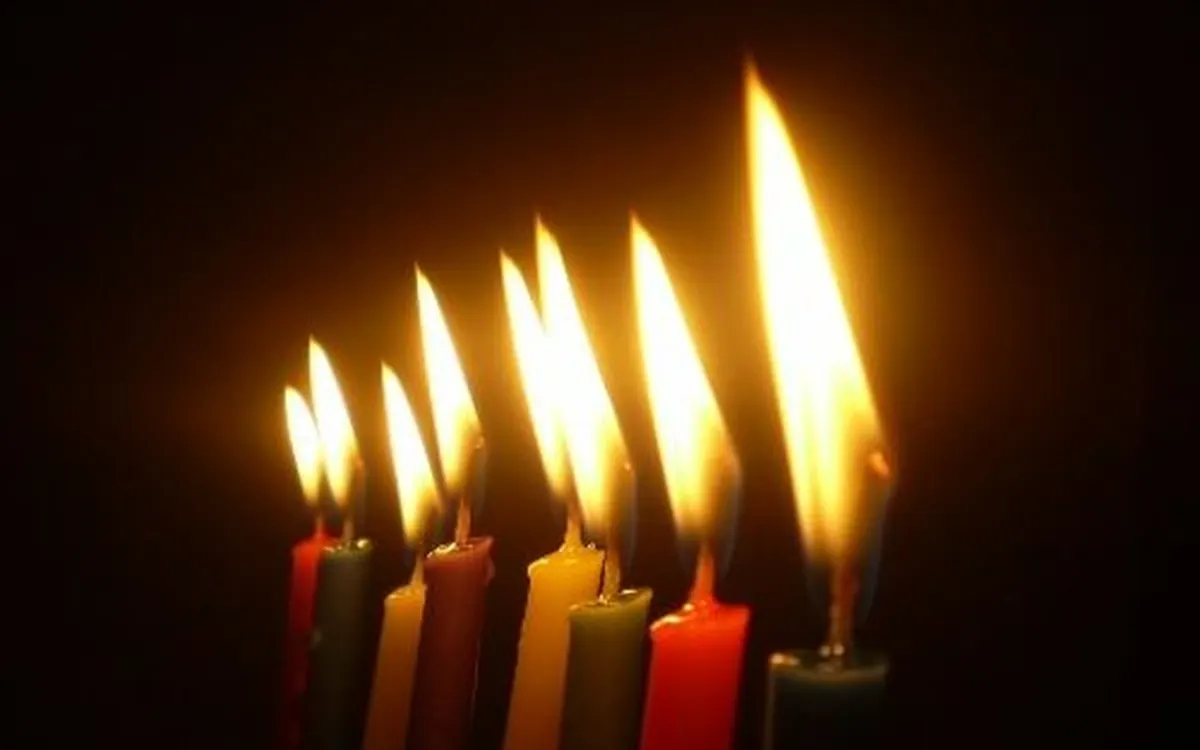
Rav Mike's annual shiur in honor of the yartzheit of his father, Charles M. Feuer, ob"m. Gratitude is one of the keys to happiness, especially in dark times. Join Rav Mike as he explores the connection between the Jewish holiday of Hanukkah candles and our ability to give thanks, and helps us let the light out.
About this episode
Albert Schweitzer said that at times our own light goes out and is rekindled by a spark from another person. Rav Mike gives this class in memory of his father, Charles Feuer, on his twenty-first yorzeit, and what he remembers most is that his father listened, one piece of gold for a good word and two for silence. When he graduated and wanted to travel in Australia rather than take a job, his father gave him the plane ticket and asked only that he keep a journal. Years later, searching for something to say, he opened that journal to the week of shiva and found a startling line, that he would be forever grateful that he had helped to bury his father. Grateful is a strange word there, and it opens the real subject of the night, hoda'a, the capacity to recognize and be grateful for the gift of life itself.
There is a tradition from the Arizal that Hanukkah lives in hod. Hod and netzach are the two legs, two aspects of the infinite, one letting the light in and one letting the light out, and this class is about letting it out. Every human being carries divine light inside, and the task is to let it out, which he says is done through gratitude. Picture a match, which holds tremendous potential energy and burns on its own once lit, yet a whole box stays inert because striking it requires an activation energy to get over the hump. Life is like that, a great store of joy that needs something to get it going. The darkness that holds us down is the Greek darkness, which the Ramban says came from believing only in the observable world, a very small world, joined to a pervasive sense of scarcity.
Hoda'a is hard to translate, holding together confession and gratitude into acknowledgement, a recognition of a reality that fills me with thanks and also makes me subservient to it. Rav Mike offers two threads woven through Hanukkah. The first is hitmasrut, giving oneself over completely, admitting that without you I would have nothing, which is vulnerable because it makes me dependent. In the Maccabee story, one cave of the faithful chose to die rather than fight on Shabbat, and then Matityahu and his sons made the opposite decision, that God wants us to live and so they would fight, because life matters. It matters simply because it is life, for the things we lean on all eventually fail us, and so gratitude built on them will not hold. That recognition is an existential courage, the ability to feel the worth of being alive and give yourself over to it day in and day out.
The second thread is hitbatlut, nullification, the recognition that nothing is coming to you. A sense of entitlement is the fast track to misery, since even what you think you deserve brings only the flat feeling that it was owed, while if life itself is an undeserved gift, everything within it becomes a gift on top of a gift. Should Rav Mike be grateful for a father gone twenty-one years, when soon he will have lived longer without him than with him? Yes, because none of it was deserved, so all of it was worthwhile and remains his. He brings the Sfat Emet, who compared the arrogant Greeks to the snake, since the Gemara says one whose spine does not bow in modim turns into a snake. The snake told Eve that God was not her friend, that she could eat and build her own world, a rival to the divine.
So the solution to the snake is hoda'a, bowing to a reality in which the world is infinite and life is its own justification. The Greeks broke thirteen breaches in the Soreg, the wall that marked the circles of intimacy in the Temple, meaning to say the Jews were nothing special, merely a tribal remnant who should join the great homogenizing culture. When the Maccabees returned they sealed the breaches and instituted thirteen prostrations at those spots, because the power of gratitude is a power of shining light outward. The windows of the first Temple were cut wide on the inside to let the light out, and the healed breaches became openings to the world. Our purpose is to be exactly who we are and shine that light so brightly that every other light becomes like a torch at noon, and on Hanukkah we are grateful for who we are more than for what we have.
Key ideas
- What Rav Mike remembers of his father is that he listened, worth two gold coins to a good word's one.
- Hanukkah lives in hod, and the task of every human being is to let the divine light within them out.
- Joy is like a match, full of potential energy that needs the activation energy of gratitude to get over the hump.
- Hitmasrut is giving oneself over to the recognition that life matters simply because it is life.
- Hitbatlut is knowing that nothing is coming to us, so every gift sits on top of the gift of life itself.
- The Maccabees sealed the thirteen breaches and turned them into openings, for gratitude shines our own light outward into the world.
Chapters
- 0:00 A spark from another person
- 2:09 My father who listened
- 3:11 The journal and the trip to Australia
- 4:19 Grateful to have buried my father
- 7:39 Hod and netzach; letting the light out
- 9:52 The match and the activation energy
- 11:58 Greek darkness; the small world
- 15:11 The darkness of scarcity
- 17:21 Hoda'a; confession and gratitude
- 18:26 Hitmasrut; giving oneself over
- 19:35 The Maccabees choose to live
- 26:01 Hitbatlut; nothing is coming to us
- 29:11 The Sfat Emet and the snake
- 35:43 Pirsumei nisa; advertising the miracle
- 38:53 Be who you are; the Temple windows
Who, where and when
People
Albert Schweitzer, Charles Feuer, The Arizal, The Ramban, The Sfat Emet, Matityahu and his sons
Places
Jerusalem and the Temple, The Soreg
Texts
Petach Eliyahu and the Tikkunei Zohar, Al HaNisim, The modim prayer, Genesis 3 and the snake
When
164 BCE: the Maccabees rededicate the Temple, 16th century CE: the Arizal, 1999 CE: the death of Rav Mike's father, Hanukkah 5781: the class given
Read the transcript
At times, said Albert Schweitzer, our own light goes out and is rekindled by a spark from another person. Each of us has cause to think with deep gratitude of those who have lighted the flame within us. Well, I'm deeply grateful for all the people in my life who've given to me. In particular, this is a class you're about to hear, given in the memory of my father, Charles Feuer, of the Taliban Abraham, on his 21st Yorzeit. And I want to show my gratitude to him most of all, to my family, to all those folks who are listening. And I want to ask you to show a little bit of gratitude to the hard work that goes into this show. You can like it. You can share it. You can give it good reviews on whatever platform you hear.
You can write to me at rovmikefoyer at gmail.com if you want information on how to dedicate a show or you simply want to give me your feedback. And, of course, you can also go to my website. That's jewishstory.co. So in the upper right-hand corner, you'll see a button there that says, Be a patron. You can click on that to give a little bit of per-podcast support. But more than anything else, in this season of darkness, you can spread a little bit of the light of gratitude in your own life by simply saying thank you to those around you. I'm Rav Mike Foyer, and this is The Jewish Story. Season 4, Interlude, Hanukkah, Letting the Light Out. I want to say thank you to my holy wife and my family for opening our home.
Thank you to my dearest friends for being the live studio audience and always being receptive to the crazy ideas I have. Thanks to everybody who's joining us on Zoom. Like Mary and Dick said when they first signed on, if it weren't for this, a lot of people wouldn't be able to be here. So it's a year of a lot of brachot. It's a year of a lot of hidden brachon. In many ways, that's kind of what I want to talk about. Before I get started, the shir, the shir, the class I'm going to give is Le'iluish Nishmat Avi Mori Betzal Ben Avram. It's for the sole elevation of my father, Betzal Ben Avram, Charles M. Foyer. And before I get started on the content of the Hanukkah, I just wanted to say a couple of words about my father.
And, you know, someone asked me, it's been 21 years, this is the 21st Yortzide, I was just in shul saying Kaddish, and someone asked me, oh, it's your father. It's your outside. He's like, tell me something about your father. So something I've told a lot of people here, and some people know it, is that, you know, people say, I always say, what did your father say? What do you remember? And the truth of the matter is, I don't remember anything my father used to say. I remember that he used to listen. So, you know, you tell a Jew something, he's got to tell you something back. So what does he say? So the sages say, right? Mila Besela Shtika Betray. Right? That I'll give you one piece of gold for a good word and two for silence.
Right? The ability to listen is really an incredible capacity. It's something that I feel blessed to have received from my father. But in particular, you know, it does get harder every year to remember something. Memory faith is just a reality. And the things that we return to all the time are the things that really shape the relationship we have with those that are gone. But in particular, I've told you guys this story about my graduation from college many times. Some of you probably heard it, some of you not. You'll forgive me. I'll sort of repeat it in brief that when I was graduating from school, I wanted to go travel in Australia. And I didn't want to get a job. And, Mom, you may recall that I asked you to tell Dad, and you said, no, I'm not telling your father.
You tell him you're not getting a job. And, of course, after graduation, my father comes up to me and says, oh, your mother tells me you're not getting a job. Yes, you know. and he asked me why and I explained to him that it was an incredible opportunity of freedom that I had after school. I had no debt in the great merit of my parents. I didn't feel, there was no war. As I said to my dad, when he graduated he had a pretty low draft number and he was looking at Southeast Asia if he hadn't gotten a job in essential industries. And so I basically said this was an opportunity you never had. It's an opportunity I have and I want to take it. He kind of nodded and said, listen. So after the ceremony he came to me with a card and in it was a check for the plane ticket to Australia.
And he said, all I ask is that you keep a diary, a journal. So I've told that story many times in terms of just the beautiful love my father really had, that his children in particular, but people in general, should be who they need to be and should pursue their dreams. But Tanakh, I wanted to share something with you, because of course I listened to my father, at least once, and kept that journal. And when I was trying to remember something I could say, I went back to, I have journals from the year I went to Australia in 1996, all the way through his death, and even a year or two beyond that, which is a very precious thing I can tell you to have now. And so when I was trying to think of something new, or at least something different, something to share, I opened up to the Shiva.
And this is what I found. One thing I must record. I will be forever grateful for the fact that I helped to bury my father. Now, that's a funny statement. Grateful. I have to tell you, I was quite shocked when I read that. It's a strange thing to be grateful for. And something I want to do right now is talk about gratitude. Things here I should add, at least as long as I'm talking about it with my dad. I do know this. My father was a loving and supportive man. And as long as I'm honest with myself, he would agree with whatever decision I make. so actually on that note before I get started in the content, what I want to speak about Tanakh is gratitude hoda'a, this ability to recognize, acknowledge and be grateful for the things that we have in life which I think is an incredibly important task life in general for someone who loses to someone they love is even more so and now the world right now is in the midst of some very profound struggles and I think that it's often hard to be grateful for what we have when we're faced by the lack of what we're used to and the challenges of things that we didn't expect.
Before I do that, though, because it's a unique opportunity, I have a lot of people here that I haven't seen in a long time, others perhaps I haven't even met. I see even some numbers on the screen I don't even know. I do want to invite some folks to know that there's a lot happening. There's a lot happening in my life. There's a lot happening in the work that I do. I want to make an invitation. If people aren't familiar with the content that I'm putting out, you should go to jewishstory.co or ravmike.com. That's my new website, ravmike.com. If you want to be on a mailing list or you want to just be in touch and know what's happening, you can sign up there. There's a very easy method to do it. I encourage you guys to do it because what I'm trying to do is spend a little light.
And in particular in these times of darkness, I think it's an important task. So I invite you to join me. So like I said, my dad, I know, wanted me to be what I could be. I don't have any questions with that. I can see my brother there, and I'm sure give me the thumbs up if you agree that that was always the message you got. even though sometimes, of course, it was also if you pierce your ear, I'll rip your ear off. But that's a generational thing. He wanted to be what I'd be. And I think also it's what Am Yisrael, what the world needs from Am Yisrael. I really feel very deeply that what the world needs from the Jewish people is that we actually be who we are. So this discussion is going to kind of take place on two planes, just so you have a sense of how deeply you're trapped.
I don't plan on speaking for more than about a half hour, 40 minutes. Don't be nervous. I apologize in advance. for those of you who don't have source sheets, because I didn't prepare adequately enough in order to make that happen. But I'll try to make sure that I'm not sort of like too deep in the text. So there's a tradition from the Arizal, the great mystic of the 16th century, that as we say, Hanukkah is in Hod. What does that mean? Hod is a certain aspect. It's one of the ways in which the creator relates to creation. And if you look in Petach Eliyahu, If you look in the Tikkun Ezzohar, where it describes all of the different ten spherot, the different ten aspects of how the creator relates to creation, each one is related to different parts of the body.
We can play head, shoulders, knees, and toes later if you want with it. But the piece that I want you to picture right now is that hod and netzach, which I'll explain what they mean in a second, are your legs. They're the left and right leg. which I want you to picture that these are, what hod and netzach are, there are two aspects of the infinite. One is letting the light in. Right? That's netzach. It's the eternal. You reduce yourself to this tiny little point and you let God's light in. Hod is the glory. And that's letting the light out. And that's what this shir is called. It's letting the light out. Because what I want you to know is that the task that every human being has in life is to let the divine light that is inside them out.
The question is, how do you do it? And the answer in brief, so you know where we're headed, or you can just sign up now and say, well, that was worthwhile, is being grateful. Now, you might think that's a little strange, because, like, I'm grateful for fill-in-the-blank. I'm grateful for the things that happen to me I'm grateful for. And in fact, there's a whole great gratitude practice, which I think is extremely worthwhile, that you can make a list every night of ten things you're grateful for, or you walk through your world and you say, I'm grateful that I have eyebrows because otherwise the sweat would drip down. I'm grateful I have a belt and my pants would fall, etc. That's great, but that's not what I'm talking about.
Because there's an aspect of gratitude which is external. I'm grateful for. And then there's an internal posture of just being grateful. For instance, I wrote in that journal that I was grateful that I buried my father. I wouldn't put that on the list. not in a normal day. So where does it come from? So like I said, Hanukkah is about hod. And for those of you who are in the know, hod is on the left side and netzach is on the right. When you walk through the door on Hanukkah, you're supposed to put the menorah on the left and you have your mezuzah on the right. There's one side that lets the light in, there's one side that lets the light out. So this shir, as I said, this class is about letting the light out.
And of course, for a little bit more of a simple relationship, We know that when the Maccabees defeated the Greeks at the beginning of the battle, if people aren't familiar with the history, that the liberation of Jerusalem and the rededication of the temple for which we celebrate eight days is the beginning of a 25-year civil war and then war against Greece. It's quite a complex story. Don't be nervous. I'm not going to tell it now. But when the Maccabees liberated the temple, it says in the description, it comes to the Gemara and elsewhere, in the coming year, that they took these days and they fixed them as days of halel, songs of praise, and hoda'ah. And the question is, which I would translate as gratitude or thanksgiving, and the question like I said I want to talk about is how do we feel, how do we live a life of genuine gratitude Now again I not talking about the external the mitzvah There a mitzvah there a commandment to give thanks to God In certain circumstances a mitzvah Not what I'm speaking about.
I'm talking about how do we actually feel grateful. Because I actually think that the human being is a wellspring of joy. It's just most of us have a hard time letting it out. So the question becomes, what tools do we have to let out that light? You know, a scientific metaphor, for those of you who can handle it, if not, you'll forgive me, that picture a match. A match has tremendous potential energy. And the burning of the chemicals on the match is what's called an exothermic reaction. As soon as it starts, it goes. It doesn't need to be encouraged. You don't have to say the match, burn, burn, burn. So why does a box of matches stay inert? Exhibit A. Why does it stay inert? Because there's an activation energy.
You have to strike a match. You have to get it over the hump. If you are familiar with the energy chart, I see Dick nodding. You can explain it to everyone later. You have to get it over the hump. That's what life is about, is that you have a tremendous amount of joy inside of you. The challenge is how do you get over the hump? So that that light which is inside you actually goes without having to make it happen. And in that light, we have to ask, what's the darkness that we're looking to dispel? What keeps us down? in the historical sense people may be familiar that Greece is compared to darkness depending on how firm you are, you may call the enlightenment the endarkenment, it's one of the favorite jokes that you hear in certain very limited circles, but hameivian, yavin, as we say those who understand do, and those who don't, it doesn't really matter because you get it, the Greeks were darkness, why?
because hechshichu eneim shal Yisrael they darkened the eyes of Am Yisrael, what does that mean? for most of the world the Greeks brought light That's the general sort of narrative you'll find in Western culture. Remember, the Jews are always swinging upstream. So if the world says that Greeks brought light, we're going to for sure say that it was darkness. What's that darkness? Well, actually, the Ramban, great mystic and rabbi, doctor, good Jewish doctor of 13th century Christian Spain, says it's very simple. The Greeks only believed in the observable and comprehensible world. Nature. That's why the basis of their culture is what gave us science, right? Which, by the way, I'm a big fan of science, don't get me wrong.
I'm a big fan of science. But the human mind is a lens, it's a keyhole through which you can view existence. It does not define existence. It observes and participates in existence. Therefore, if you believe that all that exists is what you see, you live in a very small world. And that's why the Gemara says the Greeks, or actually the Midrash says, the Greeks darkened the eyes of Am Yisrael. Now the truth is, we may blame the Greeks, but how many of us simply choose to live in the darkness that we've inherited? How many of us choose to see the world as that's just what is, right? And furthermore, how many of us give in to that unconscious element of pride that locks us into believing the world that we see is the world which really exists?
Because how could it be otherwise? Are you telling me I don't understand the world? Are you telling me that the way I see things might not be the sum total of how they are? there's a danger in limiting ourselves to that. And as we'll see at the end, this is what the snake, anybody who's out there who's in my class right now, at least I see a couple of people from the class, there's another angle on the snake from the Garden of Eden that we're going to speak about Tanakh. Because, of course, this is what the snake on some level says to Adam and Eve in the Garden. God doesn't want what's best for you and you can build your own world. Right? He wants to put humanity on top. So that's one side of the darkness.
The other side of the darkness that's holding us back, that we have to overcome this activation energy in order to give off our light, which is gratitude, is a sense of scarcity. We have a pervasive sense of scarcity in our world. Right now more than ever, I mean, the desperation of Corona and virus and economics, I'm not discounting the reality of these things, but it's just not enough. Think about the Hanukkah story. There weren't enough people to win. There's not enough oil to burn. those are the two things you have to overcome. There's always enough. There's always enough. Because God is able to do anything. The question is, can we let that light out? So, it's also last piece, and then I'll get going on explaining what it is I'm talking about.
It's important to remember that, especially in my counseling, I see this a lot, that oddly enough, these elements of darkness, bounding the world by my own understanding, feeling that everything depends upon me. I define that. A sense of scarcity and that there's nothing that exists outside of what I see and experience. These are the hallmarks of clinical depression. Actually. The difference between being sad and being depressed is losing sight of the fact that there's anything which exists outside of the darkness in which I dwell. And I worry about the world. I know what depression feels like. And I worry about the world. I worry a lot about the individuals I meet. And I worry a lot about the society in which I live.
And I worry a lot about humanity because we have a tendency to let ourselves dwell in darkness. And my argument is the only way to get out of that is gratitude. And not forcing ourselves to express gratitude that's worthwhile, but actually being grateful. So how do we do that? So, like I said, this will take place on the personal and the national. I'll do my best to keep them straight. But as anybody who's ever been around from one of these classes knows, I don't really keep much straight at all anyway. I need one of the copies of those source sheets that I gave you. Oh, everybody jumps up and gives me it. All right, thank you. Okay, Toph. So that was the studio audience, for those of you who couldn't see them before now.
Okay, so, first of all, hoda'a. is a very difficult word to translate in a single term, right? I mean, that's the nature of language. Certain terms are easy. Kova equals hat. That's a simple one, right? But if I said to you peah in Hebrew, how would you translate that? Don't say wig. Because it's not a wig. It's the corner of the field that you leave uncut so the pork can gather it. Right, go ahead and translate that, though. You get my point? Is that certain words are indicative of such deep elements of culture that they can't be simply translated in a lexicon that go from this word to that word. So there are some sort of well-known tensions that hoda'a is translated in. There's an element of confession, and there's an element of gratitude.
And you put confession and gratitude together, and we call that acknowledgement. It's a deep recognition of a reality which fills me with a sense of gratitude but also causes me, to some degree, to be subservient to its overarching reality. That's a classic tension. And I want to offer you guys another tension which runs as a thread through the story of Hanukkah, which gives a certain practice, I would say. It's a tension between what's called hit masrut and hit bat lut. Hit masrut is total giving over oneself, and hit bat lut is a nullification of self. So what do I mean? What does this have to do with gratitude? Well, kitmasrut is the recognition, is the acknowledgement that I'm actually dependent upon someone else.
It's one of the reasons we find being grateful so difficult. Saying thank you with a full heart is acknowledging that without you, I couldn't have what I have. And that's vulnerable. And it makes me dependent. It makes me feel insufficient. Right? At the same time, the same combination could make me feel cared for, loved, held, upheld. It's a question about the human condition of what wants us to hold back from giving our full faith in another person. There's a certain element of gratitude, of choda'ah, which is what Rav Shaggar calls a hizrakut. I've got to throw myself into it. I'm just going to say thank you. I acknowledge the fact that without you, I would have nothing. That type of, that type of hit masuid is literally a recognize.
You recognize a reality, but you recognize. You have to literally rebuild your frame of understanding in light of what's been done for you. And it's a source of tremendous energy. If you're familiar with the Hanukkah story, there's a tremendous moment where the Maccabees, right, Matthew Yahu and his sons are hiding out in the caves along with all the other faithful, right, and the Greeks figure, ah, we know these Jews will hunt them on Shabbat. So like the first cave that they come to has, I don't know, a thousand people hiding in these caves, and it's Shabbat, and what do they choose to do? Die. They say, well, you know, better we should die than violate the Shabbat. We don't know whether they'll kill us or not, but we know it says in the Torah, right, those who violate it will die.
You're familiar with the story. And indeed, the Greeks obliged them by killing them all. Next cave, next week, the Greeks figure, you know, next week, next cave, they come upon Matityahu and his sons, and Matityahu and his sons make a tremendous decision. They say, no, God wants us to live. And we're going to fight on Shabbat, even though it's a violation of Shabbat. Because life matters. I want you to remember that phrase. Because life matters. The ability to recognize that life matters. Not life matters because. But because life matters. Not life matters because I have this, or because I have that, or because I do this, or because... Those are all very important things. But in the end of the day, they will all fail you.
Everyone dies. Things fall apart. Toys break. People leave. Fill in the blank. Right? The center will not hold. And if you make your sense of gratitude dependent upon things which exist outside of you, then you will, in the end, not be grateful. But if life matters because it's life, and you can give yourself over that recognition that life matters, well, there's a tremendous power. What happens in the story? They realize, we've got to live. We're going to fight on Shabbat. these Hasidim pop out of the woods, not with like the Shrimals and the Kapotas, but like they're the righteous warriors, each one willing to give over their life for God. And it's from there straight up to the temple. Basically the story goes, this incredible energy, it's a burst of flame.
They get over the hump Afterwards it very messy The next 25 years are very messy But that the sweet part That why by the way this is what we celebrate Right Because it a fire that brings them all the way back up to the temple Now, it's fascinating. What do they find in the temple? Of course, you guys all know the story. It's a mess. Right? All the oils have been, you know, impurified and they were sacrificing pigs on the altars. But one of the things that it's often missed, to pull back to the national scale, is that the Greeks also broke 13 breaches in one of the walls of the temple. The temple has multiple walls around it. I'm not going to go into the sort of sacred geography right now, but it has multiple walls.
One of the walls is called the Soreg, right? And those of you who have the source sheet there is there's a Mishnahh in Midot that says that when the Maccabees and the Hasmonean kings came back and purified the temple, they sealed up these 13 breaches in the wall that the Greeks had made, and they instituted 13 prostrations. 13 sort of acts of bowing. As you went around the temple, you would bow, prostrate, not just bow, but you would literally lay yourself out flat in front of these places. And I want to come back to this because this power of hishtachavaya, of laying oneself out, is actually another one of the elements that make up the revolutionary power of hodaab, gratitude, for lack of a better translation.
So, okay, we have this element of hitmasru. You have to give yourself over completely, just recognizing that life is indeed worthwhile. It's kind of, I might call it an existential courage. Right? Meaning, it's the ability to stand in a moment, or a phase of life, or in front of a very difficult situation, recognizing that your life is finite and therefore, in a sense, meaningless. Oh, it may mean something to you now, but in 10 years, 100 years, 1,000 years, no one will remember you or what you did. Maybe in 10 minutes. Maybe nobody's looking and they'll never know what you did. It's an existential courage because if you can look inside and find some place that feels the worth of being alive, not in what you're doing, but of life itself, and you can give yourself over to that sense, ah, I'm alive, that's hodaah.
That's a life that you can live day in and day out in gratitude. By the by, at the risk of skipping around in the source sheet, in the three prayers that are daily said by traditional Jews, there's one of the 18, which are really 19 blessings, of the Shem'an Aserah is the modim. The gratitude prayer, or the acknowledgement prayer. What are you acknowledging in that prayer? Anything special? Those of you who have the text, you can see it in front of you. We're just acknowledging, we're grateful for the fact that you're God, and this is life. It's a gratitude for every moment. Not because of its content, but because of its existence. And that is an ability to give oneself over to life. That's hit masrut.
I'm not looking for the results. I'm grateful for the gift of living. So that's one half, basically, of what I want to say. Really, it's one half. And so the other half is the sense of hit bat lut. or this may be another third, but this sense of nullification, another important practice if you want to live a grateful life is you have to recognize that you have nothing coming to you. It's really that simple. If you have nothing coming to you, then anything which you receive is instantly a source of gratitude. The other way to say this is a sense of entitlement is the fast track to misery. Even if you get what you think you're entitled to, it will only produce within you the sense of, well, yeah, it was coming to me.
It will never produce gratitude. But if one recognizes that even life itself is a gift that I don't deserve, then the things which I get within life are all gifts on top of a gift. And there's a tremendously powerful sense of thanksgiving, which can then arise out of a sense that everything I have was given to me as a gift freely given. You know, just think of what it might be like to feel that the best things you've done have already happened. The best years you've lived are already gone. The people you've loved are not there anymore. I'll be very straight. Should I be grateful for my father? I mean, it's been 21 years. I'm 46, for those of you who don't know that. I know, I look young. I'm 46. Do the math.
in a few more years, I will have lived longer without my father than I will have lived with him. Please God, much longer. So, I could say, I got robbed! I got robbed! All that time. Never met my wife, my kids. In fact, there's no one in this room today, and the closest people in my life are here, with the exception of one or two that are missing. There's no one in this room here who knows my father except from pictures and my own stories. There's some people on the screen, thank God, and it's really precious to have you guys, because I tell you, I've been doing this for years and years, and usually there's no one there. So, there's a question. Should I be grateful? The answer is yes. You know why? Because I didn't deserve any of it.
It was all a gift. So therefore, those 21 years were all worthwhile. And I will always have them. That's heat but loot. There's no feeling that I deserve. They're simply what it is I've been given. So I want to come back to this picture of Yavan and breaking through the walls in a minute. But first, I'm going to take a sidestep. There's a beautiful piece that I was looking through, and those of us who have been in this shear for a number of years together have had this experience many times. There's too many thoughts on the page, basically what I'm trying to say. But there's one more concrete piece that I really want to point to, which is this incredible thought that I found from the Svat Ahmed. The Svat Ahmed was one of the third-generation Hasidic masters, lived in, let's think about that, 19th century Poland, and just one of the most, yeah, 19th, yeah, third century.
He was third-generation, right? Just say yes and help me out. Thank you. Just incredible, just incredible Gval Torah. And here's what he says. He says, They were arrogant. Meaning what? Like I said, the Greeks felt that they ruled the world. That they were the standard of measure for existence. And therefore they wanted to make Am Yisrael bow to them and not to God. So he goes on through some complicated Kabbalistic thinking that I won't drag you through to compare them to a snake. Why? He says, because the Gemara in Babakama says, Because anybody who doesn't bow in the modim prayer, three times daily that we bow and acknowledge, their spine turns into a snake. Now, what does that mean? If you don't bow, your spine turns into a snake.
Well, this is actually what I just said to you before. This is a tefillah of gratitude for God's daily existence. not just for God's daily existence, for my daily existence, for the Yom Yom Yi, everything I have in life. And that bowing and acknowledgement stops me from becoming a snake. Now, this functions on two worlds, on two planes. The Greeks wanted to deny any transcendent element to creation. It was a physical world, and that's it. There's certainly no God, no overarching story of Am Yisrael, not everything that fuels the way our people have walked in the world for 3,000 years. Second of all, of course, the human will is the ultimate arbiter of morality and purpose. This is the snake in Gan Eden.
If you look in Breshit, what does the snake actually say to Eve before she eats from the fruit? He says to her, You're never going to die. God's told them, right, if you eat from the fruit of the tree of knowledge of good and evil, you're going to die. Snake says, you're not going to die. God's lying. Furthermore, he says, God knows, the day you eat from it, and your eyes are open, you'll be just like God, knowing good and evil. Meaning, God is not on your side. Think about that. The snake said, God is not your friend. You're in competition with God. Rashi brings the Midrash. He says that, Every craftsman hates his competitors. And God ate from the tree, says the snake, and created the world. And God knows if you eat from the tree, you'll create your own world.
Meaning you are peers with God. Don't give up your selfhood to bow to the divine. What they're really saying is to bow to our culture. But they don't tell you that. It's objective truth after all. So the solution to this is hoda'a. Not gratitude in the simple sense of thanks, but a deep awareness and bowing to a reality that on one hand the world is infinite. There's no boundaries. There's no boundaries. On the other hand, that life is its own justification. Life is its own reason. Now it may seem odd coming from a religious person who is ready to stack up for you all the reasons that you have to do this and all the reasons that you're supposed to do that. But remember, those are a step down from what I'm talking about.
Those are the ways in which, in our practice, we try to shape our behavior. The core understanding of what I'm speaking about is what's called life which is life which is rooted in the highest wisdom. Basically, if you exist, that means that you have a purpose. What that purpose is, beyond your existence, you may never know. But realize that your life is a precious gift. 10 years, 20 years, 50 years, 53, 46, 92. Your life is its own justification. And that should be a tremendous source of gratitude. And if it's not, well, you're going to be a snake in competition with God thinking you can build your own world competing over a scarcity of who gets the fruit So, it's not for naught that on the Hanukkah holiday we insert an extra prayer into the modim.
You have the daily gratitude practice of bowing and not becoming a snake, and then we insert a special prayer in modim, which is called Al Han Nisim, on the miracles. And it goes through the story. Many of you probably know the story. Some of you probably say it on a regular basis. And in a sense, it's the opposite of the modi. I mean, this is no longer the sort of daily sort of miraculous of the mundane. This is a one-time historical event bound up with salvation. The many defeated by the few. The wicked defeated by the righteous. The impure driven out by the pure. You guys know the story. Furthermore, this whole eight-day miracle lights thing. It's a relationship between miracle and salvation. It's an extraordinary event, so to speak, that combines with the unfolding narrative of history to manifest or reveal, depending on how you look at it, God's will in creation on a deeper level.
It exposes a new horizon of story. Oh, you thought the story looked like this? The Greeks told you it looked like this? The reality is, God's holding the horizon. It looks like this. That's what a miracle does. And sometimes the historical salvation is the miracle. The few defeat the many. And sometimes the miracle itself is salvation. Like, oh, you thought that that much oil could only burn for one day because you understand the physics of it. That's true. But did you understand that there's a deeper will that makes those physics beat? Or do you live in darkness once that light goes out? You know, in a sense, that's why the eight days of light come as a hechshar, as a stamp of approval on the war. Because the essential message of both is the same.
So don't walk in the world as if the boundaries that your judgment sets are definitive. Otherwise, you will lack gratitude. Not an inability to say thank you, but an inability to give yourself over completely to acknowledgement of a larger reality within which you live. That's the difference between being sort of acting grateful, doing things which show you're grateful, and actually being grateful. Living the depth of acknowledgement that the world is far, far lighter and larger than we generally see. That God is holding the boundaries of the story. In that sense, what's the mitzvah you do when you light your candles? Quiz? What's the mitzvah called? Fulfilling the mitzvah? Pirsume Nisa. Pirsume Nisa literally would be translated as advertising the miracle.
It's an interesting thing because an advertisement is not a delivery of information. When you light those candles, you're not telling people that the miracle happened. What's an advertisement meant to do? To move you to action. It's the activation energy that gets you over the hump. right? Pursue Anisha is about getting people over the hump and into action of a sense of gratitude which is why if you look back in the Gemara there's a fascinating and those of you again who have this sheet there right? It says right? It tells the story they only found one little jar of oil that was there with the seal of the high priest there wasn't enough in there except the light for one day a miracle was done with it and they lit from it for eight days, lit from what?
they lit from the miracle not from the Pach Shemim the miracle is that they looked at all after years and years of Greek oppression after Hellenism which was at the heart of their culture, they knew that there was a core of identity within Am Yisrael which was indelible. And they looked and they found and it was from that that they were able to light for eight more days. Listen to it. Nasebo nes v'viku mimenu min hanes sh'mori amin. That they lit from it for eight days. that the miracle itself was what caused them to keep lighting even though the rational mind said to them there's not enough oil. Why did you look in the first place? So, quick review, last piece and then we will wrap it up. That I'm not talking about acting grateful, I'm talking about being grateful.
About letting the light out. That there's something within everyone which is a gift that starts every morning when you say every morning we say, I'm grateful because I'm alive. The question is, how do you get it out? Because the darkness of the limitations that culture puts on us, that we put on ourselves, the belief, again, not that your rational mind isn't a good tool. It's just a good tool insofar as it's fit to the situation to which you apply it. But to limit the world to your understanding is to live in a very small and scarcity-ridden world like we live in today. to be grateful is to give yourself over to an acknowledgement that there's a larger existence, which is in the hands of the Bore Olam, of the creator of the world.
So, back to this image. Because Amishra has got a lot of problems. I won't go through them all because I'm giving myself three more minutes. We've got a lot of challenges, but more than anything else, our challenge is a challenge of Hod. Of that aspect of Hod, you can even hear it just phonetically, those who don't necessarily aren't familiar with the language, hod is in hoda'a. Right? Hod means glory, and hod is that aspect of God's infinite being which is found in an infinitude of expressions. In other words, in order for God to be completely infinite, you need to be exactly who you are. Because you are unique, and therefore precious and irreplaceable expression of the divine will. And if you try to be something than what you are, and I realize there's all kinds of problems with that and antinomian elements that are, I'll stand by it to my dying day.
If you try to be something other than what you are, you are denying God's glory in the world. If that comes into conflict with other things, well, life is full of conflict after all, isn't it? Right? But Am Yisrael counts in that respect too as a people. So why did the Greeks bust 13 holes, specifically in the Soreg, the one wall around the temple? well, if you look in the Grah, in the Vilna Gaon's commentary, which I think I brought to you here, in the source sheet, the Vilna Gaon says, well, he says, Perush, lefish ad sham haya mutalo, ovid kochavim nichanitz. But there's a point at which non-Jews, idolaters, could not go in the Temple. Of course, there's also a point at which the Kohanim, no one who's not a Kohen, can't go.
And there's a point at which, beyond the Kohen Gadol, only the Kohen Gadol k'ngol, meaning these are circles of intimacy. so the Greeks wanted to say there's nothing special about you right? from there onward the idolatry was not permitted to go that's why they broke it they wanted to say no, no, no we're a homogenizing Hellenizing force we are the great culture of the world you Jews are a tribal remnant that just need to get with the program this might sound familiar to some of you and so they busted through those walls now, what did the Maccabees do when they came they didn't just fix them. They instituted a very important act at each one. Ishtachavaya. It was a prostration. The physical expression of gratitude.
Why? I mean, they fixed those walls. You would think we wouldn't talk about it after all. It's a little bit embarrassing incident that this kingdom came, defiled our sacred space so much that they busted down 13 holes. We won't talk now about why the 13. 13 holes in the wall. No. We're going to remember them every time we come in the temple. You know why? Because there's two ways light works. It can shine in, and it can shine out. I told you, this is the holiday of letting the light out. The Greeks understood that the power of Hoda'a, sorry, the Maccabees understood that the power of Hoda'a was a power of shining light outward. It wasn't enough just to seal those breaches. That our purpose is not to keep some small tribal island and to be a nation unto ourself.
Our purpose in the world is to shine God's light everywhere. In which case, the first temple, you may be familiar, the windows in the first temple worked opposite the way windows normally were. Windows were normally cut in the ancient world to be wide and let light inwards. The windows in the temple were cut to be wide on the inside in order to let the light out. And this is the same idea. When the Maccabees fixed those breaches, they sealed them physically, but spiritually, they made them openings to the world. And, you know, this type of particularism is problematic in the world in which we live. I'm well aware of it. It's problematic in the eyes of the universalist elements of the world, and it's problematic for its own right, because it causes a lot of challenges, and it invites breaching, by the way.
It invites breaching. The stronger we want to hold ourselves separate, the more certain elements of the world want to poke holes in our walls. Well, that's why it finds its tiqui, and it's fixing in hod, in hoda'a. Because if you can be exactly what we are and shine that light outward in a sense of gratitude, a completely giving over to an acknowledgement of the source of our lives and a recognition that nothing, nothing is coming to us. And therefore everything we have is a source of gratitude. We can shine that light outward so brightly that every other light in the world becomes what's called Shraga B'tihara. It's like a torch in the noonday. You can shine your light too. I'm not bothered by it. Right?
So, like I said, the windows of the first temple shined outward with that light. The healed breaches of the second temple shined outward with the light of Hoda'ah, with this bowing and prostration that was done at each. And the third temple, Shiba Nebim Herab-e-Amenu, is going to allow us both to let light in and to let it light out, both on the personal level and the national level, and that should be a light of gratitude. So I'm grateful that you all have hung with me this far for these thoughts. I want to thank especially all my family, my mom, my brother, I see Judy, my mother-in-law, I see my Uncle Mark and Aunt Carol, my cousins Dick and Mary. It's really wonderful to see so much family and students and friends.
And we should all just merit to let a little bit of light out on this Hanukkah and be grateful, not for what we have, but for who we are. Thank you very much.
More from Season 4

TJS S4 Interlude: Interview with Rabbi Berel Wein
It is not every day that you get to speak with a legend, much less interview one. Here are some precious words I had with the 'alter rebbe'...
Play Episode
TJS S4E8 War of Attrition part I
Changing our conceptions is one of the hardest things in life to do, for countries as well as individuals. Israel's stunning victory in the Six Day War of...
Play Episode
TJS S4 Interlude 10th of Tevet: it's not too late
Every fast day is an chance for cheshbon nefesh, for making an accounting of life and the world. The Tenth of Tevet offers an additional, unique opportunity -...
Play Episode