
TJS S4 Interlude: Interview with Dr. Michael Oren
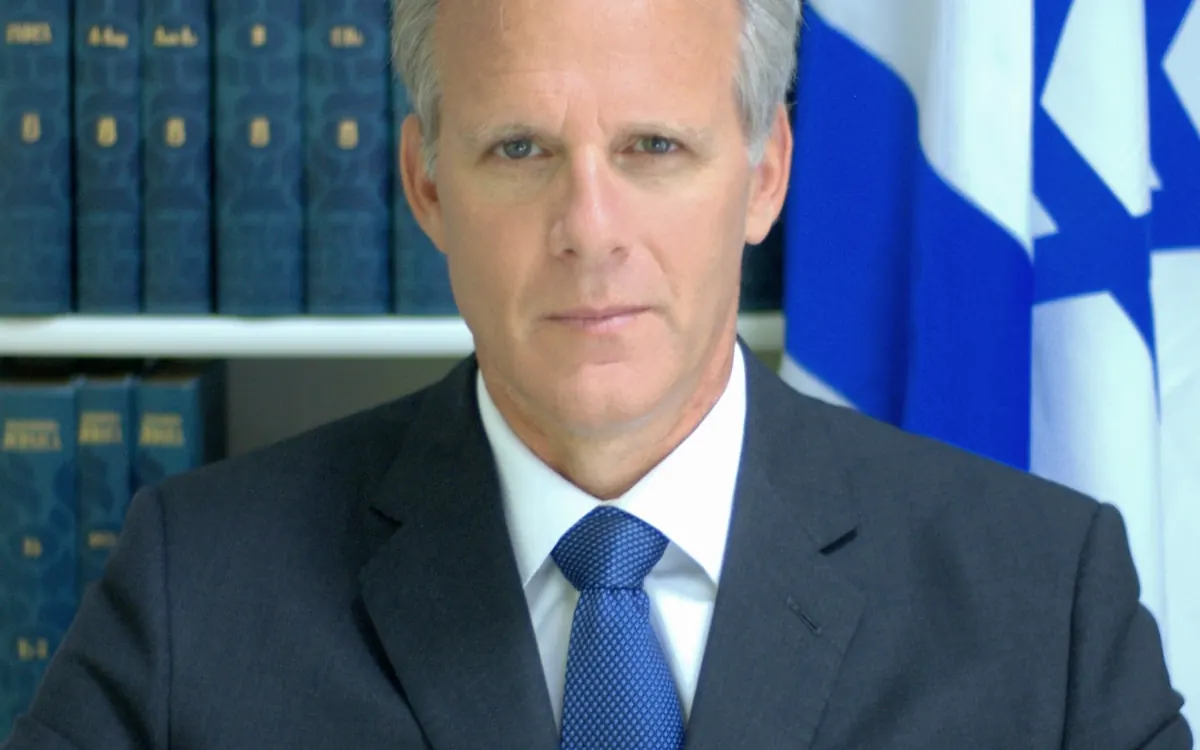
In this interlude I am joined by special guest Dr. Michael Oren, author of Six Days of War: June 1967 and the Making of the Modern Middle East among many other books. The topic at hand is how the Six Day War helped shaped the special relationship between Israel and the United States. Along the way Dr. Oren offers insights on a range of events, sharing his perspective as an ambassador, Member of Knesset, historian, author, diplomat and a Jew.
photo credit: Anne Mandelbaum, creativecommons.org/licenses/by/3.0/deed.en
About this episode
We have a better chance of assuring our future if we remember who our friends are, says Kissinger. Rav Mike sits with Dr. Michael Oren, historian, former ambassador to the United States, and author of the definitive study of the Six-Day War. They open on Oren's new fiction, The Night Archer, a collection of more than fifty stories with no single theme, before turning to the bond between fiction and history. Oren tells of a story called the thirty-year rule, built around the declassification of diplomatic documents, which lets him take aim at the positivist school of Benny Morris that treats such documents as objective. An ambassador writing a cable is thinking about how it will read three decades on, so it is deeply subjective. His own books, he says, were written to read like novels, and he opens the war study with the line that wars in history eventually become wars of history, a battle over meaning that has only grown more heated across fifty years.
A 1962 line from Kennedy to Golda Meir described a special relationship comparable only to Britain's, which Oren finds ironic since Kennedy was hard on Israel and never received a prime minister in the White House. Still the claim was right, and Oren frames it as three pillars, shared democratic values, a strategic alliance, and shared spiritual roots, with the spiritual the deepest. America remains the most religiously observant industrialized country, its people read the Bible, and the promise of return from exile runs back to the pilgrims who studied Hebrew and nearly made Moses the national symbol, with presidents from Adams to Lincoln to Wilson counted as Zionists. Yet before 1967 there was little strategic tie, only Kennedy's defensive Hawk missiles, and Israel fought the Six-Day War without a single American bullet. On the seventh day American policymakers woke to a small superpower that had beaten three Soviet-backed armies, and the alliance was born.
America's two interests in the region were interrelated, oil and keeping the Soviet Union away from it. Turning home, Oren calls the war thoroughly transformative for American Jewry, a community that in early 1967 kept a low profile, proud of Sandy Koufax yet whispering about the Holocaust until figures like Elie Wiesel spoke it aloud. The victory let Jews stand with their backs straight, a kind of expiation for the guilt of wartime inaction, and it began to resolve the question that haunted Roth, Malamud and Bellow, how to be American and Jewish at once, a question young Jews today no longer even understand. Arthur Hertzberg called the de facto religion of American Jewry Israel watching, which held until the shock of the Yom Kippur War, the oil boycott, Arafat at the UN and campus radicalism, after which the energy moved to the Soviet Jewry movement and later to Tikkun Olam.
Oren insists the Israel lobby was strong because of the alliance, reversing Steve Walt's charge that the alliance was a product of the lobby, since organizations that existed before 1967 had no power and drew it from Israel. He adds the counterintuitive point that groups critical of Israel today, from J Street to Jewish Voice for Peace, are themselves products of the confidence the state gave American Jews, who no longer feel the sting of a dual loyalty charge because being pro-Israel felt like fulfilling an American ideal. The war was also a spiritual shot in the arm, feeding Hebrew learning, the day school system and institutions like Pardes, founded in 1972. On the presidents, Oren reads Johnson as genuinely warm, a Texan who saw Israel as the Alamo, while Nixon won perhaps eight percent of the Jewish vote and harbored suspicions, yet ordered the airlift that saved Israel in 1973, moved by the Soviet rivalry rather than love.
Asked whether the subtitle, the making of the modern Middle East, still holds, Oren admits the Iran nuclear deal has become another big bang, creating a non-secular hegemon in Shiite Iran that is aggressive, armed and bent on dominance, and pushing Arab states to rethink their view of Israel. The treaties with Bahrain and the UAE were not territory for peace and did not touch the Palestinian issue, which calls his thesis into question even as the Six-Day War remains the ground of the peace with Egypt and Jordan and of American recognition of Jerusalem and the Golan. He closes as a Jew, with the lesson that you know how things start and never how they end, a humility deepened by living through the pandemic. The war carried the tragedy of Nasser, the quiet heroism of Levi Eshkol, the frailty of Rabin, and for his own parents the dread of a second Holocaust alongside the sense of being born into an age of Jewish miracles.
Key ideas
- Oren reads Kennedy's special relationship as three pillars, democratic, strategic and spiritual, with the spiritual roots reaching back to the pilgrims the deepest of them.
- Before 1967 there was barely a strategic tie, and Israel fought the Six-Day War without a single American bullet until the seventh day woke policymakers to a small superpower.
- The war let American Jews stand with their backs straight and began to dissolve the question of how to be American and Jewish at once.
- The Israel lobby grew strong because of the alliance, and even groups critical of Israel today are products of the confidence the state gave American Jews.
- Nixon, suspected of antisemitism and winning few Jewish votes, ordered the 1973 airlift that saved Israel, moved by the Soviet rivalry.
- The Iran nuclear deal has become another big bang, and Oren ends as a Jew humbled that you know how things start and never how they end.
Chapters
- 0:00 Kissinger; introducing Michael Oren
- 1:05 The Night Archer; Orson Welles
- 4:24 Fiction and history; the thirty-year rule
- 6:39 Wars become wars of history
- 7:46 JFK and the special relationship
- 10:08 The three pillars; the spiritual deepest
- 12:24 No strategic tie; no American bullet
- 13:29 The seventh day; a small superpower
- 14:33 Oil and the Soviet Union
- 15:43 A low profile; the Holocaust unspoken
- 16:49 Backs straight; Israel watching
- 20:17 The lobby strong because of the alliance
- 23:41 Dual loyalty erased; a spiritual boost
- 27:02 Johnson and Nixon; the 73 airlift
- 29:20 The modern Middle East; the Iran deal
- 34:00 As a Jew; destruction and miracle
Who, where and when
People
Michael Oren, Henry Kissinger, John F. Kennedy, Golda Meir, Benny Morris, Arthur Hertzberg, Lyndon Johnson, Richard Nixon, Levi Eshkol, Gamal Abdel Nasser
Places
The United States, Jerusalem and the Golan Heights, Bahrain and the UAE, Iran
Texts
The Night Archer, Six Days of War, Allies, The Bible in American life
When
1962 CE: Kennedy's words to Golda Meir, 1967 CE: the Six-Day War, 1972 CE: Pardes founded, 1973 CE: Nixon's airlift
Read the transcript
We cannot always assure the future of our friends, said Henry Kissinger. We have a better chance of assuring our future if we remember who our friends are. Well, I know exactly who my friends are, and I'm looking forward to a long future together. Because I'm Rav Mike Foyer, and this is The Jewish Story. Season 4, Interlude. Interview with Michael Oren on the post-1967 political reality. Well, hi everybody. I'm super excited to say that I'm not alone today on The Jewish Story. I'm joined today by Dr. Michael Oren. He's an American-born Israeli historian, author, politician, former ambassador to the United States, and is an expert on the very topic we've been discussing for so long, which is the impact of the 1967 war on not only American Jewish identity, but in particular what I'd like to speak about with Dr.
Oren today is the impact on the American Israeli political relationship. But before I do, first I want to say hello. Dr. Oren, it's okay to call Dr. Oren? Michael's fine too. Oh, Michael's fine. Well, we share that. So before we even get started, I'm actually incredibly curious. I was looking on your website before we met today, and I saw that you have a new book out, which is actually fiction. Can you tell me a little bit about not only the book, but I didn't realize that you were a fiction author. Many people don't. The new book is called The Night Archer. It is a collection of more than 50 short stories that draws on every aspect of my life, professional, personal, and otherwise, because as you said, I've been an author and a soldier and a father and a grandfather now.
And it's doing very well. And it's very different. Most short stories, collections are usually around a single theme. The only thing here is that there is no theme. It's perfect for an ADHD, corona-driven audience. I've been writing fiction since I was 12. I started as a poet and then moved on to playwrights and screenplays. Did a time in Hollywood where I was, believe it or not, I was Orson Welles' assistant. Wait, just give us one snippet about that. I mean, what was it like to have a relationship with perhaps the greatest filmmaker in American history? I've been in the military for many years and I participated in several wars. I think working with Orson Welles was scarier. All right. That kind of says it all.
He has that reputation. But, you know, a privilege. I guess. And I had to make a decision at that age. I was 21 whether I was going to stay in Hollywood to go live out my Israeli Zionist vision and dream. And I did. I thought maybe, well, worst of course, I'll always go back to Hollywood. I'll only be a paper for a certain amount of period of time. So I came here and never went back, which is very good, I think. But I kept writing. So I published several novels. People don't know this about me, including one which is actually a collection of novellas set in the Negev desert called Sand Devil. Yeah, I had no idea. Only collection of novellas ever sent in the Negev. And because I lived in the Negev for many years.
This collection of short stories, a short stories that I wrote while I was in office. Now, in Israel, as in many democracies in the world, you can write, but you can't publish. So I could write, and I used to get up at ungodly hours in the morning and write and put out these stories. But I had to wait until I got out of Knesset, out of the government, to actually publish the stories. So I'm delighted by this. I'm delighted to be able to talk about them. I've done a number of very high-profile podcasts about this from the 92nd Street Y to the Forward and Moment Magazine. Another one coming up for networks established by the Jewish Federations of North America. 85 JCCs are going to be on one Zoom talk about the Night Archer.
That's dumb. That's all the big Jews in America. Yeah, you know, the problem is nobody really knows how to market a book in Corona. You know, in the plane, you did, you know, 40 cities in four days and you went on various TV programs and you sold your book. I have not left basically what you see in the background here. And so everything I'm doing by Zoom, by remote. And we're going to see if it works or not, because the reviews have been outstanding and I've had great responses. but we just don't know how to sell a book in the daylight today. Listen, the unknown finds many manifestations in this era. I can't resist. I want to dive into our primary topic in a second. But I just am curious, as someone who writes both fiction and nonfiction as a historian, I'm curious, what do you see to be the relationship between fiction as a medium and history in terms of the power of using a story to communicate?
I think this is going to tie in very well as the Six-Day War thing. Let's hold up to the second part of my response. The first part of the response is that I write a lot about history in my fiction. In this collection, there's a story set in the 16th century about conquistadors. There's a story set in the 14th century about a Muslim sultan in the Ottoman Empire. They're a story set in World War II. So I'm always drawing on my tools as an historian. And I have one story in particular, which is one of my favorites. It's called the 30-year rule, which is about a 30-year British rule over an imaginary island in the Indian Ocean. But it's a double entendre. The 30-year rule is the rule that exists in the state of Israel as well as in other democratic societies such as Great Britain, which holds that after 30 years, diplomatic documents can be declassified.
Now, if you're a historian like I was for the Six-Day War, I started writing that book in 1998, and I was the first person to look at these documents from 1967 that had been declassified. That's the 30-year rule. But what this story is pointing out, the limits of diplomatic documents, because I also know as a diplomat, as a statesman, that when an ambassador sits down to write a document, it is not objective. The ambassador is thinking about how that document is going to be looked at and read 30 years from that point, and it's highly, highly subjective. Now, in my field of history writing, there's a subfield called positivism. Some of your listeners may be familiar with the work of Benny Morris. So Benny Morris, for example, doesn't believe in oral histories, doesn't believe in actually talking to anybody who participated in the events that he wrote about.
He wrote many books about the 1948 war, but never talked to anybody who actually participated in that war because he believes that diplomatic documents are objective sources. But of course, they're not. And the whole positive school is based on a myth. And what the short story wants to point out is a story about a diplomat going back to the British archives and reading documents that he himself wrote 30 years before and then telling the reader what the real story was. Wow. and so i had a lot of fun with the short story it's kind of a revenge my revenge against the positives uh plus the fun story and to begin with now it draws in every aspect of your life it sounds like as a diplomat as an author as a historian but now i'll come to the second part of the response and that is the high compliment at least i have gotten as an historian is that my books read like a novel and that is not entirely accidental and i look for for topics that have great emotional and dramatic content.
And you have to work very, very hard to make the Six-Day War less than riveting as a subject. It is one of the great... And there aren't many events like this in history. There are a few, not many. But the Six-Day War is certainly one of them. And even I, you know, researching this every day was, wow, I did my seat. And one of the things I found in the research I've done and also the responses from my listeners is that the narrative battle of the Six-Day War is far from finished, of course, because the question of its meaning, the debates between the sort of religious, the political, the cultural significance, etc., are an ongoing part of the very fabric of what we live in today, which is something I want to come to at the end.
And the historiographical debate. Yes. Did Israel know that the war was going to happen? Did it know it was going to win the war? Did it trigger the war? Or did it want to complete the destruction of the Palestinian national project that wasn't completed? The destruction wasn't completed in 1948. You know, all of that is part of the battle, too. You know, my book on the Six-Day War opens with a phrase, which I'm rather proud, which is that wars in history eventually become wars of history. And the Six-Day War only took six days. But the battle over the war and its meeting has gone on now for more than 50 years. And in some ways becomes more heated every day. I want to dive right in, with your permission, to some of the specifics.
I have here a quote from American President John F. Kennedy, which was said in private to Israeli Foreign Minister Golda Meir in 1962. He said to Foreign Minister Meir that the United States has a special relationship with Israel, really comparable only to that which it has with Britain. It was a little ellipsis. I cut some stuff out of there. But my first question to you is, what is the nature of the foundation? I know you've written a book on the American interest in the Middle East. What makes this special relationship so? And as a follow up, how would you characterize the impact of the Six-Day War on that relationship? It's interesting that the quote comes from Kennedy. Kennedy was highly critical of the state of Israel, particularly of Ben-Gurion.
Kennedy never received a prime minister in the White House. He met with Ben-Gurion at the Waldorf Astoria Hotel. And if you read the transcript of that conversation, it's a very tough conversation indeed about Demona. Kennedy threatens the future of the relationship unless Israel comes clean, as he said, with what was going on in Demona. and there's actually a theory out there that Ben-Gurion resigned from office later that year in part in reaction to the fact that he couldn't grapple with the threat that Kennedy posed to the state of Israel in the relationship. It's interesting that Kennedy, that quote is attributed to Kennedy. One of the more challenging presidents we have. It's ironic that we are the only country in the Middle East, maybe the only country in the world that actually has a full memorial to President Kennedy outside of Jerusalem Kennedy Memorial Forest But as they say in Hebrew was that on with the Mavit He did it.
JFK. And there were several books on that topic, too, by the way. So very, very good books about Kennedy's relationship with Israel. But having said that, he was right. Israel has a special relationship with the United States, which is unrivaled with the possible exception to that between Great Britain and the United States. And the reason for that is very specific. You know, most countries can have a strategic relationship with the United States. They could have common democratic values with the United States. But there's only one country that has both shared democratic values, a strategic alliance and shared spiritual roots with the United States. France doesn't have spiritual roots with the United States.
Italy, no. Great Britain, arguably. America was, and even in these less than observant times, remains the most religiously observant country in the industrialized world. More people go to a church of one stripe or another in the United States than any other modernized country. And they read the Bible. The Bible is, of course, the ultimate bestseller in the United States. And in that Bible, God makes a promise to the Jewish people to rescue us from exile, to restore us to our sovereignty in our promised land. and there are tens and tens of millions of Americans who take that very seriously. God doesn't lie. And this connection between America and the idea of a restored Jewish state goes back before the creation of the United States.
It goes back to pilgrim times because the pilgrims knew their Bible very, very well. They studied Hebrew. They gave Hebrew names to their kids. They made it a required language in the universities. They always say that James Madison failed Hebrew at Princeton and had it another year. Moses Moshe Rabbeinu was almost the symbol of the United States Thomas Jefferson Benjamin Franklin wanted Moses to be the symbol not not the bald eagle it's deeply deeply ingrained and presidents from John Adams to Abraham Lincoln to Woodrow Wilson were what you would call Zionists they believe that the Jewish people had a right to return to their land that the United States had an obligation to help the Jewish people return to that land so that's an immensely deep connection If you would ask me of the three pillars, spiritual, democratic and strategic, the spiritual is the biggest pillar.
It's the deepest pillar. And that relationship is completely unique. But having said that, we did not have before 1967, we did not have much of a strategic relationship. Kennedy was the first Kennedy president to sell Israel weaponry, though it was defensive weaponry. It was the Hawk missiles. You can still see them in place in the desert. The Hawk missiles, not offensive weaponry. One of the big problems in the Six-Day War was that the Jordanian army had the most advanced tanks in the Middle East, the M60, M60 Patton tank, which we didn't have. And it was the Jordanians' possession of that tank that led to the battle for Ammunition Hill. And some of the worst battles in the Six-Day War were fought because the Jordanians had these tanks.
And we thought that those tanks were going to overrun West Jerusalem. So America was in thought was selling large amounts of weaponry, even at least not to us. And ultimately, we fought the six day war without a single American bullet. A couple of World War Two surplus M1 tanks. Other than that, really, Sherman tanks. On the seventh day of that war is when American policymakers woke up and said, whoa, there's this little superpower that just defeated three Soviet-backed armies, and that maybe, maybe we should be allied with this country. And that was the birth of the true U.S.-Israel strategic alliance, which has become, to my mind, the deepest and most multifaceted strategic alliance which the United States has had with any country in the post-World War II period.
I recently read an article challenging me on that issue. But I've been inside it, and I'll stick by that position. So what was America's primary interest then in the Middle East post-67? You alluded to the Cold War. Is that the clean assumption? The two interests, and they were interrelated. One interest was oil. The United States was heavily dependent on Arab oil. And the other was the Soviet Union, and certainly keeping the Soviet Union away from the oil. So the Cold War and energy were the two major interests. So I'm going to pivot from the foreign to the domestic because we spent a lot of time, in fact, the last three or four episodes, the first opening section of this season, speaking about the impact of 1967 on American Jewish identity, which is something I'm fascinated about.
And in particular, how the war helped to consolidate, let's say, Zionism as the central ideal for American Jewry, which is something which I'm sure you're familiar with, not a given, already been shifting before the war. So my question for you is that Israel plays an interesting role in the cross-current between domestic and foreign policy. Because of the nature of the organization of American Jewish people, could you speak to that a little bit about how 67 affected that cross-current between domestic and foreign policy for America? Well, here, you know, I guess I'm older than you. I'm older than just about anybody at this point. And so my friend is someone who lived through this period. and the Six-Day War was totally and thoroughly transformative for American Jewry.
So, you know, I'll give you the snapshot of American Jewry, you know, in the winter of 1966, 1967. And that is a community which is keeping a very low profile, even though very proud of some successful members of that community like Sandy Koufax or the singer Alan Sherman or, you know, various actors, certainly in Hollywood was a big Jewish industry. But, again, remember, the Israeli prime minister has never even been to the White House yet. Major American Jewish organizations like the American Jewish Committee are not pro-Israel. AIPACs exist, but no one's ever heard of AIPAC. Israel was a source of some pride, but it was very low-key. I know this is going to sound incredible today, but Jews in America did not talk about the Holocaust openly.
I remember being, you know, 15 years old and seeing for the first time this very thin sort of reedy voiced man on the stage at my JCC talking about Seget and talking about the Holocaust and being amazed that a man like Elie Wiesel would get up there and talk about the Holocaust publicly because you didn't do that. You whispered about the Holocaust, preferably down the basement. And the Six-Day War changed all that. But in a certain way, it was a type of, let's say, expiation, a kapara for American Jewish inaction during World War II to save European Jewry. And I think we all sort of implicitly grew up with that guilt. and the the slogan back then was that Israel had enabled American Jews to stand with their backs straight which begs the question why were the backs bent before that and the sense was the backs were bent backs were bent because American Jews were confused about their identity now I often say that the great American Jewish writers I grew up with, Philip Roth, Bernard Malamud, Saul Bellow.
By the way, Saul Bellow's son is the editor of this book. You could summarize all of their books in one line. One question. How can I be American and Jewish at the same time? And young American Jews, including religious young American Jews, Haredi American Jews today, not only do not ask that question, They don't even understand the question. It's an unintelligible question to them. But that was the key question for us. How can we be American Jews? How could Sandy Koufax be the greatest pitcher in the real life? And whether he was going to pitch on Yom Kippur or not? Big issues. OK, the Six-Day War began the process of reconciling American and American Jewish identity. And it took us to various places because I was a student of Arthur Hertzberg in his day, the author of The Zionist Idea.
And in the early 70s, Hertzberg used to always say that the de facto religion of American Jewry is Israel watching. And this was true. So American Jews would look in the newspaper for Israel. They'd read a book and look in the index under I. They'd vote in elections for the person who was running for dog catcher who was most pro-Israel. I remember my father saying, is he pro-Israel? Is he pro-Israel? Is he pro-Israel? Going through the whole ballot. And that lasted until the Yom Kippur War, which was a huge shock for American Jews, as it was for Israelis. The subsequent oil boycott, Yasser Arafat standing ovation at the UN, the transformation of Europe into a generally anti-Israel body from pro-Israel, the rise of campus radicalism as an anti-Israel position among campus radicals.
All this changed very, very quickly. I can't tell you how quickly this changed. And then American Jewry went off on different tangents. So for a community that was largely looking for a replacement for Jewish observance, Israel filled that gap. But when Israel became less luminous after Yom Kippur War it took a lot of the light out of us American Jew returned to the Soviet Jewry movement which became the de facto religion for the next you know several for the next decade and a half Then peace tikkun olam became a de facto religion of large segments of American Jewry liberal American Jewry This was a replacement. But for, you know, for several years there, it was not unusual to go into an American Jewish home and see, you know, posters of Golda Meir and Moshe Dayan, rock stars.
Dayan was a rock star. And as a general, an Israeli general was a rock star in America. That was the impact of a six-day war. America was now going to be allied with Israel. Israeli prime ministers would routinely come to the White House and be welcomed as allies. That was hugely important for American Jewish identity. So, I mean, beyond the identity, it's commonly said, and, you know, these things grade even into sort of anti-Semitic conspiracy theories, But it's commonly said that American Jews are extremely organized politically, that population is distributed in key swing states, and that particularly in presidential elections, they play, let's say, a disproportionate role. So I'm curious what you would have to say about the post-67 impact of that cross-current between the domestic and the foreign affairs.
That mostly, you know, a country like the United States would be looking at Israel as a foreign entity, as you said, a strategic common values relationship. But here there is an element of domestic policy which plays a factor as well. Huge. Remember, as I said, these American Jewish organizations were pro-Israel. So almost all overnight, they become very pro-Israel. They're organized. AIPAC. There's that Steve Walt anti-Semitic notion that the American-Israel alliance is a product of AIPAC, of this lobby. But he has exactly the opposite. AIPAC is strong because of the alliance. And this, again, I know personally, AIPAC is strong from the alliance. It was the alliance that created the power of the so-called Israel lobby.
Say another word about that, because that's a very unique assertion, I think, for most people. Again, these organizations exist before 67. They had no power. Their power derived from Israel. Meaning that the door opened once Israel became a true strategic partner. The message that people, organizations like AIPAC wanted to deliver suddenly was already speaking to the choir, so to speak. It was speaking to a choir that was willing to listen to it. I don't know how to put it differently. Now we've come a full circle. I know this is going to become a huge shock to some of the members of these organizations, but the Jewish Voice for peace, the, you know, in Tiltzu, J Street, are all products of the pride and strength that the state of Israel gave to American Jewry.
In what sense? I mean, I think I understand what you're saying, but I'd love to hear specifically what you mean. It was it that gave American Jewry the confidence to stand up and speak its mind. Ultimately, some of them would speak their mind against Israel, but it's because of Israel. And it's because of Israel, ultimately, that American Jews no longer understand the question, how can you be American and Jewish? There's an immense debt that's owed to Israel in this way in terms of American Jewish activism. So many of these organizations became pro-Israel. Organizations that had been anti-Israel, remained anti-Israel, were reduced to the periphery of the American Committee on Judaism, you know, just completely irrelevant.
and these organizations became increasingly politically active. Before they were mostly social activism, but they did it with tremendous confidence. I'm an American, but I'm also pro-Israel, and don't accuse me of dual loyalty. So I think the ascent of AIPAC is particularly emblematic of this process. There's a very powerful piece I want to pull out of that, if I hear you correctly, that in some sense the consolidation of this special relationship, not just around the strategic but around the spiritual and the common values, erased the question of dual loyalty because on some level being a loyal American could be also being a loyal supporter of Israel. It didn't stand in opposition. I wrote a book about this called Allies.
I, as an American Jew, felt fulfilled through my relationship with Israel. I didn't feel in any way I was betraying the United States, even as I gave up my American citizenship. I was fulfilling an American set of ideals. And I was I was serving. I was an ambassador between two allies, two of the closest allies in the world. And I felt that that alliance was crucial for world stability. But these are very deeply held positions by me personally. They've been challenged by recent years, but they were very, very deeply held. And I wasn't the only one who felt that way. I think that people who are active in AIPAC and other organizations like it felt that by being pro-Israel politically, they were fulfilling a part of them that was American and felt no contradiction.
On the contrary, there was something, you know, mashlim, something fulfilling about it, a completion of sorts. Now, we haven't talked about what the Six-Day War did spiritually for American Jews. Sure. That it was a major shot in the arm. It was a chizuk. I was bar mitzvahed shortly after the Six-Day War, but I did my bar mitzvah from a conservative synagogue. I did my bar mitzvah in transliteration, in English letters, because nobody taught me Hebrew. So you go even to reform synagogues today, and you'll see people, you go to a reform bar mitzvah, sometimes the Hebrew is just extraordinary. Totally something beyond our can from the 60s. It's Hebrew learning. It's learning in general. Pardes comes out where I went in 1979.
It's a direct result of that, really. Was Pardes found maybe a decade after the six-day war? In 1972, less. Less. Okay, so really, it's a direct result. Sure. Where did the impetus for that type of institution come from? I remember, I'll just give you an image. My first Rosh Hashiva, Rabbi Chaim Bravander. I know him as well, I'm sure. He used to tell us stories about what it was like in the late 60s. Americans just showing up in Jerusalem, didn't know where they were, how they got there, but they wanted to learn. They wanted to learn, and they would stay up all night with dictionaries and small pieces of text and just break themselves over it without even really knowing why. Some of them didn't, and Bravander is interesting because he's kind of an observant Jew who's also left wing.
At least he used to be left wing. So he, in a way, is also a product of the 60s, out of the 60s, where he drew a different conclusion. but deeply impacted by that war. I think the reification of the state of Israel with the land of Israel, and we tend to focus on the political ramifications of that, but the spiritual ramifications of that, also for American Jewry, were huge. An institution like KJ in the United States, right? And the day school system. I didn't have day schools when I grew up. I mean, really. I went to a public school. all received a tremendous impetus, a fill-up, if you were, from the Six-Day War. It did. So I want to tap your specific historical knowledge. You know, President LBJ, Lyndon Baines Johnson, is, depending on who you read, portrayed as a staunch sort of stalwart support of Israel.
Other people portray him as far more ambivalent. But I'm a little bit curious how you see that and what you think changed when he declined to stand for election in 68 and, you know, President Nixon came to office in the beginning of 69. Johnson was, I believe, a genuine, was very genuine in his feelings for Israel. He was a Texan. He viewed the Arabs like like the Mexicans who were attacking the Alamo. Israel was the Alamo. His greatest supporters were Jewish. He surrounded himself with Jews. Apparently his one of his major lovers was a Jew as an Israeli, very comfortable around Jews. He's a guy who comes from rural Texas, very comfortable around Jews. Abe Fortas, his people just very, very close to him.
Justice Goldberg, to whom we owe, I think, an ongoing historical debt in many ways. As ambassador, I made a point of visiting his grave. And then Nixon comes in. Nixon received something in the order of eight percent of the Jewish vote, no more. was viewed very coldly, lost suspicions about his anti-Semitism, which proved to be, I think, understated. And yet Nixon turns out to be, after some very significant bumps, the Rogers Peace Initiative, a lot of tensions with Golda Meir as prime minister, not that warmth that Levi Eshkol had with Johnson. They kind of loved each other, but not Golda and not Nixon and not Kissinger. and that plays out in the 73 war very much so but and here's the big but it was nixon not kissinger who ordered the airlifting of arms and ammunition to israel during that war and in many ways saved us he did it not because he loved israel he did it because he was against the soviet union but okay we'll take it well it's also one of those three pillars that you spoke about is that the strategic relationship there is just as real as the spiritual and the commonality of values.
Yeah. And you're going to see how this all plays out during the Obama administration, which takes a different turn on all the pillars, by the way. So that's a perfect segue to my next. And perhaps it's not second to last question, which is the subtitle of your books, the book, The Six Days of War, which if anybody listening has not read, I cannot recommend highly enough. Both as a work of scholarship. But as you said, It just reads so well. Read it right after The Night Archer. I'll read The Night Archer next, and then I'll read it again. But so the subtitle of the book is The Making of the Modern Middle East And I curious considering recent developments I mean take your pick we could speak about as you spoke about the secularization of the United States a rapid the rise of Israel as a partisan issue within America Also the recent shifting potential alliance and certainly peace with certain Gulf states, the end of the Cold War.
Are we entering into a postmodern Middle East where something new is coming to be? It's an excellent question. It's one I've pondered myself looking back at that subtitle. The making of the modern release. I used to be able to say unequivocally that you couldn't understand the modern release without understanding the Six-Day War. It was like the Big Bang. And now I have to ask myself whether you can understand the modern release without understanding the Iran nuclear deal, which has had, again, been another big bang. but having said that the Six-Day War provided the basis for our peace agreement with Egypt it provided the basis for our peace agreement with Jordan it continues to have just far far reaching impact on Israeli society on Jewish religion in this country on politics in this country even in our relations with the United States it's not just a strategic alliance the fact that the United States recognized Jerusalem as our capital That's because of the Six-Day War.
The fact that the United States recognized Israeli sovereignty over the Golan Heights. Six-Day War. The Palestinian issue is a product of the Six-Day War. No one talked about Palestinians before 1967. Nobody knew who they were. 467 you're talking about the Palestinians you're talking about Jews who lived in the land of Israel before May 1948 the PLO the PA this is all products of the six-day war but we have now peace treaties with Bahrain and UAE and these treaties were not on the basis of territory for peace they did not involve ripping up settlements or redividing Jerusalem it did not didn't even involved the Palestinian issue. So I will admit that it calls into question my fundamental thesis. You still need to know the Six-Day War in order to understand the bottom Middle East, but there are other factors involved too, not the least of which would be the Iran nuclear deal.
You want to say one word about that before I ask the final question? What do you think is the profound impact of that Iran nuclear deal on the Middle East today? Well, it creates a new superpower in the Middle East, a new a new hegemon where Egypt has receded back. The big controversy, the big competition back in the 60s was between Nasser and the radical secular Arab regimes, Syria, Iraq and the religious monarchies, the traditional monarchies. Today, you still have the religious monarchies, but you have a new power, which is not secular. It's competing religious power, which is Shiite Iran. and intensely aggressive and intent on taking over the Middle East. By the way, in the way that Nasser wasn't intent on actually physically conquering territory, but Iran is and just extensively armed and wants to be a nuclear power.
And that has forced the Arab countries to rethink their relationship with Israel. we are not an enemy country we don't threaten them in fact we're here to help defend them and they rethink that and there was this little hurdle called the Palestinian issue they're fed up with the Palestinians and their rejectionism and their terror and their divisiveness and they're not going to hold their countries let the Palestinians hold the future of their countries hostage that has changed it also is related to America's withdrawal from the Middle least. And after decades when America was the regnant superpower here as elsewhere, America has retreated, both under the Obama and Trump administrations. And so it's forced everybody in the region to think about, OK, how can we more closely align with one another to defend ourselves against this Iranian threat?
And that is why the Iran nuclear deal, which has provided Iran with tens and tens of billions of dollars to spend on arms, which has given it unlimited license to conquer the Middle East, which has given it legitimacy to conquer the Middle East. Why it's such a threat and why it's such a game changer for the region, a huge game changer. I just got off with a journalist interviewing me about whether a second Trump administration or a first Biden administration would negotiate with Iran for another nuclear deal. And my answer was yes. Either way. Either way. they'll try certainly all right so i want to just close out with um pull back the lens a little bit and ask you that so as a historian and and now i know also as a as a writer of fiction i'm curious what do you feel that looking back at these events and using not just the critical lens but the creative lens has to teach us about going forward what kind of vision does a knowledge of the past provide?
It's a theme which I focus on a lot in the Jewish story. I'm very curious to hear from your experience, again, not just as an author, but as also someone who's been deeply involved in the day-to-day mechanics of how one puts a dream to reality. Well, there are many answers to this question. And with your permission, I'll end it not as an historian or as a writer, but as a Jew. Great. Okay? So as As a person who's been in diplomacy as a statesman, I will tell you that the Six Day Award was a award that almost nobody foresaw, nobody wanted. Certainly nobody anticipated its outcome. And the lesson for that is you know how things start. You have no idea how things end. Nobody knows. Nobody knows. And that you could wake up and find, you know, your world transformed.
And I think that having lived through Corona, I don't have to convince your listeners that this is the case and to be humbled by that, humbled by the power and the vicissitudes of history. as a writer. Again, the human drama and the role that human beings, people have in form. Because you cannot study the Six-Day War without understanding the tragedy of Gamal Abdel Nasser. And I say tragedy. You can't understand the Six-Day War without understanding the quiet heroism of Levi Ashkol. True heroism. I'd love your skull. The frailty of Yitzhak Rabin, the nefariousness of Moshe Tzai, I can't say this, the guy was truly nefarious. That is part of our story, a big part of our story. And then there's my reaction as a Jew, which in itself is multifaceted.
You know, one of my profoundest memories of the Six-Day War was seeing my parents in front of the television set, watching the news and basically tearing their hair out. Because they were convinced that they were going to witness a second Holocaust within a second generation. And the notion that the Jewish people can be destroyed, which is alien to so many young Jews, just completely. As alien is the notion that there could be three million Jews who are imprisoned behind the Iron Curtain. It's alien. But it's deeply ingrained in me. I think it's ingrained in anybody of my generation. and our prime minister is a good example, that the Jewish state could be destroyed. The Jewish people can be annihilated.
It's real for us. But, and here's the big but, is also the notion that we have been inestimably privileged to be born in the age of Jewish miracles. and if you had given my great great grandfather a chance to to to live in in a day in an age where there would be an independent jewish state with a strong principled victorious army which triumphed over forces that were seeking to kill jews and that army would would gain the respect and admiration of all the nations of the earth and particularly the most powerful nation on earth you'd have a hard time convincing my great-great-grandfather that this wasn't a miracle and so it's it's sort of that i guess you call it a two-edged sword it's not a pun in that on one hand the realization that we can be destroyed and the the other realization that we're kind of inestimably blessed that's fantastic fantastic i i couldn't think of a better ending before i sign off i do want to ask for people who are interested um in getting a copy of the night archer or accessing any of your other books your thought what's the best way for them to go about doing that amazon apple great you're out there dr michael oran oran ww michael oran.com has links to it all too excellent great and i just want to say to all the folks listening i want to thank you i want to thank folks who give their hard-earned money to make this show happen.
Keep it free and widely available. I want to invite you to join them. You can go to my website, jewishstory.co. There's a button in the upper right corner that says be a patron. Click on that for a little bit of her podcast. Be in touch with me, rovmikefoyer at gmail.com or on Facebook, rovmikefoyer. I want to thank the Pardes Institute, p-a-r-d-s dot org dot i-l, for building an educational institution that gives me the privilege of teaching so many amazing Jews. Thank the Land of Israel Network, that's thelandofisrael.com, for building a platform that It gives me the privilege to reach so many people out there in the world. And I want to thank you for listening. I'm Rav Mike Foyer, and this is The Jewish Story.
More from Season 4
TJS S4E4 The early struggle for Soviet Jewry
It is a truism that struggle brings out unexpected powers from within us, and what's true in life is true in history as well. The struggle to liberate...
Play Episode
TJS S4 Interlude: Sukkot
If you feel a bit like the world might be falling apart, then look to the sukkah for how to hold it together. Here are a few thoughts...
Play Episode
TJS S4E5 Israel after 1967 part I: In new territory
Abundance is always a blessing, so long as one has the capacity to receive it. In the weeks and months after their victory in the Six Day War...
Play Episode