
TJS S4E4 The early struggle for Soviet Jewry
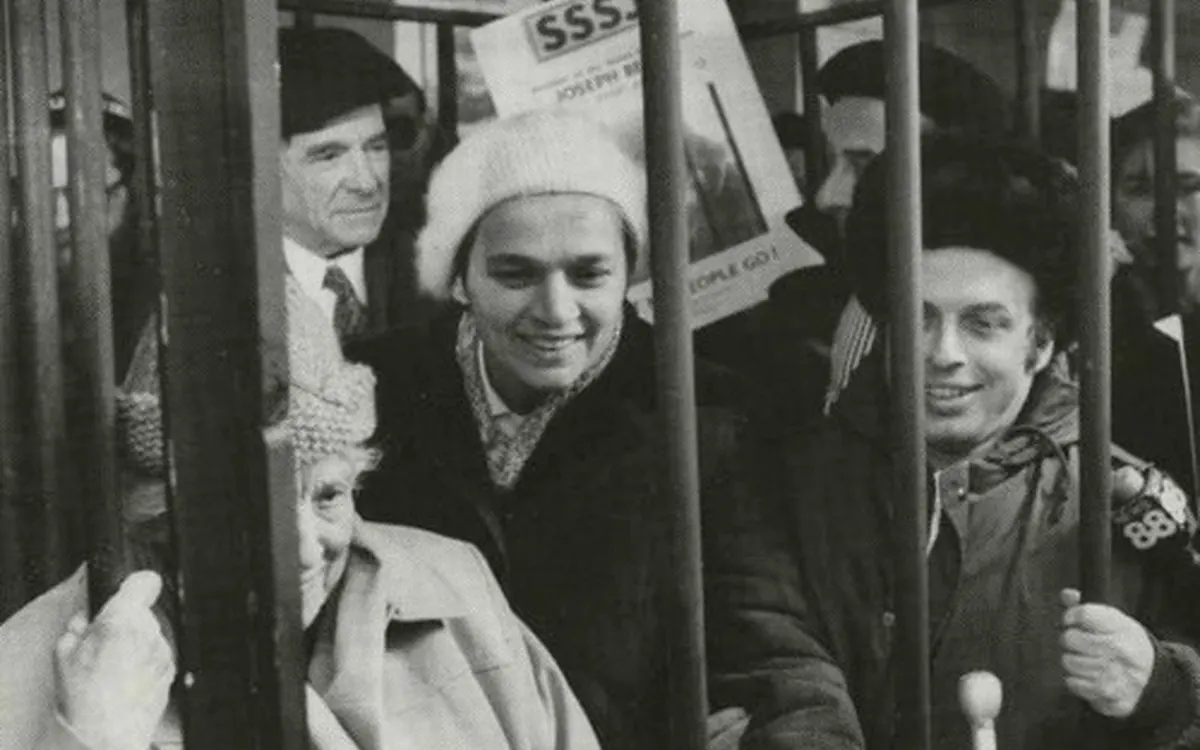
It is a truism that struggle brings out unexpected powers from within us, and what's true in life is true in history as well. The struggle to liberate Soviet Jewry will be a formative element of our story for decades to come, so here is the first chapter. Learn about Jacob Birnbaum and the Student Struggle for Soviet Jewry, Rabbi Meir Kahane and the Jewish Defense League, Natan Sharansky and more.
About this episode
Change does not roll in on the wheels of inevitability but comes through continuous struggle, said Reverend King. On May 1, 1964, a thousand students gathered across from the Soviet mission to the United Nations, not to mark workers' day but to expose a workers' paradise that systematically oppressed its own, especially the Jews. The immediate trigger was a ban on baking matzah, yet the plight ran deep. A quarter of world Jewry, some three million, lived behind the Iron Curtain, singled out for an experiment in collective memory erasure. Other faiths trained clergy and other peoples kept their languages, while Jewish identity was denied nearly every expression. By 1963 only ninety-six synagogues survived, economic trials sent some to execution, and KGB spies filled the shuls, where worshippers dared only to brush past a tourist and whisper, why are American Jews silent.
The answer came from an Orthodox Jew from England in a Panama hat. Jacob Birnbaum was born in Hamburg in 1926, grandson of Nathan Birnbaum, who had served as secretary general of the First Zionist Congress and coined the word Zionism. His father Solomon worked in wartime censorship, opening desperate letters from kinsmen who had not left Europe in time, and that helplessness seared itself into his son's soul. From his grandfather's ability to cross Jewry's bitter ideological divides, Jacob took the ideal of a Klal Yisrael Jew, a Jew for the whole people wherever they were. He was an activist young, rehabilitating teenage survivors in England in the fifties and traveling to France in 1962 to meet Jews who had fled Algeria, where he first dreamed of turning students into a movement that would serve immigrants and save them from drifting away.
American Jewry had begun to stir for its Soviet brethren, yet the first efforts were sporadic and held back by a tradition of quiet diplomacy that had kept Jews muted even during the Holocaust. When the establishment formed a long-named conference in 1964, Birnbaum called it toothless and fumbling. We do not need a conference, he said, we need a struggle. Three weeks later he convened the first meeting of the Student Struggle for Soviet Jewry, two hundred strong, drawn from Yeshiva University, the Jewish Theological Seminary, Columbia, and Queens College. From its birth two themes defined it, the Holocaust as a warning against moral weakness and the civil rights movement as a model of action. For seven years the SSSJ was the only full-time organization fighting for Soviet Jewry, and Birnbaum believed it would rescue American Jewish youth from assimilation even as it fought for Jews abroad.
The young people drawn to Birnbaum read like a roll of future leaders, among them Yitz Greenberg, Shlomo Carlebach, who composed Am Yisrael Chai at his prompting, Arthur Green, Shlomo Riskin, Avi Weiss, and Meir Kahane. Kahane was born in Brooklyn in 1932 to a revisionist father who was a friend of Jabotinsky, and he grew up in Betar absorbing Hadar, a militant Jewish pride. As the streets of Brooklyn and the Bronx grew unsafe and Jewish white flight left the elderly behind, Kahane organized young men to fight back, and in the spring of 1968, months after King's assassination, he founded the Jewish Defense League to do the job the Anti-Defamation League would not. The climate was ripe, for the Six-Day War had turned Jews from question marks into exclamation marks, and the JDL set a raised black-power fist on the Star of David.
Kahane preached that respectability had buried the six million, demanding Jews sit in the streets and chain themselves rather than stay nice. He and Birnbaum shared almost nothing beyond the cause. Birnbaum dreamed of a messianic coalition of goodwill, while Kahane held that Jews have no friends, only allies of convenience, and pursued a separatist redemption with lead pipes and vigils. The struggle went fully public when Boris Kochobievsky's letter, smuggled out and printed in the West, made him in effect the first prisoner of Zion, followed by the Georgian eighteen, whose vow Golda Meir read from the Knesset podium in 1969. The awakening had begun with forbidden Holocaust pilgrimages and deepened with Israel's victory, recalling Golda's 1948 welcome by fifty thousand Jews in Moscow. It crested in the Leningrad hijacking plot of June 1970, whose death sentences, after a show trial, blew up on the world stage and were commuted, and Rav Mike ends with Yosef Mendelevich calling the freedom of Soviet Jewry a holy duty.
Key ideas
- The May Day 1964 protest at the Soviet mission launched a movement that would help bring the USSR to its knees.
- The Soviet Union waged an experiment in memory erasure, denying three million Jews nearly every expression of identity.
- Jacob Birnbaum, grandson of the man who coined Zionism, demanded a struggle rather than a toothless conference.
- The Student Struggle joined the Holocaust as warning to the civil rights movement as a model of action.
- Meir Kahane founded the Jewish Defense League in 1968, setting a black-power fist on the Star of David.
- The Leningrad hijacking plot of 1970 turned Soviet Jewry into headlines the world could no longer ignore.
Chapters
- 0:00 King; change through struggle
- 1:09 May Day 1964 at the Soviet mission
- 3:21 The war on Jewish identity in the USSR
- 4:29 Jacob Birnbaum; an inheritance of pain
- 8:52 The student struggle is born
- 11:07 Freelancers; saving American Jewry too
- 15:36 Meir Kahane; Betar and Jewish pride
- 18:56 The streets of Brooklyn; fighting back
- 20:11 The Jewish Defense League founded
- 26:46 Respectability before it buries us
- 28:55 Two visions; Birnbaum and Kahane
- 31:23 Kochobievsky; the struggle goes public
- 34:20 The Georgian 18; Israel's shift
- 36:31 Golda in Moscow, 1948
- 38:44 The Leningrad hijacking plot
- 45:10 Mendelevich; a holy duty
Who, where and when
People
Martin Luther King, Jacob Birnbaum, Nathan Birnbaum, Solomon Birnbaum, Meir Kahane, Zev Jabotinsky, Shlomo Carlebach, Yitz Greenberg, Golda Meir, Boris Kochobievsky, Yosef Mendelevich
Places
Moscow, Leningrad, Hamburg, Brooklyn, The Rumbuli Forest
Texts
The Jewish Press, Let My People Go, The Georgian eighteen letter, Mendelevich's testimony
When
1948 CE: Golda Meir greeted in Moscow, May 1964 CE: the first SSSJ rally, 1968 CE: the Jewish Defense League founded, 1969 CE: Golda reads the Georgian eighteen, June 1970 CE: the Leningrad hijacking plot
Read the transcript
Change, says the Reverend Dr. Martin Luther King, does not roll in on the wheels of inevitability, but comes through continuous struggle. And so we must straighten our backs and work for our freedom. A man can't ride you unless your back is bent. Well, I'm certainly not afraid of continuous struggle, and I'm looking to work for our freedom. Because I'm Rav Mike Foyer, and this is The Jewish Story. Season 4, Episode 4, The Early Struggle for Soviet Jury. On May 1st, 1964, a thousand students gathered across from the Soviet mission to the United Nations in downtown Manhattan. Now this wasn't your typical May Day celebration. It certainly wasn't a return to the old school pagan festival of the spring. On the pavement across from the Soviet mission would have been an odd place for that, even in 1964.
and it wasn't even a marking of the more logical International Workers' Day. The day had been chosen by these students in an attempt to cast light on the hypocrisy of the Soviet Union, a nation that declared itself as the workers' paradise and yet systematically oppressed millions of its own citizens, in particular the Jews. The latest outrage which had triggered the immediate demonstration was a ban on baking matzah from that spring. But truth be told, the situation of the Jews of the USSR had been dire for some time. Now, when we speak about the Soviet Union, at this point, we're talking about what is likely the most powerful empire on the planet. And it had declared war against the Jewish identity.
A quarter of the world's Jewish population lived behind the Iron Curtain, estimated at around 3 million. And among the Communist Party's many enemies, they'd been singled out for special treatment. It was basically an experiment in prolonged collective memory erasure. Other religions were permitted to train their own clergy. Other ethnic groups were granted national feeders and such in their own language. But the Jews were denied almost every expression of the collective identity. By 1963, most of the synagogues which had even survived Stalin's reign of terror had been shut down. Only 96 remained. Communist poverty propaganda regularly accused the Jews of undermining the economy, and some were even executed after public so-called economic trials.
KGB spies filled the shuls, and most worshippers were too afraid to even speak with the few outside tourists from the West. Those who did would only allow themselves to brush up against the visitor and whisper, they don't let us live, or why are American Jews silent? Well, these Thalison students were representatives of the newly born student struggle for Soviet Jewry, and they had decided that American Jews would be silent no longer. Now granted, for 1964, it was a pretty tame demonstration. No one blocked traffic or scuffle with the cops. In fact, the protesters, mostly students from Yashiva University and other local colleges, marched in a circle so orderly that one reporter actually commented on how refreshingly responsible these young people were.
Not exactly high praise a month before the Freedom Summer began, but that reporter couldn't know, nor frankly could anyone involved, that this was the beginning of a movement which would shake the world and ultimately bring the Soviet Union to its knees. And it all began with an Orthodox Jew from England whose little goatee and Panama hat set him off from the student crowd on that May day. Yaakov Birnbaum, or Jacob, as he was known in America, was born in Hamburg, Germany in 1926. He was actually the grandson of Nathan Birnbaum, who'd served as the Secretary General of the First Zionist Congress back in Basel in 1897, and whose claim to fame is really the fact that he coined the term Zionism. The elder Birnbaum had lost his faith in secular nationalism, eventually switched hats, quite literally, to become the Secretary General of the ultra-Orthodox and anti-Zionist, Agudat Yisrael.
And Nathan's son, meaning Jacob's father, Solomon Asher Birnbaum, left Germany for London in 1933. During the war, the National Center recruited Solomon for his Yiddish skills, and he spent years opening the mail from his kinsmen, who had not left in time. Later, Jacob Birnbaum recalled about his father that he read the desperate letters from Europe, and so knew what was happening to the Jews there. He tried to do what he could, but his helplessness seared itself into my soul. 1933, Hitler came to power. And both my father and I had right away negative experience. He was jostled in the street, and I was, little German boys came around and stuffed my mouth with mud. They were just doing what was going around.
I heard Hitler's voice on the radio all the time. It was scary. And the crowds, hundreds of thousands of Germans, answering, screaming, howling, the dirty Jews, the Jews, the Jews, you know. The Deutschland! My father worked in the National Censorship in the Uncommon Languages Department. So he read all the terrible letters letters coming out of Europe. So we knew what was going on and there was very little which we could do. So it was not very surprising that immediately after the war I rushed to work with people who had survived the camps. I wanted to do something. So I came to America with major personal background from my grandfather and father, and with my own encounter and experience with the victims.
To teach their children their heritage, to teach their children Hebrew, Yiddish, Jewish history, literature, all the things which we take for granted in a free society, these things are absolutely and completely forbidden in the Soviet Union. This inheritance of pain from his father would fire Jacob's passion for Soviet Jewry, as would his grandfather's ability to cross European Jewry's bitter ideological divide inspire him to see himself as a Chal Yisrael Jew, as he called it, a Jew for the entire Jewish people, whoever and wherever they were. Jacob was an activist from a young age. In the 50s, he was helping to rehabilitate groups of teenage Holocaust survivors brought over to England. In 1962, on his own initiative, he went to France to meet Jews who had fled the war in Algeria.
And beyond his empathy for their suffering, Jacob wrote to his father of a shocking wastage, as he called it, from the Jewish point of view, taking place at the student level. What was happening? He saw native-born French Jews drifting away into secular society at the very same time their brothers and sisters were arriving, desperate for any aid. and his proposal was to actually solve the two problems together to create a movement of Jewish students to volunteer amongst the immigrants and help reconnect them to the Jewish community. But it was really only with his arrival in New York in 1964 that Jacob was able to put that dream to the test. Already in the early 60s, American Jewry had begun to awaken to the plight of their brothers and sisters in the USSR but the first efforts that they made were sporadic at best.
They lacked any coordinated vision And more than anything else, they were held back by the American Jewish tradition of quiet diplomacy. We saw this back in Season 2, if you recall. The hesitation of the Jews in America to make waves kept them quiet even in the face of the Holocaust. In fact, there were certain major organizations that spent more time and energy trying to suppress the loud protests of the Peter Bergson group than they did lobbying Roosevelt to save the Jews. and go back to Season 2, Episode 35 for that story. And even when the Israeli government pushed the leaders of 24 American Jewish organizations to form the American Jewish Conference on Soviet Jewry in April of 64, why do these things have to have such long names?
That habitual lack of political self-confidence and ambivalence around any public campaign basically guaranteed that the organization would exist mostly on paper. Jacob Birnbaum saw them for what it was, as he called the conference a toothless, fumbling group, which would do little to affect real change. We don't need a conference, he said. We need a struggle. And so three weeks after the founding of the conference, Birnbaum convened the first meeting of the student struggle for Soviet Jewry. 200 people attended, most of them students, as I mentioned, from Yeshiva University, JTS, the Jewish Theological Seminary, Columbia University, and Queens College. The pamphlet, which announced the birth of the SSSJ, pulled no punches, drawing from both the Jewish and the American experience.
Just as we, as human beings and as Jews, are conscious of the wrong suffered by the Negro and we fight for his betterment, so must we come to feel in ourselves the silent, strangulated pain of so many of our Russian brethren. We, who condemned silence and inaction during the Nazi Holocaust, dare we keep silent now. No major effort in human life is generated by large numbers of people. It always starts small, one person. And I have been reprimanded, why didn't you make a major adult movement? I tried, but it was not possible. Students were the only people who would take any notice. It was throwing down the gauntlet. And if you listen closely, you'll see that from its very inception, there were two themes which defined the movement.
The Holocaust as warning of moral weakness, and the Civil Rights Movement as an activist example. From 1964 until 1971, the SSSJ was the only full-time organization in the U.S. fighting for the freedom of Soviet Jewry. And though Yaakov Birnbaum lacked the charisma of certain leaders, it was nonetheless driven by his vision of mobilizing American Jewry and stirring the conscience of the world. Just like the leaders of the early civil rights movement that he admired, Birnbaum believed that only hope could protect his struggle from falling into bitterness. And so he always sought to inspire the students who joined him with righteous indignation rather than rage. and he repeated over and over that soon, very soon, the world would respond to our pain, that we must appeal to justice in order to win over public opinion.
Now, this was more than a political struggle to ease the plight of Soviet Jewry, as establishment organizations like to call it. Yakov Birnbaum wasn't looking to ease anybody's plight. He was looking to save them. The conference on Soviet Jewry would speak about a limited so-called reunification of families, but the SSJ demanded free immigration. Birnbaum understood that there is a redemptive force in Jewish history, and that it begins with what we call Arevut, the sense of responsibility which Jews have and feel for one another. And from that very first May Day rally, it was his religious spirit that infused the struggle as the posters declared what would eventually become the logo as it were of the Soviet struggle let my people go The student struggle began as a shoestring outfit of a few dozen activists without even a budget, and it more or less stayed that way.
Its inner circle never numbered more than several dozen activists, most of whom were from the modern orthodox world. But then there were what Birnbaum called the freelancers. For the first time, American Jewry became a partner in the life of world Jewry. Students without a strong Jewish background, who were nonetheless drawn to the movement because of a reawakened Jewish awareness and a general commitment to human rights. Many actually began their path to activism in the civil rights movement. And as ethnic pride worked its way into the fabric of American Jewish life, they began to seek out their own particular struggle. It was this flow of students into the movement which proved to Birnbaum one of his basic contentions, that the SSJ would save not only Soviet Jewry, but American Jewry, that it would kindle a passion for a specifically Jewish cause amongst American youth, and thus save them from the doldrums of assimilation which he so feared.
And I can tell you, as someone who grew up in the decades after he launched the struggle, where one of the most powerful memories I have is being shipped by buses as more than 100,000 Jews gathered on the mall to protest in the final stages of the struggle to free Soviet Jewry. It worked. How many times I heard that it is impossible to make American Jews to come in hundreds of thousands to Washington in winter. And here you came and winter retreated. How many times from the very beginning of our struggle we heard that it is impossible to open the gates of the Soviet Union. And we didn't listen to these voices. And we struggled, and you demonstrated, and you struggled, and that's why quarter of a million Jews were released, and that's why I and other prisoners of Zion today are free, today are here.
Mr. Gorbachev today destroyed one more Jewish demonstration in Moscow. But Soviet followers have to know that no missiles and tanks, no camps and prisons can extinguish the light of candle of freedom. Birnbaum, by the way, also predicted that the movement would be a training ground. It was the place where the new leaders, the future of American Jewry would arise. And just listen to the names of those who were drawn to him in the early days of the struggle. Yitz Greenberg, who we heard from a couple of weeks ago, theologian of post-Holocaust Judaism and leader, some would say founder, of liberal orthodoxy, singer, teacher, Rabbi Shlomo Carlebach, who actually composed the anthem Am Yisrael Chai at Birnbaum's prompting, Rabbi Arthur Green, leading light of the liberal Jewish renewal movement, Rabbi Shlomo Riskin, a role model for modern orthodoxy and Zionist revival, Rabbi Abiy Weiss, the prototypical activist rabbi, And last but not least, Rob Mayer Kahana, whose eventual split with the SSSJ would lead him to found his own organization, the Jewish Defense League.
Mayer Kahana was born in 1932, a native of Brooklyn, New York. His father, Charles Kahana, was an Orthodox rabbi as well as a passionate revisionist Zionist, a rare combination in its day. He also happened to be a personal friend of the movement's founder, Zev Jabotinsky. And thus it should come as no surprise that young Mer grew up in Beit Ar, the revisionist movement's youth group. Two of Beit Ar's primary principles would eventually become central to his own teaching, the idea of Hadar, glory or beauty, which I would actually translate as Jewish pride, in an unapologetically militant stance in defense of Am Yisrael. The first few decades of Mergahana's life traced a familiar path through the fabric of American Jewish existence, albeit one of a consistently Orthodox type.
He received a degree in international law from New York University and rabbinic ordination from the Mir Yeshiva in Brooklyn. In the early 60s, he joined the staff of the newly founded Jewish Press, soon becoming its editor, and served as a pulpit rabbi and Torah teacher through the mid-60s. Adventure first entered Mayor Kahane's life in the mid-60s when he partnered with the government to rally Jewish support for the Vietnam War. It's a time of life around which many stories, and even I would say rumors, swirl. False identities, love affairs, undercover infiltrations. But for us, it's in the late 60s that Mayor Kahane enters our story. I'm sure you recall that last episode we spoke about the Ocean Hill-Brownsville teachers' strike and raised the question of what role anti-Semitism played in how it unfolded.
And we saw that while there were doubts on the level of policy and power brokers, there was a little question that Jew hatred was alive and well on the streets of New York. If the analysis which James Baldwin offered in his New York Times article, Negroes are anti-Semitic because they're anti-white, wasn't proof enough, just remember the poem read on Julius Lester's late-night radio program. Hey Jew boy, with that yarmulke on your head, You pale-faced Jew boy, I wish you were dead. You came to America, landed the free, and took over the school system to perpetuate white supremacy. As every student of hatred knows, words paved the way for physical violence. And in the late 60s, the streets of Brooklyn and the Bronx were increasingly unsafe for Jews.
Back in Season 3, we spoke about the Jewish version of white flight, how in their rush to assimilate, so many Jews fled the urban ghettos of their forefathers with all of its cultural baggage, and found a new home in the suburban promised land. You can go back to Season 3, Episode 9 for that story. But many, of course, were left behind. Mostly the elderly grandparents, or those too poor to make the leap to the land of two-car garage and white picket fences. Often, they were more traditional, and they were always more identifiably Jewish. all of which made them easy targets for the rising racial violence on the streets fueled by the general turmoil of the late 60s as well as the particular black Jewish dynamic that Baldwin articulated.
Today, Jeff Weisenfeld is a successful financial advisor a job he took after serving as executive assistant to New York Governor George Pataki and New York Senator Al Dalmato but growing up in the late 60s He lived in a part of the Bronx that the Jews couldn't leave fast enough. He recalled in a recent interview, My father passed away when I was young. We couldn't afford to move. Elderly Jews in the East Bronx were targets of getting beat up, same as today. You know what Chaya means? It's an animal. That's in Hebrew. I was part of the Chaya squad. It was an adjunct of the JDL, the Jewish Defense League. If we saw young men messing with an elderly Jew, we'd, pardon the language, beat the sh** out of them.
that happened when there was no law and order in these neighborhoods. Jews were targets. Now the truth is, Jews have always been targets. That didn't begin in the late 60s in the Bronx. What did seem to start there, at least for American Jewry, was a newfound willingness to fight back. Mayer, now Rabbi Kahana, was a teacher, religious leader, and a newspaper man to these very Jews. And in the spring of 1968, only two months after the assassination of the Reverend Dr. Martin Luther King and the eruption of urban violence that came in its wake, he published an ad in the Jewish press which read, We are talking of Jewish survival. Are you willing to stand up for democracy and Jewish survival? Join and support the Jewish Defense Corps.
Now, CORE was sued and changed for League, and the Jewish Defense League, or JDL, was born with the declared purpose, quote, to combat anti-Semitism in the public and private sectors of life in the United States of America. Now, if the JDL sounds a bit like a trademark infringement on the ADL, the Anti-Defamation League, that grandfather of Jewish civil rights organizations, founded in 1913 to, quote, stop the defamation of the Jewish people, then you're listening well. Rav Khan himself stated that the JDL was formed, quote, to do the job that the Anti-Defamation League should do, but doesn't. Which, at this stage of our story, meant defending the Jew on the street by any means necessary. Now, I choose that phrase deliberately, and it might sound familiar.
It's made its way into the American consciousness via Malcolm X, that militant preacher for the Nation of Islam, who became a foundational voice of the Black Power Movement. He actually introduced it into the Civil Rights Movement in 1964 through a speech he gave at the founding of the Organization of Afro-American Unity. But it originated with Frantz Fanon, French West Indian psychiatrist and political philosopher. He coined the phrase in his own 1960 address entitled, Why We Use Violence. Now, if you're not familiar, Fanon is a keystone thinker of the post-colonial era. and we're going to have to delve more deeply into his thought when we get back to the Middle East and witness the rise of the guerrilla culture.
And, just so you know, his thought is a major underpinning for the intellectual and street revolution taking place in America right now. But that's really a story for another time. Right now, suffice it to say that the climate of 1968 was ripe for the rise of a militant group like the JDL amongst American Jews, a group of people who were willing to use violence in order to protect themselves. Part of that was simply the pressing need for self-defense. I mean, think back to the impact which the pogroms of the late 19th and early 20th century had on the formation of the Zionist movement and what Max Nordau called a muscular Judaism. Another factor was the gradual displacement of the classical liberal integrationist and even assimilationist views within the civil rights movement and the fabric of American society by more separatist attitude, the shift from the melting pot to the tossed salad.
As I've said many times, America in the late 60s witnessed a rising tide of ethnic pride. And remember, a rising tide lifts all ships, the Jews included. But for these Jews in particular, there was also the Six-Day War. As Rabbi Haskell Lukstein, lifetime resident of New York City, put it, before Israel's victory in 1967, Jews walked around like question marks. After, they walked around like exclamation marks. One early member of the JDL recalled the boys in his religious school hanging posters up right after the war. They showed a chassid stepping into a phone booth and stepping out as Superman. And he also said not long after is when Rav Gahanna appeared preaching a mix of pride and militancy which was downright intoxicating to these young Jewish exclamation marks His take on the Six-Day War was simple and direct.
He called it a Jewish fist in the face of an astonished Gentile world. This is a Kiddush Hashem, a sanctification of God's name. And hence the JDL symbol. It takes the raised fist, which in 68 was the ultimate symbol of black power, and superimposes it on the Jewish star. Now, by all accounts, Rav Kahana was a master of harnessing the multiple layers of anger and resentment which he found simmering amongst these newly empowered young men. Aside from anger at the physical beatings, there was resentment of Brooklyn for Manhattan, of lower middle class Jews for their more genteel brothers who controlled organized Jewish life. Beyond mocking the nice Irvings of official Jewish life, as he called them, Rav Kahana showed from the beginning that he was also quite capable at raising uncomfortable questions which these nice Irvings would prefer to avoid.
Now at this stage, it meant the street-level violence against Jews, which many felt was ignored by official Jewry out of so-called higher policy reasons, meaning these organizations wanted to preserve the fraying fabric of the liberal coalition between Jews and blacks, which had stood at the base of the civil rights movement, but which by 1968 had already lost the fire of leadership as separatist elements began to replace those integrationist ones in the black community. He was just paralleling the same process amongst the Jews. Haskell Lazier, director of the New York City chapter of the American Jewish community, put it this way, Jewish agencies have lost touch with the rank and file of the Jewish community.
Jewish agencies have shown a willingness to accommodate and adjust to the needs of others, but the Jewish establishment has been dealing with issues at top levels, not in the neighborhoods or the streets. Leadership deals with the Wilkinses, the Youngs, the Rustins, all of whom were major leaders of the civil rights movement, while people in these neighborhoods, especially the transitional ones, are confronted daily with extremists. What's coming through to those attracted by the JDL is that we care about others more than we care about our own. Then there was simple cultural resentment. The Jews attracted to the JDL often absorbed traditional culture and home, but nonetheless they were looked down upon by the assimilated Jews whose identity they saw to be illiterate and empty.
Or those attracted were the children of those very illiterate seeking a way back to a rich cultural birthright. And last but certainly not least, there was Holocaust anger. In Manhattan, they might be holding memorials and rethinking their relationship to the war in the camps, but in Brooklyn, they were the children of the survivors, surrounded by the darkness of their suffering and seeking an outlet for their rage. As Khan declared in a 1970 rally, American Jews have a hang-up. It's called respectability. The year is 1943. Stephen Wise and the other American Jewish leaders have just approached Roosevelt to bomb the train tracks leading to Auschwitz. Roosevelt refuses. What would have happened? What would have happened if Stephen Wise and all his wise men had called for 100,000 Jews to fill the streets of Washington and sit down in cold anger and not move until Roosevelt agreed to bomb the train tracks?
What if rabbis had chained themselves to the White House gates singing that well-known Jewish song, We Shall Overcome? Two things would have happened. Two things. They would have all been arrested, and the train tracks would have been bombed. But they didn't get arrested. Jews don't do such things. It's not respectable. And so six million Jews died, and American Jews kept their respectability. I say it's time to bury respectability before respectability buries us. The reason why this was not done is not because our Jewish leaders don't love Jews. It doesn't cost money to love Jews. We have a hang-up. It's called respectability. God forbid that a Jew should not be respectable. Sit in the streets. Chain yourself.
Get arrested. That's not any way for nice Jewish boys to behave. Jewish youth want to be Jewish. And they want a cause. And they want a sacrifice. And they want pride. But it has to be given to them. When do they march for the oppressed Jews of the Soviet Union? We didn't march and we didn't protest in the proper manner 30 years ago, and we don't do the same now. Now that's a lot of fuel for the fire. But nonetheless, the JDL may have remained nothing more than a vigilante club. A bunch of scruffy Jews who put on brass knuckles to defend their co-religionists in the streets if it weren't for the struggle to free Soviet Jewry. Now to say that Yakov Birnbaum and Mayor Kahana Approached the mission of liberating Soviet Jewry From different perspectives Would be a gross understatement On one level The politicians that Birnbaum And the student struggle invited to its reality Were almost universally liberals Those who shared the rhetoric Of the civil rights movement And expressed his universalist vision Kahana on the other hand Wasn't afraid to draw far-right congressmen and Eastern European exiles to his rallies.
He may have secretly despised these anti-communist cold warriors as closet Nazis, but he wasn't ashamed to recruit them to his cause. It was part of a deeper difference between the vision that each represented. Birnbaum dreamed of a messianic coalition of goodwill, which would arouse human consciousness to come to the aid of Soviet Jewry and was really part of a bigger process of redemption. Rav Kahane wrote in many places that Jews have no friends, only allies of convenience, and that the Cold War was a power level to use against a regime imprisoning one-third of world Jewry, and ultimately his redemptive vision was a separatist one. Now the two differed on tactics as well. By and large, the SSSJ maintained that quiet posture which had caused the reporter remark upon their refreshingly responsible behavior at that first May Day demonstration.
Rav Kahana, on the other hand, brought to the struggle for Soviet Jewry the same attitude he took to the streets of Brooklyn. Already in 1966, he'd written an article for the Jewish press calling for the creation of a Soviet Jewry Liberation Front, someone who would confront the Soviets. And by the end of 69, the JBL was sponsoring 100-hour vigils at the Soviet mission, rioting, chaining themselves to a Soviet airliner at the Kennedy Airport. and suddenly a movement that prided itself on responsibility and restraint had its own equivalent of the SDS and the Black Panthers. At a certain point early on, Yaakov Wurmbaum confronted Rav Kahana, arguing, quote, that so long as they're not killing Jews, we can't act violently, which would only alienate the American Jewish community from the struggle.
Rav Kahana's shout-out reply was, how dare you be responsible when Jews are in danger? Now, the two never really saw each other as allies. And in fact, Birnbaum often saw Kahana as more part of the problem than the solution. I knew Mare, he said in an interview with Yossi Klein-Alevi, an early member of both the SSSJ and the JDL. He came to a few of our rallies in the beginning, made a speech or two, very passionate and all the rest, but no substance, you see. He's ruining years of our work with wild acts of self-enggrandizement. Mer is a violent soul. He dreams of chasms of blood. As long as I am capable of feeling, I will do all I can to leave for Israel. And if you find it possible to sentence me for that, then all the same.
If I live until my release, I will be prepared to go to the homeland of my ancestors, even if it means going on foot. These words were written by Boris Kochobievsky, a Kiev engineer, in a letter addressed to the Soviet officials who ruled every aspect of his life. Now, he wasn't the first to write in this vein. In fact, only two days after the Six-Day War, a 20-year-old Moscow student named Yasha Kazakov wrote to the Kremlin, renouncing his Soviet citizenship, and named himself a citizen of Israel in absentia. I demand, he said, to be freed from the humiliation of being considered a citizen of the USSR but Kazakov was quietly permitted to immigrate while Kochobievsky, whose letter was smuggled out of Russia and published in the Western press, was sentenced to three years in prison in a sense, he was the first prisoner of Zion and with his letter, the struggle to free Soviet Jewry went fully public Mainstream America could pursue its path of quiet diplomacy, so long as the fight was about relative abstractions like a ban on matzo or the closure of synagogues.
But now there was a living symbol of Soviet oppression which had seized the headlines and could not be ignored. Hundreds of letters followed these first two. And slowly, those who Elie Wiesel had labeled in his 1966 book, the Jews of Silence, began to gain a face and a voice. It was an avalanche of personal courage. I mean, I can't even imagine who in their right mind would willfully alert the KGB to these anti-social attitudes, as they were called. And it couldn't fail to evoke a response from the Jews of the free world. Or so they hoped. Now, even the Israeli government had to shift. For decades, Israel pursued the policy of backroom negotiations, and in fact encouraged American Jewish organizations to do the same.
Their only goal was to free as many Jews as possible from behind the Iron Curtain, and they were willing to pay the price the Soviets demanded of silence on the world stage. Though, truth be told, Levi Eshkol had already begun to reconsider this approach, even before the letter-writing campaign. When Moscow cut off its ties with Israel and seemingly ceased all immigration in the wake of the Six-Day War, the Prime Minister made public this clandestine program for the first time. But it wasn't until November of 1969 that the policy shift was really complete, when Prime Minister Golda Meir, who had served as Israel's first ambassador to the Soviet Union, stood on the podium of the Knesset and read the famous letter of what was called the Georgian 18, heads of 18 Georgian Jewish families who wrote, We will wait months and years.
We will wait all our lives if necessary, but we will never renounce our faith or our hopes. One might well ask, after the brutality of the Stalinist purges of the post-war period, the decade plus of culture erasure which followed, and the wildly anti-Semitic government campaign triggered by the June War, from where did such an upwelling of Jewish identity spring? Well, it seems it began, and did so much of Jewish identity at this point, with the Holocaust. Official Soviet policy was to downplay, if not outright deny, that there was ever a genocide aimed specifically at the Jews. That denial has a lot of causes, but it certainly wasn't out of compassion for the historical memory of the Nazis. Don forget 20 million Russians died in World War II It was more about national solidarity and the desire to erase Jewish identity But whatever the reason the official stance of the government forbade marking or commemorating the many sites of massacres and the victims in any way.
Despite this, in the decades after the war, places like the Rumbali Forest near Riga, where thousands of Jews were buried in unmarked mass graves, became the sites of defiant pilgrimages. And the more the authorities forbade such act, the more popular they became. It was a desperate attempt to preserve historic memory from totalitarian obliteration. Now, that awakening of Soviet Jewish identity may have begun with Holocaust memory, but the decisive influence was the state of Israel, even before As I said, Golda Meir, whose story we'll tell in proper fashion at the right time, don't worry, was Israel's first ambassador to the USSR. She was actually issued Israel's passport number one for the task, and it was the beginning of an illustrious career in government service, filled, I'm sure, with many memorable occasions.
But by her own count, she never forgot Rosh Hashanah of 1948, which fell out not long after her arrival in Moscow. She said it had been years since she'd gone to Chul, and certainly Golda wasn't going there to crown God king on this Rosh Hashanah. She was going to see the people. But in my eyes, what could be a greater expression of Malchut Shemaim, of divine kingship, than 50,000 Jews gathering at the Moscow Choral Synagogue, defying fear of the KGB and Stalin's wrath to chant, Golda, Golda, Golda, and crane their necks with hope of catching just a glimpse of this representative of a sovereign Jewish state. As she waded through the crowd, all Golda could do was stammer out in Yiddish, thank you, thank you, thank you for remaining Jewish.
And if that was the case in the wake of the War of Independence, just imagine the impact of June 1967. One Russian Jew, Anatoly Dekatov, described the experience in an article which was smuggled out and published in the Jerusalem Post in 1970. He said, the feeling of deep anxiety for the fate of Israel, with which Soviet Jewry followed the events, was succeeded by a boundless joy and an overpowering pride in our people. Many, and especially the young, realized their Jewish identity for the first time. So, Soviet Jews shared that experience of world Jewry, itself a significant aspect of their awakening. But for people who had suffered the taunts of Jewish cowardice for more than half a century, Israel's victory over the Arabs, and by proxy Moscow, was nothing short of a revolution.
So much so that young Jews began to greet each other by placing one hand over an eye, in a subtle reference to Moshe Dayan, Israel Defense Minister and War Hero's eye patch. And so, it should come as no surprise that defiant letter writing would soon fail to suffice as an outlet for an increasingly rebellious spirit. At dawn on June 15, 1970, a small group of 12 men and women arrived at the Smolny Airport near Leningrad. Now, in and of itself, an early departure is nothing strange. But considering the passengers and their destination, this was a trip planned to shake the world. Not to mention they had no tickets. The group was mostly Jews from the Riga Underground Zionist organization. The other three, non-Jewish supporters, and their plan was to commandeer a plane in order to escape to Sweden.
Now, I say commandeer rather than hijack, because they had no weapons out of fear lest they hurt one of the pilots. One of the conspirators, Mark Dimchis, was actually himself a former pilot, but aside from his skills, the group had no clear plan of how they were going to pull off such an audacious move. In fact, they had been warned against it, both by their contacts outside of the USSR and many of their fellow underground Zionists who had refused to participate out of concern that the KGB already knew of the plot, which, of course, they did. As the Twelve lined up on the tarmac and the plane taxied out toward them, the KGB moved in. The would-be hijackers would have to wait years to reach freedom, but their story would leave the USSR in a matter of months.
The trial began in Leningrad in December of 1970, and despite the defendants' claim that they posed no harm and even that their reasons for attempting to leave were personal rather than political, all were charged with treason. And that meant a conviction carried a sentence of death. It was basically a show trial. The prosecution made much of the, quote, machinations of international Zionism, claiming that the hijackers were proof that the very fabric of Soviet society was under assault. The defense themselves were not afraid to seize the propaganda moment, denouncing the government's anti-Jewish policy and demanding their right to either live as Jews or to exercise the so-called elementary Jewish right of living in Israel.
And the results were predictable. In less than two weeks, two of the twelve were sentenced to death and the rest to hard labor for periods ranging from four to fifteen years. Now, while the harsh sentence may have sent the internal message that Moscow desired, it blew up in their faces on the international stage. When the word of the arrests were first announced, and it's important to know that the hijackers weren't the only ones arrested, they basically rounded up every Zionist that the KGB could land their hands on, American Jews reacted basically with confusion. Most simply refused to believe that their brothers in the USSR would resort to such desperate measures. I mean, were things really that bad?
do Jews actually hijack? I mean, you have to remember, if you're not aware, that this is the period at which the Palestinians were making hijacking famous. Therefore, the Jews of America largely assumed that the whole affair was more likely a KGB frame-up, except for Yaakov Birnbaum. Immediately after the arrest, he organized, together with the SSSJ, an all-night vigil at the Isaiah Plaza outside the UN building. But less than 50 people came, and no press even paid attention. Reimbaugh knew that only tens of thousands taken to the streets could save these Jews. He also knew that only the Jewish establishment had the resources to make that happen. So he and a small group of activists forced their way into a meeting with leaders of the ADL, demanding that they buy a full-page ad in the New York Times about the Leningrad arrests.
They basically got their faces laughing. and the ADL's foreign policy wonk said that the Soviets could easily bankrupt them just by arresting 12 Jews a year. I don't understand, he said. This concern for 12 Jews when there are 3 million in the Soviet Union. What about when the number was 6 million? asked one of the activists. Yes, we lost the battle for the 6 million. You didn't lose the battle, came the reply. You never fought it. Now, the JDL, on the other hand, managed to get a bit more attention out of the media. When word of the rest reached Marikana, he took 20 followers with him to the Soviet trade offense in Manhattan and went in waving lead pipes and driving the staff out. And as I mentioned, in the coming years, JDL members would use increasingly violent tactics that would disrupt appearances by Soviet artists, release mice during a violin concert, roll marbles onto an ice skating performance, dance the horror on stage during a ballet.
Those were tactics they actually learned from the yippies, those crazy violent pranksters of the new left, and the TV cameras loved it. Birnbaum and the mainstream Jewish organizations across the board condemned these acts as so-called senseless violence and sensationalism. But Rob Kahane's response was quite predictable. Never again will Jews watch silently while other Jews die. Never again, he declared at one rally. Tonight, we have a different Jew, a fighting Jew. But this fighting Jew drives the respectables, the nice Irvings, up their wood panel offices. Violence is un-Jewish. The Bible says so. In the Bible, we find the story of a man named Moses who saw an Egyptian beating a Jew. And what did Moses do?
set up a committee to investigate the root causes of Egyptian anti-Semitism? The Bible says, and he smote the Egyptian. Listen, Brezhnev, and listen well. If Dimchip and Kuzetnov, the two condemned to death, die, Russian diplomats will die in New York. Two Russians for every Jew, he declared. And truth is, the J.D.L.'s approach actually did result in loss of life in January of 1972, when a secretary of the Soviet-American Cultural Exchange was killed in a firebomb attack. Now we have a much longer story ahead, both in terms of the struggle to liberate Soviet Jewry and its impact on the fabric of American Jewish life, and in those uncomfortable questions which Rob Kahana was so good at raising, particularly with his move to Israel in 1971.
For this stage, Just know that both the SSJ, the ADL, and the JDL played their part in rallying American and ultimately world Jewry to the cause of these Leningrad 12. Even the State Department put quiet pressure on the Soviets. The death sentences were commuted, and most eventually made it out, and even to Israel. The last to be freed would be Yosef Mendeleevich, who would actually share a cell for a number of years next to Natan Sharansky during his long suffering in the Gulag. So I think it's appropriate to end this episode with a quote from a testimony that Mendeleevich wrote on the eve of his attempted escape. Jews of the world, it is your holy duty to struggle for the freedom of your brothers in the Soviet Union.
You should understand that the destiny of the Russian Jews depends on you, whether they will continue to survive or perish. We are strongly envious of your freedom and all the privileges of a free life which have become commonplace for you. we call on you to use it to the full so that you can protect our rights as well and until we are free you have to rebuild our Jewish homeland and replace us in the country where we all strongly wish to be I want to thank a few folks before I sign up I want to thank all the folks who give their hard-earned money to help make this show happy to keep it free and widely available I want to invite you to join them now is the time to put your money where your ears are and help make Season 4 sustainable.
You can go to my website, jewishstory.co. In the upper right-hand corner, you'll see a button that says Be a Patron. You can click on that for a little bit of per-podcast support. If you'd like to contact me about sponsoring a show, you can write me at robmikefoyer at gmail.com or you can personal message me at robmikefoyer on Facebook. I want to thank The Land of Israel Network. That's thelandofisrael.com for creating a platform that allows me to reach so many fantastic people. I want to thank the Pardes Institute, P-A-R-E-S.org.il, for building an educational institution that gives me the privilege of teaching so many wonderful Jews. And I want to thank you for listening. I'm Rav Mike Foyer, and this is The Jewish Story.
More from Season 4
TJS S4E3 American Jewry after 1967 part III, the Ocean Hill-Brownsville strike
There are stories which are turning points in a larger tale, and there are those which prove to be tempests in a tea cup. The story of the...
Play Episode
TJS S4 Interlude - Ten Days of Teshuva
Here is a thought to help focus your practice during these powerful Ten Days of Repentance in between Rosh Hashanah and Yom Kippur. May we all be blessed...
Play Episode
TJS S4 Interlude: Sukkot
If you feel a bit like the world might be falling apart, then look to the sukkah for how to hold it together. Here are a few thoughts...
Play Episode